⬅️ Hub: Literature
DESCRIPTION
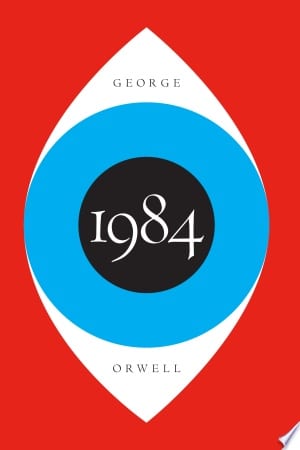
75th ANNIVERSARY EDITION “Orwell saw, to his credit, that the act of falsifying reality is only secondarily a way of changing perceptions. It is, above all, a way of asserting power.”—The New Yorker In 1984, London is a grim city in the totalitarian state of Oceania where Big Brother is always watching you and the Thought Police can practically read your mind. Winston Smith is a man in grave danger for the simple reason that his memory still functions. Drawn into a forbidden love affair, Winston finds the courage to join a secret revolutionary organization called The Brotherhood, dedicated to the destruction of the Party. Together with his beloved Julia, he hazards his life in a deadly match against the powers that be. Lionel Trilling said of Orwell’s masterpiece, “1984 is a profound, terrifying, and wholly fascinating book. It is a fantasy of the political future, and like any such fantasy, serves its author as a magnifying device for an examination of the present.” Though the year 1984 now exists in the past, Orwell’s novel remains an urgent call for the individual willing to speak truth to power.
My Summary
- Emmanuel Goldstein—a Jew used as the symbol of who to hate. To control the population as the external enemy that wants to destroy civilization. Fundamentally a distraction from the state’s own
- Controlling sex is controlling the people: The sexual drive is counter to state control.
- The idea that deep within the soul of humans is a sense of individual rights contrary to state control.
- Controlling language in a way to lessen the ways you can even create thoughts.
- The turning of family and children, the destruction of the family. State more important than family.
- No sense of personal control, even over your own emotions and impulses. Weakening of the self.
- Removal of history
- Having people believe deliberate lies and repeat those lies from their own mouths—killing their own souls one lie at a time. Erosion of self and dignity.
- Hopelessness
- Power is truth
Main Ideas, Takeaways & Similarities
Questions
I. What is the problem?
A. How is this problem formulated?
B. Why is this problem important?
C. What is the history of this problem?
D. Which prominent personalities have been interested in this problem?
II. What solutions to the problem are there?
A. What are the conclusions reached?
B. By what argument(s) is the conclusion reached?
C. What facts or assumptions serve as premises?
D. When a prominent personality offers a solution, does he also argue for or against other prominent personalities? Does he raise objections to alternative solutions? Does he consider objections to his own solutions?
III. Evaluation
A. What are the advantages and disadvantages of the alternative formulations to the problem?
B. Has the importance or history of the problem ever been misrepresented?
C. Are the solutions logically related to the premises?
D. Are the facts true? Are the assumptions acceptable? Are the objections answerable?
AI Summary
Part One — The World of Big Brother and the First Spark of Rebellion
Orwell opens by immersing us in a drab, bomb-scarred London—“Airstrip One,” a province of the super-state Oceania—where the omnipresent face of Big Brother and the ever-listening telescreen enforce total surveillance and ideological conformity. We meet Winston Smith, a frail, 39-year-old clerk at the Ministry of Truth (Minitrue), whose job is to doctor past newspaper articles so that the Party is never wrong. Life is governed by slogans such as “WAR IS PEACE / FREEDOM IS SLAVERY / IGNORANCE IS STRENGTH.” (george-orwell.org)
Haunted by blurred childhood memories and flashes of the vanished past, Winston commits a first, private act of revolt: he purchases an old-fashioned diary and scrawls “DOWN WITH BIG BROTHER” across its pages. The entry crystallizes his dim but growing conviction that truth and individual memory are being annihilated by the Party’s weaponized language, Newspeak, and by the terror of the Thought Police. (george-orwell.org)
Over eight chapters we watch Winston grope toward rebellion: enduring the ritualized Two-Minutes Hate, scrutinizing Party history for contradictions, wandering the prole districts in search of authentic human feeling, and buying a coral-encased glass paperweight and an old St Clement’s Church print from the antiques dealer Mr Charrington. Two silent figures begin to fascinate him—O’Brien, an Inner-Party intellectual who seems to share his doubts, and a brisk dark-haired girl (later Julia) whose Party zeal he both fears and desires. By Part One’s close, Winston feels sure that sooner or later he will be caught, yet a “thought-crime” has already taken root: “If there is hope, it lies in the proles.” (george-orwell.org)
Part Two — Forbidden Love, False Hope, and the Illusion of Resistance
Part Two explodes the grey routine when Julia secretly slips Winston a note reading “I love you.” Their relationship—first consummated in a rural clearing far from telescreens, then in the rented room above Mr Charrington’s shop—becomes a sensuous, defiant protest against Party puritanism. Each clandestine meeting strengthens Winston’s faith that private loyalty can undermine total power. (george-orwell.org)
Daily life remains perilous: co-worker Syme is “vaporized” for excessive intelligence, and the city prepares for Hate Week. Yet Winston and Julia briefly taste domestic normality—brewing real coffee, murmuring stolen nursery rhymes—under the watchful glass paperweight. They imagine the proles rising and history being restored. (george-orwell.org)
Their optimism peaks when O’Brien invites them to his luxury flat, offers wine (a privilege of Inner-Party elites), and inducts them into the mythical underground Brotherhood led by Emmanuel Goldstein. He supplies Winston with Goldstein’s heretical treatise, The Theory and Practice of Oligarchical Collectivism, whose chapters dissect perpetual war, class hierarchy, and the principle of doublethink. As Winston reads it aloud during an air-raid, he feels he finally understands how but not why the Party rules. (george-orwell.org, george-orwell.org)
The idyll ends abruptly: a hidden telescreen behind the print cries “You are the dead,” Mr Charrington reveals himself as a Thought-Police agent, and troops seize the lovers. The shattered paperweight epitomizes the collapse of Winston’s dreamed-of world. (george-orwell.org)
Part Three — Torture, Re-education, and the Triumph of Power
Now imprisoned in the windowless cells of the Ministry of Love (Miniluv), Winston endures a calibrated program of starvation, beatings, and psychological torture. O’Brien reappears—not as comrade, but as inquisitor—explaining that the Party seeks power “entirely for its own sake… Power is in tearing human minds to pieces and putting them together again in new shapes of your own choosing.” (george-orwell.org, george-orwell.org)
Through electric-shock sessions Winston is forced to confess imaginary crimes, accept fabricated arithmetic (2 + 2 = 5), and abandon any faith in objective reality. Yet a final spark of loyalty to Julia survives, so O’Brien consigns him to Room 101, where each prisoner meets “the worst thing in the world.” Confronted with a cage of ravenous rats swarming toward his face, Winston screams, “Do it to Julia!” In that instant he betrays the last human bond. (george-orwell.org)
Months later Winston is a hollow, gin-soaked relic idling at the Chestnut Tree Café, his memories blurred, his desires extinguished. A news bulletin hails Oceania’s crushing victory in Africa; tears of gratitude fill his eyes as he realizes that he loves Big Brother. (george-orwell.org)
Appendix — The Principles of Newspeak
An impersonal, scholarly appendix (set in the past tense, hinting that the regime has already fallen) analyzes Newspeak, the Party’s engineered language whose shrinking vocabulary and inverted meanings are designed to make heretical thought literally unthinkable. By 2050, Newspeak will supersede Oldspeak, locking Oceania into perpetual orthodoxy. The appendix underscores the novel’s central warning: control of language is control of reality. (orwell.ru)
Key Through-Lines
- Surveillance ➜ Seduction ➜ Subjugation: each part moves from external oppression, through a fragile private rebellion, to total internal surrender.
- The Paperweight Motif: first a symbol of fragile, preserved truth; later smashed to mark the obliteration of personal memory.
- Doublethink & Newspeak: intellectual self-annihilation runs parallel to physical coercion—ideas can be tortured, too.
Together, the three parts chart not merely a political tragedy but the systematic dismantling of a man’s capacity to hold any truth independent of power.