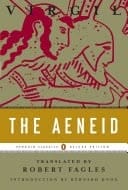
DESCRIPTION
From the award-winning translator of The Iliad and The Odyssey comes a brilliant new translation of Virgil’s great epic Fleeing the ashes of Troy, Aeneas, Achilles’ mighty foe in the Iliad, begins an incredible journey to fulfill his destiny as the founder of Rome. His voyage will take him through stormy seas, entangle him in a tragic love affair, and lure him into the world of the dead itself—all the way tormented by the vengeful Juno, Queen of the Gods. Ultimately, he reaches the promised land of Italy where, after bloody battles and with high hopes, he founds what will become the Roman empire. An unsparing portrait of a man caught between love, duty, and fate, the Aeneid redefines passion, nobility, and courage for our times. Robert Fagles, whose acclaimed translations of Homer’s Iliad and Odyssey were welcomed as major publishing events, brings the Aeneid to a new generation of readers, retaining all of the gravitas and humanity of the original Latin as well as its powerful blend of poetry and myth. Featuring an illuminating introduction to Virgil’s world by esteemed scholar Bernard Knox, this volume lends a vibrant new voice to one of the seminal literary achievements of the ancient world. For more than seventy years, Penguin has been the leading publisher of classic literature in the English-speaking world. With more than 1,700 titles, Penguin Classics represents a global bookshelf of the best works throughout history and across genres and disciplines. Readers trust the series to provide authoritative texts enhanced by introductions and notes by distinguished scholars and contemporary authors, as well as up-to-date translations by award-winning translators.
Review
🛠️ Active Reading Workflow
1. Prime (5 min)
- Thesis Prediction:
- Prior Knowledge:
- Questions to Answer:
2. Process (The “During” Loop)
Mark: T (Thesis), R (Reason), E (Evidence), D (Def), O (Objection).
- [ ] Q→A: Convert headings to questions; notes = answers.
- [ ] Feynman Check: Explain dense sections in 1-2 sentences.
- [ ] Originality: One original analogy/example per concept.
3. Review & Consolidate (Post-Session)
- [ ] Recall Dump: (Close book, list claims/terms).
- [ ] 3-2-1: 3 takeaways · 2 questions · 1 application.
- [ ] High-Yield Flashcards: (Definition, Claim → Reason, Objection).
🏛️ Analytical Deep-Dive (Adler/Paul-Elder)
| Element | Summary / Notes |
|---|---|
| Unity | The book in one sentence. |
| Problem | The central question the author is solving. |
| Propositions | Main claims in my own words. |
| Logic | Premises → Conclusion. |
| Criticism | Is the author uninformed, misinformed, or illogical? |
Counter-Argument (Steelman):
🚀 Application & Quality Gates
- The Experiment: [Define one behavior change].
- Gate 1: I can explain this in 3 mins without notes. [ ]
- Gate 2: I have at least one original counter-argument. [ ]
- Gate 3: Notes are <10% of original text length. [ ]
🖋️ Scratchpad
Unfiltered thoughts, argument trees, or “what if” scenarios.
AI Summary
Overview
The Aeneid is Rome’s foundational epic: it tells how Aeneas, a Trojan prince and survivor of Troy’s destruction, becomes the carrier of Troy’s gods, people, and destiny toward Italy, where his line will eventually produce Rome. The poem is not just an adventure story; it’s a sustained meditation on:
- Fate vs. choice: the end is “fixed” (Italy/Rome), but the path is full of real decisions, losses, and moral compromises.
- Pietas (duty/devotion): Aeneas’ defining virtue is responsibility—to gods, family, and mission—often at the expense of personal happiness.
- Empire’s double face: the poem can sound like national destiny and glory, yet it repeatedly forces you to feel the human cost (war, displacement, broken families, sacrificed loves).
- Divine politics: gods aren’t distant; they are active forces shaping weather, war, desire, and interpretation—sometimes clarifying fate, sometimes poisoning it.
Structurally, it mirrors Homer: - Books 1–6: wandering, storms, foreign courts, storytelling, descent to the dead (Odyssey-like).
- Books 7–12: war in Italy, alliances, duels, battlefield ethics (Iliad-like).
The poem’s emotional spine is that “founding” is purchased through loss: a people and a future are created by what Aeneas must give up.
What you’ll understand if you only read the chapters you’ve read
You’ve actually read a “best-of” spine that captures the epic’s main arc and its biggest moral questions. Specifically, from the books you covered, you already have:
1) The core plot in five decisive turns
- Mission launched + divine resistance (Book 1): Juno’s hostility, storm, landfall at Carthage, and the setup of Dido as both refuge and danger.
- The primal wound: Troy’s fall (Book 2 excerpt): the deception, the slaughter, and Aeneas’ pivot from “die defending” to “live carrying Troy forward”—including the loss of Creusa and the command toward Italy.
- The great detour: love vs. destiny (Book 4): the “marriage” ambiguity, Rumor, Jupiter’s recall, and Dido’s collapse into suicide—turning a personal tragedy into a future geopolitical curse.
- The theological-political center (Book 6): underworld moral order, rebirth/Lethe, and Anchises’ revelation of Roman destiny and its cost.
- The ending as moral shock (Book 12): the failed treaty, the duel that becomes a hunt, and Aeneas’ final kill—pity aborted by memory of Pallas—ending the poem on the ambiguity of “justice” and founding violence.
That is most of the epic’s “argument” in narrative form.
2) The poem’s central themes (you’ve already encountered them at maximum intensity)
- Pietas under pressure: Aeneas is repeatedly forced to choose duty over what feels humanly natural (stay, love, rest, grieve, retaliate without limit).
- The cost of founding: Troy’s collapse (Book 2), Dido (Book 4), and the ending kill (Book 12) together teach the poem’s darkest lesson: futures are built on bodies and broken bonds.
- Public vs. private voices: your translator’s postscript emphasizes that the poem can sound both like imperial destiny and like mourning for mortality’s burden.
3) The “meaning” of Rome in the epic
From Book 6 and Book 12, you get the poem’s explicit ideological frame:
- Rome’s vocation is portrayed as rule/order and the “arts” of governance.
- Rome’s identity emerges through fusion: Trojan blood absorbed into a Latin future (Book 12’s Jupiter–Juno settlement).
So even without the whole middle, you grasp the epic’s political-theological “point.”
What you will miss by not reading the rest
Even though you’ve captured the backbone, you’ll be missing the connective tissue that makes the ending feel earned and makes Aeneas’ leadership fully legible.
A) The full journey from Troy to Carthage and onward
- Book 3 (major gap): Aeneas’ long wandering narrative—misread prophecies, failed settlements, repeated losses, and the slow clarification of “Italy.” This is where the poem teaches that Fate is real but hard to interpret, and it shows how Aeneas learns to lead through uncertainty.
B) The “Roman civic” middle: building community, not just surviving
- Book 5: funeral games for Anchises and community formation—how a displaced people becomes a functioning polity. This matters because without it, Aeneas can look like a man who moves from catastrophe straight to prophecy straight to slaughter, missing the civic work in between.
C) Why the Italian war becomes inevitable (and why Turnus matters)
- Books 7–8: arrival in Latium, political tensions, the ignition of war, alliances, and the Shield episode’s historical vision.
- Books 9–11: the war’s human scale—heroic friendships, raids, deaths, and the accumulation of grief and obligation that makes Book 12’s final choice psychologically (and morally) explosive.
D) The “missing emotional bridges” to the finale
Book 12 hits hardest if you’ve lived through:
- the war’s escalating reciprocity,
- the losses on both sides,
- and especially the chain of relationships that turns Pallas into more than a name (so the belt becomes not just a trigger, but a moral wound that has been opened for several books).
If you want a “minimal reading plan” to make your partial reading feel complete
You already have 1, 2, 4, 6, 12 (the epic’s spine). To make that spine feel like a full organism, add:
- Book 3 (essential bridge): how Fate is interpreted, and why the Trojans keep failing until the destination becomes clear.
- Books 7–8 (war ignition + alliance framework): why Italy isn’t a peaceful arrival and why the conflict is structurally baked in.
- Books 9–11 (emotional and moral loading): the war’s cost, the relationships and deaths that make the ending morally charged rather than abrupt.
That set will give you the full “logic” of the epic without requiring every episode.
If you tell me whether you’re using the same translation throughout, I can tailor the “must-read scenes” inside Books 3 and 7–11 to match the edition’s pacing and headings.
Introduction
These pages introduce Virgil and the purpose of the Aeneid, then explain how the poem fuses Homeric epic with Roman national history—using myth to “prefigure” Rome’s rise and Augustus’ new order—while centering the hero Aeneas as a man defined by pietas (duty/devotion) rather than pure martial glory.
1) Virgil’s career and the Augustan backdrop
The introduction situates the Aeneid as the culmination of Virgil’s poetic development. It sketches how Virgil rose into elite literary circles (including Maecenas) and became famous first for the Eclogues (pastoral poems admired for their musical control of the Latin hexameter).
It then summarizes the Georgics—a four-book poem about farming (crops, trees, herds, bees) modeled partly on Greek predecessors, yet ultimately treated as a crafted work of art rather than a practical manual. The text highlights how the Georgics aligns with (and also quietly exposes the impracticality of) the ideal of the Roman “soldier-farmer,” noting the reality of slave labor and absentee landlords.
Virgil signals in the Georgics that he will next “celebrate” Caesar/Octavian’s victories—an ambition that becomes the Aeneid. The introduction recounts how Virgil read parts of the epic to Augustus and Octavia, then traveled to Greece intending years of revision; he fell ill and died in 19 B.C., with a tradition that he wanted the unfinished manuscript destroyed—an order Augustus overrode. The poem’s surviving “imperfections” (incomplete lines, minor contradictions) are framed as traces of this interrupted revision process.
2) What kind of epic the Aeneid is: Homer + Rome
The introduction emphasizes that the Aeneid is an epic in twelve books that begins in medias res—dropping the reader into action rather than starting at the beginning.
It also explains how Virgil deliberately models major arcs on Homer:
- The first half echoes the Odyssey (wandering, storms, encounters, storytelling of past travels).
- Specific parallels are noted: Dido’s Carthage compared to Odysseus and Calypso; Aeneas’ travel narrative compared to Odysseus’ long tale to the Phaeacians; Cyclops episodes; funeral games modeled on Homeric games.
But the poem is not just imitation—it is built to connect mythic Trojan origins to Rome’s political destiny.
3) Aeneas and the central virtue: pietas as duty to gods, family, and nation
Aeneas is introduced as a Homeric figure (a Trojan warrior in the Iliad, repeatedly saved by gods) whose survival is tied to fate and dynastic continuity.
Virgil repeatedly attaches to him the adjective pius and the concept pietas, and the introduction stresses that these words are broader than modern “piety”: they mean dutifulness—devotion to the gods, loyalty to family, and responsibility to one’s people and mission.
Key illustrative examples:
- Family duty: Aeneas carrying his father Anchises out of burning Troy while leading his son Ascanius, then losing his wife Creusa.
- Mission to Italy: Creusa’s ghost redirects him toward exile and a western destiny (Italy/Hesperia, the Tiber), reframing private loss as national-foundational duty.
- Conflict with love (Dido): When Aeneas is absorbed in building Carthage with Dido, the introduction notes the telling absence of the “pius” label; Jupiter sends Mercury with the blunt command to leave—“Let him set sail”—and Aeneas becomes “pius” again only when he recommits to his Roman destiny, despite the human cost to Dido.
4) Roman virtues projected into the epic world
The text expands from Aeneas’ personal virtue to a broader Roman ideal. Pietas becomes a civic-national value tied to the qualities Romans believed enabled empire: gravitas (seriousness), auctoritas (earned authority), and discipline.
A vivid example is a simile where the authority of a worthy man calms a violent crowd—an image used to explain how order is restored and why Roman leadership ideals matter.
5) Myth as “pre-history”: why Rome wanted Trojan ancestry
The introduction explains that traditions about Aeneas escaping Troy and heading west circulated early in Greek sources, and that the idea of Italy as the destination became established well before Virgil. As Rome’s power expanded and it faced Greek/Macedonian rivals, Trojan ancestry became politically useful and culturally attractive—an origin story that could compete in the prestige economy of the Mediterranean.
6) Narrative set-up: Juno’s grievance, the storm, and Jupiter’s prophecy
The early narrative outline foregrounds the divine conflict: Juno’s hatred is tied to Trojan-war mythology (including the Judgment of Paris), and she delays the Trojans’ arrival in Latium.
The plot “begins” with Juno bribing Aeolus to unleash a storm that scatters Aeneas’ fleet; Neptune intervenes to stop an unauthorized tempest and restore calm.
Aeneas rallies his men with a speech that frames suffering as future memory and points them toward Latium as the fated endpoint.
Then Venus presses Jupiter about the promised future, and Jupiter “unrolls” fate—foretelling wars in Italy, city-building, Ascanius/Iulus, and the long chain that leads toward Rome’s eventual greatness.
7) Roman history embedded inside the poem: Punic Wars, Hannibal, and Carthage
The introduction shows how Virgil makes Dido’s tragedy echo real Roman history. Dido’s curse—calling for endless war between her people and Aeneas’ descendants—invites Roman readers to think of the Punic Wars.
It gives a compact historical account of:
- Carthage’s Phoenician roots and expansion, then deteriorating relations with Rome as Rome intervenes in Sicily, leading to the First Punic War (264–241 B.C.) and Rome’s first province.
- The Second Punic War (218–201 B.C.) as the “avenger” motif fulfilled in Hannibal, including the Alps crossing and major Roman defeats (Trebia, Trasimenus, Cannae), followed by Scipio’s strategy and Hannibal’s defeat at Zama (202 B.C.).
- The revival of Carthage, Cato’s famous insistence on destruction, and the Third Punic War, ending in 146 B.C.with Carthage destroyed—followed by its later rebuilding and flourishing in imperial times (with Augustine as a later witness to the enduring imaginative pull of Virgil’s Troy).
8) Anchises’ pageant in the Underworld: Rome’s future as revelation
The introduction highlights Book 6 as the poem’s most extensive “rehearsal” of Roman history: Anchises shows Aeneas the spirits of great Romans-to-come, turning the underworld journey into a guided vision of Rome’s destiny.
It outlines the underworld staging (the Sibyl, the golden bough, Charon’s rule that only the properly buried can cross, Cerberus subdued with a drugged “sop”).
It also includes emotionally pointed encounters—especially Aeneas meeting Dido’s ghost, where she refuses reconciliation and turns away “his enemy forever,” a moment the introduction singles out as famously cutting.
9) The Shield of Aeneas: Rome’s story culminating in Augustus at Actium
The introduction treats the Shield (Book 8) as a centerpiece where myth carries a visual history of Rome:
- Early legends (Romulus and Remus with the wolf; the Sabine episode; heroic defenses and civic-religious institutions).
- Moral-political symbolism (Catiline punished; Cato “giving laws” among the virtuous, identified as the suicide at Utica rather than Cato the Elder).
- The climax: Actium as a world-historical turning point—Augustus and Agrippa defeating Antony and Cleopatra—framed as Italy/the West triumphing over the (depicted-as) barbarous East, followed by Augustus’ triumphal review of tribute from many nations.
10) The Etruscans: where Virgil becomes myth-maker rather than historian
Finally, the introduction notes that while Virgil blends myth with recognizable Roman history, his portrayal of the Etruscans is largely mythic. It mentions the tradition that they came from Lydia (citing Herodotus as an ancient source for that belief), then contrasts this with what modern knowledge can actually recover: undeciphered language, vanished city structures, and evidence primarily from tombs, frescoes, and grave goods—plus archaeological confirmation that early Rome was shaped by Etruscan domination and religious practices.
Book 1: “Safe Haven After Storm”
Executive Summary
Book 1 sets the entire epic in motion by framing Aeneas’ mission as a clash between Fate (Rome’s destined founding) and divine resistance (Juno’s hostility). Juno engineers a catastrophic storm to destroy the Trojan fleet, but Neptune reasserts order and the survivors reach the Libyan coast. While Aeneas outwardly steadies his men, the poem makes clear that their success depends as much on the gods’ political struggles as on human endurance.
The book then pivots from survival to statecraft and temptation: Aeneas enters the rising city of Carthage, where Queen Dido welcomes the Trojans with generosity and offers security. At the same time, Jupiter’s prophecy to Venus confirms the long Roman future—Aeneas will reach Italy and his descendants will build an endless empire—so the audience knows where the story must go, even as the characters don’t. The book’s emotional hook is set by Venus’ intervention: she uses Cupid to inflame Dido’s love, creating a powerful rival to Aeneas’ duty. The closing request—Dido asking Aeneas to tell his story—launches Books 2–3 and establishes the central tension of the epic: personal feeling and human cost versus the harsh forward-pull of destiny.
1) The poem’s stakes and Juno’s grudge
Virgil opens by announcing an epic about “wars and a man,” Aeneas, driven by Fate from Troy toward Italy—yet battered by divine hostility, especially Juno’s “relentless rage,” before he can found the city and bring Troy’s gods to Latium (the future root of Rome).
Juno’s anger is anchored in both politics and myth: she loves Carthage and fears a Trojan-descended people will someday overthrow it; she also never forgets Troy-era humiliations (Paris’ judgment, the Trojan line, honors given to Ganymede).
2) Juno unleashes the storm
To block Aeneas from Italy, Juno goes to Aeolus, keeper-king of the winds, and bribes him to smash the Trojan fleet—offering a beautiful nymph (Deiopea) as reward. Aeolus accepts and releases the winds like an attacking army, turning sea and sky into chaos.
3) Near-destruction at sea; Aeneas’ despair
The storm is catastrophic: ships split, crews scatter, men and Trojan spoils bob in the waves. Aeneas, terrified, cries that those who died at Troy were “blest,” wishing he had fallen there too rather than endure this fate.
4) Neptune intervenes and restores order
Neptune senses the disturbance in “his” realm, recognizes Juno’s interference, and rebukes the winds for raising seas without his authorization. He calms the waters, clears the sky, and (with Triton and Cymothoe) frees ships from rocks—likened to a statesman calming a violent mob by moral authority and public service.
5) Landfall in Libya; Aeneas steadies his men
The survivors reach a sheltered harbor on Libya’s coast. They make fire, salvage grain, and Aeneas hunts enough deer to feed the remaining seven ships.
He gives the crew a morale speech: they’ve endured worse; one day it may be a “joy” to remember even this; Fate still holds out Latium and a renewed “kingdom of Troy.”
6) Venus appeals to Jupiter; Jupiter “unrolls” Rome’s future
Seeing their suffering, Venus protests to Jupiter: why are Trojans still blocked after so many losses? Jupiter reassures her that Fate is unchanged and foretells the long arc: Aeneas will fight and establish rule in Italy; Ascanius/Iulus will found Alba Longa; later Romulus will found Rome; and Rome’s empire will be without end.
7) Venus guides Aeneas to Carthage; Dido’s backstory
Aeneas goes exploring with Achates and meets Venus disguised as a huntress. She explains they’ve landed in a Punic realm ruled by Queen Dido and recounts Dido’s flight from Tyre: her brother Pygmalion murdered her husband Sychaeus for wealth; Sychaeus’ ghost reveals hidden treasure and urges escape; Dido leads followers overseas and founds Carthage (including the famous bull’s-hide land purchase).
8) Carthage under construction; the “Troy” murals and Aeneas’ tears
Venus shrouds Aeneas and Achates in mist so they can enter unseen. Aeneas marvels at the intense civic labor—walls, laws, harbor, theater—likened to a bustling beehive. He then sees Troy’s war depicted in art at Juno’s temple and weeps: even here, their suffering is known, and “the world is a world of tears.”
9) Dido receives the Trojans; Aeneas reveals himself
Aeneas’ men (led by Ilioneus) appeal for mercy and basic rights of refuge: they are not aggressors; they seek either passage to Italy or, failing that, return to Sicily. Dido replies generously: she knows Troy’s story, offers safe passage and aid, and even invites them to settle as equals.
At this, the mist dissolves. Aeneas appears “like a god,” thanks Dido for compassion, and vows her name will endure so long as nature endures.
10) The banquet and Venus’ “Cupid” plot
Aeneas sends for Ascanius and selects gifts saved from Troy for Dido. Venus, fearing Juno’s treachery and wanting to bind Dido to Aeneas, substitutes Cupid in Ascanius’ form: Cupid sits close to Dido, “poisoning” her with love and erasing the memory of her dead husband, Sychaeus.
11) Dido’s fascination and the transition to Books 2–3
During the feast, Dido leads toasts; the bard Iopas sings cosmological themes (sun and moon, origins of people and beasts, storms, constellations). Dido, increasingly captivated, questions Aeneas about Troy’s heroes and finally asks him to tell his own story—setting up Aeneas’ long narrative of Troy’s fall and his wanderings in the next books.
Book II: The Final Hours of Troy
Aeneas recounts to Dido the night Troy fell: the Greeks’ deception with the wooden horse, the fatal misreading of omens, the sudden night assault, and the desperate, doomed defense. The chapter turns on pietas (duty to gods/family) versus heroic rage: Aeneas is pulled from the battlefield toward the mission of survival, carrying his father and leading his household into exile. Troy’s end is framed not only as Greek victory, but as an event permitted (and even driven) by divine will, culminating in Creusa’s ghost redirecting Aeneas toward Italy and a promised future kingdom.
Chapter Objective
This chapter aims to explain how Troy actually fell—not by strength alone, but by fraud, panic, misinterpretation of signs, and the gods’ permission—and to show why Aeneas becomes the carrier of Troy’s continuity through family, sacred objects, and fate. It fits the broader epic by transforming Aeneas from a warrior defending a city into the founder-in-exile whose mission is to reach the “Hesperian” land promised by destiny.
1) The Greek Deception and Troy’s Self-Defeat
- The Greeks’ victory depends on a psychological weapon: the horse is designed to exploit Trojan hope (the war is “over”) and Trojan religious anxiety (what does the object mean?).
- Trojan leaders debate what to do; the crucial error is treating the horse as a potential sacred offering rather than a threat.
- The deception works because it turns the Trojans into agents of their own ruin: they physically bring the disaster inside their walls.
A City Undone by Its Own Hands
“Perhaps you wonder how Priam met his end. / When he saw his city stormed and seized…” — p. 92 (excerpt pagination)
Key concept - Deception as strategy: victory achieved by manipulating an enemy’s expectations and sacred fears, not merely by force.
2) Priam’s Palace: Collapse of Order, Family, and the Sacred
- Virgil concentrates the tragedy at Priam’s palace: it is the symbolic center of Trojan continuity—dynasty, household gods, altars, and lineage.
- The Greeks breach the palace with overwhelming violence; the imagery compares the invasion to a flood that bursts boundaries and destroys all structure.
- Hecuba and her daughters cluster at an altar “clutching… the figures of their gods,” showing the city’s final resort: religion as the last refuge when walls and weapons fail.
- Priam’s attempt to arm himself is portrayed as noble but futile—an old king reenacting warrior identity in a world where that identity can no longer protect anything.
The Altar as Last Shelter
“Come to me, Priam. This altar will shield us all / or else you’ll die with us.” — p. 92 (excerpt pagination)
Key concept - Sacral collapse: the palace altar (supposed to represent protection, order, and divine presence) becomes the stage for slaughter—an inversion of what sacred space means.
3) Polites, Pyrrhus, and the Killing of Priam
- The murder sequence is built for maximum moral horror:
- Polites, Priam’s son, flees wounded through the palace.
- Pyrrhus (Neoptolemus), representing inherited violence, hunts him down.
- Polites collapses before his parents, “vomiting out his lifeblood.”
- Priam responds with a moral indictment: he contrasts Pyrrhus with Achilles, claiming Achilles respected suppliants and restored Hector’s body—implying that the son has fallen below the father’s code.
- Pyrrhus answers not with argument but with annihilation: Priam’s attempt to resist is powerless, and the king becomes a casualty of the new era’s brutality.
A Father Forced to Watch
“You’ve made me see my son’s death with my own eyes, / defiled a father’s sight…” — p. 93 (excerpt pagination)
Key concepts - Inherited violence: Pyrrhus embodies the continuation (and escalation) of the Achilles-cycle of wrath.
- Moral reversal: even the enemy (Achilles) is framed as having had limits—those limits vanish in Troy’s final night.
4) Aeneas’ Crisis: Heroic Rage vs. Duty to Family
- After witnessing devastation, Aeneas is pulled toward self-destructive heroism: the impulse to fight and die “with revenge.”
- Anchises refuses to flee at first; Aeneas confronts him with a harsh truth: staying means dragging the whole household into death.
- Aeneas’ speech frames the moment as a choice between futile honor and survival as obligation—and he imagines Pyrrhus returning “bathed in Priam’s blood,” slaughtering families at altars.
- Creusa’s intervention is pivotal: she begs Aeneas not to pursue death for its own sake, and she defines his “first duty” as guarding the house.
Pietas Over Glory
“Your first duty should be to guard our house.” — p. 98 (excerpt pagination)
Key concept - Pietas (duty): not just piety toward gods, but obligation to family line, household, and the future.
5) Omens and the Turn Toward Fate
- A marvel interrupts the argument: a flame rises from Iulus’ head without harming him.
- Anchises interprets it as a divine sign and prays for confirmation; a thunderclap and a “shooting star… trailing a flaming torch” seals the omen.
- This is the chapter’s hinge: Anchises finally agrees to flee—explicitly submitting to divine leading (“now I follow wherever you lead me”).
- Aeneas then choreographs escape as ritualized duty: he carries his father, Iulus walks beside, Creusa follows at a distance, and they choose a rendezvous at a shrine of Ceres beyond the walls.
The Sign That Forces the Choice
“No more delay… now I follow wherever you lead me…” — p. 99 (excerpt pagination)
Key terms - Omen / sign: divine authorization that transforms an action (flight) from shameful retreat into obedient necessity.
- Household gods: the religious continuity that travels when the city cannot.
6) Creusa Lost: The Cost of Survival
- In the chaos, Creusa is separated. Aeneas returns through burning Troy, calling her name repeatedly in the streets.
- He sees Greeks guarding loot in Juno’s sanctuary—children and mothers herded together—underscoring that Troy’s fall is also the collapse of civilian life into captivity.
- Creusa appears as a “stricken ghost… larger than life,” and delivers the chapter’s final redirection: what happened is “not without the will of the gods,” and Aeneas is forbidden to take her with him.
- She prophesies the destination: exile across the sea to Hesperian land, where the Tiber flows; there he will gain joy, a kingdom, and a new queen.
- Aeneas tries three times to embrace her; she dissolves “light as wind,” emphasizing the epic’s recurring pattern: intimate human attachment repeatedly yields to fate’s demands.
Fate’s Hard Sentence
“It’s not without / the will of the gods these things have come to pass.” — p. 102 (excerpt pagination)
Key concepts - Founding through loss: the future city is purchased by irreversible personal sacrifice.
- Prophetic consolation: grief is not erased; it is reframed as the cost of a destined mission.
7) The Exodus: Troy Becomes a People-in-Motion
- After Creusa’s disappearance, Aeneas returns and finds “throngs of new companions” gathering—families and survivors ready for exile, turning Troy from a place into a migrating community.
- The conclusion is stark: the Greeks hold the city and block the gates; “No hope of rescue now.”
Key Concepts (Chapter-Specific)
- Pietas as the epic’s engine: Aeneas’ defining virtue is the ability to subordinate rage and even love to duty, especially once omens clarify the gods’ will.
- Divine will and human suffering: the poem insists both are true at once—events are fated and experienced as intolerable loss.
- Sacred space inverted: altars and shrines recur as settings for terror, not safety, underlining the depth of Troy’s undoing.
Key Terms
- Pietas: duty/reverence encompassing gods, family, and ordained mission (not merely private “piety”).
- Omen: a divine sign that compels interpretation and action; here, the fire on Iulus and the shooting star authorize escape.
- Hesperia: “western land” (Italy), framed as the terminus of exile and the beginning of renewed Troy.
- Household gods: the portable sacred core of the family/state, symbolically carried out of the burning city.
Critical Analysis
- Strengths
- The chapter’s power comes from moral staging: Virgil makes the fall of Troy intelligible as a chain of decisions under fear, with the palace/altar scenes concentrating political, familial, and religious collapse into a few unforgettable images.
- The narrative builds a coherent ethical transformation: Aeneas’ heroism is redefined from “die fighting” to save the line—and the omen sequence provides a convincing epic mechanism for that turn.
- Weaknesses / tensions
- The poem leans on fate to settle moral ambiguity: saying “the gods forbid” can risk feeling like a narrative override of human choice (especially in Creusa’s removal).
- The Greeks—especially Pyrrhus—are rendered with near-total brutality, which heightens tragedy but can flatten complexity (Achilles is briefly used as a moral contrast mainly to condemn the son).
Questions for Reflection
- If Aeneas’ defining virtue is pietas, what exactly does it demand here: obedience to signs, loyalty to family, loyalty to Troy’s future, or all three—and what happens when those conflict?
- Why does Virgil place the climactic violence at an altar? What is gained by making sacrilege part of the city’s final image?
- Priam appeals to a code of honor by comparing Pyrrhus to Achilles. Is Virgil suggesting moral decline over generations, or something about war itself?
- The omens “solve” the family’s disagreement. In what sense is that persuasive—and in what sense is it tragic (because it removes alternatives)?
- Creusa’s ghost reframes catastrophe as destiny. Does that console, or does it deepen the horror by making loss unavoidable?
Connections
- Homeric echoes: Priam/Achilles ethics and the generational continuation of violence (Priam explicitly invokes Achilles as a moral comparator).
- Roman founding logic: exile as precondition of nationhood—Troy’s “people-in-motion” anticipates the later Italian destiny named by Creusa (Hesperia/Tiber).
- Themes from earlier material: the epic’s emphasis on Aeneas as “duty-bound” and destined for Latium (the larger frame of fate that makes Book II’s losses intelligible).
Book Four: The Tragic Queen of Carthage
Executive summary
Book 4 stages a collision between private passion and public destiny: Dido’s love for Aeneas (intensified and steered by the gods) derails Carthage’s civic mission, while Aeneas is forcibly recalled to Fate and to his obligations toward Italy and his son. The result is a tragedy driven by misaligned meanings of “marriage,” the violence of reputation/Rumor, and a final act in which Dido turns personal abandonment into a political curse that will echo beyond her life.
Chapter objective
This “chapter” (Book 4) explains why Aeneas must leave Carthage despite genuine attachment and hospitality, and what that departure costs: it dramatizes the epic’s central ethical engine—pietas (duty to gods, fate, family) overriding individual desire—while establishing a foundational enmity between Carthage and the Trojan/Roman line through Dido’s ruin and curse.
The hunt, the cave, and the “marriage” that starts the tragedy
- The narrative frames the hunt as ceremonial splendor and seduction: Dido appears in royal display; Aeneas is likened to Apollo in radiance and leadership.
- The storm is the hinge: the hunting parties scatter, and Dido and Aeneas take shelter in the same cave. Cosmic forces become “witnesses” (Earth, Juno, lightning, the sky), producing an event Dido will interpret as binding marriage.
- Virgil marks the cave-day as the “first day” of Dido’s death: the moment she stops guarding appearances and begins calling the affair “marriage,” using the word as moral cover.
The first day of her death
“This was the first day of her death, the first of grief, the cause of it all.” — p. 133
Main idea - The poem makes the relationship both intimate and public: “marriage” here is less a legal/religious contract than a contested interpretation—and that interpretive gap becomes the weapon that destroys Dido.
Rumor (Fama) as a political force that turns love into scandal
- Rumor erupts immediately after Dido names the affair “marriage,” spreading through “Libya’s great cities” as the “swiftest of all the evils.”
- Rumor is personified as a many-eyed, many-tongued monster—an engine of surveillance and amplification—clinging to “twisted lies” as tightly as truth.
- The content of the gossip is politically damning: the lovers are accused of warming the winter in lust, “oblivious” to their kingdoms—transforming private desire into civic neglect.
Rumor, swiftest evil
“Straightway Rumor flies through Libya’s great cities, Rumor, swiftest of all the evils in the world.” — p. 133
Main idea - Virgil treats reputation as fate-like: once Rumor circulates, it coerces action from kings and gods alike, turning the romance into an international crisis.
Iarbas’ outrage and Jupiter’s decision to reassert Fate
- Rumor targets King Iarbas, intensifying his humiliation and anger.
- Iarbas’ prayer to Jove/Jupiter is both accusation and test of divine legitimacy: if Jupiter tolerates this affront, then thunderbolts and sacred fear are “empty noise.”
- He casts Dido as an upstart foreigner and Aeneas as a decadent “second Paris,” reframing the situation as a moral-political theft of sovereignty.
- Jupiter responds by shifting attention to Carthage and ordering Mercury to confront the “malingering” Trojan captain who ignores the cities “Fate decrees are his.”
“Malingering” against destiny
“Find the Dardan captain who now malingers long in Tyrian Carthage… and pays no heed to the cities Fate decrees are his.” — p. 139
Main idea - The epic’s hierarchy is made explicit: erotic fulfillment and civic success in Carthage cannot override the poem’s teleology—Aeneas’ mission toward Italy.
Dido’s omens, haunting, and the turn from grief to fixed resolve
- Dido reads the world as hostile and uncanny: sacrificial signs invert (holy water blackens; wine congeals “in bloody filth”), suggesting the gods’ withdrawal or condemnation.
- Her past returns as haunting: the shrine of Sychaeus seems to give voice, and an owl’s dirge, seers’ warnings, and nightmares intensify her isolation and panic.
- She is compared to figures of tragic frenzy (Pentheus; Orestes), signaling that her suffering is not only emotional but madness-like—a breakdown of perception and stability.
- The crucial shift: she becomes “fixed on dying,” calculating means and moment.
The resolve to die
“So, driven by madness, beaten down by anguish, Dido was fixed on dying, working out in her mind the means, the moment.” — p. 143
Main idea - The poem shows suicide not as sudden impulse but as a grimly reasoned “plan,” built from shame, abandonment, and the sense that the moral order has turned against her.
The “magic” ruse: pyre-building as ritualized self-erasure
- Dido deceives Anna by presenting a solution: either win Aeneas back or free herself from love through the help of a Massylian priestess from the far west (near Atlas).
- The priestess’ powers are extreme—stopping rivers, reversing stars, raising the dead—making the rite feel like an inversion of natural and divine order.
- Dido orders a pyre “in secret,” piling Aeneas’ arms, clothes, and their shared bed: the ritual is framed as obliterating “every trace” of him and the “curse,” but it is also a rehearsal space for death.
- The rites invoke chthonic deities (Erebus, Chaos, triple Hecate, three-faced Diana) and employ uncanny materials (herbs with “milky black poison,” a foal-brow charm).
Obliterating every trace
“I must obliterate every trace of the man, the curse…” — p. 143
Key concept - Ritual as narrative technology: Virgil uses sacrifice/magic imagery not to validate occult power, but to externalize Dido’s inner logic—she tries to convert emotion into controllable procedure, then converts procedure into death.
The climax: Dido’s suicide, civic collapse, and divine release
- In her final words, Dido insists on dying “unavenged” yet turns the act into an omen for Aeneas: she wants him to “drink down” the sight of her fires from the sea.
- The death is immediate and physical: she falls on the sword; blood foams; the women scream.
- Rumor returns as collective hysteria: the city sounds as if enemies storm the walls—Carthage (and even old Tyre symbolically) seems to topple in the communal imagination.
- Anna’s lament highlights the human cost of deception and the civic scale of loss: Dido has destroyed not only herself but Anna, their people, and the new city.
- Dido struggles for light; at last Juno, pitying her prolonged agony, sends Iris to “release” her spirit from the body—death becomes a divine administrative act.
A city sounding like it falls
“Rumor raves like a Maenad through the shocked city… as if enemies stormed the walls.” — p. 151
Key concepts (unique to this chapter)
- Pietas vs. passion: the epic’s moral priority of duty and destiny over private fulfillment is enforced through Jupiter’s intervention and the language of “Fate decrees.”
- Rumor as a quasi-divine power: Fama operates like a god of publicity—omniscient, untiring, and politically coercive—collapsing the boundary between private acts and public consequence.
- Interpretive conflict over “marriage”: the cave scene creates a sacred-looking event, but its meaning is unstable; tragedy follows from competing claims about what happened and what obligations follow.
- Ritualized self-destruction: the pyre and “magic arts” turn grief into staged ceremony—an attempt to control fate that ends by submitting to it.
Key terms
- Rumor (Fama): personified force of public report—mixing truth and lies, multiplying quickly, and reshaping political reality.
- Zephyrs: west winds; invoked in Jupiter’s orders to speed Mercury’s mission.
- Dardan: Trojan; Dido uses it bitterly for Aeneas, stressing foreignness and hardness.
- Massylian priestess: North African magical specialist invoked by Dido as cover for her suicide plan.
- Erebus / Chaos / (triple) Hecate: chthonic powers invoked in the pyre-rites, aligning the scene with the underworld and death.
- Effigy: a likeness; Dido places an effigy of Aeneas on the bed atop the pyre, turning memory into a ritual object.
Critical analysis
- Strengths
- Virgil’s tragedy is structurally tight: the cave “wedding” triggers Rumor; Rumor triggers Iarbas; Iarbas triggers Jupiter; Jupiter triggers departure; departure triggers suicide—each link feels motivated and escalatory.
- The personification of Rumor is a powerful psychological and political insight: reputations become systems that move faster than individual intention and can govern leaders.
- Dido’s interior collapse is rendered through concrete signs (omens, nightmares, ritual objects), not abstract moralizing, giving the reader a lived sense of tragic inevitability.
- Weaknesses / tensions
- The gods’ heavy-handed steering (storm-wedding; Jupiter’s intervention; Iris’ “release”) can reduce human agency: it risks making Dido’s fate feel predetermined rather than chosen, even while the poem insists on her responsibility for naming “marriage” and abandoning “appearance.”
- The chapter’s moral optics can tilt against Dido through the language of scandal (lust, obscenity) circulated by Rumor, which may reflect Roman anxieties about female sovereignty and sexual reputation rather than a neutral account.
Questions for reflection
- If “marriage” here is an interpretation rather than a contract, what does Virgil suggest about how words create obligations (or illusions of obligation)?
- Why does Virgil make Rumor the mechanism that forces the plot forward—what does that imply about politics and legitimacy?
- Is Dido’s turn to ritual and “magic arts” a bid for control, a form of self-deception, or a final assertion of agency?
- What does it mean that Jupiter’s command is framed not only as destiny for Rome, but as duty to Ascanius/Iulus—how does family continuity justify sacrifice?
- Does the epic ask you to judge Dido, pity her, or both—and how do the divine interventions shape that response?
Connections
- Mythic exempla referenced: Pentheus (Bacchic frenzy/terror visions), Orestes (pursued by the Furies), Paris(Iarbas’ insult “second Paris”), Atlas (cosmic geography), Erebus/Chaos/Hecate/Diana (underworld and liminal divinities).
- Broader Aeneid arc: the Carthage episode’s consequences feed forward into the epic’s Roman future—Aeneas’ duty-bound departure is a prerequisite for the Italian wars and the founding trajectory of Rome.
Book VI: The Kingdom of the Dead
Virgil uses Aeneas’ descent into the Underworld to do two things at once: (1) re-center the epic on duty, fate, and moral order, and (2) reveal Rome’s future as destiny, culminating in Anchises’ vision of Roman “arts” of rule and a parade of national greatness and loss. The episode turns the poem from wandering and survival toward Italy, war, and nation-founding, while also giving a theology of the soul—purification, forgetfulness, and return—that frames Rome’s rise as both cosmic and costly.
Chapter Objective
This chapter aims to legitimate Aeneas’ mission by giving him (and the reader) a guided revelation of (a) what the dead world “means” morally, and (b) what Aeneas’ line will become historically. It fits the broader epic by transforming Aeneas’ suffering into teleology: his hardships are not random trials but the necessary path to founding a people whose destiny is to govern, to impose order, and to bear the moral burden of empire.
1) Arrival in Elysium and the Search for Anchises
- Main ideas
- The Underworld is not just punishment; it contains a realm of reward and radiance: “the Fortunate Groves” where the blessed have their own “sun” and “stars,” and where they continue recognizable forms of excellence—athletic contest, song, dance, and sacred art.
- Virgil makes Elysium feel like a perfected civic-culture: the blessed include not only warriors but also priests, poets, inventors, and benefactors—people whose lives improved the human world.
- The Sibyl becomes a kind of protocol officer for the afterlife: she consults the honored dead (Musaeus and the “happy spirits”) to locate Anchises, emphasizing that this realm has order, ranks, and proper channels.
- Key concept
- Elysium as moral-political ideal: Virgil’s paradise is not mere leisure; it is a continuation of virtue, art, piety, and service—the traits Rome will later claim as its inheritance.
- Quote integrated
The light of the blessed
“they gained the land of joy… the Fortunate Groves… / the spirits possess their own sun, their own stars.” — Page 203
2) The Reunion With Anchises: Love, Limits, and the Reality of Death
- Main ideas
- Anchises’ welcome frames the katabasis as an act of filial devotion and destiny: he has long expected Aeneas, counting the “moments,” and Aeneas credits repeated summons from his father’s ghost as the motive force bringing him here.
- The famous failed embrace (“three times… three times… nothing”) dramatizes the boundary between living and dead—Aeneas can receive knowledge and mandate, but not restore what he lost.
- Anchises is not merely a father; he is a historian-priest of the Trojan/Roman line, “reviewing” souls and counting heirs—the Underworld becomes an archive of political futurity.
- Key concept
- Pietas as engine of revelation: Aeneas’ devotion does not just earn sympathy; it earns access to cosmic/historical truth.
3) Lethe, Purification, and a Theory of the Soul
- Main ideas
- Aeneas sees the Lethe and the dense crowds of souls “like bees,” and asks what river it is and why the throng gathers there.
- Anchises explains reincarnation through forgetfulness: the souls are “owed a second body,” and Lethe’s drafts make them “oblivious forever,” freeing them from care and memory so they can return to life.
- Virgil embeds a moral psychology: souls are “weighed down” and dulled by mortal flesh; even after death they are not fully purged—there is postmortem cleansing through punishments (wind, flood, fire) that scour away stains before souls can rise again.
- The metaphysics underwrites Roman destiny: this is not only a story of individual afterlife; it is machinery for producing a people—souls prepared, purified, and recycled into history.
- Key concepts
- Lethe (forgetfulness) as moral reset: Forgetting is not simply loss; it is the condition for re-entry into embodied life.
- Purification as justice-with-mercy: some guilt can be cleansed; punishment becomes remedial rather than purely retaliatory.
- Quote integrated
Lethe and the second life
“They are the spirits / owed a second body by the Fates. They drink deep / of the river Lethe’s currents… oblivious forever.” — Page 206
4) The Roman Mission: “These Will Be Your Arts”
- Main ideas
- Anchises contrasts Roman excellence with other civilizations’ achievements (sculpture, eloquence, astronomy), then gives the epic’s most programmatic statement of imperial vocation: Rome’s “arts” are governance, peace through order, and disciplined mercy and severity.
- The speech does ideological work: it makes conquest sound like moral labor—rule becomes a burdensome craft rather than a mere appetite for domination.
- Key concept
- Imperium as moral craft: not “art for art’s sake,” but rule as a distinctive civilizational duty.
- Quote integrated
Rome’s defining craft
“But you, Roman, remember, rule with all your power / the peoples of the earth—these will be your arts… / to spare the defeated, break the proud in war.” — Page 210
5) Marcellus and the Cost of Destiny
- Main ideas
- The parade of Roman greatness culminates in a deliberately painful turn: Aeneas notices a splendid hero (Marcellus) alongside a young man shadowed by mourning; Anchises reveals the youth’s destined early death and frames it as a grief so heavy it seems almost dangerous to know.
- The episode complicates triumphalist teleology: Rome’s future glory is inseparable from sacrifice, loss, and “stern decrees of Fate.”
- Quote integrated
A greatness that cannot last
“Only a glimpse of him the Fates will grant the world… / Oh, child of heartbreak!… You will be Marcellus.” — Page 211
6) The Gates of Sleep and the Return to the Living World
- Main ideas
- Virgil ends the revelation with a symbolic exit: two gates, Horn (true shades) and Ivory (false dreams). Anchises sends Aeneas and the Sibyl out through Ivory—an ending that raises interpretive pressure: how can this vision be both authoritative and dreamlike?
- Narratively, the exit functions as a hinge: having been “fired” with love of future glory, Aeneas immediately turns back to ships, coastline, and the next stage of action (Italy and war).
- Key concept
- Dream-knowledge and human limitation: the poem can disclose destiny without making Aeneas omniscient in practice.
- Quote integrated
The troubling exit
“The other glistens with ivory… / through it the dead send false dreams up toward the sky… / and shows them out now / through the Ivory Gate.” — Page 212
Key Concepts
- Pietas (duty/devotion) as the moral credential that grants access to revelation and legitimates empire’s burdens.
- Purification and rebirth: souls carry “stains” from embodied life and undergo cleansing before returning to the world.
- Roman mission theology: Rome’s identity is defined as rule, peace-making order, mercy to the conquered, and crushing arrogance.
- The cost of destiny: future greatness is shadowed by premature death (Marcellus) and the non-negotiable decrees of Fate.
- The Ivory Gate problem: the vision is framed as quasi-dreamlike even as it commands belief and redirects the epic’s trajectory.
Key Terms
- Elysium / Fortunate Groves: the radiant realm where the blessed dwell in joy, art, and virtuous activity.
- Lethe: river whose waters produce forgetfulness, enabling souls to return to embodied life.
- Purification (“stains,” “taints”): postmortem cleansing that removes ingrained moral residue through elemental punishments.
- Pietas: devotion to gods, family, and destiny; the ethical core of Aeneas’ identity (implicit in Anchises’ framing of the journey).
- Gates of Sleep (Horn/Ivory): symbolic exits distinguishing truth-bearing passage from dreamlike delusion; Aeneas exits by Ivory.
- Musaeus: “best of poets” figure in Elysium who stands central among the blessed and is consulted as an authority.
Critical Analysis
- Strengths
- The chapter is an extraordinarily effective structural pivot: it binds personal grief (Anchises), cosmic order (Lethe/purification), and national destiny (Roman mission) into one continuous revelation.
- Virgil avoids simple triumphalism by inserting Marcellus—a deliberate emotional wound—so the future is not only glory but also irreparable loss.
- The metaphysics of purification gives moral texture to fate: history becomes not just power but ethical formation.
- Weaknesses / tensions
- Anchises’ “Roman arts” speech risks reading as imperial apologetics: conquest is morally rebranded as peace-making vocation, which can flatten the viewpoint of the conquered into a lesson for Rome rather than a full moral perspective.
- The Ivory Gate exit introduces interpretive instability: if the vision departs through “false dreams,” readers must decide whether Virgil is undercutting, qualifying, or artistically framing political prophecy as inherently dreamlike (authoritative but not fully graspable in lived time).
Questions for Reflection
- If Rome’s “arts” are to “spare the defeated” and “break the proud,” how does the poem distinguish legitimatepride from criminal arrogance—and who gets to decide?
- Why must rebirth require forgetfulness? What does Virgil suggest about memory, identity, and moral responsibility if Lethe is necessary for returning to life?
- How does the failed embrace of Anchises shape the epic’s view of duty—does it intensify Aeneas’ mission by cutting off private consolation?
- What is the function of Marcellus in the argument of Roman destiny: is he a warning against hubris, a lament for mortality, or a sign that even “Fate” contains tragedy without explanation?
- What might Virgil be doing by sending Aeneas out through the Ivory Gate—limiting knowledge, critiquing political prophecy, or emphasizing the gap between vision and action?
Connections
- Homer (Odyssey): katabasis tradition and the symbolic gates (Horn/Ivory).
- Orpheus: present in Elysium as sacred musician shaping communal harmony.
- Stoic/Platonic/Orphic-Pythagorean currents (as later commentary notes): the chapter’s metaphysics blends cosmic spirit, purification, and rebirth (helpful for interpreting Anchises’ doctrine).
- Augustan Rome (political horizon): the future pageant culminates in Roman statecraft and the emotional figure of Marcellus, tying epic destiny to contemporary Roman memory.
Book XII: The Sword Decides All
Executive summary
Book XII resolves the war by forcing everything into a single question: can violence be contained by oath and ritual, or will “fury” (human and divine) shatter all limits until one man kills another? Turnus presses for a duel to end the conflict; Latinus and Aeneas attempt a treaty; Juno, acting through Juturna and omens, wrecks the pact; the battlefield erupts into uncontrolled slaughter. Aeneas is wounded, divinely healed, and—when Turnus finally returns to face him—hunts him down and kills him at the moment pity begins to rise, because Turnus wears the belt of Pallas(Aeneas’ surrogate son), which reignites vengeance and turns justice into execution.
Chapter objective
This chapter aims to terminate the epic’s Italian war while clarifying its moral logic: even solemn pacts collapse when pride, fear, propaganda-signs, and divine hostility intervene; “peace” does not emerge from goodwill but from a final act of lethal decision. At the same time, Book XII secures the poem’s broader foundation-myth: Jupiter compels Juno to relent and guarantees that the future people will be Latin in name and culture, with Trojan blood absorbed into Italy—Rome’s destiny comes through fusion, not Trojan replacement.
Turnus demands the duel; Latinus tries to halt the disaster
- Turnus, seeing his Latins collapsing, insists the time has come to keep his pledge: single combat will decide Lavinia and end the war.
- Latinus answers with a statesman’s calculus: the braver Turnus is, the more Latinus must weigh the catastrophic risk to the whole people. He admits his own earlier wrongdoing—he broke previous bonds to favor Turnus—and points to the mounting cost in blood and ruin.
- Amata pleads desperately against the duel; Lavinia’s blush and tears intensify Turnus’ conflicted motive: love sharpens his appetite for decisive honor.
“Turnus spurns all delay”
“Turnus spurns all delay! … I’ll take him on, I will!” — p. 355
Main idea - Virgil frames Turnus’ duel-demand as a bid for honorable closure, but also as a symptom of a deeper disease: once a war becomes about reputation and shame, leaders can no longer retreat into compromise without seeming “craven.”
The treaty ritual: Aeneas and Latinus bind peace in public—then the crowd doubts
- The armies mark out the dueling ground, set altars, and perform shared rites; the entire society watches (mothers, civilians, old men on towers).
- Aeneas’ oath is strikingly political: if Turnus wins, Trojans withdraw; if Aeneas wins, he will not impose Trojan rule—both peoples will live “under equal laws,” with Latinus retaining authority, and a new city founded.
- Latinus swears with cosmic witnesses and seals the pact with a vivid image: the scepter (a cut branch) will never grow again—so the pact will never be undone.
- Yet the Rutulians feel the match is uneven; Turnus’ posture as suppliant and pale intensifies the crowd’s instability—public mood becomes a pressure point for sabotage.
Equal laws, not Trojan domination
“May both nations… under equal laws, / march together toward an eternal pact of peace.” — p. 361
Main idea - The treaty scene tests whether civilization (law, ritual, public oath) can restrain the war-god. Virgil makes the audience itself a volatile actor: crowd perception becomes destiny’s lever.
Juno recruits Juturna; propaganda and an omen break the pact
- Juno confesses she cannot bear to watch Turnus die and incites Juturna (Turnus’ sister, now a nymph honored by Jupiter) to sabotage the duel and “abort that treaty.”
- Juturna, disguised as a respected warrior, spreads arguments that convert private honor into collective fear: Are you ashamed to risk one life to save all? Will you accept enslavement on your own land?
- She then produces a “sign” in the sky (eagle vs. swan, driven off by smaller birds). The augur Tolumnius interprets it as divine authorization: the Trojans are the predator; the Italians must mass and strike.
- Tolumnius throws a spear; it kills a young man among a band of brothers; grief detonates the line. Altars are looted for torches, sacred vessels spill, and the truce collapses into chaotic violence.
“One lust drives them all”
“charging them come… Trojans… and one lust drives them all: / to let the sword decide.” — p. 365
Main idea - The war restarts not from a rational change of policy but from a chain: divine spite → rumor-arguments → omen → interpretive authority (augur) → first blood → stampede.
Aeneas is wounded; Venus heals him; Aeneas re-frames the war as duty and inheritance
- Aeneas protests the outbreak—he insists only he has the right to fight, since the pact assigned the duel to him and Turnus. Then an unknown arrow strikes him: the author deliberately withholds agency and credit, shrouding the act in fog of chance and divine obscurity.
- Turnus uses the moment to rampage across the field “amok as Mars,” killing leaders and scattering lines; the poem temporarily makes Turnus the war’s terrifying center of gravity.
- In camp, the healer Iapyx cannot remove the arrowhead; Venus secretly supplies dittany and ambrosial cure, and Aeneas’ wound closes—his return is explicitly “something greater—a god.”
- Aeneas embraces Ascanius and teaches him the epic’s ethic of formation: courage and hardship are learned from the father; “good luck” from others. He names his exemplars: himself and Hector.
A father’s curriculum of virtue
“Learn courage from me, my son, true hardship too. / Learn good luck from others.” — p. 369
Main idea - Aeneas’ wound-and-healing dramatizes the epic’s claim that Rome’s founder is protected for a purpose—but also that the war is now morally narrowed to one pursuit: Turnus.
Aeneas’ assault on the city; Amata’s suicide; Turnus’ shame-driven return
- Aeneas, driven by Venus, shifts strategy: he storms the ramparts, declares the Latins enemies “twice over” for breaking the pact, and calls to “restore our truce with fire.”
- Inside the city, panic and division erupt: some want to open gates; others arm. Virgil uses the bee-and-smoke simile to convey collective frenzy and suffocation.
- Amata sees flames and absence of Turnus’ relief forces; believing him dead, she calls herself the “criminal” source of disaster and hangs herself. Lavinia and the women wail; Latinus is stunned into despair.
- Turnus hears the city’s grief; he confronts Juturna (still disguised), recognizes her, and confesses the crisis: friends dead, shame mounting, and the fear of being remembered as a coward who fled.
- The messenger Saces delivers the final pressure: the city is collapsing; Amata is dead; Latinus doubts; Turnus is “our last best hope.” This concentrates all meaning into Turnus’ choice to face Aeneas.
- Turnus regains clarity, declares Fate in command, and runs through the lines to call a halt: he alone will redeem the pact—clearing the field for the duel.
“Better for me alone to redeem the pact”
“Whatever Fortune sends, it’s mine… Better / for me alone to redeem the pact for you / and let my sword decide!” — p. 377
Main idea - Turnus’ return is not pure heroism or pure fatalism—it is the fusion of shame, love, civic responsibility, and resignation to Fate.
The duel: Turnus’ sword breaks; the hunt begins; divine interference turns into divine settlement
- The duel begins in full epic scale: bulls, mountains, cosmic noise; Jupiter weighs their fates in scales.
- Turnus strikes—but his sword shatters because it is a mortal weapon against Vulcan-forged divine armor; he realizes he grabbed the wrong blade (Metiscus’), not his father’s. He flees as Trojans close him in.
- Aeneas pursues despite injury, like a hound on a trapped stag; the duel becomes a chase around the field—“no mean trophy”: the life-blood of Turnus.
- Aeneas’ spear sticks in a sacred olive of Faunus (the Trojans had cut it down). Turnus prays; Aeneas cannot wrench it free. Juturna returns Turnus’ sword; Venus frees Aeneas’ spear—both sides receive divine aid.
- Jupiter confronts Juno directly: the limit is reached; she must stop. Juno yields—but negotiates the cultural settlement: Latins keep name, language, and dress; Trojans “subside” into Latin stock; one people emerges, Latin in speech and rites. Jupiter grants it.
Latium endures; Troy’s name is buried
“never command the Latins… to exchange their age-old name… / alter their language… Let Latium endure… / Troy has fallen—and fallen let her stay…” — pp. 382–383
Main idea - The poem resolves its deepest political anxiety here: Rome’s origin is not a Trojan takeover but a Latin continuity with Trojan blood absorbed—an ideological foundation for Roman identity.
The Fury, Turnus’ collapse, and the killing that ends the epic
- Jupiter sends a Fury as an omen to drive Juturna away; it appears as a night-bird, beating Turnus’ shield. Turnus is numbed with dread; Juturna laments her immortality as a curse without her brother.
- Aeneas challenges Turnus; Turnus admits he fears not Aeneas but the gods. He tries to hurl a massive boundary-stone, but his strength fails like a nightmare where limbs won’t obey—Virgil literalizes Fate’s paralysis.
- Aeneas’ spear strikes Turnus’ thigh; Turnus falls and begs for mercy, offering Lavinia and pleading for his father Daunus. Aeneas hesitates—pity begins to sway him.
- Then Aeneas sees Pallas’ belt on Turnus’ shoulder—trophy of Turnus’ earlier killing of the youth. Grief reignites as wrath; Aeneas declares Pallas “sacrifices” Turnus and plunges the sword into his heart.
The moment pity breaks—and vengeance wins
“Decked in the spoils you stripped from one I loved—escape my clutches? Never— / Pallas… makes you pay the price with your own guilty blood!” — p. 386
Main idea - The epic’s final moral shock is that the founding act is not a merciful magnanimity but a vengeance-driven execution at the instant mercy becomes possible—Virgil ends on the cost and ambiguity of “justice.”
Key concepts (unique to this chapter)
- Treaty vs. Fury: civilization’s instruments (oath, altar, ritual) are fragile when collective emotion and divine hostility intrude.
- Omen-interpretation as political weapon: the eagle-swan sign becomes a rhetorical tool that grants moral cover for breaking peace.
- Cultural settlement of Rome’s origins: Jupiter guarantees Latin continuity—name, language, rites—while Trojan identity dissolves into Italy.
- Mercy aborted by memory: Aeneas’ near-restraint is destroyed by the sight of Pallas’ belt; grief overrides the possibility of sparing the defeated.
Key terms
- Juturna: Turnus’ divine sister (nymph), agent of Juno who disrupts the treaty and prolongs Turnus’ life.
- Fama / Rumor (implicit mechanism): public wavering and rumor-seeding become battlefield force (Juturna “sows a variety of rumors”).
- Tolumnius: augur who interprets the omen and throws the spear that triggers general battle.
- Dittany: healing herb Venus brings to cure Aeneas’ wound, symbolizing divine preservation.
- Faunus’ sacred olive: tree that traps Aeneas’ spear; the Trojans’ cutting of it hints at impiety and local divine resistance.
- The Furies / Megaera: infernal enforcers used by Jupiter to terrify and dismiss Juturna, sealing Turnus’ doom.
- Pallas’ sword-belt: trophy that triggers Aeneas’ final rage; the “evidence” that converts judgment into vengeance.
Critical analysis
- Strengths
- Virgil interlocks multiple causal systems—ritual politics, crowd psychology, omen-interpretation, and divine bargaining—so the collapse of peace feels tragically overdetermined rather than random.
- The Jupiter–Juno settlement is a brilliant ideological “keystone,” answering how Rome can be Trojan-founded yet Latin in language and identity.
- The ending is artistically daring: by stopping on Aeneas’ wrath, Virgil forces readers to confront the founding of order as morally compromised, not cleanly heroic.
- Weaknesses / tensions
- Divine interventions can make human agency feel secondary: crucial turns (omen-sign, spear stuck/freed, Turnus’ terror) are repeatedly decided by gods, which may blur responsibility and reduce ethical clarity.
- The “Latin continuity” solution may read as a political justification for Roman dominance: it blesses assimilation as destiny and subordinates the moral perspective of those absorbed.
Questions for reflection
- If Aeneas sincerely offers “equal laws” and no Trojan domination, what exactly breaks peace—bad faith, fear, propaganda, or something structurally inevitable in war?
- Why does Virgil make the treaty collapse through an omen and an augur’s interpretation—what does that imply about religious authority in politics?
- What is the moral status of Aeneas’ final act: justice, revenge, sacrificial necessity, or a failure of pietas?
- Does Jupiter’s guarantee of Latin name and language strengthen or weaken the idea of Rome as “Trojan destiny”? What kind of identity is being founded—bloodline, culture, or both?
- Why end the epic on Turnus’ death “with a groan of outrage” rather than on reconciliation—what lasting emotion does Virgil want attached to Rome’s origins?
Connections
- Book X–XI (Pallas): the belt of Pallas links the finale to the epic’s most intimate loss and makes the ending hinge on remembered grief.
- Earlier “pietas” theme (Aeneas as duty-bound founder): Aeneas’ oaths, his instruction to Ascanius, and Jupiter’s insistence on fate continue the poem’s core ethic of mission over desire.
- Italian local divinities (Faunus) and Roman religious imagination: sacred landscape and omen-logic shape war outcomes.
- Mythic “scales of fate” motif (Homeric resonance): Jupiter weighing destinies embeds the duel in cosmic adjudication.
Translator’s Postscript
Executive summary
The translator argues that Pope’s sharp contrast—Homer as heard performance versus Virgil as silent reading—captures something real but oversimplifies Virgil. Virgil’s epic, though literary, is also performative (Romans often read aloud), and it uses techniques like the historical present to make readers feel events “here and now.” The translator’s guiding aim is a “middle ground”: a modern English Virgil that preserves momentum and clarity without becoming either crampedly literal (“too little English”) or stiltedly “literary” (“too little Latin”). He also frames Virgil as Homer’s great “translator” in a larger sense—adapting Homeric episodes, roles, and energies—while emphasizing Virgil’s distinctive intimacy, moral ambiguity, and the poem’s two competing “voices”: official imperial triumph and private lament for the human costs of empire.
Chapter objective
This postscript explains what kind of translation the reader is holding and why: it justifies the translator’s choices about voice, rhythm, diction, tense, and fidelity, and it situates those choices within (a) the oral/literary tension in epic, (b) Virgil’s relationship to Homer, and (c) Virgil’s moral complexity—especially the poem’s simultaneous exaltation of Roman destiny and mourning for its cost.
Epic as performance: hearing Virgil, not only reading him
- Main ideas
- The translator revisits Pope’s claim (“Homer makes us Hearers, and Virgil leaves us Readers”) and argues it is too absolute: Virgil did recite effectively (per Suetonius), and Roman reading habits were often aloud, increasing sensitivity to sound.
- Translation should therefore preserve a performative cast—not merely semantic accuracy but voice, momentum, and audibility—while also allowing for Virgil’s more “literary effects” (double resonance, introspection, lapidary formality).
- Key concept
- Primary vs. Secondary epic: C. S. Lewis’s distinction (oral-traditional vs. literary epic) is a helpful frame, but Virgil blurs it by being written for readers who still “hear” the poem.
Hearers and readers
“Homer makes us Hearers, and Virgil leaves us Readers.” — p. 387
- Primary vs. Secondary epic: C. S. Lewis’s distinction (oral-traditional vs. literary epic) is a helpful frame, but Virgil blurs it by being written for readers who still “hear” the poem.
A “modern English Virgil”: the translator’s middle way
- Main ideas
- The translator rejects two extremes:
- Over-literal rendering that “cramp[s] and distort[s]” English (risking deadness).
- Over-“literary” bookishness that repeatedly brakes the poem’s forward motion.
- He proposes a hybrid: preserve “as much of what [Virgil] writes as possible” while keeping English cadence alive—“a cross between the two: a modern English Virgil.”
- The translator rejects two extremes:
- Key concept
- Translation as negotiated fidelity: faithfulness is not only lexical; it includes pacing, tone, and the reader’s experience of epic propulsion.
The translator’s target
“I have tried to find a cross between the two: a modern English Virgil.” — p. 388
- Translation as negotiated fidelity: faithfulness is not only lexical; it includes pacing, tone, and the reader’s experience of epic propulsion.
Virgil’s historical present: immediacy, enargeia, and reader participation
- Main ideas
- The translator highlights Virgil’s heavy use of the historical present (reported as nearly two-thirds of indicative verbs), which generates sweep, vividness (enargeia), and a feeling that events unfold “here and now,” making the reader a witness and participant.
- This tense-strategy fuses mythic past, present perception, and historical future into a single luminous continuum (e.g., Troy → Dido → Punic Wars; Vulcan’s shield → Actium).
- The translator uses the present “cautiously” to avoid confusing English readers, but keeps it dominant enough to preserve Virgil’s signature immediacy.
- Key concept
- Forged temporal continuum: the epic’s temporal method makes later Roman history feel embedded within myth, and myth feel present to the reader.
Echoes, diction, and the “panoply” of epic forms
- Main ideas
- Virgil’s reputed preference for the plain word over the “poetic” word informs the translator’s diction: clarity and direct speech are part of Virgil’s artistry, not an absence of artistry.
- Virgil’s self-echoing serves multiple functions:
- some echoes may be temporary drafting “props,”
- others create moral symmetry (“poetic justice”), including the closing act (Turnus) echoing earlier cruelty and binding Aeneas’ final violence to the war’s wider brutality.
- The epic’s forms are many: dramatic narration (Troy), operatic passion (Dido), pastoral interludes, elegies, catalogues, duels, divine debates, invocations—carried by the poem’s “onward pressure” and rhythmic variety.
- Key concept
- Poetic justice as moral echo: repetition is ethical architecture—Virgil forces remembrance of violence even at the moment of “victory.”
Rhythm and line: approximating hexameter’s “ocean-roll” in English
- Main ideas
- Virgil’s hexameter produces an “ocean-roll of rhythm,” intensified by Latin’s musical interplay of stress accent and quantitative meter; English cannot replicate it directly, so the translator seeks an analogue—usually five or six beats, leaning to six, but expanding or contracting for effect.
- Expansion (to seven beats) helps convey Homeric similes, storms, or battle vehemence; contraction sharpens action or speech.
- This produces a “tug-of-war” inherent to translation: meaning vs. cadence, Latin compactness vs. English naturalness.
- Key concept
- Variety within unity as epic weapon: a single metrical norm is less important than rhythmic responsiveness that sustains narrative drive.
Virgil “Homerizes” Rome: translating Homer into Roman destiny
- Main ideas
- The postscript frames the Aeneid as a reperformance of both Iliad and Odyssey: “war and humankind” in one opening phrase, with Odyssean wandering in the first half and Iliadic war in the second—yet each half contains elements of the other.
- Aeneas’ journey is also a kind of nostos (homecoming) because his ancestor Dardanus migrated from Italy to Troy; arriving in Latium is circular in result though linear in travel.
- The fall of Troy becomes the necessary precursor of Rome’s rise—“birth pangs” and “death agonies” chained by Fate.
- Characters “translate” Homeric roles: Dido combines multiple Odyssey figures (temptress, ideal queen, Nausicaa-like freshness, Penelope-like loyalty). Aeneas in the climax resembles Achilles (avenging), Hector (defending), and Odysseus (winning the bride/kingdom).
- Key concept
- Imitation as emulation: Virgil honors Homer through competitive transformation, not copying—“easier… to filch [Hercules’] club… than a line from Homer.”
2) Homer’s chase simile “translated”: Virgil’s reader-involved terror
- Main ideas
- The translator contrasts Homer’s third-person chase (Achilles/Hector) with Virgil’s adaptation in Book XII (Aeneas/Turnus), where Virgil shifts to first-person plural (“we”), drawing readers into the nightmare of paralysis and pursuit.
- This change increases sympathy and identification with Turnus; the more personal the engagement, the more horrifying the kill becomes.
- The analysis supports a broader claim: Homer’s terror often comes from spectator-remoteness; Virgil’s from direct involvement and immediacy.
- Key concept
- Virgilian humanization of epic violence: technique makes readers feel the victim’s embodied dread, not only the hero’s glory.
Aeneas as “priest,” loneliest founder, and incomplete hero-in-progress
- Main ideas
- The postscript confronts a long-running reader reaction: Aeneas can look like a “priest” more than a hero because of his service to higher powers.
- The translator argues Aeneas becomes fully himself especially after the Underworld—the “dream center” of Book VI—emerging “human,” fired with love of future glory, and ready for the “greater labor” of Books VII–XII.
- Aeneas is both deprived and empowered: too late to be Achilles, too early to live in Augustus’ reign; his founding work is real but incomplete, and the poem ends with that incompletion intact.
- The translator stresses Aeneas’ range: endurance, readiness, ferocity when required, compassion amid war—his aristeia reveals moral awareness as well as martial prowess.
- Key concept
- Double-edged destiny: the founder’s mission “yokes” gain with grief; character and destiny develop through opposing tugs rather than a single heroic trait.
Virgil’s “two voices”: imperial triumph and private lament, and why the poem feels open-ended
- Main ideas
- The translator endorses a major interpretive tradition: Virgil is a poet agonistes, struggling to reconcile two voices—public “official” triumph for Augustus and a muted personal voice mourning “the burdens of mortality” and the poem’s pervasive anguish.
- Modern readers may prefer the private voice (skeptical of national hopes), but the translator insists both voices demand hearing; their unresolved relation is one reason the poem “stops but never end[s].”
- The Aeneid remains open because:
- prophecies remain to be fulfilled,
- much postwar adjustment lies beyond the poem,
- and historically Virgil left it unfinished and reportedly wanted it destroyed—Augustus preserved it anyway.
- Key concept
- Epic as suspended contradiction: the historical present and the dual voices can hold power and pathos side-by-side without final reconciliation.
The poem that “stops but never ends”
“the poem still feels open-ended… an effect that owes a good deal to Virgil’s choice of the historical present…” — p. 397
- Epic as suspended contradiction: the historical present and the dual voices can hold power and pathos side-by-side without final reconciliation.
Acknowledgments and the translator’s scholarly lineage
- Main ideas
- The translator credits key collaborators and influences (especially Bernard Knox and Michael Putnam) and lists commentaries, translators (prose and verse), and modern writers who shaped his understanding and ear.
- He frames translation as ongoing re-performance: no two performances are identical, and language renewal eventually absorbs translations into new idioms.
- Key concept
- Translation as performance tradition: each era generates new “Virgils” because idioms and expectations change.
Key concepts
- Performative reading: even private reading can be dramatic and auditory, especially in Roman culture.
- Historical present / enargeia: tense creates immediacy and reader participation in events.
- Middle-ground translation: balancing literal fidelity with living English cadence (“modern English Virgil”).
- Homerization: Virgil reworks Iliad + Odyssey into Rome’s founding myth and destiny.
- Two Virgilian voices: imperial/public triumph and private grief coexist in tension, contributing to the poem’s open-ended feel.
Key terms
- Primary / Secondary Epic: Lewis’s categories for oral-traditional vs literary epic, used to frame Homer/Virgil differences.
- Historical present: present tense used for past events to heighten vividness and immediacy.
- Enargeia: vivid, present impact of narrated action and speech (Greek critical term).
- Nostos: homecoming/return; applied to Aeneas’ arrival in Latium as ancestral return.
- Aristeia: heroic “display of excellence,” used to describe Aeneas’ martial-moral development.
- Poet agonistes: poet as struggler, wrestling to reconcile competing voices and demands.
Critical analysis
- Strengths
- The postscript gives a concrete, technically informed account of translation as craft (diction, cadence, tense) while also arguing persuasively that Virgil’s written epic still aims at audibility and “performance.”
- The discussion of the historical present is a strong explanatory key: it links style to reader psychology and to the epic’s fusion of myth, present perception, and future history.
- The “two voices” frame responsibly preserves Virgil’s ambiguity rather than forcing the Aeneid into either propaganda or protest alone.
- Weaknesses / tensions
- The “middle ground” ideal is compelling but hard to falsify: because it is defined as a balance, readers who disagree can always claim the translation leans too far one way.
- The postscript sometimes leans on authority-chains (commentators, translators, modern poets) as validation; helpful for lineage, but it can blur where interpretation ends and translation-choice begins.
Questions for reflection
- If Virgil “makes us hearers” even as a literary poet, what does that imply about how you should read the Aeneid—silently, aloud, or both?
- Does the translator’s “modern English Virgil” aim risk losing the poem’s foreignness—its Latinity—or is that loss the price of preserving momentum?
- How does the historical present change your moral experience of events—does it heighten empathy, intensify horror, or encourage identification with Roman destiny?
- In your reading, do Virgil’s “two voices” ever harmonize, or is the Aeneid strongest precisely because they remain unresolved?
- What do you make of the claim that Virgil “humanizes” Homeric terror by turning it into “we” (reader-involved dread)?
Connections
- Alexander Pope (Homer/Virgil as hearers/readers).
- C. S. Lewis (Primary vs Secondary epic; “onward pressure”).
- Quintilian / Roman rhetorical education (sound-centered style; reading aloud).
- Homer (Iliad, Odyssey) as Virgil’s source-text for emulation and role-composites.
- Adam Parry / Michael Putnam (Virgil’s dual voices; tragic cost of empire; interpretive tradition).