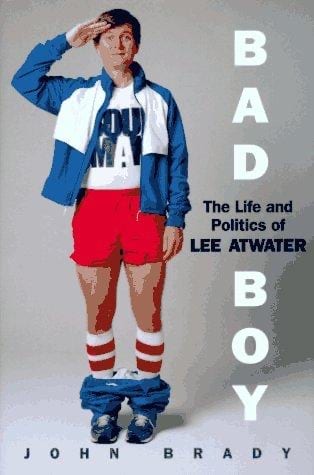
DESCRIPTION
Lee Atwater revolutionized presidential campaigning. He helped to create a solid Republican south. And he became notorious for turning national politics back into a blood sport, not only using nasty attacks but reveling in his image as the bad boy of Washington. Then, at the age of 39, Atwater was struck by a brain tumor. In thirteen months, cancer ended the most controversial career in modern politics—the charismatic, colorful, and contradictory life of Lee Atwater.Even today Atwater is a fallen leader Republicans love and a rival Democrats love to hate. He was the first political handler as mediagenic as his candidates—certainly the first chairman of the Republican National Committee to record a blues album. His campaigns represent the high-water mark of the GOPs postwar dominance of the presidency, and his techniques set the tone for races across the country. Watching Washington since his death, politicians and pundits still wonder, What if Lee Atwater had lived? Bad Boy reveals how Lee Atwater began his career controlling crowds as jittery class clown, traumatized by the agonizing death of his little brother. In college he discovered the subtle intercourse of policy and public opinion and grew from party animal to party man. Bad Boy details Atwater’s political strategies from the grass roots to the national level. Even more ruthless were the behind-the-scenes power games as he crossed paths, and occasionally crossed swords, with nearly every major Republican of the 1980s: Reagan, Bush, Baker, Ailes, Rollins, and many more.In Bad Boy, we also see the faces Atwater tried to spin away. He was a compulsive womanizer, climbing through windows to avoid reporters. He played radical politics but promoted ”big tent” Republicanism. Even his last public moment is controversial. Did Atwater’s deathbed words really repudiate entire campaigns, or were they twisted by political enemies and second-hand reporting? Was his repentance sincere or simply one last gasp of press manipulation? Was he responsible for the infamous Willie Horton ads, or was he unfairly blamed by 1988s losers, trying for a moral victory? Is Lee Atwater, a master of spin, now being spun in his grave?In its sudden end, Atwater’s remarkable life resembled the rise and fall of a fine political novel. With the probing insights of an expert interviewer and a rare stylistic verve, John Brady tells that whole frantic, fascinating story—the life of the baddest boy in D.C.
My Summary
Main Ideas, Takeaways & Similarities
Questions
I. What is the problem?
A. How is this problem formulated?
B. Why is this problem important?
C. What is the history of this problem?
D. Which prominent personalities have been interested in this problem?
II. What solutions to the problem are there?
A. What are the conclusions reached?
B. By what argument(s) is the conclusion reached?
C. What facts or assumptions serve as premises?
D. When a prominent personality offers a solution, does he also argue for or against other prominent personalities? Does he raise objections to alternative solutions? Does he consider objections to his own solutions?
III. Evaluation
A. What are the advantages and disadvantages of the alternative formulations to the problem?
B. Has the importance or history of the problem ever been misrepresented?
C. Are the solutions logically related to the premises?
D. Are the facts true? Are the assumptions acceptable? Are the objections answerable?
AI Summary
“Bad Boy: The Life And Politics Of Lee Atwater” is a biography of Lee Atwater, written by John Brady and published in 1996. The book explores the life and political career of Lee Atwater, a prominent Republican strategist. Here is a comprehensive summary of the book in bullet points:
- The book provides a detailed biography of Lee Atwater, a key figure in Republican politics during the 1980s and early 1990s.
- Lee Atwater is known for his role as a political strategist and campaign manager for prominent Republican candidates, including Ronald Reagan and George H.W. Bush.
- The book delves into Atwater’s early life, upbringing, and his early involvement in politics as a teenager.
- It discusses his rise within the Republican Party and his reputation as a skilled and ruthless political operative.
- The book explores Atwater’s work on various political campaigns, including his role in the 1988 presidential campaign of George H.W. Bush.
- It addresses the controversial and aggressive tactics employed by Atwater in his campaigns, including negative advertising and opposition research.
- The book discusses Atwater’s involvement in the infamous “Willie Horton” ad during the 1988 campaign, which is widely criticized for its racial undertones.
- It provides insights into Atwater’s personal life, including his battle with cancer and reflections on his own mortality.
- The book examines Atwater’s efforts to rebrand the Republican Party and appeal to a broader coalition of voters, including African Americans.
- It highlights Atwater’s relationships with key political figures, including his close association with George H.W. Bush and other Republican leaders.
- The book delves into Atwater’s changing perspective on politics and race as he faced his own mortality.
- It addresses the controversy and criticism surrounding Atwater’s political tactics and personal behavior.
- The book reflects on Atwater’s legacy and the impact of his strategies on American politics.
- It provides a nuanced portrait of Atwater as a complex and sometimes contradictory figure in the world of political consulting.
- The book concludes with Atwater’s death in 1991 at the age of 40, and his impact on the Republican Party’s approach to campaigning.
“Bad Boy: The Life And Politics Of Lee Atwater” offers a comprehensive exploration of the life and political career of Lee Atwater. The book delves into his role as a Republican strategist and his influence on the tactics and strategies employed in political campaigns. It provides insights into his personal life, controversies, and changing perspectives on politics and race. The biography offers a nuanced portrait of Atwater as a significant but polarizing figure in American politics.