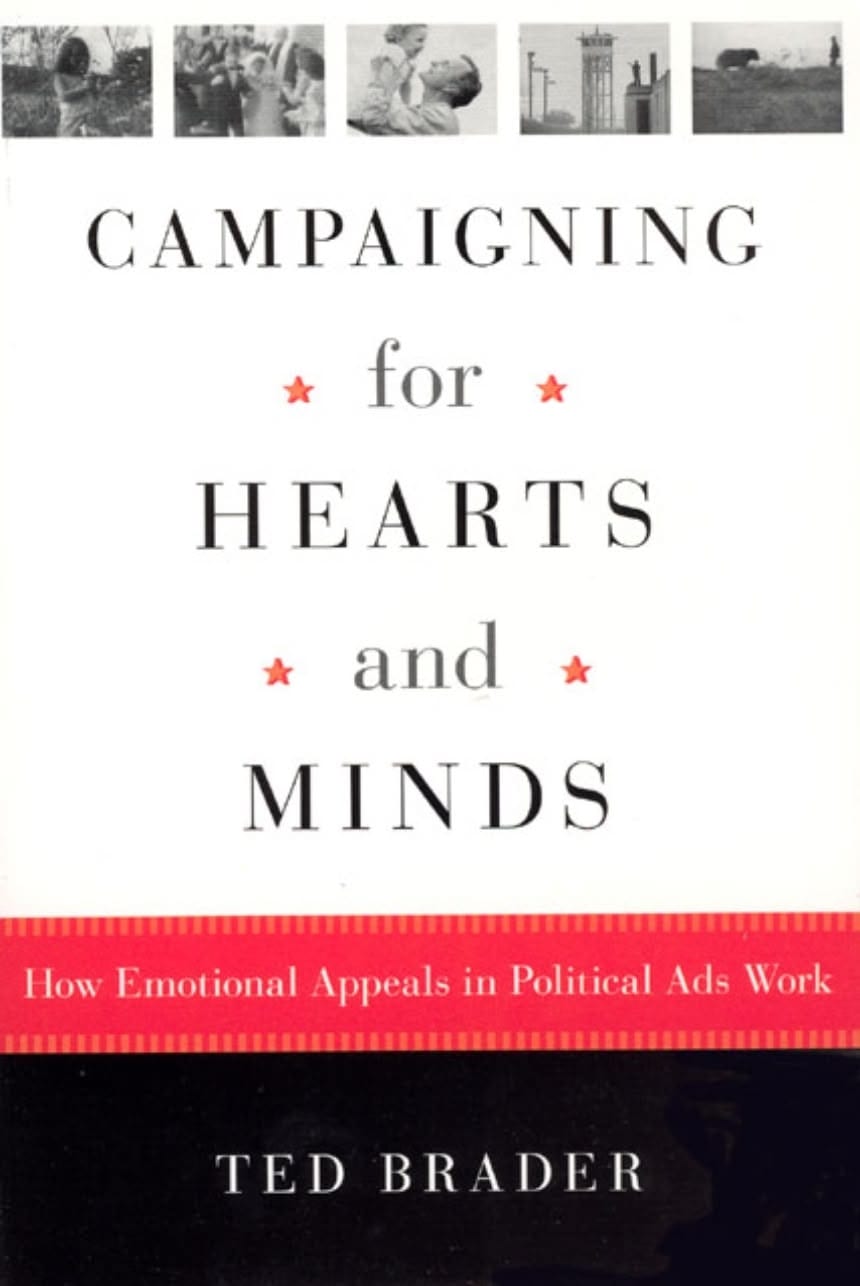

DESCRIPTION
Useful for those wishing to understand how American politics is influenced by advertising, this scientific study examines the effects these emotional appeals in political advertising have on voter decision-making.
My Summary
Main Ideas, Takeaways & Similarities
Questions
I. What is the problem?
A. How is this problem formulated?
B. Why is this problem important?
C. What is the history of this problem?
D. Which prominent personalities have been interested in this problem?
II. What solutions to the problem are there?
A. What are the conclusions reached?
B. By what argument(s) is the conclusion reached?
C. What facts or assumptions serve as premises?
D. When a prominent personality offers a solution, does he also argue for or against other prominent personalities? Does he raise objections to alternative solutions? Does he consider objections to his own solutions?
III. Evaluation
A. What are the advantages and disadvantages of the alternative formulations to the problem?
B. Has the importance or history of the problem ever been misrepresented?
C. Are the solutions logically related to the premises?
D. Are the facts true? Are the assumptions acceptable? Are the objections answerable?
AI Summary
Highlights---
Author: Brader, Ted
URL: https://www.amazon.com/gp/product/0226069893/ref=ppx_yo_dt_b_search_asin_title?ie=UTF8&psc=1
Category: Books
Genre:
- Politics
PATH: PATH
up: - "Politics MOC"
“Campaigning for Hearts and Minds: How Emotional Appeals in Political Ads Work” is a book written by Ted Brader, published in 2006. The book explores the role of emotional appeals in political advertising and how they influence voter behavior. Here is a comprehensive summary of the book in bullet points:
- The book focuses on the use of emotional appeals in political advertising and their impact on voters’ attitudes and decisions.
- Ted Brader argues that emotions play a significant role in shaping political preferences and that political ads strategically leverage emotions to influence voters.
- He introduces the concept of “affect” in politics, which refers to the emotional reactions and responses that political messages evoke in individuals.
- Brader discusses how emotions, such as fear, anger, hope, and enthusiasm, can be used in political ads to connect with voters and shape their perceptions of candidates and issues.
- The book explores the psychological mechanisms through which emotional appeals in political ads can influence voter behavior, including the processing of information and the formation of attitudes.
- Brader provides empirical evidence from studies and experiments to support his arguments about the effectiveness of emotional appeals in political advertising.
- He discusses the concept of “negative advertising” and how it often relies on fear and anger to sway voters by creating a sense of threat or crisis.
- The book also addresses the role of positive emotional appeals, such as hope and enthusiasm, in motivating voters to support candidates and causes.
- Brader emphasizes the importance of authenticity and credibility in emotional appeals, as voters are more likely to respond positively to genuine emotional expressions.
- He provides insights into the ethical considerations of emotional appeals in political advertising, including the potential for manipulation and deception.
- The book discusses the challenges and limitations of using emotional appeals in political campaigns, including the risk of backlash if emotions are mismanaged.
- Brader reflects on the role of political context and individual differences in how emotional appeals are received and interpreted by voters.
- He offers practical advice for political candidates and strategists on how to effectively use emotional appeals in campaign advertising.
- The book concludes by highlighting the enduring significance of emotions in politics and their role in shaping the democratic process.
“Campaigning for Hearts and Minds: How Emotional Appeals in Political Ads Work” provides a comprehensive examination of the role of emotions in political advertising and their impact on voter behavior. Ted Brader’s book offers insights into how emotional appeals are strategically employed in political campaigns to connect with voters, shape attitudes, and influence decision-making. It underscores the importance of understanding the psychological mechanisms at play in emotional appeals and their ethical implications in political communication.