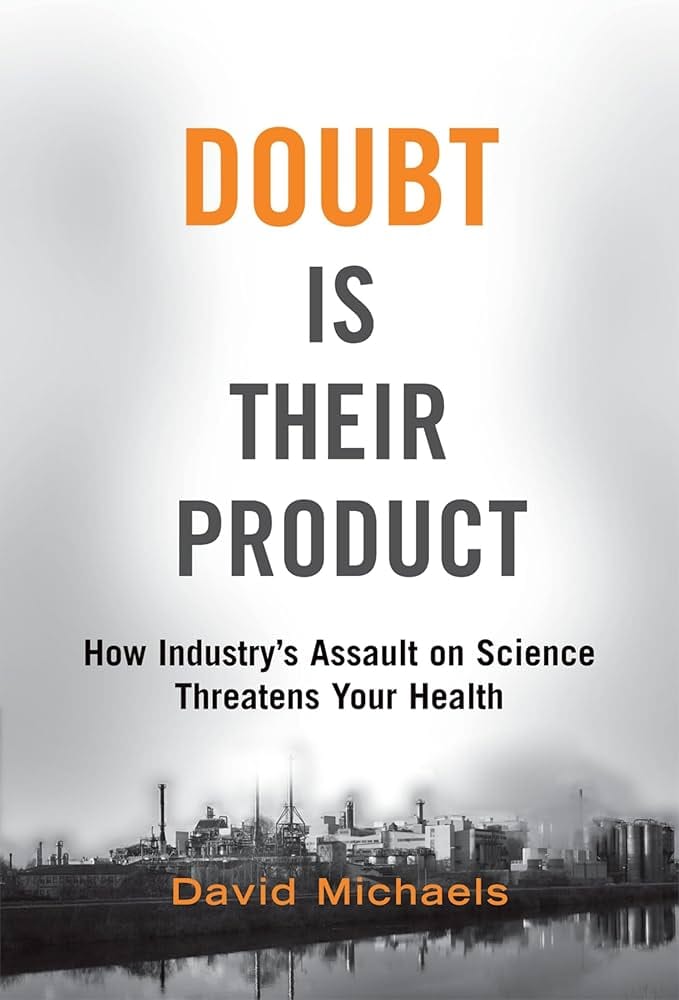

DESCRIPTION
“Doubt is our product,” a cigarette executive once observed, “since it is the best means of competing with the ‘body of fact’ that exists in the minds of the general public. It is also the means of establishing a controversy.” In this eye-opening expose, David Michaels reveals how the tobacco industry’s duplicitous tactics spawned a multimillion dollar industry that is dismantling public health safeguards. Product defense consultants, he argues, have increasingly skewed the scientific literature, manufactured and magnified scientific uncertainty, and influenced policy decisions to the advantage of polluters and the manufacturers of dangerous products. To keep the public confused about the hazards posed by global warming, second-hand smoke, asbestos, lead, plastics, and many other toxic materials, industry executives have hired unscrupulous scientists and lobbyists to dispute scientific evidence about health risks. In doing so, they have not only delayed action on specific hazards, but they have constructed barriers to make it harder for lawmakers, government agencies, and courts to respond to future threats. The Orwellian strategy of dismissing research conducted by the scientific community as “junk science” and elevating science conducted by product defense specialists to “sound science” status also creates confusion about the very nature of scientific inquiry and undermines the public’s confidence in science’s ability to address public health and environmental concerns Such reckless practices have long existed, but Michaels argues that the Bush administration deepened the dysfunction by virtually handing over regulatory agencies to the very corporate powers whose products and behavior they are charged with overseeing. In Doubt Is Their Product Michaels proves, beyond a doubt, that our regulatory system has been broken. He offers concrete, workable suggestions for how it can be restored by taking the politics out of science and that concern for public safety, rather than private profits, guides our regulatory policy.
My Summary
Main Ideas, Takeaways & Similarities
Questions
I. What is the problem?
A. How is this problem formulated?
B. Why is this problem important?
C. What is the history of this problem?
D. Which prominent personalities have been interested in this problem?
II. What solutions to the problem are there?
A. What are the conclusions reached?
B. By what argument(s) is the conclusion reached?
C. What facts or assumptions serve as premises?
D. When a prominent personality offers a solution, does he also argue for or against other prominent personalities? Does he raise objections to alternative solutions? Does he consider objections to his own solutions?
III. Evaluation
A. What are the advantages and disadvantages of the alternative formulations to the problem?
B. Has the importance or history of the problem ever been misrepresented?
C. Are the solutions logically related to the premises?
D. Are the facts true? Are the assumptions acceptable? Are the objections answerable?
AI Summary
“Doubt is Their Product: How Industry’s Assault on Science Threatens Your Health” is a book written by David Michaels, published in 2008. The book explores the tactics employed by industries to create doubt about scientific evidence and the potential health risks associated with their products. Here is a comprehensive summary of the book in bullet points:
- The book examines how various industries, including tobacco, pharmaceuticals, chemicals, and more, have used strategies to manufacture doubt about scientific research that implicates their products in health hazards.
- David Michaels, an epidemiologist and public health expert, discusses the concept of “manufacturing doubt” as a deliberate strategy employed by these industries to protect their interests.
- Michaels provides historical examples of how industries have manipulated scientific research, funded biased studies, and distorted the interpretation of scientific findings to cast doubt on the health risks associated with their products.
- The tobacco industry serves as a prominent case study, illustrating how it denied the link between smoking and lung cancer for decades, even when internal research suggested otherwise.
- The book explores the role of regulatory agencies and the challenges they face in dealing with industries that use doubt as a shield against regulation.
- It highlights the influence of industry-funded think tanks and organizations in promoting alternative narratives that question the validity of scientific consensus on health risks.
- Michaels discusses the legal strategies used by industries to avoid liability and delay regulatory action, including the manipulation of the legal system to create lengthy delays in litigation.
- The author argues that the tactics employed by these industries not only delay regulatory action but also undermine public trust in science and the regulatory process.
- Michaels emphasizes the need for transparency in scientific research and the importance of independent, unbiased research to protect public health.
- He also examines the ethical implications of industry-sponsored research and the potential for conflicts of interest to compromise scientific integrity.
- The book calls for greater accountability and regulatory reforms to address the challenges posed by industries that prioritize profits over public health.
- It discusses the role of whistleblowers in exposing industry misconduct and promoting public awareness of health risks.
- Michaels concludes by advocating for a more robust and evidence-based approach to protecting public health and minimizing the influence of industries that profit from doubt and misinformation.
“Doubt is Their Product” serves as a critical analysis of the tactics used by industries to cast doubt on scientific evidence related to health risks. It highlights the need for transparency, accountability, and independent research to ensure the protection of public health in the face of powerful corporate interests.