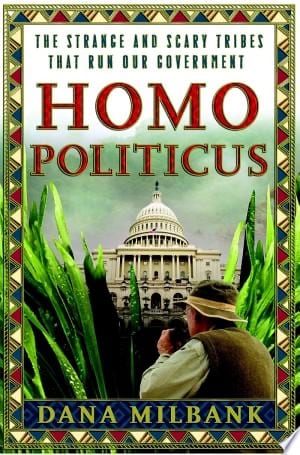
DESCRIPTION
Washington’s most acerbic (and feared) columnist, the Washington Post’s Dana Milbank, skewers the peculiar and alien tribal culture of politics. Deep within the forbidding land encircled by the Washington Beltway lives the tribe known as Homo politicus. Their ways are strange, even repulsive, to civilized human beings; their arcane rites often impenetrable; their language coded and obscure. Violating their complex taboos can lead to sudden, harsh, and irrevocable punishment. Normal Americans have long feared Homo politicus, with good reason. But fearless anthropologist Dana Milbank has spent many years immersed in the dark heart of Washington, D.C., and has produced this indispensable portrait of a bizarre culture whose tribal ways are as hilarious as they are outrageous. Milbank’s anthropological lens is highly illuminating, whether examining the mating rituals of Homo politicus (which have little to do with traditional concepts of romantic love), demonstrating how status is displayed in the Beltway’s rigid caste system (such as displaying a wooden egg from the White House Easter Egg Roll) or detailing the precise ritual sequence of human sacrifice whenever a scandal erupts (the human sacrificed does not have to be the guiltiest party, just the lower ranked). Milbank’s lacerating wit mows down the pompous, the stupid, and the corrupt among Democrats, Republicans, reporters, and bureaucrats by naming names. Every appalling anecdote in this book is, alas, true.
My Summary
Main Ideas, Takeaways & Similarities
Questions
I. What is the problem?
A. How is this problem formulated?
B. Why is this problem important?
C. What is the history of this problem?
D. Which prominent personalities have been interested in this problem?
II. What solutions to the problem are there?
A. What are the conclusions reached?
B. By what argument(s) is the conclusion reached?
C. What facts or assumptions serve as premises?
D. When a prominent personality offers a solution, does he also argue for or against other prominent personalities? Does he raise objections to alternative solutions? Does he consider objections to his own solutions?
III. Evaluation
A. What are the advantages and disadvantages of the alternative formulations to the problem?
B. Has the importance or history of the problem ever been misrepresented?
C. Are the solutions logically related to the premises?
D. Are the facts true? Are the assumptions acceptable? Are the objections answerable?
AI Summary
Highlights
“Homo Politicus: The Strange and Scary Tribes that Run Our Government” is a book written by Dana Milbank, published in 2008. The book offers an insider’s view of the political culture in Washington, D.C., and explores the behavior, rituals, and dynamics of politicians and government officials. Here is a comprehensive summary of the book in bullet points:
- The book provides a humorous and satirical look at the world of politics in the United States, particularly within the Washington, D.C., Beltway.
- Dana Milbank delves into the behavior and idiosyncrasies of politicians and government officials, shedding light on the quirks and rituals that define their culture.
- He explores the concept of “Homo politicus,” a unique species of political creatures driven by ambition, power, and the pursuit of re-election.
- Milbank discusses the role of political tribes and factions in Washington, highlighting the divisions and alliances that shape policymaking and governance.
- The book examines the influence of money in politics and the power of lobbyists and interest groups in shaping legislative decisions.
- Milbank provides insights into the media’s role in political coverage and the strategies employed by politicians to manipulate the news cycle.
- He discusses the dynamics of Congressional hearings and investigations, offering anecdotes and examples of memorable moments in political theater.
- The book explores the art of political campaigning, including the use of negative advertising, campaign spin, and the impact of political consultants.
- Milbank examines the personalities and quirks of various politicians, both past and present, shedding light on their public personas and private lives.
- He provides a behind-the-scenes look at the inner workings of Congress, including the role of staff members, committee assignments, and the legislative process.
- The author discusses the challenges and frustrations of political journalism, including the struggle to hold politicians accountable and the pressures of covering the 24-hour news cycle.
- Milbank offers a critical perspective on the disconnect between politicians and the American public, highlighting the elitism and insularity of the political class.
- The book concludes by encouraging readers to remain vigilant and engaged in the political process, despite the often absurd and perplexing nature of politics.
“Homo Politicus” offers a satirical and entertaining exploration of the world of politics, providing readers with an insider’s perspective on the behavior and culture of politicians and government officials in Washington, D.C. Dana Milbank’s book aims to demystify the political process and encourage greater understanding and engagement in civic life.