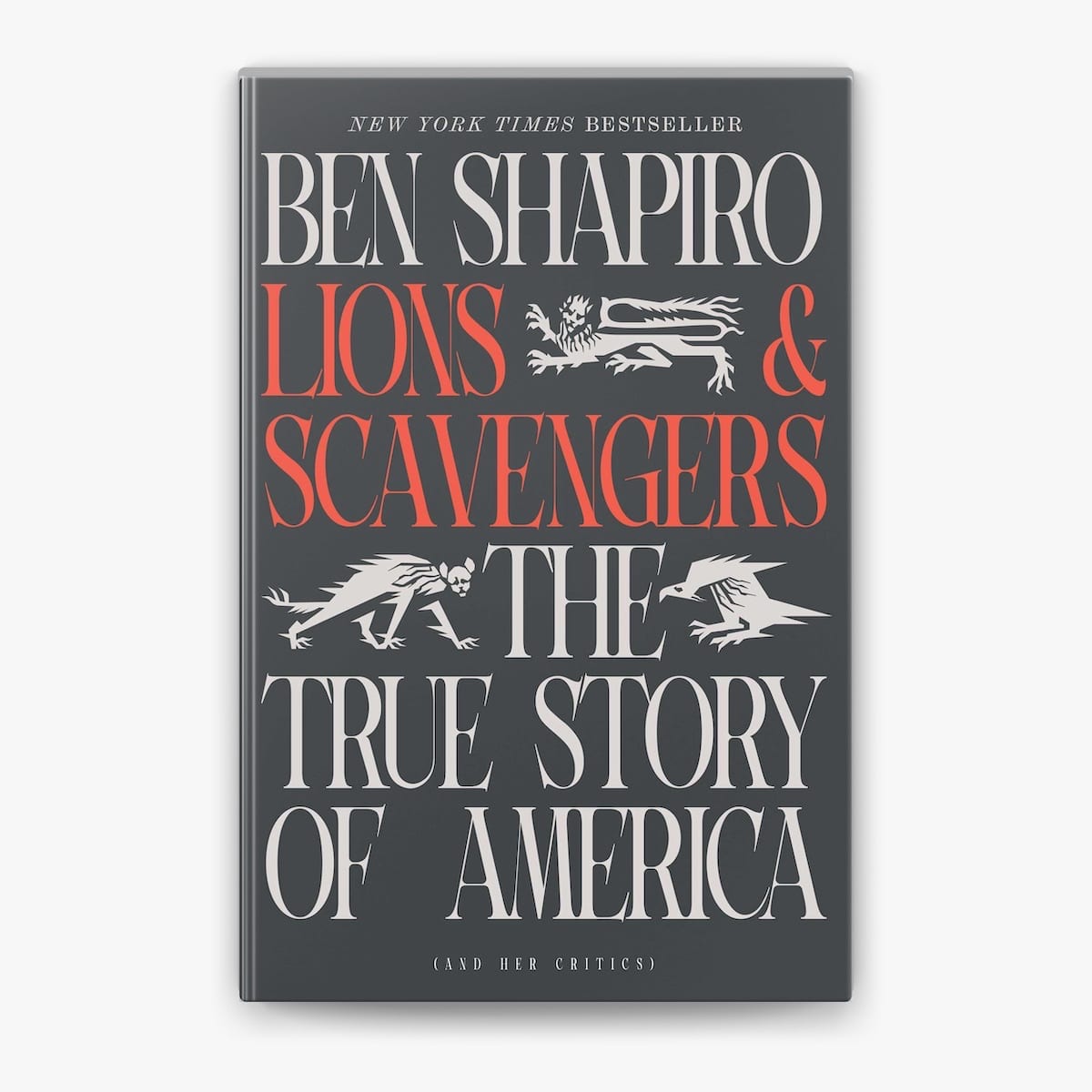
DESCRIPTION
INSTANT NEW YORK TIMES BESTSELLER #1 New York Times bestselling author Ben Shapiro examines the current state of America and Western civilization, and poses a question: will we be Lions, or will we be Scavengers? In a world split between noble Lions and destructive Scavengers, only the brave can lead the way. Acclaimed writer and conservative thought leader Ben Shapiro knows that at the heart of today’s conflicts—political, economic, and cultural—there’s a dangerous lie: that all people are equal in ability, and that all inequality stems from oppression and exploitation. With his signature clarity and sharp insight, Shapiro refutes that lie, emphasizing that in a free country, inequality is rooted in differences of talent and work ethic—not oppression—and that the best solution to lack of success lies in duty and virtue. Lions, like America’s founding fathers, strive for the highest good, building systems that promote freedom, prosperity, and equality of opportunity. Meanwhile, Scavengers degrade these ideals, spreading resentment and entitlement that threaten to dismantle the foundations of Western civilization. In Lions and Scavengers, Shapiro invites you to take up the mantle of the Lion and defend the principles that shape the freedom of a fair, powerful society. With the stakes higher than ever, this book is a gripping exploration of the ongoing war between those who cherish our nation and those who seek to undermine it. The triumph of the Lions is essential for America’s continued success. It’s a rallying cry for those who refuse to bow to the Scavengers’ demands. It’s time to fight back.
lionsscavengersbooknotes.pdf (file not included in this release)
Process
Summary
The Rules of Analytical Reading (Summary)
Stage I: Finding What a Book Is About
- Classify the book.
- State its unity.
- Outline major parts.
- Define the author’s problems.
Stage II: Interpreting the Book- Identify key terms.
- Extract main propositions.
- Find or construct arguments.
- Determine which problems are solved.
Stage III: Criticizing the Book
- General Etiquette:
9. Understand before judging.
10. Disagree reasonably, not contentiously.
11. Distinguish knowledge from opinion; give reasons.- Special Criteria:
12. Show the author is uninformed.
13. Show the author is misinformed.
14. Show the author is illogical.
15. Show the author’s analysis is incomplete.
1. What It’s About (Rules 1–4)
- Unity (1 sentence):
- Major parts outline:
- Key problems/questions:
2. Interpretation (Rules 5–8)
- Important terms:
- Main propositions (in my words):
- Arguments (premises → conclusion):
- Problems solved / left open:
3. Criticism (Rules 9–15)
- Do I fully understand before judging? ☐
- Whole book judgment (fair/unfair):
- Distinguish knowledge vs. opinion:
- Grounds for disagreement:
- Uninformed?
- Misinformed?
- Illogical?
- Incomplete?
- My judgment (agree / disagree / suspend):
- What of it? (implications / applications):
4. Cross-References (Syntopical Prep)
- Other authors on this issue:
- Agreements/disagreements:
5. Summary & Verdict
- Précis (100–150 words):
- Best passages:
- Keep / reread / discard?
Main Ideas, Takeaways & Similarities & Questions
Questions
I. What is the problem?
A. How is this problem formulated?
B. Why is this problem important?
C. What is the history of this problem?
D. Which prominent personalities have been interested in this problem?
II. What solutions to the problem are there?
A. What are the conclusions reached?
B. By what argument(s) is the conclusion reached?
C. What facts or assumptions serve as premises?
D. When a prominent personality offers a solution, does he also argue for or against other prominent personalities? Does he raise objections to alternative solutions? Does he consider objections to his own solutions?
III. Evaluation
A. What are the advantages and disadvantages of the alternative formulations to the problem?
B. Has the importance or history of the problem ever been misrepresented?
C. Are the solutions logically related to the premises?
D. Are the facts true? Are the assumptions acceptable? Are the objections answerable?
AI Summary
Highlights
PHYSICAL BOOK