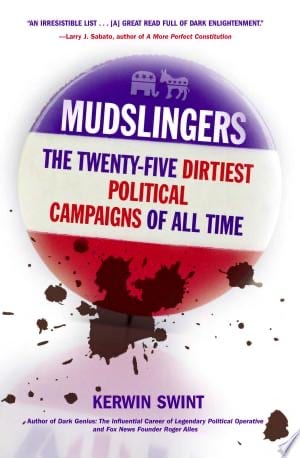
DESCRIPTION
Explores the 25 most negative campaigns in American history, including key mayoral races, especially nasty gubernatorial contests, divisive runs for the U.S. Senate, and presidential mudslinging.
My Summary
Main Ideas, Takeaways & Similarities
Questions
I. What is the problem?
A. How is this problem formulated?
B. Why is this problem important?
C. What is the history of this problem?
D. Which prominent personalities have been interested in this problem?
II. What solutions to the problem are there?
A. What are the conclusions reached?
B. By what argument(s) is the conclusion reached?
C. What facts or assumptions serve as premises?
D. When a prominent personality offers a solution, does he also argue for or against other prominent personalities? Does he raise objections to alternative solutions? Does he consider objections to his own solutions?
III. Evaluation
A. What are the advantages and disadvantages of the alternative formulations to the problem?
B. Has the importance or history of the problem ever been misrepresented?
C. Are the solutions logically related to the premises?
D. Are the facts true? Are the assumptions acceptable? Are the objections answerable?
AI Summary
Highlights
“Mudslingers: The Twenty-Five Dirtiest Political Campaigns of All Time” is a book by Kerwin Swint that explores some of the most contentious and negative political campaigns in American history. It delves into the tactics, strategies, and scandals employed by candidates and their campaigns to win elections. Here is a comprehensive summary in bullet points:
Title: Mudslingers: The Twenty-Five Dirtiest Political Campaigns of All Time
Content Overview:
- Introduction:
- Introduces the concept of dirty political campaigns and their historical significance.
- Sets the stage for the examination of 25 particularly contentious campaigns.
- Thomas Jefferson vs. John Adams (1800):
- Analyzes the rivalry between Jefferson and Adams, marked by personal attacks and partisan journalism.
- Discusses the passage of the Alien and Sedition Acts.
- Andrew Jackson vs. John Quincy Adams (1828):
- Explores the vicious personal attacks, including accusations of adultery and murder, in the Jackson-Adams campaign.
- Highlights the emergence of mass media and party politics.
- James K. Polk vs. Henry Clay (1844):
- Examines the use of propaganda and catchy slogans in the Polk-Clay campaign.
- Discusses the controversial Texas annexation issue.
- Rutherford B. Hayes vs. Samuel Tilden (1876):
- Analyzes the disputed election of 1876, marked by allegations of fraud and a contentious electoral commission.
- Benjamin Harrison vs. Grover Cleveland (1888):
- Discusses the use of “Rum, Romanism, and Rebellion” as a smear against Cleveland’s candidacy.
- Examines the impact of anti-Catholic sentiment.
- William McKinley vs. William Jennings Bryan (1896):
- Explores the influence of corporate money and advertising in McKinley’s campaign.
- Discusses the “Cross of Gold” speech by Bryan.
- Theodore Roosevelt vs. Alton B. Parker (1904):
- Analyzes the efforts to undermine Roosevelt’s credibility and portray him as a power-hungry radical.
- Discusses Roosevelt’s Progressive platform.
- Warren G. Harding vs. James M. Cox (1920):
- Examines the return to normalcy and anti-League of Nations sentiment in Harding’s campaign.
- Discusses Harding’s scandals and affairs.
- Lyndon B. Johnson vs. Barry Goldwater (1964):
- Highlights the “Daisy” ad and fear-based tactics used against Goldwater.
- Discusses the portrayal of Goldwater as a warmonger.
- Richard Nixon vs. George McGovern (1972):
- Analyzes the Watergate scandal and its impact on Nixon’s reelection campaign.
- Discusses the tactics employed by the Committee to Re-elect the President (CREEP).
- Conclusion:
- Summarizes the key themes and takeaways from the 25 campaigns.
- Reflects on the enduring presence of mudslinging in American politics.
Legacy:
- “Mudslingers” provides readers with historical insights into some of the most contentious and negative political campaigns in American history.
- It underscores the role of personal attacks, propaganda, and scandals in shaping the outcomes of elections.
- The book serves as a reminder of the enduring nature of negative campaigning and its impact on the political landscape.