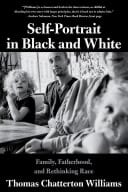
DESCRIPTION
A meditation on race and identity from one of our most provocative cultural critics. A reckoning with the way we choose to see and define ourselves, Self-Portrait in Black and White is the searching story of one American family’s multigenerational transformation from what is called black to what is assumed to be white. Thomas Chatterton Williams, the son of a “black” father from the segregated South and a “white” mother from the West, spent his whole life believing the dictum that a single drop of “black blood” makes a person black. This was so fundamental to his self-conception that he’d never rigorously reflected on its foundations—but the shock of his experience as the black father of two extremely white-looking children led him to question these long-held convictions. It is not that he has come to believe that he is no longer black or that his kids are white, Williams notes. It is that these categories cannot adequately capture either of them—or anyone else, for that matter. Beautifully written and bound to upset received opinions on race, Self-Portrait in Black and White is an urgent work for our time.
Checklist
Legend (marking)
- T = Thesis/claim
- R = Reason
- E = Evidence/example
- D = Definition
- O = Objection
- Margin cues: → why it matters · ↔ link/connection
1) Before Reading (Prime & Aim) — 5–10 min
- Survey TOC, headings, figures; sketch a quick outline.
- Write 3–5 questions I want this chapter/book to answer.
- Predict the thesis in 2–3 sentences (my words).
- Activate prior knowledge: what do I already think/know about this?
2) During Reading (Make Thinking Visible)
- Mark sparingly (≤10%): label T/R/E/D/O only.
- Add margin gists (5–10 words) and arrows (→ why; ↔ connection).
- Convert headings/paragraphs into questions; take notes as answers (Q→A).
- After each dense section: write one Feynman paragraph (explain to a novice).
- For each new concept: create one original example or analogy (not the author’s).
- Flag contradictions/tensions to revisit later.
3) Section Close-Out (every 10–20 pages or major section)
- Close the book and list bullets from memory (2–3 min).
- Write a 2–3 sentence mini-summary (my words).
- Note 1 open question and where I’ll look for an answer.
4) Session Close-Out (Immediately After Reading) — 5–8 min
- Closed-book recall dump: terms, claims, arguments, examples.
- Draw a one-page map (claim → reasons → evidence).
- 3–2–1 Reflection: 3 takeaways · 2 questions · 1 application to try this week.
- Prune highlights to essentials (keep ≤10%); add page refs to literature notes.
5) Next-Day Reinforcement — 3–5 min
- Recreate the one-page map from memory; compare and fill gaps.
- Generate ≤5 high-yield flashcards:
- definitions (cloze deletions)
- claim → best reason
- objection → author’s reply
- Write one counterargument to the chapter’s thesis (steelman), plus best reply.
6) End-of-Week Synthesis — 10–15 min
- Thesis in one sentence (my words).
- Top 3 strongest arguments and the best counters (both sides).
- 2–3 quotes with page numbers and why each matters.
- Short note: “How this changes my view/behavior.”
- Decide keep/modify/drop my planned application.
7) Application Loop (make it change behavior)
- Choose one experiment from the chapter to try.
- Define when/where + success metric + check-in date.
- Capture 30-second field notes after trying it (what happened?).
9) Quality Gates (to ensure it was active, not passive)
- I can explain the book in 2–3 minutes without the book.
- My notes contain my examples and my questions.
- I wrote at least one counterargument and reply.
- Highlights pruned to essentials; flashcards ≤5 and testable.
Scratchpad (optional prompts)
- Argument tree draft: Claim → R1/E…; R2/E…; strongest O → reply.
- Transfer: Where else could this idea apply this month?
- Source check: What data or cases would change my mind?
Process
Summary
The Rules of Analytical Reading (Summary)
Stage I: Finding What a Book Is About
- Classify the book.
- State its unity.
- Outline major parts.
- Define the author’s problems.
Stage II: Interpreting the Book- Identify key terms.
- Extract main propositions.
- Find or construct arguments.
- Determine which problems are solved.
Stage III: Criticizing the Book
- General Etiquette:
9. Understand before judging.
10. Disagree reasonably, not contentiously.
11. Distinguish knowledge from opinion; give reasons.- Special Criteria:
12. Show the author is uninformed.
13. Show the author is misinformed.
14. Show the author is illogical.
15. Show the author’s analysis is incomplete.
1. What It’s About (Rules 1–4)
- Unity (1 sentence):
- Major parts outline:
- Key problems/questions:
2. Interpretation (Rules 5–8)
- Important terms:
- Main propositions (in my words):
- Arguments (premises → conclusion):
- Problems solved / left open:
3. Criticism (Rules 9–15)
- Do I fully understand before judging? ☐
- Whole book judgment (fair/unfair):
- Distinguish knowledge vs. opinion:
- Grounds for disagreement:
- Uninformed?
- Misinformed?
- Illogical?
- Incomplete?
- My judgment (agree / disagree / suspend):
- What of it? (implications / applications):
4. Cross-References (Syntopical Prep)
- Other authors on this issue:
- Agreements/disagreements:
5. Summary & Verdict
- Précis (100–150 words):
- Best passages:
- Keep / reread / discard?
Main Ideas, Takeaways & Similarities & Questions
Questions
I. What is the problem?
A. How is this problem formulated?
B. Why is this problem important?
C. What is the history of this problem?
D. Which prominent personalities have been interested in this problem?
II. What solutions to the problem are there?
A. What are the conclusions reached?
B. By what argument(s) is the conclusion reached?
C. What facts or assumptions serve as premises?
D. When a prominent personality offers a solution, does he also argue for or against other prominent personalities? Does he raise objections to alternative solutions? Does he consider objections to his own solutions?
III. Evaluation
A. What are the advantages and disadvantages of the alternative formulations to the problem?
B. Has the importance or history of the problem ever been misrepresented?
C. Are the solutions logically related to the premises?
D. Are the facts true? Are the assumptions acceptable? Are the objections answerable?
AI Summary
Prologue
Prologue – Overview
The prologue of Self-Portrait in Black and White is both a personal story and a philosophical manifesto. Williams uses the birth of his blond, blue-eyed daughter in Paris to unsettle the American “one-drop rule,” meditate on his family’s journey from “black” to “assumed white,” and argue that racial categories themselves are fictions we should consciously reject.
He moves from intimate scenes (delivery room, family visits, old photos) to history (slavery, Jim Crow, Nazi race law) and contemporary debates (Obama, DNA tests, campus identity politics) to set up the book’s central project: confronting the illusion of race and imagining a way of relating to each other beyond rigid color categories.
1. Birth in Paris and an Identity Shock
Williams opens on the night in October 2013 when his wife Valentine goes into labor in Paris. The night drive across the nearly empty city—past the Opéra, Louvre, the Seine, Notre-Dame, the Grand Palais, and the Eiffel Tower—underscores that this beautiful, foreign-feeling city will be his daughter’s hometown, not his own.
During labor, the doctor remarks “tête dorée” (“golden head”), and he realizes with a jolt that his daughter’s hair is blond. After the chaos of birth, he wanders to the men’s room and breaks down in tears, describing himself as a kind of “newborn” as well. Alongside the usual feelings of responsibility and aging, he senses he has crossed into a new identity.
When he finally holds his daughter, he notices her inky blue eyes (which he knows will lighten but never turn brown) and feels both intense love and something like a “fear of death” – an inner voice asking, “What have you done?” that he forces into silence.
2. The One-Drop Rule and His Family’s “Black” Identity
Williams explains that he has always believed in the American rule that “a single ‘drop of black blood’ makes a person ‘black,’ primarily because they can never be ‘white.’” He contrasts this with Brazil, where a “drop of white blood” can make someone not-black.
Before Marlow’s birth, he assumed his children would be black like him—“mixed” but as black as Douglass, Du Bois, Kravitz, or Halle Berry. He had never really interrogated this either/or notion of blackness.
He describes his father, “Pappy,” as a red-brown man with freckles and a prominent “Indian” nose, but unambiguously seen as black. His mother is fully white—blond, blue-eyed, of Northern European Protestant background. Yet the family identity was shaped in Pappy’s image: theirs was “unequivocally black.”
Pappy grew up in 1930s Galveston, Texas, where horse-drawn buggies and outhouses still existed; his own grandfather was born in the last year of chattel slavery. Through education, Pappy “leapfrogged” generations into a middle-class suburban New Jersey life for his sons.
Williams recounts that his parents, though loving and bookish, were “anti-tribal.” They avoided belonging to religious or social “collectives,” barred their sons from school mass even at Catholic school, and kept few ties to extended past. That weekly experience of sitting out mass taught him from childhood to “stand apart.”
Socially, the family rejected both black and white clubs. They lived on the white side of a de facto segregated town as a quiet protest against realtors trying to steer them into black neighborhoods. Despite this nonconformity, race at home was never in question: the household was “unequivocally black.”
His father sometimes joked that his white wife wasn’t really white, just “light-skinned.” When Williams challenged this as a child, Pappy replied, “Well, she’s got black consciousness, doesn’t she?”—a conversation Williams notes could only make sense in the U.S. context.
Outside the home, the racial gulf was obvious. One of his earliest memories: in a supermarket line, after his mother scolds him and his brother, an older white woman assumes they must be adopted “from the ghetto.”
Growing up in the 1980s–90s, their interracial family drew confused or hostile stares in restaurants. Though he knew black children with different complexions, he didn’t meet anyone who self-identified as “biracial” until college in 1999. The census didn’t allow multiple race boxes until 2000, which helps him understand why some blacks feel nostalgic for segregated times: there was comfort in a “genuinely unified black experience,” however artificial its basis.
3. From New York Times Essay to the Shock of a Blond Daughter
In 2012, a year before Marlow’s birth, Williams wrote a New York Times essay confidently defining his future children as black. He now sees this as a “defiant last gasp” of an old worldview. At the time, he believed he was right and even persuaded his European wife to accept this framing.
Marlow’s actual appearance—a blond, blue-eyed, very fair child—made his one-drop stance feel absurd to him. He compares his reaction to a modern Oedipus nightmare: as if he had symbolically “slept with [his] white mother and killed [his] black dad.”
Looking at his daughter, he sees his child, a facet of himself, yet he knows most people will see and want to call her “white.” He wonders whether he has pushed his family across a threshold whose consequences he may not fully see in his lifetime.
4. Naming Marlow and the Limits of Symbolic Rebellion
The day after the birth, his father-in-law takes him to the town hall to register the baby. In France, this must be done in the first three days and is functionally a paternal privilege. His father-in-law jokes he can still change the name.
Williams feels a mischievous pull to name her something like “Jemima” or “Shaniq’wa” as a middle finger to respectability politics and a way to subvert her apparent whiteness by attaching a stigmatized “black” name. He had floated this to Valentine earlier; she rejected it as manipulative and irresponsible. The baby’s coloring reawakens his rebellious urge, but he ultimately decides that “a child’s life is not a sarcastic or even political gesture.”
He records the name Marlow—chosen partly from their shared love of The Wire and because it works in both English and French—and then adds the middle name Cora, after his father’s grandmother, the first in that line born into emancipation. He later learns that in France “Cora” is a chain-store name (like “Walmart”), his first lesson in how meanings do not cleanly transfer across the cultural worlds his daughter will inhabit.
5. Early Days: Music, Anxiety, and Pappy’s “Palomino”
Valentine spends six days in a private maternity room, courtesy of the French welfare state. For the ride home, Williams agonizes over the first song his daughter will hear, eventually picking Feist’s “Mushaboom,” a song with no specific black cultural resonance. A nagging inner voice asks why he didn’t choose Stevie Wonder, but the joy of being with Marlow gradually makes such anxieties feel increasingly irrelevant.
When his parents visit, Pappy cradles his granddaughter and jokes, “She’s just a palomino!” He explains this as part of an older black vernacular that had many terms for “improbable mélanges”—“high-yellow,” “mulatto,” “quadroon,” “octoroon”—often drawn from horse-breeding. Williams notes how bizarre these words are, yet how they point to a simple reality: in the United States, not long ago, a child like Marlow, unless she chose to “pass,” would have been legally classified and socially treated as black.
Thus, despite the cruelty of one-drop laws, there was historically a space for people like Marlow within the category “Negro,” which had little to do with strict genetics and more with shared conditions and culture. He suggests there was once a relatively unified black experience—marked by suffering but also by deep satisfactions—that did not depend on specific percentages of ancestry.
Today, he argues, that inclusive impulse is weakening, less because black people have forgotten their origins than because “whiteness,” and mixed, non-black categories, are becoming less exclusive as intermarriage grows. Over a third of Americans now report at least one family member of a different race, and since 2000 people can check multiple boxes on the census. The idea of black Americans as a “mongrel population” is fraying.
6. From “One-Drop” Faith to a Child Who Won’t Fit the Box
Williams suggests his may be the last American generation for which racial categories could so easily override what bodies actually look like. Marlow’s recessive traits force him to remember that she inherits blue eyes and fairness not only from her French mother but from his own mixed ancestry.
Despite his light skin and narrow nose, he has only ever seen a black man in the mirror and never identified with terms like “biracial” or “multiracial.” Growing up before the new census categories, such labels would not have occurred to him. But his daughter’s life will not be lived on his terms, and as a newborn she demands only care, not categorization. Only later, as she grows, does he return to thinking more intensely about how she appears.
7. Normandy Trip: Being Erased, “Don’t Lose Yourself,” and White Rooms
At four months, Williams takes Marlow on a father-daughter trip to Normandy. On arrival at his brother-in-law Steve’s chocolate shop, Steve’s sister lifts Marlow and exclaims, “Were you even in the room, or did Valentine simply reproduce herself?” He laughs outwardly, but in the car later he studies his daughter’s face, trying to locate his features that others can’t see.
This prompts a memory from his wedding on the same Norman property. Walking with Pappy under an apple tree, his father tells him quietly, “Son, don’t lose yourself.” Williams now hears this as both advice to him and perhaps a message to a younger version of Pappy himself. They never resumed the conversation, but the line grows louder with time.
Williams notes that at some point he started realizing how often he finds himself as the only black person in a room—sometimes in rooms with no other non-white person at all. In these spaces, race can feel abstract; he can, briefly, forget his racial categorization while doing everyday tasks like chatting with the baker. This “existential levity” is something he doubts his father ever experienced. Yet some inner mechanism always pulls him back into awareness that the room is white.
Looking at his daughter, he wonders whether she will develop his “ancestral GPS” or whether that signal will fade. And he questions whether it would even be right to pass on habits of orientation that are partly rooted in guilt and illusion.
8. Curating Images and Clinging to “Blackness”
During that Normandy stay, he takes many photos of Marlow. He notices himself applying filters that make her look tanner, deleting shots that look too pale or overexposed. He finds one in which her skin appears nearly ecru and sends that one to friends, relieved to have visual evidence that she is “black,” if only in the most elastic sense. That photo, plus continued reliance on the one-drop rule and the belief that Europeans “don’t know the real truth,” buys him more months of avoiding a deeper reckoning.
Another photo he keeps shows 20-month-old Marlow on a green couch beside her cousin Mila, a half-Russian, half-American child with olive skin, blond hair, and blue eyes. Between them sits a life-sized dark-skinned baby doll. The image poses a silent question: which is the “real” black baby?
The picture also evokes how they filled the house with black music—Bobby “Blue” Bland, Syl Johnson, Coltrane, Nina Simone—and how Marlow instinctively dances to it. When she gets too close to the basement stairs, Pappy springs up with unexpected speed to catch her, revealing a cross-generational bond: “They have the same smile.”
Pappy later tells him again that girls who look like Marlow and Mila would have fit easily among his classmates in segregated Texas schools. “It has always been this way,” he insists; the very idea of an absolute “other” is false. Marlow’s existence thus forces Williams to confront the fluidity of racial borders more directly than most people who haven’t grown up near those “edges.”
9. Questioning What “Black” and “White” Even Mean
Williams asks, “What does a black face even look like?” He cites writer Albert Murray’s observation that “the white people are not really white, and… black people are not black,” a truism so simple that it is hard to take seriously—like saying the sun doesn’t literally rise or set.
Referencing John Locke’s remark that categories come from the mind rather than nature, Williams notes how difficult it is to look in the mirror and see what is actually there without prejudice and myth. Despite generations of practice, we remain “obsessed with race and wholly confounded by it.”
He points out the oddity of calling Obama’s tenure the “first black presidency,” even though he is openly part-African. Americans also produce “black” public figures like blue-eyed Jesse Williams, Colin Kaepernick, and almost white-skinned NAACP leaders Benjamin Jealous and Walter White. White wrote that thousands of “white-skinned Negroes” disappear each year by passing, a precedent Williams hears echoing in his father’s refrain: “It has always been this way.”
Still, people cling to their “boxes.” Recognizing that some people might belong in more than one box paradoxically reinforces the boxes for everyone else. We haven’t truly accepted that the categories themselves are not real; we live in “collective bad faith,” refusing to draw the obvious conclusions.
10. Labels, Whiteness as Absence, and His Daughter’s Color Words
Quoting Orwell—“The worst thing one can do with words is to surrender to them”—Williams argues that terms like “black,” “white,” “mixed,” and “person of color” weigh on everyone, including those who don’t “fit” them.
He notes that in color theory white is not a color but the absence of color, and in social life “whiteness” operates as an unmarked norm: to be white is often to be seen as raceless. A drop of black blood makes one black because it disqualifies one from whiteness; blackness, meanwhile, is treated as color at its most concentrated, yet it has no meaning without the idea of white.
Designer Kenya Hara’s remark that printed letters only appear black against a white page leads Williams to note that his daughter doesn’t yet see him as “black” because she hasn’t internalized those contrasts. She calls him “beige,” recognizes her French grandfather as “white” but “pink” after wine, and her American grandfather as “brown.” She knows her mother is called white and seems to see herself as the same when she looks at her own blue eyes and blond curls.
These experiences push Williams to order a DNA test in 2016. He wants words and origins: speaking clearly about oneself requires some sense of where one comes from. For descendants of slaves, he notes, this is a particularly painful loss; without genetic testing, they often cannot even say which African country they come from. Whites, too, often dissolve into a broad “American” identity, forgetting older ethnic distinctions—as with his grandmother, who grew up speaking German but whose daughter bronzed on California beaches.
11. DNA Results, Ancestry, and Rejecting the “Skin Game”
The DNA test reports him as about 39.9% “Sub-Saharan African” and 58.7% “European,” mostly northern. His aunt, and thus his mother, appear almost entirely European (99.9%), making his father roughly 80% African—typical for African Americans. He also notes that many self-identified white Americans have some African ancestry, sometimes unknowingly.
The results include health markers: he does not carry the Alzheimer’s trait, which comforts him given his grandmother’s dementia. She forgot names but retained her childhood German, hinting that some parts of identity are tenacious even amid mental decline. He wonders what core aspects he would revert to in a similar situation.
He closes the pie-chart tab, recognizing that it cannot tell him who he is. His sense of self is being reshaped right now by his daughter’s identity and his niece’s Russianness, just as he is partly shaped by his parents and grandparents. He suggests that one becomes one’s children and grandchildren as much as one “contains” one’s ancestors.
Williams decides to stop playing what he calls the “all-American skin game” of racial box-checking, likening it to a prisoner’s dilemma where fear and self-interest keep everyone trapped. He resolves “to take a gamble and walk away,” aware that he is unusually positioned to do so thanks to his upbringing: a loving, two-parent home, an erudite father, time to read, and a non-antagonistic introduction to “whiteness” via his mother and her family.
12. Coates, Essentialism, and the Lie of Purity
Williams engages Ta-Nehisi Coates’s essay “My President Was Black,” which argues that most African Americans experience white people largely as a force for harm and that biraciality does not shield from that, often intensifying it. Coates sees Obama’s advantage as having “decent” white grandparents. Williams recognizes a similar advantage in his own life but stresses that this does not make racial designation inescapable.
He concedes that most black people do not feel able to “turn off” their racial designation—but insists that this does not mean they shouldn’t try to reject it, nor that whites should not interrogate and reject their own racial identity. Drawing on James Baldwin, he describes essentialism—the belief that one’s category is what’s “real” and cannot be transcended—as an evasion of life’s complexity. “Purity is always a lie,” he writes, most ostentatious where mixing is freshest.
He states his aim: to use his family’s multigenerational shift from “black” to “assumed white” to explore ways of seeing that lie between tribal identity politics and naïve utopianism. People will always look different, but we can choose what those differences mean.
13. The Historical Construction of Race
Williams then steps back to summarize how race as we know it is historically recent. He cites the Roman playwright Terence—“I am human, therefore nothing human is alien to me”—to show that identities were once framed as broadly human rather than racial.
The modern racial schema begins in Enlightenment Europe:
- Carl Linnaeus’s Systema Naturae (1735) divides humanity into four color-coded types (European “white,” American “red,” Asian “dark,” African “black”).
- Johann Friedrich Blumenbach later expands to five types, coining “Caucasian,” “Mongolian,” “Malayan,” “Ethiopian,” and “American,” while downplaying hierarchy.
These classifications were attempts—however flawed—to organize visible differences, especially in largely homogeneous places like Sweden and Germany.
The social and political meaning of race took shape in the New World through conquest and slavery. Quoting historian Jacqueline Jones, Williams notes that on slave ships “European captors became white and their African captives became black,” with “white” coming to mean free and “black” enslaved or descended from slaves.
He points to colonial laws that first made legal status (and thus racial status) follow the father, then switched to the mother, allowing white male slaveowners to father children with slaves without creating heirs: “black” offspring became more property, not more claimants. These rules were initially “wet cement,” not timeless truths.
Despite slavery’s end, the color hierarchy born of this system has proved durable and exportable, even where slavery itself didn’t take the same form.
14. Nazi Racial Law, “Negro Blood,” and Lingering Racial Logic
Living in Berlin, Williams visits the House of the Wannsee Conference, where Nazi leaders formalized the “Final Solution.” He studies the Nuremberg Laws diagrams, which precisely grade Jewish and black ancestry, and reads the line that “Negro blood is so strong that its influence is frequently still clearly visible among members of the 7th or 8th generation,” prompting a “thorough examination” before any marriage.
He notes that Nazis were inspired by U.S. Southern practices. The first anti-miscegenation law (Maryland, 1661) did not ban interracial marriage but enslaved white women who married black men, a way of protecting white male dominance.
Since World War II, explicit racial essentialism has been discredited in respectable discourse. People now prefer terms like “culture,” “ethnicity,” “nationality,” or “genetic pools.” Yet Williams questions whether, beneath these newer words, the same logic endures when we talk about “black blood,” “Jewish blood,” or “Native American blood.” He cites the controversy around Elizabeth Warren’s DNA test as an example of how genetic claims can unintentionally reinforce race-essentialist thinking.
His goal, he says, is to refute this “flattening thinking” and its human cost. Doing so will require overcoming “whiteness,” the illusion underpinning race, while also recognizing that identities formed in resistance to whiteness may be even harder to relinquish.
15. Campus Challenge: “Black, Period” vs. Rejecting Race
In a Q&A after a talk at a liberal arts college, a dark-skinned student from Queens, the child of Jamaican immigrants, stands up to challenge him. The student insists he is “black, period,” because that is how white people in the rural town see him and because that category expresses loyalty to his working-class community back home, contrasted with the isolating campus.
Williams empathizes, recalling his own sense of displacement in an elite college town. But he argues that the student’s stance rests on two questionable assumptions:
- That one’s inner self should be defined by neighbors’ ignorance or mistaken views (Williams notes he would count as “Arab” in France if he accepted local misperception).
- That we cannot reimagine a flawed paradigm simply because we must live with its present consequences.
He acknowledges “colorism”—lighter-skinned people having advantages—and admits it surely shapes his own thinking. But he distinguishes this from his argument: he is not simply renouncing blackness while staying within the racial frame; he is rejecting the legitimacy of race as an organizing construct at all. He believes even unambiguously dark-skinned people can, and should, reject race, because it is wrong to sanctify something both harmful and fictitious.
He extends the invitation beyond visibly mixed or light-skinned people to those considered white or Asian as well. If more well-intentioned people try to reconceive their identities beyond racial terms, he argues, the rigidity of the collective faith in race will gradually soften.
16. Kmele Foster, the “Police Argument,” and Misperception
Williams offers Kmele Foster—a dark-skinned public figure who refuses to identify as black—as an example of someone taking a similar stance from a very different starting point. Foster’s wife and child are also brown-skinned, making his rejection of racial labels notable.
He describes the common response: people say that once Foster has a bad encounter with the police, he will “see how black he is.” Williams treats this not as an argument but as a threat, an appeal to a hypothetical future event that cannot logically compel him to adopt the racist’s categories. Even if Foster were profiled, that would not oblige him to revise his self-understanding to match the officer’s prejudice—just as Williams himself should not internalize being misidentified as Middle Eastern simply because airport security often treats him as such.
17. Ideas, Language, and the Need for “Naïveté”
Williams insists that “ideas matter.” Language, images, and narratives shape how we experience ourselves and others. Fixing what is wrong with society will require not just better policies or behaviors but “nothing less heroic than new ideas.”
He quotes David Brooks: social repair doesn’t happen “at scale” first, but “in rooms one by one,” then gradually changes norms. Williams hopes his account of how the idea of race has unraveled in his own life can serve as a small spark in those rooms.
He concludes by repeating something he told the skeptical student: a degree of “naïveté” is necessary if we ever hope to solve the tragedy of racism without relying on the existence of human races. Sophisticated cynicism has already shown us where it leads.
Key Themes of the Prologue
- Personal transformation through fatherhood
- The birth of a blond, blue-eyed daughter in Paris catalyzes a crisis in Williams’s inherited black identity and his faith in the one-drop rule.
- The fragility and arbitrariness of racial categories
- From Pappy’s Texas to Nazi Germany to contemporary DNA tests, the prologue shows race as a shifting, legally and culturally constructed schema, not a biological given.
- Mixed ancestry and the lie of racial purity
- His DNA results, his daughter’s appearance, and his family’s history all reveal how thoroughly mixed people labeled “black” or “white” actually are, making “purity” a fiction.
- Bad faith and racial “boxes”
- Americans cling to rigid labels and boxes, including for multiracial people, even while acknowledging race’s social construction, living in a kind of collective bad faith.
- A call to reject race rather than just redefine it
- Williams’s central move is not to rename or multiply categories but to refuse the entire racial frame, for himself, his daughter, and ideally for others—black, white, and otherwise.
- The tension between structural reality and aspirational identity
- He fully acknowledges ongoing discrimination, colorism, and the persistence of racism, yet argues that we should not let racist perceptions dictate our deepest self-descriptions.
Notable Short Quotes
- Pappy to Williams before his wedding: “Son, don’t lose yourself.”
- Williams on race: “We are at the same time obsessed with ‘race’ and wholly confounded by it.”
- Baldwin’s essentialism (paraphrased): the insistence that categorization alone is what is real and cannot be transcended.
- Orwell: “The worst thing one can do with words is to surrender to them.”
How the Prologue Sets Up the Book
The prologue functions as both narrative hook and intellectual blueprint for the rest of Self-Portrait in Black and White:
- Narratively, it traces a line from Williams’s Southern-black, Jim Crow–marked family history, through his own “black” upbringing and internalization of the one-drop rule, to the shock of fathering a child others will read as white.
- Historically, it sketches the emergence of race as a modern idea—from Enlightenment taxonomy to slavery, Jim Crow, and Nazi race law—showing that these categories have a specific, contingent history.
- Philosophically, it sets Williams’s thesis: to confront the fiction of race, to examine how whiteness and blackness were made, and to argue that we must ultimately move beyond these categories if we want to address racism at its root.
In short, the prologue is both a personal “origin story” of his changing identity and a manifesto for the book’s central project: dismantling racial categorization from within a life that has been defined by it.
PART ONE: The View From Near and Far
Overview of the Chapter
In this chapter from Self-Portrait in Black and White, Williams traces how his sense of being “black” was not simply inherited but painstakingly constructed—through childhood encounters with racism, his father’s fears and expectations, teenage performances of black masculinity, and romantic relationships that encoded ideas about color, class, and authenticity. He then shows how experiences in France and with non-American “blackness” destabilize this identity, revealing race as local, contingent, and imposed rather than intrinsic.
The chapter sits at the heart of the book’s project: it shows, from “the view from near and far,” how a boy raised to be unequivocally black can later come to see racial identity as a negotiated story rather than a biological fact.
1. Childhood Racism and Protecting His Father
The “monkey” insult
As a third-grader at his parochial school, Williams is alone in the boys’ bathroom, swinging from a high bar between the stalls, proud of his athleticism. An older boy, Evan—freckled, blond, and stereotypically preppy—enters, blocks his exit, and twice calls him a “little fucking monkey.”
Williams is confused. On one level, he has literally been swinging like a monkey; on another, he senses something uglier he cannot yet fully articulate. He pushes past Evan and walks back to the cafeteria with his heart racing and his face burning with new self-consciousness.
Why he doesn’t tell his father
He immediately knows he will not tell his father, Pappy, what happened. He imagines the chain reaction with cinematic clarity: his father leaping from his chair, grabbing his overcoat and keys, face set and chin lowered, ready to confront the boy and the school with overwhelming fury.
Williams fears not for himself but for his father’s mental state. Pappy would lose sleep, lose work, and be transported back to his own traumatic past, tormented by the confirmation of what he has always suspected—that he cannot fully shield his sons from the “psychological warfare of American racism” that ambushes black boys when adults aren’t looking. The emotional cost to his father would be too high.
From that day and on others like it, the son decides he must be strong enough to shield his father from these truths, reversing the expected protector–protected relationship.
2. Pappy’s Fury, Boxing, and “I’ll Be Damned if They Make You White”
The car conversation about boxing
On another day, his father picks him up from school—a special event. In the car, there’s no music; instead, Pappy asks serious questions, including about sports. He suggests it’s time Thomas learn to box.
Boxing, for Pappy, is part of a balanced ideal of manhood: intellectual development is crucial, but so is physical competence and readiness. Young Thomas, sun in his face and mind wandering toward play, answers casually that he doesn’t really care about boxing.
Pappy’s demeanor changes. He repeatedly asks, “Who told you that?” and gestures toward the mostly white classmates on the sidewalk. When Thomas insists no one told him, his father erupts: “I’ll be damned if they make you white!”
The outburst shocks him. He suddenly confronts the idea that he could be “made” into something (white) he knows he cannot be. The silence in the car afterward is excruciating.
Boxing as identity and inheritance
Later, when the storm of feeling has passed, Williams asks to learn boxing. He gradually realizes how central it is to his father’s sense of himself—on par with books.
The basement is a hybrid gym and library: treadmill, bikes, weights, heavy bag and speed bag, headgear, red Everlast gloves, plus shelves of books. Looking back, he sees that his father clearly envisioned training his sons there.
They have scattered lessons over the years—foot placement, guard, parrying. Pappy is “unhittable” well into his sixties, compact, with a firm jaw and whip-fast movement.
Learning “how to take a punch”
One memory stands out: his father brings him, a small boy, into the hard, cold basement, puts gloves on both of them, and begins to jab him repeatedly in the face—not full force, but harder than you hit a child.
Pappy explains that he must know what it feels like to be hit, so it can’t ever take him by surprise. The boy is stunned, wants to be anywhere else, but endures, desperate for his father’s respect.
He doesn’t clearly remember how the session ends, only that his father never repeats this exercise. He concludes that Pappy probably disliked that lesson as much as he did, and that his father ultimately did not want him to have to rely on his fists. Still, the episode reveals that for Pappy, real manhood—and by implication, black manhood in a racist world—requires a certain familiarity with discomfort and the possibility of violence.
3. Adolescence: Wanting to “Join the Tribe”
Turning the tables and choosing a school
By eighth grade, Williams has learned to channel his own sense of racial vulnerability into aggression. He describes terrorizing Evan’s younger brother, who has no idea why he is being targeted, as one of the times he was most conscious of his race.
Around the same time, Pappy offers him a major choice:
- Delbarton – an expensive, all-boys, elite (mostly white) school with strong academics and basketball, where Pappy believes he can secure a scholarship.
- Union Catholic Regional High School – a coed, nearby school with average academics and sports but a student body that is roughly one-third white, one-third black, one-third Latino.
He doesn’t hesitate: he chooses Union Catholic. Hormones play a role (he wants girls around), but he also recognizes this as a significant assertion of racial identity. He wants to end his ambiguity and join the “tribe” his parents’ lifestyle had, in some ways, kept at a distance. He chooses to be black.
4. Performing “Nigga”: Blackness, Class, and Taste
Learning race as behavior, not genes
Through adolescence, spent mostly on asphalt basketball courts and in front of BET, and without an extended black family network (Pappy has cut ties with the South), Williams becomes a kind of convert to blackness.
He consciously learns and performs “his race,” treating it like a course on black masculinity in which he is the teacher’s pet. He uses “nigga” deliberately, not out of pride or shame but to reflect how he and his friends actually talked—a defensive appropriation of a term that captured both society’s prejudice and their own aspirations or resignations.
He notes that the genes inherited from his father (kinked hair, tinted skin) don’t encode behaviors. Everything he learned about being a “nigga” came from the “contrived and punishingly Manichaean world” he inhabited: TV, music, peer culture, and local norms.
Blackness as style and social positioning
In his town, blackness is less about physical appearance—there is enormous diversity among those labeled “black”—and more about:
- How you speak and dress
- How you present yourself to the world
- What you love and what loves or accepts you
- Whose space you disrupt or offend simply by being there
He recalls the 1990s as politically apathetic compared with today’s “woke” era: he and his peers often chose form over content—hat angles, jewelry, nonchalance. Yet their version of blackness remained defined by absence—by what it supposedly lacked.
He argues that Americans often talk about “race” when they’re really talking about class, or more precisely: manners, values, and taste. That’s why:
- A blue-collar Italian friend could insist that his bookish, academically inclined Pappy was “whiter” than the friend’s own educated-but-unrefined father.
- A poor black boy could walk into their small house, see shelves of books and his cheerful blond mother baking, and declare, “Man, y’all are rich,” despite evidence to the contrary.
Whiteness, here, is being conflated with cheerfulness, comfort, and middle-class codes; blackness with strain, toughness, and lack.
5. Stacey: Idealized Blackness, the Blond Chest Hair, and Color Hierarchies
Stacey as the “Platonic ideal” of a black partner
At Union Catholic, Williams falls in love with Stacey, a girl a year younger than him. She is neither very light nor very dark, walks with charisma, dances like an adult woman, and presents a carefully constructed urban style: plaid skirt, knee-high socks, unlaced Timberlands, gold chains, bubble gum, eye-rolls.
She rarely shares her inner world but completely occupies his imagination. He feels she “makes him whole” not only as lovers do but specifically by increasing his “physical and cultural blackness,” diluting any “whiteness” in his identity. He longs, impossibly, to make his hair coil as tightly as hers.
In Stacey, he thinks he’s found the ideal future wife: the perfect embodiment of the blackness he wants to inhabit.
The single platinum-blond chest hair
One afternoon at her grandmother’s house, after they’ve made love, she suddenly bursts into laughter, pulling at a long, bone-straight, platinum-blond hair growing from his chest. It is utterly unlike his other hair and seems to embody some buried white or even “Viking” ancestry. He plucks it, but it always grows back.
They laugh it off and never discuss it again. He leaves content to think of himself as black, albeit with this single strange blond strand. He notes that people tend not to dwell on traits that contradict the identity they are conditioned to project.
Stacey’s insecurity and black male preferences for lighter women
As an adult, he looks back on Stacey with concern. She did not seem to know what it was to be properly loved—by family or partners. Her parents were divorced and absorbed in new relationships and children; she was materially comfortable but emotionally neglected.
He connects this with a broader pattern: many of his black male peers derived their self-esteem from “moving away” from girls who looked like Stacey. They openly preferred white or “Spanish” girls:
- Some argued white girls were easier, less guarded, and more pleasant because they hadn’t experienced the same intergenerational trauma.
- Others, on a deeper level, seemed to believe white or lighter-skinned girls were actually better—and were stronger status symbols.
He notes how often his friends’ desire for Puerto Rican or Colombian girls—even from difficult backgrounds—gave away the underlying color logic: lighter bodies, regardless of class, were seen as higher value.
Internalized colorism at home
Williams resents this internalized colorism partly because he knows similar attitudes exist within his own extended family. His white grandfather didn’t want his children bringing home darker partners. More painfully, his father’s black aunt had told Pappy never to bring home a girl darker than himself.
He sees this as plantation-era logic, still alive in both black and white communities. It pains him especially because it reflects a backwards-directed self-hatred: black people measuring themselves through the contemptuous eyes of whites, as W. E. B. Du Bois described in his concept of “double consciousness.”
For Williams, this leads to a reversal: he actively covets black girlfriends as a kind of homecoming, not escape. His choice of Stacey is not just romantic but ideological: a rejection of colorist values.
6. Georgetown, Stacey’s Diverging Path, and Reaffirmed Blackness
At Georgetown, Williams decorates his dorm room with photos of Stacey as icons of his racial authenticity. He measures the more middle-class black women he meets on campus against her and feels ambivalent about them.
He also detects in himself a new sense of superiority: because he comes from what he views as a “tougher” background, he flatters himself that he is more “real” or “blacker” than his new peers—a mirror image of those who misread his family as “rich” or “white.”
Over time, their lives diverge sharply:
- He continues on a college-track path.
- Stacey doesn’t even sit for the SAT.
- On a mall date, she teases him for buying dress shoes instead of sneakers—“Jesus, them white niggas got you buggin’.”
- She becomes pregnant by a man who supports her by selling crack and moves into the projects.
He is devastated, but recognizes that their paths now point in different directions—not because of genes, melanin, or basic material conditions, but because of a chain of decisions each of them and their families have made.
Letting go of Stacey also means relinquishing the idea that his connection to her makes him more authentically black than his new classmates. Yet what persists is his sense of himself as inherently black and as someone who can only truly be complete with a black partner.
7. Betrys: “Tripled” Identity and the Complexity of Blackness
Meeting Betrys and her triple heritage
In his second year at university, Williams meets Betrys, who is unlike anyone he has known:
- Daughter of an Italian mother from Bolzano (South Tyrol, northern Italy)
- Nigerian father from the Urhobo people (with whom she’s estranged)
- Raised in Manhattan above Harlem, near the Bronx
She calls herself black and is perceived that way, but her blackness is not the Southern U.S. blackness of Pappy; it is a cosmopolitan, pan-African identity shaped by immigrant experience.
She is fluent in English, Spanish, Italian, and Japanese, quotes conscious rap (the Roots, Black Star), cooks Nigerian food, and references Chinua Achebe as casually as others reference pop culture.
Specificity vs. flattening labels
Betrys has one of the most precise self-conceptions he has ever encountered:
- She is not just Italian; she is specifically from the autonomous province of Bolzano–South Tyrol, culturally distinct from southern Italian communities. She cringes at Italian-American mispronunciations of words like prosciutto and soppressata.
- She is not just Nigerian; she is Urhobo, a distinction she considers at least as important as being Nigerian.
She resists being flattened into broad categories like “Italian,” “Nigerian,” or “white,” and questions whether his mother, a culturally privileged Protestant American, should be lumped together with her immigrant Italian mother under the same “white” label. For Betrys, privilege and cultural position, not just skin color, help define “whiteness.”
This forces Williams to see that identities are complex and sometimes paradoxical: you can be fully Italian, fully Nigerian, and fully American at once, in different aspects.
He envisions a future with Betrys in which their children would embody vast ethnic diversity but would almost certainly mark “black” on official forms, reflecting how American racial categories override nuance.
8. Clotilde and the First Major Fork in Identity
Falling for his French TA
Before that imagined future can unfold, Williams spends a summer in the Loire Valley studying French, then returns to Georgetown for one more French class taught by Clotilde, an exchange student from Nancy who serves as his TA.
Clotilde is almost a photographic negative of Stacey and Betrys: tall, blond, pale, with blue eyes. She wears Paco Rabanne, drinks coffee, chain-smokes, and has radical political views (on Palestine, capitalism, etc.). Her specific Frenchness—accent, smell, gestures—makes her feel compellingly knowable to him, even though she embodies a category he had previously excluded from his romantic imagination (white women).
During this period, he and Betrys are in a long-distance relationship that begins to fray. Clotilde destabilizes his sense of a straight path: for the first time, he perceives a fork in his identity trajectory. She warns him they are “parentheses” in each other’s lives—detours, not destinations.
Nevertheless, after graduation he finds himself on a plane not to Tokyo (his and Betrys’s original plan) but to Paris, alone.
9. France: Misrecognition, Haven, and “All Race Is Local”
Being mistaken for Arab, Mediterranean, or not-black
In northern France, teaching English near the Belgian border, he frequently visits late-night kebab shops. There, Algerian workers sometimes greet him in Arabic. One man insists he must speak Arabic and berates his parents for not teaching him his “own language.”
When Williams explains that he is American and not Arab, the man asks about his origins. He replies, “Black.” The man reacts with disbelief: “But you are not black. Michael Jordan is black!”
Similarly, on an earlier trip to Paris, a young white American tourist joins him and his friends by the Seine, assumes he is “Mediterranean,” and begins making racist jokes about blacks. When corrected, the tourist blushes and apologizes.
France as haven for African Americans
He notes that such misrecognition has long made France attractive to African Americans (GIs, artists, others). In France, they are encountered first as Americans, not as blacks, which contrasts sharply with how African and Caribbean immigrants are seen.
The crucial point is not that color becomes invisible, but that the meanings attached to it change. In the French context, his skin still registers, but the social story attached to it differs from that in the U.S.
Race as local and constructed
These experiences make him realize that race is not an intrinsic property but a function of place:
- Sociologist Paul Gilroy calls race an “afterimage,” a lingering effect of past conflicts and prejudices.
- Race is “local”: what counts as “black” or “white” depends on geography and history.
- Biologically, there are no discrete human races; people infer identity from physical traits, language, cultural cues, and nationality, but these signals have no fixed meaning across contexts.
Travel, then, is liberating and sometimes unsettling: it reveals that identity is a negotiation between how we see ourselves and how our societies categorize us.
10. Returning Home and Sliding Back Into a “Prefab” Identity
After his year teaching in France, Williams returns to New York and reunites with Betrys. The complex questions stirred up by France—about race, misrecognition, and belonging—recede.
He resumes an “easy prefabricated idea” of himself: he and Betrys see themselves simply as a black couple, even when out to lunch with their two white mothers. This willed simplicity, for him, is itself a sign he is back on familiar American ground, where race offers ready-made labels that are easier to live with than the ambiguities abroad.
11. Footnote Insights: Names, “Whiteness” as Cheerfulness, and DNA vs Race
The chapter’s footnotes deepen several themes:
- “Babe” vs. “Pappy” – The family calls his father “Babe” when speaking directly to him, a domestic, intimate form parallel to “Pappy.” It arose from his brother mishearing their mother’s “baby” as a name; it illustrates how family language can diverge from public labels.
- Cheerfulness and race – He notes the countless times people conflated his mother’s simple cheerfulness with “whiteness,” as if being in a good mood were ontologically white—an example of how behaviors and moods get racialized.
- The blond chest hair repeats in his brother – His brother also has a single long blond hair, suggesting a shared but minor genetic echo that has no straightforward racial meaning.
- “Spanish” girls – Among his peers, “Spanish” was a vague term rarely referring to actual Spaniards, underscoring how imprecise popular talk of ethnicity can be.
- His father’s view of pan-Africanism – He notes that Pappy, a Southern-descended black American like Albert Murray or James Baldwin, emphasizes the incommensurability of the black American experience compared to African or Caribbean identities, whereas people like Betrys see broader pan-African connections.
- Genetics and the “melting” of race – A National Geographic study is cited: several people with essentially the same genetic ancestry (similar percentages of European, African, and Southwest Asian/North African origins) identify themselves as black, white, mixed, or something else. Their DNA “pie charts” look alike, but their racial self-understandings and social treatment differ. This reinforces Williams’s argument that genetics do not map cleanly onto race; the construct of race “melts away” when DNA is all you see.
Notable Quotes from the Chapter
- Evan’s slur in the school bathroom:
- “You little fucking monkey.”
- Pappy’s fear of assimilation and whitening:
- “I’ll be damned if they make you white!”
- Stacey’s remark when he buys dress shoes at the mall:
- “Jesus, them white niggas got you buggin’.”
- A black friend’s weary explanation for preferring non–black women:
- “Black girls just deal with too much shit, bro. I get it, but it’s not fun.”
- The aunt’s colorist command to his father:
- “Never [bring] home a girl darker than you.”
- The Algerian kebab seller on who counts as black:
- “But you are not black. Michael Jordan is black!”
- Clotilde’s description of their relationship:
- They are “parentheses” in each other’s lives.
These lines crystallize key themes: racial insult and trauma, parental anxiety about assimilation, internalized color hierarchies, the everyday policing of “real” blackness, and the instability of racial categories across contexts.
How This Chapter Connects to the Overall Book
This chapter advances the book’s larger argument in several ways:
- From “inherited blackness” to “constructed blackness”
- It shows how Williams’s black identity, though anchored in his father’s Southern history and Jim Crow experiences, was also a performance: learned from peers, media, and romantic choices, and sustained by a desire for authenticity.
- Exposing internal contradictions of racial thinking
- The blond chest hair, family colorist remarks, and his male friends’ preference for lighter women all undermine the notion of a pure, stable blackness, even as he clings to it.
- Globalizing the question of race
- His time in France and encounters with Algerians and white tourists underline that race is not a universal fact but a local script. This prepares the ground for his later, more radical claim that racial categories themselves should be abandoned.
- Foreshadowing his later family and Paris life
- The French interlude, and his attraction to Clotilde, prefigure his eventual move to France, marriage to a French woman, and the birth of a daughter who does not visibly register as black—events that force him to confront racial categories head-on.
- Reinforcing the book’s central thesis
- Through narrative rather than abstract theory, the chapter dramatizes the book’s core idea: that race is not a biological essence but a story negotiated among history, family, desire, and geography. It shows how compelling that story can be—and how hard it is to let go, even after one has seen through it.
Taken together, the experiences here—bathroom insults, boxing lessons, teenage love, colorist hierarchies, and misrecognition abroad—form the experiential backbone of Williams’s later decision to reject racial box-checking altogether and to seek a new vocabulary for understanding himself and his family.
PART TWO: Marrying Out
Chapter Overview
In this chapter (“Marrying Out”), Williams weaves together memoir, sociology, and philosophy to examine what it means for a black American man to fall in love with, marry, and have children with a white European woman. He situates his own marriage against:
- Obama-era “post-racial” hopes and the stubborn reality of classed and racialized poverty.
- His parents’ interracial marriage in the 1960s, when such unions were still widely taboo.
- Patterns of intermarriage among black men and women, and the anxieties these raise.
- The deep asymmetry between how white and black ancestry have historically been valued in America.
Through these stories he presses a set of uncomfortable questions: What do we owe “our” group? Is marrying outside the race betrayal or a quiet rebellion against a racist system? And can we meaningfully “retire” from racial identity in a world that still treats race as real?
1. New Freedom, Paris, and Obama-Era Idealism
Book advance and existential tabula rasa in Paris
At twenty-six, still in grad school at NYU, Williams receives a significant advance for his first memoir. It buys him time and mobility: no fixed address, his relationship with Betrys is over, and his work consists largely in revisiting childhood memories. When he closes the laptop, what he wants is “alterity”—difference.
He spends autumn in Paris, living in a friend’s studio behind Montmartre. The city functions as a kind of existential blank slate:
- He follows Roberto Bolaño’s advice he has copied into a notebook: “Write in the morning, revise in the afternoon, read at night, and spend the rest of your time exercising your diplomacy, stealth, and charm.”
- He is no longer a corralled student in the Latin Quarter; now he can honestly say, je suis écrivain—I am a writer—something the French instinctively respect.
- He spends long hours wandering, reading, talking, and re-finding aspects of himself he had “lost track of,” describing this period as difficult in the way lifting weights is—strenuous but “rewardingly purposive.”
At the same time, an “extraordinary American political moment” is unfolding: Barack Obama’s rise. When Williams returns to New York he puts his things in storage, sleeps on his friend Josh’s couch, and volunteers for Obama’s campaign.
Obama as racial and political savior—then doubt
He has already canvassed once, after Obama’s upset over Hillary Clinton in Iowa, feeling an idealism he has never experienced before. In his New York milieu, people sincerely believe Obama might be the answer both to “depressing politics” and to the problem of race. An editor even half-jokes that his memoir should be titled Barack Is the New Black—a phrase that now sounds painfully premature but captured the hopeful mood at the time.
His “reality check”—the sense that America’s “racial sickness” would need far more than one presidency—begins with a canvassing trip to Baltimore.
2. Canvassing in Black Baltimore: Race vs. Class and “Gringo” Identity
The streets look like The Wire
Williams, Josh, and their German friend Kaspar drive a rental car to Baltimore, pick up clipboards and Obama flyers, and are sent to an overwhelmingly black neighborhood that feels like an episode of The Wire:
- Boarded-up row houses sagging under their own weight.
- Police cameras dangling over intersections.
- Middle-school children acting as lookouts, eating chips for breakfast.
- Battered doors bearing marks of police battering rams.
They knock on doors and encounter:
- A heavyset woman in construction boots who insists Jennifer is not home and closes the door, then later calls them back, admits she is Jennifer, and says she thought they were cops. She promises to tell “Senator Borama’s people” came by.
- A shirtless, tattooed man who calls inside, “Ay, come to the door, the Jesus people back!” When Williams explains they’re Obama canvassers, the man replies he is a convicted felon and no one in the house can vote. The campaign form has boxes for “leaning Obama,” “Republican,” “undecided,” but nothing for “permanently disenfranchised.”
- Children unsure who actually lives with them.
- An elderly man who becomes ecstatic at Obama’s picture, runs into the street shouting the news, then disappears into a liquor store and emerges with a brown bag to continue drinking.
At one door a young woman answers topless, apparently high or exhausted. He delivers his pitch while forcing himself to keep eye contact. After she finally realizes she is naked and puts on a stretched-out red tank top, they ask, “Can we count on you for Tuesday?” She says yes—and then asks, “What’s on Tuesday?”
He remembers his mother’s description of real poverty as “the permanent sense that nothing ever works,” and a line from The Wire: “You think it’s one way, but it’s the other way.”
Back at headquarters, when he admits he doubts the three of them have produced even three votes, another volunteer tells him this is “better than South Carolina,” where she met a man who had never heard not just of Bush but of the office of the president at all.
Rethinking what identity matters here
Reflecting later, Williams realizes that many of the people he met in Baltimore would identify him as black, or “mixed and therefore black,” but would not feel any meaningful sense of shared identity with him. What really grouped him with Josh and Kaspar on those porches was not race but class and network capital.
He remembers how, years earlier on spring break in Belize, Josh casually said “gringos like us.” Williams indignantly rejected the label at the time. In Baltimore, though, “gringos like us” suddenly feels unavoidably accurate:
- Racial categories blur into social ones—education, speech, demeanor, mobility.
- He is painfully aware that in the U.S. affluence is more fragile for those deemed black than those counted as white, even among the top 1 percent; black children are more likely to slide backwards. His own position is “statistically less secure” than his white friends’.
- Yet the shape of people’s lives on those streets seems more clearly determined by class, education, geography, and psychological wounds than by biogenetic ancestry.
He invokes Kafka’s diary question: “What have I in common with other Jews?” adding Kafka’s line, “I have hardly anything in common with myself.” He uses this to suggest that while group identities are real, they are not simple or all-determining.
For Williams, this becomes an ethical question: what we owe others cannot be bounded by ancestry or citizenship. He insists that:
- He should not feel more responsible for Baltimore than Josh or Kaspar simply because of African ancestry.
- Nor should he and Josh feel something fundamentally inaccessible to Kaspar just because they share American nationality.
Both are forms of tribalism that democratic, multiethnic societies need to outgrow. The “great intellectual project” ahead is to develop a self-understanding that acknowledges inherited identities without allowing them to define us.
3. Canvassing in White Fishtown: Inner-City White Strife
On a later trip, he canvasses again for Obama, this time in Philadelphia’s Fishtown, a white working-class area Charles Murray uses in Coming Apart. He describes this as the first time he has seen “inner-city white strife.”
The environment is as bleak and menacing as in Baltimore, but their reception differs:
- In Baltimore they were “Jesus people”—curious intruders.
- In Fishtown, to bored teens smoking on porches, they are objects of contempt, embodiments of “vile and effeminate liberalism” seen on Fox News or on the Penn campus. Some angrily toss their flyers aside.
Yet the neighborhood is not monolithic. Some older working-class residents and women support Obama, largely along party and policy lines rather than racial enthusiasm.
He is especially moved by an obese, ash-blond woman with oxygen tubes who begs Josh, in all seriousness, to “ask Obama” to help her keep her health care after losing her job. Her naïve belief that this young volunteer might have a direct line to the candidate leaves them stunned and sorrowful.
After Obama’s victory and the euphoria in Brooklyn on November 4, 2008, Williams flies to Buenos Aires for the rest of the year, seeking again the solitude and freedom to write.
4. Buenos Aires, Alana, and Becoming a “Statistic”
In Buenos Aires, he knows only two people:
- An older American novelist, an expat in San Telmo.
- Alana, a slim, brown-skinned woman with striking light eyes whom he first met years earlier in New York at a dinner where a mutual friend introduced them—almost certainly, he suspects, because they were her two black friends.
Alana, whose parents are both black and who is solidly upper middle class, helps him find an apartment with her fluent, Barcelona-honed Spanish. He notices:
- She has none of the “armor” or “scar tissue” his old high school friends claimed was intrinsic to being black.
- He now understands that what they called a racial condition was often a matter of personality and class.
They fall into a rhythm: he writes all day, they meet for drinks, end up at one or the other’s place, then go their separate ways in the morning. It mimics monogamy, but he always knows there is a shelf life: his return flight is booked, and he tells everyone his only firm commitment is finishing the book.
Back in Brooklyn, they still bump into each other. Now he feels again the “weight of group pressure” on his thinking:
- A friend enthuses that he could not have found a better black partner.
- Williams agrees she is a wonderful partner but notices how “black” has become the crucial qualifier. He had valued her particularity, not a racial category.
In retrospect he realizes he has become a “statistic”—one more black man in the intricate musical chairs of a race-conscious dating market, where black women are disproportionately left without partners as upwardly mobile black men date across racial lines.
5. Meeting Valentine and the Cleaver/Yacub Anxiety
Falling quickly in love and a spontaneous proposal
In January in Paris, at a bar near Place de la Bataille de Stalingrad, he meets Valentine, a French woman with a mane of yellow curls and a fur coat, who arrives with a mutual friend. He is immediately struck by her; they barely speak, but he gives her his information.
Months later she comes to New York to interview the band MGMT and writes to him. They meet for drinks; he discovers she is witty, not aloof, just shy about her English. They share:
- A need to travel.
- A belief in the power of words and ideas.
- A willingness to sacrifice stability to make a life by reading and writing.
They see each other again in New York, and then in Paris; by early summer, they have fallen in love. When she invites him to Corsica with friends, he goes. Back in New York she visits again; after a drink with his friend Jason, he impulsively introduces her as “the girl I’m going to marry.” She calmly rolls with it.
Later that night, on a rooftop overlooking the Manhattan skyline, he drops to one knee and proposes without a ring or plan. She accepts.
Eldridge Cleaver and the fear of “racial death-wish”
The next morning he wakes exhilarated but terrified. A saying echoes: when you’re black you “don’t have to do nothin’ but stay black and die”—with dying the inevitable part and “staying black” something that requires volition and character.
He thinks of Eldridge Cleaver’s attack on James Baldwin in Soul on Ice, where Cleaver describes a “racial death-wish” driving blacks to seek white partners, a self-hatred so deep the self-hater cannot detect it. Cleaver also invokes Elijah Muhammad’s myth of Yacub, the mad black scientist who “grafted” the white race by systematically breeding paler and paler offspring, culminating in “the white devil with the blue eyes of death.”
Williams wonders if he is now completing “Yacub’s sinister work,” participating in a “racial murder-suicide” that will wipe out his father’s black line. The thought “flattens” him on the mattress.
Sensing his anxiety, Valentine whispers that he doesn’t have to go through with it; he has “the right to change [his] mind.” That remark abruptly returns agency to him. He decides, out of love and also stubbornness, not to let Cleaver’s rhetoric bully him into abandoning his happiness. “What kind of liberation is that?” he asks himself. He resolves to marry the woman he wants, treating the rest as distraction.
6. Parents’ Reactions: Maternal Sadness, Paternal Stoicism
Telling his parents
They travel to New Jersey to share the news. Around the kitchen island, there is:
- Joy at seeing a genuine, sustaining love that promises grandchildren.
- A sense of generational transition: their youngest is nearly thirty, leaving behind the “suspended millennial adolescence” they never knew.
- Pride in the relationship’s health.
His mother asks Valentine whether her father has met Thomas. When Valentine says no but that “we will do it anyway,” his parents are impressed by her self-assurance.
Yet his mother also cries through laughter. He reads this as an intuition that the couple will eventually move to Paris—putting an ocean between them. She sees not “a black man and a white woman” but two freelance writers (American and French) who would benefit from a society with more affordable health care and child care and cheaper living. Her concerns are cultural, linguistic, geographic, not phenotypic.
Pappy’s reaction and “blues-like stoicism”
His father’s reaction is different. Pappy remains convinced that America is irredeemably racist and expects they will face subtler forms of racial resistance. He asks Valentine whether she understands that a white woman marrying a black man in America still faces stigma. When she says she is unafraid, his response is unreserved happiness.
Williams is struck by this levity. It crystallizes what he calls Pappy’s “blues-like stoicism” about race:
- Pappy holds two conflicting ideas at once: race is not real; race has harmed me severely.
- He refuses to let his own biography dictate his children’s choices.
- He will not fetishize skin categories now, just as earlier he had jokingly called his white wife “light-skinned, with black consciousness.”
This response aligns Pappy with the expansive black tradition of Albert Murray rather than the resentful essentialism of Eldridge Cleaver.
7. Intermarriage, “Marrying Out,” and Adrian Piper’s “Retirement” from Race
Obligations to others and the “marriage crisis”
Looking back after eight years of marriage, Williams sees his path to Valentine as obvious for someone who has distanced himself from collectives and made choices as opportunities arose. Still, questions nag:
- What does he owe other black people—especially black women—who, statistically, have a harder time finding partners?
- Can black women or Asian men (who, compared to black men and Asian women, intermarry far less) realistically “renounce” their racial identity?
He cites data (Pew, Ralph Richard Banks, etc.):
- About 24% of black men marry non-black partners versus 12% of black women; among those with bachelor’s degrees, 30% vs. 13%.
- Asian women intermarry at much higher rates than Asian men (36% vs. 21%).
- Such gender disparities do not exist among whites or Hispanics.
- In 2010, around seven in ten black women were unmarried; college-educated black women are more likely than any other group to be celibate. Many black women say only black men are suitable partners, which paradoxically intensifies scarcity.
He asks whether it even makes sense to speak of “marrying out” in a population where black Americans, on average, have roughly 25% European ancestry and are already an ethnically “mixed” group. And he wonders whether increased intermarriage and exposure to difference will help or worsen inequality. His answer is that it can do both; the question becomes how to navigate that tension.
Dinner with Ishmael Reed: black radicals, white spouses
Williams recounts a dinner in Paris hosted by jazz saxophonist David Murray and attended by the writer Ishmael Reed, who had invited him after reading one of his essays. Reed is a staunchly pro-black figure associated with the Black Arts Movement. Williams worries about disappointing him, and about bringing his white wife to meet a “big important black writer.” Valentine ends up unable to come.
At the gathering he discovers:
- Murray’s wife, who greets him, is white.
- Reed’s wife is white.
- He is seated next to another older black expat writer—from New York—whose wife is also white.
The scene forces him to confront a pattern: many black men who think professionally about race—Henry Louis Gates Jr., James Baldwin, Jordan Peele, his own father, and “countless others”—have white partners. Is this hypocrisy or betrayal, as Cleaver and Spike Lee might say? Or could it be that one of the most subversive ways to respond to racism is to simply “bow out” of its racial taboos, refusing to honor its boundaries in one’s intimate life?
He notes that we typically fixate on race (and secondarily religion and class) in intermarriage, as if those are the only or most important differences. Yet he knows writers married to lawyers with far fewer shared experiences than he and his French writer wife have.
Camus and Adrian Piper’s “retirement” from blackness
He condenses these questions into a Camus line: “The only way to deal with an unfree world is to become so absolutely free that your very existence is an act of rebellion.”
He then cites philosopher-artist Adrian Piper, who in 2012, after moving to Berlin, publicly “retired from being black.” The gesture can be read as foolish or irresponsible, but he asks: what if we take the thought seriously?
He distinguishes between:
- Passing – pretending to be white while accepting the rules of an unjust game, which ultimately affirms those rules.
- Retiring from race / marrying out – refusing to recognize the game’s legitimacy, declining to let racial categories define one’s identity at all.
Yet he acknowledges an unresolved tension: in a society that still prioritizes “whiteness,” does marrying someone designated white count as rebellion or capitulation? This difficulty sits at the heart of anxieties over interracial relationships, mixed-race identity—Zadie Smith’s “persistent horror of the middling spot”—and the prospect of a genuinely post-racial society.
8. His Parents’ Interracial Marriage in the Late 1960s
War on Poverty and falling in love
He then turns to his parents’ story at the height of America’s racial upheaval. In the mid-1960s:
- Martin Luther King Jr. and Malcolm X are assassinated.
- Los Angeles reels from the Watts rebellion.
- Lyndon Johnson’s Great Society is in full swing.
His mother has just graduated from San Diego State with a sociology degree, after attending Wheaton College in Illinois, deepening her Protestant faith, and doing South Side Chicago charity work. She takes a job in San Diego’s War on Poverty program, directing a center for poor black and Mexican families in Otay, the same neighborhood where her father pastors a conservative Baptist church.
At a community meeting she invites the executive director—a meticulous man from the Southwest (insisting he is not a “Southerner”)—to speak. This man is Pappy, an atheist. As he explains his social-justice vision, she feels he is articulating ideas that have been forming inside her, “speaking as an atheist words that felt even more Christian” than her father’s sermons. She falls in love with him and his mission, deciding she will marry him.
Legal but taboo, and the cost they paid
Pappy delays, wary of the backlash they will face. Loving v. Virginia has just struck down anti-miscegenation laws, but Gallup polls show roughly 72% of Americans still oppose black–white marriage.
In San Diego, they cannot openly acknowledge their relationship; doing so would threaten his standing and her relationship with her family and church. Only when he takes another job in Los Angeles—where they can live more anonymously—can they begin to exist as a couple in public. After five “circumspect” years, once he believes they are strong enough to withstand ostracism, he proposes.
Moving east and growing up without a “we”
Pappy has already left the segregated South; now he and his wife gradually move east, driven by job opportunities and a desire to escape the “aloofness” of her family and church, eventually ending up in New Jersey—geographically as far from San Diego as possible. As a result:
- Williams grows up with virtually no extended black family contact and very little extended white family contact.
- He has only one cousin, thousands of miles away.
- Friends—black and white—find this paucity of kin “pitifully absurd.”
As a child he sometimes longs for a wider clan, but he also knows he is unusually loved in his nuclear family. As an adult he recognizes subtle advantages in being cut off from a ready-made “we,” including the freedom to define himself outside a strong group identity.
9. The Grandfather’s Smallness and the Cost of Refusing Cross-Racial Ties
Philosophical and imaginative failure
Williams argues that the “problem of racial difference” is not only economic, political, biological, or cultural; it is also a “philosophical and imaginative disaster.” We struggle, even now, to imagine genuine, binding ties across racial lines.
He studies an old photograph of his mother’s white family in the late 1950s:
- Children with blond hair bleached by the California sun.
- Parents posing before a tail-finned Chevrolet in a pre–civil rights America.
He feels a mix of anger, pity, and above all unreality: they are kin “only in the most technical sense.” He recalls Baldwin’s observation that racism dehumanizes everyone but may dehumanize the racist most, and wonders what price his grandfather paid for refusing to acknowledge the reality of men like Pappy.
A loving grandmother vs. an absent grandfather
In contrast, he remembers his grandmother Esther, who visited for two weeks each year. Two weeks out of fifty-two were enough for him to know and love her:
- He remembers her face, smell, stride, sense of humor, and warmth.
- She helped with homework, walked to the playground, invented inside jokes.
As a child he never questioned why she always came alone; excuses about his grandfather’s bad back and dislike of flying satisfied him. Only as an adult does he realize what his grandfather’s perpetual absence really meant: an active choice to avoid crossing racial boundaries, even within his own family.
He recounts visiting them as a young adult in 2003. His grandfather, now wheelchair-bound, is charming and proud that he graduated from Georgetown. Various relatives are present; the afternoon is pleasant. As they leave, his grandfather wheels over to a shelf, takes down a pristine New Testament, and presses it into Josh’s hands, urging him to read with an “open mind.”
Williams suddenly sees this as a small but telling act of proselytizing hierarchy—his grandfather implicitly trying to convert Jews to his brand of Christianity, just as he would eagerly have pressed a book on his father if one could have converted him from blackness. Williams concludes his grandfather is exercising the prerogative of many like him: a “cookie-cutter” WASP identity that masquerades as universal while treating others as deficient.
10. Genealogy: Anton Spath vs. James “Pump” McLemore
White immigrant upward mobility
A Facebook post by his aunt Shirley introduces him to an ancestor he had never heard of: Anton Spath, a weaver born in Dietzenbach, Germany, in 1835 who immigrated to Baltimore in his twenties.
Spath:
- Marries Anna and has a son, Anton Jr., just before the Civil War ends.
- Buys land and grows willows, runs a small farm and a rock quarry.
- Acquires about twenty rental houses by the time of his death in 1913.
The family tells this story with pride—as many white Americans do—emphasizing thrift and tenacity leading from humble European origins to prosperity. Williams, too, is impressed. Yet he cannot ignore that at the same time Spath was accumulating property and power, his father’s people—who had been in America longer and could trace ancestry to both Europe and Africa—were still enslaved nearby.
The void of enslaved ancestry and the figure of Pump McLemore
Before doing DNA testing, Williams spends frustrating weeks on Ancestry.com trying to build a paternal family tree. The surname Williams is too common to be helpful. His grandmother’s maiden name, Mclemore, can be traced only back to James “Pump” McLemore, born in 1865—perhaps in Mississippi, perhaps in Texas—right on the cusp of bondage and emancipation.
Pump McLemore:
- Is among the first generation of African Americans born into legal freedom.
- Somehow becomes literate and a landowner by the time he marries Cora Jones, a descendant of Louisiana slaves.
- Has eight children with Cora.
Williams knows little beyond a 1910 census form (where Pump marks “Yes” to “Able to read?”) and a few stories from his grandmother, such as Pump floating in the Caddo River singing after long days of farm work. He and his father have no idea what Pump looked like or how he acquired land. Beyond Pump and Cora, there is a “void”—the vast anonymity of slavery.
He had not pressed his father for details, partly because the older man was told in youth to keep quiet and because digging into slavery-era origins is painful. Marlow’s birth, however, makes him yearn for more complete answers, especially as he knows she will be able to trace her French ancestors for centuries, including those who ran a factory compelled to supply the Nazis. The “black kernel” of her identity, by contrast, dissolves as one moves back in time.
23andMe, taboo, and asymmetric stigma
On the 23andMe site, a disclaimer warns that the knowledge will be “irrevocable.” Williams notes this matters not only for health information but for the 24% of white Americans likely to discover some African ancestry. As Adrian Piper observes, African ancestry among whites, though scientifically unsurprising, is still treated like an embarrassing family secret—akin to incest, murder, or suicide.
He explains why this is psychologically fraught:
- To be white in America has meant being associated with liberty and dignity, even in poverty.
- To be black has meant being “irrevocably stigmatized by the inhumanity of chattel slavery”—like a virgin in a traditional society who is violated and then scorned because of the violation.
Racial essentialism, however mutable, rests on this division between those seen as defined by inherited inferiority and those not so marked.
11. Meeting Valentine’s Father and Everyday Cross-Racial Life
He notes that racial boundaries have always been porous and are more so today. Interracial relationships no longer carry the same taboo, especially when class barriers are eased.
When he and Valentine travel to Brittany to announce their engagement to her father:
- He is unsure how the news will be received but feels his dignity is not at stake.
- Europe tends to see him first as an American, not as black.
- Even if his father-in-law objected, society would not universally echo that judgment.
In the event, there is no need for magnanimity:
- Valentine’s father reacts by leaping up to embrace and kiss him, then immediately orders his youngest daughter to book a terrace table so they can celebrate with champagne.
Williams often contrasts this “normal and decent response” with his grandfather’s cruelty toward his parents. The comparison leaves him both sorrowful and cautiously optimistic about social change.
A hybrid marriage beyond phenotype
In his own marriage, he rarely experiences the painful sense of racial division he felt, as a child, standing in the supermarket with his white mother. Reasons include:
- Society is more accustomed to mixing than in his childhood.
- He and Valentine have always lived in cosmopolitan cities.
- People are more than racial or national traits.
Valentine:
- Is “soulful,” dances well, and was immersed in black music growing up—some of which she has introduced him to for the first time—without the associated American racial mythology.
Williams:
- Is a long-time student of France, sometimes surprising his wife with aspects of French literature or culture she didn’t know.
They have little inherited shorthand; they have had to learn each other as individuals, not as racial representatives. Their marriage is hybrid in many more meaningful ways than hair texture.
At the same time, he would be naïve not to see that her hair and especially her eyes carry more social value than his. Strangers gush, “Ooh la la, les beaux yeux bleus!” over their daughter’s blue eyes. In retrospect, he connects this to his high school friend Charles briefly wearing colored contacts, and to his own apprehensive wondering whether Marlow would inherit Cleaver’s coveted “blue eyes of death.”
He insists that these seemingly minor aesthetic preferences are precisely the kind of bias he must consciously reject, without sliding into resentment, because “with such minor and arbitrary preferences entire worldviews are sustained.”
12. Parenting, Police Violence, and the Ethics of “Marrying Out”
As a parent, Williams is plagued by the usual diffuse fears, but he notices a specific fear many black parents voice—particularly since the killings of Trayvon Martin and other unarmed black youths in the age of smartphone video—is not one he experiences in the same way.
He sees friends’ social media feeds full of anguish over viral clips of police brutality and knows:
- This could still happen to him.
- It is extremely unlikely to happen to Marlow, given how she will be racialized.
He feels undeniable relief—and recognizes that this relief resembles “treason” to many.
Thus he returns to the stubborn question: Is it unethical, in such a context, for black people to date, marry, and have children with non-black partners instead of “strategically banding together”?
He worries that as the one-drop rule fades, there could emerge:
- A comparatively privileged, “white-beige” population—including Asians, Latinos, and increasingly mixed individuals—for whom accusations of “white privilege” no longer stick, yet who may still float above a persistently stigmatized, darker-skinned underclass.
At the same time, he believes that “marrying out,” if stripped of any desire to become white, could be part of a solution—a way of eroding race as a meaningful category. His answer to whether intermarriage can both intensify and alleviate injustice is “Yes.” Given the known cost of the status quo, he ends this section asking, “what are we to do?”
Notable Quotes and Their Significance
- On poverty: His mother once said real poverty is “the permanent sense that nothing ever works.” This line fuses with his Baltimore canvassing experiences and The Wire’s “You think it’s one way, but it’s the other way,” to frame poverty as a crushing, self-perpetuating expectation of failure.
- Kafka on group identity: “What have I in common with other Jews? I have hardly anything in common with myself… .” Williams uses this to underline how group identity is real but not totalizing and to question easy assumptions of shared essence.
- Camus on rebellion: “The only way to deal with an unfree world is to become so absolutely free that your very existence is an act of rebellion.” This is his touchstone for understanding moves like Adrian Piper’s “retirement” from blackness and, implicitly, his own cross-racial marriage.
- Adrian Piper on white ancestry: He cites her remark that African ancestry among whites is treated like incest, murder, or suicide—one of the most difficult facts for white Americans to swallow—illustrating how psychologically loaded racial boundaries still are.
- On his grandfather’s smallness: He imagines that had there been a book capable of converting his father “from his blackness,” his grandfather “would have procured a copy and magnanimously slipped it to him,” just as he gave Josh the New Testament. This captures the subtle arrogance of a supposedly universal identity that sees others as needing correction.
Connection to the Overall Book
This chapter deepens and extends the book’s central project in several key ways:
- From personal doubt to structural questioning
- It moves from the intimate story of falling in love with a white woman to a broader interrogation of how intermarriage interacts with race, class, and power.
- Interrogating racial obligations and “betrayal”
- By juxtaposing his anxieties (Cleaver, Yacub), intermarriage statistics, and the example of black male intellectuals with white spouses, Williams confronts accusations of betrayal while probing whether such unions can be a quiet refusal of racial scripts.
- Reinforcing the asymmetry of racial history
- The contrast between Anton Spath’s success and Pump McLemore’s barely visible existence highlights how whiteness and blackness have been historically tied to liberty vs. inherited stigma, further underscoring race’s constructed but powerful nature.
- Showing how family history shapes—and does not dictate—identity
- His parents’ marriage under legal and social duress, his grandfather’s failure of imagination, and his own freedom to marry with much less risk show change over time while emphasizing how individual choices still unfold within structures shaped by race.
- Pushing toward a post-racial ethic
- The chapter continues his argument that ethical concern must transcend narrow group identities. While fully acknowledging persistent racism and unequal risk, he insists on imagining bonds and obligations that are not determined by race, and on questioning whether racial identities themselves must eventually be loosened or “retired” for a just society to emerge.
Within the book’s broader arc, “Marrying Out” functions as the bridge between his inherited black identity and his eventual decision to “walk away from the all-American skin game.” It shows how love, ancestry, politics, and history collide in the intimate sphere—and how that collision forces him to rethink what race is, what it costs, and what it might mean to live as if it were not ultimate.
PART THREE: Self-Portrait of an Ex-Black Man
Part Three – Self-Portrait of an Ex-Black Man (pages 82–116)
A. Core Idea and Themes
In this section, Williams pushes his argument to its most radical point: that to truly escape the damage of racism, we must reject race itself—not just biologically, but as a social and moral category. He:
- Begins with an uncomfortable family scene in Normandy that crystallizes his ambivalence about inherited racial injury and victimhood.
- Moves through contemporary examples (campus talks, Black Lives Matter, Ta-Nehisi Coates, social media disputes) to show how race-thinking persists and hardens on all sides.
- Explores philosophical tensions between universalism and particularism, agency and determinism, and between rejecting race and honoring the struggles conducted in racial terms.
- Argues that racism produces “race,” not vice versa, and urges a deliberate disinvestment from racial identity in favor of shared human and class-based solidarities.
- Ends by narrating how, with Adrian Piper’s help, he decides to “retire from race,” relinquishing loyalty to a racial identity he had clung to partly out of guilt and obligation to past suffering.
The tone is reflective and argumentative, blending memoir with moral and political philosophy.
B. Normandy, Genevieve, and the Porcelain Slave Head
1. A privileged landscape with a troubling object
Williams opens in Normandy at the property of Genevieve, his wife Valentine’s widowed grandmother: a sizeable but not ostentatious estate—old main house, guesthouse, outbuildings in traditional colombage, wild fields, ponds and a pool, surrounded by idyllic apple and dairy country.
He notes that almost no Black people have ever set foot there except himself and one cousin’s Black boyfriend at his wedding, highlighting the site’s historic whiteness.
Genevieve’s background:
- She was fourteen when Nazis and then Americans seized her family’s property for troop quarters.
- Her brother was killed soon after enlisting; she hints that conditions got so dire she may have eaten human flesh.
- Yet when the war ended, her life largely returned to upper-middle-class normalcy in a still-imperial Europe.
He expected possible coldness from such a woman of her milieu, but instead she embraced him warmly and made him feel at home. He asks himself why he is tempted to give extra “credit” simply for being accepted.
2. The slave’s head and secondhand anger
Despite this acceptance, he is constantly aware of skin in Normandy. He, Valentine and her sister Juliette sunbathe; Juliette tans darker than he does; his daughter Marlow is the palest and must be shielded from burns.
In this setting, one object haunts him: a dark-brown porcelain head of a slave or servant woman—thick-lipped, bug-eyed, hollow and lidded to store bonbons or keys—displayed prominently on Genevieve’s coffee table amid hunting trophies and equestrian prints.
The first time he sees it, he wants Valentine to tell him he imagined it. She blushes. Over the meal he tries to think of other things, but when he sits with his coffee he feels the head’s eyes “glued” to him. The cousins sometimes hide it when Genevieve isn’t looking, but he himself never insists. He wonders whether his failure to demand its removal makes him a “traitor.”
3. Bound to a past that is not quite his
He would struggle to explain to Genevieve why he doesn’t want Marlow to see the object once she’s old enough to understand. He knows Genevieve would be mortified, but doubts she could grasp why it presents such an existential problem to him. Valentine does understand, and he has complained at length to her.
The more he complains, however, the more he recognizes that he is partly “playing a role,” willing himself into communion with an anger that does not originate in his own experience. The lived injury belongs to others. He and Valentine can eventually laugh at his torment because the grievance feels too abstract and artificial—he does not feel himself a victim “in any collectively accessible way” and cannot honestly see himself, or his father, in that slave’s face.
This leads to a key question: why is he “bound and defined by this sordid past in some truer way” than by his relatively “leveled present” and his daughter’s unwritten future?
He notes how members of oppressed groups sometimes feel a strange relief when they do find evidence of bias (“Of course she keeps a woolly-haired slave’s head on her coffee table!”): it confirms a belief that racism will always be what it has been. Leon Wieseltier’s remark about anti-Semitism—“It is easier to believe that the world does not change than to believe that the world changes slowly”—captures this temptation.
Yet his overall conclusion is not pessimistic. The very fact of his loving, mixed family, the deep warmth between Genevieve and his Black father, and the transformed terms on which he and Valentine live together in Normandy convince him the “wound can and does heal.” The slave head is troubling, but he doubts he should see an “eternal reflection” of himself in it.
C. Campus Talks, Segregation, and the “Privilege to Be Oblivious”
1. Speaking as an ex-hip-hop insider
Williams often lectures at universities about his first book, Losing My Cool, which critiqued the influence of street-centered hip-hop culture on Black youth. Since marrying Valentine and moving to France, and especially after Marlow’s birth, he feels increasingly estranged from the younger audiences he addresses, particularly at historically Black colleges, where the culture he once inhabited is simply everyday life for teenagers.
His own “Black experience,” he notes, has diverged sharply from theirs.
2. “Why do white people hate us so much?”
In a small freshman class in Florida, a dark-skinned boy in neat, twisted dreadlocks quietly asks why white people “hate us so much.” Williams is struck that:
- The professor is not surprised.
- Many students nod; the sentiment seems familiar and unchallenged.
He suspects the student has never truly known or loved a white person, nor been loved by one. What he tells the class is:
- There are racists one must guard against.
- But in his experience, most white people do not actively “hate” Black people; rather, they fail to think deeply and imaginatively about Black lives at all.
The problem is a poverty of imagination, compounded by de facto segregation.
This mutual alienation harms everyone but hurts Black people more, even as he still wants Baldwin’s paradoxical point—that racism dehumanizes the racist most—to be true. He describes his own position as unusual: he has seen more of both sides than most Americans, but from a vantage point more people will occupy as the mixed-race population grows. The “privilege to be oblivious,” however, remains painfully visible, especially in his relationships with some white relatives.
D. Viral Killings, Tumblrs, and a Cousin’s Denial
1. 2014: watching deaths on screens
The summer of 2014 brings a new spectacle: repeated viral videos of Black men and children dying at the hands of police. Williams is especially shaken by:
- The refusal to indict officer Daniel Pantaleo in the filmed choking of Eric Garner.
- The instantaneous killing of twelve-year-old Tamir Rice with a toy pistol in Cleveland.
These combine in his conscience with other cases to produce grief and reflection.
In response, he and his Black photographer friend Kris start a Tumblr project: portraits and oral histories of as wide a variety of Black men as they can reach, hoping to complicate the narrow cultural image of Black maleness. Friends of all colors encourage them.
2. Hope’s Facebook intervention
Then his white twenty-year-old cousin Hope (whom he hardly knows beyond small talk) joins the Facebook thread, angrily questioning why they should focus on Black men at all. She asks whether they will also do white people and declares that if a Black man’s life is different now, “it is their choice and their doing. Your skin no longer defines who you are unless you let it.”
He knows that, in many ways, her life has been harder than his, yet she is also sweet and caring. She likes his brother, has non-white relatives, and would say she loves them; she believes this insulates her from prejudice.
What disturbs him is not outright hatred, but her inability—or refusal—to think seriously about experiences that deviate from her own. Nothing in her life structure forces or incentivizes such effort. This lack of mental bandwidth is, for him, a central obstacle to mutual understanding, and not one confined to whites.
E. Ta-Nehisi Coates, Triggered Histories, and Freedom
1. Coates’s Upper West Side episode
Williams turns to a scene from Ta-Nehisi Coates’s Between the World and Me: an impatient white woman pushes Coates’s dawdling son leaving a cinema and snaps, “Come on!” Coates responds with words “hot with all of the moment and all of my history.” A white man intervenes to defend the woman; Coates interprets this as a knight rescuing the “damsel” from the Black “beast,” and imagines the crowd’s reactions along racial lines.
Williams does not deny the woman may be racist, but he criticizes Coates for refusing to consider that she may simply be a rude, self-absorbed person who would shove any child. Coates does not acknowledge that his reaction is disproportionate and likely perceived as such by bystanders, partly due to his size and intensity. For Williams, this exposes a deeper issue: as long as Black people are “so easily triggered and provoked,” with ancestral pain hovering just below the surface, they can never be fully free or equal.
2. Coates’s view of white life
Coates has written that as a child he did not know white people personally, only via television—a damning indictment of American segregation. Yet Williams feels that even as an adult Coates continues to misapprehend whites, attributing to them more power and self-satisfaction than most actually possess.
He cites passages where Coates imagines Parisian men in pastel pants and sports cars, “loving their lives” and believing themselves beyond “the design flaws of humanity,” a caricature that flattens differences among whites and overstates their ease. For Williams, this fantasy bolsters a permanent sense of injury that doesn’t always match Coates’s own material realities. If such a lens guides the country’s most influential writer on race, he fears, we will spend our time talking past one another rather than seeking shared truths.
F. Adrian Piper, Racial Anger, and White Reaction
1. Being misread from both sides
While profiling Adrian Piper in 2018, Williams comes to see more clearly the “tragic conundrum of racial incommunicability.” In her 1992 essay “Passing for White, Passing for Black,” Piper recounts being mistaken for white by working-class Black Harlemites who either mock her or test her loyalty via a “Suffering Test.” These were humiliating but clarifying experiences: they showed her how whites feel when they become targets of Black anger that is justified historically, yet arbitrarily directed.
Piper notes that in such moments one feels both unjustly accused and ashamed of being the sort of person who could plausibly provoke the accusation. From this she derives two white responses:
- Defensive anger, feeding racist stereotypes.
- Emotional detachment and physical distancing, which may allow forgiveness but also fosters condescension and makes it harder to relate to Black people as equals.
Williams finds this last, “detached” reaction especially important: many whites who abhor racism nonetheless withdraw and begin to see Black people mainly as wounded or flawed, which can itself become a barrier to solidarity.
2. Watching his own family fracture
He sees this pattern in the breakdown of his relationships with parts of his mother’s family, where he often catches himself condescending in turn. On Facebook, one uncle calls Black anguish over police killings “playing the race card,” praises Bush, and attacks Obama as the “least intelligent” president. These hardened sentiments shock Williams, particularly because this man has always been kind to him in person.
He recalls a joke tweet after Ferguson: “Just found a new app that tells you which one of your friends are racist. It’s called Facebook.” For him, social media made his relatives’ conservatism and racial resentment unbearable, especially around the 2016 election.
This context helps explain why Coates’s uncompromising pessimism is emotionally compelling, even though Williams believes it to be self-defeating: the backlash to Obama, exemplified by his cousin and uncle’s attitudes, felt like a collective spasm that helped fuel Trumpism.
G. Anti-Racism, White Supremacy, and the American Sonderweg
1. The seduction of “special paths”
Living in Berlin, Williams thinks about the German concept of sonderweg—a “special path” from Luther to Hitler that imagines German history as a linear trajectory driven by a unique national essence. Such thinking is both terrifying and soothing: it makes people puppets of forces beyond their control, whether for glory or for guilt.
He sees a similar narrative gaining ground in the United States: a national sonderweg of white supremacy, where the “original sin” of slavery, land theft and genocide is treated as explaining everything in the present. In this view, America is fated by its founding crime; history becomes a straight line from plantation to police shooting.
2. How “woke” anti-racism mirrors white supremacy
The most shocking aspect of mainstream anti-racism, in his view, is how closely it mirrors white supremacist ideas about the specialness of whiteness. So-called “woke” anti-racism:
- Starts from the premise that race is real and foundational, even if “socially constructed.”
- Reduces people to abstract color categories.
- Shares with white supremacists the belief that race is fixed and determinative, almost mystical.
He points to white friends on social media who flagellate themselves for their “whiteness” as if they were born into original sin. Citing John McWhorter, he describes this as a new religion of Anti-racism, where acknowledging “white privilege” functions like confessing fundamental sinfulness—an act that often substitutes for real change.
George Packer’s conversation with economist Glenn Loury reinforces his worry: Loury warns that if race becomes the irreducible category of politics, it becomes a weapon anyone can wield. Identity politics encourages whites to see themselves as a besieged interest group. Loury insists the “American bedrock” must remain a “racially transcendent humanism.”
For Williams, this means abandoning both white supremacy and anti-racism that reifies race. Instead, we need a new vocabulary that moves beyond tribal categorization and seeks shared democratic values accessible to all. Simply calling race a social construct is not enough; treating race as a “social fact,” as Walter Benn Michaels notes, often just means admitting we were wrong biologically but insisting on continuing the error.
H. Personal Position: Limited Racism, Different Risks, and Black Lives Matter
1. His life vs. the life he was prepared for
Pappy raised him to brace for the burdens of being a Black man in America, particularly the burdens placed on “Black-looking bodies.” Yet, in practice, Williams has rarely suffered direct harm because of his appearance. He has:
- Been denied entry to a Munich club where his blond friend was welcomed.
- Been in a meeting where a white interlocutor addressed only his white partner even when responding to Williams’s remarks.
He knows such experiences could be constant for others; if he had to endure them daily, they would shape him more deeply. Still, his adult life has not matched the worst predictions.
His daughter’s life diverges even more: he is quite certain she will not be turned away from the doors that might have rejected him. This raises a haunting question: what of “his people” is preserved in Marlow? Is the surface aspect that has changed—her skin and eyes—really what matters most?
2. Support for Black Lives Matter, but philosophical misgivings
He criticizes many contemporary voices that make “the body” the sole ground of identity. While he largely supports Black Lives Matter’s aim of exposing criminal justice abuses, he finds its very framing—positing some lives as “essentially black” and others as “white”—philosophically inadequate. It risks re-inscribing the categories that racism relies on.
His cousin’s crude colorblindness is wrong in denying pervasive injustice. But he argues we cannot defeat racial pathologies by clinging to the mental habits that generated them.
Here he invokes Paul Gilroy’s call for a radical rethinking of how racial differences appear to us, and Frantz Fanon’s plea for a “new man.” He imagines a national project of sloughing off inherited “skins.” Yet he acknowledges a deep bind: generations of struggle aimed at securing the freedom to create oneself now threaten to dissolve the very racial identity whose existence fueled that struggle. That paradox, he argues, must be faced and resolved by shedding the identity itself.
I. Debate with “B.”: Universalism, Agency, and Critical Mixed-Race Studies
1. The Berlin lecture and a colleague’s challenge
At the American Academy in Berlin in 2017, he gives a lecture (with family photos) advancing the argument of this book. White American and German listeners range from puzzled to politely supportive to genuinely enthusiastic about a post-racial future. Some Black attendees also support the talk, but others are upset.
A Black colleague, “B.,” an American academic raised in Zurich, married to a white man, challenges him in the Q&A and later in a thoughtful email. Her objections matter to him because they articulate, carefully and sympathetically, the resistance he encounters whenever he questions his allegiance to racial categories.
Her own scholarship traces long histories of Black participation in European classical music, undermining the notion that certain practices “belong” to racial essences. He admires this work and wants to push its implications further.
2. Universal ideals vs. historical domination
B. worries that appeals to universal values have long served as camouflage for white supremacy: high-minded universalism has often accompanied Black subjugation, colonialism and exclusion from the “good life.” Thus, universalism and particularism can appear as two sides of the same coin of power.
Williams replies that ideals like shared truth and equal worth are akin to kilograms or Greenwich Mean Time—empty without human implementation, but not inherently white. The fact that white freedom historically depended on Black unfreedom does not mean it must always do so. Just as heterosexual marriage once depended on excluding same-sex couples but has since expanded, universals can be realized more fully over time.
He quotes Henry Louis Gates Jr., who insists that only through education that seriously engages cultural diversity can we transcend divisions of race, class and gender. Gates maintains that any human being sufficiently motivated can fully possess any culture, however “alien.” For Williams, this supports salvaging the best of Enlightenment universalism—reason, tolerance, the search for unifying truth—while discarding its historical biases.
3. Agency vs. determinism
B., influenced by Gayatri Spivak, questions how much agency individuals can really exercise in racialized societies: can a Black person truly reject being Black when every social structure re-inscribes that identity? Are we not too thoroughly determined?
Williams admits the question is philosophically difficult. He does not deny the near-impossibility of transcendence for enslaved ancestors or the deeply marginalized “subaltern.” But he insists that people in 21st-century Western democracies retain real capacity to accept or challenge the racial designations imposed on them.
He aligns himself explicitly with existentialism: external forces constrain us, but we remain responsible for our beliefs and actions. He invokes Heidegger’s idea of “thrownness”—we are hurled into circumstances we did not choose, yet these do not fully dictate our future.
Quoting theologian Greg Boyd, he argues that everyone who deliberates implicitly believes in free will; a belief that cannot be consistently acted on cannot be true. B., by composing her critique, exercises precisely the agency she questions. He concludes that while no one can be compelled to accept agency, we all live and argue as though it exists.
J. Against “Monoracial” and “Mixed-Race” Identities Alike
1. Critical mixed-race studies
B. also asks whether he has engaged critical mixed-race studies (CMRS). He has: scholars in this field highlight how “racial blending” has always existed and expose the role of hypodescent and monoracial norms in shaping US thought. They stress the mutability of race and the porosity of racial boundaries.
He finds this vital, but parts ways with CMRS on one point: their insistence that interrogating monoracial norms should not delegitimize monoracial identification. He argues that if race itself is a mistake, then all monoracial identities are fictitious—and so is the notion of a separate “mixed-race” identity, since everyone is mixed in some sense.
2. Colorism and practical steps to freedom
B. objects that physical variation is real—her own brother is very dark—so colorism cannot be sidestepped. For him to “reject race” is one thing; what would freedom look like for someone whose appearance is unmistakably coded Black?
He acknowledges the difficulty but argues that colorism is best understood as a symptom of power imbalance rather than an essence. Whether or not race exists, racism and racial inequality do.
Adrian Piper proposes incremental steps:
- Research one’s genetic and genealogical background; most people will find it variegated.
- Begin, if one chooses, to describe oneself as “mixed” instead of “Black” or “white.”
- Use this as a way station toward fully rejecting racial categories.
For B.’s brother, taking this stance would likely be an intellectual and political project, not a mere label. It would require study and articulation, and might provoke ridicule from both whites and Blacks. Williams admits not everyone can tolerate such discomfort, but he notes that he himself has been mocked both for calling himself Black and for disavowing the label. In his view, the occasional social cost is a reasonable price for the freedom of self-definition.
K. Racecraft, Currency, Class, and Culture
1. Racism creates race
Drawing on Barbara and Karen Fields’s Racecraft, Williams emphasizes the idea that racism creates race, not the other way around. Race is like witchcraft: witches do not exist, yet real women have been executed as witches.
He suggests another analogy: race is like currency. Since the end of the gold standard, we know money is an abstraction, but our shared belief in it has very concrete effects. If race is like money, then whiteness has functioned as the crispest hundred-dollar bill, a powerful form of social capital.
Whites benefit most from this system; light-skinned minorities may sometimes buy in as well. This can be called white supremacy or white privilege. But recognizing this should lead all those deemed “non-white,” and whites of goodwill, to withdraw cooperation from the “confidence game,” not to reinvest in its categories.
Any serious disinvestment from racial identity, he argues, must be accompanied by renewed attention to class. Militarized police, unaffordable medicine, rising seas—these crises cut across color lines and demand class-based coalitions, glimpsed in movements like Bernie Sanders’s 2016 campaign.
2. The risk of cultural erasure, and the answer
B. points out another worry: removing race might erase the particularities of Black life and culture. Blackness has produced extraordinary art—from Hughes and Bearden to Michael Jackson. How else do people organize cultural belonging if not along racial lines?
Williams responds by distinguishing between racial mystification and real communities and traditions. Race is neither biological nor necessary as a social organizing principle. All cultures, he argues with Piper and Gates, are ultimately available to any human being, though not all are equally central to everyone’s life.
There is no inherent “Black sensibility” or “Black culture,” only particular groups at particular times, drawing on inherited habits in new circumstances. Black Americans did create jazz and the blues, but their achievements can inspire and be carried forward by people of many backgrounds. He can feel an intense connection to James Brown’s “The Payback” as part of a paternal and communal inheritance without calling that inheritance “racial.”
L. Self-Image, the Blues, and Letting Go of Racial Guilt
1. B.’s struggle and Albert Murray’s “Omni-Americans”
B. closes her email by describing her own long effort to accept her brown skin and curly hair growing up in Switzerland. She sometimes wished to be white to make life easier; what saved her was immersing herself in the histories and achievements of Black figures like Marian Anderson, W.E.B. Du Bois, Mary Church Terrell—and even the pop icon Beyoncé.
For Williams, this speaks to self-image, which Albert Murray considered crucial. In The Omni-Americans, Murray argued that labels like Black and white, saturated in pseudo-science, are unhelpful; African-Americans embody within themselves the mongrel nature of the US. People live in terms of images, and the prevailing images of Blacks as victims—even when produced by Black thinkers—are inadequate.
B. changed her governing images by finding models of resilience among people labeled Black. Williams asks why these identifications must remain racial when their inspirational power is clearly broader: Black people may be moved by Shakespeare or the Buddha; non-Black people may be moved by Du Bois. Children, he notes, do not naturally loathe their bodies or think racially; they learn these responses. They can also unlearn them through relationships and self-reflection.
He returns to Murray’s idea of the blues as “equipment for living”: a way of reconfiguring life’s terms so that dignity comes from playing the hand you’re dealt as best you can, while recognizing that no one else has a perfect hand either.
M. Adrian Piper, Marlow, and “Retiring from Race”
1. Piper’s family as proof of racial absurdity
Williams then recounts Adrian Piper’s own family history to dramatize how porous racial lines are. Her father received two birth certificates—one listing him as white, a second (at his mother’s insistence) labeling him “octoroon.” Her grandfather abandoned his family and started a new “white” family out West; her great-uncle William lived as a white aviation magnate, “the Henry Ford of Aviation.”
Her father grew up privileged in private school but was shamed and pulled from the basketball team when he asked a white girl out. In WWII he enlisted as Caucasian to see combat, but the racism he witnessed as a “white man” horrified him, and he never again wavered from a Black identity afterward.
For Williams, Piper’s father’s switching identities shows how arbitrary race is: if one man can be both “Black” and “white” at different times, what is race? He sees the same contrast in his own ancestry: on his mother’s side, German immigrants who “pulled themselves up”; on his father’s side, a void of chattel slavery. Race, he concludes, is little more than “the difference between those who descend from the free and those who do not.” Yet he himself has always been free—so why should he let the slaver’s perception define him?
2. Dinner in Berlin and the final step
Over dinner with Piper in Berlin—held in a former Jewish girls’ school—he confronts his last hesitation. The one thing keeping him attached to a Black identity is a vague sense of indebtedness: earlier generations suffered under that label, and created beauty under it; he fears that leaving it behind would dishonor their pain.
He shows Piper a photo of Marlow on his phone: a three-year-old with ivory skin, limpid blue eyes and a puff of golden curls, standing on a jetty in Sweden. He often thinks that in the not-so-distant past, a child like her could have been enslaved, as he and his father might have been, but she now looks like those who did the enslaving. He confesses that it worries him she may not feel guilty.
Piper’s answer cuts through his anxiety: “Why would you want that in the first place? If the pain and the guilt isn’t there, why introduce it?”
This simple question destabilizes his assumption that allegiance to ancestral pain is morally required. He remembers Richard Wright’s insight: every hour spent fighting for freedom is an hour not free. At some point, the very struggle can become another form of bondage.
As he leaves the restaurant, he tells Piper he, too, is “retiring from race,” stepping out of the flawed and cruel game that depends on belief in racial fictions. Nothing in the world changes in that moment—but his stance toward it does.
N. Notable Quotes and Their Roles
- On the allure of pessimism: “It is easier to believe that the world does not change than to believe that the world changes slowly.” (Leon Wieseltier, applied to racism’s persistence and our temptation to see it as eternal.)
- On racism and race: The Fields sisters’ view that racism creates race, not the other way around, underpins his call to reject the “racecraft” that keeps racial thinking alive.
- On the new religion of anti-racism: John McWhorter’s comparison of “white privilege” discourse to acknowledging original sin helps him argue that some forms of anti-racism mirror the metaphysics of white supremacy.
- On freedom and rebellion: Camus’s injunction—to become so free that one’s existence is rebellion—finds concrete expression in Adrian Piper’s and Williams’s decision to “retire” from being Black.
- On guilt and inherited pain: Piper’s question—“If the pain and the guilt isn’t there, why introduce it?”—marks the turning point where Williams stops believing he must perpetuate racial suffering in his daughter’s imagination to honor the past.
O. Connection to the Overall Book
This section completes the arc that began with Williams’s childhood desire to be unequivocally Black and moved through his interracial marriage and his daughter’s birth:
- From experience to philosophy: Early chapters focus on lived tensions—mixed family, interracial love, foreign cities. Here, he systematizes those experiences into a philosophical position: racism is real and must be resisted, but “race” is a fiction we must finally abandon.
- From loyalty to past suffering to loyalty to freedom: His earlier loyalty to Blackness stemmed from solidarity with ancestors’ pain. This section shows him recognizing that clinging to that pain can itself become a chain—and deciding to prioritize present and future freedom over inherited guilt.
- From isolated self-questioning to an explicit call: Having traced how race has unraveled in his own life, he now explicitly calls for a broader “retirement” from race, beginning especially with those who have the most to gain from dismantling the Black–white binary.
Within the book, these pages mark the point where “self-portrait in black and white” becomes “self-portrait of an ex-Black man”: not someone free from the history of racism, but someone determined not to let that history’s categories define his, or his children’s, fundamental identity any longer.
EPILOGUE
Epilogue – “The Shape of Things to Come”
1. Main Idea and Themes
The epilogue circles around one central tension:
- How do you honor a history of Black struggle and suffering when your own children no longer look Black and will never endure the same dangers?
- And how do you resist racism without remaining imprisoned by the very idea of race?
Williams ends the book by choosing, firmly, to live beyond racial categories: grounding himself not in abstractions like “Blackness” or “whiteness,” but in concrete love for specific people, in the present, and in a commitment to keep difference from hardening into hierarchy.
2. The Daydream: A Future Descendant Who Barely Remembers
Williams describes a recurring daydream from years earlier:
- A pale, blond, blue-eyed young woman, somewhere in Europe, casually mentions that she once had Black ancestors in America.
- She says it with the offhand tone of a classmate claiming faint “Cherokee” ancestry.
- Her companions show mild surprise at most, then move on to trivial talk—weekend plans, the menu.
In this moment, he imagines a whole world—his ancestors’ history, culture, struggle, and his own sense of self—“dissolve into the void” in one casual exchange. He can see a “potential Marlow” he can no longer recognize.
This triggers two forms of panic:
- Specific panic: Has he and his brother permanently changed “the culture or mind-set or physiognomy or… ‘race’” of an entire line, like a train slowly switching tracks?
- Moral panic: At a time when people deemed Black are still disproportionately stopped, frisked, harassed, and killed in broad daylight, what does it mean to have “escaped a fate”? What is proximity to “whiteness” worth, and what does color cost—for those who have it and those who don’t?
The birth of his second child, Saul—an even paler, bluer-eyed “Venetian blond” son—sharpens these questions and adds gender: he suspects it will be “something else altogether to raise a white-looking male.”
3. Reframing “Proximity” – From Color to People
Over time, Williams learns to pose the questions differently:
- He begins to acknowledge that what he is close to is not abstract “whiteness” or “blackness,” but actual family and friends—“real flesh-and-blood people, of different hues and heritages, nothing more or less.”
- He repeats Albert Murray’s point: “the white people are not really white and… black people are not black,” and decides to inhabit that “childlike foolishness” as an antidote to an adult world that turns color metaphors into real castes.
He is determined to live at that level of “foolishness” because it is the only way he knows to resist a system that can even co-opt anti-racism into reinforcing color hierarchies.
4. Kapuściński’s Dissident and the “Great Evil” of Race
Williams quotes Ryszard Kapuściński on the anti-Communist dissident who becomes doubly victimized:
- First, imprisoned by the system itself.
- Second, imprisoned in thought by spending his life obsessed with Communism’s “web of problems.”
Kapuscinski writes that this is “the demonic nature of great evil”—it blinds and forces you into its straitjacket. Williams suggests that if we substitute “race” for “communism” in this passage, we get a parallel insight:
“No matter how long and hard you try—you cannot struggle your way out of a straitjacket that does not exist.”
Pretending the straitjacket exists—continuing to frame everything in racial terms, even in opposition—leaves you in a “severely restricted posture.” He wants to “stand tall, with [his] full range of motion intact.”
He admits that he used to need society’s racial web: the Black/white, free/unfree binary, even when he suspected it was irredeemably flawed. James Baldwin once noted it is easier to sink deeper into a lukewarm bath than to stand and walk away; Williams now feels he has no choice but to get out—for his children’s sake.
5. From Abstraction Back to the “Jagged Grain” of the Present
He describes a shift in where he seeks liberation. It no longer comes from wrestling with abstractions about race, but from a recurring movement:
- Away from the “abstract, general, and hypothetical.”
- Back into the “jagged grain of the here and now.”
He roots himself in:
- The “humanizing specificity” of his love for his father, mother, brother, wife, and children.
- His delight in them as “distinct and irreplaceable people, not ‘bodies’… or avatars, sites of racial characteristics and traits, reincarnations of conflicts and prejudices past.”
Through them, he returns to himself as:
- “A man and a human being who is free to choose.”
- Someone who has made choices and is not reducible to “a set of historical circumstances and mistakes.”
This is the heart of his ex-racial stance: identity grounded in concrete relationships and agency, not in inherited racial scripts.
6. Provence Gathering: Many Origins, One Table
Shortly after Saul’s birth, the family rents an old house in the Luberon region of Provence. Over several weeks, a wide range of people pass through to meet the baby and enjoy the place:
- Blacks “of a variety of mixes,” Jews, gentiles, Arabs, Asians.
- French-speakers with roots in former colonies, French families with aristocratic “de” names.
- “Plain-old Americans.”
All “broke bread” and “sipped the same wine.” What is exceptional in a “painfully tribal world” is how normal it feels.
He does not claim to be “colorblind”:
- He doubts he’ll ever stop noticing ethnic and social differences.
- But he has “ceased to allow those differences to dominate and determine the exchange.”
The scene offers a small, lived example of the post-racial practice he advocates: differences acknowledged, not erased, but stripped of their power to dictate hierarchy or distance.
7. Camus, History, and the Sun
On those Provençal mornings, he straps Saul to his chest and walks the terrace while rereading Albert Camus. The Luberon mountains would have been familiar to Camus, who bought a house in nearby Lourmarin with his Nobel money and is buried there under a simple stone whose name is nearly worn away.
Williams recalls visiting that grave, then reads a Camus line as he shields Saul’s “nearly translucent” skin from the sun:
“Poverty kept me from thinking all was well under the sun and in history,” Camus wrote. “But the sun taught me that history was not everything.”
He contrasts this “wise and supple view” with today’s loudest voices on race, who lean heavily on Faulkner’s line that “the past is not dead, it’s not even past.” These voices repeat, often with “masochistic glee,” that:
- The United States was founded on slavery, genocide, and land theft.
- Much of the world has suffered under European colonialism.
- The poor are sacrificed to capitalist greed.
- White supremacy remains a recurring “plague.”
Williams grants that all of this is true “in part,” and much of his book has explored exactly those histories. But he insists that seeing ourselves as only beholden to past deeds and decisions “misses something of equal veracity”:
- History is necessary context, and explains why his father inherited less wealth than his mother, and why Pappy’s efforts to right those wrongs deserve humility and gratitude.
- Yet history’s usefulness is “diminished greatly” when it “smothers the light of the present day,” overshadowing the here-and-now possibilities that need no reference beyond themselves.
We have a responsibility to remember, he says—but also “the right and… duty to continuously remake ourselves anew.”
8. Theseus’s Ship and the Trap of the “Same Race” Question
Williams revisits the ancient “Ship of Theseus” paradox:
- A ship is preserved by replacing its planks one by one.
- Once all planks are replaced, is it still the same ship?
He learned the paradox in college, but it began to haunt him when he started having that daydream of the future blond descendant discussing her Black ancestors. He once asked an old childhood friend—“black” but likely mixed—whether he’d see the same ship. The friend thought and said he saw a different ship.
Williams concludes that the question itself is a trap:
- The answer depends on what you see when you look at the vessel.
- Do you believe color is inherent and meaningful?
- Or can you accept that the “color” you think you see is itself a product of perception?
The epilogue quietly suggests that insisting on “same ship vs different ship” in racial terms keeps us locked inside the categories he has spent the book questioning.
9. A Message to Future Marlow (and Saul)
He ends by imagining what he would say to that future Marlow (and by extension, Saul):
- Reject the drive to flatten difference
- He warns against the “drive to flatten difference, the inclination to erase and define ourselves against some other.”
- They must side with those who “celebrate and cultivate variety,” accepting difference “without fetishizing” it.
- Confront bias but refuse hypnosis by the past
- He invokes another old experiment: if you hold a chicken’s head to the ground and draw a line from it, the bird will remain “hypnotized” and unable to move even when released.
- For Williams, the “line” is history—real, visible, but not actually binding.
- “We are not chickens,” he would tell her; the past “cannot immobilize us unless we allow it to.”
- Recognize the growing category of “more-than-they-seem” people
- He wants her to know that there will be more and more people like her—people whose ancestry and appearance don’t fit old boxes, people who are “more than what at first they seem.”
- Lift yourself up and walk away
- His final question is aspirational: what would all our lives look like if people like her—and “the rest of us who are willing along with them”—decided to “lift ourselves up and walk away?”
“Walk away” here does not mean forgetting history or ignoring injustice. It means refusing to let race—as an abstract, binary organizing principle—go on dictating who we are and how we relate to each other.
10. How the Epilogue Connects to the Whole Book
The epilogue ties together the book’s arguments and the author’s personal journey:
- From inherited Black identity to “ex-Black man”: Earlier chapters trace his upbringing as unequivocally Black, his embrace of Blackness in youth, his interracial marriage, his pale children, and his eventual decision to “retire from race.” The epilogue shows him living inside that decision: still haunted at times, but committed.
- From race as destiny to race as perception: The recurring daydream and Theseus’s ship illustrate the risk that Black history will be flattened into a casual genealogical footnote. But instead of clinging to race as essence, he redefines the problem: the danger lies in the way we look—in our insistence that color is intrinsic rather than perceptual.
- From guilt-bound solidarity to present-centered responsibility: Throughout the book he wrestles with what he owes “his people.” Here he reframes his duty: to remember history, to honor his father’s struggle, but not to shackle his children to inherited guilt or scripts. His responsibility is to help them inhabit a world where difference is real but not weaponized.
- From critique to prescription: Much of the book critiques both white supremacy and a strain of anti-racism that keeps race central. In the epilogue he offers his clearest positive prescription: root identity in concrete, loving relationships and in a deliberate refusal to let racial categories dominate meaning.
In other words, the epilogue is the lived, emotional coda to the philosophical claim at the book’s core: racism is tragically real, but “race” is a dangerous fiction—and the work of our time is to remember the first without continuing to believe in the second.
“just under 80 percent African,” is “right on average… for the mixed, Afro-European population of Americans we refer to as ‘black.’”
Short answer: that line is broadly in the right ballpark, but it’s a simplification.
In the book he writes that his father, at “just under 80 percent African,” is “right on average… for the mixed, Afro-European population of Americans we refer to as ‘black.’”
Genetic studies of African Americans generally find:
- Roughly 73–82% Sub-Saharan African ancestry
- Roughly 17–24% European ancestry
- With about 1% (or less) Native American ancestry on average (Wikipedia)
For example: - A large 2015 study (Bryc et al.) reported an average of 73.2% African, 24.0% European, 0.8% Native Americanancestry among African Americans in their sample. (PMC)
- Earlier work and summaries (including Broad Institute and 23andMe reporting) often state the average as about 80% African and 20% European, with regional variation. (Broad Institute)
So: - His “just under 80% African” ≈ “20% European” is consistent with one common, older shorthand (80/20).
- Newer, large-sample estimates tend to put the overall U.S. average a bit lower on the African side (around mid-70s%) and a bit higher on the European side (low-20s%), but still in the same general range.
In other words, his sentence is directionally accurate and within the range that genetic studies report, even if the more precise contemporary average is closer to ~75% African / ~20–25% European rather than exactly 80/20.