DESCRIPTION
“‘Political correctness’ has taken politeness and turned it into a weapon of censorship and intimidation. In the workplace, on social media, and even at the dinner table, Americans are confronted daily with a laundry list of words they’re ‘not allowed’ to say—and that list is updated constantly and without warning. How did so absurd a concept become so dangerous—and come to dominate our public discourse over the last quarter-century? [This book]…traces the history and effects of political correctness from the early twentieth century to the present, revealing its insidious roots, exposing the power-hungry language architects behind its ever-growing control, and examining what this concerted manipulation of speech means for the future of American culture, politics, and minds”—Publisher.
Highlights
Speechless_ Controlling Words, Controlling - Michael Knowles.pdf (file not included in this release)
AI Summary
Chapter 1 & 2
The Power and Politics of Language
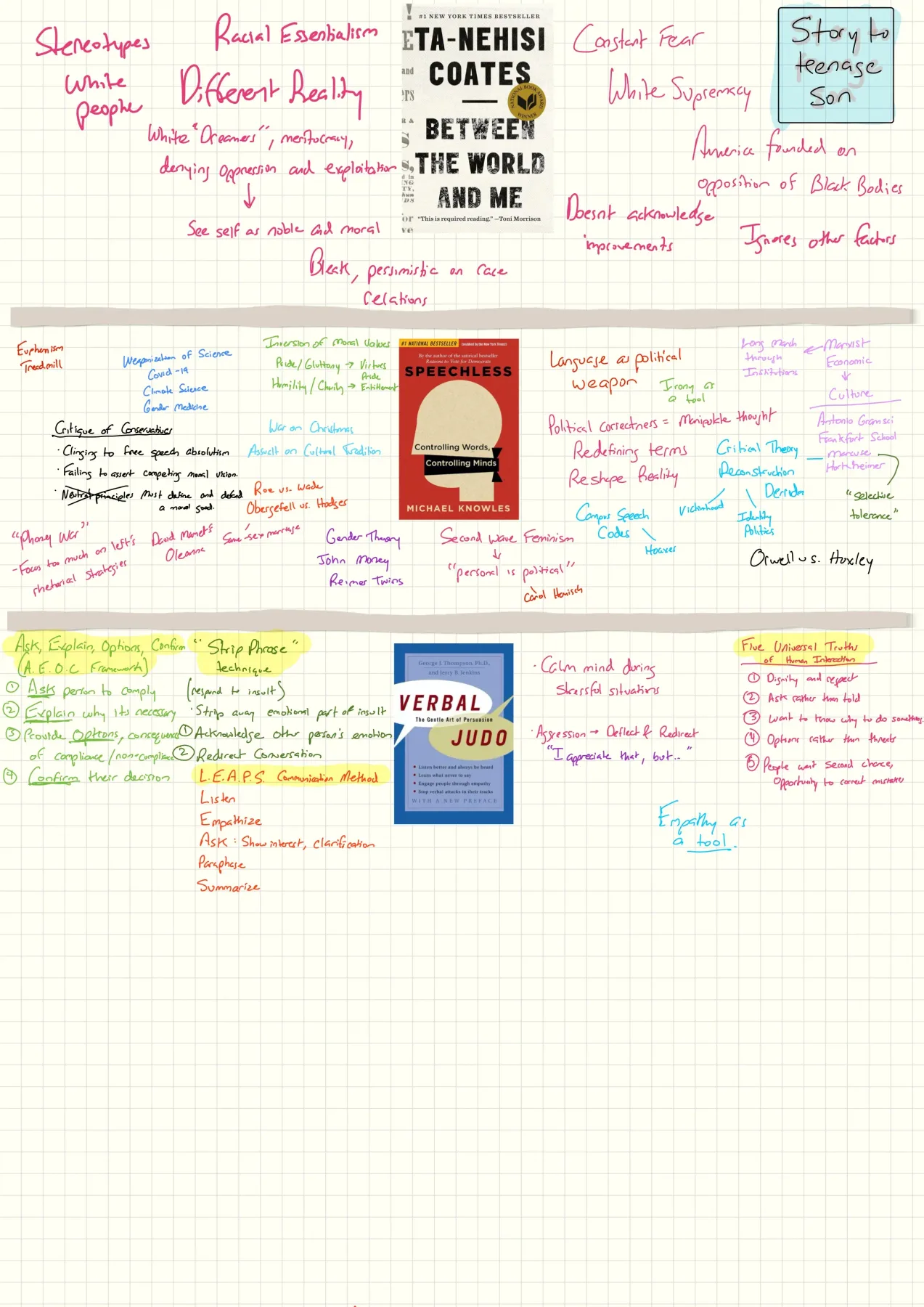
In this section, Knowles argues that language is a powerful tool for shaping political power and societal norms. Political correctness is not just a matter of etiquette but a strategic manipulation of language to control how people think.
- Semantics and Thought Control: Words matter because they shape perception. Knowles highlights examples where political correctness changes the meaning of terms like “illegal alien” to “undocumented immigrant” to soften the reality and shift public opinion. This manipulation alters societal views on issues such as immigration and identity.
- Political Correctness as Manipulation: Knowles draws a distinction between natural language evolution and politically motivated changes. The latter, he argues, is a forced and artificial attempt to reshape reality. For example, redefining the meaning of “marriage” or “gender” reflects ideological agendas, not linguistic progression.
Historical Roots and Orwellian Parallels
- Not a New Phenomenon: Knowles traces political correctness back further than its emergence in the 1990s, highlighting earlier movements. He argues that this effort to manipulate language has been part of progressive strategies for over a century, connecting it to broader cultural and political shifts.
- Orwell’s Influence: George Orwell’s 1984 is central to Knowles’ argument. In the novel, Orwell introduces Newspeak, a language designed to limit thought. Knowles compares this to political correctness, suggesting that controlling language serves to narrow the range of acceptable ideas in society. Orwell’s vision of Newspeak is a model for how political correctness functions today.
Redefining Reality Through Words
- From Words to Reality: Political correctness doesn’t just alter language—it seeks to redefine reality itself. Terms like “justice-involved youth” are not just euphemisms; they are attempts to reshape how society views concepts like crime. The redefinition of gender (e.g., calling a man who identifies as female a “trans woman”) is presented as a prime example of how political correctness forces society to adopt new realities based on ideology rather than facts.
- Leftist Ideologues and Gender Debates: Knowles points out that leftist ideologues, particularly in the case of gender debates, use language to impose their worldview on society. The push to redefine gender is presented not as an issue of identity but as an effort to force societal acceptance of a redefined concept of biological sex.
People Mentioned in the Debate
- Carl von Clausewitz: Knowles references Clausewitz, a military theorist, to illustrate that politics is essentially a continuation of warfare by other means. In this context, political correctness is viewed as a war of words, with language being the primary battlefield.
- Winston Churchill: Churchill is mentioned as an example of a conservative leader who used clear, evocative language to rally people during a crisis. His speeches during World War II, such as the famous “We shall fight on the beaches” speech, are contrasted with modern politically correct language, which often avoids clarity.
- John F. Kennedy and Edward R. Murrow: President Kennedy is mentioned for quoting Murrow in his praise of Churchill, saying he “mobilized the English language and sent it into battle.” Knowles uses this quote to emphasize that strong, clear language can have a powerful impact in times of crisis, something political correctness dilutes.
- Donald Trump: Trump is highlighted as a modern figure who uses blunt, direct language, particularly in his speeches and rhetoric about illegal immigration. Knowles contrasts Trump’s style with politically correct language, arguing that Trump’s clarity stands in stark contrast to the euphemisms often used by political correctness to obscure reality.
- Hillary Clinton: Clinton is cited as an example of someone whose use of clear language backfired. During the 2016 campaign, her comment about Trump supporters being “deplorable” was a rare instance where she was direct, and it became a turning point that alienated many voters. Knowles argues that this moment illustrates the dangers of political correctness when the truth slips out.
- Deborah Cameron: An Oxford linguist, Cameron is mentioned for her critique of political correctness. She argued that conservative language is also politically invested and that terms traditionally accepted as neutral reflect the dominance of privileged groups. Knowles uses her perspective to demonstrate how even advocates of political correctness admit it’s a tool for shaping reality.
- Stanley Fish: A literary theorist, Fish published There’s No Such Thing as Free Speech, in which he contends that traditional language is as politically loaded as politically correct jargon. Knowles references Fish to show that even leftist thinkers acknowledge the power of language manipulation, but Knowles argues that the Right and the Left manipulate language in fundamentally different ways.
The Conservative vs. Leftist Use of Language
- Conservative Clarity vs. Leftist Vagueness: Knowles highlights the contrast between conservative language, which he describes as clear and evocative, and politically correct language, which often uses euphemism to obscure or soften reality. He uses figures like Churchill and Trump as examples of conservatives who speak in direct, understandable terms.
Conclusion: Language as a Tool of Power
Knowles concludes that political correctness is not a harmless trend but a calculated strategy to control culture and politics. By redefining language, political correctness alters the terms of debate and limits open discussion. Figures like Orwell, Clausewitz, and Trump are used to illustrate how language is not just a tool of communication but a weapon in the battle for control over society’s norms and beliefs.
Chapter 3
Cultural Hegemony and the Shift in Marxism
In this section, Knowles focuses on how Marxist ideology shifted from an economic focus to a cultural one, a transformation that plays a central role in the rise of political correctness.
- Antonio Gramsci and Cultural Hegemony: Italian Marxist Antonio Gramsci recognized that Marxist revolutions failed because they did not account for the power of culture. He introduced the concept of “cultural hegemony,” arguing that revolutionaries must dominate culture to transform society. Gramsci believed that winning political and economic power wasn’t enough—control over intellectual and cultural institutions was crucial. This idea has deeply influenced modern political correctness.
- Gramsci’s Influence on Political Correctness: While imprisoned, Gramsci wrote Prison Notebooks, which laid out strategies for achieving this cultural dominance. His ideas have infiltrated mainstream thought, especially in academic and cultural institutions, influencing movements like Black Lives Matter.
- Gramsci’s Legacy in Modern Politics: Gramsci’s influence extends into contemporary times, with notable figures like Joseph Buttigieg, an English professor and father of Pete Buttigieg, a 2020 Democratic presidential candidate, being part of this intellectual tradition. Knowles highlights how deeply Gramsci’s ideas have permeated modern leftist movements.
The Frankfurt School and Critical Theory
- The Frankfurt School: Knowles traces the development of Critical Theory, a Marxist-inspired philosophy that emerged from the Frankfurt School in Germany. Thinkers like Max Horkheimer, Erich Fromm, and Herbert Marcuse were key figures in this intellectual movement, which later migrated to the United States. Critical Theory aimed to critique and dismantle existing societal structures, particularly in Western culture, through relentless criticism.
- Critical Theory’s Focus on Culture: The Frankfurt School moved beyond Marx’s focus on economics to highlight how culture, especially through language and media, could be tools for societal change. This intellectual movement laid the groundwork for what Knowles argues is today’s political correctness, a continuation of the Marxist agenda through cultural subversion.
The Influence of Sexual Revolution
- Wilhelm Reich: Reich, a disciple of Freud and a radical proponent of sexual revolution, is discussed as a significant figure who helped link Marxist thought with sexual liberation. Reich’s bizarre theories about sexual freedom, encapsulated in works like The Function of the Orgasm, sought to dismantle the traditional family structure. Knowles sees this attack on the family as a key part of the cultural Marxist agenda, influencing movements today that seek to challenge traditional gender and family roles.
- Black Lives Matter and Cultural Marxism: The Black Lives Matter (BLM) movement is presented as a modern manifestation of cultural Marxism. Founders Patrisse Cullors and Alicia Garza have self-identified as “trained Marxists,” using race as a key issue to promote a broader cultural revolution. Knowles argues that BLM’s focus on race, gender, and sexual identity aligns with the Marxist goal of subverting Western cultural norms.
People and Their Context
- Karl Marx and Friedrich Engels: They are referenced for their prediction of socialist revolution, which failed to materialize, leading later Marxists to shift focus from economic to cultural revolution.
- Antonio Gramsci: He is a central figure in this section. Gramsci realized that Marxism needed to focus on cultural domination rather than economic forces alone. His theory of cultural hegemony remains influential in political correctness and modern leftist movements.
- Joseph Buttigieg: The father of 2020 Democratic presidential candidate Pete Buttigieg, Joseph Buttigieg was a key figure in bringing Gramsci’s ideas to an English-speaking audience. His connection highlights how deeply Gramsci’s thought has penetrated American academic and political circles.
- Max Horkheimer, Herbert Marcuse, Erich Fromm: These leading figures from the Frankfurt School are noted for their development of Critical Theory, which focuses on critiquing and deconstructing Western societal structures. Their ideas helped merge Marxist and Freudian thought, paving the way for modern political correctness.
- Wilhelm Reich: Reich’s radical sexual theories are discussed as a key part of the cultural Marxist strategy to undermine traditional societal structures, particularly the family.
- Patrisse Cullors, Alicia Garza, and Opal Tometi: Founders of Black Lives Matter, they are cited for their Marxist roots, focusing not on class struggle like traditional Marxists, but on race and identity politics to drive cultural change. Knowles sees their movement as a continuation of the cultural Marxist agenda.
Conclusion: Culture as the Battlefield
Knowles argues that political correctness is rooted in the strategy of cultural Marxism, a theory developed by thinkers like Gramsci and the Frankfurt School. This approach seeks to subvert traditional Western institutions, especially through control of language and cultural institutions. The modern manifestations, such as Black Lives Matter, continue this tradition by focusing on cultural rather than economic revolution.
Chapter 4
The Influence of Orwell and Huxley on Political Correctness
In this section, Knowles highlights the prophetic visions of two British authors, George Orwell and Aldous Huxley, who anticipated the rise of political correctness and the control of thought through language.
- George Orwell’s Vision in Nineteen Eighty-Four: Orwell’s dystopian novel, written in 1948, serves as a warning against totalitarian regimes that control language and thought. Key terms like “Newspeak,” “thoughtcrime,” and “doublethink” reflect Orwell’s fear that governments could rewrite history and limit free thought by narrowing the language available to citizens. Knowles links Orwell’s concerns with the actions of modern movements like Black Lives Matter, particularly the 2020 protests and the historical revisionism tied to the 1619 Project.
- Aldous Huxley’s Brave New World: Huxley, Orwell’s high school French teacher, offered a different dystopian vision. Rather than controlling people by repressing pleasure, Huxley imagined a society dominated by pleasure, distraction, and superficial indulgence, maintained through the use of drugs like “soma.” In Brave New World, people are too consumed by entertainment and hedonism to realize their own oppression. Knowles argues that Huxley’s vision better captures the modern state of political correctness, where societal control is achieved not by force but through the promotion of vices and distractions.
- Orwell vs. Huxley: Orwell’s focus was on a repressive regime that used censorship and punishment to maintain control. Huxley foresaw a more subtle form of oppression, where people would be pacified by indulgence and a lack of critical thinking. Knowles suggests that the political correctness we see today aligns more with Huxley’s vision, where distractions and moral relativism prevent people from challenging the status quo.
Language as a Tool of Control
- Speech Codes and the New Morality: Knowles explains how political correctness operates through constantly shifting speech codes, which redefine moral standards. For example, terms like “homeless” or “unhoused” replace older words like “bum,” shifting the focus from personal responsibility to victimhood. He argues that by changing the language, political correctness removes the possibility of a coherent moral code, focusing instead on victimhood and grievance culture.
- Undermining Tradition: Political correctness doesn’t just create new standards; it systematically undermines the old ones. By displacing traditional values and norms, it erases the moral judgments embedded in older terms and concepts. Knowles cites examples like the redefinition of sexual norms and gender identity to demonstrate how political correctness rejects the idea of fixed human nature.
Key People and Context
- George Orwell: Orwell is central to this discussion, with his novel Nineteen Eighty-Four providing many of the terms and concepts Knowles uses to frame his argument about political correctness. Orwell’s fear of totalitarian control through language resonates with the way modern political correctness limits free expression.
- Aldous Huxley: As Orwell’s former teacher, Huxley is another key figure. His novel Brave New World offers a different but complementary dystopian vision. Knowles argues that Huxley’s focus on distraction and vice as tools of control is more relevant to contemporary society than Orwell’s more overtly repressive regime.
- Friedrich Hayek: Orwell corresponded with the anti-socialist economist Hayek, acknowledging that collectivism was inherently tyrannical. This conversation highlights Orwell’s complex relationship with socialism, as he opposed totalitarianism but believed in a more democratic version of socialism.
- Nikole Hannah-Jones: Hannah-Jones, the author of the 1619 Project, is referenced in connection to the 2020 protests. Knowles links the project’s historical revisionism to the broader goals of political correctness, arguing that movements like Black Lives Matter use such reinterpretations to justify societal change.
- Stanley Fish: Fish, a liberal scholar, is mentioned for his argument that free speech is not an absolute value but is always tied to underlying conceptions of the good. Knowles uses this to critique conservatives who misunderstand free speech as a purely neutral principle, while radicals use it to promote their moral framework.
The Conservative Response
- Free Speech Purism as a Trap: Knowles critiques conservatives who defend free speech as an absolute principle, failing to recognize that all societies have standards of speech and behavior. He argues that by defending free speech in the abstract, conservatives leave traditional values undefended and allow political correctness to redefine the good.
- Stanley Fish’s Insight on Free Speech: Fish’s argument that speech is always tied to some conception of the good is used to underscore that political correctness has succeeded because its opponents have failed to assert their own moral framework. Knowles argues that conservatives must recognize that free speech cannot be divorced from the values it seeks to uphold.
Conclusion: The Struggle Over Speech and Morality
Knowles concludes that the battle over political correctness is not just about censorship vs. free speech; it’s a struggle between competing moral frameworks. While conservatives have focused on defending free speech, they have failed to protect the traditional values and norms that political correctness seeks to abolish. True victory, he argues, will come not from neutral free speech but from asserting and defending a clear conception of the good.
Chapter 5
Maoist Influence on Political Correctness
This section explores how the ideology of political correctness has roots in Maoism and how its mechanisms have infiltrated Western culture, transforming language and thought.
- Origins of Political Correctness: Knowles explains that the phrase “politically correct” first appeared in American legal discourse as early as the 18th century but gained its current meaning through radical movements in the 20th century. It was used sarcastically by leftists to critique rigid orthodoxy, but it eventually became a serious mechanism for enforcing cultural norms.
- Mao’s Influence: Chairman Mao’s Little Red Book became a source of inspiration for Western radicals in the 1960s, despite the phrase “political correctness” never being used directly in the text. Mao emphasized that art and culture are inseparable from political ideology, a view that became central to the cultural Marxist movements in the West. His idea that all art and literature must serve political goals helped shape the political correctness we see today.
- Cultural Revolution in the West: Mao’s concept of a “long march through the institutions” was embraced by activists like Rudi Dutschke, who combined Mao’s tactics with Gramsci’s theories to influence a generation of Western radicals. The aim was to infiltrate cultural institutions like education, media, and art to reshape society from within. The strategy was not to engage in direct political confrontation but to achieve control through cultural domination.
Political Correctness and Irony
- Irony as a Weapon: Knowles discusses how political correctness uses irony as a tool, allowing leftists to dismiss conservative criticisms as not serious or outdated. This strategy confuses opponents and keeps them from effectively challenging political correctness. For example, terms like “politically incorrect” started as an inside joke among leftists but were eventually embraced to enforce a rigid new orthodoxy.
- Inconsistency in Application: Political correctness often applies rules selectively. Words or actions deemed inappropriate for conservatives are often tolerated when used by leftists. This inconsistency is intentional, allowing radicals to control the narrative without being held to the same standards they impose on others. Knowles uses examples like racial slurs or offensive costumes that are excused for liberals but condemned for conservatives, showing the arbitrary enforcement of political correctness.
People and Context
- Mao Zedong: Chairman Mao’s cultural revolution and the spread of his Little Red Book into Western radical circles are central to the development of political correctness. His belief that all art and culture must serve political goals laid the groundwork for how political correctness enforces ideology in the arts and institutions today.
- Rudi Dutschke: A German student activist, Dutschke applied Maoist and Gramscian ideas in advocating for a “long march through the institutions,” a strategy to reshape society by controlling culture. He represents the intellectual connection between Eastern Maoism and Western radicalism.
- Joseph Wood Krutch: Krutch, a writer and critic, highlighted the emerging trend of radical professors at Columbia University indoctrinating students in “correct” political opinions, marking the early stages of political correctness in academia.
- Nassim Nicholas Taleb: Taleb is mentioned in reference to his concept of “antifragility,” which Knowles uses to explain how political correctness thrives under attack. The more critics push against it, the more it grows, as conservatives inadvertently reinforce its framework by accepting its terms.
- Deborah Cameron: A feminist linguist, Cameron explains that “politically correct” began as a self-effacing joke among leftists to distinguish themselves from the dogmatic old left. This ironic usage later transformed into the rigid orthodoxy that governs much of today’s cultural discourse.
- Barbara Epstein: Co-founder of The New York Review of Books, Epstein suggested that “correct lineism” from Communist ideology also contributed to the formation of political correctness in Western radical circles.
Language as a Tool for Control
- Euphemism Treadmill: Knowles describes how political correctness perpetuates itself by constantly changing language through euphemisms, such as replacing “criminal” with “justice-involved person.” Over time, the original harshness of reality returns, necessitating new euphemisms. The constant shift in language helps reshape societal perceptions and maintains control over public discourse.
- Selective Moralism: Political correctness enforces a selective moral framework, where some groups are allowed to use offensive language or engage in actions that would be condemned if performed by others. This selective enforcement keeps conservatives on the defensive, constantly reacting to shifting standards they cannot control.
Conclusion: Political Correctness as a Cultural Revolution
Knowles concludes that political correctness is not a mere trend but a calculated strategy that uses language to reshape society’s moral and cultural foundations. By borrowing tactics from Maoist and Marxist thought, political correctness has become a dominant force in Western institutions. Conservatives often fail to challenge it effectively because they accept the premise of the debate on the terms set by the left. To push back, Knowles argues, they must challenge the underlying assumptions and stop playing by the rules of political correctness.
This summary captures the ideas and key figures mentioned, showing how political correctness is both a tool of cultural revolution and an inconsistent system that confounds opposition through irony and selective enforcement.
Chapter 6
The Tolerant Left and the Weaponization of Tolerance
This section explores how political correctness manipulates the concept of tolerance, often using it as a weapon to silence dissent and advance leftist political goals. Knowles contrasts true tolerance with the selective tolerance espoused by the political left, arguing that leftist tolerance is inherently hypocritical and repressive.
- Selective Tolerance: Knowles explains how the left often justifies intolerance toward conservatives, claiming that they must not tolerate views that threaten marginalized groups or progressive ideals. Leftist figures, including Maxine Waters and Hillary Clinton, openly encourage public harassment of political opponents, demonstrating the left’s rejection of civility toward those they oppose.
- Maxine Waters and Leftist Activism: In 2018, Congresswoman Maxine Waters called for her supporters to confront members of President Trump’s administration in public places, pushing them out of restaurants and other venues. Waters’ rhetoric emboldened left-wing activists to harass several public figures, including Mitch McConnell and Ted Cruz.
- Herbert Marcuse and Repressive Tolerance: Knowles traces the intellectual roots of this selective tolerance to Herbert Marcuse, a Marxist philosopher of the Frankfurt School. In the 1960s, Marcuse developed the idea of “repressive tolerance”—the notion that true tolerance requires the suppression of conservative or right-wing viewpoints, as they are seen as oppressive and harmful to the liberation of marginalized groups. Marcuse argued that tolerance should only extend to progressive views, while conservative ideas should be censored or suppressed.
The Legacy of Critical Theory
- Marcuse’s Influence on Modern Politics: Marcuse’s concept of repressive tolerance has deeply influenced leftist movements. Today, left-wing activists justify deplatforming and canceling conservative speakers by claiming their ideas are harmful and cannot be tolerated. Marcuse’s theories have given rise to the cancel culture we see in academic institutions and media, where conservative ideas are often labeled as hate speech or dangerous rhetoric.
- Marcuse’s Government Career: Before his influence as a leftist intellectual, Marcuse worked for the U.S. government during and after World War II, preparing reports on Nazi Germany. Despite his Marxist background, Marcuse’s academic career flourished after the war, with positions at elite universities like Columbia and Harvard. This combination of government work and academic influence gave Marcuse a platform to spread his ideas.
- Repressive Tolerance in Practice: Knowles highlights how the principles of repressive tolerance play out in modern society. The left selectively censors speech they deem dangerous, while advocating for the open expression of ideas that align with their worldview. Marcuse’s idea that speech can be violence has been adopted by modern progressives who claim that conservative speech can cause psychological harm, further justifying censorship.
People and Their Context
- Maxine Waters: Waters is mentioned for her inflammatory rhetoric against members of the Trump administration, encouraging public harassment as a form of protest. Her words embody the selective tolerance Knowles criticizes, where civility is extended only to those who align with leftist politics.
- Hillary Clinton: Clinton is cited for a statement that civility is impossible with a political party (the Republicans) that opposes what the left stands for, reinforcing the idea that tolerance only applies to those who support progressive ideals.
- Herbert Marcuse: The central figure in this section, Marcuse’s ideas on repressive tolerance laid the groundwork for modern leftist strategies of suppressing conservative viewpoints. His writings, especially One-Dimensional Man and A Critique of Pure Tolerance, shaped the ideological framework of the New Left, which views tolerance as a tool for liberation only when applied to progressive ideas.
- Lisa Feldman Barrett: Barrett, a professor who wrote in The New York Times that words can cause physical harm to the brain, is used as an example of how modern leftists justify the suppression of speech by equating words with violence. Her argument builds on Marcuse’s ideas about the dangerous effects of conservative speech.
The Shift in Cultural Norms
- Changing Symbols and Speech Codes: Knowles discusses how political correctness has shifted cultural norms, with once-venerated symbols like the American flag becoming divisive. Leftist activists reject traditional symbols while elevating new ones, like the rainbow flag, which has become a sacred symbol of LGBTQ rights. This shift reflects the broader cultural change orchestrated by political correctness.
- Court-Packing and Judicial Activism: Knowles also touches on the shift in attitudes toward court-packing, once considered taboo but now openly advocated by progressive politicians. This reflects the long-term success of leftist efforts to reshape societal norms and institutions through cultural and intellectual domination.
Conclusion: The Limits of Tolerance
Knowles concludes that true tolerance has limits, and the left has effectively used this understanding to shift the boundaries of acceptable discourse. By promoting selective tolerance, leftists have created a cultural environment where conservative ideas are marginalized. Conservatives, he argues, must recognize that not all ideas can be tolerated, and they need to reassert their own moral and cultural standards to counter the dominance of political correctness.
This summary captures the ideas and key figures discussed in the section, focusing on how the left uses the concept of tolerance to advance their political agenda while suppressing conservative viewpoints.
Chapter 7
Feminism and Political Correctness: The Personal is Political
In this section, Knowles discusses how feminism, particularly second-wave feminism in the 1970s, played a key role in expanding political correctness into mainstream culture. The feminist movement not only critiqued patriarchal structures but also helped introduce the idea that personal issues are inherently political, a concept that deeply influenced the development of political correctness.
- Feminism’s Role in Political Correctness: Knowles argues that feminists, particularly during the second-wave movement, were instrumental in pushing political correctness beyond the academic sphere and into everyday life. Feminists sought to reshape language and societal norms to dismantle what they saw as oppressive, patriarchal structures. Terms like “politically correct” began to take on their modern meaning during this period.
- Carol Hanisch and “The Personal is Political”: Feminist activist Carol Hanisch is a central figure in this discussion. Her famous 1970 essay, The Personal is Political, argued that personal problems (especially those experienced by women) were reflections of broader political and societal issues. This concept led to the rise of “consciousness-raising” groups, where women would share their personal experiences and recognize them as part of larger systemic oppression. Hanisch’s work emphasized that private life was inextricably linked to political realities, a key idea in the feminist agenda.
- Kathie Sarachild and Consciousness-Raising: Sarachild, another feminist activist, popularized the concept of “consciousness-raising,” which she adapted from older Marxist ideas. Feminists used consciousness-raising sessions to make women more aware of their oppression and to galvanize them into political action. This process of “raising consciousness” mirrored the Marxist idea of awakening the working class to their own exploitation, except here it was applied to gender.
Language as a Political Tool
- Manipulating Language: Feminists, according to Knowles, understood the power of language in shaping political and social realities. Radical feminists coined new terms and phrases to challenge traditional language, which they believed reinforced patriarchal structures. For example, terms like “chairperson” replaced “chairman,” and more extreme variations such as “wimmin” or “womyn” emerged to remove the perceived male bias in language.
- Simone de Beauvoir and Radical Feminism: French feminist Simone de Beauvoir is mentioned for her stark position on the role of women in society. She believed that no woman should be allowed to stay home and raise children, arguing that such choices perpetuated the myth of maternity and family, which she saw as tools of oppression. De Beauvoir’s views influenced later feminists who sought to dismantle the family structure as an oppressive institution.
Political and Social Implications
- The Blurring of Public and Private Life: Knowles highlights how the feminist mantra of “the personal is political” contributed to the breakdown of the traditional separation between public and private life. Everyday decisions, such as household roles or family dynamics, became political battlegrounds. Meanwhile, political life itself became more personal, with courts and bureaucracies making decisions that once belonged to the people through democratic processes.
- Supreme Court and the Right to Privacy: The feminist movement, according to Knowles, also played a role in cases like Griswold v. Connecticut and Roe v. Wade, where the U.S. Supreme Court “discovered” a right to privacy. These rulings, while celebrated by feminists, took political decisions on issues like contraception and abortion away from the democratic process and placed them in the hands of unelected judges, further removing public control over important moral and political questions.
- Antonin Scalia on Judicial Overreach: Knowles cites Justice Antonin Scalia’s dissent in Obergefell v. Hodges, the case that legalized same-sex marriage, as an example of how personal rights have been used to undermine political rights. Scalia warned that judicial decisions like these stripped the people of their ability to make moral decisions through democratic means.
People and Their Context
- Pat Robertson: Robertson is quoted for his inflammatory critique of feminism, describing it as a movement that promotes radical social changes such as destroying capitalism and encouraging lesbianism. His remarks capture the intense backlash against feminist ideas from conservative figures.
- Carol Hanisch: Hanisch’s essay The Personal is Political laid the intellectual groundwork for feminist consciousness-raising, linking personal experiences to larger political movements and challenging the separation between public and private life.
- Simone de Beauvoir: The radical French feminist is discussed for her belief that women should not have the option to stay at home and raise children, as this perpetuated oppressive societal norms. Her ideas reflect the most extreme elements of feminist thought, which sought to reshape both the family and society.
- Betty Friedan: Friedan, another key feminist figure, is contrasted with Beauvoir. While Friedan also sought to liberate women from traditional roles, she balked at Beauvoir’s rigidity. Friedan’s The Feminine Mystique helped launch second-wave feminism in the United States, but she was less willing to go as far as de Beauvoir in dismantling the family.
- Nikole Hannah-Jones: Hannah-Jones, the journalist behind the 1619 Project, is referenced for her tweet distinguishing between being “politically black” and “racially black,” echoing ideas of consciousness-raising. Her remarks tie into the broader theme of leftist identity politics.
Conclusion: The Ongoing Struggle for Cultural Dominance
Knowles concludes that feminism, particularly second-wave feminism, played a central role in expanding political correctness by politicizing private life and reshaping language. Feminist efforts to blur the lines between personal and political life succeeded in embedding political correctness in everyday language and culture. Knowles argues that conservatives failed to effectively challenge this movement, allowing feminists and other radicals to dominate cultural institutions and reshape societal norms.
This summary captures the feminist movement’s role in the evolution of political correctness, focusing on key figures and ideas that helped shape the modern cultural and political landscape.
Chapter 8
The School of Resentment and the Assault on Western Civilization
In this section, Knowles critiques the rise of “The School of Resentment,” a term coined by literary critic Harold Bloom to describe the modern academic disciplines focused on deconstructing and critiquing Western culture through the lens of identity politics. Knowles connects the influence of critical theory, deconstructionism, and other postmodern ideologies to the downfall of traditional literary education.
- Harold Bloom’s Insight: Bloom’s description of the “School of Resentment” refers to academic movements like Black Studies, Women’s Studies, and Queer Studies, which valorize victimhood groups while denigrating Western figures and traditions. Knowles cites Bloom’s frustration at his assistant’s shock upon hearing Walt Whitman called a racist in an American Studies seminar, reflecting the pervasive anti-Western sentiment in universities.
- Critical Theory’s Takeover of the Academy: According to Knowles, academic radicals, influenced by critical theory, have shifted the focus from the search for wisdom in texts to a resentful, ideological critique of Western culture. This has led to movements that dismiss the works of great Western thinkers like William Shakespeare and impose modern ideologies onto classical texts, distorting their meaning.
- The Yale Protest and Shakespeare: In 2016, Yale University students petitioned to “decolonize” the English department by lifting the requirement to study authors like Shakespeare and Chaucer, as these authors were perceived as representatives of white male oppression. This reflects a broader push to remove traditional Western figures from education, a trend Knowles argues is part of a campaign to destroy Western civilization from within.
Jacques Derrida and Deconstructionism
- Deconstructionism and Postmodernism: French philosopher Jacques Derrida’s concept of deconstruction, encapsulated in his cryptic statement, “There is nothing outside the text,” serves as a basis for the academic deconstruction of Western texts. Derrida’s philosophy, which denies absolute truth and objective meaning, has heavily influenced modern literary criticism. Knowles argues that Derrida’s work has led to a denial of the intrinsic beauty and value of Western literature, as critics focus more on an author’s identity than on the content of their work.
- Derrida’s Legacy in the Classroom: The obsession with the context of an author’s race, sex, or nationality often overshadows the appreciation of their work. For example, instead of focusing on the literary value of Shakespeare’s plays, academics emphasize the racial or gender stereotypes in his writing. This has led to a distorted understanding of literature and history, with radical critics ignoring the objective beauty and wisdom found in classic texts.
Cultural Revolution in Education
- Attacks on the Western Canon: Knowles describes how student radicals have framed their opposition to the Western literary canon as a fight against “colonization.” However, he argues that the real colonizers are the students themselves, who seek to displace traditional Western works with ideologically-driven literature that fits their political agendas. By demanding that universities offer alternative, politically correct curricula, radicals have effectively silenced traditional voices in favor of subversive ones.
- Choice vs. Indoctrination: Knowles criticizes conservatives for their weak response to these attacks on the Western canon, often defending the idea of choice rather than opposing the radical changes to the curriculum. He points out that education is inherently coercive; students are required to learn certain things and take certain courses. The radicals understand this, pushing for the inclusion of politically correct material, while conservatives mistakenly call for “free choice,” not recognizing the ideological indoctrination taking place.
People and Their Context
- Harold Bloom: Bloom is central to this section as the originator of the term “School of Resentment,” critiquing modern academic movements that focus on identity politics and criticize Western culture. His assistant’s shock at hearing Whitman labeled as a racist underscores the extent to which these ideologies have taken over academic discourse.
- Jacques Derrida: Derrida’s postmodern philosophy of deconstruction has had a profound impact on modern academia, leading to the rejection of objective truth and the focus on identity politics in literary criticism. Derrida’s philosophy is used to justify the dismissal of classical Western texts as relics of an oppressive past.
- Leonard Jeffries: The founder of the Black Studies department at the City College of New York, Jeffries espoused pseudo-scientific racial theories, such as the idea that Africans are “sun people” and whites are “ice people.” His radical ideas were tolerated under the banner of academic freedom for decades, despite their lack of scholarly credibility. Jeffries represents the extreme end of what Knowles calls the academic degradation caused by political correctness.
- Nick Cannon: The TV personality is mentioned for repeating Jeffries’ racial theories on his podcast, claiming that white people lack compassion and souls, further perpetuating divisive and pseudoscientific ideas. Cannon’s remarks are part of a broader trend where celebrities adopt and spread radical, racially charged ideologies.
- Tommy Robinson and Mahmoud Ahmadinejad: Knowles contrasts the reception of right-wing British activist Tommy Robinson with that of Iranian President Mahmoud Ahmadinejad at Columbia University. Ahmadinejad was allowed to speak under the guise of “academic freedom” despite his violent policies, while Robinson, who spoke against Islamic extremism, faced protests and was denied entry into the U.S. Knowles uses this example to demonstrate how academic freedom is selectively applied.
The Battle Over Academic Freedom
- Selective Academic Freedom: Knowles critiques the selective nature of academic freedom in modern universities. Radical professors, like Leonard Jeffries, are allowed to promote extreme views with little consequence, while conservative or even centrist professors face censorship or job loss. This double standard reflects the broader political bias within academia, where only left-wing ideas are protected.
- William F. Buckley Jr.: Buckley, the founder of the postwar conservative movement, is referenced for his critique of academic freedom. In his book God and Man at Yale, Buckley argued that universities must have a clear mission, and academic freedom cannot be used to justify the teaching of harmful ideologies. Knowles highlights how conservatives today have lost sight of Buckley’s warnings, often defending academic freedom without recognizing the damage it can cause when misapplied.
Conclusion: The Consequences of Radical Indoctrination
Knowles concludes that the radical takeover of the academic world has long-term consequences for Western civilization. By allowing radicals to dismantle the Western literary canon and replace it with politically correct alternatives, universities are undermining the foundations of Western culture. Conservatives, Knowles argues, must stop playing by the rules set by radicals and defend the traditional values and education systems that have shaped Western society for centuries.
This summary covers the key points and people mentioned, focusing on the ideological battle within academia and how radical leftist ideas have infiltrated education, leading to the degradation of Western culture.
Chapter 9
Campus Codes and Coercion: The Origin of Political Correctness in Universities
In this section, Knowles traces the development of political correctness back to its roots in university campuses, highlighting how radical ideas like neo-Marxism, Critical Theory, and postmodernism took hold in academia and influenced broader culture. He argues that universities have nurtured these ideologies, which later sought to destroy the institutions that birthed them.
- The University as a Hotbed of Radicalism: Political correctness thrived in universities because they offered a “safe haven” for the ruthless criticism of Western institutions. University campuses provided a sheltered environment for these radical ideas to evolve, eventually making their way into corporate boardrooms and government offices. Knowles highlights how political correctness paradoxically both preserves and dismantles the university system that nurtured it.
- Weaponizing Grievances: Universities, Knowles argues, falsely portrayed campuses as dangerous spaces filled with racism and sexism to justify speech codes and behavior reforms. While radical activists claimed to be reacting to real threats, many of these incidents were fabricated or exaggerated to push their ideological agendas. He draws attention to hoaxes like the infamous cross-burning at Cornell University in 1969, which was reportedly staged by the very activists who protested it.
The Rise of Speech Codes and Racial Hoaxes
- Speech Codes and Safe Spaces: The radical activists of the 1960s and beyond pushed for the implementation of speech codes and “safe spaces” on campus, using false claims of oppression to justify these policies. Knowles presents numerous examples of hoaxes intended to create the appearance of racial tension and violence on campuses, such as Jussie Smollett’s 2019 hate crime hoax and the Oberlin College bakery incident in 2016. These hoaxes, Knowles argues, were designed to silence dissenting views and push the agenda of political correctness.
- Jussie Smollett and Similar Hoaxes: Smollett’s attempt to stage a racist attack in Chicago was widely ridiculed when it was revealed that he had hired actors to carry out the hoax. Knowles links this incident to a larger trend of racial and sexual hoaxes on campuses, where students invent oppression to further their political goals. He discusses how these hoaxes, while often debunked, still manage to incite public outrage and justify new restrictions on free speech.
The Myth of the Campus Rape Epidemic
- Exaggerated Claims of Sexual Assault: Knowles critiques the often-repeated statistic that “one in five” women will be raped during their time in college, calling it a politically motivated myth. He traces the origins of this statistic to a flawed 1976 survey by Mary Koss, which used broad definitions of sexual assault to inflate the numbers. He contrasts these exaggerated claims with data from the Department of Justice, which shows much lower rates of sexual assault on college campuses compared to non-students of the same age.
- High-Profile Rape Hoaxes: Knowles highlights several high-profile rape hoaxes, such as the 2014 Rolling Stone article about the alleged gang rape at the University of Virginia, which was later fully retracted. He argues that such hoaxes contribute to the broader narrative of victimization on campus, which is used to justify speech codes and other forms of political correctness.
People and Their Context
- Jussie Smollett: Smollett’s staged attack is used as an example of how hoaxes are created to perpetuate the narrative of victimhood and justify the further implementation of politically correct policies. His hoax, although debunked, sparked significant outrage and media coverage, demonstrating the power of such fabrications.
- Mary Koss: Koss is mentioned for her 1976 survey, which contributed to the widespread belief that sexual assault is rampant on college campuses. Knowles criticizes her methodology, arguing that her broad definitions of sexual assault distort the reality of campus safety.
- Oberlin College: The 2016 incident at Oberlin, where students falsely accused a bakery owner of racial profiling, is highlighted as another example of how universities facilitate and amplify false narratives of oppression to promote political correctness.
- Cornell University: The 1969 takeover of Willard Straight Hall by armed students at Cornell University is cited as one of the early examples of radicals using fabricated incidents (such as a cross-burning) to justify their political demands. This event is emblematic of how universities have been used as platforms for advancing radical ideologies through deceit.
The Hypocrisy of Campus Speech Codes
- The Double Standard of Academic Freedom: Knowles critiques the selective application of speech codes, pointing out that universities claim to champion free speech while simultaneously enforcing speech restrictions on conservative viewpoints. He discusses how “bias response teams” and similar initiatives have been established to silence dissent on campuses under the guise of protecting marginalized groups.
- Michigan and Stanford Universities: Knowles examines the speech codes at these universities, arguing that their broad and vague policies, which aim to prevent “stigmatizing” or “victimizing” speech, are unconstitutional. He discusses how these policies often run afoul of the First Amendment and how conservatives have failed to effectively push back against them.
Conclusion: The Dangers of Radical Openness
Knowles concludes that the pursuit of radical openness and the dismantling of traditional standards have led to a new form of repression. Universities, once bastions of free thought and the pursuit of truth, have become ideological battlegrounds where political correctness reigns supreme. Conservatives, he argues, must stop defending abstract ideals like “free speech” and “openness” without recognizing the need for clear moral and cultural standards. Without such standards, Knowles warns, the radicals will continue to redefine society’s values on their own terms.
This summary captures the key points and people mentioned in the section, focusing on how universities have played a central role in advancing political correctness through hoaxes, exaggerated claims, and selective enforcement of speech codes.
Chapter 10
The New Cold War: Political Correctness and Cultural Warfare
This section discusses the shift from the Cold War’s focus on global politics to a new internal conflict in the United States, centered around political correctness and cultural battles.
- George H. W. Bush’s Speech at the University of Michigan: In 1991, President George H. W. Bush gave a commencement speech at the University of Michigan, addressing the growing problem of political correctness. Bush highlighted that while political correctness began as an effort to promote civility, it had soured into censorship. He criticized how political correctness was being used to stifle free speech and replace old prejudices with new forms of oppression, all under the guise of civility. Bush’s speech marked one of the earliest acknowledgments of the political correctness debate at a national level.
- The Legacy of the Cold War: As the Cold War ended, Bush’s presidency focused on establishing the U.S. as a global economic and military superpower. However, Knowles argues that Bush and his administration missed the growing cultural battle at home. While the U.S. celebrated victory over Soviet tyranny, political correctness and radical ideologies were taking hold domestically. Knowles criticizes Bush for failing to articulate a strong conservative cultural agenda, leaving the door open for leftist ideologies to flourish in academic and political institutions.
Pat Buchanan and the Culture War
- Pat Buchanan’s Culture War Speech (1992): At the 1992 Republican National Convention, Pat Buchanan gave a fiery speech warning of a “culture war” in the United States. Buchanan’s speech outlined the battle lines of this new conflict, highlighting issues such as abortion, feminism, and gay rights. He argued that America’s traditional values were under assault by radical leftists, warning that conservatives needed to take back their culture and country. Although Buchanan did not use the term “political correctness,” his speech described the ideological battles over societal norms and values that would define the cultural conflicts of the 1990s and beyond.
- Buchanan’s Warning on Judicial Activism: Buchanan specifically criticized the judiciary for creating new victim groups and privileging them through judicial fiat, such as the recognition of special rights for homosexuals. His concerns about the expansion of judicial power and the creation of new societal norms through court rulings would later be realized in cases like Planned Parenthood v. Casey and Obergefell v. Hodges.
Political Correctness on Campus
- Robert Kelner and Conservatives’ Phony War: Conservative lawyer Robert Kelner critiqued fellow conservatives for their weak response to political correctness, referring to their efforts as a “phony war.” Kelner believed that conservatives were focusing too much on criticizing the left’s rhetorical strategies rather than articulating their own cultural vision. He warned that conservatives needed to engage in substantive debates and offer a positive vision for society rather than simply defending free speech in the abstract.
- David Mamet’s Oleanna and Political Correctness: Knowles references David Mamet’s 1992 play Oleanna, which centers on the power dynamics between a male professor and his female student. The play illustrates how political correctness can destroy lives, as the student accuses the professor of sexism and sexual misconduct, resulting in the destruction of his career and reputation. The play ends with a brutal confrontation that symbolizes the unchecked power of political correctness and its ability to turn ordinary conflicts into career-ending controversies.
The Clarence Thomas Hearings and the New Sexual Morality
- Clarence Thomas and Anita Hill: The confirmation hearings for Supreme Court Justice Clarence Thomas in 1991 are discussed as a key moment in the political correctness debate. Thomas was accused by Anita Hill of sexual harassment, a claim that became a focal point of the hearings. While Thomas denied the allegations, Knowles argues that the hearings represented the emergence of a new sexual morality in American politics, where accusations of harassment were weaponized for political gain. Thomas famously referred to the hearings as a “high-tech lynching,” using race to counter the political correctness of his opponents.
- The Cultural Revolution in the Courts: Knowles highlights how political correctness not only affected public discourse but also became enshrined in legal precedent. The Supreme Court’s decisions in cases like Planned Parenthood v. Casey (1992), which upheld the right to abortion, and Obergefell v. Hodges (2015), which legalized same-sex marriage, reflected the growing influence of politically correct ideologies in American law. These rulings, Knowles argues, were part of a broader cultural shift that redefined personal liberty and social norms according to leftist ideals.
People and Their Context
- George H. W. Bush: His speech at the University of Michigan in 1991 addressed the dangers of political correctness and censorship, acknowledging its harmful effects on free speech and public debate. However, Knowles critiques Bush for failing to grasp the cultural significance of the issue and for not addressing the deeper ideological battle taking place in America.
- Pat Buchanan: His 1992 “culture war” speech at the Republican National Convention warned of the growing cultural conflict in America, focusing on issues like feminism, abortion, and gay rights. Buchanan’s speech laid the groundwork for conservative resistance to political correctness, though his warnings went largely unheeded by the broader conservative movement.
- Robert Kelner: Kelner critiqued conservatives for their weak response to political correctness, calling for a more substantive approach to cultural issues rather than merely opposing leftist rhetoric. He believed conservatives needed to offer a positive vision for society to effectively counter the left’s dominance in cultural institutions.
- David Mamet: The playwright’s work Oleanna is used as an example of how political correctness can destroy lives and careers. The play dramatizes the power dynamics between a professor and his student, illustrating how accusations of sexism and misconduct can be weaponized to devastating effect.
- Clarence Thomas and Anita Hill: The Thomas confirmation hearings are discussed as a turning point in the political correctness debate, with Hill’s allegations of sexual harassment becoming a key moment in the development of new sexual norms in American politics.
Conclusion: The Cultural Shift After the Cold War
Knowles concludes that while America won the Cold War against Soviet tyranny, it failed to recognize the internal cultural war being waged at home. The rise of political correctness and the dominance of radical ideologies in universities, the judiciary, and public discourse marked the beginning of a new cold war over cultural values. Conservatives, he argues, must engage more deeply in this cultural battle to preserve traditional values and prevent further erosion of societal norms.
This summary captures the key ideas and figures discussed in this section, highlighting how the cultural battles of the 1990s and the rise of political correctness have shaped the modern political and legal landscape.
Chapter 11
Trading Taboos: The Shift in Cultural Standards
This section of Knowles’ book examines how political correctness has led to a shift in societal taboos, moving away from traditional values and elevating certain forms of behavior and language once considered inappropriate. The discussion revolves around the idea that political correctness has altered the boundaries of acceptable discourse and behavior, often in hypocritical ways.
- Hypocrisy of Political Correctness: Knowles argues that while politically correct individuals claim to promote politeness and etiquette, they often engage in vulgarity and crude behavior. He cites examples such as “slut walks” and “pride parades” where public indecency is celebrated. The use of profanity in media, like Mark Harmon’s utterance of the word “shit” on Chicago Hope and South Park’s parody of this event, is emblematic of how cultural standards of decency have been relaxed.
- The Last Remaining Taboo: According to Knowles, most taboo words and behaviors have been normalized, but one remains in American English: the “n-word.” He explains that this word became a central issue during the O.J. Simpson trial, where it was weaponized in the courtroom by Simpson’s defense team to shift the focus from his guilt to racial tensions. This case, and the public’s reaction to it, solidified the word’s place as the ultimate racial slur, carrying a level of taboo unmatched by other offensive terms.
People and Their Context
- O.J. Simpson Trial: The trial of O.J. Simpson is central to Knowles’ discussion of how the “n-word” became a cultural flashpoint. The defense team’s strategic use of Mark Fuhrman’s alleged use of the word was designed to inflame racial tensions and detract from the evidence of Simpson’s guilt. Christopher Darden, the black deputy district attorney, warned that introducing the word would blind the jury to the truth, turning the case into a racial spectacle.
- Christopher Darden: Darden, the prosecutor, strongly opposed the use of the “n-word” in the trial, recognizing its power to derail the case and inflame racial tensions. His insight, that the word would blind the jury to the truth, has been validated over time as the word became the ultimate racial taboo in American society.
The Reordering of Society’s Moral Priorities
- Shifting Focus from the Metaphysical to the Physical: Knowles discusses how leftist radicals have shifted societal priorities from metaphysical concerns, like the soul and religious values, to a focus on the physical, particularly in discussions of race. He critiques thinkers like Ta-Nehisi Coates, who focus on the concept of “black bodies” rather than on the moral or spiritual aspects of racial issues. This shift, according to Knowles, allows radicals to reframe societal values to their benefit, ultimately inverting traditional moral orders.
The Rise of Pride and the Celebration of Sin
- Pride Parades and the Political Movement: Knowles traces the origins of the first “pride parade” to the Stonewall Riots and how it expanded over time to become an iconic symbol of not just gay rights, but leftist political activism in general. He critiques the adoption of “pride” as the central virtue of the movement, noting that pride is traditionally viewed as one of the seven deadly sins. For Knowles, the choice to embrace “pride” reflects a broader inversion of moral values by the left.
- The Broader Inversion of Virtue and Vice: Knowles argues that political correctness has redefined traditional vices as virtues. This includes not just pride but also gluttony, sloth, and envy, all of which have been reframed as acceptable or even desirable behaviors. He mentions movements like “fat acceptance” as examples of how radicals have inverted societal standards, encouraging indulgence and laziness as forms of political rebellion.
- Whittaker Chambers and Communism: Chambers is mentioned for his observation that communism promised mankind the ability to become like gods, echoing the temptation of pride. Knowles links this observation to the pride movement, arguing that the left’s embrace of pride reflects a broader attempt to overthrow traditional moral standards in pursuit of a utopian vision of humanity.
Political Correctness and the Death of Charity
- Bernie Sanders’ Rejection of Charity: Knowles discusses how Bernie Sanders, a self-proclaimed socialist, rejected the concept of charity, preferring government intervention as a means to address societal ills. This rejection of charity, one of the fundamental virtues of Christianity, is emblematic of the left’s broader disdain for traditional moral values.
- Charity and Western Civilization: Charity, according to Knowles, is one of the pillars of Western civilization, rooted in Christian morality. By rejecting charity in favor of state-enforced redistribution, the left undermines the virtue of voluntary giving, replacing it with government-mandated wealth transfers that are devoid of moral value.
Conclusion: The Inversion of Traditional Morality
Knowles concludes that political correctness has fundamentally inverted the moral structure of society. Virtues like humility, charity, and moderation have been replaced by pride, greed, and gluttony. This inversion is driven by leftist radicals who have redefined societal taboos to align with their political agenda. Conservatives, he argues, must reclaim the moral high ground by reasserting traditional values and opposing the left’s reordering of society’s priorities.
This summary covers the key ideas and individuals discussed in this section, focusing on the shift in societal taboos and the redefinition of morality through political correctness.
Chapter 12
The War on Christmas: Secularism vs. Tradition
In this section, Knowles delves into the ongoing “War on Christmas,” a cultural conflict centered on the place of Christmas in public life. The debate over Christmas serves as a microcosm for the broader struggle between traditional religious values and the secular, politically correct worldview.
- Historical Roots of the War on Christmas: Knowles begins by tracing the roots of the conflict over Christmas to the early days of America, when Puritans like Governor William Bradford actively discouraged Christmas celebrations. The Puritans believed Christmas festivities were not sufficiently pious, equating them with paganism. Bradford even confiscated toys and games from residents who refused to work on Christmas Day. For decades, Christmas was banned in Puritan New England due to its association with indulgence and debauchery.
- Cotton Mather and Puritan Discontent: Cotton Mather, a prominent Puritan minister, complained in 1712 about the licentiousness associated with Christmas celebrations, viewing them as little more than pagan revelry. Mather, like other Puritans, accepted the religious significance of the holiday but rejected the indulgent ways in which it was celebrated.
- The Shift Toward Acceptance: Over time, opposition to Christmas softened, and by the 19th century, Christmas was recognized as a public holiday in Massachusetts. President Ulysses S. Grant signed legislation in 1870 officially designating Christmas as a federal holiday, marking a significant turning point in the cultural acceptance of the holiday.
The Modern War on Christmas
- The Secular Challenge: Knowles argues that the modern war on Christmas, which began in the 1980s and 1990s, is fundamentally different from earlier objections. While Puritans criticized Christmas for being too indulgent, today’s progressives aim to remove Christmas from the public sphere in the name of secularism, inclusion, and diversity. The goal is not just to discourage public Christmas celebrations but to erase religious symbols and language altogether.
- Examples of Anti-Christmas Activism: Knowles points to a 1983 legal battle in Pawtucket, Rhode Island, over the city’s Christmas display, which included a Nativity scene. Resident Daniel Donnelly, with the help of the American Civil Liberties Union (ACLU), sued the city to remove the display, claiming it violated the Establishment Clause. The case eventually reached the Supreme Court, which ruled in favor of Pawtucket by a narrow 5–4 margin, allowing the display to remain because it served a “legitimate secular purpose.”
- Secularism’s Double Standard: Knowles criticizes the legal arguments used to preserve the Nativity scene, which framed it as a secular symbol rather than a religious one. He argues that this undermined the true cultural and religious significance of Christmas. The left’s push to replace “Merry Christmas” with “Happy Holidays” and rename Christmas trees as “holiday trees” reflects a broader attempt to secularize American public life.
People and Their Context
- William Bradford: Bradford is central to the early historical narrative, representing the Puritanical opposition to Christmas celebrations. His strict enforcement of Christmas day as a workday and the confiscation of toys highlight the early American ambivalence toward Christmas.
- Cotton Mather: Mather’s complaints about the indulgent ways in which Christmas was celebrated by his contemporaries are used to illustrate the Puritans’ religious objections to Christmas festivities.
- Ulysses S. Grant: Grant’s 1870 decision to recognize Christmas as a federal holiday marks the beginning of Christmas’s integration into American public life.
- Daniel Donnelly and the ACLU: Donnelly’s lawsuit to remove the Nativity scene in Pawtucket, Rhode Island, represents the modern secularist attack on Christmas. The ACLU’s involvement in the case exemplifies the legal strategies used by secularists to challenge religious symbols in public spaces.
- Colbert King: A columnist for The Washington Post, King dismisses the war on Christmas as a manufactured conflict, though Knowles points out that King’s own writing reveals an acknowledgment of the efforts to replace “Christmas” with more generic, secular terms.
The Broader Cultural Battle
- Corporate Secularization: Knowles discusses how major corporations, including Walmart, Target, and Best Buy, adopted secular language in their holiday marketing campaigns, often avoiding references to “Christmas” in favor of more generic terms like “holiday.” He critiques the way businesses have embraced secularism to avoid controversy and cater to political correctness.
- Political Correctness and Semantic Manipulation: The push to rename Christmas trees and replace religious references with more inclusive language is framed as part of the broader strategy of political correctness. Knowles argues that these seemingly minor changes in language are part of a larger effort to remove Christianity from the public square.
Conclusion: The Fight for Cultural and Religious Recognition
Knowles concludes by emphasizing the importance of preserving Christmas as a public celebration of Christianity, arguing that the war on Christmas is a proxy for the larger cultural struggle between traditional values and the forces of secularism. He warns that if conservatives continue to accept the left’s premise that secularism is neutral, they will lose the battle for cultural and religious recognition in public life.
This summary covers the key points and individuals mentioned in the chapter, focusing on the historical and modern struggles over Christmas and its place in American culture.
Chapter 13
The Battle for the Sexes
This section delves into one of the most contentious aspects of political correctness: gender ideology and its impact on the understanding of sex and identity. Knowles discusses the rise of the gender identity movement, focusing on how it challenges traditional notions of biology and gender roles.
- Controversy Over Biological Reality: Knowles recounts his experience giving a lecture at the University of Missouri-Kansas City in 2019, where he asserted that “men are not women.” The response from left-wing protesters was immediate and hostile, with students screaming and a masked protester even attempting to spray him with a chemical substance. This incident underscores the emotional intensity surrounding debates on gender and free speech. The assertion that biological sex is immutable—a once widely accepted fact—has now become a “provocative” statement that triggers extreme reactions.
- Heckler’s Veto and Free Speech: Knowles discusses the concept of the “heckler’s veto,” where activists disrupt speeches to prevent ideas they disagree with from being heard. He critiques this tactic, arguing that it shuts down free debate and intimidates those who wish to discuss controversial topics. Knowles emphasizes the importance of defending free speech, even in the face of violent opposition.
The Roots of Gender Theory
- John Money and the Tragic Reimer Case: Knowles introduces Dr. John Money, a psychologist who played a pivotal role in developing modern gender theory. In the 1960s, Money experimented on a boy named Bruce Reimer, who lost his penis during a botched circumcision. Money convinced the child’s parents to raise Bruce as a girl, claiming that gender identity was socially constructed and could be molded through upbringing. Bruce, renamed “Brenda,” struggled throughout childhood and eventually learned the truth. He transitioned back to living as a male, taking the name David. Tragically, both David and his brother Brian later committed suicide. Knowles uses this case to demonstrate the dangers of gender ideology and its harmful effects on individuals.
- The Rise of Gender Dysphoria: Knowles highlights the growing prevalence of gender dysphoria, particularly among young people, as evidence of the spread of gender ideology as a social contagion. He argues that indulging in gender dysphoria rather than treating it has failed to improve mental health outcomes for individuals suffering from the condition. Instead, it has contributed to increasing rates of anxiety, depression, and suicide among the transgender community.
The Inconsistencies of Gender Ideology
- Contradictions in Gender and Feminism: Knowles points out the contradictions between the transgender movement and the feminist movement. Feminism asserts that women are distinct from men and have been oppressed by them, while transgender ideology allows men to claim womanhood by mere declaration, undermining the feminist premise. He discusses how feminists who refuse to accept transgender ideology are labeled “TERFs” (trans-exclusionary radical feminists) and are ostracized by the politically correct left.
- Gnosticism and Materialism: Knowles links gender ideology to the ancient heresy of Gnosticism, which posits a divide between the body and the soul, where the material world is seen as lesser or irrelevant. He argues that gender ideology similarly separates the body from identity, claiming that one’s true self is based on subjective feelings rather than biological reality. This dualism, he asserts, stands in opposition to the traditional understanding of human nature as a union of body and soul.
Key Figures and Their Context
- John Money: Money’s tragic experiment on David Reimer is used as a cautionary tale about the dangers of gender theory. Knowles condemns Money’s approach, which prioritized social theory over the well-being of his patient. Money’s belief in the primacy of gender identity over biological sex laid the groundwork for modern gender ideology, despite its harmful outcomes.
- Paul McHugh: A prominent psychiatrist at Johns Hopkins University, McHugh stopped performing sex-reassignment surgeries in the 1970s after studies showed that these surgeries did not improve patients’ mental health. McHugh is critical of the transgender movement and its focus on surgery as a solution for gender dysphoria, arguing that it does more harm than good.
- Ben Shapiro and Zoey Tur: Knowles recounts an incident involving conservative commentator Ben Shapiro, who was physically threatened by transgender activist Zoey Tur during a televised debate. Shapiro’s refusal to refer to Tur by female pronouns led to the altercation, illustrating the intensity of the gender debate and the hostility toward those who reject the language of gender ideology.
Conclusion: The Destruction of Truth
Knowles concludes by emphasizing that gender ideology represents a fundamental attack on truth and reality. By denying the biological distinction between men and women, political correctness undermines the basic truths that have underpinned human civilization for millennia. He calls for conservatives to stand firm in defense of reality and resist the cultural pressures to conform to gender ideology.
This summary covers the main points and figures in this section, focusing on the development of gender theory, its contradictions, and its impact on society.
Chapter 14
Locking Down Dissent: Science and Political Correctness
This section explores how political correctness has infiltrated scientific fields, particularly in relation to the COVID-19 pandemic and other areas like climate change. Knowles argues that science has been weaponized to achieve political ends, with experts redefining terms and presenting their conclusions as beyond debate.
- Science and Gender Ideology: Knowles opens by discussing how scientific disciplines, including medicine, have been manipulated to accommodate politically correct gender ideology. For instance, the New England Journal of Medicine declared in 2020 that sex designations on birth certificates were harmful to transgender and intersex individuals. Knowles argues that such declarations are examples of how science is being redefined to fit progressive political goals rather than being based on objective facts.
- Redefining Herd Immunity: During the COVID-19 pandemic, the World Health Organization (WHO) shifted its definition of herd immunity to favor vaccination over natural infection. Initially, the WHO included immunity acquired through previous infection in its definition of herd immunity but later revised the definition to focus solely on vaccination. Knowles points out that this change was driven by political objectives rather than scientific discoveries, emphasizing the influence of political correctness on public health policy.
- The Double Standard in Public Health: Knowles highlights the hypocrisy in how public health measures were enforced during the pandemic. While conservative protests against lockdowns were condemned, the Black Lives Matter protests that occurred after George Floyd’s death were endorsed by public health experts, despite the health risks posed by large gatherings during the pandemic. He argues that this discrepancy reveals a politically motivated bias in how science is applied and used to justify policies.
People and Their Context
- Anthony Fauci: Dr. Fauci, a central figure during the COVID-19 pandemic, is criticized for his shifting guidance on masks. Knowles notes that Fauci initially discouraged mask-wearing, claiming it was ineffective, only to reverse his position later. Fauci admitted that his initial advice was driven by concerns about mask shortages for healthcare workers, indicating that his guidance was based on political considerations rather than purely scientific reasoning.
- World Health Organization (WHO): The WHO’s changing definition of herd immunity is used as an example of how scientific terms can be redefined to align with political agendas. Knowles suggests that the WHO’s emphasis on vaccination over natural immunity was not based on new scientific evidence but rather on a desire to promote a particular policy.
- Black Lives Matter (BLM): The Black Lives Matter protests following George Floyd’s death are discussed in the context of public health hypocrisy. While gatherings to protest lockdowns were condemned as dangerous, the BLM protests were largely supported by public health experts, despite the ongoing pandemic. Knowles uses this as an example of how political correctness influences the enforcement of public health measures.
The Role of Experts in Public Policy
- The Authority of Science: Knowles critiques how public policy has increasingly been outsourced to scientific experts, with politicians deferring to them without considering broader political or social implications. He argues that while scientific advice is important, it should not replace democratic decision-making. He warns that experts, such as Fauci and WHO officials, have used their scientific credentials to push political agendas, while pretending that their recommendations are apolitical.
- Historical Precedent: Knowles notes that previous epidemics, including the Spanish flu and cholera outbreaks, did not result in the kind of sweeping lockdown measures seen during the COVID-19 pandemic. He argues that the extreme measures were driven by political motivations and an overreliance on expert opinion without sufficient consideration of the broader social and economic consequences.
- Global Cooling and Climate Change: Knowles draws parallels between the public health response to COVID-19 and earlier scientific claims about climate change. He notes that in the 1970s, many scientists warned of global cooling, but by the 1980s, the narrative had shifted to global warming. He suggests that scientific consensus is often driven by political factors rather than objective data, and that the same dynamic was at play during the COVID-19 pandemic.
Conclusion: The Politicization of Science
Knowles concludes by warning that political correctness has corrupted scientific inquiry, turning it into a tool for enforcing progressive policies. He argues that conservatives need to resist the tendency to accept scientific claims without question, particularly when those claims are used to justify sweeping social changes. Instead, he calls for a return to traditional values and democratic deliberation, where science informs but does not dictate public policy.
This summary covers the key points and individuals discussed in the section, focusing on the intersection of science and political correctness, particularly in relation to the COVID-19 pandemic and broader cultural issues.
Chapter 15
The Purge of Conservative Voices: The Role of Big Tech
This section discusses the mass censorship of conservative voices, particularly after the events of January 6, 2021, and how Big Tech companies used their immense power to de-platform not only President Donald Trump but many other conservative figures. Knowles argues that this censorship reflects the growing power of Silicon Valley to shape public discourse and limit free speech according to a progressive orthodoxy.
- Trump’s De-platforming: On January 7, 2021, Facebook and Instagram, led by CEO Mark Zuckerberg, suspended President Donald Trump’s accounts, citing the risk of incitement to violence. Twitter followed by permanently banning Trump’s personal account, despite the fact that world leaders like Iran’s Ayatollah Khamenei retained access to their accounts, even after promoting genocide and violence. Twitter justified the ban by claiming that Trump’s tweets were inciting violence, despite similar or worse content being tolerated on the platform from left-wing activists and foreign leaders.
- Section 230 and Legal Loopholes: Trump argued that Big Tech companies like Twitter had exploited Section 230 of the Communications Decency Act, which shields platforms from legal liability for user content while behaving like publishers with editorial control. Knowles critiques the selective enforcement of these platforms’ speech codes, noting the hypocrisy in banning Trump but allowing violent rhetoric from left-wing activists.
- Parler and the Consolidation of Power: Following Trump’s ban, many of his supporters migrated to Parler, a platform that promoted free speech. However, Parler was quickly removed from Google’s Play Store and Apple’s App Store, and shortly after, Amazon Web Services withdrew its web hosting. These actions effectively shut down Parler, demonstrating how Big Tech companies collaborate to control which platforms and voices are allowed in the digital public square.
Hypocrisy and Double Standards
- Kathy Griffin and Leftist Rhetoric: Knowles points out the hypocrisy of platforms like Twitter, which allowed comedian Kathy Griffin to post a photo of herself holding a decapitated likeness of Trump, and did nothing when the phrase “Hang Pence” trended on the platform. Such double standards illustrate how Big Tech enforces its rules based on ideology rather than consistent principles of free speech.
- Kamala Harris and Bail Funds for Rioters: During the 2020 Black Lives Matter protests, Vice President Kamala Harris and staffers from Joe Biden’s campaign promoted bail funds for rioters arrested during the violent demonstrations. Despite their support for violent rioters, none of them were de-platformed or censored, further highlighting the selective enforcement of speech regulations.
The Rise of Technological Tyranny
- Big Tech as Unaccountable Oligarchs: Knowles criticizes the libertarian defense of Big Tech companies, which argues that because they are private businesses, they can censor as they please. He counters that these companies are some of the largest and most powerful corporations in the world, controlling the majority of online communication and public discourse. Allowing them to de-platform individuals and restrict speech without accountability threatens democracy.
- The Failure of Conservative Responses: Knowles argues that Republicans failed to regulate Big Tech during Trump’s presidency, missing opportunities to strip companies like Facebook and Twitter of their Section 230 protections or to break them up through antitrust laws. Despite holding hearings where tech CEOs were grilled by Congress, no substantive action was taken to curb their power.
People and Their Context
- Mark Zuckerberg: As the CEO of Facebook, Zuckerberg played a key role in de-platforming President Trump after the January 6 Capitol riot, citing concerns over incitement to violence. His actions set the tone for other social media platforms to follow suit.
- Jack Dorsey: The CEO of Twitter, Dorsey permanently banned Trump’s personal account and later removed the @POTUS account when Trump attempted to communicate with his followers. Dorsey’s decisions reflect the broader trend of tech giants controlling political discourse.
- Kathy Griffin: The comedian’s controversial tweet with an image of Trump’s decapitated head is used as an example of left-wing speech being tolerated, while conservatives face heavy censorship.
- Kamala Harris: Vice President Harris’ promotion of bail funds for BLM rioters is highlighted as an example of leftist politicians supporting violent rhetoric and actions without facing the same censorship that conservatives experience.
Conclusion: The Privatization of Speech Policing
Knowles concludes by warning that conservatives’ reliance on the free market to regulate Big Tech has backfired. By failing to acknowledge the need for limits and standards, conservatives have allowed unaccountable tech giants to impose their own speech codes, which disproportionately target right-wing voices. The de-platforming of Trump and the removal of alternative platforms like Parler underscore the dangers of leaving the control of speech to a few powerful corporations.
This summary captures the key ideas and individuals discussed in this section, focusing on the de-platforming of conservative figures by Big Tech and the implications for free speech and public discourse in the digital age.
Conclusion
Conclusion: The Subtle and Long Battle for Cultural Hegemony
In the final section of the book, Knowles reflects on the long and deliberate process by which political correctness has become ingrained in society. He traces its intellectual roots and the strategies employed to gain cultural dominance.
- George Bernard Shaw’s Back to Methuselah: Knowles opens by referencing Shaw’s play, which presents the idea of the subtle, contemplative, and willful manipulation of reality. He draws a parallel between the serpent’s subtlety in the play and how political correctness has gradually redefined cultural norms, trading traditional values for an inverted moral order.
- The Communist Influence: Knowles links political correctness to the strategies of Communists like Karl Marx, Antonio Gramsci, and Herbert Marcuse. Marx’s call for the “ruthless criticism of all that exists” set the stage for the cultural revolution that Gramsci and Marcuse would later pursue. Gramsci’s concept of “cultural hegemony” and Marcuse’s “repressive tolerance” were strategies aimed at dismantling the existing moral and cultural order by controlling institutions and suppressing conservative voices.
- Orwell and Huxley’s Dystopias: George Orwell’s Nineteen Eighty-Four and Aldous Huxley’s Brave New World serve as prophetic warnings about the consequences of political correctness. Orwell’s vision of totalitarian control through language manipulation and Huxley’s portrayal of societal control through pleasure and distraction are contrasted to show how political correctness uses both repression and indulgence to maintain control.
Cultural Revolution and the Long March
- The Long March Through the Institutions: Knowles emphasizes how political radicals, inspired by Gramsci and Marcuse, infiltrated key cultural institutions—academia, media, and government—over decades. They implemented a slow, deliberate strategy to dominate the cultural discourse, pushing leftist ideologies through education and social movements like feminism and civil rights.
- Feminism and the Personal as Political: He reflects on the feminist movement’s strategy of “consciousness-raising” and how it politicized personal grievances. Feminist leaders like Carol Hanisch and Simone de Beauvoir played a key role in turning personal matters, like household dynamics and child-rearing, into political issues, further advancing the goals of the cultural left.
The Inversion of Moral Standards
- Exchanging One Set of Standards for Another: Knowles argues that political correctness did not eliminate standards but simply replaced traditional values with new, leftist ones. For example, he notes how traditional religious observances like Christmas have been replaced by secular celebrations of diversity, equity, and inclusion. Likewise, leftists enforce their own speech codes while claiming to champion free speech.
- Marcuse’s Repressive Tolerance: Knowles revisits Marcuse’s concept of “repressive tolerance,” which advocates for suppressing conservative ideas while promoting left-wing views. This inversion of tolerance has led to the marginalization of traditional values and the dominance of progressive ideologies in public discourse.
The Role of Big Tech and Modern Censorship
- Censorship of the Right: The book concludes by addressing the role of Big Tech and modern institutions in enforcing political correctness through censorship, particularly the de-platforming of conservative voices, including President Donald Trump. Knowles argues that this censorship is part of the broader strategy to consolidate leftist control over public discourse.
- The Necessity of Standards: Knowles critiques conservatives for failing to defend traditional moral and cultural standards. He asserts that all societies have standards, and if conservatives do not enforce their own, they will continue to lose ground to the left. He advocates for conservatives to articulate and uphold a clear moral vision rather than simply defending abstract concepts like “free speech” or “neutrality.”
People and Their Context
- Karl Marx, Antonio Gramsci, and Herbert Marcuse: These intellectuals are central to Knowles’ analysis, as their theories on cultural revolution and ideological control laid the foundation for modern political correctness
Highlights
itical correctness is not merely a synonym for “censorship,” though the two concepts are related. Political correctness (PC) is a standard of speech and behavior along leist ideological lines. It no doubt censors certain words and actions, but then so does chivalry. All societies embrace and enforce standards. Yet today this basic social fact seems to be lost on many conservatives. Ironically, the putative defenders of tradition have come to eschew standards altogether. e social engineers who (Page 11)
ndards, or we will all succumb to the new rules. e choice between “free speech” and “censorship” is illusory—a false dichotomy from which political correctness has profited for a century. We will speak and act according to some set of standards or other, whether conservatives are willing to admit it or not. Political correctness has le us speechless, but the right to speak means nothing to those who have nothing to say. (Page 12)
CHAPTER 1 THE WEST IN WONDERLAND (Page 13)
cribe a distinction as “just semantics,” they mean to dismiss it as trivial. But how many of those people know what the word “semantics” means? “Semantics,” it turns out, means meaning itself. Semantics is the study of the meaning of words, which exist so that we can distinguish one thing from another. is process of discernment begins with our very first words. A baby cries out, “Mama!” to distinguish Mommy from Daddy. Today even that basic distinction falls afoul of politically correct orthodoxy, as we will come to see. What Humpty Dumpty understands and Alice fails to see is that words shape how we think; they color how we view the world. (Page 13)
guage to manipulate reality, but they maintain that their conservative opponents do the very same. e Oxford linguist Deborah Cameron made this accusation during the debates over political correctness that roiled the academy in the 1990s. According to Cameron, with the advent of political correctness, liberal “verbal hygienists” were simply pointing out “that the illusion of a common language depends on making everyone accept definitions which may be presented as neutral and universal, but which in fact represent the particular standpoint of straight white men from the most privileged social classes.”8 In other words, they declared value-neutral language a lie designed to enforce patriarchy and white supremacy. (Page 15)
uage differs. e Right tends to manipulate language by using strong wor (Page 16)
ar images. Churchill promised, “We shall fight on the beaches, we shall fight on the l (Page 16)
sh realities. We all use euphemisms some of the time as a matter of good manners. We (Page 16)
Leists tend to manipulate language by using vague t to soen but to conceal and even contradict the realities to which they refer. Killing babies in the womb becomes “women’s healthcare” and “repr (Page 17)
djective or adverb to a noun or adjective. e late presidential speechwriter and conservative columnist William Safire described this form as the “adverbially premodified adjectival lexical unit,” the description itself a play on PC jargon.15 Around the time (Page 17)
adjective it modifies. e term “politically correct” itself follows this politically correct formula by using an adverb to negate the adjective it precedes. at is, “correct” means true. But “politically correct” means not true. “Justice” means getting what one deserves without favor. e politically correct “social justice” is a form of injustice because it means getting what one does not deserve because one is favored. “Marriage” in every culture throughout history has meant the union of husbands and wives. “Same-sex marriage,” however favorably one views the concept, is not marriage. e history of “same-sex marriage” offers a telling glimpse (Page 18)
CHAPTER 2 REDEFINING REALITY (Page 20)
objective truth,” must inevitably explain how he came to regard his own statement as objectively true. But logical rigor and consistency do not much matter when it comes to (Page 20)
w York Magazine ran a front-page story on the phenomenon. Writers such as Dinesh D’Souza and Roger Kimball found PC flourishing in the campus debates of the 1980s and the battle over the Western canon. William Safire and leist academic Ruth Perry traced it to the Chinese Communist revolutionary Mao Tse-tung and his American acolytes in the 1960s.1 In fact, progressives’ unnatural manipulation of language go (Page 21)
ther still. e spelling reformers of the early twentieth century tried to hasten society’s march toward progress by erasing inefficient flourishes and vestiges of tradition from language. e Esperantists of the late nineteenth century sought to break down barriers to global communication and identity through the contrivance of a universal second language, ironically just at the moment when the world’s traditional universal second language, Latin, fell out of favor among progressives, who derided it as “dead” even before they had succeeded in killing it. Despite progressives’ best efforts, Esperanto never caught on, and few today speak the unnaturally simplistic language. (It should come as no surprise that one of the few people ever to speak Esperanto as a child is George Soros, the most infamous and influential leist financier of our age.2) (Page 21)
Accord ht Young America’s Foundation, nearly half of students aged thirteen to twenty-two had “stopped [themselves] from sharing [their] ideas or opinions in class discussions” for fear of reprisal from the enforcers of political correctness. e students have every reason to fear punishment for contradicting leist orthodoxy. During a lecture I gave for the Young America’s Foundation in 2019 at (Page 23)
lence is speech—a new standard that took center stage during the tumultuous spring of 2020. As the Chinese coronavirus led to the widespread curtailment of p (Page 23)
not and has never been merely about any of the items that it imposes, but about the imposition itself.” For this reason, the British historian Paul Johnson defined political correctness as “liberal fascism.” Political correctness goes back much further than the (Page 24)
CHAPTER 3 CULTURAL HEGEMONY (Page 26)
omorphic being, and consequently he believed that material conditions define history and politics.2 e machinery of the Industrial Revolution had formed the oppressed proletariat into a revolutionary force, and the inevitable unfolding of history would compel it to overthrow its oppressors.3 But while Marx and Engels perceived the historic enormity of industrial exploitation, they failed to recognize a stronger, more pervasive force that inhibited revolution: culture. Karl Marx died a failure (Page 26)
t two years aer Marx’s death, the first in a new generation of Marxists was born who would empower Marxism by redirecting its focus from economics to culture. e first of these “cultural Marxists” was the philosopher, critic, and Hungarian minister of culture Georg Lukács, who was soon eclipsed by the godfather of this new ideological movement: Antonio Gramsci, Marxist philosopher and Communist politician. (Page 26)
derscores the central strategy of political correctness: control the words, control the culture. And the strategy worked. By 2019, mainstream information channels accepted the new definition. Wikipedia, the most popular source for general knowledge on the internet, had redefined cultural Marxism as “an anti-semitic conspiracy theory which claims that the Frankfurt School is part of a continual academic and intellectual effort to undermine and destroy Western culture.”6 (When one investigates the phrase “conspiracy theory,” which came into fashion in its present meaning during the late 1960s, one discovers leists insisting that research into the origins of “conspiracy theory” itself constitutes a conspiracy theory.7) In an essay outlining the sudden leist denial of a well-known int (Page 27)
tradicted his own thesis. “Some Marxists, like the Italian philosopher Antonio Gramsci and his intellectual heirs, tried to understand how the class rule they criticized worked through cultural domination,” he admitted.11 In other words, cultural Marxism does exist, it has been around since the early twentieth century, and its most prominent progenitor was Italian, not Jewish. So much for “conspiracy theories” and “anti-semitism.” Among Mussolini’s many sins and blunders, the least acknowledged a (Page 28)
prisonment—but he recognized that the revolution he sought could never take place without cultural upheaval. Gramsci believed that Marxists should aim to attain what he called “cultural hegemony,” an early expression of Andrew Breitbart’s famous dictum that “politics is downstream of culture.” And the beating heart of culture is language. In the little-read Discourse or Dialogue a (Page 30)
pares the infiltration of an opponent’s language with the military tactics used by ancient Rome to control foreign territories and armies. By “cultural hegemony,” Gramsci understood, as did Machiavelli, that society may be overcome not solely by force but also by internal subversion. A cray revolutionary may find more success by transforming a society’s traditions, institutions, and most of all its language than by picking a fight out in the open. Ac (Page 30)
ial institutions that shape common sense. He differentiated between “wars of maneuver,” in which the revolutionaries engage their opponents head on, and “wars of position,” in which the aggressors defeat their adversaries by gaining positions of power within the established institutions. e latter strategy has come to be called the “long march through the institutions,” a phrase “ubiquitously attributed” to Gramsci, in the words of Joseph Buttigieg, but in fact coined by Rudi Dutschke. For revolution to take hold, it does not suffice merely to control the means of production or even it requires cultural hegemony—total levers of political power; the domination of the prevailing institutions. “Together with the problem of gaini (Page 30)
tter how confident they are in the ability of their radical theories to improve the lot of the common man, the common man never seems to like those theories. In fact, the common man tends to enjoy his own customs, language, and way of life. is contentment must therefore constitute a “false consciousness” that cannot be overcome save by “raising awareness,” a popular phrase derived from Gramsci. To raise the awareness of the people, to transform the common sense, one must subtly uproot and replant their culture. “Every revolution,” he wrote, “has been preceded by an intense labor of criticism, by the diffusion of culture and the spread of ideas amongst the masses of men.”16 us the revolutionary must take up two goals simultaneously: to criticize and to educate. A group of Marxist academics took (Page 31)
e Frankfurt School developed the which over the past century has come to dominate not just college campuses in the United States but primary and secondary education as well. ese educational institutions have offered an incubator to protect and no (Page 31)
ology. “What united them,” according to Max Horkheimer, an influential early director of the Frankfurt School, “was the critical approach to existing society.”19 Some modern critics of Critical eory portray the Frankfurt School as a monolithic movement with a substantive message, but this analysis fails to give the devils their due. Concrete systems may be criticized, as the critical theorists well knew. e Frankfurt School never le itself open to the sort of attack it leveled at others. e strength of Critical eory came not from any philosophical coherence but rather from its position, in Jay’s words, “as a gadfly on other systems.”20 In an 1843 letter to the German p (Page 32)
rx and Freud. At its most basic tactical level, the Frankfurt School, especially Erich Fromm, Max Horkheimer, and Herbert Marcuse, sought to reconcile sex and socialism. e Frankfurt School took its cues from Marx, who denied the classical conception of human nature as fixed and permanent.23 Instead, he considered it to be socially constructed and therefore fluid. “e human essence is no abstraction inherent in each single (Page 32)
ex holds the key to human relations. Sex also plays a role in the construction (Page 33)
damental institution: the family. Culture-minded Marxists have long understood that any successful “march through the institutions” must overcome the family. Among the most imaginative and memorable of these deviants was Wilhelm Reich, an Austrian Communist and disciple of Freud who carried his patients from the psychiatrist’s couch to the bed. When those unprofessional relations produced children, Reich oen forced his wives and mistresses to snuff them out with illegal abortions.25 In 1940, Reich published his bizarre, pseudoscientific (Page 33)
“endemic illness,” which he called “familitis.”26 He encouraged all manner of deviancy to destroy the family, just as his ideo (Page 33)
idation and concrete realization of child and adolescent sexuality,” a disturbing theme that has enthralled radicals of the far Le for decades. But this perverse obsession with child sexuality follows naturally from the cultural Communists’ premises: if man has no fixed nature, then the “human essence” derives from human relations, the most influential of which is sex, which must therefore be molded from the earliest stages of life. e socialist senator and sometime presidential candidate Bernie Sander (Page 34)
CHAPTER 4 STANDARDS AND PRACTICES (Page 40)
ntless historical monuments throughout the United States, put Winston’s (Page 40)
justice” and “woke” politics, new jargon for the same old scourge of political correctness. e rioters took their cues from the New York Times’s 1619 Project, which cast the United States as hopelessly unjust on the false premise that the Founding Fathers fought the American Revolution to preserve slavery. Although aca s central lie, the Times persisted, and the revisionist series went on to win the Pulitzer Prize.3 e 1619 Project sought not to reexamine American history but to rewrite it as a pretext for re-founding the country. When the political philosopher Charles Kesler called the nationwide violence of 2020 the “1619 Project riots,” the project’s author Nikole Hannah-Jones welcomed the moniker as “an honor” and thanked him.4 Beyond historical revision, Orwell’s reg (Page 41)
ols its subjects’ minds by changing and limiting their lexicon. rough this curtailing of language, “thoughtcrime”—that is, dissent from party orthodoxy—becomes impossible. “Don’t you see that the whole aim of Newspeak i (Page 41)
plained to the antisocialist liberal economist Friedrich Hayek. “In the negative part of Professor Haye (Page 42)
well’s high school French teacher, Aldous Huxley. Brave New World, written seventeen years before Orwell’s Nineteen Eighty-Four, envisions a different type of dystopia. e title derives from the most famous line of Shakespeare’s tragicomedy e Tempest, expressing innocent obliviousness to natural evil: “O wonder! How many goodly creatures are there here! How beauteous mankind is! O brave new world, that has such people in’t.”9 In Brave New World, a tyrannical one-world government has wielded technology, ideology, and man’s basest impulses to engineer a docile populace too distracted by sex and drugs to notice their own slavery within a rigid hierarchy. Orwell envisi (Page 42)
rectness in their brazen dishonesty: “war is peace,” “freedom is slavery,” “ignorance is strength.” But the moral code by which the regime maintains its rule bears a greater resemblance to puritanism than to postmodern perversity. It enforces temperance, diligence, patience, kindness, humility, and charity—albeit in a corrupted form. traditional virtues—chastity, the H (Page 43)
cerbating vice. Whereas Orwell’s Big Brother rules by breaking his subjects’ faith in their faculties of reason, as Winston learns when the regime tortures him into believing that two plus two make five, Huxley’s World State holds power by exacerbating its subjects’ vices so that they can never build or maintain the capacities and institutions necessary for self-rule. is promotion of vice provides a subtler means to political powe (Page 43)
n they do any other author, Huxley understood more clearly the subtle method by which cultural revolutionaries would overthrow traditional society. Poli (Page 43)
p lies in PC’s dual character as at once a speech code and the antithesis of a moral code. e constantly churning jargon and taboo terms constitute a new speech code, as anyone who has ever been scolded for using an out-of-date epithet well understands. “Persons of color,” for example, must never be called “colored persons”—at least according to this week’s standards. But th (Page 44)
Drunkards and druggies make poor choices and live with , but victims of the “disorder” or “disease” of drug use cannot be held responsible for their miserable state. By its speech codes, political correctness removes responsibility and therefore the possibility of any coherent moral code. Under political correctness, saying the right thing supplants doing the right thing. Political correctness deni (Page 44)
hibits traditional moral opprobrium. e lexical shi from “bum” to “unhoused” necessarily implies a moral shi from ne’er-do-well to victim. It removes the stigma from living on the street and suggests that the sidewalk denizen bears no responsibility for his lodging or lack thereof. e Christian religion on which our culture rests holds hu (Page 45)
sts” undertaken by Marx and his ideological heirs must be thorough. Only one moral and philosophical framework can win out in the end. And therein lies the trap. Ever since cultu (Page 45)
m all standards and norms, plays right into the politically correct censors’ hands. (Page 45)
enforced standards of speech and behavior. Critics of political correctness have assailed it as a “new puritanism.” In a sense it is, but that new puritanism didn’t spring into existence out of thin air. It has replaced the old puritanism, which “purified” Anglicanism, which replaced Catholicism, which suppressed heresy, and so on and so on. Civilization cannot stand for nothing. When the liberal scho (Page 46)
Even John Milton, perhaps the e English language, explicitly endorsed censorship of certain ideas in his most famous treatise on the subject, Areopagitica. “I mean not tol (Page 46)
s a thought that stops thought, and that is the (Page 46)
which all religious authority was aimed.”20 Milton decried what he considered superstition; Chesterton, radical skepticism. Both saw the same problem: we can abuse our reason to undermine our reason; we can abuse speech to undermine speech. “Free speech” carries a d (Page 47)
realm of politics requires limits, so too must the realm of speech. By failing to acknowledge this practical reality, the so-called “free speech purists” give the game away to politically correct censors, whose immediate object is not even the establishment of new standards but merely the abolition of the old. is clever strate (Page 47)
“free speech purists” follow their own logic only insofar as it does not threaten their traditional moral standards, they expose themselves as hypocrites and concede the argument. But if in an attempt at consistency they reject all speech codes, including those that aim to uphold traditional morality, then they forfeit the traditional standards that the radicals hoped to abolish in the first place. Either way, the radicals win. Specificity holds the key to escaping this rigged se (Page 47)
icately manicured garden. As long as conservatives defend free speech as a neutral, natural state rather than as a substantive product of our culture’s keenest insight and best traditions, we will lose. e radicals recognize that speech rests on an established conception of the good. By failing to recognize this, we are effectively mounting a retreat, leaving radicals to redefine the good and abolish what we call free speech itself. (Page 48)
CHAPTER 5 MAO GOES MAINSTREAM (Page 49)
By the 1930s, the to take hold. Vladimir Nabokov introduced the phrase “politically incorrect” (Page 50)
bokov and Miłosz, understood the power of language to shape politics. “If thought corrupts language, language can also corrupt thought,” wrote Orwell in his essay “Politics and the English Language,” which examines the relationship between linguistic perversion and political orthodoxy. “A bad usage can spread by tradition and imitation even among people who should and do know better.”7 Political correctness has succeeded because even its opponents fall victim to its allure. Antifa, a le-wing terror gro (Page 50)
cism, defined the term with the help of the philosopher Giovanni Gentile in 1832. Fascism, according to Mussolini and Gentile, rejects individualism, economic liberalism, egalitarianism, pacifism, Christianity, and “Marxian socialism.” It supports one entity above all others: the state. “e keystone of the Fascist doctrine is its conception (Page 51)
nition of fascism, which is an ideology unto itself. Yet the Le flings the term at the Right, and the Right foolishly hurls it right back at the Le, accepting “fascism” as the ultimate political evil, the very premise leists sought to establish in the first place. Both sides excitedly condemn fascism, a phantom villain that died with Mussolini on the streets of Milan. Meanwhile, the extant evil of Marxian socialism, openly embraced by the Le’s most influential activist groups and vast swaths of the Democrat Party, gets off the hook and spreads. Political correctness thr (Page 51)
porters. It exhibits what the essayist Nassim Nicholas Taleb calls “antifragility,” the quality of not merely resisting but actually becoming stronger (Page 51)
through shock and challenge. e more we argue against it, the more we accept its terms—its very substance—into our language, thought, and culture. “e (Page 52)
ears in the famous Communist tract. But the word “correct” appears 110 times. e translators preferred “correct” to “right,” which they rarely used in the sense of “justified” or “acceptable,” perhaps for fear of associating rightness with the Right.15 Whatever the reason, the odd and persistent use of “correct” caught the attention of Western radicals, who adopted the phrase and the ideology it described. Ruth Perry, a leist professor an (Page 52)
gram, credits the term to Mao in her essay “A Short History of the Term Politically Correct.” Barbara Epstein, founding co-editor of the New York Review of Books, suggests the additional influence of “correct lineism,” a the radicals who embraced “political Communist Party term, on (Page 52)
correctness.” ough historians of the movement continue to debate the precise details of its spread, all agree that foreign Communists bequeathed the notion to Western radicals, who popularized it. Chairman Mao, like Antonio Gramsci and (Page 53)
nkfurt School, understood that cultural upheaval must precede political revolution. “In the world today all culture, all literature and art belong to definite classes and are geared to definite political lines,” he declared in the Little Red Book. “ere is in fact no such thing as art for art’s sake, art that stands above classes, art that is detached from or independent of politics.”17 Mao’s cynical and exploitative view of art may explain why his regime never produced a Michelangelo. But his understanding of politics helps to explain politically correct radicals’ success in spreading their worldview and conservatives’ incompetence at stopping it. Many conservatives will recoil at the s (Page 53)
w of politics than their radical opponents. While conservatives tend to cherish some separation between public and private life as necessary to selfgovernment, the radicals recognize no such distinction. For them, “the personal is the political.”18 Precisely because separation between public and private life is necessary for republican government, the revolutionaries must abolish this separation to further their revolution. e radicals have a point. Politics in its most (Page 53)
nothing can escape ideology. e “ruthless criticism of all that exists” spares no edifice. Mao described the revolutionaries’ pur (Page 54)
art fit well into the whole revolutionary machine as a component part, that they operate as powerful weapons for uniting and educating the people and for attacking and destroying the enemy.”20 A partial revolution would be no revolution at all; on the contrary, it (Page 54)
e phrase Wikipedia’s assertion that “Cultural Marxism is a far-right, antisemitic conspiracy theory.” But (Page 55)
euphemism treadmill,” Pinker wrote. “People invent new words for emotionally charged referents, but soon the euphemism becomes tainted by association, and a new word must be found, which soon acquires its own connotations, and so on.”27 A pretty word can conceal a harsh fact for only so long; eventually, the harshness of the reality will pollute the beauty of the word. (Page 56)
tory of the United States, explained the irreconcilable difference between these two political frameworks by way of scientific example. e Founding Fathers and framers of the Constitution, Wilson contended, established constitutional government because they lived under the sway of Isaac Newton, who believed that eternal and fixed laws governed nature. But now, Wilson explained, we live in the age of Charles Darwin, who has demonstrated that nature is never fixed but always “evolving,” and therefore our politics must acknowledge this discovery, ditch the old fixed rules, and “evolve.”41 (Page 59)
human nature? If men were angels, no government would be necessary. If angels were to govern men, neither external nor internal controls on government would be necessary. In framing a government which is to be administered by men over men, the great difficulty lies in this: You must first enable the government to control the governed; and in the next place, oblige it to control itself.42 (Page 60)
e reigns even on the right, as shown by the prominence of libertarianism in “conservative” circles throughout the late twentieth and early twenty-first centuries. During the early days of political correctness, restrictiv (Page 61)
sion of responsibility. One never need commit too much. e ironic utterance of a phrase or performance of an action allows one to conceal his true motives. He may mean what he says, or he may mean the opposite; in any case, no one can ever hold him to account. A meme arose in 2019 to describe the (Page 62)
tegy to politics: the “irony bro,” who evades criticism for his statements and actions by reciting the four-word incantation, “It’s called irony, bro!”48 Urban Dictionary, an online encyclopedia of slang, defines the “irony bro” as (Page 62)
e last refuge of modest and chaste-souled people when the privacy of their soul is coarsely and intrusively invaded.”50 Pride, he observes, causes people to hide their intentions behind sarcasm, a form of verbal irony. e Scottish philosopher omas Carlyle cast sarcasm in even (Page 62)
fidence to defend those beliefs; decadent societies retreat into irony and criticism. Medieval Europe repelled invaders and set out under the Cross of St. Geor (Page 62)
CHAPTER 6 THE TOLERANT LEFT (Page 64)
rant, in a department store, at a gasoline station, you get out and you create a crowd! And you push back on them! And you tell them they’re not welcome anymore, anywhere!”1 Democrats did as they were told. A few months aer Waters’s war cry, Democrats mobbed Transportation Secretary Elaine Chow and her husband, Senate Majority Leader Mitch McConnell, at a restaurant in Louisville, Kentucky.2 Around that same time, another group of le-wing activists swarmed Texas senator Ted Cruz and his wife, Heidi, at a restaurant in Washington, D.C., and still another group vandalized the home of conservative cable news host Tucker Carlson.3 Rather than condemn Waters’s radical rhetoric, (Page 64)
plified it. “You cannot be civil with a political party that wants to destroy what you stand for, what you care about,” declared Hillary Clinton. But Hillary’s first four words would have sufficed to convey her point: “You cannot be civil.”4 Either civility extends to one’s political adversaries, who by definition seek t (Page 64)
nkfurt School in the 1930s, returned to prominence in the 1960s through his subversive books One-Dimensional Man and A Critique of Pure Tolerance, which earned him the title “Father of the New Le.”7 During the intervening decades, Marcuse had prepared reports on Nazi G (Page 65)
ceptible to criticism. e cultural vandal undertakes “the ruthless criticism of all that exists” more easily than the conservative cultivates and builds. But if American society fails to live up to its allegedly liberal, pluralistic, tolerant ideals, what ought to replace it? Marcuse offered an answer: “repressive tolerance.” “e realization of the ob (Page 66)
ard prevailing policies, attitudes, opinions, and the extension of tolerance to policies, attitudes, and opinions which are outlawed and suppressed,” Marcuse explained in 1965.13 In other words, toleration for me, but not for thee. ough conservatives both then and now tend to regard tolerance as an abstract, eternal, and boundless ideal, Marcuse and the radicals he inspired recognized tolerance as a contextual, bounded concept. (Page 66)
“Today tolerance appears again as what it was i (Page 67)
destroyed critical thought and obliterated “the difference between true and false, information and indoctrination, right and wrong.”14 Here Marcuse conceals the radicalism of his proposal behind euphemism, but hints of his partisan ends creep out. What precisely distinguishes “information” from “indoctrination”? Both words simply mean teaching.15 e former entered English in the early fourteenth century with the meaning “to train or instruct in some specific object”; the latter appeared in the 1620s with the meaning “to teach.”16 Marcuse simply considers some teaching good— namely, his own—and other teaching bad. Rather than discerning between truth and falsehood or right and wrong as those terms have traditionally been understood, Marcuse appears more concerned with the distinction between “politically correct” and “politically incorrect.” Pure tolerance would permit all views into the pu (Page 67)
ple so far in the direction of falsehood, Marcuse insists that “the trend would have to be reversed: they would have to get information slanted in the opposite direction” through “undemocratic means,” as the deluded masses cannot understand their own oppression.17 In the name of objectivity and free thought, he proposes control and propaganda. Marcuse justifies his censorship in the nam (Page 68)
rom the Right and toleration of movements from the Le,” Marcuse concluded.20 Conservative speech, by inhibiting liberation and oppressing the masses, constitutes violence and must not be tolerated. Twenty-first century leists have embraced Marcuse’s (Page 69)
ile sticks and stones may break our bones, words can also hurt us. “Scientifically speaking,” she warned, “it’s not that simple. Words can have a powerful effect on your nervous system. Certain types of adversity, even those involving no physical contact, can make you sick, alter your brain—even kill neurons— and shorten your life.”21 Barrett, like Marx an (Page 69)
Dur umnists invoked the most banal cliché in the censorship toolkit: that no one has the right to yell “Fire!” in a crowded theater. e line derives from the 1919 Supreme Court case Schenck v. United States, in which the justices unanimously upheld convictions under the Espionage Act of 1917 for distributing flyers opposing the dra in World War I. One suspects the Le (Page 69)
context in which it arose. Justice Oliver Wendel ech on the grounds that the flyers created a “clear and present danger” by hampering the government’s efforts to recruit soldiers for the war. “e most stringent protection of free speech,” the justice insisted, “would not protect a man falsely shouting fire in a theatre and causing a panic.”23 But Holmes appears to have changed his mind later that year when he dissented in Abrams v. United States, arguing that the distribution of flyers opposing the government’s interference in the Russian Revolution did not violate the Espionage Act. And in 1969, the Court partially overturned the Schenck decision in Brandenburg v. Ohio.24 Nevertheless, the lazy phrase has persisted in our discourse. Herbert Marcuse hims (Page 70)
ated or recognized, according to one’s point of view, the constitutional right to burn the American flag, the law could prohibit desecration of venerated objects. Now courts hold that the First Amendment protects flagburning.29 And yet in 2019, an Iowa judge sentenced thirty-year-old Adolfo Martinez to fieen years in prison for the “hate crime” of stealing and burning a rainbow flag, which symbolizes colorful sexual desires.30 So in fact, the government still outlaws desecration of venerated objects; it’s just that the objects of veneration are different. “Previously neutral, value-free, formal (Page 71)
Where once schoolchildren learned the arguments that our Founding set forth at the constitutional convention, today they study the subversive calumny of the 1619 Project.34 While heretofore-innocuous object (Page 72)
ablished a common prejudice against prejudice, which the conservative philosopher Edmund Burke mocked in his Reflections on the Revolution in France: feelings; that instead of casting away all our old prejudices, we cherish them to a very considerable degree, and, to take more shame to ourselves, we cherish them because they are prejudices; and the longer they have lasted, and the more generally they have prevailed, the more we cherish them. We are afraid to put men to live and trade each on his own private stock of reason; because we suspect that this stock in each man is small, and that the individuals would do better to avail themselves of the general bank and capital of nations, and of ages.35 (Page 72)
for new prejudices, a political reality Marcuse well understood. His description of prejudice reads as a mirror image of Burke’s; he decries e (Page 73)
e way. Over the past half century, more than 60 million immigrants have entered the United States, constituting the largest mass migration in recorded history.39 Polls consistently show that most Americans want to reduce overall immigration. A 2018 survey conducted by Harvard’s Center for American Political Studies and Harris Poll found that a full 81 percent of (Page 74)
percent of voters want to cut it by at least half.40 Yet even President Trump, the most hardlin (Page 75)
mitted limits on tolerance. Locke begins by praising toleration as “the chief characteristic mark of the true Church… so agreeable to the Gospel of Jesus Christ.” But soon enough, like his elder contemporary Milton, Locke questions whether Catholics ought to be afforded that same toleration. “at Church can have no right to be tolerated by the magistrate which is constituted upon such a bottom that all those who enter into it do thereby ipso facto deliver themselves up to the protection and service of another prince,” Locke clarifies, referring one presumes to the pope. Much like twenty-first century Democrats, Locke was willing to tolerate Catholics only if the dogma lived not so loudly within them. But beyond Catholics, the great philoso st trenchant intolerance for atheists. “ose are not at all to be tolerated who deny the being of a God,” Locke declared. For starters, “promises, covenants, and oaths, which are the bonds of human society, can have no (Page 75)
though but even in thought, dissolves all” that one might cherish in society, and the atheists have none but themselves to blame, since “those that by their atheism undermine and destroy all religion, can have no pretense of religion whereupon to challenge the privilege of a toleration.”41 Our notions of tolerance rely upon Christianity; one cannot coherently demand the former while rejecting the latter. Conservatives who invoke (Page 76)
pect to our most radical opponents would benefit from actually reading the liberal philosopher. e atheism Locke decried has now combined with an overt hatred of our civilization, and the radicals who embody both have enlisted our culture’s unique concept of tolerance as an instrument for its own destruction. Hence the split personality of political correctness, which, in the name of tolerance for “marginalized” people, enforces a rigid code of speech and behavior intolerant of dissent. (Page 76)
CHAPTER 7 NOTHING PERSONAL (Page 77)
Pat Robertson once political movement that encourages women to leave their husbands, kill their children, practice witchcra, destroy capitalism and become lesbians.”1 His comment shocked liberal sensibilities, though Robertson’s foes have (Page 77)
y Bertrand Russell found when he attempted to refute the ontological argument for the existence of God—namely, that “it is easier to feel convinced that it must be fallacious than it is to find out precisely where the fallacy lies.”2 Feminists of the mid-to-late-twentieth century may not have flown arou (Page 77)
sciousness,” a phrase that Friedrich Engels coined in an 1893 letter to the Communist historian Franz Mehring.10 Gramsci, Marcuse, and countless other Marxist intellectuals in and out of the Frankfurt School have relied on the concept to explain why the oppressed masses seem so much better adjusted than the theorists who write about them. e radicals think they understand the little guy better than he understands himself, and they intend to convince him of his own misery. Wendy Doniger, a feminist professor (Page 79)
sciousness” in the racial realm. “ere is a difference between being politically black and being racially black,” she tweeted. “I am not defending anyone but we all know this and should stop pretending that we don’t.”12 In fact, Hannah-Jones was defending someone. Earlier that (Page 79)
erican Founding, insisted on a separation between private and public— that is, between the familial and the general or, in Carol Hanisch’s words, the personal and the political. He began his Second Treatise of Government by declaring, “e Power of a Magistrate over a Subject, may be distinguished from that of a Father over his Children, a Master over his Servant, a Husband over his Wife, and a Lord over his Slave.”15 As one might suspect, Locke’s penultimate example rankled feminists, who deplored the notion that a husband might lawfully lord over his wife. Whereas Locke sought to circumscribe the scope of government and its interference with the family, feminists feared the patriarchal family more than they did the state. Ironically, in their ideology the “Second Wave” feminists of t (Page 80)
h the ironic exception of politics, which actually becomes depoliticized. Today every facet of our culture has taken on a political aspect, from sneakers to sports leagues to fast food chicken sandwiches. How a family structures household chores, whether a wife adopts her husband’s surname, who gets to use the home office—all these formerly private matters come to denote a political perspective. Yet at the same time, citizens have ceded more and more political control to bureaucrats, experts, and judges. e politicization of everything has robbed the people of basic political rights. e light on issues of contraception and abortion shed t (Page 81)
nse an (Page 83)
, and nothing can be more personal than the words that form one’s thought and speech. e feminist linguist Deborah Cameron explains the strategy. “Meaning works by contrast: the words you choose acquire force from an implicit comparison with the ones you could have chosen, but did not,” she observes. “By coining alternatives to traditional usage, therefore, the radicals have effectively politicised all the terms.”24 e mere existence of politically correct jargon, ridiculous though it may be, charges traditional language with heightened political significance. “Wimmin” never quite caught on. But oth (Page 83)
erved, “e real tendency of PC is not to inculcate respect for the marvelous variety of humanity but to reduce each group into subgroups and finally to atoms, so that everyone is on their guard against everyone else.”25 Political correctness breaks the unconscious bonds and traditions that protect private life from the intrusions of ideological engineering. Rather than dismissing this semantic engineering and retreat (Page 84)
titudes about a neutral or de-politicized world, conservatives ought to admit that the feminists have a point. ey recognize that traditional language and behavior prop up a traditional moral standard, which they seek to overthrow. ey manipulate language in order to transform the consciousness of women who, they believe, unwittingly uphold wicked and false ideas about sex in particular and human nature in general. e Second Wave feminists understood that culture can never be neutral. So they undertook to rewrite the terms of engagement. Lazy liberals of the Le and Right parrot sl (Page 84)
inherited (Page 84)
nd belong together; the Second Wave feminists believed that “a woman needs a man like a fish needs a bicycle.”28 eir language reflects their largely successful efforts to break the tradition (Page 85)
edan, a radical feminist in her own right, whose book e Feminine Mystique sparked Second Wave feminism in America. During a dialogue that Friedan recorded and published in her collection It Changed My Life, Beauvoir declared, “No woman should be authorized to stay at home to raise her children. Society should be totally different. Women should not have that choice, precisely because if there is such a choice, too many women will make that one.” en, to make sure Friedan had understood the enormity of her point, she added, “It is a way of forcing women in a certain direction.” Friedan objected to Beauvoir’s rigidity. “I follow the argument,” (Page 85)
and the maternal instinct are not destroyed,” she concluded, “women will still be oppressed.”29 Political correctness seeks to (Page 86)
ly fieenth century, more than half a millennium before “parenting” began to replace it.31 References to a child’s “parent or guardian” have almost entirely supplanted references to mothers and fathers in official documents and even polite conversation, much as the sterile terms “partner” and “significant other” have replaced “husband” and “wife” in a society that shuns normativity. Liberals may argue that “parenting” offers a neutral alternative to an outdated, sexist term. But that neutrality is illusory, as “parenting” carries just as many social implications as the traditional word it supplanted. “Mother (Page 86)
itical,” he continued, “[a]nd nothing is more political, in their view, than the humanities, where much of the recent controversy has been centered.”33 e humanities explore what it means to be human, preserving civilization’s (Page 87)
established a beachhead in human sexuality, politically correct radicals next moved to redefine our civilization and our very selves through a new style of teaching: the school of resentment. (Page 88)
CHAPTER 8 THE SCHOOL OF RESENTMENT (Page 89)
tical eory valorize their subjects. “Black Studies” exalts black people, “Women’s Studies” venerates women, and “Queer Studies” casts a sympathetic light on homosexuals. e exceptions are “Whiteness Studies” and “American Studies,” which exist to deconstruct and denigrate white people and America, respectively. In fact, all the other “critical st (Page 89)
erpret a text. But the deconstructionists’ obsession with context to the exclusion of absolute truth and objective knowledge has had the ironic effect of depriving great works of their proper context. e puerile focus of the “decolonizers” on Shakespeare’s genetics and genit (Page 91)
scures (Page 91)
nge it. ey sought to remove focus from the great authors of the Western tradition in favor of newer and lesser writers selected along narrow ideological lines. Here again conservatives have all too oen fallen into the trap laid before them, responding to the cultural massacre with lame, liberal platitudes praising “choice.” Perhaps universities need not require that English majors read Shakespeare, they whimper, just so long as they have the choice. ese (Page 92)
servatives must make choices themselves. Not only must they defend the cultural tradition that the revolutionaries ruthlessly and relentlessly criticize, (Page 92)
revolutionaries are installing in its place. Not only should universities teach classes on Shakespeare, but they should not offer courses on Cardi B or Underwater Basket Weaving or Lesbian Dance eory, all of which have actually appeared in recent years at American universities.10 Such courses need not actively oppose the Western tradition to effect the radicals’ goals. Whether subversive or merely frivolous, these courses waste students’ time and keep them away from the great works that made the great culture now fading before our very eyes. Conservatives consider (Page 93)
ong sp (Page 94)
madinejad to lecture in New York. Columbia defended its invitation to Ahmadinejad, who at the time was actively killing U.S. servicemen in Iraq, on the grounds of “academic freedom.” Protests took place around the campus, and Columbia’s president opened the lecture by listing the Islamic leader’s crimes, but still the university permitted the international terrorist to address a full auditorium, interrupted only by the applause of Ahmadinejad’s supporters in the room.17 Ahmadinejad spent his lecture denying the existence of homosexuals in Iran and the historicity of the Holocaust.18 (Page 94)
hypocrites for abandoning their own avowed devotion to “academic freedom” when it suits their ideological ends, but the radicals understand the true nature of this slogan far better than their present-day conservative critics. Pure “academic freedom,” like pure “free speech” and “tolerance,” has never existed, nor can it. e ancient Athenians killed Socrates for corrupting the youth.21 e Catholic Church, which invented the university in the Middle Ages, exerted significant control over the boundaries of academic discourse, most notably in the case of Galileo Galilei.22 e modern notion of academic freedom began aer th (Page 95)
gan. William F. Buckley Jr. launched both his career and the postwar conservative movement with a book inveighing against “academic freedom,” which he dismissed as a “hoax.” Twenty-first century conservatives may remember the book’s title, God and Man at Yale, but few seem to recall its subtitle, e Superstitions of “Academic Freedom.” All universities must have a mission, Buckley argued, so educators must structure their lectures toward advancing that mission and leave sermons that contradict it out of the classroom. Buckley (Page 96)
ricula on the basis of academic freedom over the objections of parents and alumni. “In the last analysis,” Buckley concluded, “academic freedom must mean the freedom of men and women to supervise the educational activities and aims of the schools they oversee and support.” While Buckley encouraged alumni to withhold donations until universities encouraged Christian morality and free-market economics, present-day conservatives relegate themselves to making piddling pleas for “intellectual diversity” in the hope that radicals don’t run them off campus altogether.26 Buckley’s intellectual heirs have flipped his stance (Page 96)
and discourage others. Neutrality is an illusion. (Page 96)
e ceded over the past century, they must extricate themselves from the trap laid for them by radicals, who have convinced conservatives to abandon all standards and substantive claims for an abstract ideal of openness that has never existed in practice. We cannot rest easy in the belief that the good, the true, and the beautiful will necessarily win out in the “free marketplace of ideas” when the radicals regulate the market to subsidize the wicked, the false, and the ugly. e New York (Page 97)
estown in 1607. e first slave ship landed at Point Comfort in 1619. e Pilgrims first set foot on Plymouth Rock in 1620. An unknown soldier fired the shot heard round the world in 1775. e Continental Congress approved the Declaration of Independence in 1776. In 1789, the Constitution became the law of the land. In 1865, Abraham Lincoln won the Civil War and with it “a new birth of freedom.”38 In 1964, Lyndon Johnson signed the Civil Rights Act, which the politically incorrect historian Christopher Caldwell has called America’s second constitution.39 For much of our history, Americans (Page 100)
n Jamestown, even though the Mayflower sailed more than a decade aer the southern settlers reached Virginia. e Pilgrims’ religious zeal, work ethic, and focus on the family better “framed” the national spirit than the all-male Jamestown settlers’ hapless quest for wealth, which ended in starvation and even cannibalism before mail-order brides arrived to repopulate the colony.40 Many Americans fin (Page 100)
a half of English settlement that preceded the signing of the Declaration. Now radicals have attempted to re-found the Founding in 1619, ignoring every virtue in American history to focus solely on the sin of slavery. eir first try failed on the facts, but in the long run they may yet succeed, as fact succumbs to framing. Conservatives hav (Page 100)
s notorious polemic A People’s History of the United States, but his lies have caused less damage than his attitude, which recast America as a dark and devilish morass rather than a shining city upon a hill. He highlighted our nation’s vices and ignored her virtues. According to Zinn, America exists authentically only in her sins. Two national narratives have emerged fr (Page 101)
history. e conservative version affirms America’s basic goodness and acknowledges her shortcomings with humility—both the national humility of our forefathers, who considered themselves sinners in the hands of an angry God, and also the personal humility expected of heirs to a great fortune given us by those selfsame forefathers. e “politically correct” history of the United States differs from the conservative version not so much in the facts it acknowledges as in its attitude toward the nation. e politically correct narrative approaches our national scandals with wrath and pride, delightedly condemning our ancestors and boasting of the radicals’ own righteousness. Conservatives tend to arm themselves with facts in the battle against leist “feelings.” Facts matter, but feelings dictate where those facts find themselves in the historical narrative. Political correctness shows us history through the len (Page 101)
CHAPTER 9 CAMPUS CODES AND COERCION (Page 104)
The university campus gave birth to political correctness, and with characteristic ingratitude political correctness killed its alma mater. Colleges across the country nursed neo-Marxism, Critical eory, deconstruction, postmodernism, and all the other radical analyses that would come to constitute what we know as political correctness. Universities gave these movements the means to transmit their radical ideas to an entire generation of elites who could import them into corporate boardrooms and the halls of government. But to put those ideas into practice, political correctness had to destroy the institution that gave it life. Political correctness is an anti-s (Page 104)
aight Hall at Cornell University, evicting parents who had been visiting their children for the weekend.1 e students demanded the creation of an (Page 104)
a response to reports of a burning cross the previous night outside of the Wari black women’s cooperative on campus. But the cross-burning appears to have cked down the elusive cross-burners, and they suspected Afro-American Society (AAS) members of setting the blaze themselves to justify further protests—a thesis that one AAS member later seems to have confirmed. Stephen Goodwin, a Cornell student who served as treasurer of the AfroAmerican Society, called the cross-burning “a set-up.” e Society had contrived the hoax, according to Goodwin, “to bring more media and more attention to the whole thing.”2 Whatever really transpired that night, racial hate hoaxes of the sort Goodwin described would proliferate in the ensuing decades as student radicals, bere of any real grievance, invented imaginary oppression. e acto (Page 105)
racially profiling Oberlin College students. Oberlin faculty, staff, and administrators organized protests. e university canceled its contracts with Gibson’s Food Mart. In reality, Gibson had caught the students stealing liquor from the store, a crime the ringleader later admitted. Fortunately the Oberlin story had a happy ending: an Ohio jury awarded the owners $44 million dollars in punitive and compensatory damages in its defamation case against the college.5 On the very same da (Page 105)
ot, Bowling Green State student Eleesha Long fabricated an attack by rock-hurling white Trump supporters. Long struggled to keep her story straight, and cell phone records later revealed she wasn’t even present at the site of the alleged attack. e only evidence of racism or violence (Page 105)
boyfriend disparaging whites and wishing death upon Trump supporters. “I hope they all get AIDS,” she wrote.6 In 2017, a black student activist (Page 106)
Olaf College in Minnesota.7 at same year, five black Air Force Academy cadets wrote racial slurs on their own doors.8 e following November, Fynn Arthur, a black student at Goucher College in Maryland, wrote, “I’m gonna kill all niggers,” in a dormitory bathroom.9 e list of similar incidents in recent years could fill not just its own chap (Page 106)
that one in five women will be raped during their undergraduate years.12 Some radicals inflate the statistic to one in four.13 If those numbers were true, women would face greater danger on the picturesque green of Harvard Yard than they do in the back alleys of Botswana. No reasonable person could believe those (Page 106)
ported victims, many of whom “had not realized they had been raped” until le-wing activists informed them of their victimhood.14 e origin of the “one in five” statistic lies in a thirteen-question survey d (Page 106)
versity students across thirty-two campuses in the United States. She (Page 106)
suffered rape since the age of fourteen. But only 55 percent of those clinically classified victims agreed with Koss’s assessment.15 A more recent survey by the Association of Amer (Page 107)
ived at the one-in-four statistic through the explicit use of political correctness: the social scientists administering the survey simply redefined the terms. e surveyors found that 11 percent of female undergraduate respondents had suffered rape or sodomy according to the legal definitions of those terms, but that number soared to 23 percent when measured by the vaguer category of “sexual assault,” which might include any unwanted “grabbing, groping or rubbing against the other in a sexual way, even if the touching is over the other’s clothes.”16 But this broad definition robs the statistic of all meaning. One cannot compare an unwanted pinch—however unpleasant, immoral, and even illegal—to rape. Still, even discarding the dubious “one in (Page 107)
ding that 11 percent of female undergraduates had suffered rape or sodomy still sounds implausibly high. A closer look at the data reveals why. Just half of those 11 percent of respondents reported that any force was involved in their encounter. e other half report being too drunk to give consent according to the law, a circumstance that raises a problem for the statisticians: sexual encounters and drinking go hand in hand on campus. Drunken undergraduates oen get frisky. Depending on (Page 107)
staggering statistic. Is one of every eighteen girls really raped during her time in college? Probably not, as even the AAU researchers admit. Fewer than one in five students asked to take the survey agreed to do so. Hundreds of thousands of students chose not to participate, which likely accounts for a “non-response bias,” as researchers find that students who have been assaulted are more likely to take the survey in the first place.17 (Page 107)
e DOJ found a victimization rate 6.1 among 1,000 students. In both cases, the Justice Department data show victimization rates more than an order of magnitude lower than the ideological surveys suggest.19 Harvard is not more dangerous for women than Botswana. (Page 108)
cism” and “sexism,” but it has uniquely eschewed both. Unlike closed and tribal cultures everywhere else on earth, Western civilization has welcomed and integrated new peoples to enjoy and contribute to its superior cultural achievements. e very s (Page 110)
stern Culture, the Nobel Prize–winning novelist Saul Bellow infamously challenged the politically correct curriculum reformers. “Who is the Tolstoy of the Zulus?” he asked them. “e Proust of the Papuans? I’d be happy to read them.”29 e radicals wailed and gnashed their teeth, but none has refuted his po (Page 110)
“Geniu (Page 111)
minorities. In fact, no civilization in history has shown women and minorities greater respect. But radicals exploited that singular deference to undermine the civilization itself. ey pressured the university to drop the course, arguing with a straight face against the “Eurocentricity” of European culture.33 Stanford caved. In 1988, the administr (Page 111)
en” the curriculum, but only to close it again on terms more favorable to their political ends. Just as with “free speech” and “tolerance,” perfect openness cannot exist. Boundaries must constrain free speech if only to protect speech, as in the case of laws against sedition or rules against the heckler’s veto. Tolerance cannot tolerate intolerance. And openness cannot leave itself open to closed-mindedness. In Bloom’s words, the education of openness “is open to all kinds of men, all kinds of life-styles, all ideologies. ere is no enemy other than the man who is not open to everything.”40 But no man really can be open to everything—least of all the reformers. Education requires judgment, and popularity contests do not determine truth. Pedagogy is neither an open nor a democratic process. When one decides that two plus two equals four, he clo (Page 113)
ralism. It traces its roots back to ancient Greece, where it cultivated in citizens the habits, knowledge, and skills that befit free men. In medieval Europe, university students studied grammar, rhetoric, logic, geometry, arithmetic, music, and astronomy. ese seven subjects did not train pupils for any particular jobs. e liberal arts served a loier goal: the liberal arts trained men to be free. e Marxist concep ve feminists of the 1970s, may have proven perverse in practice, but it began with a true principle: men must be forced to be free. We come into this world helpless slaves to our appetites. If we persist in thoughtless pursuit of our lusts and desires, we descend into licentiousness; if we educate ourselves and tame our appetites through training in virtue, we attain liberty. A free politics requires free people. But free people reject the radicals’ politics. So the radicals redefined liberal education. e reformers began by conflating licentiousness, the pe (Page 114)
spoke with suc (Page 115)
traced back to the earliest days of our republic. Some of those unprotected categories appear broad and vague, such as New Hampshire’s ban on “annoying” address or the nation’s longstanding suppression of “obscenity,” which evades precise definition though we all “know it when we see it,” to borrow Justice Potter’s famous phrase.53 Conservatives and libertarians overstate their case when they argue that all limitations on speech are unconstitutional. But worse, they misunderstand political reality and fall into the same utopian idealism of which they accuse their le-wing opponents. Nature (Page 117)
CHAPTER 10 THE NEW COLD WAR (Page 121)
“Ironically, on the 200th anniversary of our Bill of ech under assault throughout the United States, including on some college campuses,” Bush warned. “e notion of political correctness has ignited controversy across the land, and although the movement arises from the laudable desire to sweep away the debris of racism and sexism and hatred, it replaces old prejudice with new ones.” e president continued in his characteristically conciliatory tone, even as he detailed the dire consequences of political correctness. “It declares certain topics off lim (Page 121)
tain gestures off limits,” he explained to a cheering crowd. “What began as a crusade for civility has soured into a cause of conflict and even (Page 121)
censorship.” Bush recognized the growing problem, but he misunderstood how it started. Political co (Page 122)
itical campaign to upend Western society. Its instigators viewed our culture as unjust and oppressive, and they undertook to remake that culture by forbidding traditional perspectives and enforcing the fashionable views of leist ideologues. e new standard took the name of political correctness, a variation of an earlier Communist slogan. Bush decried this “bullying” as “outra (Page 122)
deeply revered of all our liberties,” Bush declared. “Americans, to debate, to say what we think—because, you see, it separates good ideas from bad. It defines and cultivates the diversity upon which our national greatness rests.”4 Beneath many layers of dubious platitudes lay the philosophical insigh (Page 122)
Beneath many layers of dubious platitudes lay the philosophical of Areopagitica and the Letter Concerning Toleration. But while Milton and Locke had the insight and integrity to admit the necessary limits of free speech and tolerance, Bush extolled the virtues of free speech in the abstract, which he defended with vague appeals to “diversity.” How the process of separating good from ideas (Page 122)
In response to politically selves as the true stewards of tolerance and liberality. But conservatives’ minds were not entirely “open” either. “W (Page 123)
r the culture rather than simply criticize the Le’s rhetorical strategy. Less than a y (Page 123)
ultural agenda because he represented the liberal, establishment wing of the Republican Party. He ran against Reagan in 1980 and coined the term “voodoo economics.”12 He supported legal abortion before Reagan tapped him to be his running mate. Bush supported the party platform and served as a loyal vice president to Reagan, but his views on cultural questions, which he sought to project overseas, aligned more closely (Page 124)
dedicated to preserving traditional American culture at home. Bush accused his opponent Bill Clinton and the Democ (Page 125)
chanan or some more clubbable, culturally minded conservative clinched the Republican nomination in 1992. Instead the moderate, progressive George Bush ran against the moderate, progressive Bill Clinton and lost. At the crucial moment following the fall of Soviet Communism, the ostensibly conservative political party offered only lip service in opposition to political (Page 125)
growing among the unelected public. e backlash against political c (Page 126)
only two options: betray his life’s work or become a brute. Opponents of political correctness have fallen for this same false dichotomy for decades, as when in 2017 a conservative student activist donned a diaper and sucked a pacifier in a playpen to protest “safe spaces” during a “free speech week” demonstration at Kent State University in Ohio.20 In depicting the degrading influence of political correctness, he degraded himself. Leists mocked conservatives for the Pyrrhic victory of wear (Page 127)
ly w (Page 128)
ke society more polite, reasonable, and civilized. When opponents of political correctness protest the new standards by behaving in impolite, unreasonable, and uncivilized ways, they give the radicals precisely what they want. Were the Proud Boys simply to defend the West, were the conservative Kent State student merely to disregard “safe spaces,” were John to have dismissed Carol, all might still have faced retribution from the politically correct enforcers, but they would not have granted them their premise or helped the radicals to gain ground. e scholarly setting of Oleanna may sug (Page 128)
e practice goes all the way back to the Founding Fathers and Alexander Hamilton’s extramarital affair with Maria Reynolds, which his political opponents used against him in 1797.30 Had the Anita Hill hearings focused on an ordinary affair, they would me (Page 131)
atters cou (Page 133)
lition, as they were least offensive to the other members. Libertarians and foreign policy hawks oen reject Christianity, traditionalists care little for foreign invention, but everyone can enjoy a nice tax cut. As the Cold War ended, inattention to cultural matters and the complacent embrace of “freedom” as a bumper sticker slogan rather than a particular political tradition gave politically correct radicals the advantage in the new cold war raging at home. Conservativ (Page 135)
tract would not suffice to stem the tide of leist censorship overtaking society. Ebullient conservatives cheered a “new world order” that they mistakenly believed would favor their goals. Little did they know that their political sloganeering and cultural negligence would lead first to social chaos and then to a creeping order fundamentally opposed to the world they wished to conserve. (Page 135)
CHAPTER 11 TRADING TABOOS (Page 136)
Politically correct people portray themselves as empathic stalwarts of etiquette and manners. ey insist that political correctness is just another term for politeness. Yet these same people oen engage in crasser and more vulgar speech and behavior than their allegedly boorish, politically incorrect countrymen. Ironically profanity, not politeness, marks the rise of political correctness. Practitio (Page 136)
introduced it into our language.8 e British explorer James Cook first heard the word on a trip to Tonga in 1777. “When a thing is forbidden to be eaten, or made use of, they say that it is taboo,” wrote Cook, though the meaning extends beyond mere dietary restrictions. Cook described it as “a word of an extensive signification.”9 Cook’s friend Omai, (Page 138)
a, banned public dancing, as Kevin Bacon informed the world in Footloose. Taboos make clear what a culture worships and what i (Page 139)
ite society. But the elevation of racial over religious and cultural taboos reflects a reordering of social priorities that redounds to the benefit, not of black Americans or any other racial group, but of leist radicals. By emphasizing the physical to the exclusion of the metaphysical, as Ta-Nehisi Coates does when he waxes poetic over “black bodies” rather than black souls or whole black people, the radicals reorder cultural priorities and invert society. is inversion extends far beyond racial, sexual, and scatological swear words. By changing taboos, radicals reorient the entire moral order, up to and especially the deadliest of the seven deadly sins. “Pride goeth before destruction,” and political correctness before (Page 141)
parade” in New York to mark the anniversary of the “Stonewall Riots,” which had occurred aer police raided an illegal, mafia-run bar that catered to gay clientele in Greenwich Village.18 Politically correct whitewashing has (Page 141)
real story depicts a less gay image of Stonewall Inn. In 1966, the notorious Genovese crime fam (Page 142)
newall Inn restaurant and converted it into a gay bar, as they had other establishments, hoping to profit by protecting then-illicit public homosexual behavior. During the renovation, the mafia neglected to install a fire exit, running water behind the bar to wash glasses, or clean, functioning toilets. e Genovese family proprietors not only gouged gay customers on watered-down drinks sold without a liquor license in a dingy, dangerous ambiance; they also blackmailed the bar’s wealthiest clients.19 Sexual politics aside, the police had every right and reason to shut down Stonewall. But within a year, the Stonewall raid and the subsequent r (Page 142)
iticians does not exist. ough many people believe the word “utopia” means an ideal place, it actually means “nowhere,” deriving from the Greek ou (“not”) and topos (“place”).29 Saint omas More coined the term in 1516 as the title of his book about an imaginary island with the perfect political system, which has led many to conflate utopia with eutopia, or “good place.”30 (Page 144)
s more modest approach. “To be conservative, then, is to prefer the familiar to the unknown, to prefer the tried to the untried, fact to mystery, the actual to the possible, the limited to the unbounded, the near to the distant, the sufficient to the superabundant, the convenient to the perfect,” Oakeshott explained, before arriving at his punchline: conservatives prefer “present laughter to utopian bliss.”32 Conservatives see a great deal of good in the imperfect world, which we cautiously hope to improve, always remembering that our own nature partakes of that imperfection, while leists rage at the fallen world, which they seek to replace with the paradise that they feel we all deserve and that they believe they can effect through their own subtlety and cleverness. “Pride parades” may have en (Page 145)
owboating. (A “humility parade” would seem self-defeating.) Conservatives’ public virtues, such as they are, flow from their political humility; radicals’ political vices stem from their penchant for pride. Traditional soci (Page 145)
failure, the creed of ignorance, and the gospel of envy.”33 He, like Whittaker Chambers, recognized socialism as the alternative religion of mankind, an anti-gospel that promoted the worship of lies over truth and exalted sin over (Page 145)
socialists, whom he charged with “stealing the very Gospel itself to deceive more easily the unwary.”34 e gospel of radical leism—call it any name you like—trades the virtue of charity for the sin of envy. According to the radicals’ new standard, it is greed (Page 146)
perty but charitable to covet and steal the possessions of another, a perfect inversion of the old standards of justice. People oen confuse envy and greed, but while the Le exalts both, there is a difference. Greed is the excessive desire for acquisition; envy is pain at another’s good fortune. e greedy want something for themselves; the envious merely want others not to have it. When (Page 146)
radicals’ plan in explicit terms (Page 147)
correct guide for “talking about race” and specifically “being antiracist.”40 e guide decried “aspects and assumptions” of “white culture” that “have been normalized over time and are now considered standard practices in the United States.” Among the many evils white people had foisted on the world, according to the Smithsonian, were “self-reliance,” “be[ing] polite,” and “hard work.”41 e politically correct author of the guide appears not to have asked any raci (Page 147)
theon of public values. Greed crosses partisan lines, but the same vaunte (Page 149)
ttitudes tend to have better health than their liberal counterparts because the former place greater value on personal responsibility.”51 Conservative (Page 150)
have many more children than liberals—41 percent more, to be precise.55 (Page 150)
Politically they have redefined vice as virtue and virtue as vice. While radicals recast these seven de (Page 151)
CHAPTER 12 THE WAR ON CHRISTMAS (Page 152)
oughout the eighteenth century until Massachusetts recognized Christmas Day as a public holiday in 1856.4 President Ulysses S. Grant abolished any remaining stigma around the day fourteen years later, in 1870, when he signed legislation making Christmas a federal holiday alongside New Year’s Day, the Fourth of July, and anksgiving.5 In the opening engagement of the American war on Christmas, Santa had defeated Scrooge. While today’s progressives wage war on Christmas in the name of (Page 153)
ularism, the Puritans attacked Christmas for the opposite reason. Bradford, Mather, and all the other Puritans objected to Christmas festivities because they considered them insufficiently pious. With the possible exception of John Knox, the founder of Presbyterianism who condemned all church festivals, no leading Protestant advocated the total abolition of Christmas.6 As the E (Page 153)
CHAPTER 13 THE BATTLE FOR THE SEXES (Page 167)
erred to kinds and classes of people and things. By the end of that century, it acquired a primarily grammatical use, referring to male and female nouns, pronouns, and adjectives.11 For example, la pizza is a feminine noun in Italian, and il gelato is masculine, and neither fact implies that the slice or ice cream has genitals for toppings. “Gender” retained this grammatical sense almost exclusively for the next six centuries, until 1963, when feminists began to use the word, according to the Oxford English Dictionary, as “a euphemism for the sex of a human being, oen intended to emphasize the social and cultural, as opposed to the biological, distinctions between the sexes.”12 Sex, they claimed, may be innate, but gender was “socially constructed.” And what society had constructed, society could “deconstruct” as well. e Second Wave (Page 170)
ntion the Reimers. ey insist that only by indulging delusion can we show compassion for the estimated 0.005 percent of the population who suffer confusion over their sex.19 is fantastical strategy appears to have spread sexual confusion as a social contagion, particularly among young people, whose rates of gender dysphoria have risen dramatically in recent years.20 (Page 172)
ression, and suicide among people already suffering from gender dysphoria. at failure prompted Dr. Paul McHugh to stop “sexreassignment surgery” at Johns Hopkins University, which had pioneered the procedure during the 1960s as part of broader research into sex and gender. In t (Page 173)
fused people who had undergone the surgery with those who had not. “Most of the surgically treated patients described themselves as ‘satisfied’ by the results,” explains McHugh, “but their subsequent psycho-social adjustments were not better than those who didn’t have the surgery. And so we stopped doing sex-reassignment surgery.” McHugh believes that “producing a ‘satisfied’ but still troubled patient is an inadequate reason for surgically amputating normal organs.”21 Any responsible physician or disinterested scientist would have to agree. But gender ideologues had other plans, scientific method be damned. John Money gussied up his ex (Page 173)
ds, and society cannot question them, even if their subjective sense contradicts observable reality.22 is radical subjectivism at the heart of intersectionality, woke ideology, and gender theory abolishes the possibility of disinterested debate by recasting any disagreement with people who can claim to suffer as “erasing their lived experience.” Descartes inaugurated this philosophy when he declared, “I think; therefore, I am”; politically correct radicals perfected it by asserting, “I suffer; therefore, I am.”23 When a gender ide (Page 174)
desire constituted the ultimate reality. e allegedly scientific discoveries of gender ideol (Page 174)
ut materialists; the gender ideologues who now enforce political correctness are thoroughgoing gnostics. How could political correctness attract and encompass both contradictory views? e same ques (Page 175)
his opinion (Page 175)
sm denies. If man and woman do not exist as real sexual categories—if “gender” is a mere “social construct”—then the logic behind “gay rights” falls apart. Conversely, if men really are men, and women really are women, and men cannot become women by simply declaring that they are, then the logic behind “transgenderism” collapses. Yet political correctness demands that we hold both contradictory views at the same time. (Page 175)
oppressors hindering women’s liberation, and transgenderism, which empowers men to redefine femininity and even to become women themselves. During the 1970s, proponents of political correctness took the side of the (Page 175)
ey continue to view political correctness as a coherent political vision rather than an instrument for destroying traditional standards and culture. Sometimes political correctness spea (Page 176)
believe that a smear of lipstick and a pair of stilettos can turn a man into a woman. e radicals are determined to upend society, and they will avail themsel (Page 177)
en the liberal city council of Charlotte, North Carolina, passed an ordinance that banned discrimination on the basis of “gender” and “gender identity” in public restrooms and changing rooms, erasing an earlier provision permitting separate facilities for men and women.30 In effect, the statute abolished the right of women and girls to undre (Page 177)
sident Barack Obama, sued North Carolina to protect the right of men to use the ladies’ room.33 In addition, the Office for Civil Rights in Obama’s Department of Education issued a “dear colleague” letter threatening to withhold federal funds from school districts and colleges that did not permit men to use the women’s bathroom.34 In 2017, President Trump rev (Page 177)
h political correctness, it has come to encourage those fantasies and destructive appetites. Outsid (Page 179)
essary consequence of free government fall into the classic trap of political correctness: they believe that if they reject the radicals’ new public standards, they must reject all public standards. If the government can ban drag shows in public libraries, they seem to suggest, then what’s to stop it from outlawing Sunday Mass or Monday Night Football? According to them, liberty requires that we permit everyone to do just about anything he pleases. At a (Page 180)
history of the American government, which has never counted drag performances among the natural rights it was designed to protect. In fact, for most of the nineteenth century, dozens of cities outlawed cross-dressing altogether. Some cities—including San Francisco, of all places—kept these laws on the books until the late twentieth century.42 But worst of all, these accommodating conservatives misunderstand the nature of liberty in the American regime by failing to recognize the distinction between liberty and license so important to the Founders’ conception of republican government. e preamble to the Constitution offers important insight into ho (Page 180)
end of government,” wrote Madison. “It is the end of civil society. It has (Page 180)
lost in the pursuit.”44 Civil society requires liberty, but it seeks justice. And just who defines justice? e present-day “conservative” defenders of Drag Queen Story Hour seem to suggest that no one has the right to define justice. What one man calls justice another might consider injustice. erefore, they insist, we must throw up our hands and hold our tongues, lest the radicals prohibit the rituals and institutions that we ourselves cherish. Neve (Page 181)
CHAPTER 14 LOCKING DOWN DISSENT (Page 184)
e experts at the entific fact in late 2020 when they declared, “Sex designations on birth certificates offer no clinical utility, and they can be harmful for intersex and transgender people.”1 It does not take a doctorate to know that sexual difference matters a great deal in medicine. e wokest obstetrician in the world will struggle to treat a “trans-woman.” ese “experts” lend (Page 184)
ument. “White supremacy is a lethal public health issue that predates and contributes to COVID-19,” they claimed.13 Leaving aside the supposed medical consequences of “white supremacy,” the social fact that “whites” uniquely may be castigated on the basis of their race would seem to contradict America’s alleged “white supremacy.” e scientists exploited their academic (Page 187)
roughly political correctness has inverted intellectual life. e phrase rarely if ever appeared in literature, scientific or otherwise, before the 1970s. Aer a brief dip in popularity during the Reagan era, its use skyrocketed during the 1990s and 2000s.52 e new phrase reflected a new, politically (Page 195)
through republican government and consensus, increasingly outsourced rule to purportedly apolitical experts. Meanwhile scientific inquiry, once undertaken by clinical experts, began to rely on popular support for legitimacy. For dec (Page 196)
CHAPTER 15 THE PURGE (Page 199)
pany controls the flow of information around the internet, which serves as the modern-day public square.36 Moreover, many social media platforms attracted a critical mass of users under the fraudulent pretext that they would be able to read and write what they wished, as Attorney General Bill Barr observed during an interview in June of 2020.37 Republican legislators dragged tech moguls b (Page 204)
he political,” they opened up the most intimate aspects of life to public scrutiny while at the same time removing controversial political questions from the realm of legitimate debate, most notably in the Supreme Court’s invention of a right to abortion in Roe v. Wade. Conservatives responded to this inversion by narrowing the political realm further still through the attacks on “big government” and paeans to the “private sector.” For many conservatives of the late twentieth and earl (Page 208)
CONCLUSION BACK TO METHUSELAH (Page 210)
grounds that sex and desire are innate and immutable, or they may justify their plan on the grounds that sex is socially constructed and there are no such things as “men” or “women.” e premises on which the radicals base their demands may contradict one another, but no matter which justification they choose, the traditional conception of marriage must be (Page 215)
actually furthers the radicals’ ends by rendering people, in George Orwell’s words, “unwilling and unable to think too deeply on any subject whatsoever.” Orwell called this tactic “doublethink,” and he credited it with enabling regimes to “arrest the course of history.”12 As we have seen, conservatives have mustere (Page 216)
ich have only accelerated the progress of the radicals’ campaign. e most conciliatory conservatives have simply gone along, ceding one piece of the culture aer another to political correctness. eir more curmudgeonly brethren have refused to abide by political correctness but nonetheless have effectively tolerated it on broadly liberal grounds. “Free speech absolutists” have refused to acknowledge that liberty entails limits, retreating instead to skeptical platitudes upholding licentiousness, which previous generations of conservatives including the Founding Fathers understood to be the very opposite of liberty. William F. Buckley Jr. denounced this sort of political cowardice in God and Man at Yale when he observed, “Skepticism has utility only when it leads to conviction.”13 Unfortunately since Buckley’s time, conservatives have lost their conviction, appealing to a neutral liberal order that never existed. Too many conservatives have become liberals, as Richard Weaver defined the liberal: “someone who doubts his premises even while he is acting on them.”14 In the words of Yeats, “e best lack all conviction, while the worst are full of passionate intensity.”15 e old standards never stood a chance. Conservativ (Page 216)
eritance, but any such hope requires changing course. First and foremost, conservatives must ditch the tired slogans that they have parroted for decades. ere has never been any such thing as absolute “free speech,” and conservatives’ delusions to the contrary have afforded radicals the opportunity to dismantle the traditional moral order that conservatives purport to uphold. us far, while (Page 216)
Any su moral conscience, which is a judgment of reason whereby we recognize the moral quality of concrete acts. is acknowledgment requires the further recognition that good, evil, virtue, and vice are not mere sentiments or superstitions but eternal realities. We can know this fact through the application of right reason and by the light of revelation, neither of which conservatives can afford to forgo in craing a political vision, no matter how implausible radicals make both guides to action out to be. As a prudential matter, conservatives must begin itical correctness with the practical tradition of free speech as it has existed in America. Such a defense would require that conservatives admit the necessity of just and prudent censorship. In particular, we would need to restore prohibitions against obscenity, which politically correct radicals have long exploited to arouse the people’s base passions and undermine their liberty, just as the Founding Fathers feared. Vague harangues against “cancel culture (Page 217)
acknowledge the justice of ostracizing certain people and marginalizing certain ideas. All cultures “cancel.” In the 1950s, American society “canceled” Communists; in the 2020s, it “cancels” anti-Communists. If conservatives hope to recover anything akin to traditional standards, they must not only articulate a moral and political vision but also suppress ideologies and organizations that would subvert that vision. But what exactly do conservatives hope to defend a (Page 217)
ve each individual free to pursue his own conscience in the supposedly neutral and value-free playing ground of secular liberalism, as many seem to believe. Instead, we give our ideological foes free rein to define and enforce their opposite vision of the good, to which everyone will ultimately be forced to submit or else face censorship and ostracism, as we see occurring now in real time. One wonders (Page 218)