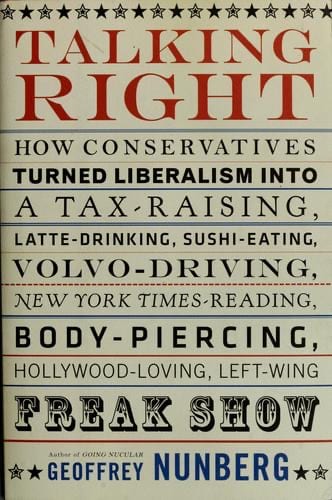
DESCRIPTION
Geoffrey Nunberg breaks new ground with this fierce and funny narrative of how the political right has ushered in a new world order, aided unwittingly by the liberal media. Democrats are well known for their “lousy bumper stickers,” as Joe Klein puts it. As liberals wade through the semantics of “social security lockbox,” “single payer,” and other wonky locutions, the right has become harder, meaner and better at getting out the message: the estate tax became the more menacing “death tax” and a contentious education initiative was wrapped in the comforting (and memorable) blanket of “No Child Left Behind.” But Nunberg shows that the real story is more subtle than just a bumper sticker war. Conservatives’ main goal wasn’t to win voters over to their positions on healthcare, education, or the environment. They had a much more dramatic ambition. By changing the meaning of words like “values,” “government,” “liberal”; “faith,” and “freedom,” conservatives have shifted the political center of gravity of the language itself to the right. “Whatever our politics,” Nunberg observes, “when we talk about politics nowadays, we can’t help using language that embodies a conservative world-view.”
My Summary
Main Ideas, Takeaways & Similarities
Questions
I. What is the problem?
A. How is this problem formulated?
B. Why is this problem important?
C. What is the history of this problem?
D. Which prominent personalities have been interested in this problem?
II. What solutions to the problem are there?
A. What are the conclusions reached?
B. By what argument(s) is the conclusion reached?
C. What facts or assumptions serve as premises?
D. When a prominent personality offers a solution, does he also argue for or against other prominent personalities? Does he raise objections to alternative solutions? Does he consider objections to his own solutions?
III. Evaluation
A. What are the advantages and disadvantages of the alternative formulations to the problem?
B. Has the importance or history of the problem ever been misrepresented?
C. Are the solutions logically related to the premises?
D. Are the facts true? Are the assumptions acceptable? Are the objections answerable?
AI Summary
Highlights
“Talking Right: How Conservatives Turned Liberalism into a Tax-Raising, Latte-Drinking, Sushi-Eating, Volvo-Driving, New York Times-Reading, Body-Piercing, Hollywood-Loving, Left-Wing Freak Show” is a book by Geoffrey Nunberg that analyzes the language and rhetoric used by conservatives to shape public perception of liberalism and liberal values. Here is a summary of the book in bullet points:
- Title: Talking Right: How Conservatives Turned Liberalism into a Tax-Raising, Latte-Drinking, Sushi-Eating, Volvo-Driving, New York Times-Reading, Body-Piercing, Hollywood-Loving, Left-Wing Freak Show
- Author: Geoffrey Nunberg
- Overview:
- The book explores the strategies employed by conservative pundits, politicians, and media outlets to portray liberalism and liberal individuals as out of touch with mainstream America.
- It delves into the use of language and rhetoric to create negative stereotypes of liberals and progressive values.
- Key Themes:
- Language and Framing: The book examines how conservatives have framed the language around liberal values and policies to make them seem unappealing or elitist.
- Cultural Signifiers: It discusses the use of cultural signifiers such as “latte-drinking” or “sushi-eating” to associate liberalism with urban, cosmopolitan lifestyles.
- Political Strategy: The book highlights how these linguistic tactics have been used as a political strategy to mobilize conservative voters and win elections.
- Media Influence: It addresses the role of conservative media outlets in disseminating and popularizing these linguistic frames.
- Impact on Political Discourse: The book argues that these rhetorical strategies have had a lasting impact on political discourse in the United States, shaping public perception of liberal policies and individuals.
- Critique and Analysis:
- Nunberg provides a critical analysis of how language can be used to manipulate public opinion and influence political debates.
- He discusses the effectiveness of these rhetorical tactics in shaping public perception and political outcomes.
- Conclusion:
- “Talking Right” sheds light on the power of language and framing in political discourse and encourages readers to critically examine the ways in which language is used to shape political narratives.
- Legacy:
- The book contributes to discussions about the role of language in politics and remains relevant in understanding the dynamics of political communication and persuasion.
- Audience:
- The book is of interest to readers interested in political communication, rhetoric, and the influence of language on public opinion.
- Impact:
- “Talking Right” has been referenced in discussions about political communication strategies and the framing of political debates, particularly in the context of conservative vs. liberal ideologies.