The Coddling of the American Mind _ How Good Intentions and — Greg Lukianoff, Jonathan Haidt.pdf (file not included in this release)
DESCRIPTION
Something is going wrong on many college campuses in the last few years. Rates of anxiety, depression, and suicide are rising. Speakers are shouted down. Students and professors say they are walking on eggshells and afraid to speak honestly. How did this happen? First Amendment expert Greg Lukianoff and social psychologist Jonathan Haidt show how the new problems on campus have their origins in three terrible ideas that have become increasingly woven into American childhood and education: what doesn’t kill you makes you weaker; always trust your feelings; and life is a battle between good people and evil people. These three Great Untruths are incompatible with basic psychological principles, as well as ancient wisdom from many cultures. They interfere with healthy development. Anyone who embraces these untruths—and the resulting culture of safetyism—is less likely to become an autonomous adult able to navigate the bumpy road of life. Lukianoff and Haidt investigate the many social trends that have intersected to produce these untruths. They situate the conflicts on campus in the context of America’s rapidly rising political polarization, including a rise in hate crimes and off-campus provocation. They explore changes in childhood including the rise of fearful parenting, the decline of unsupervised play, and the new world of social media that has engulfed teenagers in the last decade. This is a book for anyone who is confused by what is happening on college campuses today, or has children, or is concerned about the growing inability of Americans to live, work, and cooperate across party lines.
My Summary
Main Ideas, Takeaways & Similarities
Questions
I. What is the problem?
A. How is this problem formulated?
B. Why is this problem important?
C. What is the history of this problem?
D. Which prominent personalities have been interested in this problem?
II. What solutions to the problem are there?
A. What are the conclusions reached?
B. By what argument(s) is the conclusion reached?
C. What facts or assumptions serve as premises?
D. When a prominent personality offers a solution, does he also argue for or against other prominent personalities? Does he raise objections to alternative solutions? Does he consider objections to his own solutions?
III. Evaluation
A. What are the advantages and disadvantages of the alternative formulations to the problem?
B. Has the importance or history of the problem ever been misrepresented?
C. Are the solutions logically related to the premises?
D. Are the facts true? Are the assumptions acceptable? Are the objections answerable?
AI Summary
The Coddling of the American Mind explores how well-intentioned efforts to protect young people—especially on college campuses—have paradoxically harmed their emotional development, mental health, and capacity for critical thinking. The authors identify and analyze three “Great Untruths” that have become dominant in American culture, particularly among the post-Millennial generation (iGen), and argue that these beliefs are making young people more anxious, fragile, and polarized.
I. Introduction: The Three Great Untruths
The authors define three pervasive and harmful beliefs:
- The Untruth of Fragility – “What doesn’t kill you makes you weaker.”
- The Untruth of Emotional Reasoning – “Always trust your feelings.”
- The Untruth of Us vs. Them – “Life is a battle between good people and evil people.”
Each of these contradicts both ancient wisdom and modern psychology. The authors argue that promoting these untruths leads to negative outcomes in mental health, education, and democracy.
II. Part I: Three Bad Ideas
- Chapter 1: The Untruth of Fragility
- Children and young adults are “antifragile”—they grow stronger with challenges.
- Overprotection (e.g., peanut bans, avoidance of discomfort) weakens resilience.
- Safetyism—the prioritization of emotional safety above all else—has led to a culture where discomfort is equated with harm.
- Avoiding triggers may worsen anxiety and PTSD; exposure and resilience-building are more effective.
- Chapter 2: The Untruth of Emotional Reasoning
- CBT (Cognitive Behavioral Therapy) teaches that feelings are not facts.
- Encouraging youth to always trust their emotions fosters distorted thinking patterns (e.g., catastrophizing, mind-reading).
- Ancient philosophers like Epictetus and Boethius taught that interpretation—not events themselves—causes suffering.
- Chapter 3: The Untruth of Us vs. Them
- A binary worldview fosters tribalism and identity-based conflict.
- Activist culture encourages call-outs and moral purity tests, reinforcing in-group/out-group hostility.
III. Part II: Bad Ideas in Action
- Chapter 4: Intimidation and Violence
- Dissenting speech is increasingly treated as violence on campuses.
- Shout-downs and physical disruptions prevent open dialogue and education.
- Chapter 5: Witch Hunts
- Callout culture mimics historical moral panics, where fear and virtue signaling override fairness and truth.
- People are punished socially or professionally for minor or unintentional transgressions.
IV. Part III: How Did We Get Here?
- Chapter 6: The Polarization Cycle
- Increasing political polarization feeds moral absolutism.
- Social media amplifies outrage, rewards extremism, and deepens ideological silos.
- Chapter 7: Anxiety and Depression
- Rates of teen depression, anxiety, and suicide have surged since 2011, especially among girls.
- The rise of smartphones and social media is strongly correlated with declining mental health.
- Chapter 8: Paranoid Parenting
- Parents overprotect children from risk and discomfort.
- Children no longer learn self-governance through free play and conflict resolution.
- Chapter 9: The Decline of Play
- Unstructured play is crucial for developing social, emotional, and problem-solving skills.
- Its decline contributes to increased fragility and reduced independence.
- Chapter 10: The Bureaucracy of Safetyism
- Universities have expanded administrative systems to manage safety and inclusion.
- These bureaucracies incentivize overreach and create environments where fear of offense stifles debate.
- Chapter 11: The Quest for Justice
- A legitimate desire for justice has been distorted by a simplified identity politics framework.
- Concepts like “impact over intent” and “equity over equality” sometimes undermine fairness and due process.
V. Part IV: Wising Up
- Chapter 12: Wiser Kids
- Encourage independence, free play, and resilience.
- Teach children to confront, not avoid, challenges.
- Limit overuse of technology and encourage real-world interaction.
- Chapter 13: Wiser Universities
- Restore institutional neutrality and viewpoint diversity.
- Reaffirm commitment to free speech and academic rigor.
- Avoid safetyism and overreaction to discomfort.
- Conclusion: Wiser Societies
- Building resilience and emotional maturity in the next generation is critical for democratic health.
- Addressing the six causal threads—polarization, mental health, parenting, play, bureaucracy, and justice—is essential to reversing harmful trends.
Key Themes & Takeaways
- Antifragility: Students grow stronger through difficulty, not protection from it.
- CBT & Rationality: Thoughts, not feelings, shape experience; challenge distortions.
- Tribalism vs. Nuance: Binary thinking and group-based morality degrade discourse.
- Safetyism: Over-prioritizing emotional comfort undermines education and growth.
- Restoring Wisdom: Ancient teachings and modern psychology offer a roadmap for healthier, freer, more robust individuals and institutions.
Highlights
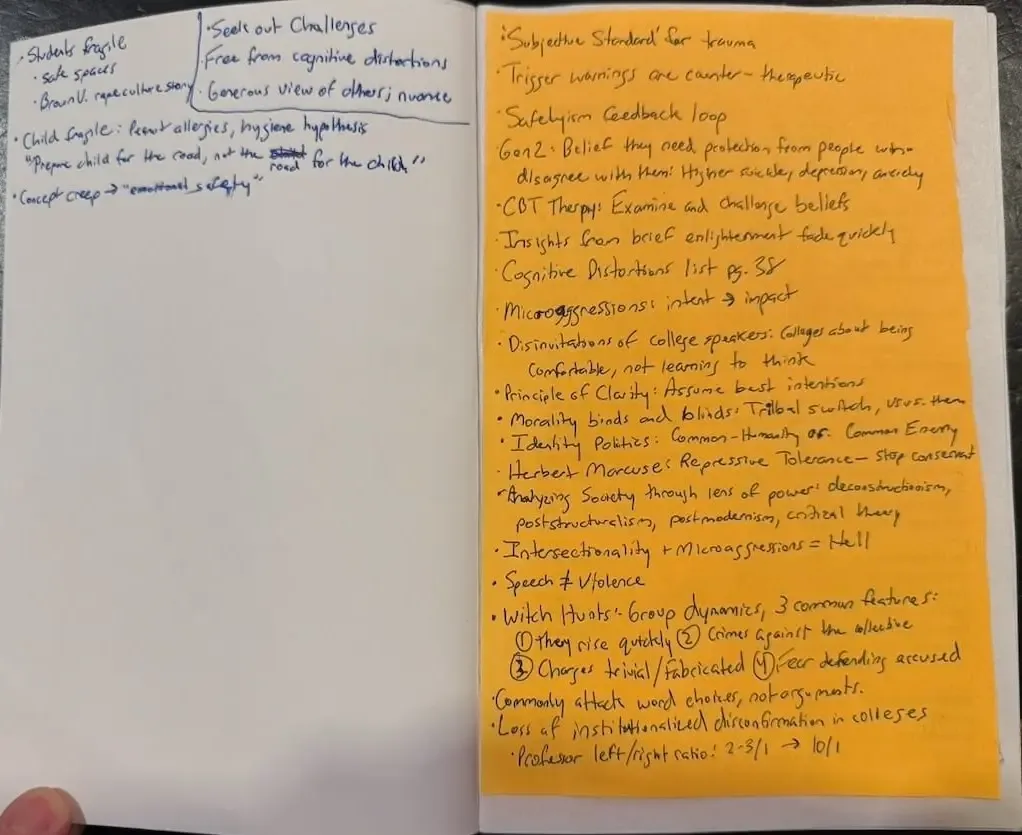
- The Untruth of Fragility: What doesn’t kill you makes you weaker. 2. The Untruth of Emotional Reasoning: Always trust your feelings. 3. The Untruth of Us Versus Them: Life is a battle between good people and evil people. (Page 14)
What is new today is the premise that students are fragile. Even those who are not fragile themselves often believe that others are in danger and therefore need protection. There is no expectation that students will grow stronger from their encounters with speech or texts they label “triggering.” (This is the Untruth of Fragility: What doesn’t kill you makes you weaker.) (Page 17)
Greg worried that if students came to see themselves as fragile, they would stay away from that gym. If students didn’t build skills and accept friendly invitations to spar in the practice ring, and if they avoided these opportunities because well-meaning people convinced them that they’d be harmed by such training, well, it would be a tragedy for all concerned. Their beliefs about their own and others’ fragility in the face of ideas they dislike would become selffulfilling prophecies. Not only would students come to believe that they can’t handle such things, but if they acted on that belief and avoided exposure, eventually they would become less able to do so. If students succeeded in creating bubbles of intellectual “safety” in college, they would set themselves up for even greater anxiety and conflict after graduation, when they will certainly encounter many more people with more extreme views. (Page 18)
Based on Greg’s personal and professional experience, his theory was this: Students were beginning to demand protection from speech because they had (Page 18)
unwittingly learned to employ the very cognitive distortions that CBT tries to correct. Stated simply: Many university students are learning to think in distorted ways, and this increases their likelihood of becoming fragile, anxious, and easily hurt. (Page 19)
In that article, we argued that many parents, K-12 teachers, professors, and university administrators have been unknowingly teaching a generation of students to engage in the mental habits commonly seen in people who (Page 19)
suffer from anxiety and depression. We suggested that students were beginning to react to words, books, and visiting speakers with fear and anger because they had been taught to exaggerate danger, use dichotomous (or binary) thinking, amplify their first emotional responses, and engage in a number of other cognitive distortions (which we will discuss further throughout this book). Such thought patterns directly harmed students’ mental health and interfered with their intellectual development—and sometimes the development of those around them. At some schools, a culture of defensive self-censorship seemed to be emerging, partly in response to students who were quick to “call out” or shame others for small things that they deemed to be insensitive—either to the student doing the calling out or to members of a group that the student was standing up for. We called this pattern vindictive protectiveness and argued that such behavior made it more difficult for all students to have open discussions in which they could practice the essential skills of critical thinking and civil disagreement. (Page 20)
To repeat, we are not saying that the problems facing students, and young people more generally, are minor or “all in their heads.” We are saying that what people choose to do in their heads will determine how those real problems affect them. Our argument is ultimately pragmatic, not moralistic: Whatever your identity, background, or political ideology, you will be happier, healthier, stronger, and more likely to succeed in pursuing your own goals if you do the opposite of what Misoponos advised. That means seeking out challenges (rather than eliminating or avoiding everything that “feels unsafe”), freeing yourself from cognitive distortions (rather than always trusting your initial feelings), and taking a generous view of other people, and looking for nuance (rather than assuming the worst about people within a simplistic us-versus-them morality). (Page 23)
PART I Three Bad Ideas (Page 25)
CHAPTER 1 The Untruth of Fragility: What Doesn’t Kill You Makes You Weaker (Page 26)
When heaven is about to confer a great responsibility on any man, it will exercise his mind with suffering, subject his sinews and bones to hard work, expose his body to hunger, put him to poverty, place obstacles in the paths of his deeds, so as to stimulate his mind, harden his nature, and improve wherever he is incompetent. MENG TZU (MENCIUS), fourth century BCE (Page 26)
Peanut allergies were rare among American children up until the mid-1990s, when one study found that only four out of a thousand children under the age of eight had such an allergy (meaning probably nobody in Max’s entire preschool of about one hundred kids) But by 2008, according to the same survey, using the same measures, the rate had more than tripled, to fourteen out of a thousand (meaning probably one or two kids in Max’s school). (Page 27)
It was later discovered that peanut allergies were surging precisely because parents and teachers had started protecting children from exposure to peanuts back in the 1990s In February 2015, an authoritative study5 was published. The LEAP (Learning Early About Peanut Allergy) study was based on the hypothesis that “regular eating of peanut-containing products, when started during infancy, will elicit a protective immune response instead of an allergic immune reaction.”6 The researchers recruited the parents of 640 infants (four to eleven months old) who were at high risk of developing a peanut allergy because they had severe eczema or had tested positive for another allergy. The researchers told half the parents to follow the standard advice for high-risk kids, which was to avoid all exposure to peanuts and peanut products. The other half were given a supply of a snack made from peanut butter and puffed corn and were told to give some to their child at least three times a week. The researchers followed all the families carefully, and when the children turned five years old, they were tested for an allergic reaction to peanuts. (Page 27)
Among the children who had been “protected” from peanuts, 17% had developed a peanut allergy. In the group that had (Page 27)
been deliberately exposed to peanut products, only 3% had developed an allergy. As one of the researchers said in an interview, “For decades allergists have been recommending that young infants avoid consuming allergenic foods such as peanut to prevent food allergies. Our findings suggest that this advice was incorrect and may have contributed to the rise in the peanut and other food allergies.” (Page 28)
The immune system is a complex adaptive system, which can be defined as a dynamic system that is able to adapt in and evolve with a changing environment It requires exposure to a range of foods, bacteria, and even parasitic worms in order to develop its ability to mount an immune response to real threats (such as the bacterium that causes strep throat) while ignoring nonthreats (such as peanut proteins). (Page 28)
This is the underlying rationale for what is called the hygiene hypothesis the leading explanation for why allergy rates generally go up as countries get wealthier and cleaner—another example of a problem of progress. (Page 28)
Thanks to hygiene, antibiotics and too little outdoor play, children don’t get exposed to microbes as they once did. This may lead them to develop immune systems that overreact to substances that aren’t actually threatening—causing allergies. In the same way, by shielding children from every possible risk, we may lead them to react with exaggerated fear to situations that aren’t risky at all and isolate them from the adult skills that they will one day have to master [emphasis added] (Page 28)
Antifragility (Page 29)
book Antifragile, Taleb explains how systems and people can survive the inevitable black swans of life and, like the immune system, grow stronger in response. Taleb asks us to distinguish three kinds of things. Some, like china teacups, are fragile: they break easily and cannot heal themselves, so you must handle them gently and keep them away from toddlers. Other things are resilient: they can withstand shocks. Parents usually give their toddlers plastic cups precisely because plastic can survive repeated falls to the floor, although the cups do not benefit from such falls. But Taleb asks us to look beyond the overused word “resilience” and recognize that some things (Page 29)
are antifragile. Many of the important systems in our economic and political life are like our immune systems: they require stressors and challenges in order to learn, adapt, and grow. Systems that are antifragile become rigid, weak, and inefficient when nothing challenges them or pushes them to respond vigorously. (Page 30)
Taleb opens the book with a poetic image that should speak to all parents. He notes that wind extinguishes a candle but energizes a fire. He advises us not to be like candles and not to turn our children into candles: “You want to be the fire and wish for the wind.” (Page 30)
“Prepare the child for the road, not the road for the child.” (Page 30)
The Rise of Safetyism (Page 30)
But gradually, in the twenty-first century, on some college campuses, the meaning of “safety” underwent a process of “concept creep” and expanded to include “emotional safety.” (Page 31)
article published in 2016 by the Australian psychologist Nick Haslam, titled “Concept Creep: Psychology’s Expanding Concepts of Harm and Pathology.”16 Haslam examined a variety of key (Page 31)
concepts in clinical and social psychology—including abuse, bullying, trauma, and prejudice—to determine how their usage had changed since the 1980s. He found that their scope had expanded in two directions: the concepts had crept “downward,” to apply to less severe situations, and “outward,” to encompass new but conceptually related phenomena. (Page 32)
As with trauma, a key change for most of the concepts Haslam examined (Page 32)
was the shift to a subjective standard It was not for anyone else to decide what counted as trauma, bullying, or abuse; if it felt like that to you, trust your feelings. (Page 33)
America is a rape culture, (Page 33)
(For example, in parts of Afghanistan, “women are married against their will, they are murdered for men’s honor, they are raped. And when they are raped they are arrested for it, and they are shunned by their family afterward,” she says. “Now that’s a rape culture.”25) (Page 33)
Illustrating concept creep and the expansion of “safety” to include emotional comfort, the student quoted above, along with other Brown students, attempted to get McElroy disinvited from the debate (Page 34)
So the student quoted above worked with other Brown students to create a “safe space” where anyone who felt triggered could recuperate and get help. The room was equipped with cookies, coloring books, bubbles, Play-Doh, calming music, pillows, blankets, and a video of frolicking puppies, as well as students and staff members purportedly trained to deal with trauma. (Page 34)
“I was feeling bombarded by a lot of viewpoints that really go against my dearly and closely held beliefs.” (Page 34)
most people report becoming stronger, or better in some way, after suffering through a traumatic experience. (Page 35)
Trigger warnings are counter-therapeutic (Page 35)
reactivation of anxiety is so important to recovery that some therapists advise their patients to avoid using antianxiety medication while undertaking exposure therapy. (Page 35)
safetyism (Page 36)
“Safetyism” refers to a culture or belief system in which safety has become a sacred value, which means that people become unwilling to make trade-offs demanded by other practical and moral concerns. (Page 36)
She calls those born in and after 1995 “iGen,” short for “internet Generation.” (Others use the term “Generation Z.”) (Page 36)
higher rates of anxiety and depression (Page 37)
higher rates of suicide (Page 37)
“one should be safe not just from car accidents and sexual assault but from people who disagree with you.” (Page 37)
What really frightens and dismays us is not external events themselves, but the way in which we think about them. It is not things that disturb us, but our interpretation of their significance. EPICTETUS, 1st–2nd century1 (Page 39)
therapists have helped you question your fears, not amplify them (Page 39)
Buddha (“Our life is the creation of our mind”)2 or Shakespeare (“There is nothing either good or bad, but thinking makes it so”)3 or Milton (“The mind is its own place, and in itself can make a heaven of hell, a hell of heaven”) (Page 40)
“Nothing is miserable unless you think it so; and on the other hand, nothing brings happiness unless you are content with it.” (Page 40)
Reasoning and learning instead to question our feelings. The feelings themselves are real, and sometimes they alert us to truths that our conscious mind has not noticed, but sometimes they lead us astray. (Page 40)
rider does his job without objection, but the rider has some ability to talk back to the elephant, particularly if he can learn to speak the elephant’s language, which is a language of intuition rather than logic. (Page 41)
If you engage in this “talking back” process on a regular basis, it becomes easier and easier to do. (Page 41)
patients tended to get themselves caught in a feedback loop in which irrational negative beliefs caused powerful negative feelings, which in turn seemed to drive patients’ reasoning, motivating them to find evidence to support their negative beliefs. (Page 42)
schemas. Schemas refer to the patterns of thoughts and behaviors, built up over time, that people use to process information quickly and effortlessly as they interact with the world. Schemas are deep down in the elephant; (Page 42)
If you can get people to examine these beliefs and consider counterevidence, it gives them at least some moments of relief from negative emotions, and if you release them from negative emotions, they become more open to questioning their negative beliefs. (Page 42)
insights gained from moments of enlightenment often fade quickly). (Page 43)
commitment to connect one’s claims to reliable evidence in a proper way (Page 45)
microaggressions (Page 45)
Teaching people to see more aggression in ambiguous interactions, take more offense, feel more negative emotions, and avoid questioning their initial interpretations strikes us as unwise, to say the least. It is also contrary to the usual goals of good psychotherapy. (Page 48)
microaggression concept19 reveals a crucial moral change on campus: the shift from “intent” to “impact.” (Page 49)
It is crucial to teach incoming students to be thoughtful in their interactions with one another. A portion of what is derided as “political correctness” is just an effort to promote polite and respectful interactions by discouraging the use of terms that are reasonably taken to be demeaning But if you teach students that intention doesn’t matter, and you also encourage students to find more things offensive (leading them to experience more negative impacts), and you also tell them that whoever says or does the things they find offensive are “aggressors” who have committed acts of bigotry against them, then you are probably fostering feelings of victimization, anger, and hopelessness in your students. They will come to see the world—and even their university—as a hostile place where things never seem to get better. (Page 51)
foster an external locus of control. (Page 51)
A great deal of research shows that having an internal locus of control leads to greater health, happiness, effort expended, success in school, and success at work. (Page 51)
“disinvitation” of guest speakers. (Page 51)
379 such events. (Page 52)
As you can see in Figure 2.1, from 2000 through 2009, disinvitation efforts were just as likely to come from the right as from the left But after 2009, a gap opens up, and then widens beginning in 2013, right around the time that Greg began noticing things changing on campus. (Page 52)
In 2017, 58% of college students said it is “important to be part of a campus community where I am not exposed to intolerant and offensive ideas.” (Page 53)
almost half of very conservative students (45%) endorsed that statement, too. (Page 53)
job to sting, to disturb, to question, and thereby to provoke his fellow Athenians (Page 54)
“Education should not be intended to make people comfortable; it is meant to make them think.” (Page 55)
There is the moral dualism that sees good and evil as instincts within us between which we must choose. But there is also what I will call pathological dualism that sees humanity itself as radically … divided into the unimpeachably good and the irredeemably bad. You are either one or the other. RABBI LORD JONATHAN SACKS, Not in God’s Name (Page 57)
There is a principle in philosophy and rhetoric called the principle of charity, which says that one should interpret other people’s statements in their best, most reasonable form, not in the worst or most (Page 58)
offensive way possible. (Page 59)
Erika later revealed that many professors were very supportive privately, but were unwilling to defend or support the (Page 60)
Christakises publicly because they thought it was “too risky” and they feared retribution (Page 61)
It’s as though some of the students had their own mental prototype, a schema with two boxes to fill: victim and oppressor. Everyone is placed into one box or the other. (Page 61)
minimal group paradigm, (Page 61)
fMRI (Page 62)
people’s hands getting pricked by a needle or touched by a Q-tip. (Page 62)
hand being pricked by a needle was labeled with the participant’s own religion, the area of the participant’s brain that handles pain showed a larger spike of activity (Page 62)
human mind is prepared for tribalism (Page 62)
When the “tribe switch”30 is activated, we bind ourselves more tightly to the group, we embrace and defend the group’s moral matrix, and we stop thinking for ourselves. (Page 62)
“morality binds and blinds,” (Page 62)
Any kind of intergroup conflict (real or perceived) immediately turns tribalism up, making people highly attentive to signs that reveal which team another person is on. (Page 62)
Traitors are punished, and fraternizing with the enemy is, too. Conditions of peace and prosperity, in contrast, generally turn down the tribalism People don’t need to track group membership as vigilantly; they don’t feel pressured to (Page 62)
conform to group expectations as closely. When a community succeeds in turning down everyone’s tribal circuits, there is more room for individuals to construct lives of their own choosing; there is more freedom for a creative mixing of people and ideas. (Page 63)
So what happens to a community such as a college (or, increasingly, a high school33) when distinctions between groups are not trivial and arbitrary, and when they are emphasized rather than downplayed? What happens when you train students to see others—and themselves—as members of distinct groups defined by race, gender, and other socially significant factors, and you tell them that those groups are eternally engaged in a zero-sum conflict over status and resources? (Page 63)
But how identity is mobilized makes an enormous difference—for the group’s odds of success, for the welfare of the people who join the movement, and for the country. Identity can be mobilized in ways that emphasize an overarching common humanity while making the case that some fellow human beings are denied dignity and rights because they belong to a particular group, or it can be mobilized in ways that amplify our ancient tribalism and bind people together in shared hatred of a group that serves as the unifying common enemy. (Page 63)
COMMON-HUMANITY IDENTITY POLITICS (Page 64)
Part of Dr. King’s genius was that he appealed to the shared morals and identities of Americans by using the unifying languages of religion and patriotism. (Page 64)
King’s approach made it clear that his movement would not destroy America; it would repair and reunite it. (Page 65)
This is the way to win hearts, minds, and votes: you must appeal to the elephant (intuitive and emotional processes) as well as the rider (reasoning). (Page 66)
COMMON-ENEMY IDENTITY POLITICS (Page 66)
Identifying a common enemy is an effective way to enlarge and motivate your tribe. (Page 66)
In calling for the dismantling of power structures, the author was using a set of terms and concepts that are common in some academic departments; the main line of argumentation fell squarely within the large family of Marxist approaches to social and political analysis. It’s a set of approaches in which things are analyzed primarily in terms of power. Groups struggle for power. Within this paradigm, when power is perceived to be held by one group over (Page 67)
others, there is a moral polarity: the groups seen as powerful are bad, while the groups seen as oppressed are good. It’s a variant of the pathological dualism that Rabbi Sacks described in the quotation at the start of this chapter. (Page 68)
Herbert Marcuse, (Page 68)
Marcuse therefore analyzed the conflict between the left and the right in Marxist terms. (Page 68)
power differentials between groups exist, tolerance only empowers the already powerful and makes it easier for them to dominate institutions like education, the media, and most channels of communication. Indiscriminate tolerance is “repressive,” (Page 68)
A truly “liberating tolerance,” claimed Marcuse, is one that favors the weak and restrains the strong. (Page 68)
justifiable to use “repression and indoctrination” to allow the “subversive majority” to achieve the power that it deserves. (Page 69)
Marcuse argued that true democracy might require denying basic rights to people who advocate for conservative causes, (Page 69)
The ways should not be blocked [by] which a subversive majority could develop, and if they are blocked by organized repression and indoctrination, their reopening may require apparently undemocratic means. They would include the withdrawal of toleration of speech and assembly from groups and movements which promote aggressive policies, armament, chauvinism, discrimination on the grounds of race and religion, or which oppose the extension of public services, social security, medical care, etc. Moreover, the restoration of freedom of thought may necessitate new and rigid restrictions on teachings and practices in the educational institutions which, by their very methods and concepts, serve to enclose the mind within the established universe of discourse and behavior (Page 69)
“Repressive Tolerance” (Page 70)
analyzing society through the lens of power relationships among groups. (Page 70)
deconstructionism (Page 70)
critical theory (Page 70)
postmodernism (Page 70)
poststructuralism (Page 70)
intersectionality (Page 70)
Intersectionality as an analytic tool examines how power relations are intertwined and mutually constructing. Race, class, gender, sexuality, dis/ability, ethnicity, nation, religion, and age are categories of analysis, terms that reference important social divisions. But they are also categories that gain meaning from power relations of racism, sexism, heterosexism, and class exploitation. (Page 71)
Intersectionality is a theory based on several insights that we believe are valid and useful: power matters, members of groups sometimes act cruelly or unjustly to preserve their power, and people who are members of multiple identity groups can face various forms of disadvantage in ways that are often invisible to others. The point of using the terminology of “intersectionalism,” as Crenshaw said in her 2016 TED Talk, is that “where there’s no name for a problem, you can’t see a problem, and when you can’t see a problem, you pretty much can’t solve it.” (Page 71)
The main axes of oppression usually point to one intersectional address: straight white males. (Page 73)
many college students today seem to be adopting a different version of intersectional thinking and are embracing the Untruth of Us Versus Them. (Page 74)
Imagine an entire entering class of college freshmen whose orientation program includes training in the kind of intersectional thinking described above, along with training in spotting microaggressions. By the end of their first week on campus, students have learned to score their own and others’ levels of privilege, identify more distinct identity groups, and see more differences between people They have learned to interpret more words and social behaviors as acts of aggression. They have learned to associate aggression, domination, and oppression with privileged groups. They have learned to focus only on perceived impact and to ignore intent. How might students at such a school react to the sorts of emails sent by Dean Spellman and Erika Christakis?68 (Page 74)
creates an environment highly conducive to the development of a “call-out culture,” in which students gain prestige for identifying small offenses committed by members of their community, and then publicly “calling out” the offenders. (Page 74)
Life in a call-out culture requires constant vigilance, fear, and selfcensorship. Many in the audience may feel sympathy for the person being shamed but are afraid to speak up, yielding the false impression that the audience is unanimous in its condemnation. (Page 75)
students at many colleges today are walking on eggshells, afraid of saying the wrong thing, liking the wrong post, or coming to the defense of someone whom they know to be innocent, out of fear that they themselves will be called out by a mob on social media. (Page 75)
Mobs can rob good people of their conscience, particularly when participants wear masks (in a real mob) or are hiding behind an alias or avatar (in an online mob). Anonymity fosters deindividuation—the loss of an individual sense of self—which lessens self-restraint and increases one’s willingness to go along with the mob. (Page 76)
four features of the culture: dogmatism, groupthink, a crusader mentality, and anti-intellectualism. (Page 76)
The book has had a powerful impact on the political left, but the issues it raises resonate across the political spectrum. In books like Radley Balko’s Rise of the Warrior Cop: The Militarization of America’s Police Forces77 and FIRE cofounder Harvey Silverglate’s Three Felonies a Day: How the Feds Target the Innocent libertarians have expressed opposition to both overpolicing and the excesses of the war on drugs. The conservative group Right on Crime opposes overcriminalization, mass incarceration, and the drug war There are opportunities for real cooperation on serious but potentially solvable issues. (Page 77)
When we dehumanise and demonise our opponents, we abandon the possibility of peacefully resolving our differences, and seek to justify violence against them. NELSON MANDELA (Page 82)
The failure of UC Berkeley to openly discipline any of the students who engaged in violence or vandalism during the mayhem29—even those who publicly admitted participating—and the fact that the police arrested just one person that night (for failure to disperse)30 seems to have taught the protesters an important lesson: Violence works. Unsurprisingly, the Antifa activists built on their success by threatening more violence in response to campus invitations to conservatives David Horowitz, Ann Coulter, and Ben Shapiro. (Page 84)
VIOLENCE AS SELFDEFENSE, (Page 85)
Orwellian inversions of common English words. (Page 86)
But if asking for peaceful dialogue is violent, then it seems that the word “violence” is taking on new meanings for some students. This is another example of concept creep. (Page 86)
This is not an uncommon view on many campuses. Almost one in five students surveyed in a 2017 Brookings Institution study agreed that using violence to prevent a speaker from speaking was sometimes “acceptable.”39 While some critics challenged the sampling used in that study, findings in a second study by McLaughlin and Associates were similar; 30% of undergraduate students surveyed agreed with this statement: “If someone is using hate speech or making racially charged comments, physical violence can be justified to prevent this person from espousing their hateful views.”40 (Page 87)
John McWhorter describes how the term “white supremacist” is now used in an “utterly athletic, recreational” way, as a “battering ram” to attack anyone who departs from the party line (Page 87)
No one should have to pass someone else’s ideological purity test to be allowed to speak. (Page 93)
In a widely circulated essay in The New York Times in July 2017, the argument that words can be violence was made by Lisa Feldman Barrett, a well-respected professor of psychology and emotion researcher at Northeastern University Barrett offered this syllogism: “If words can cause stress, and if prolonged stress can cause physical harm, then it seems that speech—at least certain types of speech—can be a form of violence.” (Page 95)
I don’t want you to be safe ideologically. I don’t want you to be safe emotionally. I want you to be strong. That’s different. I’m not going to pave the jungle for you. Put on some boots, and learn how to deal with adversity. I’m not going to take all the weights out of the gym; that’s the whole point of the gym. This is the gym. (Page 97)
“collective effervescence,” (Page 100)
three features common to most political witch hunts (Page 101)
They arise quickly: (Page 101)
Crimes against the collective: (Page 101)
Charges are often trivial or fabricated: (Page 101)
Fear of defending the accused: (Page 102)
Transracialism (Page 104)
It is striking how many of the critics’ complaints refer not to Tuvel’s arguments but to her word choices. (Page 105)
“Paying the Price for Breakdown of the Country’s Bourgeois Culture.” (Page 107)
“bourgeois cultural script” that used to compel Americans to “get married before you have children and strive to stay married for their sake. Get the education you need for gainful employment, work hard, and avoid idleness.” (Page 107)
One is not supposed to say that a dominant culture is superior to a nondominant one in any way. But anthropologists generally agree that cultures and subcultures instill different goals, skills, and virtues in their members (Page 107)
Solidarity engenders trust, teamwork, and mutual aid. But it can also foster groupthink, orthodoxy, and a paralyzing fear of challenging the collective. (Page 108)
One of the most brilliant features of universities is that, when they are working properly, they are communities of scholars who cancel out one another’s confirmation biases. (Page 108)
institutionalized disconfirmation (Page 108)
A left-to-right ratio of two or three to one should be enough to sustain institutionalized disconfirmation. (Page 109)
The ratios in other core fields in the humanities and social sciences are nearly all above ten to one. (Page 111)
Six social scientists (including Jon) wrote an academic article in 2015 that explains how For example, when a field lacks political diversity, researchers tend to congregate around questions and research methods that generally confirm their shared narrative, while ignoring questions and methods that don’t offer such support. (Page 111)
But we are saying that viewpoint diversity is necessary for the development of critical thinking, while viewpoint homogeneity (whether on the left or the right) leaves a community vulnerable to groupthink and orthodoxy. (Page 112)
These rituals and talk of campuswide “solidarity” make sense from a Durkheimian perspective. They are ways to prepare a community for collective action. (Page 114)
There is no simple answer. In Part III, we present six interacting explanatory threads: rising political polarization and cross-party animosity; rising levels of teen anxiety and depression; changes in parenting practices; the decline of free play; the growth of campus bureaucracy; and a rising passion for justice in response to major national events, combined with changing ideas about what justice requires. We believe that it is impossible to understand the state of higher education today without understanding all six. Before we present these threads, however, we must make two points explicitly and emphatically. (Page 122)
A set of new ideas about speech, violence, and safety has emerged on the far left in recent years, and the debate on campus is largely a debate within the left, pitting (mostly) older progressives, who generally have an expansive notion of free speech, against (mostly) younger progressives, who are more likely to support some limitations on speech in the name of inclusion (Page 124)
21-point increase in the distance between Republicans and Democrats over the same time period, nearly all of it occurring since 2004. (Page 125)
mid-twentieth century was a historical anomaly—a period of unusually low political polarization and cross-party animosity7 combined with generally high levels of social trust and trust in government From the 1940s to around 1980, American politics was about as centrist and bipartisan as it has ever been. (Page 127)
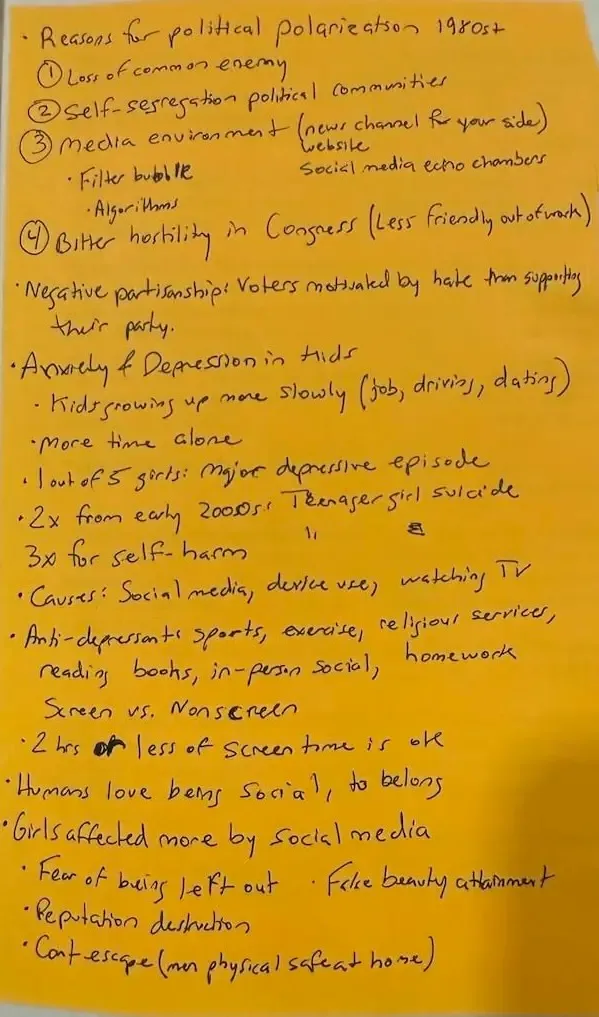
loss of a common enemy (Page 127)
since the 1970s, Americans have been increasingly self-segregating into politically homogeneous communities (Page 127)
The two major political parties have sorted themselves along similar lines: as the Republican Party becomes disproportionately older, white, rural, male, and Christian, the Democratic Party is increasingly young, nonwhite, urban, female, and nonreligious. (Page 127)
media environment, (Page 127)
By the 1990s, there was a cable news channel for most points on the political spectrum, and by the early 2000s there was a website or discussion group for every conceivable interest group and grievance. (Page 127)
social media sites like Facebook and Twitter, which make it easy to encase oneself within an echo chamber. (Page 127)
“filter bubble,” in which search engines and YouTube algorithms (Page 127)
increasingly bitter hostility in Congress. (Page 128)
Gingrich then imposed a set of reforms intended to discourage his many new members from forging the sort of personal relationships across party lines that had been normal in previous decades. (Page 128)
negative partisanship (Page 128)
Americans are now motivated to leave their couches to take part in political action not by love for their party’s candidate but by hatred of the other party’s candidate. (Page 128)
This is an essential part of our story. Americans now bear such animosity toward one another that it’s almost as if many are holding up signs saying, “Please tell me something horrible about the other side, I’ll believe anything!” Americans are now easily exploitable, and a large network of profit-driven media sites, political entrepreneurs, and foreign intelligence agencies are taking advantage of this vulnerability. (Page 129)
“outrage industry” of talk radio, cable news networks, and conspiracy websites is more developed and effective on the right (Page 129)
In physics, as Newton’s law tells us, every action produces an equal and opposite reaction. In a polarization spiral, however, for every action there is a disproportionate reaction. Many critics of campus protesters in 2015 accused them of overreacting to small things (such as Dean Spellman’s email at Claremont McKenna). But beginning in late 2016, we began to see more examples of off-campus overreaction from the right in response to speech by professors on the left. (Page 130)
The title refers to the little-known fact that (Page 132)
ancient Greek and Roman statues were usually painted with skin tones and bright colors, but when these buried and weathered statues were rediscovered during the Renaissance, the paint had worn off. Renaissance artists and their patrons believed that the unadorned white marble was part of the intended aesthetic, and these artists created new statues (such as Michelangelo’s David) using what they mistakenly believed was the Greco-Roman ideal As a result, the white marble statues of the Renaissance have shaped our current image of what the ancient world must have looked like: white marble statues everywhere. (Page 133)
Dylann Roof (Page 135)
death Richard Collins III (Page 135)
Charlottesville (Page 136)
An hour and a half after Spencer’s speech ended, three men proclaiming to be white nationalists drove their car over to a group of protesters at a bus stop and began to yell neo-Nazi chants at them. (Page 136)
Twenge’s analyses suggest that there are two major generational changes that may be driving the rise of safetyism on campus since 2013. The first is that kids now grow up much more slowly. Activities that are commonly thought to mark the transition from childhood to adulthood are happening later—for example, having a job, driving a car, drinking alcohol, going out on a date, and having sex. Members of iGen wait longer to do these things— and then do less of them—than did members of previous generations. Instead of engaging in these activities (which usually involve interacting with other people face-to-face), teens today are spending much more time alone, interacting with screens Of special importance, the combination of (Page 142)
helicopter parenting, fears for children’s safety, and the allure of screens means that members of iGen spend much less time than previous generations did going out with friends while unsupervised by an adult. (Page 143)
Teens are physically safer than ever, yet they are more mentally vulnerable. (Page 143)
major generational change is a rapid rise in rates of anxiety and depression (Page 143)
By 2016, as you can see in Figure 7.1, roughly one out of every five girls reported symptoms that met the criteria for having experienced a major depressive episode in the previous year The rate for boys went up, too, but more slowly (from 4.5% in 2011 to 6.4% in 2016). (Page 144)
Compared to the early 2000s, nearly twice as many teenage girls now end their own lives. (Page 145)
“nonfatal self-inflicted injuries.” (Page 146)
nearly tripling from roughly 110 per hundred thousand in 2009 to 318 per hundred thousand in 2015. ( (Page 146)
Twenge finds that there are just two activities that are significantly correlated with depression and other suicide-related outcomes (such as considering suicide, making a plan, or making an actual attempt): electronic device use (such as a smartphone, tablet, or computer) and watching TV. On the other hand, there are five activities that have inverse relationships with depression (meaning that kids who spend more hours per week on these activities show lower rates of depression): sports and other forms of exercise, attending religious services, reading books and other print media, in-person social interactions, and doing homework. (Page 147)
Notice anything about the difference between the two lists? Screen versus nonscreen. When kids use screens for two hours of their leisure time per day or less, there is no elevated risk of depression. (Page 147)
Human beings are an “ultrasocial” species. (Page 147)
Humans love teams, team sports, synchronized movements, and anything else that gives us the feeling of “one for all, and all (Page 147)
for one.” (Page 148)
The trick is to satisfy people’s needs to belong and interact without activating the more defensive and potentially violent aspects of tribalism.) (Page 148)
“curated” versions of lives, (Page 148)
“FOBLO”—fear of being left out. (Page 149)
“Girls use social media more often, giving them additional opportunities to feel excluded and lonely when they see their friends or classmates getting together without them.” (Page 149)
beauty is artificially enhanced, making girls ever more insecure about their own appearance. (Page 149)
Girls, in contrast, are more “relationally” aggressive; they try to hurt their rivals’ relationships, reputations, and social status—for example, by using social media to make sure other girls know who is intentionally being left out. (Page 149)
if boys’ aggression is generally delivered in person, then the targets of boys’ aggression can escape from it when they go home. On social media, girls can never escape. (Page 150)
Clearly universities were not causing a national mental health crisis; they were responding to one, and this may explain why the practices and beliefs of safetyism spread so quickly after 2013. (Page 152)
“learned helplessness,” (Page 153)
“hostile attribution bias,” (Page 153)
The crime wave ended rather abruptly in the early 1990s, when rates of nearly all crimes began to plummet all over the United States In 2013, for example, the murder rate dropped to the same level it had been at sixty years earlier Nevertheless, the fear of crime did not diminish along with the crime rate, and the new habits of fearful parenting seem to have become new national norms. American parenting is now wildly out of sync with the actual risk that strangers pose to children. (Page 160)
Putting it all (Page 161)
together, from 1960 to 1990, there was a 48% reduction in deaths from unintended injuries and accidents among kids between five and fourteen years of age, and a 57% drop in deaths of younger kids (ages one to four). (Page 162)
As Taleb showed us in Antifragile, by placing a protective shield over our children, we inadvertently stunt their growth and deprive them of the experiences they need to become successful and functional adults. (Page 163)
When parents get together and talk about parenting, it is common to hear condemnations of helicopter parenting. Many parents want to do less hovering and give their kids more freedom, but it’s not so easy; there are pressures from other parents, from schools, and even from laws that push parents to be more protective than they would like to be. Skenazy says that societal pressures often prompt parents to engage in “worst-first thinking.”32 Unless parents prepare for the worst possible outcomes, they are looked down on by other parents and by teachers for being bad parents (or even “America’s Worst Mom”). Good parents are expected to believe that their children are in danger every moment they are unsupervised. (Page 164)
Before the rise of paranoid parenting, eleven-year-olds could earn money and learn responsibility by babysitting for neighbors, as Jon and his sisters did in the 1970s. Now, according to some police departments and local busybodies, eleven-year-olds need babysitters themselves. The mother was issued a misdemeanor summons and forced to appear in court. (Page 164)
Both scholars find that, with respect to parenting practices, social class matters far more than race, s (Page 165)
The big divide in parenting practices is best seen in the contrast between two kinds of families: those in which children are raised by two parents who each have four-year-college degrees and are married to each other throughout their children’s childhood, and those in which children are raised by a single or divorced parent (or other relative) who does not have a four-year-college degree. The first kind of family is very common in the upper third of the socioeconomic spectrum, in which marriage rates are high and divorce rates are low. These families generally employ a parenting style that Lareau calls “concerted cultivation.” Parents using this style see their task as cultivating their children’s talents while stimulating the development of their cognitive and social skills. They fill their children’s calendars with adult-guided activities, lessons, and experiences, and they closely monitor what happens in school. They talk with their children a great deal, using reasoning and persuasion, and they hardly ever use physical force or physical punishment. The second kind of family is very common in the bottom third of the socioeconomic spectrum, where most children are born to unmarried mothers. These families generally employ a parenting style that Lareau calls “natural growth parenting.” Working-class parents tend to believe that children will reach maturity without needing much guidance or interference from adults. Children therefore experience “long stretches of leisure time, child-initiated play, clear boundaries between adults and children, and daily interactions with kin.”36 Parents spend less time talking with their children, and reason with them far less, compared with middle-class parents; they also give more orders and directives, and they sometimes use spanking or physical discipline. (Page 166)
beginning in the 1980s and accelerating in the 1990s, “the dominant ideas and social norms about good parenting [had] shifted from Spock’s ‘permissive parenting’ to a new model of ‘intensive parenting,’”38 which essentially describes Lareau’s concerted cultivation. (Page 167)
It would be a mistake, however, to think that working-class kids had an overall advantage. Putnam and Lareau both note a variety of factors that make it harder for working-class kids to succeed in general, and in college in particular, even if they are admitted to selective universities. One is that all those organized activities help to familiarize middle-class children with the ways of adults in professional settings and adult-run institutions. Parental modeling gives them a sense that institutions can be made to serve their needs if they can make the right argument to the right person at the right time. Working-class kids, in contrast, have generally had less exposure to adult institutions and have not seen their parents engage with these institutions with the same sense of strength, rights, or entitlement to good treatment. Working-class kids are therefore more likely to feel like “fish out of water” in college. (This may have contributed to the feelings of not belonging that Olivia wrote about, from the Claremont McKenna College story we presented in chapter 3.) (Page 167)
Compared with middle-class kids, the second major disadvantage plaguing working-class kids is that they are more likely to have been affected by chronic and severe adversity. In the 1990s, a group of researchers (Page 167)
developed a survey to standardize the assessment of “Adverse Childhood Experiences” (ACE) The survey asked people to report which items, from a list of ten, they had been exposed to in childhood; things like “Parents separated/divorced,” “You lacked food or clothes or your parents were too drunk or high to care for you,” “Felt no one in family loved or supported you,” “Adult sexually abused you.” As the number of yes responses increases beyond two, measures of health and success in adulthood tend to decline, and this introduces an important complication to our story about antifragility: Severe adversity that hits kids early, especially in the absence of secure and loving attachment relationships with adults, does not make them stronger; it makes them weaker. Chronic, severe adversity creates “toxic stress.” It resets children’s stress responses to kick in more readily and for longer periods in the future. Putnam summarizes the findings like this: (Page 168)
Moderate stress buffered by supportive adults is not necessarily harmful, and may even be helpful, in that it can promote the development of coping skills. On the other hand, severe and chronic stress, especially if unbuffered by supportive adults, can disrupt the basic executive functions that govern how various parts of the brain work together to address challenges and solve problems. Consequently, children who experience toxic stress have trouble concentrating, controlling impulsive behavior, and following directions (Page 168)
Kids raised in families below the middle class score much higher, on average, on the ACE survey. Their family situations tend to be more unstable; their economic lives are often precarious, and they are much more likely to witness violence or be victims of violence. This means that even if they make it to college, they may still be carrying scars and disadvantages with them, and in order to thrive in college, they may need different kinds of support than are appropriate for their wealthier peers, whose brains were shaped by concerted cultivation. The lesson we draw from this brief review of research on social class and parenting is that although kids are naturally antifragile, there are two very different ways to damage their development. One is to neglect and underprotect them, exposing them early to severe and chronic adversity. This has happened to some of today’s college students, particularly those from (Page 168)
working-class or poor families. The other is to overmonitor and overprotect them, denying them the thousands of small challenges, risks, and adversities that they need to face on their own in order to become strong and resilient adults. America’s selective universities are dominated by children from the upper class and upper-middle class. A recent analysis found that at thirty-eight top schools, including most of the Ivy League, there are more undergraduate students from families in the top 1% of the income distribution than from the bottom 60% This means that overparenting is probably a much greater cause of fragility on such campuses than is underparenting. (Page 169)
Skenazy sees discounting positives when parents overmonitor. “Any upside to free, unsupervised time (joy, independence, problem-solving, resilience) is seen as trivial, compared to the infinite harm the child could suffer without you there. There is nothing positive but safety.” Parents also use negative filtering frequently, Skenazy says. “Parents are saying, ‘Look at all the foods/activities/words/people that could harm our kids!’ rather than ‘I’m so glad we’ve finally overcome diphtheria, polio, and famine!’” She also points out the ways that parents use dichotomous thinking: “If something isn’t 100% safe, it’s dangerous.” Paranoid parenting is a powerful way to teach kids all three of the Great Untruths. We convince children that the world is full of danger; evil lurks in the shadows, on the streets, and in public parks and restrooms. Kids raised in this way are emotionally prepared to embrace the Untruth of Us Versus Them: Life is a battle between good people and evil people—a worldview that makes them fear and suspect strangers. We teach children to monitor themselves for the degree to which they “feel unsafe” and then talk about how unsafe they feel. They may come to believe that feeling “unsafe” (the feeling of (Page 169)
being uncomfortable or anxious) is a reliable sign that they are unsafe (the Untruth of Emotional Reasoning: Always trust your feelings). Finally, feeling these emotions is unpleasant; therefore, children may conclude, the feelings are dangerous in and of themselves—stress will harm them if it doesn’t kill them (the Untruth of Fragility: What doesn’t kill you makes you weaker). (Page 170)
A key concept from developmental biology is “experience-expectant development.”5 Human beings have only about 22,000 genes, but our brains have approximately 100 billion neurons, with hundreds of trillions of synaptic connections. Our genes could never offer a codebook or blueprint for building anything so complex. Even if a blueprint could be passed down in our genes, it would not be flexible enough to build children who were well adapted to the vast range of environments and problems that our wandering species has gotten itself into. Nature found a better way to wire our large brains, and it goes like this: Genes are essential for getting the various cell lines started in the embryo, and genes guide brain development toward a “first draft” in utero. But experience matters, too, even while the baby is in the uterus; and after birth, it matters enormously. Experience is so essential for wiring a large brain that the “first draft” of the brain includes a strong motivation to practice behaviors that will give the brain the right kind of feedback to optimize itself for success in the environment that happens to surround it. That’s why young mammals are so keen to play, despite the risks. It’s easy to see how this works with language in humans: The genes get the ball rolling on the development of brain structures for language, but the child must actually encounter and practice a language to finish the process. The linguistic brain is “expecting” certain kinds of input, and children are therefore motivated to engage in back-and-forth reciprocal exchanges with others in order to get that input. It’s fun for them to exchange sounds, and later, real words, with other people. A child who was deprived of these linguistic interactions until puberty would be unable to fully acquire a language or learn to speak normally, having missed the “critical period” for language learning that is part of the normal developmental pro…
…cess (Page 173)
The genes get the ball rolling on the first draft of the brain, but the brain is “expecting” the child to engage in thousands of hours of play—including thousands of falls, (Page 173)
scrapes, conflicts, insults, alliances, betrayals, status competitions, and acts of exclusion—in order to develop. (Page 174)
Research has shown that anxious children may elicit overprotective behavior from others, such as parents and caretakers, and that this reinforces the child’s perception of threat and decreases their perception of controlling the danger. Overprotection might thus result in exaggerated levels of anxiety. Overprotection through governmental control of playgrounds and exaggerated fear of playground accidents might thus result in an increase of anxiety in society. We might need to provide more stimulating environments for children, rather than hamper their development [emphasis added] (Page 174)
Vigorous physical free play— outdoors, and with other kids—is a crucial kind of play, one that our evolved minds are “expecting.” (Page 175)
achievement benefits in elementary school are smaller, and homework that isn’t realistic in length and difficulty can even decrease achievement (Page 176)
In one large survey, published in 2004, 85% of mothers said that their children played outdoors less frequently than they themselves had played when they were the same age. (Page 176)
Today, kindergarten is much more structured and sedentary, with children spending more time sitting at their desks and receiving direct instruction in academic subjects— known as the “drill and skill” method of instruction, but that teachers not-soaffectionately call “drill and kill.”25 Such methods are sometimes effective ways to communicate academic information to older children, but they are not appropriate for use with young children. There is growing evidence that with young children, these methods can backfire and produce negative effects on creativity as well as on social and emotional development (Page 178)
Researchers at the University of Virginia compared kindergarten classes in 1998 (composed of some of the last members of the Millennial generation) to kindergarten in 2010 and found that by 2010, the use of standardized tests in kindergarten was much more common. Teaching methods and classroom organization had changed, and far more time was spent on advanced reading (Page 178)
and math content. The study also found that teachers’ academic expectations of kindergarteners in 2010 were far higher than they had been in 1998,27 a trend that seems to continue. For example, today’s Common Core kindergarten math standards include “construct viable arguments and critique the reasoning of others,”28 and reading skills include “read emergentreader texts with purpose and understanding.”29 (Page 179)
Christakis laments that social time and play have been sacrificed in preschool to keep up with academic expectations for kindergarten readiness. (Page 179)
(like listening and being able to take turns). (Page 179)
schools’ focus on preparing students to meet state testing requirements. Meanwhile, especially for wealthier kids, instead of neighborhood children finding one another after school and engaging in free play, children have after-school activities like music lessons, team sports, tutoring, and other structured and supervised activities For younger children, parents schedule playdates which are likely to occur under the watchful eye of a parent. (Page 179)
Resume Arms Race (Page 180)
in the 1980s and ’90s, Yale’s acceptance rate hovered around 20%. By 2003, the admission rate was down to 11% and in 2017 it was 7%. (Page 180)
Given the fierce competition, parents in some social circles convey a sense of panic about children’s grades, even in middle school—as if not getting an A will determine the course of a child’s life. This would normally be a clear example of catastrophizing, but in some highly competitive school districts, it may not be entirely unrealistic. Julie Lythcott-Haims puts it like this: “Let’s say this is math. If they don’t get an A in sixth-grade math, it means they might not be on track to be in the highest level of math in high school, which means they won’t get into Stanford.”38 So it isn’t surprising that so many parents are hovering and oversupervising, not just to ensure safety but to ensure that children do homework and prepare for tests Some of these parents may think that making sure their children do whatever it takes to succeed in advanced courses helps their children develop “grit.” But “grit is often misunderstood as perseverance without passion, and that’s tragic,” psychology professor Angela Duckworth, author of the book Grit, told us. “Perseverance without passion is mere drudgery.” She wants young people to “devote themselves to pursuits that are intrinsically fulfilling.” (Page 180)
In a 2015 survey, 95% of students at Lexington High School in Massachusetts reported “a lot of stress” or “extreme stress” about their classes, and in a 2016 study, the Centers for Disease Control reported that the teen suicide rate in Palo Alto, California, was more than four times the national average (Page 181)
The effects of play deprivation and oversupervision may extend far beyond college. (Page 181)
Horwitz points out that when adult-supervised activities crowd out free play, children are less likely to develop the art of association: (Page 182)
Denying children the freedom to explore on their own takes away important learning opportunities that help them to develop not just independence and responsibility, but a whole variety of social skills that are central to living with others in a free society. If this argument is correct, parenting strategies and laws that make it harder for kids to play on their own pose a serious threat to liberal societies by flipping our default setting from “figure out how to solve this conflict on your own” to “invoke force and/or third parties whenever conflict arises.” This is one of the “vulnerabilities of democracies” noted by Vincent Ostrom. (Page 182)
The consequences for democracies could be dire, (Page 182)
A society that weakens children’s ability to learn these skills denies them what they need to smooth social interaction. The coarsening of social interaction that will result will create a world of more conflict and violence, and one in which people’s first instinct will be increasingly to invoke coercion by other parties to solve problems they ought to be able to solve themselves. (Page 182)
From time to time in the years to come, I hope you will be treated unfairly, so that you will come to know the value of justice. I hope that you will suffer betrayal because that will teach you the importance of loyalty. Sorry to say, but I hope you will be lonely from time to time so that you don’t take friends for granted. I wish you bad luck, again, from time to time so that you will be conscious of the role of chance in life and understand that your success is not completely deserved and that the failure of others is not completely deserved either. And when you lose, as you will from time to time, I hope every now and then, your opponent will gloat over your failure. It is a way for you to understand the importance of sportsmanship. I hope you’ll be ignored so you know the importance of listening to others, and I hope you will have just enough pain to learn compassion. Whether I wish these things or not, they’re going to happen. And whether you benefit from them or not will depend upon your ability to see the message in your misfortunes (Page 183)
In the 2015–2016 school year, the most recent year for which statistics are available, combined revenues at U.S. postsecondary institutions totaled about $548 billion. (Page 187)
multiversity (Page 187)
research, education, fundraising, branding, and legal compliance. (Page 187)
noninstructional employees would take over in leading the institution. (Page 187)
faculty, who used to play a major role in university governance, have ceded much of that power to nonfaculty administrators (Page 188)
“The fundamental cause [of campus intolerance],” he suggests, “isn’t students’ extreme leftism or any other political ideology” but “a market-driven decision by universities, made decades ago, to treat students as consumers—who pay up to $60,000 per year for courses, excellent cuisine, comfortable accommodations and a lively campus life.” (Page 188)
universities increased spending on student services by 22.3%, which was far more than the increases for research (9.5%) or instruction (9.4%). (Page 189)
luxurious “country clubs.” (Page 189)
fear of bad publicity (Page 189)
threats of litigation (Page 189)
More students seemed to be in agreement with administrators that they were unsafe, that many aspects of students’ lives needed to be carefully regulated by adults, and that it was far better to overreact to potential risks and threats than to underreact. In this way, campus administrators—usually with the best of intentions—were modeling distorted thinking (Page 190)
Vague and Overbroad Speech Codes: (Page 191)
Free Speech Zones (Page 192)
NYU Bias Response (Page 194)
human is to have biases. We are biased toward ourselves and our ingroups, toward attractive people, toward people who have done us favors, and even toward people who share our name or birthday. (Page 194)
Bias Response Line (Page 195)
The bureaucratic innovation of “bias response” tools may be well intended but they can have the unintended negative effect of creating an “us versus them” campus climate that results in hypervigilance and reduced trust. (Page 196)
Or consider the case in which a student who worked as a janitor at his college was sanctioned because he was seen reading a book called Notre Dame vs. the Klan: How the Fighting Irish Defeated the Ku Klux Klan, a book that celebrates the defeat of the Klan when they marched on Notre Dame in the 1920s. (The image on the cover was upsetting to the two people who reported him.)52 Lowering the bar that far trivializes the real harm that true harassment can do—and frequently does—to students’ education The purpose of these laws is to protect students from unlawful acts, not to empower censors. (Page 197)
By eliminating the reasonable-person standard, harassment was left to be defined by the self-reported subjective experience of every member of the university community. It was, in effect, emotional reasoning turned into a federal regulation. (Page 197)
“sexual paranoia” (Page 197)
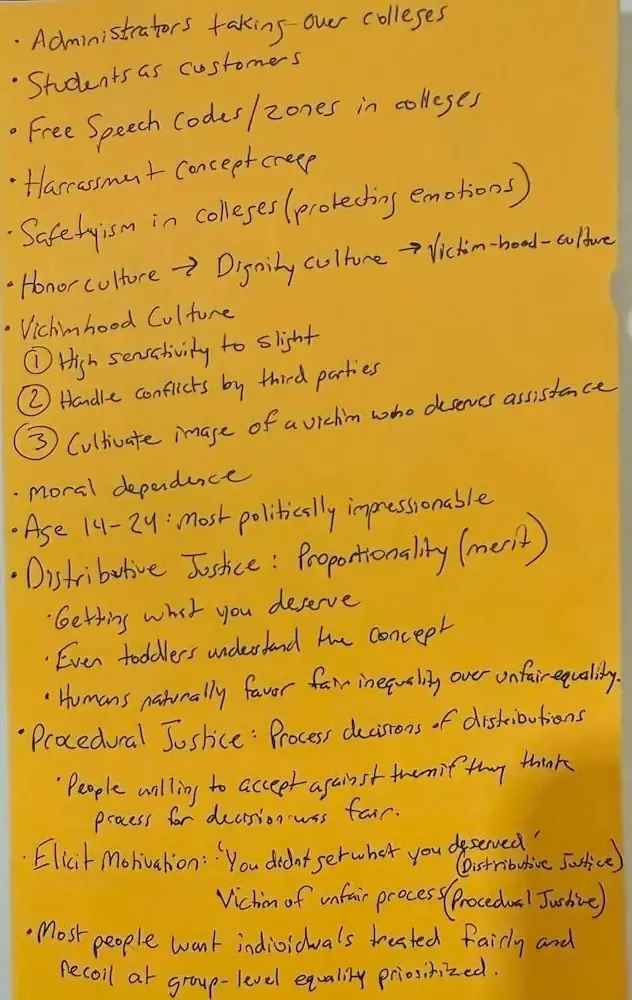
“victimhood culture,” (Page 199)
conflict with the older “dignity culture,” (Page 199)
contrast to the older “honor cultures,” (Page 199)
interlocking set of new ideas about microaggressions, trigger warnings, and safe spaces. (Page 199)
They defined a victimhood culture as having three distinct attributes: (Page 199)
First, “individuals and groups display high sensitivity to slight”; second, they “have a tendency to handle conflicts through complaints to third parties”; and third, they “seek to cultivate an image of being victims who deserve assistance.” (Page 200)
“moral dependence.” (Page 200)
Justice is the first virtue of social institutions, as truth is of systems of thought. JOHN RAWLS, A Theory of Justice1 (Page 203)
ere’s a quirk about American politics: the majority of white Americans vote for Republicans for president, unless they were born after 1981 or between 1950 and 1954. Why those who were born after 1981 vote differently is easy to understand. They are Millennials or iGen; they lean left on most social issues and many economic ones (as Bernie Sanders discovered). They are less religious than previous generations, and the Republican Party turns them off in a variety of ways. But what’s the story for those born from 1950 to 1954? (Page 203)
They found that there is a window of higher impressionability running from about age fourteen to twenty-four, with its peak right around age eighteen. Political events—or perhaps the overall zeitgeist as people perceive it—are more likely to “stick” during that period than outside that age range. (Page 204)
Intuitive Justice (Page 206)
Justice is arguably the most important moral concept in the history of Western philosophy. From Plato’s Republic through John Rawls’s A Theory of Justice, philosophers have tried to propose rules and principles that would underlie a fair or “just” society. Rather than review that history here in order (Page 206)
to derive a philosophical definition of justice, we’ll take a shortcut and tell you about two major areas of psychological research that, when combined, give us a working definition of people’s everyday, ordinary, or “intuitive” notions of justice. Intuitive justice is the combination of distributive justice (the perception that people are getting what is deserved) and procedural justice (the perception that the process by which things are distributed and rules are enforced is fair and trustworthy). We’ll show where claims about social justice fit well with intuitive justice and where they don’t. (Page 207)
DISTRIBUTIVE JUSTICE (Page 207)
Even toddlers seem to recognize the importance of proportionality. (Page 207)
“humans naturally favour fair distributions, not equal ones,” and “when fairness and equality clash, people prefer fair inequality over unfair equality.” (Page 207)
proportionality or merit is the most common and preferred principle children and adults use for allocating rewards outside a family. (Page 208)
“equity theory,” (Page 208)
people keep close track of how much reward each person is reaping (their outcomes, such as pay and perks) in proportion to how much they are contributing (their inputs, such as hours worked and the skills or credentials they bring). (Page 208)
An early study testing equity theory found that when people were led to believe that they were being overpaid for a job, they worked harder in order to deserve the pay—to get their ratio back into line (Page 208)
PROCEDURAL JUSTICE (Page 209)
people are much more willing to accept a decision or action, even one that goes against themselves, when they perceive that the process that led to the decision was fair. (Page 209)
The first is how the decision is being made. (Page 209)
trustworthy (Page 209)
conflicts of interest, prejudices (Page 209)
transparency—is (Page 209)
second basic concern is how a person is being treated (Page 209)
how people respond to the police. (Page 209)
If you want to motivate people to support a new policy or join a movement in the name of justice, you need to activate in them a clear (Page 209)
perception, or intuition, that someone didn’t get what he or she deserved (distributive injustice) or that someone was a victim of an unfair process (procedural injustice). If you can’t elicit at least one of those feelings, then people are much more likely to be content with the status quo, even if it is one in which some people or groups end up with more resources or more status than others (Page 210)
Using that definition of social justice, we’ll define proportional-procedural social justice as the effort to find and fix cases where distributive or procedural justice is denied to people because they were born into poverty or belong to a socially disadvantaged category. (Page 210)
Harvard legal scholar Lani Guinier explored cases like this in her 1994 book, The Tyranny of the Majority She pointed out that seemingly fair (Page 211)
processes can sometimes lead to a group that is in the minority getting entirely shut out at the end of the process. (Page 212)
(You don’t need a Bill of Rights to protect the rights of the majority in a democracy, because the vote already does that. (Page 212)
Clinton administration began to put pressure on schools to achieve equal outcomes. (Page 213)
Some schools cut men’s sports teams as part of their effort to improve their gender balance (Page 214)
Of course, if male and female students had equal levels of interest in participating in sports, then both versions of social justice would converge on the desired end-state of equal outcomes. Give everyone the same access to sports, and your teams will mirror the overall population. Note that “equal outcomes” in these cases doesn’t necessarily mean fifty-fifty; it means representative of the overall student body, which is usually mostly female. “Equal outcomes” means that of all the students who participate in sports, the ratio of men to women will be the same as the ratio of men to women in the student body as a whole. More generally, equal-outcomes social justice activists seem to believe that all institutions and occupations should mirror the overall U.S. population: 50% female, roughly 15% African American, 15% Latino, and so on. Any departure from those numbers means that a group is “underrepresented,” and underrepresentation is often taken to be direct evidence of systemic bias or injustice. (Page 214)
Yet men and women differ in their interests on many things, including sports. A review of the literature led by psychologist Robert Deaner, of Grand Valley State University (Michigan), finds that boys and men show greater interest in playing sports and watching sports than do girls and women, and this is true across cultures, eras, and age groups, whether one uses interview methods or observations of play behavior Of course, those differences could just reflect a pervasive cross-cultural tendency to steer girls away from sports and deprive them of opportunities, but if that were true—if girls were being (Page 214)
discouraged from doing what they wanted to do—then sex differences would be smaller in informal settings, such as when kids are playing in a park, compared with school settings. But in fact, the opposite is true. The gender difference is relatively small in school—girls constitute about 42% of the athletes on high school teams—but it is much larger when adolescents are observed in public parks or when they are surveyed about how they use their leisure time The available research suggests that girls and women are often as interested as boys and men in getting physical exercise, but not in playing team sports (Page 215)
If this is true—if boys and men are more interested, on average, in playing team sports—then universities cannot achieve the equal-outcome target just by offering equal opportunity. They must work harder to recruit women and, perhaps, discourage men. In fact, in order to meet their equal-outcomes targets, many universities are resorting to ethically questionable techniques, known collectively as “roster management,” which sometimes border on fraud. As reported in a 2011 New York Times exposé it is very common for schools to pad the rosters of their women’s teams with women who never come to practice and sometimes don’t even know they are signed up. Some schools invite men to practice with the women and then count the men on the women’s team roster. The exposé gives the impression that U.S. universities are sneaky and dishonest institutions, but this is the predictable response of a bureaucracy, as we described in the previous chapter. When the federal government pressures universities to achieve equal outcomes in the face of unequal inputs, administrators do what they can to protect the institution. That might require them to violate procedural justice, distributive justice, and honesty along the way. (Page 215)
You can see the basic problem if you plug the terms into equity theory, as we do in Figure 11.2. At the University of Virginia, men who want to row must contribute much more than women ($1,000 or more per year, plus renting themselves out for labor). Yet their outcomes are less than those received by women (who have a much larger budget). The ratios are far from equal. (Page 215)
Most people want individuals to be treated well, and they recoil from cases where individuals are treated unfairly in order to bring about some kind of group-level equality. (Page 216)
people who are more extraverted have more sex and also make more money. (Page 217)
In an article titled “The Psychology of the Unthinkable,” social psychologist Philip Tetlock calls this the use of “forbidden base rates.”42 But if this kind of thinking is forbidden and social scientists don’t work as hard to challenge the theories that are politically favored, then “institutionalized disconfirmation,” the process of challenging and testing ideas, breaks down. (Page 218)
But if activists embrace the equal-outcomes form of social justice—if they interpret all deviations from population norms as evidence of systemic bias—then they will get drawn into endless and counterproductive campaigns, even against people who share their goals. Along the way, they will reinforce the bad mental habits that we have described throughout the book. (Page 219)
we urge students to treat deviations from population norms as invitations to investigate further. (Page 219)
If only it were so simple! If only there were evil people somewhere insidiously committing evil deeds, and it were necessary only to separate them from the rest of us and destroy them. But the line dividing good and evil cuts through the heart of every human being (Page 231)
Until that moment, the feeling of being wrong is indistinguishable from the feeling of being right. We are all wrong about many things at every moment, but until we know it, we are often quite certain that we are right. (Page 231)
We cannot absolutely prove that those are in error who tell us that society has reached a turning point, that we have seen our best days. But so said all who came before us, and with just as much apparent reason… . On what principle is it that, when we see nothing but improvement behind us, we are to expect nothing but deterioration before us?1 (Page 250)