
DESCRIPTION
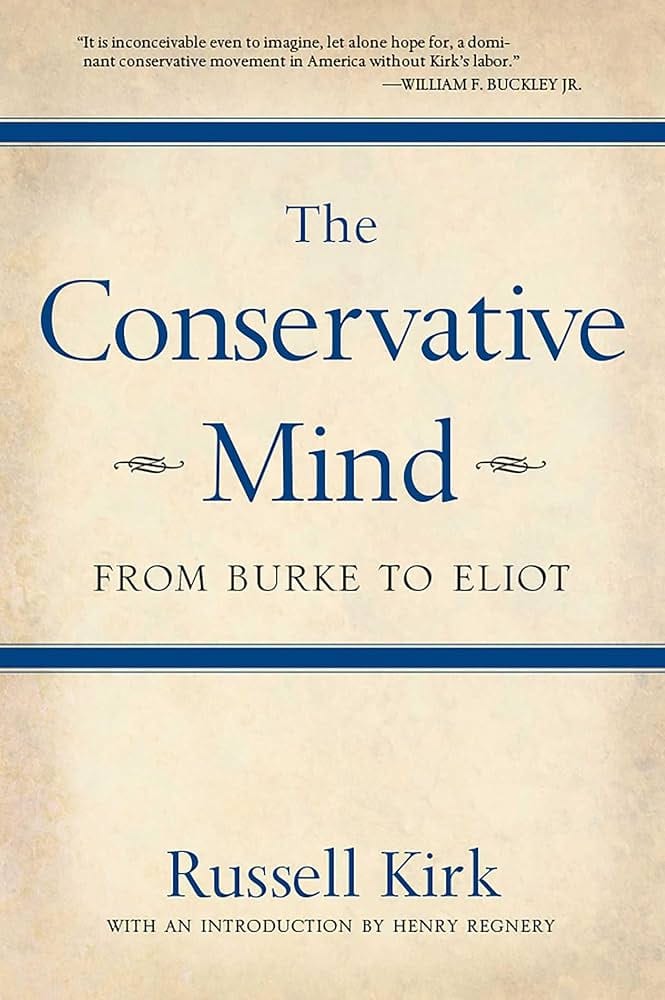
“It is inconceivable even to imagine, let alone hope for, a dominant conservative movement in America without Kirk’s labor.” — WILLIAM F BUCKLEY “A profound critique of contemporary mass society, and a vivid and poetic image - not a program, an image - of how that society might better itself. [ The Conservative Mind ] is, in important respects, the twentieth century’s own version of the Reflections on the Revolution in France… [Kirk] was an artist, a vsionary, almost a prophet.” - DAVID FRUM, author of Dead Right “I have been one of your fans since the time many years ago when I read The Conservative Mind.” - RICHARD NIXON “Dr. Russell Kirk’s impact on conservative thought and policy in America has been decisive. It was his writings, and in particular his seminal work, The Conservative Mind, that laid the foundation for many of the ideas that continue to shape public discourse and debate to this day.” - JOHN ENGLER, former Governer of Michigan “Kirk is assured a place of prominence in the intellectual histories for helping to define the ethical basis of conservatism. He has tried to pull conservatism away from the utilitarian premises of libertarianism, toward which conservatism often veers, toward a philosophy rooted in ethics and culture.” - THE WALL STREET JOURNAL Russell Kirk’s The Conservative Mind is one of the greatest contributions to twentieth-century American conservatism. Brilliant in every respect, from its conception to its choice of significant figures representing the history of intellectual conservatism, The Conservative Mind launched the modern American Conservative Movement when it was first published in 1953 and has become an enduring classic of political thought. The seventh revised edition features the complete text and an introduction by publisher Henry Regnery. A must-read.
My Summary
Main Ideas, Takeaways & Similarities
Questions
I. What is the problem?
A. How is this problem formulated?
B. Why is this problem important?
C. What is the history of this problem?
D. Which prominent personalities have been interested in this problem?
II. What solutions to the problem are there?
A. What are the conclusions reached?
B. By what argument(s) is the conclusion reached?
C. What facts or assumptions serve as premises?
D. When a prominent personality offers a solution, does he also argue for or against other prominent personalities? Does he raise objections to alternative solutions? Does he consider objections to his own solutions?
III. Evaluation
A. What are the advantages and disadvantages of the alternative formulations to the problem?
B. Has the importance or history of the problem ever been misrepresented?
C. Are the solutions logically related to the premises?
D. Are the facts true? Are the assumptions acceptable? Are the objections answerable?
AI Summary
Highlights
“The Conservative Mind: From Burke to Eliot” is a book written by Russell Kirk, first published in 1953. This influential work traces the development of conservative thought in Western civilization. Here’s a thorough summary of the book in bullet points:
- The book explores the evolution of conservative thought from the late 18th century to the mid-20th century, highlighting key conservative thinkers and their ideas.
- Edmund Burke, an Irish statesman and philosopher, is presented as a foundational figure in conservative thought. His writings emphasized the value of tradition, gradual change, and the preservation of social order.
- Kirk discusses other influential conservative thinkers, such as John Adams, John Adams, and James Madison, who played essential roles in shaping American conservatism and the U.S. Constitution.
- The book argues that conservatism is a disposition rather than a strict ideology, rooted in a respect for tradition, a skepticism of radical change, and a belief in the importance of moral and social order.
- Kirk emphasizes the significance of religion and spirituality in conservative thought, particularly the role of Christianity in shaping Western civilization.
- The book delves into the Romantic movement and its impact on conservative thinking, emphasizing the value of literature and the arts in conveying moral and cultural truths.
- It discusses the role of conservative intellectuals in responding to the challenges posed by modernity, secularism, and the rise of ideologies like liberalism and socialism.
- Kirk argues that conservatives value the diversity of human experience and are cautious about attempts to impose a single, uniform system of thought or government.
- The book explores the tensions between traditionalism and libertarianism within conservative thought, highlighting that conservatives differ on the extent of government intervention in society.
- Kirk criticizes the materialistic and utilitarian aspects of modern society and argues for the importance of transcendent values and moral principles.
- He emphasizes the idea that conservatism is not opposed to change but seeks to preserve what is valuable from the past while carefully considering the consequences of innovation.
- Kirk concludes by advocating for a return to a more balanced and moral approach to politics and culture, rooted in the principles of conservatism.
“The Conservative Mind: From Burke to Eliot” is a foundational text in the study of conservative thought. It explores the ideas and philosophies of key conservative figures while articulating the core principles of conservatism, making it a significant contribution to political and intellectual discourse.