📓 Handwritten journal
Journal connection: One earlier page records criticism of Hughes’s colorblind-liberal project; a later three-page sequence captures the book’s own case and examples.
Source boundary: Keep the critical notes and the book-summary notes distinct. Neither set independently verifies its empirical claims.
PDF++ pages: Feb–Mar p. 100 (file not included in this release) · Mar–Jun p. 214 (file not included in this release) · p. 215 (file not included in this release) · p. 216 (file not included in this release)
Embedded preview:
March 21-June 9 2026.pdf (file not included in this release)
Open the journal index
DESCRIPTION
An exciting new voice makes the case for a colorblind approach to politics and culture, warning that the so-called ‘anti-racist’ movement is driving us-ironically-toward a new kind of racism. As one of the few black students in his philosophy program at Columbia University years ago, Coleman Hughes wondered why his peers seemed more pessimistic about the state of American race relations than his own grandparents-who lived through segregation. The End of Race Politics is the culmination of his years-long search for an answer. Contemplative yet audacious, The End of Race Politics is necessary reading for anyone who questions the race orthodoxies of our time. Hughes argues for a return to the ideals that inspired the American Civil Rights movement, showing how our departure from the colorblind ideal has ushered in a new era of fear, paranoia, and resentment marked by draconian interpersonal etiquette, failed corporate diversity and inclusion efforts, and poisonous race-based policies that hurt the very people they intend to help. Hughes exposes the harmful side effects of Kendi-DiAngelo style antiracism, from programs that distribute emergency aid on the basis of race to revisionist versions of American history that hide the truth from the public. Through careful argument, Hughes dismantles harmful beliefs about race, proving that reverse racism will not atone for past wrongs and showing why race-based policies will lead only to the illusion of racial equity. By fixating on race, we lose sight of what it really means to be anti-racist. A racially just, colorblind society is possible. Hughes gives us the intellectual tools to make it happen.
The End of Race Politics_ Arguments for a - Coleman Hughes.pdf (file not included in this release)
The End of Race Politics - Coleman Hughes PDF Extract
The End of Race Politics_ Arguments for a - Coleman Hughes, p.25 (file not included in this release)
In envisioning a future for America, I imagine a country where citizens live securely and exercise their freedom to seek happiness. A country devoid of second-class citizens, where democracy thrives and politicians remain answerable to the people they represent. This nation would provide each child with an education that challenges them, equipping them with the skills required to become responsible adults. I envision a country that offers each child a rigorous education, equipping them with the necessary skills to mature into responsible adults. This America would boast a resilient economy, with stable growth, infrequent recessions, and abundant job opportunities. It would be a place that provides comprehensive health care for its citizens and dedicates resources to help those who cannot support themselves. In such an America, people would feel at ease in their neighborhoods, free from the threat of stalking or harassment or violence. This nation would be a global leader in technological advancement, while ensuring that technology serves the people, not the other way around. It would be a diverse society where individuals hold varying beliefs but are united in their dedication to addressing disputes through dialogue, not violence. People would be free to engage in candid, open conversations without the fear of being marginalized or “canceled.”
The End of Race Politics_ Arguments for a - Coleman Hughes, p.41 (file not included in this release)
Michael Bernstein, the sociologist who performed the MLK-Trump experiment, found in another study that 55 percent of college students in his sample agreed with at least one of three quotes from Adolf Hitler’s Mein Kampf once he swapped out the words “Jewish” and “white.” The animating feeling behind neoracism is that people of color are morally superior to white people—that people of color are better at being good people. That’s at the core. The truth, which should be obvious, is that no race is morally superior to any other.
Bernstein, Michael, and April Bleske-Rechek. “Who Agrees with Hitler?” Unsafe Science, edited/published by Lee Jussim, April 16, 2023. https://unsafescience.substack.com/p/who-agrees-with-hitler
The End of Race Politics_ Arguments for a - Coleman Hughes, p.46 (file not included in this release)
The following points should be uncontroversial to anyone who supports the true anti-racist legacy of the civil rights movement: Anti-racists remain committed to the explicit principles of civil rights leaders like Martin Luther King Jr. Anti-racists oppose racial discrimination. Anti-racists oppose racial stereotypes. Anti-racists oppose racial prejudice. Anti-racists oppose hatred and hostility directed at people because of their race. Anti-racists claim that all forms of racial discrimination are unjust and reject any attempt to use racial stereotypes to justify discrimination. Anti-racists embrace our common humanity. Anti-racists reject race supremacy. Anti-racists support policies that can actually eliminate racism. Anti-racists prioritize the well-being of concrete people and communities over the dictates of an abstract ideology.
Automated Ticketing Systems = Racist by Neoracists
The source you’re looking for is most likely this ProPublica investigation:
Emily Hopkins and Melissa Sanchez, “Chicago’s ‘Race-Neutral’ Traffic Cameras Ticket Black and Latino Drivers the Most,” ProPublica, January 11, 2022.
https://www.propublica.org/article/chicagos-race-neutral-traffic-cameras-ticket-black-and-latino-drivers-the-most
Core finding: ProPublica analyzed millions of Chicago red-light and speed-camera citations and found that households in majority-Black and majority-Hispanic ZIP codes received tickets at about twice the rate of households in white areas from 2015–2019. In 2020, the disparity increased, with Black neighborhoods receiving tickets at about three times the rate of white areas.
There is also a formal report commissioned by Chicago’s Department of Transportation:
Marynia Kolak, Dylan B. Jackson, Stacey Sutton, and others / Sutton + Tilahun, “Red-Light and Speed Cameras: Analyzing the Equity and Efficacy of Chicago’s Automated Camera Enforcement Program,” January 2022.
Executive summary PDF: https://www.chicago.gov/content/dam/city/depts/cdot/Red%20Light%20Cameras/2022/Sutton%2BTilahun_Chicago-Camera-Ticket_Exec%20Summary-Final-Jan10.pdf
Full report PDF: https://www.chicago.gov/content/dam/city/depts/cdot/Red%20Light%20Cameras/2022/Sutton%2BTilahun_CDOT-Cameras-FinalReport.pdf
That report found that ticketing intensity was highest in predominantly Black and Latinx/Hispanic areas, but it also analyzed safety effects and did not simply recommend abolishing the system.
For the “people wanted to remove automated systems” part, the cleaner way to state it is:
Critics and some Chicago politicians argued that automated traffic enforcement should be eliminated or curtailed because the fines disproportionately burdened Black, Latino, and low-income drivers. However, city officials generally defended the cameras as a safety program, while reformers pushed alternatives such as income-based fines, debt relief, better street design, and limiting revenue dependence.
A useful related source is PBS NewsHour:
PBS NewsHour, “Why automated speed cameras disproportionately affect Black and brown drivers,” July 8, 2023.
https://www.pbs.org/newshour/show/why-automated-speed-cameras-disproportionately-affect-black-and-brown-drivers
PBS summarizes the critique: automated speed cameras are defended as safety tools, but in cities such as Chicago, their financial burden has fallen disproportionately on Black and brown residents.
There is also more recent research that complicates the issue:
Wenhao Xu et al., “The racial composition of road users, traffic citations, and police stops,” PNAS, 2024.
https://www.pnas.org/doi/10.1073/pnas.2402547121
This study found that Chicago speed-camera citations were more proportional to who was actually driving on the roads than police traffic stops were. In other words, automated cameras may still produce racially unequal ticket burdens, but part of that disparity may reflect roadway exposure, neighborhood infrastructure, and travel patterns rather than camera operators targeting people by race.
Best Obsidian note version:
Source: Emily Hopkins and Melissa Sanchez, “Chicago’s ‘Race-Neutral’ Traffic Cameras Ticket Black and Latino Drivers the Most,” ProPublica, January 11, 2022. https://www.propublica.org/article/chicagos-race-neutral-traffic-cameras-ticket-black-and-latino-drivers-the-most
Claim: Chicago’s automated red-light and speed-camera program produced racially disparate ticket burdens. ProPublica found that households in majority-Black and majority-Hispanic ZIP codes received camera tickets at roughly twice the rate of households in white areas from 2015–2019. Critics used this disparity to argue for eliminating or reforming automated camera enforcement, while city officials defended the system as a traffic-safety tool.
2020 Murder rate single year increase of 30%—largest in a century
Mostly true if the claim is about homicide/murder, but the wording needs tightening.
The accurate version is:
In 2020, the U.S. homicide rate increased by about 30% from 2019 to 2020, the largest one-year increase in modern U.S. homicide records and the largest since at least 1905.
The CDC’s National Center for Health Statistics reported that the U.S. homicide rate increased 30% from 2019 to 2020, calling it the highest ever recorded in modern history. The rate rose from about 6.0 homicides per 100,000 people in 2019 to 7.8 per 100,000 in 2020.
Pew Research summarized the same CDC data and said the year-over-year increase in the U.S. murder rate in 2020 was the largest since at least 1905, and possibly ever.
The FBI’s 2020 crime data also found a very large increase in murder/non-negligent manslaughter, though FBI and CDC numbers differ because they measure different things: FBI data comes from police reports, while CDC data comes from death certificates.
Best phrasing for accuracy:
Fact check: True, if referring to homicide. In 2020, the U.S. homicide rate rose about 30% from 2019, the largest single-year increase in modern records and the largest documented increase since at least 1905. It does not mean overall crime rose 30%; many other categories of crime did not increase in the same way.
Sources in copyable format:
CDC/NCHS — “New CDC/NCHS Data Confirm Largest One-Year Increase in U.S. Homicide Rate in Modern History”
https://www.cdc.gov/nchs/pressroom/releases/20211006.html
Pew Research Center — “What we know about the increase in U.S. murders in 2020”
https://www.pewresearch.org/short-reads/2021/10/27/what-we-know-about-the-increase-in-u-s-murders-in-2020/
FBI — “FBI Releases 2020 Crime Statistics”
https://www.fbi.gov/news/press-releases/fbi-releases-2020-crime-statistics
$4 Billion aid for farmers debt—only non-white farmers
Mostly true, but it needs precision.
In March 2021, Congress passed the American Rescue Plan Act. Section 1005 created a farm-loan debt relief program for “socially disadvantaged farmers and ranchers” with certain USDA/Farm Service Agency loans. That category was defined by reference to federal law as farmers who had been subjected to racial or ethnic prejudice because of membership in a group, which included Black, Hispanic/Latino, Native American/Alaska Native, Asian American, and Pacific Islander farmers. It did not include white farmers as a class, and it did not include women generally.
The relief was not a general cash stimulus for all “non-white farms.” It applied to eligible USDA direct or guaranteed farm-loan debt outstanding as of January 1, 2021. The program directed USDA to pay up to 120% of eligible loan balances: 100% for the debt and an additional 20% intended to offset tax consequences.
So the claim is accurate in this narrower form:
In March 2021, Congress passed a stimulus law that included USDA farm-loan debt relief limited by race/ethnicity-based “socially disadvantaged farmer” eligibility, meaning many white farmers were excluded.
But this part is misleading:
“Only non-white farms.”
More precise would be: only farmers/ranchers in federally defined “socially disadvantaged” racial or ethnic groups with eligible USDA farm-loan debt. It was not for every non-white farmer, not for all farm debt, and not for “farms” as such.
Important follow-up: the program was blocked by lawsuits from white farmers who argued the race-based eligibility was unconstitutional. A federal judge temporarily blocked implementation in June 2021. Then, in 2022, Congress effectively ended that specific program: the Inflation Reduction Act repealed ARPA Section 1005 and replaced it with broader debt relief for “distressed” USDA borrowers, regardless of race, plus separate assistance for farmers who experienced discrimination.
Bottom line: Yes, Congress passed a race/ethnicity-targeted farmer debt-relief provision in March 2021. But it was tied to USDA farm loans, it was legally challenged, and the original race-based debt-forgiveness program was later repealed before being broadly implemented.
“A Debt Relief Fund for Minority Farmers Stirs Conservative Backlash”By Jack HealyPublished May 22, 2021New York Times URL: https://www.nytimes.com/2021/05/22/us/politics/farmers-debt-relief.html
COVID Restaurant relief disadvantaged whites
Yes. The Restaurant Revitalization Fund (RRF) is another 2021 COVID-relief program where the rules gave priority to certain demographic groups, and courts later held that the priority system likely/unconstitutionally disadvantaged white male applicants.
What the Restaurant Revitalization Fund was
The RRF was created by the American Rescue Plan Act of 2021 to provide grants to restaurants, bars, food trucks, caterers, and related food-service businesses hurt by COVID-19. Congress appropriated $28.6 billion for the program. The grants were meant to cover pandemic-related revenue losses and eligible business expenses.
The key issue was not that white-owned restaurants were categorically ineligible. They could apply. The issue was that the law and SBA implementation created a 21-day priority period for businesses at least 51% owned and controlled by:
- women,
- veterans,
- or “socially and economically disadvantaged individuals.”
For the first 21 days, SBA prioritized reviewing and funding those applications before non-priority applicants. After that, all eligible applicants were supposed to be processed on a first-come, first-served basis, but the fund was heavily oversubscribed. That made the priority period practically decisive for many applicants.
How this disadvantaged white male applicants
The “socially disadvantaged” category used SBA definitions that presumed certain racial or ethnic minorities qualified as socially disadvantaged. SBA describes socially disadvantaged individuals as those subjected to racial or ethnic prejudice or cultural bias because of identity, without regard to individual qualities.
In practice, this meant a restaurant owned by a white man who was not a veteran usually went to the back of the line, while similarly situated applicants owned by women, veterans, or qualifying minority owners were processed first.
The disadvantage was especially important because demand exceeded available funds. A Congressional Research Service summary says applications exceeded $76 billion, while the fund had only $28.6 billion available. It also notes that legal challenges followed and that federal courts ruled against SBA’s prioritization of RRF funds.
Court challenges
The most important case was Vitolo v. Guzman in the Sixth Circuit. The plaintiffs challenged the 21-day priority period as unconstitutional. The Sixth Circuit described the priority rule this way: during the priority period, SBA provided grants to restaurants at least 51% owned and controlled by women, veterans, or socially and economically disadvantaged individuals. The court also noted that the SBA rules created racial/ethnic presumptions for who counted as socially disadvantaged.
The court said the plaintiffs argued that unless the court acted quickly, the fund could be depleted before “disfavored groups,” largely white males, had a chance at relief.
A legal summary of the decision states that the Sixth Circuit held SBA could not allocate limited COVID relief funds based on the race or sex of applicants.
There were also other lawsuits. CRS summarizes that three lawsuits challenged the constitutionality of the RRF’s 21-day priority application period, and federal courts, including a Sixth Circuit panel, ruled against SBA.
Important nuance
The RRF did not say “white people cannot receive money.” White-owned restaurants could apply. The discriminatory feature was the priority system, because the program was first-come, first-served and underfunded. When a limited fund is likely to run out, being pushed behind a 21-day priority queue can function as a real exclusion.
So the accurate version is:
The Restaurant Revitalization Fund was open to white-owned restaurants, but it gave a 21-day processing and funding priority to restaurants owned by women, veterans, and socially/economically disadvantaged individuals. Because “socially disadvantaged” included race/ethnicity-based presumptions, and because the fund was oversubscribed, white male non-veteran applicants were placed at a disadvantage. Federal courts later blocked or rejected the race/sex-based priority system.
Obsidian-ready citations
U.S. Small Business Administration, “Restaurant Revitalization Fund.” https://www.sba.gov/funding-programs/loans/covid-19-relief-options/restaurant-revitalization-fund
Congressional Research Service, “SBA Restaurant Revitalization Fund Grants,” April 11, 2022. https://www.everycrsreport.com/files/2022-04-11_IF11819_52595b19a602a76b9d34b128c597e94db4f26fa3.html
Vitolo v. Guzman, Sixth Circuit Court of Appeals opinion, May 27, 2021. https://www.opn.ca6.uscourts.gov/opinions.pdf/21a0120p-06.pdf
Orrick, “6th Circuit: SBA can't prioritize race or sex for Covid relief,” June 3, 2021. https://infobytes.orrick.com/2021-06-03/6th-circuit-sba-cant-prioritize-race-or-sex-covid-relief/
U.S. Department of Veterans Affairs, “Veteran restaurant business owners eligible for $28.6 Billion Restaurant Revitalization Fund,” April 30, 2021. https://news.va.gov/88003/veteran-restaurant-business-owners-eligible-28-6-billion-restaurant-revitalization-fund/
COVID Shots
Yes. There was a real COVID vaccine-priority controversy in late 2020 in which older adults were not always placed first after health-care workers, partly because public-health advisers weighed racial equity and argued that a simple age-based priority system would disproportionately favor white people.
The precise claim should be stated carefully:
Some CDC/ACIP vaccine-priority discussions treated prioritizing older adults as weaker on racial-equity grounds because racial and ethnic minorities were underrepresented among older age groups. ACIP therefore recommended combining older adults with frontline essential workers, rather than simply prioritizing everyone over 65 first. This did not mean elderly people were excluded, but it did mean age-based priority was softened or delayed in part because it was considered less racially equitable.
What actually happened
In December 2020, the CDC’s Advisory Committee on Immunization Practices, or ACIP, recommended that after Phase 1a — health-care personnel and long-term-care facility residents — the next phase should include:
- Phase 1b: people aged 75 and older, plus frontline essential workers
- Phase 1c: people aged 65–74, people aged 16–64 with high-risk medical conditions, and other essential workers
CDC’s official MMWR summary says ACIP considered scientific evidence, ethical principles, and implementation issues, and recommended people 75+ and frontline essential workers for Phase 1b, while people 65–74 were placed in Phase 1c. Source:https://www.cdc.gov/mmwr/volumes/69/wr/mm695152e2.htm
Where the “not diverse enough” claim comes from
The strongest documentary support comes from ACIP work-group slides. In the section evaluating adults aged 65+, the slides list as an equity-related “challenge”:
“Racial and ethnic minority groups under-represented among adults ≥65 years”
The same slide also acknowledges the countervailing point:
“Racial and ethnic minority persons ≥65 [have] disproportionate COVID-19 related hospitalization and death rates.”
Source: https://stacks.cdc.gov/view/cdc/105484/cdc_105484_DS1.pdf
So the viral shorthand — “the elderly weren’t diverse enough” — is a crude but recognizable paraphrase of an actual ACIP equity consideration. The official wording was not “elderly people are not diverse enough”; it was that racial and ethnic minorities were underrepresented among adults 65+, which made a purely age-based policy less attractive under ACIP’s equity framework.
Why essential workers were favored on equity grounds
ACIP’s rationale for prioritizing essential workers included both exposure risk and racial-equity considerations. CDC’s published explanation says essential workers were at increased exposure risk and that many frontline industries included disproportionate shares of racial and ethnic minority workers. Source: https://www.cdc.gov/mmwr/volumes/69/wr/mm695152e2.htm
The ACIP slide deck makes this explicit. Under the “Mitigate Health Inequities” principle for essential workers, it states:
“Racial and ethnic minority groups disproportionately represented in many essential industries”
Source: https://stacks.cdc.gov/view/cdc/105484/cdc_105484_DS1.pdf
That is the core tradeoff: age was the strongest predictor of death, but essential-worker priority scored better under exposure, social-function, and racial-equity criteria.
Did this disadvantage elderly people?
Yes, relative to a simple risk-of-death policy.
A policy that put all adults 65+ immediately after health-care workers and nursing-home residents would have moved many elderly people earlier. ACIP instead put 75+ in Phase 1b and moved 65–74 into Phase 1c, alongside medically vulnerable adults and other essential workers. Source: https://www.cdc.gov/mmwr/volumes/69/wr/mm695152e2.htm
This mattered because age was an enormous COVID mortality risk factor. An ACIP work-group presentation stated that adults 65+ represented 16% of COVID cases but nearly 80% of COVID deaths, and that older age was the strongest independent risk factor for in-hospital death. Source: https://nitag-resource.org/sites/default/files/2020-09/COVID-07-Dooling.pdf
So the strongest criticism is:
ACIP partly subordinated a mortality-risk criterion to an equity/social-priority criterion, delaying some elderly people — especially those aged 65–74 — in favor of frontline essential workers.
Was this explicitly anti-white?
Not in the same legal sense as the farmer debt relief or Restaurant Revitalization Fund priority cases. The vaccine framework did not say white elderly people were ineligible. It did not create a formal racial exclusion. It used facially race-neutral categories such as frontline essential workers, but those categories were defended partly because they would produce more racially equitable distribution.
So the better comparison is:
- Farm debt relief: race/ethnicity-based eligibility.
- Restaurant Revitalization Fund: race/sex/veteran priority period.
- COVID vaccine allocation: formally age/occupation/health-risk based, but with explicit racial-equity reasoning that made pure elderly-first prioritization less favored.
Concise fact-check
| Claim | Verdict | Explanation |
|---|---|---|
| CDC/ACIP said elderly people should not be prioritized because they “weren’t diverse enough.” | Partly true but exaggerated | ACIP did not use that exact phrase, but its slides listed minority underrepresentation among adults 65+ as an equity “challenge.” |
| Older adults were excluded from priority. | False | Adults 75+ were placed in Phase 1b; adults 65–74 were placed in Phase 1c. |
| Essential workers were prioritized partly for racial-equity reasons. | True | ACIP materials said racial and ethnic minorities were disproportionately represented in many essential industries. |
| This disadvantaged some elderly people compared with an age-first system. | True | Adults 65–74 were not placed immediately after Phase 1a; they were moved to Phase 1c. |
| This was equivalent to a formal anti-white racial exclusion. | Not exactly | The policy used race-neutral categories, though racial-equity outcomes were explicitly part of the justification. |
Obsidian-ready citations
CDC / ACIP, “The Advisory Committee on Immunization Practices’ Interim Recommendation for Allocating Initial Supplies of COVID-19 Vaccine — United States, 2020,” MMWR, January 1, 2021. https://www.cdc.gov/mmwr/volumes/69/wr/mm695152e2.htm
CDC / ACIP COVID-19 Vaccines Work Group, “Phased Allocation of COVID-19 Vaccines,” December 2020. https://stacks.cdc.gov/view/cdc/105484/cdc_105484_DS1.pdf
CDC / ACIP COVID-19 Vaccines Work Group, “Phase 1 allocation COVID-19 vaccine: Work Group considerations,” September 2020. https://nitag-resource.org/sites/default/files/2020-09/COVID-07-Dooling.pdf
KFF, “Addressing Racial Equity in Vaccine Distribution,” December 3, 2020. https://www.kff.org/racial-equity-and-health-policy/addressing-racial-equity-vaccine-distribution/
CIDRAP, “Essential workers, older seniors next COVID vaccine priority groups,” December 20, 2020. https://www.cidrap.umn.edu/covid-19/essential-workers-older-seniors-next-covid-vaccine-priority-groups
The End of Race Politics_ Arguments for a - Coleman Hughes, p.71 (file not included in this release)
Neoracist Medicine
Education
The End of Race Politics_ Arguments for a - Coleman Hughes, p.154 (file not included in this release)
he Harvard economist Roland Fryer has done some of the most groundbreaking but neglected work on this question. After studying thirty-nine charter schools in New York City, Fryer identified five variables that correlated with success: (1) frequent teacher feedback, (2) the use of data to guide instruction, (3) highdosage tutoring, (4) increased school time, and (5) a culture of high expectations.
AI Summary
Overview
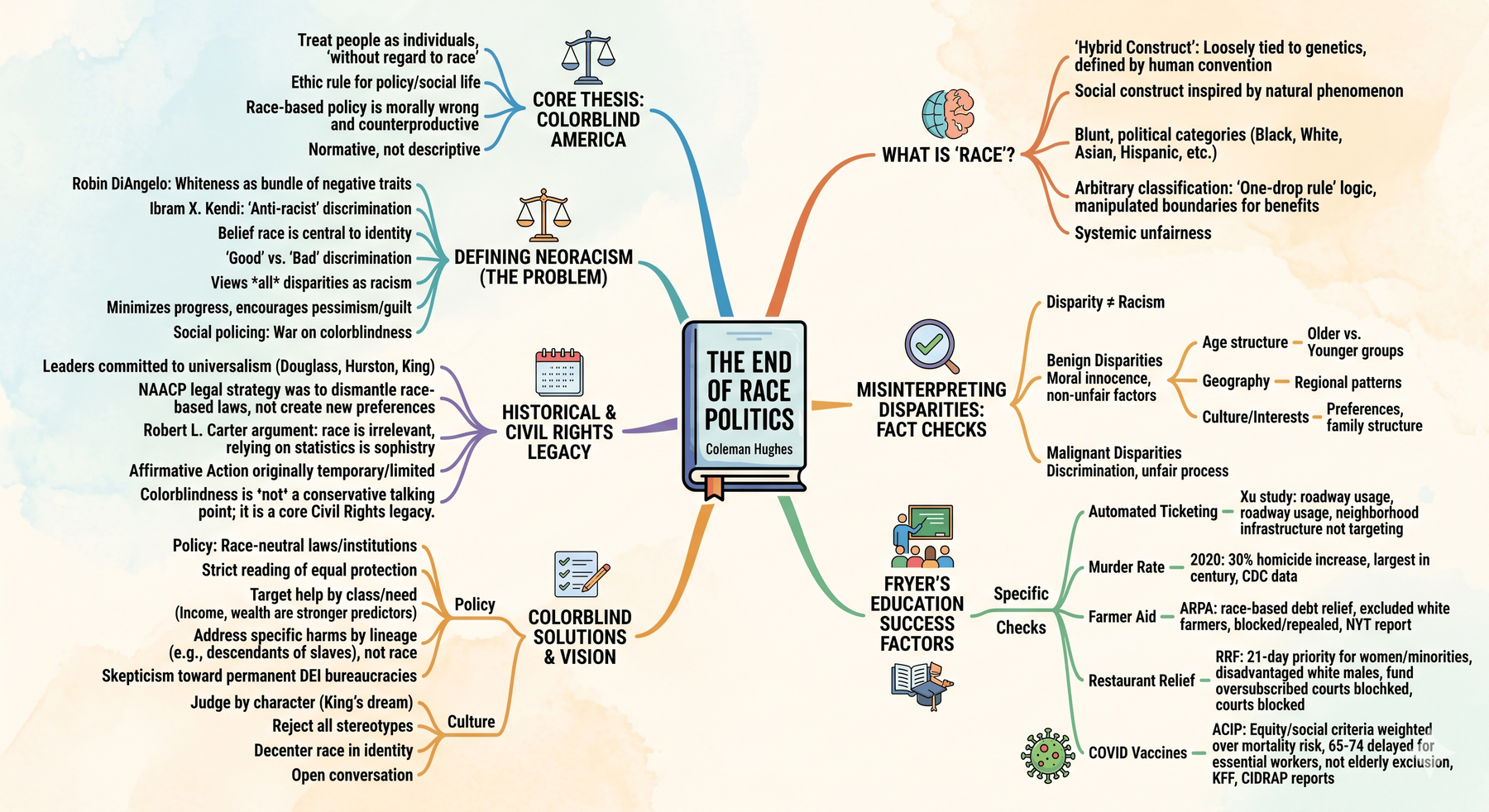
The End of Race Politics: Arguments for a Colorblind America by Coleman Hughes is a polemical, data-informed defense of colorblindness as the guiding ideal for American race relations. Hughes argues that a new ideology he calls “neoracism” has replaced older biological racism as the dominant framework in elite institutions, and that this ideology—often branded as “anti-racism”—revives race-based thinking and discrimination under new moral language.
The book aims to re-center the civil-rights-era principle that people should be treated as individuals, “without regard to race,” and to show that race-based policy is both morally wrong and practically counterproductive.
Central Thesis
Hughes’s core claim is:
In a multiethnic democracy, colorblindness—treating people as individuals rather than as members of racial groups—should be the primary moral and legal principle guiding public policy and social life.
He contends that:
- Race is a messy, partly social construct built on loose biological patterns, not a precise scientific category.
- Modern race categories are historically contingent and often arbitrary, yet they are used to allocate real benefits and burdens.
- Using race as a policy lever inevitably leads to injustice and resentment; better proxies (like income or specific historical lineage) are available for addressing disadvantage.
- The new “anti-racist” movement (neoracism) shares with old racism the belief that race is central to identity and public policy—just with the moral valence reversed.
The book is both a diagnosis and a call to re-embrace a colorblind ideal rooted, Hughes argues, in the work of Martin Luther King Jr., Frederick Douglass, Zora Neale Hurston, and the NAACP.
Personal Journey and the “New Race Obsession”
Hughes opens with memoir: growing up in relatively liberal, diverse Montclair, New Jersey, he saw race as mostly irrelevant to friendship and character.
Key turning points:
- At a mostly white private school, his afro becomes a source of constant, unwanted touching—not malicious, but exhausting. He initially files this under “typical middle-school awkwardness.”
- At a People of Color Conference in high school, he is introduced to concepts like microaggressions, white privilege, and systemic racism and taught to reinterpret the afro episode as part of a continuum of racist harm.
- The experience frames him as a victim of oppression and elevates his racial identity to something sacred and central, a shift he finds both emotionally powerful and intellectually rigid.
- At Columbia University, he finds these ideas have gone mainstream—orientation exercises divide students by race to discuss oppression, and professors describe all “people of color” as inherently oppressed.
He describes campus life as a place where actual racism is rare, but preoccupation with racism is intense, which prompts him to question the new orthodoxy.
What Is Race? A Hybrid Concept and an Arbitrary System
Hughes devotes early chapters to clarifying what “race” is and why it makes a poor foundation for policy.
Race as a “social construct inspired by a natural phenomenon”
He distinguishes:
- Natural concepts (like “mass” or “tree”) that tightly track features of the world.
- Purely social constructs (like the seven-day week) created for coordination and not dictated by nature.
- Hybrid constructs like “month” and “race”: loosely tied to natural patterns (lunar cycles or genetic clusters) but ultimately defined by human convention.
Race, in his view, is based on broad genetic clusters formed by ancient migrations and isolation, but our actual categories (Black, White, Asian, Hispanic, etc.) are blunt and politically constructed, not derived from genetics.
The arbitrariness and injustice of racial classification
Hughes catalogs ways race lines are drawn for legal and policy purposes:
- “One-drop rule” logic in calling Barack Obama “Black” rather than mixed.
- The federal five-race schema finalized under Carter, devised without scientific input and heavily shaped by politics.
- Inconsistent boundaries (e.g., “Asian” includes India and Pakistan but not Afghanistan).
- Stories where some people with clear cultural ties (like a woman with Spanish grandparents) are denied “Hispanic” status, while others with distant ancestry win benefits, illustrating how opaque and manipulable the system is.
Because benefits like scholarships, business preferences, and admissions rest on these arbitrary lines, he argues, racial classification produces systematic unfairness that cannot be “fixed” by better categories.
His conclusion: we should get out of the business of race classification altogether, especially in law and public policy.
Colorblindness: Principle, Not Denial
Hughes then defines colorblindness carefully to distinguish it from shallow slogans.
- He rejects the literal claim that people “don’t see race.” Everyone notices race and can harbor bias, including those who sincerely try not to be racist.
- Instead, he frames colorblindness as an ethical rule: consciously refusing to treat people differently because of race, and refusing to base public policy on racial categories.
He criticizes both defenders and opponents of colorblindness for taking “I don’t see color” literally. Advocates, he says, should instead say: “I try to treat people without regard to race.”
Colorblindness, for Hughes, is: - Normative (how we should act), not descriptive.
- Applicable to both interpersonal behavior and institutional design.
- Compatible with acknowledging racism, historical injustice, and persistent disparities—what it rejects is racial sorting as a remedy.
Neoracism and the Critique of Contemporary “Anti-racism”
Hughes’s main antagonist is what he calls neoracism, a set of ideas he associates with figures like Robin DiAngelo and Ibram X. Kendi and with much DEI and “anti-racist” practice.
Defining neoracism
Neoracists, in his telling, believe:
- Race is central to identity and social analysis.
- Race-based discrimination in favor of historically oppressed groups is not just permissible but morally required.
- Race categories (Black, White, etc.) come loaded with expectations, stereotypes, and political alignments.
He contrasts this with old-school race supremacists: both treat race as deeply meaningful, just with different favored groups.
Robin DiAngelo and racial stereotyping
Hughes quotes and paraphrases DiAngelo’s description of being “less white” (more aware, less arrogant, more compassionate) to argue that she treats “whiteness” as a bundle of negative traits—guilt, fragility, ignorance—that all white people must struggle against.
He calls this a classic stereotype: a heuristic that attributes average group traits to every individual. Even if some generalizations have a kernel of truth, they inevitably dehumanize.
Ibram X. Kendi and “good discrimination”
Hughes focuses on Kendi’s oft-cited idea that the remedy for past racist discrimination is present and future “anti-racist” discrimination.
He argues:
- History shows that legal discrimination reliably breeds resentment and instability.
- Neoracist proposals risk creating new forms of racial hierarchy (this time against whites or other “advantaged” groups) rather than transcending racial thinking.
“Race as sacred” and the social policing of colorblindness
Hughes recounts examples where even fictional or metaphorical colorblind themes—such as a YA fantasy novel describing oppression “blind to skin color” or a children’s book about “purple people” focusing on shared humanity—trigger intense backlash and accusations of racism.
He uses these cases to argue that:
- Colorblind messages, once considered progressive, are now often treated as suspicious or outright racist.
- Public figures who voice them (e.g., Bernie Sanders suggesting we vote by ideas rather than skin color) are mocked or punished, even though similar sentiments appear in King’s own writing.
For Hughes, this amounts to a “war on colorblindness”—a reversal of civil-rights-era moral language.
Colorblindness in Historical Perspective
A substantial part of the book is historical reinterpretation. Hughes argues that:
- The abolitionist movement and key civil-rights leaders were deeply committed to universalism and to the idea that race should not matter in law or moral judgment.
- The NAACP’s legal strategy was to dismantle race-based laws rather than replace them with new race-based preferences. He cites NAACP counsel Robert L. Carter’s argument that if race is truly irrelevant, then relying on race statistics as a policy tool becomes sophistry.
- Many early proponents saw affirmative action as temporary and limited; the permanent, expansive race-conscious framework prevalent today is, in his view, a historical departure rather than a fulfillment of their vision.
This historical narrative underpins his central claim that colorblindness is not a conservative talking point but a core legacy of the civil rights movement.
Why Race Is a Bad Policy Proxy
Hughes spends a lot of time on a practical question: even if race categories are imperfect, aren’t they useful approximations for injustice and disadvantage?
His answer: No, or at best very weakly.
Disadvantage and “privilege”
He argues that:
- Socioeconomic status (income, wealth, neighborhood, schooling) is a much stronger predictor of life outcomes than race.
- If you took 100 random Americans and lined them up from least to most advantaged, using race would be a poor sorting rule; using income or wealth would get you closer to a morally relevant ranking.
On this view, “white privilege” as a blanket category is too coarse: wealthy whites and poor whites do not share the same advantages, and blanket racial framing obscures rather than clarifies who needs help.
Historical victimhood and ancestry
Hughes also points out that:
- A significant and growing share of Black Americans are recent immigrants or children of immigrants, with no ancestral ties to chattel slavery in the U.S.
- If the goal is to address harms to the descendants of slaves or specific historically persecuted groups, Blackness alone is a poor and increasingly inaccurate proxy.
His broader point: when better, more precise measures of need or historical injustice are available, race should be dropped in favor of those measures.
The Neoracist Narrative: Ideas and Effects
In later chapters, Hughes systematizes the set of beliefs he sees spreading through elite institutions:
- Racism is omnipresent and unchanged in kind, even if it is less overt.
- Disparities equal discrimination: outcome gaps between racial groups are presumptive evidence of racism.
- Lived experience and identity trump data in public debate.
- Speech norms: disagreement from “privileged” groups signals fragility and harm, legitimizing censorship and social punishment.
He argues that this narrative: - Creates a culture where progress is minimized or ignored (e.g., major declines in racist attitudes, violence, and explicit discrimination).
- Encourages pessimism among minorities and guilt and self-censorship among whites.
- Reinforces racial boundaries by making cross-group interaction fraught and rule-bound.
In Hughes’s framing, neoracism amplifies our tribal instincts instead of restraining them.
Solutions: What Colorblind Policy and Culture Would Look Like
The final chapter sketches what Hughes sees as a better path forward.
Policy principles
He advocates:
- Race-neutral laws and institutions
- Remove race as a criterion in government policy wherever possible.
- Uphold a strict reading of equal protection: no discrimination for or against any group.
- Target help by class and concrete disadvantage, not race
- Use socioeconomic indicators (income, wealth, neighborhood, school quality) for scholarships, welfare, education funding, and opportunity programs.
- Where historical injustices are specific (e.g., descendants of slaves), design lineage-based remedies rather than race-based ones.
- Skepticism toward permanent DEI bureaucracies and race quotas
- Hughes sees many contemporary DEI initiatives as institutionalizing neoracist assumptions and incentivizing racial bean-counting.
- Universalism plus targeted help
- Strengthen institutions (schools, healthcare, criminal justice) for everyone, with extra support for the poor and vulnerable, regardless of race.
Cultural and personal norms
Beyond policy, he argues for:
- Re-embracing King’s dream that people should be judged by character, not skin color.
- Rejecting stereotypes, whether aimed at minorities or whites.
- Encouraging open conversation about race without treating dissent as moral heresy.
- Shifting identity away from racial categories and toward shared civic, moral, and personal commitments.
The end state Hughes imagines is a society where race is not denied but decentered—something noticed, perhaps, but not considered morally or politically foundational.
Why the Book Is Worth Reading
The End of Race Politics is valuable if you want:
- A clear articulation of the colorblind position, grounded in moral philosophy, personal narrative, and social science.
- A forceful critique of contemporary “anti-racist” theories from someone who is not dismissing racism, but who believes current approaches are making things worse.
- A historical argument that reclaims colorblindness as part of the civil rights tradition, rather than a conservative rebranding.
- A concrete alternative vision: race-neutral but not problem-neutral, acknowledging inequality and discrimination while rejecting race as the main organizing principle.
You may disagree with parts of Hughes’s analysis—especially if you see race-conscious policy as necessary to address entrenched racism—but the book is designed to sharpen the debate. It challenges readers across the spectrum to think harder about whether perpetually foregrounding race can genuinely end racism, or whether a recommitment to colorblind norms is a better way to secure justice in a multiethnic democracy.
“benign disparities” as opposed to “malignant disparities.”
He’s talking about “benign disparities” as opposed to “malignant disparities.”
In the book he says, roughly:
- Not every difference in outcomes between groups (a disparity) is the result of racism or unfair discrimination.
- Some disparities are malignant – they are caused by discrimination or some unfair process (e.g., a company that refuses to hire qualified Black applicants).
- Others are benign – they arise naturally from non-unfair factors like age, geography, culture, interests, or demographics.
So when he talks about “the benign,” he means disparities that are morally innocent: they may look unequal on paper, but they’re not the result of anyone being wronged.
He gives examples like: - Age structure: The median white American is older than the median Black or Hispanic American. Older people usually earn more and commit less crime, so if you compare raw income or crime rates by race without adjusting for age, you’ll see gaps that are partly just an age difference, not discrimination.
- Geography: People in the U.S. South have lower average credit scores than people in other regions, and that pattern holds for both Black and white Southerners. The regional pattern itself creates a disparity that isn’t best explained by racism.
- Culture and interests:
- A huge share of elite classical pianists are Chinese, not because the world is biased in favor of Chinese pianists, but because Chinese parents and kids (on average) place a very high cultural value on piano.
- Former Soviet countries produce a lot of chess grandmasters; Japan produces more top players in Go and Shogi. Different cultural priorities → different outcome patterns.
In short:Benign disparities = outcome gaps between groups that come from neutral factors (age, region, culture, preferences, family structure, etc.) rather than from unjust discrimination.
A big part of his argument is that the “Disparity = Racism” mindset treats all disparities as malignant, which leads to overdiagnosing racism and trying to “fix” harmless differences with heavy-handed policies that can actually do more harm than good.