DESCRIPTION
“Read this book, strengthen your resolve, and help us all return to reason.” —JORDAN PETERSON The West’s commitment to freedom, reason, and true liberalism have become endangered by a series of viral forces in our society today. Renowned host of the popular YouTube show “The SAAD Truth”, Dr. Gad Saad exposes how an epidemic of idea pathogens are spreading like a virus and killing common sense in the West. Serving as a powerful follow-up to Jordan Peterson’s book 12 Rules for Life Dr. Saad unpacks what is really happening in progressive safe zones, why we need to be paying more attention to these trends, and what we must do to stop the spread of dangerous thinking. A professor at Concordia University who has witnessed this troubling epidemic first-hand, Dr. Saad dissects a multitude of these concerning forces (corrupt thought patterns, belief systems, attitudes, etc.) that have given rise to a stifling political correctness in our society and how these have created serious consequences that must be remedied–before it’s too late.
Important
Summary (Mine) — State the Ideas of the book in own words (Interrogating Texts)
- How the mind can get infected with bad ideas
Important
MAIN IDEAS, TAKEAWAYS & SIMILARITIES
Important
Summary (AI)
- Chapter 1: From Civil War to the Battle of Ideas
The main points from the pages 12-30 of “The Parasitic Mind” by Gad Saad are as follows:
- Saad discusses his motivations for challenging the status quo, driven by his personal history and ideals of freedom and truth, shaped by experiencing the Lebanese Civil War and observing the war against reason on North American university campuses.
- He reflects on his upbringing in Lebanon, highlighting the challenges of growing up Jewish in a country rife with religious and political turmoil, leading to his family’s migration to Canada.
- Saad criticizes modern academia for promoting political correctness and stifling free thought, which he sees as an existential threat to the principles he values.
- He introduces the concept of “idea pathogens” as harmful ideological constructs that undermine reason, comparing them to biological parasites that impact human behavior and societal health.
- The text explores Saad’s academic journey, including his interests in evolutionary psychology and consumer behavior, and his critiques of postmodernism, radical feminism, and social constructivism in academia.
- Saad argues that universities have become breeding grounds for these “idea pathogens,” contributing to a culture that rejects objective truth and scientific inquiry.
- The chapter concludes with a call to combat these detrimental ideas through reasoned discourse and a commitment to the scientific method and intellectual freedom.
- Chapter 2: Thinking versus Feeling, Truth versus Hurt
Feelings
The main points from pages 31-46 of “The Parasitic Mind” by Gad Saad are:- Saad explores the false dichotomy of thinking versus feeling, arguing that both cognitive and affective systems are integral to human decision-making.
- He criticizes the prioritization of feelings over facts in academia, suggesting that this undermines the pursuit of truth.
- Saad discusses the influence of “idea pathogens” in academia, which promote emotional fragility over intellectual rigor and scientific inquiry.
- He highlights several examples where truth and scientific evidence are suppressed in favor of political correctness and emotional comfort.
- Saad argues for a return to a culture that values factual accuracy and critical thinking over emotional coddling.
- Chapter 3: Non-Negotiable Elements of a Free and
Modern Society
The section from Gad Saad’s “The Parasitic Mind” covers various topics around the impact of ideological conformity and the suppression of free speech in academic and societal contexts. Here are the main points and examples provided:- Satire as a Critical Tool: Satire is highlighted as a powerful means to critique and expose the fragility of ideologically driven ideas. Saad discusses the importance of satire in challenging ideas and mentions examples of his own satirical engagements on social media and their impacts.
- Identity Politics vs. Scientific Inquiry: Saad criticizes the intrusion of identity politics into scientific discourse and academia. He shares an incident where he was criticized for not having enough female speakers at a symposium he organized, illustrating the conflict between identity politics and merit-based selection in academia.
- Science and Objective Truth: The book argues against the notion that different forms of knowledge or “ways of knowing” can replace the scientific method. Saad emphasizes the universality of the scientific method and critiques movements that argue for the validity of knowledge forms based on identity or culture.
- Ideological Conformity in Academia: The text discusses the dominance of certain ideological perspectives within academia and the suppression of intellectual diversity. Saad presents statistics on the political leanings of faculty in various disciplines to illustrate the imbalance.
- Diversity, Inclusion, and Equity (DIE) Ideology: Critique of the emphasis on DIE in academic and corporate settings, arguing that it often overlooks intellectual and political diversity. The author shares personal anecdotes to highlight the enforcement of ideological conformity.
- Impact on Academic Freedom and Inquiry: Saad warns against the dangers of allowing ideological conformity to suppress free speech and academic freedom, asserting that such trends threaten the foundational principles of scientific inquiry and open debate.
- Chapter 4: Anti-Science, Anti-Reason, and Illiberal
Movements
This section of Gad Saad’s “The Parasitic Mind” outlines several critical points related to free speech, social media, and self-censorship:- Non-Negotiable Elements of a Free Society: Emphasizes freedom of speech and scientific method as foundational to Western Civilization’s success, citing historian Niall Ferguson’s “Six Killer Apps” of Western greatness.
- Social Media and Free Speech: Critiques the power of social media companies over public discourse, highlighting instances of demonetization and account bans as forms of speech suppression.
- Self-Censorship in Academia: Shares personal anecdotes from individuals within academia who feel compelled to self-censor to avoid repercussions from challenging prevailing political correctness.
- Free Speech and Controversy: Discusses the cancellation of a free speech event at Ryerson University by an Antifa-like group, underscoring the irony and challenges faced when promoting free speech today.
- The Satanic Verses Controversy: Uses Salman Rushdie’s experience to argue against the suppression of speech that offends religious or ideological sensibilities, noting the double standards applied to criticism of different religions.
- Free Speech Absolutism: Advocates for an uncompromising stance on free speech, rejecting the notion that speech should be curtailed to prevent offense, and criticizes hate speech laws for undermining free expression.
- Chapter 5: Campus Lunacy: The Rise of the Social Justice
Warrior
The PDF covers several key points regarding the impact of social justice ideologies and progressive thought on campuses and broader society, as observed by Gad Saad. Here’s a summary of the main points with examples where appropriate:- Rise of Social Justice Warriors (SJWs) on Campuses: It discusses how a minority of student activists and progressive faculty enforce political correctness, leading to a culture of victimhood and censorship of dissenting views. Examples include the stifling of academic debate and the ostracization of individuals like Ayaan Hirsi Ali and Dave Rubin for criticizing Islam or the radical left.
- Safe Spaces and Intellectual Sterility: The concept of safe spaces is criticized for creating intellectually sterile environments that hinder critical thinking and emotional maturity. An analogy is drawn with children in allergen-poor environments being more prone to illnesses, suggesting that exposure to diverse viewpoints is essential for developing resilience.
- Victimhood Culture: The text argues that the current academic environment promotes a competitive victimhood, where individuals gain status by being perceived as oppressed. This is likened to a form of Collective Munchausen Syndrome, where individuals feign or exaggerate victimhood for attention and sympathy.
- Cultural and Intellectual Homogeneity: There’s concern over the lack of exposure to opposing viewpoints, leading to a generation unable to engage in healthy debate. Examples include incidents where speakers are disinvited from campuses or attacked for presenting controversial views.
- Misinterpretation of Tolerance: The paradox of tolerance is highlighted, where unlimited tolerance, including for intolerant viewpoints, may lead to the erosion of a tolerant society. The text argues that some progressive ideologies have become intolerant under the guise of promoting tolerance.
- Impact on Personal Responsibility and Success: It criticizes the shift towards identifying as victims rather than taking personal responsibility for success. The narrative around “healthy at any size” and the pushback against traditional gender and sexual preferences norms are discussed as examples of rejecting reality for ideological conformity.
- Consequences of Ideological Extremism: The text warns against the dangers of embracing extreme ideologies without critical examination, leading to absurdities like the accusation of cultural appropriation for mundane activities or the promotion of self-censorship to avoid offending sensitive groups.
- Chapter 6: Departures from Reason: Ostrich Parasitic
Syndrome
The PDF continues exploring the concepts introduced earlier in Gad Saad’s book, focusing on cognitive biases, denial of reality, and the impact of ideologies on perception and society. Here are the main points summarized with examples:- Ostrich Parasitic Syndrome (OPS): Describes the denial or rationalization of clear realities for comfort, like ignoring scientific evidence against personal beliefs. Examples include the rejection of vaccine science and embracing anti-vaccine movements despite overwhelming evidence of vaccines’ safety and effectiveness.
- Six Degrees of Faux-Causality: Discusses how individuals create false connections between unrelated events or facts, often to support a narrative or ideology. Bill Nye linking climate change directly to terrorism is used as an illustration of drawing illogical connections to fit a narrative.
- Ideological Extremism in Open Borders and Immigration: Criticizes the uncritical celebration of diversity without consideration of compatibility of values, using Canada’s immigration policy and statements by Prime Minister Justin Trudeau as examples.
- Misinterpretation of Islamic Extremism: Challenges the reluctance to link Islamist terrorism with Islamic doctrines, citing examples of cognitive dissonance where individuals or societies ignore or rationalize the ideological motivations behind terrorism to avoid offending cultural sensitivities.
- The Problem with Sharia Law and Western Standards: Argues that Sharia law fundamentally conflicts with Western legal principles, especially in terms of equality before the law, by highlighting differences in treatment based on gender, religion, and social status.
- Profiling and Rational Discrimination: Defends profiling as a rational response to statistical realities, contrasting it with OPS-induced refusal to acknowledge patterns or probabilities in behavior for fear of appearing prejudiced.
- Chapter 7: How to Seek Truth: Nomological Networks of
Cumulative Evidence
The excerpt from “The Parasitic Mind” by Gad Saad covers several main points regarding the spread of ideas, how to establish truth, and the concept of nomological networks of cumulative evidence. Here are the bullet points summarizing the main ideas and examples where appropriate:- Cognitive and Emotional Traps in Seeking Truth: People often avoid effort in understanding issues, are biased by varied data veracity, and resist changing their views despite opposing evidence.
- Example: Cognitive dissonance theory explains the difficulty in changing someone’s beliefs.
- Argumentative Theory of Reasoning: Suggests that reasoning evolved not to seek truth but to win arguments.
- Example: People engage in motivated reasoning to protect their beliefs.
- Nomological Networks of Cumulative Evidence: A powerful tool for synthesizing information from multiple sources to establish truth.
- Example: Charles Darwin’s synthesis of evidence from diverse fields for natural selection.
- Empirical Truths and Scientific Method: Scientific truths are provisional and subject to falsifiability, yet biases can affect interpretation.
- Example: The author’s own experience presenting evolutionary psychology concepts to differing audiences, highlighting resistance to new ideas based on entrenched paradigms.
- Building a Nomological Network: Demonstrates using varied evidence to support a hypothesis.
- Example: Men’s universal preference for the hourglass figure in women, supported by evidence from health, cultural representation, and biological preferences across cultures and historical times.
- Toy Preferences as Biological: Challenges the social constructivist view by showing biologically based preferences.
- Example: Studies on infants and comparative psychology with primates showing inherent toy preferences.
- Sex Differences in Human Mating: Documented differences in mate preferences rooted in evolutionary realities.
- Example: Global studies showing consistent sex-specific preferences in mate selection.
- Islam and its Global Impact: Discussion on Islam’s spread, its approach to conversion and apostasy, and its impact on religious minorities and global terrorism.
- Example: Comparative analysis of Islam and Judaism in terms of conversion ease, proselytizing, and the prevalence of Islamic countries with minimal religious diversity.
- Cognitive and Emotional Traps in Seeking Truth: People often avoid effort in understanding issues, are biased by varied data veracity, and resist changing their views despite opposing evidence.
- Chapter 8: Call to Action
The excerpt from “The Parasitic Mind” by Gad Saad emphasizes a call to action against the spread of harmful ideas, encouraging individuals to actively defend reason, science, and freedom of speech. Main points include:
- Importance of Speaking Up: Stresses the need for individuals to voice their opposition to idea pathogens, citing the dangers of remaining silent in the face of threats to rational thought and free expression.
- Empowerment through Participation: Urges people to engage in discussions, challenge questionable academic practices, and resist social pressure to conform to ideologically driven narratives.
- Challenges of Cultural Relativism: Criticizes the reluctance to judge harmful cultural and religious practices due to cultural relativism, arguing for the necessity of judgment in the defense of human well-being.
- Critique of Virtue Signaling: Highlights the superficiality of virtue signaling in response to crises, advocating for actions that genuinely contribute to solving problems.
- Encouragement of Intellectual Courage: Encourages courage and conviction in defending one’s beliefs against ideological conformity, drawing parallels with evolutionary principles.
- Reform in Universities: Calls for a return to merit-based academic excellence, critical thinking, and the rejection of identity politics and other divisive concepts in academia.
| Concept | Supporting Quote | Commentary |
| The West is losing its commitment to reason and truth | ”Over the past few decades though, several nefarious forces have slowly eroded the West’s commitment to reason, science, and the values of the Enlightenment” | Saad argues that postmodernism, radical feminism, and other ideological forces are undermining principles like free speech and objective truth that made the West great. This is concerning as it threatens continued social progress. |
| Universities spread anti-truth ideas | ”It became clear to me during my doctoral training that much of the social sciences were bereft of biological-based thinking… universities serve as patient zero for a broad range of other dreadfully bad ideas and movements.” | Ironically, universities which should promote truth and debate have become hotbeds for irrational, politically-driven ideas that often contradict science and reason. This is deeply problematic. |
| ”Ideopathogens” infect minds like parasites | ”In the same way that brain parasites have evolved to take advantage of their hosts… parasitic viruses of the human mind (devastatingly bad ideas) function in a similar manner.” | Saad argues that certain irrational belief systems spread like parasites, infecting people’s minds and causing them to lose touch with reality. This metaphor highlights the dangerous spread of such mind viruses. |
| Identity politics contradict science | ”By definition, science is, or should be, an apolitical process. Scientific truths and natural laws exist independent of researchers’ identities.” | Saad rightly contends that science should be impartial, yet there is pressure for it to conform to diversity ideologies, undermining this key principle. Science loses credibility when politicized. |
| Truth subordinated to hurt feelings | ”The driving motto of the university is no longer the pursuit of truth but the coddling of hurt feelings.” | Saad critiques how universities now prioritize avoiding offense over debate and truth-seeking. This is deeply anti-intellectual and an obstacle to progress. |
| Free speech restrictions increase | ”American and Canadian universities are hardly bastions of free speech. Instead, they are echo chambers for the left.” | Saad documents the declining openness to diverse ideas in academia. This conformist atmosphere is extremely worrying for creativity, debate, and discovering truth. |
In summary, Saad’s book highlights several dangerous trends that threaten foundational Western ideals like free speech, debate, science, and truth. He uses vivid language and metaphors to argue that postmodern and politically correct belief systems spread like parasites, infecting institutions and minds. This leads to irrationality and science denial. Saad contends that universities shockingly often drive such developments rather than guard against them. The book serves as a wake-up call about threats to reason and open inquiry, which are crucial to social progress. Saad hopes to spur action to reverse these alarming trends.
Important
My Notes
- Life Ideals: Freedom & Truth
- Idea Pathogens
- Mosquito most dangerous
- Yellow Fever
- Malaria
- Spider Wasp
- Turn spider into zombie to burrow its eggs in it — offspring eat it
- Parelaphostrongylus tenuis is a parasite that infects the brains of ungulates (moose, deer, elk) causing afflicted animals to at times engage in circling behavior (going around in a small circle endlessly). This robotic behavior will continue even as looming predators approach the ill-fated animal.
- nematomorpha constitute a class of suicide-inducing parasites that afflict a broad range of insects including crickets, cockroaches, and praying mantises. For example, the Gordian worm gets its host (cricket) to jump into a body of water (which it would usually avoid) so that the parasite can leave its host’s body and look for a mate
- Mosquito most dangerous
- “Memes” idea created by Richard Dawkins
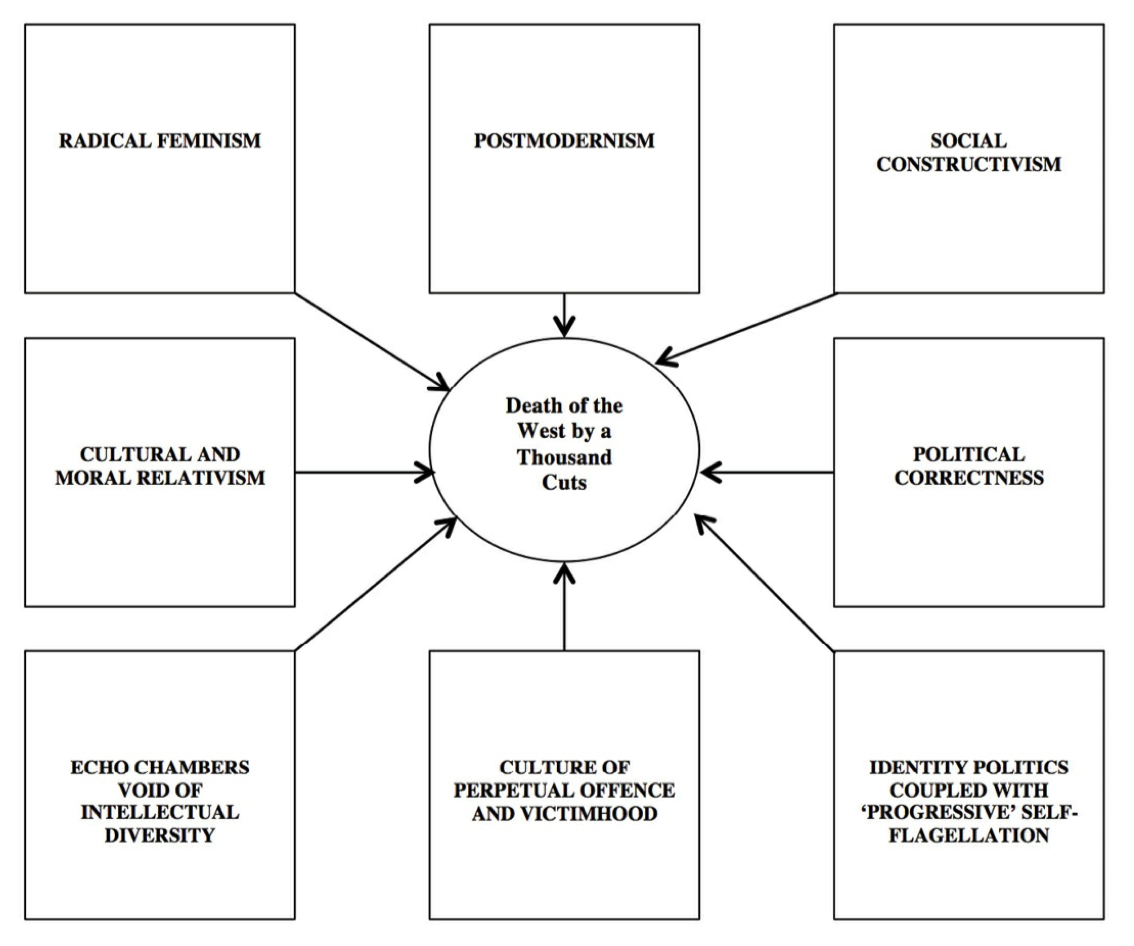
- Nefarious Forces:
- Political correctness
- Postmodernism
- Radical feminism
- Social constructivism
- Moral relativism
- Culture of perpetual offense and victimhood
- Microaggressions
- Trigger warnings
- Safe Spaces
- Identity Politics
Examples
-
Canada’s Bill C-16
-
Halloween costumes
-
Geert Wilders, a Dutch parliamentarian, was charged with a slew of crimes for having the temerity to criticize Islam and its growing influence in his country.
-
confirmation of Justice Brett Kavanaugh to the U.S. Supreme Court
-
Professor Rachel Fulton Brown
- She had the “audacity” to write a blog post that lauded white men (since they were instrumental in leading the charge in founding the emancipatory freedoms that we now possess in the West, including women’s rights). 16 This led to her being accused of being a white supremacist and a merchant of hate by many of her colleagues, including Professor Dorothy Kim, who was supposedly existentially threatened by Brown’s remarks since Kim is a “person of color.”
-
Lawrence Summers on intrinsic sex differences
-
Alessandro Strumia
-
Sir Tim Hunt; 2001 Nobel Prize winner, was giving a toast at the 2015 World Conference of Science Journalists in Seoul, South Korea, when he jokingly referred to the emotional predicaments that take place in mixed-sex labs
-
Lazar Greenfield is a distinguished surgeon with a long list of scientific and clinical accomplishments. While serving as editor-in-chief of Surgery News, he authored an editorial in 2011 discussing research that women exposed to sperm via unprotected coitus had lower depression scores than their counterparts who engaged in protected sex
-
Matt Taylor is another scientist who crossed paths with the perpetually offended and rabidly outraged. In 2014, while being interviewed during a livestream about a breathtaking accomplishment of human ingenuity, he wore a rather obnoxious and frankly inappropriate shirt that included drawings of scantily clad women in various poses.
Important
HIGHLIGHTS
- Hierarchy of effects models have been used in marketing and advertising to describe the cognitive (thinking), affective (feeling), and conative (behavioral) stages that consumers go through after seeing or hearing an advertisement. Products that require a high level of involvement (choosing a mutual fund) will have a different sequence of effects from their lowinvolvement counterparts (buying a candy bar). For the former, the operative sequence is thinking–feeling–behavior: an informed opinion leads to liking the product; hence, its purchase. On the other hand, for impulse products it is feeling–behavior–thinking: a positive feeling leads to an impulse purchase, and the opinion is formed post-purchase. Inherent to the various sequences is the recognition that both cognition and emotions matter in the decision-making process. In other words, we do not need to construe thinking and feeling as antithetical to one another. They are both fundamental components of decision-making. Problems arise when we use the wrong sequence to make a decision. For example, choosing which presidential candidate to vote for should be construed as a high-involvement decision, and accordingly a rational voter should first engage his cognitive system rather than his affective system. And yet, many hysterical antiTrump voters begin with a visceral emotional hatred of the man and then process subsequent information in a manner that supports their a priori affective position. (Page 33)
- Niall Ferguson, the Harvard historian, proposed “Six Killer Apps” that define the greatness of the West, namely competition, scientific revolution, property rights, modern medicine, consumer society, and work ethic. (Page 47)
- “Social media companies are not the government. They have the right to choose which content will be carried on their platforms.” In a sane world, this would a laughable position to hold, and yet it is endlessly repeated without any reflection on its nefarious implications. Google, YouTube, Facebook, and Twitter have more global control over us than all other companies combined. It is not hyperbole to say that they have more collective power, in terms of the information they control, than all the rulers, priests, and politicians of history. If knowledge is power, then these social media giants are nearly all-powerful when they decide which information we can have and whether we can be allowed a social media platform. Big tech companies routinely ban right-leaning commentators, but of course this is all an unfortunate “algorithmic coincidence.” What could be more sinister? (Page 48)
- John Watson, one of the founders of behaviorism, famously stated: Give me a dozen healthy infants, well-formed, and my own specified world to bring them up in, and I’ll guarantee to take any one at random and train him to become any type of specialist I might select—doctor, lawyer, artist, merchant-chief and, yes, even beggar-man and thief, regardless of his talents, penchants, tendencies, abilities, vocations, and race of his ancestors. I am going beyond my facts and I admit it, but so have the advocates of the contrary and they have been doing it for many thousands of years This is a truly extraordinary statement. It falsely posits that your parents (or Dr. John Watson) could have nurtured you into becoming the next NBA superstar. Move aside Michael Jordan, there is a new kid in town, and he is a chubby and clumsy 5’4” teenager named Mordechai Goldberg who has been expertly trained by John Watson. Watson rejected the notion of heredity and innate talent: Our conclusion, then, is that we have no real evidence of the inheritance of traits Everything we have been in the habit of calling “instinct” today is a result largely of training—belongs to man’s learned behavior. As a corollary from this I wish to draw the conclusion that there is no such thing as an inheritance of capacity, talent, temperament, mental constitution, and characteristics. These things again depend on training that goes on mainly in the cradle [Italics in original.] (Page 72)
- Postmodernism proclaims that there are no objective truths. Evolutionary psychologists like myself recognize that human universals exist precisely because they constitute elements of a shared biological heritage. (Page 73)
- Postmodernist bullshitters like Jacques Derrida, Jacques Lacan, and Michel Foucault succeeded in academia with their charlatanism because of the assumption that if something is nearly impossible to understand, it must be profound (note that there are individual differences in the extent to which people are swayed by bullshit) In a conversation with the American philosopher John Searle, Foucault confessed to this faux-profundity: “In France, you gotta have ten percent incomprehensible, otherwise people won’t think it’s deep—they won’t think you’re a profound thinker.” That admission notwithstanding, Foucault thought that Derrida pushed this in obscurantisme terroriste I, too, strategy too independently, have referred to postmodernism as intellectual terrorism. Beware of those trying to impress you with confusing word salads. far by engaging (Page 76)
- London’s Hayward Gallery hosted an exhibition in 2012 titled Invisible: Art about the Unseen 1957–2012, which featured—well, you guessed it— invisible art! (Page 77)
- In 1996, Alan Sokal, a physics professor at New York University, published a gibberish article titled “Transgressing the Boundaries: Toward a Transformative Hermeneutics of Quantum Gravity” in Social Text, a leading academic journal of postmodernism. (Page 77)
- In 2017, James Lindsay and Peter Boghossian (who happens to be a good friend of mine) published a hoax paper (using pseudonyms) wherein they argued that the human penis was a conceptual construct that was a driving force behind climate change. (Page 78)
- Lisa Littman is a physician and an assistant professor of the practice of behavioral and social sciences at Brown University. In 2018, she published a paper in PLOS ONE wherein she argued that rapid-onset gender dysphoria spreads in social networks as a form of contagion fueled in part by peer pressure Brown University had originally issued a news release describing the study’s conclusions but then, when faced with an outcry from transgender activists who thought that the article’s conclusions were offensive, expunged the story from its website As an act of solidarity toward an embattled colleague, I reached out to Littman and invited her on my show. She was reluctant to accept my invitation as she was undoubtedly concerned about possible institutional repercussions that might befall her. This was yet again a case where faux-outrage trumps academic freedom. If people scream “I’m offended” loudly enough, they drive the academic discourse. (Page 83)
- Charlize Theron on Twitter. In my view, Theron and many other parents of newly trans children are exhibiting a classic manifestation of Munchausen syndrome by proxy (via contagion). They can reap the “woke” progressive rewards of being a parent of a trans child. Theron has proclaimed that one of her two adopted children (a biological boy) is transgendered, having advised her at the age of three that he is a girl. (Page 83)
- Of the many dreadful anti-science idea pathogens to spring from the delusional world of gender studies, few are as corrosive as the nonsensical concept of toxic masculinity Nearly twenty years ago, Christina Hoff Sommers authored an important book on the unrelenting attack on boys The problem has only worsened since. It is perhaps not a good idea to pathologize half of humanity when dealing with a sexually reproducing species. Countless prestigious universities now offer talks, seminars, if not full courses on how to unlearn, combat, and overcome toxic masculinity. (Page 86)
- Fields that you might have thought were immune from this nonsense have all been slowly infected with this idea pathogen. We now have feminist architecture, feminist biology, feminist physics, feminist feminist chemistry, glaciology This next sentence comes from the abstract of the paper on feminist glaciology: “Merging feminist postcolonial science studies and feminist political ecology, the feminist glaciology framework generates robust analysis of gender, power, and epistemologies in dynamic socialecological systems, thereby leading to more just and equitable science and human–ice interactions.” Who knew that ice could be so sexist and patriarchal? feminist mathematics, and feminist geography, (Page 89)
- Nearly 125 years ago, the feminist Charlotte Perkins Gilman infamously proclaimed, “There is no female mind. The brain is not an organ of sex. As well speak of a female liver.”58 One would have thought that the thousands of scientific studies documenting the biological, anatomical, physiological, morphological, hormonal, cognitive, emotional, and behavioral differences between the two sexes might have put a dent in those obstinate refusals to accept the existence of biologically-based sex differences. (Page 89)
- What is particularly galling is that neurosexism was positively covered in Nature, one of the most prestigious scientific journals (Page 90)
- Evolutionary scientists, for example, explain that people in warmer climates tend to have spicier cuisines, because spices offer antimicrobial protection against foodborne pathogens, which are more likely to be present in warmer climates This demonstrates how cultural forms (national cuisine) serve as adaptive responses to biological challenges (exposure to microbes). (Page 94)
- In 2016, Humanities dean Jodi Kelly of Seattle University was removed from her administrative post when she uttered the word “nigger” in a conversation with a student This sounds awfully bigoted and inappropriate until one finds out that she was recommending a book of that title written by black civil rights activist Dick Gregory. She was responding to a request for a greater diversity of authors in assigned readings! (Page 102)
- Jussie Smollett, the otherwise minimally known actor of the series Empire, was unhappy with his “meagre” salary (more than $1 million per year). (Page 104)
- Some trans activists are just as creative in their rejection of reality. Two popular YouTube trans activists (Riley J. Dennis and Zinnia Jones) have proclaimed that it is “cissexist” for people to restrict their mating preferences to “cisnormative” individuals; or in other words, heterosexuality is bigoted. (Page 105)
- The actress Lena Dunham was concerned that her alma mater Oberlin College served sushi in the cafeteria, a clear case of cultural appropriation A self-described queer woman of color, chef Mithalee Rawat was aghast that white people had violated her Indian heritage by using bone broth, which she deemed colonialist theft. (Page 105)
- Katy Perry, who had to apologize for having dressed as a geisha in her performance at the 2013 American Music Awards Keziah Daum, a white high school student, wore a Chinese dress known as a qipao to her prom, and this triggered the faux-outrage brigade Beware of how you wear your hair, especially if you are white, for this too could be a signal that you are a bigoted Nazi. Katy Perry made that mistake by wearing cornrows and later apologized for it Kendall Jenner stirred controversy by sporting an Afro during a Vogue shoot And a white male student at San Francisco State University was angrily accosted by a black woman who was outraged that he had dreadlocks Other examples of faux-outrage over cultural appropriation stemming from the land of the insane (university campuses) include the University of Ottawa cancelling a yoga class a resident assistant at Pitzer College angered by white people wearing hoop earrings and Lynne Bunch, a student at Louisiana State University who wrote an op-ed in The Daily Reveille (LSU’s student newspaper) proclaiming that the thickening of one’s eyebrows is a form of cultural appropriation (Page 106)
- Erika Christakis, a lecturer in developmental psychology, wrote an extraordinarily meek and polite email to the Yale community questioning whether institutional warnings regarding Halloween costumes were a good idea, which led to a tsunami of outrage for not recognizing how bigoted Halloween costumes could be, ending ultimately in her resignation. (Page 106)
- Elizabeth Warren is guilty of it. She literally appropriated Native American culture as her own by constructing a false narrative about her ancestry. A subsequent genealogical test revealed that she was somewhere between 1/64 to 1/1024 Native American, making her less of that ancestry than the average white American. (Page 107)
- Several years ago, Tal Nitzan, then a doctoral student at Hebrew University, authored an award-winning paper that examined the incidence of rape as perpetrated by Israeli Defense Forces on Palestinian women. Undoubtedly, the goal was to uncover an epidemic of rape to demonstrate how diabolical those evil Jews truly were. When no such empirical reality was found, it was concluded (you might need to sit down for this) that this was proof of the extent to which the Israelis dehumanized the Palestinians They were so hateful that they did not even consider the Palestinian women worthy of rape! If rapes are uncovered or if none are discovered, the same conclusion is reached: the Israelis are diabolical (Page 108)
- The grand struggle of life for all sexually reproducing species involves having to survive (natural selection) and to reproduce (sexual selection). (Page 109)
- homophily (being attracted to those who are similar) has been documented in a very broad range of social contexts For instance, if marital success is your ultimate objective then the research is very clear: choose someone who is similar to you. We also choose our friends partly based on genetic homophily our dogs based on (Page 122)
- morphological homophily and our global trade partners based on cultural homophily It follows that when it comes to immigration, people who share foundational values are more likely to get along than those who don’t. If you are a classically liberal, modern, pluralistic, and secular society, opening your door to innumerable immigrants whose cultural and religious heritage in religious supremacy, homophobia, misogyny, intolerance toward religious minorities with a special hatred for Jews, rejection of freedom of speech, and freedom of conscience, will not yield good outcomes. To state this is not “bigoted”; it is recognizing a reality as clear as the existence of the sun. is rooted (Page 123)
- Reciprocal altruism is an evolved mechanism (the West grants entry to a manageable number of refugees fully expecting that they will reciprocate our generosity by adopting our secular, liberal, and modern values); suicidal empathy is not. We should never compromise the fabric of our modern societies in order to engage in a pious exercise of civilizational selfflagellation. (Page 123)
- Since the September 11, 2001, Islamist terrorist attacks on the United States, Islamic terrorists have perpetrated more than 35,000 attacks across the globe. (Page 123)
- obfuscation starts with the use of fantastical euphemisms and misdirection in referring to the terror attacks. (Page 123)
- The deflect strategy which she employed is a very common progressive defense of Islam. By pointing to ugly realities elsewhere, progressives hope to absolve Islam from criticism. The All Religions Have Extremists fallacy is immeasurably deceptive. It is true that a minuscule number of Christian individuals have used their faith as a justification for attacking abortion providers in the United States over the past twenty-five years People with functioning brains, though, recognize that the scale of a phenomenon matters. Even though Islam does not hold a monopoly on ideologically-based violence, it is certainly much more conducive to violence than, say, the beliefs of extremist Jains (who would assiduously use a broom to ensure that they do not walk on ants) (Page 125)
- The Crusades were a response to hundreds of years of Islamic aggression, and they took place (Page 125)
- within a very restricted time and place, nearly a millennium ago. As for the Bible, you can count on one hand the number of individuals who have used violent passages from Deuteronomy to justify acts of terrorism in the twenty-first century. On the other hand, innumerable Jihadis around the world use Islamic doctrines to justify their violent actions. Scale matters. (Page 126)
- Another classic ploy used by apologists is the No True Scotsman fallacy. This argues that entire Islamic countries, Islamic governments, and leading Islamic scholars are “fake” representations of the true faith. If you point to sharia law in Saudi Arabia, the retort is that this does not represent True Islam. Similarly, Iran’s mullahs apparently do not represent True Islam. Osama bin Laden was a “fake” Muslim. Other “fake” Muslims include Amin al-Husseini (the Grand Mufti of Jerusalem who was on friendly terms with Adolf Hitler), Sheikh Hassan al-Banna the Muslim Brotherhood), Grand Ayatollah Khomeini (the leader of the 1979 Iranian revolution), Sheikh Yusuf al-Qaradawi (arguably the leading Sunni theologian today), and Caliph Abu Bakr al-Baghdadi (the late leader of ISIS). (founder of (Page 126)
- OPS sufferers also employ the Infinite Spiral of Delegitimization strategy meant to delegitimize your right to critique Islam. For most Westerners it takes only one question: Do you speak Arabic? But other questions might include: Did you grow up in the Middle East? Are you a Muslim? Do you understand Qur’anic philology? Are you a hafiz (someone who has memorized the Qur’an in its entirety)? Did you attend Al-Azhar University (the supposed leading institution of Sunni Islam)? Are you an imam? Or, if all else fails: Are you one of the faithful companions of Muhammad? No? Well, shut up then. You don’t have the right to criticize the Noble Faith. Given that Arabic is my mother tongue and that I’m from Lebanon, it takes longer to “delegitimize” me. Most Westerners don’t stand a chance. (Page 126)
- Andalusian era of alleged peaceful coexistence is a historical myth People of the Book (Jews and Christians) were at times tolerated as second if not third-class citizens, but they needed to know their place in the grand fabric of Islamic society. They held the status of a dhimmi, which required that they adhere to specific laws including the payment of the jizya (protection tax). In Muslim societies, non-Muslims are tolerated until they are not—at which point you better run fast. You never know when this is going to happen, but you know that the looming metaphorical heart attack is just around the corner. (Page 127)
- In a quest to appear nuanced, many academics will posit that a given phenomenon (like global jihad) is due to a broad range of hyphenated and concatenated factors that represent a complex multifactorial problem. I call this the concatenation strategy. I have often satirized this form of intellectual duplicity whenever another terror attack takes place with the perpetrators yelling Allahu Akbar. I remind people (satirically) that the true motives of the terrorists may never be known but they are likely due to a confluence of paleo-botanic, sociocultural, biopolitical, neurophysiological, psychoeconomic, hetero-historical, geo-organic, and ethno-ketogenic factors. The more nonsensical terms that you can strew together, the greater the illusion of explanatory profundity. (Page 127)
- When faced with the unsavory nature of many Islamic doctrines, progressives argue that these cannot be taken seriously because the interpretation of texts (hermeneutics) is a subjective exercise, and very clear Islamist edicts of genocidal hate have, we are told, been mistranslated, misinterpreted, and misunderstood (I call this the Holy 3M of Apologia33). Using the political philosophy of multiculturalism, OPS sufferers refrain from criticizing truly abhorrent cultural and religious practices such as female genital mutilation, child brides, and honor killings under the guise of moral and cultural relativism. It is apparently wrong to apply universal moral principles when judging the precepts of a given society. Thus, Western critics are silent if not supportive of cultural and religious practices that otherwise should be universally condemned, as it would be “racist and bigoted” to question the traditions of others. (Page 128)
- Similar arguments apply to attempts to exempt the views or tastes of any group from reasoned appraisal and measured judgment. However well intentioned, all such attempts are, in the end, condescending. They assume that, in relation to a given topic, those who are in a disadvantaged “minority” (we are all in minorities in relation to certain topics) need—in addition to efforts to remedy their disadvantage—the further protection of not having their most cherished convictions critically scrutinized. This in effect posits a two-tier society intellectually with the grown-ups deciding not just what may or may not be said in front of the children but who are to count as children in the first place. This eventually engenders a situation in which it is considered acceptable to criticize, mock or give offence to those deemed to be among the privileged but not to those deemed to be among the less privileged—a moral asymmetry which is ultimately corrosive of genuine respect and equality. (Page 129)
- sharia law is even more fundamentally opposed to Western legal standards because Islam rejects the Western idea of impartial justice applied fairly regardless of an individual’s identity. Under sharia, punishments are applied as a function of the identity of the victim and perpetrator. A Jewish man who kills a Muslim man is judged very differently than a Muslim man who kills a Jewish man Sharia law specifically states that no retaliation can take place when a Muslim kills a non-Muslim and that indemnities depend on the identities of the parties in question. (Page 130)
- If a dark alley offered a shortcut on your way home, would you be more or less likely to take it if you noticed four young men or four elderly women loitering there? Using common sense, you realize that young men are more likely to be dangerous than elderly women, and you might go another way if you saw the young men. This does not make you sexist or ageist. Most young men are not violent, but there is a greater possibility that they could be, which warrants trepidation. (Page 131)
- desire to adhere to the “reality is racist” tenets of progressivism, they refuse to profile because to do so would be discriminatory (in the prejudicial sense of the word). They belong to what the political humorist Evan Sayet referred to as the Cult of Indiscriminateness (Page 132)
- Intellectual courage—or as I prefer to call it, testicular fortitude—is a necessary first step for anyone who wishes to participate in the battle of ideas. (Page 135)
- Replication studies, literature reviews, and meta-analyses are means by which scientists amass cumulative evidence for a given phenomenon typically within rigidly defined methodologies, paradigms, and disciplines. But beyond this, there is a way to generate and organize knowledge so that it becomes difficult even for one’s staunchest detractors, wallowing in ideological biases, to deny your conclusions. (Page 138)
- Cumulative Evidence (Page 138)
- Toy Preferences (Page 140)
- one can easily refute the social constructivist argument by showing that infants exhibit sex-specific toy preferences. This has indeed been shown in several studies and serves as sufficient evidence to reject the idea that it is “arbitrary sexist” standards that are the root cause of toy preferences. (Page 140)
- The relative lengths of the index and ring fingers are known as the digit ratio. It is a sexually dimorphic trait meaning that human males and females exhibit a consistent difference along this trait. (Page 140)
- Using clinical data, two separate groups of researchers have documented that little girls suffering from congenital adrenal hyperplasia—a masculinizing endocrinological malady—exhibit more masculinized toy preferences. So, we have proof of the incontestable biological roots of toy preferences using developmental, morphological, and pediatric endocrinological evidence stemming from normal and clinical populations. (Page 141)
- anthropologist Jean-Pierre Rossie conducted a detailed analysis of dolls and doll-play among various tribes within Saharan and North African territories. The peoples included the Belbala, the Chaamba, the Chaouia, the Ghrib, the Kabyles, the Moors, the Mozabites, the Reguibat, the Sahrawi, the Teda, the Tuareg, the inhabitants of the Saoura Valley, the populations of the Moroccan countryside, and the towndwellers of Algeria, Morocco, and Tunisia. Hardly, a repository of Western cultures. Rossie documented two key results of relevance to the current discussion: 1) Girls are much more likely than boys to play with dolls; 2) Female dolls are much more prevalent than male dolls. I uncovered a study that examined illustrations of children on funerary monuments in Ancient Greece. The same pattern emerged: boys are depicted playing with wheels, and girls are depicted playing with dolls. (Page 142)
- The framework for understanding the epidemiology of infectious diseases is relevant to examining the spread of ideas, beliefs, urban legends, and other packets of transmissible information such as religions. (Page 149)
- to convert to Islam simply requires that one proclaim openly one sentence, the shahada (the testimony): “There is no true god but Allah [God], and Muhammad is the Messenger (Prophet) of Allah.” (Page 150)
- While the Old Testament does mention the death penalty for apostasy, it has seldom been applied throughout Jewish history, whereas to this day apostasy from Islam does lead to the death penalty in several Islamic countries. (Page 150)
- perhaps the most important difference is that Judaism does not promote or encourage proselytizing, whereas it is a central religious obligation in Islam. According to Islam, the world is divided into dar al-harb (the house of war) and dar al-Islam (the house of Islam). Peace will arrive when the entire world is united under the flag of Allah. Hence, it is imperative to Islamize the nations within dar al-harb. (Page 150)
- fifty-seven member states of the Organization of Islamic Cooperation (OIC) (Page 150)
- In many OIC countries, Islam is not only the majority religion, it is practically the only religion. Here is a list of Islamic countries where Muslims currently comprise between 95 and 100 percent of the total population: Afghanistan, Algeria, the Comoros, Iran, Iraq, Jordan, Kosovo, Libya, the Maldives, Mauritania, Morocco, Niger, Pakistan, the Palestinian Territories, Saudi Arabia, Senegal, Somalia, Sudan, Tajikistan, Tunisia, Turkey, Uzbekistan, Western Sahara, and Yemen. The most populous Arab Muslim nation, Egypt, has a small and continually dwindling population of Coptic Christians. (Page 150)
- Among the intelligentsia of the West, it is common to self-flagellate by pointing to Western colonialism and American global hegemony. The West, we are told, was built by war and conquest whereas Islam spread via love and peace. The reality is that Islamic history is replete with endless conquests. In the now infamous words of the Harvard political scientist Samuel P. Huntington, “Conflict along the fault line between Western and Islamic civilizations has been going on for 1,300 years.” And even more succinctly, “Islam has bloody borders.”45 Since its founding in the seventh century, Islam has subjugated, converted, or killed hundreds of millions of people. (Page 151)
- Bill Warner, a former professor of physics and founder of the Center for the Study of Political Islam has conducted content analyses on the three canonical sources of Islam: the Qur’an (which represents the inerrant, universal, and eternal word of Allah), the hadith (the amalgamation of the traditions, deeds, and sayings of Muhammad, the prophet of Islam), and the Sira (the biography of Muhammad) Warner has analyzed the percentages of the three texts that are devoted to the Kafir (pejorative term for nonMuslims), to Jew-hatred, to politics, and to Jihad (holy war against nonbelievers). The conclusions are striking. For example, 51 percent of the trilogy of texts is devoted to uncomplimentary and unloving portrayals of the Kafir, and there is more Jew-hatred in the trilogy (9.3 percent) than in Adolf Hitler’s Mein Kampf (7 percent). (Page 152)
- sixty-eight current terror groups present on the U.S. Department of State’s Foreign Terrorist Organization List. Eighty-one percent of the terror groups (fifty-five of them) are Islamic. Two other terrorist groups (the Kurdistan Workers Party and the Revolutionary People’s Liberation Party/Front) are largely composed of Muslim individuals but their founding is not rooted in Islamic theology. The Canadian government maintains the Public Safety Canada’s list of terrorist organizations It lists fifty-five terror groups, of which forty-four are Islamic (80 percent). These Islamic groups vary along ethnic, racial, linguistic, economic, political, and geographical lines but are united by a common religious ideology. (Page 154)
- number of Islamic terror attacks since September 11, 2001. As of July 19, 2019, there have been 35,339 Islamist terror attacks in nearly 70 countries This is astronomically higher than all other religions combined. The National Consortium for the Study of Terrorism and Responses to Terrorism produced a background report of global terrorism (for the year 2017) including the number of victims killed by the twenty most active terror groups An astonishing 96.6 percent of the victims were murdered by Islamic groups (19,089 out of 19,752). (Page 154)
- In 2010, a Pew survey captured the extent to which people from Islamic countries held unfavorable views of the Jews Jew-hatred is the proverbial canary in the coal mine when it comes to measuring a society’s hateful prejudices. In Lebanon, 98 percent of those surveyed admitted to holding unfavorable views of Jews; in Jordan, the number was 97 percent; in the Palestinian territories, 97 percent; in Egypt, 95 percent; in Pakistan, 78 percent; in Indonesia, 74 percent; in Turkey, 73 percent; in Nigeria, 60 percent of Muslims dislike Jews, while a relatively paltry 28 percent of Christians do; and among Israeli Arabs, 35 percent. The Anti-Defamation League produced a global report of Jew-hatred using interviews with 53,100 individuals carried out between July 2013 and February 2014 in 101 countries and the Palestinian Territories (West Bank and Gaza) Here is the list of the sixteen most anti-Semitic countries, in decreasing order of hate: West Bank and Gaza, Iraq, Yemen, Algeria, Libya, Tunisia, Kuwait, Bahrain, Jordan, Morocco, Qatar, United Arab Emirates, Lebanon, Oman, Egypt, and Saudi Arabia. If only there was a way to uncover a unifying rubric for these bastions of love, peace, and tolerance. (Page 158)
- Examining a society’s attitudes towards gay people serves as another valuable indicator of tolerance. Pew conducted a global survey in 2013 asking respondents whether homosexuality should be rejected by society Islamic countries led the way in intolerance toward gays. Here are some of the relevant data: Senegal, 98 percent; Jordan, 97 percent; Egypt, 95 percent; Tunisia, 94 percent; the Palestinian territories, 93 percent; Indonesia, 93 percent; Pakistan, 87 percent; Malaysia, 86 percent; Lebanon, 80 percent; Turkey, 78 percent. The Western LGBTQ activists who belong to or support Queers for Palestine might be interested to know that Israel (even counting (Page 158)
- How well do women fare around the world? In 2018, the World Economic Forum released “The Global Gender Gap Report,” wherein countries were ranked in terms of gender gaps in four domains: health, education, economics, and politics Out of 149 countries, here are the twenty worst for women, in decreasing rank order: Turkey, Ivory Coast, Bahrain, Nigeria, Togo, Egypt, Mauritania, Morocco, Jordan, Oman, Lebanon, Saudi Arabia, Iran, Mali, Democratic Republic of Congo, Chad, Syria, Iraq, Pakistan, and Yemen. (Page 159)
- In 2018, the Foundation for the Advancement of Liberty, a Spanish libertarian think tank released its 2018 World Index of Moral Freedom wherein 160 countries were ranked on a composite score composed of five freedom measures Here are the rankings of the fourteen worst countries, in decreasing order: Libya, Oman, Algeria, Brunei, Pakistan, Iran, Egypt, Afghanistan, Kuwait, Qatar, Iraq, United Arab Emirates, Yemen, and Saudi Arabia. These nations vary along ethnic, racial, linguistic, economic, and sociopolitical metrics, but they have one thing in common. (Page 159)
- Here are the countries that currently impose a death penalty for atheism: Afghanistan, Iran, Malaysia, Maldives, Mauritania, Nigeria, Pakistan, Qatar, Saudi Arabia, Somalia, Sudan, United Arab Emirates, and Yemen. (Page 159)
- Research Center examined which countries have the most governmental restrictions on religion Combining the data from the 2013 and 2014 surveys, the twenty worst countries are China, Indonesia, Uzbekistan, Iran, Egypt, Afghanistan, Saudi Arabia, Malaysia, Burma, Russia, Syria, Turkey, Azerbaijan, Sudan, Brunei, Eritrea, Kazakhstan, Turkmenistan, Laos, and the Maldives. Seventy-five percent of the worst countries are Muslimmajority nations. (Page 159)
- people are reluctant to join the battle of ideas is what we call “diffusion of responsibility” or “the bystander effect.” (Page 162)
- If your Facebook friends are posting comments with which you disagree, engage them and offer an alternative viewpoint. Do not fear the possible loss of friendship. Anyone who is willing to end a relationship because of a reasoned difference of opinion is not worthy of your friendship. (Page 162)
- The English historian Henry Thomas Buckle famously remarked: “Men and women range themselves into three classes or orders of intelligence; you can tell the lowest class by their habit of always talking about persons; the next by the fact that their habit is always to converse about things; the highest, by their preference for the discussion of ideas.” (Page 164)
- Cultural relativism also impedes people from casting judgments, especially against otherwise abhorrent religious and cultural practices. Several generations of university students have been indoctrinated into the false belief that it is gauche if not bigoted to judge people of different ethnic or religious backgrounds, especially if you are a white Westerner. In April 2011 the University of Notre Dame hosted a debate between William Lane Craig (a Christian theologian) and Sam Harris (an atheist neuroscientist) on the natural versus supernatural foundations of morality. During the debate, Harris recounted an anecdote that perfectly summarizes the moral blindness that cultural relativism engenders. It centered around a conversation he had with an appointee to President Obama’s Council on Bioethics She said, “How could you ever say that forcing women to wear burqas is wrong from the point of view of science?” I said, “Well, because I think it’s pretty clear that right and wrong relate to human well-being, and it’s just as clear that forcing half the population to live in cloth bags and beating them, or killing them when they try to get out, is not a way of maximizing human wellbeing.” And she said, “Well, that’s just your opinion.” And I said, “Well, okay, let’s make it even easier. Let’s say we found a culture that was literally removing the eyeballs of every third child, ok, at birth. Would you then agree that we have found a culture that is not perfectly maximizing well-being?” And she said, “It would depend on why they were doing it.” So after my eyebrows returned from the back of my head, I said, “Okay, well say they were doing it for religious reasons. Let’s say they have a scripture which says, ‘Every third should walk in (Page 165)
- darkness’ or some such nonsense.” And then she said, “Well, then you could never say that they were wrong.” (Page 166)
- To judge is to be human. It is perfectly natural to judge others. It is an integral part of being a well-functioning adult. A central feature of human decision making is the process of judging several competing alternatives. This is precisely why the Society for Judgment and Decision Making and its flagship journal Judgment and Decision Making exist. We judge whom to include within our close circle of friends. We judge various prospective suitors prior to marrying our eventual spouse. We judge the performance of our students and employees. Life is laden with endless judgments. If I were to ask you to think about the people whom you consider to be most interesting, they would likely have one thing in common: they judge; they opine; they take positions. Fence-sitters who equivocate about the pros and cons of every conceivable issue without ever pronouncing a judgment are profoundly boring people. To never judge is to be an intellectual coward for it serves as an insurance policy against the possibility of being a polarizing figure. The most charismatic public intellectuals are typically those who share their judgments on a broad range of issues. Thomas Sowell and the late Christopher Hitchens are two of the leading public intellectuals of the past four decades precisely because they never shied away from sharing their opinions on contentious issues. (Page 166)
- Costly signaling is also relevant in explaining rites of passage across various cultures meant to serve as an honest signal of one’s courage, bravery, and toughness. The Sateré-Mawé, an indigenous Amazonian tribe, have a very powerful way of differentiating prospective warriors from their fake counterparts. They sedate bullet ants, whose sting is akin to being shot, and then weave them into leaf gloves. Initiates wear the gloves for several minutes and must withstand the stings of hundreds of these ants as they come out of their sedated torpor. One sting causes unimaginable pain, and yet the inductees must withstand the suffering with restrained dignity (they cannot holler). One such ordeal would be sufficient to test anyone’s toughness, and yet the young men must endure this tribulation twenty separate times. If all it took to become a warrior was the completion of ten push-ups, nearly everyone could complete the task. It would leave the tribe in the unenviable position of not knowing who the truly tough individuals were. However, create a rite of passage that serves as an honest signal of toughness and courage, and you’ve solved the problem of identifying the fakers (Page 169)
- To criticize Islam does not make you an Islamophobe (a nonsensical term) nor a hater of individual Muslims. To scrutinize radical feminism does not make you a misogynist. To question open borders does not make you a racist. You can have an open heart filled with empathy and compassion and yet reject open borders. To assert that trans women (biological males) should not be competing in athletic competitions with biological females does not make you a transphobe. Many situations in life involve a calculus of competing rights. With that in mind, the right of your eight-year-old daughter to feel comfortable and safe in a public bathroom supersedes that of a 230-pound, six foot two trans woman. To reject the idea that so-called “other forms of knowing” (whether the indigenous way of knowing or (Page 174)
- postmodernism) are as valid as the scientific method does not make you a close-minded bigot. To reject the hysterical demonization of white men as exemplars of toxic masculinity and white supremacy does not make you Adolf Hitler. The name-calling accusations are locked and loaded threats, ready to be deployed against you should you dare to question the relevant progressive tenets. Most people are too afraid to be accused of being racist or misogynist, and so they cower in silence. Keep your mouth shut and nod in agreement or else prepare to be tarred and feathered. Don’t fall prey to this silencing strategy. Be assured in your principles and stand ready to defend them with the ferocity of a honey badger. (Page 175)
- The cure is before you: it is the pursuit and the defense of truth; it is the recommitment to the Western Scientific Revolution and Age of Enlightenment. March on, soldiers of reason. Together we can win the battle of ideas. the virtues of (Page 178)