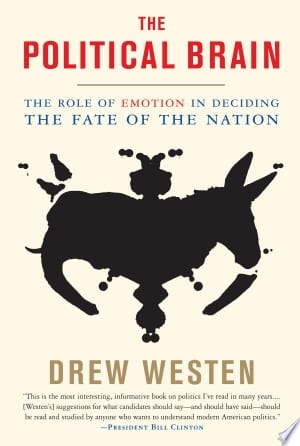
DESCRIPTION
The Political Brain is a groundbreaking investigation into the role of emotion in determining the political life of the nation. For two decades Drew Westen, professor of psychology and psychiatry at Emory University, has explored a theory of the mind that differs substantially from the more “dispassionate” notions held by most cognitive psychologists, political scientists, and economists — and Democratic campaign strategists. The idea of the mind as a cool calculator that makes decisions by weighing the evidence bears no relation to how the brain actually works. When political candidates assume voters dispassionately make decisions based on “the issues,” they lose. That’s why only one Democrat has been re-elected to the presidency since Franklin Roosevelt — and only one Republican has failed in that quest. In politics, when reason and emotion collide, emotion invariably wins. Elections are decided in the marketplace of emotions, a marketplace filled with values, images, analogies, moral sentiments, and moving oratory, in which logic plays only a supporting role. Westen shows, through a whistle-stop journey through the evolution of the passionate brain and a bravura tour through fifty years of American presidential and national elections, why campaigns succeed and fail. The evidence is overwhelming that three things determine how people vote, in this order: their feelings toward the parties and their principles, their feelings toward the candidates, and, if they haven’t decided by then, their feelings toward the candidates’ policy positions. Westen turns conventional political analyses on their head, suggesting that the question for Democratic politics isn’t so much about moving to the right or the left but about moving the electorate. He shows how it can be done through examples of what candidates have said — or could have said — in debates, speeches, and ads. Westen’s discoveries could utterly transform electoral arithmetic, showing how a different view of the mind and brain leads to a different way of talking with voters about issues that have tied the tongues of Democrats for much of forty years — such as abortion, guns, taxes, and race. You can’t change the structure of the brain. But you can change the way you appeal to it. And here’s how
Haidt, Chapter 3 — partisan words and candidate faces can act before policy analysis
Haidt’s affective-priming account supplies a compact mechanism for this book’s thesis. In the studies he summarizes, politically loaded words such as names, taxes, welfare, and “pro-life” produced rapid congruence or conflict signals among partisans. Alexander Todorov’s participants then chose which congressional candidate looked more competent from paired photographs; those face judgments picked the eventual winner about two-thirds of the time, with similar prediction after a tenth-second exposure in a follow-up.
This shows fast political perception, not facial access to actual competence. Predicting the winner is not proving why voters chose, and a party cue’s speed does not make the resulting judgment fixed. Campaign skill, exposure, incumbency, media, demographics, and other appearance-linked variables remain possible pathways. The practical lesson is to audit the cue before treating the later policy explanation as the whole cause: remove names and faces, compare the same proposal under reversed party labels, and ask which facts would survive the identity swap. Partisan affective priming, PDF pp. 77-79 (file not included in this release) · Todorov qualifications, PDF p. 372 (file not included in this release) · Permanent concept note
My Summary
Main Ideas, Takeaways & Similarities
Questions
I. What is the problem?
A. How is this problem formulated?
B. Why is this problem important?
C. What is the history of this problem?
D. Which prominent personalities have been interested in this problem?
II. What solutions to the problem are there?
A. What are the conclusions reached?
B. By what argument(s) is the conclusion reached?
C. What facts or assumptions serve as premises?
D. When a prominent personality offers a solution, does he also argue for or against other prominent personalities? Does he raise objections to alternative solutions? Does he consider objections to his own solutions?
III. Evaluation
A. What are the advantages and disadvantages of the alternative formulations to the problem?
B. Has the importance or history of the problem ever been misrepresented?
C. Are the solutions logically related to the premises?
D. Are the facts true? Are the assumptions acceptable? Are the objections answerable?
AI Summary
Highlights
“The Political Brain: The Role of Emotion in Deciding the Fate of the Nation” by Drew Westen explores the influence of emotions on political decision-making and campaigns. The book delves into the role of emotional narratives and messaging in shaping voters’ perceptions and choices. Here’s a comprehensive summary in bullet points:
- Title: The Political Brain: The Role of Emotion in Deciding the Fate of the Nation
- Author: Drew Westen
Introduction:
- Introduces the concept of the political brain, emphasizing the importance of emotions in political decision-making.
- Argues that voters are influenced by emotional narratives rather than solely rational arguments.
Chapter 1: The Political Brain:
- Discusses the cognitive processes involved in political decision-making.
- Highlights the interplay between reason and emotion in shaping political beliefs.
Chapter 2: Defining Political Ideology:
- Examines the psychological and emotional aspects of political ideology.
- Explores how individuals form and maintain their political beliefs.
Chapter 3: The Political Brain of Conservatives:
- Investigates the emotional underpinnings of conservative ideology.
- Discusses how conservative values are often rooted in emotional responses.
Chapter 4: The Political Brain of Liberals:
- Explores the emotional foundations of liberal ideology.
- Examines the role of empathy and compassion in liberal beliefs.
Chapter 5: The Role of Emotion in Presidential Campaigns:
- Analyzes the impact of emotional narratives in presidential campaigns.
- Discusses how successful candidates connect with voters on an emotional level.
Chapter 6: Campaigning on the Wrong Brain:
- Critiques the strategies used by political consultants and candidates that neglect emotional appeals.
- Argues that purely rational messaging can fail to resonate with voters.
Chapter 7: Political Consultants: The Masters of Disasters:
- Examines the role of political consultants and their influence on campaign messaging.
- Discusses the limitations of relying solely on polling data and focus groups.
Chapter 8: Crafting a Winning Message:
- Provides guidance on crafting emotionally resonant political messages.
- Emphasizes the importance of storytelling and personal narratives.
Chapter 9: Changing Minds, or Winning Votes?:
- Explores the distinction between changing voters’ minds and winning their votes.
- Discusses the importance of emotional persuasion in electoral success.
Chapter 10: The Future of Political Campaigning:
- Speculates on the future of political campaigning and the continued role of emotions.
- Discusses the potential for more emotionally intelligent campaigns.
Conclusion:
- Summarizes the key insights and findings from the book.
- Emphasizes the enduring significance of emotions in political decision-making.
Legacy:
- “The Political Brain” challenges conventional wisdom about political campaigns and the importance of emotional appeals.
- It underscores the role of emotions in shaping voters’ perceptions and choices.
- The book has influenced discussions about political messaging and campaign strategies, emphasizing the need for emotional resonance in political communication.