
DESCRIPTION
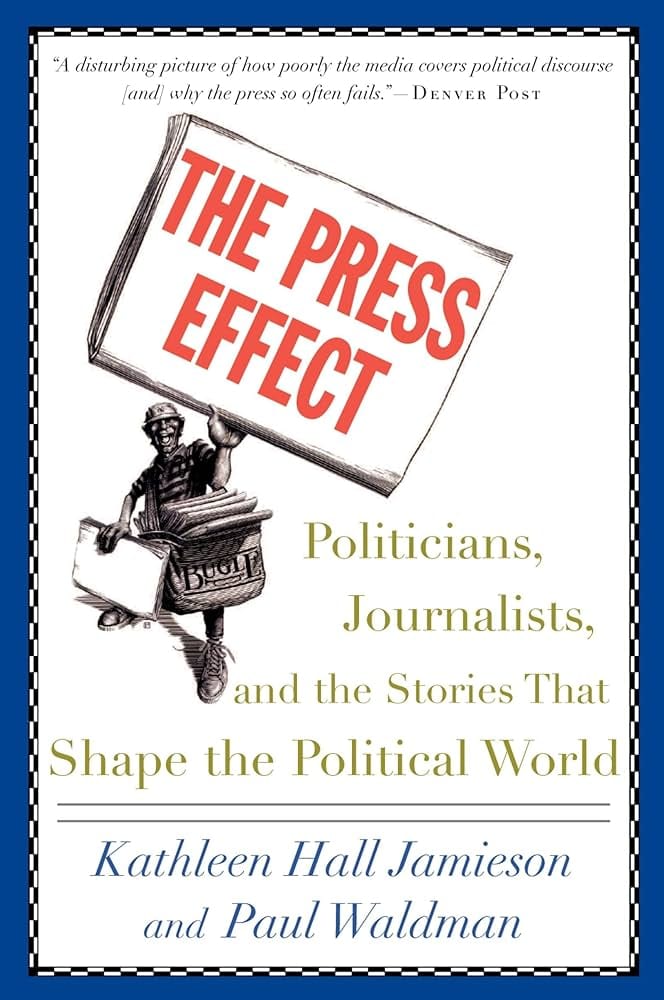
Kathleen Hall Jamieson and Paul Waldman argue in The Press Effect that there is an evident failure of America’s press and its citizenry to engage the most important part of our political process in a critical fashion. The authors analyze both press coverage and public opinion, using the Annenberg 2000 survey, which interviewed more than 100,000 people, to examine one of the most interesting periods of modern presidential history, from the summer of 2000 through the aftermath of September 11th. How does the press fail us during presidential elections? Jamieson and Waldman show that when political campaigns side-step or refuse to engage the facts of the opposing side, the press often fails to step into the void with the information citizens require to make sense of the political give-and-take. The authors look at the stories through which we understand political events — examining a number of fabrications that have deceived the public about consequential governmental activities — and explore the ways in which political leaders and reporters select the language we use to talk and think about politics, and the relationship between the rhetoric of campaigns and the reality of governance. The Press Effect is, ultimately, a wide-ranging critique of the press’s role in mediating between politicians and the citizens they are supposed to serve. Book jacket.
My Summary
Main Ideas, Takeaways & Similarities
Questions
I. What is the problem?
A. How is this problem formulated?
B. Why is this problem important?
C. What is the history of this problem?
D. Which prominent personalities have been interested in this problem?
II. What solutions to the problem are there?
A. What are the conclusions reached?
B. By what argument(s) is the conclusion reached?
C. What facts or assumptions serve as premises?
D. When a prominent personality offers a solution, does he also argue for or against other prominent personalities? Does he raise objections to alternative solutions? Does he consider objections to his own solutions?
III. Evaluation
A. What are the advantages and disadvantages of the alternative formulations to the problem?
B. Has the importance or history of the problem ever been misrepresented?
C. Are the solutions logically related to the premises?
D. Are the facts true? Are the assumptions acceptable? Are the objections answerable?
AI Summary
Highlights
“The Press Effect: Politicians, Journalists, and the Stories that Shape the Political World” is a book written by Kathleen Hall Jamieson and Paul Waldman, published in 2003. The book explores the complex relationship between politicians, journalists, and the media’s role in shaping political narratives. Here is a comprehensive summary of the book in bullet points:
- The book examines the symbiotic relationship between politicians and the media, emphasizing the influential role that the press plays in shaping public perceptions of political events and figures.
- Kathleen Hall Jamieson and Paul Waldman explore the dynamics of political communication and how politicians strategically use the media to convey their messages and shape their public image.
- They discuss the concept of the “press effect,” which refers to the influence of media coverage on the political process and public opinion.
- The authors argue that media coverage often prioritizes conflict, drama, and sensationalism over substantive policy issues, which can lead to a focus on personality and superficial aspects of politics.
- The book delves into the strategies employed by politicians to control their media image and craft compelling narratives, including the use of soundbites and photo opportunities.
- Jamieson and Waldman analyze how journalists select and frame stories, as well as the impact of deadlines and competition on news coverage.
- They discuss the role of political ads, press conferences, and press releases in shaping political discourse and influencing public opinion.
- The book explores case studies of political campaigns and events to illustrate how media narratives can influence electoral outcomes and policy debates.
- Jamieson and Waldman address the concept of media bias and provide insights into the challenges of objective reporting in the context of political polarization.
- They discuss the role of fact-checking and the challenges of correcting misinformation and false claims in the media.
- The authors emphasize the importance of media literacy and critical thinking skills for citizens to navigate the complex and often partisan media landscape.
- The book reflects on the ethical considerations and responsibilities of journalists in providing accurate and balanced coverage of political events.
- Jamieson and Waldman highlight the potential for the press to hold politicians accountable and serve as a watchdog for democracy.
- They discuss the evolving media landscape, including the impact of digital and social media on political communication and news consumption.
- The book concludes by offering recommendations for improving the quality and accountability of political journalism and promoting a more informed and engaged citizenry.
“The Press Effect” provides a comprehensive analysis of the interplay between politics and the media, shedding light on how political narratives are constructed and disseminated. Kathleen Hall Jamieson and Paul Waldman offer insights into the challenges and opportunities in political communication and highlight the role of media literacy in fostering a more informed electorate. The book encourages readers to critically assess media coverage and its impact on the political world.