
DESCRIPTION
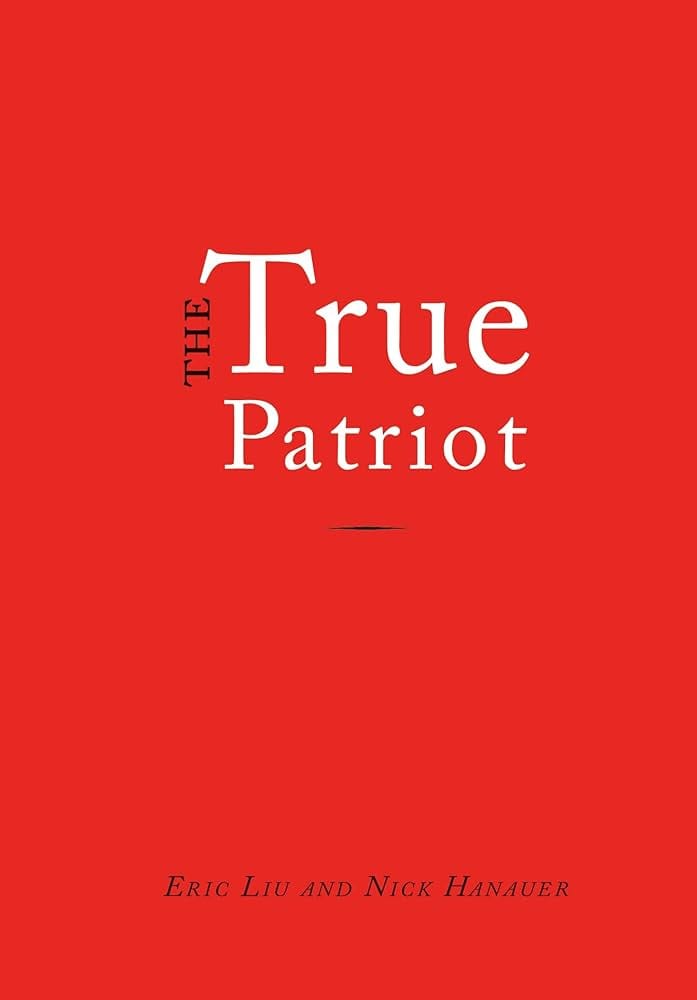
Written in the style of Thomas Paine, this ‘little red book’ challenges modern patriotism—and calls for a return to the ideals on which American democracy was founded. An essential, non-partisan read for both progressive and conservatives! Over the course of a generation, patriotism in America has been hijacked by the right and abandoned by the left. But the principles and values of true patriotism—country above self, contribution above consumption, stewardship over exploitation, freedom with responsibility, purpose through sacrifice and service, pragmatism, a fair shot for all—are inherently progressive. Written in the pamphleteering style of Thomas Paine (Common Sense), The True Patriot challenges progressives to reclaim patriotism and spells out just how to do it. This powerful and timely “little red book” combines a manifesto, a ten-principle plan, a model speech, and a moral code. Throughout, it weaves between the words of the authors and excerpts from foundational American texts and speeches, as well as a parade of iconic American images.
My Summary
Main Ideas, Takeaways & Similarities
Questions
I. What is the problem?
A. How is this problem formulated?
B. Why is this problem important?
C. What is the history of this problem?
D. Which prominent personalities have been interested in this problem?
II. What solutions to the problem are there?
A. What are the conclusions reached?
B. By what argument(s) is the conclusion reached?
C. What facts or assumptions serve as premises?
D. When a prominent personality offers a solution, does he also argue for or against other prominent personalities? Does he raise objections to alternative solutions? Does he consider objections to his own solutions?
III. Evaluation
A. What are the advantages and disadvantages of the alternative formulations to the problem?
B. Has the importance or history of the problem ever been misrepresented?
C. Are the solutions logically related to the premises?
D. Are the facts true? Are the assumptions acceptable? Are the objections answerable?
AI Summary
Highlights
“The True Patriot” is a book co-authored by Eric Liu and Nick Hanauer. Published in 2007, it explores the concept of patriotism and offers a progressive perspective on what it means to be a true patriot in the United States. Here is a comprehensive summary of the book in bullet points:
- The book challenges traditional notions of patriotism, asserting that it is not limited to blind loyalty to the government but rather encompasses a commitment to the ideals and principles that make America a better nation.
- Eric Liu and Nick Hanauer argue that true patriotism involves a deep love for one’s country and a desire to improve it by addressing social, economic, and political issues.
- They emphasize the importance of civic engagement, active participation in the democratic process, and holding the government accountable for its actions.
- “The True Patriot” advocates for a more inclusive and compassionate approach to patriotism, one that seeks to bridge divides and promote social justice.
- The authors discuss the values of economic fairness, social responsibility, and environmental sustainability as essential components of a true patriot’s mindset.
- The book explores various policy issues, including income inequality, healthcare, education, and the environment, from a progressive perspective.
- Liu and Hanauer argue that addressing these issues is not contrary to patriotism but rather aligns with the goal of creating a more just and equitable society.
- They reject the notion that patriotism is solely defined by flag-waving or militarism and propose a vision of patriotism that embraces diversity and pluralism.
- “The True Patriot” encourages readers to be critical thinkers, question the status quo, and advocate for positive change.
- The book promotes the idea that true patriots are not passive consumers of government services but active participants in shaping the nation’s future.
- Liu and Hanauer argue that true patriots are willing to engage in constructive dissent and work towards a more perfect union.
- The authors draw inspiration from historical figures and events that exemplify the principles of true patriotism, such as the Civil Rights Movement and the abolitionist movement.
- “The True Patriot” concludes by calling on Americans to reclaim patriotism from narrow interpretations and embrace a more inclusive and progressive vision of love for their country.
In summary, “The True Patriot” challenges conventional notions of patriotism and presents a progressive perspective that emphasizes active civic engagement, social responsibility, and a commitment to addressing pressing issues to make America a better nation for all its citizens.