
DESCRIPTION
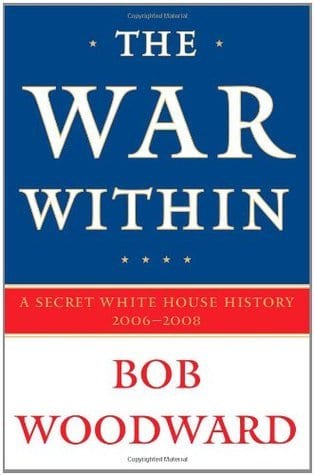
Bob Woodward once again pulls back the curtain on Washington to reveal the inner workings of a government at war in his fourth book on President George W. Bush. The War Within provides an exhaustive account of the struggles of General David Petraeus, who takes over in Iraq during one of the bleakest and most violent periods of the war. It reveals how breakthroughs in military operations and surveillance account for much of the progress as violence in Iraq plummeted in the middle of 2007. Woodward interviewed key players, obtained dozens of never-before-published documents, and had nearly three hours of exclusive interviews with President Bush. The result is a stunning, firsthand history of the years from mid-2006, when the White House realizes the Iraq strategy is not working, through the decision to surge another 30,000 U.S. troops in 2007, and into mid-2008, when the war becomes a fault line in the presidential election. The War Within addresses head-on questions of leadership, not just in war but in how we are governed and the dangers of unwarranted secrecy.
My Summary
Main Ideas, Takeaways & Similarities
Questions
I. What is the problem?
A. How is this problem formulated?
B. Why is this problem important?
C. What is the history of this problem?
D. Which prominent personalities have been interested in this problem?
II. What solutions to the problem are there?
A. What are the conclusions reached?
B. By what argument(s) is the conclusion reached?
C. What facts or assumptions serve as premises?
D. When a prominent personality offers a solution, does he also argue for or against other prominent personalities? Does he raise objections to alternative solutions? Does he consider objections to his own solutions?
III. Evaluation
A. What are the advantages and disadvantages of the alternative formulations to the problem?
B. Has the importance or history of the problem ever been misrepresented?
C. Are the solutions logically related to the premises?
D. Are the facts true? Are the assumptions acceptable? Are the objections answerable?
AI Summary
Highlights
“The War Within: A Secret White House History 2006-2008” is a book written by Bob Woodward, published in 2008. The book provides an inside look at the Bush administration’s decision-making process during a crucial period in the Iraq War and the broader War on Terror. Here is a comprehensive summary of the book in bullet points:
- The book covers the years 2006 to 2008 and offers an insider’s perspective on the Bush administration’s handling of the Iraq War and related foreign policy matters.
- Bob Woodward, a renowned investigative journalist, conducted extensive interviews with key officials and had access to classified documents and meeting notes.
- The book reveals internal debates and conflicts within the Bush administration, particularly between civilian leaders and military commanders.
- Woodward highlights the role of key figures such as President George W. Bush, Vice President Dick Cheney, Secretary of Defense Robert Gates, and General David Petraeus in shaping the war strategy.
- It discusses the implementation of the “surge” strategy in Iraq, which involved deploying additional troops to stabilize the country.
- The book provides insights into the evolving relationship between the U.S. military and the Iraqi government, as well as the challenges of dealing with sectarian violence and insurgency.
- Woodward discusses the tensions and disagreements between the Bush administration and the Iraqi Prime Minister Nouri al-Maliki.
- He explores the impact of domestic politics and public opinion on the administration’s decision-making process, especially as the 2008 presidential election approached.
- The book reveals secret negotiations and diplomatic efforts, including talks with Iran and Syria, aimed at stabilizing the region.
- Woodward addresses the role of intelligence agencies and the assessment of the situation in Iraq, including the controversial National Intelligence Estimate (NIE).
- It discusses the implications of the Iraq War for the broader War on Terror and the fight against al-Qaeda.
- The book provides insights into the efforts to track down and capture or kill high-value targets, including al-Qaeda leaders.
- Woodward reflects on the legacy of the Iraq War and the challenges faced by the next administration in the transition of power.
- He emphasizes the importance of leadership, decision-making, and the consequences of the Iraq War for American foreign policy.
“The War Within: A Secret White House History 2006-2008” offers a detailed and behind-the-scenes account of the Bush administration’s handling of the Iraq War during a critical period. Bob Woodward’s book provides readers with a glimpse into the internal debates, strategies, and conflicts that shaped U.S. foreign policy in Iraq and the broader Middle East. It sheds light on the challenges faced by decision-makers and the complex interplay of politics, diplomacy, and military strategy in a time of war.