Bottom line
Kyle Kulinski’s article makes a morally serious anti-imperialist case by assembling real episodes of U.S. violence, unlawful intervention, support for abusive partners, and civilian harm. Several of its underlying examples are strongly supported. The headline conclusion—that the United States is the world’s biggest terrorist—is not a fact that can be verified as written. It is a polemical classification that depends on a disputed definition of terrorism, an unstated time period, a casualty method, rules for attributing proxy and war deaths, and a comparison set. The article is most persuasive as an indictment of U.S. conduct and least persuasive when it turns evidence of grave wrongdoing into claims about proven intent, settled legal judgments, or a numerical world ranking.
Source boundary and cutoff
This note separates what the article says from what the cited or independently located evidence establishes. A documented civilian death, unlawful use of force, war crime, act of state repression, and act of terrorism are related but not interchangeable categories. The initial audit was conducted on 2026-09-30; several 2026 events remain subject to investigations, later corrections, and legal proceedings.
Verdict key
- Supported — strong evidence establishes the material claim.
- Mostly supported — the core is established, but wording or scope needs qualification.
- Partly supported — important components are established, while another material component is unproven or overstated.
- Unsupported as stated — the available evidence does not establish the specific claim.
- Interpretive / legally contested — a defensible judgment, not a settled empirical or legal fact.
- Open — not yet audited adequately or dependent on unresolved evidence.
Article Thesis and Argument
The article defends Hasan Piker’s statement that, measured “pound for pound” by deaths, the United States is worse than al-Qaeda. Kulinski argues that people apply the word terrorism asymmetrically: spectacular violence by nonstate enemies receives the label, while large-scale violence by the United States or its partners is described as war, policy, sanctions, counterterrorism, or collateral damage. He supports the charge with recent cases involving Iran, Cuba, Gaza, Caribbean boat strikes, and Venezuela, then places them in a bipartisan history running through Vietnam, Cuba, Indonesia, Nicaragua, Iraq, Afghanistan, Yemen, and U.S. support for Israel.
The argument has four steps:
- Terrorism should be classified by the violent conduct and its effect or purpose, not by whether the actor is a state or an officially designated enemy.
- U.S. policy has caused or enabled civilian deaths on a scale exceeding al-Qaeda’s direct killings.
- American political language hides this continuity by using exceptional labels for enemies and sanitized labels for itself.
- Progressive politicians should confront rather than dilute this anti-imperialist critique.
The Definitional Problem
There is no universally agreed comprehensive definition of terrorism. International humanitarian law nevertheless prohibits acts or threats of violence whose primary purpose is to spread terror among civilians, while also prohibiting direct attacks on civilians through more specific rules. Under 18 U.S.C. § 2331, international terrorism requires violent or dangerous criminal acts that appear intended to intimidate or coerce civilians or influence government conduct, together with a transnational nexus.
These definitions create a crucial test the article often skips: civilian harm, even unlawful civilian harm, does not by itself prove the specific coercive or terrorizing purpose that many definitions require. State conduct can reasonably be analyzed as terrorism, and the state/nonstate distinction should not immunize governments from moral scrutiny. But a comparative claim still needs a declared definition, unit of analysis, period, source dataset, counterfactual, and attribution rule.
What a Testable Version Would Need
| Dimension | Question that must be answered |
|---|---|
| Definition | Does terrorism require a purpose to terrorize or coerce civilians, or is foreseeable civilian harm enough? |
| Time | Since 1945, since 2001, during a named war, or under a particular administration? |
| Death measure | Direct violent deaths, indirect/excess deaths, or all deaths in conflicts the actor helped cause? |
| Attribution | Are partner, proxy, insurgent, and downstream deaths assigned wholly, proportionally, or not at all? |
| Comparison set | Al-Qaeda alone, designated terrorist groups, all states, or all violent political actors? |
| Denominator | Total deaths, deaths per year, civilian deaths, population-adjusted deaths, or some other measure? |
Without those choices, “world’s biggest terrorist” is rhetoric rather than a reproducible finding.
Initial Claim Ledger
| Article claim | Initial verdict | What the evidence supports |
|---|---|---|
| The United States is the world’s biggest terrorist. | Interpretive / not rankable as stated | U.S. policy has caused, enabled, or contributed to very large-scale civilian harm and unlawful conduct. No agreed definition or comprehensive dataset establishes this superlative ranking. |
| The U.S. is worse than al-Qaeda “pound for pound” by deaths. | Unsupported as a comparative statistic | A broad causal accounting of U.S.-associated wars can exceed al-Qaeda’s direct killings, but the article supplies no symmetric dataset, time period, or attribution method. Scale alone also does not settle the terrorism classification. |
| U.S. missiles struck a school in Minab, Iran, killing more than 100 children. | Strongly supported, responsibility not formally admitted | Investigations report two U.S. Tomahawks struck the school and killed more than 150 people, including at least 123 children; U.S. officials had not publicly accepted responsibility at the audit cutoff. |
| A second Minab strike was launched “to kill survivors.” | Unsupported motive claim | Two missiles reportedly arrived minutes apart. That sequence does not establish that killing survivors was the second missile’s purpose. |
| Trump lied when he blamed Iran for Minab. | Partly supported | His blame of Iran was unsupported by the available evidence and contradicted by evidence pointing toward U.S. weapons. Calling it a lie additionally asserts knowledge and intent that public evidence does not establish. |
| U.S. sanctions and fuel pressure are intensifying Cuba’s medical and humanitarian crisis. | Mostly supported | UN experts report major medicine shortages, surgery backlogs, energy disruption, and sanctions-related overcompliance. Cuba’s crisis also has domestic-policy, infrastructure, and other causes, so sanctions are not a complete explanation. |
| The U.S. is intentionally killing Cubans so officials’ friends can profit. | Unsupported as stated | There is evidence of coercive sanctions, severe foreseeable humanitarian effects, and politically connected interest in post-regime-change opportunities. That does not establish a government policy whose demonstrated purpose is to kill Cubans for private enrichment. |
| Gaza’s recorded death toll exceeds 70,000. | Supported as a recorded aggregate toll | Contemporary reporting cited more than 73,400 deaths recorded by Gaza’s health ministry, whose overall count Israeli military officials reportedly regarded as broadly reliable. The aggregate does not by itself distinguish civilians from fighters or resolve individual attribution. |
| Israel’s conduct in Gaza is genocide, and the U.S. is complicit. | Serious allegation; final legal merits unresolved | The characterization has support from experts and organizations, and U.S. material support is extensive. The ICJ case had not produced a final merits judgment at the audit cutoff; provisional measures are not a final genocide ruling. Legal complicity requires its own elements and evidence. |
| Israeli officials openly admit they are ethnically cleansing Gaza. | Partly supported / misleading wording | Officials have openly advocated mass Palestinian emigration and discussed facilitating it “by any means.” They describe it as voluntary migration; ethnic cleansing is the critic’s characterization, not their literal admission. |
| The U.S. raid that captured Nicolás Maduro killed about 75 people. | Supported as an official estimate | U.S. officials reportedly estimated roughly 75–80 deaths, including Venezuelan and Cuban security personnel and civilians. |
| The Maduro operation was a kidnapping designed to steal Venezuela’s oil and gold. | Interpretive and insufficiently supported | Kidnapping is a legal-political characterization of the capture. Resource interests may be relevant, but the article does not establish theft of oil and gold as the operation’s proven purpose. |
| The Iraq War caused “maybe half a million deaths in Iraq.” | Method-dependent | Brown University’s Costs of War estimated roughly 281,000–315,000 direct deaths in Iraq through March 2023, including about 187,000–210,000 civilians. Higher totals arise from excess-death methods or broader geographies; not every conflict death is directly caused by U.S. forces. |
| Obama bombed a Doctors Without Borders hospital in Kunduz. | Supported, with agency qualification | A U.S. airstrike destroyed the MSF trauma center in 2015 and killed 42 people. “Obama bombed” is shorthand for action by the U.S. military under his administration, not evidence that he personally selected the target. |
| The U.S. backed Contra violence in Nicaragua. | Supported, with attribution limits | The ICJ found unlawful U.S. intervention and support involving financing, training, equipment, arms, and organization. It did not attribute every Contra act to the United States under the court’s effective-control test. |
| The U.S. helped the Indonesian Army massacre roughly half a million alleged communists. | Substantially supported; toll varies | Declassified records show detailed U.S. knowledge and active support for the Army’s anti-communist campaign. Scholarly death estimates vary, and assistance is not the same as sole or direct perpetration of every killing. |
| The Reagan administration supported Saddam Hussein despite knowing Iraq used chemical weapons. | Substantially supported | Declassified records document extensive U.S. political, diplomatic, intelligence, commercial, and at least indirect military support while officials knew of Iraq’s chemical-weapons use. This does not mean the United States supplied the chemical agents themselves. |
Detailed Fact Checks
1. The Headline Claim: Moral Indictment vs. Empirical Ranking
The article is right to reject a purely actor-based double standard. Governments can terrorize civilians, and official status does not transform prohibited violence into morally neutral conduct. It is also reasonable to compare state and nonstate political violence rather than reserve maximum moral condemnation for weak actors.
The problem is the word biggest. Kulinski never specifies whether he is counting direct attacks, all deaths in wars initiated by the United States, deaths caused by supported partners, sanctions-related deaths, or foreseeable downstream mortality. He also does not apply the same causal rule to al-Qaeda, other armed groups, or other states. A finding produced by assigning all deaths in a U.S.-initiated conflict to the United States while assigning only direct killings to al-Qaeda would be asymmetric. The article’s examples can establish grave wrongdoing without establishing its global superlative.
Working verdict: the headline is a defensible anti-imperialist thesis or provocation, not a verified fact.
2. Minab School Strike
The Los Angeles Times/Bloomberg investigation reports that two U.S. Tomahawk missiles struck the Shajareh Tayyebeh girls’ elementary school in Minab on February 28, 2026, killing more than 150 people, including at least 123 children. It describes outdated intelligence, failures in the targeting chain, weakened civilian-protection safeguards, and an internal review. FactCheck.org found that President Trump’s claim that Iran was responsible lacked evidence and noted that Iran did not possess Tomahawk missiles. Airwars maintains a civilian-harm incident record.
The school’s location needs careful description. The building had originally been part of an IRGC Navy base or its larger walled compound and remained adjacent to an active Guard facility. Satellite analysis reported by The Washington Post and Human Rights Watch indicates that the school parcel was walled off by 2015–2016, given separate access, and visibly functioning as a school. Proximity to a military objective did not itself turn the separated school into a military objective.
As of September 30, the Pentagon had not publicly released its investigation or issued a complete official explanation. Reporting based on officials and people familiar with the internal findings instead points to a chain of failures: old Defense Intelligence Agency coordinates and imagery, an uncorrected classification of the site as an IRGC facility, an analyst’s observation of site changes being stored in a system that did not update the main targeting database, rushed first-day target review, gaps in civilian-harm safeguards and no-strike data, and reported overreliance on the Maven AI-enabled system. These are reported internal findings rather than a published final Pentagon account.
This is powerful evidence for the article’s wider criticism. It does not, on the public record reviewed here, prove that the second missile was fired for the purpose of killing survivors. Nor does proof that Trump’s statement was false prove that he knowingly lied rather than repeated a false or reckless account.
3. Cuba Sanctions and Humanitarian Harm
A 2026 communication by UN special rapporteurs describes electricity, water, food, transportation, and health-system effects linked to the fuel blockade, including a backlog of roughly 96,000 surgeries, 11,000 involving children. An earlier UN communication described widespread shortages of pharmaceuticals and problems affecting cancer and pediatric care, including sanctions-induced overcompliance.
These documents strongly support the claim that U.S. policy contributes materially to civilian deprivation. They are allegation-and-concern communications, not final judicial findings, and they do not establish the article’s claimed murderous-for-profit intent. Cuba’s internal economic management, aging infrastructure, emigration, and external shocks also matter to causal apportionment.
The June 2026 UN warning adds important evidence but needs source qualification. UN human rights chief Volker Türk stated that children were dying because doctors lacked medicines and that U.S. fuel and extraterritorial restrictions were directly harming vulnerable Cubans. The accompanying figures—childhood-cancer survival falling from 85% to 65% and essential medicines reaching only about 30% of normal availability—were presented by OHCHR, but the 85-to-65 comparison appears to derive from Cuban government reporting and is not accompanied in the news item by a cohort definition or calculation method. A 2026 PAHO country profile independently reports five-year overall childhood-cancer survival of 65.4%, supporting the current level, while earlier international data and a pre-2026 UNICEF country programme document indicate that severe oncology shortages and declining survival predated the January 2026 fuel measures. The medical deterioration is real; attributing the entire decline, or every individual death, solely to the newest sanctions is not yet demonstrated.
4. Gaza: Death Toll, Genocide, and Forced Migration
The article’s “minimum 70,000” figure is broadly consistent with the recorded aggregate toll at the time. The number should be presented as a ministry-recorded total, not automatically as 70,000 civilians or 70,000 people individually killed by U.S.-supplied weapons.
The genocide allegation is not frivolous, but source status matters. The ICJ’s South Africa v. Israel case had not reached a final merits judgment at the audit cutoff. Provisional measures concern urgency and plausible rights; they do not equal a final holding that genocide occurred. The article also converts documented statements favoring mass emigration into an alleged confession: Israel Katz’s statements are strong evidence of an official plan to facilitate large-scale departure, but officials call it voluntary and do not literally admit to “ethnic cleansing.” Whether conditions make such movement genuinely voluntary is a separate factual and legal question.
5. Venezuela Raid
The Washington Post reported a U.S. estimate of about 75–80 deaths in the operation that captured Maduro, including members of Venezuelan and Cuban security forces and some civilians. That supports the article’s approximate toll. It does not by itself resolve the legality of the capture, justify the word kidnapping, or establish resource theft as the operation’s motive.
6. Historical Cases
- Iraq: Brown’s Costs of War project documents an enormous human toll, but method and geography determine whether “half a million” is defensible. Direct deaths, excess deaths, Iraq-only totals, and Iraq-plus-Syria totals should not be blended.
- Kunduz: Médecins Sans Frontières documents the 2015 U.S. destruction of its trauma center and 42 deaths.
- Nicaragua: The ICJ judgment supports the claim that U.S. support and intervention were unlawful while preserving a legal distinction between supporting the Contras and bearing state responsibility for every act they committed.
- Indonesia: The National Security Archive summarizes declassified evidence of U.S. knowledge and active support during the 1965–1966 mass killings.
- Saddam Hussein: The National Security Archive’s Iraq Project documents extensive U.S. support despite knowledge of Iraq’s illegal chemical-weapons use; precision requires distinguishing support for the Iraqi government from provision of the chemical weapons themselves.
What the Article Gets Right
- It identifies a real asymmetry in political language: state violence is often normalized through administrative or military vocabulary while similar nonstate conduct receives the morally loaded label terrorism.
- It places recent civilian-harm events inside a longer, bipartisan history rather than treating each as an isolated error.
- It directs attention to forms of responsibility beyond the person who releases a weapon: authorization, weapons supply, intelligence, diplomatic cover, sanctions design, proxy support, and foreseeable downstream harm.
- Several central examples—Minab, Cuba’s sanctions-related deprivation, Kunduz, Nicaragua, Indonesia, Iraq, and U.S.-enabled Israeli military operations—rest on substantial evidence even when the article’s wording goes further than that evidence.
- It challenges a common mistake in casualty debate: an action need not resemble 9/11 operationally to be morally catastrophic or unlawful.
Where the Article Overreaches
- It treats a contested category and unspecified casualty comparison as a demonstrated world ranking.
- It sometimes infers purpose from outcome: the second Minab missile, Cuban deaths for cronies’ profit, and resource theft in Venezuela.
- It sometimes replaces careful agency language with presidential personalization: saying a president “bombed” a site can obscure the difference among authorization, command responsibility, negligence, and personal target selection.
- It collapses different legal statuses: allegation, expert conclusion, provisional order, documented policy, war crime, genocide, complicity, unlawful use of force, and terrorism.
- It occasionally describes critics’ interpretations as officials’ admissions, most clearly with “ethnic cleansing” in Gaza.
- It combines direct deaths, indirect deaths, partner-caused deaths, and conflict-wide totals without stating a consistent attribution rule.
Open Claims Queue
These claims need a fuller source audit before receiving a firm verdict:
- The September 2026 wedding strike in Kuhestak, Iran, including the final responsible-party finding and casualty breakdown.
- The number, targeting basis, legal authority, and casualty record of U.S. Caribbean boat strikes described as attacks on “alleged drug boats.”
- The article’s claim that the United States currently “aid[s] and abet[s] al-Qaeda in Yemen.”
- The complete evidentiary chain for U.S. responsibility in specific Yemen wedding strikes and the distinction between direct U.S. strikes and partner operations.
- The circumstances of Abdulrahman al-Awlaki’s death: a U.S. strike killed the 16-year-old citizen, but whether he was an intended target must be kept separate from responsibility for the strike.
- The scope of Operation Mongoose and the article’s phrasing that Kennedy “greenlit terrorist attacks on Cuba.”
- A symmetric casualty comparison among the United States, al-Qaeda, other armed groups, and other states under a declared definition and time period.
Reader Questions and Fact-Check Updates
Living ledger
Each question asked while reading will be added below with the exact claim, a concise answer, verdict, strongest evidence, important caveats, and what could change the verdict. Later evidence will revise earlier entries rather than silently overwrite them.
Update template
Q001 — Is “The United States is the world’s number one terrorist” using terrorist incorrectly?
Date: 2026-09-30
Claim being checked: “The United States is the world’s number one terrorist.”
Verdict: Conceptually imprecise and unproven, but not meaningless.
Answer: The sentence compresses three different propositions into one label:
- The United States has committed or enabled grave political violence. This is amply supportable in many individual cases.
- Some of those acts qualify as terrorism. This requires an additional conduct-and-intent test; civilian deaths, illegality, or moral horror alone do not automatically establish terrorism.
- The United States is the world’s “number one” terrorist. This requires a definition, time period, comparison set, casualty measure, and consistent attribution rule that the article never supplies.
In conventional criminal-law and counterterrorism usage, a terrorist is normally a person or nonstate organization, while a government is more often described as committing terrorist acts, employing state terror, or sponsoring terrorism. U.S. law, for example, separately uses the category state sponsor of terrorism for a government that repeatedly supports acts of international terrorism. Calling an entire country “a terrorist” therefore shifts from a conduct description to an identity label and obscures which officials, agencies, operations, and policies are being accused.
It is not a pure category error, however. State terrorism is a recognized scholarly and historical concept, and the word terrorism originally included government terror during the French Revolution. A definition can therefore be actor-neutral. The stronger criticism is that Kulinski never states or applies such a definition consistently.
The recurring core of modern definitions is not merely politically caused death but violence used to frighten or coerce an audience beyond the immediate victim. The UNODC describes a classic structure in which A attacks B to intimidate or pressure C for a political or ideological end. 18 U.S.C. § 2331 similarly requires violent criminal conduct that appears intended to intimidate or coerce civilians or influence government conduct. In armed conflict, Additional Protocol I, Article 51(2) prohibits acts or threats of violence whose primary purpose is spreading terror among civilians.
That produces the decisive distinction:
A war, strike, sanction, proxy operation, or intervention may be aggressive, unlawful, reckless, disproportionate, a war crime, a crime against humanity, or morally atrocious without necessarily being terrorism. To classify it as terrorism, one must show that it meets the chosen definition—especially its coercive or terrorizing purpose—not simply that many people died.
Casualty scale and terrorism are independent variables. A relatively low-casualty bombing intended to frighten a population can be terrorism; a vastly deadlier conventional battle may not be, although it may violate other bodies of law. Therefore, showing that U.S. actions have killed more people than al-Qaeda does not by itself show that the United States is a greater terrorist.
Most precise reformulation:
The United States has repeatedly committed or enabled political violence against civilians, and particular episodes may qualify as state terrorism when evidence establishes a purpose to terrorize or coerce a civilian population. Whether it is the world’s largest perpetrator cannot be determined without a consistent definition, time period, dataset, and attribution method.
Best evidence:
- The UNODC introduction to international terrorism says no universally agreed definition exists, but broadly describes terrorism as coercive violence or threatened violence used to spread fear for political or ideological purposes. It notes that contemporary legal treatment focuses heavily on nonstate actors while the term historically included state terror.
- 18 U.S.C. § 2331 requires violent criminal acts plus an apparent intent to intimidate or coerce civilians, influence government policy through intimidation or coercion, or affect government conduct through specified violent means.
- The ICRC’s explanation of terrorism and international humanitarian law distinguishes the specific prohibition on terrorizing civilians from the broader rules already prohibiting attacks on civilians.
- U.S. law’s foreign-state terrorism exception and the State Department’s state-sponsor category show that states can be legally connected to terrorist acts, but official vocabulary normally distinguishes a state or state sponsor from a designated terrorist organization.
Caveats / competing evidence:
- There is no universal legal definition, so ordinary usage, domestic statutes, international humanitarian law, and scholarly theories of state terrorism do not perfectly coincide.
- Requiring evidence of purpose does not excuse foreseeable civilian harm or make non-terroristic violence lawful. Other legal categories may be both more precise and more serious.
- “State sponsor of terrorism” is U.S. statutory and policy terminology, not a politically neutral or universally binding taxonomy.
- A state acts through particular people and institutions. Even if an operation meets a definition of terrorism, describing the entire country and population as “a terrorist” obscures individual and institutional agency.
What would change the verdict: A defensible ranking would require Kulinski to define state terrorism, identify qualifying U.S. incidents at the act level, demonstrate the relevant terrorizing or coercive purpose, select a time period and outcome measure, allocate direct and proxy responsibility consistently, and apply the same rules to every comparator. Without that work, the sentence remains a polemical shorthand rather than an established fact.
Sources: UNODC introduction · UNODC on definitional disagreement · 18 U.S.C. § 2331 · ICRC · Additional Protocol I, Article 51 · 28 U.S.C. § 1605A
Q002 — Was the Minab elementary school inside a military complex, and why was it wrongly targeted?
Date: 2026-09-30
Claim being checked: The school’s location within a military-complex area may explain why it was struck; what is the official explanation for the error?
Verdict: Historically within the larger military property and adjacent to an active IRGC facility, but physically separated and visibly operating as a school for about a decade. The best-supported explanation is stale target intelligence and review failures; no final official Pentagon account has been publicly released.
Answer: There are three different senses of “inside,” and reports sometimes blur them:
- Historical property: The building or parcel was originally part of an Iranian Revolutionary Guard Corps Navy base.
- Outer compound or block: The school remained within, or immediately beside, the wider walled complex containing Guard facilities. The Associated Press described it as lying within the same larger compound.
- Operational separation: Satellite imagery indicates that by approximately 2015–2016 a wall separated the school from the military portion and that it had separate entrances. A playground and other visible school features appeared in later imagery. A medical clinic was also separately walled by 2022.
So “the school was in a military complex” is partly true but potentially misleading. It was not an ordinary school many miles from military property, but neither was it simply an active barracks being used as a school without any physical distinction. The evidence indicates a functioning civilian school, separated from the active base but dangerously close to it. Some pupils reportedly had parents in the Guard, but children’s family affiliations do not make them or their school military targets.
The known military rationale was to attack an IRGC Navy facility in the area. The more specific question—why the school building itself appeared in the strike plan—has not received a transparent final answer from the Pentagon. As of the audit date, the Defense Department had not released its investigative report or formally accepted responsibility. Its public position remained that an investigation was continuing and that the United States does not deliberately target civilians.
The reported preliminary/internal explanation is:
- U.S. Central Command used target coordinates and classifications derived from outdated Defense Intelligence Agency data.
- The school site remained incorrectly coded in the primary target system as an IRGC or military facility.
- An analyst had noticed changes at the site years earlier, reportedly by 2019, but recorded them in a system that did not feed the main military targeting database.
- The target folder and associated imagery were not adequately updated to reflect the wall, separate entrances, playground, and established school activity.
- Senior commanders were reportedly warned that parts of the Iran target database were stale but accelerated target approval for the opening phase of the war.
- Investigators reportedly identified reduced civilian-harm safeguards and excessive reliance on the Maven AI-enabled targeting platform as contributing factors. This does not mean Maven autonomously chose and fired on the school; human analysts, lawyers, targeteers, and commanders remained responsible for the targeting chain.
Early accounts offered multiple possible forms of the same intelligence error: some sources said the building was listed as a factory; others said planners may have believed it was an arms depot or part of the naval base. Later reporting more consistently described an old military-site classification that had not been corrected after the property changed use.
There is also an important distinction between intended point of impact and knowing attack on a school. The UN-backed fact-finding mission reportedly concluded that the school building itself—not merely blast spillover from a neighboring target—was an intended impact point. That supports a target-identification failure: the munition appears to have gone where it was directed, while planners apparently had the wrong understanding of what the building was. It does not, without further evidence, prove that the operators knew it was a functioning elementary school and intentionally attacked children.
Best evidence:
- The Washington Post’s satellite and sourcing analysis found that the school had once belonged to the naval base but had been walled off since 2015, with separate entrances added by 2016; its early reporting described uncertainty over whether planners coded it as a factory, arms depot, or military site.
- Associated Press reporting on the preliminary investigation says CENTCOM relied on target coordinates created from outdated DIA data. Its later reconstruction says one analyst had recognized the building as a school years earlier, but that information did not become known to target developers.
- Human Rights Watch confirmed from imagery that the school was separated from the base by a wall by 2016 and reported that the preliminary investigation traced the coordinates to outdated DIA data.
- Bloomberg’s investigation reports that flawed intelligence, outdated imagery, rushed review, disconnected data systems, diminished civilian-protection checks, and overreliance on Maven contributed to the strike.
- Amnesty International’s evidence review concluded that the adjacent IRGC compound was a military objective but emphasized the separate duty to verify and protect the civilian school; it also confirmed that the Pentagon had promised an investigation.
Caveats / competing evidence:
- The Pentagon’s investigative report remained unpublished at the audit cutoff. Descriptions of its findings come from journalists’ sources, including anonymous officials, rather than a publicly inspectable official report.
- Iranian restrictions and wartime information controls complicated independent access to the site, although satellite imagery, public school activity, weapons analysis, and multiple investigations provide substantial corroboration.
- Iran had its own duty, where feasible, to avoid locating civilians and schools near military objectives. A failure by Iran would not remove the attacking force’s duties to distinguish, verify, take precautions, and refrain from attacking the school.
- Statements that Iranian forces used “schools” generally to launch attacks do not establish that this particular school was being used for military purposes. No credible public evidence located in this audit establishes such use at Shajareh Tayyebeh.
What would change the verdict: Publication of the Pentagon report, target folder, coordinates, current-at-the-time imagery, no-strike list, Maven outputs, legal review, approval chain, weapons assignments, and evidence of any military use of the school would allow a firmer conclusion about precisely what planners believed, which safeguards failed, and whether conduct went beyond negligence into recklessness or knowing attack.
Sources: Washington Post · AP preliminary findings · AP reconstruction · Human Rights Watch · Bloomberg · Amnesty International
Q003 — Is the U.S. deliberately letting Cuban children with cancer die, then blaming socialism?
Date: 2026-09-30
Claim being checked: “They’re deliberately letting kids with cancer die by strangling the country economically, then blaming it on ‘socialism.’”
Verdict: The sanctions-related medical harm is substantially supported; deliberate economic coercion and awareness of humanitarian consequences are supported; an intention to make children die is not established. The U.S. does blame Cuba’s communist/socialist government and centralized economy for the broader crisis, but no located official statement specifically blames these pediatric-cancer deaths on socialism.
Answer: The sentence combines four propositions with different evidentiary strength.
1. Cuban children with cancer are being harmed, and some have died — supported
The linked UN News report relays UN human rights chief Volker Türk’s statement that children were dying because doctors could not obtain essential medicines. OHCHR cited childhood-cancer survival falling from 85% to 65%, essential-medicine availability at roughly 30% of normal, and infant mortality rising to 9.9 per 1,000 births.
Associated Press reporting supplies direct clinical context: a pediatric-oncology specialist at Havana’s National Institute of Oncology and Radiobiology said two children had died during 2026 and described patients missing treatment by one or two weeks because fuel shortages prevented travel. A Cuban government report said 300 of 395 domestically produced essential medicines were unavailable for lack of inputs and that the childhood-cancer survival rate had fallen to 65%.
The present 65% level has independent support: PAHO’s 2026 Cuba childhood-cancer profile reports five-year overall survival of 65.4% for children aged 0–14, using data from the 2025 collection year.
2. U.S. economic restrictions materially contribute — strongly supported, but not exclusive causation
The United States deliberately imposed measures intended to deprive the Cuban government and important state sectors of fuel, revenue, finance, and foreign commercial support. The May 2026 executive order authorizes sanctions involving Cuba’s energy, finance, mining, security, defense, and other sectors, as well as foreign institutions facilitating covered transactions.
UN and PAHO officials report that fuel shortages and the broader sanctions environment interrupt electricity, transportation, hospital operations, medicine production, international payments, shipping, humanitarian distribution, dialysis, surgery, refrigeration, and continuity of cancer treatment. This is a credible causal mechanism rather than a mere correlation. Sanctions do not have to prohibit a chemotherapy drug by name to make it unavailable: hospitals still need electricity, fuel, foreign exchange, bank processing, shipping, spare parts, chemical inputs, refrigeration, and transport for patients.
Nevertheless, sole causation is too strong. Cuba’s health system was already under acute stress before the January 2026 measures. A UNICEF country programme document prepared in December 2025 reported that 68% of essential medicines had supply problems and that shortages affecting childhood hematologic cancers had already reduced survival from 75% to 60%. Longstanding sanctions were one part of that pre-2026 environment, but Cuba’s centralized economic failures, aging infrastructure, dependence on imported fuel and medical inputs, COVID-era disruption, loss of Venezuelan support, emigration and medical brain drain also contributed.
3. “Deliberately letting children die” — morally arguable, but intent is overstated as a factual finding
Three different propositions should not be collapsed:
- Deliberately applying economic pressure: established. The sanctions and fuel restrictions are purposeful instruments of coercion.
- Knowing that the pressure creates serious civilian medical risks: strongly supportable. UN experts, legislators, aid organizations, clinicians and news investigations have repeatedly notified the U.S. government of these effects. Continuing the policy after those warnings supports an inference that civilian harm is a foreseeable and tolerated cost.
- Wanting children with cancer to die, or making their deaths the policy objective: not established by the evidence reviewed. The official rationale is pressure on the Cuban government over national security, repression, political prisoners, governance, and economic reform—not the death of pediatric patients.
The phrase deliberately letting can express a moral judgment about knowingly maintaining a harmful policy. If it means that U.S. officials intend the children’s deaths, it exceeds the evidence. A more defensible charge is that the government knowingly maintains coercive measures despite credible warnings that their broad economic effects are obstructing life-saving treatment.
4. Humanitarian exemptions exist, but do not settle the real-world impact
The U.S. government disputes the characterization that it targets medicine. OFAC guidance says the 2026 sanctions are not intended to disrupt food, medicine or medical devices; humanitarian transactions are authorized subject to rules, and the government announced work toward $100 million in aid delivered through independent organizations.
That is meaningful limiting evidence against a purpose to kill patients. It does not prove that medical access is functioning. Licensing, cash-in-advance and financing restrictions, sanctions exposure for banks and shipping companies, fuel deprivation, and private-sector overcompliance can obstruct nominally exempt goods. UN agencies reported that even their own humanitarian deliveries were impaired. The correct empirical question is therefore not only whether medicine is exempt on paper, but whether the entire transaction and delivery chain works in practice.
5. “Then blaming it on socialism” — partly supported as political framing
American officials plainly blame Cuba’s political and economic system for much of the island’s suffering. The administration describes Havana as a communist or socialist regime, condemns its values and repression, and demands economic and governance reforms. President Trump referred to Cuba’s leaders as “socialist allies” of Maduro, while Secretary of State Marco Rubio described Cuba’s centralized economy as failing and its leaders as unable to repair it.
But the precise formulation in the article is broader than the located evidence. No official statement found in this audit said, in substance, “these children died from cancer because of socialism.” The evidence supports an ideological blame narrative about Cuba’s overall crisis; it does not establish that U.S. officials answered the pediatric-cancer evidence with that exact explanation.
The 85%-to-65% figure needs special caution
The reported current survival level is credible, but the claimed 20-point fall caused by the January 2026 restrictions is not yet securely demonstrated:
- The UN News item repeats the 85%-to-65% numbers without providing the underlying cohort, cancers included, observation period, or statistical method.
- AP attributes the comparison to a Cuban government or state-media report.
- PAHO independently reports 65.4% overall five-year survival, but its profile does not by itself validate an 85% immediately pre-blockade baseline.
- UNICEF reported a different pre-2026 comparison—75% to 60% for childhood hematologic cancers—showing serious deterioration already underway and probably measuring a narrower cancer category.
- Published international registry estimates for Cuba use still other periods and definitions.
These figures may refer to different patient groups, treatment programmes, cancer types or time periods. They establish a severe problem but should not be combined into a clean before-and-after causal experiment.
Most precise reformulation:
U.S. sanctions and fuel restrictions are deliberate instruments of economic coercion whose broad effects materially obstruct Cuba’s health system, including pediatric-cancer treatment. U.S. officials have continued those policies despite credible warnings that children are dying amid shortages. The evidence does not establish that killing children is the policy’s intended objective, and Cuba’s pre-existing economic and health-system failures also contribute. American officials do blame the communist government and centralized system for the broader crisis, though the specific claim that they blame these cancer deaths on “socialism” is not directly documented.
Best evidence:
- UN News and its accessible syndicated text — Türk’s warning, medical-supply claim and headline statistics.
- OHCHR special-rapporteur communication USA 12/2026 — fuel, electricity, water, food, transportation, hospital and surgery effects, explicitly presented as allegations and serious concerns rather than a final adjudication.
- Associated Press on Cuba’s health system — clinician testimony, two reported child deaths, treatment delays and PAHO/WHO observations.
- PAHO Cuba childhood-cancer profile — independently reported 65.4% overall five-year survival.
- UNICEF Cuba country programme document — serious medicine shortages and reduced hematologic-cancer survival already documented before the newest fuel restrictions.
- White House Executive Order 14404 — official economic-pressure authority and stated rationale.
- OFAC humanitarian guidance — medicine/food non-targeting policy, authorization conditions and announced humanitarian assistance.
- White House Cuban Independence Day statement — official anti-socialist framing and claim that sanctions target the regime and its financial lifelines.
Caveats / competing evidence:
- The linked UN item is an authoritative account of the High Commissioner’s conclusion, but it is not an epidemiological study and does not disclose methods behind every statistic.
- Some underlying health figures originate with Cuban state institutions, which have an interest in attributing the crisis to U.S. policy. Independent PAHO, WHO, UNICEF and clinician evidence corroborates severe harm, but not every causal or baseline claim.
- Formal humanitarian exemptions weaken the specific-intent allegation while real-world banking, fuel, shipping and overcompliance effects show why exemptions do not erase sanctions-related harm.
- Cuba’s government bears independent responsibility for economic management, public-health prioritization, infrastructure, transparency and allocation of scarce resources. That responsibility can coexist with U.S. responsibility for foreseeable sanctions effects.
- A full individual-level causal claim—“this child died because of this sanction”—would require clinical histories, treatment availability, counterfactual treatment outcomes and supply-chain tracing that are not publicly available.
What would change the verdict: Disaggregated Cuban cancer-registry data, consistent pre/post cohorts, treatment-interruption records, mortality audits, drug and fuel supply records, sanctions-license data, banking/shipping rejection records, and internal U.S. decision documents addressing expected civilian mortality would permit stronger judgments about magnitude, causal share and intent.
Sources: UN News · Global Issues mirror · OHCHR USA 12/2026 · AP health-system reporting · AP on the Cuban government report · PAHO profile · UNICEF programme document · Executive Order 14404 · OFAC FAQ 1264
Q004 — What humanitarian assistance, food, medicines, and medical supplies has gone from the United States to Cuba since 1990?
Date: 2026-09-30
Claim being checked: The existence and scale of U.S.-origin humanitarian aid, food, pharmaceuticals, and medical supplies to Cuba since 1990.
Verdict: Substantial U.S.-origin goods and private assistance have gone to Cuba, especially food. The public record does not support one complete “humanitarian aid since 1990” total. Actual exports, private donations, direct U.S.-government relief, remittances, and the maximum face value of export licenses are different measures and must not be added together.
Answer: The cleanest official measure is the Census Bureau’s record of goods actually exported. It begins in 1992, not 1990. Summing the annual Census totals gives approximately $9.06 billion in U.S. merchandise exports to Cuba from 1992 through 2025, in nominal dollars. That is not $9.06 billion of charitable aid: after commercial food sales resumed in 2001, agricultural and food products dominated the total.
For the detailed 2016–2025 period in the Census country-by-end-use workbook:
- food end-use categories total approximately $2.979 billion;
- pharmaceutical preparations total approximately $44.72 million;
- medicinal equipment totals approximately $7.06 million;
- the two medical categories together total approximately $51.78 million.
The chart deliberately keeps actual shipments, reported aid delivered, and license or authorization ceilings visually distinct.
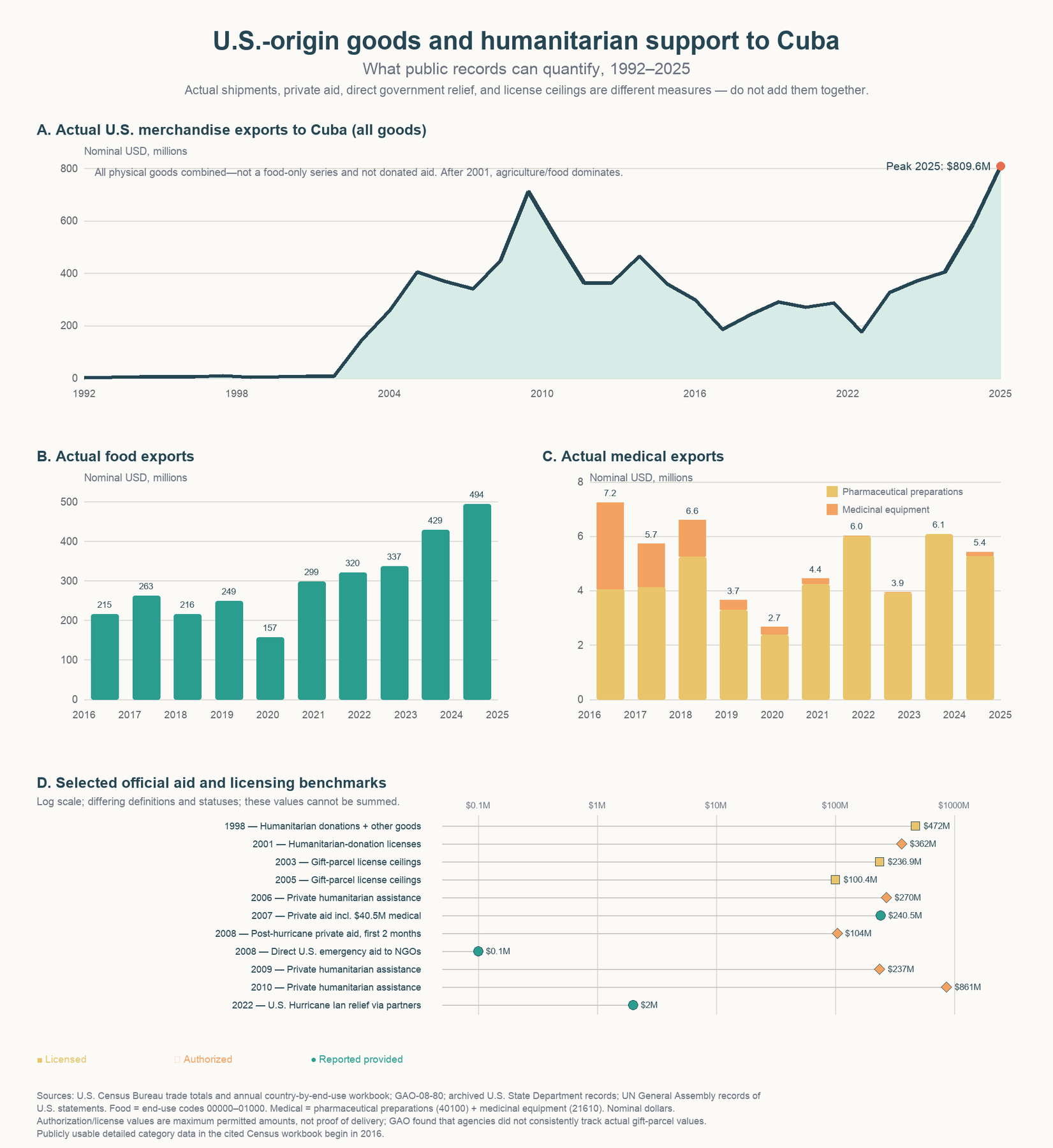
Important: Panel A is all merchandise exports (all physical goods), not food alone and not humanitarian aid. Panel B is the food-only subset; Panel C is the narrower pharmaceutical-preparations-plus-medicinal-equipment subset.
What the chart establishes
- Goods did flow from the United States to Cuba despite the embargo. Annual merchandise exports rose from $7.2 million in 2001 to $145.9 million in 2002, reached $711.5 million in 2008, and reached $809.6 million in 2025. These are customs-recorded exports, not merely licenses.
- Food was the dominant measurable humanitarian-category flow. In the 2016–2025 detailed data, annual food exports rose from approximately $215.1 million to $493.8 million. Food sales are commercial transactions, however; Cuba or another buyer paid for them under restrictive financing rules.
- Direct medical exports were real but much smaller. Combined pharmaceutical-preparation and medicinal-equipment exports ranged from approximately $2.66 million to $7.24 million per year in 2016–2025. Most of that was pharmaceuticals. Recorded medicinal-equipment exports fell sharply after 2018 and were near zero in several later years.
- Earlier evidence shows the same imbalance. GAO found that in 2006 the United States exported $340.75 million in agricultural products to Cuba but only $0.12 million in medicinal and pharmaceutical products. GAO also counted $6.90 million in other nonagricultural products, a category that included some donated medicines and medical goods but was not exclusively medical.
- Private support exceeded direct government disaster aid in the official figures located. The State Department said Americans “provided” $240.5 million in private humanitarian assistance in 2007: $179.4 million in gift parcels, $20.6 million in nonagricultural humanitarian donations, and $40.5 million in medical donations. By contrast, the U.S. government reported $100,000 in immediate emergency assistance to NGOs after the 2008 hurricanes and announced $2 million for Hurricane Ian relief through international partners in 2022.
Why large license figures are not delivery figures
U.S. officials have frequently cited hundreds of millions—or cumulative billions—of licensed or authorized private humanitarian assistance. For example:
| Period | Officially stated amount | What the figure measures |
|---|---|---|
| 1992–1998 | More than $2 billion cumulative | Private humanitarian assistance licensed, much of it described as medicine, equipment, and food; not demonstrated shipment value |
| 1998 | $472 million | Export licenses for humanitarian donations and other goods, including $19 million in medical sales |
| 2001 | Up to $362 million | Humanitarian-donation licenses approved during the year |
| 2003 | $236.9 million | Face value of 53 approved gift-parcel licenses |
| 2005 | $100.4 million | Face value of 22 approved gift-parcel licenses |
| 2006 | More than $270 million | Private humanitarian assistance authorized, according to State’s response printed by GAO |
| 2008 hurricane response | $104 million | Private assistance authorized during the first two months after the hurricanes |
| 2009 | $237 million | Private humanitarian assistance authorized |
| 2010 | $861 million | Private humanitarian assistance authorized |
These numbers are politically relevant because they show that humanitarian channels legally existed. They are not an auditable total of goods received in Cuba. GAO found that BIS kept the nominal value of approved gift-parcel licenses but did not consistently collect the actual value of parcels shipped. A license can cover a maximum amount that is never fully used, and one authorization can remain valid across multiple prospective shipments.
What this does—and does not—show about the sanctions dispute
This evidence is a serious qualification to any statement that the United States imposes an absolute prohibition on food or medicine going to Cuba. It does not support such an absolute claim: exemptions, licensed donations, commercial food sales, pharmaceuticals, medical equipment, gift parcels, and disaster assistance are documented.
It does not by itself refute the claim that sanctions materially damage Cuban health care. The chart does not measure unmet need, rejected transactions, bank and shipping overcompliance, fuel shortages, financing restrictions, unavailable chemical inputs, replacement parts, refrigeration, hospital electricity, patient transportation, or goods Cuba would have purchased in a normal commercial relationship. A few million dollars in annual medical exports can coexist with severe shortages in a country of roughly eleven million people. Likewise, large food sales are not the same as free humanitarian aid.
The most defensible synthesis is:
The embargo has humanitarian exceptions, and substantial U.S.-origin food plus smaller medical shipments have reached Cuba. Private American aid has also been significant in some years. But the United States does not publish a complete, comparable annual series of delivered humanitarian assistance since 1990, and license ceilings substantially overstate what can be proven to have arrived. These flows rebut an “absolute blockade of all humanitarian goods” formulation; they do not establish that humanitarian access is adequate or that broader sanctions effects are harmless.
Best evidence:
- The U.S. Census Bureau bilateral trade table supplies actual annual merchandise-export totals from 1992 onward.
- The Census annual country-by-end-use workbook, linked from the historical end-use page, supplies the 2016–2025 food, pharmaceutical-preparation, and medicinal-equipment figures.
- GAO-08-80 reports the 2006 actual export composition, explains licensing rules, and states that agencies lacked reliable actual shipment data for gift parcels and remittances.
- The archived 2008 State Department hurricane statement gives the 2007 private-aid breakdown, the $100,000 direct emergency contribution, post-hurricane authorizations, and medical/agricultural sales figures.
- The archived 2022 State Department Hurricane Ian statement announces $2 million in relief through independent partners; USAID’s FY2023 humanitarian report describes the assistance delivered to affected communities.
Caveats / competing evidence:
- “From the United States” can refer to the federal government, state or local government, NGOs, religious organizations, companies, Cuban-American families, gift-parcel consolidators, or goods of U.S. origin reexported through a third country. No located dataset captures all of these channels consistently.
- Census export statistics measure declared merchandise value, not whether a shipment was donated, who ultimately paid, which institution received it, whether it reached a particular patient, or whether an exempt transaction was delayed or blocked before shipment.
- The food aggregation uses Census end-use codes 00000–01000. The medical aggregation uses code 40100, Pharmaceutical preparations, and code 21610, Medicinal equipment. It is narrower than every item that could be called a medicine, device, hospital supply, laboratory input, or humanitarian good.
- Official State Department statements are primary evidence for what the U.S. government reported, but several figures are advocacy claims made during disputes over the embargo. GAO’s warning about authorization values is therefore crucial.
- Remittances may help families buy food and medicine, but they are not plotted because estimates vary widely and they are money transfers rather than identifiable delivered medical or humanitarian goods.
- The 2026 Census total was excluded because the year was incomplete at the audit date.
What would change the verdict: A complete transaction-level release from Census, BIS, OFAC, USAID, aid organizations, shippers, and banks—identifying authorization value, amount shipped, amount received, donation versus sale, payer, end user, commodity, and failed transactions—would permit a defensible cumulative humanitarian-support total and a better comparison with unmet Cuban needs.
Sources: Census bilateral trade · Census end-use data page · Census annual country-by-end-use workbook · GAO-08-80 · State Department, 1998/1999 licensing figures · State Department, 2001 humanitarian licenses · State Department, 2008 hurricane response · UN record of U.S. 2009 statement · UN record of U.S. 2010 statement · State Department, Hurricane Ian
Q005 — Does “Actual U.S. merchandise exports to Cuba” mean food?
Date: 2026-09-30
Claim being checked: Whether Panel A of the chart represents only food exports.
Verdict: No. It represents all customs-recorded physical goods exported from the United States to Cuba. Food is the largest component after 2001, but it is only one subset of the total.
Answer: “Merchandise exports” is the Census Bureau’s term for physical goods recorded as exports. The series can include agricultural and food products, pharmaceuticals, medicinal equipment, chemicals, machinery, and other consumer and industrial goods. It excludes services and remittances, and it does not mean that the goods were donated. Most post-2001 shipments were commercial sales.
The chart separates the measures:
- Panel A: all merchandise exports;
- Panel B: food end-use categories only;
- Panel C: pharmaceutical preparations plus medicinal equipment only.
For scale, all merchandise exports in 2016–2025 totaled approximately $3.765 billion. Of that, the chart’s food categories accounted for approximately $2.979 billion (about 79%), while the two plotted medical categories accounted for approximately $51.78 million (about 1.4%). These categories do not exhaust every good that could have a humanitarian use.
Sources: U.S. Census Bureau bilateral goods trade with Cuba · Census historical end-use data · Census country-by-end-use workbook
Q006 — Where can I find charts of U.S. exports to Cuba?
Date: 2026-09-30
Answer: Use different official sources depending on what you want to see:
- All U.S. goods exports to Cuba: The Census Bureau’s Trade in Goods with Cuba page is the authoritative annual and monthly table from 1992 onward. It is the source for Panel A of the chart in this note.
- Agricultural and food exports, with ready-made interactive charts: The USDA Foreign Agricultural Service Cuba dashboard charts total U.S. agricultural exports by year and the leading commodities. This is the easiest official page for a quick visual breakdown of food and agricultural trade.
- Longer-run agricultural charts and interpretation: USDA’s Economic Research Service report, Cuba’s Deteriorating Food Security and Its Implications for U.S. Agricultural Exports, includes a stacked annual chart of U.S. agricultural exports by product category. The related ERS Chart of Note highlights Cuba’s food-production decline and the composition of U.S. agricultural exports.
- Build-your-own product charts: The Census historical end-use page and its country-by-end-use workbook allow separate plotting of food, pharmaceuticals, medicinal equipment, and other categories.
- The audited comparison chart in this vault:
![[60 Knowledge/60.3 Politics/60.3.11 - Leftism & Woke Ideology/U.S.-Cuba Humanitarian and Medical Support 1992-2025.png]]distinguishes all merchandise, food, medical goods, reported private aid, direct U.S.-government relief, and license ceilings.
Reading warning: The Census “exports” line is all goods, USDA’s lines are agricultural products, and neither is automatically “humanitarian aid.” Commercial sales, donated goods, government relief, and license ceilings are different measures.
Q007 — Did U.S. officials say they were killing or starving Cubans so they could seize Cuba’s assets and distribute them to friends?
Date: 2026-09-30
Claim being checked: “They say they’re killing Cubans in order to bring down their government, so they can seize Cuba’s assets and distribute them to their friends.” The linked support is a September 17, 2026 Guardian investigation.
Verdict: Misleading and substantially overstated, although it is built from several real and disturbing facts. The public record supports deliberate economic pressure intended to force political change, foreseeable and documented civilian harm, and politically connected investors positioning themselves to profit from sanctions-driven dislocation. It does not show U.S. officials saying that they intend to kill or starve Cubans, nor does it establish a government program to seize Cuban assets and distribute them to friends.
What is supported
- The economic pressure is intentional and exceptionally broad. Executive Order 14380 authorizes tariffs on goods from any country that sells or provides oil to Cuba. Executive Order 14404 authorizes blocking sanctions against foreign persons operating in Cuban energy, mining, finance, defense, and other sectors and against financial institutions facilitating significant transactions for sanctioned persons. This is not an accidental commercial side effect; constraining Cuba’s fuel supply, finance, and state-linked industries is the policy mechanism.
- Political transformation is an express U.S. objective. Official documents call for “peaceful change,” democracy, free enterprise, and an end to practices benefiting the Cuban government and military. President Trump said the United States would not rest until Cuba was “free.” That supports describing the policy as an effort to force major political and economic change. It does not amount to an official statement that civilian death or starvation is the intended instrument.
- Severe civilian harm is foreseeable and documented. UN special rapporteurs warned that the fuel restrictions affect electricity, health care, water, transport, food production and distribution, and reported major surgery and vaccination backlogs. Their April letter carefully labeled some particulars as allegations not yet prejudged, but concluded that the situation warranted urgent attention. The existence of humanitarian exemptions and U.S.-funded aid does not eliminate these economy-wide effects.
- The Sherritt–Gillon example is real and creates a strong appearance of politically connected advantage. Sherritt stated that it suspended direct participation in its Cuban nickel-and-cobalt joint venture because of the May 1 U.S. order. It then negotiated a non-binding arrangement under which Gillon Capital could obtain 55% of Sherritt at an expected discount. Gillon is the Washburne family office; Ray Washburne served in the first Trump administration, sat on Trump’s intelligence advisory board, was vice-chair of the 2016 Trump Victory Committee, and was a major Republican fundraiser. Sherritt said State and Treasury did not object to negotiations, although any transaction remained subject to approval and had not been completed.
- The Antilles Gold–GEM plan also supports concern about sanctions-conditioned U.S. commercial control. Published deal terms contemplated U.S. investors eventually holding at least 51% of Antilles Gold’s Cuba-project subsidiary, preferential sales of strategic metal to U.S. buyers, and an effort to purchase the Cuban state partner’s 50% share. The proposal was conditional on due diligence, sanctions relief, licenses, and further agreements; the located record did not establish a completed transfer.
- Post-regime commercial planning is documented. A federal lobbying disclosure states that Erik Cartelle was advising the State Department on an economic-development plan for a future “free and democratic Cuba,” including energy development and compensation for owners of expropriated property. That proves the lobbying activity and subject matter. It does not prove that the State Department adopted the plan or promised assets to those clients.
What the quote changes or overstates
| Wording in Current Affairs | What the evidence actually supports |
|---|---|
| “They say they’re killing Cubans” | Neither the Guardian article nor the located official documents quotes a U.S. official admitting an intention to kill Cubans. The article quotes critics and UN experts about deprivation; its explicit “regime change” quotation comes from private consultant Erik Cartelle, not an administration official. |
| “in order to bring down their government” | Broad coercive pressure and a goal of political transformation are well supported. The official framing is pressure on the regime plus support for the Cuban people, while critics describe the mechanism as collective punishment. Specific intent to kill civilians as the means of regime change is not established. |
| “seize Cuba’s assets” | Executive Order 14404 blocks or freezes covered property and restricts transactions. OFAC explicitly distinguishes blocking from seizure: title remains with the owner. The mining examples concern proposed purchases of corporate or joint-venture interests under heavy sanctions pressure, not a completed U.S. confiscation of Cuba’s sovereign assets. |
| “distribute them to their friends” | At least one proposed beneficiary, Gillon, has clear Trump connections, and other actors named by the Guardian have political or lobbying relationships. But the evidence shows private bids, negotiations, proposed investments, and required government approvals—not a documented state allocation program. “Friends” is rhetorically plausible for some actors but too broad as a factual description of every deal. |
| “starve an entire country” | Cuba is suffering grave, widespread shortages and the fuel restrictions aggravate food production, distribution, health care, water, and electricity. But “starve an entire country” is not a measured finding: U.S. food exports, humanitarian channels, U.S.-funded relief, other foreign suppliers, and uneven individual outcomes continue to exist. |
| “plunder its resources” | The sanctions-driven bargaining asymmetry and connected-investor opportunities justify scrutiny and can reasonably be criticized as coercive opportunism. “Plunder,” however, asserts a proven dispossession scheme; the located evidence shows proposed, negotiated, and still-contingent transactions. |
Assessment of the underlying Guardian article
The article’s core commercial narrative is substantially supported by company statements, an AP account, executive orders, and lobbying disclosures: sanctions caused foreign firms to suspend or reconsider Cuban operations; connected U.S. actors pursued discounted or strategically favorable positions; and the administration possessed approval power over transactions. That is important reporting and raises legitimate questions about conflicts of interest, selective licensing, sanctions-induced fire sales, and whether foreign investors are being displaced in favor of politically connected U.S. capital.
However, the article mixes different evidentiary levels:
- The Sherritt/Gillon negotiation, sanctions causation, investor connection, government non-objection, and lobbying disclosure are publicly corroborated.
- Several other allegations—including reported meetings involving Trump Organization figures, the claim that Crowley is benefiting from forced rerouting, and assessments of an aid contractor’s implementation capacity—are attributed to unnamed or informed sources and were denied, unanswered, or not independently established in the public records reviewed here.
- “Vying for control” and “positioning” accurately describe prospective conduct. They should not be silently converted into claims that assets have already been seized, transferred, or awarded.
- The article documents a risk and pattern consistent with crony advantage; it does not by itself prove a single coordinated plan whose purpose is to kill Cubans and hand their national wealth to Trump or Rubio allies.
Bottom line
A defensible formulation would be: The United States is deliberately using sanctions and oil pressure to force political change in Cuba despite well-documented risks to civilians. The same pressure has destabilized foreign investments, while politically connected U.S. investors and lobbyists seek stakes in Cuban mining and influence over a possible post-communist economy. That creates credible concerns about coercive profiteering and favoritism. But there is no located official admission of an intent to kill or starve Cubans, and the evidence does not establish that Washington has seized Cuban assets and distributed them to friends.
The al-Qaeda comparison is therefore a moral analogy rather than a demonstrated factual comparison. There is no cited evidence that al-Qaeda has starved an entire sovereign country, but the quotation has also not established its own predicates—that the United States is intentionally starving every Cuban or that resource plunder is the purpose of the sanctions. It cannot carry the claimed “next-level terrorism” conclusion without a defined terrorism standard and evidence of the required intent.
Sources: Current Affairs passage · Guardian investigation · Executive Order 14380 · Executive Order 14404 · White House Cuban Independence Day statement · UN special-rapporteur communication AL USA 12/2026 · Sherritt sanctions statement · Sherritt Q2 update on Gillon negotiations · AP on the Gillon transaction · Antilles Gold–GEM terms · federal lobbying disclosure · OFAC explanation of blocking versus seizure · AP on U.S. humanitarian shipments
Q008 — What is the source for “Actual U.S. merchandise exports to Cuba, 1992–2025”?
Date: 2026-09-30
Source: U.S. Census Bureau, Trade in Goods with Cuba.
Provenance: The Census page publishes monthly export, import, and trade-balance values and a TOTAL [year] row for every year from 1992 onward. Panel A of this note’s chart takes the Exports value from each completed annual total for 1992 through 2025. The plotted figures are therefore official customs-recorded merchandise values, expressed in millions of nominal U.S. dollars and not seasonally adjusted. The chart excludes 2026 because it was incomplete at the audit date.
The approximately $9.06 billion cumulative figure in Q004 is not printed as a Census headline. It is the arithmetic sum of those 34 annual Census export totals. It should be described as all U.S. goods exports to Cuba, not food alone, humanitarian aid, services, remittances, or inflation-adjusted value.
Q009 — Where can I find a chart of humanitarian aid provided to Cuba over the years?
Date: 2026-09-30
Answer: No located source provides a complete historical chart of every form of humanitarian support reaching Cuba. The closest authoritative charting tools cover different slices and should not be merged without reconciling definitions:
- U.S. government-funded assistance: Use the ForeignAssistance.gov Cuba country dashboard. Switch to the trends view, select Cuba, and compare fiscal years. Prefer disbursements when the question is money actually paid; obligations are legal commitments and may differ from delivery. Filter activities or sectors carefully because the Cuba total includes democracy, civil-society, broadcasting, and other programs that are not humanitarian relief.
- Humanitarian funding reported by governments, UN bodies, NGOs, and other donors: Use the UN OCHA Financial Tracking Service and select Cuba as the destination. FTS charts reported humanitarian contributions inside and outside coordinated appeals. It is the best multi-donor humanitarian source, but reporting is voluntary or partner-supplied and therefore not guaranteed to capture every private or bilateral shipment.
- Comparable official aid from the United States and other donors: Use the OECD Data Explorer and filter the Creditor Reporting System for recipient Cuba, the desired provider, disbursements, and humanitarian-purpose codes 720, 730, and 740. OECD data are useful for annual comparisons but reflect reportable official development assistance, not all private donations, remittances, trade, or sanctions licenses.
- Specific U.S. disaster responses: USAID/BHA publishes response fact sheets, such as its January 2023 Cuba assistance overview, which reported $2 million for Hurricane Ian relief. These are authoritative for the named response but are not a complete longitudinal series.
- U.S.-origin goods and selected aid benchmarks: The chart embedded in Q004 is the most useful comparison assembled for this note, but it intentionally does not present a single humanitarian-aid line. It separates all merchandise exports, food exports, medical exports, reported private assistance, direct government relief, and license ceilings because they are not interchangeable measures.
Bottom line: For a chart labeled simply “humanitarian aid to Cuba,” the most defensible source is OCHA FTS for multi-donor reported humanitarian funding, or ForeignAssistance.gov for U.S. government assistance after filtering out non-humanitarian programs. Neither is a complete measure of everything sent from the United States since 1990.
Q010 — What is the best way to find a chart of Cuba receiving food from the United States?
Date: 2026-09-30
Answer: The easiest authoritative chart is the USDA Foreign Agricultural Service Cuba page. Its By Year view charts the value of U.S. agricultural exports to Cuba, while By Commodity shows what was shipped. This is preferable to the Census all-merchandise series when the question is specifically food or agriculture.
For a longer historical chart with product composition, use Figure 8 of USDA ERS’s Cuba’s Deteriorating Food Security and Its Implications for U.S. Agricultural Exports. It presents stacked annual U.S. agricultural exports to Cuba by product category for 2001–2022.
For a customized chart, use USDA’s Global Agricultural Trade System: select U.S. exports, Cuba as the market, calendar years, and either total agricultural products or chosen food commodities. GATS contains historical agricultural trade statistics from 1989 onward and can export the results. Choose value to show dollars and quantity when available to show physical shipments; the two answer different questions.
Important qualification: These are customs-recorded exports to Cuba, which are the best official measure of food shipped from the United States. They do not establish that every shipment reached households or was consumed, and they are mainly commercial sales rather than donated humanitarian aid. “Agricultural products” can also include some nonfood products, so use commodity filters if the desired label is strictly “food.”
Q011 — What percentage of U.S. food exports to Cuba is humanitarian aid or purchased by the Cuban government?
Date: 2026-09-30
Verdict: There is no defensible current percentage. U.S. customs and USDA trade data classify products and values, not whether a shipment was donated, who paid for it, or whether the buyer was a Cuban state entity or private firm. Historically, however, essentially all commercial U.S. agricultural sales went through the Cuban state importer Alimport; this should not be confused with saying that 100% was humanitarian aid.
Historical state purchasing
The strongest official evidence comes from the U.S. International Trade Commission. Its 2016 investigation reported that Alimport, a Cuban state entity, imported roughly 80–90% of Cuba’s agricultural imports from all countries and had sole authority to purchase agricultural products from the United States. Therefore, for the system examined through 2015, the best characterization is that approximately all ordinary U.S. agricultural exports to Cuba were commercial sales to or through Alimport, not donations. Alimport supplied ration stores, school lunches, hospitals, other state institutions, convertible-currency stores, and part of the tourism sector.
The 80–90% figure must not be misquoted as the U.S.-shipment share. It describes Alimport’s share of Cuba’s total agricultural imports from all origins. The reason the U.S.-specific historical share was effectively near 100% is the separate finding that Alimport then possessed sole authority to buy U.S. agricultural products.
Treasury testimony in 2015 likewise described Alimport as the state-run monopoly through which all U.S. agricultural goods were imported. Purchases were subject to statutory cash-payment or qualifying third-country-bank arrangements, which indicates commercial sales rather than free humanitarian transfers.
Humanitarian share
No located official series identifies the percentage of food-export value that was donated. GAO found that agencies did not consistently collect the actual value shipped under some humanitarian and gift-parcel licenses. Customs records can show that food left the United States for Cuba, but not whether a charity donated it, a private buyer paid for it, or Alimport purchased it.
The available evidence suggests that commercial sales dominated after Cuba began buying U.S. agricultural products in late 2001. GAO reported $340.75 million in agricultural exports in 2006—97.98% of all U.S. merchandise exports to Cuba that year—within the cash-sale state-import system. That does not produce an exact humanitarian percentage, but it makes it incorrect to treat the agricultural-export total as donated aid.
Why a current government/private percentage is unavailable
Cuba has since permitted a larger private-business sector and private-sector import channels, often using authorized state foreign-trade intermediaries. A Canadian government market report states that Cuba’s private sector imported more than $2 billion in 2025, approximately 25% of Cuba’s imports from all countries, and that most of those private imports were food and beverages. This is important evidence that the historical Alimport-only model no longer describes every import.
It still cannot answer the U.S.-specific question because the 25% figure:
- covers imports from every country, not just the United States;
- covers goods beyond food;
- does not identify donations;
- and cannot be matched transaction by transaction to Census or USDA export totals.
Best usable formulation
From 2001 through at least the mid-2010s, nearly all commercial U.S. agricultural exports to Cuba were purchased through the Cuban state importer Alimport, while the humanitarian/donated share was not separately measured. In the 2020s, private Cuban businesses became meaningful food importers, so no reliable public source supports a current state-versus-private percentage for U.S. food exports. The export totals should be treated primarily as commercial trade, not humanitarian aid.
If “bought by the government” means the U.S. government, rather than the Cuban government, the answer is also not calculable from the trade series: Census and USDA do not identify the payer, and separately announced U.S.-funded food relief should be tracked through ForeignAssistance.gov, USAID/BHA, or OCHA rather than inferred from agricultural-export totals.
Sources: USITC, Overview of Cuban Imports of Goods and Services and Effects of U.S. Restrictions · Treasury testimony on Alimport and cash-purchase requirements · GAO-08-80 · Government of Canada, Cuba agri-food market · USDA FAS Cuba trade dashboard
Q012 — How much humanitarian aid has the United States provided to Cuba over the years?
Date: 2026-09-30
Verdict: No complete cumulative total is publicly available. The defensible answer depends on whether “United States” means federal-government relief, broader foreign-assistance programs, private American donations, commercial exports, or merely authorized licenses. These categories have incompatible definitions and cannot be summed into one aid number.
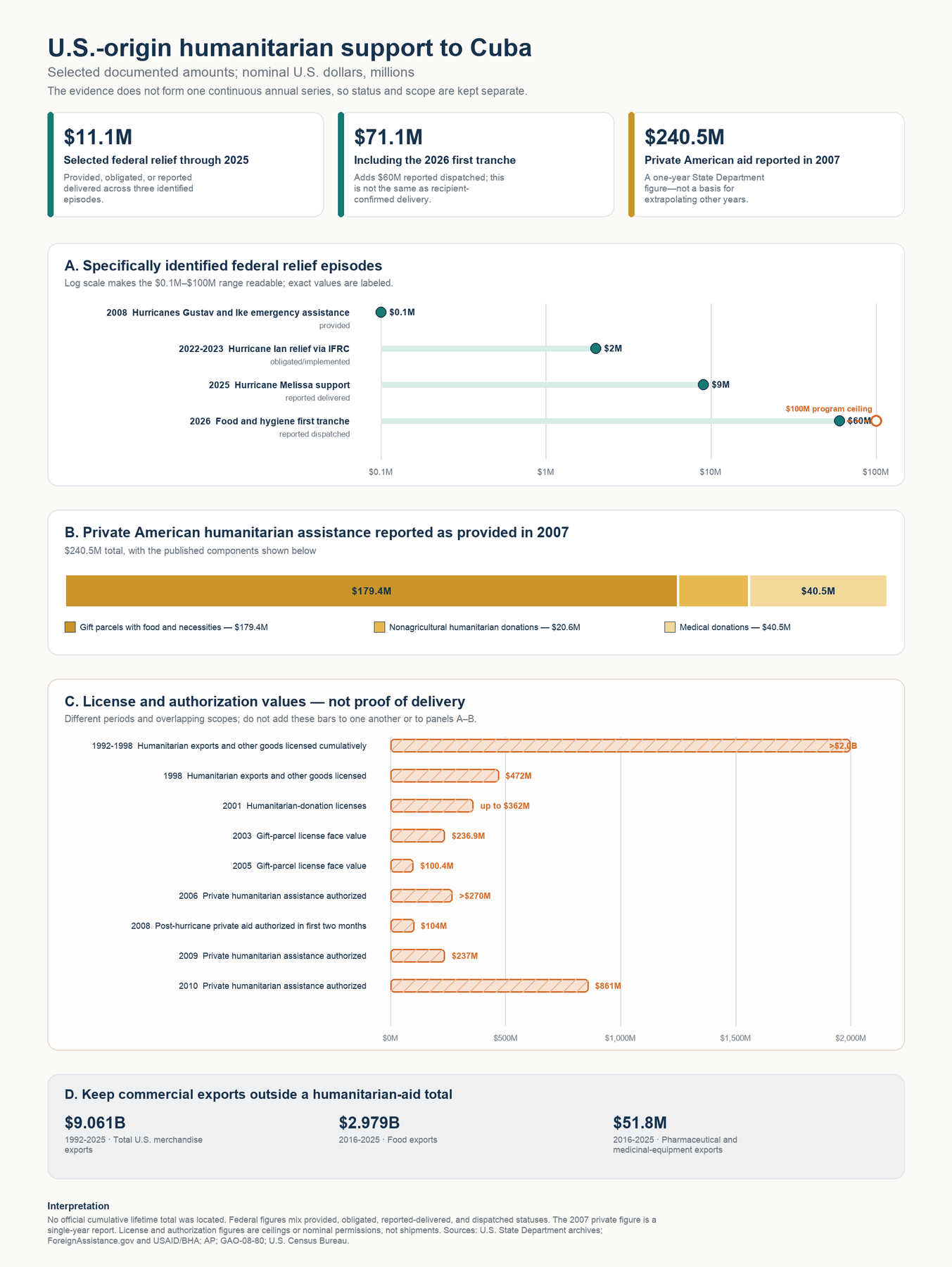
How to read the chart
Panels A and B show selected amounts reported as provided, obligated, delivered, or dispatched, with the exact status preserved. Panel C shows license or authorization values, not proven delivery. Panel D shows commercial exports that must remain outside any humanitarian-aid total. The panels are intentionally separated and should not be added together.
Specifically identified federal humanitarian and disaster relief
| Year | Amount | Status and scope |
|---|---|---|
| 2008 | $100,000 | Immediate U.S.-government emergency assistance provided to NGOs after Hurricanes Gustav and Ike |
| 2022–2023 | $2 million | Hurricane Ian relief announced in 2022 and recorded by ForeignAssistance.gov as a FY2023 USAID emergency-response obligation; implemented through IFRC for relief items, shelter support, logistics, and transport |
| 2025 | $9 million | Direct support following Hurricane Melissa, reported by a senior State Department official in 2026 as delivered the previous year |
| 2026 | $60 million first tranche of a $100 million program | AP reported that a Cuba-bound food-and-hygiene shipment initiated the first tranche, with distribution through Catholic organizations; the remaining $40 million should be treated as offered or planned unless later delivery records confirm it |
The first three entries total $11.1 million in specifically identified federal relief reported as provided, delivered, or obligated through the end of 2025. Adding the reported 2026 first tranche produces $71.1 million associated with identified provided/obligated/dispatched relief episodes, while the full program ceiling would make $111.1 million. Those arithmetic totals are only orientation: they mix “provided,” “delivered,” “obligated,” and “first tranche” statuses, omit any unlocated episodes, and are not an official cumulative total.
ForeignAssistance.gov also reports broader Cuba assistance. For FY2023 it shows approximately $9.52 million in total obligations, including the $2 million emergency-response activity plus democracy, civil-society, media, operating-expense, activist-resilience, and other programs. The full $9.52 million therefore should not be labeled conventional humanitarian relief.
Private American humanitarian assistance
The strongest actual-flow figure located is the State Department’s statement that in 2007 the American people provided $240.5 million in private humanitarian assistance:
- $179.4 million in gift parcels containing food and other necessities;
- $20.6 million in nonagricultural humanitarian donations;
- $40.5 million in medical donations.
This is a large one-year reported figure, but no comparable, consistently defined annual series was located for 1990–2026. It cannot simply be extrapolated to other years.
Why the much larger historical numbers are not delivered aid totals
Official statements also cite very large values for licenses or authorizations, including more than $2 billion licensed during 1992–1998, $472 million in 1998, up to $362 million in 2001, and $861 million authorized in 2010. Those figures demonstrate that legal humanitarian channels existed, but they are maximum permitted or nominal license values—not proof that the full amount was purchased, shipped, received, or distributed. GAO specifically found that agencies did not consistently collect actual gift-parcel shipment values.
What must remain outside a humanitarian-aid total
- The approximately $9.06 billion in total U.S. merchandise exports during 1992–2025 is mostly commercial trade, not aid.
- The approximately $2.979 billion in food exports during 2016–2025 is principally commercial sales, not donated food.
- Remittances are household money transfers, not an identified humanitarian-goods series.
- License ceilings, authorizations, obligations, disbursements, shipments, and recipient-confirmed delivery are different stages and should not be added without reconciliation.
Best usable answer
There is no auditable lifetime total for U.S. humanitarian aid to Cuba. Public records identify at least $11.1 million in selected federal disaster-relief episodes through 2025, plus a reported $60 million first tranche in 2026 under a $100 million program. Private Americans were reported to have provided $240.5 million in 2007 alone. Much larger historical figures—sometimes hundreds of millions or cumulative billions—usually measure licenses or authorizations rather than aid proven to have arrived. Commercial food and medical exports must be reported separately.
Sources: State Department, 2008 hurricane assistance and 2007 private-aid breakdown · ForeignAssistance.gov Cuba FY2023 · USAID/BHA Cuba assistance overview · AP on the 2025 and 2026 relief programs · GAO-08-80
Q013 — Was Lyndon Johnson “napalming little Vietnamese girls”?
Date: 2026-10-01
Verdict: Substantially true as a moral shorthand for presidential and command responsibility, but misleading if read literally. Johnson designed and promoted the Great Society, personally authorized the major U.S. escalation and bombing campaign in Vietnam, and presided over U.S. forces that repeatedly used napalm. Vietnamese children were among the civilians burned. But Johnson did not personally drop napalm, the evidence does not show that he ordered children to be targeted, and the famous 1972 “Napalm Girl” attack occurred under Richard Nixon and was carried out accidentally by a South Vietnamese aircraft.
What is accurate
- “Architect of the Great Society” is fair. Johnson introduced the program in his May 22, 1964 University of Michigan address, describing a “Great Society” aimed at ending poverty and racial injustice and improving cities, the countryside, and education.
- Johnson bears high-level responsibility for the escalation. The State Department’s Office of the Historian says Johnson and his advisers ordered Operation Rolling Thunder and treated escalation of the U.S. presence as their chosen solution. As president and commander in chief, Johnson approved the basic war policy even though operational target selection and individual weapons releases ran through military chains of command.
- U.S. forces unquestionably used napalm during Johnson’s presidency. The Air Force’s official history of the 1965–1968 air war repeatedly records U.S. aircraft dropping napalm. It describes, for example, 25 tons of napalm and eight tons of bombs falling on enemy positions in one day during a 1965 battle, with 54 tons of bombs and napalm used over the wider engagement. It also describes routine napalm loads and multiple U.S. F-100 napalm strikes during 1967 operations.
- Children were among napalm’s civilian victims. Contemporary 1966–1967 hospital and eyewitness reports documented Vietnamese children with napalm burns. The exact number was politically contested and poorly recorded: one contemporary medical account claimed relatively few identified cases, while other witnesses reported substantially more. That uncertainty affects scale, not the basic fact that children were burned.
What the linked 2018 article establishes—and what it does not
The hyperlink on “napalming” goes to Nathan J. Robinson’s 2018 Current Affairs essay “What We Did in Vietnam”. The article is a secondary, openly argumentative synthesis, not a primary operational record. It draws principally on books by Ken Burns and Geoffrey Ward, Guenter Lewy, Christian Appy, Nick Turse, and others.
It is relevant because it documents the enormous scale of U.S. and South Vietnamese air operations, widespread napalm use, attacks affecting villages, and severe civilian consequences. But it does not identify a particular Johnson order to strike girls. Its statement that the conflict involved 400,000 tons of napalm covers the wider war in Southeast Asia—including Laos and Cambodia—and is not a Johnson-presidency-only figure. Its discussion therefore supports the broad institutional-responsibility claim, while the official Air Force history and Johnson-administration records are the stronger evidence for what occurred specifically under Johnson.
What the sentence blurs
The grammatical subject makes Johnson sound like the immediate attacker and “little girls” sound like the intended target. The evidence supports a different causal chain:
Johnson authorized and sustained the war and bombing strategy → U.S. and allied commanders conducted air operations → U.S. forces repeatedly deployed napalm against claimed military targets → civilians, including children, were foreseeably and sometimes actually burned.
That is enough to support serious political and moral responsibility. It is not evidence that Johnson gave an order to burn girls or that every napalm strike was indiscriminate. The Air Force’s own history records both civilian-casualty incidents and rules intended to protect populated areas, including warnings, higher-level clearance, target marking, and restrictions on incendiaries. It also documents targeting errors and acknowledges that the Air Force lacked reliable data for measuring strike effects. The existence of precautions therefore neither erases civilian harm nor proves that every strike complied with them.
The “Napalm Girl” trap
If the wording is meant to invoke the famous image of nine-year-old Phan Thị Kim Phúc, it misattributes that specific event:
- the strike occurred on June 8, 1972, more than three years after Johnson left office;
- Richard Nixon was president;
- AP’s reconstruction identifies it as a “friendly fire” attack by a South Vietnamese aircraft; and
- the South Vietnamese plane accidentally dropped napalm on South Vietnamese troops and civilians near Trảng Bàng.
The image remains evidence of the human consequences of the U.S.-supported war and a U.S.-supplied allied air system, but it is not evidence that Johnson or a U.S. pilot personally carried out that particular strike.
Legal distinction
Napalm was not categorically illegal merely because it was napalm. The core legal questions are the target, distinction, proportionality, and precautions. Deliberately attacking civilians was prohibited; later, the 1980 Convention on Certain Conventional Weapons’ Protocol III expressly prohibited air-delivered incendiary attacks against military objectives located within concentrations of civilians. That later treaty should not be projected backward as though it governed every Vietnam-era strike, but it helps explain why “napalm was used” and “a war crime occurred” are not automatically identical propositions.
Best usable formulation
Lyndon Johnson, the principal political architect of the Great Society, also authorized and sustained a massive escalation in Vietnam in which U.S. forces repeatedly used napalm and Vietnamese children were among the civilian victims. That establishes grave presidential responsibility, but it does not establish that Johnson ordered children targeted. The iconic 1972 Kim Phúc attack was a separate Nixon-era friendly-fire strike by the South Vietnamese Air Force.
Sources: Current Affairs, “What We Did in Vietnam” · LBJ Library, Great Society address · State Department Office of the Historian, Gulf of Tonkin and escalation · U.S. Air Force official history, The War in South Vietnam: The Years of the Offensive, 1965–1968 · Congressional Record, February 20, 1967, contemporary eyewitness account of children with napalm burns · TIME, 1967 medical mission on war-burned children · AP reconstruction of the 1972 Kim Phúc photograph · ICRC treaty database, CCW Protocol III Article 2
Q014 — How many Vietnamese children were killed by napalm dropped directly from U.S. planes?
Date: 2026-10-01
Verdict: No credible numerical total is available. The historical record establishes that U.S. aircraft used napalm and that Vietnamese children were among napalm’s victims, but the available casualty data do not isolate children who died—as opposed to being injured—from napalm delivered specifically by U.S.-operated aircraft. The answer is therefore “unknown,” not zero. Any precise total presented without an incident-by-incident source trail should be treated as unsupported.
The four filters a defensible count would have to satisfy
A valid total would need a record for each victim establishing all four of the following:
- the victim was a child;
- the victim died rather than survived with burns;
- napalm, rather than another weapon or wartime cause, caused the death; and
- the attacking aircraft was operated by the United States, rather than the South Vietnamese Air Force or another allied force.
No located official or scholarly dataset cross-tabulates those four facts. RAND’s review of Vietnam-era assessment records states that no official U.S. estimate of civilian casualties exists for the Vietnam War at all and characterizes the contemporary unofficial totals as guesses. The Air Force’s own official history explains the attribution problem: it lacked reliable data on air-strike results, and Air Force aircraft frequently attacked alongside U.S. Army helicopters, South Vietnamese, Navy, and Marine aircraft, artillery, troops, and armor. In those combined attacks, the history says it was impossible to determine which participating weapon inflicted particular casualties. If the records cannot reliably identify all civilian deaths or even which weapon caused many casualties, they cannot yield a trustworthy U.S.-aircraft/napalm/child-death total.
Why the numbers sometimes cited do not answer the question
| Figure or example | What it actually measures | Why it cannot be used as the requested total |
|---|---|---|
| 13 children | Children among 38 patients with “war burns” seen by a 1967 medical mission | These were patients observed alive, not recorded deaths; “war burns” combined phosphorus and napalm; and the report did not identify the aircraft operator. |
| Broad estimates of Vietnamese child deaths | Children believed killed by the war from all causes and parties | They include bombs, artillery, gunfire, mines, disease, deprivation, and attacks by multiple forces—not just U.S.-delivered napalm. |
| Kim Phúc and the other children at Trảng Bàng | Documented child casualties of a June 8, 1972 napalm strike | AP identifies the attack as friendly fire by a South Vietnamese aircraft, so it cannot be counted as napalm dropped directly from a U.S. plane. |
| Individual photographs, witness accounts, or hospital cases | Evidence that children were burned—and in some cases may have died | They prove the human harm but usually lack one or more of the necessary facts: confirmed death, weapon, age, or aircraft nationality. They cannot be safely aggregated without avoiding duplicates and resolving those gaps. |
What can and cannot responsibly be concluded
- Supported: U.S. aircraft dropped napalm extensively; napalm caused civilian casualties; Vietnamese children were burned; and at least some child deaths are historically plausible and reported in individual accounts.
- Not supported by a comprehensive dataset: a precise count of Vietnamese children killed by U.S.-aircraft napalm.
- Not a valid inference: treating the absence of an aggregate count as evidence that no children died. It reflects deficient and non-comparable recordkeeping, not proof of zero casualties.
Best usable answer
We do not know how many Vietnamese children were killed by napalm dropped specifically from U.S. planes. No credible aggregate count separates child deaths by weapon and aircraft operator. The sources confirm U.S. napalm use and child victims, but the often-cited figures either count burn patients rather than deaths, combine napalm with other weapons, include all child war deaths, or concern South Vietnamese aircraft. A precise number would overstate what the records can establish.
Sources: RAND, Embracing the Fog of War, p. 103 · U.S. Air Force official history, The War in South Vietnam, pp. 289–291 · TIME, 1967 medical mission on war-burned children · AP reconstruction of the Trảng Bàng attack
Q015 — Are there reliable historical estimates that approximate the number?
Date: 2026-10-01
Verdict: There are credible estimates for broader categories—especially all Vietnamese child war deaths and all civilian deaths from air attack—but no reliable historian’s estimate isolates children killed by napalm dropped by U.S.-operated aircraft. The best peer-reviewed child estimate is approximately 84,000 Vietnamese children killed by the war from all causes and parties during 1965–1975. It must not be relabeled as a napalm or U.S.-aircraft figure.
| Estimate | Source and method | Reliability | What it does—and does not—mean |
|---|---|---|---|
| Approximately 84,000 child war deaths | Charles Hirschman, Samuel Preston, and Vu Manh Loi, peer-reviewed demographic study (1995). Using the 1991 Vietnam Life History Survey, kin-reported mortality, model life tables, and national population estimates, the authors calculated 798,000 adult war deaths and added an estimated 84,000 deaths among children under 15. | Best located scholarly estimate of total Vietnamese child war deaths, but still uncertain. The child calculations were not printed in the article; the household sample was small and geographically limited; survivor reporting can omit families in which everyone died; and alternative rural weighting materially changes the overall total. | All war-related deaths, all weapons, all forces, and both military and civilian sides during 1965–1975. It says nothing about the fraction caused by napalm or U.S. aircraft. |
| Approximately 146,000 Vietnamese civilians killed by air attacks | Air-power historian Phillip S. Meilinger derived this rough figure from Guenter Lewy’s estimate of 587,000 civilian deaths. He applied hospital injury shares and assumed that shelling and bombing divided the residual equally and that fatal causes followed the same distribution as injuries. | Very rough extrapolation. Meilinger expressly describes the assumptions as “big ifs,” and this is his derived estimate—not a direct casualty count or a napalm estimate made by Lewy. | All ages, all aerial munitions, North and South Vietnam. It does not identify children, napalm, or whether each aircraft was American or South Vietnamese. |
| 150,000 civilians killed and 350,000 injured by U.S. military action or U.S.-supplied weapons since 1965 | A 1971 General Accounting Office/Senate Subcommittee estimate summarized in historian Robert Neer’s source notes. | Useful as a contemporary institutional estimate of a broad category, not a weapon-specific count. Its category expressly combines direct U.S. action with weapons supplied to an ally. | All civilian ages and weapons; includes indirect responsibility and therefore cannot answer “directly from U.S. planes.” |
| At least 250,000 Vietnamese children killed; one million killed, wounded, or burned | William F. Pepper’s 1967 Ramparts estimate. He began with an overall civilian-death estimate, assumed roughly half the population was under 16, conjectured that about 70% of residents in heavily attacked rural villages were children, and then used a 3-to-1 wounded-to-dead rule. | Low reliability for a numerical fact claim. It is an advocacy-era demographic extrapolation, not a registry, survey estimate of child deaths, or incident reconstruction. The assumptions were disputed at the time. | All child deaths or casualties from the war, not napalm deaths; it mixes killed, wounded, and burned; and it does not distinguish U.S. from South Vietnamese aircraft. |
The most defensible broader number
The Hirschman–Preston–Loi study is the strongest answer to “How many Vietnamese children died because of the war?” The study’s central calculation was:
- 655,000 adult male war deaths;
- 143,000 adult female war deaths;
- 84,000 child war deaths; and
- 882,000 total Vietnamese war deaths in its initial weighting.
After considering a more rural-weighted population and sampling uncertainty, the authors described approximately one million deaths, with a range of 791,000 to 1,141,000. This was a demographic estimate of excess war mortality, not a count by perpetrator or weapon. Even the 84,000-child component cannot be multiplied by napalm’s share of tonnage or sorties: weapon lethality, target population, survival, reporting, and U.S./South Vietnamese mission shares were not interchangeable.
What historians of napalm say
Robert Neer’s Napalm: An American Biography is the most directly relevant scholarly history located. It carefully documents the competing 1967 claims, the 250,000-child extrapolation, the hospital surveys, official denials, the GAO/Senate estimate, and later medical assessments of napalm’s lethality. In the material reviewed, Neer does not supply a replacement numerical total for children killed by U.S.-aircraft napalm. That absence is significant: even a historian writing an entire archival history of napalm could document use, victims, contemporary controversy, and medical effects without recovering the four-variable total requested here.
Best usable answer
Yes, reliable scholars have estimated broader losses. The best peer-reviewed demographic estimate is about 84,000 Vietnamese child war deaths from all causes and parties during 1965–1975. A much rougher historical extrapolation suggests roughly 146,000 Vietnamese civilians of all ages died in air attacks. Neither figure identifies napalm or U.S.-operated aircraft. The famous 250,000-child claim was an advocacy-era extrapolation with weak assumptions, not a reliable napalm count. No historian located provides a defensible estimate for the exact category “children killed by napalm dropped directly from U.S. planes.”
Sources: Hirschman, Preston, and Vu, “Vietnamese Casualties During the American War” (peer-reviewed abstract and DOI) · Charles Hirschman’s publication page and author-hosted paper · U.S. Air University, Phillip S. Meilinger, Airpower: Myths and Facts, pp. 93–95 · Robert Neer, Napalm: An American Biography, supplementary notes · British parliamentary record reproducing Pepper’s method · 1967 public-television debate on the competing medical and advocacy claims
Q016 — Did JFK begin the Cuba embargo and a terror campaign designed to hurt civilians?
Date: 2026-10-01
Claim: “The Cuba embargo was JFK, who began a massive terror campaign against Cuba, designed specifically to hurt civilians in order to bring political change—textbook terrorism.”
Verdict: Partly true, but it compresses separate policies and overstates what the documents prove. Kennedy imposed the comprehensive all-trade embargo in February 1962 and authorized Operation Mongoose, an extensive covert regime-change program involving political warfare, sabotage, paramilitary activity, and proposed assassination attempts. But Eisenhower—not Kennedy—initiated the export embargo and the explicit economic-hardship rationale in 1960. Declassified records show that U.S. policy deliberately sought economic deprivation and popular discontent to help overthrow Castro, while operational sabotage plans also instructed planners to minimize loss of life and sometimes specified “things, not people” as targets. Calling the combined policy “textbook terrorism” is therefore an arguable state-terrorism interpretation, not a definition-neutral fact.
Claim-by-claim check
| Claim component | Finding |
|---|---|
| “The Cuba embargo was JFK” | Incomplete. Eisenhower eliminated Cuba’s sugar quota and, in October 1960, prohibited most U.S. exports to Cuba while exempting nonsubsidized food, medicines, and medical supplies. Kennedy’s Proclamation 3447, signed February 3, 1962 and effective February 7, prohibited Cuban imports and proclaimed the comprehensive embargo on trade. Kennedy therefore completed and greatly broadened the embargo; he did not originate the policy. |
| Kennedy “began a massive terror campaign” | Substantial factual core, loaded label. Kennedy authorized the development of Operation Mongoose on November 3, 1961. The State Department’s historical summary describes coordinated political, psychological, military, sabotage, and intelligence operations intended to remove Castro; some, but not all, planned actions were executed. “Massive” and “terror campaign” are evaluative descriptions rather than official or universally accepted classifications. |
| It was designed to hurt civilians to produce political change | Strongly supported for economic hardship as a mechanism, but too broad if it implies orders to physically attack civilians. An April 1960 State Department memorandum by Lester Mallory argued for weakening Cuban economic life, reducing wages, and producing “hunger” and “desperation” in order to bring about overthrow. Kennedy-era plans proposed damaging power systems, transportation, communications, refineries, sugar facilities, and industries providing food, clothing, and shelter in order to weaken the economy and breed discontent. Those consequences necessarily reached civilians. But other operational documents prioritized economic targets whose destruction would cause the “minimum possible loss of life,” and one plan said “things, not people, are the targets.” |
| “Textbook terrorism” | Contestable classification. If state terrorism includes state-directed violence or sabotage intended to intimidate or coerce a population for political ends, parts of Mongoose can reasonably be analyzed that way. Under narrower definitions requiring civilians themselves to be the direct objects of violence, the fit is less clear because the documentary target sets emphasized the government, military, infrastructure, and economy and sometimes expressly sought to avoid deaths. An embargo is economic coercion and collective pressure; it is not automatically terrorism under conventional legal definitions. |
The crucial provenance correction
The most explicit document about deliberately creating civilian economic suffering predates Kennedy. In April 1960, during the Eisenhower administration, Deputy Assistant Secretary of State Lester Mallory wrote that because most Cubans supported Castro and no effective opposition existed, the foreseeable means of alienating that support was “economic dissatisfaction and hardship.” He recommended denying money and supplies so as to reduce wages and bring about “hunger, desperation and overthrow of government.” This is unusually strong evidence that civilian hardship was contemplated as the causal mechanism for regime change—but it is a policy memorandum, not proof that every later sanction or covert operation had identical intent, and it should not be misattributed to JFK personally.
Kennedy nevertheless adopted and expanded the pressure strategy. His administration made the embargo comprehensive and authorized Mongoose. The later sabotage proposals included attacks or proposed attacks on power plants, refineries, port facilities, shipping, bridges, communications, transportation, and key industries. A 1963 CIA sabotage/harassment proposal explicitly evaluated targets according to their effect on the economy and Cuban population and described weakening industries connected to food, clothing, and shelter so as to “breed discontent against the regime.”
Best usable formulation
Eisenhower began the economic embargo and his administration produced the clearest memorandum advocating economic hardship—including hunger and desperation—to erode popular support for Castro. Kennedy then imposed the comprehensive trade embargo and authorized Operation Mongoose, a major covert regime-change campaign involving sabotage, subversion, paramilitary activity, and assassination proposals. These policies deliberately used economic pressure and public discontent to pursue political change, although operational plans often described infrastructure rather than civilians as the direct targets and sometimes required minimizing deaths. Calling this “state terrorism” is a defensible interpretation under some definitions, but “textbook terrorism” states a contested classification as though it were undisputed.
Sources: FRUS, Mallory memorandum, April 6, 1960 · FRUS, Eisenhower meeting on the October 1960 export embargo · Kennedy, Proclamation 3447, February 3, 1962 · State Department history of the Bay of Pigs and Operation Mongoose · FRUS, Guidelines for Operation Mongoose · FRUS, August 1962 sabotage discussion and minimum-loss-of-life qualification · FRUS, January 1963 integrated Mongoose program · FRUS, June 1963 sabotage/harassment target analysis
Q017 — Was Obama bombing hospitals and weddings, boasting about killing, killing a teenage American, and helping Saudi war crimes?
Date: 2026-10-01
Verdict: Mostly true at the level of administration and command responsibility, but several clauses misleadingly imply personal orders, proven intent, or settled legal judgments. Under Obama, a U.S. gunship destroyed the MSF Kunduz hospital; a U.S. drone strike hit a Yemeni wedding procession; the drone program expanded dramatically; a U.S. strike killed 16-year-old American citizen Abdulrahman al-Awlaki; and the administration provided crucial military support to the Saudi-led Yemen campaign despite mounting evidence of unlawful coalition attacks. However, the Pentagon found Kunduz to be an unintentional targeting catastrophe, the wedding claim rests on one documented linked incident, the “good at killing people” line is an anonymously sourced book report rather than a verified recording, Abdulrahman was not the intended target according to U.S. reporting, and U.S. legal complicity in particular Saudi war crimes was alleged rather than judicially established.
| Claim | Finding |
|---|---|
| Obama was “bombing hospitals” | Substantially true as command-responsibility shorthand; misleading if it implies Obama ordered a hospital attacked. On October 3, 2015, a U.S. AC-130 attacked MSF’s functioning Kunduz trauma hospital, killing 42 people: 14 staff, 24 patients, and four caretakers. The Pentagon attributed the attack to cascading human, technical, and procedural failures, called it unintentional, and disciplined 16 personnel administratively. MSF disputed the adequacy and independence of that investigation and argued that the prolonged repeated attack could constitute a war crime. No evidence shows Obama personally selected the hospital or ordered it attacked as a hospital. |
| Obama was bombing “weddings” | One linked example is documented. On December 12, 2013, a U.S. drone strike hit an 11-vehicle wedding procession near Rad’a, Yemen, killing 12 men and wounding at least 15 people. Anonymous U.S. officials said AQAP militants were targeted; relatives said everyone hit was civilian; Yemeni officials gave inconsistent accounts, while one acknowledged both that it was a wedding convoy and that civilians were killed. Human Rights Watch found serious questions about compliance with the laws of war and Obama’s own targeting rules. The linked evidence establishes one wedding-procession strike, not by itself a plural pattern of attacks on weddings. |
| Obama said he was good at killing people | Reported, not independently verified. CFR repeats the line as something Obama “reportedly told” senior aides in 2011 and links to Mark Halperin and John Heilemann’s campaign book Double Down. There is no public recording, transcript, named eyewitness on the record, or Obama confirmation located. It should be attributed as an allegation from secondary political reporting, not quoted as an established public statement. The broader fact that Obama greatly expanded and normalized drone strikes is well supported. |
| He killed teenage American Abdulrahman al-Awlaki | A U.S. strike under Obama did; evidence does not show Obama targeted the teenager personally. Abdulrahman, a 16-year-old U.S. citizen born in Denver, was killed in Yemen on October 14, 2011. Human Rights Watch described the strike as targeting another alleged al-Qaeda militant; subsequent reporting identified the intended target as Ibrahim al-Banna, who was not present. U.S. officials said Abdulrahman was not an intended target. This differs from his father Anwar al-Awlaki, whose targeted killing Obama publicly said he authorized. The administration’s secrecy and failure to provide a full public accounting remain serious accountability problems. |
| Obama helped Saudi Arabia commit war crimes in Yemen | The material-support claim is true; “commit war crimes” needs a legal qualifier. Beginning in March 2015, Obama authorized intelligence and logistical support, a joint planning cell, military advice and targeting assistance, arms transfers, and aerial refueling for the Saudi-led coalition. Human-rights investigators documented numerous apparently unlawful coalition attacks, including strikes using U.S.-manufactured weapons, and warned that U.S. participation could create joint responsibility or complicity. But no court adjudicated Obama or the United States guilty of aiding and abetting a specified Saudi war crime. Late in 2016 the administration suspended one planned precision-guided-munition sale and reduced some support, while continuing refueling and other assistance. |
Best usable formulation
Long before Trump, the Obama administration expanded the U.S. targeted-killing program. U.S. forces destroyed the MSF hospital in Kunduz in a strike the Pentagon called an unintentional but catastrophic failure; a U.S. drone hit a Yemeni wedding procession and killed civilians; and another U.S. drone strike killed 16-year-old American citizen Abdulrahman al-Awlaki, although officials said he was not the target. Obama also authorized intelligence, logistics, targeting assistance, refueling, and arms support for the Saudi-led Yemen campaign despite mounting documentation of apparently unlawful coalition attacks. A colorful quotation about Obama being “good at killing people” was reported anonymously in a political book and is not independently verified, while U.S. legal complicity in particular Saudi war crimes was seriously alleged but not adjudicated.
Sources: U.S. Defense Department summary of the Kunduz investigation · MSF Kunduz casualty record and investigation material · Human Rights Watch, A Wedding That Became a Funeral · CFR, “Obama’s Final Drone Strike Data” · Google Books record for Double Down · ACLU, Al-Aulaqi v. Panetta · Human Rights Watch on U.S. targeted killings and Abdulrahman · Obama’s 2013 address distinguishing the authorized Anwar al-Awlaki strike · Congressional Research Service on Obama-era support for the Saudi coalition · Human Rights Watch on continued U.S. support and possible complicity · Amnesty International on U.S. arms and possible war crimes
Q018 — Did the United States help Indonesia massacre half a million communists?
Date: 2026-10-01
Verdict: Substantially true with two important corrections. The Indonesian Army and army-directed or army-enabled civilian militias carried out the 1965–1966 mass killings; the United States did not itself execute the victims. But declassified records show that U.S. officials knew an annihilation campaign was underway, welcomed the destruction of the Indonesian left, encouraged and covertly assisted the Army with material, communications, medical, financial, and political support, and considered further arms assistance. Approximately 500,000 deaths is the modern scholarly consensus estimate, but the victims were not all verified “communists”: they included PKI members, alleged sympathizers, members of affiliated unions and mass organizations, peasants, teachers, intellectuals, ethnic Chinese, relatives, and other civilians swept into the purge.
What is firmly established
- The killings followed the September 30, 1965 movement that abducted and killed six senior generals. The Army under Major General Suharto blamed the Communist Party of Indonesia (PKI), destroyed the September 30 movement, and then led or facilitated a nationwide anti-leftist purge with allied Muslim, nationalist, and other civilian organizations.
- Peer-reviewed scholarship describes approximately 500,000 deaths as the consensus estimate, while acknowledging severe regional variation and deficient records. Wider published ranges commonly run from roughly 500,000 to one million.
- The U.S. Embassy closely tracked the massacres. Declassified records show U.S. officials understood that the Army was moving to “exterminate” or annihilate the PKI and knew that prisoners and alleged supporters were being summarily killed.
- Washington viewed the Army’s victory as strategically advantageous, discussed lending a “helping hand,” approved covert communications and other assistance, and considered covert weapons support. Official records explicitly weighed the risk of assisting a group engaged in a violent campaign against the perceived opportunity to secure U.S. interests and eliminate the PKI.
- Retrospective testimony and reporting also indicate that U.S. Embassy personnel supplied names of PKI officials to Indonesian contacts. The declassified record firmly establishes that the Embassy tracked leaders and executions; the precise operational effect of transferred lists is less completely documented than the broader policy of support.
What the sentence should not imply
- The United States was an enabler, not the principal physical perpetrator. Indonesian military commanders, soldiers, police, and local militias organized and performed the arrests, detention, torture, and killing. “We helped” is accurate; “the United States massacred half a million people” would collapse Indonesian agency and overstate the direct U.S. role.
- “Communists” is too narrow and legitimizing. Many victims were accused rather than proven PKI members, and many were targeted through organizational, familial, ethnic, religious, or local political association. Calling all of them communists reproduces the killers’ category.
- Half a million is an estimate, not a body-by-body count. It is a defensible central figure and current scholarly consensus, but the absence of complete records makes false precision inappropriate.
- U.S. support was not merely passive awareness. The documentary record goes beyond “standing by”: American officials encouraged the Army, sought to conceal assistance, supplied or approved useful aid, supported the suppression of the leftist labor movement, and celebrated the anti-communist political outcome. Scholars can still debate exactly how much that assistance changed the number killed or whether the massacre would have proceeded at similar scale without it.
Best usable formulation
In 1965–1966, the Indonesian Army and allied militias killed roughly 500,000 people in an anti-leftist purge. The victims included PKI members but also alleged sympathizers, unionists, peasants, intellectuals, ethnic Chinese, relatives, and other civilians. Declassified records show that the United States knew the Army was conducting mass murder, welcomed the destruction of the Indonesian left, and provided political and covert material assistance while considering additional arms support. The United States therefore materially and politically helped the perpetrators, although Indonesian forces organized and carried out the massacre and the exact causal effect of U.S. assistance cannot be quantified.
Sources: Vincent Bevins, “How ‘Jakarta’ Became the Codeword for US-Backed Mass Killing” · National Security Archive, U.S. Embassy files on the mass killings · FRUS, November 1, 1965 Embassy cable recommending a “helping hand” · FRUS, November 9, 1965 assessment of covert assistance · FRUS, November 1965 communications assistance · Journal of Asian Studies, “New Findings on the Indonesian Killings of 1965–66” · Amnesty International, Mass Killings in Indonesia and Kampuchea
Q019 — Did the United States help the Contras terrorize Nicaragua and help Saddam use chemical weapons on Iran?
Date: 2026-10-01
Verdict: The Contra clause is substantially true. The Saddam clause is defensible only if “helped” means that the United States knowingly continued intelligence and other support that assisted Iraqi offensives in which Iraq used chemical weapons—not that Washington supplied the chemical agents, ordered their use, or necessarily knew before the first 1988 nerve-agent attack exactly how Iraq would fight.
| Claim | Finding |
|---|---|
| “We helped the Contras terrorize Nicaragua.” | Substantially true, although “terrorize” is an evaluative description rather than a precise legal finding. The Reagan administration financed, armed, trained, equipped, supplied, organized, and provided intelligence and logistical support to the Contras. The International Court of Justice held that this support violated the customary-law principle of non-intervention and that the United States, by producing and distributing the CIA manual Psychological Operations in Guerrilla Warfare, encouraged acts contrary to general principles of humanitarian law. The manual contemplated shooting a civilian trying to leave a town and “neutralizing” selected officials after a sham proceeding. The Court nevertheless held that the evidence did not establish the degree of effective U.S. control required to attribute every Contra violation to the United States; the Contras remained legally responsible for their own acts. |
| “We helped Saddam Hussein use chemical weapons on Iran.” | Partly true, but the wording compresses a disputed causal claim. The United States knew by 1983–1984 that Iraq was using chemical weapons, tilted toward Baghdad, and provided intelligence and military-related support. In 1987–1988 U.S. personnel gave Iraq order-of-battle and battlefield intelligence; Iraq used mustard gas and nerve agents in its 1988 offensives, and U.S. cooperation resumed after personnel confirmed nerve-agent use at al-Faw. That is strong evidence of knowing enablement of an Iraqi war effort that included chemical warfare. But the linked Foreign Policy article’s strongest assertion—that U.S. officials supplied Iranian troop locations while already “fully aware” Iraq would use sarin in the coming attack—is disputed by its central named source, retired Lt. Col. Rick Francona. He says the United States did not know Iraq had an effective nerve-agent capability before al-Faw, halted intelligence cooperation when it found evidence, and then deliberately resumed support despite knowing Iraq had used nerve agents. The evidence reviewed does not show that the United States supplied Saddam’s chemical agents or selected chemical targets. |
What is firmly established
- The ICJ found extensive U.S. support to the Contras and unlawful intervention; it also found that the CIA manual encouraged acts contrary to humanitarian law.
- The State Department’s historical overview confirms clandestine support, later military aid, and extralegal Iran-Contra financing.
- Declassified records summarized by the National Security Archive show that U.S. intelligence had confirmed Iraq’s repeated chemical-weapons use while Washington continued its strategic tilt and intelligence support.
- The linked Foreign Policy investigation reports that U.S. battlefield intelligence supported four 1988 Iraqi offensives in which chemical weapons were used.
- Francona’s correction accepts that support resumed despite confirmed nerve-agent use but disputes advance U.S. knowledge before al-Faw and denies that the United States facilitated Iraq’s development, acquisition, or employment of chemical weapons.
Best usable formulation
The Reagan administration armed, trained, financed, supplied, and advised the Nicaraguan Contras despite well-documented abuses; the ICJ found the support unlawful and found that a CIA manual encouraged acts contrary to humanitarian law, although it did not attribute every Contra atrocity to the United States. During the Iran–Iraq War, Washington also supplied Iraq with battlefield intelligence and continued or resumed support after it knew Saddam’s forces were using chemical weapons. That amounts to knowing assistance to a war effort employing poison gas, but the evidence does not show that the United States supplied the agents or ordered their use, and a central source disputes the linked article’s claim that U.S. officers knew in advance that sarin would be used in the first 1988 offensive.
Sources: ICJ, 1986 merits judgment · ICJ summary of judgment · State Department, “Central America, 1981–1993” · National Security Archive, “Shaking Hands with Saddam Hussein” · Foreign Policy investigation · Rick Francona’s corrections and clarifications
Source Map
Source Under Analysis
- Kyle Kulinski, “Yes, The U.S. Is The World’s Biggest Terrorist”, Current Affairs, 2026-09-22.
Definitions and Law
- 18 U.S.C. § 2331 — Definitions
- United Nations Office on Drugs and Crime, Introduction to international terrorism and definitional approaches
- International Committee of the Red Cross, “What does IHL say about terrorism?”
- Additional Protocol I, Article 51 — Protection of the civilian population
Case Evidence
- Axios interview with Hasan Piker
- Los Angeles Times/Bloomberg investigation of the Minab strike
- Washington Post analysis of the school’s location and target-list history
- Associated Press on preliminary U.S. investigative findings
- Associated Press reconstruction of the Minab strike
- Human Rights Watch legal and imagery analysis
- Amnesty International evidence review
- FactCheck.org on Trump’s Minab attribution
- Airwars incident record for Minab
- UN special-rapporteur communication on Cuba, 2026
- UN special-rapporteur communication on Cuba, 2024
- UN News warning on sanctions, medicines and child deaths
- Associated Press on Cuba’s healthcare and pediatric oncology
- PAHO — Cuba childhood-cancer country profile 2026
- UNICEF — Cuba country programme document
- White House Executive Order 14404
- OFAC humanitarian guidance for Cuba
- U.S. Census Bureau — Trade in Goods with Cuba
- U.S. Census Bureau — historical end-use data and annual country-by-end-use exports workbook
- ForeignAssistance.gov — U.S. foreign assistance to Cuba
- UN OCHA Financial Tracking Service — reported humanitarian funding
- OECD Data Explorer — official development and humanitarian assistance
- USAID/BHA — January 2023 Cuba assistance overview
- Associated Press — 2025 delivered support and 2026 food-and-hygiene assistance
- U.S. Treasury — 2015 testimony on Alimport and agricultural-sale financing
- Government of Canada — Cuba agri-food market and 2025 private-import share
- GAO-08-80 — Economic Sanctions: Agencies Face Competing Priorities in Enforcing the U.S. Embargo on Cuba
- State Department — 1998/1999 Cuba export-license and humanitarian-assistance figures
- State Department — 2008 hurricane assistance and 2007 private-aid breakdown
- State Department — Hurricane Ian recovery assistance
- LBJ Library — Great Society address at the University of Michigan
- State Department Office of the Historian — Gulf of Tonkin and Johnson’s escalation
- U.S. Air Force official history — The War in South Vietnam: The Years of the Offensive, 1965–1968
- RAND — Embracing the Fog of War: Assessment and Metrics in Counterinsurgency
- Hirschman, Preston, and Vu — “Vietnamese Casualties During the American War: A New Estimate”
- Charles Hirschman — author publication page and hosted paper
- Phillip S. Meilinger — Airpower: Myths and Facts
- Robert Neer — Napalm: An American Biography, supplementary notes
- UK Parliament — April 21, 1967 debate reproducing William F. Pepper’s estimate
- American Archive of Public Broadcasting — The Children of Vietnam
- FRUS — Lester Mallory memorandum advocating economic hardship, April 6, 1960
- FRUS — Eisenhower meeting approving the October 1960 export embargo
- John F. Kennedy — Proclamation 3447, Embargo on All Trade with Cuba
- State Department Office of the Historian — Bay of Pigs and Operation Mongoose
- FRUS — Guidelines for Operation Mongoose
- FRUS — August 1962 Mongoose sabotage discussion
- FRUS — January 1963 integrated Mongoose program
- FRUS — June 1963 sabotage/harassment target analysis
- U.S. Defense Department — Kunduz hospital investigation summary
- Médecins Sans Frontières — Kunduz hospital attack dossier
- Human Rights Watch — A Wedding That Became a Funeral
- Council on Foreign Relations — “Obama’s Final Drone Strike Data”
- ACLU — Al-Aulaqi v. Panetta
- Obama White House archive — May 23, 2013 targeted-killing address
- Congressional Research Service — Yemen, Saudi Arabia, and U.S. coalition support
- Human Rights Watch — U.S. support and potential complicity in coalition war crimes
- Amnesty International — arms transfers and possible war crimes in Yemen
- New York Review of Books — Vincent Bevins on U.S.-backed mass killing in Indonesia
- National Security Archive — U.S. Embassy files on Indonesia’s 1965–1966 mass killings
- FRUS — November 1, 1965 Embassy cable recommending support for the Indonesian Army
- FRUS — November 9, 1965 assessment of covert assistance to the Indonesian Army
- FRUS — November 1965 covert communications assistance
- Journal of Asian Studies — “New Findings on the Indonesian Killings of 1965–66”
- Amnesty International — Mass Killings in Indonesia and Kampuchea
- Congressional Record — 1967 eyewitness account of children with napalm burns
- TIME — 1967 medical mission on war-burned children
- Associated Press — reconstruction of the 1972 Kim Phúc photograph
- ICRC — CCW Protocol III, Article 2
- Current Affairs — Nathan J. Robinson, “What We Did in Vietnam”
- Guardian — Trump and Rubio allies positioning for Cuban assets
- White House — Executive Order 14380 on oil-supplier tariffs
- Sherritt — sanctions impact and Cuba-joint-venture statement
- Sherritt — Gillon negotiation and government-approval status
- Associated Press — Gillon transaction and Ray Washburne connections
- Antilles Gold–GEM proposed transaction terms
- Federal lobbying disclosure — future-Cuba development and property compensation
- OFAC — blocked property is frozen, not seized
- ICJ — South Africa v. Israel
- Israel Katz remarks on Gaza emigration
- Washington Post reporting on the Venezuela raid death toll
- Brown University Costs of War — Iraq and Syria
- MSF — Kunduz hospital attack
- ICJ — Military and Paramilitary Activities in and against Nicaragua
- National Security Archive — Indonesia mass murder files
- National Security Archive — Iraq Project
- ICJ — 1986 merits judgment in Military and Paramilitary Activities in and against Nicaragua
- ICJ — summary of the 1986 Nicaragua judgment
- State Department — “Central America, 1981–1993”
- National Security Archive — “Shaking Hands with Saddam Hussein: The U.S. Tilts toward Iraq, 1980–1984”
- Foreign Policy — “Exclusive: CIA Files Prove America Helped Saddam as He Gassed Iran”
- Rick Francona — corrections and clarifications to the Foreign Policy article
Revision Log
- 2026-10-01: Added Q019 fact-checking U.S. support for the Nicaraguan Contras and intelligence assistance to Saddam Hussein’s Iraq; affirmed extensive and unlawful Contra support while preserving the ICJ’s attribution limit, and distinguished knowing support for Iraqi offensives involving chemical weapons from supplying, ordering, or necessarily having advance knowledge of a particular chemical attack.
- 2026-10-01: Added Q018 fact-checking U.S. assistance to Indonesia’s 1965–1966 mass killings; affirmed the approximately 500,000 consensus estimate and documented U.S. knowledge and support while distinguishing Indonesian perpetrators, heterogeneous victims, uncertain causal magnitude, and the limits of calling every victim a communist.
- 2026-10-01: Added Q017 fact-checking the Obama-era hospital, wedding, drone-boast, Abdulrahman al-Awlaki, and Saudi/Yemen claims; distinguished administration responsibility from personal targeting, documented incidents from pluralized rhetoric, reported quotation from verified speech, unintended victim from selected target, and potential U.S. complicity from an adjudicated war-crimes judgment.
- 2026-10-01: Added Q016 fact-checking the claim that JFK began the Cuba embargo and a civilian-directed terror campaign; separated Eisenhower’s partial embargo and hardship rationale, Kennedy’s comprehensive embargo, Operation Mongoose’s documented regime-change and sabotage program, precautions against loss of life, and the contested state-terrorism classification.
- 2026-10-01: Added Q015 assessing historian, demographic, institutional, and advocacy estimates around Vietnamese child deaths and air-war casualties; identified the approximately 84,000 all-cause child-war-death estimate as the strongest broader figure while rejecting its use as a napalm/U.S.-aircraft count.
- 2026-10-01: Added Q014 explaining why no credible total exists for Vietnamese children killed by napalm dropped specifically by U.S.-operated aircraft; separated deaths from injuries, napalm from other causes, U.S. aircraft from South Vietnamese aircraft, and documented victims from unsupported aggregation.
- 2026-10-01: Added Q013 fact-checking the claim that Lyndon Johnson was “napalming little Vietnamese girls”; distinguished presidential responsibility, documented U.S. napalm use and child victims, intended targeting, disputed victim counts, the Nixon-era South Vietnamese “Napalm Girl” strike, the legal status of incendiary weapons, and the evidentiary limits of the linked 2018 Current Affairs essay.
- 2026-09-30: Added a consolidated humanitarian-support chart to Q012, separating federal relief episodes, the 2007 private-aid breakdown, historical license/authorization values, and commercial exports that must not be counted as aid.
- 2026-09-30: Added Q012 with a status-separated accounting of identified federal relief, the 2007 private-aid breakdown, the 2026 assistance program, broader foreign-assistance obligations, license ceilings, and the reasons no complete cumulative U.S. humanitarian-aid total can be calculated.
- 2026-09-30: Added Q011 explaining why no current humanitarian-versus-government-buyer percentage can be calculated, distinguishing Alimport’s historical 80–90% share of all Cuban agricultural imports from its former sole authority over U.S. purchases, and documenting the newer private-import channel.
- 2026-09-30: Added Q010 identifying the USDA Cuba dashboard as the simplest food/agricultural-export chart, the ERS historical stacked chart, and the GATS workflow for product-specific value or quantity charts.
- 2026-09-30: Added Q008 and Q009 documenting the Census provenance of the 1992–2025 merchandise-export series and identifying the closest official charting tools for U.S., multi-donor, and disaster-specific humanitarian assistance to Cuba, with their coverage limits.
- 2026-09-30: Added Q007 fact-checking the claim that U.S. officials admit killing or starving Cubans to seize assets for friends; distinguished documented coercive pressure, civilian harm, political objectives, connected-investor opportunities, contingent private transactions, anonymous-source allegations, blocked versus seized property, and unsupported intent claims.
- 2026-09-30: Added Q005 and Q006 clarifying that Census merchandise exports cover all physical goods, not only food; relabeled the chart’s first panel; and added official Census and USDA locations for export charts and product-level data.
- 2026-09-30: Added Q004 and a source-audited chart of U.S.-origin goods and humanitarian support to Cuba; separated actual customs-recorded exports, food and medical categories, private assistance, direct government relief, and license ceilings, and documented why the figures cannot be summed into one aid total.
- 2026-09-30: Added Q003 on pediatric-cancer deaths and U.S. economic pressure on Cuba; separated documented medical harm, sanctions contribution, intent, humanitarian exemptions, Cuban-government responsibility, anti-socialist framing, and uncertainty in the 85%-to-65% comparison.
- 2026-09-30: Added Q002 on the Minab school’s physical relationship to the neighboring IRGC Navy facility and the reported targeting failure; distinguished published evidence, reported internal findings, and the still-unreleased official Pentagon account.
- 2026-09-30: Added Q001 on whether calling the United States “the world’s number one terrorist” misuses the term; distinguished actor labels, state terrorism, intent, casualty scale, and the unsupported superlative ranking.
- 2026-09-30: Created source note; captured the article’s argument; added definition framework, initial claim ledger, detailed first-pass fact checks, open research queue, and reader-question ledger.