-
Against immigration
-
Nativist
-
Isolationism
- Against going into WWII
-
- sum up his admiration for Hitler’s governing style
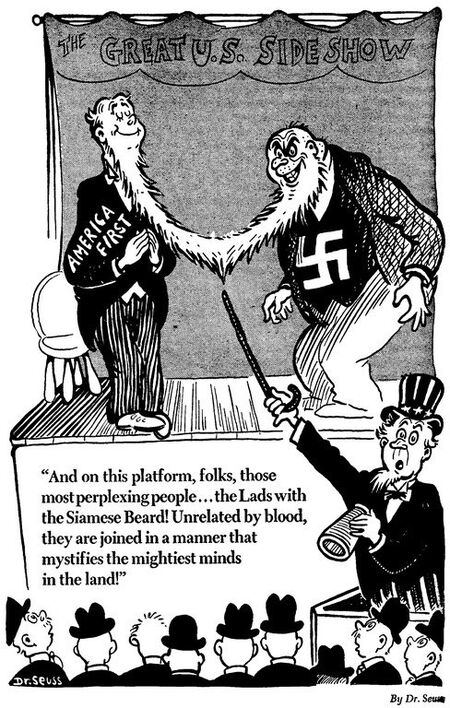
- America First Committee, which opposed U.S. aid to the opponents of Nazi Germany before December 1941.
- Hearst did not invent the slogan “America First”; he borrowed it from Woodrow Wilson—so he could hurl it back at the president. After World War I broke out, Wilson used the “motto” of “America First” to define his version of neutrality
- By 1932, Hearst was publishing articles by Adolf Hitler, whom Hearst admired for keeping Germany out of, as Hitler put it in a Hearst paper, “the beckoning arms of Bolshevism.” Hitler instead promoted a transcendent idea of nationalism—putting Germany first—and, by organizing devoted nationalist followers to threaten and beat up leftists, Hitler would soon destroy class-based politics in his country. Increasingly, Hearst wanted to see something similar happen in the United States.
-
Was ‘America First’ a Slogan of the Ku Klux Klan? | Snopes.com
- Ku Klux Klan, one of whose ex-leaders, David Duke, himself ran for public office in 2016 on an “America first” platform.

- The phrase “America first” also appears in Klan literature as part of a longer credo, “America first, last and forever,” or its variant “America first, last and always,” as uttered by a KKK speaker quoted in the Binghamton, New York Press and Sun-Bulletin in 1923:
- For that matter, Presidents Calvin Coolidge, Warren G. Harding, and William McKinley all used the catchphrase at one time or another to promote isolationist and/or protectionist foreign policies (we found an instance of McKinley being touted as having an “America first” agenda as long ago as 1896).
-
The Resurrection of “America First!”
- Foer went on: “9-11 hasn’t boosted the isolationist right, it has extinguished it … Sept. 11 has virtually ended conservative qualms about spending blood and treasure abroad.” He explained how trade and immigration were dead issues and neoconservatives were “no longer a wing of the conservative movement, they are the conservative movement.”
- For 20 years, Americans felt we had been had by the Brits and had been suckered into war “only to pull England’s chestnuts out of the fire.” This sentiment fueled the greatest of all anti-war movements in U.S. history, America First.
- The achievements of that organization are monumental. By keeping America out of World War II until Hitler attacked Stalin in June of 1941, Soviet Russia, not America, bore the brunt of the fighting, bleeding and dying to defeat Nazi Germany. Thanks to America First, no nation suffered less in the world’s worst war.
- With the end of the Cold War, anti-interventionism, as Foer writes, made a comeback in the GOP, until 9-11.
‘America First,’ a phrase with a loaded anti-Semitic and isolationist history - Los Angeles Times
-
While the America First Committee attracted a wide array of support, the movement was marred by anti-Semitic and pro-fascist rhetoric. Its highest profile spokesman, Charles Lindbergh, blamed American Jews for pushing the country into war.
-
The “greatest danger” Jews posed to the U.S. “lies in their large ownership and influence in our motion pictures, our press, our radio, and our government,” Lindbergh said.
-

-
Lindbergh
- But then came Pearl Harbor, and that changed everything. Lindbergh’s movement collapsed — and he not only backed the U.S. war effort, he joined it. Although he had civilian, not military status, he still manged to fly more than 50 combat missions in the Pacific.
History of the Term
- 1850s
- nativist movement of the 1850s, when the Native American or American Party (nicknamed the Know Nothings) formed to defend what its members considered the nation’s “real” Protestant culture from the threat of immigrant Catholicism.
- 1855
- At an 1855 “American convention” held in Philadelphia, the American Party adopted a platform that would have sweepingly denied political and civil rights to immigrants. Speaking during a downpour, a nativist politician from New York told the crowd, to cheers: “American as I am, I decidedly prefer this rain to the reign of Roman Catholicism in this country … I, as an American citizen, prefer this rain or any other rain to the reign of foreignism … I go for America first, last and always.”
- 1888
- Benjamin Harrison promised home labor and protectionism under the “Republic Banner” of “America First, the World Afterwards!” in an election fought over tariff policy.
- 1900
- nationally syndicated article in 1900 called “Rich Men and Democracy,” arguing that every republic in history was endangered not by disgruntled ordinary citizens but by “discontented multi-millionaires,” because they are “very rarely, if ever, content with a position of equality.” Submitting to wealthy elites’ divisive demands for special privileges would mark “the end of the American dream,” because that dream was one of democratic parity and equality of opportunity.
- 1915
- Wilson certainly popularized it, in a 1915 speech urging native-born Americans to view hyphenate immigrant Americans with suspicion and to demand of naturalized citizens: “Is it America first, or is it not?” But he didn’t originate it.
- 1916
- A domestic tourism campaign called “See America First” helped the phrase explode into popular culture in the first years of the 20th century; by 1916 “America First” was the slogan of both Wilson and his Republican opponent, Charles Evans Hughes. William Randolph Hearst blared “America First” across his newspaper chain as he fought to keep the United States out of World War I and the League of Nations, and to block the ratification of the Treaty of Versailles, even as Warren G. Harding rode an isolationist and protectionist “America First” platform into the White House in 1920.
- 1920s
- In the 1920s, it was used prominently by the KKK. Binghamton, New York was the site of a KKK “America First” Parade where banners reading “America First | One God | One Country | One Flag” were openly displayed.37 In January 1922, a KKK parade in Alexandria, Louisiana bore two flaming crosses and banners with the slogans “America First” and “White Supremacy.”38 Another variation of the slogan appeared in an “Imperial Proclamation” submitted to Congress as evidence during a 1921 hearing on the KKK’s activities.39 The phrase was also used in KKK literature and speeches to foment anti-immigrant sentiment. For example, in 1923 a KKK speaker proclaimed, “I stand for America first, last and always … I am opposed to any organization which tries to bring in foreign and alien ideals.”40
- 1945
- The phrase “America First” fell rapidly into disrepute during World War II, largely because the America First Committee (whose most prominent spokesman was Charles Lindbergh) had urged non-intervention and appeasement and been accused of anti-semitism and fascist sympathies.
- 2017
- President elevated the phrase in his inaugural address in 2017 when he promised that “[f]rom this day forward, a new vision will govern our land. From this day forward, it’s going to be—always—America First.”45 In his first State of the Union Address in 2018, President Trump reiterated a commitment to this principle, both as a legislative philosophy and as the actual policy of his new Administration, promising to “fulfill[ ] [his] ironclad pledge to only sign a bill that puts America first.”
- adl.org/sites/default/files/ab-2020-saget-v-trump-usca-2nd-circuit.pdf
- During the presidential campaign for the 2000 election, then-Mr. Trump decried the use of “America First” as the slogan of Reform Party presidential candidate Patrick Buchanan, calling him a “Hitler lover” and “the choice of ‘the really staunch-right wacko vote.’”49 However, he later adopted that same phrase as his own
- President elevated the phrase in his inaugural address in 2017 when he promised that “[f]rom this day forward, a new vision will govern our land. From this day forward, it’s going to be—always—America First.”45 In his first State of the Union Address in 2018, President Trump reiterated a commitment to this principle, both as a legislative philosophy and as the actual policy of his new Administration, promising to “fulfill[ ] [his] ironclad pledge to only sign a bill that puts America first.”
How it lost in the 1930/40s
Short version: the “America First” isolationist bloc of the late 1930s and early 1940s was not defeated by one clever speech or election; it was crushed by events. Step-by-step:
- They lost the big policy fights in 1940–41 (Lend-Lease, rearmament).
- Lindbergh and others discredited the movement with overt antisemitism and softness toward fascism.
- Pearl Harbor and Hitler’s declaration of war wiped out public support for isolationism almost overnight.
- After 1945, a bipartisan foreign-policy consensus and new institutions (UN, NATO, etc.) locked in an anti-“America First” stance for decades.
Here’s that story in more detail.
1. Who we’re talking about: the interwar “America First” bloc
“America First” has been used as a slogan since the 19th century, but when people talk about the _America First faction_in early 20th-century politics, they usually mean:
- Interwar isolationists (in both parties) who opposed League of Nations, collective security, and later US entry into WWII.
- The most organized expression: the America First Committee (AFC), founded in 1940, a mass non-interventionist pressure group that reached 800,000–850,000 members in 450 chapters.
The AFC argued that: - The US could defend itself without entering the European war.
- A British defeat would not endanger US security.
- Aid to Britain would risk dragging the US into the conflict.
So: this is a non-interventionist coalition, not pacifist, but clearly opposed to entangling the US in WWII.
2. Losing the key legislative battles (1940–1941)
Even before Pearl Harbor, the America First side was losing ground in Washington.
Roosevelt and pro-intervention groups like the Committee to Defend America by Aiding the Allies (CDAAA)pushed a strategy of incremental steps short of war:
- Revision of the Neutrality Acts to allow “cash and carry” arms sales.
- The Destroyers-for-Bases deal (1940), trading old US destroyers to Britain.
- Lend-Lease (1941) – effectively making the US the “arsenal of democracy”.
The AFC mobilized heavily against Lend-Lease and other measures, but: - They did not actually defeat any major Roosevelt proposal in Congress. Historians like Wayne Cole conclude they only narrowed the margins; every key bill still passed.
So politically, by mid-1941 the isolationists were losing the concrete policy fights, even if public opinion was still wary of full war.
3. Public opinion shifts under pressure of events
Between 1939 and late 1941, polls show a steady move away from strict isolationism:
- In 1939–1940, strong majorities oppose declaring war on Germany, but support material aid to Britain.
- By late 1941, a majority says that helping Britain is more important than staying out of war, recognizing that war may be unavoidable.
Key psychological blows to isolationism: - The fall of France (1940) and the Battle of Britain made Nazi victory look plausible and frightening.
- Axis expansion (into the Balkans, North Africa, Japan’s continued aggression in Asia) made the war look less like “someone else’s problem.”
So even before Pearl Harbor, the “America First” line – “Britain can lose and we’ll still be fine” – was increasingly out of sync with how events looked to average Americans.
4. Lindbergh’s Des Moines speech and reputational self-destruction
The symbolic turning point for the America First Committee’s credibility was Charles Lindbergh’s Des Moines speech on 11 September 1941.
In that speech he named:
“The three most important groups who have been pressing this country toward war are the British, the Jewish and the Roosevelt administration.”
He went on to talk about Jews as a group pushing the US into war and warned that “Jewish influence” over the media was too strong.
Impact:
- Massive backlash in the press, from politicians, and especially from Jewish organizations.
- Roosevelt compared Lindbergh’s isolationists to the “Copperheads” (Northern anti-war Democrats in the Civil War) in private and sometimes in public tone.
- Many previously sympathetic Americans saw the AFC as tainted by antisemitism and softness toward Nazi Germany, not just “prudently cautious.”
Historically, scholars and contemporaries both say Des Moines badly damaged the moral standing of the America First movement, even though the organization continued for a few more months.
5. Pearl Harbor and Hitler’s declaration of war: isolationism implodes
The decisive defeat, though, came from outside: Japanese and German decisions.
- December 7, 1941: Japan attacks Pearl Harbor. US declares war on Japan.
- December 11, 1941: Nazi Germany and Fascist Italy declare war on the United States.
That erased the core premises of America First: - They had argued no foreign power could successfully attack a well-armed United States; Pearl Harbor disproved that in one morning.
- They had argued that war with Hitler could be avoided; Hitler himself removed that option by declaring war.
Four days after Pearl Harbor, on 11 December 1941, the America First Committee formally voted to dissolve.
Their final statement essentially said: - “Our principles were right; had they been followed, war could have been avoided” – but they recognized that once war existed, their position was untenable and urged members to support the war effort.
Many America First leaders (including Lindbergh) then contributed to the war effort in various ways.
Politically, after December 1941: - No major national figure could plausibly campaign on staying out of WWII.
- Isolationism as a mass movement vanished almost overnight, replaced by overwhelming support for winning the war.
6. Post-1945: why “America First” stayed buried for so long
The long-term defeat of that faction is what really matters.
The catastrophic war experience and the Cold War that followed produced a bipartisan internationalist consensus:
- Creation of the United Nations, IMF, World Bank, GATT, and later NATO and other alliances.
- Democratic and Republican leaders (Truman, Eisenhower, Kennedy, Johnson, Nixon, Reagan, etc.) largely agreed on active US global engagement as the lesson of WWII.
Within that framework: - “America First” became associated with naïve or morally suspect pre-war isolationism, antisemitic overtones, and underestimation of fascism.
- The phrase largely disappeared from respectable mainstream politics until fringe paleoconservatives (e.g., Pat Buchanan) revived it in the 1990s, and Donald Trump mainstreamed it again in 2016.
So the defeat was double:
- Short-term: Pearl Harbor and Hitler’s declaration of war made non-intervention politically impossible; the AFC dissolved and isolationism collapsed.
- Long-term: The postwar order and memory of WWII turned “America First” into a cautionary tale, so that for decades serious national politicians avoided that label and that posture.
Handy links for your notes (markdown-friendly)
- America First Committee overview – https://en.wikipedia.org/wiki/America_First_Committee
- “America First” slogan history – https://en.wikipedia.org/wiki/America_First
- USHMM, “The United States: Isolation–Intervention” – https://encyclopedia.ushmm.org/content/en/article/the-united-states-isolation-intervention
- US State Dept., “American Isolationism in the 1930s” – https://history.state.gov/milestones/1937-1945/american-isolationism
- Lindbergh’s Des Moines speech (full text) – https://www.charleslindbergh.com/americanfirst/speech.asp
- CFR blog on the Des Moines speech – https://www.cfr.org/blog/twe-remembers-charles-lindberghs-des-moines-speech
- ThoughtCo summary, “The History of the America First Committee of 1940” – https://www.thoughtco.com/america-first-1940s-style-4126686