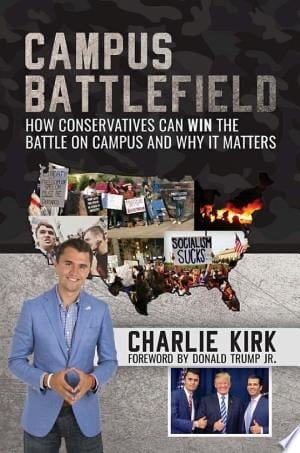
DESCRIPTION
Campus Battlefield takes that fight to our nation’s college campuses, where the left’s decades-long campaign to transform our universities into radical re-education camps is working, and now we are seeing the disastrous results. Free speech, intellectually rigorous debate, and the simple concepts of tolerance and fairness are routinely being corrupted and weaponized to promote radical leftist ideologies, enforce groupthink, and marginalize or eliminate any student, professor, and dean who gets in their way. All the while, these hothouses of close-mindedness are staffed by blame-America, anti-free market, victimology professors who are twisting the minds of tomorrow’s leaders.
The campus battlefield- how conservatives can win the battle — Charlie Kirk.pdf (file not included in this release)
kirkcampusbattlefieldnotes.pdf (file not included in this release)
Process
Summary
The Rules of Analytical Reading (Summary)
Stage I: Finding What a Book Is About
- Classify the book.
- State its unity.
- Outline major parts.
- Define the author’s problems.
Stage II: Interpreting the Book- Identify key terms.
- Extract main propositions.
- Find or construct arguments.
- Determine which problems are solved.
Stage III: Criticizing the Book
- General Etiquette:
9. Understand before judging.
10. Disagree reasonably, not contentiously.
11. Distinguish knowledge from opinion; give reasons.- Special Criteria:
12. Show the author is uninformed.
13. Show the author is misinformed.
14. Show the author is illogical.
15. Show the author’s analysis is incomplete.
1. What It’s About (Rules 1–4)
- Unity (1 sentence):
- Major parts outline:
- Key problems/questions:
2. Interpretation (Rules 5–8)
- Important terms:
- Main propositions (in my words):
- Arguments (premises → conclusion):
- Problems solved / left open:
3. Criticism (Rules 9–15)
- Do I fully understand before judging? ☐
- Whole book judgment (fair/unfair):
- Distinguish knowledge vs. opinion:
- Grounds for disagreement:
- Uninformed?
- Misinformed?
- Illogical?
- Incomplete?
- My judgment (agree / disagree / suspend):
- What of it? (implications / applications):
4. Cross-References (Syntopical Prep)
- Other authors on this issue:
- Agreements/disagreements:
5. Summary & Verdict
- Précis (100–150 words):
- Best passages:
- Keep / reread / discard?
Main Ideas, Takeaways & Similarities & Questions
Questions
I. What is the problem?
A. How is this problem formulated?
B. Why is this problem important?
C. What is the history of this problem?
D. Which prominent personalities have been interested in this problem?
II. What solutions to the problem are there?
A. What are the conclusions reached?
B. By what argument(s) is the conclusion reached?
C. What facts or assumptions serve as premises?
D. When a prominent personality offers a solution, does he also argue for or against other prominent personalities? Does he raise objections to alternative solutions? Does he consider objections to his own solutions?
III. Evaluation
A. What are the advantages and disadvantages of the alternative formulations to the problem?
B. Has the importance or history of the problem ever been misrepresented?
C. Are the solutions logically related to the premises?
D. Are the facts true? Are the assumptions acceptable? Are the objections answerable?
AI Summary
Highlights
Physical book