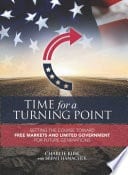
DESCRIPTION
From the bestselling author of The MAGA Doctrine! Turning Point USA founder Charlie Kirk shares a vision for America’s future embracing first principles, free markets, and small government. Kirk provides a roadmap on how to return to a free America, with an emphasis on reaching our youth and engaging them in the process. During the 2016 Presidential election cycle, it has become clear that there is growing frustration on the part of many Americans with the general direction of the nation. There has been an abandonment of the principles of free markets and limited government upon which America was founded. We didn’t get to this point over just the last eight years and it’s going to take more than one or two election cycles to reverse it. In Time for a Turning Point Charlie Kirk shows exactly what needs to be done and how it needs to be done to restore America’s freedom. This is a book of hope, not despair—book of action, not condolences.
Time for a Turning Point_ Setting a Course - Charlie Kirk.pdf (file not included in this release)
turningpointbooknotes.pdf (file not included in this release)
Process
Summary
The Rules of Analytical Reading (Summary)
Stage I: Finding What a Book Is About
- Classify the book.
- State its unity.
- Outline major parts.
- Define the author’s problems.
Stage II: Interpreting the Book- Identify key terms.
- Extract main propositions.
- Find or construct arguments.
- Determine which problems are solved.
Stage III: Criticizing the Book
- General Etiquette:
9. Understand before judging.
10. Disagree reasonably, not contentiously.
11. Distinguish knowledge from opinion; give reasons.- Special Criteria:
12. Show the author is uninformed.
13. Show the author is misinformed.
14. Show the author is illogical.
15. Show the author’s analysis is incomplete.
1. What It’s About (Rules 1–4)
- Unity (1 sentence):
- Major parts outline:
- Key problems/questions:
2. Interpretation (Rules 5–8)
- Important terms:
- Main propositions (in my words):
- Arguments (premises → conclusion):
- Problems solved / left open:
3. Criticism (Rules 9–15)
- Do I fully understand before judging? ☐
- Whole book judgment (fair/unfair):
- Distinguish knowledge vs. opinion:
- Grounds for disagreement:
- Uninformed?
- Misinformed?
- Illogical?
- Incomplete?
- My judgment (agree / disagree / suspend):
- What of it? (implications / applications):
4. Cross-References (Syntopical Prep)
- Other authors on this issue:
- Agreements/disagreements:
5. Summary & Verdict
- Précis (100–150 words):
- Best passages:
- Keep / reread / discard?
Main Ideas, Takeaways & Similarities & Questions
Questions
I. What is the problem?
A. How is this problem formulated?
B. Why is this problem important?
C. What is the history of this problem?
D. Which prominent personalities have been interested in this problem?
II. What solutions to the problem are there?
A. What are the conclusions reached?
B. By what argument(s) is the conclusion reached?
C. What facts or assumptions serve as premises?
D. When a prominent personality offers a solution, does he also argue for or against other prominent personalities? Does he raise objections to alternative solutions? Does he consider objections to his own solutions?
III. Evaluation
A. What are the advantages and disadvantages of the alternative formulations to the problem?
B. Has the importance or history of the problem ever been misrepresented?
C. Are the solutions logically related to the premises?
D. Are the facts true? Are the assumptions acceptable? Are the objections answerable?
AI Summary
Highlights
PHYSICAL BOOK