Haidt, Chapter 12 — conservatism is not synonymous with orthodoxy
Through Jerry Muller, Haidt distinguishes orthodoxy from a modern Enlightenment conservatism. Orthodoxy tries to conform society to a transcendent moral order—biblical law or sharia, for example—and can therefore demand radical change. The Hume–Burke tradition instead offers a reasoned, pragmatic critique of rapid redesign: people are fallible, social knowledge is dispersed and tacit, and inherited institutions may coordinate trust and obligation in ways a reformer has not yet perceived.
Haidt calls the supporting ecology moral capital: interlocking values, virtues, norms, practices, identities, institutions, and technologies that regulate selfishness and sustain cooperation. This is not a presumption that whatever survives is good. Cults and fascist systems can be cohesive; traditions can conceal domination, exclusion, and protected rent. The conservative test is strongest when paired with a liberal test for victims and a libertarian test for coercion and feedback: identify the institution’s actual function, changed conditions, excluded people, dissent and exit, and a less coercive replacement before either destroying or sacralizing it. Haidt explicitly separates conservative philosophy from the Republican Party. Muller and the bookstore-floor reversal, PDF pp. 325–327 (file not included in this release) · Moral capital and its limits, PDF pp. 327–331 (file not included in this release) · Conservative thinkers versus the Republican Party, Chapter 12 endnote 36, PDF p. 429 (file not included in this release) · permanent institutional-humility note
Conservative values as political philosophy
The organizing question
What inherited goods, practices and institutions make a decent common life possible, and how can they be repaired without destroying the conditions that sustain them? Philosophical conservatism gives continuity, practical judgment and the limits of deliberate redesign a central place. It is a family of approaches, not a timeless list of every policy favored by today’s conservative parties.1
You already wrote about these values
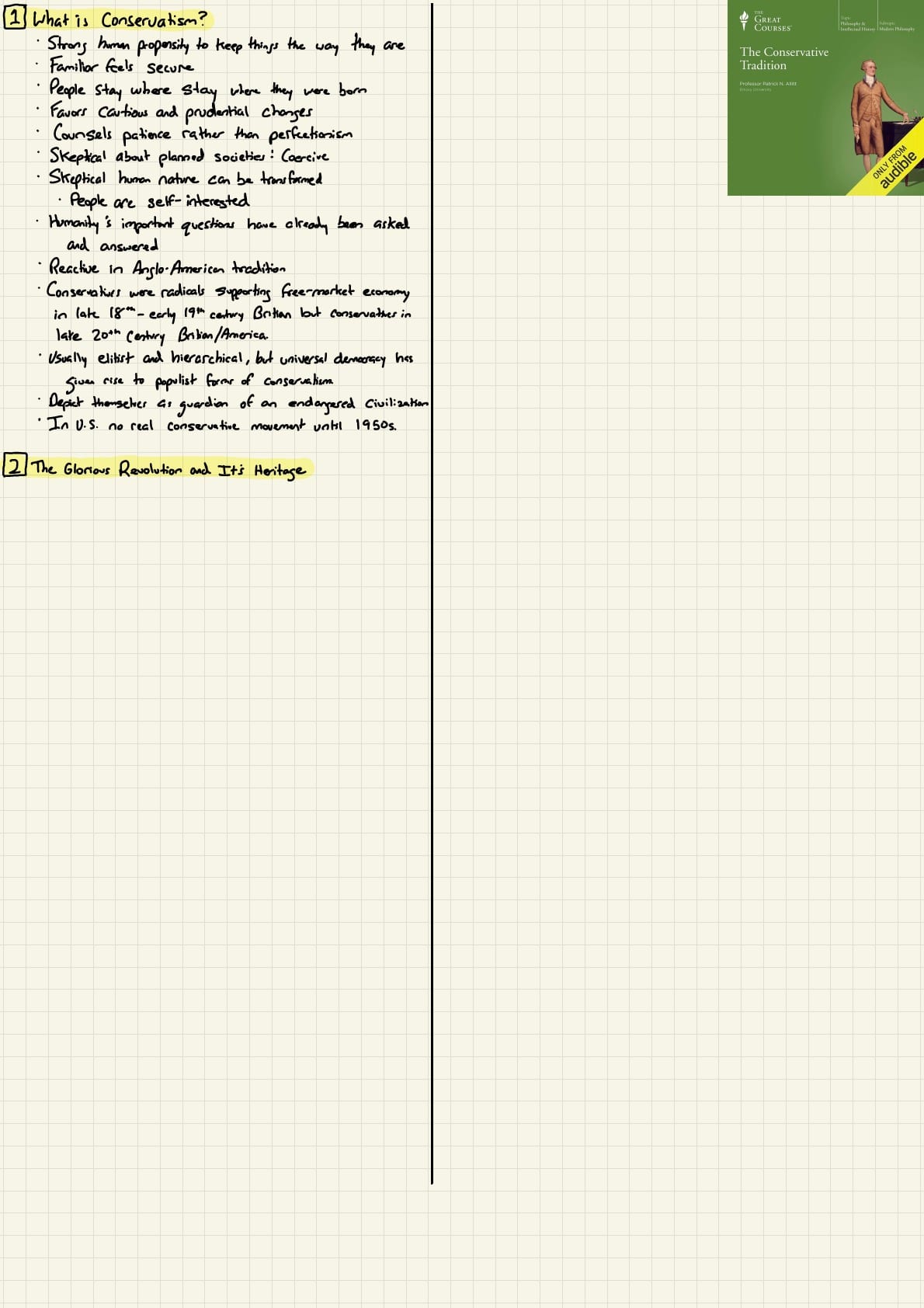
The older notebook has a page explicitly headed “Conservative values”, alongside a Scruton summary: Zibaldone 2024–2025, PDF p. 348 (file not included in this release). That page was visually inspected for this addition on November 8, 2026. The page index independently routes to it: Personal Journal/Zibaldone 2024-2025 - Page Index. The relevant values are restated below; unrelated private material on the page is not reproduced.
The vault also already has your first-person conservatism position, Conservatism - Position Card, Conservatism - Arguments and the Scruton book note. Your rhetorical position combines Burkean conservatism with liberal commitments; it should remain distinct from a neutral description of the whole tradition. Locke and Mill are important liberal interlocutors, not automatically members of a conservative canon.
Main values, sub-values and the questions they raise
This is a working synthesis for study, not a declaration that every conservative accepts every row. Kirk’s own list is one influential account with an explicitly American setting; the broader philosophical tradition contains disagreements about markets, religion, authority and rights.21
| Main value or concern | Sub-values and characteristic ideas | Moral, legal or practical question |
|---|---|---|
| Prudence and limits of knowledge | Fallibility; unintended consequences; practical judgment; learning from experience | How certain must reformers be before changing an institution whose functions they only partly understand? |
| Continuity and inheritance | Tradition; prescription; custom; intergenerational obligation | What knowledge or obligation does a practice carry, and does that justify retaining it? |
| Repair and preservation | Gradual reform; discrimination between good and bad inheritance; resistance to utopian redesign | Which changes preserve a worthwhile institution, and which injustices require a more decisive break? |
| Social order and legitimate authority | Peace; lawful authority; predictable expectations; duties of office | What makes authority legitimate, limited and answerable rather than merely powerful? |
| Law and constitutional restraints | Rule of law; due process; precedent; institutional checks | How should inherited law be corrected while retaining predictability and protection against arbitrary rule? |
| Civil society and belonging | Family; voluntary associations; local community; mutual trust | Which obligations are best sustained outside central administration, and how are vulnerable members protected? |
| Responsibility and character | Duty; self-restraint; reciprocity; honesty; stewardship | What habits support freedom and cooperation, and when do appeals to responsibility overlook unequal power? |
| Property and economic independence | Secure ownership; dispersed power; incentives; duties attached to possession | Which property rules sustain independence, and which create entrenched privilege or undermine community? |
| Particular loyalties | Home; civic patriotism; national membership; sovereignty | How can special duties to one’s community coexist with outsiders’ rights and equal citizenship? |
| Religion, moral order and meaning | Conscience; inherited moral practices; sacred places; ritual; beauty | Which goods merit protection, and how should believers and nonbelievers share political authority? |
| Liberty and legal equality | Freedom under law; limits on power; equal civil standing | Which freedoms are fundamental, and how does a conservative justify them when inherited arrangements deny them? |
| Plural institutions and difference | Local variety; differentiated roles; limits to enforced uniformity | When is difference valuable, and when does hierarchy become domination or exclusion? |
The last column deliberately supplies tests and objections; those questions are the synthesis’s analytical scaffolding, not quotations from a single thinker. For the institutional argument and its limits, continue to Political Visions and Institutional Humility.
How the notebook’s list fits
Your p. 348 list includes limited/small government, constitutionalism, rule of law, individual liberty, natural rights, personal responsibility, free markets, tradition/moral order/social continuity, community/civil society, peace through strength, equality before law, skepticism toward sweeping social engineering for equal outcomes, national sovereignty/secure borders, civic patriotism, religious liberty, prudence and anti-utopianism. A short phrase after “equality before law” is unclear and is not reconstructed as an exact quotation.
Its Scruton panel adds love of home (oikophilia), inherited institutions, nation as an extended home, patriotism without resentment, common law, civil association, limited government, free economy, responsibility/duty, and ritual, reverence and beauty. This is evidence of your earlier capture, not independent authentication of every phrase as Scruton’s wording. The existing book note gives a more developed route into belonging, obligation and preservation.
Several entries belong especially to liberal or market-conservative combinations. A philosophical conservative need not favor the smallest possible state, an unrestricted market or abstract natural-rights foundations. A paternalist may defend protective social provision; a traditionalist may worry that market disruption dissolves community. Conversely, conserving a constitutional tradition can entail defending liberty against a current majority. Political Fusionism helps explain the coalition without treating its components as identical.1
Morality and law — what is common and what is contested
For a Burkean line of argument, society contains obligations and attachments that were not created by a single contract between presently living individuals. Its inheritance should be considered with care; prudence does not imply that every inherited arrangement is just. Burke’s criticism of revolutionary abstraction is an argument about political judgment, institutions and obligations, not a ready-made answer to every modern policy question.3
Kirk gives enduring moral order, custom, prudence, human imperfection, property, voluntary association, limits on power and reconciliation of permanence with change prominent roles. Treat that as Kirk’s formulation, not proof that all conservatives share one theology or identical policy conclusions. His text itself stresses variation.2
Concrete disputes about abortion, taxation, punishment, marriage or immigration therefore need further premises. “Conservatives believe X” is not enough: identify the branch, the good being protected, the proposed legal power, its limits and the people who bear its costs. Religious conservatives also disagree over establishment versus religious liberty. “Secular” does not mean value-free, while belief in moral truth does not automatically justify state enforcement of a particular creed. See Law Is Not Value-Free - Legal Neutrality, Morality, and the Common Good.
Haidt’s moral-foundations account can help explain psychological emphasis on loyalty, authority or sanctity. It does not establish that those intuitions are morally correct, or define the philosophical tradition by itself. Keep explanation of belief distinct from justification of belief; the existing Haidt callout above already preserves that boundary.
The strongest objections to answer
Inherited injustice: A practice may survive because its beneficiaries control exit, speech or resources. Longevity does not establish legitimacy. A strong conservative defense must identify a valuable function, hear excluded people, and compare feasible repairs against the costs of retention as well as abolition.
A brake without a direction: Hayek argues that resistance to change does not specify where society should go; he distinguishes his liberal position from conservatism even while crediting conservative insight into evolved institutions. This challenges a purely positional defense of whatever happens to exist.4
Selective tradition: Which past, whose memory and whose authority? A defensible answer needs explicit moral criteria and evidence, rather than treating an attractive historical story as a substitute for justification. The practical study test is: name the good, explain its institutional support, identify the injustice or failure, and compare a rights-respecting repair with realistic alternatives.
Source and integration receipt
Added November 8, 2026, America/New_York. Existing authored text, links, frontmatter relationships and media were preserved. This section expands the existing core note because both a vault note and a relevant notebook page already existed. It does not create a second personal ideology or replace the first-person rhetoric notes. Philosophical taxonomy is a labeled synthesis; the notebook is treated as a source capture. Sources below were checked for the stated scope, not read as entire books. Independent-agent review was unavailable.
The Importance of Working Together - YouTube
Most Democrats Say They’d Flee, Not Fight, a Ukraine-Style Invasion
TODO:
patrick deneen post liberalism - Google Search
Two Concepts of Liberty - Wikipedia
Footnotes
-
Stanford Encyclopedia of Philosophy, “Conservatism”, current entry accessed November 8, 2026. Used for the philosophical-family framing and distinctions involving tradition, skepticism, reform, liberalism and different conservative strands. The study table’s evaluative questions are this note’s synthesis. ↩ ↩2 ↩3
-
Russell Kirk, “Ten Conservative Principles”. Primary statement of Kirk’s own position; introduction and numbered principles. Its own American historical setting and explicit rejection of a single model conservative qualify its use as a universal definition. ↩ ↩2
-
Edmund Burke, Reflections on the Revolution in France (1790), University of Virginia primary-text edition. Read beside the existing notebook and Scruton note; neither a modern party platform nor an automatic defense of every surviving custom. ↩
-
F. A. Hayek, “Why I Am Not a Conservative”, University of Chicago Press excerpt, especially sections 1–3. Primary criticism from a classical liberal; evidence of an intellectual disagreement, not a neutral verdict settling it. ↩