DESCRIPTION
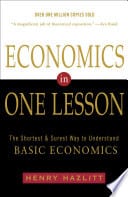
Over a million copies sold! A fundamental influence on modern libertarianism, this classic guide to the basics of economic theory defends capitalism and the free market from economic myths that persist to this day. “A magnificent job of theoretical exposition.”—Ayn Rand Considered among the leading economic thinkers of the “Austrian School,” which includes Carl Menger, Ludwig von Mises, Friedrich (F.A.) Hayek, and others, Henry Hazlitt wrote Economics in One Lesson in 1946. Concise and instructive, it is also deceptively prescient and far-reaching in its efforts to dissemble economic fallacies that are so prevalent they have almost become a new orthodoxy. Economic commentators across the political spectrum have credited Hazlitt with foreseeing the collapse of the global economy which occurred more than fifty years after the initial publication of Economics in One Lesson. Hazlitt’s focus on non-governmental solutions, strong—and strongly reasoned—anti-deficit position, and general emphasis on free markets, economic liberty of individuals, and the dangers of government intervention make Economics in One Lesson every bit as relevant and valuable today as it has been since publication.
Review
Handwrite First
Use this section with the book and notes closed. The goal is retrieval, not polish.
1. Before Reading
Prime your mind before reading.
- Prediction:
- Question I want answered:
- What I already think about this topic:
- What I expect to disagree with:
2. Closed-Book Recall Dump
Close the book and notes. Reconstruct what you read from memory.
-
Main points I remember:
-
Key examples, evidence, stories, or cases I remember:
-
Terms, people, dates, or concepts I remember:
-
-
What feels fuzzy or incomplete:
3. Core Argument From Memory
- The book/section in one sentence:
- Main claim:
- Problem the author is responding to:
- Why the author thinks this is true:
- Best evidence/example I remember:
- Conclusion the author wants the reader to accept:
4. Argument Map From Memory
5. Feynman Check
Explain the idea simply, as if teaching it to someone unfamiliar with the topic.
- Simple explanation:
- Analogy or concrete example:
- Where someone might misunderstand this:
6. Pushback From Memory
- Strongest objection or weakness:
- What evidence would weaken the author’s argument?
- What a rival thinker/book might say:
- My current judgment:
7. Personal Takeaway
- What changed, clarified, or challenged my thinking?
- What am I less certain about now?
- One way I could apply this:
- One question I need to keep investigating:
Type Into Obsidian
Use this section after handwriting. The goal is long-term storage, search, linking, and spaced review.
1. Correction After Checking Notes
Reopen the book/notes. Compare them against your handwritten recall.
- I forgot:
- I misunderstood:
- I overemphasized:
- I underemphasized:
- This needs review:
2. Clean Core Argument
- The book/section in one sentence:
- Main claim:
- Problem the author is responding to:
- Why the author thinks this is true:
- Best evidence/example:
- Conclusion the author wants the reader to accept:
3. What Actually Matters?
- Most important idea:
- Best quote or passage:
- Term/concept worth remembering:
- Most useful example:
- Most surprising point:
- One sentence I want to remember:
4. Connections
- Connects to:
- [[]]
- [[]]
- [[]]
- Supports:
- [[]]
- Challenges:
- [[]]
- Reminds me of:
- [[]]
- Possible future note:
- [[]]
5. Clean Pushback
- Strongest objection or weakness:
- What evidence would weaken the author’s argument?
- What the author might say in response:
- What a rival thinker/book would say:
- My current judgment:
Retrieval Questions
Answer these without looking during future reviews.
Basic Recall
- What is the author’s main thesis?
- What problem is the author responding to?
- What are the 3–5 main claims?
- What are the key terms or concepts?
- What is the best example or piece of evidence?
Argument Reconstruction
- How does the author move from evidence to conclusion?
- What assumptions does the argument depend on?
- What would the argument look like in premise-conclusion form?
- What does the author want the reader to reject?
Comparison
- How does this book/section compare with [[]]?
- How does this support or challenge [[]]?
- Which thinker would agree with this?
- Which thinker would disagree with this?
Criticism
- What is the strongest objection?
- What evidence would weaken the argument?
- What does the author ignore, minimize, or assume?
- Is the author’s conclusion stronger than the evidence allows?
Synthesis
- How does this change my larger framework?
- Where does this fit in the broader historical/philosophical debate?
- What question should I ask next?
- What would I write about using this idea?
Flashcards / Atomic Recall
Use only for facts, definitions, distinctions, names, dates, and compact claims.
- Q:
- A:
- Q:
- A:
- Q:
- A:
Retention Check
24 Hours Later
- I can explain the main argument without notes.
- I remember the best example or evidence.
- I can define the key concept.
- I can state one objection.
24-hour recall notes:
- What I remembered:
- What I forgot:
- What needs another review:
1 Week Later
- I can summarize this in 5 sentences.
- I can reconstruct the argument.
- I can connect it to another book, thinker, or historical period.
- I can state whether I agree, disagree, or remain undecided.
1-week recall notes:
- What I remembered:
- What I forgot:
- New connection:
- Revised judgment:
1 Month Later
- I still remember the core argument.
- I can explain why this matters.
- I know whether this changed my larger framework.
- I know whether this is worth rereading, citing, or building into a permanent note.
1-month recall notes:
- What endured:
- What disappeared:
- What this changed:
- Next action:
Scratchpad
Unfiltered thoughts, questions, comparisons, argument trees, future writing ideas, or possible links.
Simplified rule
Handwrite
Use handwriting for:
- Before-reading predictions
- Closed-book recall dump
- Core argument from memory
- Argument map from memory
- Feynman explanation
- Initial pushback
- Personal takeaway
- Confusion list
These are the sections where the benefit comes from struggling to reconstruct the idea.
Type in Obsidian
Use Obsidian for:
- Corrections after checking notes
- Clean one-sentence thesis
- Clean argument summary
- Important quotes
- Key concepts
- Links to other notes
- Retrieval questions
- Flashcards
- Retention checks
- Review logs
- Scratchpad for future essays or synthesis
These are the sections where the benefit comes from searchability, linking, spaced review, and long-term organization.
Best workflow
Use this order:
1. Handwrite from memory.
2. Check the book/notes.
3. Type only the corrected, useful version into Obsidian.
4. Create retrieval questions.
5. Review those questions later without looking.
Do not type all your handwritten notes into Obsidian. That turns the system into transcription work. Only transfer what is worth preserving, linking, or reviewing.
Notes
The Big Picture (read this first)
Hazlitt argues that nearly all popular economic error reduces to a single failure of attention: judging a policy by its immediate, visible effect on one favored group while ignoring its long-run, invisible effects on everyone. The book states this “one lesson” abstractly in a single chapter, then drives it home through roughly two dozen worked applications — tariffs, public works, minimum wages, inflation, rent control — each showing the same buried cost. The method is deliberately unoriginal and “classical”: Hazlitt sees himself modernizing Bastiat’s “what is seen and what is not seen.”
The moves that define how he builds the argument:
- State the lesson once, in the abstract (Ch. I), as a rule about tracing consequences across time and across all groups.
- Anchor it in one irreducible parable — the broken window (Ch. II) — then show that almost every fallacy is that parable “in new clothing.”
- Apply the same test mechanically to policy after policy, always asking: who is the unseen A who pays for the visible B?
- Refuse to deny the real gains to special interests; concede the half-truth, then supply the missing half.
- Restate and generalize (Ch. XXV): the fallacy is systematic, rooted in the division of labor, and its endpoint is “the doctrine of wealth through scarcity.”
- Audit the world thirty years later (Ch. XXVI): the lesson was not learned; inflation and the redistributive state have spread everywhere.
Biggest animating question: When a policy visibly helps someone, who is the forgotten person paying for it — and is the nation richer or poorer once you count everyone?
Author’s standpoint
Henry Hazlitt (1894–1993) was a self-taught American economic journalist (New York Times, Newsweek, The Freeman) rather than an academic — a fact he leans into, writing “as a working newspaper man” for readers with no prior economics. He writes as an unapologetic classical liberal and defender of the free market, and openly names his three debts: Frédéric Bastiat (the “seen vs. unseen” expository frame), Philip Wicksteed (wages and the summary chapter), and Ludwig von Mises (the mechanics of how monetary inflation spreads). His method is primarily deductive — reasoning from a few premises about scarcity, exchange, and incentives — and he uses statistics sparingly and by design, arguing that principles outlast figures. What makes the approach distinctive is also what makes it contestable: he treats the “one lesson” as nearly sufficient for policy judgment, brackets questions where classical economists erred (callousness to those hurt short-term), and deliberately avoids naming the rival theorists (Keynes, Marx, Veblen) whose “anonymous” popular fallacies he attacks — so the book answers positions, not their most careful formulations.
Contents / Navigation
- Part One — The Lesson (ch 1) — the entire argument stated once, in the abstract.
- Part Two — The Lesson Applied (chs 2–25) — the same test run against two dozen policies; includes the price-system and profit chapters that supply the positive theory.
- Part Three — The Lesson After Thirty Years (ch 26) — a 1978 audit: nothing learned, inflation and the redistributive state triumphant.
- Hazlitt's Key Arguments (Takeaways) — the load-bearing claims, stated crisply.
- Key Concepts / Glossary — the recurring terms and mechanisms.
- Thinkers & Positions Engaged — allies cited and rivals refuted, plus the reading path he recommends.
- Critical Analysis — what the method achieves, where it strains, what it omits.
- Questions for Reflection — synthesis prompts / essay seeds.
Part One — The Lesson (ch 1)
What Part One does
It compresses the whole book into one chapter. Economics is uniquely plagued by fallacy for two reasons — the special pleading of self-interest and the human tendency to see only immediate effects on one group. Both collapse into one rule for distinguishing good economics from bad. Everything after this is illustration.
Ch. I — The Lesson (the abstract statement)
- Two forces breed economic fallacies endlessly: (1) organized self-interest that hires “the best buyable minds” to argue its case, and (2) the persistent habit of watching only the immediate effect of a policy, or its effect on a single group.
- The distinction between good and bad economics is entirely one of scope in time and persons.
- Personal life already teaches the principle (the child who overeats candy, the spendthrift heading for debt); the error appears only when we enter public economics.
- The “new” economists’ fixation on short-run effects is not an advance but a regression — it lands them, unawares, back in seventeenth-century mercantilism.
- Hazlitt concedes the opposite error exists (the classical economists’ callousness toward those hurt in the short run) but argues it is now rare and confined to professionals.
- Bad economists win audiences because they trade in half-truths that are correct as far as they go; the honest reply requires “a long, complicated, and dull chain of reasoning.”
The one lesson
“The art of economics consists in looking not merely at the immediate but at the longer effects of any act or policy; it consists in tracing the consequences of that policy not merely for one group but for all groups.” — Ch. I
The test for an economist
“The bad economist sees only what immediately strikes the eye; the good economist also looks beyond.” — Ch. I
Part Two — The Lesson Applied (chs 2–25)
What Part Two does
This is the body of the book: the single lesson run, almost mechanically, against policy after policy. The pattern rarely varies — identify the visible beneficiary, then trace the diverted resource to the invisible party who paid. Three “hinge” chapters break the pattern to supply Hazlitt’s positive economics: Ch. XV (the price system), Ch. XXII (profits), and Ch. XXV (the lesson restated), which together explain what the interventions disrupt. The chapters cluster loosely into destruction/spending fallacies (II–X), trade and price fallacies (XI–XVIII), wage and union fallacies (XIX–XXI), and money/capital fallacies (XXII–XXIV).
Ch. II — The Broken Window (the master parable)
- A hoodlum breaks a baker’s window; onlookers console themselves that the glazier gains business that ripples outward “in ever-widening circles,” so the vandal is almost a public benefactor.
- The crowd counts only two parties (baker, glazier) and forgets the third: the tailor, from whom the baker will now not buy a suit.
- The glazier’s gain is exactly the tailor’s loss; no new employment or wealth is created. The community is down one suit.
- The error is perceptual: the new window will be seen; the unmade suit “will never be seen, precisely because it will never be made.”
Why the fallacy persists
“They see only what is immediately visible to the eye.” — Ch. II
Ch. III — The Blessings of Destruction (war and “backed-up” demand)
- The broken window “grown fat beyond recognition”: the belief that war and destruction bring prosperity by creating pent-up demand.
- Confuses need with demand — need is not effective demand without purchasing power (India needs more than America but can stimulate far less).
- Confuses money with wealth: postwar “good results” were mostly wartime inflation, achievable by peacetime inflation too.
- Demand and supply are two sides of one coin; supply is at bottom demand (the farmer’s wheat is his demand for cars). War destroys accumulated capital; there is an “optimum rate of replacement,” so bombed-out plants are an advantage only if they were already worthless.
Ch. IV — Public Works Mean Taxes
- The “mother fallacy”: faith that government spending creates net new wealth or employment.
- Every dollar of spending is ultimately a dollar of taxation (inflation being merely “a particularly vicious form” of it).
- A bridge built to serve a need is fine; a bridge built to provide employment inverts ends and means — “projects have to be invented.”
- For every visible public job, an invisible private job is destroyed by the taxes; the unbuilt homes, cars, and dresses require “a kind of imagination that not many people have.”
- Applies identically to public housing and the TVA — the region that gets the tax dollars looks richer only because other regions are made poorer.
Ch. V — Taxes Discourage Production
- Beyond the simple transfer, taxation itself corrodes incentives: it is not just moving money “from the right-hand pocket to the left.”
- When a firm keeps only part of each gain but bears the whole of each loss, it stops expanding and taking risks; risk capital is taxed away before it can accumulate.
- High personal rates make people ask why they should work months of the year “for the government.” Net effect: “the government spenders create the very problem of unemployment that they profess to solve.”
- Concedes reasonable taxes for genuine government functions do little harm; the damage scales with the share of national income taken.
Ch. VI — Credit Diverts Production
- Government “encouragement” (loans, loan guarantees) can be as harmful as hostility. All credit is debt.
- Real capital — farms, tractors — is limited; what is lent to B cannot be lent to A. Government lends precisely to those private lenders judged too risky (B), displacing the efficient borrower (A).
- “Credit is something a man already has” — brought into the bank as assets or character — not something a banker confers.
- Private lenders are disciplined by a “cruel market test” (survival of the fittest); bureaucrats risk other people’s money and reward projects by how much employment they require (i.e., how inefficient they are).
- Government-guaranteed mortgages with tiny down payments breed malinvestment, overbuilding, and losses socialized onto taxpayers.
Ch. VII — The Curse of Machinery
- The “most viable of delusions”: that machines cause net unemployment. Taken consistently it condemns all progress back to the first labor-saving tool.
- Historical refutation: Adam Smith’s pin factory; cotton spinning after Arkwright (1760) — employment in cotton textiles rose from 7,900 to 320,000 by 1787; stocking-frame Luddite riots; the 1932 Technocrats; 1960s “automation” panic.
- The mechanism: a manufacturer’s labor savings become profits, which are necessarily (1) reinvested, (2) invested elsewhere, or (3) spent — each of which creates offsetting employment. Competition then passes savings to consumers as lower prices, freeing purchasing power for other goods.
- The function of machines is not to create jobs but to increase production and raise real wages. “Full employment” is trivially easy in a primitive economy; the goal is full production.
- Balancing caveat: keep “one eye on Joe Smith,” the displaced worker, but not only on him — remember Tom Jones who makes the machine and Daisy Miller who buys the cheaper coat.
Ch. VIII — Spread-the-Work Schemes
- Union make-work rules, minute job jurisdictions, and legislated shorter weeks all rest on the “fixed amount of work” fallacy (the lump-of-labor fallacy).
- Subdividing a job so two men do one man’s work raises production costs; the householder who overpays for a repair has less left for a sweater, so a sweater-knitter is disemployed.
- Shortening the week without raising hourly pay merely has the employed subsidize the unemployed; shortening it with compensating pay increases costs, driving out marginal firms and workers.
- “There is no limit to the amount of work to be done” while any human want is unfilled.
Ch. IX — Disbanding Troops and Bureaucrats
- Fear that demobilized soldiers or dismissed officials will lack “purchasing power” looks at one side only.
- With a balanced budget, taxpayers keep the funds formerly used to support them; civilian demand rises to employ the released labor, and — crucially — those people become self-supporting producers rather than tax-supported consumers, so total output rises.
- The “purchasing power” argument for keeping needless officials could equally justify a thief: the robber also spends, but every job his spending funds is one your lost money can no longer fund.
Ch. X — The Fetish of Full Employment
- The economic goal is maximum production; full employment is a byproduct, not the end. “We can very easily have full employment without full production.”
- Coercion always delivers full employment — Hitler’s armament program, war, slave labor, chain gangs all did. Retarded economies have the fullest (and most miserable) employment.
- Legislators pass “Full Employment” bills, never “Full Production” bills — the means enthroned as the end.
Ch. XI — Who’s “Protected” by Tariffs?
- Rests entirely on the central fallacy applied to trade. Uses Adam Smith on free trade and the specialization of labor (“never…make at home what it will cost him more to make than to buy”).
- The visible sweater-maker saved by a $5 duty hides the consumers who lose $5 each and the exporters who lose foreign sales — because imports are what give foreigners the dollars to buy American exports.
- A tariff does not raise general wages; it deflects labor and capital into less efficient uses, so on net balance it reduces real wages and productivity. “Tariff walls” work like literal walls against transport efficiency.
- Honest concessions: a tariff can benefit a single protected group if everyone else stays free-trading; sudden tariff changes cause real, sometimes permanent, dislocation. The argument targets only the claim that tariffs “provide employment” or “protect the standard of living.”
Ch. XII — The Drive for Exports
- The mirror-image pathology to import-dread. In the long run exports must equal imports — “it is exports that pay for imports, and vice versa.”
- Foreign loans that aren’t repaid, and export subsidies, amount to giving goods away: “A nation cannot grow rich by giving goods away.” Individual exporters may gain while the nation loses.
- Foreign “economic aid” sold as a jobs program is “the delusion that a nation can get rich by giving things away.”
- Following J.S. Mill: the real gain from trade is in imports (cheaper or otherwise-unavailable goods); exports are only how a country pays for them.
Ch. XIII — “Parity” Prices
- Case study in how a well-funded special interest wears down disinterested critics. The New Deal (1933) fixed farm prices to a 1909–1914 “parity” ratio — a period cherry-picked as maximally favorable to agriculture.
- The absurdity test: if the ratio were sacred, every commodity’s 1909–1914 price relation should be frozen (a 1942 Chevrolet would cost $3,270). It is never universalized, and never enforced downward — proof it’s a subsidy, not a principle.
- Raising farm prices by fiat merely transfers purchasing power from city buyers to farmers, and often destroys wealth through forced crop restriction. The “tariff-equivalent” defense fails: the joint system just lets Farmer A and Industrialist B both profit at the expense of Forgotten Man C.
Ch. XIV — Saving the X Industry
- Generalizes parity/tariff logic to any declining “X industry” (historical cases: silver and coal — the Guffey Act ended up fixing 350,000 separate coal prices).
- Whether by exclusion (keeping capital/labor out) or subsidy, propping up X diverts resources from more efficient uses; X gains only at the expense of A, B, and C industries, and average living standards fall.
- Core principle: “it is just as necessary to the health of a dynamic economy that dying industries be allowed to die as that growing industries be allowed to grow” — the horse-and-buggy must yield to the automobile.
Ch. XV — How the Price System Works (positive theory, hinge chapter)
- Opens by restating the whole book’s thesis, then explains what the interventions wreck. The rival target is the “production-for-use-not-for-profit” school and the “fallacy of isolation” (looking at one industry as if it existed alone).
- Crusoe economics: even a lone islander or a family faces “alternative applications of labor” — one occupation can expand only at the expense of others. A modern economy solves the same allocation problem through prices, profits, and costs.
- Prices are set by supply and demand; profit signals attract producers into wanted goods and losses drive them out. Cost of production does not directly determine price — rather, price and marginal cost tend toward equality via expectation.
- Metaphor: the market is like thousands of interconnected steam-engine governors, each correcting departures from equilibrium quasi-automatically — solving the allocation of “tens of thousands of different commodities” better than any bureaucracy, because each consumer “casts a fresh vote… every day.”
Ch. XVI — “Stabilizing” Commodities
- “Stabilization” is usually a disguised price boost. Attacks the vilification of speculators: by buying cheap at harvest and selling dear in scarcity, competent speculators smooth prices and bear risks farmers otherwise would; historically they’ve even subsidized farmers via chronic over-optimism.
- Government “ever-normal granary” becomes an “ever-political granary”: it sets prices above market, so surpluses pile up, foreign markets are lost, and rival producers abroad are stimulated (British rubber, American cotton).
- Restriction schemes freeze inefficient producers in place instead of letting the market cull high-cost ones; the eventual collapse is worse than any the free market would have produced.
Ch. XVII — Government Price-Fixing (ceilings)
- Fixing a price below market raises demand and cuts supply → shortage of the very necessity the regulators wanted abundant.
- Control spreads inexorably: to hold beef down you must fix wholesale, cattle, feed, and wage prices (“vertically”); rationing pushes demand onto substitutes, forcing control “horizontally.” Endpoint: a “petrified totalitarian economy.”
- Black markets partly mitigate the folly but breed inefficient fly-by-night firms and general demoralization (“a premium is put on dishonesty”).
- Root confusion: rising prices are caused by scarcity of goods or surplus of money, neither of which ceilings can cure. Each of us is “producer, taxpayer, consumer” — a Jekyll-and-Hyde who wants inflation for his own product and ceilings for everyone else’s.
Why price control ends in tyranny
Quoting Alexander Hamilton in the Federalist: “A power over a man’s subsistence amounts to a power over his will.” — Ch. XVII
Ch. XVIII — What Rent Control Does (added 1961/expanded 1978)
- A special case of price control with distinctive dynamics. Because housing is durable, effects appear slowly, so the political incentive to keep controls is strong (“tenants have more votes than landlords”).
- Consequences compound over time: no new building (no incentive), no maintenance or remodeling (no funds or reason), wasteful over-occupancy by protected tenants, and eventual slum formation, abandonment, and arson; city tax bases erode toward bankruptcy.
- A cruel paradox: the more unjust and unrealistic the control, the harder it is to repeal — because decontrol would require huge rent jumps. Landlords, including “slumlords,” are forced to subsidize tenants who may be richer than they are.
- Failure is blamed on “capitalism,” prompting public housing — “another all but irreversible step… toward the total Welfare State.”
Ch. XIX — Minimum Wage Laws
- A wage is a price; the “different name” hides that the same principles apply. A minimum wage cannot make a worker worth more — it prices out anyone whose output is below the floor. “For a low wage you substitute unemployment.”
- The relief that must follow creates its own trap: any relief below the minimum still deprives society of the man’s services; relief at or near the minimum destroys the incentive to work at all.
- The honest route to higher wages is higher marginal labor productivity (capital accumulation, invention, better management/training). “Real wages come out of production, not out of government decrees.”
- Historical footnote: legislated minimums have followed the rising market wage, feeding the myth that the law caused the rise.
Ch. XX — Do Unions Really Raise Wages?
- “One of the great delusions of the present age.” Wages are fundamentally set by productivity — hence U.S. wages exceeded Britain’s and Germany’s even when their labor movements were more advanced.
- Legitimate union functions exist: correcting workers’ weak bargaining position and information gaps, setting a known “standard wage,” and (historically) protecting health and reducing brutal hours.
- But forcing wages above market worth requires coercion (restricted membership, mass picketing against other workers — the maligned “strikebreaker” is often just someone taking the best option left to him). A six-group thought experiment shows uneven union gains simply redistribute among workers and, absent matching inflation, cause unemployment.
- “Exploitation of capital by labor” (e.g., railroads with trapped capital) can only be temporary: investment dries up and flows elsewhere, ending in “a Pyrrhic victory.” Net verdict: unions may have held down real wages by reducing productivity via make-work rules.
Ch. XXI — “Enough to Buy Back the Product”
- Attacks the Marxist / purchasing-power doctrine that depressions come from workers not being paid enough to buy back what they make. Contrasts it with the classical concept of functional wages/prices — those that maximize employment, output, and sustained payrolls.
- The slogan is incoherent (should mink-coat makers earn enough to buy mink coats?) and self-serving (auto unions demanding raises while already in the top income third).
- Everyone’s income is someone else’s cost; a 30% wage rise ultimately forces ~30% higher prices (labor being ~two-thirds to three-quarters of total production cost), so labor “can buy no more… and the merry-go-round must start all over.”
- Cites Pigou and Paul Douglas: the elasticity of demand for labor is roughly 3–4, so pushing wages above marginal productivity cuts employment several times as much.
Ch. XXII — The Function of Profits (hinge chapter)
- Corrects the hostility to profits by showing their smallness and their function. Corporate profits after tax averaged under 6% of national income; most years from 1930–1938 more corporations lost money than made it. There’s “profiteer” but no “losseer.”
- Profits guide production (which goods, in what quantities) and exert “constant and unremitting pressure” to cut costs. “Profits are achieved not by raising prices, but by introducing economies… that cut costs of production.”
- Every economic system — socialist or capitalist — must answer which goods, made how; competitive profit-and-loss answers “incomparably” better than any bureaucrat.
Ch. XXIII — The Mirage of Inflation
- The oldest error is confusing money with wealth (quoting Adam Smith). Real wealth is goods produced and consumed; printing dollars cannot conjure them.
- Rejects both the naïve “just print more purchasing power” view and the rigid mechanical quantity theory (n× money ≠ exactly n× prices). Instead traces inflation through groups A → B → C → D: the first recipients gain (spend before prices rise); the last lose (pay higher prices before their incomes rise). Even a later “fair” 25% rise never repays the transition losses.
- Inflation distorts the structure of production (malinvestment), cannot be stopped smoothly, and cannot be finely controlled because money’s value rests on subjective, expectation-driven valuations — hence hyperinflation’s runaway collapse.
- It is a hidden, regressive tax — a flat capital levy hitting the poor hardest — and its political appeal is precisely that it confuses: deficit-financed public works seem to create jobs “out of new purchasing power,” but the debt must be repaid by later taxation that destroys more jobs than it made.
Inflation as anesthetic
“Inflation is the opium of the people.” — Ch. XXIII
The political endpoint
“It plants the seeds of fascism and communism. It leads men to demand totalitarian controls. It ends invariably in bitter disillusion and collapse.” — Ch. XXIII
Ch. XXIV — The Assault on Saving
- Defends thrift via Bastiat’s two brothers: spendthrift Alvin (visibly “gives employment”) vs. prudent Benjamin, whose saved dollars are invested — i.e., spent on capital goods that give equal employment now and greater productive capacity later. “Saving… is only another form of spending.”
- Distinguishes true saving/investment from hoarding; a downturn’s cash-hoarding is the consequence of depression (and of policy-induced uncertainty), not its cause — “like blaming a fall in the price of apples… on the people who refuse to pay more.”
- Savings ≈ investment, equalized by the interest rate (the price of loaned capital). Artificially cheap-money policies act like any price ceiling: they raise demand for capital and cut its supply, encourage speculative ventures, discourage thrift, and — by feeding inflation — eventually raise rates (with an inflation premium).
- There is no fixed limit to capital that can be absorbed; unit costs can fall indefinitely, so saving “will absorb itself and pay for itself.” Refutes the “economic maturity”/stagnationist thesis (Terborgh vs. the Galbraithians).
Ch. XXV — The Lesson Restated (hinge / generalization)
- Economics is “a science of recognizing secondary consequences” and of inevitable implications — like algebra, the answer is already contained in the problem, merely not obvious.
- Every popular remedy has a hidden reverse side: more credit = more debt; higher farm prices = dearer food; more exports = more imports; higher wages = higher production costs.
- Reintroduces William Graham Sumner’s Forgotten Man (1883): A and B pass a law deciding what C must do for X; C, who pays, is forgotten. In the 1930s the phrase was perversely reassigned from C (the payer) to X (the recipient).
- The deepest root is the division of labor: each producer benefits from scarcity in his own product and abundance in all others, so the private interest in scarcity, generalized, becomes “the insane doctrine of wealth through scarcity” — publicly false, “economic suicide.”
The whole argument in one sentence
“To see the problem as a whole, and not in fragments: that is the goal of economic science.” — Ch. XXV
Part Three — The Lesson After Thirty Years (ch 26)
What Part Three does
Written for the 1978 revision, it audits the thirty-two years since 1946 and concludes the lesson was not learned. It reframes the whole book’s target as the Redistributive State — “expropriating money from Peter… to lavish it on Paul” — of which chronic inflation is the inevitable byproduct.
Ch. XXVI — The Lesson After Thirty Years (1978 audit)
- Politicians learned “practically none of it.” Federal spending rose from under $3B (1926) to $451B (fiscal 1978); the money supply more than tripled (1947–1978), and consumer prices more than tripled (index 58.5 → 199.3).
- Blames the persistence of Keynesian deficit-spending myths, which divert attention from the real causes of unemployment (excessive union rates, minimum wage laws, over-generous relief).
- Surveys the sprawling redistributive apparatus (Social Security, Medicare/Medicaid, food stamps, farm and housing subsidies, AFDC) and a 50-country Citibank inflation survey showing every currency losing purchasing power (the D-mark best at −35% over a decade; Latin American pesos over −99%).
- Case study: Social Security (est. 1935) was sold as self-financed insurance but became pay-as-you-go relief, with benefits and coverage sweetened “in each of the past seven general election years” and unfunded liabilities of ~$4.1 trillion — “a frightening symbol” of any relief scheme running out of control.
- Verdict and hope: “the main problem we face today is not economic, but political”; government’s proper role is to enforce a framework against force and fraud and otherwise preserve the free market. Faint optimism in a rising “Austrian” school and retreating Keynesians.
What every citizen may ask of government
Quoting Diogenes to Alexander the Great: “Yes, stand a little less between me and the sun.” — Ch. XXVI
Hazlitt’s Key Arguments (Takeaways)
The theses worth remembering
- The one lesson: trace every policy’s effects across the long run and across all groups, not just its immediate effect on a favored group.
- The seen and the unseen: the visible beneficiary is real, but so is the invisible party whose foregone spending, job, or capital paid for it — economics is the discipline of counting the unseen.
- Destruction is never net wealth: the broken window, war, and forced obsolescence always destroy capital; “backed-up demand” is mostly the money illusion of inflation.
- Government spending = taxation (or inflation): every public job or project displaces private ones; the transfer also corrodes incentives, so the net effect is usually less production, not more.
- Resources are finite and rival: what goes to B (via loans, subsidies, tariffs, “saving” an industry) is taken from a more efficient A; propping up dying industries starves growing ones.
- Prices, profits, and losses are an information system: they solve the allocation of tens of thousands of goods quasi-automatically, better than any bureaucracy; interfering with them creates shortages, gluts, and malinvestment.
- Wages come from productivity, not decree: minimum-wage laws price out low-productivity workers; unions can raise money wages for some only by coercion and at others’ expense, and cannot raise real wages for labor as a whole.
- Money is not wealth: inflation is a hidden, regressive tax that redistributes from later to earlier receivers, distorts production, cannot be finely controlled, and tends toward political catastrophe.
- Saving is deferred spending on capital: thrift funds the tools and productivity gains that raise real wages; artificially cheap money starves real capital.
- The Forgotten Man (C) always pays: redistribution and “wealth through scarcity” are privately tempting but publicly self-defeating; the goal is to see the problem whole.
Key Concepts / Glossary
Core concepts and mechanisms
- The one lesson — trace consequences across time (immediate + long-run) and across persons (one group + all groups).
- The seen and the unseen — Bastiat’s frame: policy is judged by its visible effect while its invisible costs (uncreated goods, destroyed jobs) go unnoticed because they never come into existence.
- The broken-window fallacy — mistaking destruction (or the spending it forces) for net economic gain; the book’s master template.
- Secondary / long-run consequences — the effects a policy contains “as surely as the hen was in the egg,” often delayed by months, years, or decades.
- Need vs. demand — need is not effective demand without purchasing power; war creates need, not wealth.
- Money illusion / money ≠ wealth — judging prosperity by monetary totals rather than real goods; the taproot of inflationism.
- The Forgotten Man (C) — Sumner’s third party who is taxed to fund what A and B decide to do for X.
- Functional prices/wages — prices and wages set to maximize production, sales, employment, and real payrolls (vs. “just” or “fair” prices).
- Fallacy of isolation — analyzing one industry as if it existed alone, ignoring that resources are rival and interconnected.
- The price system as governor — supply/demand/profit/loss as an interconnected self-correcting mechanism allocating resources.
- Marginal producer / marginal labor productivity — the least-efficient producer culled by falling prices; productivity as the true source of real wages.
- Malinvestment — capital misdirected into unsustainable projects by cheap credit or inflation, revealed as loss when the stimulus ends.
- Lump-of-labor / “fixed amount of work” fallacy — the false premise behind machine-fear, spread-the-work, and many union rules.
- Wealth through scarcity — the “insane doctrine” that restricting supply enriches a nation; true privately for one group, false publicly for all.
- The Redistributive State — the 1978 reframing: the machinery of taxing Peter to pay Paul, of which chronic inflation is the byproduct.
Thinkers & Positions Engaged
Allies and influences (cited approvingly)
- Frédéric Bastiat — What Is Seen and What Is Not Seen; the entire expository frame, the broken window, and the two brothers.
- Philip Wicksteed — The Common Sense of Political Economy; the wages chapters and the summary chapter.
- Ludwig von Mises — the mechanics of how monetary inflation spreads (A→B→C→D); read the manuscript. Human Action is Hazlitt’s top recommendation.
- Adam Smith — The Wealth of Nations (1776); free trade, the pin factory, money-vs-wealth, public debt and bankruptcy.
- John Stuart Mill — the “monetary veil”; the real gain of trade lies in imports.
- William Graham Sumner — the Forgotten Man (1883).
- A.C. Pigou and Paul H. Douglas — elasticity of demand for labor (~3–4).
- Frank H. Knight — Risk, Uncertainty and Profit (1921) on the nature of profit.
- Macaulay, Santayana, Alexander Hamilton — cited for supporting aphorisms and historical illustration.
- Recommended reading path (reverse-chronological classics): Wicksteed → Clark → Böhm-Bawerk → Menger → Jevons → Mill → Ricardo → Smith; plus Hayek (Road to Serfdom, Constitution of Liberty) and Friedman (Capitalism and Freedom).
Rivals and positions refuted (mostly kept anonymous by design)
- Keynes / the “New Economics” — deficit spending, the multiplier, “in the long run we are all dead”; Hazlitt refuses to name him in the text but attacks the popular form of his doctrine (and elsewhere wrote The Failure of the “New Economics”).
- Marxists and the “purchasing-power” school — the “enough to buy back the product” wage doctrine.
- The “production-for-use-not-for-profit” school — the attack on the price system.
- Technocrats and general technophobes / Luddites — the machinery-causes-unemployment delusion.
- Mercantilists / protectionists — tariffs and the export fetish.
- “Social credit” and currency cranks — the alleged chronic “gap” in purchasing power.
- Stagnationists / “economic maturity” theorists (and their successors, the Galbraithians) — the claim that capital expansion has hit its limit.
- New Dealers / the Redistributive State — parity prices (1933), the Guffey Act, TVA, Social Security, rent control.
Critical Analysis
Method, strengths, and limits
- What the method achieves: By fixing on a single, teachable rule and applying it relentlessly, Hazlitt makes an unusually coherent case — the reader can predict the argument before it arrives, which is both a pedagogical strength and a sign of the book’s deductive engine. The “seen vs. unseen” device genuinely corrects a real cognitive bias (concentrated benefits are salient; diffuse costs are invisible), and the price-system and profit chapters give the critique a positive foundation rather than mere negation.
- Deliberate rhetorical honesty: Unlike much polemic, Hazlitt repeatedly concedes the half-truth — tariffs can help one protected group; machines really do displace real workers; classical economists really were callous. This makes the argument harder to dismiss and models good faith.
- The central strain — universality: The lesson is powerful but treated as nearly sufficient for policy judgment. Cases where the “unseen” cost is outweighed by an unpriced benefit (public goods, externalities, network effects, coordination problems, information failures, macro-scale demand shortfalls) are acknowledged only in passing and then bracketed. The bridge chapter assumes the taxed private spending was as valuable as the public project; that is asserted more than demonstrated.
- The anonymity choice: By refusing to name Keynes, Marx, or Veblen, Hazlitt attacks the popular form of doctrines rather than their most careful formulations. This keeps the book readable and durable, but it also means the strongest versions of his opponents (e.g., Keynes on liquidity traps, involuntary unemployment, and sticky wages) are not directly met — a Keynesian would say the broken-window logic assumes full employment and does not address a demand-deficient slump where idle resources exist.
- Empirical style: Hazlitt’s near-abstention from statistics is principled (figures date) but leaves many strong claims (e.g., that unions on net lowered real wages) resting on deduction plus selected illustration rather than tested evidence. His historical examples are apt but chosen.
- Standpoint transparency vs. bias: The classical-liberal priors are stated openly, which is to his credit; but the framing consistently treats government action as intervention into a natural order and market outcomes as the baseline, so questions of distribution, power, and market failure are defined largely outside the analysis rather than weighed within it.
- Durability: The 1978 audit shows the framework’s predictive reach (inflation, entitlement growth) but also its selection effect — it reads the era’s problems as confirmations while giving little accounting of postwar growth achieved alongside the very policies it condemns.
Questions for Reflection
Synthesis and application prompts
- Hazlitt’s lesson assumes the resources a policy diverts would otherwise be fully and productively employed. When (if ever) does that assumption fail, and does the broken-window logic still hold in a genuine demand-deficient depression with idle capacity?
- The “seen vs. unseen” frame corrects a bias toward concentrated benefits over diffuse costs. Are there symmetric cases — concentrated costs and diffuse benefits — where the same cognitive bias argues for intervention rather than against it?
- Hazlitt insists real wages come from productivity, not decree. How would he account for periods where productivity rose but real wages stagnated (as he himself notes for 1968–1977), and does his “bad policy” explanation fully absorb that gap?
- The book treats the market price system as a near-optimal information processor. Which categories of goods or failures (public goods, externalities, monopoly, information asymmetry) most strain that claim, and how might Hazlitt reply within his own framework?
- If nearly every economic change “hurts someone,” what principled line separates a legitimate transitional cushion for the displaced from the “wealth through scarcity” schemes Hazlitt condemns? Where does compensating the loser end and propping up the obsolete begin?
- Hazlitt reframes his whole target in 1978 as the “Redistributive State.” Is the one lesson a neutral analytical tool that could equally critique corporate subsidy and welfare, or does its choice of the free market as baseline pre-load its conclusions?
- Compare Hazlitt’s method with a rival tradition (Keynesian, institutionalist, or behavioral): what does the discipline of “tracing all consequences to everyone” capture that the rival misses — and what does the rival capture that a single-lesson deductive approach cannot?
How to use this note
Scan the Big Picture and Takeaways first — together they hold the entire argument in miniature. When you need the actual reasoning, expand the relevant collapsible chapter callout; the pattern repeats, so once Ch. II (broken window) clicks, most of Part Two reads fast. For the deepest recall, re-read the pairing of Ch. XV (price system) + Ch. XXII (profits) + Ch. XXV (lesson restated) together — they are the positive spine the interventionist critiques hang from. Then read Critical Analysis against the Takeaways to test where the one lesson is load-bearing and where it strains.