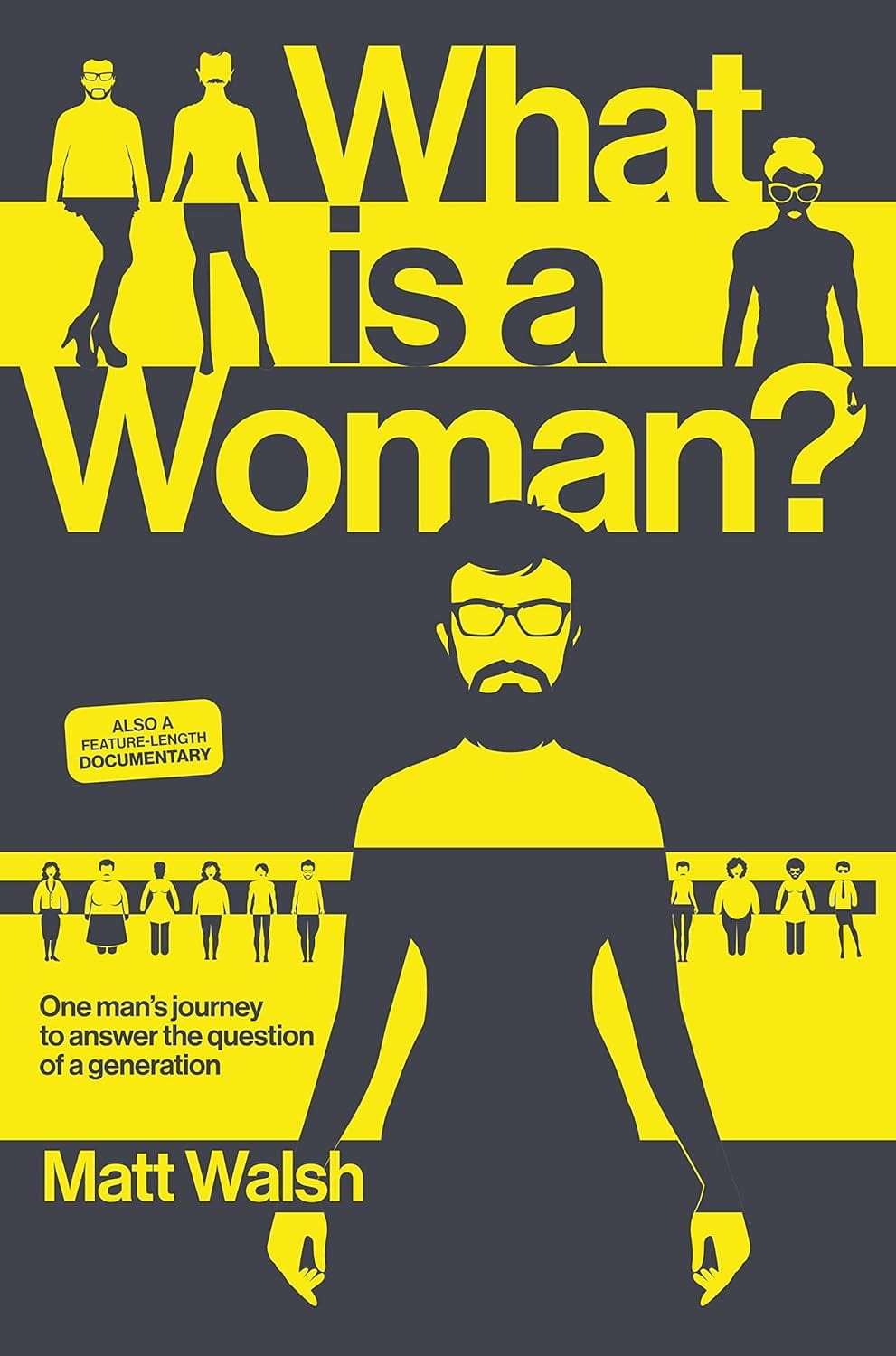

WhatIs_a_Woman____One_Mans_Jo-_Walsh_Matt_copy_copy 1.pdf (file not included in this release)
Summary (Mine)
- How gender disorder turned into a leftist ideology, its history and how its effecting children and adults.
AI Summary
The highlights from “What Is a Woman?” by Matt Walsh are extensive and cover a range of topics related to gender theory, its history, and its societal impact. Here’s a concise summary in bullet points:
- History of Gender Theory: Traces the origins and development of gender theory, focusing on key figures like Alfred Kinsey, John Money, and their contributions to the field.
- Gender Theory and Education: Discusses the integration of gender theory into educational curriculums, highlighting the shift from sexual education to gender education.
- Transgender Cultural Shifts: Examines the rise of transgender visibility and acceptance in popular culture, media, and politics.
- Debates on Gender Identity and Truth: Explores philosophical and psychological perspectives on gender identity, including debates about the nature of truth and self-perception.
- Medical Aspects of Gender Transition: Details the medical processes and implications of gender transition, including hormone treatments and surgeries.
- Controversies and Criticisms: Presents various criticisms and controversies surrounding gender theory and practices, such as the impact on children, medical ethics, and societal norms.
- Case Studies and Personal Accounts: Includes specific case studies and personal stories to illustrate the real-world effects of gender theory and its applications.
This summary highlights the main themes and arguments presented in the book, focusing on the evolution and influence of gender theory in various spheres of society.
Quotes
“The main difference between gender identity disorder and gender dysphoria is that the pathology is no longer that the child is questioning who they [sic] are. Rather, it’s the distress that the child feels, which is due to society, the parents, the school, not accepting those feelings of the child.” With gender identity disorder, the issue lies in the person. With gender dysphoria, the problem is everyone else. -Dr. Grossman
Dr. Peterson was swift to condemn the very idea of affirmative care. “There’s no such thing as a gender-affirming therapist. That’s a contradiction in terms,” he told me. “If you’re a therapist, it’s not your business to affirm.”
Gender-confused people who aren’t affirmed in their gender identity are at a high risk for suicide. But the inverse is also true. Gender-confused people who are affirmed in their gender identity are also at a high risk for suicide. That’s because people with gender dysphoria trend towards suicide no matter what. 8
Dr. Grossman unpacked it further. “These [gender dysphoric] kids, as I mentioned, have a lot of comorbidities. A lot of them were hurting themselves. A lot of them were suicidal before they even discovered gender. That is never part of the discussion when we talk about these kids hurting themselves and committing suicide.”
there are masculine girls. There are feminine boys. What are we going to do about that? Carve them up? Convince them that [they’re the wrong gender] when they’re three? - Jordan Peterson
MAIN IDEAS, TAKEAWAYS & SIMILARITIES
- Early proponents of gender theory were fighting against the religious constraints put on sex. Transgenderism is just a part of this larger movement of sexual liberation.
- “eunuchs” & “Two-spirited peoples” is bullshit.
- Timeline:
- Magnus Hirschfeld (German) — Grandfather of LGBT. Promoted gay rights and invented term of tranvestivism.
- Henry Benjamin (German) — Hormone therapy to cross dress
- Alfred Kinsey — Took Hirschfeld & Benjamin’s ideas and brought it to American consciousness. Expert on wasps, fraud on sex research.
- John Money — Modern gender theory. Gender separate from sex.
- Disgusting history of the pioneers of gender theory, especially Kinsey and Money.
- John Money re-defining the word “gender”
- Separating gender & sex; Gender being learned.
- Many early proponents supported pedophilia.
- How it spread: John Hopkins, NYTs article, DSM V changing it from individual’s disorder to a societal problem, spreading to other universities.
- Reimer Twins
- Tug of war between being “performative” and being definitive.
- 1990 started gender studies degrees
- Promotion of Sex Ed through SIECUS
- DSM V: Gender identity disorder → Gender dysphoria
- Rapid Onset Gender Dysphoria
- Gender identity disorder: Between 1 in 30,000 and one in 110,000
- 4785 people out of 335 million (US pop in 2024)
- Brutality of gender surgeries
- Suicide threats as moral blackmail
- Suicide rates are increasing
- Higher risk if they get affirmed or don’t get affirmed.
- Group have multiple mental disorders—not simply gender confusion.
- Gender-confused people who aren’t affirmed in their gender identity are at a high risk for suicide. But the inverse is also true. Gender-confused people who are affirmed in their gender identity are also at a high risk for suicide. That’s because people with gender dysphoria trend towards suicide no matter what. 8
- Puberty Blockers - Hormones
- Many medical issues
- Osteoporosis etc.. (pg. 114)
- Not FDA approved (Lupron)
- Don’t improve happiness
- Nearly 100% will proceed to cross-sex hormones and surgeries.
- Sex is binary. Gender is just temperament.
- Lots of people making money from this
Highlights
CHAPTER 2 THE HISTORY OF GENDER THEORY (Page 12)
transhumanism (Page 13)
Matthew 19 did mention eunuchs. Unfortunately, he was wrong about everything else. (Page 14)
Origen wrote on that exact verse that Dr. Bowers mentioned. He wrote that God was talking about celibacy and “means not the excision of the members” in this verse. “Since the man who has mutilated himself, in fact, is subject even to a curse.” It only got more extreme from there. “For to cut off our members has been from the beginning a work of demoniacal agency, and satanic device, that they may bring a bad report upon the work of God, that they may mar his living creature.”3 Looks like transgender doctors aren’t exactly the best source on theology. (Page 15)
The Bible never actually mentions anything that we would recognize as the modern conception of transgenderism. (Page 15)
“The principal theme relating the transgender/transexual person to the ‘eunuch’ as described in the Bible is at best a questionable connection.” The whole theory rests on conjecture is “disputable and sometimes obviously incorrect.”6 that (Page 15)
eunuch trope a method “employed by transgender Christians to alleviate [their] cognitive dissonance.”9 (Page 16)
According to HHS, Native American “two-spirit people” combined the traits of both men and women but were considered neither male nor female. They also received their spirit (their gender?) from the gods in some sort of mystical way. Was this a common belief? Was it a big part of Native American culture? Does this have anything to do with a man becoming a woman or a woman becoming a man, or is it merely the spiritual idea that the gods can impart characteristics of both men and women? that thought I wasn’t Apparently, rooting the only one transgenderism in the idea of “two-spirit” was a bit thin. In none other than the Encyclopedia of Gender and Society, it says that the term “two-spirit” itself “emphasizes a Western idea that gender, sex, and sexuality are binaries. It implies that the individual is both male and female, and that these aspects are intertwined within them. The term moves away from traditional Native America/First Nations cultural identities and meanings of sexuality and gender variance.” Furthermore, the encyclopedia noted that “the idea of gender and sexuality variance being universally accepted among Native American/First Nations peoples has become romanticized.” (Page 17)
if it’s an “arbitrary social construction,” then maybe transgenderism really has been with us since the dawn of time, and human beings have just been viciously repressing it for millennia (Page 18)
THE REAL ROOTS OF GENDER THEORY (Page 19)
what matters is that now we think that men and women can decide whatever they want about themselves. (Page 19)
seeds were actually planted by a particular person, a German physician by the name of Magnus Hirschfeld. Few people in America have heard of him, but in the 1930s he was dubbed “The Einstein of Sex,” and he’s considered the primogenitor of the gay rights movement. (Page 20)
“Homosexuality was part of the plan of nature and creation just like normal love,” Hirschfeld said in a 1907 testimony defending an army officer accused of having gay sex.16 Suffice it to say, Hirschfeld was very, very ahead of his time. (Page 20)
“transvestitism,”20 Hirschfeld broke ground by coining new terms like from which homosexuality,21 as people who proactively hoped to change their sex.22 In fact, Hirschfield described a multiplicity of what he called sexual androgynes, homosexual, and transvestites—all of whom were deemed a “third sex” who deviated from the male and female norm. hermaphrodites, “intermediaries” distinguished like he (Page 21)
“the woman who needs to be liberated most is the woman in every man, and the man who needs to be liberated most is the man in every woman.”24 Above all others, Hirschfeld was taking the first, tepid steps of forming the idea of gender as distinct from sex. (Page 21)
his Institute for Sexual Science performed some of the earliest known sex change surgeries on these so-called transvestites. (Page 21)
Hirschfeld is the grandfather of the modern LGBT movement. (Page 21)
the launcher of Professor Dagmar Herzog of the City University of New York Graduate Center underscored Hirschfeld’s influence: “[He] was ‘the first’ in so many ways: the founder of the first gay and lesbian rights movement, to decriminalize homosexuality, first vocal and empathetic defender of transgender rights (including facilitating early gender confirmation surgeries), first to open an institute of sexual science, first to start a medical journal dedicated to sexual minorities, first to use film and pamphlet literature and public talks to combat popular anti-homosexual prejudice, first to develop support groups for same-sex-desiring individuals in order to facilitate self-acceptance.” first campaign (Page 22)
sexologist named Harry Benjamin. (Page 22)
Truth be told, in the 1930s, 40s, and 50s, America was hardly a fertile place for gender theory—certainly not as open to the ideas as Weimar Germany. (Page 22)
Hirschfeld and Benjamin may have been developing the doctrine and honing the message, but they (Page 22)
needed a voice crying out in the wilderness to prepare the way of transgenderism, to make queer the straight path, and to condition people for this new “truth.” That man was Alfred Kinsey—a personal colleague of Harry Benjamin who received materials from Benjamin for his research and who, in return, referred patients to Benjamin for therapy. (Page 23)
THE SEXUALLY CURIOUS CASE OF ALFRED KINSEY (Page 23)
According to Dr. Grossman, the dam holding back gender theory began to break in the middle of the 20th century and, like so much social degradation, it started by targeting children. Before children were ever injected with opposite sex hormones or told that they could be a man born in a woman’s body or a woman born in a man’s body, there first had to be a disruption in the understanding of childhood, development, and sex itself. Kinsey was just the man for the job. (Page 23)
No one before Kinsey had attempted to research and describe actual sexual practices among Americans.39 In this approach—an approach pioneered by the likes of Hirschfeld and Benjamin—sex was no longer governed by the dictates of morals or truth but by the concepts of health and freedom. It was a seismic intellectual shift, and it had profound consequences not only on America but the world. (Page 24)
when children and teenagers are repressed by [JudeoChristian] values, that is when people begin to suffer terribly,” (Page 24)
Kinsey didn’t exactly have the academic background to make such an assertion. He wasn’t a physician or a psychologist. In fact, he was a zoologist whose expertise was in wasps—and he studied wasps intensively for roughly eighteen years40 before shifting his focus to sex in 1938. (Page 24)
Kinsey electrified the assembled students by announcing at the outset that there were only three types of sexual abnormality —abstinence, celibacy, and delayed marriage (Page 24)
“His research was published to great fanfare,” Dr. Grossman told me, “because in his research he claimed that… the way that we think of how people are living in terms of their sexuality is just a complete cover-up.” Standing alongside researchers and professors in white coats and armed with diagrams and statistics, Kinsey allegedly revealed that everyone was living a double life. “Almost everyone in the country, male and female, is living a life of sexual (Page 25)
freedom, multiple partners, different sexes, experimentation, different activities, children, babies… and he claimed that his research proved it,” Dr. Grossman said. According to one biographer, his findings were “being discussed in homes, grocery stores, break rooms, and on the radio,”47 and another said that his major accomplishment “was to challenge most of the assumptions about sexual activity in the United States.” (Page 26)
It took years, but a researcher named Judith Reisman uncovered the truth. “[Kinsey] was interviewing convicted sex offenders,” Dr. Grossman told me. “He was going into jails and interviewing child molesters, people who committed sexual assault. He was interviewing prostitutes… terrible experiments [were] done on children under year one. They were basically being sexually assaulted.” According to Dr. Grossman, Kinsey’s entire methodology was bunk. (Page 27)
Dr. Grossman’s theory was that Kinsey was projecting to rationalize his own perversions. “What he wanted to do is to be able to say, ‘No, it’s not like it’s just me. Everyone’s like this. Everyone’s like this, not me.’ I mean, I’m a psychiatrist, but it’s pretty clear what his motivation was.” (Page 27)
KINSEY’S CREEPY FOCUS ON KIDS (Page 27)
As Kinsey biographer Jonathan Gathorne-Hardy put it, “Theoretically, therefore, as far as Kinsey was concerned, there was nothing automatically wrong with child-adult sex.” (Page 28)
I asked Dr. Grossman if there was anything at all scientifically valid about Kinsey’s research. “Maybe from his research about wasps,” she retorted. “I think in this area [of sexuality] he was a fraud.” (Page 29)
Adults with their own peculiar sexual fantasies and tastes began to project their desires and confusions onto children. It was only a small jump from that to the supposition that children are born with a free-floating gender too. (Page 29)
Kinsey himself didn’t approve of genital surgery in an attempt to change one’s sex. (Page 29)
Kinsey’s research seemed to be following a natural development. (Page 30)
Where Kinsey “described the varieties (Page 30)
of sexual behavior of Americans,” another man “took the next step and constructed a theory of sexual development, emphasizing the interaction and interdependence of social, psychological, and biological factors.”71 That man wove together the disparate threads and earliest hypothesis of gender theory into a more cohesive whole. Effectively, he was the father of what we now recognize as gender theory, and his name was John Money. (Page 31)
CHAPTER 3 JOHN MONEY (Page 32)
John Money was the one who first put the pieces together. In fact, he was the first person to use “gender” as a term distinguishable from sex. (Page 32)
FOLLOWING MONEY (Page 32)
“Father of Gender Theory.” (Page 33)
another sexologist allegedly marred by a troubled childhood. (Page 33)
Money developed what would now be called “gender dysphoria” (Page 33)
As a psychiatrist, Dr. Grossman saw a common thread: “You can see how… if you look at the psychology of both John Money and Alfred Kinsey, you see the suffering that they went through and how they came up with theories that would give them some relief from that suffering.” (Page 33)
“John Money came up with a theory that each of us is born a hermaphrodite, at least psychologically,” Dr. Grossman told me. Effectively, nature means nothing, and nurture is the only aspect that influences whether someone grows up to think of him or herself as a male or female. This fits in very nicely with modern theories about gender roles—not to mention the very ideas of masculinity and femininity—as all being “social constructs.” If nurture is everything, then there’s no real, biological reason whatsoever that a girl would prefer to play with dolls and a boy would want to play with trucks. (Page 34)
“When John Money came up with a theory that each of us is born a hermaphrodite, we, at least psychologically, could be either. To him, that would have been an answer to his distress and his pain, not wanting to identify as a male, as a father, as his father.” (Page 34)
theory that only nurture counts and not nature] you could almost believe it,” she said, “because we couldn’t look at the X and Y chromosomes the way that we can now.” (Page 35)
It’s important to note that while Money’s theories have obvious implications for science, medicine, and society, Money himself was a psychologist—he wasn’t a medical doctor or a surgeon or even a biologist.15 In a way, his theory was divorced from biology because, by training, he focused on behavioral aspects alone (Page 35)
Things like sex hormones, wrote Money, “have no direct effect on the direction or content of inclination. They are assumed to be experientially determined.” (Page 35)
As the New York Times wrote in 1973 while discussing Money’s “findings,” “If you tell a boy he is a girl, and raise him as woman, he will want to do feminine things.” (Page 35)
Money and his team chose the word “gender” as something psychologically distinguishable from sex. Money defined sex by six different factors: assigned sex, external genitalia, internal reproductive structure, hormonal and secondary sex characteristics, gonadal sex, and chromosomal sex. (Page 35)
It’s not that “gender” is a made-up word. It was used before, predominantly as a way to describe whether words in other languages were masculine or feminine. Ultimately “gender” has its roots in the words (ironically) “gene,” “genus,” and “genre”—all ways of classifying and ordering or grouping people or animals or objects together. (Page 36)
Ironically, Money, by an apparent act of will, chose a word meant to provide order and changed it to create confusion and disorder. It wouldn’t be the first or the last time in my journey that I discovered proponents of gender theory abusing and misappropriating language. (Page 36)
“arbitrary social construction.” (Page 37)
Meyerowitz drew a direct connection between this theory and Kinsey: “Alfred Kinsey and his colleagues had rejected both the theory of human bisexuality and psychoanalytic theories of early personality development. They argued that much of human sexual behavior, including homosexuality and transvestism, resulted from ‘learning and conditioning.’ Similarly, in their studies of intersexed conditions, Money, Hampson, and Hampson pointed to forms of social learning as the source of gender.”22 One man was building upon the work of another. (Page 37)
Unsurprisingly, there is a popular idea today that children not only are blank slates when born, at least in regards to gender, but also should be raised in an androgynous environment and urged by their parents to choose their own gender—and continue to cycle through an infinite array of gender options as they develop. That idea can be clearly traced back to John Money. (Page 37)
“Gender… is a perception. It’s a feeling,” Dr. Grossman told me, describing how Money’s theory played out. “It’s a way of identifying. It’s an experience. Ok, that’s subjective. That’s up to the person. That can change from day to day.” (Page 38)
idea that prenatal hormones can influence behavior as well,25 opening the door to modern experiments with hormone therapy. (Page 38)
MONEY’S POLITICAL (AND SEXUAL) AGENDA (Page 38)
Promethean hubris. (Page 38)
“sexual orientation, (Page 39)
“affectional pedophilia,” (Page 39)
pro-pedophilia comments (Page 39)
Money’s support for pedophilia goes far beyond an exercise in dismantling Victorian prudishness. This is the full-scale destruction of any moral guardrails whatsoever, and the end result is nothing less than throwing the most vulnerable and defenseless people in our society—our children—to the wolves, subject to the sick and twisted desires of those around them. (Page 40)
It was becoming clear that full and complete sexual anarchy isn’t a corruption of the project of the transgender movement or of the sexual revolution, for that matter. In fact, the exercise of unrestricted desire is at the core of the project of sexual liberation—and transgenderism is just one part of this movement. (Page 40)
openly defended child sexual abuse for the sake of protecting sex research (Page 42)
THE RISE OF SEX CHANGE OPERATIONS (Page 42)
John Money wasn’t the first to conduct a sex change operation, but he may have done the most to make the idea palatable to polite society. (Page 42)
first surgical patient in 1965 (Page 42)
Johns (Page 42)
Hopkins Gender Identity Clinic (Page 43)
of the nearly 2,000 requests, only one-fifth were from females who wanted to attempt to have the genitals of males, while the rest were all males who wanted to be females, suggesting that without the influence of mass social pressure, there are far more men wanting to become women than the other way around. (Page 43)
Thomas Buckley, at the New York Times, (Page 43)
Soon enough, there were headlines across the nation pushing the same line about how the reputable Johns Hopkins Hospital approved (Page 43)
of the procedure. (Page 44)
Soon, there were more programs at Northwestern University Medical School, Stanford University, and University of Washington in Seattle. In a little over a decade, doctors at American universities had conducted more than 1,000 sex change operations, and there were roughly twenty centers for sex change surgery in the United States (Page 44)
Ironically, thirteen years later Johns Hopkins shuttered the clinic after one of their own studies failed to find evidence that sex change operations benefited transsexual people. (Page 44)
Ironically, thirteen years later Johns Hopkins shuttered the clinic after one of their own studies failed to find evidence that sex change operations benefited transsexual people (Page 44)
THE REIMER TWINS (Page 45)
“gender identity gate,” which happened around three or four years old when he believed gender identity was more set in stone. (Page 47)
Brenda’s living contradiction of nascent gender theory would be laughable if what was done to him wasn’t so cruel. He apparently wanted to be a mechanic and had a “very masculine gait” according to the documentarians.62 Throughout his childhood, he never felt like he was the gender all the authority figures in his life told him he was. (Page 48)
As for David Reimer, he soon revealed that castration and forced femininity were far from the only crimes Money committed against him. Phil Gaetano, writing for Arizona State University School of Life Sciences, recounted the terrifying details. “During the twins’ psychiatric visits with Money, and as part of his research, Reimer and his twin brother were directed to inspect one another’s genitals and engage in behavior resembling sexual intercourse,” Gaetano wrote. “Reimer claimed that much of Money’s treatment involved the forced reenactment of sexual positions and motions with his brother.” (Page 49)
DEFENDING THE INDEFENSIBLE (Page 50)
Almost immediately after the Johns Hopkins Gender Identity Clinic founded by Money was shuttered, one of Money’s protégés, Dr. Fred Berlin, began a sexual disorders clinic at Johns Hopkins—a clinic explicitly recognized as an extension of Money’s work.68 In Dr. Berlin’s office at Johns Hopkins, there was a photo of a baby Adolf Hitler. (Page 50)
Others made excuses or ignored the Reimer case entirely, all in a seeming attempt to defend the trans movement and to protect the reputation of the father of gender theory. (Page 51)
I realize now that the reason people don’t talk about the history of gender theory is not because the information isn’t available but because the details are shameful, immoral, disgusting, and—to use a term gender theorists hate—perverse. (Page 52)
I learned that gender theory is the brainchild of sick people like Alfred Kinsey and John Money, people whose experiments masqueraded as science and who used their positions of authority to overthrow the sexual status quo and normalize what good people know instinctively is wrong. When they were done, they had left the door open to everything from sex change surgeries to pedophilia to the open sexualization of children. (Page 52)
CHAPTER 4 HOW GENDER THEORY BECAME THE CORE CURRICULUM (Page 53)
universities (Page 53)
Alfred Kinsey and John Money began to popularize their ideas of sexualized and genderless children as far back as the 1940’s, ’50s, and ’60s from their respective perches at Indiana University in Bloomington and Johns Hopkins (Page 54)
Judith Butler, (Page 54)
She took the heart of Money’s thesis but extended the timeline and proposed that the locus of gender changes was not only the outside influences of nurture but also a personal process of action and behavior. Gender is the result of how we talk, act, gesture, dress, and behave. (Page 54)
If gender is performative, then obviously gender is something much more fluid and not set in stone at three or four years old, as Money hypothesized. Instead, gender is the result of a continual dialogue between the person and his or her surroundings to create a masculine or feminine identity, whatever that means now. (Page 55)
There is no gender identity behind the expressions of gender… identity is performatively constituted by the very ‘expressions’ that are said to be its results.” (Page 55)
A good rule of life is that the less clear people are when they speak, the more they are trying to hide. (Page 56)
gender is about your interactions with and relationships to others (Page 56)
GENDER THROUGH THE EYES OF THERAPY (Page 57)
gender is really a process of self-exploration (Page 58)
gender has its roots in selfdefinition. (Page 58)
Gender is performative. (Page 59)
So is gender a fluid, lifelong journey? Or are people born the wrong gender? Is it even possible to believe both at the same time? Nobody I spoke with seemed to notice the apparent contradiction. (Page 59)
Consistency matters much less to gender theory than that sexual norms and traditional modes of masculinity and femininity are disrupted. In the end, it doesn’t matter why someone says he or she is transgender, only that you accept it. Almost everyone I had spoken with was a relativist. But as I later learned, their relativism stopped where contradicting their opinions began. (Page 59)
Butler’s opaque (Page 59)
philosophizing had really infiltrated the minds of the highly educated people (Page 60)
Since 1990, the number of people awarded women’s and gender studies degrees from American colleges increased by more than 300 percent. In 2015 alone, more than 2,000 students graduated with women’s or gender studies degrees. (Page 60)
THE PERVASIVENESS OF SEX ED (Page 60)
“Behind the whole sex education movement was Kinsey ideology,” said Dr. Grossman, who has actually devoted much of her research to sex education. (Page 60)
Kinsey and Money’s work led to the introduction of sexually explicit materials into the classrooms of universities. Dr. Judith Riesman, the researcher who uncovered Kinsey’s sexual abuse of children, wrote that “the introduction of pornographic films into medical training, and the unwholesome influence of the films on individual doctors and the profession as a whole, were brought about by Kinsey.”13 (Page 61)
Professor John Money compiled an illustrated presentation called “Pornography in the Home,” which became very popular with students at Johns Hopkins Medical School. Since Johns Hopkins enjoys a leadership role among American medical colleges, it is not surprising that roughly 90 percent of medical schools followed its lead in initiating explicitly sexual films as part of the curriculum for their students.”14 Much like Money leveraged the prestige of Johns Hopkins to normalize sex change surgeries, he used the same method to push pornography into education. (Page 61)
SIECUS was the entity that most aggressively turned Kinsey’s ideas about sex education into a reality in kindergarten through twelfth grade education—and SIECUS’s roots were, let’s just say, seedy. “[Kinsey] was pals with the individuals that were at the helm of creating the sex industry,” Dr. Grossman explained to me. “Hugh Hefner, for example, gave money toward creating an organization called SIECUS.” (Page 62)
call SIECUS advances this ploy through the production of them, which offer they educational guidelines, as recommendations for how schools can offer “comprehensive sexuality education” for students from kindergarten to twelfth grade. Notice it’s not just “sexual” education; it’s “sexuality” education. “Sex” could be limited to mean the understanding of reproductive organs and sexual health. “Sexuality,” on the other hand, is much, much broader. (Page 62)
These guidelines include calls for sections on such subjects as contraception, abortion, sexual fantasies, and masturbation—all in an attempt to help cultivate in students a radically open and permissive understanding of sexuality. The only reason anyone would conceive of this as being acceptable for young children is thanks to Kinsey’s “research” on pre-adolescent orgasm and his proposition that people are sexual from birth. (Page 63)
why does a fourteen-year-old need to know that? Why would an eight-year-old? The obvious implication is that there’s nothing at all wrong with a fourteen-year-old having sex— and that there are ways to manage sex and make it “safe.” (Page 63)
they rarely, if at all, discuss the profound spiritual, moral, health-related, and emotional harm that people can cause themselves even when engaging in purportedly “safe” sex. (Page 63)
sex education was about sexual freedom (Page 64)
“If this is shown by a teacher to her students in fourth grade—ten years old is, I guess, fourth grade, fifth grade—it gives a message to the student that, number one, this is ok. Number two, school is where I learn about these things, not home. I learn about my body, about sexuality, about gender, about all these things at school.” (Page 65)
Divorcing sex education from the family environment is critical to Kinsey’s theory of liberated sexuality. The less parents know, the better. As Kinsey is reported to have said frequently, “The difference between a good time and rape may hinge on whether the girl’s parents were awake when she finally arrived home.” (Page 65)
HOW SEX ED LED TO GENDER ED (Page 66)
gender ideology entered the education system the same way that extreme sexual openness did, moving first from scientific discussion then to academic dogma and finally to a mandatory part of public education. The only difference is that it happened a lot faster. (Page 67)
After people like Money and Butler broke ground in the theory of gender, the basic tenets of gender ideology moved from radical theory to scientific “fact.” The big shift came in 2012. (Page 67)
“So what is gender identity disorder? Is it a mental illness?” I asked Dr. Grossman. “Well, we’re not supposed to use that term anymore as of 2012, but prior to 2012 we used the term to describe a disorder that was very rare,” (Page 67)
“The main difference between gender identity disorder and gender dysphoria is that the pathology is no longer that the child is questioning who they [sic] are. Rather, it’s the distress that the child feels, which is due to society, the parents, the school, not accepting those feelings of the child.” With gender identity disorder, the issue lies in the person. With gender dysphoria, the problem is everyone else. (Page 67)
What happened in 2012 was that the DSM was updated to DSM-5— and with it “gender identity disorder” was dropped and “gender dysphoria” was added. (Page 67)
Generally they’re activists, especially when it comes to these issues—sexual issues and gender issues… So this is not a consensus.” (Page 68)
Once this small group of ideologues changes the definitions, the medical establishment, professional organizations, and other psychiatrists can point to it as definitive, the final word. They use the weight of an established publication to beat back any dissent and label people as anti-science. (Page 68)
When gender confusion was redefined from being an internal pathology and into being an identity, that opened the way for teachers and the education system to more aggressively teach about fluid gender as just another part of human sexuality. Gays and lesbians had already spent decades proactively pushing to get prolibraries and schools.27 The transgender gay materials movement quickly made up for lost time. into (Page 68)
The most up-to-date SIECUS guidelines state definitively that one of the “life behaviors of a sexually healthy adult” is to “affirm one’s own gender identities and respect the gender identities of others.” Other sections say that “people’s understanding of their gender identity may change over the course of their lifetimes” and that “gender role stereotypes are harmful to both men and women.” 28 Dr. Grossman, as usual, put it more succinctly: “Kids are being taught that gender is between the ears, it’s what you think, and sex is between the legs—and the two are completely different things.” (Page 68)
gender unicorn is designed for kids in kindergarten and even preschool. (Page 69)
From the classroom, we’ve seen a sort of social contagion. You can’t go anywhere, read anything, watch any movie, view any ad, or have any conversation without gender theory prodding its way in. Gender theory is the new civil religion. (Page 70)
CHAPTER 5 THE TRANSGENDER TAKEOVER (Page 71)
FROM UNKNOWN TO CELEBRATED (Page 71)
1950s, a former GI from the Bronx who renamed himself Christine Jorgensen went to Copenhagen, Denmark, received (Page 71)
a sex change surgery and massive doses of estrogen, and became the first international transgender media sensation. (Page 72)
1970s, the controversy over Renee Richards broke onto the scene, presaging debates we are still embroiled in today. Renee Richards was a tennis player who underwent a sex change and proposed that, as a result, he was a woman. (Page 72)
In 2008, the reality show “America’s Next Top Model” featured a transgender character, normalizing transgenderism with regular appearances on many Americans TV diets. A few years later, Bruce Jenner was reborn as “Caitlyn.” (Page 72)
Obama administration lifted the ban on (Page 72)
transgender service members in the military (Page 73)
Amazon Prime produced a remake of the classic Cinderella, casting the fairy godmother as transgender.6 In the Marvel Universe—which produces the biggest blockbuster hits today—Disney (which owns Marvel) announced that there would soon be a transgender superhero. (Page 73)
Rachel Levine was confirmed as the first transgender cabinet secretary, and he now runs the Department of Health and Human Services charged with managing health policies governing, among other issues, Medicare, Obamacare, and the coronavirus. We’ve had our first transgender Rhodes Scholar,15 our first transgender boy scout,16 our first transgender national political party convention speaker,17 and even leaker and our whistleblower in the person of Chelsea Manning. The amount of history being made is just staggering. transgender government first high-profile (Page 74)
WHAT IS TRUTH? (Page 75)
A seeming key to transgenderism appeared to be this idea of “accepting” or having “acceptance” or, going one step further than that, proactively “affirming” people in their decision to change genders. In fact, it began to dawn on me that the staggeringly fast advance of the transgender movement through popular culture is driven by the twin powers of acceptance and affirmation. It all just sounds so good, so positive, that it’s difficult to resist. (Page 75)
True to 1960s form, the way to be authentic and find the fullness of life, according to Comfrey, is not to fulfill your duties and obligations, rise to the challenge of human existence, or live in accordance with some ultimate truth. Rather, fulfillment comes from loosening restrictions and casting off any inhibitions that might hold the lone individual back. (Page 76)
Self-discovery and self-acceptance come first. This concept isn’t unique to gender theory. Popular philosophies posited by everyone from Oprah Winfrey down to feel good Instagrammers promote the idea that self-actualization comes through self-understanding. Fullness comes from within. Happiness is found after first finding “my truth.” (Page 76)
from within Defining everything the self causes profound frustrations. It makes it impossible to pin down facts and ideas. (Page 77)
You can’t combat gender theory through logic. Honestly, you can’t even understand gender theory through logic. Logic means truth. It demands an external reality from which to judge actions and determine events and process experiences. Gender theory has none of that. It is relativist. (Page 77)
gender theorists have decided that gender is not rooted in reality, but other things are. The distinction is arbitrary. (Page 78)
LANGUAGE FLUIDITY (Page 79)
When it comes to gender, the language is always changing. Is it “mastectomy” or “top surgery”? Is it “sex change” or “bottom surgery”? people.” “Breastfeeding” is “chestfeeding.” “Nursing women” are now “nursing (Page 79)
In a weird way, the social libertarians and the gender ideologues are operating on similar presuppositions. They both assert the primacy of freedom and self-definition. As such, it only seems natural that you are free to do what you want in your own sphere as long as you don’t harm anyone else. Your freedom to swing your arms ends at my face, as the saying goes. (Page 81)
RAPID ONSET GENDER DYSPHORIA (Page 81)
A simple formula holds that when society condemns and (Page 81)
discourages something, you get less of it; when society affirms and promotes something, you get more of it. (Page 82)
“ROGD is a social contagion that comes on suddenly in adolescence, afflicting teens who’d never exhibited any confusion about their sex.” (Page 82)
ROGD largely shows itself in young, teenage or pre-teen girls who are probably more susceptible to social pressure than any other group of people in human existence. (Page 82)
Few other eras have been so replete with broken homes, divorced parents, unmoored social change, unstable local communities, frequent moves, lack of a common culture, faith, and experiences among peers, overindulgent acceptance of sexual experimentation among youth, and immediate access to extreme pornography, all on top of inescapable social media that allows others to pretend their lives are perfect (Page 82)
Dr. Littman issued a seminal report on her finding in 201820 where she traced how ROGD advances. “Parents describe that the onset of gender dysphoria seemed to occur in the context of belonging to a peer group where one, multiple, or even all of the friends have become gender dysphoric and transgender-identified during the same timeframe,” Dr. Littman discovered. “Parents also report that their children exhibited an increase in social media/internet use prior to disclosure of a transgender identity.”21 (Page 83)
Dr. Grossman explained the distinction. “There are individuals—rare, very rare individuals—who from an early age, from the first years of life, have consistent, continuous, severe distress from their biological sex,” she told me. “These children, like I said, are very rare. They exist anywhere between one in 30,000 people and one in 110,000 people. Those are the numbers that have been established from long ago. These children suffer, and their parents suffer tremendously. They have what used to be called gender identity disorder.” (Page 83)
They exist anywhere between one in 30,000 people and one in 110,000 people (Page 83)
An overwhelming majority of people say that at least before puberty they felt like something was different, and they kind of knew that something was different.” (Page 84)
According to Dr. Littman’s research, of those who said they experienced gender identity disorder later in their childhood, 82.8 percent were female, and their identity crisis appeared roughly around fifteen to sixteen years old. (Page 84)
“it was much more common in boys; I think five times more common in boys than girls” to suffer from gender identity disorder. (Page 84)
Dr. Littman found that over onethird—36.8 percent of groups—ended up with a majority of the individuals identifying as transgender. “Parents described intense group dynamics where friend groups praised and supported people who were transgender-identified and ridiculed and maligned non (Page 85)
transgender people.” (Page 86)
WHICH IDENTITY IS “ESSENTIAL” AND WHICH ISN’T? (Page 86)
The result of this mass social pressure campaign is measurable. In 2014 there were twenty-four gender clinics in America, almost all in California or along the east coast. The next year, there were forty. Not long ago, the idea of “affirming care” didn’t exist. Now, there are 215 gender-affirming pediatric residency programs pumping out future pediatricians who will take every proclamation of gender dysphoria at face value and start helping children to transition. (Page 90)
“Progress.” “Universal happiness.” Paradise on earth. It’s the goal of revolutionaries in every age. The ideals and battle cries were different in the past—liberty, equality, fraternity; the triumph of the proletariat; the brotherhood of man—but the desire was the same, the desire for mankind to finally be at peace with each other and at peace within himself. These new revolutionaries believe they’ve found the answer that escaped those in the past: true happiness comes from acceptance, from affirmation, from the self. It comes from my will and my understanding and my identity. (Page 91)
CHAPTER 6 THE PROMISE OF TRANSITION (Page 92)
THE ONLY MEDICAL TREATMENT WITHOUT SIDE EFFECTS! (Page 92)
THE PROCESS OF CHANGING SEX (Page 95)
“genital correlation surgery” or “gender affirmation surgery” are better terms. (Page 95)
I find when someone all of a sudden aggressively asserts the use of euphemisms, he’s hiding something. (Page 95)
The idea is that when gender-confused kids are afraid of developing a certain way, this alleged pause gives them time to choose if they would prefer to have medical intervention through cross-sex hormones or even surgery to force their body to develop in a chosen way—all before their body kicks into gear and develops according to the natural plan. Alternatively, Dr. Forcier told me puberty blockers allow children to stop puberty indefinitely and stay prepubescent forever. (Page 97)
female-to-male transitioning is even more difficult. For would-be men, there is also a wide array of cosmetic surgeries to choose from, such as facial masculinization surgery, hair transplants, and breast reduction surgery. When it comes to what some call “bottom surgery,” these women have more options than men who want to transition. (Page 99)
WHAT ARE WE ALLOWED TO AFFIRM? (Page 100)
I have never met a single, successful parent that did anything like this. What kind of parent tells their kids they are perfect just the way they are? Why send your kid to school? Why tell him to sit up straight? Why show them how to share their toys? Why teach her not to lie or cheat? Parenthood is one long, drawn out process of continually molding and shaping your kids to be something better because they aren’t perfect just the way they are. (Page 101)
That doesn’t mean we don’t love our kids. But love isn’t the same thing as affirmation. Love isn’t the endless repetition of “yes.” Love is frequently a series of “no.” No, you can’t keep eating that. No, you can’t touch that. No, you shouldn’t hang out with those people. Without those “nos,” your kid will become an obese burn victim hanging out with drug addicts. (Page 101)
THE TRUE STORY OF A TRANSITIONER (Page 103)
In reality, Newgent says, transgender people aren’t affirming an identity. They are adopting a persona. “Why would people with dark hair want to have blond hair? Why would people with regular lips want to have red lipstick? I mean, it’s cosmetic, right?” Newgent said. “We’ve been doing that since the beginning of time. Why is medical transitioning any different?” (Page 105)
USING SUICIDE THREATS AS MORAL BLACKMAIL (Page 106)
“We find with children that have gender dysphoria, if and when they enter into talk therapy, 82 percent kind of grow out of that and grow into loving being a woman.” (Page 106)
Newgent actually believes that affirmative care causes even more problems by pressuring kids who would otherwise have no psychological issues to embrace an identity out of sync with their sex —a disconnect that everyone agrees comes with great mental anguish. (Page 106)
As a psychologist well-versed in therapy, Dr. Peterson was swift to condemn the very idea of affirmative care. “There’s no such thing as a gender-affirming therapist. That’s a contradiction in terms,” he told me. “If you’re a therapist, it’s not your business to affirm. (Page 107)
Dr. Forcier and Dr. Bowers alluded to seemed to have a clear correlation: no affirmation = high suicide risk. Then I remembered a quote attributed to Nobel Prize winning economist Ronald Coase: “If you torture data long enough, it will confess to anything.” (Page 107)
The truth is, those with gender dysphoria have roughly the same rate of suicide as youths with other mental health conditions. (Page 107)
Gender-confused people who aren’t affirmed in their gender identity are at a high risk for suicide. But the inverse is also true. Gender-confused people who are affirmed in their gender identity are also at a high risk for suicide. That’s because people with (Page 107)
gender dysphoria trend towards suicide no matter what (Page 108)
Dr. Grossman unpacked it further. “These [gender dysphoric] kids, as I mentioned, have a lot of comorbidities. A lot of them were hurting themselves. A lot of them were suicidal before they even discovered gender. That is never part of the discussion when we talk about these kids hurting themselves and committing suicide.” (Page 108)
“This thinking is not clear. It’s not. It’s not backed up by the evidence that we have, and it’s a way to emotionally blackmail the parents. They say, ‘What would you rather have? A living daughter or a dead son?’” (Page 108)
emotionally blackmail the parents (Page 108)
His parents blame John Money, the father of gender theory. They blame Money for the surgery. They blame Money for the insidious ideas he planted in their heads. They blame Money for his abuse of David and his brother year after agonizing year. Gender theory didn’t kill David Reimer. That would be saying too much. But gender theory provided the excuse for inflicting so much pain upon him that David ended up taking his own life. (Page 110)
CHAPTER 7 FALL OF THE HOUSE OF CARDS (Page 111)
affirming gender confusion leads to serious complications and trauma. I had learned that affirmation leads to depression, anxiety, and even suicide, but what happens when people act on that affirmation and interfere with the body on a chemical level? Does it get even worse when they take the next, radical step of making surgical changes that can never be undone? (Page 111)
“COMPLETELY REVERSIBLE?” YEAH, NOT SO MUCH (Page 111)
fourteen-year-old girl has osteoporosis! (Page 112)
twenty-one-year-olds with hearts and lungs the size of an eleven-year-old’s (Page 113)
males take estrogen for an extended period of time, it causes bone loss (Page 113)
The truth is, nobody I spoke with on the pro-trans side ever really dug into the studies. They could cite a million headlines, but I didn’t know if the data was legitimate. (Page 113)
“There are no long-term case studies on hormone blockers, on synthetic hormones.” Newgent went on, “How many studies do they have—long-term studies on hormone blockers for children? None. So we’re saying 82 percent of children will recover from gender dysphoria. We’re going to put them on hormone blockers. We don’t know what the f*ck they’re going to do to our children.” (Page 113)
according to the Journal of Clinical Medicine, is that the long-term use of cross-sex hormones increases the risk of heart attacks, bone damage, liver and kidney failure, and pulmonary embolism. The American Heart Association adds that cross-sex hormones can cause blood clots and strokes as well. (Page 114)
heart attacks, bone damage, liver and kidney failure, and pulmonary embolism (Page 114)
blood clots and strokes (Page 114)
hormone-therapy patients on high-dose anabolic steroids (such as the testosterone taken by female-to-male transitioners) exhibit major mood-syndrome symptoms. Between three and twelve percent go on to develop symptoms of psychosis.” (Page 114)
mood-syndrome symptoms. (Page 114)
psychosis.” (Page 114)
most common puberty blocker drug is called Lupron. It only took the most cursory search to confirm what Newgent and Dr. Grossman had said—a search I hadn’t even thought to do since all the other doctors were so confident. Not only is Lupron not approved by the FDA to be used as a hormone blocker for gender-confused kids, it causes a wide array of adverse health effects that nobody had told me about before (Page 114)
Lupron (Page 114)
fibromyalgia (Page 114)
brittle bones, faulty joints, mood swings, headaches, even cracked spines and thinning bones. (Page 114)
fibromyalgia. (Page 114)
brittle bones, faulty joints, mood swings, headaches, even cracked spines and thinning bones (Page 114)
most common side effects people experienced were depression and anxiety— maybe not because of Lupron itself, but certainly as a result of the pain and hardship they underwent after having taken it. (Page 114)
depression and anxiety (Page 114)
CHEMICALLY CASTRATING KIDS (Page 115)
Lupron was ever used to block puberty in adolescent children, it had another purpose: chemical castration. (Page 115)
She was trying to change the way I thought about chemical castration by calling it something else. She was trying to change the way I thought about using a chemical castration drug on children by calling me “malignant” and “harmful.” (Page 118)
HORMONES DO NOT IMPROVE HAPPINESS (Page 118)
improved happiness (Page 118)
two main studies that evaluated the effects of puberty blockers on mental health, one found absolutely no improvement7 and the other only found extremely marginal improvement.8 Other studies were fundamentally flawed or also failed to show any positive impact on psychological health. 9 (Page 118)
Jack Turban study of 2020 that purportedly showed that transgender adolescents who had access to puberty blockers were 70 percent less likely to commit suicide. (Page 118)
The only problem is that study is a crock too. The study was done online by a pro-trans lobbying group, and only 11 percent of the 3,494 respondents had actually received puberty blocking drugs—an exceedingly small sample size. Even then, this pro-trans-funded survey still found that while 58 percent of those people who didn’t receive puberty blockers planned to commit suicide, so did 55 percent of those who did receive puberty blockers—not that that difference matters much, considering the sample population for that question was only eighty-nine people. (Page 118)
United Kingdom’s National Health Service (NHS) will now limit puberty blockers for children after a court found that children at such a young age can’t possibly weigh the long-term consequences and that research found that the impacts of puberty blockers on things like bone-mass density and height are not actually fully reversible (Page 119)
United Kingdom (Page 119)
Finland, once an early adopter of medical transitioning for adolescents, also found that transitioning failed to improve mental health outcomes.14 In 2020, the Finish National Gender Identity Development Service recommended psychotherapy as the primary sex for treatment reassignment. young, gender-confused people, not (Page 119)
Finland (Page 119)
Sweden, many hospitals and clinics have stopped medical transitions for those under eighteen because of the mounting evidence that medical transitioning has adverse side effects without improving psychological well-being. (Page 119)
Sweden, (Page 119)
In 2021, the Society for Evidence-Based Gender medicine wanted to share information about the impacts of gender-affirming treatment at the annual meeting of the American Academy of Pediatrics (AAP). The AAP rejected the application without any explanation—they refused to even consider data that could contradict the pro-affirmative care side—despite the fact that days earlier 80 percent of pediatricians at the meeting called for more caution when it comes to gender transitions for minors. (Page 120)
BOTCHED SEX-CHANGE HORROR STORY (Page 120)
nearly 100 percent of children who begin puberty blockers will proceed to cross-sex hormones and surgeries.20 (Page 121)
Newgent admitted the studies are out there. But that’s hardly the end of it. “We have studies that said that medical transition helps mental health, helps mental health of kids,” Newgent said. “They’ve all been retracted, modified, changed. But you’re not covering it. ABC’s not covering it, NBC’s not covering it because they’re afraid.” (Page 123)
Dr. Jordan Peterson attributed this terrifying and unscientific medical experimentation to the very foundational claims of gender theory. It’s not that gender theorists were wrong to want to differentiate between people’s biological sex and their outward or psychological characteristics. It’s that they invented the idea of “gender” with all its implications when we already had a perfectly fine way to understand what was going on. (Page 125)
The issue with sex and gender, a lot of that’s just deep ignorance and confusion, with trifling malevolence thrown in there and some willful blindness (Page 126)
Biological sex [is] binary. It’s been binary for, like, one hundred million years—longer than that, since sex evolved a long time ago. (Page 126)
So sex is binary… temperament is not binary.” “So, temperament is gender?” I asked. “Gender is a not good word,” he responded. “It’s a not good word because it’s vague and it isn’t measurable and it isn’t definable and it isn’t precise.” “Can we just say ‘temperament’?” I asked. “What do we even need the word ‘gender’ for?” (Page 126)
people who talk about the diversity in gender are actually talking about diversity in personality and temperament, but they don’t know it. (Page 126)
there are masculine girls. There are feminine boys. What are we going to do about that? Carve them up? Convince them that [they’re the wrong gender] when they’re three? (Page 126)
to some degree, adolescents are often extremely confused, not about their gender identity, you (Page 126)
know, but about their identity.” (Page 127)
THE MEDICAL ESTABLISHMENT IS IN IT FOR THE MONEY (Page 127)
sex change surgeries are deemed experimental, baselines of care have never been established—and surgeons are rarely held accountable. (Page 127)
experimental, (Page 127)
phalloplasties (Page 128)
67 (Page 128)
percent complication rate, (Page 129)
25 percent complication with the flap of skin used to form the phallus and a 64 percent complication with the extension of the urethra (Page 129)
The timing lines up perfectly. The psychology DSM changed “gender identity disorder” to “gender dysphoria” in 2013. In seeming lockstep with that change, Medicare and Medicaid—the largest insurance providers in America—began coverage for sex change surgery in 2014. Private insurance followed suit, with coverage for sex change surgery spiking from around 25 percent in 2011 to 45 percent in 2014. All this opened up a floodgate of taxpayer-fueled funding for medical transitioning. 25 By 2025, the sex reassignment surgery industry is set to reach a market value of more than $1.5 billion.26 (Page 129)
These clinics and medical centers need customers though. It’s no surprise that during the same period as all these insurance and clinical changes were happening, transgenderism splashed with full force on the culture scene, affirmative care was adopted that urged kids to adopt a gender identity different from their biological sex, and rapid onset gender dysphoria first made its appearance. All of a sudden there was a massive increase in the number of customers for medical transitioning. In the UK, the number of young people seeking “gender treatment” saw a 4,000 percent spike in the decade from 2009 to 2018. (Page 130)
CHAPTER 8: THE TRANSGENDER CULTURE WAR (Page 133)
expensive and irreversible Frankenstein experiments of gender transitioning. (Page 133)
That means when you fail to give affirmation, you not only undermine a transgender person’s happiness, you are a danger to his or her “mental health.” And it’s not just that one person you harm; it’s all trans people. When you reject one person’s gender identity, you reject the idea that their identity is rooted in gender at all. That makes you more than a menace to one person’s mental health. (Page 135)
ALWAYS THE VICTIM, NEVER THE VICTOR (Page 135)
THE TRANSGENDER WAR ON WOMEN (Page 138)
Selina Soule, and she’s a track athlete who was forced to compete against biological males throughout high school. (Page 139)
THE TRANS CULTURE CRUSADE (Page 142)
Former pitcher and now former ESPN analyst Curt Schilling learned this the hard way as well after saying something that just about everyone agreed with a few years ago. On Facebook, he posted that “a man is a man no matter what they call themselves [sic]. I don’t care what they [sic] are, who they [sic] sleep with, men’s room was designed for the penis, women’s not so much. Now you need laws telling us differently? Pathetic.” (Page 142)
J.K. Rowling, the author of the Harry Potter series and once a feminist icon, also learned that you can accept 99 percent of the Left’s sexual and social dogma, but if you deviate on even one point, you are anathema. (Page 143)
“trans-exclusionary radical feminist.” (Page 143)
Abigail Shrier—author of the book Irreversible Damage (Page 143)
Perhaps most ironically, so many of these people being censored and attacked from Selina Soule to J.K. Rowling to Abigail Shrier to Dr. Lisa Littman to Scott Newgent are all biological women, a group that was for no short period of time deemed a special protected class by the very same people on the front lines of the transgender crusade. (Page 145)
deadnaming (Page 145)
Public recognition of the lie is mandatory. (Page 146)
Leaked audio from the California Teachers Association (CTA) revealed teachers plotting how to recruit students into LGBTQ clubs without their parents finding out. (Page 147)
That’s when teachers started “stalking”—to use their own words—their students online in order to recruit them into their faculty-formed LGBTQ clubs. (Page 147)
Coexistence and accommodation are contrary to the real goal of transgender activists, who desire nothing more than uniformity. (Page 148)
INDECENT EXPOSURE (Page 149)
Wi Spa, a Korean spa in Los Angeles. After women—including a six-year-old girl—complained about the presence of a biological male in the women’s section exposing himself to them, the staff told them that they couldn’t do anything because the man identified as a woman. The man himself later claimed that he was a victim of transgender harassment. (Page 149)
Biological women have no right to private space any more. (Page 150)
The term is “minor-attracted persons.” Notice the Money-esque bait and switch, changing it from the action or proclivity of “pedophilia” to the identity of “minor-attracted persons.” Once something is claimed as an identity, it can’t be rejected or argued with. You deny someone’s existence to express your disagreement, after all. (Page 151)
These are small rumblings at the moment. But if we’ve learned anything, it’s that radical ideology at universities pushed by unrepentant perverts has a way of going mainstream fast. (Page 151)
THE BRAVE CASE OF DON SUCHER (Page 151)
CHAPTER 9: CRUSHED BY THE BOOT OF THE PINK POLICE STATE (Page 154)
ROB HOOGLAND WAS sitting in a jail cell. (Page 154)
Rob attempted to retake control, but the totalizing transgender ideology had already sunk its roots deep into Mary’s psyche. “If you (Page 154)
don’t let me take testosterone, I’m going to kill myself,” Mary told her father. But Rob knew her better than that. “No, you know you’re not,” he told her. I can imagine Mary hesitating, realizing that the line didn’t work as intended. “I know, but they told me to say that,” she responded. (Page 155)
Rob was summarily banned from trying to persuade his daughter to stop her so-called treatments. He was banned from addressing her (Page 155)
by the name he and his ex-wife gave Mary when she was born. He was banned from referring to Mary as a girl or using feminine pronouns to describe her in any conversation with anyone at any time. Failure to follow these rules would be “considered to be family violence,” the judge said. (Page 156)
he resisted the judge’s order and spoke in public about what was being done to his daughter. Another judge stepped in to stop the publicity. He ordered Rob to stop talking with anyone about his daughter’s hormone therapy except for the people the court authorized him to talk to. (Page 156)
sounded like a dystopian fiction (Page 157)
HOW TO MAKE DISAGREEMENT ILLEGAL (Page 157)
Equality Act, a transformative pro-transgender piece of legislation passed by the House of Representatives in February of 2021. (Page 157)
amends the 1964 Civil Rights Act to include sexual orientation and gender identity so as to include these two groups of people as protected classes.” In layman’s terms, that means disagreeing with the trans agenda will be treated the same as being a racist. (Page 158)
Catholic Hospitals in New Jersey and California have been sued because they refuse to perform hysterectomies on perfectly healthy women who say they are male. Another hospital in Washington State was sued because it didn’t want to chop off the breasts of a physically healthy sixteenyear-old girl who wanted irreversible surgery to confirm her “identity” as a male.2 The Equality Act would nationalize these lawsuits, and any doctor, nurse, or hospital system that fails to go along would be crushed by the law. (Page 159)
WHO IS UNCOMFORTABLE? (Page 162)
Rodrigo Heng-Lehtinen is the Executive Director of the National Center for Transgender Equality (NCTE), an activist organization founded in 2003 to advance the trans agenda in Washington. (Page 162)
“A lot of people don’t realize that it used to be really, really difficult to get health insurance if you happen to be trans just because you were trans,” she said, which is obviously not true. Trans people have always been able to get health insurance, just like everyone else. They just couldn’t have other people pay for medically unnecessary surgeries and therapies to affirm their self-perception—also just like everyone else. (Page 163)
Bullying trans people? What about the trans movement bullying everyone else?! Heng-Lehtinen kept telling me over and over again that people’s opinions on transgenders will change when they get to know transgender people. I wondered if her opinions would change if she met the six-year-old girl who had a penis shoved in her face at Wi Spa. (Page 166)
Everything the pro-trans politicos were telling me sounded so positive and kind. It was about ending discrimination. It was about respect. It was about affirmation. Every policy and regulation and reform was a win-win. Who could be against it? Yet all the while they were working to force, by legal mandate, the acceptance of biological men into women’s spaces, to use our tax dollars to fund hormone therapy and sex change surgeries, and to mark any resistance to their agenda as no better than racism. (Page 167)
SLIDING DOWN THE SLIPPERY SLOPE (Page 167)
Some states preemptively bar any attempts to prevent children from transitioning. Fourteen states and Washington, D.C., prohibit what is derogatorily called “conversion therapy.”5 That means that everyone—parents, counselors, from making an effort to help a person gain or regain a gender identity that conforms with their biological sex. teachers—are prevented (Page 168)
Of course, trans activists are engaged in a population-wide campaign of conversion therapy every single day. Transgenderism is in schoolbooks, on ads, placed into TV shows and movies, and pushed by teachers and therapists and doctors. Every attempt is made to get young people to explore their gender identity and embrace gender fluidity. Every movement that contradicts a person’s biological sex—from acting out the most basic stereotypes to actual clinical feelings of gender dysphoria—are affirmed and embraced and cultivated ad nauseum with or without parents’ consent. (Page 168)
Yet even the smallest attempt to counteract this and assert that biological sex is not some random, useless, outdated concept is treated not merely as backward, but as illegal. And you can guarantee that trans activists like Representative Takano and HengLehtinen would take the first opportunity to ban so-called conversion therapy nationwide if they had the chance. (Page 168)
Ahmed chose to save his son. He quit his job, moved his entire family out of Washington, and went somewhere where parental rights are still respected. Take that in for a moment. An American man was forced to pack up his family and flee oppression, not from (Page 169)
some foreign land, but within America itself. (Page 170)
What the Left is erecting has come to be referred to as, using the words of writer James Poulos, the pink police state. It is totalitarian in nature but warmly wrapped in an ever more multi-colored rainbow flag. The pink police state won’t be enforced by grim, army-greenwearing shock troops. Its soldiers are political activists, teachers, and members of Congress. It enforces order with lawyers and through your fellow citizens, ever at the ready to film your words and movements in an attempt to catch any whiff of anti-trans sentiment so that they can post the video on social media and turn the outrage mob against you. It keeps people in line, not at gunpoint, but through the resident Nurse Ratched who informs you with a cold, polite smile that your daughter is now your son, and we would hate to see what happens if you don’t take him to the gender clinic immediately. (Page 170)
Their regime of anti-discrimination discriminates against women and attempts to end any distinction between male and female. Their desire for acceptance demands affirmation and bans dissent. They require your respect, but they refuse to respect the dictates of biology, the innocence of children, or the most elemental and sacred bond in all of human existence—the bond between parent and child. Their words are easy, but their burden is large. (Page 170)
CHAPTER 10 THE REBELLION (Page 172)
You can tell if someone is telling the truth if they aren’t trying to hide anything. They let their yes be yes and their no be no. Clarity is a mark not only of sincerity, but honesty. (Page 176)
“It’s not a complicated question. It’s been turned into a very complicated question, but it’s not,” she said. “A woman is a female. A female is a biological being with two X chromosomes who reproduces by means of a gamete called an egg, who, in most cases, can conceive a child naturally and carry it in her womb. That’s a woman. Simple enough, right? We don’t have to have pages and pages of explanation about what is a woman and what is a man. It’s not a thorny, complicated subject.” (Page 177)
THE TRUTH IS MARCHING ON (Page 178)
The most important lesson I learned from their examples was to always tell the truth, no matter how much the other side bullies you. Compromising on the fundamental facts of biology and language doesn’t help find common ground with our opponents. It is seen as a sign of weakness. If they’re willing to give hormones with long-term side effects to thirteen-year-olds while stripping parents of custody of their own children when they don’t agree with what’s going on, they certainly aren’t going to be satisfied if you offer a simple pinch of incense to Caesar by using preferred pronouns without agreeing with them on everything else. There is no cafeteria transgender ideology here. As J.K. Rowling taught us, you either buy into all of it or you are condemned. They do not accept half measures. (Page 178)
The other side has built an entire structure on a foundation of lies. Transgender people are not more likely to commit suicide if they aren’t affirmed. Hormone blockers do have long-term side effects and are not reversible. There are real and meaningful physical differences between men and women. (Page 180)
Acknowledging these facts imposes a two-fold duty on parents and adults in the world. First, you can’t imagine your private actions won’t have consequences for those around you. Problems in your marriage pass down to your children. Instability in the home leads to instability in the lives of children. Divorce especially creates a massive disruption and vulnerability in the lives of kids where transgender ideology can enter in with its false promises and comforting lies. (Page 182)
Second, we have a responsibility to help young people in the world recognize that there are consequences to their actions, that transitioning is not cost-free and that this ideology is harmful. To use Newgent’s words, we must help them “see around corners.” (Page 182)
Helping adolescents see around corners works the same way. They have no idea that adults at school or in medical facilities or online will prey on them. They have little to no (Page 182)
preparation to be able to resist when an authority figure tells them they are the wrong gender or that medical transitioning is completely safe. They are defenseless, and it’s our job to defend them. And that job is more important now than ever before. (Page 183)
You can’t be a helicopter parent, but you can be vigilant. And you can preemptively counter the assault on your child’s psyche by teaching them the truth early and often. (Page 183)
EPILOGUE AFRICA (Page 188)
For all the talk about “gender” being a social construct, the truth is that gender theory is itself one of the most complicated and monumental social constructs there is. A whole Jenga tower of critical philosophy, language, culture, and medical advances that allow once unimaginable manipulations of the human body all must first be built up to sustain the fiction of gender identity. The moment you step out of the mind prison socially constructed all around us, you see just how much gender ideology is a product of western privilege, luxury, and decadence. Without a society that can support the likes of professional sexologists, phalloplasty surgeons, gender studies professors, and queer affirming counselors, gender ideology would have never been invented. (Page 191)
Important
Summary (Mine) — State the Ideas of the book in own words (Interrogating Texts)
- How gender disorder turned into a leftist ideology, its history and how its effecting children and adults.
Important
Summary (AI)
The highlights from “What Is a Woman?” by Matt Walsh are extensive and cover a range of topics related to gender theory, its history, and its societal impact. Here’s a concise summary in bullet points:
- History of Gender Theory: Traces the origins and development of gender theory, focusing on key figures like Alfred Kinsey, John Money, and their contributions to the field.
- Gender Theory and Education: Discusses the integration of gender theory into educational curriculums, highlighting the shift from sexual education to gender education.
- Transgender Cultural Shifts: Examines the rise of transgender visibility and acceptance in popular culture, media, and politics.
- Debates on Gender Identity and Truth: Explores philosophical and psychological perspectives on gender identity, including debates about the nature of truth and self-perception.
- Medical Aspects of Gender Transition: Details the medical processes and implications of gender transition, including hormone treatments and surgeries.
- Controversies and Criticisms: Presents various criticisms and controversies surrounding gender theory and practices, such as the impact on children, medical ethics, and societal norms.
- Case Studies and Personal Accounts: Includes specific case studies and personal stories to illustrate the real-world effects of gender theory and its applications.
This summary highlights the main themes and arguments presented in the book, focusing on the evolution and influence of gender theory in various spheres of society.
Important
QUOTES
“The main difference between gender identity disorder and gender dysphoria is that the pathology is no longer that the child is questioning who they [sic] are. Rather, it’s the distress that the child feels, which is due to society, the parents, the school, not accepting those feelings of the child.” With gender identity disorder, the issue lies in the person. With gender dysphoria, the problem is everyone else. -Dr. Grossman
Dr. Peterson was swift to condemn the very idea of affirmative care. “There’s no such thing as a gender-affirming therapist. That’s a contradiction in terms,” he told me. “If you’re a therapist, it’s not your business to affirm.”
Gender-confused people who aren’t affirmed in their gender identity are at a high risk for suicide. But the inverse is also true. Gender-confused people who are affirmed in their gender identity are also at a high risk for suicide. That’s because people with gender dysphoria trend towards suicide no matter what. 8
Dr. Grossman unpacked it further. “These [gender dysphoric] kids, as I mentioned, have a lot of comorbidities. A lot of them were hurting themselves. A lot of them were suicidal before they even discovered gender. That is never part of the discussion when we talk about these kids hurting themselves and committing suicide.”
there are masculine girls. There are feminine boys. What are we going to do about that? Carve them up? Convince them that [they’re the wrong gender] when they’re three? - Jordan Peterson
Important
MAIN IDEAS, TAKEAWAYS & SIMILARITIES
- Early proponents of gender theory were fighting against the religious constraints put on sex. Transgenderism is just a part of this larger movement of sexual liberation.
- “eunuchs” & “Two-spirited peoples” is bullshit.
- Timeline:
- Magnus Hirschfeld (German) — Grandfather of LGBT. Promoted gay rights and invented term of tranvestivism.
- Henry Benjamin (German) — Hormone therapy to cross dress
- Alfred Kinsey — Took Hirschfeld & Benjamin’s ideas and brought it to American consciousness. Expert on wasps, fraud on sex research.
- John Money — Modern gender theory. Gender separate from sex.
- Disgusting history of the pioneers of gender theory, especially Kinsey and Money.
- John Money re-defining the word “gender”
- Separating gender & sex; Gender being learned.
- Many early proponents supported pedophilia.
- How it spread: John Hopkins, NYTs article, DSM V changing it from individual’s disorder to a societal problem, spreading to other universities.
- Reimer Twins
- Tug of war between being “performative” and being definitive.
- 1990 started gender studies degrees
- Promotion of Sex Ed through SIECUS
- DSM V: Gender identity disorder → Gender dysphoria
- Rapid Onset Gender Dysphoria
- Gender identity disorder: Between 1 in 30,000 and one in 110,000
- 4785 people out of 335 million (US pop in 2024)
- Brutality of gender surgeries
- Suicide threats as moral blackmail
- Suicide rates are increasing
- Higher risk if they get affirmed or don’t get affirmed.
- Group have multiple mental disorders—not simply gender confusion.
- Puberty Blockers - Hormones
- Many medical issues
- Osteoporosis etc.. (pg. 114)
- Not FDA approved (Lupron)
- Don’t improve happiness
- Nearly 100% will proceed to cross-sex hormones and surgeries.
- Sex is binary. Gender is just temperament.
- Lots of people making money from this
Important
ADDITIONAL RESOURCES
WhatIs_a_Woman____One_Mans_Jo-_Walsh_Matt_copy_copy 1.pdf (file not included in this release)
Important
PREVIEW (Interrogating Texts)
Important
HIGHLIGHTS
CHAPTER 2 THE HISTORY OF GENDER THEORY (Page 12)
THE REAL ROOTS OF GENDER THEORY (Page 19)
THE SEXUALLY CURIOUS CASE OF ALFRED KINSEY (Page 23)
KINSEY’S CREEPY FOCUS ON KIDS (Page 27)
CHAPTER 3 JOHN MONEY (Page 32)
FOLLOWING MONEY (Page 32)
MONEY’S POLITICAL (AND SEXUAL) AGENDA (Page 38)
THE RISE OF SEX CHANGE OPERATIONS (Page 42)
THE REIMER TWINS (Page 45)
DEFENDING THE INDEFENSIBLE (Page 50)
CHAPTER 4 HOW GENDER THEORY BECAME THE CORE CURRICULUM (Page 53)
GENDER THROUGH THE EYES OF THERAPY (Page 57)
THE PERVASIVENESS OF SEX ED (Page 60)
HOW SEX ED LED TO GENDER ED (Page 66)
CHAPTER 5 THE TRANSGENDER TAKEOVER (Page 71)
FROM UNKNOWN TO CELEBRATED (Page 71)
WHAT IS TRUTH? (Page 75)
LANGUAGE FLUIDITY (Page 79)
RAPID ONSET GENDER DYSPHORIA (Page 81)
WHICH IDENTITY IS “ESSENTIAL” AND WHICH ISN’T? (Page 86)
CHAPTER 6 THE PROMISE OF TRANSITION (Page 92)
THE ONLY MEDICAL TREATMENT WITHOUT SIDE EFFECTS! (Page 92)
THE PROCESS OF CHANGING SEX (Page 95)
WHAT ARE WE ALLOWED TO AFFIRM? (Page 100)
THE TRUE STORY OF A TRANSITIONER (Page 103)
USING SUICIDE THREATS AS MORAL BLACKMAIL (Page 106)
CHAPTER 7 FALL OF THE HOUSE OF CARDS (Page 111)
“COMPLETELY REVERSIBLE?” YEAH, NOT SO MUCH (Page 111)
CHEMICALLY CASTRATING KIDS (Page 115)
HORMONES DO NOT IMPROVE HAPPINESS (Page 118)
BOTCHED SEX-CHANGE HORROR STORY (Page 120)
THE MEDICAL ESTABLISHMENT IS IN IT FOR THE MONEY (Page 127)
CHAPTER 8: THE TRANSGENDER CULTURE WAR (Page 133)
ALWAYS THE VICTIM, NEVER THE VICTOR (Page 135)
THE TRANSGENDER WAR ON WOMEN (Page 138)
THE TRANS CULTURE CRUSADE (Page 142)
INDECENT EXPOSURE (Page 149)
THE BRAVE CASE OF DON SUCHER (Page 151)
CHAPTER 9: CRUSHED BY THE BOOT OF THE PINK POLICE STATE (Page 154)
HOW TO MAKE DISAGREEMENT ILLEGAL (Page 157)
WHO IS UNCOMFORTABLE? (Page 162)
SLIDING DOWN THE SLIPPERY SLOPE (Page 167)
CHAPTER 10 THE REBELLION (Page 172)
THE TRUTH IS MARCHING ON (Page 178)
EPILOGUE AFRICA (Page 188)
CHAPTER 2 THE HISTORY OF GENDER THEORY (Page 12)
transhumanism (Page 13)
Matthew 19 did mention eunuchs. Unfortunately, he was wrong about everything else. (Page 14)
Origen wrote on that exact verse that Dr. Bowers mentioned. He wrote that God was talking about celibacy and “means not the excision of the members” in this verse. “Since the man who has mutilated himself, in fact, is subject even to a curse.” It only got more extreme from there. “For to cut off our members has been from the beginning a work of demoniacal agency, and satanic device, that they may bring a bad report upon the work of God, that they may mar his living creature.”3 Looks like transgender doctors aren’t exactly the best source on theology. (Page 15)
The Bible never actually mentions anything that we would recognize as the modern conception of transgenderism. (Page 15)
“The principal theme relating the transgender/transexual person to the ‘eunuch’ as described in the Bible is at best a questionable connection.” The whole theory rests on conjecture is “disputable and sometimes obviously incorrect.”6 that (Page 15)
eunuch trope a method “employed by transgender Christians to alleviate [their] cognitive dissonance.”9 (Page 16)
According to HHS, Native American “two-spirit people” combined the traits of both men and women but were considered neither male nor female. They also received their spirit (their gender?) from the gods in some sort of mystical way. Was this a common belief? Was it a big part of Native American culture? Does this have anything to do with a man becoming a woman or a woman becoming a man, or is it merely the spiritual idea that the gods can impart characteristics of both men and women? that thought I wasn’t Apparently, rooting the only one transgenderism in the idea of “two-spirit” was a bit thin. In none other than the Encyclopedia of Gender and Society, it says that the term “two-spirit” itself “emphasizes a Western idea that gender, sex, and sexuality are binaries. It implies that the individual is both male and female, and that these aspects are intertwined within them. The term moves away from traditional Native America/First Nations cultural identities and meanings of sexuality and gender variance.” Furthermore, the encyclopedia noted that “the idea of gender and sexuality variance being universally accepted among Native American/First Nations peoples has become romanticized.” (Page 17)
if it’s an “arbitrary social construction,” then maybe transgenderism really has been with us since the dawn of time, and human beings have just been viciously repressing it for millennia (Page 18)
THE REAL ROOTS OF GENDER THEORY (Page 19)
what matters is that now we think that men and women can decide whatever they want about themselves. (Page 19)
seeds were actually planted by a particular person, a German physician by the name of Magnus Hirschfeld. Few people in America have heard of him, but in the 1930s he was dubbed “The Einstein of Sex,” and he’s considered the primogenitor of the gay rights movement. (Page 20)
“Homosexuality was part of the plan of nature and creation just like normal love,” Hirschfeld said in a 1907 testimony defending an army officer accused of having gay sex Suffice it to say, Hirschfeld was very, very ahead of his time. (Page 20)
“transvestitism,”20 Hirschfeld broke ground by coining new terms like from which homosexuality as people who proactively hoped to change their sex In fact, Hirschfield described a multiplicity of what he called sexual androgynes, homosexual, and transvestites—all of whom were deemed a “third sex” who deviated from the male and female norm. hermaphrodites, “intermediaries” distinguished like he (Page 21)
“the woman who needs to be liberated most is the woman in every man, and the man who needs to be liberated most is the man in every woman.”24 Above all others, Hirschfeld was taking the first, tepid steps of forming the idea of gender as distinct from sex. (Page 21)
his Institute for Sexual Science performed some of the earliest known sex change surgeries on these so-called transvestites. (Page 21)
Hirschfeld is the grandfather of the modern LGBT movement. (Page 21)
the launcher of Professor Dagmar Herzog of the City University of New York Graduate Center underscored Hirschfeld’s influence: “[He] was ‘the first’ in so many ways: the founder of the first gay and lesbian rights movement, to decriminalize homosexuality, first vocal and empathetic defender of transgender rights (including facilitating early gender confirmation surgeries), first to open an institute of sexual science, first to start a medical journal dedicated to sexual minorities, first to use film and pamphlet literature and public talks to combat popular anti-homosexual prejudice, first to develop support groups for same-sex-desiring individuals in order to facilitate self-acceptance.” first campaign (Page 22)
sexologist named Harry Benjamin. (Page 22)
Truth be told, in the 1930s, 40s, and 50s, America was hardly a fertile place for gender theory—certainly not as open to the ideas as Weimar Germany. (Page 22)
Hirschfeld and Benjamin may have been developing the doctrine and honing the message, but they (Page 22)
needed a voice crying out in the wilderness to prepare the way of transgenderism, to make queer the straight path, and to condition people for this new “truth.” That man was Alfred Kinsey—a personal colleague of Harry Benjamin who received materials from Benjamin for his research and who, in return, referred patients to Benjamin for therapy. (Page 23)
THE SEXUALLY CURIOUS CASE OF ALFRED KINSEY (Page 23)
According to Dr. Grossman, the dam holding back gender theory began to break in the middle of the 20th century and, like so much social degradation, it started by targeting children. Before children were ever injected with opposite sex hormones or told that they could be a man born in a woman’s body or a woman born in a man’s body, there first had to be a disruption in the understanding of childhood, development, and sex itself. Kinsey was just the man for the job. (Page 23)
No one before Kinsey had attempted to research and describe actual sexual practices among Americans In this approach—an approach pioneered by the likes of Hirschfeld and Benjamin—sex was no longer governed by the dictates of morals or truth but by the concepts of health and freedom. It was a seismic intellectual shift, and it had profound consequences not only on America but the world. (Page 24)
when children and teenagers are repressed by [JudeoChristian] values, that is when people begin to suffer terribly,” (Page 24)
Kinsey didn’t exactly have the academic background to make such an assertion. He wasn’t a physician or a psychologist. In fact, he was a zoologist whose expertise was in wasps—and he studied wasps intensively for roughly eighteen years40 before shifting his focus to sex in 1938. (Page 24)
Kinsey electrified the assembled students by announcing at the outset that there were only three types of sexual abnormality —abstinence, celibacy, and delayed marriage (Page 24)
“His research was published to great fanfare,” Dr. Grossman told me, “because in his research he claimed that… the way that we think of how people are living in terms of their sexuality is just a complete cover-up.” Standing alongside researchers and professors in white coats and armed with diagrams and statistics, Kinsey allegedly revealed that everyone was living a double life. “Almost everyone in the country, male and female, is living a life of sexual (Page 25)
freedom, multiple partners, different sexes, experimentation, different activities, children, babies… and he claimed that his research proved it,” Dr. Grossman said. According to one biographer, his findings were “being discussed in homes, grocery stores, break rooms, and on the radio,”47 and another said that his major accomplishment “was to challenge most of the assumptions about sexual activity in the United States.” (Page 26)
It took years, but a researcher named Judith Reisman uncovered the truth. “[Kinsey] was interviewing convicted sex offenders,” Dr. Grossman told me. “He was going into jails and interviewing child molesters, people who committed sexual assault. He was interviewing prostitutes… terrible experiments [were] done on children under year one. They were basically being sexually assaulted.” According to Dr. Grossman, Kinsey’s entire methodology was bunk. (Page 27)
Dr. Grossman’s theory was that Kinsey was projecting to rationalize his own perversions. “What he wanted to do is to be able to say, ‘No, it’s not like it’s just me. Everyone’s like this. Everyone’s like this, not me.’ I mean, I’m a psychiatrist, but it’s pretty clear what his motivation was.” (Page 27)
KINSEY’S CREEPY FOCUS ON KIDS (Page 27)
As Kinsey biographer Jonathan Gathorne-Hardy put it, “Theoretically, therefore, as far as Kinsey was concerned, there was nothing automatically wrong with child-adult sex.” (Page 28)
I asked Dr. Grossman if there was anything at all scientifically valid about Kinsey’s research. “Maybe from his research about wasps,” she retorted. “I think in this area [of sexuality] he was a fraud.” (Page 29)
Adults with their own peculiar sexual fantasies and tastes began to project their desires and confusions onto children. It was only a small jump from that to the supposition that children are born with a free-floating gender too. (Page 29)
Kinsey himself didn’t approve of genital surgery in an attempt to change one’s sex. (Page 29)
Kinsey’s research seemed to be following a natural development. (Page 30)
Where Kinsey “described the varieties (Page 30)
of sexual behavior of Americans,” another man “took the next step and constructed a theory of sexual development, emphasizing the interaction and interdependence of social, psychological, and biological factors.”71 That man wove together the disparate threads and earliest hypothesis of gender theory into a more cohesive whole. Effectively, he was the father of what we now recognize as gender theory, and his name was John Money. (Page 31)
CHAPTER 3 JOHN MONEY (Page 32)
John Money was the one who first put the pieces together. In fact, he was the first person to use “gender” as a term distinguishable from sex. (Page 32)
FOLLOWING MONEY (Page 32)
“Father of Gender Theory.” (Page 33)
another sexologist allegedly marred by a troubled childhood. (Page 33)
Money developed what would now be called “gender dysphoria” (Page 33)
As a psychiatrist, Dr. Grossman saw a common thread: “You can see how… if you look at the psychology of both John Money and Alfred Kinsey, you see the suffering that they went through and how they came up with theories that would give them some relief from that suffering.” (Page 33)
“John Money came up with a theory that each of us is born a hermaphrodite, at least psychologically,” Dr. Grossman told me. Effectively, nature means nothing, and nurture is the only aspect that influences whether someone grows up to think of him or herself as a male or female. This fits in very nicely with modern theories about gender roles—not to mention the very ideas of masculinity and femininity—as all being “social constructs.” If nurture is everything, then there’s no real, biological reason whatsoever that a girl would prefer to play with dolls and a boy would want to play with trucks. (Page 34)
“When John Money came up with a theory that each of us is born a hermaphrodite, we, at least psychologically, could be either. To him, that would have been an answer to his distress and his pain, not wanting to identify as a male, as a father, as his father.” (Page 34)
theory that only nurture counts and not nature] you could almost believe it,” she said, “because we couldn’t look at the X and Y chromosomes the way that we can now.” (Page 35)
It’s important to note that while Money’s theories have obvious implications for science, medicine, and society, Money himself was a psychologist—he wasn’t a medical doctor or a surgeon or even a biologist In a way, his theory was divorced from biology because, by training, he focused on behavioral aspects alone (Page 35)
Things like sex hormones, wrote Money, “have no direct effect on the direction or content of inclination. They are assumed to be experientially determined.” (Page 35)
As the New York Times wrote in 1973 while discussing Money’s “findings,” “If you tell a boy he is a girl, and raise him as woman, he will want to do feminine things.” (Page 35)
Money and his team chose the word “gender” as something psychologically distinguishable from sex. Money defined sex by six different factors: assigned sex, external genitalia, internal reproductive structure, hormonal and secondary sex characteristics, gonadal sex, and chromosomal sex. (Page 35)
It’s not that “gender” is a made-up word. It was used before, predominantly as a way to describe whether words in other languages were masculine or feminine. Ultimately “gender” has its roots in the words (ironically) “gene,” “genus,” and “genre”—all ways of classifying and ordering or grouping people or animals or objects together. (Page 36)
Ironically, Money, by an apparent act of will, chose a word meant to provide order and changed it to create confusion and disorder. It wouldn’t be the first or the last time in my journey that I discovered proponents of gender theory abusing and misappropriating language. (Page 36)
“arbitrary social construction.” (Page 37)
Meyerowitz drew a direct connection between this theory and Kinsey: “Alfred Kinsey and his colleagues had rejected both the theory of human bisexuality and psychoanalytic theories of early personality development. They argued that much of human sexual behavior, including homosexuality and transvestism, resulted from ‘learning and conditioning.’ Similarly, in their studies of intersexed conditions, Money, Hampson, and Hampson pointed to forms of social learning as the source of gender.”22 One man was building upon the work of another. (Page 37)
Unsurprisingly, there is a popular idea today that children not only are blank slates when born, at least in regards to gender, but also should be raised in an androgynous environment and urged by their parents to choose their own gender—and continue to cycle through an infinite array of gender options as they develop. That idea can be clearly traced back to John Money. (Page 37)
“Gender… is a perception. It’s a feeling,” Dr. Grossman told me, describing how Money’s theory played out. “It’s a way of identifying. It’s an experience. Ok, that’s subjective. That’s up to the person. That can change from day to day.” (Page 38)
idea that prenatal hormones can influence behavior as well opening the door to modern experiments with hormone therapy. (Page 38)
MONEY’S POLITICAL (AND SEXUAL) AGENDA (Page 38)
Promethean hubris. (Page 38)
“sexual orientation, (Page 39)
“affectional pedophilia,” (Page 39)
pro-pedophilia comments (Page 39)
Money’s support for pedophilia goes far beyond an exercise in dismantling Victorian prudishness. This is the full-scale destruction of any moral guardrails whatsoever, and the end result is nothing less than throwing the most vulnerable and defenseless people in our society—our children—to the wolves, subject to the sick and twisted desires of those around them. (Page 40)
It was becoming clear that full and complete sexual anarchy isn’t a corruption of the project of the transgender movement or of the sexual revolution, for that matter. In fact, the exercise of unrestricted desire is at the core of the project of sexual liberation—and transgenderism is just one part of this movement. (Page 40)
openly defended child sexual abuse for the sake of protecting sex research (Page 42)
THE RISE OF SEX CHANGE OPERATIONS (Page 42)
John Money wasn’t the first to conduct a sex change operation, but he may have done the most to make the idea palatable to polite society. (Page 42)
first surgical patient in 1965 (Page 42)
Johns (Page 42)
Hopkins Gender Identity Clinic (Page 43)
of the nearly 2,000 requests, only one-fifth were from females who wanted to attempt to have the genitals of males, while the rest were all males who wanted to be females, suggesting that without the influence of mass social pressure, there are far more men wanting to become women than the other way around. (Page 43)
Thomas Buckley, at the New York Times, (Page 43)
Soon enough, there were headlines across the nation pushing the same line about how the reputable Johns Hopkins Hospital approved (Page 43)
of the procedure. (Page 44)
Soon, there were more programs at Northwestern University Medical School, Stanford University, and University of Washington in Seattle. In a little over a decade, doctors at American universities had conducted more than 1,000 sex change operations, and there were roughly twenty centers for sex change surgery in the United States (Page 44)
Ironically, thirteen years later Johns Hopkins shuttered the clinic after one of their own studies failed to find evidence that sex change operations benefited transsexual people. (Page 44)
Ironically, thirteen years later Johns Hopkins shuttered the clinic after one of their own studies failed to find evidence that sex change operations benefited transsexual people (Page 44)
THE REIMER TWINS (Page 45)
“gender identity gate,” which happened around three or four years old when he believed gender identity was more set in stone. (Page 47)
Brenda’s living contradiction of nascent gender theory would be laughable if what was done to him wasn’t so cruel. He apparently wanted to be a mechanic and had a “very masculine gait” according to the documentarians Throughout his childhood, he never felt like he was the gender all the authority figures in his life told him he was. (Page 48)
As for David Reimer, he soon revealed that castration and forced femininity were far from the only crimes Money committed against him. Phil Gaetano, writing for Arizona State University School of Life Sciences, recounted the terrifying details. “During the twins’ psychiatric visits with Money, and as part of his research, Reimer and his twin brother were directed to inspect one another’s genitals and engage in behavior resembling sexual intercourse,” Gaetano wrote. “Reimer claimed that much of Money’s treatment involved the forced reenactment of sexual positions and motions with his brother.” (Page 49)
DEFENDING THE INDEFENSIBLE (Page 50)
Almost immediately after the Johns Hopkins Gender Identity Clinic founded by Money was shuttered, one of Money’s protégés, Dr. Fred Berlin, began a sexual disorders clinic at Johns Hopkins—a clinic explicitly recognized as an extension of Money’s work In Dr. Berlin’s office at Johns Hopkins, there was a photo of a baby Adolf Hitler. (Page 50)
Others made excuses or ignored the Reimer case entirely, all in a seeming attempt to defend the trans movement and to protect the reputation of the father of gender theory. (Page 51)
I realize now that the reason people don’t talk about the history of gender theory is not because the information isn’t available but because the details are shameful, immoral, disgusting, and—to use a term gender theorists hate—perverse. (Page 52)
I learned that gender theory is the brainchild of sick people like Alfred Kinsey and John Money, people whose experiments masqueraded as science and who used their positions of authority to overthrow the sexual status quo and normalize what good people know instinctively is wrong. When they were done, they had left the door open to everything from sex change surgeries to pedophilia to the open sexualization of children. (Page 52)
CHAPTER 4 HOW GENDER THEORY BECAME THE CORE CURRICULUM (Page 53)
universities (Page 53)
Alfred Kinsey and John Money began to popularize their ideas of sexualized and genderless children as far back as the 1940’s, ’50s, and ’60s from their respective perches at Indiana University in Bloomington and Johns Hopkins (Page 54)
Judith Butler, (Page 54)
She took the heart of Money’s thesis but extended the timeline and proposed that the locus of gender changes was not only the outside influences of nurture but also a personal process of action and behavior. Gender is the result of how we talk, act, gesture, dress, and behave. (Page 54)
If gender is performative, then obviously gender is something much more fluid and not set in stone at three or four years old, as Money hypothesized. Instead, gender is the result of a continual dialogue between the person and his or her surroundings to create a masculine or feminine identity, whatever that means now. (Page 55)
There is no gender identity behind the expressions of gender… identity is performatively constituted by the very ‘expressions’ that are said to be its results.” (Page 55)
A good rule of life is that the less clear people are when they speak, the more they are trying to hide. (Page 56)
gender is about your interactions with and relationships to others (Page 56)
GENDER THROUGH THE EYES OF THERAPY (Page 57)
gender is really a process of self-exploration (Page 58)
gender has its roots in selfdefinition. (Page 58)
Gender is performative. (Page 59)
So is gender a fluid, lifelong journey? Or are people born the wrong gender? Is it even possible to believe both at the same time? Nobody I spoke with seemed to notice the apparent contradiction. (Page 59)
Consistency matters much less to gender theory than that sexual norms and traditional modes of masculinity and femininity are disrupted. In the end, it doesn’t matter why someone says he or she is transgender, only that you accept it. Almost everyone I had spoken with was a relativist. But as I later learned, their relativism stopped where contradicting their opinions began. (Page 59)
Butler’s opaque (Page 59)
philosophizing had really infiltrated the minds of the highly educated people (Page 60)
Since 1990, the number of people awarded women’s and gender studies degrees from American colleges increased by more than 300 percent. In 2015 alone, more than 2,000 students graduated with women’s or gender studies degrees. (Page 60)
THE PERVASIVENESS OF SEX ED (Page 60)
“Behind the whole sex education movement was Kinsey ideology,” said Dr. Grossman, who has actually devoted much of her research to sex education. (Page 60)
Kinsey and Money’s work led to the introduction of sexually explicit materials into the classrooms of universities. Dr. Judith Riesman, the researcher who uncovered Kinsey’s sexual abuse of children, wrote that “the introduction of pornographic films into medical training, and the unwholesome influence of the films on individual doctors and the profession as a whole, were brought about by Kinsey.”13 (Page 61)
Professor John Money compiled an illustrated presentation called “Pornography in the Home,” which became very popular with students at Johns Hopkins Medical School. Since Johns Hopkins enjoys a leadership role among American medical colleges, it is not surprising that roughly 90 percent of medical schools followed its lead in initiating explicitly sexual films as part of the curriculum for their students.”14 Much like Money leveraged the prestige of Johns Hopkins to normalize sex change surgeries, he used the same method to push pornography into education. (Page 61)
SIECUS was the entity that most aggressively turned Kinsey’s ideas about sex education into a reality in kindergarten through twelfth grade education—and SIECUS’s roots were, let’s just say, seedy. “[Kinsey] was pals with the individuals that were at the helm of creating the sex industry,” Dr. Grossman explained to me. “Hugh Hefner, for example, gave money toward creating an organization called SIECUS.” (Page 62)
call SIECUS advances this ploy through the production of them, which offer they educational guidelines, as recommendations for how schools can offer “comprehensive sexuality education” for students from kindergarten to twelfth grade. Notice it’s not just “sexual” education; it’s “sexuality” education. “Sex” could be limited to mean the understanding of reproductive organs and sexual health. “Sexuality,” on the other hand, is much, much broader. (Page 62)
These guidelines include calls for sections on such subjects as contraception, abortion, sexual fantasies, and masturbation—all in an attempt to help cultivate in students a radically open and permissive understanding of sexuality. The only reason anyone would conceive of this as being acceptable for young children is thanks to Kinsey’s “research” on pre-adolescent orgasm and his proposition that people are sexual from birth. (Page 63)
why does a fourteen-year-old need to know that? Why would an eight-year-old? The obvious implication is that there’s nothing at all wrong with a fourteen-year-old having sex— and that there are ways to manage sex and make it “safe.” (Page 63)
they rarely, if at all, discuss the profound spiritual, moral, health-related, and emotional harm that people can cause themselves even when engaging in purportedly “safe” sex. (Page 63)
sex education was about sexual freedom (Page 64)
“If this is shown by a teacher to her students in fourth grade—ten years old is, I guess, fourth grade, fifth grade—it gives a message to the student that, number one, this is ok. Number two, school is where I learn about these things, not home. I learn about my body, about sexuality, about gender, about all these things at school.” (Page 65)
Divorcing sex education from the family environment is critical to Kinsey’s theory of liberated sexuality. The less parents know, the better. As Kinsey is reported to have said frequently, “The difference between a good time and rape may hinge on whether the girl’s parents were awake when she finally arrived home.” (Page 65)
HOW SEX ED LED TO GENDER ED (Page 66)
gender ideology entered the education system the same way that extreme sexual openness did, moving first from scientific discussion then to academic dogma and finally to a mandatory part of public education. The only difference is that it happened a lot faster. (Page 67)
After people like Money and Butler broke ground in the theory of gender, the basic tenets of gender ideology moved from radical theory to scientific “fact.” The big shift came in 2012. (Page 67)
“So what is gender identity disorder? Is it a mental illness?” I asked Dr. Grossman. “Well, we’re not supposed to use that term anymore as of 2012, but prior to 2012 we used the term to describe a disorder that was very rare,” (Page 67)
“The main difference between gender identity disorder and gender dysphoria is that the pathology is no longer that the child is questioning who they [sic] are. Rather, it’s the distress that the child feels, which is due to society, the parents, the school, not accepting those feelings of the child.” With gender identity disorder, the issue lies in the person. With gender dysphoria, the problem is everyone else. (Page 67)
What happened in 2012 was that the DSM was updated to DSM-5— and with it “gender identity disorder” was dropped and “gender dysphoria” was added. (Page 67)
Generally they’re activists, especially when it comes to these issues—sexual issues and gender issues… So this is not a consensus.” (Page 68)
Once this small group of ideologues changes the definitions, the medical establishment, professional organizations, and other psychiatrists can point to it as definitive, the final word. They use the weight of an established publication to beat back any dissent and label people as anti-science. (Page 68)
When gender confusion was redefined from being an internal pathology and into being an identity, that opened the way for teachers and the education system to more aggressively teach about fluid gender as just another part of human sexuality. Gays and lesbians had already spent decades proactively pushing to get prolibraries and schools The transgender gay materials movement quickly made up for lost time. into (Page 68)
The most up-to-date SIECUS guidelines state definitively that one of the “life behaviors of a sexually healthy adult” is to “affirm one’s own gender identities and respect the gender identities of others.” Other sections say that “people’s understanding of their gender identity may change over the course of their lifetimes” and that “gender role stereotypes are harmful to both men and women.” 28 Dr. Grossman, as usual, put it more succinctly: “Kids are being taught that gender is between the ears, it’s what you think, and sex is between the legs—and the two are completely different things.” (Page 68)
gender unicorn is designed for kids in kindergarten and even preschool. (Page 69)
From the classroom, we’ve seen a sort of social contagion. You can’t go anywhere, read anything, watch any movie, view any ad, or have any conversation without gender theory prodding its way in. Gender theory is the new civil religion. (Page 70)
CHAPTER 5 THE TRANSGENDER TAKEOVER (Page 71)
FROM UNKNOWN TO CELEBRATED (Page 71)
1950s, a former GI from the Bronx who renamed himself Christine Jorgensen went to Copenhagen, Denmark, received (Page 71)
a sex change surgery and massive doses of estrogen, and became the first international transgender media sensation. (Page 72)
1970s, the controversy over Renee Richards broke onto the scene, presaging debates we are still embroiled in today. Renee Richards was a tennis player who underwent a sex change and proposed that, as a result, he was a woman. (Page 72)
In 2008, the reality show “America’s Next Top Model” featured a transgender character, normalizing transgenderism with regular appearances on many Americans TV diets. A few years later, Bruce Jenner was reborn as “Caitlyn.” (Page 72)
Obama administration lifted the ban on (Page 72)
transgender service members in the military (Page 73)
Amazon Prime produced a remake of the classic Cinderella, casting the fairy godmother as transgender In the Marvel Universe—which produces the biggest blockbuster hits today—Disney (which owns Marvel) announced that there would soon be a transgender superhero. (Page 73)
Rachel Levine was confirmed as the first transgender cabinet secretary, and he now runs the Department of Health and Human Services charged with managing health policies governing, among other issues, Medicare, Obamacare, and the coronavirus. We’ve had our first transgender Rhodes Scholar our first transgender boy scout our first transgender national political party convention speaker and even leaker and our whistleblower in the person of Chelsea Manning. The amount of history being made is just staggering. transgender government first high-profile (Page 74)
WHAT IS TRUTH? (Page 75)
A seeming key to transgenderism appeared to be this idea of “accepting” or having “acceptance” or, going one step further than that, proactively “affirming” people in their decision to change genders. In fact, it began to dawn on me that the staggeringly fast advance of the transgender movement through popular culture is driven by the twin powers of acceptance and affirmation. It all just sounds so good, so positive, that it’s difficult to resist. (Page 75)
True to 1960s form, the way to be authentic and find the fullness of life, according to Comfrey, is not to fulfill your duties and obligations, rise to the challenge of human existence, or live in accordance with some ultimate truth. Rather, fulfillment comes from loosening restrictions and casting off any inhibitions that might hold the lone individual back. (Page 76)
Self-discovery and self-acceptance come first. This concept isn’t unique to gender theory. Popular philosophies posited by everyone from Oprah Winfrey down to feel good Instagrammers promote the idea that self-actualization comes through self-understanding. Fullness comes from within. Happiness is found after first finding “my truth.” (Page 76)
from within Defining everything the self causes profound frustrations. It makes it impossible to pin down facts and ideas. (Page 77)
You can’t combat gender theory through logic. Honestly, you can’t even understand gender theory through logic. Logic means truth. It demands an external reality from which to judge actions and determine events and process experiences. Gender theory has none of that. It is relativist. (Page 77)
gender theorists have decided that gender is not rooted in reality, but other things are. The distinction is arbitrary. (Page 78)
LANGUAGE FLUIDITY (Page 79)
When it comes to gender, the language is always changing. Is it “mastectomy” or “top surgery”? Is it “sex change” or “bottom surgery”? people.” “Breastfeeding” is “chestfeeding.” “Nursing women” are now “nursing (Page 79)
In a weird way, the social libertarians and the gender ideologues are operating on similar presuppositions. They both assert the primacy of freedom and self-definition. As such, it only seems natural that you are free to do what you want in your own sphere as long as you don’t harm anyone else. Your freedom to swing your arms ends at my face, as the saying goes. (Page 81)
RAPID ONSET GENDER DYSPHORIA (Page 81)
A simple formula holds that when society condemns and (Page 81)
discourages something, you get less of it; when society affirms and promotes something, you get more of it. (Page 82)
“ROGD is a social contagion that comes on suddenly in adolescence, afflicting teens who’d never exhibited any confusion about their sex.” (Page 82)
ROGD largely shows itself in young, teenage or pre-teen girls who are probably more susceptible to social pressure than any other group of people in human existence. (Page 82)
Few other eras have been so replete with broken homes, divorced parents, unmoored social change, unstable local communities, frequent moves, lack of a common culture, faith, and experiences among peers, overindulgent acceptance of sexual experimentation among youth, and immediate access to extreme pornography, all on top of inescapable social media that allows others to pretend their lives are perfect (Page 82)
Dr. Littman issued a seminal report on her finding in 201820 where she traced how ROGD advances. “Parents describe that the onset of gender dysphoria seemed to occur in the context of belonging to a peer group where one, multiple, or even all of the friends have become gender dysphoric and transgender-identified during the same timeframe,” Dr. Littman discovered. “Parents also report that their children exhibited an increase in social media/internet use prior to disclosure of a transgender identity.”21 (Page 83)
Dr. Grossman explained the distinction. “There are individuals—rare, very rare individuals—who from an early age, from the first years of life, have consistent, continuous, severe distress from their biological sex,” she told me. “These children, like I said, are very rare. They exist anywhere between one in 30,000 people and one in 110,000 people. Those are the numbers that have been established from long ago. These children suffer, and their parents suffer tremendously. They have what used to be called gender identity disorder.” (Page 83)
They exist anywhere between one in 30,000 people and one in 110,000 people (Page 83)
An overwhelming majority of people say that at least before puberty they felt like something was different, and they kind of knew that something was different.” (Page 84)
According to Dr. Littman’s research, of those who said they experienced gender identity disorder later in their childhood, 82.8 percent were female, and their identity crisis appeared roughly around fifteen to sixteen years old. (Page 84)
“it was much more common in boys; I think five times more common in boys than girls” to suffer from gender identity disorder. (Page 84)
Dr. Littman found that over onethird—36.8 percent of groups—ended up with a majority of the individuals identifying as transgender. “Parents described intense group dynamics where friend groups praised and supported people who were transgender-identified and ridiculed and maligned non (Page 85)
transgender people.” (Page 86)
WHICH IDENTITY IS “ESSENTIAL” AND WHICH ISN’T? (Page 86)
The result of this mass social pressure campaign is measurable. In 2014 there were twenty-four gender clinics in America, almost all in California or along the east coast. The next year, there were forty. Not long ago, the idea of “affirming care” didn’t exist. Now, there are 215 gender-affirming pediatric residency programs pumping out future pediatricians who will take every proclamation of gender dysphoria at face value and start helping children to transition. (Page 90)
“Progress.” “Universal happiness.” Paradise on earth. It’s the goal of revolutionaries in every age. The ideals and battle cries were different in the past—liberty, equality, fraternity; the triumph of the proletariat; the brotherhood of man—but the desire was the same, the desire for mankind to finally be at peace with each other and at peace within himself. These new revolutionaries believe they’ve found the answer that escaped those in the past: true happiness comes from acceptance, from affirmation, from the self. It comes from my will and my understanding and my identity. (Page 91)
CHAPTER 6 THE PROMISE OF TRANSITION (Page 92)
THE ONLY MEDICAL TREATMENT WITHOUT SIDE EFFECTS! (Page 92)
THE PROCESS OF CHANGING SEX (Page 95)
“genital correlation surgery” or “gender affirmation surgery” are better terms. (Page 95)
I find when someone all of a sudden aggressively asserts the use of euphemisms, he’s hiding something. (Page 95)
The idea is that when gender-confused kids are afraid of developing a certain way, this alleged pause gives them time to choose if they would prefer to have medical intervention through cross-sex hormones or even surgery to force their body to develop in a chosen way—all before their body kicks into gear and develops according to the natural plan. Alternatively, Dr. Forcier told me puberty blockers allow children to stop puberty indefinitely and stay prepubescent forever. (Page 97)
female-to-male transitioning is even more difficult. For would-be men, there is also a wide array of cosmetic surgeries to choose from, such as facial masculinization surgery, hair transplants, and breast reduction surgery. When it comes to what some call “bottom surgery,” these women have more options than men who want to transition. (Page 99)
WHAT ARE WE ALLOWED TO AFFIRM? (Page 100)
I have never met a single, successful parent that did anything like this. What kind of parent tells their kids they are perfect just the way they are? Why send your kid to school? Why tell him to sit up straight? Why show them how to share their toys? Why teach her not to lie or cheat? Parenthood is one long, drawn out process of continually molding and shaping your kids to be something better because they aren’t perfect just the way they are. (Page 101)
That doesn’t mean we don’t love our kids. But love isn’t the same thing as affirmation. Love isn’t the endless repetition of “yes.” Love is frequently a series of “no.” No, you can’t keep eating that. No, you can’t touch that. No, you shouldn’t hang out with those people. Without those “nos,” your kid will become an obese burn victim hanging out with drug addicts. (Page 101)
THE TRUE STORY OF A TRANSITIONER (Page 103)
In reality, Newgent says, transgender people aren’t affirming an identity. They are adopting a persona. “Why would people with dark hair want to have blond hair? Why would people with regular lips want to have red lipstick? I mean, it’s cosmetic, right?” Newgent said. “We’ve been doing that since the beginning of time. Why is medical transitioning any different?” (Page 105)
USING SUICIDE THREATS AS MORAL BLACKMAIL (Page 106)
“We find with children that have gender dysphoria, if and when they enter into talk therapy, 82 percent kind of grow out of that and grow into loving being a woman.” (Page 106)
Newgent actually believes that affirmative care causes even more problems by pressuring kids who would otherwise have no psychological issues to embrace an identity out of sync with their sex —a disconnect that everyone agrees comes with great mental anguish. (Page 106)
As a psychologist well-versed in therapy, Dr. Peterson was swift to condemn the very idea of affirmative care. “There’s no such thing as a gender-affirming therapist. That’s a contradiction in terms,” he told me. “If you’re a therapist, it’s not your business to affirm. (Page 107)
Dr. Forcier and Dr. Bowers alluded to seemed to have a clear correlation: no affirmation = high suicide risk. Then I remembered a quote attributed to Nobel Prize winning economist Ronald Coase: “If you torture data long enough, it will confess to anything.” (Page 107)
The truth is, those with gender dysphoria have roughly the same rate of suicide as youths with other mental health conditions. (Page 107)
Gender-confused people who aren’t affirmed in their gender identity are at a high risk for suicide. But the inverse is also true. Gender-confused people who are affirmed in their gender identity are also at a high risk for suicide. That’s because people with (Page 107)
gender dysphoria trend towards suicide no matter what (Page 108)
Dr. Grossman unpacked it further. “These [gender dysphoric] kids, as I mentioned, have a lot of comorbidities. A lot of them were hurting themselves. A lot of them were suicidal before they even discovered gender. That is never part of the discussion when we talk about these kids hurting themselves and committing suicide.” (Page 108)
“This thinking is not clear. It’s not. It’s not backed up by the evidence that we have, and it’s a way to emotionally blackmail the parents. They say, ‘What would you rather have? A living daughter or a dead son?’” (Page 108)
emotionally blackmail the parents (Page 108)
His parents blame John Money, the father of gender theory. They blame Money for the surgery. They blame Money for the insidious ideas he planted in their heads. They blame Money for his abuse of David and his brother year after agonizing year. Gender theory didn’t kill David Reimer. That would be saying too much. But gender theory provided the excuse for inflicting so much pain upon him that David ended up taking his own life. (Page 110)
CHAPTER 7 FALL OF THE HOUSE OF CARDS (Page 111)
affirming gender confusion leads to serious complications and trauma. I had learned that affirmation leads to depression, anxiety, and even suicide, but what happens when people act on that affirmation and interfere with the body on a chemical level? Does it get even worse when they take the next, radical step of making surgical changes that can never be undone? (Page 111)
“COMPLETELY REVERSIBLE?” YEAH, NOT SO MUCH (Page 111)
fourteen-year-old girl has osteoporosis! (Page 112)
twenty-one-year-olds with hearts and lungs the size of an eleven-year-old’s (Page 113)
males take estrogen for an extended period of time, it causes bone loss (Page 113)
The truth is, nobody I spoke with on the pro-trans side ever really dug into the studies. They could cite a million headlines, but I didn’t know if the data was legitimate. (Page 113)
“There are no long-term case studies on hormone blockers, on synthetic hormones.” Newgent went on, “How many studies do they have—long-term studies on hormone blockers for children? None. So we’re saying 82 percent of children will recover from gender dysphoria. We’re going to put them on hormone blockers. We don’t know what the f*ck they’re going to do to our children.” (Page 113)
according to the Journal of Clinical Medicine, is that the long-term use of cross-sex hormones increases the risk of heart attacks, bone damage, liver and kidney failure, and pulmonary embolism. The American Heart Association adds that cross-sex hormones can cause blood clots and strokes as well. (Page 114)
heart attacks, bone damage, liver and kidney failure, and pulmonary embolism (Page 114)
blood clots and strokes (Page 114)
hormone-therapy patients on high-dose anabolic steroids (such as the testosterone taken by female-to-male transitioners) exhibit major mood-syndrome symptoms. Between three and twelve percent go on to develop symptoms of psychosis.” (Page 114)
mood-syndrome symptoms. (Page 114)
psychosis.” (Page 114)
most common puberty blocker drug is called Lupron. It only took the most cursory search to confirm what Newgent and Dr. Grossman had said—a search I hadn’t even thought to do since all the other doctors were so confident. Not only is Lupron not approved by the FDA to be used as a hormone blocker for gender-confused kids, it causes a wide array of adverse health effects that nobody had told me about before (Page 114)
Lupron (Page 114)
fibromyalgia (Page 114)
brittle bones, faulty joints, mood swings, headaches, even cracked spines and thinning bones. (Page 114)
fibromyalgia. (Page 114)
brittle bones, faulty joints, mood swings, headaches, even cracked spines and thinning bones (Page 114)
most common side effects people experienced were depression and anxiety— maybe not because of Lupron itself, but certainly as a result of the pain and hardship they underwent after having taken it. (Page 114)
depression and anxiety (Page 114)
CHEMICALLY CASTRATING KIDS (Page 115)
Lupron was ever used to block puberty in adolescent children, it had another purpose: chemical castration. (Page 115)
She was trying to change the way I thought about chemical castration by calling it something else. She was trying to change the way I thought about using a chemical castration drug on children by calling me “malignant” and “harmful.” (Page 118)
HORMONES DO NOT IMPROVE HAPPINESS (Page 118)
improved happiness (Page 118)
two main studies that evaluated the effects of puberty blockers on mental health, one found absolutely no improvement7 and the other only found extremely marginal improvement Other studies were fundamentally flawed or also failed to show any positive impact on psychological health. 9 (Page 118)
Jack Turban study of 2020 that purportedly showed that transgender adolescents who had access to puberty blockers were 70 percent less likely to commit suicide. (Page 118)
The only problem is that study is a crock too. The study was done online by a pro-trans lobbying group, and only 11 percent of the 3,494 respondents had actually received puberty blocking drugs—an exceedingly small sample size. Even then, this pro-trans-funded survey still found that while 58 percent of those people who didn’t receive puberty blockers planned to commit suicide, so did 55 percent of those who did receive puberty blockers—not that that difference matters much, considering the sample population for that question was only eighty-nine people. (Page 118)
United Kingdom’s National Health Service (NHS) will now limit puberty blockers for children after a court found that children at such a young age can’t possibly weigh the long-term consequences and that research found that the impacts of puberty blockers on things like bone-mass density and height are not actually fully reversible (Page 119)
United Kingdom (Page 119)
Finland, once an early adopter of medical transitioning for adolescents, also found that transitioning failed to improve mental health outcomes In 2020, the Finish National Gender Identity Development Service recommended psychotherapy as the primary sex for treatment reassignment. young, gender-confused people, not (Page 119)
Finland (Page 119)
Sweden, many hospitals and clinics have stopped medical transitions for those under eighteen because of the mounting evidence that medical transitioning has adverse side effects without improving psychological well-being. (Page 119)
Sweden, (Page 119)
In 2021, the Society for Evidence-Based Gender medicine wanted to share information about the impacts of gender-affirming treatment at the annual meeting of the American Academy of Pediatrics (AAP). The AAP rejected the application without any explanation—they refused to even consider data that could contradict the pro-affirmative care side—despite the fact that days earlier 80 percent of pediatricians at the meeting called for more caution when it comes to gender transitions for minors. (Page 120)
BOTCHED SEX-CHANGE HORROR STORY (Page 120)
nearly 100 percent of children who begin puberty blockers will proceed to cross-sex hormones and surgeries (Page 121)
Newgent admitted the studies are out there. But that’s hardly the end of it. “We have studies that said that medical transition helps mental health, helps mental health of kids,” Newgent said. “They’ve all been retracted, modified, changed. But you’re not covering it. ABC’s not covering it, NBC’s not covering it because they’re afraid.” (Page 123)
Dr. Jordan Peterson attributed this terrifying and unscientific medical experimentation to the very foundational claims of gender theory. It’s not that gender theorists were wrong to want to differentiate between people’s biological sex and their outward or psychological characteristics. It’s that they invented the idea of “gender” with all its implications when we already had a perfectly fine way to understand what was going on. (Page 125)
The issue with sex and gender, a lot of that’s just deep ignorance and confusion, with trifling malevolence thrown in there and some willful blindness (Page 126)
Biological sex [is] binary. It’s been binary for, like, one hundred million years—longer than that, since sex evolved a long time ago. (Page 126)
So sex is binary… temperament is not binary.” “So, temperament is gender?” I asked. “Gender is a not good word,” he responded. “It’s a not good word because it’s vague and it isn’t measurable and it isn’t definable and it isn’t precise.” “Can we just say ‘temperament’?” I asked. “What do we even need the word ‘gender’ for?” (Page 126)
people who talk about the diversity in gender are actually talking about diversity in personality and temperament, but they don’t know it. (Page 126)
there are masculine girls. There are feminine boys. What are we going to do about that? Carve them up? Convince them that [they’re the wrong gender] when they’re three? (Page 126)
to some degree, adolescents are often extremely confused, not about their gender identity, you (Page 126)
know, but about their identity.” (Page 127)
THE MEDICAL ESTABLISHMENT IS IN IT FOR THE MONEY (Page 127)
sex change surgeries are deemed experimental, baselines of care have never been established—and surgeons are rarely held accountable. (Page 127)
experimental, (Page 127)
phalloplasties (Page 128)
67 (Page 128)
percent complication rate, (Page 129)
25 percent complication with the flap of skin used to form the phallus and a 64 percent complication with the extension of the urethra (Page 129)
The timing lines up perfectly. The psychology DSM changed “gender identity disorder” to “gender dysphoria” in 2013. In seeming lockstep with that change, Medicare and Medicaid—the largest insurance providers in America—began coverage for sex change surgery in 2014. Private insurance followed suit, with coverage for sex change surgery spiking from around 25 percent in 2011 to 45 percent in 2014. All this opened up a floodgate of taxpayer-fueled funding for medical transitioning. 25 By 2025, the sex reassignment surgery industry is set to reach a market value of more than $1.5 billion (Page 129)
These clinics and medical centers need customers though. It’s no surprise that during the same period as all these insurance and clinical changes were happening, transgenderism splashed with full force on the culture scene, affirmative care was adopted that urged kids to adopt a gender identity different from their biological sex, and rapid onset gender dysphoria first made its appearance. All of a sudden there was a massive increase in the number of customers for medical transitioning. In the UK, the number of young people seeking “gender treatment” saw a 4,000 percent spike in the decade from 2009 to 2018. (Page 130)
CHAPTER 8: THE TRANSGENDER CULTURE WAR (Page 133)
expensive and irreversible Frankenstein experiments of gender transitioning. (Page 133)
That means when you fail to give affirmation, you not only undermine a transgender person’s happiness, you are a danger to his or her “mental health.” And it’s not just that one person you harm; it’s all trans people. When you reject one person’s gender identity, you reject the idea that their identity is rooted in gender at all. That makes you more than a menace to one person’s mental health. (Page 135)
ALWAYS THE VICTIM, NEVER THE VICTOR (Page 135)
THE TRANSGENDER WAR ON WOMEN (Page 138)
Selina Soule, and she’s a track athlete who was forced to compete against biological males throughout high school. (Page 139)
THE TRANS CULTURE CRUSADE (Page 142)
Former pitcher and now former ESPN analyst Curt Schilling learned this the hard way as well after saying something that just about everyone agreed with a few years ago. On Facebook, he posted that “a man is a man no matter what they call themselves [sic]. I don’t care what they [sic] are, who they [sic] sleep with, men’s room was designed for the penis, women’s not so much. Now you need laws telling us differently? Pathetic.” (Page 142)
J.K. Rowling, the author of the Harry Potter series and once a feminist icon, also learned that you can accept 99 percent of the Left’s sexual and social dogma, but if you deviate on even one point, you are anathema. (Page 143)
“trans-exclusionary radical feminist.” (Page 143)
Abigail Shrier—author of the book Irreversible Damage (Page 143)
Perhaps most ironically, so many of these people being censored and attacked from Selina Soule to J.K. Rowling to Abigail Shrier to Dr. Lisa Littman to Scott Newgent are all biological women, a group that was for no short period of time deemed a special protected class by the very same people on the front lines of the transgender crusade. (Page 145)
deadnaming (Page 145)
Public recognition of the lie is mandatory. (Page 146)
Leaked audio from the California Teachers Association (CTA) revealed teachers plotting how to recruit students into LGBTQ clubs without their parents finding out. (Page 147)
That’s when teachers started “stalking”—to use their own words—their students online in order to recruit them into their faculty-formed LGBTQ clubs. (Page 147)
Coexistence and accommodation are contrary to the real goal of transgender activists, who desire nothing more than uniformity. (Page 148)
INDECENT EXPOSURE (Page 149)
Wi Spa, a Korean spa in Los Angeles. After women—including a six-year-old girl—complained about the presence of a biological male in the women’s section exposing himself to them, the staff told them that they couldn’t do anything because the man identified as a woman. The man himself later claimed that he was a victim of transgender harassment. (Page 149)
Biological women have no right to private space any more. (Page 150)
The term is “minor-attracted persons.” Notice the Money-esque bait and switch, changing it from the action or proclivity of “pedophilia” to the identity of “minor-attracted persons.” Once something is claimed as an identity, it can’t be rejected or argued with. You deny someone’s existence to express your disagreement, after all. (Page 151)
These are small rumblings at the moment. But if we’ve learned anything, it’s that radical ideology at universities pushed by unrepentant perverts has a way of going mainstream fast. (Page 151)
THE BRAVE CASE OF DON SUCHER (Page 151)
CHAPTER 9: CRUSHED BY THE BOOT OF THE PINK POLICE STATE (Page 154)
ROB HOOGLAND WAS sitting in a jail cell. (Page 154)
Rob attempted to retake control, but the totalizing transgender ideology had already sunk its roots deep into Mary’s psyche. “If you (Page 154)
don’t let me take testosterone, I’m going to kill myself,” Mary told her father. But Rob knew her better than that. “No, you know you’re not,” he told her. I can imagine Mary hesitating, realizing that the line didn’t work as intended. “I know, but they told me to say that,” she responded. (Page 155)
Rob was summarily banned from trying to persuade his daughter to stop her so-called treatments. He was banned from addressing her (Page 155)
by the name he and his ex-wife gave Mary when she was born. He was banned from referring to Mary as a girl or using feminine pronouns to describe her in any conversation with anyone at any time. Failure to follow these rules would be “considered to be family violence,” the judge said. (Page 156)
he resisted the judge’s order and spoke in public about what was being done to his daughter. Another judge stepped in to stop the publicity. He ordered Rob to stop talking with anyone about his daughter’s hormone therapy except for the people the court authorized him to talk to. (Page 156)
sounded like a dystopian fiction (Page 157)
HOW TO MAKE DISAGREEMENT ILLEGAL (Page 157)
Equality Act, a transformative pro-transgender piece of legislation passed by the House of Representatives in February of 2021. (Page 157)
amends the 1964 Civil Rights Act to include sexual orientation and gender identity so as to include these two groups of people as protected classes.” In layman’s terms, that means disagreeing with the trans agenda will be treated the same as being a racist. (Page 158)
Catholic Hospitals in New Jersey and California have been sued because they refuse to perform hysterectomies on perfectly healthy women who say they are male. Another hospital in Washington State was sued because it didn’t want to chop off the breasts of a physically healthy sixteenyear-old girl who wanted irreversible surgery to confirm her “identity” as a male The Equality Act would nationalize these lawsuits, and any doctor, nurse, or hospital system that fails to go along would be crushed by the law. (Page 159)
WHO IS UNCOMFORTABLE? (Page 162)
Rodrigo Heng-Lehtinen is the Executive Director of the National Center for Transgender Equality (NCTE), an activist organization founded in 2003 to advance the trans agenda in Washington. (Page 162)
“A lot of people don’t realize that it used to be really, really difficult to get health insurance if you happen to be trans just because you were trans,” she said, which is obviously not true. Trans people have always been able to get health insurance, just like everyone else. They just couldn’t have other people pay for medically unnecessary surgeries and therapies to affirm their self-perception—also just like everyone else. (Page 163)
Bullying trans people? What about the trans movement bullying everyone else?! Heng-Lehtinen kept telling me over and over again that people’s opinions on transgenders will change when they get to know transgender people. I wondered if her opinions would change if she met the six-year-old girl who had a penis shoved in her face at Wi Spa. (Page 166)
Everything the pro-trans politicos were telling me sounded so positive and kind. It was about ending discrimination. It was about respect. It was about affirmation. Every policy and regulation and reform was a win-win. Who could be against it? Yet all the while they were working to force, by legal mandate, the acceptance of biological men into women’s spaces, to use our tax dollars to fund hormone therapy and sex change surgeries, and to mark any resistance to their agenda as no better than racism. (Page 167)
SLIDING DOWN THE SLIPPERY SLOPE (Page 167)
Some states preemptively bar any attempts to prevent children from transitioning. Fourteen states and Washington, D.C., prohibit what is derogatorily called “conversion therapy.”5 That means that everyone—parents, counselors, from making an effort to help a person gain or regain a gender identity that conforms with their biological sex. teachers—are prevented (Page 168)
Of course, trans activists are engaged in a population-wide campaign of conversion therapy every single day. Transgenderism is in schoolbooks, on ads, placed into TV shows and movies, and pushed by teachers and therapists and doctors. Every attempt is made to get young people to explore their gender identity and embrace gender fluidity. Every movement that contradicts a person’s biological sex—from acting out the most basic stereotypes to actual clinical feelings of gender dysphoria—are affirmed and embraced and cultivated ad nauseum with or without parents’ consent. (Page 168)
Yet even the smallest attempt to counteract this and assert that biological sex is not some random, useless, outdated concept is treated not merely as backward, but as illegal. And you can guarantee that trans activists like Representative Takano and HengLehtinen would take the first opportunity to ban so-called conversion therapy nationwide if they had the chance. (Page 168)
Ahmed chose to save his son. He quit his job, moved his entire family out of Washington, and went somewhere where parental rights are still respected. Take that in for a moment. An American man was forced to pack up his family and flee oppression, not from (Page 169)
some foreign land, but within America itself. (Page 170)
What the Left is erecting has come to be referred to as, using the words of writer James Poulos, the pink police state. It is totalitarian in nature but warmly wrapped in an ever more multi-colored rainbow flag. The pink police state won’t be enforced by grim, army-greenwearing shock troops. Its soldiers are political activists, teachers, and members of Congress. It enforces order with lawyers and through your fellow citizens, ever at the ready to film your words and movements in an attempt to catch any whiff of anti-trans sentiment so that they can post the video on social media and turn the outrage mob against you. It keeps people in line, not at gunpoint, but through the resident Nurse Ratched who informs you with a cold, polite smile that your daughter is now your son, and we would hate to see what happens if you don’t take him to the gender clinic immediately. (Page 170)
Their regime of anti-discrimination discriminates against women and attempts to end any distinction between male and female. Their desire for acceptance demands affirmation and bans dissent. They require your respect, but they refuse to respect the dictates of biology, the innocence of children, or the most elemental and sacred bond in all of human existence—the bond between parent and child. Their words are easy, but their burden is large. (Page 170)
CHAPTER 10 THE REBELLION (Page 172)
You can tell if someone is telling the truth if they aren’t trying to hide anything. They let their yes be yes and their no be no. Clarity is a mark not only of sincerity, but honesty. (Page 176)
“It’s not a complicated question. It’s been turned into a very complicated question, but it’s not,” she said. “A woman is a female. A female is a biological being with two X chromosomes who reproduces by means of a gamete called an egg, who, in most cases, can conceive a child naturally and carry it in her womb. That’s a woman. Simple enough, right? We don’t have to have pages and pages of explanation about what is a woman and what is a man. It’s not a thorny, complicated subject.” (Page 177)
THE TRUTH IS MARCHING ON (Page 178)
The most important lesson I learned from their examples was to always tell the truth, no matter how much the other side bullies you. Compromising on the fundamental facts of biology and language doesn’t help find common ground with our opponents. It is seen as a sign of weakness. If they’re willing to give hormones with long-term side effects to thirteen-year-olds while stripping parents of custody of their own children when they don’t agree with what’s going on, they certainly aren’t going to be satisfied if you offer a simple pinch of incense to Caesar by using preferred pronouns without agreeing with them on everything else. There is no cafeteria transgender ideology here. As J.K. Rowling taught us, you either buy into all of it or you are condemned. They do not accept half measures. (Page 178)
The other side has built an entire structure on a foundation of lies. Transgender people are not more likely to commit suicide if they aren’t affirmed. Hormone blockers do have long-term side effects and are not reversible. There are real and meaningful physical differences between men and women. (Page 180)
Acknowledging these facts imposes a two-fold duty on parents and adults in the world. First, you can’t imagine your private actions won’t have consequences for those around you. Problems in your marriage pass down to your children. Instability in the home leads to instability in the lives of children. Divorce especially creates a massive disruption and vulnerability in the lives of kids where transgender ideology can enter in with its false promises and comforting lies. (Page 182)
Second, we have a responsibility to help young people in the world recognize that there are consequences to their actions, that transitioning is not cost-free and that this ideology is harmful. To use Newgent’s words, we must help them “see around corners.” (Page 182)
Helping adolescents see around corners works the same way. They have no idea that adults at school or in medical facilities or online will prey on them. They have little to no (Page 182)
preparation to be able to resist when an authority figure tells them they are the wrong gender or that medical transitioning is completely safe. They are defenseless, and it’s our job to defend them. And that job is more important now than ever before. (Page 183)
You can’t be a helicopter parent, but you can be vigilant. And you can preemptively counter the assault on your child’s psyche by teaching them the truth early and often. (Page 183)
EPILOGUE AFRICA (Page 188)
For all the talk about “gender” being a social construct, the truth is that gender theory is itself one of the most complicated and monumental social constructs there is. A whole Jenga tower of critical philosophy, language, culture, and medical advances that allow once unimaginable manipulations of the human body all must first be built up to sustain the fiction of gender identity. The moment you step out of the mind prison socially constructed all around us, you see just how much gender ideology is a product of western privilege, luxury, and decadence. Without a society that can support the likes of professional sexologists, phalloplasty surgeons, gender studies professors, and queer affirming counselors, gender ideology would have never been invented. (Page 191)