Michel Foucaultl Roots
Here’s a concise, thorough expansion that situates those bullets inside the main streams of critical theory and postmodern/post-structural thought, explains why discourse (language-in-use) is treated as a medium of power, and clarifies how (and in what sense) “harmful speech” is theorized as structural or symbolic violence.
1) Where this view comes from (two related lineages)
- Critical Theory (Frankfurt School, broadly): “Critical theory” names a family of projects that unite diagnosis of domination with normative critique and social change. In the narrow sense (Adorno, Horkheimer, Marcuse), it asked how modern societies reproduce domination through culture and institutions. Later “critical theories” diversify this lens (feminist theory, critical race theory, queer theory, post-colonial theory), keeping the core idea that power is embedded in everyday practices, meanings, and institutions. (Stanford Encyclopedia of Philosophy)
- Post-structural / postmodern strands: Thinkers like Foucault, Derrida, Lyotard, Butler questioned stable essences and universal narratives. Rather than treating categories like “criminal,” “mad,” “woman,” or “homosexual” as natural kinds, they examine how such categories are historically produced, normalized, and policed through discourse. Foucault’s work is foundational here. (Stanford Encyclopedia of Philosophy)
2) Foucault: power/knowledge, discourse, and “regimes of truth”
- Power/knowledge. For Foucault, power and knowledge are co-constitutive: in knowing we control, and in controlling we know. Knowledge about people (medicine, criminology, sexology, psychometrics) is never neutral; it arises within networks of institutions, expert practices, and norms that produce the very objects they describe (e.g., the “delinquent,” the “perverse”). (Stanford Encyclopedia of Philosophy)
- Discourse & regimes of truth. “Discourse” is not just talk; it’s the rules, classifications, and practices that determine what counts as true, sayable, normal, and who is authorized to speak. Societies maintain a “regime of truth”: ordered procedures that produce and circulate truths and thereby govern subjects. The point isn’t that truth is mere propaganda; rather, truth is inseparable from power relations that sustain it. (UBC Blogs)
- Subjectivation. Power works productively, making us into subjects (patients, students, citizens, deviants) through practices like examination, confession, documentation, and professional judgment. The upshot is your prompt’s claim: discourse helps produce and enforce hierarchies (race, gender, sexuality) by stabilizing what those categories mean and how they are treated. (Stanford Encyclopedia of Philosophy)
3) How discourse “makes” social hierarchies: complementary theories
- Althusser’s interpellation: Ideology “hails” individuals (“Hey, you!”) and in answering, we become subjects of a social order. This explains how ordinary address and institutional rituals recruit people into positions (worker, citizen, suspect) that carry duties and expectations. (Stanford Encyclopedia of Philosophy)
- Bourdieu’s symbolic power & symbolic violence: Beyond overt coercion, domination operates through habitus(embodied dispositions), cultural/linguistic capital, and symbolic power—the authority to define reality, confer prestige, and set legitimate speech. Symbolic violence names the non-physical imposition of meaning that leads dominated groups to misrecognize hierarchy as natural or deserved (e.g., accents or registers coded as “educated,” manners as “refined”). (University of Minnesota Duluth)
- Butler’s performativity: “Gender” isn’t a fixed inner essence; it is performed and policed through repeated acts patterned by norms (speech, gesture, dress), which constitute gendered identities. Language (naming, address, slurs, norms of recognition) helps produce the reality of gender and its hierarchies. (Stanford Encyclopedia of Philosophy)
- Gramsci & hegemony (bridge to race/class): Domination endures less by force than by consent, secured in civil society via schools, media, common sense. This helps explain how racial orders can be reproduced through “ordinary” meanings and institutions without constant coercion. (Stanford Encyclopedia of Philosophy)
4) Why harmful speech is treated as more than “offense”
Several strands converge to treat certain speech as social action with constitutive effects:
- Speech-act theory applied to subordination (Langton): Following Austin/Searle, some speech doesn’t just describe; it does things (promises, orders, permissions). Rae Langton argues certain forms—e.g., pornography in her famous case—can silence and subordinate by disablement of illocutionary authority (others can’t successfully refuse, accuse, or consent), thereby altering power relations. On this view, part of the harm is that speech changes who gets uptake and what social actions “count.” (JSTOR)
- Structural violence (Galtung): “Violence” can be direct (bodily harm) or structural (social arrangements that predictably thwart basic needs or life chances). When speech practices systematically exclude, stigmatize, or block civic standing for a class of people, some theorists analogize these effects to structural violence. (Not a universal view, but a key connection.) (SAGE Journals)
- Symbolic violence (Bourdieu): Repeated devaluation, misrecognition, or non-recognition can reinforce subordination even without direct force, because the dominated partially internalize the dominant’s categories and standards. Certain genres of speech (derision, “jokes,” gatekeeping language) can be vehicles of this process. (University of Minnesota Duluth)
- Epistemic injustice (Fricker): Speech can wrong people “as knowers” via testimonial injustice (credibility deficits due to identity prejudice) or hermeneutical injustice (gaps in shared interpretive resources). Both are linguistic-social harms that help keep groups in subordinate positions. (Stanford Encyclopedia of Philosophy)
5) How this shows up across critical traditions
- Feminist theory & queer theory: Map how naming, norms, and slurs regulate gender/sexuality; analyze policy and everyday speech that authorizes or withholds recognition. Butler’s performativity + Langton’s speech-acts are touchstones. (Stanford Encyclopedia of Philosophy)
- Critical race theory & philosophy of race: Analyze racialization as a discursive/institutional process; show how ordinary language, bureaucratic categories, expert reports, and media frames sustain racial hierarchy (including who is treated as credible, dangerous, or fully civic). Gramscian hegemony often undergirds the analysis. (Stanford Encyclopedia of Philosophy)
- Post-colonial theory (e.g., Said): Explores how representational regimes (Orientalism) structure global hierarchies by fixing identities and justifying control—again, discourse as a technology of power.
6) Is “words are violence” literal?
Most theorists distinguish senses of “violence”:
- Direct/bodily violence (assault) vs structural/symbolic violence (systematically produced disadvantage, misrecognition). The latter expands “violence” metaphorically or analogically to capture non-bodily harms with material consequences. Proponents say this clarifies how speech practices help build and maintainoppressive structures; critics worry about category inflation that blurs vital boundaries in law and ethics. (SAGE Journals)
7) Tensions and critiques (from inside and outside)
- Liberal free-speech critique: Even if some speech contributes to injustice, robust speech protections (Mill, contemporary defenders) argue that counter-speech, not restriction, is the right remedy; they warn that broad harm concepts chill dissent. Others (e.g., Waldron) counter that hate speech undermines the dignity and social standing needed to participate as equals, so some restrictions are compatible with democratic equality. (Stanford Encyclopedia of Philosophy)
- Habermasian critique of Michel Foucault: If “power is everywhere,” where do norms that justify critique come from? Discourse ethics seeks a more procedural, justificatory account than Foucault’s genealogies supply. (This is one reason “Critical Theory” in the Frankfurt sense keeps explicit normative argument at the center.) (Stanford Encyclopedia of Philosophy)
- Methodological cautions: Empirical uptake matters. Claims about discourse causing harm should be tied to mechanisms and evidence (e.g., documented credibility deficits, measurable exclusion effects), not asserted in the abstract.
8) Concrete illustrations (how discourse can “do” hierarchy)
- Credentialing and accents: Schools and employers treat certain accents, vocabularies, and styles as markers of competence; those who don’t share them incur credibility penalties—a classic site of symbolic violence and testimonial injustice. (University of Minnesota Duluth)
- Administrative categories: Crime statistics, diagnostic manuals, immigration labels, and risk scores create actionable kinds that steer policing, healthcare, and benefits—Foucault’s core insight about power/knowledgein action. (Stanford Encyclopedia of Philosophy)
- Degrading address and uptake: Persistent slurs or degrading frames can make a target’s refusals or complaints fail as speech acts (no “uptake”), which is Langton’s “silencing” thesis. (JSTOR)
9) What follows (without begging the policy question)
Taking the view seriously does not force a single policy. It does push us to ask:
- What speech norms and gatekeeping practices systematically lower some groups’ credibility, standing, or access?
- Which remedies are appropriate where (education, counterspeech, institutional design, targeted legal rules), given liberal concerns about overbreadth? The philosophical dispute is not whether speech can harm—it can—but which harms justify which responses. (Stanford Encyclopedia of Philosophy)
10) Starter bibliography (primary concepts)
- Foucault: Discipline and Punish; History of Sexuality I; “Truth and Power.” (Power/knowledge, discourse, regimes of truth). (Stanford Encyclopedia of Philosophy)
- Bourdieu: “Social Space and Symbolic Power”; “The Forms of Capital”; Language and Symbolic Power. (Symbolic power/violence, capital, habitus). (University of Minnesota Duluth)
- Butler: Gender Trouble; (on speech explicitly, Excitable Speech). (Performativity, policing of norms). (Stanford Encyclopedia of Philosophy)
- Langton, Rae (1993): “Speech Acts and Unspeakable Acts,” Philosophy & Public Affairs. (Illocutionary disablement, subordination). (JSTOR)
- Galtung (1969): “Violence, Peace, and Peace Research,” Journal of Peace Research. (Structural violence). (SAGE Journals)
- Fricker (2007): Epistemic Injustice. (Testimonial & hermeneutical injustice; speech-related harms to standing as a knower). (Stanford Encyclopedia of Philosophy)
- Gramsci (1971 selections): Prison Notebooks. (Hegemony, consent). (Stanford Encyclopedia of Philosophy)
- SEP Entries (overviews): Critical Theory; Hate Speech; Freedom of Speech. (Conceptual maps and competing positions). (Stanford Encyclopedia of Philosophy)
Critical Theory & Postmodern Thought: Concept–Application Table
| Thinker / Concept | Applications, Examples, Critiques |
|---|---|
| Michel Foucault• Power/knowledge• Discourse & regimes of truth• Subjectivation | • Institutions (law, medicine, criminology) create categories like “delinquent,” “homosexual,” “immigrant” → shape identities & hierarchies.• “Regimes of truth” define what counts as normal/true and who can speak. |
| Pierre Bourdieu• Symbolic power• Symbolic violence• Habitus, cultural/linguistic capital | • Everyday distinctions (accents, dress, vocabulary) confer legitimacy.• Inequality is misrecognized as natural (“educated,” “refined”).• Symbolic violence = domination through acceptance of imposed meanings. |
| Judith Butler• Performativity of gender• Excitable Speech (language as constitutive) | • Gender identities produced through repeated acts (speech, dress, gesture).• Slurs and norms enforce boundaries, disciplining performances. |
| Rae Langton• Speech acts can silence/subordinate• Illocutionary disablement | • Certain speech (e.g. pornography, slurs) alters what actions count.• A refusal (“no”) may fail to be heard as refusal — silencing in practice. |
| Miranda Fricker• Epistemic injustice• Testimonial & hermeneutical harm | • Testimony discounted because of prejudice → credibility deficit.• Lack of concepts (e.g. “sexual harassment” pre-1970s) leaves experiences unintelligible → hermeneutical injustice. |
| Johan Galtung• Structural violence | • Inequality embedded in institutions (housing, healthcare, schooling).• Harmful speech contributes to systemic disadvantage and blocked life chances. |
| Antonio Gramsci• Hegemony• Consent, “common sense” | • Cultural norms, media, curricula produce consent to inequality.• Hierarchies maintained not only by force but by shaping what feels natural. |
| Cross-cutting Critiques | • Free-speech defenders: “Words ≠ violence” — counter-speech is the remedy, not restriction.• Critical theorists: Misrecognition, silencing, and exclusion undermine equality.• Habermasian critique: If power is everywhere (Foucault), where do the norms for critique come from? |
Counter-Arguments to “Words as Violence”
| Counter-Position | Core Argument | Representative Thinkers / Sources |
|---|---|---|
| Liberal Free Speech Tradition | Speech can be harmful, but equating it with violence dilutes the category of violence. The best remedy is more speech, not censorship. Restrictions risk suppressing dissent and minority viewpoints. | John Stuart Mill (On Liberty); U.S. First Amendment jurisprudence; contemporary free speech advocates |
| Category Inflation Concern | Expanding “violence” to include words risks conceptual overreach. Physical violence is materially distinct (bodily harm). Blurring the line weakens moral and legal clarity. | Philosophers of language critical of “violence” metaphors; legal scholars warning against overbroad hate-speech laws |
| Practical / Legal Critique | Law must distinguish between offense and harm. Offensive speech can be challenged socially, but not all offense warrants restriction. Ambiguity invites state overreach and arbitrary enforcement. | U.S. Supreme Court majority opinions on hate speech; Nadine Strossen (HATE: Why We Should Resist It With Free Speech, Not Censorship) |
| Resilience / Autonomy Argument | Framing words as violence risks infantilizing citizens, undermining resilience and autonomy. Mature democratic citizens should engage, counter, or ignore — not demand protection from speech. | Jonathan Rauch (Kindly Inquisitors); Greg Lukianoff & Jonathan Haidt (The Coddling of the American Mind) |
| Habermasian Critique (Internal to Critical Theory) | If “power is everywhere” (Foucault), then where do normative grounds for critique arise? Habermas argues for discourse ethics: we can justify norms through procedures of reason-giving, not just power analysis. | Jürgen Habermas (Theory of Communicative Action; Discourse Ethics) |
| Empirical Caution | Not all harmful outcomes attributed to speech can be causally tied to speech alone. Structural inequalities are multi-causal. Overemphasis on discourse risks ignoring material, economic, and institutional drivers. | Critics of strong linguistic determinism; social scientists emphasizing structural economics |
| Democratic Pluralism | In pluralist societies, offensive or harmful speech is inevitable. Efforts to regulate “structural harm” risk privileging dominant group norms of civility and silencing marginalized counter-speech. | Chantal Mouffe (The Democratic Paradox); pluralist democratic theorists |
Foucault: Claims vs. Counter-Arguments
| Foucault’s Claim | Counter-Argument / Critique | Representative Thinkers |
|---|---|---|
| Power/Knowledge: Knowledge is never neutral; it is bound up with power. Institutions (medicine, psychiatry, criminology, sexuality studies) produce the objects they claim to describe. | Critics argue this collapses truth into power. If all knowledge is power, how can we distinguish propaganda from genuine discovery? Some accuse Foucault of epistemic relativism. | Habermas (discourse ethics); Searle (realist philosophy of language/science) |
| Discourse as constitutive: Discourses shape what is thinkable, sayable, and doable. Categories like “madness,” “delinquent,” “homosexual” are discursive constructions that regulate people. | Counter: While discourse matters, it doesn’t fully “construct” reality. Biological facts, material constraints, and individual agency still matter. Critics caution against over-linguistic determinism. | Ian Hacking (The Social Construction of What?); analytic philosophers of science |
| Regimes of truth: Each society produces a “regime” — rules that define what counts as true. | Critics: This risks relativizing truth into mere social consensus. If truth is only a product of power, Foucault struggles to explain why we should trust science at all, or how critique itself escapes power. | Habermas; defenders of scientific realism |
| Power is everywhere: Not just top-down (laws, rulers), but capillary — in practices, norms, everyday interactions. Power is productive, not only repressive. | Critics: If power is everywhere, the concept becomes too diffuse to be analytically useful. Also, Foucault underplays intentional domination, economic structures, and organized coercion (e.g. the state, class conflict). | Marxist critics; Nancy Fraser; Alex Callinicos |
| Subjectivation: Power makes us subjects through practices like surveillance, confession, examination. People internalize norms and govern themselves. | Critics: This leaves little room for human agencyor resistance. Individuals appear fully shaped by discourse. Later theorists argue for more emphasis on how people resist and reinterpret norms. | Charles Taylor; feminist theorists stressing agency (e.g., Seyla Benhabib) |
| Genealogy as critique: Foucault’s historical “genealogies” reveal how contingent our institutions and categories are, destabilizing claims to naturalness. | Counter: Genealogy exposes contingency but offers no normative standard for change. Without criteria, how do we judge one regime as better than another? | Habermas (again); critics of “normative deficit” in Foucault |
Timeline: From Discourse to “Speech as Violence”
1950s–1960s: Structuralism & Early Critical Theory
- J.L. Austin – How to Do Things with Words (1955 lectures, published 1962)
- Introduces speech act theory: words don’t just describe, they do things (promising, ordering, marrying).
- Sets the foundation for later thinking about speech as action, not mere expression.
- Frankfurt School (Adorno, Marcuse, Horkheimer)
- Broader critical theory emphasis: language and culture reproduce domination, but not yet formulated as “speech is violence.”
1960s–1970s: Foucault and Discourse/Power
- Michel Foucault – Discipline and Punish (1975), History of Sexuality I (1976)
- Develops the concept of power/knowledge and discourse as ways of structuring society.
- Speech and discourse produce categories (“mad,” “delinquent,” “perverse”) that govern people.
- Foucault doesn’t call speech “violence,” but frames it as a medium of power that disciplines and normalizes.
1970s–1980s: Bourdieu and Symbolic Violence
- Pierre Bourdieu – Outline of a Theory of Practice (1972), Language and Symbolic Power (1982 lectures; published 1991 in English)
- Coins symbolic violence: domination through cultural meanings that seem natural.
- Language is a tool of symbolic power — it legitimates hierarchies and imposes misrecognition.
- Here the metaphor of violence gets attached to speech practices.
1980s–1990s: Butler and Performativity
- Judith Butler – Gender Trouble (1990)
- Argues gender is performatively constituted through repeated speech acts, norms, and practices.
- Judith Butler – Excitable Speech: A Politics of the Performative (1997)
- Explicitly argues that injurious speech (slurs, hate speech) is not merely expressive but constitutive of subordination.
- Strong claim: speech acts can wound, constrain, or even silence subjects.
- This is one of the clearest formulations of speech as violence in postmodern philosophy.
1990s: Langton and Speech Acts as Subordination
- Rae Langton – “Speech Acts and Unspeakable Acts” (Philosophy & Public Affairs, 1993)
- Uses speech act theory to argue that pornography and sexist speech can silence women’s refusals, effectively undermining consent.
- Speech doesn’t just offend; it alters what kinds of speech acts “count,” subordinating people.
2000s: Extensions and Refinements
- Miranda Fricker – Epistemic Injustice (2007)
- Explains how language can wrong people “as knowers.”
- Two kinds: testimonial injustice (credibility deficit) and hermeneutical injustice (gaps in interpretive resources).
- Speech harms are reframed as epistemic violence.
- Critical Race Theory & Postcolonial Theory (1980s–2000s, ongoing)
- Scholars like bell hooks, Patricia Hill Collins, and Gayatri Spivak tie racist/colonial discourse to structural harm.
- Spivak uses the term epistemic violence for how dominant discourse erases subaltern voices.
2010s–Present: Mainstream Debate on “Words as Violence”
- Public discourse & campus debates (2010s–2020s)
- The phrase “words are violence” emerges in activist and journalistic contexts.
- Draws on Butler, Bourdieu, Langton, and critical theory to argue that hate speech or demeaning language perpetuates oppression.
- Critiques (Rauch, Lukianoff & Haidt, Habermas)
- Push back: conflating speech with violence is conceptually dangerous and undermines free speech.
- Emphasize resilience, counterspeech, and clear boundaries between harm and violence.
Big Picture
- Austin (1960s): Words are acts.
- Foucault (1970s): Discourse produces power and subjects.
- Bourdieu (1980s): Speech enacts symbolic violence.
- Butler (1990s): Hate speech constitutes subordination.
- Langton (1990s): Speech can silence and disable refusal.
- Fricker (2000s): Speech causes epistemic injustice.
- Today: Debate over whether calling speech “violence” strengthens or weakens democracy.
Comparative Chart: Speech, Power, and Violence
| Thinker | Key Work(s) | Concept of Speech / Discourse | Relation to Violence |
|---|---|---|---|
| J.L. Austin(1955/1962) | How to Do Things with Words | Speech acts: language doesn’t just describe but performs actions (promising, marrying, ordering). | Not framed as violence, but sets foundation for treating speech as actionwith real effects. |
| Michel Foucault(1970s) | Discipline and Punish(1975); History of Sexuality I (1976) | Discourse as power/knowledge: produces categories, normalizes behavior, creates subjects. | Didn’t call speech violence; showed how language/discourse discipline and embed inequality. |
| Pierre Bourdieu(1970s–80s) | Outline of a Theory of Practice (1972); Language and Symbolic Power(1982/1991) | Language as symbolic power: authority to define reality, confer legitimacy. | Coins symbolic violence: subtle domination through language and cultural capital. |
| Judith Butler(1990/1997) | Gender Trouble (1990); Excitable Speech (1997) | Speech is performative: enacts gender and social norms. Hate speech constitutes subordination. | Strongest claim: injurious speech = constitutive violence (it wounds, silences, enforces hierarchies). |
| Rae Langton(1993) | “Speech Acts and Unspeakable Acts” | Builds on speech act theory: sexist speech can silence by preventing refusals from being heard as refusals. | Speech can act as coercion/subordination, functioning like violence in altering agency. |
| Miranda Fricker(2007) | Epistemic Injustice | Language shapes credibility and interpretive resources. | Epistemic injustice (testimonial & hermeneutical) = harms to people’s status as knowers; a form of epistemic violence. |
| Gayatri Spivak(1988) | “Can the Subaltern Speak?” | Dominant discourse erases or distorts marginalized voices. | Calls this epistemic violence, tied to colonial power structures. |
| Johan Galtung(1969) | “Violence, Peace, and Peace Research” | Distinguishes direct vs. structural violence. | Later theorists extend structural violence to speech regimes that perpetuate inequality. |
✅ Progression:
- Austin: Speech as action.
- Foucault: Discourse as power.
- Bourdieu: Symbolic violence.
- Butler/Langton: Harmful speech as constitutive/subordinating.
- Fricker/Spivak: Epistemic violence.
- Galtung (adapted): Structural violence through language.
Herbert Marcuse
Counters to “Words are Violence”
Greg Lukianoff
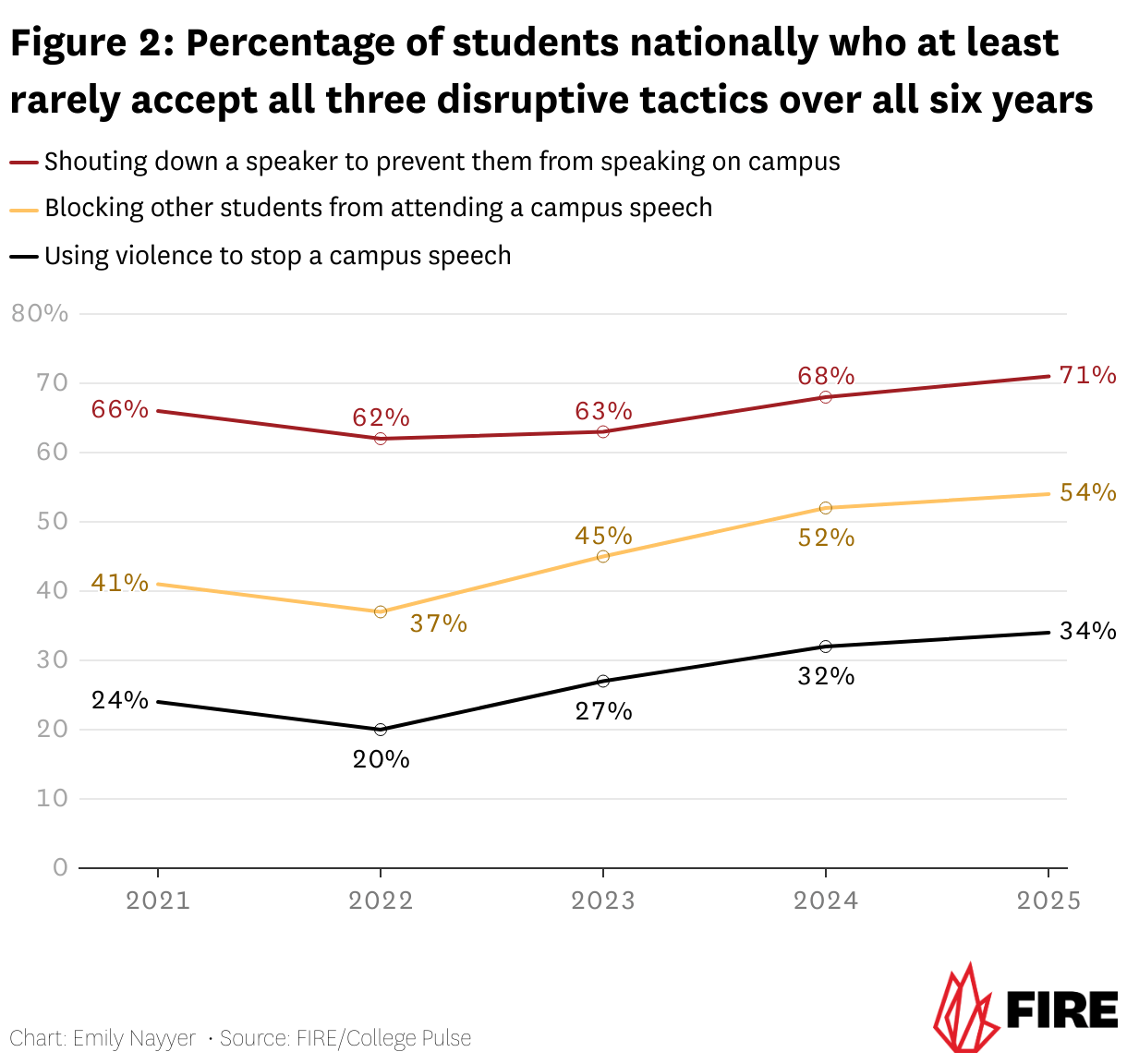
The numbers show how far the rot has spread. FIRE’s new College Free Speech Rankings, which surveyed nearly 70,000 students across 257 campuses, find a record share now rationalizing coercion. Roughly 34 percent of students say that using violence to stop a campus speech can be acceptable in some circumstances; roughly 70–72 percent say the same about shouting down speakers. In 2021, the violence number was in the low 20s; by last year it was 32 percent. It should be zero. A university that can’t persuade students to reject violence categorically is failing at the first task of liberal education.
We’ve seen the escalation step by step. Middlebury, 2017: Political scientist Charles Murray was shouted down; professor Allison Stanger left with a concussion and neck injury. University of California, Davis, 2023: Masked protesters smashed windows at a Charlie Kirk event; to the university’s credit, the talk continued. San Francisco State University, 2023: Former collegiate swimmer Riley Gaines’ event was so aggressively disrupted she was held hostage in a room for hours; campus police ultimately suspended the case without charges. And of course, there were the violent riots at University of California, Berkeley, in 2017—the birthplace of the Free Speech Movement—in response to a planned speech by commentator Milo Yiannopoulos. It’s a miracle no one was killed. These episodes move norms from argument, to heckling, to property destruction, to “rare” violence—and now, in Orem, Utah, to a bullet.
So what do we do? First, bury the “words are violence” cliché. I have pointed out before that it was always self-serving nonsense, a way to claim moral high ground while reaching for the duct tape. But after Utah, it is grotesque. Anyone trying to argue that speech is violence should be treated with sneers, jeers, condemnation, and a recommendation that if they really want to live in a society in which there is no bright line distinction between speech and violence, they should try living in the thirteenth century. Maybe they’ll be happier there.
Second, restore the norms that once made universities the safest place to clash over dangerous ideas: maximal tolerance for speech; zero tolerance for force. Draw the line where the law draws it—true threats, targeted harassment, and incitement, as the Supreme Court defines them. Keep everything else inbounds, for everyone: left, right, and otherwise.
Third, stop rewarding disruption: If you shout down a speaker, you’re removed. If you smash windows, you’re disciplined. If you assault anyone, you’re referred to the police. Order protects liberty; it doesn’t replace it.
Bury the “Words Are Violence” Cliché
College
Yale Vote for Violence
But at the end of the debate, attendees voted 55–28 against the statement “violence is never the answer,” with one voter abstaining.
Kwek-Rupp also referred to the phrase “no justice, no peace,” explaining that violence may be used when oppressed groups have no other alternative than violence to escape.
Yale Political Union attendees challenge King’s son on nonviolence
Polling
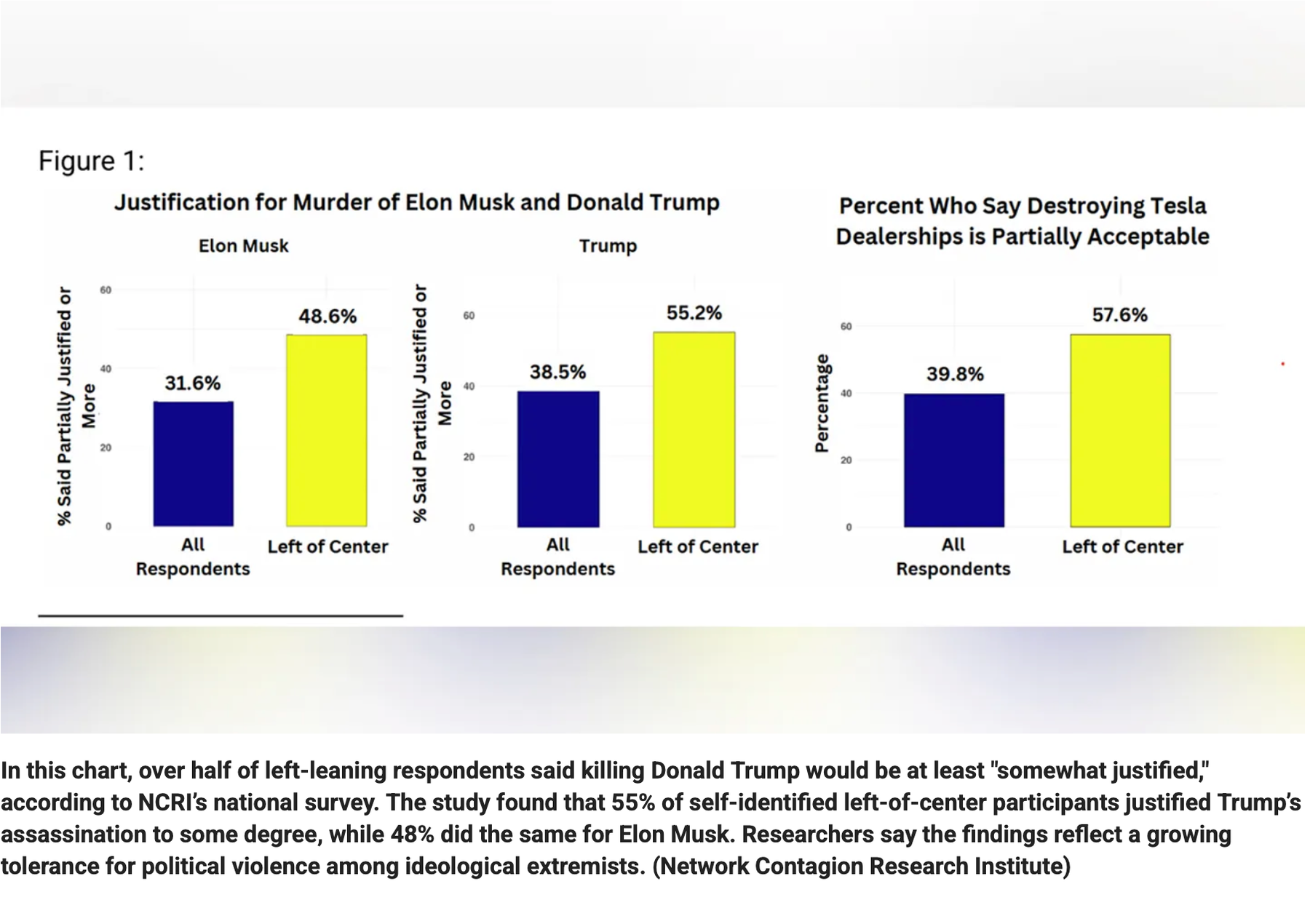
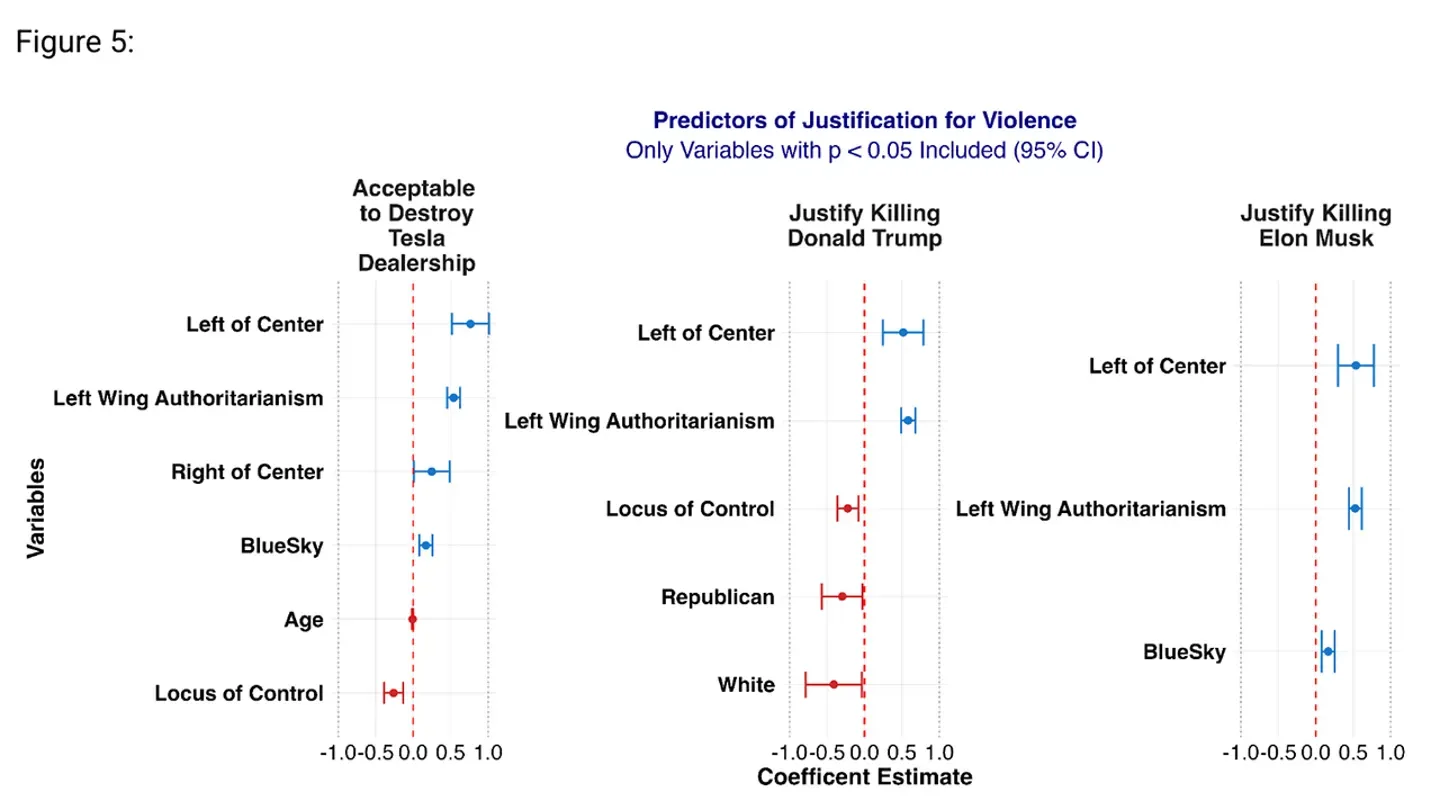
Study reveals 'assassination culture' spreading on the left
Finkelstein said that while some level of violent sentiment exists on the right, “What we found was a statistically higher endorsement of political murder on the left, 41% more than among right-leaning participants.”
The report singles out BlueSky, a social media platform favored by progressive users, as a major amplifier of extremist ideation.
New bombshell study reveals ‘assassination culture’ spreading on the left under President Trump
NCRI-Assassination-Culture-Brief.pdf (file not included in this release)
YouGov Polling
In a November 2017 YouGov poll, when asked if violence was justified to advance political goals, only 8% of Democrats and Republicans said it was “at least a little bit justified.” Although the pollster stopped asking the question in the same way in 2020, the percentage of people who said it was at least “a little” justified had already risen to 36% among Republican respondents and 33% among Democratic respondents.
In the latest poll by YouGov taken after Kirk was murdered, 11% said violence can sometimes be justified to achieve political goals, while 72% said violence is never justified. (Another 5% said they would prefer not to say whether they think violence is sometimes justifiable to achieve political goals.)
Saying that violence can be justified was more prominent among Democrats and independents than among Republicans, with 14% of Democrats, 13% of independents, and only 6% of Republicans holding that opinion, according to the Sept. 10 poll. On the other end of the scale, 81% of Republicans said violence is never justified, compared with 72% of Democrats and 65% of independents.
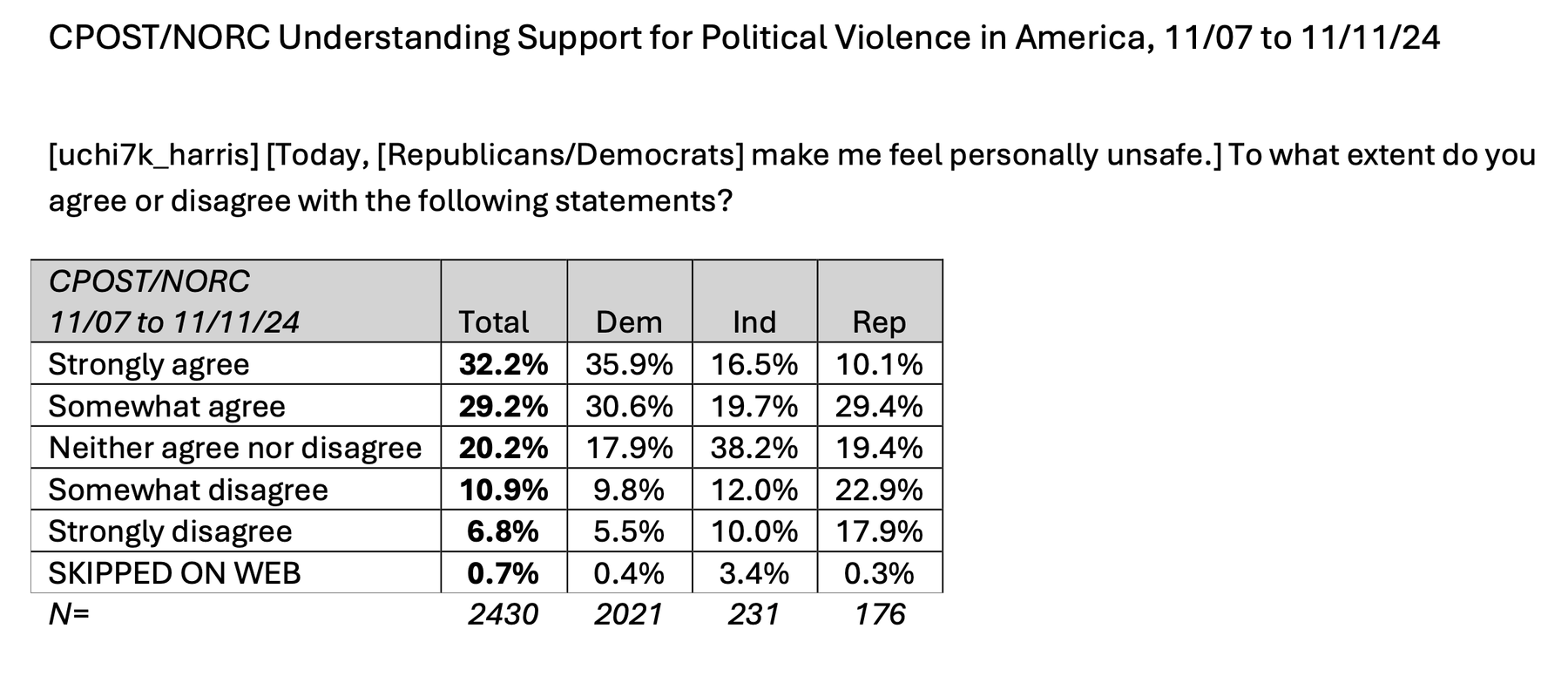
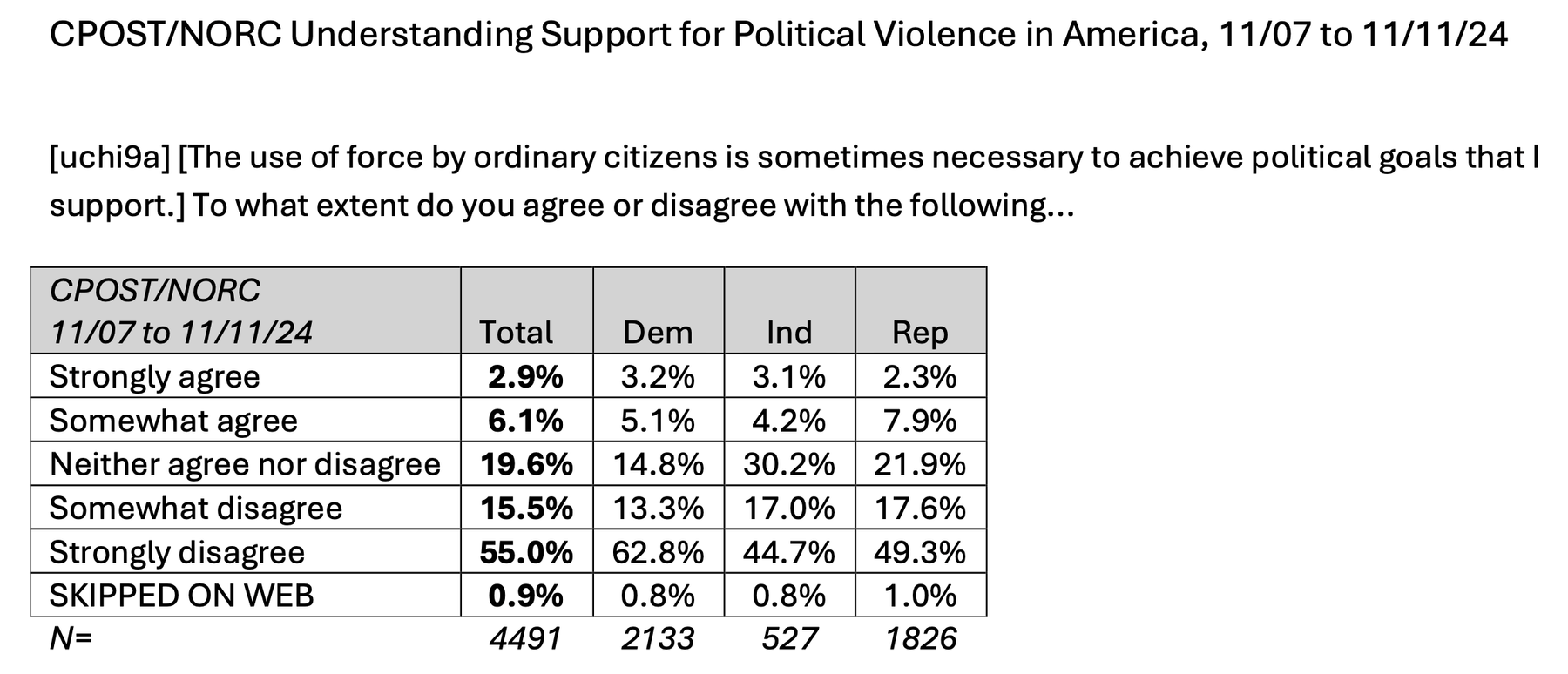
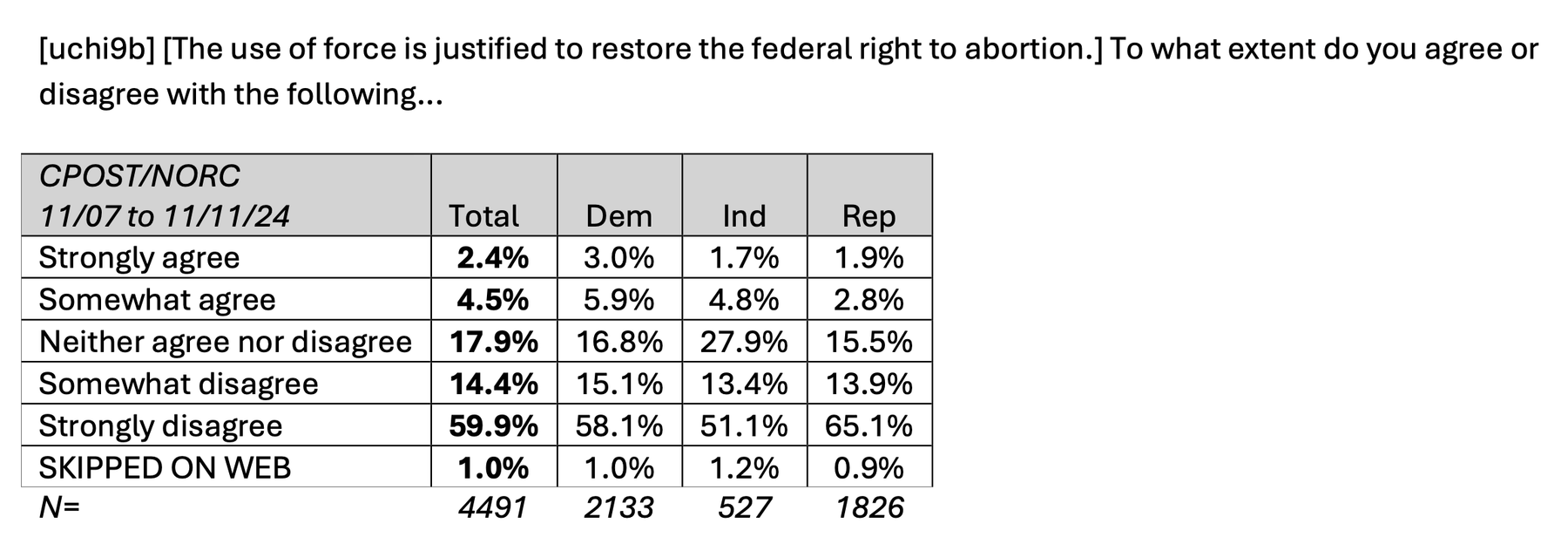
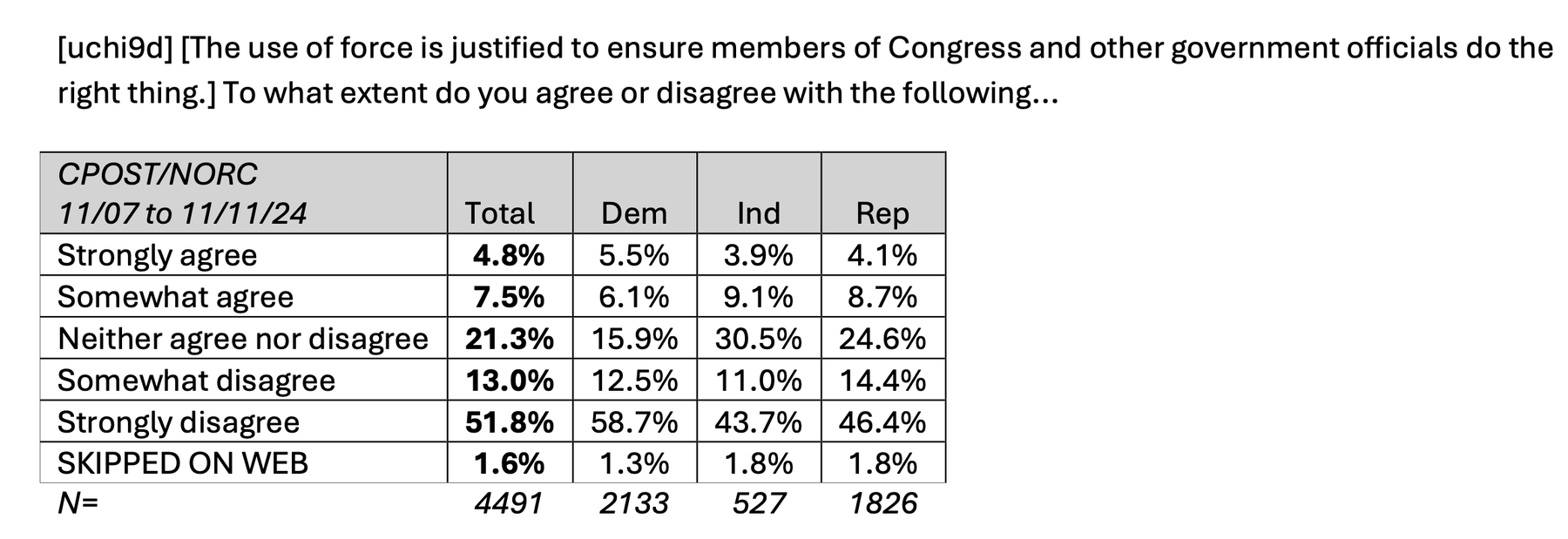
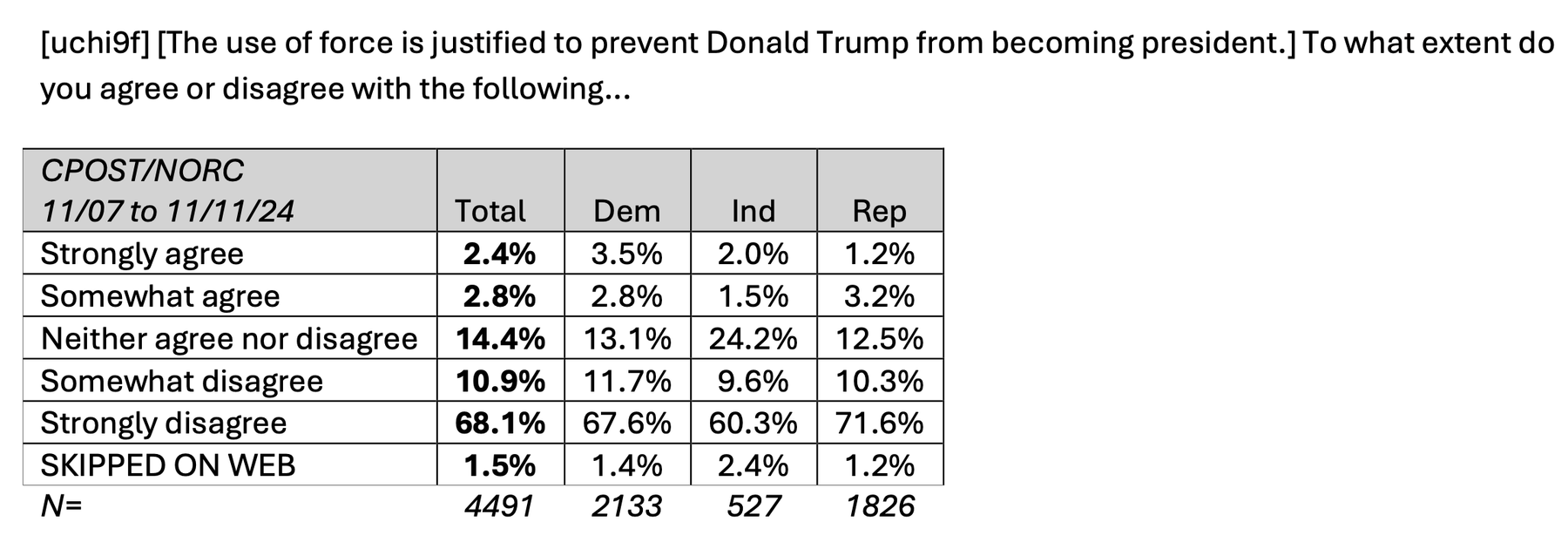
UChicago November 2024 CPOST Post Election Understanding Political Violence Survey Topline
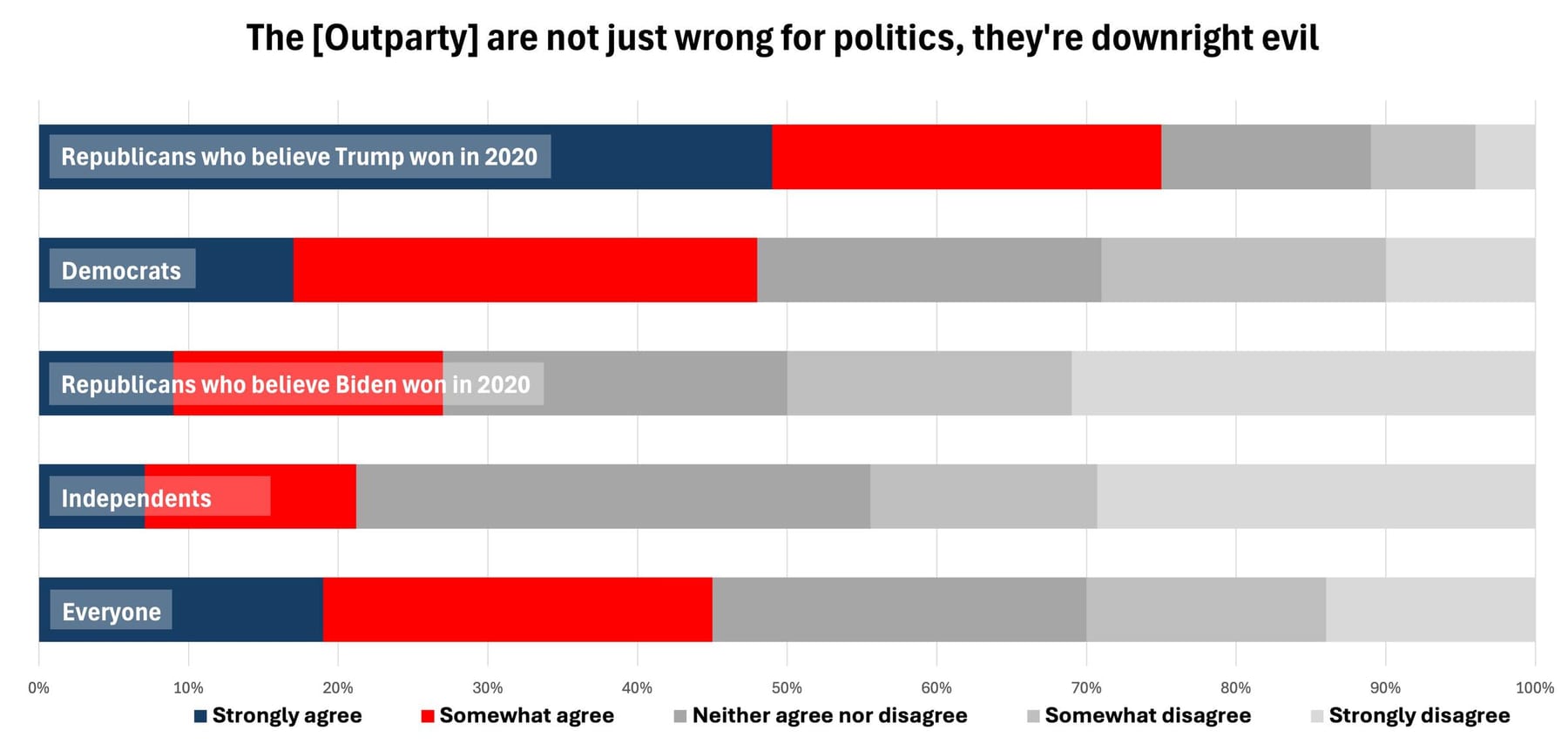
POLL: NEARLY HALF OF AMERICANS THINK MEMBERS OF THE OPPOSING POLITICAL PARTY ARE 'EVIL'
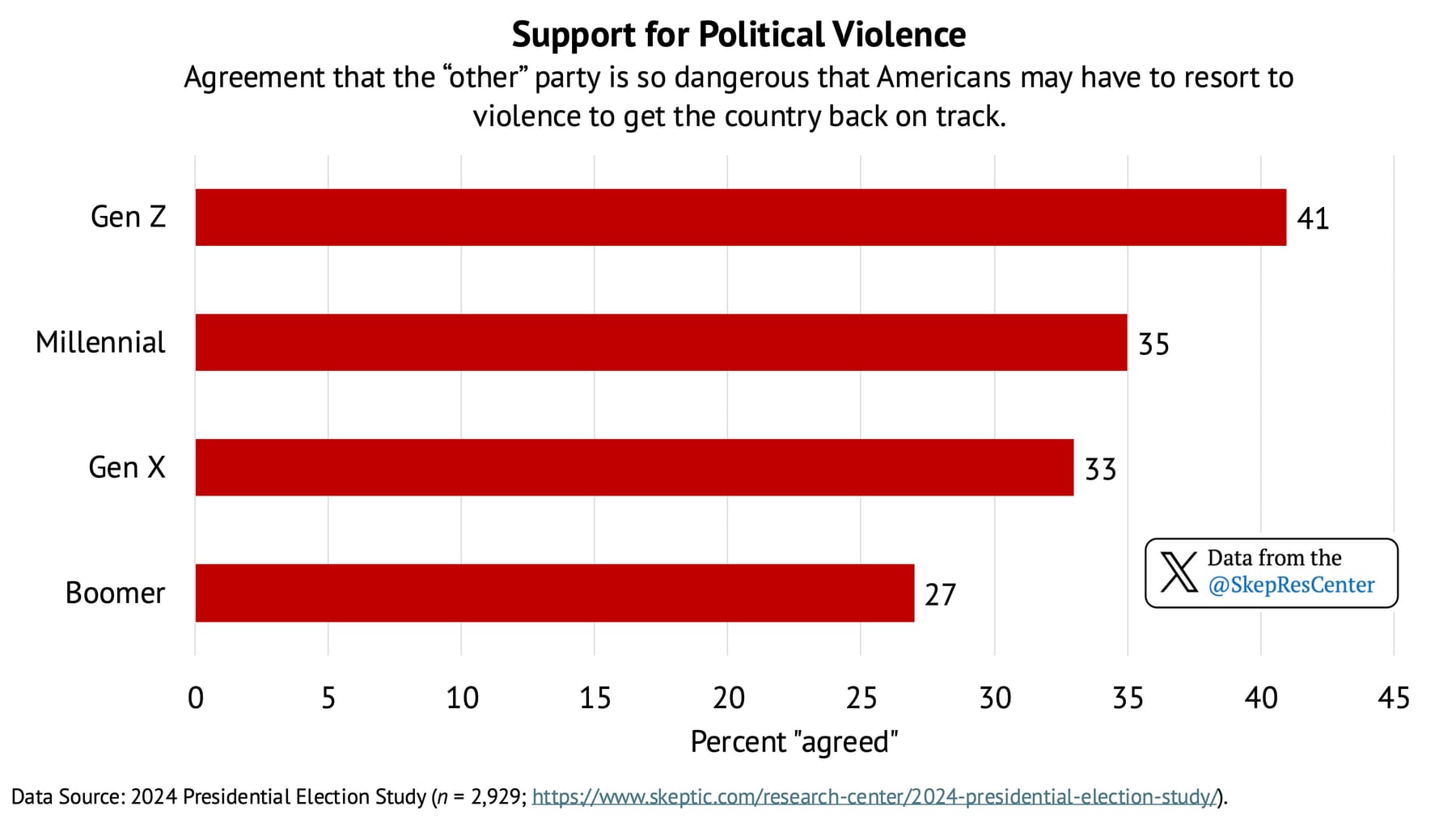
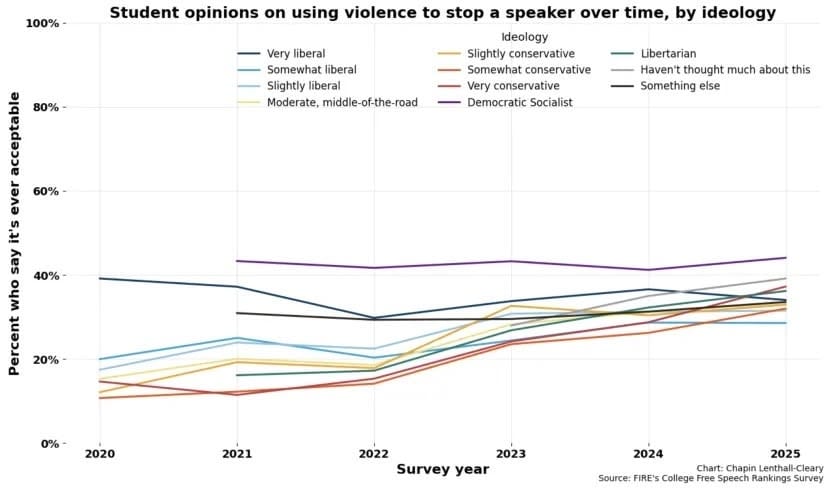
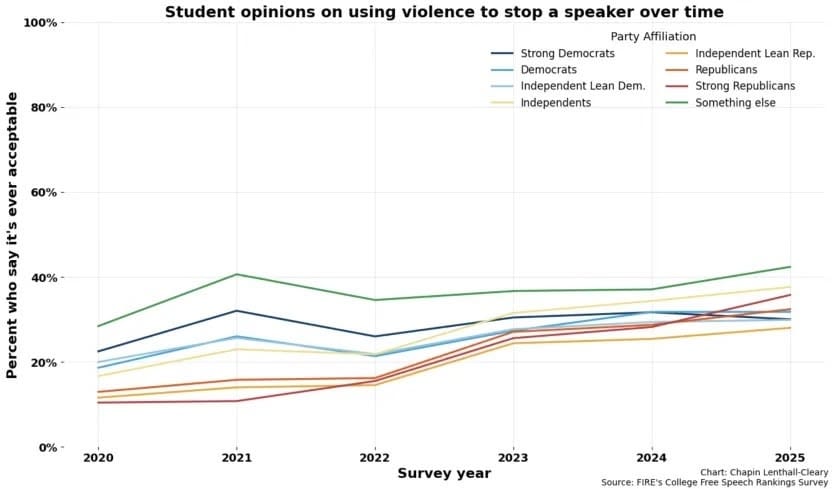
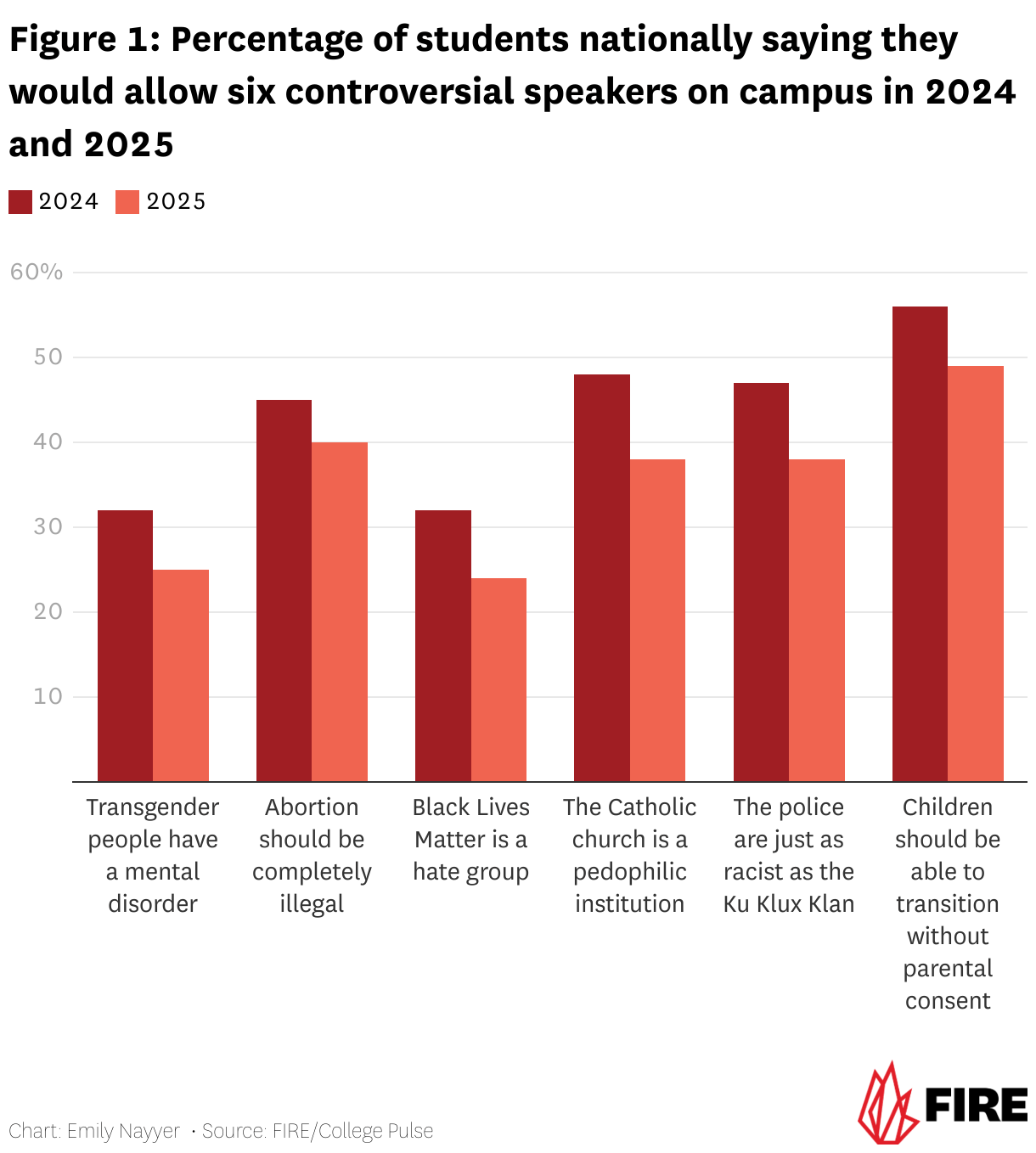
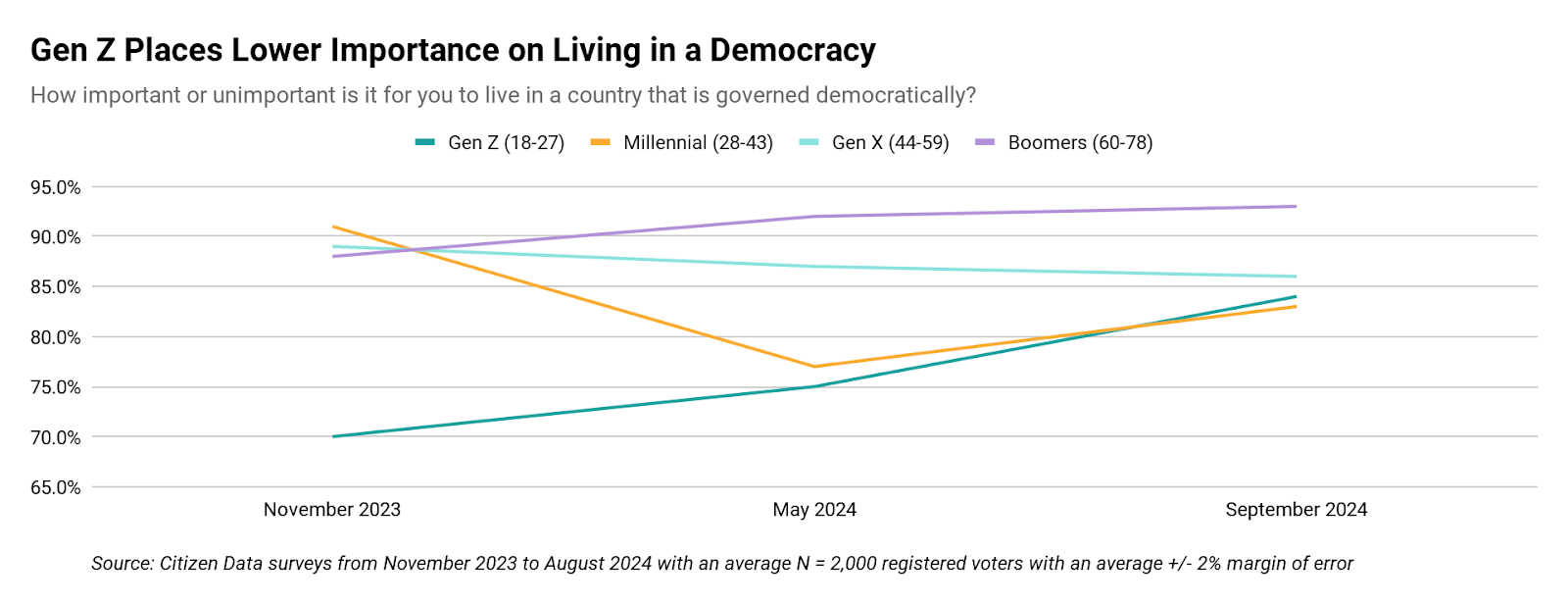
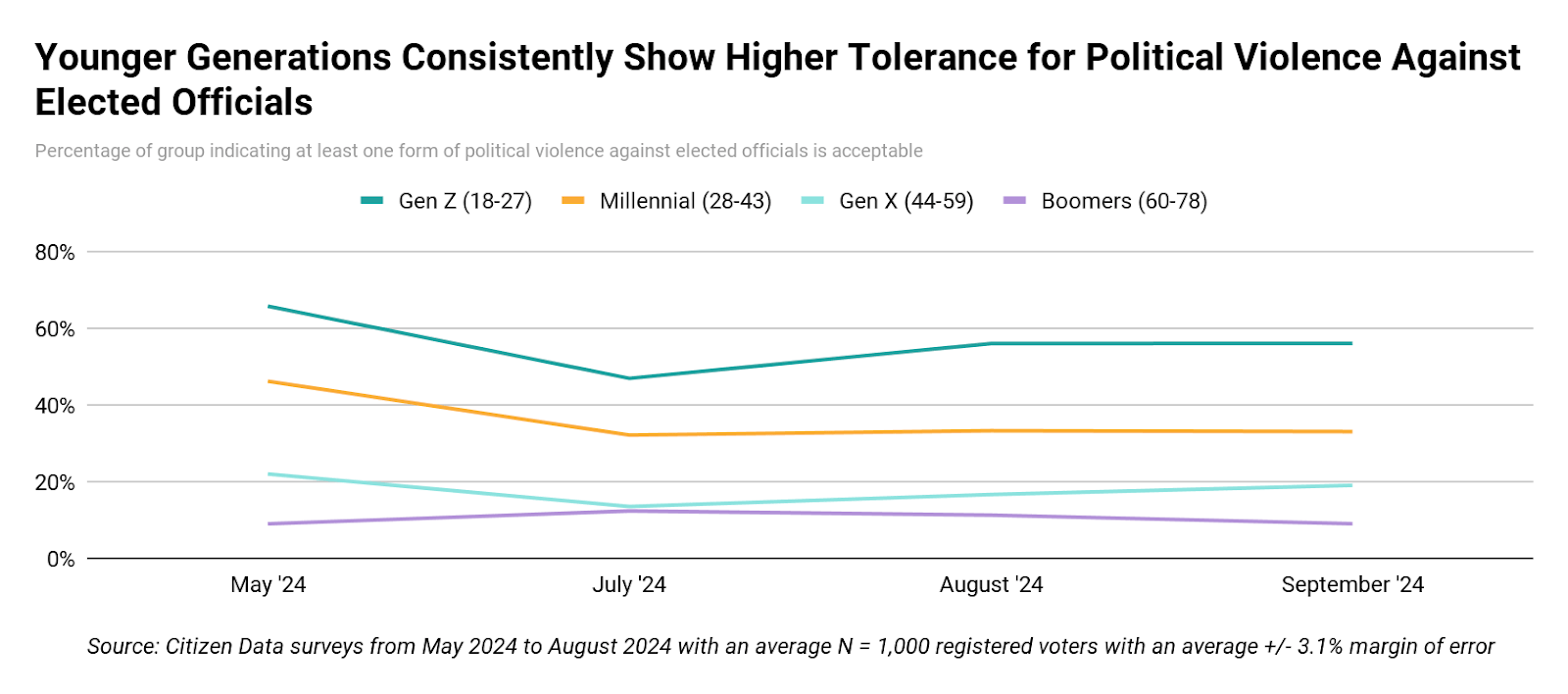
Fact check: polling data has shown increased support for political violence. 30 years ago 1 in 10/15 Americans would say violence is sometimes justified for political ends but now those numbers are up, some survey estimates them as high as 30% some even as high as 40%
Here’s what I found in fact-checking that claim — the polling evidence does support the idea that more Americans now say political violence is sometimes justified, though the precise numbers depend a lot on how questions are phrased, when the survey was done, and what “political violence” means in context. I’ll lay out what the data shows, where there’s uncertainty, and how that compares to “30 years ago.”
What polling data does show
- Recent large-survey findings
- A longitudinal survey by the University of California Davis Violence Prevention Research Program found in 2022 that about 32.8% of respondents said violence is usually or always justified to advance _at least one_of a set of political objectives. (BioMed Central)
- In that same survey, that number dropped somewhat in 2023 and held roughly stable in 2024 at ≈ 25-26%. (BioMed Central)
- Another poll (from PRRI, 2023) asked whether “true American patriots may have to resort to violence to save our country” and found 23% agreed with that. (PRRI)
- Evidence of increase over recent years
- The same PRRI poll shows that figure has risen: in 2021 the agreement was ~15%, and by 2023 it reached ~23%. That is a substantial uptick over just a couple of years. (PRRI)
- Subgroups vary a lot: Republicans (especially those with favorable views of Trump), those who believe the 2020 election was stolen, etc., show higher levels of agreement. (PRRI)
- What people worry about
- Many polls also indicate that a large majority of Americans are worried about political violence, or believe democracy is under threat. That’s a slightly different question than “do you believe violence is justified.” (Leadership Conference)
What is more uncertain / depends on wording
- The phrasing of questions matters a lot. Asking if “violence is justified” across any political objective vs asking about specific scenarios changes responses. Also asking about “true patriots” or “save the country” is more abstract and may get more agreement than more concrete, morally weighty questions (e.g. “violence against people” or “killing”).
- Surveys often distinguish between justifying violence in principle vs willingness to personally engage in it. The latter is usually much lower. (BioMed Central)
- Comparisons over time are hard: older surveys used different question wording, different samples, etc. So when people say “30 years ago only 10-15%,” that may be a rough estimate but it’s not always a directly comparable baseline.
What about 30+ years ago?
- I did not find solid polling data from ~1990-1995 that directly asked equivalent questions in the same way. So it is hard to say exactly what “10-15%” represented back then under comparable measures.
- Some older surveys in more recent decades (say 2000-2010) show lower levels of overt support for political violence, but exact numbers vary.
Bottom line
- Yes: the claim that more Americans now express some justification for political violence is supported by data. Surveys in recent years show numbers in the 20-35% range, depending on the question.
- The idea of “as high as 30-40%” is plausible for certain subgroups or particular questions (especially when asked in more abstract terms), but not uniformly true across all Americans or under all definitions.
- The “10-15% thirty years ago” is plausible as a general comparison, but I didn’t find a clean, directly comparable survey from that time to confirm that exact baseline.
Here’s a table summarizing what the polling/studies I found say about support for political violence by political affiliation. The numbers vary a lot depending on how the question is asked.
| Survey / Question | Republicans (GOP) | Independents / Non-aligned | Democrats | Notes / Question Wording |
|---|---|---|---|---|
| PRRI / Brookings, Oct 2023 — “Because things have gotten so far off track, true American patriots may have to resort to violence to save the country.” | ~ 33% (PRRI) | ~ 22%(Axios) | ~ 13%(PRRI) | |
| PRRI / American Values Survey, 2024 — same “patriots may have to resort to violence…” question | ~ 29% (PRRI) | ~ 16%(PRRI) | ~ 8%(PRRI) | |
| UC Davis Violence Prevention Research Program (2022-2024) — “Violence usually or always justified to advance at least one of 17 specified political objectives” (“justified” measure) | Republicans more likely than Democrats; MAGA Republicans highest (≈ 58.2%) vs other Republicans ≈ 31.5% vs non-Republicans ≈ 25.1% (PLOS) | — | Democrats / non-Republicans ≈ 25.1% (PLOS) | |
| UC Davis VPRP, 2024 — same “justified to advance at least one objective” overall (regardless of party) | — | — | — | Overall ≈ 26.2% say violence usually or always justified for at least one political objective. Does _not_break out by party in that specific overall number in that report. (PMC) |
Key takeaways / caveats
- Among Republicans, a sizeable minority (roughly 30-35%) believe violence may be justified under certain political conditions (depending on wording). This percentage is much lower among Democrats (often around 10-15% in similar questions).
- Among Independents, the numbers are generally in between Republicans and Democrats, often in the low-20% range for these questions.
- The highest party‐based numbers tend to come from subsets: for example MAGA Republicans had ~ 58% saying violence is “usually or always justified” to advance at least one objective. But that’s a subgroup (MAGA Republicans) rather than all Republicans. (PLOS)
References
Martin Luther King, Jr.’s Six Principles of Nonviolence handout
Expose Charlie’s Murderers
New bombshell study reveals ‘assassination culture’ spreading on the left under President Trump
Yale Political Union attendees challenge King’s son on nonviolence
NCRI-Assassination-Culture-Brief 1.pdf (file not included in this release)
Polls Show Rising Number of Americans Justify Political Violence
“Marist-PollUSA-NOS-and-Tables_202504301348-1.Pdf.” n.d. Accessed September 11, 2025. https://maristpoll.marist.edu/wp-content/uploads/2025/04/Marist-Poll_USA-NOS-and-Tables_202504301348-1.pdf.
UChicago CPOST
“CPOST-Understanding_Political_Violence_Survey-Nov_2024_Topline.Pdf?Mtime=1747074713.” n.d. Accessed September 11, 2025. [https://d3qi0qp55mx5f5.cloudfront.net/cpost/i/docs/CPOST-Understanding_Political_Violence_Survey-Nov_2024_Topline.pdf?mtime=1747074713](https://d3qi0qp55mx5f5.cloudfront.net/cpost/i/docs/CPOST-Understanding_Political_Violence_Survey-_Nov_2024_Topline.pdf?mtime=1747074713).
Political scientist says recent polling data shows support for political violence
Johns Hopkins poll reveals that nearly half of Americans think that members of the opposing political party are ‘evil’
Poll: Nearly half of Americans think members of the opposing political party are ‘evil’
Thread by @wokal_distance on Thread Reader App – Thread Reader App.pdf (file not included in this release)
Violence towards ICE Reflects a Core Aspect of Leftist Psychopathology
Student acceptance of violence in response to speech hits a record high | The Foundation for Individual Rights and Expression
2026 College Free Speech Rankings | The Foundation for Individual Rights and Expression
Gen Z’s Divergent Path: What Their Views Mean for American Democracy in 2024