Smart Phones & Social Media
Four Foundational Harms
- Social deprivation
- More info:
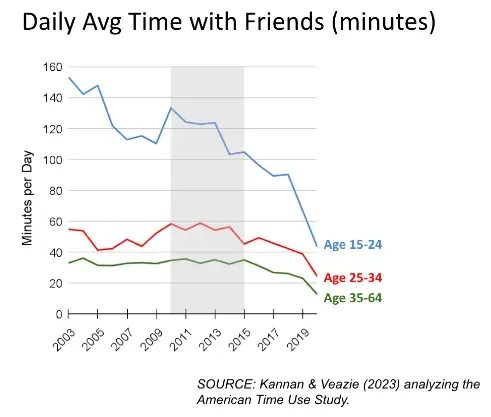
- S5.4.1 Daily average time spent with friends, in minutes. From Kannan & Veazie (2023), re-graphed by Haidt, analyzing the American Time Use Study. Only the youngest age group showed a sharp drop before the 2020 data collection, which was performed after COVID restrictions had begun. That youngest group was all Gen Z in 2020, while the 2nd youngest group was millennials. [Zach’s spreadsheet]
- More info:
- Sleep deprivation
- 55% of girls, 44% of boys sleep less than 7 hours a day (8th, 10th and 12 graders)
- Happened as soon as adolescents moved from basic phones to smartphones
- Sleep deprivation is extremely well studied, and its effects are far reaching. They include depression, anxiety, irritability, cognitive deficits, poor learning, lower grades, more accidents, and more deaths from accidents.
- Attention Fragmentation
- Smartphones are kryptonite for attention
- Many adolescents get hundreds of notifications per day, meaning that they rarely have five or 10 minutes to think without an interruption.
- Evidence that may interfere with development of executive function
- Addiction
- Social media is designed to hook children’s brains
- Many adolescents have developed behavioral addictions similar to a slot machine
Mental Health
- Not limited to the United States
- No other theory able to explain rates of anxiety and depression surged among adolescents in so many countries 2010-2015
- Sensitive period for cultural learning ages 9 to 15.
- Lessons learned and identities are formed—imprint and stick
- Early puberty period of rapid brain rewiring
Men
- Engaged in fewer risky activities outdoors or away from home
- Pornography
- Video game addiction
- Consequences
- Depression
- Anxiety
- Failure to launch
- Lonliness
Women
-
Hit harder than boys
-
Girls desire to connect and develop sense of belonging and social media appeals to these desires, but it often ends up frustrating it.
-
Four Reasons It Harms Girls More:
-
- More sensitive to visual comparisons
-
- Girls aggression is gossip and social media offers endless ways to do this
-
- Sharing Emotions: More vulnerable to sociogenic illnesses
-
- Easier for men to approach and stalk girls and behave badly and avoid accountability.
- Pressured by boys to share nudes; blackmail
-
-
- Depression
- Heavy users are three times as likely to be depressed as nonusers.
- Self-Harming
- Suicide
- Loneliness
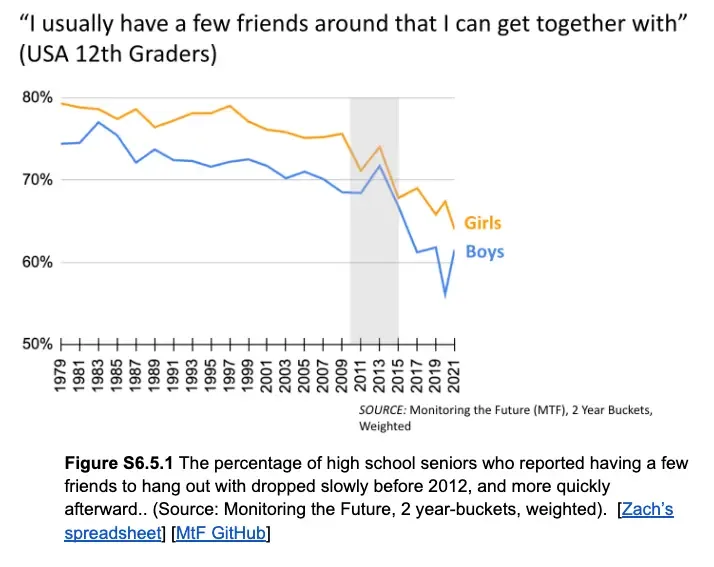
- Social media promises connection and communion, multiplying number of relationships while reducing their quality. Making it harder to spend time with a few close friends in real life.
- Depression
-
The Great Rewiring of Childhood pulled young people out of real-world communities, including their own families, and created a new kind of childhood lived in multiple rapidly shifting networks. One inevitable result was anomie, or normlessness, because stable and binding moralities cannot form when everything is in flux, including the members of the network.
-
As the sociologist Émile Durkheim showed, anomie breeds despair and suicide. This may be why boys and girls, who followed different paths through the Great Rewiring, ended up in the same place, with a sudden and rapid increase in the feeling that their lives were meaningless.
Spiritual Elevation or Degradation
- When people see morally beautiful actions, they feel as though they have been lifted up—elevated on a vertical dimension that can be labeled divinity. When people see morally repulsive actions, they feel as though they have been pulled downward, or degraded.
- A phone-based life generally pulls people downward. It changes the way we think, feel, judge, and relate to others. It is incompatible with many of the behaviors that religious and spiritual communities practice, some of which have been shown to improve happiness, well-being, trust, and group cohesion, according to researchers such as David DeSteno. I described six such practices.
-
- Profane and the sacred
-
- Religious rituals
- Synchronously with others
- Eating together
- Virtual world is by definition disembodied, asynchronously
- Spiritual practices
- Phone-based life fill every moment of consciousness with distractions
- Self-transcendence
- Social media keeps focus on the self
- Less judgemental
- Grandeur of nature
-
Free Play
- Books
Crime
- Crime has fallen (get stats)
- actual risk of a teen or child being abducted by a stranger and killed or not returned is estimated at around 0.00007%, or one in 1.4 million annually—a risk so small that experts call it de minimis, meaning effectively zero
-
“Having a child abducted by a stranger and returned later is awful, but the ultimate nightmare is having a child stolen by a stranger and murdered—or having a child simply vanish from the face of the earth. According to NISMART, that nightmare scenario happens to about fifty teens and children a year in the United States. That’s fifty out of 70 million Americans under eighteen. Thus the annual risk of a teen or child being abducted by a stranger and killed or not returned is 0.00007 percent, or one in 1.4 million.” The Science of Fear - Daniel Gardner, page 215 (file not included in this release)
- Moral Judgements about Parents
- In reality, a child would have to be left unattended for 750,000 years for an abduction to be statistically likely
- Statistics show that violent crime, including crimes against children, has been falling since the early 1990s. Children today are as safe from violent crime as their parents and grandparents were.
What is Free Play?
- Unsupervised
- The overall message is that kids are very resilient and capable of handling much more than today’s overprotective society thinks. Experiencing challenges and responsibility from a young age is important for their development into successful adults.
- The car-centric culture in American suburbs restricts children’s freedom and independence compared to other countries.
- Attempting to control everything and smooth out all obstacles in a child’s path, sometimes called “lawnmower parenting”, actually increases anxiety for both parent and child. It’s an impossible task.
- Historically, children were not seen as needing intensive parental involvement and stimulation. The current obsession with parenting as the most important role that defines a person’s identity is a recent phenomenon.
- Parents should relax and accept that they cannot control every aspect of their child’s development. Doing one’s best is enough, and kids are resilient.
- Overinflated compassion leads parents to treat kids as powerless and vulnerable, lacking the resources to handle life’s everyday challenges. This is a recent phenomenon.
- It is the job of parents to teach children the skills they need to navigate the world independently, rather than coddling them and doing everything for them.
Benefits of Free Play
- Essential for developing social skills, like conflict resolution.
- Learn to care for themselves and to deal with risk, conflict and frustration.
- Physical skills
- Learn to connect, synchronize and take turns
- Educational toys and videos for babies are heavily marketed as essential for development, but interacting with the real world is more valuable. Baby videos have not been proven educational and may even be harmful.
- The educational toy obsession makes parents feel pressured to constantly stimulate their children’s minds. But this is unnecessary
- When playing together, kids learn skills like negotiation, compromise, and communication by working out scenarios and disputes on their own.
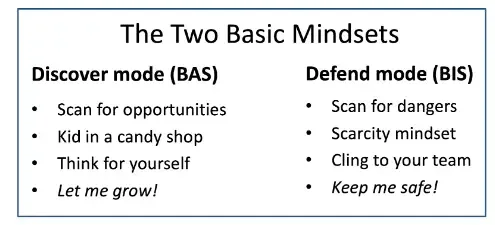
- *Discover mode vs. Defend mode
- Tree Metaphor
- trees must be exposed to wind, children require exposure to setbacks, failures, shocks, and stumbles in order to develop strength and self-reliance.
- Overprotection interferes with this development and renders young people more likely to be fragile and fearful as adults.
- Boredom, while painful, pushes kids to find ways to fill their time on their own, which can lead to the development of new interests and skills.
- Today, parents try to prevent kids from experiencing any pain, anxiety or fear by always being present to handle things for them. This removes opportunities for kids to develop resilience.
Consequences of phone-based childhoods
- How children learn
- Conformist bias: Copy whatever seems to be most common
- Prestige bias: Copy whoever seems most accomplished and prestigious
- Due to these bias, social media engineered for engagement drown out the culture of the family and local community and onto the influences of questionable value.
- Safetyism is an experience blocker. When we make children’s safety a quasi-sacred value and don’t allow them to take any risks, we block them from overcoming anxiety, learning to manage risk, and learning to be self-governing, all of which are essential for becoming healthy and competent adults.
- Western societies have eliminated many rites of passage
Discipline
- How to Discipline
- How To Discipline. Crisis in the Era of Therapy | by Anthony | My Commitment | May, 2024 | Medium
- Use Nonverbal and Playful Techniques
- Teach Through Stories and PlayFoster Autonomy, Not Independence
- Hunt Gather Parent > ^75f4bd
Guide based on Age
Ages 0 - 5
-
Good nutrition
-
Loving adults
-
Time to play
-
Lots of interactions with adults & other kids
-
More Experience in the Real World:
- Free play with other children, mixed ages
- Little beyond their current abilities
- Teacher of younger kid
- Loving secure base
- Plenty of playtime
- Trust their desire to help out. Provide with responsibility
- Makes them feel essential to the family
- Offer some protection against later feelings of uselessness
- Free play with other children, mixed ages
-
Less Experience on Screens:
- No screens first two years
- Sparingly until age 6 or so
- Child’s brain expecting to wire up in 3D, five senses
-
American Academy of Child & Adolescent Psychiatry:
- Until 18 months of age, limit screen use to video chatting along with an adult (for example, with a parent who is out of town).
- Between 18 and 24 months, screen time should be limited to watching educational programming with a caregiver.
- For children 2–5, limit noneducational screen time to about one hour per weekday and 3 hours on the weekend days.
- For ages 6 and older, encourage healthy habits and limit activities that include screens.
- Turn off all screens during family meals and outings.
- Learn about and use parental controls.
- Avoid using screens as pacifiers, babysitters, or to stop tantrums.
- Turn off screens and remove them from bedrooms 30–60 minutes before bedtime.
Age 6 - 13
- Children need to head out and take on more advanced challenges, including social challenges
- They begin to care more about social norms and how their peers see them
- Shame and embarrassment become more common and painful
- Comfort bias & Prestige bias in full force
- More Experience in the Real World:
- Get a lot of experience by doing things together (like play) or with adults in real-world communities, rather than sitting alone watching videos, playing games.
- Reduce overprotection and encourage more productive off-base adventures (file not included in this release)
-
- Practice letting your kids out of your sight without them having a way to reach you.
-
- Encourage sleepovers, and don’t micromanage them, although if the friend brings a phone, hold on to it until the friend leaves, otherwise they’ll have a phone-based sleepover.
-
- After school is for free play. Try not to fill up most afternoons with adult-supervised “enrichment” activities.
-
- Go camping
-
- Find a sleepaway camp with no devices and no safetyism.
-
- Form child-friendly neighborhoods and playborhoods.
-
- Learn how to use parental controls and content filters
- Focus more on maximizing in-person activity and sleep than on total screen hours.
- Provide clear structure to the day and the week
- Look for signs of addiction or problematic use
- Delay opening social media accounts until 16
- Talk with your preteen about the risks, and listen to their thoughts
Age 13-18 (file not included in this release)
Fundamentals
Reforms
- No smartphones before high school
- No social media before 16
- Phone-free schools
- Far more unsupervised play and childhood independence
Be the gardener; not a carpenter. Facilitate rather than impose; guide rather than control
- The Gardener and the Carpenter
- Parents should focus more on providing a nurturing environment rather than attempting to shape specific outcomes in children.
- Provide a stable, nurturing environment that allows for exploration.
- Balance safety and structure with independence.
- Imitation and watching adults is important. Apprenticeship is an effective learning method for school-age children, allowing them to observe and practice skills under expert guidance.
- Important for the parent to be confident; as a child will rely on their confidence in their own words and beliefs to believe or not to. Children are more vulnerable to blowhards.
Relax
- Many parents worry excessively that their parenting decisions and actions will have a major negative impact on their child’s development, but this is often not the case.
- The rise of the internet and parenting forums has fueled judgment and insecurity among parents, who feel pressure to make all the “right” choices.
- Parents should resist the urge to compare themselves to others or worry that every small decision will make or break their child. There is no one perfect way to raise a child.
- Parents should relax and accept that they cannot control every aspect of their child’s development. Doing one’s best is enough, and kids are resilient.
Safety
- Parents should empower their children by teaching them they have the right to say no, to confide in their parents without fear of getting in trouble, and to distinguish between good and bad secrets.
- The National Center for Missing and Exploited Children advises teaching children to resist potential abductors by running away, fighting back, yelling, and attracting attention.
- Instead, children should be taught that most adults are good, and while they should never go off with a stranger, they can ask nearby adults for help if bothered or threatened.
Outdoor
- Books
- Outdoor Kids in an Inside World 1
- Nature as a peer
- Two hours a week spent in nature
- Large studies shown physical and emotional well-being improvements, immune-boasting, improve cognitive and motor skills
- A practice done regularly
- getting your kids involved in the process. It’s a shift that turns an outing or activity from a chore for you into an adventure for them. Though they may not often admit as much, kids actually like being given responsibility, in no small part because they like to feel that they’re on the same level as those pesky adults who won’t stop bossing them around. Include them in the process. It changes the entire context.
- only 1.3 percent of the American workforce is engaged in the agricultural industry. Less than two centuries ago, that number was 70 percent.
- For many of us, the disconnectedness between us and the sources of our food is cause for serious unease. It’s as though we’ve willfully discarded our physical link to what is arguably our most fundamental human need.
Gardening
- Outdoor Kids in an Inside World 1 > ^185e6e
Foraging
- Outdoor Kids in an Inside World 1 > ^0921cc
Fishing
- Outdoor Kids in an Inside World 1 > ^e10ab6
Hunting
- Outdoor Kids in an Inside World 1 > ^8b5c6f
Values
-
Emotional Control
- adult as the “decisive element” whose “daily mood makes the weather” for the child.
- Model Emotional Control
-
Resilience
- The greatest gift that we parents can get from our kids, really, is an assurance that they’ll rise to the occasion of the future. That they’ll find the strength to tackle their problems head-on. Their readiness to pull that off will not be something that they can articulate directly to us. Instead, we’ll have to be satisfied with whatever assurances we can garner from their behavior and actions. One of the greatest disservices that we can do to them is to spoil their native enthusiasm for the natural world in which they live. The planet’s salvation will not be delivered by a generation that is disheartened and apathetic. It will come from folks who step outside of their home in the morning with an eagerness to be embraced by the sun and the wind and the rain.
- Lev Vygotsky, pioneer in study of child development, idea of “scaffolding”
- Growth mindset—Dont give up when they fail, hold core belief that they can practice a task and improve instead of thinking a failure is an indictment of their abilities.
- Idea of teaching your kids to learn how to be comfortable with being uncomfortable. Similar to emotions being subordinate to your goals. Resilience
-
Encourage Helping and Cooperation
- Hunt Gather Parent > ^7c5cc3
- To inspire a child, make sure they feel connected to you, that they are choosing to do the task voluntarily, and that their contribution is valued. Resist the urge to correct a child who is trying to help. Let them do it their way, even if imperfect. Pay attention to how they try to contribute and build off their ideas. Teach by letting them practice, not by lecturing. Accept their efforts even if it’s not exactly what you wanted. Use praise very sparingly.
-
Strong Fathers, Strong Daughters
- Strong Fathers, Strong Daughters
- Daughters need their fathers to provide strong leadership and be heroes who guide and protect them. This establishes trust and respect.
- Fathers should openly express love to daughters through words, hugs, spending quality time together. This teaches daughters what to expect from men.
- Teach daughters humility and realism about life’s limits rather than entitlement. This prevents selfishness and depression.
- Fathers must establish clear rules and morals to equip daughters to handle challenging situations. Daughters want to know fathers’ standards.
- Fathers play a vital role in guarding daughters’ sexuality and relationships with boys. Establish accountability and enforce standards.
- Fathers introduce daughters to concepts of God. Live out values to provide an example. Seek spiritual guidance together.
- Help daughters balance emotions and passions with reason and discipline to prevent self-destruction. Fathers provide steadiness.
- Simply spending time together, without entertainment or events, conveys love and provides a safe base for daughters.