DESCRIPTION
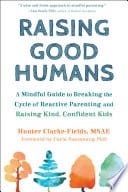
A kinder, more compassionate world starts with kind and compassionate kids. In Raising Good Humans, mindfulness mentor, parenting coach, and mother of two Hunter Clarke-Fields offers parents practical and breakthrough strategies for conflict resolution and positive communication. Parents learn to break free from ingrained “reactive parenting” habits in order to forge better relationships with their children—relationships built on respect and cooperation.
Summary
Here’s a summary of the main ideas from Raising Good Humans by Hunter Clarke-Fields, based on your PDF highlights. The book is centered on mindful parenting—breaking the cycle of reactivity and raising emotionally intelligent, kind, and confident children.
🧘 Part I: Break the Cycle of Reactivity
1. Keep Your Cool
- Reactivity isn’t a personal failure—it’s a biological response (amygdala activation).
- Mindfulness meditation can rewire the brain by shrinking the amygdala and strengthening the prefrontal cortex (responsible for empathy, reasoning, and self-regulation).
- Children mirror stress responses. A threatening adult posture or tone can activate their fight-or-flight system, making learning or cooperation impossible.
- Seeing your child with “fresh eyes” every day helps you stay present and empathetic.
2. Disarm Your Triggers
- Children often reveal unresolved emotional wounds. Parenting becomes an opportunity for self-awareness and growth.
- Anger usually masks deeper emotions like fear, shame, or exhaustion.
- Yelling is counterproductive—it activates the child’s limbic alarm system, increasing resistance and aggression.
- Track your triggers: journal when you yell and what emotions or circumstances led to it.
3. Practice Compassion—Starting with You
- Guilt (behavior-focused) can be constructive; shame (identity-focused) is harmful.
- Self-compassion improves your ability to learn from mistakes and parent better.
- Self-kindness, mindfulness, and a sense of shared humanity are key.
- Good parenting doesn’t mean perfection. “Good enough” parenting accepts imperfections in both child and parent.
4. Handle Difficult Emotions
- Avoidance or resistance to emotions leads to suffering (Pain × Resistance = Suffering).
- Emotions are like toddlers—they need to be seen and heard.
- Use the RAIN technique for processing emotions:
- Recognize
- Accept
- Investigate
- Nurture
- Expect emotional outbursts from children (their prefrontal cortex is still developing).
- Accept emotions, limit behavior: allow healthy expression but set boundaries.
🌱 Part II: Raise Kind, Confident Kids
5. Listen to Help and Heal
- Children want connection every time they speak. Treat this as a cue to be mindful.
- Be an empathetic helper, not a fixer.
- Practice reflective listening: identify and mirror your child’s emotions.
- If you can’t be present, be honest—reschedule the conversation instead of faking attention.
6. Say the Right Things
- Avoid power tactics (blaming, threatening, ordering, judging). They damage communication.
- Use I-messages: describe your feelings and unmet needs instead of accusing.
- E.g., “When I see dishes in the sink, I feel overwhelmed because I need some order.”
- Children need healthy, firm boundaries—permissiveness leads to poor self-regulation and behavioral issues.
7. Solve Problems Mindfully
- Avoid authoritarian “my way” or permissive “anything goes” solutions.
- Use Win-Win Conflict Resolution:
- Identify needs (not just solutions).
- Brainstorm options together.
- Choose what meets everyone’s needs.
- Assign actions and deadlines.
- Follow up and reassess.
8. Support a Peaceful Home
- Prioritize connection through:
- Touch
- Play
- Special Time (child-led, undistracted attention)
- Working Together (include them in daily chores)
- Verbal Encouragement
- Use consistent rhythms: daily/weekly schedules to bring structure and reduce resistance.
- Boredom is beneficial—it precedes creativity.
- Simplify schedules. Protect kids from overcommitment and overstimulation.
- Screen Time Tips:
- Delay smartphones.
- Set tech boundaries (no phones at dinner, limit screen time before bed).
- Have screen-free days (e.g., “Screen-Free Sundays”).
✨ Core Message:
Mindful parenting isn’t about controlling your child—it’s about transforming yourself. When you manage your own reactivity and model emotional intelligence, you raise children who are kind, secure, and capable of handling life’s challenges.
Would you like a blog post version of this summary next?
Highlights
new generation of parent: present, evolving, calm, authentic, and free. Mindful Parents reject the culture of “not good enough,” knowing that when we free ourselves from unnecessary stress and limiting stories, our authentic, peaceful nature shines through. Mindful Parents practice self-compassion and see their challenges as teachers, not flaws. Mindful Parents value wisdom over reactivity, empathy over obedience, and begin anew every day. Mindful Parents live what we want our kids to learn, knowing that the best parenting is in modeling. Mindful Parents go within and get quiet to access their power. Mindful Parents practice presence, create their experience, embrace imperfection, and love themselves. Mindful Parents are motivated, knowing that with every step, they are changing things for the generations that follow. I am a Mindful Parent. (Page 24)
Part I: Break the Cycle of Reactivity (Page 25)
Chapter 1: Keeping Your Cool (Page 26)
We are at our worst in the parenting department when we’re in reactive mode. (Page 27)
Losing control isn’t a choice that you make. It’s your biological system reacting automatically. Therefore, it takes intentional practice to learn to respond differently. It also means that we are not entirely to blame for our own reactivity. Instant reactivity to threat may have been critical for our ancestors. Our amygdalae don’t know that we live in a different world today. (Page 30)
Happily for you and me, there is a time-tested intervention: mindfulness meditation. (Page 30)
Mindfulness meditation can significantly change how reactive our brains are over time. We aren’t 100 percent sure yet how this happens, but MRI scans show that after an eight-week course of mindfulness practice, the brain’s fight-or-flight centers, the amygdalae, actually appear to shrink. Not only that, but as the amygdalae shrink, the prefrontal cortex (again, the area associated with more-complex brain functions such as awareness, concentration, empathy, and decision making) becomes thicker! (Page 32)
Your child has the same reactive stress response as you have. Her fight-or-flight system will often register a huge, looming parent as a threat. If your child’s nervous system sees you as threatening, it will trigger resistance, and she won’t be able to learn. This is because the upper parts of the brain (which are less developed in children than in adults) are offline. So when you need to connect with your child, it’s important to crouch down to her level and be conscious of how your body and voice might be coming off as threatening. If you make your body seem less threatening, and speak in a calmer voice instead of yelling, you’ll have a less-stressed child—and you’ll get more cooperation. (Page 33)
The truth is that every morning we wake up with a new child. Every single moment they are growing, learning, changing. At a biological level, thousands of their cells are dying and thousands are formed in every minute. Children are, quite literally, never the same person twice. Mindfulness helps us to recognize this truth and see our children with fresh eyes in each moment. (Page 44)
Think about this: what’s at the root of your fear when you’ve discovered that your child has lied (again)? Most likely you fear that your child will always be this way, destroying your relationship forever and ruining her chances of a successful and happy life. “Always” thinking leads us down a scary rabbit hole of anxiety. Without the thought, My child will always be like this, you’d be in a much more grounded and calmer state to deal with the actual situation. (Page 44)
Practice: Beginner’s Mind on a Walk Start by seeing the activity of walking with fresh eyes, as if you don’t know what to expect, as if you haven’t done it thousands of times already. (Page 46)
Practice: See Your Child with Fresh Eyes Imagine that you’re meeting your child for the first time. See him with fresh eyes, curious about who he is, as if you haven’t known him all of his life. (Page 46)
Acknowledging can be magic with our children. They have a great need for us to recognize their thoughts and feelings—to really hear and see them. As parents, we often want to skip over this step and solve their problems. Instead, when we say what we see, our children feel seen and heard, which makes nearly every situation better. (Page 47)
Acknowledging our feelings is a mindful way of deflating the drama bubble. Feeling irritated with your kids? Say what you see out loud: “I’m feeling grumpy right now.” Simply acknowledging that can provide a lot of relief, and it communicates to your child what’s going on with you. Win-win! You’re feeling slightly better and you’ve modeled healthy emotional intelligence for your child. (Page 48)
Instead of letting these thoughts rule you, you can interrupt them and unhook from the thought. How do you do that? Put the phrase “I’m having a thought that…” in front of your negative thought. This acknowledging gives you a bit of space from an unhelpful thought so that you can choose to pay attention to the present moment. (Page 50)
Chapter 2: Disarming Your Triggers (Page 54)
Like little spiritual masters, children have an uncanny ability to reveal our unresolved issues. Something about your parenting experience driving you bananas? That’s your inner work. Want some major personal growth? Six months with a preschooler can be more effective than years alone on a mountaintop. It might just be the fast track to enlightenment. (Page 55)
quote from Dr. Dan Siegel: “The best predictor of a child’s well-being is the parent’s self-understanding.” (Page 55)
Anger is often called a secondary or “iceberg” emotion because underneath it is often a host of other feelings that are driving it: fear, sadness, embarrassment, rejection, criticism, stress, exhaustion, irritation, and more. Thus, when your child behaves wildly in a public place, embarrassment can set off your anger and trigger a response that perpetuates a pattern passed down in your family through generations. (Page 62)
Almost immediately, yelling triggers the fear center in children’s brains, causing the same stress response that we looked at in ourselves in the previous chapter. Yelling rings the limbic system alarm bell, causing kids to be alert and self-protective. Instead of learning from the moment, their stress response bypasses the upper parts of the brain and causes children to fight back, talk back, withdraw, or run away. They are not “misbehaving” in these moments, they are experiencing a stress response. (Page 63)
Because of their stress response, children can’t sit still, pay attention, or learn. In a moment when we want our children to learn to change their behavior, yelling is actively counterproductive. Furthermore, research has shown that yelling makes children more aggressive physically and verbally (Gershoff, et al. 2010). So the effects on their behavior are bad in both the short and the long term. (Page 63)
Track Your Triggers I invite you to take a full week to track every time you yell or feel like yelling. The goal at first is not to change your actions but to understand where they are coming from. What are the situations that set you off? Why does that situation trigger your stress response? All the information you collect in your journal will provide insight into changes you can make in your routines, self-care, and environment that will help you yell less. (Page 66)
Chapter 3: Practicing Compassion—It Begins with You (Page 81)
Researcher Brené Brown has helped us understand the difference between guilt and shame. Shame is a feeling of badness about the self. Guilt is about behavior—a feeling of “conscience” from having done something wrong or against our values. Her research has shown that guilt can be helpful and adaptive, while shame is destructive and doesn’t help us change our behavior. As Brown (2012) puts it: “Shame corrodes the very part of us that believes we are capable of change.” When you feel like a terrible person, it’s almost impossible to empower yourself to make a change. (Page 83)
Imagine if, instead of self-shaming, we could offer ourselves the kindness and understanding of a good friend. How might that change things? Research is showing that this approach helps us grow and learn from our own mistakes better than the old paradigm of condemnation. (Page 85)
Neff breaks down self-compassion into three elements: self-kindness, common humanity, and mindfulness. So how do we begin to practice self-compassion instead of self-judgment? We can start by noticing and interrupting our negative self-talk. (Page 86)
force and manipulation are not the same as authority, and fear is not the same as respect. (Page 91)
Good-enough parenting tells us that we don’t need to strive to be perfect parents, and we should not expect perfection from our children. Problems will occur in every family, and reacting with blame, shame, and harsh criticism does not help. Instead, can we remember that imperfections in all human beings are unavoidable—especially for kids? Can we expect our children to make mistakes? Can we let go of our own striving for perfection? (Page 101)
Chapter 4: Taking Care of Difficult Feelings (Page 103)
Exercise: What Are Your Habitual Responses to Feelings? When we have uncomfortable feelings, our habitual responses may range from grabbing a tub of gummy worms to raging at our kids. What are your habitual responses? Below are some common ways that people deal with their feelings. (Page 105)
When you’ve identified your common responses, start to notice them in everyday life. Get curious, like a scientist. Then, select a time to practice staying nonreactive instead. Mindfully notice the feelings and sensations that arise. Notice that it’s possible to breathe and sit through those feelings. Journal on your experience. (Page 106)
Resistance Makes It Hurt More When we’re upset, we obviously don’t want to feel that way, so blocking or fighting those feelings is our instinctive response. We want to avoid uncomfortable things. The problem is that we can’t avoid all of life’s hurts, and our resistance to them when they arise makes things worse. This is such a common human behavior that Buddhists came up with an equation for it: Pain x Resistance = Suffering Fighting against the reality of our pain makes it worse—it creates suffering. The equation also says that it’s possible to experience pain without suffering—they are not the same thing. (Page 106)
Psychologist Carl Jung long ago said that “what you resist not only persists, but will grow in size.” Today we abbreviate this to “What you resist persists,” pointing to the ineffectiveness of blocking out our feelings (Seltzer 2016). Avoidance leads to suffering and keeps us from living fully. I like to think of our feelings as toddlers: they will not give us any peace until we truly see and hear them. That means acknowledging and accepting our uncomfortable emotions. (Page 107)
simple way to practice accepting our feelings is the acknowledgment practice from chapter 1. When an uncomfortable feeling arises, rather than pushing through to the next thing on your to-do list, blocking your feelings with distraction, or losing it, you can internally say what you feel. This simple labeling can provide a lot of relief. I find that if I acknowledge my anxiety, for instance, by pausing and saying to myself, “Hello, anxiety, I see you there,” it gives me a moment to stop and feel what’s happening in my body. Labeling loosens anxiety’s hold on me, giving me the breathing space I need to let it pass. (Page 108)
A note about acceptance: when you practice accepting the emotions that arise, don’t do it with the intention of changing it. That’s a subtle form of resistance that can keep things stuck. Just like our children, our emotions don’t like to be manipulated. They want to be fully seen and heard. (Page 109)
RAIN is an acronym that can help you remember the mindful way through difficult emotions: Recognize Allow or accept Investigate Nurture (Page 113)
Expect and Accept Strong Emotions Just like adults, children get flooded by strong emotions. In fact, because the prefrontal cortex doesn’t fully develop until children are in their early twenties, they are more prone to becoming flooded by strong emotions. This is an inevitable part of childhood, so as parents we need to expect and accept children’s difficult emotions. Just like adults, when kids block and repress emotions, those feelings pop out in potentially destructive ways, like exploding at a sibling. Let’s agree that we don’t want that. So just as we practice to accept our own emotions, we must seek to accept our children’s emotions and help them to accept their emotions as well. (Page 119)
The truth is that emotional expression is healthy. Just like us, our children need to feel it to heal it. They may need to talk, yell, or cry. When we come from a place of expecting these inevitable strong emotions, we don’t suffer the pain that comes from the knee-jerk reaction of denying this healthy expression. The thought, They shouldn’t feel like this is the second arrow that creates much of the suffering felt by us and our children. (Page 120)
Accept Emotions, Limit Behavior (Page 121)
Tools to Help Children with Strong Emotions (Page 122)
Tolerating Tantrums (Page 122)
Tell a Story (Page 125)
Telling your child the story of an experience can help him process both the events and the emotions he is feeling in a healthy way. (Page 125)
Part II: Raising Kind, Confident Kids (Page 128)
Chapter 5: Listening to Help and Heal (Page 129)
When your child has a problem, think of yourself as an empathetic helper rather than a problem solver. What is your child needing? How can you help your child meet her needs in a better way? (Page 132)
Every time your child talks to you, he wants to make a connection. And every time he wants to connect, think of the act as a bell of mindfulness—a reminder to pause and listen with all of your attention. (Page 135)
Make it a practice to stop talking and simply listen with your full attention. Think of it as a mindfulness practice, so that you can be fully present when your child is talking to you. (Page 136)
Barriers to communication: Blaming Name calling Threatening Ordering Dismissing Offering solutions (Page 139)
accepting the child’s feelings. This kind of empathetic response is sometimes called “active listening.” It’s also called “emotion coaching,” because it helps children learn to regulate their own emotions. (Page 141)
Practice: Reflective Listening Pay attention mindfully. Hear the facts and the underlying feelings. Respond with your understanding. Express empathy. (Page 142)
you aren’t feeling up to listening, then be direct and honest about that. “I’m not feeling ready to listen to you right now. Can we talk about this in a little while?” (Page 147)
Chapter 6: Saying the Right Things (Page 150)
Children need healthy boundaries. Research has shown that children who grow up with permissive parents—who don’t uphold healthy boundaries and appropriate behavioral expectations—are more likely to be more self-centered, lacking in self-regulation and impulse control, and have higher rates of drug use than other children (Shapiro and White 2014). Instead of permissiveness, we should set healthy boundaries for our own mental and emotional health, and that of our children. (Page 154)
Communication Barriers As we did in the previous chapter, let’s look at what not to say. The same barriers apply here: Ordering Threatening Advising/ offering solutions Blaming Name-calling/ judging Dismissing Using these methods will stop the flow of communication between you and your child, leading to resentment in the child. (Page 155)
To shift our language, we have to shift our intention. (Page 159)
Let’s be real: in our interactions with our kids, we’re usually trying to manipulate them—to make them do something. We need to change our way of thinking, from changing the other to expressing our own unmet needs. (Page 159)
we refrain from blaming and shaming—looking instead at how the behavior affects ourselves—our language naturally shifts to an “I” perspective. The I-message is a tried-and-true method of skillful communication, in which our statements generally start with “I” rather than “you.” (Page 160)
Describe the behavior. Use simple statements without judgments. For example, “When your hair isn’t brushed…” instead of “Your hair is such a mess!” (Page 162)
Describe a specific, tangible effect. What effect does it have on you? This must be on you, not a sibling or another person. What needs of yours are not being met? It’s a tangible effect if it: (Page 162)
Share your feelings. What is your honest, authentic response to this behavior? Are you disappointed, resentful, hurt, sad, embarrassed, scared? (Page 163)
Chapter 7: Solving Problems Mindfully (Page 173)
Both authoritarian and permissive parenting approaches treat conflict resolution like a zero-sum game: one party wins and the other loses. (Page 179)
Steps of Win-Win Problem Solving Identify needs, not solutions. Brainstorm as many solutions as you both can think of. Evaluate what will meet both of your needs. Make decisions on who will do what and by when. Check in to see if everyone’s needs have been met. (Page 181)
Chapter 8: Supporting Your Peaceful Home (Page 197)
Consciously Cultivate Connection (Page 198)
Connect with Physical Touch (Page 198)
Connect with Play (Page 200)
Practice: “Special Time” Special Time is a way for us to give kids what they crave: 100 percent of our attention without any distractions. The premise is that you let your child lead the way (while keeping him safe), and you agree to be up for anything. (Page 201)
Connect by Working Together (Page 203)
Children want to be able to do all the things that adults do. Encourage this! Children can and should work with us in daily life. It might start with having a sturdy stool in the kitchen so that our children can help wash the potatoes and peel carrots. Very young children can wipe up spills, set out the napkins, help feed the cat, and so on. (Page 203)
Connect with Verbal Encouragement (Page 204)
Effective Parenting Habits (Page 205)
Responsibilities Before Fun (Page 205)
“First we do  [responsibility], then we do  [fun thing].” (Page 206)
Consistency and Rhythm (Page 206)
Daily Rhythm (Page 206)
Weekly Rhythm (Page 210)
In our family, we adopted this wonderful idea from Simplicity Parenting by Kim Payne: a predictable rhythm for dinners. In our house it is vegetarian on Sunday, pizza on Monday, pasta on Tuesday, soup on Wednesday, rice on Thursday, fish on Friday, and Saturday is open. Keeping to this rhythm helped my young children know what day of the week it was and made them less resistant about meals. It also made stepping out of the rhythm with a night at a restaurant a real treat. (Page 210)
You may be worried that your child will be bored if you allow time for free, unstructured play. You’re right. However, it’s good for children to feel bored! In Simplicity Parenting, author and counselor-therapist Kim Payne characterizes boredom as a “gift,” describing it as the precursor to creativity. (Page 214)
What do we say when our children complain of being bored? I recommend Payne’s single, flatline response: “Something to do is right around the corner.” Don’t rescue them and don’t entertain them. They’ll find something to do. (Page 214)
Our diminishing leisure time is detrimental for children. We must fight back and take back our time. Do you have your child in multiple groups or activities? Do you hurry from one thing to the next? Take steps to simplify your schedule and protect your child’s time. (Page 215)
Screen time tips: Use password protection on devices so that your child must ask you to unlock them. Set parental controls on devices to filter and block violence and pornography. Establish time limits for screen time. Keep all screens and technology out in “public” family spaces. Charge your phones in public/ family spaces. Don’t give your child screen time thirty minutes to an hour before bedtime. The bright light can interrupt your child’s sleep. Resist handing your child your phone while waiting in line or driving in the car if you can. Have a weekly digital detox day (or part of the day). We have “screen-free Sunday” in our home. Make sure responsibilities such as chores and homework are done before screen time. No one has phones at the dinner table. Insist on some fresh air and exercise before screen time. Delay giving your child a smartphone. Consider doing the “Wait Until Eighth” pledge to empower parents to resist the pressure to get a smartphone earlier. (Page 219)