Core model
Jonathan Haidt’s social-intuitionist model treats moral judgment as a social sequence, not a solitary proof. A triggering event usually produces a rapid intuition and judgment; explicit reasons commonly follow as explanations or advocacy. Yet the model is not an intuition-only dictatorship: another person’s reasons, relationship, and expressed judgment can alter what we intuitively see, while deliberate judgment and private reflection remain possible routes.
Chapter 6 companion — judgment sequence and judgment content are different models
The social-intuitionist model describes how a verdict moves: trigger → intuition → judgment → reasons, with social and reflective routes capable of revision. Moral Foundations Theory proposes what kinds of information may supply some intuitions: Care, Fairness, Loyalty, Authority, and Sanctity in Chapter 6’s first draft. The two models are complementary but neither entails the other.
Original and current triggers connect them. Culture can teach a prepared system to treat a new act as harm, betrayal, subversion, or degradation; the social-intuitionist links then describe how that appraisal becomes a verdict and travels between people. A foundation label still does not prove the appraisal factually accurate or morally justified. Original and current triggers, PDF pp. 150–151 (file not included in this release) · First-draft foundations, PDF pp. 152–153 (file not included in this release) · Chapter 6 source audit
The six links
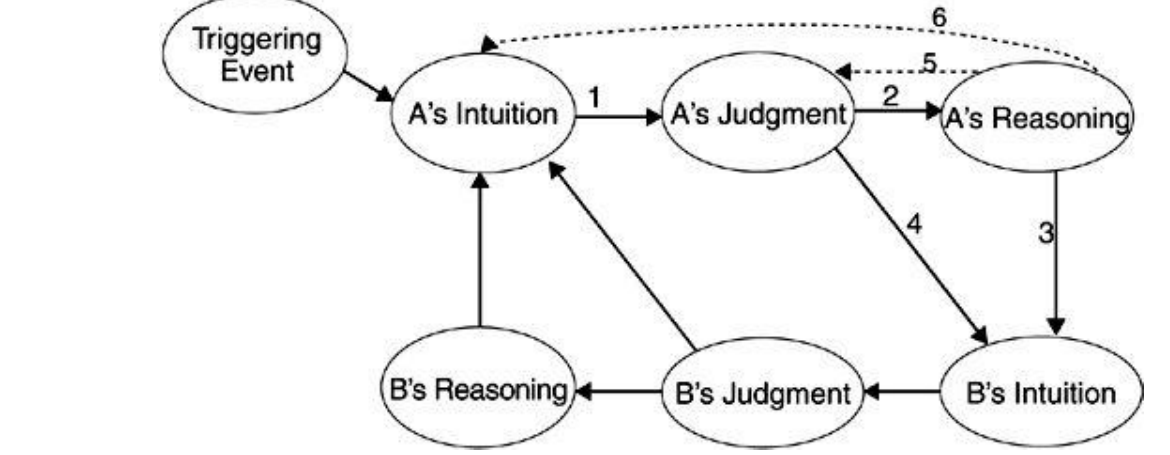
| Link | Route | Function in Haidt’s model |
|---|---|---|
| 1 | A’s intuition → A’s judgment | Intuitive judgment: an automatic appraisal produces the initial verdict. |
| 2 | A’s judgment → A’s reasoning | Post hoc reasoning: the person searches for a defensible account after judging. |
| 3 | A’s reasoning → B’s intuition | Reasoned persuasion: another person’s argument can make a new feature of the case salient. |
| 4 | A’s judgment → B’s intuition | Social persuasion: approval, disapproval, relationship, and group signals can move judgment without an explicit argument. |
| 5 | A’s reasoning → A’s judgment | Reasoned judgment: deliberate inference can produce or revise a verdict; Haidt draws this route as less common. |
| 6 | A’s reasoning → A’s intuition | Private reflection: solitary thought can generate a new way of seeing; Haidt also draws this route as less common. |
The figure and the prose immediately around it identify links 3 and 4 as reasoned and social persuasion respectively. A later paragraph in “How to Win an Argument” reverses those two labels even though the figure’s arrows do not; the diagram and preceding definitions provide the internally consistent mapping above. Figure 2.4 and links 1-3, PDF pp. 66-67 (file not included in this release) · The reversed labels in the later paragraph, PDF p. 68 (file not included in this release)
What “intuition” means here
Haidt rejects a simple emotion-versus-cognition opposition. Emotion includes appraisal and information processing, while many intuitions never become full emotions. The operative contrast is:
- seeing-that: rapid, automatic pattern recognition whose result enters awareness without access to all of the generating steps;
- reasoning-why: slower, language-based work used to explain, justify, compare, or persuade.
The Müller-Lyer illusion illustrates why knowing an explanation need not erase an appearance. The Wason task illustrates how confidently supplied reasons can defend either a correct or an incorrect answer. Haidt uses these analogies to explain how a moral verdict can persist after one justification fails. The analogy supports a causal hypothesis; it does not show that a moral intuition is literally a perceptual illusion or that every reason is a rationalization. Seeing-that and reasoning-why, PDF pp. 60-63 (file not included in this release)
Evidence in Chapter 2
Cognitive-load and response-time null results
Haidt reports that heavier memory load did not change the moral judgments in his early studies, nor did requiring quick answers versus a ten-second delay. He interpreted these failures as evidence against his Jeffersonian model of independent emotional and reasoning routes. The endnote says these null results were never turned into a manuscript because he expected them to be unpublishable. They are therefore autobiographical evidence in the book, not a published estimate of how cognitive load affects moral judgment in general. The tests and null results, PDF pp. 54-55 (file not included in this release) · Endnote 26, PDF p. 367 (file not included in this release)
Thirty extended interviews
Scott Murphy interviewed thirty UVA students across five scenarios. In the nonmoral prompts, 23% initially signed a plainly nonbinding $2 soul-sale and 37% agreed to sip apple juice touched by a sterilized cockroach; challenge moved another 17% and 10% respectively. In the two harmless-taboo prompts, only 20% accepted Julie and Mark’s protected incest and 13% accepted eating flesh from a cadaver. Haidt reports more discarded reasons and far more admissions of being unable to explain the verdict than in the Heinz dilemma. The study is vivid but small, artificial, and unpublished; the cockroach drink was stopped before anyone actually swallowed it. Interview design and nonmoral prompts, PDF pp. 55-56 (file not included in this release) · Taboo prompts and responses, PDF pp. 57-59 (file not included in this release) · Endnotes 28-30, PDF pp. 367-368 (file not included in this release)
Emotion and practical decision
Haidt uses Antonio Damasio’s reports of patients with ventromedial prefrontal damage: IQ, factual moral knowledge, and verbal reasoning could remain intact while emotional response and ordinary decision-making deteriorated. His inference is that affective valuation helps make options matter and cannot simply be removed to liberate pure reason. That supports interaction between value and deliberation, not a claim that one brain region contains the passions or that reason merely narrates every choice. Damasio discussion, PDF pp. 52-53 (file not included in this release) · Current evidence audit
Haidt, Chapter 3 — six proposed routes to intuitive primacy, plus a correction case
Chapter 3 tests the model through six bodies of evidence: instant affect and mere exposure; social and political cueing; bodily-state effects; psychopathy; infant social evaluation; and the timing of affect-associated neural activity during moral dilemmas. Together they support the claim that evaluation often begins before explicit reason-giving. They do not establish that every first reaction is accurate, that every reason is post hoc, or that the source-era priming literature is currently robust.
The chapter’s counterweight is equally important. Friendly interlocutors can change salience, conflicting intuitions can alternate, and a forced two-minute delay reportedly let a strong defense of the Julie-and-Mark case change judgments when the same argument had no advantage under immediate response. Weak reasoning did not improve with time. The rider therefore needs favorable conditions and a substantive argument; it is constrained, not absent. Six evidence routes begin, PDF pp. 75-88 (file not included in this release) · Reasoned revision, PDF pp. 89-91 (file not included in this release) · Chapter 3 source audit · Permanent concept note
Haidt, Chapter 4 — strategic reasoning and the conditions for social correction
Chapter 4 expands the model’s second half. The rider often behaves like a press secretary: Wason’s 2–4–6 task, Kuhn’s evidence cards, and Perkins’s my-side results illustrate how a conclusion can recruit tests and arguments that protect it. Higher cognitive ability can enlarge the brief without automatically enlarging the search for disconfirmation. Haidt’s claim is functional and probabilistic; it does not show that every reason is insincere or that valid arguments become invalid when motivated.
Tetlock’s accountability work supplies the institutional correction. Exploratory thought becomes more likely when accountability is announced before a view forms, the audience’s position is unknown, and the audience is thought informed and accuracy-seeking. A known partisan audience can instead intensify confirmatory reasoning. Social correction therefore requires both adversarial challenge and a shared forum in which accuracy and revision are reputationally safe. Accountability conditions, PDF pp. 97–100 (file not included in this release) · Press secretary and my-side evidence, PDF pp. 102–105 (file not included in this release) · Reasoning as a group-level corrective, PDF pp. 113–114 (file not included in this release) · Chapter 4 source audit
Haidt, Chapter 5 — culture helps furnish the elephant’s moral world
The six-link model explains how judgments move; Chapter 5 adds an account of what the intuitive system has learned to notice. Shweder’s ethics of autonomy, community, and divinity organize attention around individuals and rights, roles and institutions, or elevation and degradation. Practices, relationships, and institutions make some of these concerns fluent while leaving others latent. A moral intuition is therefore neither a culture-free reflex nor a consciously taught proposition.
Haidt’s Indian immersion illustrates the social links in slow motion. Dependence on kind hosts and gratitude made their perspective easier to inhabit; community and divinity concerns began to feel salient rather than merely classifiable. That autobiography is evidence about Haidt’s learning, not a controlled estimate of cultural change—and it contains its own warning: affection can recruit the rider to defend a social order. New intuitions still require factual and normative review. Culture and psyche and the three ethics, PDF pp. 122–124 (file not included in this release) · Gratitude, perspective, and the rider, PDF pp. 125–126 (file not included in this release) · Chapter 5 source audit · Three-ethics model
The practical implication for disagreement
Refuting a person’s stated rationale may remove only the latest defense, not the evaluation that recruited it. Productive disagreement therefore has two tasks:
- Lower defensive social pressure: convey respect, listen accurately, and show that revision will not automatically mean expulsion or humiliation.
- Change what the case looks like: introduce a fact, analogy, counterexample, affected person’s perspective, or concrete experience capable of producing a new intuition.
This is not permission to manipulate. Warmth without truth becomes influence theater; reasons without relational access may never be considered. The ethical aim is to create conditions in which accurate reasons can be heard and both parties can revise. Argument, empathy, and perspective, PDF pp. 68-69 (file not included in this release)
What the model does not establish
- Not “feelings are always right.” Causal priority gives an intuition no automatic normative authority.
- Not “reason never matters.” Links 3, 5, and 6 explicitly allow reasons to change judgment directly or by changing intuition.
- Not “emotion versus cognition.” Haidt counts intuitive appraisal as cognition and reserves “reasoning” for conscious, language-based processing.
- Not a frequency estimate. Haidt concedes in endnote 44 that he had no evidence for how often links 5 and 6 occur in daily moral life. Endnote 44, PDF p. 369 (file not included in this release)
- Not a metaethical verdict. A genealogy of judgment does not decide whether a moral claim is true, what would make it true, or which decision procedure ought to govern action.
- Not a complete theory of persuasion. Knowledge, incentives, identity, trust, power, and institutions can all affect whether an argument is considered.
Operational use
When a moral disagreement stalls:
- Identify the intuitive concern: harm, unfairness, betrayal, degradation, coercion, hierarchy, or purity.
- Ask which facts activate it and which could falsify the factual story.
- Restate the other person’s view until they recognize it.
- Offer one concrete comparison or perspective that changes salience, not ten abstract rebuttals.
- Invite reciprocal identity reversal and a counterexample to your own rule.
- Separate the psychological question—why did this verdict arise?—from the normative question—what verdict is best supported?
Connected notes
- Ethical authority of intuition → Intuition Is Evidence, Not a Verdict
- Descriptive versus metaethical levels → Moral Psychology Does Not Settle Metaethics
- Deliberative synthesis → Moral Judgment Argument Map
- Social incentives → Social Incentives Dictate Beliefs
- Early evaluation and correction conditions → Affective Primacy in Moral and Political Judgment
- Practical rhetoric → Persuasion
- Source audit → The Righteous Mind, Chapter 2