Distilled Knowledge
Source contribution
Henderson treats morality as an evolved and culturally elaborated system for restraining selfishness, sustaining cooperation, assigning moral typecasts, and managing reputation. The course’s chief value is its range of candidate mechanisms and its explicit warning that moral psychology remains unsettled after the replication crisis.
- Moral perception can alter judgments about intention, normality, identity, blame, and deservingness—not only the final verdict.
- Emotions such as anger, disgust, shame, guilt, and gratitude can function as social signals and enforcement mechanisms.
- Kin selection, reciprocal altruism, reputation, partner choice, and cultural group processes offer different explanations for cooperation.
- Proximate reasons and ultimate evolutionary explanations answer different questions; neither automatically invalidates the other.
- Moral dyads and moral-foundations theory compete over whether harm is the organizing template or one foundation among several.
Routes into permanent notes
- Moral Psychology Does Not Settle Metaethics separates functional explanation from moral justification.
- Intuition Is Evidence, Not a Verdict converts the course into a practical audit.
- Moral Judgment Argument Map supplies the normative comparison the course itself cannot settle.
Evidence boundary
This is a course-note synthesis, not an independent systematic review. Evolutionary explanations can be speculative, and cited findings vary in replication quality. Verify individual studies before publication and distinguish the instructor’s claims from settled field consensus.
The Righteous Mind, Chapter 1 — the empirical dispute behind “more than harm”
Haidt reconstructs the debate between Elliot Turiel and Richard Shweder. Turiel’s tests suggested that even young children distinguish harm-based moral rules from alterable conventions. Shweder’s 600 interviews in Chicago and Orissa suggested a broader moral domain; Haidt’s later 360 interviews across three cities reported city, class, and age differences that persisted after respondents who consciously perceived harm were filtered out.
The chapter therefore supports the course’s claim that moral psychology may not reduce to explicit harm judgments, while also sharpening its evidence boundary: descriptive variation does not establish moral relativism, validate every taboo, or settle whether later Moral Foundations Theory is complete. Turiel through Haidt’s test, PDF pp. 26–44 (file not included in this release) · Chapter 1 source audit
Handwritten journal source
Consolidated source: PDF pp. 93–103 (file not included in this release)
Source boundary: These are handwritten source pages. Use the scan for exact wording; verify quotations and factual claims before reuse.
Embedded preview:
March 21-June 9 2026.pdf (file not included in this release)
Open the journal routing table
1. Morality by Nature
Peterson Academy - The Psychology of Morality (Henderson) - Lecture 01.pdf (file not included in this release)
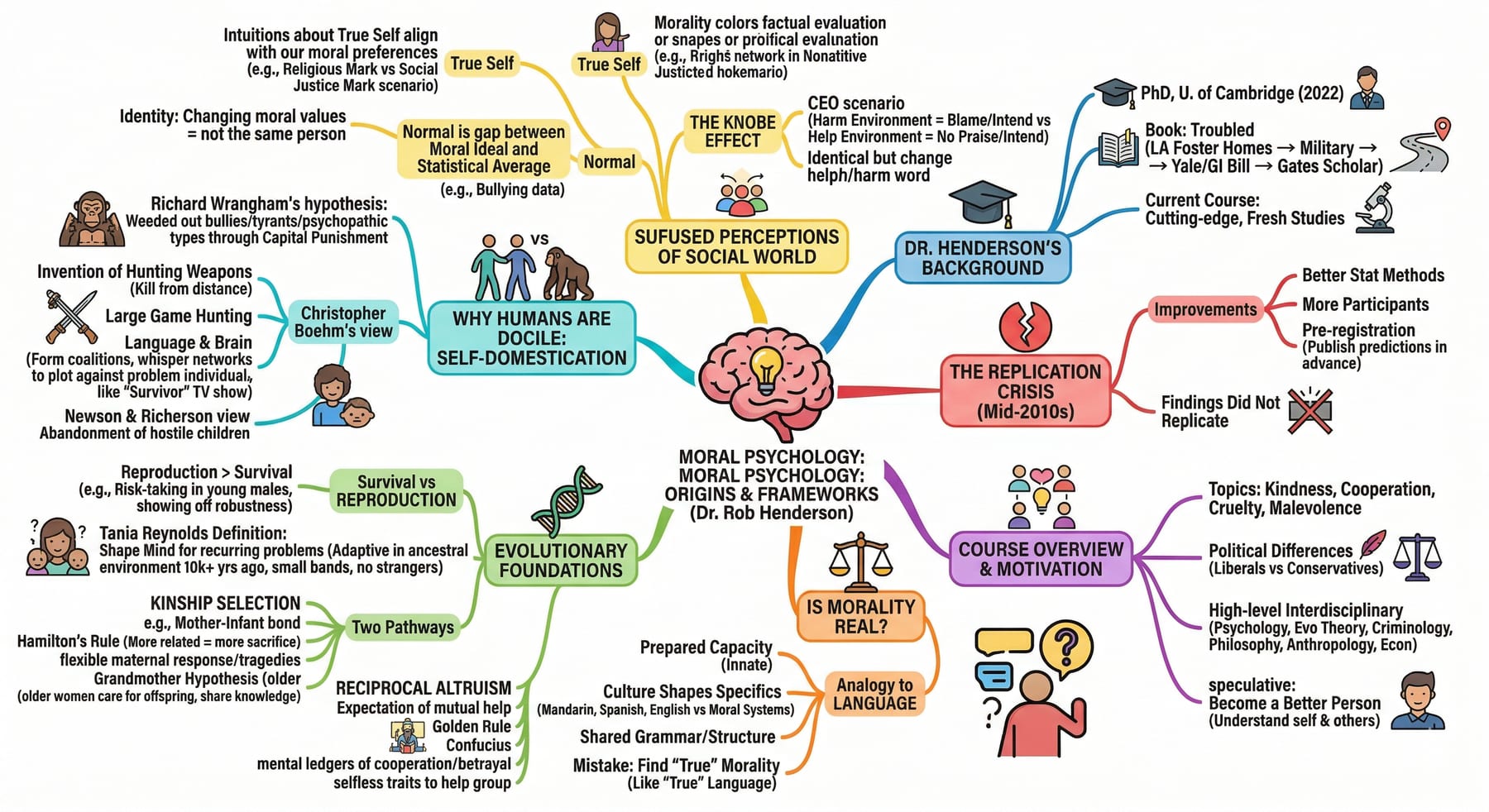
Overall thesis of the lecture
- The lecture argues that morality is not a superficial social add-on but a deep feature of human social life.
- The instructor’s central claim is that morality primarily functions to suppress selfishness and make cooperation possible.
- He frames moral psychology as an interdisciplinary field that draws from psychology, philosophy, anthropology, criminology, behavioral economics, and evolutionary theory.
- He also stresses that the field is still debated and unsettled, especially after the replication crisis in psychology, so students should treat the material as a set of competing frameworks rather than a closed doctrine.
1. Opening framing: who the instructor is and what kind of course this is
- Rob Henderson introduces himself as a recent PhD in psychology from Cambridge, with earlier study at Yale and a background shaped by foster care, military service, and the GI Bill.
- He presents the course as grounded both in historical thinkers and contemporary scholarship.
- He emphasizes that because he is a recent graduate, he will be drawing on newer psychological research and “cutting-edge” studies.
- He flags the replication crisis as an important background issue: many findings in psychology failed to replicate in the mid-2010s, but the field has responded with improvements such as better statistical methods, larger samples, and preregistration.
- This opening matters because it sets the tone: the course will use science, but cautiously, with awareness that not every result is equally solid.
2. Course roadmap and the big questions it wants to answer
- The lecture serves as an orientation to the broader course.
- Topics he says the course will explore include:
- the origins of kindness and cooperation
- cruelty and malevolence
- liberal and conservative differences in moral thinking
- sex differences in morality
- age differences and moral development across the lifespan
- the relationship between morality and happiness
- He offers three reasons to study moral psychology:
- the topics are inherently fascinating
- the field yields interdisciplinary insight into human behavior
- it may help people understand themselves and others better, and perhaps become better people
- He uses Anton Chekhov’s idea that people improve when shown what they are like, suggesting that self-knowledge can have moral value.
3. The first core problem: is morality even real?
- Henderson begins by addressing skepticism directly.
- He describes common skeptical positions:
- nihilism
- cynicism
- relativism
- the idea that morality is only subjective dispute
- His response is not to begin with abstract proof, but with a social example: people who deny morality often still display intense outrage when shown a concrete moral violation.
- His example is the viral outrage over an animal care worker dragging a dog by the leash. He highlights that strangers who had no personal connection to the dog still reacted strongly, calling for punishment and trying to identify the worker.
- His point is that moral judgment appears spontaneously and powerfully even among people who may deny objective morality in theory.
- This is one of the lecture’s recurring themes: moral life is inescapable at the level of lived human psychology, even if people dispute it philosophically.
4. Historical and philosophical definitions of morality
- Henderson then surveys several thinkers to look for a shared theme in their definitions of morality.
- Thinkers mentioned:
- Aristotle
- St. Augustine
- David Hume
- Jonathan Haidt
- Joshua Greene
- The common thread he identifies across these definitions is:
- morality restrains selfishness
- morality promotes cooperation
- morality serves the common good or the functioning of social life
- This is one of the lecture’s most important conceptual moves. He is not treating morality primarily as a list of commandments or as a metaphysical system, but as a social technology for cooperative life.
- His preferred summary formula is that morality exists to “promote and sustain cooperation.”
5. Adam Smith and Jefferson as early allies of the “moral sense” view
- Adam Smith is used to argue that humans naturally respond to the fortune and suffering of others.
- Smith’s importance here is that sympathy is presented as a basic building block of morality.
- Thomas Jefferson is quoted from 1787 saying that the moral sense or conscience is as much a part of man as a limb and can be strengthened by exercise.
- The lecture uses these figures to show that the idea of an innate moral faculty is not new and has deep roots in Enlightenment thought.
- Henderson does not claim these authors settle the issue, but he uses them to reinforce the idea that morality is deeply embedded in human nature rather than being a mere cultural invention.
6. Morality as analogous to language
- One of the lecture’s main explanatory analogies is between morality and language.
- The argument works like this:
- humans are born with a prepared capacity for language
- the specific language learned depends on culture
- variation in languages does not mean language is unreal
- likewise, humans may be born with a prepared capacity for morality
- the specific moral code varies by culture
- This analogy is used against a crude relativist argument.
- Henderson’s point is that diversity of moral systems does not prove morality is fake; it may instead reveal a shared human capacity that gets differently expressed.
- He also criticizes the philosophical urge to discover “the one true morality” in a simplistic sense, comparing it to trying to discover “the one true language.”
- The implication is not that all moral systems are equal, but that moral variation should be studied the way linguists study language variation: as evidence of a common underlying human faculty.
7. Why morality matters for humans at all
- Henderson argues that human beings are unusual primates because we are highly cooperative relative to our physical weakness.
- He cites Sarah Hrdy’s quip that chimpanzees on a plane would tear each other apart before arriving.
- He pairs this with Coltan Scrivner’s remark that it is actually remarkable humans do not kill one another more often.
- This section tries to establish that morality is not ornamental but necessary:
- humans are physically vulnerable
- humans survive through trust and coordination
- therefore a moral sense is part of the machinery that makes human life possible
- The deeper claim is that moral order is not merely about idealism; it is part of the species’ survival strategy.
8. Moral psychology shapes perception, not just judgment
- A major theme of the lecture is that people do not first gather neutral facts and then make moral judgments.
- Instead, moral evaluation influences how facts themselves are interpreted.
- Henderson contrasts:
- the “detective model” of moral thinking, where facts are neutrally gathered first
- the moral psychology model, where perception is already filtered through moral lenses
- This shift matters because it means morality is not simply the last stage of reasoning.
- It is embedded in cognition itself.
9. The Knobe effect: how moral evaluation changes judgments of intention
- Henderson introduces the Knobe effect as one of the lecture’s strongest examples.
- Scenario structure:
- a CEO wants profit
- a product either harms or helps the environment as a side effect
- the CEO says he does not care about the environment
- Result:
- when the side effect is harm, most people say he intended the harm
- when the side effect is help, most people say he did not intend the help
- The factual structure is the same in both cases except for “harm” versus “help.”
- The key lesson:
- judgments of intention are morally asymmetrical
- people are quicker to ascribe intentionality when blame is at stake
- This supports the broader claim that moral appraisal shapes factual interpretation.
10. Developmental version of the same pattern: children already show it
- The lecture strengthens the Knobe point by showing a child version of the same moral asymmetry.
- In the frog scenario:
- Andy knows Janine hates frogs and brings one anyway
- children say he intended to upset her
- In the reverse version:
- Janine loves frogs
- Andy brings one and she is happy
- children tend to say he did not intend to make her happy
- Henderson uses this to argue that the tendency is not merely an adult ideological overlay.
- It may reflect an early-developing structure of moral cognition.
- This is important because it suggests the moral filtering of intention is developmentally basic.
11. The moral meaning of the word “normal”
- Henderson gives another example of morality shaping perception through the word “normal.”
- He uses a New York Times headline saying, “It’s not normal to raise children like this.”
- His point:
- in a statistical sense, if many people raise children that way, then it is normal
- but in everyday speech, “normal” often means morally acceptable or desirable
- He explains this with the bullying example:
- actual average = 10 cases
- ideal = 0
- what people call “normal” may be somewhere in between
- This means that ordinary language often mixes descriptive facts with moral aspiration.
- The broader lesson is that moral preferences leak into supposedly neutral concepts.
12. Morality and the “true self”
- Another major idea is that morality shapes how people think about identity itself.
- Henderson presents the “Mark” scenarios:
- a conservative Christian man with same-sex desire
- a social justice advocate with anti-gay disgust reactions
- In both cases, participants tend to identify the “real” self as whichever side aligns with their own moral commitments.
- Conservatives say the principled religious self is real in the first case.
- Liberals say the same-sex-desiring self is real.
- In the second case, the pattern reverses.
- Henderson’s point is:
- people think they are discovering the true self
- but in reality, they are often projecting their moral values into their judgments of authenticity
- This is a strong example of morality structuring not just judgment of actions, but metaphysical intuitions about who a person really is.
13. Moral values as central to personal identity
- He extends the “true self” idea with another study:
- if a loved one loses memory, food preferences, clothing preferences, or travel preferences, people still tend to think it is the same person
- if a loved one radically changes moral values, people are much more likely to feel the person is no longer really the same
- This supports a powerful claim:
- morality sits near the core of our intuitive concept of personhood
- In ordinary life, moral change often feels deeper than cognitive loss or preference change.
- Henderson uses this to suggest that morality is not peripheral but central to how humans understand identity and relationship.
14. Evolutionary account: why humans evolved to care about morality
- Henderson’s main explanatory framework is evolutionary psychology.
- He argues that moral emotions and moral norms were adaptive because they promoted:
- social cohesion
- trust
- kin protection
- alliance formation
- reproductive success
- Peggy Mason is cited for the idea that prosocial acts support group cohesion and therefore survival and reproduction.
- Patricia Churchland is used to argue that conscience grows out of attachment systems, especially mother-child bonding, later expanded to wider social relations.
- Her formula is memorable:
- attachment begets caring
- caring begets conscience
- This means morality is presented not as a detached rational invention, but as something built upon older mammalian bonding mechanisms.
15. Key moral emotions and their function
- Henderson treats emotions like guilt, shame, betrayal, pride, disgust, and joy as part of the architecture of moral life.
- These emotions are not presented as irrational leftovers.
- Instead, they are described as evolved regulatory tools:
- they encourage cooperation
- punish defection
- bind people to group expectations
- The lecture implies that moral emotions make norms socially enforceable long before formal law appears.
16. Morality, mating, and reputation
- A notable point in the lecture is that morality is not only about survival or abstract goodness.
- Being perceived as moral can:
- build trust
- attract allies
- attract mates
- Henderson says kindness is one of the strongest predictors of attraction.
- His broader evolutionary point is that moral reputation has social and reproductive payoff.
- This leads to a subtle argument:
- moral behavior may be sincere
- but it can also serve signaling functions
- He extends this logic with the skate park example, where boys perform riskier stunts in front of a female research assistant.
- The analogy is that humans also “show off” moral worth, not just physical daring.
- So the lecture suggests morality has both cooperative and display functions.
17. Evolutionary psychology as the lecture’s master framework
- Henderson explicitly defines evolutionary psychology using Tania Reynolds:
- the mind contains adaptations shaped to solve recurring ancestral problems
- He stresses that “adaptive” does not mean adaptive in modern life.
- It refers to conditions in the ancestral environment:
- small hunter-gatherer groups
- long pre-agricultural history
- face-to-face relationships
- This matters because he repeatedly invokes evolutionary mismatch:
- traits suited to small, stable groups may function awkwardly in anonymous modern societies
- This mismatch idea helps explain:
- shame before strangers
- social anxiety in one-off interactions
- moral intuitions that do not fit modern institutions neatly
18. The first evolutionary pathway: kinship selection
- Henderson identifies kinship selection as one of the two principal routes by which moral psychology evolved.
- Basic idea:
- helping close kin helps copies of one’s genes survive
- therefore altruism toward family can evolve
- William Hamilton’s rule is the centerpiece here.
- Main implications:
- people sacrifice more for those more closely related to them
- the willingness to help rises with genetic relatedness
- this is especially visible in parents and children, then siblings, then more distant kin
- Henderson emphasizes that this is not conscious arithmetic.
- People do not compute genetic percentages in real time.
- Rather, natural selection built emotional tendencies that make kin-directed care feel immediate and natural.
19. Hard ancestral conditions and tragic maternal trade-offs
- This is one of the darkest parts of the lecture.
- Henderson argues that ancestral life involved:
- high child mortality
- disease
- warfare
- limited food and support
- In that setting, mothers sometimes withdrew care from infants.
- He presents this not as evidence against parental love, but as evidence of brutal environmental trade-offs.
- He argues that because these decisions were so morally and psychologically painful, societies developed myths to rationalize them.
20. Changelings, spirit children, and folklore as coping mechanisms
- Henderson uses anthropological material to argue that folklore sometimes functioned as a moral-psychological defense mechanism.
- Examples:
- changelings
- spirit children
- goblin or fairy children
- infants treated as non-human beings to justify abandonment
- He cites Daniela Sieff and Catherine Dettwyler’s report from Mali, along with European changeling folklore.
- His argument:
- when a sick or disabled child was abandoned or left to die, the myth allowed parents to interpret the act as something other than abandoning their own real child
- This is one of the lecture’s strongest examples of culture serving a psychological and moral need.
- The implication is that myth can emerge not only to explain nature but to manage unbearable guilt and grief.
21. Twins, scarcity, and the harsh logic of resource constraints
- Henderson also mentions that in some small-scale societies twins were treated as bad omens and one or both might be killed.
- The explanation he gives is material:
- expecting one child but receiving two dramatically increases the resource burden
- His goal is not to endorse such practices but to explain them as products of scarcity and evolutionary trade-offs.
- The broader lesson is that care for offspring evolved strongly, but under extreme scarcity it could be overridden by desperate survival calculations.
22. The “death mother” archetype and an evolutionary reinterpretation
- Henderson introduces Marion Woodman’s Jungian “death mother” archetype:
- cold
- rejecting
- devouring
- anti-nurturing
- He then gives it an evolutionary reinterpretation:
- fear of abandonment may motivate children to secure and maintain parental investment
- This section is important because it shows him blending symbolic/psychoanalytic ideas with evolutionary reasoning.
- He is not presenting the archetype as mystical truth.
- He is using it as a way to think about the child’s deep fear of losing care.
23. Freud and the Oedipus complex reinterpreted
- Henderson does not endorse Freud’s classic formulation strongly.
- But he suggests there may be an evolutionary kernel behind it.
- His reinterpretation:
- young children need intense parental investment
- a sibling threatens to dilute that investment
- one way to preserve exclusive attention is to interfere with the parental bond
- So statements like “I want to marry mommy” are not read literally, but as traces of competitive attachment.
- This is one of the lecture’s more speculative moves, but it fits his general pattern:
- reinterpret classical psychological theories through parental investment and resource competition.
24. The smoke detector principle and infant crying
- Randolph Nesse’s smoke detector principle is used to explain infant fussiness.
- Main analogy:
- a good smoke detector is oversensitive because false alarms are safer than missing a real fire
- likewise, infant distress systems may be designed to be overreactive
- Henderson argues that babies cry even when nothing is wrong because the cost of under-signaling need is too high.
- He also adds the idea that energetic crying may signal robustness, making the infant seem worth investing in.
- This section fits the larger point that even seemingly irrational behaviors may be adaptive when viewed in ancestral conditions.
25. The grandmother hypothesis
- Henderson briefly covers Kristen Hawkes’s grandmother hypothesis.
- Core idea:
- human females often live long past fertility
- this is unusual compared with other primates
- one explanation is that post-reproductive women help raise grandchildren
- He presents this as evidence that kin-selected care extends beyond parents.
- Grandmothers may increase:
- child survival
- knowledge transfer
- family stability
- This supports the broader point that human morality and care systems are embedded in extended kin networks, not just nuclear families.
26. The second evolutionary pathway: reciprocal altruism
- The second main route to moral evolution is reciprocal altruism.
- Unlike kinship selection, this applies to non-kin.
- Basic idea:
- I help you now
- you help me later
- long-term cooperation becomes advantageous
- Henderson connects this to:
- the Golden Rule from Christ
- Confucius’s version of reciprocity
- He suggests reciprocity is one of the deepest foundations of moral life across civilizations.
- This is important because it expands morality beyond family loyalty into broader social exchange.
27. Social memory: cheaters, cooperators, and mental ledgers
- Henderson argues that humans are very good at tracking:
- who helped
- who cheated
- who failed to pull their weight
- He uses laboratory games as evidence that people remember defectors and are reluctant to cooperate with them again.
- This means moral psychology includes cognitive systems for:
- reputation tracking
- punishment
- selective trust
- He portrays human beings as carrying mental ledgers, even when not explicitly aware of it.
- This is central to how reciprocal altruism becomes stable.
28. Dawkins and the paradox of selfish genes producing selfless behavior
- Henderson leans on Richard Dawkins to make an important clarification:
- if genes are “selfish,” that does not mean organisms are always selfish in behavior
- In fact, kin selection and reciprocity can produce very costly altruism.
- Examples given:
- parents sacrificing for children
- soldiers sacrificing for comrades
- This helps Henderson resist the simplistic idea that evolution means only brutality or competition.
- His view is that evolution generated both kindness and cruelty, cooperation and conflict.
29. The self-domestication hypothesis
- This is one of the lecture’s biggest explanatory claims.
- Richard Wrangham’s self-domestication hypothesis is used to explain why humans are less violently aggressive than chimpanzees.
- Henderson states:
- chimpanzees are much more violent than humans in hunter-gatherer societies
- bonobos are calmer than chimps but still more violent than humans
- The proposed explanation:
- over time, human groups removed highly aggressive, domineering bullies
- this could happen through ostracism or killing
- thus highly reactive aggression was gradually selected against
- His phrase “whisper network” is key:
- language and coalition-building let groups coordinate against dangerous individuals
- This hypothesis supports the lecture’s broader picture of morality as partly enforced through coalition, punishment, and group regulation.
30. Historical and anthropological mechanisms behind self-domestication
- Henderson supplements Wrangham with Christopher Boehm’s account from Hierarchy in the Forest.
- Key enabling developments:
- hunting weapons
- ability to kill at a distance
- language for coalition-building
- group coordination against bullies
- He uses Survivor as a modern analogy for coalition-based expulsion.
- He also mentions Jane Murphy’s Inuit example about disposing of a selfish group member.
- The underlying idea is that egalitarian order may have been built not by everyone becoming nicer spontaneously, but by communities collectively suppressing chronic aggressors.
31. Aggressive children and social pruning
- Henderson adds another related theory from Lesley Newson and Peter Richerson:
- not only aggressive adult males, but also highly aggressive children may have been abandoned or removed in some hunter-gatherer groups
- This is presented as a complementary mechanism to self-domestication.
- Again, the idea is long-term selection against extreme aggression.
- This section reinforces the lecture’s claim that human prosociality may partly be the result of harsh collective filtering over many generations.
32. Moral valuation and relationship calculus
- Near the end, Henderson suggests that humans implicitly calculate the value of relationships.
- His example:
- many people would take $8 for themselves over $10 for a friend
- but would prefer $10 for a friend over only $1 for themselves
- The point is not mere selfishness.
- It is that social decisions weigh:
- self-interest
- partner value
- relationship importance
- This fits his broader framework that morality is intertwined with exchange, reputation, and social valuation.
33. Evolutionary mismatch and modern shame
- Henderson ends by noting that humans evolved in small groups where almost everyone was known.
- Therefore, modern one-off anonymous interactions are evolutionarily novel.
- This helps explain:
- embarrassment before strangers
- humiliation in fleeting encounters
- social anxiety in low-stakes situations
- His claim is that ancient social emotions remain active in modern environments they were not designed for.
- This is one of the lecture’s most practical modern applications of evolutionary thinking.
34. Main ideas of the lecture, condensed
- Morality is presented as an evolved human capacity, not merely a philosophical abstraction.
- The lecture’s preferred functional definition is that morality suppresses selfishness and enables cooperation.
- Moral psychology shapes how people see facts, intentions, identity, and normality.
- Human morality is rooted in at least two major evolutionary pathways:
- kinship selection
- reciprocal altruism
- Human prosociality is explained not only by bonding and reciprocity, but also by punishment, coalition, and self-domestication.
- The lecture repeatedly argues that morality is inescapable in human life, even for skeptics who deny it at the level of theory.
35. Historical events, periods, and contexts mentioned
- The replication crisis in psychology, especially the mid-2010s, when many findings failed to replicate.
- Thomas Jefferson in 1787, cited on the moral sense as part of human nature.
- The Scottish Enlightenment through Adam Smith.
- The pre-agricultural ancestral environment, especially hunter-gatherer life over most of human history.
- The agricultural revolution as a dividing line between ancestral and later social conditions.
- The Middle Ages and later centuries in relation to changeling folklore and abandonment of children.
36. Thinkers, scholars, and sources mentioned in the transcript
People mentioned
- Rob Henderson
- Jordan Peterson / Peterson family
- Adam Smith
- Thomas Jefferson
- Aristotle
- St. Augustine
- David Hume
- Jonathan Haidt
- Joshua Greene
- Anton Chekhov
- Friedrich Nietzsche
- Sarah Hrdy
- Coltan Scrivner
- Joshua Knobe
- Peggy Mason
- Patricia Churchland
- Tania Reynolds
- William Hamilton
- Richard Dawkins
- Daniela Sieff
- Catherine Dettwyler
- Marion Woodman
- Sigmund Freud
- Randolph Nesse
- Kristen Hawkes
- Richard Wrangham
- Jane Murphy
- Christopher Boehm
- Lesley Newson
- Peter Richerson
- Confucius
- Christ / Jesus (through the Golden Rule reference)
Books and works mentioned
- Troubled by Rob Henderson
- The Wealth of Nations by Adam Smith
- The Theory of Moral Sentiments by Adam Smith
- Conscience: The Origins of Moral Intuitions by Patricia Churchland
- The Selfish Gene by Richard Dawkins
- The Goodness Paradox by Richard Wrangham
- Hierarchy in the Forest by Christopher Boehm
Other sources/articles/examples mentioned
- A New York Times headline: “It’s not normal to raise children like this”
- The viral story about the animal-care worker dragging a dog
- Lab experiments on cooperation and cheating
- Preschool studies on moral intention
- The reality TV show Survivor as an analogy
- Ethnographic material on the Inuit
- Anthropological material from Mali on spirit children/changelings
37. Tensions, assumptions, and possible points to think critically about
- The lecture strongly favors evolutionary explanations, which may be illuminating but can also risk overextending adaptationist reasoning.
- Some sections are more solidly empirical, such as:
- the Knobe effect
- preschool intention asymmetries
- reciprocity and cheating memory
- Other sections are more interpretive or speculative, such as:
- evolutionary reinterpretations of the Oedipus complex
- the “death mother” archetype
- some claims about ancient infanticide practices as direct evolutionary logic
- The lecture often moves from “this pattern may have had an adaptive function” to a broader story about why it exists. That can be insightful, but it is not always definitive proof.
- He also frames morality mainly in cooperative-functional terms, which is powerful, but may leave out traditions that center morality more on truth, virtue, holiness, duty, natural law, or rights.
38. Related topics for further exploration
- Jonathan Haidt’s moral foundations theory
- The replication crisis and reform movement in psychology
- Experimental philosophy and the Knobe effect
- The evolution of empathy and sympathy
- The grandmother hypothesis and human life history
- Kin selection versus group selection
- Reciprocal altruism and game theory
- Reputation, punishment, and moral signaling
- Evolutionary mismatch in modern society
- Human self-domestication versus bonobo/chimp social behavior
- Moral realism versus moral anti-realism
- Adam Smith’s moral psychology in The Theory of Moral Sentiments
- Patricia Churchland on neurobiology and conscience
- Christopher Boehm on egalitarianism and anti-dominance coalitions
- Richard Wrangham on reactive aggression and human evolution
- The anthropology of infanticide, scarcity, and child value
- The moral psychology of political identity and the “true self”
39. One-paragraph synthesis
- This lecture is essentially a defense of moral psychology as the study of one of the deepest features of human life: our tendency to judge, care, cooperate, punish, bond, and interpret the world through moral categories. Henderson argues that morality is real at least in the psychological sense that humans cannot escape it, and he explains it largely through evolutionary mechanisms such as kinship selection, reciprocal altruism, and self-domestication. Along the way, he shows how moral concerns shape intention judgments, notions of normality, and even beliefs about the “true self.” The lecture is broad, ambitious, and interdisciplinary, combining classical philosophers, contemporary psychology, anthropology, and evolutionary theory into a single framework centered on one master claim: morality is a human adaptation for cooperative social life.
2. Moral Foundations
Peterson Academy - The Psychology of Morality (Henderson) - Lecture 02.pdf (file not included in this release)
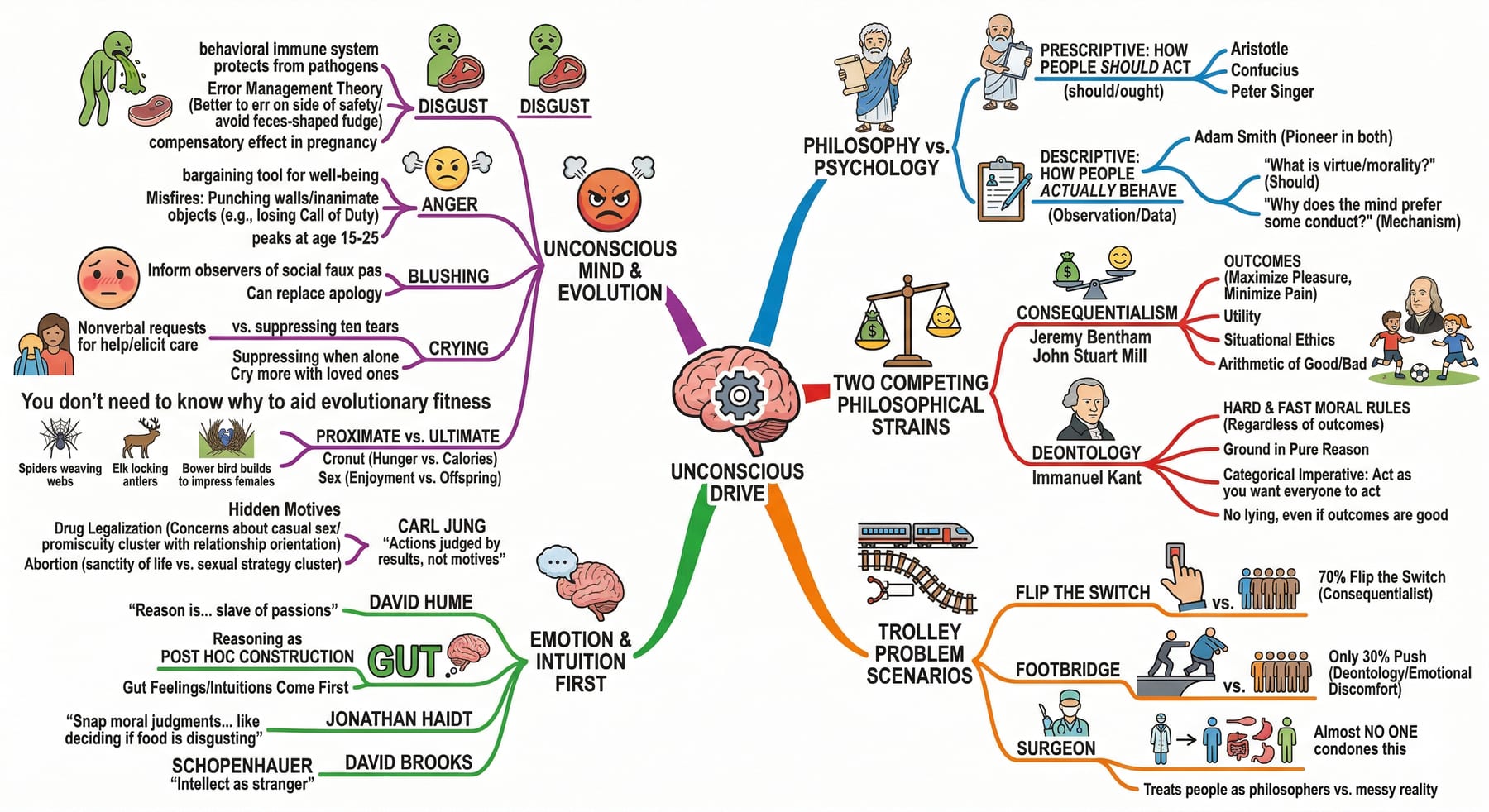
Overall argument of the lecture
- This lecture argues that moral psychology is not the same thing as moral philosophy.
- The speaker’s central point is that moral psychology studies how people actually form moral judgments, not how they ideally should behave.
- He moves from older philosophical frameworks such as consequentialism and deontology toward a more modern psychological claim: in everyday life, people usually make moral judgments through intuition, emotion, disgust, and unconscious processes, then justify those judgments afterward with reasoning.
1. Main distinction: moral philosophy vs. moral psychology
- The lecture opens by drawing a firm distinction:
- Moral philosophy asks:
- What is the good life?
- What principles should guide conduct?
- What ought people to do?
- Moral psychology asks:
- How do people actually make moral judgments?
- What emotions, intuitions, and social patterns shape those judgments?
- Moral philosophy asks:
- The speaker frames this as:
- philosophy = prescriptive
- moral psychology = descriptive
- He emphasizes that the course is not meant to preach a moral doctrine, but to examine the mental and social machinery behind moral judgment.
2. Adam Smith as a bridge figure
- Adam Smith is presented as an important bridge between philosophy and psychology.
- The speaker says Smith separated two questions:
- What counts as virtue?
- What faculty of mind leads us to approve or condemn actions?
- This is a key framing move in the lecture:
- Smith is used to show that one can distinguish between the content of morality and the psychology of moral judgment.
- The speaker uses Smith to legitimize moral psychology as a serious field with roots in older thought, not merely a modern academic invention.
3. Historical moral frameworks: consequentialism and deontology
Consequentialism
- Presented as most associated with:
- Jeremy Bentham
- John Stuart Mill
- Defined as a framework where:
- morality depends on outcomes
- the right act is the one that maximizes pleasure or happiness and minimizes suffering
- Linked closely to:
- utilitarianism
- moral “calculation”
- situational ethics rather than fixed rules
Deontology
- Presented as most associated with:
- Immanuel Kant
- Defined as a framework where:
- some actions are wrong regardless of consequences
- morality depends on principles, duties, and rules
- Kant’s categorical imperative is used as the main example:
- act only in ways you could will everyone to act
Main analytical point
- The lecture shows that these frameworks are historically powerful, but psychologically incomplete.
- The speaker suggests they treat human beings too much like consistent philosophers with stable systems, whereas actual people are far more inconsistent and context-sensitive.
4. The trolley problem and what it reveals
- The lecture uses three famous moral dilemmas:
- the switch version of the trolley problem
- the footbridge version
- the surgeon/organ harvesting scenario
- Key pattern:
- many people will flip a switch to save five and kill one
- far fewer will push a man off a bridge to save five
- almost no one will approve sacrificing a healthy patient for five organs
- Main takeaway:
- if people were clean, consistent consequentialists, their answers should remain more stable across these cases
- but their answers change dramatically depending on physical closeness, emotional vividness, and felt violation
- This supports the lecture’s argument that actual moral judgment is not just rational arithmetic.
- It is heavily shaped by context, emotion, and intuitive aversion.
5. Shift from reason-first morality to intuition-first morality
- After discussing trolley problems, the lecture pivots to a broader claim:
- people often do not reason their way into a moral judgment
- they feel the judgment first, then explain it afterward
- David Brooks is used to illustrate this:
- moral judgments are compared to instantly sensing that a food is disgusting or a landscape is beautiful
- Jonathan Haidt’s social intuitionist view becomes the lecture’s dominant framework:
- intuition comes first
- reasoning often serves as post hoc justification
- David Hume is brought in as an intellectual ancestor of this view:
- “reason is, and ought only to be, the slave of the passions”
- Schopenhauer is added to reinforce the same theme:
- conscious intellect often arrives late and merely discovers what deeper forces have already decided
- One of the lecture’s biggest main ideas is here:
- moral reasoning often behaves more like a lawyer defending a verdict than a judge impartially reaching one.
6. Disgust as a major moral emotion
- The speaker identifies disgust as one of the most important emotions studied in moral psychology.
- He describes disgust sensitivity scales involving examples such as:
- using a stranger’s toothbrush
- someone urinating in a pool
- sitting on a still-warm bus seat
- Main finding he highlights:
- people who are more easily disgusted also tend to judge moral transgressions more harshly
- This is used to argue that moral judgment is linked not only to abstract principles, but also to embodied emotional responses.
7. The behavioral immune system
- Disgust is explained through the idea of the behavioral immune system:
- the physiological immune system helps once you are already sick
- the behavioral immune system helps you avoid infection in the first place
- Disgust originally evolved to keep humans away from:
- pathogens
- contamination
- disease sources such as rot, excrement, and infection
- The speaker then extends this to:
- sexual disgust
- moral disgust
- Main idea:
- emotions that once protected the body may also have been co-opted into protecting the social order.
8. Error management theory
- The lecture uses error management theory to explain why humans often overreact to things that are technically safe.
- Examples:
- fudge shaped like feces
- apple juice in a sterilized bedpan
- eating a sterilized dead cockroach
- Point:
- it is safer for the mind to make too many false alarms than too few
- evolution favors overcaution when the cost of missing danger is high
- This gives the lecture a broader theme:
- many emotions are not “irrational glitches” but biased safety systems
- they are designed to avoid costly errors, even if that means discomfort or false positives.
9. Pregnancy, disgust, and adaptive compensation
- The speaker claims that pregnant women tend to become more disgust-sensitive because:
- pregnancy compromises parts of the immune response
- increased disgust works as a compensatory defense
- He links this to:
- morning sickness
- food aversions
- preferences for familiar foods from childhood
- The larger point is that emotions such as disgust may shift in predictable ways depending on bodily vulnerability.
- This section reinforces his overall view that emotions are functional adaptations, not arbitrary feelings.
10. You do not need to understand a behavior for it to work
- A major thesis of the middle of the lecture is:
- organisms do not need conscious theories of their behavior in order for the behavior to be adaptive
- Examples used:
- spiders weaving webs
- elk locking antlers
- bower birds building elaborate structures to attract mates
- These examples serve two purposes:
- they normalize the idea of instinctive behavior
- they prepare the audience to accept that humans also act in ways they do not fully understand
- The speaker argues that conscious thought is metabolically expensive, so evolution would favor making many beneficial patterns automatic and unconscious.
11. Proximate vs. ultimate explanations
- This is one of the lecture’s most important conceptual distinctions.
- Proximate explanation:
- the immediate, felt reason for behavior
- example: “I eat because I’m hungry”
- Ultimate explanation:
- the evolutionary reason that desire exists
- example: eating helps survival and reproduction
- The speaker says his analysis will often focus on ultimate explanations.
- He applies this distinction to:
- hunger
- sex
- status display
- cosmetics
- sports cars
- voice pitch
- Main takeaway:
- human beings often live at the proximate level while evolutionary psychology asks about the ultimate level.
12. Hidden motives and status signaling
- Geoffrey Miller is quoted for the idea that behaviors that feel good must have evolved because they carried some hidden benefit.
- The speaker applies this to status and mating displays:
- expensive goods
- cosmetics
- sports cars
- voice depth
- One example is the claim that:
- men lower voice pitch when they feel dominant
- people speak in lower pitch when discussing topics where they have expertise
- Elizabeth Holmes is used as a modern illustration:
- the speaker suggests she deepened her voice to project authority and seriousness
- The main point is that many social behaviors are not random self-expression; they are also signals of status, competence, dominance, and mate value.
13. Politics and hidden sexual/reproductive strategies
- One of the boldest and most controversial themes in the lecture is that some political attitudes may partly reflect unconscious reproductive strategies.
Drug legalization
- A study involving Rob Kurzban is described.
- Claimed pattern:
- people oriented toward monogamy and long-term bonding tend to be more prohibitive on drugs
- people oriented toward short-term mating and casual sex tend to be more permissive
- The speaker says the link between religiosity and drug views weakened once sexual attitudes were controlled for.
- His interpretation:
- the politics of drugs may partly be a politics of regulating sexual environments
Abortion
- He extends the same logic to abortion:
- pro-life views may sincerely involve sanctity-of-life concerns
- but may also track a desire for stable, monogamous pair-bonding norms
- pro-choice views may sincerely involve choice and healthcare concerns
- but may also track preferences for environments with fewer constraints on short-term mating
- The key argument is not that moral language is fake.
- It is that moral language may be sincere and strategic at the same time.
- This is one of the lecture’s strongest examples of its overall method:
- go beneath stated reasons
- look for hidden adaptive or strategic functions.
14. Anger as a bargaining tool
- The speaker claims that anger has an evolved function.
- He describes it as a kind of bargaining or recalibration mechanism:
- when someone mistreats you, anger pressures them to place more weight on your welfare
- He emphasizes that this is not consciously planned.
- He also argues there can be misfirings:
- for example, punching walls or breaking objects
- His example of young men punching walls is used to show how an evolved social emotion can be misdirected toward objects that cannot respond.
- This section reinforces his larger thesis that moral and social emotions are adaptive systems, but imperfect ones.
15. Blushing and crying as evolved social signals
Blushing
- Blushing is described as an involuntary signal that one recognizes a social mistake.
- The speaker says observers often trust a blushing person more because:
- the blush signals awareness
- it implies the person is less likely to repeat the offense
- In some cases, he says, blushing can almost substitute for apology.
Crying
- Crying is described as a nonverbal request for support.
- He argues people cry more readily:
- around loved ones
- around those likely to offer help
- less when isolated or with unsympathetic observers
- Children and infants are used as examples:
- the presence of supportive caregivers helps trigger visible crying
- Main point:
- these behaviors are social tools as much as inner experiences.
16. Jung and the overestimation of conscious thought
- Carl Jung is quoted to argue that actions should be judged more by their results than by their conscious motives.
- The lecture uses Jung to support its larger anti-rationalist point:
- people overestimate how much conscious thinking governs their conduct
- This section does not reject intentions entirely.
- Rather, it places heavier explanatory weight on:
- evolved functions
- outcomes
- hidden motives
- unconscious emotional machinery.
17. Moral dumbfounding
- One of the most memorable concepts in the lecture is moral dumbfounding.
- The speaker uses Jonathan Haidt’s famous taboo scenarios:
- consensual sibling incest with contraception
- a family cooking and eating their dog after it dies
- using a national flag to scrub a toilet
- having sex with a frozen chicken and then cooking it
- In each case:
- many people feel immediate moral revulsion
- when pressed for reasons, they struggle to explain exactly why
- This produces dumbfounding:
- “It’s just wrong, but I can’t fully explain why”
- The larger lesson:
- moral judgment often exceeds people’s ability to articulate a rational defense
- This is one of the clearest demonstrations of the lecture’s central thesis:
- intuition precedes explanation.
18. Ethic of autonomy and its limits
- The speaker notes that many people in Western societies seem to endorse something like an ethic of autonomy:
- if no one is harmed and everything is consensual, then it should be morally acceptable
- But the Haidt scenarios reveal limits to this ethic:
- even where no clear harm occurs, people still often feel that something morally wrong has happened
- This suggests that actual morality includes more than:
- harm
- consent
- explicit rights language
- It also includes:
- taboo
- purity
- reverence
- disgust
- symbolic violation
19. How people actually change their minds
- The lecture ends by asking how moral persuasion really works.
- The speaker says that when asked directly, people claim they want:
- facts
- studies
- data
- statistics
- But the research he describes suggests people are more persuaded by:
- stories
- anecdotes
- emotionally vivid personal narratives
- Examples he gives:
- gun control debates shaped by self-defense stories
- immigration debates shaped by family and deportation stories
- Main takeaway:
- emotion often moves people more effectively than abstract information
- This is consistent with the lecture’s overall argument that moral and political thought is rooted in pre-attentive affect before explicit reasoning.
20. Q&A themes at the end
Why do modern people fight to save sick children more than earlier societies did?
- The answer given is mostly resource abundance and medical technology.
- The speaker argues that old societies often lacked options.
- Modern societies have:
- hospitals
- laws against turning patients away
- advanced care
- Therefore, moral behavior may shift when constraints change.
Nash equilibrium and cooperation
- The speaker connects morality to cooperation and discusses:
- John Nash
- game theory
- the prisoner’s dilemma
- He suggests optimal morality is not total selfishness or total altruism, but selective cooperation.
Online life and self-domestication
- He revisits a theme from the prior lecture about self-domestication and punishment of antisocial behavior.
- He suggests online toxicity may result either from:
- depersonalization and lack of accountability
- or from a small number of highly antagonistic people dominating discourse
- He leans toward the second explanation:
- the internet may amplify bad actors more than it transforms ordinary people into worse ones.
21. Main ideas distilled
- Moral psychology studies actual human moral judgment, not ideal moral doctrine.
- People are not cleanly consistent consequentialists or deontologists in real life.
- Moral judgment is strongly shaped by:
- intuition
- emotion
- disgust
- unconscious processing
- contextual cues
- Evolutionary psychology is used throughout as the explanatory framework for:
- disgust
- anger
- crying
- blushing
- mating displays
- political attitudes
- Many of our stated reasons may be partial rationalizations rather than the true causal origins of judgment.
- Stories often persuade more effectively than facts because moral cognition is emotionally structured.
22. Historical figures, traditions, and events mentioned
- Confucius
- Aristotle
- Adam Smith
- David Hume
- Jeremy Bentham
- John Stuart Mill
- Immanuel Kant
- Arthur Schopenhauer
- Carl Jung
- Jonathan Haidt
- David Buss
- Geoffrey Miller
- Rob Kurzban
- John Forbes Nash
- Peter Singer
- Reference to 18th- and 19th-century moral philosophy
- Reference to the germ theory of disease as a historical turning point in how humans explain disgust and contamination
- Reference to the modern case of Elizabeth Holmes / Theranos as an example of status signaling and vocal manipulation
23. Books, articles, research, and media mentioned
Books
- The Theory of Moral Sentiments — Adam Smith
- The Righteous Mind — Jonathan Haidt
- The Development of Personality — Carl Jung
Research traditions / studies mentioned
- Research on the trolley problem
- Research on moral dumbfounding
- Research on disgust sensitivity
- Research on the behavioral immune system
- Error management theory
- Study by Rob Kurzban and colleagues on drug legalization attitudes
- A “very recent” study on abortion attitudes and sexual strategy
- A “very recent” persuasion study comparing facts vs. stories
- Work in game theory and the prisoner’s dilemma
- Research on online toxicity, narcissism, and antagonistic traits
Media / cultural sources
- The New York Times columnist David Brooks
- The Dropout mini-series
- A Beautiful Mind / John Nash reference
- Mentions of social media, gun control, and immigration debates as real-world applications
24. Related topics for further exploration
- Jonathan Haidt’s moral foundations theory
- The debate between reason-first and emotion-first models of morality
- Dual-process theory in moral psychology
- The history of utilitarianism and Kantian ethics
- Moral dumbfounding and taboo psychology
- Purity ethics versus harm ethics
- Evolutionary psychology and criticism of adaptationist explanations
- Error management theory in broader social behavior
- The behavioral immune system and modern politics
- The relationship between disgust sensitivity and political conservatism
- Game theory, especially the prisoner’s dilemma and repeated cooperation
- Signaling theory and status displays
- The psychology of narrative persuasion
- Online disinhibition effect and social media amplification
- The difference between proximate and ultimate causes in evolutionary explanation
25. Final synthesis
- This lecture is essentially a sustained argument that human morality is much less like formal philosophy and much more like an evolved, emotionally driven, socially embedded response system. It begins with classical frameworks like Bentham and Kant, shows their usefulness but also their limits, and then argues that everyday moral life is governed largely by intuition, disgust, symbolic violation, and unconscious motives. The lecture’s deepest claim is that people usually feel first and explain later, and that to understand morality, you have to study not just principles but the hidden emotional and evolutionary architecture beneath them.
3. Moral Theories
Peterson Academy - The Psychology of Morality (Henderson) - Lecture 03.pdf (file not included in this release)
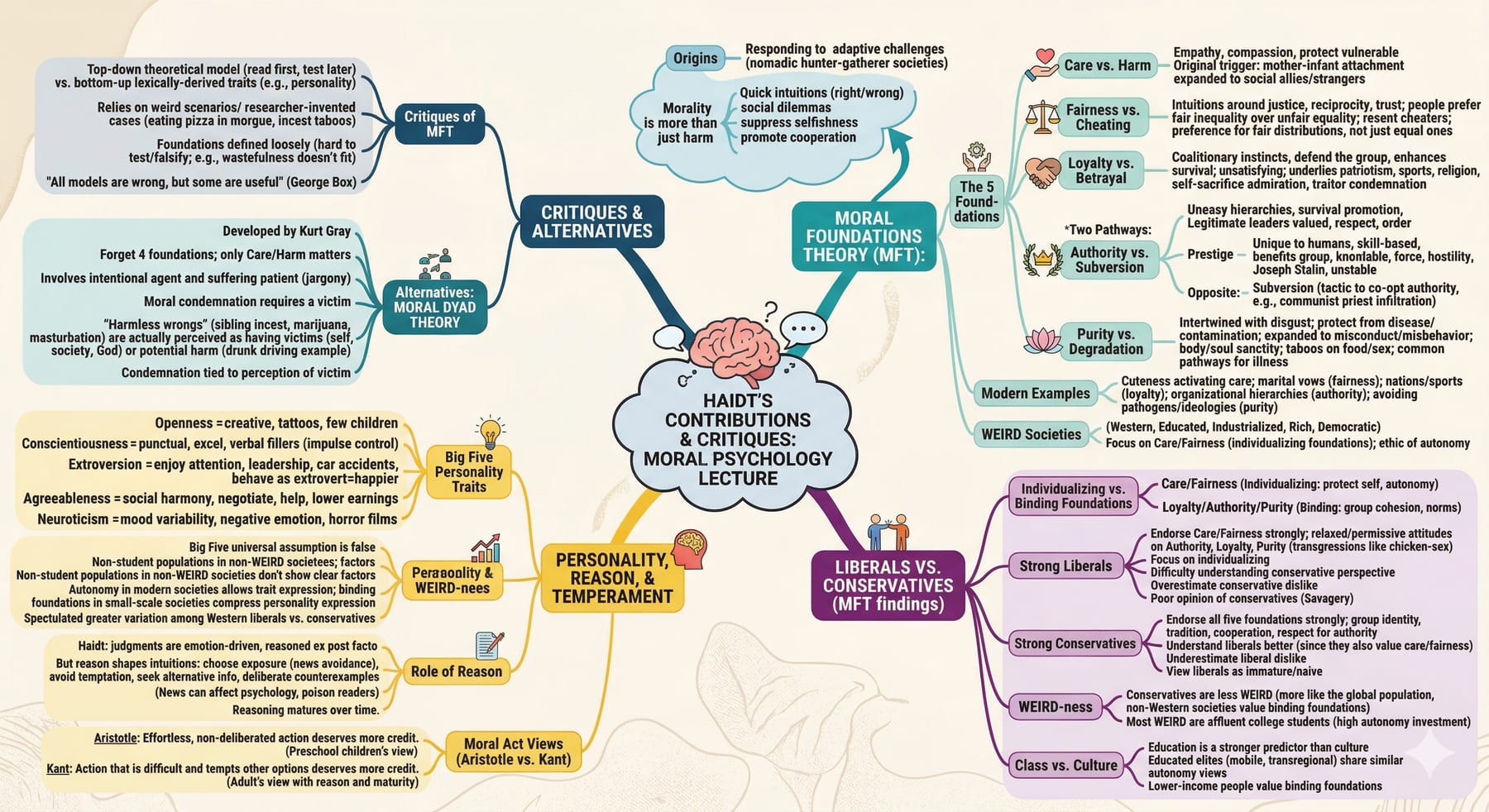
Overall thesis of the lecture
- This lecture continues the discussion of Jonathan Haidt’s moral psychology, especially moral foundations theory, and then turns to critiques of that framework and an important alternative, moral dyad theory.
- The speaker’s main argument is that morality is broader than simple harm-based reasoning, but he also presents a competing view that says harm is ultimately the core of all moral judgment.
- The lecture also uses these frameworks to explain:
- why liberals and conservatives often talk past one another
- why WEIRD societies are morally unusual
- how class, education, and social environment shape moral intuitions
- how reason and intuition interact, rather than intuition fully replacing reason.
1. Opening setup: from moral dumbfounding to moral foundations
- The lecture opens by recalling the earlier discussion of moral dumbfounding:
- sibling incest
- eating a family dog after it dies
- sex with a rotisserie chicken
- These cases matter because many people say such acts are wrong even when no clear harm is present.
- That sets up the central question for this lecture:
- if morality is not just about harm, then what else is it about?
- Haidt’s answer is moral foundations theory, which says human morality is built on several evolved moral dimensions, not just one.
2. Moral Foundations Theory: the lecture’s main framework
- The speaker presents moral foundations theory (MFT) as one of the most influential ideas in moral psychology.
- He describes it as:
- cross-cultural
- evolutionary
- designed to explain how human beings solved recurring social problems in ancestral environments
- Under this theory, moral intuitions evolved to:
- suppress selfishness
- promote cooperation
- stabilize group life
- He emphasizes that the theory has inspired a very large research program and is not meant to say there is only one proper morality.
- Instead, it claims that across cultures and across history, morality tends to organize itself around a recurring set of foundations.
3. The five moral foundations
Care / Harm
- Rooted in:
- empathy
- compassion
- protection of the vulnerable
- Evolutionary basis:
- mother-infant attachment
- later expanded to kin, allies, romantic partners, and in modern societies even strangers
- Modern expression:
- distress at cruelty
- desire to protect children, animals, and vulnerable people
- The care foundation is especially central in modern Western liberal moral language.
Fairness / Cheating
- Focuses on:
- reciprocity
- justice
- resentment of cheaters
- expectations that effort should be fairly rewarded
- The speaker stresses that fairness is not the same thing as equality.
- One of the lecture’s strongest claims is that many people prefer:
- fair inequality
- over unfair equality
- This becomes one of the main political applications of the theory.
Loyalty / Betrayal
- Concerns:
- solidarity
- coalition
- patriotism
- religion
- admiration for self-sacrifice
- condemnation of traitors and apostates
- Evolutionary purpose:
- promote group survival
- encourage trust and group cohesion
- This foundation helps explain why group identity can feel morally charged, not merely strategic.
Authority / Subversion
- Concerns:
- hierarchy
- respect
- obedience
- deference to legitimate leadership
- The speaker distinguishes two ways authority can arise:
- dominance: fear, intimidation, coercion
- prestige: competence, knowledge, contribution
- He argues stable human hierarchies work best when based on prestige, not dominance.
Purity / Degradation
- Rooted in:
- disgust
- contamination avoidance
- sanctity of body and soul
- Covers:
- taboos around food
- sex
- cleanliness
- corruption
- degradation
- The speaker also extends purity to ideological disgust:
- people speak of political views as “gross” or “disgusting,” as though bad ideas were contaminating substances
- This is meant to show that disgust, originally pathogen-focused, now also structures moral judgment.
4. The evolutionary logic behind the five foundations
- The lecture ties each foundation to recurring ancestral challenges:
- care: suffering, need, vulnerability
- fairness: deception, cheating, reciprocity failure
- loyalty: threats to group solidarity
- authority: status, order, dominance, submission
- purity: contaminants, pathogens, bodily degradation
- This is one of the lecture’s key themes:
- moral foundations are presented not as arbitrary cultural inventions but as adaptive responses to survival and social coordination problems.
5. Fairness is not equality: one of the lecture’s biggest claims
- A major section of the lecture argues that people often care more about fairness than equality.
- The speaker cites a paper claiming that people are not mainly upset by inequality itself, but by unfairness.
- Main idea:
- if inequality is seen as earned, justified, and procedurally fair, many people tolerate it
- if rewards seem rigged or undeserved, resentment rises
- He gives several illustrations:
- people often accept different rewards for different contributions
- effort-linked inequality feels more legitimate than equal shares detached from effort
- He uses this to distinguish:
- moral resentment at unfairness
- from abstract hostility to unequal outcomes as such.
6. Political application: capitalism, communism, and “voting with your feet”
- The lecture uses broad political examples to illustrate the fairness/equality distinction.
- The speaker claims:
- capitalist societies often become unequal
- but people may still prefer them if they believe rewards track effort
- He contrasts this with communist systems that emphasize equality regardless of contribution.
- He points to migration patterns as evidence:
- people often flee toward unequal but opportunity-rich societies rather than toward more equal but closed or coercive ones
- Examples mentioned:
- the United States
- North Korea
- communist versus free-market systems separated by partitions
- The underlying point is not merely economic.
- It is moral-psychological:
- people often prefer systems where effort appears connected to reward.
7. College-educated vs. working-class moral emphasis
- The lecture adds a class and education angle to fairness.
- The speaker says:
- non-college Americans tend to prioritize reducing poverty
- college-educated Americans are more likely to prioritize reducing inequality
- He interprets this as reflecting different beliefs about whether the system is fundamentally fair.
- Another claim he makes:
- college-educated Americans may be more skeptical of the fairness of the system
- working-class people may sometimes be more focused on absolute material conditions than on relative differences
- This section broadens the lecture beyond left/right ideology into moral differences by social position.
8. Loyalty, patriotism, and coalition psychology
- The lecture frames loyalty as one of the moral foundations that binds people into enduring groups.
- Loyalty underlies:
- patriotism
- sports fandom
- religion
- admiration of self-sacrifice
- hostility toward betrayal
- The speaker argues that loyalty is morally satisfying both when:
- someone proves loyal to you
- and when you prove loyal to others
- This is important because it shows morality as not only individual-protective but also group-constituting.
9. Authority, prestige, dominance, and political order
- One of the strongest analytical sections in the lecture is the distinction between prestige-based and dominance-based hierarchy.
- Prestige:
- rests on skill, knowledge, competence, or contribution
- people defer because the leader can help or teach them
- Dominance:
- rests on threat, fear, punishment, or bullying
- people defer because of what the leader can do to them
- The speaker uses Joseph Stalin as an example of authority grounded in dominance.
- Main point:
- stable and legitimate authority is usually prestige-based
- dominance-based systems require surveillance and coercion because they are fundamentally unstable.
10. Historical example: subversion during the Cold War
- The lecture gives a specific historical example to illustrate the authority/subversion foundation.
- He refers to Cold War efforts in Eastern Europe, where communist sympathizers were inserted into trusted institutions such as the Catholic Church.
- The example given is of priests sympathetic to the communist project being placed in parishes.
- Claimed effect:
- young people in those parishes were less resistant to the communist regime
- The broader point:
- subversion is morally potent because trusted authority structures can be infiltrated and redirected from within
- This is one of the clearest “historical events” sections in the lecture.
11. Purity, contamination, and taboo
- The purity foundation is explained as an extension of disgust from physical contamination to moral and symbolic contamination.
- The speaker emphasizes that food and sex are common sites of taboo across cultures because historically they were major routes of disease and social disorder.
- He argues that purity concerns persist even in modern societies, though often in changed forms:
- food politics
- sexual taboos
- ideological revulsion
- reverence for bodies, symbols, and rituals
- This section ties back to earlier lectures on disgust and moral dumbfounding.
12. The and how it measures judgment
- The lecture explains how moral foundations are often measured:
- respondents read mildly transgressive scenarios
- then rate how wrong they are
- Example items mentioned include:
- laughing at a cancer patient
- intentionally running over a squirrel
- setting traps to kill stray cats
- a professor giving a bad grade because of personal dislike
- a politician using tax money for home improvements
- a boy disrespecting his father while the father talks about military service
- sex with a frozen chicken
- an employee eating pizza off a corpse
- The speaker explains why the scenarios are somewhat “mid-level” rather than extreme:
- if every act were obviously horrific, everyone would give the top rating, and the questionnaire would reveal little variation
- This is an important methodological point in the lecture.
13. Individualizing vs. binding foundations
- The speaker introduces a major distinction within moral foundations theory:
- individualizing foundations:
- care
- fairness
- binding foundations:
- loyalty
- authority
- purity
- individualizing foundations:
- Individualizing foundations protect persons from:
- harm
- exploitation
- Binding foundations protect groups through:
- cohesion
- solidarity
- respect
- norm enforcement
- This distinction becomes the main lens for explaining political and cultural division.
14. Liberals and conservatives through the lens of moral foundations
- The lecture uses moral foundations theory to explain ideological differences.
- The speaker claims:
- liberals strongly emphasize care and fairness
- conservatives also value care and fairness, but place much more emphasis on loyalty, authority, and purity
- This leads to one of the lecture’s most important conclusions:
- conservatives draw on all five foundations more evenly
- strong liberals rely most heavily on the first two
- He argues this helps explain why the two camps often miss each other in debate:
- each may be invoking different moral languages without realizing it.
15. Claim about asymmetrical understanding: conservatives understand liberals better than liberals understand conservatives
- The lecture highlights a study where:
- liberals answered a moral foundations questionnaire as if they were conservatives
- conservatives answered as if they were liberals
- Claimed result:
- conservatives were better at simulating liberal responses
- liberals had more difficulty simulating conservative responses
- The interpretation given:
- conservatives understand care/fairness concerns because they share them
- liberals may not fully appreciate why loyalty, authority, and purity matter to others
- This is one of the lecture’s strongest and most politically pointed claims.
16. WEIRD societies and moral exceptionalism
- The lecture then broadens from U.S. politics to comparative moral psychology.
- WEIRD stands for:
- Western
- Educated
- Industrialized
- Rich
- Democratic
- The speaker says WEIRD societies emphasize:
- autonomy
- individuality
- self-expression
- care/fairness moral language
- By contrast, non-WEIRD societies tend to give much more weight to:
- loyalty
- authority
- purity
- His conclusion:
- U.S. conservatives are often closer to the “typical” person globally than U.S. liberals are, because much of the world still strongly endorses the binding foundations
- He also says the most WEIRD of all are often affluent college students, who are especially committed to the ethic of autonomy.
17. Elite college students and moral permissiveness
- The speaker notes that in prior research on taboo scenarios such as incest, the main group more likely to relax condemnation consisted of students at elite universities.
- This point is used to reinforce the lecture’s broader picture:
- elite, educated, affluent populations often display moral patterns that are unusual both historically and globally
- In his framing, this is not just political but anthropological:
- elite Western liberal norms are treated as a distinctive moral subculture, not the universal human default.
18. Liberal and conservative perceptions of one another
- The lecture next discusses a study in which liberals and conservatives judged faces that looked more liberal or conservative.
- Main claims from the study:
- conservatives saw conservative-looking faces relatively positively
- liberals saw liberal-looking faces relatively positively
- conservatives’ image of liberals looked fairly neutral
- liberals’ image of conservatives looked notably angry and severe
- The speaker connects this with personality judgments:
- both sides see the other as somewhat immature
- liberals view conservatives as especially “savage,” cold, and callous
- conservatives do not rate liberals as equivalently savage
- He adds another result:
- conservatives underestimate how much liberals dislike them
- liberals overestimate how much conservatives dislike them
- The takeaway is that liberals, in this dataset, had a more negative out-group image of conservatives than the reverse.
19. Class, education, and moral outlook across countries
- The lecture argues that education may predict moral outlook even more strongly than national culture in some contexts.
- The speaker describes a study involving:
- Brazil
- India
- the United States
- Claimed pattern:
- educated elites in all three countries resembled each other
- lower-income or non-college populations also resembled one another across countries
- Educated elites tended to endorse:
- care
- fairness
- autonomy
- Lower-income populations tended to emphasize:
- loyalty
- authority
- purity
- This is a major lecture point because it suggests that class position and elite education can create a transnational moral culture.
20. Geographic rootedness vs. elite mobility
- The lecture reinforces the class point by discussing mobility.
- He cites the idea that:
- most people live close to where they grew up
- the typical American lives relatively near family
- By contrast, elite educated populations:
- are more mobile
- interact more with each other across borders
- may feel more at home in another global city than in a small town in their own country
- This helps explain why elite moral culture can become detached from local moral cultures.
21. The Big Five personality traits and the ethic of autonomy
- The lecture then shifts from morality to personality and argues that the ethic of autonomy shapes personality expression too.
- He reviews the Big Five:
- openness
- conscientiousness
- extroversion
- agreeableness
- neuroticism / emotional stability
- He gives a brief behavioral sketch of each:
- openness: creative, educated, experimental
- conscientiousness: punctual, disciplined, planful
- extroversion: social, attention-seeking, leadership-visible
- agreeableness: cooperative, harmony-seeking
- neuroticism: emotionally reactive, mood-variable
- But the deeper point is comparative:
- the Big Five were long assumed to be universal
- yet the lecture says researchers did not find them cleanly in many non-WEIRD societies.
22. Personality compression in non-WEIRD societies
- The speaker says that in places such as:
- Bolivia
- Ghana
- Kenya
- Laos
- Sri Lanka
- Vietnam
- Macedonia
the Big Five do not emerge as clearly, especially outside student samples.
- His interpretation:
- in WEIRD societies, people have greater freedom to express their “inner self”
- in small-scale or more traditional societies, duties, roles, and constraints compress self-expression
- He extends this logic to morality:
- strong loyalty, authority, and purity norms may compress personality expression
- care/fairness-centered autonomy cultures allow more individual variation to show
- He even speculates that Western liberals may display more personality variation than Western conservatives because autonomy norms are more central to liberal culture.
23. Intuition vs. reason: reason still matters
- Although the lecture emphasizes moral intuition, it does not present reason as powerless.
- The speaker argues reason can shape intuition in several ways:
- by controlling what you expose yourself to
- by avoiding content that predictably enrages or manipulates you
- by seeking counterexamples and alternative viewpoints
- by binding yourself in advance against temptation
- This is an important refinement:
- intuition may often come first
- but reason can structure the environment that feeds those intuitions
- He gives news avoidance as a major example:
- people may deliberately avoid emotionally hijacking media to preserve psychological balance.
24. News avoidance and emotional self-protection
- The lecture quotes a Washington Post piece by a journalist who confesses to actively avoiding the news because it feels draining and psychologically toxic.
- The speaker uses this as evidence that:
- people know information environments can manipulate emotion
- reason can be used to limit those influences
- This section ties moral psychology to modern media ecology:
- attention is not neutral
- what you consume changes your emotional and moral state
- The point is less about journalism than about moral self-regulation.
25. Aristotle vs. Kant on moral credit
- One of the most interesting philosophical sections of the lecture revisits a classic dispute:
- Aristotle: moral credit belongs to the person who does the right thing effortlessly
- Kant: moral credit belongs especially when it is hard and temptation is overcome
- The speaker then describes a study with preschoolers and adults:
- a boy breaks a lamp while doing something he should not
- in one version he tells the truth immediately
- in another he struggles internally but tells the truth anyway
- Results:
- children give more credit to effortless truth-telling
- adults give more credit to truth-telling after temptation and struggle
- Interpretation:
- children are more “Aristotelian”
- adults, through experience and maturity, become more “Kantian”
- This section is a nice example of the lecture’s overall method:
- combine philosophy with developmental psychology.
26. Critiques of Moral Foundations Theory
- The speaker makes clear that moral psychology is not settled science and that moral foundations theory has real critics.
- Main critiques listed:
A. Top-down construction
- The theory began with researchers identifying likely foundations from theory and prior reading, then testing them.
- Critics say this is less convincing than discovering structure from bottom-up data.
B. Weird and artificial scenarios
- Many famous cases are highly contrived:
- sex with a corpse
- eating pizza off a dead body
- incest hypotheticals
- Critics argue these may not reflect real-world morality well.
C. Loose category boundaries
- The five foundations may be too broad or too flexible.
- Almost any moral transgression can be forced into one of them after the fact.
- This raises concerns about falsifiability.
D. Missing intuitions
- He gives wastefulness as an example of a possible moral concern not neatly captured by the five foundations.
- This suggests the theory may not be exhaustive.
27. Strengths of Moral Foundations Theory
- Even while criticizing it, the lecture credits the theory with major strengths:
- it integrates psychology, anthropology, and evolution
- it helps explain political conflict
- it expands morality beyond harm and fairness
- it has generated extensive research
- The speaker quotes George Box:
- all models are wrong, but some are useful
- That captures his stance:
- the theory may be imperfect, but still illuminating.
28. Alternative framework: Moral Dyad Theory
- The lecture then transitions to moral dyad theory, associated with Kurt Gray.
- This theory is presented as a direct challenge to moral foundations theory.
- Its core claim:
- morality is fundamentally about harm
- all moral judgments revolve around a dyad:
- an intentional agent / perpetrator
- a suffering patient / victim
- The key idea is that people morally condemn acts when they perceive:
- someone doing harm
- and someone or something suffering from it
- This is a simpler framework than Haidt’s five-foundation model.
29. No such thing as a “harmless wrong”?
- One of the lecture’s central contrasts is this:
- Haidt-style cases suggest there are moral wrongs even without obvious harm
- Gray argues that if people call something wrong, they will usually infer some victim or harm
- Examples:
- people who oppose masturbation or marijuana may say the self is being harmed
- taboo acts may be said to harm society, God, the community, or the moral order
- So moral dyad theory argues that “harmless wrongs” are not really perceived as harmless by most people.
- If the victim is not obvious, people still complete the moral dyad by supplying one.
30. Drunk driving as a moral dyad example
- The lecture uses drunk driving to explain why people condemn acts even when no one was hurt in the particular case.
- Example:
- someone gets drunk, drives home, and arrives safely
- people still say the action was wrong
- Why?
- because the act is understood as containing the potential for serious harm
- the moral imagination still sees victims even when none materialized in that instance
- This helps Gray’s framework because it shows that judgments may remain harm-based even when the harm is abstract, hypothetical, or probabilistic.
31. Purity violations and inferred victims
- The lecture says studies found that when people judge purity violations as wrong, they also tend to infer a victim.
- Even where the scenario insists that no one was harmed, participants still identify harms such as:
- damage to society
- damage to the community
- damage to oneself
- offense against God
- Examples revisited:
- sex with a corpse
- cutting up a flag to clean a toilet
- taboo sexual acts
- This is one of the lecture’s key analytical conclusions:
- people complete the moral structure by filling in a victim if one is not explicit.
32. The motivational “completion” of the moral dyad
- The speaker emphasizes that people seem motivated to complete both halves of the dyad:
- if there is a victim, they look for a perpetrator
- if there is a perpetrator, they look for a victim
- Example:
- homelessness may present a visible victim
- then observers seek the responsible perpetrator: government, society, the person, or structural forces
- This makes moral cognition look less like a checklist of five foundations and more like a narrative structure:
- someone is harmed
- someone caused it
- That is the essence of moral dyad theory as presented in the lecture.
33. Q&A: persuasion, crime, and progressive misconceptions
- In the Q&A, the speaker is asked about false beliefs liberals sometimes hold about conservatives, minorities, or policy preferences.
- His answer returns to an earlier theme:
- stories persuade more than statistics
- He references crime debates and says vivid high-profile attacks got more people to pay attention to consequences of anti-police or permissive crime policies than statistics alone did.
- This echoes earlier lectures:
- concrete stories often move moral opinion more effectively than data.
34. Q&A: food taboos and wastefulness
- In response to a question, the speaker clarifies that Western societies still have food taboos, but they are often:
- less rigid
- more subcultural
- less all-encompassing than in non-WEIRD societies
- He mentions examples such as:
- veganism
- vegetarianism
- locally sourced food norms
- moralized views of factory farming
- On wastefulness, he says it may be a real moral intuition not neatly captured by Haidt’s five foundations.
- Under moral dyad theory, wastefulness could be understood as harm:
- people are being deprived of resources they could have used
- This exchange highlights that the boundary lines between frameworks remain contested.
35. Main ideas of the lecture, distilled
- Morality may be broader than harm, and Haidt’s theory proposes five evolved foundations.
- Those five foundations help explain:
- taboo condemnation
- cross-cultural morality
- political disagreement
- elite/non-elite moral differences
- Liberal and conservative conflict can partly be understood as a conflict between:
- individualizing morality
- and binding morality
- WEIRD societies are morally unusual because they emphasize autonomy so heavily.
- Education and elite status may matter as much as or more than national culture in shaping moral outlook.
- Reason is not powerless; it can regulate what influences intuition.
- Moral foundations theory is influential but imperfect.
- Moral dyad theory offers a competing reduction:
- morality is ultimately about perpetrators, victims, and harm.
36. Historical events, contexts, and social developments mentioned
- Cold War infiltration and ideological subversion in Eastern Europe through clergy placement.
- Communist vs. capitalist societies, including the contrast between equality and effort-linked reward.
- North Korea as an example of a highly equal but undesirable society.
- Contemporary debates over:
- policing
- violent crime
- media effects
- elite ideology
- news avoidance.
37. Books, papers, articles, and sources mentioned
Major thinkers and scholars
- Jonathan Haidt
- Joseph Henrich
- Aristotle
- Immanuel Kant
- George Box
- Kurt Gray
Concepts / research programs / papers
- Moral Foundations Theory
- Moral Dyad Theory
- WEIRD societies paper by Joseph Henrich and colleagues
- Research on liberals vs conservatives and moral foundations
- Research comparing educated elites across Brazil, India, and the U.S.
- Research on cross-cultural failure to cleanly recover the Big Five in some non-WEIRD populations
- Developmental study comparing Aristotelian vs Kantian moral credit in children and adults
Articles / media explicitly mentioned
- The Washington Post article by a journalist describing active news avoidance
- A headline/report noting that the typical American lives close to family
- News stories around violent crime in major U.S. cities used in the Q&A as examples of story-driven persuasion
38. Related topics for further exploration
- Jonathan Haidt’s The Righteous Mind
- Joseph Henrich on WEIRD psychology
- Kurt Gray on moral dyad theory
- The relationship between disgust and purity morality
- The difference between fairness, equality, and equity
- The politics of prestige vs dominance
- Elite overproduction or elite value divergence
- Class vs culture in political psychology
- The cross-cultural validity of the Big Five personality model
- The role of narratives vs statistics in persuasion
- Whether wastefulness should count as its own moral foundation
- The psychology of out-group dehumanization
- The moral psychology of news consumption and digital attention
- The debate over whether moral judgment is fundamentally plural (Haidt) or fundamentally dyadic/harm-based (Gray)
39. Final synthesis
- This lecture is doing two things at once. First, it presents Haidt’s moral foundations theory as a rich pluralistic account of morality, one that helps explain cross-cultural variation, political differences, and the moral unusualness of WEIRD societies. Second, it steps back and subjects that theory to critique, arguing that some of its categories may be loose, some of its cases overly contrived, and that a simpler theory—moral dyad theory—might explain much of the same territory by showing that people almost always perceive morality in terms of perpetrators, victims, and harm. The lecture’s larger contribution is to show that moral psychology is a field of live debate, not settled doctrine, and that questions about morality connect deeply to politics, class, culture, personality, and media environments.
4. Judging Harm
Peterson Academy - The Psychology of Morality (Henderson) - Lecture 04.pdf (file not included in this release)
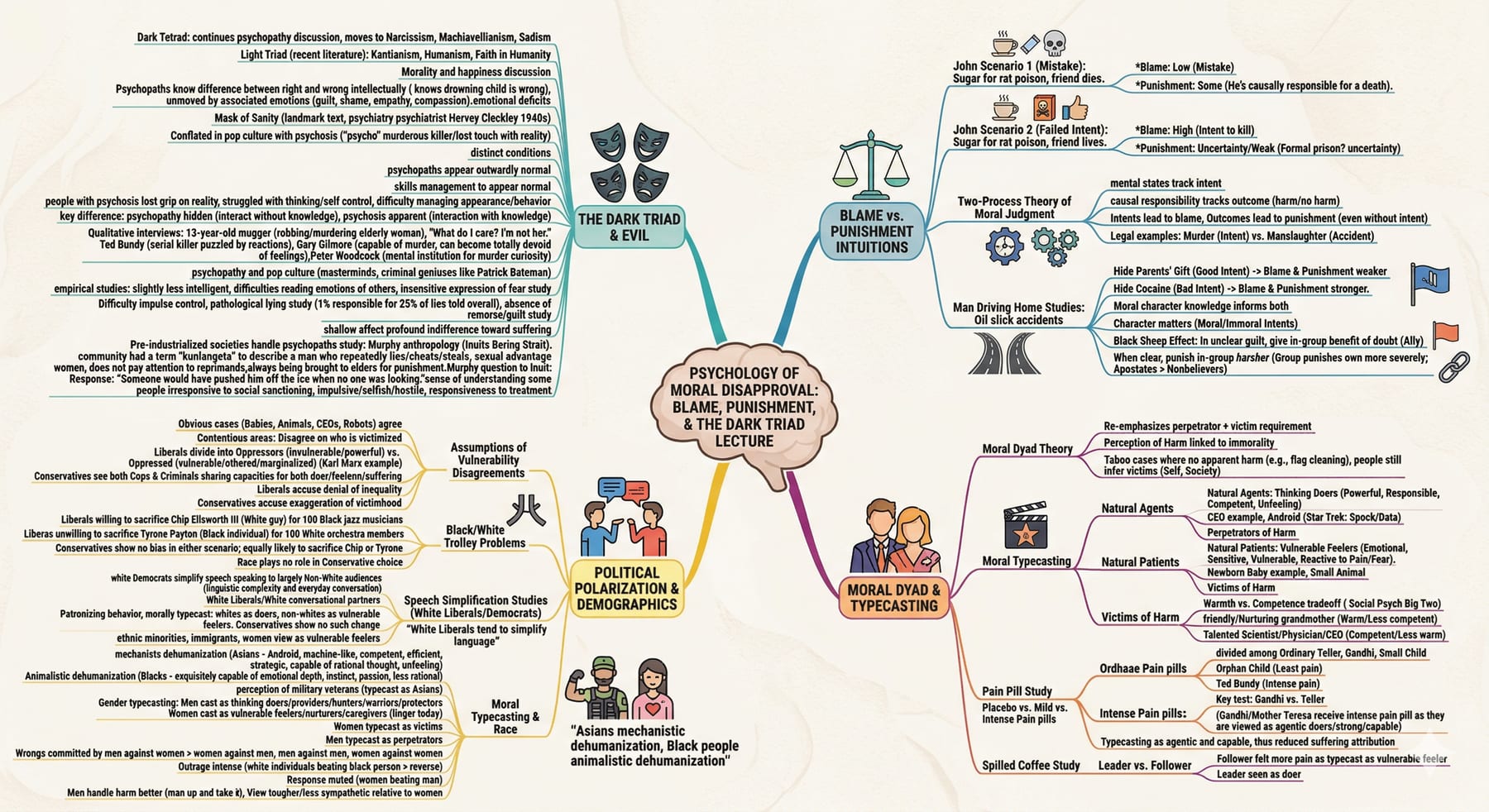
Overall argument of the lecture
- This lecture continues the discussion of moral dyad theory and uses it to explain:
- how people distinguish blame from punishment
- how we assign moral roles such as perpetrator and victim
- how these roles shape judgments about gender, race, class, authority, and politics
- The lecture then expands into a discussion of evil, cruelty, and psychopathy, arguing that some people understand right and wrong intellectually but are emotionally detached from the suffering of others.
- One of the lecture’s deepest themes is that moral judgment is not only about what happened, but also about:
- intention
- outcome
- character
- group membership
- and who we imagine as naturally able to suffer versus naturally able to cause harm.
1. Main focus: blame and punishment are not the same thing
- The lecture opens by separating two forms of moral disapproval:
- blame / condemnation
- punishment / formal penalty
- The speaker argues that psychology shows people do not treat these as identical.
- This is important because ordinary moral thinking often blends them together, but experiments suggest they are driven by partly different intuitions.
2. The two-process theory of moral judgment
- The speaker presents what he calls the two-process theory of moral judgment.
- According to this view, people track at least two distinct things:
- mental state / intention
- causal responsibility / outcome
- These can pull in different directions.
Case 1: accidental killing
- John believes he is putting sugar in coffee, but it is actually rat poison.
- His friend dies.
- Typical response:
- people give less blame, because the act was unintended
- but still endorse some punishment, because a death occurred and John caused it
Case 2: attempted killing that fails
- John believes he is putting rat poison in coffee, but it is actually sugar.
- His friend survives.
- Typical response:
- people give high blame, because the intention was evil
- but are less certain about formal punishment, since no one was harmed
Main point
- This suggests that blame tracks bad intention more strongly.
- Punishment tracks actual harmful outcome more strongly.
- The lecture connects this to legal distinctions such as murder vs manslaughter.
3. Outcome matters, but so does character
- The lecture adds a further refinement: moral judgment is influenced not only by intent and outcome, but by what kind of person the actor seems to be.
- Example:
- a man crashes into a pedestrian after hitting an oil slick
- in one version, he was hurrying home to hide an anniversary gift
- in another, he was hurrying home to hide illegal cocaine
- The physical event is identical in both scenarios.
- But people judge the second man more harshly, both in blame and punishment.
- Main takeaway:
- character information colors moral judgment
- people do not evaluate actions in isolation
- they interpret them through a broader picture of the actor’s moral standing.
4. The black sheep effect
- The lecture next discusses the black sheep effect.
- Basic idea:
- when guilt is uncertain, people give more benefit of the doubt to in-group members and are harsher toward out-group members
- when guilt is clear, people may punish their own group members more harshly
- This reversal is important.
- The speaker suggests it helps explain why:
- apostates are often treated more harshly than outsiders
- betrayal from within feels especially morally charged
- This fits with the broader lecture theme that morality is deeply linked to group membership and identity.
5. Return to the moral dyad
- The lecture then returns to moral dyad theory.
- Recall the dyad:
- perpetrator
- victim
- The speaker repeats the idea that people are motivated to complete this structure:
- if a victim is visible but the perpetrator is unclear, people search for one
- if a wrongdoing is visible but the victim is unclear, people infer one
- This helps explain why so-called “victimless crimes” often still feel immoral to people:
- observers assume someone, somewhere, must be harmed
- if not an individual, perhaps society, the self, or a moral order.
6. Moral typecasting: the social distribution of agency and suffering
- One of the lecture’s central ideas is moral typecasting.
- Moral typecasting means people are sorted into moral roles:
- moral agents = powerful doers, capable of planning and causing harm
- moral patients = vulnerable feelers, capable of suffering and in need of protection
- This is not just about individual actions.
- It is about how entire groups get socially coded.
- This concept is one of the lecture’s main analytical tools for explaining political and cultural conflict.
7. Moral agents: “thinking doers”
- Moral agents are described as:
- competent
- strategic
- rational
- capable
- responsible
- powerful
- They are seen as:
- more able to inflict harm
- less naturally associated with victimhood
- Examples the lecture gives:
- a successful CEO
- an android
- Spock
- Data
- The important point is that these figures are seen as effective, but not especially emotionally vulnerable.
8. Moral patients: “vulnerable feelers”
- Moral patients are described as:
- emotional
- sensitive
- reactive
- innocent
- easy to hurt
- They are seen as:
- more capable of suffering
- less capable of strategic harm
- Examples:
- newborn babies
- small animals
- The contrast with the CEO or android is deliberate:
- one side is imagined as powerful but cold
- the other as warm but vulnerable.
9. Warmth and competence as a parallel framework
- The lecture links moral typecasting to the social psychology distinction between:
- warmth
- competence
- Warmth means:
- friendly
- kind
- nurturing
- well-intentioned
- Competence means:
- capable
- skilled
- effective
- accomplished
- The speaker says these dimensions often trade off in perception:
- the more competent someone seems, the less warm we often perceive them to be
- the warmer someone seems, the less competent we may assume they are
- This is a key bridge between general social perception and moral judgment.
10. The pain pill study: competence reduces perceived vulnerability
- One of the lecture’s strongest examples is the pain pill study.
- Participants distribute pain-causing pills among:
- Ted Bundy
- an ordinary bank teller
- Mother Teresa
- an orphan child
- The child gets the least painful pill.
- Bundy gets one of the most painful pills.
- The key comparison is:
- bank teller vs Mother Teresa
- Result:
- many participants give the more painful pill to Mother Teresa, not the bank teller
- Why?
- she is seen as stronger, more agentic, more capable of enduring pain
- The lecture uses this to show that admired, highly competent or morally elevated figures are paradoxically seen as less vulnerable.
11. Leadership and pain perception
- Another study described:
- a leader of an employee walkout spills hot coffee on themselves
- in another version, a follower spills coffee
- Participants tend to say:
- the follower feels more pain
- the leader feels less
- Again, leadership is associated with:
- agency
- competence
- reduced perceived suffering
- This shows that moral typecasting can shape even judgments about bodily pain.
12. Politics and vulnerability: liberals vs conservatives
- The lecture argues that liberals and conservatives differ in how they assign vulnerability and agency to groups.
- The speaker, drawing on Kurt Gray, says liberals are more likely to divide the world into:
- oppressors
- oppressed
- In this framework:
- powerful groups are cast as thinking doers
- marginalized groups are cast as vulnerable feelers
- Conservatives, in the speaker’s presentation, are said to be more likely to treat people as similarly capable of:
- agency
- suffering
- This is one of the lecture’s core political claims.
13. Example: police and criminals
- The lecture uses policing as a vivid example.
- According to the speaker:
- liberals tend to see police officers as powerful, competent, responsible agents
- and criminals as vulnerable products of circumstance
- Conservatives are said to view both cops and criminals as sharing:
- responsibility
- vulnerability
- agency
- The speaker uses this contrast to explain why the two sides interpret justice so differently:
- one sees unequal vulnerability
- the other sees more equal moral capacity.
14. The racial trolley problem study
- Primary-paper audit and comparison with the separate partisan-face study: Chip/Tyrone experiments. This example is Uhlmann et al. (2009), not Petsko & Kteily (2024); it measures judgments about a hypothetical act, not literal willingness to sacrifice anyone.
- One of the most provocative studies described is a racialized trolley problem.
- Version 1:
- sacrifice Chip Ellsworth III, a white man, to save 100 Black jazz musicians
- Version 2:
- sacrifice Tyrone Payton, a Black man, to save 100 white orchestra members
- Claimed finding:
- liberals were more willing to sacrifice the white man than the Black man
- conservatives were equally willing in either case, focusing on the numbers rather than race
- The speaker interprets this through moral typecasting:
- liberals assign different levels of victimhood and protected status across groups
- conservatives are presented as more symmetrical in this particular study
- This is one of the lecture’s clearest illustrations of how perceived vulnerability can alter even apparently abstract moral reasoning.
15. Speech simplification and perceived competence
- Another politically charged study described:
- white liberal politicians and white liberal participants simplify their language when speaking to non-white audiences
- white conservatives do not show the same shift
- The speaker presents this as evidence that white liberals may unconsciously see minorities as:
- more vulnerable
- less competent
- more in need of accommodation
- He says the behavior may be well-intentioned but can come off as patronizing.
- Again, the framework is moral typecasting:
- whites are unconsciously cast as agents
- non-whites as patients
- Whether one agrees with the interpretation or not, this is a major argumentative pillar of the lecture.
16. Infrahumanization and racial stereotypes
- The lecture discusses a paper on infrahumanization and linked dehumanization patterns.
- Claimed pattern in the U.S.:
- Asians are seen as highly competent, efficient, strategic, but emotionally cold
- Blacks are seen as emotionally rich and reactive, but less competent and less rational
- The paper’s distinction:
- Asians are more likely to receive mechanistic dehumanization
- Blacks are more likely to receive animalistic dehumanization
- This fits directly with the warmth/competence and agent/patient framework:
- mechanistic = thinking without feeling
- animalistic = feeling without disciplined reason
- This is one of the most important race-related analytical moves in the lecture.
17. Military veterans and mechanistic typecasting
- The speaker says military veterans are often typecast similarly to Asians in this framework:
- competent
- strategic
- hardened
- less emotionally vulnerable
- This extends the lecture’s point that these perceptions are not only racial but broader social stereotypes about power, toughness, and emotional depth.
18. Gender and moral typecasting
- The lecture argues that gender may be one of the deepest foundations of social cognition.
- Men are often perceived as:
- competent
- agentic
- responsible
- tough
- Women are often perceived as:
- warm
- nurturing
- emotionally deep
- vulnerable
- The speaker says this likely reflects ancient sex-role patterns:
- men as providers, hunters, protectors
- women as caregivers and nurturers
- He suggests that these ancient associations still shape modern moral judgments.
19. Gender and asymmetric outrage
- The lecture argues that wrongs committed by men against women are often perceived as more egregious than:
- women against men
- women against women
- men against men
- Similarly, he claims:
- harms against women are more likely to trigger sympathy
- harms against men are more likely to be seen as bearable
- This follows from moral typecasting:
- women = patient/victim
- men = agent/perpetrator
- He also states that when identical harms are described, participants judge men as experiencing less harm than women in the same scenario.
20. General altruism toward women
- The lecture says that in economic game studies:
- both men and women behave more altruistically toward women than toward men
- participants are more willing to cheat male competitors than female competitors
- This is presented as further evidence that women are moralized as protected sufferers and men as more acceptable targets of harm or competition.
21. Strengths of moral dyad theory and moral typecasting
- The lecture identifies several strengths in the framework:
Elegant simplicity
- It reduces moral judgment to a basic structure:
- perpetrator
- victim
- harm
Fits intuition
- People naturally search for:
- villains
- sufferers
- causes
- harms
Cross-cultural plausibility
- The speaker says the dyad appears widely, even if cultures differ over what counts as harm.
Political explanatory power
- It offers a rival explanation to moral foundations theory for ideological division:
- liberals differ because they assign suffering asymmetrically
- conservatives differ because they distribute agency and suffering more evenly
- Whether or not one agrees, this is the lecture’s proposed strength of the framework.
22. Critiques of moral dyad theory
- The speaker also gives limitations of the theory.
It may stretch “harm” too far
- If every moral issue can be rewritten as harm, then the concept risks becoming too broad to explain anything clearly.
It may be too WEIRD
- The theory may reflect the moral assumptions of Western, educated societies that foreground harm and autonomy.
- It may fit less well in cultures where morality also strongly includes:
- honor
- purity
- hierarchy
- communal duty
Harm is not always immoral
- Some forms of suffering are seen as moral or necessary:
- rites of passage
- punishment
- warfare
- sacrifice
- This creates pressure on a theory that treats harm as the root of wrongness.
23. Virtuous violence: harm can be moral
- The lecture introduces a direct challenge to harm-centered morality through the book Virtuous Violence.
- The authors argue that violence is often used to regulate relationships.
- In many contexts, people do not see themselves as doing something evil when they use violence.
- They see themselves as:
- correcting a wrong
- enforcing justice
- restoring balance
- punishing mistreatment
- Examples given:
- cultural rites of passage involving pain
- prison as deserved suffering
- warfare or intergroup conflict justified as righteous
- This is one of the lecture’s strongest counterarguments to a simple “harm = immorality” model.
24. Intent changes the felt experience of pain
- The lecture describes a study where participants receive identical electric shocks under three conditions:
- maliciously inflicted
- accidentally inflicted
- benevolently inflicted to help them win lottery tickets
- The shocks are objectively the same.
- But they feel different:
- malicious shocks hurt the most
- accidental shocks hurt less
- benevolent shocks hurt the least
- Main takeaway:
- subjective suffering is shaped by how people interpret intent
- the same physical event can be morally and psychologically transformed by context
- This is a very important study in the lecture because it shows that moral framing affects even bodily experience.
25. Control and endurance: the alarm study
- Another study described:
- participants solve tasks while a loud alarm sounds every few seconds
- in one condition, they have no real sense of control
- in another, they are told they can stop the alarm but are asked not to
- Result:
- those with the option of control tolerate the alarm longer and solve more tasks
- This supports the broader claim that subjective experience depends heavily on interpretation, agency, and perceived legitimacy, not only on objective conditions.
26. Transition to evil and cruelty: psychopathy
- The lecture then turns more directly to evil and cruelty through the case of psychopathy.
- The speaker defines the psychopath as someone who:
- knows, intellectually, the difference between right and wrong
- but lacks the moral emotions normally associated with that knowledge
- In other words:
- the psychopath can understand a rule
- but does not feel guilt, shame, empathy, or compassion in the ordinary way
- This section is meant to show that moral cognition and moral emotion can come apart.
27. The Mask of Sanity and the classic picture of psychopathy
- The central historical text mentioned is The Mask of Sanity by Hervey Cleckley.
- The lecture presents it as a landmark book from the 1940s.
- Cleckley’s key observation:
- some patients appeared normal, articulate, charming, even highly functional
- but lacked deep emotional responsiveness and empathy
- That is why psychopathy is described as a “mask”:
- the person looks sane and ordinary on the surface
- but their emotional and moral structure is profoundly impaired.
28. Psychopathy vs psychosis
- The speaker makes an explicit distinction:
- psychopathy is not the same as psychosis
- Psychopathy:
- hidden
- socially masked
- outwardly normal
- emotionally deficient
- Psychosis:
- disconnection from reality
- impaired thought and self-control
- visible difficulty managing behavior and appearance
- This is an important conceptual clarification because pop culture often conflates them under the label “psycho.”
29. Interviews and examples of psychopathic thinking
- The lecture gives several examples meant to illustrate psychopathic indifference:
13-year-old mugger
- After robbing and murdering an elderly woman, he says:
- “What do I care? I’m not her.”
Ted Bundy
- Bundy is described as being puzzled by why people were so upset about his murders:
- “There’s so many people.”
Gary Gilmore
- Says he knew he was doing something wrong, but still found pleasure in it.
Peter Woodcock
- Says he wanted to know what it would feel like to kill someone.
- These examples are used to show:
- knowledge of wrongness can exist without moral feeling
- psychopaths can understand the rule while being emotionally detached from it.
30. Traits of psychopathy
- The lecture lists common features:
- reduced empathy
- poor fear recognition
- weak remorse
- pathological lying
- shallow affect
- impulsivity
- indifference to suffering
- The speaker also pushes back against the popular image of psychopaths as masterminds:
- empirically, they are often slightly less intelligent than average
- not criminal super-geniuses
- He mentions difficulty reading expressions of fear, including a murderer who identified fear as “the look people get right before I stab them.”
31. Pathological lying and concentration of deception
- The lecture mentions a study finding that:
- about 1% of people are responsible for 25% of all lies
- The speaker speculates that this group would likely score high on psychopathy-related measures.
- This reinforces the idea that severe antisocial traits are not evenly distributed through the population.
32. Pre-industrial responses to psychopathy
- The lecture recalls an anthropological example from Jane M. Murphy’s work with Inuit communities near the Bering Strait.
- They had a term, kunlangeta, for a man who:
- lies
- cheats
- steals
- exploits women
- ignores reprimands
- When Murphy asked what the group would do with such a person, the answer was:
- someone would push him off the ice when no one was looking
- The point is that even premodern societies recognized persistent antisocial personalities and could respond with extreme collective removal.
- This also connects back to earlier lecture themes about self-domestication and the elimination of chronic predators from the group.
33. Q&A: parental estrangement and moral development
- In the Q&A, the speaker is asked about adult children estranging themselves from parents.
- His answer includes several ideas:
- young affluent adults in modern societies may overemphasize an ethic of autonomy
- dark personality traits such as narcissistic and psychopathic tendencies peak in early adulthood in the general population
- young healthy people with resources often feel they do not need others
- later in life, people may rediscover the value of enduring family ties
- He also gives an anecdote from an oncologist:
- some older patients lacked family support and were accompanied only by ex-spouses
- The broader point is that modern abundance can weaken perceived dependence and thereby lower the felt weight of loyalty obligations.
34. Q&A: the “true self”
- Another question asks what the “true self” really is.
- The speaker replies that the studies he has cited are about beliefs about the true self, not the philosophical reality of one.
- He then suggests an interesting psychological interpretation:
- people often feel most authentic when they behave in ways that win social approval in their culture
- Examples:
- introverts sometimes feel more authentic when behaving extrovertedly
- people feel more authentic when acting conscientiously or succeeding in leadership
- in collectivist societies, being recognized as a good listener can increase feelings of authenticity
- The lecture’s answer is therefore:
- psychologically, the “true self” often behaves more like an aspirational socially affirmed self-image than some hidden metaphysical core.
35. Q&A: morality vs legality
- The final question asks why some things feel wrong but are not illegal.
- The speaker’s answer:
- in Western societies, law mainly centers on care and fairness
- other moral foundations such as loyalty, authority, and purity are often left outside criminal law
- So acts like:
- disrespect
- taboo behavior
- adultery
- symbolic desecration
may be seen as immoral without being punished by law
- He notes that in non-WEIRD or more religious societies, laws can regulate these other domains much more extensively.
- The lecture thus closes by reinforcing a key distinction:
- morality is broader than legality
- what gets formal punishment depends on what a society defines as harmful enough to regulate.
36. Main ideas of the lecture, distilled
- Blame and punishment are related but psychologically distinct.
- Moral judgment depends on:
- intention
- outcome
- character
- group loyalty
- Moral dyad theory says people search for:
- perpetrators
- victims
- harm
- Moral typecasting explains why some groups are seen as:
- natural victims
- natural perpetrators
- These perceptions shape judgments about:
- race
- gender
- class
- politics
- policing
- Harm is not always seen as immoral:
- pain can be framed as deserved, necessary, or even virtuous
- Psychopathy shows that a person can know morality cognitively while lacking its emotional force.
- Modern conflicts often reflect deep disagreements about who is vulnerable, who is responsible, and which harms matter most.
37. Historical events, periods, and contexts mentioned
- The legal distinction between murder and manslaughter as an example of blame vs punishment.
- Reference to intergroup warfare and conflict as contexts where violence is moralized.
- Anthropological example from Inuit society near the Bering Strait concerning the kunlangeta.
- The 1940s psychiatric context of Hervey Cleckley’s work on psychopathy.
- Contemporary political conflicts over:
- race
- policing
- immigrants
- gender
- elite discourse
- parental estrangement.
38. Books, articles, thinkers, and sources mentioned
Books
- Outraged — Kurt Gray
- Virtuous Violence — Alan Fiske and Tage Rai
- The Mask of Sanity — Hervey Cleckley
- The Social World of a Child — mentioned as the source for the 13-year-old mugger interview
- American Psycho — via Patrick Bateman reference
Thinkers / researchers / people mentioned
- Kurt Gray
- Alan Fiske
- Tage Rai
- Hervey Cleckley
- Jane M. Murphy
- Ted Bundy
- Gary Gilmore
- Peter Woodcock
- Gandhi
- Mother Teresa
- Matthew McConaughey
- Jessica Alba
- Sydney Sweeney
- Spock
- Data
- Karl Marx
Research traditions / concepts mentioned
- Two-process theory of moral judgment
- Moral dyad theory
- Moral typecasting
- Warmth and competence framework
- Infrahumanization
- Mechanistic dehumanization
- Animalistic dehumanization
- Psychopathy
- Psychosis
- Dark tetrad
- Light triad
39. Related topics for further exploration
- The psychology of attempted harm versus accidental harm
- The relationship between moral blame, punishment, and criminal law
- Apostasy, betrayal, and in-group punishment
- Moral typecasting and modern identity politics
- Warmth/competence stereotypes across race, gender, and class
- Mechanistic vs animalistic dehumanization
- The psychology of policing, crime, and competing models of victimhood
- Virtuous violence and justified suffering in religion, punishment, and war
- The neuroscience of psychopathy
- Differences between psychopathy, sociopathy, and psychosis
- Dark tetrad personality research
- The social psychology of authenticity and the “true self”
- Why some moral norms become laws while others remain social expectations
- Cross-cultural differences in who counts as a victim and who counts as an agent
40. Final synthesis
- This lecture builds a powerful picture of moral judgment as a process that is never just about abstract rules. People judge actions through a shifting mix of intention, consequence, character, group allegiance, and deep assumptions about who can suffer and who can cause harm. The lecture’s major innovation is moral typecasting: the idea that social groups are slotted into roles of agent and patient, competence and warmth, perpetrator and victim. That framework is then used to explain contemporary conflict around race, gender, crime, and politics. The final section on psychopathy sharpens the stakes by showing that evil may consist not in ignorance of moral rules, but in emotional indifference to them. Altogether, the lecture argues that moral life is structured by the stories we tell about power, vulnerability, deserved suffering, and the human capacity to feel.
5. Light vs. Dark
Peterson Academy - The Psychology of Morality (Henderson) - Lecture 05.pdf (file not included in this release)
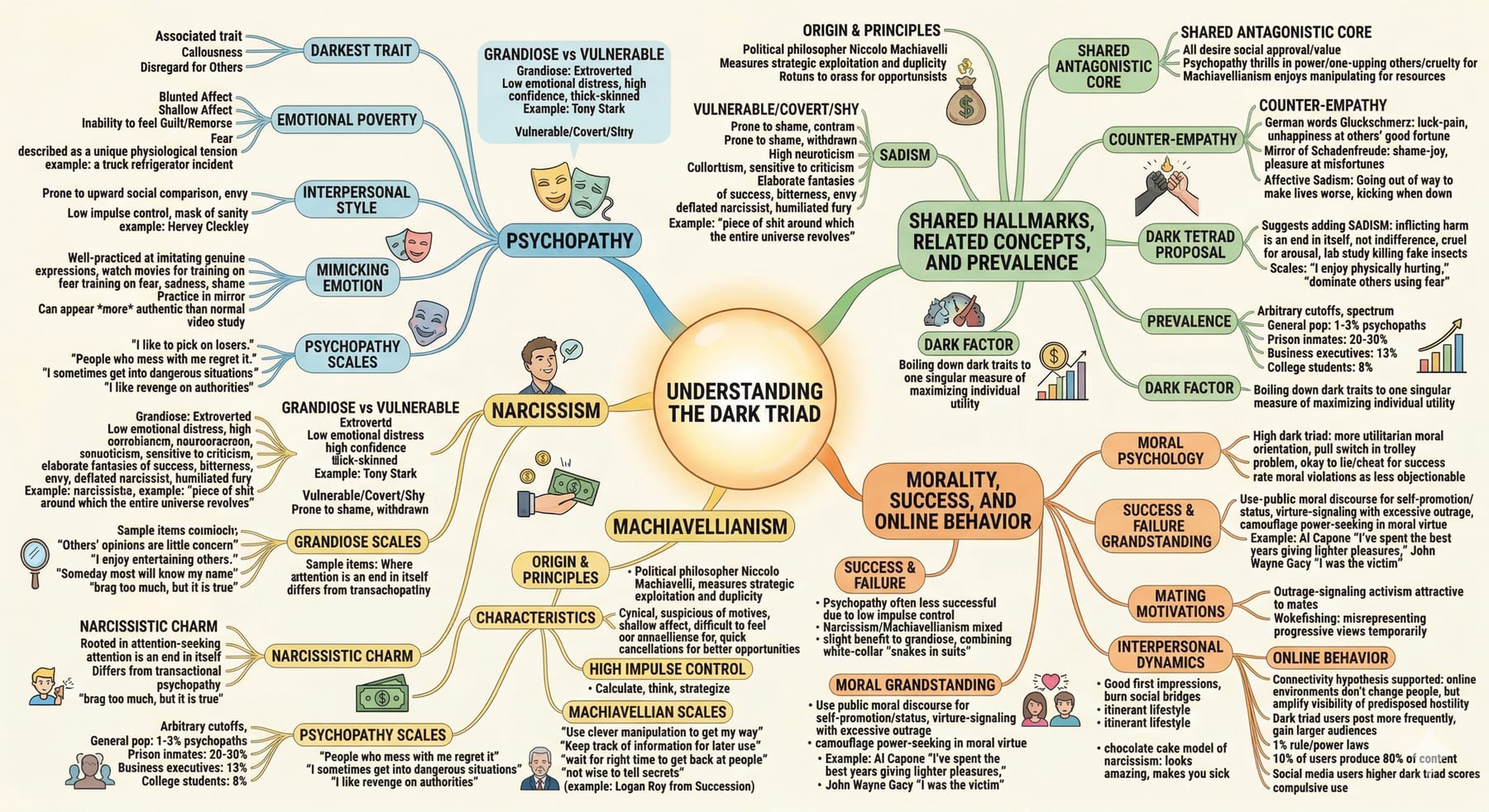
Overall thesis
- The transcript argues that the dark triad—psychopathy, narcissism, and Machiavellianism—is a useful way to understand antagonistic personality styles in the general population, not just among criminals or clinical cases. It frames these traits as distinct but positively correlated, each involving forms of self-interest, manipulation, envy, and weak concern for others.
- A second major claim is that these traits are deeply relevant to morality: people high in dark triad traits tend to judge moral violations less harshly, show more willingness to cheat or exploit, and often derive satisfaction from power, attention, or others’ misfortune.
- A third major theme is contrast: the lecture moves from the dark triad to a proposed light triad—humanism, Kantianism, and faith in humanity—to argue that more prosocial traits are associated with greater self-esteem, life satisfaction, and stronger moral objection to wrongdoing.
Key sections and main ideas
1) The dark triad framework
- The lecture opens by defining the dark triad as:
- Psychopathy
- Narcissism
- Machiavellianism
- The speaker emphasizes that these are usually measured in the general population, not just in prisons or psychiatric settings.
- The traits are presented as dimensional, not all-or-nothing:
- Most people would score somewhere in the middle.
- Very few people would score extremely low or extremely high.
- The lecture also notes a lifespan pattern:
- These traits often peak more in adolescence and early adulthood
- Then tend to decline with age.
2) Psychopathy
- Psychopathy is described as the darkest of the three traits.
- Main characteristics highlighted:
- callousness
- disregard for others
- poverty of emotion
- blunted or shallow affect
- low guilt and remorse
- diminished fear
- low impulse control
- low conscientiousness
- The lecture stresses that psychopaths may not always look obviously abnormal because they can wear a “mask of sanity”:
- they may appear charming
- mimic normal emotion
- learn socially acceptable behavior instrumentally rather than empathetically
- A key example:
- a psychopath describing fear not emotionally, but as a vague bodily tension while swerving to avoid a falling refrigerator
- this is used to illustrate emotional shallowness and weak introspection.
- Another striking point:
- psychopaths may study movies and social behavior as training material in order to imitate sadness, embarrassment, shame, or fear convincingly.
- The speaker cites a study where observers judged high-psychopathy people’s emotional expressions as more genuine, suggesting practiced mimicry can outperform ordinary expression.
3) Narcissism
- The transcript makes an important distinction between:
- Grandiose narcissism
- Vulnerable narcissism
- It argues that most dark triad research focuses mainly on grandiose narcissism.
Grandiose narcissism
- Traits emphasized:
- extroversion
- thick skin
- confidence
- self-promotion
- bragging
- attention-seeking
- lower distress
- relative happiness
- The speaker’s important nuance:
- some narcissism may be useful
- it can support risk-taking, confidence, and success
- so narcissism is not treated as purely or always destructive.
- The lecture says narcissists want proof that they are valued and envied by others.
- Their motivation is not simply material gain, but recognition and admiration.
Vulnerable narcissism
- Traits emphasized:
- shame
- introversion
- sensitivity to criticism
- depression
- bitterness
- envy
- fantasies of greatness without action
- The speaker describes vulnerable narcissists as:
- outwardly modest or withdrawn
- inwardly preoccupied with success, recognition, and status
- Main psychological mechanism:
- they fantasize about significance
- avoid the risks of striving
- then become resentful that they remain unseen or unrecognized.
- A vivid line used to summarize this mindset:
- feeling like “a piece of shit around which the entire universe revolves.”
- The lecture links this form of narcissism strongly to depression and humiliation.
4) Narcissism versus psychopathy
- A central distinction:
- Narcissists seek attention as an end in itself
- Psychopaths often seek attention as a means to an end
- Narcissistic charm is presented as:
- theatrical
- extroverted
- attention-hungry
- often less calculated
- Psychopathic charm is presented as:
- colder
- more strategic
- transactional
- aimed at securing resources, sex, professional gain, or leverage
- This is one of the lecture’s most useful contrasts:
- both may appear socially effective
- but their motivations are not the same.
5) Machiavellianism
- Machiavellianism is presented as the most strategic and calculating of the three.
- Key traits:
- manipulation
- duplicity
- cynicism
- suspicion
- shallow affect
- strategic patience
- higher impulse control than psychopathy
- The lecture stresses that Machiavellians often assume others operate by the same hidden, exploitative logic they do.
- As a result:
- when others act kindly, they respond not with gratitude but suspicion.
- Their goal is not mainly admiration or thrill, but control of social channels, keeping themselves at the center of resources and advantage.
- The pop-culture example used is Logan Roy from Succession.
6) Simplified motives of the three traits
- The speaker reduces the three traits to different central desires:
- Narcissism: wants admiration, proof of value, envy from others
- Psychopathy: wants domination, thrill, power over others
- Machiavellianism: wants manipulation, leverage, and control of outcomes
- This simplification is one of the lecture’s strongest organizing ideas because it shows that the traits overlap but are not interchangeable.
7) Counter-empathy
- The lecture introduces counter-empathy as a major extension of dark triad psychology.
- Instead of sharing others’ feelings in normal empathic ways, high-dark-triad individuals may experience:
- Schadenfreude: pleasure at others’ misfortune
- Gluckschmerz: pain at others’ success
- Affective sadism: active enjoyment in worsening others’ lives
- Main argument:
- some dark personalities do not merely lack empathy
- they may experience the inverse of empathy.
- This helps explain:
- envy
- trolling
- sabotage
- resentment of others’ joy
- attraction to humiliation and interpersonal antagonism.
8) Moral grandstanding
- The lecture defines moral grandstanding as using public moral discourse for:
- self-promotion
- status seeking
- social superiority
- It distinguishes this from ordinary “virtue-signaling” by emphasizing:
- outrage
- performance
- status competition
- Core claim:
- moral language can be used not to pursue truth or justice, but to look morally superior and shame rivals.
- The transcript strongly links grandstanding to narcissism, especially its antagonistic core.
- It also argues there are real social incentives for it:
- appearing virtuous
- gaining status
- becoming more attractive in some contexts
- One cited study is especially notable:
- moral outrage alone did not significantly increase romantic appeal
- but outrage paired with real-world activism did.
9) “Wokefishing” and strategic ideological signaling
- The lecture uses the term wokefishing to describe people pretending to be more progressive than they are in order to impress romantic partners.
- This is framed as a modern social example of:
- strategic self-presentation
- moral camouflage
- manipulation through values.
- The speaker also references rumors from the late 2016 / early 2017 period about Trump supporters attending anti-Trump rallies to attract women.
- This section is less about hard data and more about illustrating how moral display can become a mating strategyor identity performance.
10) Sadism and the possible “dark tetrad”
- The lecture asks whether the dark triad should become a dark tetrad by adding sadism.
- Important distinction:
- Psychopathy may harm others instrumentally
- Sadism seeks harm as an end in itself
- The behavioral experiment with insects is used as the strongest example:
- participants were invited to “kill” insects in a fake grinder
- some refused
- some did a few
- others eagerly wanted more
- higher eagerness correlated with sadism scores
- The lecture emphasizes the experiment was staged so no insects were harmed.
- Main takeaway:
- sadism may be statistically separable from psychopathy, even if the two overlap.
11) Morality, utilitarianism, and wrongdoing
- One of the transcript’s most important arguments is that dark triad traits shape moral judgment.
- The lecture claims dark triad individuals are more likely to:
- endorse trolley-style sacrificial reasoning
- cheat if it benefits them
- regard moral transgressions as less objectionable
- The speaker interprets this as:
- more “utilitarian” or consequentialist responses in moral dilemmas
- but often stripped of empathy rather than grounded in principled moral philosophy
- This is an important conceptual move:
- the lecture is not praising them as more rational
- it suggests their apparent utilitarianism may reflect emotional detachment and distorted moral concern.
12) Behavioral evidence and criminality
- The lecture goes beyond questionnaires and points to behavioral studies:
- e.g. the coin-flip cheating study
- participants who cheated disproportionately had elevated dark triad scores
- It also claims higher dark triad traits are linked with:
- delinquency
- criminality
- sexual misconduct
- unstable relationships
- manipulative tactics
- difficulty maintaining friendships and jobs
- Another important idea:
- these traits can be locally effective but globally self-defeating
- manipulation may work in the short run
- but often burns bridges over time.
13) Psychopathy prevalence and social distribution
- The lecture gives several prevalence estimates:
- roughly 1–3% in the general population
- 20–30% among prison inmates
- around 13% among business executives
- around 8% among college students
- It also notes caution with younger males:
- psychopathy-like scores in adolescence may partly reflect immaturity and underdeveloped impulse control.
- The discussion of Robert Hare and Snakes in Suits supports the idea of the organizational psychopath:
- someone cold, manipulative, but disciplined enough to succeed in white-collar settings.
- Important nuance:
- not every psychopath is a criminal
- not every criminal is a psychopath.
14) Victim-signaling and the virtuous victim effect
- One of the most interesting parts of the transcript is the claim that dark-triad individuals may use victimhood as camouflage.
- The lecture introduces victim-signaling as the intentional public display of one’s suffering, marginalization, or mistreatment.
- Key claim:
- higher dark triad scores correlate with more victim-signaling.
- The explanation is the virtuous victim effect:
- people seen as victims of wrongdoing are judged more moral and trustworthy
- this moral halo does not apply the same way to mere bad luck, like being struck by lightning
- This becomes a powerful argument in the lecture:
- if victimhood raises perceived trustworthiness,
- manipulative personalities may strategically present themselves as victims.
- Historical/criminal examples used:
- Al Capone
- John Wayne Gacy
- Both are presented as figures who framed themselves as victims after causing immense harm.
15) Nature, nurture, and heritability
- The lecture says:
- psychopathy and narcissism appear more strongly heritable
- Machiavellianism appears more tied to environment
- It then pauses to explain a common misunderstanding about heritability:
- heritability is not “what percent of you is genetic”
- it is about how much of the difference between people is explained by genes versus environment
- The “arms” example is used to explain this:
- although having two arms is biologically normal,
- variation in number of arms in the real world is mostly environmental
- therefore heritability of arm count is near zero.
- This section is not just about dark personalities; it is also a mini-lesson in behavior genetics and statistical interpretation.
16) The light triad
- The speaker transitions from pathology to positive psychology with the light triad:
- Humanism: valuing the success and creation of others
- Kantianism: integrity and honesty rather than deceitful charm
- Faith in humanity: seeing people as basically good and trustworthy
- The lecture argues:
- light and dark triad traits are inversely related but not exact opposites
- most people contain some mixture of both
- Morally, people high in the light triad are said to:
- object more strongly to wrongdoing
- be less willing to sacrifice one for many in trolley problems
- be more charitable
- orient themselves outward toward others.
17) Happiness, self-esteem, and mental health
- Another major thesis is that morality and happiness are connected.
- The lecture contrasts the dark and light triads in terms of well-being:
- Light triad correlates with higher self-esteem and life satisfaction
- Dark triad correlates with lower life satisfaction overall
- Important nuance:
- grandiose narcissism can inflate self-esteem
- but psychopathy and Machiavellianism are associated with poorer emotional well-being
- vulnerable narcissism is especially linked to depression
- The lecture also introduces:
- state orientation: self-absorption, inward preoccupation
- task orientation: focus on goals, action, the world outside oneself
- It argues task orientation predicts happiness better than self-absorbed state orientation.
- The dark triad is also associated with:
- self-hate
- shame
- anxiety
- depression
- alexithymia
- anhedonia
- misanthropy
- antinatalism
- The speaker suggests dark-triad depression may partly arise from:
- envy
- failed fantasies
- resentment
- inability to enjoy others’ flourishing.
18) Online behavior and social media
- The final major section applies these ideas to the internet.
- The lecture contrasts two hypotheses:
- Mismatch hypothesis: the internet makes ordinary people worse
- Connectivity hypothesis: the internet mainly amplifies already-hostile people
- The speaker argues for the connectivity hypothesis:
- nice people offline are generally nice online
- antagonistic people offline are antagonistic online
- the internet mainly increases their reach and visibility
- Key points:
- toxic personalities post more often
- they gain disproportionate reach
- ordinary people withdraw, lurk, or disengage
- that creates the illusion that “everyone online is toxic”
- Social media concentration examples:
- 10% of Twitter/X users produce 80% of tweets
- 25% of TikTok users post 98% of videos
- about half of TikTok users never post at all
- Main conclusion:
- online life does not fundamentally transform human nature
- it magnifies a small, noisy, often darker subset of it.
Historical events, cultural references, and notable examples
- Niccolò Machiavelli is referenced as the source of the Machiavellian label.
- Al Capone is used as an example of criminal victim-framing after arrest.
- John Wayne Gacy is used the same way.
- Late 2016 / early 2017 anti-Trump rally anecdote is used to illustrate strategic ideological performance for dating.
- Social media era examples:
- Twitter/X
- TikTok
- “wokefishing”
- virtue-signaling
- outrage signaling.
- Pop-culture examples:
- Tony Stark for grandiose narcissism
- Logan Roy for Machiavellianism
- Succession as a reference point.
Books, articles, studies, and sources mentioned
- Hervey Cleckley, The Mask of Sanity
- foundational work on psychopathy and the idea that psychopaths can appear outwardly normal.
- Robert Hare
- psychopathy checklist; major figure in psychopathy research.
- Robert Hare, Snakes in Suits
- cited in connection with “organizational psychopaths” or corporate psychopaths.
- Jonathan Shedler
- quoted on psychopathic domination and on the depressive gap in vulnerable narcissism.
- Justin Tosi and Brandon Warmke
- mentioned in connection with the concept/book on moral grandstanding.
- Robert Greene, The 48 Laws of Power
- quoted regarding moral display masking power-seeking.
- Mitch Brown et al.
- paper on moral grandstanding and mating motivations.
- Delroy Paulhus
- pioneer of dark triad research; associated with behavioral sadism work.
- Nicholas D. Thomson, Understanding Psychopathy: The Biopsychosocial Perspective
- cited on psychopaths’ disproportionate contribution to violent crime.
- Martha Stout, The Sociopath Next Door
- cited on sociopathic use of pity.
- Isaiah Berlin on Kant
- quoted on being worthy of happiness rather than simply pursuing happiness.
- Boston Globe headline about psychopathy and magic shows
- cited as a modern popularization of a study.
- Paul Silvia
- quoted regarding why high-psychopathy people may dislike magic shows.
Most important takeaways
- The lecture’s deepest point is that immoral or antagonistic personality styles are not just about “bad behavior”; they involve a distinct emotional economy:
- envy instead of admiration
- domination instead of reciprocity
- performance instead of authenticity
- suspicion instead of trust
- misfortune-of-others as gratification rather than concern.
- It also argues that dark personalities often succeed briefly or locally, but tend to fail over time because human flourishing ultimately depends on:
- empathy
- trust
- cooperation
- credibility
- impulse control.
- The lecture finally tries to make a moral-psychological case that:
- being more principled, outward-looking, and prosocial is not only more ethical
- it is also more closely tied to enduring well-being.
Related topics for further exploration
- The difference between psychopathy, antisocial personality disorder, and sociopathy
- The debate over whether dark-triad “utilitarianism” is genuine moral reasoning or just empathy deficits
- The relationship between narcissism and leadership
- Corporate psychopathy and white-collar institutions
- Victimhood culture, moral status, and public trust
- The psychology of online trolling and outrage economies
- The distinction between virtue-signaling, moral grandstanding, and sincere activism
- Whether sadism truly deserves recognition as a separate “fourth” dark trait
- The light triad and how it relates to older traditions like Aristotelian virtue ethics and Kantian ethics
- How envy, resentment, and social comparison affect politics, social media, and mental health
6. The Moral Life
Peterson Academy - The Psychology of Morality (Henderson) - Lecture 06.pdf (file not included in this release)
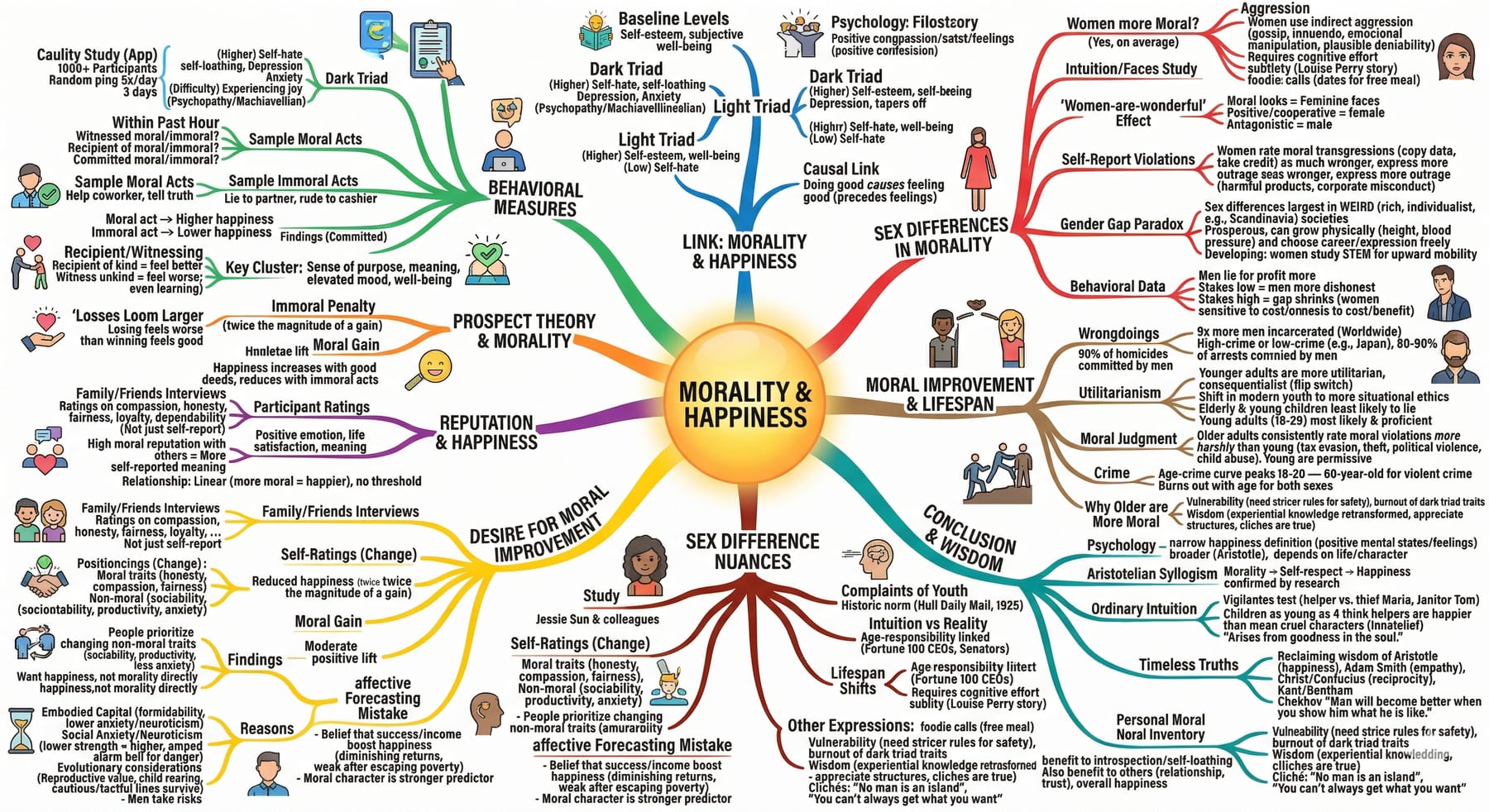
Overall thesis
- This transcript argues that moral character is closely tied to happiness, that people generally intuit happiness in moral rather than purely hedonic terms, and that both sex differences and age differences appear in moral judgment and behavior. The speaker’s broad conclusion is that morality is not just socially useful; it appears to be psychologically beneficial, tied to self-respect, life satisfaction, and well-being.
1) Main argument: morality and happiness are linked
- The speaker begins by building on the earlier contrast between the dark triad and light triad:
- dark triad traits were associated with:
- self-hate
- anxiety
- depression
- difficulty experiencing joy
- light triad traits were associated with:
- higher self-esteem
- lower self-hate
- greater well-being
- dark triad traits were associated with:
- The question in this lecture is whether there is a causal link between moral behavior and happiness, not just a correlation.
Evidence from experience-sampling study
- The transcript describes a study in which 1,000+ participants installed an app and were prompted five times a day for three days.
- They were asked whether in the previous hour they had:
- committed a moral act
- committed an immoral act
- witnessed a moral act
- witnessed an immoral act
- been the target of a moral or immoral act
- Reported examples:
- moral acts:
- helping a coworker finish a report
- telling the truth when lying would be easier
- immoral acts:
- lying to a partner
- being rude to a cashier
- moral acts:
- Main finding:
- committing moral acts was followed by higher happiness relative to baseline
- committing immoral acts was followed by lower happiness relative to baseline
- receiving or witnessing moral acts also improved mood
- receiving or witnessing immoral acts worsened mood
- The speaker emphasizes that because the act preceded the reported feeling, this suggests a causal direction from morality to happiness.
Losses loom larger than gains
- A striking point from the study:
- the happiness penalty from immoral action was about twice as large as the happiness boost from moral action.
- The speaker links this to prospect theory:
- losses hurt more than gains feel good
- similarly, immorality harms well-being more sharply than moral action boosts it
- This creates a psychologically asymmetrical moral economy:
- doing good helps
- doing wrong hurts more.
Evidence from social reputation
- Another study described in the lecture did not rely only on self-report.
- Researchers asked:
- family
- friends
- romantic partners
- coworkers
- acquaintances
to rate the participant on traits such as: - honesty
- fairness
- compassion
- loyalty
- dependability
- The participants then reported:
- positive emotion
- life satisfaction
- meaning in life
- Main finding:
- people regarded by others as more moral also reported greater meaning and subjective well-being
- the relationship was described as linear, not leveling off after a threshold
- This supports the lecture’s central claim that morality is not just admired by others but also tied to one’s own durable sense of flourishing.
2) A major paradox: people want happiness, but not necessarily moral improvement
- The transcript then raises a provocative question:
- if morality boosts happiness, do people want to become more moral?
- The speaker describes a study by Jessie Sun and colleagues in which people and their loved ones were asked what traits they most wanted the participant to improve.
- Result:
- people wanted more change in non-moral traits than moral ones
- they wanted to become:
- more sociable
- more productive
- less anxious
- but not especially:
- more honest
- more fair
- more compassionate
- Even loved ones showed the same pattern:
- they wanted improvement, but more on functional or social traits than on morality itself.
- Main interpretation:
- people may misjudge what most contributes to happiness
- they may overvalue productivity, status, or social smoothness
- and undervalue moral character, even though moral character appears to predict well-being more strongly.
Affective forecasting mistake
- The speaker frames this as a problem of affective forecasting:
- people imagine that better productivity, income, or status will make them happier
- but the evidence described here suggests that moral character may be a stronger predictor of happinessthan worldly success, especially once basic material needs are met.
- The lecture also notes a classic happiness finding:
- after escaping poverty, the relationship between more money and more happiness weakens quickly.
3) Moral character and competence: how we judge people
- The transcript argues that when we meet others, we primarily evaluate two things:
- moral character
- competence
- Together, these are said to account for about 82% of the differences in how we form impressions of others.
- The speaker emphasizes that moral character matters more than competence:
- people prefer a person who is moral but less competent
- over a person who is highly competent but immoral
- The logic:
- a competent immoral person is dangerous because they can effectively pursue harmful goals.
- This section strengthens the morality-happiness link by suggesting moral behavior increases social trust, likability, and relationship stability.
4) Philosophical question: is happiness about feeling good or being good?
- A central philosophical tension runs through the lecture:
- psychologists often define happiness narrowly as positive feeling
- moral philosophers, especially since Aristotle, treat happiness as connected to living well and having good character
- The speaker uses this contrast to ask whether ordinary people think happiness is:
- merely subjective pleasure
- or something morally thicker.
Paul Bloomfield’s Aristotelian syllogism
- The lecture cites Paul Bloomfield:
- morality is necessary for self-respect
- self-respect is necessary for happiness
- therefore morality is necessary for happiness
- Whether or not every step is philosophically airtight, the speaker argues that the empirical evidence points in the same direction:
- immoral people often show more self-hate
- moral conduct appears linked to better well-being.
5) Experimental philosophy: people judge immoral “happy” people as not really happy
- The transcript gives several vignette examples to test ordinary intuitions.
Maria vignette
- Two versions of Maria are described:
- one is a loving, busy mother devoted to her children
- the other is a celebrity-aspiring party-goer focused on popularity, alcohol, and shallow status
- In both versions:
- Maria’s feelings are described the same way
- she feels excited
- she enjoys her life
- she thinks it is worth the sacrifice
- Yet people judge the first Maria as happy and are much less willing to judge the second Maria as happy.
- Conclusion:
- people do not define happiness by feeling alone
- they incorporate the moral quality of one’s life into the concept itself.
Tom vignette
- Same structure:
- one Tom is a janitor who helps disabled students
- the other Tom is a thief who steals from students to buy alcohol
- Both are described as feeling good and satisfied with life.
- Yet participants overwhelmingly attribute happiness to the helping Tom, not the stealing Tom.
- Main point:
- ordinary judgments of happiness are morally saturated
- people resist calling an immoral but pleased person “happy” in the fullest sense.
Preschoolers show the same intuition
- The lecture says even young children display this pattern.
- Children hearing stories about:
- sharing/helping characters
- versus stealing/hurting characters
judged the moral characters as happier, even when the characters’ internal feelings were described identically.
- The study’s interpretation:
- this may be early-emerging, perhaps partly innate
- not merely learned from long experience
- This is one of the most important claims in the whole transcript:
- the link between morality and happiness may be a deep feature of human cognition, not just a philosophical theory.
6) Sex differences in morality
- The lecture then shifts to a controversial question:
- Are women more moral than men?
- The speaker’s answer is:
- on average, yes, according to the studies summarized here
- but with the repeated caveat that averages do not erase individual exceptions.
Perceptual and stereotype evidence
- A study is described in which participants repeatedly saw pairs of faces and chose which one looked more moral.
- Result:
- participants chose the more feminine-looking face as more moral 99% of the time
- Related judgments:
- traits such as peaceful and angelic were associated more with femininity
- traits such as self-prioritizing, stubbornness, and challenge were associated more with masculinity
- This is connected to the women-are-wonderful effect:
- a tendency to view women as more cooperative, prosocial, or morally desirable.
Self-report and moral foundations evidence
- Women were said to:
- condemn moral violations more harshly
- show more outrage at corporate wrongdoing
- be more likely to boycott companies seen as harmful
- In a large cross-national study of 67 countries and 300,000+ participants:
- women scored higher on sensitivity to violations of:
- care
- fairness
- purity
- there was less difference on:
- loyalty
- authority
- women scored higher on sensitivity to violations of:
- Overall conclusion:
- women appear more morally sensitive across multiple domains.
Behavioral evidence
- The lecture says men:
- lie for profit more often than women
- cheat more in laboratory games, especially when stakes are small
- Women:
- cheat less when the stakes are low
- but become more likely to cheat as incentives rise
- The interpretation offered:
- men appear more uniformly dishonest across stakes
- women appear more sensitive to tradeoffs, reward, and possible reputational costs.
Crime evidence
- The speaker then turns to actual wrongdoing:
- in the U.S., men have been incarcerated at far higher rates than women
- in Japan, men account for 80–90% of arrests
- there is no country with more women in prison than men
- men commit over 90% of homicides
- An important nuance:
- men are also about 70% of homicide victims
- much violence is young men harming other young men
- The lecture also points out a parallel pattern in chimpanzees:
- male killers and male victims dominate there too.
- This section is meant to show that the sex difference is not only about opinions but also about behavior.
7) Why the speaker thinks women are more moral on average
Physical vulnerability and anxiety account
- One explanation is physiological and psychological:
- men have more embodied capital
- larger size
- strength
- robustness
- and lower average anxiety, neuroticism, and fearfulness
- men have more embodied capital
- Women score higher on social anxiety, and the speaker says social anxiety correlates with rating moral violations as more wrong.
- A striking claim from handgrip-strength studies:
- stronger people are less anxious
- weaker people are more anxious
- once handgrip strength is controlled for, sex differences in anxiety reportedly disappear
- The suggested mechanism:
- vulnerable people have more reason to want predictable, safe, rule-bound environments
- therefore they condemn wrongdoing more strongly.
Evolutionary explanation
- The second explanation is evolutionary:
- women historically bore more responsibility for:
- childbearing
- childrearing
- protection of vulnerable offspring
- therefore caution, vigilance, and a stronger interest in constraining threats would have been adaptive
- women historically bore more responsibility for:
- Men, by contrast, historically had more room for:
- risk-taking
- aggression
- moral permissiveness
- This is presented as part of a broader reproductive and survival logic rather than a purely cultural story.
Luxury beliefs and class buffering
- The lecture also extends the argument beyond sex to capital:
- people with more embodied capital or economic capital can afford to be more permissive toward threats
- those who are safer are less dependent on strong moral condemnation of conventional wrongdoing
- This is used to explain why affluent people in wealthy societies may care less about conventional threats like crime and more about abstract moral causes.
8) Gender equality paradox
- One of the most important conceptual frameworks in this part of the lecture is the gender equality paradox.
- The claim:
- as societies become richer and more equal, sex differences often get larger, not smaller
- This is said to appear in:
- personality
- occupational preferences
- crying frequency
- dark triad differences
- even physical traits such as height, BMI, and blood pressure
- Applied to morality:
- the gap between men and women in moral judgment and dark triad scores is said to be largest in WEIRD societies and especially in wealthy Western countries.
9) Age differences: are older people more moral?
- The final major section argues that older adults are more moral than younger adults, again on average.
- The speaker notes this fits a long historical intuition:
- older generations have often criticized youth as selfish, rude, and thoughtless
- a 1925 British newspaper quote is used as an example of this recurring complaint.
Leadership and age
- The lecture notes that positions of responsibility tend to skew older:
- average startup founder around 42
- Fortune 100 CEOs around 57
- S&P 500 CEOs at hire around 58
- U.S. senators around 64
- The implication is not merely demographic:
- society seems to associate responsibility, reliability, and maturity with age.
Dark triad declines; light triad rises
- Across the lifespan:
- dark triad traits peak in late adolescence / early adulthood
- then decline with age
- This decline is said to be especially strong for psychopathy
- Older adults score higher on light triad traits:
- humanism
- Kantianism
- faith in humanity
- Related study:
- older adults spread more positive gossip
- younger adults spread more malicious gossip.
Younger adults are more permissive in moral judgment
- The speaker describes his own cross-national work using multiple large data sets.
- Main finding:
- older adults consistently rate moral violations more harshly than younger adults
- This applied not only to:
- theft
- tax evasion
but also to: - political violence
- child abuse
- spousal abuse
- Important nuance:
- younger people still rated these acts as wrong
- but older people rated them as more wrong
- The speaker says this pattern remained even after controlling for:
- income
- education
- political orientation
- He also argues it is not just a cohort effect, because the pattern appears in data sets spanning back to the early 1980s.
Crime and the age-crime curve
- The lecture then turns to behavior:
- criminality peaks around ages 18–20
- a 20-year-old man is much more likely than a 60-year-old man to commit violent crime
- the same age pattern appears for women, though at a much lower overall rate
- This is called the age-crime curve
- The speaker argues that age differences in dark triad traits are so large that:
- a 20-year-old woman may score higher on dark-triad measures than a 60-year-old man
- so age can matter even more than sex in some comparisons.
10) Why older people may be more moral
- Several explanations are offered:
Greater vulnerability
- Older adults are physically more vulnerable, so they may prefer:
- stronger rules
- greater predictability
- stricter condemnation of wrongdoing.
Dark triad burnout
- With age, people become:
- less impulsive
- less power-seeking
- less manipulative
- This lowers dark-triad tendencies and can produce stricter moral attitudes.
Changed incentives
- Early adulthood may reward:
- boldness
- confrontation
- manipulation
- status-seeking
- Later adulthood often shifts priorities toward:
- spouse
- children
- stability
- preserving relationships
- So some darker tactics may be more adaptive early and less necessary later.
Wisdom
- The final explanation is wisdom through experience
- The lecture contrasts:
- theoretical knowledge
- with lived, experiential knowledge
- The Cambridge Handbook of Wisdom is quoted to argue that wisdom is not merely knowing proverbs intellectually, but having life experiences that reveal why those proverbs are true.
- This is tied to cliché sayings like:
- “No man is an island”
- “You can’t always get what you want”
- The speaker’s point:
- old moral insights may sound banal to the young
- but age and suffering can transform them into real wisdom.
11) Closing interpretation
- The lecture closes by claiming modern psychology can help “rediscover” older moral insights:
- Aristotle may have been right about happiness
- Adam Smith about moral sentiments
- Christ and Confucius about reciprocity
- older folk wisdom about youthful folly
- The final message is not merely descriptive:
- if showing people what they are like helps them improve, then psychological self-knowledge has moral value.
- That idea is anchored in the quoted line from Anton Chekhov:
- “Man will become better when you show him what he is like.”
12) Q&A section: important extra points
How women may express dark-triad traits differently
- The speaker says women with elevated dark-triad traits may show aggression more indirectly:
- gossip
- innuendo
- backbiting
- emotional manipulation
- plausible deniability
- This is contrasted with men’s more direct physical aggression.
- An anecdote involving Louise Perry is used to illustrate women’s ability to detect subtle interpersonal aggression in office settings.
- Another example mentioned:
- women higher in dark-triad traits may be more prone to “foodie calls”, using dates for free meals rather than genuine relational interest.
Personal moral inventory
- In response to a question about moral inventory, the speaker says introspection can be beneficial:
- identifying where one has fallen short
- recommitting to better conduct
- The value is both:
- internal, through more happiness and less self-loathing
- external, through making other people’s lives less miserable
- This reinforces the transcript’s overall thesis:
- moral improvement benefits both self and community.
Hardship, wealth, and moral development
- In a final exchange, the speaker agrees that harsher environments may reduce some forms of moral experimentation or permissiveness.
- He uses:
- traditional rules about food, sex, and purity
- and an anecdote involving anthropologist Napoleon Chagnon and the Yanomami
to suggest that moral values shift with: - wealth
- technology
- disease threat
- need for survival
- Rich societies can afford greater permissiveness about some conventional moral rules; poor or dangerous environments cannot.
Historical events and historical references mentioned
- World War II
- mentioned as part of the moral reevaluation that followed the catastrophe of the war.
- The Holocaust
- referenced as a major historical event that changed how modern Westerners think about in-group versus out-group morality.
- 1925 – Hull Daily Mail quote
- used to show that complaints about selfish, rude youth are at least a century old.
- COVID
- mentioned by the speaker when describing conducting online studies during that period.
- Longer civilizational references:
- development of medicine, vaccines, and sanitation as factors reshaping purity norms and moral attitudes.
Books, articles, thinkers, and sources mentioned
- Thinking, Fast and Slow — Daniel Kahneman
- Amos Tversky — associated with prospect theory
- Jessie Sun — study on desire for self-improvement in moral vs non-moral traits
- Aristotle — moral conception of happiness
- Paul Bloomfield — Aristotelian syllogism about morality, self-respect, and happiness
- Isaiah Berlin — referenced earlier in the lecture sequence on Kant and happiness
- Adam Smith — moral sentiments
- Christ
- Confucius
- Bentham
- Kant
- Anton Chekhov — closing quote
- Cambridge Handbook of Wisdom — edited by Robert Sternberg
- Robert Conquest
- Manvir Singh
- Napoleon Chagnon
- Louise Perry
- Also referenced conceptually from earlier lectures:
- moral foundations theory
- moral dyad theory
- moral typecasting
- dark triad
- light triad.
Key takeaways
- The transcript’s strongest claim is that morality is not merely socially approved; it appears to be emotionally and existentially beneficial.
- It also argues that ordinary people, and even children, see happiness as morally loaded, not just as a bundle of pleasant feelings.
- The lecture maintains that:
- women are more moral than men on average
- older adults are more moral than younger adults on average
- and both patterns may be partly explained by vulnerability, incentives, and lived experience.
- The deeper synthesis is that wisdom, moral seriousness, and well-being converge more than modern people often assume.
Related topics for further exploration
- Aristotle’s concept of eudaimonia versus modern psychological notions of happiness
- The debate over whether morality causes happiness or whether happier people simply act better
- Prospect theory and its application beyond money to moral psychology
- The women-are-wonderful effect and critiques of it
- The gender equality paradox and debates around its interpretation
- The age-crime curve in criminology
- Whether moral permissiveness among youth reflects immaturity, incentives, or generational change
- The relationship between physical vulnerability, anxiety, and moral condemnation
- Whether indirect aggression in women is empirically distinct from male aggression
- The connection between wisdom literature, proverbs, and modern empirical psychology