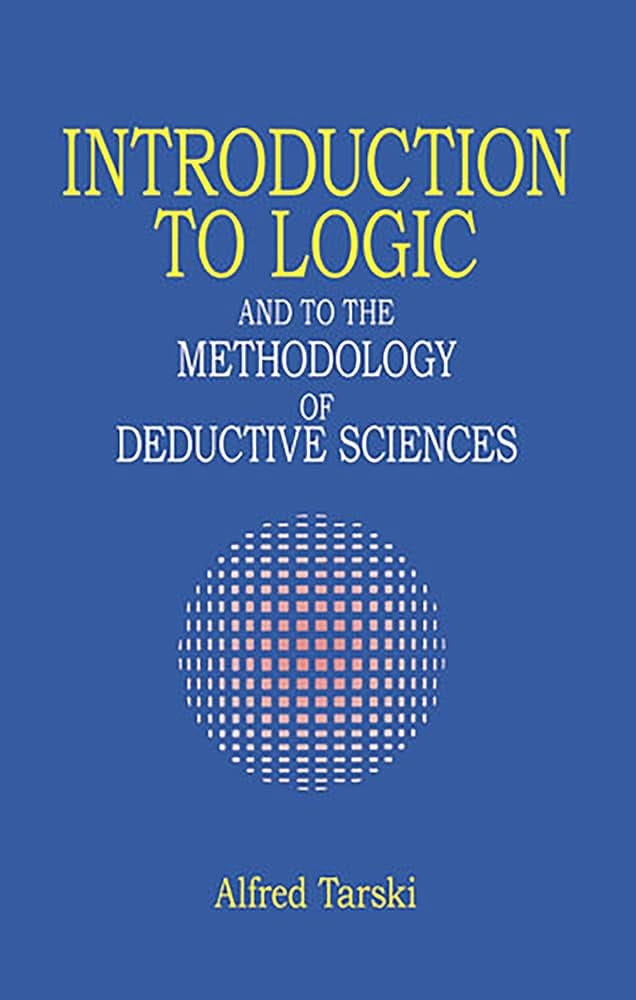

DESCRIPTION
This classic undergraduate treatment examines the deductive method in its first part and explores applications of logic and methodology in constructing mathematical theories in its second part. Exercises appear throughout.
My Summary
Main Ideas, Takeaways & Similarities
Questions
I. What is the problem?
A. How is this problem formulated?
B. Why is this problem important?
C. What is the history of this problem?
D. Which prominent personalities have been interested in this problem?
II. What solutions to the problem are there?
A. What are the conclusions reached?
B. By what argument(s) is the conclusion reached?
C. What facts or assumptions serve as premises?
D. When a prominent personality offers a solution, does he also argue for or against other prominent personalities? Does he raise objections to alternative solutions? Does he consider objections to his own solutions?
III. Evaluation
A. What are the advantages and disadvantages of the alternative formulations to the problem?
B. Has the importance or history of the problem ever been misrepresented?
C. Are the solutions logically related to the premises?
D. Are the facts true? Are the assumptions acceptable? Are the objections answerable?
AI Summary
Highlights
“Introduction to Logic” by Alfred Tarski is a foundational textbook that covers the principles and fundamentals of formal logic. Here’s a comprehensive summary in bullet points:
- Title: Introduction to Logic
- Author: Alfred Tarski
Chapter 1: Propositional Logic:
- Introduces the basic concepts of propositional logic.
- Covers propositions, connectives (AND, OR, NOT), truth tables, and logical equivalence.
- Explains how to construct and evaluate logical arguments using propositional logic.
Chapter 2: Predicate Logic:
- Expands on propositional logic by introducing predicate logic.
- Covers predicates, quantifiers (universal and existential), and the concept of variables.
- Discusses how to symbolize and reason about statements involving variables and quantifiers.
Chapter 3: Formal Deduction:
- Focuses on the rules of inference and methods of formal deduction.
- Introduces natural deduction and proof techniques for propositional and predicate logic.
- Teaches how to derive conclusions from premises in a systematic manner.
Chapter 4: The Theory of Identity:
- Explores the concept of identity and equality in logic.
- Discusses the properties and principles of identity, including reflexivity, symmetry, and transitivity.
- Covers the substitution and Leibniz’s Law.
Chapter 5: The Formal Axiomatic Method:
- Introduces the formal axiomatic method as a rigorous approach to logic.
- Discusses axioms, inference rules, and theorems.
- Explores the foundations of logical systems and their consistency.
Chapter 6: The Theory of Classes:
- Discusses set theory and the theory of classes within the context of logic.
- Covers concepts like unions, intersections, complements, and subsets.
- Explores the axiomatic development of set theory.
Chapter 7: Modal Logic:
- Introduces modal logic, which deals with modalities like necessity and possibility.
- Covers possible world semantics and modal operators.
- Discusses modal logic as an extension of classical logic.
Chapter 8: Semantics and Pragmatics:
- Delves into the semantics and pragmatics of logical languages.
- Discusses truth conditions, meaning, and interpretation of logical statements.
- Explores the relationship between syntax and semantics.
Chapter 9: The Theory of Probability:
- Discusses probability theory and its relevance to logic.
- Covers basic probability concepts, including probability spaces, events, and conditional probability.
- Explores the connection between logic and probability.
Chapter 10: Decision Logic:
- Introduces decision logic, a field that deals with decision-making under uncertainty.
- Covers decision trees, utility theory, and rational decision-making.
- Discusses how logic can be applied to decision problems.
Chapter 11: Applications of Logic:
- Provides examples of logic’s practical applications in various fields, including mathematics, philosophy, computer science, and linguistics.
- Discusses how logical reasoning is used to solve problems and make decisions.
Conclusion:
- Summarizes the key concepts and principles covered in the book.
- Emphasizes the importance of formal logic in various disciplines and everyday reasoning.
Legacy:
- “Introduction to Logic” by Alfred Tarski remains a classic text in the field of logic.
- It has been influential in teaching formal logic and critical thinking to students and continues to be a valuable resource for those studying logic and related disciplines.
- The book’s comprehensive coverage of logical principles and its systematic approach to formal reasoning have contributed to its enduring legacy in the field of logic.