Handwritten journal source
Consolidated source: PDF pp. 127–129 (file not included in this release) · PDF pp. 132–136 (file not included in this release)
Source boundary: These are handwritten source pages. Use the scan for exact wording; verify quotations and factual claims before reuse.
Embedded preview:
March 21-June 9 2026.pdf (file not included in this release)
Open the journal routing table
1. Why Logic Matters
Peterson Academy - Logic (Hicks) - Lecture 01.pdf (file not included in this release)
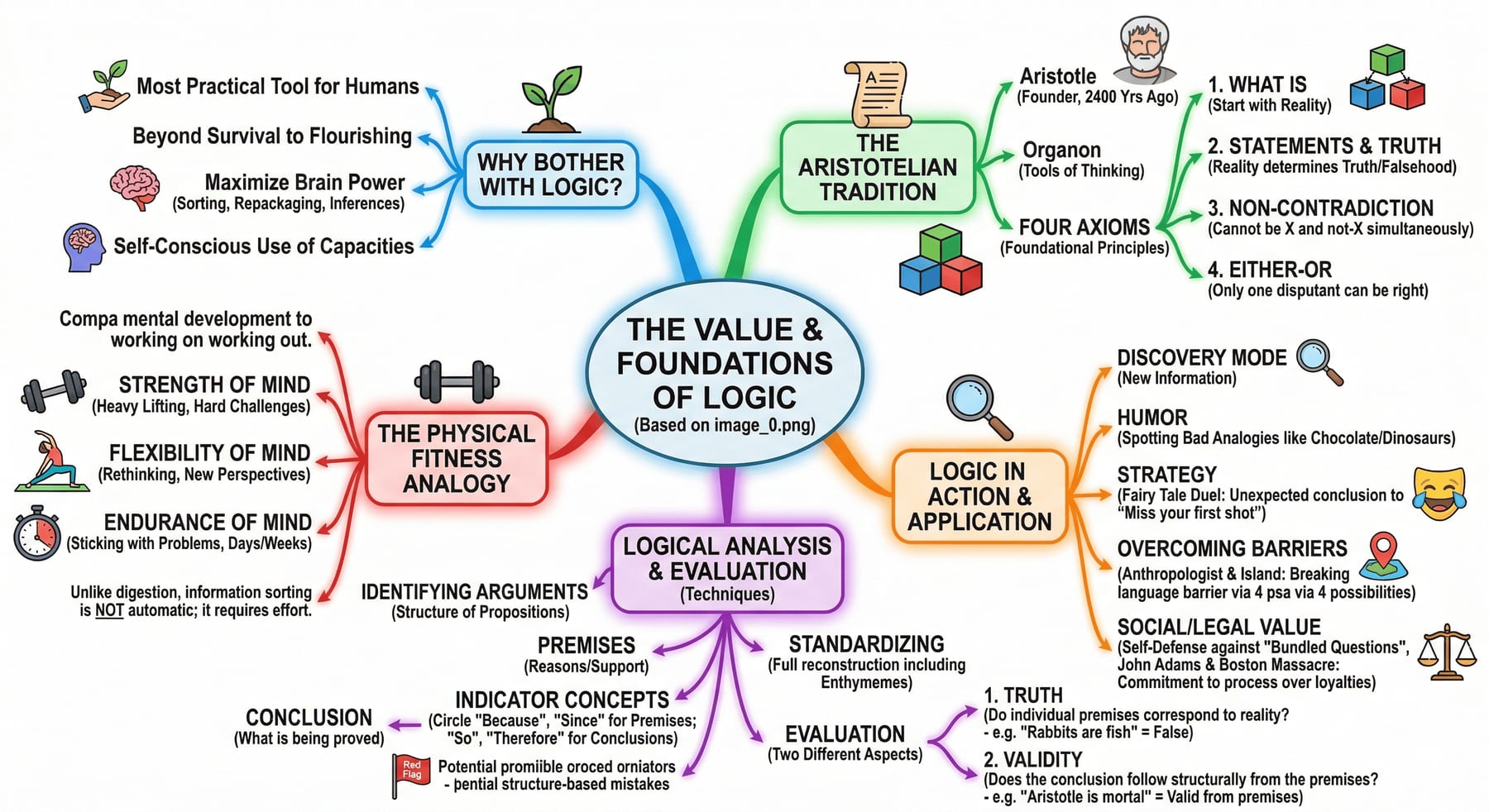
Core Thesis of the Lecture
- The speaker argues that logic is the most practical discipline a human being can master.
- The reason is not merely academic or intellectual prestige, but that:
- human beings survive and flourish less by physical strength than by the power of the mind
- logic helps the mind stay connected to reality
- logic improves our ability to analyze, infer, discover, revise beliefs, defend ourselves, and cooperate with others
- Logic is presented not just as a classroom subject, but as:
- a discipline of mental training
- a tool of truth-seeking
- a social and moral necessity in personal life, law, politics, and justice
Main Ideas and Key Points
1. Why logic matters so much
- Human beings are physically limited compared to many animals:
- not especially fast
- not especially hardy
- narrow range of environmental comfort
- What makes humans powerful is their ability to:
- take in information
- sort and classify it
- detect similarities and differences
- draw inferences
- build complex understandings of the world
- These mental capacities do not automatically operate at their highest level.
- We must become self-conscious about how our minds work, including:
- what they can do well
- where they fail
- how to use them properly
- how to avoid misuse
- Logic is therefore presented as a method of training the mind deliberately, much like exercise trains the body.
2. Logic as mental fitness
- The speaker compares logic to physical training.
- Just as one can train the body for:
- strength
- flexibility
- endurance
- one can train the mind for:
- strength of mind: ability to take on difficult intellectual problems
- flexibility of mind: ability to reconsider, reframe, and think from different perspectives
- endurance of mind: ability to stay with a problem for long periods of time
- This analogy is central to the lecture:
- logic is not merely about memorizing rules
- it is a lifelong discipline of cognitive development
3. Logic keeps thought tied to reality
- A major claim of the lecture is that logic is what keeps the mind “on track with reality.”
- The speaker presents an Aristotelian view:
- reality comes first
- truth depends on whether our statements correspond to what is real
- logic is the method by which our thinking remains aligned with that reality
- This becomes the foundation for the lecture’s defense of logic:
- not just “I like logic”
- but “logic is the proper way to think if we care about truth”
Aristotle and the Historical Foundations of Logic
1. Aristotle as founder of logic
- Aristotle is given the “lion’s share” of the credit for founding logic as a formal discipline.
- Historical context:
- ancient Greece
- around 2400 years ago
- a period of intense development in philosophy, politics, literature, science, and art
- Aristotle is placed in an intellectual line:
- Socrates
- Plato
- Aristotle
- The speaker credits Aristotle with making logic explicit and systematic.
2. The Organon
- Aristotle’s logical works are collectively called the Organon.
- The word means “tool.”
- This is important because it frames logic as:
- a set of tools for thinking
- different tools for different reasoning situations
3. Aristotelian axioms / foundational principles
The speaker attributes several foundational logical commitments to Aristotle:
a. Reality comes first
- “What is makes statements true or false.”
- Meaning:
- reality determines truth
- our statements are true if they correspond to what exists
- false if they fail to connect to reality
b. Principle of non-contradiction
- A thing cannot both be and not be in the same respect at the same time.
- If we contradict ourselves, we have made a mistake.
- This principle reflects the idea that:
- reality is consistent
- contradictions in thought indicate an error in reasoning
c. Either-or principle
- Where two contradictory claims are in conflict, both cannot be true.
- If one says X and another says not-X, one must be mistaken.
- This reflects a commitment to clear differentiation and decisive reasoning.
4. Objectivist orientation
- The speaker characterizes Aristotle as belonging to a small-o objectivist tradition.
- This means:
- objects / objective reality are what they are independently of our wishes
- the thinking subject must conform thought to objects
- logic is the tool that allows this conformity
5. Controversy noted
- The speaker briefly notes that not everyone accepts the Aristotelian framework.
- He suggests there are philosophical controversies within the history of logic over whether these principles are truly axiomatic.
- He does not develop those alternative traditions here, but flags them as part of the broader history of logic.
Logic as a Method of Avoiding Error
1. Thinking does not automatically sort truth from falsehood
- The body automatically digests and sorts food.
- The mind does not automatically sort good information from bad information.
- We can:
- absorb falsehoods
- combine truths badly
- infer nonsense from correct premises
- Therefore logic must be learned and applied consciously.
2. Logic identifies truth-preserving processes
- The goal is not only to gather facts.
- It is to learn which patterns of thinking:
- preserve truth
- extend knowledge
- uncover hidden implications
- And which patterns:
- are seductive
- feel plausible
- but lead us astray
Formal Reasoning Patterns: Valid and Invalid Inference
1. Abstract pattern example
The speaker introduces an abstract syllogistic structure:
- All P are Q
- All Q are M
- Therefore, all P are M
Key point: - This is presented as a good logical pattern.
- It “feels” correct even before specific content is inserted.
2. Contrasting invalid pattern
He then gives:
- All P are Q
- All M are Q
- Therefore, all P are M
Key point: - This feels suspect.
- It turns out to be a bad pattern because the shared middle term is placed wrongly.
- The speaker uses this to show that structure matters, not just the words themselves.
3. Concrete examples
Valid pattern
- All humans are mammals
- All mammals are mortal
- Therefore, all humans are mortal
Why it matters: - true premises
- truth-preserving inference
- true conclusion reached by a proper pattern
Invalid pattern
- All humans are mammals
- All pigs are mammals
- Therefore, all humans are pigs
Why it matters: - starts from true information
- but uses a bad reasoning pattern
- produces a false conclusion
4. Terminology introduced
- The good pattern is later called valid
- The bad pattern is invalid
- The lecture stresses that:
- correct information alone is not enough
- correct structure is also necessary
Logic as a Tool of Discovery
1. Logic does more than tidy knowledge
- Logic is not only useful for organizing what we already know.
- It is also powerful in discovering new truths.
2. Ancient scientific example: sweat and pores
The speaker gives a proto-scientific example:
- People observe that when humans exert themselves, their skin becomes wet.
- Ancient observers lacked microscopes and could not see pores.
- Someone notices a bucket that leaked water through tiny holes.
- By analogy, the thinker infers that human skin may also have tiny holes through which moisture escapes.
Main point: - This is analogical reasoning
- It transfers known structure from one case to another
- It produces a plausible new hypothesis
- Logic therefore contributes to scientific discovery
3. Humor and bad analogies
The speaker gives a joke:
- “Chocolate is crucial to our survival. Dinosaurs didn’t have chocolate, and look what happened to them.”
Why the joke works: - it mimics analogical reasoning
- it uses a clearly bad analogy
- our awareness of logical mismatch makes it funny
Main lesson: - learning logic sharpens not only serious reasoning but also our ability to detect comic absurdity
Logic, Endurance, and Unexpected Solutions
1. The princess and the three princes duel problem
The lecture includes a puzzle involving:
- Prince Noble: 100% accuracy
- Prince Debonair: 80% accuracy
- Prince Valiant: 60% accuracy
- Valiant gets the first shot
- Princess wants Valiant to survive and win
Initial intuition: - Valiant should shoot the most dangerous opponent first
Logical result: - if Valiant kills one opponent, the remaining stronger shooter likely kills him next
- the best strategy is unexpectedly to intentionally miss the first shot
- this increases the chance that the stronger opponents target each other first
- then Valiant faces a more favorable final duel
Main lesson: - logic can generate counterintuitive but correct solutions
- only careful step-by-step reasoning reveals them
2. Endurance matters
- This example supports the earlier analogy about mental endurance
- Some problems cannot be solved quickly or intuitively
- Logic requires:
- patience
- multi-step reasoning
- tracking alternatives
- resisting premature conclusions
Logic and Language: Truth-Tellers, Liars, and Unknown Words
1. Anthropologist island puzzle
Setup:
- islanders are either truth-tellers or liars
- they use two words, “bal” and “dal”
- one means yes, the other means no
- but the anthropologist does not know which is which
- and does not know whether a given islander lies or tells the truth
Key question asked: - “Is your word for yes, bal?”
The speaker runs through four possibilities: - truth-teller + bal = yes
- liar + bal = yes
- truth-teller + bal = no
- liar + bal = no
Conclusion: - the pattern of answers allows the anthropologist to infer:
- whether the person is a truth-teller
- and what the words mean
Main lesson:
- careful logical analysis can extract surprising knowledge from seemingly impossible situations
- this demonstrates logic’s power in:
- language
- inference
- problem-solving
- breaking through uncertainty
Logic and Revising Beliefs
1. Importance of flexibility
- A good thinker must be willing to revise earlier beliefs when new evidence appears.
- Many people resist this because:
- they are lazy
- they are attached to their initial interpretation
- they do not want to do the work of rethinking
2. Car battery example
Scenario:
- cold winter night
- car does not start
- initial hypothesis: dead battery
- then remembered: battery was replaced two weeks ago
- then remembered: mechanic seemed tipsy
- then remembered: father checked the installation
- then noticed: dashboard light was left on
Main lesson: - reasoning often involves:
- forming a hypothesis
- weakening it
- strengthening it
- revising it repeatedly as new information comes in
3. Detective reasoning
The speaker compares this to detectives in fiction and real life:
- Sherlock Holmes
- Agatha Christie-style mysteries
- detective stories intentionally mislead the audience with shifting evidence
Main lesson: - justice depends on the capacity to:
- sort evidence
- revise theories
- remain flexible
- follow implications carefully
Logic in Personal, Social, and Political Life
1. Logic in relationships
- Social life depends heavily on reasoning.
- Logic helps in:
- friendships
- romantic relationships
- parenting
- business negotiations
- political discussion
- religious reasoning
2. Failures of logic damage relationships
- Many relationships break down because people:
- make things up
- leap to conclusions
- fail to listen
- cannot see alternative interpretations
- The ability to:
- step outside one’s own framework
- understand another person’s structure of reasoning
- compare interpretations fairly
is presented as essential to good social life
3. Logic as self-defense
The speaker gives an example of a loaded/bundled question:
- “Are you still that jerk you used to be?”
Why this matters: - a yes/no answer traps the respondent
- either answer concedes the hidden assumption that the person used to be a jerk
- logic helps us detect the hidden structure
- the correct move is to unbundle the question and challenge the assumption
Main lesson: - logic protects against manipulation
- especially in hostile or sneaky social settings
Logic, Law, and Justice
1. John Adams and the British soldiers
The speaker invokes a historical legal example:
- before American independence
- British soldiers fired into a crowd of colonists
- public outrage threatened mob justice
- instead of mob revenge, the case went to trial
- John Adams served as defense attorney for the British soldiers
2. Why this example matters
- The lecture presents this as a model of commitment to logic, law, and justice.
- The process involved:
- evidence collection
- eyewitness testimony
- cross-examination
- argument and counterargument
- Main principle:
- justice requires logical procedure, not passion alone
- loyalties and emotions must not override evidence and reasoning
3. Broader point
- Logic is tied not only to personal intelligence but also to:
- civil order
- legal fairness
- principled justice
Transition to Formal Logic
The latter part of the lecture shifts from motivation to technical basics.
1. What an argument is
- In logic, an argument is not merely a quarrel or shouting match.
- An argument is:
- a structure of propositions
- where one or more claims are offered as reasons for another claim
2. Two basic components
Conclusion
- what is being argued for
- what the speaker wants you to believe
Premise(s)
- the reasons given in support of the conclusion
- why you should believe it
Identifying Premises and Conclusions
1. Aristotle democracy example
Argument:
- In a democracy, the poor have more power than the rich
- because there are more of them
- and the will of the majority is supreme
Analysis: - conclusion: the poor have more power than the rich
- premises:
- there are more poor than rich
- majority rule determines political power in a democracy
2. Doctors and terminal patients example
Argument:
- Doctors should never lie to terminally ill patients
- for one ought never to lie
- and patients have a right to know their condition
Analysis: - conclusion: doctors should never lie to terminally ill patients
- premises:
- lying is wrong
- patients have a right to know their condition
3. Concert / apartment cleanup example
Argument:
- We cannot go to the concert and clean the apartment tonight
- we are hosting dinner tomorrow
- so we must clean tonight
- therefore the concert is out
Analysis: - conclusion: cannot go to the concert
- premises:
- cannot do both activities
- cleanup must happen tonight because guests are coming tomorrow
Indicator Words
The speaker emphasizes that certain words signal whether a statement is a premise or conclusion.
Premise indicators mentioned
- because
- since
- for
- after all
- as
Conclusion indicators mentioned
- so
- therefore
- it follows that
Main lesson: - learning these helps us reconstruct arguments in standard form
- this becomes especially important when arguments are presented unclearly or out of order
Standard Form and Reconstructing Arguments
1. Standard form
- Logic often requires taking arguments as they appear in ordinary language and rewriting them clearly:
- Premise 1
- Premise 2
- Conclusion
2. Same argument, different order
The lecture shows that the same reasoning can be expressed in different ways:
- “Socrates is a human, and humans are mortal, so Socrates is mortal.”
- “Since humans are mortal, Socrates must be mortal, as he is a human being.”
- “Socrates is mortal. After all, he is a human being, and human beings are mortal.”
Main lesson: - wording and order can vary
- structure remains the same
- logic trains us to see the structure beneath the verbal surface
Enthymemes: Incomplete Arguments
1. What an enthymeme is
- Many real-life arguments leave something unstated.
- These are called enthymemes.
- They are not necessarily bad arguments; they are often efficient because speakers rely on shared background knowledge.
2. Example: Socrates is mortal because he is a man
What is missing:
- the unstated premise that men / humans are mortal
Main point: - logical analysis often requires making missing premises explicit
3. Example: “Of course he’s a chauvinist. He’s a man, isn’t he?”
Analysis:
- conclusion: he is a chauvinist
- stated premise: he is a man
- hidden premise: men are chauvinists
Main lesson: - logic reveals hidden assumptions
- once made explicit, those assumptions can be examined and criticized
4. Joke example: “Every fourth child born in the world is Chinese. Mrs. O’Reilly is expecting her fourth child…”
Why it is funny:
- it misreads “every fourth child” as a sequential claim rather than a percentage claim
- it relies on an unstated absurd conclusion:
- therefore Mrs. O’Reilly’s fourth child will be Chinese
Main lesson:
- therefore Mrs. O’Reilly’s fourth child will be Chinese
- humor often depends on:
- ambiguity
- suppressed premises
- faulty inference patterns
- logic helps explain why jokes work
Evaluating Arguments: Truth and Validity
1. Two distinct standards
The speaker distinguishes between:
Truth
- whether individual statements correspond to reality
Validity
- whether the conclusion follows logically from the premises
- whether the structure preserves truth
2. Shopping analogy
- To total spending correctly:
- you need correct numbers
- and correct addition
- In logic:
- you need true premises
- and valid inference
3. Example of a sound-looking valid case
- Aristotle is human
- Humans are mortal
- Therefore Aristotle is mortal
Assessment: - premises true
- inference valid
4. Example of true premises but invalid argument
- Aristotle is human
- Humans are mortal
- Therefore water freezes at zero degrees Celsius
Assessment: - premises true
- conclusion true
- but the conclusion does not follow from those premises
- therefore invalid
5. Example of false premises but valid structure
- Rabbits are a species of fish
- Fish have fuzzy ears
- Therefore rabbits have fuzzy ears
Assessment: - premises false
- conclusion true
- but the inference pattern is valid
- important lesson: validity and truth are different things
6. Why this distinction matters
- Beginners often confuse:
- a true conclusion with a good argument
- false premises with invalid reasoning
- The lecture insists that these must be separated carefully
Historical Events Mentioned
- Ancient Greece as the context for Aristotle and the birth of formal logic
- Aristotle’s work in the Organon, Categories, and Metaphysics
- Early scientific reasoning in ancient societies concerning sweating and pores
- John Adams defending British soldiers after the shooting of colonists, referring to the event commonly known as the Boston Massacre and its aftermath in colonial America
Books, Works, and Sources Mentioned
Classical philosophical works
- Aristotle, Organon
- Aristotle, Categories
- Aristotle, Metaphysics
- Aristotle, Politics
Historical / literary references
- Sherlock Holmes stories
- Agatha Christie detective fiction
Figures mentioned
- Socrates
- Plato
- Aristotle
- John Adams
Other source-types mentioned generally
- logic books
- puzzle books
- online logic resources
- graduate-school logic teaching / puzzle traditions
Related Topics for Further Exploration
History of logic
- Aristotle and the origins of formal logic
- later challenges to Aristotelian logic
- the development of symbolic and modern logic
Core logical principles
- principle of non-contradiction
- excluded middle / either-or reasoning
- identity and metaphysical realism
Argument analysis
- premise and conclusion indicators
- standard form reconstruction
- enthymemes and suppressed premises
- rhetorical questions as disguised arguments
Types of reasoning
- deductive reasoning
- inductive reasoning
- analogical reasoning
- abductive reasoning / inference to the best explanation
Informal fallacies and manipulation
- loaded questions
- bundled questions
- ambiguity
- hidden assumptions
- conversational traps
Logic and practical life
- logic in law and courtroom reasoning
- logic in detective work
- logic in politics and public argument
- logic in friendship, marriage, and parenting
- logic as self-defense against manipulation
Philosophy of logic
- objectivist vs anti-objectivist approaches
- whether logic reflects reality or merely language
- controversies over the law of non-contradiction
- relation between logic, truth, and metaphysics
Cognitive development
- logic as mental fitness
- reasoning under uncertainty
- belief revision
- intellectual humility and flexibility
2. Concepts & Our Cognitive Hierarchy
Peterson Academy - Logic (Hicks) - Lecture 02.pdf (file not included in this release)
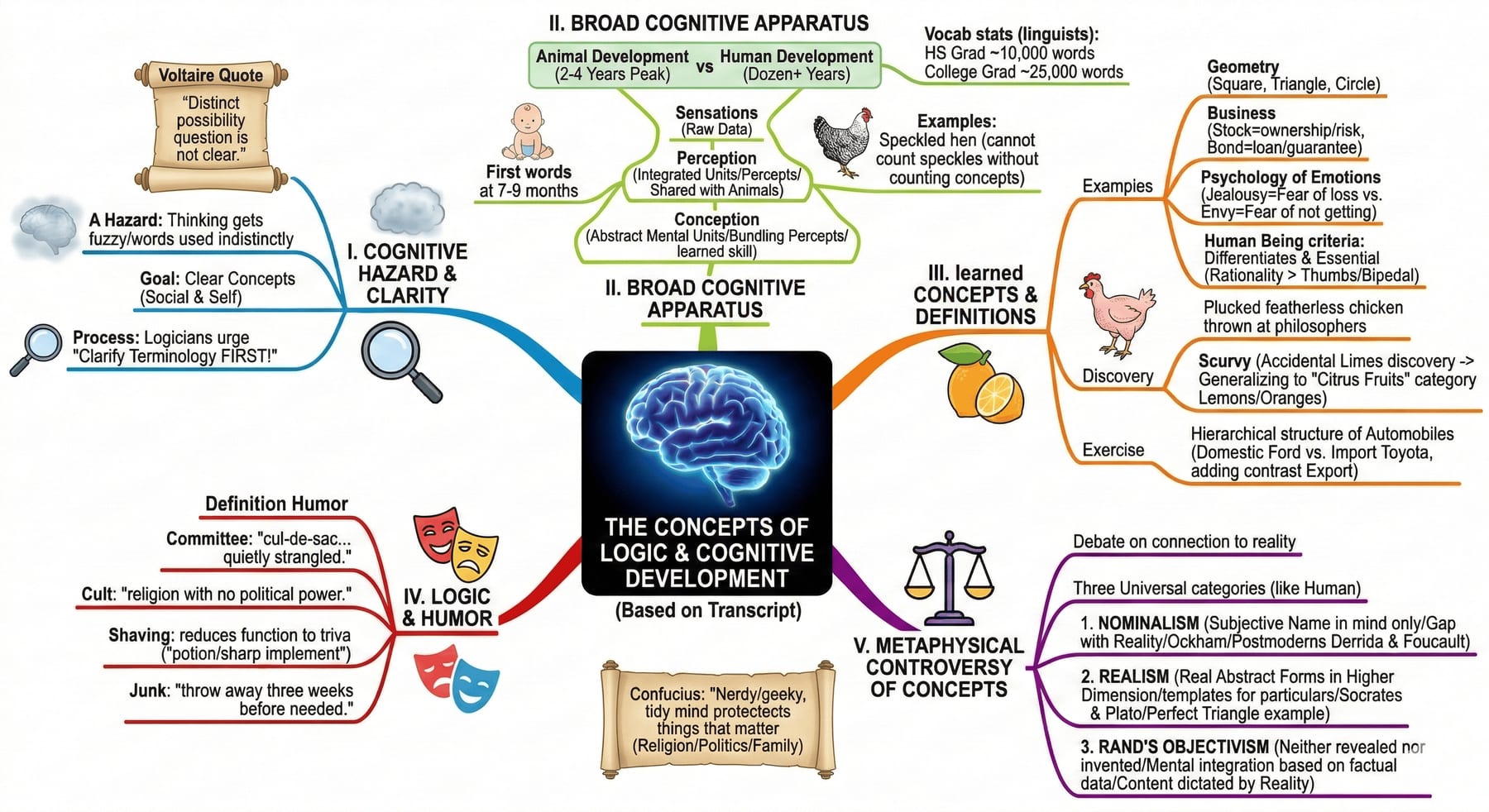
Central Purpose of the Lecture
- The lecture argues that logic depends on conceptual clarity, not just on valid argument forms.
- The speaker’s central concern is that many disputes continue not because people are reasoning badly at the level of inference alone, but because they are:
- using words loosely
- using the same word in different senses
- failing to define key concepts before arguing
- The lecture places logic within a broader theory of human cognition:
- sensation
- perception
- conception
- sentence formation
- narratives
- theories
- The key idea is that concepts are the building blocks of propositions, and if the concepts are fuzzy, the later reasoning built from them will also be fuzzy.
- The lecture also moves into a major philosophical controversy:
- what concepts are
- whether concepts connect us objectively to reality
- or whether they are partly or wholly subjective constructions
Main Themes and Arguments
1. Conceptual clarity is essential to logic
- The lecture opens with a quotation from Voltaire:
- when enlightened people argue for a long time, one possibility is that the question itself is unclear
- The point is that prolonged disputes often arise because:
- the issue is not sharply defined
- the concepts being used are vague
- the disputants are not using words univocally
- The speaker argues that one major task of logic is to make sure:
- we know what our terms mean in our own minds
- others know what we mean in social discussion
- our conceptual structures are stable enough to support sound reasoning
2. Logic belongs within a broader cognitive process
- The speaker broadens logic beyond formal argument analysis and places it in the wider context of human cognitive development.
- Logic is not presented as an isolated technical skill, but as something embedded in the way human beings:
- receive information
- organize it
- classify it
- build abstract concepts
- construct sentences, stories, and theories
Developmental Psychology and the Growth of Cognition
1. Human development is unusually long and sophisticated
- Human beings take much longer than most animals to reach cognitive maturity.
- The speaker contrasts humans with many animals:
- dogs
- dolphins
- other intelligent species
- These animals may reach adult functioning in:
- two years
- three years
- four years
- Humans, by contrast, take:
- more than a decade
- often well into the teenage years
- This long developmental arc is presented as evidence of the complexity and power of human cognition.
2. First stage: sensation
- A newborn begins with sensations:
- light
- sound
- touch
- taste
- smell
- The five senses immediately begin supplying raw data from the environment.
- At this stage, the child is not yet working with stable objects or concepts, but with sensory input.
3. Second stage: perception
- Very quickly, the child moves from sensation to perception.
- Perception is defined as the integration of sensations.
- Example:
- the child does not merely receive disconnected color patches and shapes
- the child comes to perceive the mother’s face as a stable unit
- The child can:
- recognize the mother
- track her face visually
- identify it as the same face even when it moves or disappears and reappears
- This is a major step:
- from sensory fragments
- to object-awareness
4. Third stage: conception
- The next stage is conception, which the speaker treats as especially important and more distinctively human.
- Concept formation occurs when the mind:
- takes many percepts
- integrates them into a higher-order abstract unit
- Words become signs of concepts.
- Example:
- the child learns “dog”
- the family dog, the neighbor’s dog, and a dog on the street are all recognized as belonging to the same category
- This shows that the child is no longer just responding to individual percepts, but to an abstract class.
5. Human conceptual vocabulary becomes enormous
- The speaker cites linguistic estimates:
- average North American high school graduate: roughly 10,000 words
- average college graduate: roughly 25,000 words
- The significance of this is that human conceptual life becomes:
- highly abstract
- highly differentiated
- increasingly sophisticated
Percepts vs Concepts
1. The speckled hen example
- The lecture uses the example of a speckled hen to show the difference between perception and conception.
- A person can perceive the hen and its speckles as a visual whole.
- But merely perceiving it does not mean one knows:
- how many speckles it has
- To know that, one must use conceptual and mathematical thought.
- One could count the speckles and conclude:
- 872 speckles
- The key point:
- perception gives the object
- conception and mathematics give abstract precision
2. Counting does not arise automatically
- The speaker emphasizes that counting and mathematical abstraction are learned, not automatic.
- He uses this to support the claim that conceptual sophistication is acquired through effort and cultural transmission.
Anthropological Example: Goats and Pebbles
1. Tribe without counting concepts
- The lecture describes anthropologists studying a remote tribe on an Indonesian island.
- The tribe had:
- agriculture
- goat enclosures
- practical systems of animal management
- They tracked goats by using pebbles:
- each goat exiting the enclosure corresponded to one pebble moved to another pile
- when goats returned, pebbles were matched back one by one
2. Significance of the example
- The tribe could track correspondence between:
- goat count
- pebble count
- But they apparently lacked explicit number concepts like:
- 1, 2, 3, 4, etc.
- So if goats were missing, they could know:
- “some goats are missing”
- But not:
- “eight goats are missing”
- The lesson:
- abstract number concepts are not the same as practical matching
- conceptual mathematics is a learned achievement
Crow Experiment and Limits of Animal Numerical Awareness
1. Sir John Lubbock and the crows
- The lecture gives an example associated with Sir John Lubbock in the 1880s.
- Setup:
- crows perched in an area near a cabin
- when humans approached, the crows flew up into the trees
- the humans tried to trick them by entering the cabin and having some, but not all, leave
2. Results
- With:
- one entering, one leaving: crows knew it was safe
- two entering, one leaving: crows stayed away
- three entering, two leaving: crows stayed away
- four entering, three leaving: crows came down too early
- Interpretation:
- the crows seemed able to distinguish up to about three
- beyond that, it became undifferentiated: “many”
- Main lesson:
- animal cognition has limits
- human beings go much farther because they develop abstract, open-ended conceptual systems
From Concepts to Sentences, Narratives, and Theories
1. Words are integrated into sentences
- Once children acquire concepts, they begin putting them together into sentences.
- Example:
- “My blanket is in my room.”
- This involves integration of multiple conceptual elements:
- blanket
- possession
- place
- relation between object and location
2. Sentences become narratives
- Children then move into stories and narratives.
- Storybooks teach them how sentences can be linked into:
- causal sequences
- meaningful events
- coherent wholes
3. Narratives become theories
- Eventually people move from stories to theories:
- structured networks of propositions explaining how the world works
- The speaker uses the weather cycle example:
- sun heats water
- water evaporates
- clouds form
- clouds cool and become heavy
- rain falls
- water returns to lakes, rivers, and oceans
- This is presented as a child’s early scientific theory:
- already abstract
- already systematic
- already composed of linked concepts and propositions
4. Main conclusion of this developmental section
- Logic operates across all these levels.
- But the lecture focuses especially on the conceptual level, because clear concepts are necessary before more advanced reasoning can occur.
Why Definitions Matter
1. Before arguing, define the terms
- The speaker insists that in serious reasoning, especially about important topics, we must ask first:
- what do you mean by the word?
- Examples:
- God
- socialist
- conservative
- The claim is that many arguments begin too late:
- people start arguing for or against a position
- without first clarifying what the central terms mean
2. Personal clarity and social clarity
- Definitions matter for two reasons:
- personal: I need to know what I mean
- social: others need to know what I mean
- Without this, reasoning becomes confused because identical words may conceal different concepts.
Definitional Models from Other Disciplines
1. Geometry
- The speaker uses geometry as a model of good definitional practice.
- Example concepts:
- square
- triangle
- circle
- The process:
- observe examples
- identify essential attributes
- draft definitions
- refine them before doing more advanced theorem-proving
- Main point:
- higher-level reasoning depends on careful preparatory definitions
2. Business and finance
- Another example is the distinction between:
- stock
- bond
- Both are investment vehicles, but they differ in essential ways:
- stock: ownership stake with risk
- bond: loan with a guaranteed return structure
- Again, the lesson is:
- before reasoning about a subject, define the core terms
3. Psychology: envy vs jealousy
This is one of the lecture’s most developed examples.
Jealousy
- Scenario:
- the speaker sees his wife hugging another man
- Emotional structure:
- fear of losing something one believes one already has
Envy
- Scenario:
- the speaker sees another man driving a luxurious car he wishes he had
- Emotional structure:
- distress over lacking something desirable that someone else possesses
Key distinction
- Jealousy:
- fear of losing what one has
- Envy:
- distress over not having what one wants
Why this matters
- The distinction is not trivial.
- In therapy, mislabeling one for the other could confuse diagnosis and treatment.
- This example illustrates the practical importance of accurate concepts.
Political and Social Concepts
1. Political labels require definition
- The speaker argues that people should define political terms before arguing over them.
- Terms mentioned:
- liberal
- conservative
- socialist
- libertarian
- fascist
- communist
- Democrat
- Republican
- Main point:
- these terms have long histories
- they are often used differently by different speakers
- careless use leads to confused political thought
2. Serious thinking requires conceptual discipline
- The lecture presents definitional work as a mark of intellectual seriousness.
- People should not simply throw labels around.
- They should clarify what their own usage is before entering political argument.
Defining “Human Being”
1. Why this example matters
- The speaker uses “human being” as a deep example of conceptual analysis.
- The task is not merely to list traits, but to identify:
- what differentiates humans from other beings
- what is essential rather than accidental
2. Candidate definitions considered
a. Opposable thumbs
- Humans may uniquely or nearly uniquely have opposable thumbs.
- Problem:
- if someone loses a thumb, do they cease to be human?
- this suggests thumbs are not essential enough
b. Bipedalism
- Another historical suggestion:
- humans are bipeds
- Problem:
- birds like chickens are also bipeds
- so this does not differentiate humans adequately
c. Featherless bipeds
- This is the famous joke:
- if humans are “featherless bipeds,” then a plucked chicken fits the definition
- Main lesson:
- bad definitions may capture accidents rather than essences
d. Soul / spirit
- Some define humans as animals possessing:
- a soul
- a spirit
- This raises deeper metaphysical questions about whether such things exist
e. Rationality
- The speaker presents rationality as a stronger candidate:
- language
- mathematics
- logic
- moral reflection
- science
- art
- Rationality seems more central and explanatory than bodily features like thumbs
3. Two criteria for definitions
The speaker says good definitions should satisfy at least two demands:
Differentiation
- The definition must distinguish the thing from other things.
Essentiality
- It must capture what is most important to the thing’s nature.
4. The role of thought experiments
- The speaker tests definitions by imagining loss of a trait:
- lose thumbs → still human
- lose rationality → something much deeper seems lost
- This helps identify what is essential and what is secondary.
Conceptual Structures and Scientific Discovery
1. Scurvy and limes
- The lecture gives a historical example from the British Navy.
- Sailors on long voyages developed scurvy:
- loose teeth
- physiological decline
- The cure was found:
- limes
- This is said to be part of why the British were nicknamed “Limeys.”
2. From observation to abstraction
- The crucial question becomes:
- why do limes cure scurvy?
- Once one identifies limes as the cure, one can abstract upward:
- what broader class do limes belong to?
- If limes and lemons share relevant features, perhaps lemons also cure scurvy.
- This leads to the category:
- citrus fruits
- Then from that category one can test:
- lemons
- oranges
- grapefruits
- Main lesson:
- proper conceptual classification leads to new discoveries
- abstraction helps us infer beyond the immediately observed case
Hierarchical Classification
1. Concepts fit into larger trees
- The speaker emphasizes that concepts often belong in hierarchical structures.
- Example chain:
- lime
- citrus fruit
- fruit
- plant
- living thing
- Likewise for animals:
- dog
- mammal
- animal
- living thing
2. Importance of hierarchy
- Hierarchical classification allows thinkers to:
- locate a thing quickly in a conceptual structure
- define it in relation to broader and narrower classes
- communicate more precisely
- reason more efficiently
3. Automobile classification exercise
The speaker works through a classification task with automobile terms such as:
- import
- Ford
- Expedition
- Chrysler
- Toyota
- Lexus
- Tesla
- Volkswagen
- BMW
- Accord
Key lessons from the exercise: - some terms denote:
- broad categories
- brands
- sub-brands
- specific models
- sometimes the thinker must add missing structural categories in brackets, such as:
- export
- domestic
- Honda
- This is an example of:
- conceptual reconstruction
- hierarchical placement
- disciplined addition of implied categories
4. Methodological caution
- When adding terms not explicitly given, the speaker recommends using brackets.
- This signals:
- “I am reconstructing”
- “I am adding structure for clarity”
- This protects against unfairly putting words into someone else’s mouth.
Humor and Definitions
1. Humor often depends on conceptual manipulation
- The speaker argues that good humorists often have sharp logical intelligence.
- Word humor often works by:
- setting up an expected definition
- twisting the essential features
- reducing something to absurdity
- exposing an unflattering truth
2. Examples analyzed
Committee
- “A cul-de-sac down which ideas are lured and then quietly strangled.”
- Why it works:
- committees are supposed to generate and evaluate ideas
- the joke reverses that function
- it captures the lived frustration of committee work
Cult
- “A religion with no political power.”
- Why it works:
- “cult” is usually a dismissive term
- the joke suggests the real distinction between cult and religion may be power rather than truth
- it has an anti-religious or skeptical edge
Shaving
- “A male ritual that consists in spreading a potion across one’s face and scraping it off with a sharp implement.”
- Why it works:
- it omits the practical purpose of shaving
- it redescribes the act to make it seem bizarre and pointless
Junk
- “Something you throw away three weeks before you need it.”
- Why it works:
- it draws on common experience
- it defines junk functionally, but in a way that highlights human misjudgment
3. Larger lesson
- Humor reveals:
- how definitions can be manipulated
- how selective emphasis changes meaning
- how conceptual framing shapes emotional response
Confucius and the Moral Importance of Correct Concepts
- The speaker ends the practical section by invoking Confucius.
- The message is that conceptual clarity matters especially where the stakes are highest:
- religion
- politics
- relationships
- family
- This suggests a connection to the Confucian theme often translated as the rectification of names:
- social and moral order depends on correct use of concepts and language
Philosophical Controversy: What Are Concepts?
This is the most theoretical part of the lecture.
1. The puzzle of universals
- We apply one abstract term, like human, to many individuals.
- But each person differs in:
- appearance
- shape
- size
- voice
- smell
- countless perceptible details
- So the philosophical problem is:
- what is the status of the universal term?
- what is “humanness”?
- is it real?
- invented?
- discovered?
- mentally constructed?
2. Three major positions
A. Nominalism — William of Ockham
- William of Ockham is presented as a major nominalist.
- His view:
- universals are not real features existing in things
- they exist only as thought-objects in the mind
- In this view:
- the world contains only individual particulars
- universals are names we impose
- Implication:
- concepts are to some degree subjective
- there is a gap between words and objective reality
- The speaker says this tends in a skeptical direction.
B. Realism — Plato
- Plato is presented as the opposite view.
- His view:
- universals are real
- but not in the physical particulars
- they exist as perfect forms
- Example:
- actual triangles in the world are imperfect
- but perfect triangularity exists in a higher realm
- Human cognition accesses these forms through some higher kind of insight or intuition.
- This is called realism because universals are taken as genuinely real.
C. Objectivist conceptualism — Ayn Rand
- Ayn Rand is introduced as rejecting both nominalism and Platonic realism.
- Her position:
- concepts are neither merely revealed from another realm nor arbitrarily invented
- they are formed by consciousness through a method of abstraction from reality
- the process is mental, but the content is constrained by facts
- Her goal is to preserve objectivity without positing Platonic forms.
3. Why this matters for logic
- Logic depends on concepts.
- If concepts are:
- arbitrary
- subjective
- disconnected from reality
then logic may be unstable at its base.
- If concepts are objective, logic can remain reality-oriented even at the abstract level.
- So the lecture argues that the philosophy of concepts is not peripheral:
- it is foundational to logic itself.
Postmodernism and Nominalism
1. Student question
- A student asks whether postmodernism fits into this discussion of concepts and reality.
2. Speaker’s answer
- The speaker places postmodernists such as:
- Derrida
- Foucault
in the line of nominalism.
- He claims postmodernists treat language and conceptual divisions as:
- subjective
- arbitrary
- shaped by power structures
- He characterizes them as:
- extreme nominalists
- extreme subjectivists
3. Significance
- This is the lecture’s bridge from medieval philosophical disputes to contemporary theory.
- The speaker suggests that postmodernism radicalizes the nominalist tendency by linking conceptual schemes to power rather than objective reality.
Key Historical Events and Historical References
Historical periods and contexts referenced
- 18th century Enlightenment through Voltaire
- Ancient Greek philosophy through Socrates and Plato
- Late medieval philosophy through William of Ockham
- 1880s scientific / observational inquiry through Sir John Lubbock and the crow example
- British imperial and naval expansion through the history of scurvy and lime use in the British Navy
- Contemporary philosophy through Ayn Rand
- Contemporary continental / postmodern thought through Derrida and Foucault
Historical developments discussed
- the rise of abstract thought in child development
- British naval discovery that limes cured scurvy
- conceptual and philosophical disputes over universals across ancient, medieval, and modern thought
Books, Sources, Thinkers, and Traditions Mentioned
Thinkers explicitly mentioned
- Voltaire
- Aristotle
- Sir John Lubbock
- Confucius
- William of Ockham
- Socrates
- Plato
- Ayn Rand
- Derrida
- Foucault
Works or source-types mentioned
- Rand’s work in epistemology is referenced, though not titled
- geometry and business textbooks are mentioned as examples of fields that define their terms carefully
- developmental psychology
- linguistics
- anthropology
- psychology
- history of medicine
- epistemology
- logic
Key Ideas by Section
A. Logic and concepts
- Logic requires clarity about the meanings of terms.
- Arguments can fail because the concepts inside them are unclear.
B. Cognitive development
- Human thought develops from:
- sensation
- perception
- conception
- language
- narrative
- theory
C. Concepts as learned abstractions
- Counting, categorization, and concept-use are not automatic.
- They are acquired through development and cultural learning.
D. Definition as a prerequisite of reasoning
- Before arguing about big issues, define the key terms.
- This applies especially to:
- God
- political labels
- psychological concepts
E. Essential vs accidental traits
- Good definitions must capture what is:
- distinctive
- essential
- Not just superficial or accidental features.
F. Concepts and discovery
- Proper categorization enables scientific discovery.
- The scurvy / citrus example shows how abstraction helps extend knowledge.
G. Hierarchies matter
- Concepts belong in broader classificatory structures.
- Knowing a thing’s position in a hierarchy aids reasoning and communication.
H. Humor as conceptual distortion
- Many jokes work by subtly redefining things.
- Humor often relies on logical precision and conceptual misdirection.
I. The metaphysics and epistemology of concepts
- The lecture ends by moving from practical logic into philosophy:
- are concepts real?
- subjective?
- objectively formed abstractions?
- This debate affects whether logic itself remains anchored to reality.
Suggested Related Topics for Further Exploration
Logic and language
- premise-level clarity vs concept-level clarity
- ambiguity, equivocation, and vagueness
- univocal, equivocal, and analogical language
Developmental psychology
- Piaget and stages of cognitive development
- concept acquisition in children
- language development and abstraction
Philosophy of universals
- realism
- nominalism
- conceptualism
- medieval debates about universals
Ancient and medieval philosophy
- Plato’s theory of forms
- Aristotle on categories and definitions
- Ockham and nominalism
Modern and contemporary thought
- Ayn Rand’s theory of concept formation
- postmodernism and language
- Foucault and power/knowledge
- Derrida and deconstruction
Philosophy of science
- classification and taxonomy in science
- the role of concepts in discovery
- analogy and generalization in scientific reasoning
Political language
- how terms like liberal, socialist, fascist, and conservative change over time
- conceptual inflation in political rhetoric
- definitional disputes in public debate
Psychology and therapy
- emotional classification
- envy vs jealousy
- why accurate conceptual distinctions matter in diagnosis and treatment
Humor and logic
- joke structure and conceptual subversion
- how humor depends on framing, omission, and definition
3. Logical Fallacies
Peterson Academy - Logic (Hicks) - Lecture 03.pdf (file not included in this release)
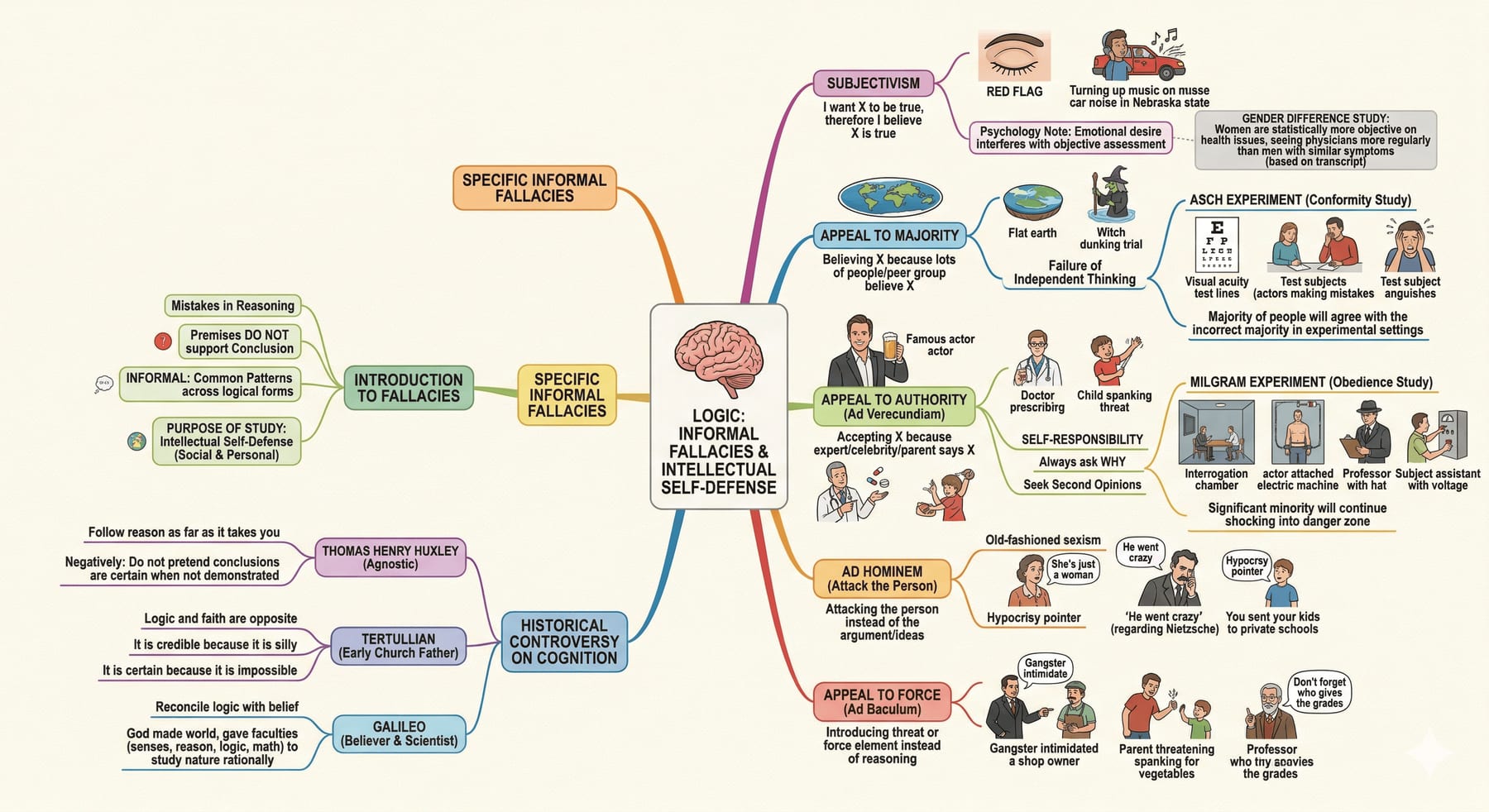
Central Aim of the Lecture
- The lecture shifts from good reasoning to bad reasoning.
- Its main purpose is to explain why studying informal fallacies is essential for:
- intellectual self-defense
- moral seriousness
- psychological self-awareness
- resistance to manipulation by others
- The speaker argues that human beings do not merely reason badly by accident:
- we are often pulled into bad reasoning by
- emotion
- conformity
- deference to authority
- fear
- laziness
- social pressure
- we are often pulled into bad reasoning by
- The lecture’s broader theme is that logic must defend itself not only against error, but against psychological and cultural forces that short-circuit evidence-based thinking.
Main Thesis
- Informal fallacies are common reasoning errors that:
- seem persuasive
- appear to give support to a conclusion
- but actually do not support the conclusion
- They are called informal because:
- they occur across many kinds of reasoning
- not just one formal logical structure
- they show up in:
- ordinary conversation
- politics
- religion
- family life
- education
- business
- legal and social contexts
- The lecture argues that learning these fallacies helps us:
- catch ourselves when we are being irrational
- avoid being manipulated by other people
- understand the psychological temptations behind bad reasoning
Why Informal Fallacies Matter
- The speaker emphasizes that studying fallacies is not negative for its own sake.
- It matters because:
- human beings are fallible
- complex issues are hard
- emotional issues distort judgment
- social life is full of manipulation and rhetorical pressure
- Fallacies are especially dangerous because they often work:
- even when they are logically weak
- because they connect to powerful psychological tendencies
- The speaker repeatedly presents logic as a form of self-defense:
- against self-deception
- against social pressure
- against indoctrination
- against abuse of power
Core Fallacies Covered
1. Subjectivism
Definition
- Subjectivism is the fallacy of treating one’s wants, feelings, or desires as if they determined truth.
- Crude form:
- I want X to be true
- therefore X is true
- It is called subjectivism because:
- the basis for belief is internal desire
- not evidence
- not reality
- not independent justification
Main idea
- The speaker presents this as a failure to keep the mind objectively connected to reality.
- Instead of asking:
- What does the evidence show?
- the person asks:
- What do I want to be true?
Examples given
Health avoidance
- A person has symptoms suggesting something may be wrong.
- They know they should see a doctor.
- But they do not want:
- inconvenience
- bad news
- confirmation that something is seriously wrong
- So they suppress the thought and act as though nothing is wrong.
Car trouble in Nebraska
- The speaker gives a personal example:
- driving an unreliable car as a poor graduate student
- hearing worrying engine sounds in the middle of Nebraska
- responding by turning up the music
- This is humorous, but the point is serious:
- refusal to hear evidence is a form of subjectivism
Romantic relationships
- People in early love often want the relationship to succeed.
- Because of that desire, they:
- ignore warning signs
- dismiss concerns from friends or family
- reinterpret red flags
- Later they say:
- “I should have known better.”
Religion and politics
- People become invested in:
- their faith
- their ideology
- their political candidate
- Once emotionally invested, they may refuse to examine problems or contradictions.
Business decision-making
- Entrepreneurs may become attached to their own idea.
- Because they want the business plan to work, they reject criticism and ignore warning signs.
- This can lead to financial loss.
Psychological dimension
- The speaker notes a possible sex difference:
- women seem more likely than men to seek medical help when symptoms arise
- men more often “shrug it off”
- He presents this as suggestive of psychological tendencies, though not as an absolute law.
- More broadly, subjectivism is tied to:
- ego
- fear
- denial
- emotional attachment
Main lesson
- Emotions are important, but they are not the faculty for determining truth.
- One must manage one’s inner dialogue so that desire does not overrule evidence.
2. Appeal to Majority
Definition
- Appeal to majority is the fallacy of believing something because many people believe it.
- Crude form:
- Many people believe X
- therefore X is true
Why it is fallacious
- Large numbers of believers do not provide truth by themselves.
- What matters is:
- the evidence
- the reasoning
- the justification
- The majority may be:
- uninformed
- conformist
- misled
- historically wrong
Main point
- This fallacy is a failure of independent judgment.
- Instead of asking whether something is true, the thinker simply follows the crowd.
Historical examples given
Flat earth beliefs
- The speaker uses the belief that the earth is flat as a stock example of mass error.
- Even if widely believed, that popularity is not evidence.
Witch trials
- He describes dunking tests used to determine whether a woman was a witch.
- If she survived, that supposedly proved witchcraft.
- If she died, she may have been innocent, but it was too late.
- This is presented as a destructive example of socially widespread irrationality.
Magnet adultery test
- In the early fascination with electricity and magnetism, people attributed magical powers to magnets.
- One claimed use:
- placing a magnet under the wife’s pillow to determine adultery
- The point is not merely that the belief was false, but that many people adopted it because others were doing so.
Psychological explanation
- The speaker asks why people so often commit this fallacy.
- Possible explanations:
- laziness
- fear of standing out
- peer pressure
- desire for social belonging
- discomfort with dissent
Solomon Asch experiments
This is the lecture’s main psychological illustration of the appeal to majority.
Setup
- A subject is placed with two others who appear to be fellow students.
- In reality, the other two are cooperating with psychologist Solomon Asch.
- The ostensible task is visual discrimination:
- are two lines the same length or different?
Procedure
- In obvious cases, the confederates answer correctly.
- In key test cases, they intentionally give the wrong answer.
- The real subject must then decide:
- say what he sees
- or conform to the group
Results
- In many cases, the subject goes along with the false majority.
- He publicly says something he knows to be false.
- Sometimes he does so with visible distress.
Important observations
- When the line difference becomes large enough, subjects eventually defect.
- But when they do, they often apologize for saying what is plainly true.
- That is psychologically revealing:
- people can feel guilty or socially anxious simply for disagreeing with the group
Larger significance
- Even in a culture like the United States, which celebrates independence, conformity remains powerful.
- Therefore, the appeal to majority is not just a logical error.
- It is rooted in deep social psychology.
Main lesson
- A person committed to logic must learn to:
- resist being a “lemming”
- speak truth as they see it
- not lie publicly for the sake of social ease
3. Appeal to Authority
Definition
- Appeal to authority is the fallacy of believing something because an authority or expert says it.
- Crude form:
- Some expert says X is true
- therefore X is true
Why it is fallacious
- The expert may be wrong.
- Experts often disagree.
- Merely citing the expert does not give the listener understanding.
- It is still a failure of independent thought if the hearer never asks why.
Common contexts
Celebrity authority
- A famous actor endorses a beer.
- A famous musician weighs in on foreign policy.
- Their status in one area is treated as if it transferred to another.
Social prestige
- An English professor says which books are the greatest.
- People adopt the list not because they understand the reasons, but because they want to appear cultured.
Parenting
- A parent says:
- believe me because I am the parent
- This is a small-scale version of authority replacing reasoning.
More difficult case: real expertise
The speaker makes an important distinction here.
- Real experts do possess specialized knowledge.
- Examples:
- doctors
- lawyers
- professionals
- It is understandable why people defer to them.
- But logic still requires more than passive acceptance.
What one should do instead
- Ask the expert:
- why do you think that?
- what evidence supports the diagnosis?
- what alternatives are there?
- why is this treatment preferable?
- what are the risks?
- what does the literature say?
- In important cases:
- get a second opinion
- compare expert perspectives
- remain intellectually engaged
Why people commit this fallacy
- Possible reasons:
- laziness
- intimidation
- politeness
- fear of questioning authority
- social deference
- wish to avoid the hard work of understanding
Stanley Milgram experiments
This is the key psychological illustration of appeal to authority.
Setup
- A participant is told he is assisting a professor.
- Another person, actually an actor, is wired up to an apparatus.
- The participant is instructed to administer electric shocks when the actor gives wrong answers.
- The participant believes the shocks are real.
Procedure
- The “authority” figure, representing Stanley Milgram’s experimental framework, instructs the participant to continue.
- Shock levels escalate, including into a red “danger” zone.
- The actor protests, cries out, and begs for the shocks to stop.
Results
- A significant minority continue to administer shocks under instruction from authority.
- They are not sadists.
- Under ordinary circumstances they would reject such conduct.
- But the authority structure changes their behavior.
Main lesson of Milgram
- Authority can seduce people into:
- suspending independent judgment
- obeying against conscience
- acting as instruments rather than thinkers
- So the appeal to authority is not only a logical mistake.
- It is also a profound psychological danger.
4. Ad Hominem
Definition
- Ad hominem means attacking the person instead of the argument.
- Crude form:
- X says Y is true
- but X is flawed / bad / biased / disliked / compromised
- therefore Y is false
Why it is fallacious
- A person’s flaw does not by itself disprove the claim being made.
- Even a flawed, hypocritical, eccentric, or immoral person can make a sound argument.
- The right target is:
- the reasons
- the evidence
- the logic
- not the personal characteristics of the speaker
Examples discussed
Sexism
- A woman presents an argument.
- Someone dismisses it with:
- “She’s just a woman.”
- This ignores the argument and attacks identity.
Social media identity dismissal
- People dismiss arguments because of:
- race
- religion
- political affiliation
- other group identity markers
- The person’s identity becomes a substitute for engaging the argument.
Business taxation example
- Business professionals argue that lower taxes would improve the economy.
- Response:
- business people just want money
- This may point to a motive, but motive alone does not refute the economic argument.
Nietzsche example
- Friedrich Nietzsche is dismissed because he went insane later in life.
- The speaker argues:
- later mental collapse does not automatically refute earlier arguments
- Nietzsche’s arguments must be addressed on their own terms
Hypocrisy arguments
- A politician supports public education now but sent his own children to private school years earlier.
- This may raise an important question about consistency.
- But it does not automatically refute present arguments for public education.
Overweight doctor example
- A physician advises a patient to lose weight.
- The patient notices the physician is overweight.
- This may reveal hypocrisy or inconsistency, but it does not invalidate the medical advice.
Psychological attraction of ad hominem
- Human beings are highly sensitive to:
- hypocrisy
- inconsistency
- status resentment
- personal flaws
- This makes ad hominem emotionally satisfying.
- It often works rhetorically because:
- it is easier to attack a person than answer a difficult argument
- it mobilizes group hostility
- it lets us avoid uncomfortable counterarguments
Main lesson
- Personal criticism may sometimes be relevant to credibility or context.
- But it is not a logical substitute for addressing the claim itself.
5. Appeal to Force
Definition
- Appeal to force, or ad baculum, is the fallacy of replacing reasons with threats.
- Crude form:
- X is true because I say so
- and if you do not agree, bad consequences will follow
Why it is fallacious
- Threats do not prove a proposition.
- Force may change behavior, but it does not supply evidence.
- This is argument replaced by coercion.
Examples given
Organized crime
- A shop owner is told:
- pay us and nothing bad will happen to your business
- The threat manufactures compliance through fear.
Parenting
- A child asks:
- why should I eat vegetables?
- Parent replies:
- because you’ll get a spanking if you don’t
- This is expedient, but it bypasses reasoning.
Professorial intimidation
- A professor subtly signals:
- if students express the wrong political or intellectual view, their grades may suffer
- Students learn:
- do not think for yourself
- tell the authority what it wants to hear
Religion
- Children who question doctrine may be told:
- ask that and you’ll go to hell
- The speaker presents this as a threat used to suppress inquiry.
Family politics
- A father makes clear that in “this house” political dissent is unwelcome.
- Authority and fear suppress independent thought.
Why it is tempting
- Rational persuasion is hard:
- you must present evidence
- answer objections
- tolerate slow processing
- engage honestly
- Threats are easy:
- they produce short-term compliance
- So appeal to force is attractive to anyone who values control over truth.
Psychological and moral consequences
- On the receiving end, people may internalize:
- “I should not think for myself”
- “I should not ask hard questions”
- “I should simply say what keeps me safe”
- Over time this damages:
- character
- intellectual independence
- integrity
Main lesson
- Coercion can produce agreement in appearance, not truth in substance.
Common Structure Behind All These Fallacies
- The speaker emphasizes that all the fallacies discussed share a deep common feature:
- they break the link between evidence and belief
- Instead of believing according to reasons, people believe according to:
- desire
- crowd pressure
- authority
- personal attack
- force
- That means these are not random mistakes.
- They are all ways of short-circuiting the rational process.
Psychology and Logic
1. Logic alone is not the full story
- The lecture repeatedly insists that informal fallacies have psychological power.
- They are not merely abstract errors in structure.
- They are attractive because they mesh with human tendencies:
- fear
- belonging
- obedience
- resentment
- laziness
- emotional investment
2. Importance of self-monitoring
- The logician must not only identify fallacies in others.
- He must also monitor them in himself.
- This includes:
- not suppressing unpleasant evidence
- not following crowds blindly
- not surrendering to authority
- not dismissing arguments by attacking persons
- not using fear to dominate discussion
Historical Controversy Over Logic Itself
The lecture ends by broadening from particular fallacies to a larger cultural and philosophical conflict.
1. Huxley’s rationalist position
The speaker quotes Thomas Henry Huxley:
- In matters of intellect:
- follow reason as far as it goes
- without regard to other considerations
- Negatively:
- do not pretend certainty where certainty has not been demonstrated
Main ideas in Huxley’s position
- Be ruthlessly honest about the degree of support your beliefs have.
- Do not claim certainty prematurely.
- If the evidence is incomplete:
- admit that it is incomplete
- If your beliefs contain contradiction:
- acknowledge the contradiction
- suspend certainty until it is resolved
- This position represents a strong commitment to:
- evidence
- intellectual honesty
- rational integrity
2. Tertullian’s anti-rational tendency
The speaker then contrasts Huxley with Tertullian, one of the early Church Fathers.
Historical setting
- Late Roman Empire
- Christianity rising
- tension between:
- Greco-Roman philosophy
- early Christian doctrine
Main issue
- Christian doctrines often seemed paradoxical or contradictory:
- virgin birth
- incarnation
- death of God / Son of God
- resurrection
- Trinity and monotheism together
Tertullian’s strategy
- Instead of resolving tensions through reason, the speaker presents Tertullian as attacking the demand for rational consistency itself.
- Famous formulations quoted:
- “It is immediately credible because it is silly.”
- “It is certain because it is impossible.”
Interpretation
- The lecture presents Tertullian as saying:
- faith and logic are opposed
- religious belief may require setting logic aside
- This becomes the strongest historical statement of:
- believing despite absurdity
- or because of perceived absurdity
Role in the lecture
- Tertullian is used as the clearest antagonist to the logical ideal.
- He represents the view that:
- rational standards are not the proper standards for faith
3. Galileo’s reconciliationist position
The lecture then introduces Galileo as a third position.
Galileo’s view as presented
- God made the world.
- God also gave humans:
- senses
- reason
- logic
- mathematics
- Therefore:
- God intends us to use those faculties to understand creation
- rational inquiry and religious belief should ultimately be compatible
Main significance
- This yields a three-way contrast:
Huxley
- if you are rigorous in logic, you may end up non-believing
Tertullian
- if you want faith, you must be willing to abandon logic
Galileo
- reason and belief should be reconcilable
Why this matters
- The lecture ends by showing that commitment to logic is historically controversial.
- Many intellectual and religious traditions have had to decide:
- whether logic is supreme
- limited
- subordinate to faith
- or harmonizable with faith
Historical Figures and Historical Context Mentioned
Figures mentioned
- Solomon Asch
- Stanley Milgram
- Thomas Henry Huxley
- Tertullian
- Galileo
- Friedrich Nietzsche
- Herman Melville and James Joyce are referenced in the Milgram-style question examples, though not as central historical subjects
Historical contexts mentioned
- late 19th century rationalism through Huxley
- early Christianity and late Roman imperial decline through Tertullian
- scientific and religious tension through Galileo
- witch trials / premodern superstition
- 18th-century magnetism and superstition
- 20th-century psychology experiments on conformity and obedience
Books, Works, and Sources Mentioned
Thinkers and works referenced
- Thomas Henry Huxley — quoted on reason and certainty
- Tertullian — quoted on faith and impossibility
- Galileo — discussed as reconciling faith and reason
- Friedrich Nietzsche — discussed as an example in ad hominem reasoning
Literary works mentioned in examples
- Moby-Dick
- The House of the Seven Gables
Fields and sources referenced generally
- logic textbooks
- psychology experiments
- religious doctrine
- political discussion
- educational practice
- history of science and belief
Key Takeaways
About reasoning
- Bad reasoning often feels persuasive because it fits our psychology.
- Informal fallacies are dangerous precisely because they are emotionally or socially effective.
About character
- Good reasoning requires courage.
- One must be willing to:
- face unpleasant evidence
- stand apart from the crowd
- question authorities
- separate argument from personality
- resist coercion
About education
- Education should train independent judgment, not compliance.
- Threat-based or authority-based teaching damages the mind.
About belief
- Beliefs should track evidence as closely as possible.
- Certainty should never outrun justification.
About culture and history
- The authority of logic has always been contested.
- The deepest conflicts often emerge when logic confronts:
- faith
- power
- conformity
- emotion
Suggested Related Topics for Further Exploration
Informal logic and rhetoric
- other informal fallacies beyond those covered here
- straw man
- false dilemma
- slippery slope
- begging the question
- red herring
Psychology of irrationality
- conformity and groupthink
- obedience to authority
- motivated reasoning
- cognitive dissonance
- self-deception
- identity-protective cognition
History of ideas
- Huxley and Victorian agnosticism
- Tertullian and early Christian apologetics
- Galileo and faith-reason debates
- Nietzsche and critiques of religion
Political and social applications
- propaganda and mass persuasion
- cult dynamics
- indoctrination in education
- social media pile-ons and ad hominem culture
- political conformity and fear-based messaging
Ethics and intellectual character
- courage in truth-telling
- intellectual honesty
- humility and uncertainty
- second opinions in medicine and law
- authority, autonomy, and responsibility
Philosophy of religion
- faith vs reason
- paradox and contradiction in theology
- classical apologetics
- rational theology vs fideism
4. Fallacies & Cognitive Biases
Peterson Academy - Logic (Hicks) - Lecture 04.pdf (file not included in this release)
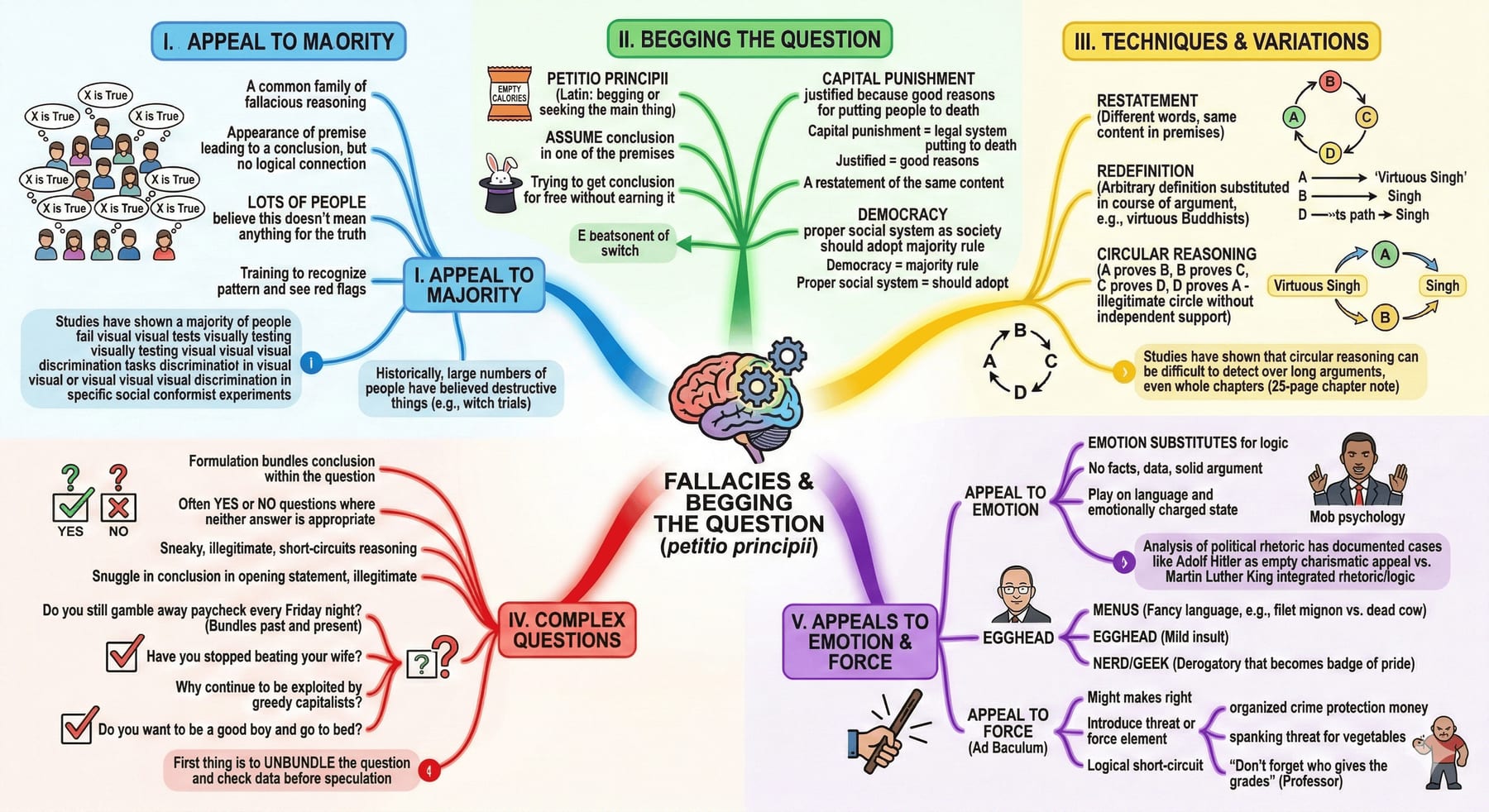
Central Aim of the Lecture
- This lecture continues the study of informal fallacies by focusing on errors that look like reasoning but do not actually provide logical support for their conclusions.
- The speaker’s core claim is that these fallacies often work not because they are rationally persuasive, but because they:
- manipulate expectations
- exploit ambiguity
- smuggle conclusions into premises
- pressure people psychologically
- shift burdens unfairly
- The lecture especially emphasizes:
- begging the question
- equivocation
- amphiboly
- appeal to emotion
- false alternatives
- appeal to ignorance
- the related burden of proof principle
- A major theme is that logic requires us to ask, over and over:
- Does this premise actually add new support?
- Is the language clear?
- Has the speaker hidden assumptions in the wording?
- Has the burden of proof been shifted unfairly?
- Are we being moved by evidence or by rhetoric?
Main Themes and Ideas
1. Fallacies often operate by psychological manipulation
- The speaker begins by reminding us that fallacious arguments frequently give the appearance of premise-to-conclusion reasoning.
- But what is really happening is often:
- emotional prompting
- linguistic trickery
- social manipulation
- unearned assumptions
- Earlier fallacies such as:
- appeal to majority
- appeal to authority
- subjectivism
- ad hominem
were all cases where the real work was not being done by evidence.
- This lecture continues that same pattern:
- many bad arguments succeed because people do not slow down and inspect their structure.
I. Begging the Question
Core definition
- Begging the question means that the conclusion is being assumed in the premises instead of actually being proved.
- The conclusion is not earned through reasoning.
- It is “begged,” meaning:
- slipped in
- presupposed
- smuggled into the premises
- then handed back as though it had been established
- The lecture connects this to the Latin phrase petitio principii.
Main structure
- Simplest abstract form:
- X is true
- therefore X is true
- But the speaker stresses that it is rarely this obvious.
- Usually the same content is disguised by:
- synonyms
- rephrasing
- definitional shifts
- circular structures
- loaded wording
- complex questions
A. Begging the question by restatement
Key idea
- Sometimes the premise and conclusion are simply the same claim stated in different language.
- This gives an illusion of argument, but no real inference occurs.
Example 1: Capital punishment
- “Capital punishment is justified because there are good reasons for putting people to death.”
Analysis
- “Capital punishment” = legally putting people to death
- “Justified” = supported by good reasons
- So the premise and conclusion are effectively saying the same thing:
- putting people to death is justified because there are good reasons for putting people to death
- No new information has been added.
Example 2: Democracy
- “Democracy is the proper social system as society should adopt majority rule.”
Analysis
- “Democracy” = majority rule
- “Proper social system” = what society should adopt
- Again, the argument only restates itself in different words.
- The conclusion is built into the premise.
Main lesson
- A genuine argument must contain premises that add new supporting information.
- Merely restating the conclusion with synonyms is empty.
B. Begging the question by arbitrary redefinition
Key idea
- Another strategy is to redefine a term in a way that guarantees the desired conclusion.
- Instead of arguing about the issue fairly, the speaker changes the meaning of a key word.
Example: Buddhists and virtue
- Claim: “All Buddhists are virtuous.”
- Objection: “But Singh is a Buddhist and behaves unvirtuously.”
- Response: “Then Singh is not really a Buddhist, because he is not virtuous.”
Analysis
- The ordinary meaning of “Buddhist” would include:
- self-identification
- ritual practice
- scripture
- community membership
- But the arguer has substituted a new definition:
- “Buddhist” now means “virtuous Buddhist”
- So any counterexample is ruled out by definition.
- That avoids the real issue rather than answering it.
Main lesson
- Definitions can be manipulated to protect a thesis from criticism.
- When that happens, the argument is not proving anything; it is insulating itself from refutation.
C. Begging the question through circular reasoning
Key idea
- Circular reasoning is a more extended form of begging the question.
- Instead of directly repeating the conclusion, the argument moves through a chain:
- A proves B
- B proves C
- C proves D
- D proves A
- The argument seems to advance, but it ends up where it began.
Why it is difficult
- In real life, especially in:
- academic writing
- long essays
- books
- ideological systems
this circle may stretch across many pages.
- That makes it harder to detect.
- The thinker must keep track of the larger argumentative map.
Example: Bank loan and friend vouching
- A person wants a loan without collateral.
- He says he is trustworthy.
- The bank officer says he does not know that.
- The borrower brings a friend to vouch for him.
- The bank officer says he does not know the friend.
- The borrower then says he can vouch for the friend.
Analysis
- Friend supports borrower
- Borrower supports friend
- There is no independent evidence outside the circle
- The mutual endorsement does not establish either person’s credibility
Main lesson
- Circular reasoning can feel satisfying because it seems to create a web of support.
- But if all support stays internal to the same set of assumptions, nothing has really been proved.
D. Question-begging epithet
Key idea
- A question-begging epithet is a loaded descriptive term that assumes what still needs to be proved.
Example: Prosecutor calling a defendant a “vicious killer”
- In an opening statement, the prosecutor says:
- “I will now prove that this vicious killer is guilty.”
- But whether the person is:
- a killer
- vicious
is exactly what still must be proved.
Example: “Monstrous policy”
- A politician calls a policy “monstrous” before arguing for that judgment.
Main lesson
- Loaded labels can smuggle conclusions into the argument before evidence has been presented.
- The emotional or evaluative word is doing work it has not earned.
E. Begging the question through complex questions
Key idea
- A complex question bundles multiple assumptions into a single yes/no format.
- The person answering is trapped because either answer seems to concede something.
Example 1: Gambling away paycheck
- “Do you still gamble away your paycheck every Friday night?”
Hidden assumptions
- You used to do this
- You may still do it now
Problem
- “Yes” admits present and past guilt
- “No” denies the present but seems to admit the past
Example 2: Stop beating your wife
- The classic example
- It assumes the person has beaten his wife before
Example 3: “Why should we continue to be exploited by greedy capitalists?”
Hidden assumptions
- We are being exploited
- Capitalists are greedy
- This exploitation is ongoing
Example 4: Parenting
- “Do you want to be a good boy and go to bed?”
Hidden assumptions
- Good boys go to bed when told
- Refusing bedtime means being a bad boy
Example 5: Politics and religion
- “Do you want to be a progressive socialist person?”
- “Don’t you admire these upstanding religious people?”
Hidden assumptions
- socialism is inherently progressive
- this religion is inherently morally upright
Historical example: King Charles and the fish
- King Charles asks why:
- a live fish in a full bowl does not cause overflow
- but a dead fish in the same bowl does
- Court intellectuals try to explain it.
- But the trap is that the premise itself is false or unverified.
- They should have checked the empirical setup before theorizing.
Main lesson
- Before answering a question, one may need to:
- unbundle it
- separate its assumptions
- test whether its built-in claims are true
- This is especially important in debate, politics, family pressure, and intellectual life.
II. Equivocation and Amphiboly
General idea
- These are fallacies of ambiguity.
- The argument fails because the language is unclear and shifts meaning.
Distinction
Equivocation
- A word or phrase has more than one meaning
- The argument begins with one meaning and slips into another
Amphiboly
- The grammatical structure of a sentence is ambiguous
- Word order, punctuation, or phrasing allows multiple interpretations
A. Equivocation
Key idea
- Equivocation occurs when a term changes meaning during the argument.
- Since the meaning shifts, the conclusion no longer follows from the premises.
Example 1: “Your argument is sound, nothing but sound.”
Analysis
- “Sound” first means:
- logically strong
- Then “sound” shifts to:
- mere noise
- The sentence begins like praise and ends as insult
Example 2: Voting as a right
- “Voting is a right. The government should enforce rights. Thus, the state should enforce voting.”
Analysis
- “Right” can mean:
- a protected liberty or entitlement
- “Enforce” can mean:
- protect your freedom to act
- compel you to act
- In one sense, the state protects the right to vote
- In another sense, the state forces people to vote
- Those are different meanings, but the argument slides between them
Example 3: Selling drugs to children
- “People who sell drugs to children are the scum of the earth.”
- Then:
- pharmacists sell drugs to children
- Therefore:
- pharmacists are scum of the earth
Analysis
- “Sell drugs to children” initially evokes:
- criminal dealers harming children
- But then the phrase is extended to:
- lawful pharmacists dispensing medicine
- The phrase shifts meaning between illicit and legitimate contexts
Humor examples using equivocation
George Burns
- “If you live to be 100, you have it made, because very few people die past the age of 100.”
Psychiatrist joke
- “One out of four people has a mental illness. Check three friends. If they’re OK, it’s you.”
Farmer sign
- “The farmer allows walkers to cross the field for free, but the bull charges.”
Marriage joke
- “The shortest sentence in English is ‘I am.’ Could it be that ‘I do’ is the longest sentence?”
Tequila joke
- “Take life with a grain of salt… plus a slice of lemon and a shot of tequila.”
Main lesson
- Equivocation is often funny in comedy because the audience detects the shift.
- In serious argument, the same shift can mislead or confuse.
B. Amphiboly
Key idea
- Amphiboly is ambiguity created by grammar, not merely by a single word.
Example 1: “All that glitters is not gold.”
Two possible readings
- Not everything glittering is gold
- Everything glittering is not gold
Example 2: “All married couples do not sleep together.”
Two readings
- No married couples sleep together
- Not all married couples sleep together
Example 3: “Woman without her man is lost.”
Depending on punctuation
- “Woman, without her man, is lost.”
- “Woman: without her, man is lost.”
Example 4: Recommendation letters
- “I cannot recommend this person too highly.”
- “Nobody would be better for the job.”
Problem
- These can be read as strong praise or subtle insult
Example 5: Cookbook instruction
- “Serve the meat when thoroughly stewed.”
Ambiguity
- Is the meat stewed?
- Or is the cook drunk?
Example 6: Logic-book review
- “The author warns against a number of logical fallacies in his book.”
Ambiguity
- Does the author warn readers about fallacies?
- Or warn readers that his own book contains them?
Example 7: Graf Zeppelin newspaper report
- Description:
- after mentioning Mrs. Smith and the Zeppelin
- the report says “her huge nose was turned into the wind” and “she crawled along the grass”
Problem
- Pronouns and sentence flow make it sound like Mrs. Smith has the huge nose and crawls like a beast
- The intended referent was the Zeppelin
Example 8: Want ad
- “Selling an antique desk suitable for lady with curved legs and large drawers.”
Problem
- Grammatically unclear whether:
- the desk has curved legs and drawers
- or the lady does
Main lesson
- Grammar matters to logic.
- Poorly structured sentences can produce false or absurd interpretations.
- Clear thinking requires clear writing.
III. Appeal to Emotion
Core definition
- Appeal to emotion is fallacious when emotion substitutes for argument.
- Emotion itself is not bad.
- Passion is legitimate when it rides on top of:
- evidence
- logic
- substance
- The fallacy occurs when emotional language is doing all the work.
Main point
- Some speech is persuasive because it gives reasons.
- Some speech is persuasive because it:
- triggers fear
- rage
- disgust
- enthusiasm
- tribal belonging
- The lecture warns that one must distinguish those.
A. Political rhetoric and mob psychology
- Mass rallies are especially fertile settings for this fallacy.
- Audiences arrive already:
- energized
- angry
- hopeful
- agitated
- A demagogue can intensify those feelings without presenting much substance.
Important contrast made by the speaker
- Martin Luther King Jr.
- presented as an example of emotional power integrated with logical substance
- Adolf Hitler
- presented as an example of emotional power often overriding thin or empty content
Main lesson
- Emotional intensity alone does not tell us whether speech is rational or empty.
- One must inspect the content beneath the rhetoric.
B. Everyday examples of emotive framing
Menu language
- “Filet mignon” sounds elegant and desirable
- “Chunk of dead cow” is literally closer to the physical reality
- The point is not that menus are dishonest, but that wording shapes emotional response
Labels for people
- “Intellectual” vs “egghead”
- “Nerd” or “geek” as insult vs badge of pride
Political language
- “Reverse discrimination” vs “affirmative action”
- “Terrorist” vs “freedom fighter”
- “Marxists” vs “commies”
Main insight
- Competing terms often carry different emotional coloring even when pointing at similar or overlapping realities
- The emotional charge can steer judgment before argument even begins
C. Climate-change example
- The speaker offers a stylized social-media post attacking oil companies:
- “diabolical conspiracy”
- “profit-mad vultures”
- “slimy tentacles”
- “squeeze our children’s future dead”
Analysis
- The language is intense and morally vivid
- But the question becomes:
- what actual argument has been made?
- what evidence has been supplied?
- Once translated into neutral language, much of the post may lose its apparent force
Main lesson
- Strong wording can create the illusion of content
- We must ask whether the emotion rests on argument, or replaces it
D. Legitimate role of emotion and poetry
- The speaker is careful not to condemn emotional language altogether
- Poetry, rhetoric, and passion can be valid if grounded in substance
Example
- “Ode to a Grecian Urn” vs “Poem for a Greek Pot”
Analysis
- The first is more elevated, more evocative, more emotionally charged
- But it is not fallacious because the purpose of poetry is partly aesthetic and expressive
Main lesson
- Emotion is not the enemy
- Emotional language becomes a problem only when it pretends to be argument without providing reasons
IV. False Alternative
Core definition
- A false alternative presents a situation as though there are only two choices when, in reality, there are more.
Main point
- This fallacy pressures people into an artificial either-or.
- It simplifies reality in a way that benefits the speaker’s preferred conclusion.
Examples
Example 1: Steve Martin joke
- Girlfriend wants to leave a party because she is too drunk
- Steve Martin says he was having too much fun to leave
- Audience expects normal options:
- take her home
- call a cab
- find help
- Punchline:
- “So I shot her.”
Analysis
- The humor comes from introducing a wildly illegitimate “option”
- It exposes the absurdity of false-choice thinking
Example 2: Parenting
- “Do you want to be a good boy and go to bed?”
Hidden false alternative
- either:
- go to bed
- or be a bad boy
Example 3: Politics / religion
- “You’re either with us or against us.”
Problem
- There may be many other positions:
- undecided
- indifferent
- partly agreeing
- disagreeing with the framing
- needing more evidence
Main lesson
- False alternatives shrink the field of thought
- They are powerful because they force quick commitment and suppress nuance
V. Appeal to Ignorance
Core definition
- Appeal to ignorance argues:
- because something has not been disproved, it must be true
- or because something cannot be proved false, it should be accepted
- This is illegitimate because lack of disproof is not proof.
A. Cheating accusation example
- Professor tears up a student’s test and says:
- “You cheated. Prove that you didn’t.”
Analysis
- If the student did cheat, there might be evidence:
- looking at another paper
- hidden notes
- earpiece
- video recording
- But if the student did not cheat, there is no positive “evidence of non-cheating” of the same sort
- The burden belongs to the accuser
Main lesson
- One cannot fairly demand proof of a non-event in the same way one can demand evidence of an event
B. Girls’ dorm example
- A girl is accused of having a boy in her room after curfew
- House mother demands:
- “Prove that you didn’t”
Analysis
- If there had been a boy, there might be evidence
- But the absence of a boy does not leave the same kind of trace
- Again, the accuser must supply evidence
C. Detective example and endless burden shifting
- Detective says:
- prove you didn’t commit the crime
- Person provides an alibi:
- passport stamp from Switzerland
- Detective says:
- prove the passport is not forged
- Then:
- prove you are not lying
- prove you didn’t plan the forgery
- This can continue forever
Main lesson
- Once someone is forced to prove negatives in an open-ended way, the game is rigged
- This is why burden-of-proof principles matter
VI. Existence Claims vs Nonexistence Claims
Core distinction
- The lecture draws a major distinction between:
- existence claims
- nonexistence claims
Existence claims
- If something exists or happened, it leaves:
- evidence
- traces
- effects
- causal interactions
Nonexistence claims
- If something does not exist, it does not leave traces in the same way
- A non-existing thing does not interact with reality
Main implication
- It is generally easier and more rational to demand evidence for:
- what is claimed to exist
than for: - what is claimed not to exist
- what is claimed to exist
Main lesson
- This asymmetry is what underlies the burden of proof principle
VII. Burden of Proof Principle
Core definition
- The person making the claim bears the initial burden of justifying it.
- One may not simply announce a thesis and demand that others disprove it.
Main uses
- logic
- law
- public argument
- religion
- politics
- everyday accusations
A. Roman jurisprudence
- The speaker traces this principle back to Roman jurisprudence
- Principle:
- the necessity of proof lies with the person who lays charges
Legal implications
- In civil law:
- plaintiff must present evidence
- In criminal law:
- prosecution bears the burden
- Police need:
- probable cause
- The defense is not required to prove innocence from scratch if the prosecution fails to establish guilt
B. Presumption of innocence
Core idea
- In civil society, the individual is presumed innocent
- State power must justify interference
In court
- Even after arrest, the accused remains innocent in the eyes of the court until proven guilty
Logical basis
- If guilt exists as a real action, there should be evidence for it
- Innocence is not a positive event of the same sort
C. Alternative legal philosophy: presumption of guilt
- The speaker notes that not all legal systems historically or globally have followed presumption of innocence
- Some have presumed guilt instead
Philosophical basis
- This often rests on a darker view of human nature:
- humans are born bad
- wickedness is normal
- innocence is rare
- If that is your anthropology, you are more likely to:
- lower standards for accusation
- burden the accused with proving innocence
D. Trial by ordeal
Example
- Suspect holds a red-hot iron bar
- If unharmed, God has protected the innocent
- If burned, guilt is confirmed
Analysis
- This procedure combines:
- presumption of guilt
- religious metaphysics
- reversal of burden of proof
- It assumes innocence must be demonstrated through ordeal
Main lesson
- Legal procedure depends not only on logic, but on:
- metaphysics
- theology
- views of human nature
VIII. Burden of Proof in Religion
Core point
- The lecture applies the burden-of-proof principle to religious belief, especially the existence of God.
Logical structure
- “God exists” is an existence claim
- Therefore, the person making that claim bears the burden of presenting:
- evidence
- argument
- reasons
Illegitimate move
- “Prove that God does not exist”
- If the other person cannot, the believer treats that failure as confirming God’s existence
Why this is fallacious
- It shifts the burden improperly
- It turns lack of disproof into proof
- That is an appeal to ignorance
Main lesson
- On high-stakes questions, the temptation to shift burdens becomes stronger
- That is exactly why logical discipline matters more, not less
Historical and Legal Themes in the Lecture
Historical references
- Roman jurisprudence
- trial by ordeal in older Western legal practice
- King Charles and the fish-in-bowl anecdote
- development of principles like:
- probable cause
- burden of proof
- presumption of innocence
Legal ideas discussed
- plaintiff and prosecution burdens
- defense asymmetry
- probable cause
- courtroom standards
- legal implications of views of human nature
Key Terms and Fallacies Covered
- Begging the question
- petitio principii
- restatement
- arbitrary redefinition
- circular reasoning
- question-begging epithet
- complex question
- equivocation
- amphiboly
- appeal to emotion
- false alternative
- appeal to ignorance
- burden of proof
- onus of proof
- presumption of innocence
- existence claim
- nonexistence claim
Books, Articles, or Sources Mentioned
The lecture does not cite formal books or articles in a bibliographic way, but it explicitly mentions or draws on the following sources, traditions, or figures:
Historical / legal / intellectual sources
- Roman jurisprudence
- historical Western legal practice
- King Charles anecdote about scientific court intellectuals
- trial-by-ordeal traditions
- courtroom procedure and criminal law standards
Literary / cultural references
- George Burns
- Steve Martin
- George Burns joke about living past 100
- Steve Martin joke used to illustrate false alternatives
Poetic reference
- “Ode to a Grecian Urn”
- referenced as a famous Romantic poem
News / media / social examples
- old newspaper story about the Graf Zeppelin
- social media climate-rhetoric example
- cookbook and want-ad examples
- recommendation-letter examples
Main Takeaways
About reasoning
- A good argument must add support, not just restate or smuggle in its conclusion.
- Ambiguous language is dangerous because it lets people shift meanings unnoticed.
- Emotional intensity does not equal argumentative strength.
- Being unable to disprove something is not the same as having evidence for it.
About language
- Logic requires:
- careful definitions
- clear syntax
- unambiguous terms
- resistance to loaded labels and manipulative phrasing
About law and justice
- Burden of proof is not a minor rule but a deep civilizational achievement
- Presumption of innocence rests on:
- logical asymmetry
- and a moral-philosophical view of persons
About philosophy and culture
- Views of human nature shape legal systems
- Religious and ideological debate often becomes confused when burden-of-proof rules are ignored
Suggested Related Topics for Further Exploration
Informal fallacies
- straw man
- red herring
- slippery slope
- false cause
- hasty generalization
- composition and division
- special pleading
Legal reasoning
- presumption of innocence in comparative law
- standards of proof:
- probable cause
- preponderance of evidence
- beyond a reasonable doubt
- inquisitorial vs adversarial legal systems
Philosophy of language
- ambiguity
- vagueness
- reference and meaning
- semantic shift in political language
- rhetoric vs logic
Logic and debate
- how to identify hidden premises
- how to reconstruct arguments in standard form
- how to detect circularity in long texts
History of law and punishment
- Roman law
- medieval ordeals
- development of due process
- theological influences on criminal procedure
Religion and epistemology
- burden of proof in philosophy of religion
- arguments for God’s existence
- atheism, agnosticism, and evidential standards
Political rhetoric
- loaded terms in public discourse
- emotional framing in propaganda
- slogan-thinking and false dichotomies
5. Deduction: Categorical Syllogisms
Peterson Academy - Logic (Hicks) - Lecture 05.pdf (file not included in this release)
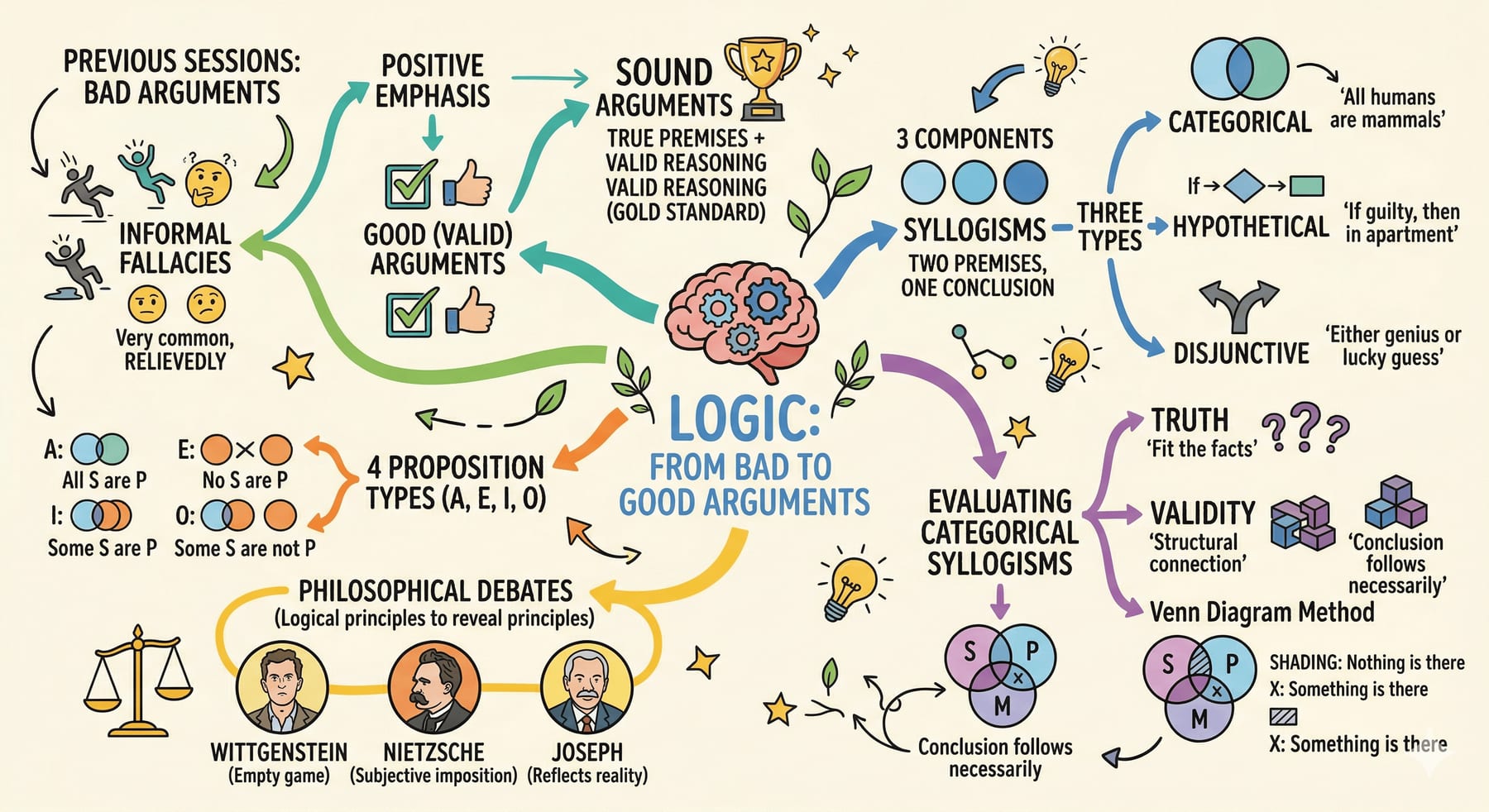
Core Purpose of the Lecture
- This lecture marks a transition from studying informal fallacies to studying good arguments, especially valid, invalid, and sound arguments.
- The main focus is on syllogisms, especially categorical syllogisms, which the speaker treats as one of the foundational tools for formal logical analysis.
- The lecture has three major aims:
- to review the distinction between truth, validity, and soundness
- to introduce the three main kinds of syllogisms
- to begin a systematic method for evaluating categorical syllogisms, especially through Venn diagrams
Main Themes and Arguments
1. Shift from bad reasoning to good reasoning
- The speaker opens by saying the previous sessions focused heavily on informal fallacies:
- common bad arguments
- manipulative arguments
- psychologically persuasive but logically weak arguments
- This lecture now turns toward the positive task of logic:
- identifying good reasoning
- recognizing valid forms
- distinguishing them from invalid forms
- eventually identifying sound arguments
- The goal is not only to understand logic abstractly, but to build practical “logic muscles”:
- pattern recognition
- memory for valid forms
- suspicion toward invalid forms
- faster evaluation of arguments encountered in real life
Truth, Validity, and Soundness
1. Review of truth
- Truth applies to premises considered individually.
- A premise is true when it matches reality or is justified by prior evidence or reasoning.
- The speaker notes that logic classes usually do not spend much time proving whether premises are true because:
- logic can be used for any subject matter
- the truth of premises often depends on outside disciplines
- examples:
- biology
- physics
- mathematics
- empirical observation
- So logic often takes truth “as given” for the sake of analyzing the structure of reasoning.
2. Review of validity
- Validity concerns the structure of the argument, not the truth of the premises.
- The key question is:
- if the premises were true, would the conclusion have to be true?
- Validity is about:
- form
- pattern
- logical move
- inferential structure
- If the conclusion necessarily follows from the premises, the argument is valid.
- If it does not necessarily follow, the argument is invalid.
3. Review of soundness
- A sound argument has both:
- true premises
- valid reasoning
- This is presented as the gold standard in logic.
- The speaker emphasizes:
- true premises alone are not enough
- valid form alone is not enough
- both together are required for soundness
Illustrative Examples of Truth, Validity, and Soundness
1. Sound argument example
- Example:
- All humans are mammals
- All mammals are mortal
- Therefore, all humans are mortal
- Evaluation:
- premises appear true
- reasoning is valid
- therefore the argument is sound
2. Valid but unsound argument example
- Example:
- All rabbits are birds
- All birds eat whales
- Therefore, all rabbits eat whales
- Evaluation:
- premises are false
- but the reasoning pattern is valid
- Main lesson:
- logical validity is separate from factual truth
- an argument can be structurally excellent while factually ridiculous
3. True premises but invalid argument example
- Example:
- All humans are mammals
- All mammals are mortal
- Therefore, all humans like jokes
- Evaluation:
- premises appear true
- conclusion may also be true in some loose sense
- but it does not follow from those premises
- Main lesson:
- a true conclusion does not rescue an argument if it is inferred badly
What a Syllogism Is
1. Basic definition
- A syllogism is defined here as:
- an argument with two premises and a conclusion
- The lecture emphasizes that syllogisms come in three main kinds:
- categorical syllogisms
- hypothetical syllogisms
- disjunctive syllogisms
2. The three types
A. Categorical syllogisms
- These are arguments about categories and their relationships.
- Example:
- all humans are mammals
- all mammals are mortal
- therefore all humans are mortal
- The current lecture focuses almost entirely on this type.
B. Hypothetical syllogisms
- These involve if-then structures.
- Example:
- If he is guilty, then he was in the apartment
- He was not in the apartment
- Therefore he is not guilty
- These will be covered more fully later.
C. Disjunctive syllogisms
- These involve either-or alternatives.
- Example:
- Either she is a genius or she made a lucky guess
- She is no genius
- Therefore she made a lucky guess
- These also will be treated later.
Why Categorical Syllogisms Matter
- The speaker says categorical syllogisms are the most complicated of the three main syllogistic types.
- Because of this, they require:
- more setup
- more terminology
- more formal structure
- stronger evaluation tools
- They are treated as a major training ground for understanding formal reasoning.
Categorical Reasoning as Category Relations
1. Categories as classes or sets
- A categorical proposition links two categories.
- The speaker encourages visualizing these categories as:
- circles
- file folders
- classes of things
- Logic then studies the asserted relation between those classes.
2. Examples of categories
- humans
- mammals
- mortals
- dirty things
- stinking things
- liars
- funny things
- sophisticated things
- lean things
- elegant things
3. Individuals treated as categories
- Proper names like John or Samantha can be treated as a “category” with one member.
- This lets them be diagrammed in the same general framework.
The Four Basic Types of Categorical Proposition
The lecture introduces the standard four proposition types in traditional categorical logic.
1. A proposition: Universal affirmative
- Form:
- All S are P
- Example:
- All humans are mortal
- This is a universal positive claim.
2. E proposition: Universal negative
- Form:
- No S are P
- Example:
- No fish are angels
- This is a universal negative claim.
3. I proposition: Particular affirmative
- Form:
- Some S are P
- Example:
- Some Canadians are mathematicians
- This is a particular positive claim.
4. O proposition: Particular negative
- Form:
- Some S are not P
- Example:
- Some Canadians are not bilingual
- This is a particular negative claim.
5. Naming system
- These are labeled:
- A
- E
- I
- O
- The speaker notes these are simply the standard vowel-based labels used in traditional logic.
Translating Ordinary English into A, E, I, O Form
A major part of the lecture is showing that ordinary language can usually be reduced to one of the four standard categorical forms.
1. Examples translated
- “Many fish are caught each year.”
- translated as: Some fish are caught each year
- I proposition
- “Not all dogs are fast runners.”
- translated as: Some dogs are not fast runners
- O proposition
- “Most Americans aren’t communists.”
- translated as: Some Americans are not communists
- O proposition
- “Every Catholic is a Christian.”
- translated as: All Catholics are Christians
- A proposition
- “Being a liar and being virtuous are incompatible.”
- translated as: No liars are virtuous
- E proposition
- “All but a few of the delegates are present.”
- translated as: Some delegates are present
- I proposition
- “To be a tortoise is to be slow.”
- translated as: All tortoises are slow
- A proposition
- “Not every man can be bought.”
- translated as: Some men are not buyable
- O proposition
- “Without exception, each new generation of college students scorns the standards established by earlier generations.”
- translated as: All new generations of college students scorn the standards established by earlier generations
- A proposition
- “Faint heart ne’er won a fair lady.”
- translated as: No timid people win in love
- E proposition
2. Main lesson
- Real-world language is often:
- poetic
- idiomatic
- archaic
- compressed
- rhetorically dressed up
- A major skill in logic is stripping such language down into its simplest structural form.
The Challenge of Categorical Syllogisms
1. Many possible combinations
- Since each proposition can be one of four types:
- A
- E
- I
- O
- and since syllogisms combine two premises and a conclusion, many forms are possible.
- The speaker states that there are 256 possible categorical syllogisms.
2. Few are valid
- Depending on how one treats material implication, only:
- 24 are valid
- or on another view only 16 are valid
- That means the vast majority are invalid.
- Main lesson:
- there are far more ways to reason badly than to reason well
3. Importance of method
- Because there are so many possible forms, one should not simply rely on intuition.
- Instead, one needs:
- formal rules
- mnemonic recognition
- or graphical tools
- The speaker prefers Venn diagrams as the best learning method.
Famous Valid and Invalid Patterns
1. Barbara
- The speaker names one famous valid form:
- All S are P
- All P are M
- Therefore all S are M
- This traditional medieval name is Barbara.
- He treats it almost as a friend:
- reliable
- always valid
- worth memorizing
2. A classic invalid form
- Form:
- All S are M
- All P are M
- Therefore all S are P
- Example:
- All dogs are mortal
- All cats are mortal
- Therefore all dogs are cats
- Main problem:
- the shared middle term appears in the predicate position both times
- that pattern does not establish the conclusion
Rule-Based Method vs Venn Diagram Method
1. Rule-based method
- The speaker notes that one can learn rules for valid categorical syllogisms.
- Example of a rule:
- the middle term must appear once as subject and once as predicate in valid forms
- Another rule:
- if a premise is negative, the conclusion must be negative
- He acknowledges this method is real and useful.
2. Preference for Venn diagrams
- The speaker clearly prefers Venn diagrams, especially for beginners.
- Reasons:
- they make abstract relations visible
- they help the learner see structure
- they reduce mental overload
- they are more intuitive than memorized rules alone
The Venn Diagram Method
1. Basic idea
- Each category is represented by a circle.
- Overlaps show possible shared membership.
- The goal is to represent all possibilities initially, then mark what the premises tell us must or must not be there.
2. Diagram conventions
The speaker gives two main graphical conventions:
- Shading:
- means nothing is there
- the region is empty
- X:
- means something exists there
- there is at least one thing in that region
3. Individual proposition examples
Samantha is lean and elegant
- Samantha must be in the overlap between:
- lean
- elegant
- Other Samantha-positions are ruled out
John is funny but not sophisticated
- John must be in:
- funny
- not sophisticated
- Regions inconsistent with that are excluded
Someone is a dirty, stinking liar
- An X is placed in the region where:
- dirty
- stinking
- liar
all overlap
All humans are rational and capable of self-agency
- Regions where a human is:
- not rational
- or not capable of self-agency
are shaded out
- This expresses that all humans must lie within the overlap
Material Implication Issue
1. The issue
- The lecture briefly flags a theoretical wrinkle called material implication.
- The question is whether universal claims imply actual existence.
2. Example
- If we say:
- all humans are rational and capable of self-agency
we usually assume humans exist.
- all humans are rational and capable of self-agency
- But if we say:
- all unicorns are rational and capable of self-agency
we do not want to imply unicorns really exist.
- all unicorns are rational and capable of self-agency
3. Why it matters
- This affects:
- whether one places an X in the diagram
- and how many syllogistic forms count as valid
- The speaker notes it as an important but somewhat side issue.
Using Venn Diagrams to Test Validity
1. General principle
- First diagram only the premises.
- Then stop.
- Ask:
- is the conclusion already represented by the diagram?
- If yes:
- the conclusion follows necessarily
- the argument is valid
- If no:
- the argument is invalid
- the conclusion goes beyond the information given
Example: Valid Argument with Venn Diagram
Argument
- All humans are mammals
- All mammals are mortal
- Therefore all humans are mortal
Diagram reasoning
- “All humans are mammals” shades out the human-but-not-mammal regions.
- “All mammals are mortal” shades out the mammal-but-not-mortal regions.
- Once both premises are diagrammed, any region where humans could be non-mortal has already been eliminated.
- Therefore the conclusion is already built into the diagram.
Main lesson
- Validity means the conclusion is already implicit in the premises.
- The Venn diagram makes that visible.
Example: Invalid Argument with Venn Diagram
Argument
- All men are mortal
- All pigs are mortal
- Therefore all men are pigs
Diagram reasoning
- “All men are mortal” removes regions where men are non-mortal.
- “All pigs are mortal” removes regions where pigs are non-mortal.
- But the diagram still leaves open a region where:
- men are mortal
- but not pigs
- Therefore the conclusion is not forced.
Main lesson
- Shared membership in a broader class does not imply identity between subclasses.
The Broader Philosophical Debate: Is Logic Real or Merely Formal?
The lecture ends by stepping back from technique into philosophy of logic.
1. The issue
- Are the principles of logic:
- merely formal human constructions
- empty symbolic games
- subjective impositions on reality
- or genuine reflections of the structure of reality?
This is presented as a deep controversy.
Philosophical Positions Mentioned
1. Early Wittgenstein
- The speaker identifies the early Wittgenstein as close to the view that logic is:
- formal
- empty
- purely structural
- not genuinely informative about reality
- Cited work:
- Tractatus Logico-Philosophicus
- Quotation summarized:
- all propositions of logic say the same thing: nothing
- Main implication:
- logic may be a formal system we construct
- but it does not tell us substantive truths about the world
2. Friedrich Nietzsche
- Nietzsche is presented as a more radical subjectivist about logic.
- Cited work:
- The Will to Power
- Core idea:
- the world appears logical to us because we have already imposed logic onto it
- logic reflects our mental or psychological structuring, not reality itself
- This is compared to a Kantian structure:
- the subject organizes experience
- but Nietzsche makes this structure more unstable, relative, and historically variable
- Main implication:
- logic may reveal more about human psychology than about objective reality
3. H. W. B. Joseph
- Joseph is presented as standing in the Aristotelian objectivist tradition.
- Core view:
- the laws of thought are not arbitrary
- they correspond to the laws of things
- logic reflects patterns in reality
- Quotation summarized:
- if laws of thought were not laws of things, thought would be doomed to misrepresent reality
- Main implication:
- logic is abstract, but not empty
- it is abstract because it distills the structure of reality
Objectivity vs Subjectivity in Logic
1. Subjectivist line
Represented in different ways by:
- early Wittgenstein
- Nietzsche
- Kantian-style positions
Main idea: - logic is generated by the subject
- its rules come from our conceptual scheme, psychology, language, or mental structures
- therefore logic may not tell us about reality as it is in itself
2. Objectivist line
Represented by:
- Aristotle
- H. W. B. Joseph
Main idea: - logic arises from reality’s structure
- thought must conform to what is objectively there
- logic is a tool for keeping the mind aligned with reality
Discussion Questions and Applied Reflections
The lecture includes a question-and-answer session that applies the material to broader issues.
Q&A Theme 1: Can logic help with appeal to majority?
Main response
- Yes, but the speaker says it begins with self-discipline.
- One must recognize:
- social desires
- desire for agreement
- benevolence toward others
- wish to belong
- None of those are bad in themselves.
- The danger is allowing them to override independent judgment.
- In parenting or close relationships, the solution is gradual:
- model reasonableness
- encourage independent thought
- show disagreement can be handled rationally
- avoid simply outnumbering or overpowering others
Q&A Theme 2: Abortion and fallacies
The student’s question
- If one side argues bodily autonomy and another side argues fetal life, is one of those necessarily fallacious?
Main response
- The speaker says abortion debates are full of fallacies, especially appeals to emotion.
- Example of pro-life emotional language:
- “murder of tiny, defenseless human beings”
- Example of pro-choice dehumanizing language:
- “surgical removal of an unwanted clump of cells”
- He says both can function rhetorically without doing the deeper logical work.
His main substantive point
- The debate legitimately contains at least two major questions:
- the status of the fetus
- the status and rights of the woman
- Therefore it is not fallacious to raise bodily autonomy.
- That is a real part of the broader issue.
- Likewise, it is legitimate to raise fetal moral status.
- The correct logical approach is to put both on the table and examine their relation carefully.
Q&A Theme 3: What makes someone susceptible to fallacies?
Main answer
The speaker identifies two major causes:
A. Laziness
- Fallacies often let people avoid hard thinking
- They create the illusion of having argued without doing the work
B. Subjectivism
- The deeper motive is often:
- I want to believe what I want to believe
- Then other fallacies are used defensively as tools:
- ad hominem
- begging the question
- appeal to force
- etc.
Main lesson
- Subjectivism may be the root motive, and specific fallacies become tactical instruments for protecting desired beliefs.
Q&A Theme 4: Wittgenstein, Nietzsche, Joseph, and truth
Student’s point
- Their disagreement seems to be about truth and objectivity.
Main response
- The speaker agrees.
- He frames the dispute as one about:
- objectivity vs subjectivity
- fact vs truth
- relation between mind and reality
Important distinction introduced
- Fact emphasizes the object side:
- what is real in the world
- Truth emphasizes the subject side:
- true propositions in the mind about those facts
Main idea
- Human cognition is relational:
- subject in relation to object
- If that relation is successful:
- there are facts in reality
- and true propositions in mind corresponding to them
Historical Figures, Books, and Sources Mentioned
Figures mentioned
- Aristotle
- Wittgenstein
- Friedrich Nietzsche
- Schopenhauer
- Kant
- H. W. B. Joseph
- Martin Luther King Jr.
- Adolf Hitler
Works mentioned
- Tractatus Logico-Philosophicus by Wittgenstein
- The Will to Power by Nietzsche
Traditional logic source
- medieval scholastic tradition that named valid syllogisms like Barbara
Key Concepts Introduced or Reinforced
- truth
- validity
- soundness
- syllogism
- categorical syllogism
- hypothetical syllogism
- disjunctive syllogism
- category
- subject term
- predicate term
- copula
- quantifier
- universal affirmative
- universal negative
- particular affirmative
- particular negative
- A proposition
- E proposition
- I proposition
- O proposition
- material implication
- middle term
- Venn diagram
- objectivity
- subjectivity
- fact
- truth
Main Takeaways
About logic
- Logic is not only about spotting bad arguments; it is also about learning reliable valid forms.
- Good arguments require both:
- true premises
- valid structure
About categorical syllogisms
- They can be reduced to formal patterns.
- These patterns can be tested systematically.
- Venn diagrams are a powerful tool for visualizing validity.
About language
- Much of the challenge in logic is translating ordinary language into precise logical form.
About philosophy
- There is a serious debate about whether logic:
- reflects reality
- or merely reflects human mental structure or language games
About thinking
- Logical training strengthens one’s ability to:
- recognize form
- resist fallacies
- clarify issues
- slow down and test reasoning
Suggested Related Topics for Further Exploration
Formal logic
- the full system of traditional categorical syllogisms
- medieval names of syllogistic forms
- rule-based tests for validity
- square of opposition
- immediate inferences
Diagrammatic reasoning
- Venn diagrams in logic
- Euler diagrams vs Venn diagrams
- visual reasoning and cognition
Philosophy of logic
- Aristotle’s theory of logic
- Wittgenstein’s early philosophy
- Nietzsche on cognition and perspective
- Kant on mind and structure
- realism vs conventionalism in logic
Logic and language
- how ordinary language obscures formal structure
- translating rhetoric into logical form
- ambiguity and hidden quantifiers
Logic and psychology
- cognitive habits in learning valid forms
- why invalid forms feel persuasive
- subjectivism and motivated reasoning
Ethics and public reasoning
- logic in controversial debates
- moral status arguments
- rights conflicts
- emotional rhetoric in political issues
6. Deduction: Hypothetical & Disjunctive Syllogisms
Peterson Academy - Logic (Hicks) - Lecture 06.pdf (file not included in this release)
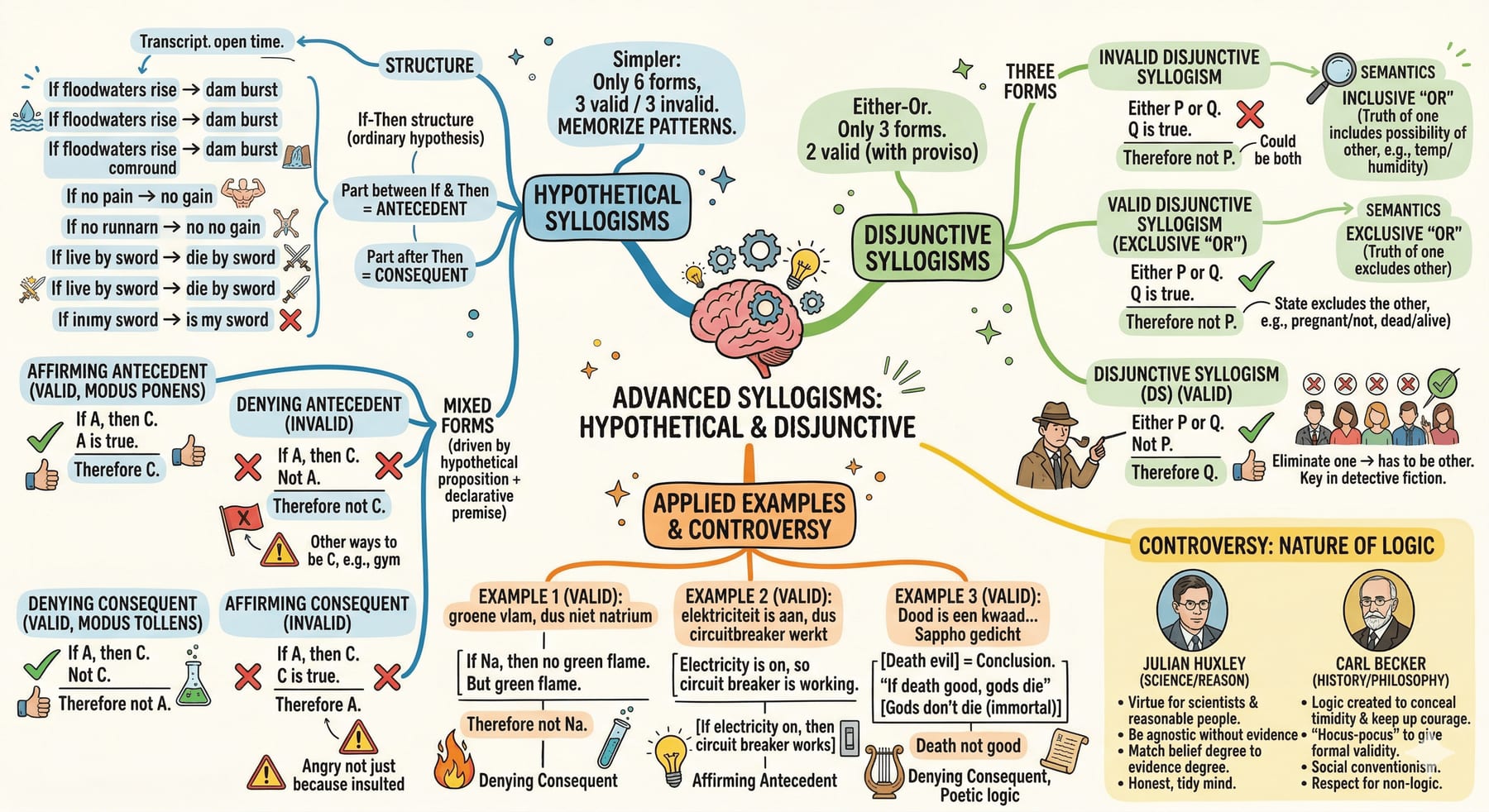
Core Purpose of the Lecture
- This lecture shifts from categorical syllogisms to hypothetical syllogisms and then to disjunctive syllogisms.
- The main goal is to show that these forms of argument are:
- easier to classify than categorical syllogisms
- easier to memorize
- highly useful for real-world reasoning
- The speaker stresses that these forms should become automatic mental patterns:
- you should recognize them quickly
- know which are valid and invalid
- feel “red flags” immediately when bad forms appear
- The lecture also ends by returning to a broader philosophical theme:
- whether logic is a genuine guide to truth
- or merely a psychological/social construction humans use for comfort or conformity
Main Themes and Structure
1. Hypothetical syllogisms are simpler than categorical syllogisms
- The speaker contrasts hypothetical syllogisms with categorical syllogisms:
- categorical syllogisms involve category relations and are much more complex
- there are 256 categorical possibilities
- Hypothetical syllogisms are simpler because:
- there are only six possible forms
- three are valid
- three are invalid
- Because the number is small, the speaker recommends:
- memorizing the patterns directly
- using repetition until recognition becomes immediate
2. The practical aim is rapid recognition
- The lecture is not only theoretical.
- The point is to train the mind to:
- identify structure quickly
- evaluate validity immediately
- catch mistakes before being persuaded by them
- This is part of building the “logic muscles” the speaker has referred to in earlier lectures.
I. Hypothetical Propositions: Structure and Language
What a hypothetical proposition is
- A hypothetical proposition is governed by an if-then structure.
- It presents:
- a possibility
- and the consequence that would follow if that possibility were true
- This connects naturally to ordinary reasoning:
- “If this happens, then that will happen.”
Core terminology
Antecedent
- The part that follows the if
- The condition
Consequent
- The part that follows the then
- The result or implication
Main point
- Recognizing the antecedent and consequent is essential because the names of the argument forms depend on them.
II. Translating Ordinary English into If-Then Form
A major skill emphasized in the lecture is that ordinary English often expresses hypothetical relations without explicitly using “if…then.”
Main lesson
- Before evaluating an argument, you often must first:
- identify whether it is hypothetical
- rewrite it into clear standard form
- locate antecedent and consequent correctly
Examples of translation
1. Floodwaters and temporary dams
- Original:
- “Should the floodwaters rise too high, they will burst the temporary dams.”
- Translation:
- If the floodwaters rise too high, then they will burst the temporary dams.
2. Chartered accountant example
- Original:
- “He must have at least a high school diploma, should it turn out that he’s a chartered accountant.”
- Translation:
- If he is a chartered accountant, then he must have at least a high school diploma.
3. “No pain, no gain”
- Translation:
- If not pain, then not gain
- The speaker uses this example to begin showing the importance of separating negation from the term itself.
4. “Seeing is believing”
- Possible translation:
- If I do not see, then I do not believe
- Or equivalently:
- If I believe, then I must see
- This introduces the idea of contraposition.
5. “Live by the sword, die by the sword”
- Translation:
- If you live by the sword, then you die by the sword
6. “Time flies when you’re having fun”
- Translation:
- If you are having fun, then time seems to pass quickly
7. Socrates: “The unexamined life is not worth living”
- Translation:
- If your life is unexamined, then it is not worth living
- Equivalent contrapositive:
- If your life is worth living, then it has been examined
8. Ecclesiastes
- Original:
- “He that increaseth knowledge, increaseth sorrow.”
- Translation:
- If you increase knowledge, then you increase sorrow
9. Voltaire
- Original:
- “If God did not exist, it would be necessary to invent him.”
- Translation:
- If God did not exist, then it would be necessary to invent him
Importance of contrapositives
- The lecture briefly introduces the idea that two hypothetical propositions can be logically equivalent if:
- the antecedent and consequent are swapped
- and both are negated
- Example:
- If I do not see, then I do not believe
- If I believe, then I must see
- The speaker notes that this will be explored more formally later, but already flags it as important.
III. The Four Mixed Hypothetical Argument Forms
The lecture first covers what the speaker calls mixed hypothetical arguments.
Why “mixed”
- Because the argument contains:
- one hypothetical proposition
- plus a non-hypothetical assertion
- and then a conclusion
These are the four classic forms:
- affirming the antecedent
- denying the antecedent
- denying the consequent
- affirming the consequent
1. Affirming the Antecedent
Form
- If P, then Q
- P
- Therefore Q
Example
- If Roberto worked hard, then he is tired
- Roberto worked hard
- Therefore Roberto is tired
Evaluation
- This is valid
Why
- If the condition is met, and the conditional is true, then the consequence follows
Label
- Affirming the antecedent
Latin name
- Modus ponens
Practical point
- This is one of the core valid forms that should be memorized immediately
Example used by the speaker for reinforcement
- If you give me $20, I will drive you to the airport
- You gave me $20
- Therefore I will drive you to the airport
2. Denying the Antecedent
Form
- If P, then Q
- Not P
- Therefore not Q
Example
- If Roberto worked hard, then he is tired
- Roberto did not work hard
- Therefore he is not tired
Evaluation
- This is invalid
Why
- The premise only tells us one sufficient condition for tiredness
- It does not tell us that working hard is the only cause of tiredness
- Roberto may be tired for other reasons:
- lack of sleep
- exercise
- illness
- stress
Label
- Denying the antecedent
Main lesson
- Failure of the condition does not guarantee failure of the consequence
Importance
- The speaker emphasizes that this is committed frequently in everyday reasoning
3. Denying the Consequent
Form
- If P, then Q
- Not Q
- Therefore not P
Example
- If there is fire, then there is oxygen
- There is no oxygen
- Therefore there is no fire
Evaluation
- This is valid
Why
- If fire requires oxygen, then the absence of oxygen rules out fire
Label
- Denying the consequent
Latin name
- Modus tollens
Scientific significance
- The speaker notes that this form is especially important in science:
- form a hypothesis
- derive consequences
- if the predicted consequence fails, the hypothesis is challenged or refuted
4. Affirming the Consequent
Form
- If P, then Q
- Q
- Therefore P
Example
- If there is fire, then there is oxygen
- There is oxygen
- Therefore there is fire
Evaluation
- This is invalid
Why
- Oxygen may be present for many reasons other than fire
- The consequent does not uniquely identify the antecedent
Example used for illustration
- If you insult him, he will be angry
- He is angry
- Therefore you insulted him
- Invalid, because there are many other reasons for anger
Label
- Affirming the consequent
Main lesson
- Presence of the consequence does not prove the specific condition that would also produce it
Summary of the Four Mixed Forms
Valid
- Affirming the antecedent
- Denying the consequent
Invalid
- Denying the antecedent
- Affirming the consequent
Memory advice
- The speaker recommends memorizing these until recognition is immediate
IV. Pure Hypothetical Syllogisms
After mixed forms, the lecture turns to pure hypothetical syllogisms.
Why “pure”
- Every proposition in the argument is hypothetical
- The whole argument stays inside if-then reasoning
1. Valid Pure Hypothetical Syllogism
Example
- If a student is young, then he is enthusiastic
- If he is enthusiastic, then he is diligent
- If he is diligent, then he will likely succeed
- Therefore, if a student is young, he will likely succeed
Structure
- Consequent of the first proposition becomes antecedent of the next
- Then that consequent becomes antecedent of the next
- The argument forms a continuous chain
Evaluation
- This is valid
Label
- Hypothetical syllogism
- Sometimes called informally a chain argument
Main idea
- If each link genuinely connects to the next, the first antecedent is connected to the final consequent
2. Broken Chain Fallacy
Example
- If you are a physician, then you went to college
- If you are an attorney, then you went to college
- Therefore, if you are a physician, then you are an attorney
Evaluation
- This is invalid
Why
- The structure does not continue the chain properly
- Both premises end with the same consequent (“went to college”)
- But the second premise does not begin from that term in antecedent position
- So the chain is broken
Label
- Broken chain fallacy
Main lesson
- In valid hypothetical chains:
- consequent of one premise must become antecedent of the next
- If the chain does not connect in sequence, the inference fails
V. Disjunctive Syllogisms
The third type of syllogism covered is the disjunctive syllogism.
Basic structure
- These are driven by either-or formulations.
- They work with alternatives or disjuncts.
Key complication
- Disjunctive arguments require attention to whether the “or” is:
- inclusive
- or exclusive
1. Invalid Disjunctive Form with Inclusive “Or”
Example
- Either the temperature or the humidity is high
- The humidity is high
- Therefore the temperature is not high
Evaluation
- This is invalid
Why
- The fact that one disjunct is true does not rule out the other
- Both may be true at the same time:
- high humidity
- high temperature
Main concept
- This is an inclusive or
- One disjunct leaves open the possibility of the other
2. Valid Form with Exclusive “Or”
Example
- Sally is either pregnant or not pregnant
- The test came back positive
- Therefore she is not not-pregnant / therefore she is pregnant
Evaluation
- This is valid
Why
- This is an exclusive or
- One condition excludes the other absolutely
- If one is true, the other must be false
Main lesson
- Whether “affirm one disjunct, deny the other” is valid depends on the semantics of the disjunction
3. Standard Valid Disjunctive Syllogism
Example
- Yuriko is either a real samurai or an excellent actor
- There are no more real samurai
- Therefore Yuriko is an excellent actor
Form
- Either P or Q
- Not P
- Therefore Q
Evaluation
- This is valid
Why
- One alternative is ruled out
- Therefore the other remaining alternative must be true
Label
- Disjunctive syllogism
- Often abbreviated DS
Practical application
- The speaker notes this is common in:
- detective fiction
- detective reasoning
- elimination-based inquiry
Detective-fiction significance
- Agatha Christie–style cases often work by:
- listing suspects
- then ruling them out one by one
- This is a practical use of disjunctive reasoning
VI. Worked Examples in Argument Reconstruction
The lecture then gives three examples to show how much of logic is not just testing forms, but reconstructing ordinary language into standard form.
Example 1: Sodium and green flame
Original statement
- “This substance is not sodium because it burns with a green flame, which it would not do if it were sodium.”
Reconstruction
- Conclusion:
- This substance is not sodium
- Premise 1:
- If this substance were sodium, then it would not burn with a green flame
- Premise 2:
- It does burn with a green flame
Form identified
- If P, then not Q
- Q
- Therefore not P
Evaluation
- This is denying the consequent
- Therefore it is valid
Main lesson
- The hardest part is often reconstructing the English correctly
Example 2: Electricity and circuit breaker
Original statement
- “The electricity is on, so the circuit breaker must be working.”
Problem
- Only one explicit premise is given
- Therefore the argument is an enthymeme with an unstated premise
Likely hidden premise
- If the electricity is on, then the circuit breaker is working
Full reconstruction
- Premise 1:
- If the electricity is on, then the circuit breaker is working
- Premise 2:
- The electricity is on
- Conclusion:
- Therefore the circuit breaker is working
Form identified
- Affirming the antecedent
Evaluation
- Valid
Main lesson
- Logic often requires supplying missing premises that the speaker assumes are obvious
Example 3: Sappho on death
Original
- “Death is an evil, we have the gods’ word for it. They too would die, if death were a good thing.”
Challenges
- No explicit premise indicators
- No explicit conclusion indicators
- Poetic language
- Hidden assumptions
Likely reconstruction
- Premise 1:
- If death were a good thing, then the gods would die
- Hidden premise 2:
- The gods do not die / the gods are immortal
- Conclusion:
- Therefore death is not a good thing / death is an evil
Form identified
- Denying the consequent
Evaluation
- Valid
Main lesson
- Good poetry can contain real logic
- Literary language often compresses reasoning that must be unpacked carefully
VII. Broader Philosophical Debate About Logic
The lecture ends, as earlier lectures often do, by connecting logical technique to a wider philosophical debate.
Core question
- Is logic:
- a virtue and a guide to truth
- or merely a human construction for emotional comfort and social conformity?
1. Julian Huxley’s view
Main idea
- Logic is a virtue of:
- science
- honesty
- intellectual discipline
- We should be agnostic where there is no evidence
- We should not believe things merely because they satisfy emotional desires
Specific examples mentioned
- afterlife
- immortality
- heaven
- hell
Main lesson
- Rational integrity means:
- proportioning belief to evidence
- not believing because one wants consolation
- keeping one’s beliefs tied to justification
Character dimension
- Logic is presented not just as a technique, but as a moral and intellectual discipline
2. Carl Becker’s view
Main idea
- Becker is presented as deeply suspicious of logic
- He sees logic as:
- socially conventional
- psychologically defensive
- a mask for timidity
- a type of “hocus-pocus”
Quoted idea summarized
- Logic may be a formal device humans use:
- to feel safer
- to hide fear
- to dress up conclusions they are already willing to accept
- especially when their peer group accepts them too
Historical framing
- Becker is described as critical of:
- the Enlightenment
- the 18th century’s trust in science, reason, and logic
Main lesson
- The lecture presents Becker as part of the anti-logic tradition:
- logic is not noble truth-seeking
- it is social and psychological self-protection
3. The larger conflict
The lecture ends with a strong contrast:
Huxley
- Logic is:
- honesty
- discipline
- scientific virtue
- evidence-responsiveness
Becker
- Logic is:
- concealment
- social conformity
- psychological cowardice
- formalized self-deception
Main implication
- There is a deep cultural and philosophical divide over the value of logic itself
Key Concepts and Terms Introduced or Reinforced
- hypothetical proposition
- antecedent
- consequent
- mixed hypothetical argument
- affirming the antecedent
- denying the antecedent
- affirming the consequent
- denying the consequent
- modus ponens
- modus tollens
- pure hypothetical syllogism
- chain argument
- broken chain fallacy
- disjunctive syllogism
- inclusive or
- exclusive or
- enthymeme
- argument reconstruction
- agnosticism
- evidence
- subjectivism
- logic as virtue
- logic as social construction
Historical Figures, Texts, and Sources Mentioned
Figures mentioned
- Socrates
- Voltaire
- Sappho
- Julian Huxley
- Carl Becker
- Agatha Christie (as an example of detective fiction)
- Ecclesiastes is cited as a source text
Texts / sources mentioned
- Ecclesiastes
- sayings attributed to Socrates
- line from Voltaire
- poetic fragment from Sappho
Main Takeaways
About hypothetical reasoning
- Hypothetical syllogisms are much simpler than categorical ones
- They are limited enough in number to be memorized directly
- The valid/invalid distinction can be made very quickly once the forms are learned
About disjunctive reasoning
- Disjunctive arguments depend crucially on whether the “or” is:
- inclusive
- exclusive
- That means logic sometimes depends not only on form, but also on semantic context
About ordinary language
- Much of the work of logic lies in:
- translating ordinary language into standard form
- identifying hidden premises
- clarifying literary or compressed language
About logic and culture
- Logic is not universally admired
- Some thinkers treat it as:
- a virtue
- a route to truth
- others treat it as:
- a human coping mechanism
- a social convention
- a mask for timidity
Suggested Related Topics for Further Exploration
Logic
- contraposition in hypothetical logic
- symbolic logic and formalization
- truth tables for conditionals
- validity testing in propositional logic
- exclusive vs inclusive disjunction
Informal and formal overlap
- enthymemes in everyday reasoning
- reconstructing poetic and rhetorical arguments
- ambiguity in if-then statements
Philosophy of logic
- Enlightenment defenses of reason
- critiques of reason in Nietzsche and post-Enlightenment thought
- Huxley on agnosticism and scientific integrity
- Becker on the Enlightenment
Literature and logic
- logical structure in poetry
- logic in detective fiction
- rhetoric vs argument in political speech
Applied reasoning
- scientific hypothesis testing
- legal and forensic reasoning
- how to detect affirming the consequent in media and politics
7. Propositional Logic
Peterson Academy - Logic (Hicks) - Lecture 07.pdf (file not included in this release)
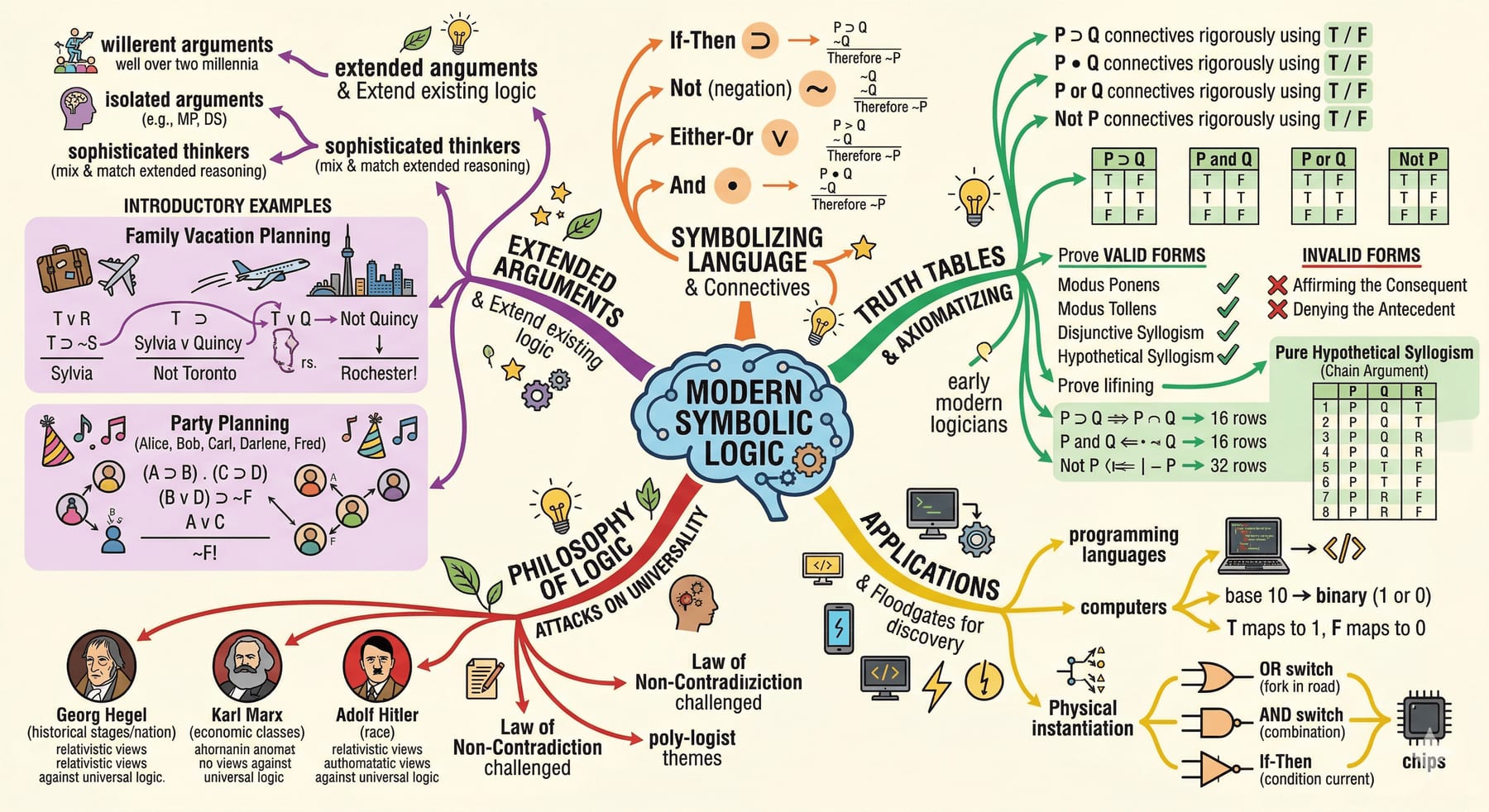
Central Aim of the Lecture
- The lecture introduces modern symbolic logic as an extension of earlier logical traditions, especially traditional syllogistic and propositional reasoning.
- The speaker’s main goals are:
- to show how previously learned valid argument forms can be renamed, symbolized, and systematized
- to explain how ordinary reasoning can be translated into symbolic form
- to introduce truth tables as a rigorous method for defining logical connectives and proving argument validity
- to show how symbolic logic connects directly to:
- mathematics
- binary systems
- electrical circuits
- computing
- to raise a final philosophical controversy about whether logic is:
- universal
- or relative to groups, historical stages, classes, or races
Main Themes and Big Picture
1. Symbolic logic as a modern development with deep roots
- The speaker emphasizes both continuity and extension:
- logic has been developing for more than two thousand years
- modern logic builds on earlier logic
- but it also becomes more tightly integrated with mathematics
- This modern development helps explain later technological breakthroughs:
- programming languages
- computer science
- digital systems
- machine reasoning
2. Symbolic logic makes reasoning more rigorous and economical
- Earlier in the course, arguments were analyzed in more ordinary language.
- Here, the speaker wants to:
- strip arguments down
- symbolize them
- define their operations precisely
- test them axiomatically
- The point is not just elegance, but:
- precision
- speed
- proof
- scalability
3. Logic becomes more mechanical without losing power
- The lecture repeatedly stresses that once logical patterns are properly symbolized, they become:
- more repeatable
- more machine-like
- more formal
- That mechanical character is exactly what later made logic useful for:
- computation
- automation
- hardware design
- digital reasoning
I. Review of Previously Learned Valid Argument Forms
Before moving into modern symbolic logic proper, the speaker reviews four valid forms already learned in earlier lectures.
1. Modus Ponens
Traditional form
- If P, then Q
- P
- Therefore Q
Earlier name
- affirming the antecedent
New preferred name
- Modus ponens
- abbreviation: MP
Main point
- The speaker wants to standardize terminology for later symbolic work.
2. Modus Tollens
Traditional form
- If P, then Q
- Not Q
- Therefore not P
Earlier name
- denying the consequent
New preferred name
- Modus tollens
- abbreviation: MT
Main point
- This too is a valid form that will become part of the speaker’s ongoing symbolic toolkit.
3. Hypothetical Syllogism
Form
- If P, then Q
- If Q, then R
- Therefore if P, then R
Informal description
- chain argument
Preferred name
- Hypothetical syllogism
- abbreviation: HS
Main point
- This is a valid pure hypothetical form.
- It links conditional propositions into a chain.
4. Disjunctive Syllogism
Form
- Either P or Q
- Not P
- Therefore Q
Preferred name
- Disjunctive syllogism
- abbreviation: DS
Main point
- This is the standard valid elimination form for disjunctive reasoning.
Why this review matters
- The lecture is preparing to use these as building blocks.
- Instead of only recognizing them in isolation, the speaker now wants to show how they can be:
- combined
- layered
- chained
- formalized symbolically
- This is the bridge from ordinary logic to symbolic proof.
II. Extended Arguments and the Need for Symbolic Formalization
The speaker uses two everyday-style examples to show how real reasoning often involves multiple steps, not just one isolated syllogism.
Example 1: Family vacation planning
Original reasoning
- We should visit either Toronto or Rochester this trip.
- If we go to Toronto, then we won’t see Sylvia.
- But we have to see either Sylvia or Quincy this trip.
- Quincy is unavailable.
- Therefore Rochester it is.
Main point
- In ordinary conversation, this reasoning feels natural and quick.
- But the speaker shows that several hidden inferential steps are involved.
Reconstructed steps
- From:
- either Sylvia or Quincy
- not Quincy
- infer:
- Sylvia
- This is disjunctive syllogism
- From:
- if Toronto, then not Sylvia
- Sylvia
- infer:
- not Toronto
- This is modus tollens
- From:
- either Toronto or Rochester
- not Toronto
- infer:
- Rochester
- This is disjunctive syllogism
Significance
- What looked like a short practical conclusion actually involved:
- multiple formal inference steps
- Symbolic logic aims to make those hidden steps visible and provable.
Example 2: Party planning
Original reasoning
- If Alice comes, Bob will.
- If Carl comes, Darlene will.
- If either Bob or Darlene comes, Fred won’t.
- Either Alice or Carl is coming.
- Therefore Fred is not coming.
Main point
- This is a more complex example because it mixes:
- conditionals
- disjunctions
- embedded alternatives
- It feels intuitively valid, but the lecturer wants to show that it can also be proved rigorously.
Significance
- Symbolic logic is not just for toy examples.
- It is meant to formalize the kinds of multi-step reasoning we already do informally.
III. Symbolic Notation: Housekeeping and Core Connectives
The lecture next introduces the symbolic notation that will be used for modern symbolic logic.
1. Conditional / hypothetical connective
Symbol
- ⊃ (horseshoe)
Meaning
- if…then
Example
- P ⊃ Q
2. Negation
Symbol
- ~
Meaning
- not
Example
- ~Q
Main point
- The speaker emphasizes the importance of detaching negation from the word itself.
- This parallels how mathematics treats negative signs as operators.
3. Disjunction
Symbol
- v
Meaning
- either…or
Example
- P v Q
Visual note
- The speaker notes the symbol resembles a fork in the road.
4. Conjunction
Symbol
- · (dot)
Meaning
- and
Example
- P · Q
5. Basic assumption about proposition-combining
- The speaker claims that most of our logical sentence-connections can be reduced to a few fundamental types:
- conditional
- disjunctive
- conjunctive
- negation
- Other English forms are often reducible to combinations of these.
- Examples:
- “but” = conjunction plus contrast/negation flavor
- “neither…nor” = disjunction plus negation
- “if and only if” = two conditionals working together
Main lesson
- Symbolic logic aims at economy:
- many complicated ordinary-language constructions can be reduced to a few basic logical forms
IV. Truth Tables: Defining the Connectives
This is one of the central sections of the lecture.
Core purpose of truth tables
- Truth tables are introduced as a way to define the logical connectives axiomatically.
- Instead of relying on intuition alone, truth tables let us ask:
- under what exact circumstances is this compound proposition true?
- under what exact circumstances is it false?
Fundamental starting point
- Every proposition is assumed to be either:
- true
- or false
- This is linked to Aristotle’s law of excluded middle
Symbols
- T = true
- F = false
1. Truth table for conjunction
Proposition
- P · Q
Possibilities
- P true, Q true
- P true, Q false
- P false, Q true
- P false, Q false
Result
- P · Q is true only if both are true
- Truth table:
- TT → T
- TF → F
- FT → F
- FF → F
Main lesson
- Conjunction is strict:
- both conjuncts must be true
2. Truth table for disjunction
Proposition
- P v Q
Result
- P v Q is false only when both are false
- Truth table:
- TT → T
- TF → T
- FT → T
- FF → F
Main lesson
- Disjunction is looser:
- only one disjunct must be true
- This is the standard inclusive-or interpretation unless otherwise specified
3. Truth table for negation
Proposition
- ~P
Result
- If P is true, ~P is false
- If P is false, ~P is true
Truth table
- T → F
- F → T
Main lesson
- Negation simply reverses truth value
4. Truth table for the conditional
Proposition
- P ⊃ Q
Truth table
- TT → T
- TF → F
- FT → T
- FF → T
Important note
- The speaker acknowledges that this result can feel counterintuitive, especially in the last two rows where the antecedent is false.
- He says that fuller explanation will come later through equivalences, but for now this truth table is to be accepted as the formal definition being used.
Main lesson
- A conditional is false only when:
- the antecedent is true
- and the consequent is false
V. Using Truth Tables to Prove Validity and Invalidity
Once the connectives are defined, the speaker shows how truth tables can prove whether argument forms are valid.
General test for validity
- An argument is valid if:
- whenever all premises are true
- the conclusion is also true
- If there is even one row where:
- all premises are true
- but the conclusion is false
- then the argument is invalid
Example 1: Modus Ponens
Form
- P ⊃ Q
- P
- Therefore Q
Result
- When the premises are both true, the conclusion is true
- There is no row where both premises are true and the conclusion false
Conclusion
- Modus ponens is valid
Example 2: Affirming the Consequent
Form
- P ⊃ Q
- Q
- Therefore P
Result
- There is a row where:
- both premises are true
- but the conclusion is false
- That shows the inference pattern is unreliable
Conclusion
- Affirming the consequent is invalid
Example 3: Disjunctive Syllogism
Form
- P v Q
- ~Q
- Therefore P
Result
- The truth table shows that whenever both premises are true, the conclusion is true
Conclusion
- Disjunctive syllogism is valid
Example 4: Hypothetical Syllogism
Form
- P ⊃ Q
- Q ⊃ R
- Therefore P ⊃ R
Main complication
- There are now three variables:
- P
- Q
- R
- That means 8 rows are required in the truth table
Result
- In every case where both premises are true, the conclusion is true
Conclusion
- Hypothetical syllogism is valid
Main lesson of this section
- Truth tables allow us to prove rigorously what earlier lectures often established by:
- intuition
- example
- natural-language testing
- They transform logic from “this seems right” into formal demonstration
VI. The Burden of Scale and the Need for More Efficient Methods
After demonstrating truth tables, the speaker notes a major practical problem.
1. Truth tables quickly become tedious
- With 2 variables: 4 rows
- With 3 variables: 8 rows
- With 4 variables: 16 rows
- With 5 variables: 32 rows
Main point
- As arguments get longer and more complicated, full truth tables become cumbersome
2. This creates pressure toward efficiency
- The speaker says he personally tires of truth tables after about four rows
- This motivates the need for:
- shorter proof methods
- recognized valid forms
- derived rules
- more elegant symbolic systems
3. Computers become imaginable here
- The repetitive, mechanical nature of truth tables naturally raises the question:
- could a machine do this work?
- This becomes an important bridge to computation
VII. Derivations Using Known Valid Forms
The lecture then shows how, once valid forms are known, one can prove more complex conclusions without doing a full truth table every time.
Example 1: Abstract proof with MT and DS
Premises
- R ⊃ ~B
- D v R
- B
Goal
- Prove D
Reasoning
- From 1 and 3:
- If R then not B
- But B
- Therefore not R
- This is modus tollens
- From 2 and the inferred not R:
- D or R
- Not R
- Therefore D
- This is disjunctive syllogism
Main point
- Multi-step formal proof can be built from basic valid patterns
- A long truth table is unnecessary once those forms are trusted
Example 2: Constructive Dilemma
The speaker introduces a new valid pattern.
Form
- (P ⊃ Q) · (R ⊃ S)
- P v R
- Therefore Q v S
Interpretation
- If P, then Q
- If R, then S
- Either P or R
- Therefore either Q or S
Label
- Constructive dilemma
Explanation
- This effectively combines two modus ponens structures under a disjunction
Example given
- “Damned if you do, damned if you don’t”
- If you do, then you’re damned
- If you don’t, then you’re damned
- Either you do or you don’t
- Therefore you’re damned
Humor example
- Everything can be fixed with either:
- duct tape
- WD-40
- If it moves and shouldn’t, use duct tape
- If it doesn’t move and should, use WD-40
- This is framed as a joke built from constructive dilemma structure
Main lesson
- There are more valid argument forms than the original four
- Truth tables can prove them, but once established they become tools in a growing logical toolkit
VIII. Returning to the Earlier Extended Examples
The lecture revisits the earlier ordinary-language examples and now solves them more efficiently with symbolic derivations.
1. Family vacation proof
Symbolized premises
- T v R
- T ⊃ ~S
- S v Q
- ~Q
Goal
- Prove R
Derivation
- From 3 and 4:
- S
- by DS
- From 2 and S:
- ~T
- by MT
- From 1 and ~T:
- R
- by DS
Main point
- What looked like a casual planning conversation can be shown to be a valid 3-step proof
2. Party planning proof
Symbolized premises
- (A ⊃ B) · (C ⊃ D)
- (B v D) ⊃ ~F
- A v C
Goal
- Prove ~F
Derivation
- From 1 and 3:
- B v D
- by constructive dilemma
- From 2 and that result:
- ~F
- by modus ponens
Main point
- Symbolic logic can handle reasoning that initially seems too complicated to formalize
- Once the forms are known, proof becomes cleaner and shorter
IX. Logic, Mathematics, Binary Systems, and Computers
This is one of the lecture’s most important broader claims.
1. Truth and falsity can be mapped onto binary
- Logic begins with:
- true
- false
- Mathematics can translate these into:
- 1
- 0
2. Binary systems become physically instantiable
- Electrical circuits naturally lend themselves to binary structure:
- on / off
- open / closed
- current / no current
3. Logical operations map onto circuit operations
- “And”
- “Or”
- “Not”
- “If-then”
These can all be represented: - symbolically
- mathematically
- physically in circuitry
4. Implication for computers
- Once logic is:
- formalized
- mathematized
- mapped to binary
- instantiated in hardware
- we get the foundations of:
- digital computation
- programmable systems
- chip design
- machine intelligence in the mechanical sense
5. Main lesson
- Modern symbolic logic is not just abstract philosophical play
- It is one of the conceptual foundations of modern computing technology
X. The Universality of Logic and the Attack on Universal Logic
The final section turns to a major philosophical and political controversy.
Core issue
- Is logic universal?
- Or are there different logics for different:
- peoples
- historical stages
- classes
- races
The speaker frames this as a deep threat to the universalist conception of logic.
1. Universalist position
Main idea
- Logic is valid for all human beings
- It is not dependent on:
- class
- nation
- race
- group identity
- It can also be generalized beyond humans into machines
Importance
- This underwrites:
- communication
- proof
- argument
- shared reasoning
- science
- universal intelligibility
2. Hegel
How the speaker presents him
- Hegel is said to argue that:
- reality unfolds historically through stages
- nations occupy different developmental stages
- thought and logic vary with those stages
- This implies:
- different peoples may operate with different logics
- contradiction may be built into the development of reality itself
Main criticism implied by the speaker
- This undermines the universal law of non-contradiction
- It also undermines rational communication across peoples
3. Marx
How the speaker presents him
- Marx shifts the relativity from nationality to economic class
- People born into different class structures develop:
- different understandings
- different modes of thought
- effectively different logics
Consequence
- Communication across classes becomes deeply compromised
- Social conflict is then resolved less by shared argument than by struggle
4. Hitler and Aryan / racial logic
How the speaker presents him
- Hitler and related theorists shift the issue from nation or class to race
- Different races supposedly think differently at the logical level
- This leads to rejection of universal logic in favor of race-relative logic
Consequence
- Once universal reason is denied, violence replaces dialogue
- The speaker links this view directly to political and moral danger
5. Main philosophical theme
- The lecture presents Hegel, Marx, and Hitler as forms of polylogism
- the theory that there are multiple logics tied to group identity
- This is portrayed as a direct attack on the universality of logic
- The speaker strongly favors universal logic over relativized or politicized logic
Key Concepts Introduced or Reinforced
- symbolic logic
- modern logic
- modus ponens
- modus tollens
- hypothetical syllogism
- disjunctive syllogism
- conjunction
- disjunction
- negation
- conditional
- truth table
- law of excluded middle
- binary
- proof
- derivation
- constructive dilemma
- valid form
- formalization
- mechanization of reasoning
- universality of logic
- polylogism
Historical Figures, Movements, and Technologies Mentioned
Thinkers mentioned
- Aristotle
- Julian Huxley
- Carl Becker
- Georg Hegel
- Karl Marx
- Adolf Hitler
Intellectual developments mentioned
- early modern logic
- logic-mathematics integration
- modern symbolic logic
- 20th-century programming and computers
Technological developments mentioned
- programming languages
- computers
- binary systems
- circuits
- chips
- machine reasoning
Books, Articles, or Sources Mentioned
The lecture references thinkers and broad traditions more than formal bibliography, but these are explicitly mentioned:
- Julian Huxley on agnosticism and evidence
- Carl Becker critiquing logic and Enlightenment reason
- Hegel and his historical philosophy
- Marx and class-based thought
- Adolf Hitler and racialized anti-universal logic
No specific published book titles are named in the transcript excerpt for Huxley, Becker, Hegel, Marx, or Hitler, but they are treated as major sources or traditions relevant to the philosophy of logic.
Main Takeaways
About symbolic logic
- Symbolic logic increases precision by reducing arguments to:
- symbols
- connectives
- defined truth conditions
About proof
- Truth tables let us prove validity rigorously
- Once valid forms are established, they can be reused in derivations much more efficiently
About computers
- Symbolic logic’s binary structure makes it naturally translatable into:
- mathematics
- physical switches
- digital systems
About philosophy
- There is an ongoing dispute over whether logic is:
- universal and objective
- or relative to historical, economic, or racial groupings
- The lecture strongly defends the universalist position
Suggested Related Topics for Further Exploration
Logic and mathematics
- propositional calculus
- truth-functional logic
- Boolean algebra
- logical equivalence
- derived rules of inference
Computing
- binary number systems
- logic gates
- digital circuit design
- Turing machines
- programming language foundations
Philosophy of logic
- universality of logic
- polylogism
- non-classical logics
- Hegelian dialectic vs classical logic
- Marxist epistemology
- relativism and logic
History of ideas
- Enlightenment reason and its critics
- early modern formal logic
- development of mathematical logic in the 19th and 20th centuries
Applied reasoning
- symbolic reconstruction of arguments
- proof strategies
- modeling real-world decisions with logic
- using formal logic to test political rhetoric and ideology
8. Induction & Open-Ended Discovery
Peterson Academy - Logic (Hicks) - Lecture 08.pdf (file not included in this release)
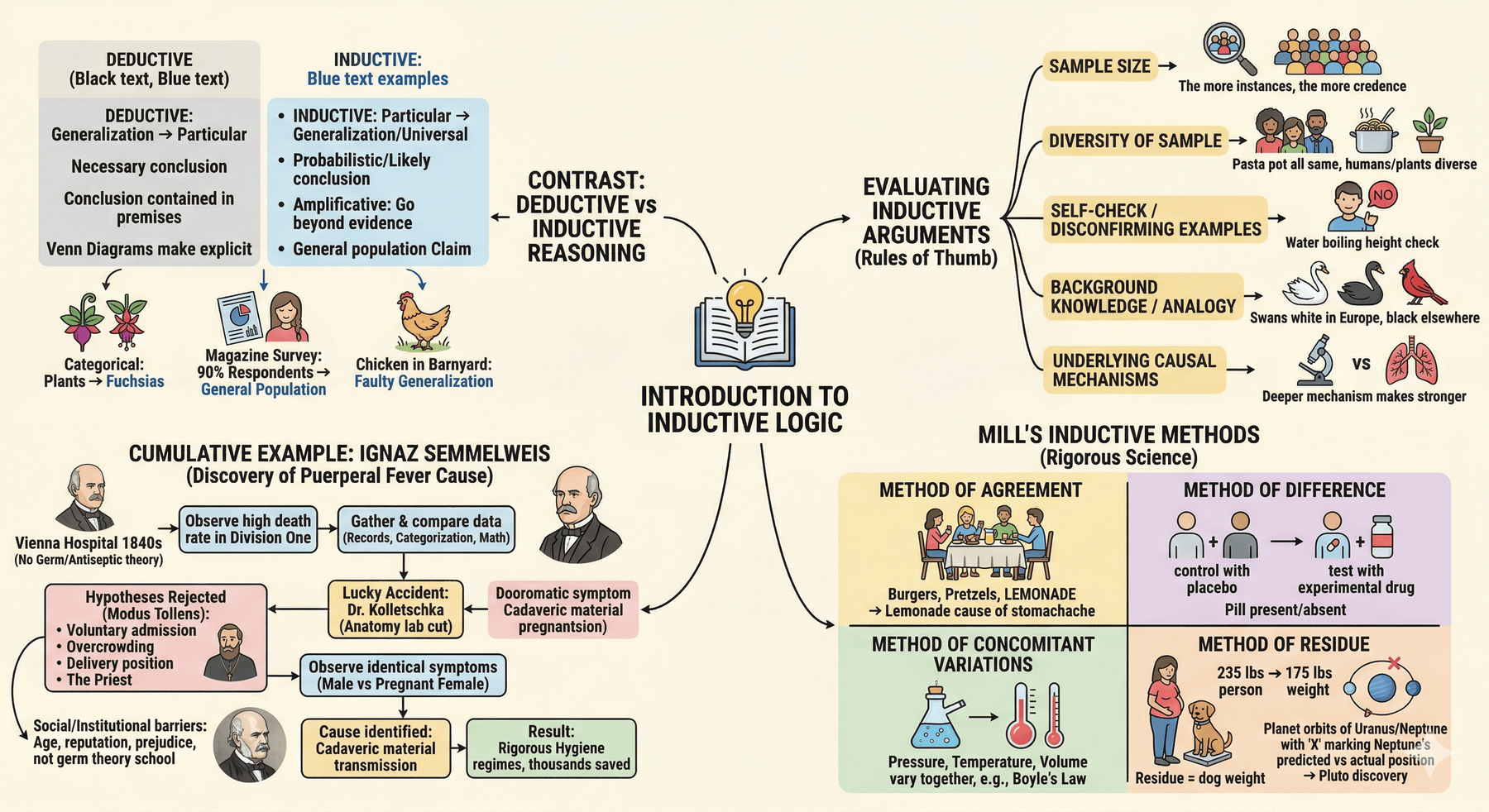
Central Aim of the Lecture
- The lecture introduces inductive reasoning as a major contrast to deductive reasoning.
- The speaker’s main claim is that induction is:
- indispensable in everyday life
- central to science
- more open-ended and uncertain than deduction
- often even more difficult to evaluate properly than deductive arguments
- The lecture aims to:
- distinguish deduction from induction
- explain what makes inductive reasoning different
- show why induction is both powerful and dangerous
- introduce rough evaluative standards for inductive arguments
- present John Stuart Mill’s inductive methods
- close with a major historical case study: Ignaz Semmelweis and puerperal fever
Main Themes and Big Picture
1. Deduction and induction move in different directions
- Deductive reasoning usually moves:
- from a general rule to a particular case
- or through a structure where the conclusion follows necessarily from the premises
- Inductive reasoning usually moves:
- from particular observations to broader generalizations
- from a sample to a class
- from repeated cases to a law, principle, or probability claim
- This directional difference is one of the lecture’s foundational distinctions.
2. Deduction aims at necessity; induction deals in probability
- Deductive arguments, when valid, allow us to say:
- the conclusion follows necessarily
- Inductive arguments usually do not justify that level of certainty.
- Instead, induction uses language such as:
- probably
- likely
- maybe
- plausible
- supported by the evidence so far
- This makes inductive reasoning both:
- scientifically powerful
- epistemically more fragile
3. Induction is unavoidable
- Even though induction is risky, we use it constantly:
- in ordinary life
- in practical decision-making
- in science
- in medicine
- in social life
- We cannot function without generalizing from experience.
I. Deduction vs Induction: Initial Contrast
The speaker begins with four arguments to contrast deductive and inductive reasoning.
A. Deductive examples
1. Plants and chlorophyll
- Premise:
- All plants contain chlorophyll
- Premise:
- Fuchsias are a type of plant
- Conclusion:
- Fuchsias contain chlorophyll
Main point
- This is a deductive categorical argument
- It moves from:
- a universal statement
- to a particular case
- The conclusion follows necessarily if the premises are true.
2. Stupid or lazy
- Premise:
- He is either stupid or lazy
- Premise:
- He is not stupid
- Conclusion:
- Therefore he is lazy
Main point
- This is a deductive disjunctive argument
- One option is eliminated, so the other must hold
- Again, the conclusion follows necessarily.
B. Inductive examples
1. Chronic liars and self-esteem
- Premise:
- 280 chronic liars were examined
- Premise:
- all 280 had low self-esteem
- Conclusion:
- probably all chronic liars have low self-esteem
Main point
- This is inductive because it moves from:
- a finite sample
- to a broader class
- The speaker emphasizes the word probably
- The conclusion is not certain, only supported to a degree.
2. Magazine survey and free love
- Premise:
- 90% of those who responded to a magazine survey opposed free love
- Conclusion:
- therefore 90% of the general population oppose free love
Main point
- This is another inductive argument
- It generalizes from:
- a subset of respondents
- to the whole population
- The key issue is whether that sample is representative enough to justify the generalization.
Core contrast drawn by the speaker
- Deduction:
- starts with a generalization and applies it downward
- produces necessity if valid
- Induction:
- starts with particulars and generalizes upward
- produces varying levels of probability, not necessity
II. Why Induction Matters
The speaker makes clear that induction is not optional.
Everyday examples of induction
1. Hot stove
- A child touches a hot stove once
- Learns a general lesson:
- do not touch hot stoves
- The child does not need infinite repetitions to make the generalization
2. Sunburn
- Too much sun exposure causes pain
- We generalize:
- avoid excessive sun exposure
3. Pasta cooking
- One piece of pasta is tested
- We infer that the rest of the pasta in the pot is cooked
Main lesson
- Ordinary life depends on inductive reasoning constantly
- We are always moving from:
- one or some instances
- to broader expectations
III. The Philosophical Puzzle of Induction
This is one of the most important conceptual parts of the lecture.
A. Why induction seems reasonable
- In the pasta example, the generalization seems justified because:
- the pasta pieces are the same kind of thing
- they are in the same water
- they are subject to the same heating process
- This relies on a broader causal assumption:
- the same causes produce the same effects
B. The deeper philosophical issue
- But where do we get that broader principle from?
- The idea that:
- reality is governed by cause and effect
- similar conditions produce similar results
is itself a very large generalization
The problem
- If we justify induction by appealing to an even larger induction, we seem to be moving in a circle
- We have not experienced all of reality
- Yet we generalize to claims such as:
- all reality is governed by cause and effect
Main point
- The legitimacy of induction is not simple
- It rests on assumptions that themselves seem to be generalized from experience
IV. The Dangers of Bad Induction
The lecture stresses that induction is enormously useful but also highly error-prone.
A. Superstition example
- A person walks under a ladder
- Then twists an ankle
- Concludes:
- walking under ladders causes bad luck
Main point
- This is a bad inductive causal generalization
- Mere sequence is mistaken for causation
B. New Yorker stereotype
- One rude person in Manhattan gives bad directions
- Conclusion:
- New Yorkers are rude
Main point
- This is a weak and hasty generalization
C. Canadian stereotype
- Meet a nice Canadian
- Conclude:
- Canadians are wonderful and polite
Main point
- Even flattering stereotypes are still weak inductions
D. Bertrand Russell’s chicken
- The chicken is fed every day
- It generalizes:
- the farmer is benevolent
- the feeding pattern will continue
- Then one day the farmer kills the chicken
Main point
- Repeated prior regularity does not guarantee future continuation
- This is one of the most famous illustrations of the problem of induction
V. Induction in Science and Social Science
The speaker repeatedly emphasizes that science depends deeply on induction.
A. Scientists seek general laws
- Scientists observe cases
- Run experiments
- Generalize from those experiments to:
- laws
- principles
- broader explanatory claims
B. These generalizations can be life-shaping
- Scientific inductions are not merely academic
- We rely on them in:
- medicine
- engineering
- technology
- safety
- public policy
- This makes getting induction right extremely important
VI. Adam Smith and the Pin Factory
This is one of the lecture’s central historical examples of inductive reasoning in social science.
Historical context
- The speaker references Adam Smith in 1776
- Smith publishes The Wealth of Nations
- One of Smith’s famous examples is the pin factory
What Smith observed
- Traditionally, one person would make a pin from start to finish:
- prepare the metal
- draw the wire
- cut it
- shape it
- sharpen it
- put on the head
- package it
- A skilled individual might make only a limited number of pins per day
The striking case
- Smith observes a factory with about 10 workers producing around 50,000 pins a day
- This far exceeds what 10 isolated craftsmen would have produced individually
The key explanatory idea
- The work has been divided into specialized tasks
- Each worker performs one narrow part repeatedly
- The principle Smith draws is division of labor
Why it matters
- Smith moves from:
- a particular case
- to a broader economic principle
- He generalizes that division of labor increases productivity more broadly, not just in pin factories
Importance in the lecture
- This is presented as a classic example of powerful social-scientific induction
- It shows how one specific observed case can yield a broad, important principle
VII. How Inductive Arguments Are Evaluated
The speaker contrasts evaluation of inductive and deductive reasoning.
A. Deductive evaluation
- Validity asks:
- does the conclusion follow necessarily?
- The conclusion is already in the premises in some implicit way
B. Inductive evaluation
- Inductive arguments are different because:
- they amplify knowledge
- they go beyond the observed data
- the conclusion is not already fully “contained” in the premises
- So we need different standards
C. Five practical “rules of thumb”
The speaker presents these as rough but sophisticated standards for evaluating inductive arguments.
1. Size of sample
Main idea
- Larger samples generally provide stronger support than smaller ones
Example
- One rude New Yorker does not justify the claim that all New Yorkers are rude
- Five rude New Yorkers is stronger than one
- But still may not be enough
Lesson
- Avoid hasty generalization from tiny samples
2. Diversity of sample
Main idea
- It is not enough to have many examples
- The examples must also be diverse in relevant ways
Example
- Pasta is not highly diverse, so one sample may be enough
- Human beings are much more diverse, so stronger generalizations require a wider and more varied sample
Lesson
- Greater complexity requires broader representativeness
3. Look for disconfirming cases
Main idea
- Good induction does not merely collect confirming evidence
- It actively searches for counterexamples
Importance
- This is partly methodological
- But also psychological:
- humans tend to look for evidence that supports what they already want to believe
Example
- If studying the boiling point of water, one should test whether elevation changes matter
- That is a search for a disconfirming or limiting factor
4. Fit with background knowledge
Main idea
- A proposed induction should be checked against what else we already know
Example: Swans
- Europeans long believed all swans were white
- That is understandable if all observed swans were white
- But broader zoological knowledge suggests animal coloration often varies
- That should make us cautious about overgeneralizing
Lesson
- Analogies from related domains can help moderate confidence in induction
5. Underlying causal mechanisms
Main idea
- An induction becomes stronger if we can identify the mechanism producing the observed effect
Examples
- Pasta cooking:
- if we understand the underlying structure and heat process, we generalize more securely
- Fish in water:
- understanding gills gives a deeper explanatory basis for the generalization
Lesson
- Causal explanation strengthens inductive generalization
VIII. Practice Examples of Inductive Evaluation
The speaker applies these rough standards to some examples.
A. Barber example
- Premises:
- barber cut Rick’s hair well
- cut Bill’s hair well
- cut Larry’s hair well
- Conclusion:
- he will do a good job on mine
Evaluation
- Weak but not absurd
- Questions to ask:
- sample is only 3
- are Rick, Bill, and Larry similar to me?
- same style?
- same time of day?
- same level of care for friends vs strangers?
Judgment
- A weak induction, but maybe acceptable for a low-stakes decision
B. Letters to the editor and the strike
- Premise:
- 18 out of 20 letters complain about inconvenience caused by the strike
- Conclusion:
- the public is antagonized by the strike
Evaluation
- Weak induction
- Why:
- people who write letters to the editor are not necessarily representative
- dissatisfied people are more likely to write in
- silent majority may feel differently
Main lesson
- Response samples are often biased
C. Young baseball player and Babe Ruth
- Premise:
- Buster plays like Babe Ruth
- similar stance
- good eye
- Conclusion:
- he should prove to be an excellent batter
Evaluation
- Weak induction
- Reason:
- too many other relevant variables matter
- physical, psychological, developmental, and situational factors are not accounted for
Lesson
- Similarity in a few traits does not justify a strong predictive generalization
IX. Mill’s Methods of Induction
The lecture then turns from rough rules of thumb to more systematic scientific methods.
Historical figure
- John Stuart Mill
- 19th-century British philosopher
- Wrote significantly on logic
- Credited with formalizing these methods
Main point
- Mill identified methods scientists can use to investigate causes more systematically
1. Method of Agreement
Structure
- Several cases all produce the same effect
- Only one factor is common to all of them
- Therefore that common factor is likely the cause
Example from the board
- Various combinations of A, B, C, D, F, G
- Effect E occurs in all four cases
- Only G is present every time
- Therefore G is the likely cause of E
Homey example
- Four people go to a party
- All eat/drink different things
- All get stomachaches
- The only common item consumed was lemonade
- Therefore the lemonade is the likely cause
Strength
- Strong and commonly used
- But still requires caution:
- maybe some unobserved shared factor was missed
2. Method of Difference
Structure
- Two cases are the same except for one factor
- In one case the effect occurs
- In the other case it does not
- Therefore the differing factor is the likely cause
Example
- A, B, C, F produce effect E
- A, B, C without F do not produce E
- Therefore F is likely the cause
Scientific example
- Drug testing:
- one group gets the real drug
- another gets a placebo
- all else is held constant as much as possible
- If the effect appears only with the drug, that supports causal inference
Importance
- This is one of the most central tools in experimental science
3. Method of Concomitant Variations
Structure
- Factors cannot be simply turned on or off
- Instead, one studies how changes in one factor systematically correlate with changes in another
Example
- Pressure, temperature, and volume in gases
- One cannot simply remove pressure or temperature absolutely
- Instead, one holds some variables constant and varies others
- Then observes patterned change
Scientific connection
- This is how laws like Boyle’s law are discovered
Main point
- Some causes can only be studied through matched variation, not simple presence/absence
4. Method of Residue
Structure
- Part of the effect is explained by known causes
- What is left over, the residue, must be due to some additional cause
Dog-weighing example
- You and dog together weigh X
- You alone weigh Y
- Clothes weigh Z
- The remainder is the dog’s weight
Historical science example: Pluto
- Scientists tracked planetary motions
- Known planets’ gravitational effects explained most of the motion
- But one planet’s position was slightly off from prediction
- The leftover discrepancy suggested another planet
- Telescopes were directed accordingly
- Pluto was discovered
Main point
- Residual unexplained effects can point to hidden causes
X. Cumulative Reflection on the Course So Far
The lecturer pauses to reflect on how induction integrates with the earlier lectures.
Logic so far has included:
1. Basic argument analysis
- identifying premises and conclusions
- spotting indicators
- filling in missing premises
2. Concept formation and definition
- clarifying meanings
- organizing conceptual hierarchies
- working carefully with categories
3. The role of language and psychology
- logic depends on precise language
- but also on how minds form abstractions
4. Deductive methods
- categorical syllogisms
- hypothetical and disjunctive reasoning
- truth tables and symbolic logic
- relations to mathematics and machine reasoning
5. Inductive methods
- now added as a further layer
- showing that logic is not exhausted by deduction
XI. Ignaz Semmelweis and Puerperal Fever
This is the lecture’s culminating historical case study and one of its most important sections.
Historical setting
- 1840s
- Vienna Hospital
- Medicine is advancing
- But:
- no germ theory yet
- no antiseptic theory yet
Main figure
- Ignaz Semmelweis
- Hungarian-born physician working at the University of Vienna Hospital
- Focused on maternal care and childbirth
A. The initial observation
- Vienna Hospital had two maternity divisions:
- Division One
- Division Two
- Semmelweis notices:
- women in Division One seem to die at a much higher rate after childbirth than women in Division Two
Key point
- Many others might have ignored this as normal
- Semmelweis cared enough to observe systematically
B. Verification through data
- He checks:
- his own observations
- hospital records from prior years
- He calculates the death rates
- He discovers:
- women in the first division were dying at nearly four times the rate of those in the second
Importance
- This required:
- observation
- record keeping
- categorization
- mathematical comparison
C. Hypothesis testing
Semmelweis then begins generating and testing possible causes.
1. Voluntary vs involuntary admission
- Hypothesis:
- women brought in under duress may be more likely to die
- Test:
- compare admission conditions and death outcomes
- Result:
- no support
- Rejected by what the lecturer describes as effectively modus tollens
2. Overcrowding
- Hypothesis:
- the first division is more crowded
- Test:
- compare conditions and outcomes
- Result:
- does not explain the difference
- Rejected
3. Birthing position
- Observation:
- first division favored one birthing position
- second division favored another
- Hypothesis:
- position during delivery causes the difference
- Test:
- examine outcomes across positions
- Result:
- no explanatory power
- Rejected
4. The priest hypothesis
- Semmelweis notices that a priest frequently passes through the first division to give last rites elsewhere in the hospital
- Hypothesis:
- perhaps the priest’s appearance causes psychological stress in vulnerable women, pushing them over the edge
- Test:
- ask priest to avoid the first division
- Result:
- death rate does not change
- Rejected
D. The breakthrough: Kolletschka
The event
- Semmelweis’s colleague Kolletschka is accidentally cut by a student’s scalpel during a dissection
- Soon after, Kolletschka becomes gravely ill and dies
Critical observation
- Semmelweis notices:
- Kolletschka exhibits the same symptoms as the women dying of puerperal fever
Conceptual leap
- Different categories:
- male physician
- postpartum women
- But same symptom pattern
- Therefore, the same underlying cause may be at work
E. The causal inference
- Kolletschka died because cadaveric material entered his bloodstream through the cut
- Semmelweis then realizes:
- physicians and students move from anatomy lab dissections
- to the first maternity division
- washing hands only superficially
- They are transmitting cadaveric matter to women whose bodies are physically vulnerable after childbirth
Conclusion
- This is the cause of puerperal fever in the first ward
F. Significance of the discovery
- Semmelweis has discovered the importance of hygienic and antiseptic practice before germ theory is fully established
- The implication is enormous:
- better handwashing and hygiene can save thousands of women
G. Why this case matters for logic
The speaker uses Semmelweis as a model of logic in action.
Skills Semmelweis displayed
- acute observation
- categorization
- careful record keeping
- sensitivity to patterns
- willingness to revise hypotheses
- persistence across years
- hypothesis generation
- prediction
- elimination of false explanations
- inductive reasoning
- deductive testing of implications
- mathematical comparison
- conceptual flexibility
Main point
- The discovery was not a lucky guess alone
- It required an integrated logical character:
- intellectual discipline
- methodological rigor
- persistence
- concern for truth and human life
H. The social failure to accept the evidence
The story does not end triumphantly.
Problem
- Semmelweis had great difficulty convincing others at Vienna Hospital
- Other doctors resisted his findings
Reasons given
- adherence to textbooks and older teaching
- hostility to younger innovators
- institutional inertia
- prestige concerns
- politics
- religion
- personal animosity
- skepticism toward new theory
Main lesson
- Individual logical excellence is not enough
- Society also needs:
- people capable of understanding evidence
- willingness to revise beliefs
- openness to argument
XII. Final Q&A: Correlation and Causation
The lecture ends with a student question about studies that mistake correlation for causation.
The question
- Many studies have later been debunked because they treated correlation as causation
- Is that a fault of the method, human error, or moral failure?
Speaker’s answer
Main point
- Correlation is not always causation
- But sometimes correlation is causation
- The real problem is determining which case one is dealing with
Likely explanation
- Usually the problem is not the method itself
- More often it is:
- human error
- haste
- incomplete knowledge
- premature confidence
- sometimes emotional investment in a result
Defense of scientists
- The speaker says most scientists likely have:
- good training
- good ethics
- The more common problem is simply that reality is more complicated than we know
Final advice
- Scientists and thinkers should maintain:
- objectivity
- awareness of complexity
- historical caution
- willingness to calibrate confidence to evidence
Key Concepts Introduced or Reinforced
- deductive reasoning
- inductive reasoning
- generalization
- amplification of knowledge
- probability
- possibility
- hasty generalization
- cause and effect
- sample size
- diversity of sample
- disconfirming cases
- background knowledge
- causal mechanism
- scientific law
- method of agreement
- method of difference
- method of concomitant variations
- method of residue
- hypothesis
- prediction
- correlation vs causation
- puerperal fever
- germ theory
- antiseptic theory
Historical Figures, Events, and Cases Mentioned
Figures
- Bertrand Russell
- Adam Smith
- John Stuart Mill
- Ignaz Semmelweis
- Kolletschka
- Babe Ruth
Events / historical developments
- 1776 publication of The Wealth of Nations
- 1840s Vienna Hospital maternity wards and maternal mortality
- pre-germ-theory medicine
- pre-antiseptic medical practice
- discovery of Pluto by residual inference from planetary irregularities
Books, Articles, or Sources Mentioned
Explicitly mentioned works or sources
- The Wealth of Nations — Adam Smith (1776)
Traditions / authorities mentioned
- John Stuart Mill on inductive methods
- Bertrand Russell and the chicken example
- historical medical records at Vienna Hospital
- history of medicine and Semmelweis
- history of astronomy and Pluto’s discovery
No journal articles are explicitly named in the transcript, but several historical scientific and philosophical examples are discussed.
Main Takeaways
About induction
- Induction is necessary for life and science
- But it does not produce necessity in the way deduction does
- Its conclusions are often provisional, probabilistic, and revisable
About evaluating induction
- Stronger induction requires:
- larger samples
- diverse samples
- active search for counterexamples
- fit with broader knowledge
- causal explanation
About science
- Mill’s methods give more systematic ways to search for causes
- Good science is not merely collecting data; it is organizing, comparing, testing, and ruling out alternatives
About logic as a human virtue
- Semmelweis shows that logic is not just abstract manipulation
- It can save lives when joined with:
- moral seriousness
- patience
- courage
- professional integrity
About society
- Evidence and good reasoning are not always enough to persuade institutions
- Logic also depends on social willingness to listen, revise, and change
Suggested Related Topics for Further Exploration
Philosophy of induction
- David Hume and the problem of induction
- probability and confirmation theory
- scientific realism vs instrumentalism
Philosophy of science
- Karl Popper and falsification
- Thomas Kuhn and scientific revolutions
- causal inference in science
Research methods
- correlation vs causation
- sampling bias
- experimental design
- placebo and control groups
- replication crises in science
History of science and medicine
- Semmelweis and antisepsis
- germ theory and Pasteur
- Lister and antiseptic surgery
- maternal mortality in premodern medicine
Economics and social science
- Adam Smith and division of labor
- how social scientists generalize from case studies
- external validity in economics and sociology
Logic and cognition
- why humans stereotype
- confirmation bias
- how people form causal beliefs
- superstition and pattern detection