Zibaldone 2024–2025 journal
Journal connection: A comparative political-philosophy page featuring Rawls.
Source boundary: These are captured journal materials; the integration does not independently verify every clipped claim, quotation, or figure.
PDF++ pages: p. 314 (file not included in this release)
Embedded preview:
Zibaldone 2024-2025.pdf (file not included in this release)
Open the complete Zibaldone page index
Distilled Knowledge
Source contribution
Rawls asks which principles free and equal persons would choose for society’s basic structure under fair conditions. The original position and veil of ignorance model impartiality; they do not describe an actual founding bargain.
- Equal basic liberties have priority and are not ordinarily traded away for aggregate welfare or economic gain.
- Fair equality of opportunity requires more than formal legal permission when background institutions systematically determine prospects.
- Social and economic inequalities are permissible only under offices open under fair opportunity and when arranged to benefit the least advantaged.
- The difference principle concerns rules of the basic structure, not a central authority literally dividing every product after it is made.
- Reflective equilibrium revises principles and considered judgments until they fit coherently; it is not intuition treated as unquestionable evidence.
Routes into the permanent notes
- Political Philosophy Allocates Power and Goods identifies the institutions, goods, agents, and justificatory burden in Rawls’s framework.
- Liberty, Equality, Authority, and the Common Good includes the fairness case and objections about incentives, responsibility, measurement, and ideal theory.
- My Political Beliefs keeps the user’s qualified view separate from Rawls’s position.
Evidence boundary
The present note is sparse. It does not yet establish Rawls’s treatment of property-owning democracy, stability, civil disobedience, international justice, disability, historical injustice, or later revisions. Use this as orientation pending primary-text verification.
DESCRIPTION
Previous edition, 1st, published in 1971.
My Summary
rawls-theory of justice notes.pdf (file not included in this release)
Main Ideas, Takeaways & Similarities
Questions
I. What is the problem?
A. How is this problem formulated?
B. Why is this problem important?
C. What is the history of this problem?
D. Which prominent personalities have been interested in this problem?
II. What solutions to the problem are there?
A. What are the conclusions reached?
B. By what argument(s) is the conclusion reached?
C. What facts or assumptions serve as premises?
D. When a prominent personality offers a solution, does he also argue for or against other prominent personalities? Does he raise objections to alternative solutions? Does he consider objections to his own solutions?
III. Evaluation
A. What are the advantages and disadvantages of the alternative formulations to the problem?
B. Has the importance or history of the problem ever been misrepresented?
C. Are the solutions logically related to the premises?
D. Are the facts true? Are the assumptions acceptable? Are the objections answerable?
AI Summary
Part One: Theory
Chapter I: Justice as Fairness
1. The Role of Justice
- Primacy of justice: Justice is the first virtue of social institutions, just as truth is the first virtue of thought. Institutions must be reformed or abolished if unjust. Individual rights are inviolable and not to be sacrificed for the greater good.
- Conflict and cooperation: Social cooperation brings both shared interests (a better life through cooperation) and conflicts (how to divide benefits). Principles of justice are needed to assign rights, duties, and shares fairly.
- Well-ordered society: Defined as one where (1) all accept the same public conception of justice, and (2) institutions generally satisfy these principles. Shared justice creates civic friendship and limits pursuit of self-interest.
- Concept vs. conceptions: The concept of justice refers to fairness and proper balance of claims; conceptions are specific sets of principles (utilitarian, Rawlsian, etc.) that specify this balance.
- Broader social problems: Justice relates to coordination, efficiency, and stability. A conception of justice must be evaluated not only by distributive fairness but also by how it fosters efficient, stable cooperation.
2. The Subject of Justice
- Primary subject: The basic structure of society—its main political, social, and economic institutions—because these deeply shape opportunities and life prospects from birth.
- Inequalities of starting positions: Social institutions inevitably favor some at birth; these inequalities cannot be justified by merit alone and must be addressed by justice.
- Scope: Focuses on domestic justice (not law of nations or everyday customs). Principles of justice regulate the political constitution and major economic/social structures.
- Ideal vs. partial compliance: Rawls begins with “strict compliance” (ideal theory: all act justly) before turning to partial compliance (punishment, war, civil disobedience).
- Connection to tradition: Builds from Aristotle’s idea that justice involves refraining from pleonexia (seizing what is not one’s due). Modern institutions shape entitlements, so principles of justice must address this.
3. The Main Idea of the Theory of Justice
- Justice as fairness: Generalizes the social contract tradition (Locke, Rousseau, Kant). Not about joining society, but agreeing on principles of justice for the basic structure.
- Original position: Hypothetical situation where free, equal, rational persons choose principles of justice without knowing their place in society—behind a veil of ignorance.
- Rationale: Ensures fairness, since no one can design principles to favor their status. Agreements reached are self-imposed and autonomous.
- Two principles of justice:
- Equal basic rights and liberties for all.
- Inequalities are permissible only if they benefit everyone, especially the least advantaged.
- Rejection of utilitarianism: Rational individuals would not accept sacrificing their basic rights for greater aggregate welfare. Justice must protect reciprocity and fairness in cooperation.
4. The Original Position and Justification
- Justification through choice: A conception of justice is justified if it would be chosen by rational persons in the original position.
- Veil of ignorance: Ensures impartiality—people lack knowledge of social class, fortune, abilities, or personal goals.
- Equality of parties: Everyone has equal rights in deliberation, representing humans as moral persons.
- Reflective equilibrium: Justification balances theoretical principles with our considered judgments (e.g., intolerance and racial discrimination are unjust). We revise both judgments and principles until they cohere.
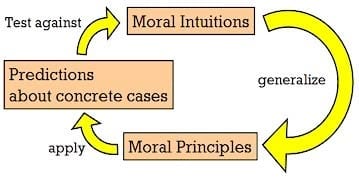
- Hypothetical nature: Even if no real contract exists, the original position expresses conditions we already regard as reasonable for fair cooperation.
5. Classical Utilitarianism
- Core idea: A society is just if its institutions maximize total satisfaction across individuals. Modeled on the rational prudence of an individual maximizing his lifetime welfare.
- Teleological structure: Defines the good independently of the right, then defines the right as maximizing the good.
- Variants: Hedonism, eudaimonism, perfectionism (human excellence), etc. Rawls treats classical utilitarianism as maximizing rational desire satisfaction.
- Problem: Distribution of satisfaction doesn’t matter intrinsically; only the total does. This allows liberty or rights of some to be violated if offset by greater aggregate satisfaction.
6. Some Related Contrasts
- Priority of justice: Common sense affirms that rights and liberties are not overridden by greater social welfare. Justice as fairness explains this; utilitarianism treats it as a useful illusion.
- Individual vs. society: Utilitarianism applies the principle of rational prudence for one man to society, conflating distinct persons. Justice as fairness stresses plurality and reciprocity.
- Deontological vs. teleological: Justice as fairness is deontological: the right is prior to the good. Desires that violate justice (e.g., pleasure in others’ subordination) have no value. Institutions must respect equal liberty and fair opportunity.
- Underlying contrast: Utilitarianism views society as efficient administration of resources; Rawls views it as reciprocal cooperation chosen under fair terms.
7. Intuitionism
- Definition: A doctrine with multiple irreducible first principles, requiring intuitive judgment to balance them without systematic priority rules.
- Plurality of principles: Common-sense morality often has competing precepts (fair wages, just taxation, etc.) that must be balanced by intuition and social expectations.
- Philosophical intuitionism: Can take forms like efficiency + equality principles, but lacks rules for weighting them, leaving much to intuition or political compromise.
- Critique: Provides some coherence but remains indeterminate. Rawls wants to replace intuitionism’s reliance on judgment with a systematic contract framework (original position + explicit principles).
§8. The Priority Problem and the Principle of Perfection
- Priority problem: When principles conflict (e.g., liberty vs. efficiency), which has greater weight? Rawls notes utilitarianism often sacrifices liberty for aggregate welfare, but justice as fairness insists on the priority of certain rights.
- Perfectionist principle: A doctrine (from Aristotle, Aquinas, Green, etc.) holding that society should maximize human excellence or the realization of objective values (e.g., knowledge, art, culture).
- Rawls’ critique:
- Attractive in spheres like education and the arts, but not suitable as the foundation of justice.
- Risks justifying sacrifice of basic liberties for the sake of excellence.
- Individuals must be free to decide how to pursue values of perfection; coercion undermines autonomy.
- Rawls’ position: The perfectionist ideal may inform personal or collective goals, but principles of justice must give lexical priority to basic liberties over perfectionist aims .
§9. Some Remarks About Moral Theory
- Justice in moral theory: Justice as fairness is a deontological view — the right is prior to the good. The good does not define the right, unlike utilitarian or teleological doctrines.
- Moral motivation: Justice is not about maximizing happiness but about fair terms of cooperation that free and equal persons would accept.
- Broader moral structure: Rawls sketches how his theory fits into moral philosophy:
- Principles of justice are one part of moral theory.
- Other parts include virtues, ideals of the good life, and rules of conduct in everyday contexts.
- Reflective equilibrium: Moral theory must bring principles into coherence with our considered judgments, showing how justice integrates with a full ethical framework .
Recap of Chapter I
By the close of Chapter I, Rawls has:
- Defined the role of justice (the first virtue of institutions, regulating conflicts of interest).
- Identified the subject of justice (the basic structure of society).
- Introduced the main idea (justice as fairness, using the original position and veil of ignorance).
- Outlined the method of justification (hypothetical agreement + reflective equilibrium).
- Compared justice as fairness with utilitarianism, intuitionism, and perfectionism, showing how his view avoids their weaknesses.
- Positioned his theory as a deontological framework where the right constrains conceptions of the good.
Chapter II: The Principles of Justice
§10. Institutions and Formal Justice
- Institutions as subjects of justice: Defined as public systems of rules that assign rights, duties, powers, and responsibilities (e.g., parliaments, markets, property). They exist when people act in line with shared rules and recognize others’ participation.
- Formal justice: Consistency in applying rules (“treating like cases alike”). Institutions may be formally just yet substantively unjust (e.g., slavery applied impartially). Still, regularity reduces arbitrariness and protects expectations.
- Levels of assessment: One can judge a single rule, an institution, or the basic structure as a whole. Justice requires considering both internal consistency and how parts fit together.
- Limits: Rituals or customs usually fall outside justice unless they affect rights and values. Formal justice depends on impartial administration, but substantive justice is defined by the principles framing institutions.
§11. Two Principles of Justice
- Provisional statement:
- Each person has an equal right to the most extensive basic liberty compatible with similar liberty for others.
- Social and economic inequalities must (a) benefit everyone and (b) be attached to positions open to all.
- Serial ordering: The liberty principle has priority over the equality principle. Basic liberties cannot be traded for material or social advantages.
- General conception of justice: All social values (liberty, opportunity, wealth, self-respect) should be distributed equally unless inequality benefits all. Injustice = inequalities not to everyone’s advantage.
- Primary goods: Rights, liberties, opportunities, income, wealth (later self-respect). The benchmark is an equal initial distribution, with deviations justified only if they improve everyone’s prospects.
§12. Interpretations of the Second Principle
- Ambiguity: “Everyone’s advantage” and “open to all” yield four versions of the principle. Three main ones are analyzed:
- System of natural liberty: Free markets + careers open to talents. Distributive shares reflect efficiency and natural/social contingencies. Injustice: outcomes depend heavily on chance and class background.
- Liberal equality: Adds fair equality of opportunity. Those with similar abilities and motivation should have equal life chances regardless of class. Requires public education and limiting wealth concentration. Still flawed: outcomes depend on natural talents, themselves arbitrary.
- Democratic equality: Combines fair equality of opportunity with the difference principle (inequalities must benefit the least advantaged). This eliminates the arbitrariness of both class background and natural lottery.
- Natural aristocracy (brief): Accepts natural talents but limits their use so that advantages serve the less well-off. Seen as unstable compared to democratic equality.
§13. Democratic Equality and the Difference Principle
- Core idea: Inequalities are permissible only if they maximize the life prospects of the least advantaged. The better-off may gain more only when this also benefits those at the bottom.
- Contrast with utilitarianism: Utilitarianism permits larger inequalities if total welfare increases. Rawls rejects sacrificing the worst-off for greater overall gain.
- Two cases:
- Perfectly just scheme: Prospects of the least advantaged are maximized.
- Just but not best: The least advantaged still benefit from inequalities, though not maximally.
- Chain connection: Assumes that if gains to the better-off improve the least advantaged, they also benefit intermediate groups. This spreads benefits widely, supporting stability.
- Lexical difference principle: In complex societies, maximize the worst-off, then the next-worst, and so forth.
§14. Fair Equality of Opportunity and Pure Procedural Justice
- Why open positions matter: Exclusion is unjust even if everyone benefits materially, because it denies individuals the dignity of participation and self-realization.
- Pure procedural justice: Justice is built into the design of fair institutions, not in comparing isolated allocations. Outcomes are just if they result from a just structure, even without an independent criterion.
- Perfect procedural justice: Guaranteed fair outcomes (e.g., cake-cutting).
- Imperfect: Fair trials, but errors possible.
- Pure: Gambling analogy—no independent “correct” outcome, but fairness comes from the process.
- Application: With fair background institutions (education, property distribution, taxation, competitive markets), distributive shares reflect pure procedural justice. The difference principle ensures results are just without tracking every transaction.
§15. Primary Social Goods as the Basis of Expectations
- Expectations as benchmark: Representative individuals’ life prospects are measured in terms of primary goods (rights, liberties, opportunities, income, wealth, self-respect).
- Contrast with utilitarianism: Utilitarianism maximizes satisfaction of preferences; Rawls uses primary goods as a common basis since all rational persons want them.
- Purpose: Provides a way to assess and compare distributive schemes systematically and fairly, without relying on subjective preferences.
§16. The Basis of Expectations
- Representative persons: Expectations are not measured for named individuals but for representative positions in the basic structure (e.g., worker, entrepreneur, professional).
- Life prospects: These are tied to the distribution of rights and duties. When institutions change, expectations tied to each position change too.
- Comparisons: Justice evaluates the scheme of cooperation, not isolated transactions. The principles of justice regulate institutions, not one-off allocations of goods.
- Difference principle applied: Requires each representative position to prefer its prospects under inequalities to its prospects under strict equality. Inequalities are unjust if lowering the expectations of the better-off would improve the least advantaged.
§17. The Tendency to Equality
- Inherent pull toward equality: Because the difference principle demands maximization of the least advantaged’s expectations, inequalities tend to narrow unless they yield gains for the worst-off.
- Rejection of meritocracy: Even if fair equality of opportunity works perfectly, outcomes still reflect natural talents, which are morally arbitrary. The difference principle blocks the meritocratic justification of unequal rewards.
- Democratic equality vs. efficiency: Sometimes reducing inequality lowers average well-being but raises the worst-off’s prospects. Rawls accepts this because justice is prior to efficiency.
- Moral intuition: Everyone’s fate should not depend heavily on brute luck of birth or natural endowments. A just society mitigates the role of chance.
§18. Principles for Individuals: Natural Duties and Obligations
- Beyond institutions: Rawls introduces principles that apply directly to individuals, not just institutions. These include:
- Natural duties: Universal duties not based on voluntary acts (e.g., duty of justice, duty to aid others, duty not to harm, duty of mutual respect).
- Obligations: Arise from voluntary acts such as promising, making agreements, or joining associations.
- Importance of natural duties: Especially the duty to support and comply with just institutions and to work toward reform when they are unjust.
- Contrast with utilitarianism: Rawls stresses fairness and reciprocity rather than maximizing aggregate welfare. The moral force of duties and obligations is grounded in principles of justice, not in utility.
§18. The Principle of Fairness (Obligations) — correction
- Obligations arise from fair cooperation: You are required to “do your part” under an institution when (1) the institution is just, and (2) you have voluntarily accepted its benefits or used its opportunities. Free-riding on others’ restricted liberties is unfair; fair shares are defined by the two principles of justice.
§19. Principles for Individuals: The Natural Duties
- Natural duties vs. obligations: Unlike obligations (which depend on voluntary acts and the principle of fairness), natural duties bind us regardless of consent or institutional membership. Examples include: the duty of mutual aid (help others in need if you can do so without excessive risk), the duty not to harm, and the duty not to cause unnecessary suffering. Rawls notes the usual priority of negative over positive duties where the distinction is clear.
- Scope and basis: Natural duties apply to persons generally—“between all as equal moral persons”—not only to co-participants in a practice. This helps explain why the law of nations should recognize them (e.g., constraints on means in war).
- Fundamental natural duty: the duty of justice: We have a natural duty to support and comply with just institutions that apply to us, and to work toward establishing just arrangements when feasible—independent of any act of consent. In justice as fairness, these duties would be acknowledged in the original position and apply unconditionally (they do not presuppose promising or other performative acts).
- Relation to obligations and noblesse oblige: The principle of fairness can add obligations (e.g., for officeholders or those who have especially benefited), reinforcing the tie already created by the natural duty of justice; the more privileged may thus acquire stronger obligations to a just scheme.
- Permissions and supererogation (brief): Beyond duties/obligations, Rawls notes permissions and highlights supererogatory acts (benevolence, mercy, heroic self-sacrifice) as good but not required, posing challenges for strictly aggregative moral theories.
Recap of Chapter II
By the end of Chapter II, Rawls has:
- Defined justice as fairness in terms of two principles (equal liberty and the difference principle with fair equality of opportunity).
- Distinguished between interpretations (natural liberty, liberal equality, natural aristocracy, democratic equality) and argued for democratic equality.
- Linked distributive justice to pure procedural justice, showing how just institutions ensure fair outcomes.
- Established primary goods and representative expectations as the measurable basis for comparing life prospects.
- Extended justice to include natural duties and obligations, embedding fairness not only in institutions but also in individual conduct.
Chapter III: The Original Position
§20. The Nature of the Argument for Conceptions of Justice
- Justice as fairness: Principles of justice are the object of an original agreement in a fair starting position.
- Purpose: To show that the two principles of justice (equal liberty + difference principle with fair equality of opportunity) are the rational choice in this situation.
- Method: Uses a simplified hypothetical contract device, not a historical event. It embodies pure procedural justice—the setup guarantees fairness.
- Deductive aspiration: Though Rawls admits the reasoning is intuitive, he seeks a “moral geometry.” The argument is to be deductive from assumptions about the parties’ interests and knowledge.
§21. The Presentation of Alternatives
- Challenge: Parties cannot consider every conceivable conception of justice.
- Device: Present a short list of traditional conceptions, including:
- Rawls’s two principles.
- Mixed conceptions (average utility with constraints).
- Classical teleological views (utility, perfectionism).
- Intuitionistic conceptions (balancing principles).
- Egoistic views (dictatorship, free rider, general egoism)—later ruled out.
- Goal: The two principles must be shown preferable to each alternative on this list.
- Unconditionality: Principles on the list apply regardless of circumstances, keeping the choice manageable.
§22. The Circumstances of Justice
- Definition: Normal conditions that make cooperation both possible and necessary.
- Objective conditions: Plurality of persons, rough equality of powers, vulnerability, and moderate scarcity.
- Subjective conditions: Diverse conceptions of the good, mutual disinterest, and limits of knowledge and judgment.
- Importance: Without these conditions, questions of justice wouldn’t arise.
- Justice between generations: Parties are assumed to care about their descendants, ensuring intergenerational fairness.
- Key point: The original position assumes minimal motivational ties (mutual disinterest), making the principles robust and not dependent on strong altruism.
§23. The Formal Constraints of the Concept of Right
- Five conditions any conception of justice must meet:
- Generality (no names or rigged descriptions).
- Universality (apply to all moral persons).
- Publicity (publicly known and acknowledged).
- Ordering (able to resolve conflicting claims consistently).
- Finality (serve as the last court of appeal).
- Effect: These conditions exclude egoism and arbitrary principles (like privileges based on hair color or height).
- Outcome: Principles must be fit to guide a public conception of justice and endure over time.
§24. The Veil of Ignorance
- Core idea: Parties lack knowledge of their social position, class, talents, psychology, or generation.
- They do know: General facts about human society, psychology, and economics.
- Purpose: Neutralize arbitrary contingencies and bargaining advantages.
- Result: Forces impartiality; parties cannot tailor principles to themselves.
- Unanimity: With ignorance of personal circumstances, all are convinced by the same reasons, making agreement possible.
- Stability: Principles must be such that once embodied, people develop a sense of justice to support them.
§25. The Rationality of the Parties
- Rational choice: Parties aim to maximize their index of primary goods (liberties, opportunities, income, wealth, self-respect).
- Non-envy assumption: Parties are not motivated by envy; they seek absolute gains, not relative ones.
- Mutual disinterest: They neither seek to harm nor to help others beyond what justice requires.
- Strict compliance: It is assumed everyone will follow the chosen principles, ensuring the agreement is not in vain.
- Implication: The veil of ignorance + mutual disinterest replicates the effects of benevolence while avoiding complexities.
§26. The Reasoning Leading to the Two Principles of Justice
- Baseline: Equal distribution of goods is the natural starting point (no reason to accept less).
- Inequalities: Allowed only if they benefit all, especially the least advantaged—hence the difference principle.
- Maximin analogy: Parties reason conservatively, focusing on the worst-case scenario; they would prefer principles that maximize the minimum position.
- Lexical priority: Basic liberties are not to be traded off for social/economic benefits; liberty is protected first.
§27. The Principle of Utility
- Comparison with justice as fairness: Rawls contrasts the two principles with the principle of utility, particularly the average utility version.
- Utilitarian reasoning: From behind the veil, it seems irrational to accept a principle that could justify sacrificing one’s own basic rights or life prospects if it increases average welfare.
- Risk and uncertainty: Because parties don’t know their position, utilitarianism exposes them to the chance of being among the badly off. The two principles, by contrast, protect the least advantaged.
- Stability concern: Justice as fairness builds enduring support since everyone knows they are protected. Utilitarianism risks resentment from those disadvantaged under its calculus.
§28. Some Difficulties with the Average Principle
- Problem of “strains of commitment”: Parties may find it unreasonable to agree to average utility because they cannot be sure they would willingly accept its outcomes if they turned out badly situated.
- Maximin vs. average: Maximin avoids this issue by focusing on securing the best outcome for the worst-off. Average utility could demand acceptance of intolerable conditions.
- Feasibility: Since principles must be stably complied with, a conception that requires some to bear excessive burdens will not be stable. Thus utilitarianism fails the test of acceptability under the original position.
§29. The Strains of Commitment
- Core idea: A principle of justice must be such that those who accept it in the original position can reasonably comply with it in real life.
- Justice as fairness: Because it guarantees equal liberties and protects the least advantaged, people can in good conscience commit to it.
- Utilitarianism: Demands too much from the unlucky; individuals might refuse to comply when badly disadvantaged.
- Lesson: Stability and feasibility matter. A conception of justice must not only be rationally chosen but also capable of being stably maintained.
§30. Classical Utilitarianism, Impartiality, and Benevolence
- Kantian contrast: Justice as fairness secures impartiality not through benevolence but through the veil of ignorance and mutual disinterest.
- Utilitarian impartiality: Based on benevolence (equal concern for all interests), but this is too strong and unrealistic.
- Rawls’s critique: Benevolence with full knowledge is too indeterminate to yield clear principles. Justice as fairness, with minimal assumptions, produces determinate and fair results.
- Conclusion: Justice as fairness is not egoistic, nor does it depend on altruism. Its impartiality is institutional, generated by the veil of ignorance and fairness of the procedure.
Recap of Chapter III (full)
By the end of Chapter III, Rawls has:
- Defined the original position as the fair hypothetical situation for choosing principles of justice.
- Excluded egoism and utilitarianism as unstable or unfair from behind the veil.
- Justified the two principles of justice as rational, feasible, and stable under conditions of fairness.
- Established impartiality as rooted in procedure (veil of ignorance), not in strong benevolence.
- Framed justice as fairness as the most reasonable outcome of a fair choice situation among free and equal persons.
Part Two: Institutions
Chapter IV: Equal Liberty
§31. The Four-Stage Sequence
Rawls sets out four stages for applying the two principles:
- Original position – principles chosen.
- Constitutional convention – just constitution designed, with liberties protected.
- Legislative stage – laws and policies framed under the constitution, guided by justice.
- Judicial/administrative stage – laws applied in specific cases.
Each stage relaxes the veil of ignorance slightly, adding general facts but not personal details. This sequence models the rational, impartial application of principles.
§32. The Concept of Liberty
- Liberty always involves (1) an agent, (2) constraints removed, and (3) what they can do.
- Rawls stresses liberty as a system of public rules (constitutional/legal structure).
- System of liberties: worth of one liberty depends on how it fits with others (e.g., rules of order limit speech but preserve its value).
- Equal liberty: liberties may be restricted only to preserve or enhance the system of liberty itself.
- Distinction between liberty (formal rights) and worth of liberty (real use of rights); the difference principle helps maximize worth for the least advantaged.
§33. Equal Liberty of Conscience
- In the original position, parties must secure liberty of conscience—no one would risk persecution.
- Utilitarianism too uncertain; equal liberty is safer and more rational.
- Liberty of conscience is not negotiable for greater wealth or satisfaction.
- Intergenerational concern: parties want these liberties for descendants too.
- Mill’s arguments (progress, informed preference, desire for freedom) support liberty but are less secure than Rawls’s contractarian reasoning.
§34. Toleration and the Common Interest
- State must be neutral: no established religion, no penalties for belief or apostasy.
- Limits: liberty of conscience may be restricted only for public order and security, and only with evidence available to all.
- Toleration is grounded in justice, not state expediency.
- Government is an agent of equal citizens, not a judge of truth in religion or morals.
§35. Toleration of the Intolerant
- Problem: should intolerant groups be tolerated?
- Intolerant sects have no grounds to complain if restricted.
- Tolerant groups may restrict them only if security or liberty is threatened.
- Stability: just institutions tend to soften intolerance over time, as groups benefit from liberty.
- Principle: suppress the intolerant only when necessary to preserve equal liberty itself.
§36. Political Justice and the Constitution
- Two aspects: (1) constitution as a just procedure securing liberty, (2) constitution designed to produce just legislation.
- Principle of participation: all citizens must have equal rights to influence constitutional processes—fair elections, speech, assembly, party organization.
- Fair value of liberty: rights lose value if wealth distorts influence; requires property dispersion, public funding, and party independence.
- Problem in history: democracies often failed to secure fair value of political liberty, letting inequality dominate politics.
§37. Limitations on the Principle of Participation
- Three kinds of limits: (1) less extensive majority rule via constitutional devices, (2) unequal liberties, (3) unequal resources.
- Restrictions on majority rule are easier to justify if applied equally and if they protect other liberties.
- Unequal liberty (e.g., one person–one vote violated) directly violates justice.
- Overall: constitutional limits are justified only if they produce a better total system of liberty.
§38. The Rule of Law
- Protects liberty by ensuring laws are general, public, clear, prospective, and stable.
- Requires due process and equality before the law.
- Liberty of the person (bodily security, freedom from arbitrary arrest, habeas corpus) depends on the rule of law.
- Without it, formal liberties are empty.
§39. The Grounds and Limits of Political Obligation
- Citizens have duties of justice (to support just institutions) and obligations of fairness (to do their part in cooperative schemes).
- Political obligation holds in a nearly just society.
- When injustice is severe, the duty may shift to reform or resistance.
- Civil disobedience and conscientious refusal (later in Part III) are grounded here.
§40. The Priority of Liberty
- Lexical priority: liberties may only be limited to protect other liberties—not for economic or social gain.
- Example: speech may be limited by procedural rules, but not by suppressing opinions.
- Liberty is prior because it secures autonomy and moral powers of citizens.
- This priority reflects the Kantian idea of persons as free and equal moral agents, authors of their own laws under fair conditions.
Recap of Chapter IV (31–40)
Rawls:
- Applies the two principles via the four-stage sequence.
- Defines liberty as a system of rights and emphasizes equal liberty over maximization.
- Grounds conscience and toleration as central, including careful handling of the intolerant.
- Extends liberty to political justice, requiring fair value of participation.
- Clarifies that rule of law and political obligation are essential supports.
- Asserts the priority of liberty over distributive outcomes or aggregate welfare.
Chapter V: Distributive Shares
§41. The Concept of Justice in Political Economy
- Purpose: Justice as fairness can function as a doctrine of political economy—a standard for assessing economic institutions and policies.
- Beyond efficiency: Economic systems shape not only wants and needs but also character and aspirations. Thus their choice is a moral/political issue, not merely technical.
- Archimedean point: The original position, focusing on primary goods, allows judgments independent of current desires or interests.
- Constraints: The priority of liberty and justice over efficiency limits which desires are legitimate (e.g., unjust desires carry no moral weight).
- Stability: Institutions must generate their own support by fostering a sense of justice. This embeds an ideal of the person within the basic structure.
- Contrast with utilitarianism: Utilitarianism relies on existing desires; justice as fairness embeds a normative conception of persons and society that discourages unjust wants.
§42. Some Remarks About Economic Systems
- Scope: Focus is on justice, not technical economics; economic assumptions are simplified to test moral conceptions.
- Two dimensions of the public sector:
- Ownership of means of production – socialism (more public ownership) vs. private property.
- Provision of public goods – indivisible, non-excludable goods (e.g., defense, health, environment) require collective provision.
- Problems of public goods: Free-rider issues and externalities necessitate state enforcement. Even just individuals need assurance mechanisms to prevent breakdowns.
- Markets under both regimes: Competitive markets can function under socialism or capitalism. They provide efficiency and preserve liberty of occupational choice if background institutions are just.
- Key distinction: Prices serve both allocative (efficiency) and distributive (income) functions. Under socialism, distribution is decoupled from ownership; under private property, both functions intertwine.
- Conclusion: Justice as fairness is compatible with both socialism and private property, provided institutions uphold liberty and the difference principle.
§43. Background Institutions for Distributive Justice
- Need for background institutions: Without them, market outcomes won’t be just. Justice depends on the design of the basic structure.
- Four branches of government:
- Allocation branch – ensures competitive markets, prevents monopolies, corrects externalities.
- Stabilization branch – maintains full employment and effective demand.
- Transfer branch – guarantees a social minimum, addressing needs outside market allocation (e.g., family allowances, negative income tax).
- Distribution branch – corrects wealth distribution through taxation (inheritance/gift taxes, progressive taxation when necessary) to maintain fair equality of opportunity and prevent domination.
- Justice of distributive shares: Defined by whether the total income of the least advantaged (wages + transfers) is maximized under fair liberty and opportunity.
- Compatibility: Both property-owning democracy and liberal socialism could satisfy these requirements.
§44. The Problem of Justice Between Generations
- Challenge: How should burdens of saving and investment be shared across time?
- Difference principle inapplicable: Later generations cannot aid the first; a separate savings principle is needed.
- Contractual view: In the original position, representatives don’t know their generation. They choose saving rates as if all generations are equally represented.
- Fair rate: Each generation saves enough for just institutions to endure and for descendants to enjoy equivalent opportunities. The rate varies: less when poor, more when wealthy, falling to zero once just institutions are secured.
- Limits: Society must avoid excessive saving that sacrifices current generations for richer future ones (a flaw in utilitarianism).
- Special reciprocity: Unlike contemporaries, later generations can’t repay earlier ones. Justice is maintained by a principle all would accept under the veil of ignorance.
§45. Time Preference
- Against pure time preference: Merely preferring the present to the future is irrational (Sidgwick’s view).
- Rational concern: Future goods may be discounted for uncertainty or changes in capacity, but not just because they’re later in time.
- Contractual reasoning: In the original position, there’s no reason to favor present generations over future ones. Thus just savings principles must exclude pure time preference.
- Implication: Justice between generations requires impartial concern across time.
§46. Further Cases of Priority
- Problem: How to order the claims of different principles when they conflict.
- Priority sequence:
- The first principle (equal liberty).
- The principle of fair equality of opportunity.
- The difference principle.
- The just savings principle (intergenerational).
- Reasoning: This order reflects what parties in the original position would adopt. Liberty is foundational, then opportunity, then distributive benefits, and finally savings for the future.
- Practical effect: For example, no generation may sacrifice liberty or equality of opportunity just to maximize income or wealth for later generations.
§47. The Precept of Justice Between Generations
- Clarification: Extends the just savings principle. Each generation must contribute to preserving just institutions and fair opportunity for the next.
- Balance: The duty is not unlimited. Early generations may save less when poor; richer generations may save more until just institutions are secured.
- Constraint: Utilitarianism might require endless sacrifice for the future; Rawls limits this by embedding fairness in the agreement made under the veil of ignorance.
- Social minimum: Later generations must be ensured at least the same basic rights and fair value of liberties that earlier generations enjoyed.
§48. The Priority Rules and Their Justification
- Why priority matters: Prevents principles of justice from being overridden by efficiency or aggregate welfare.
- Comparison with intuitionist doctrines: Rawls’s rules provide systematic ordering, unlike intuitionism, which relies on judgment without structure.
- Rules are conditional: They apply in a society where the circumstances of justice hold (moderate scarcity, mutual disinterest, etc.).
- Outcome: Priority rules anchor stability, since citizens can endorse them as reasonable under fair conditions.
§49. Some Remarks About Perfectionism
- Perfectionist principle: Society should maximize excellence in art, science, or culture.
- Rawls’s critique:
- Valuable in personal ethics, but unsuitable as the basis of justice.
- Risks justifying restrictions of liberty or distributive unfairness for the sake of elite achievements.
- Does not respect persons as free and equal—the right must be prior to the good.
- Proper role: Perfectionism may guide policy at the legislative stage (e.g., supporting the arts), but only after liberty and equality are secured.
§50. The Sense of Justice
- Institutional stability: A just system cultivates in citizens a sense of justice—commitment to principles that regulate society.
- Support for justice: Citizens develop allegiance when they see principles as fair and beneficial, not as imposed sacrifices.
- Contrast with utilitarianism: Utilitarian institutions may fail to generate stable support if some are consistently disadvantaged.
- Key point: Justice as fairness not only distributes goods but also shapes moral psychology, ensuring that citizens willingly sustain just institutions.
Recap of §§46–50
- §46–47: Rawls orders the principles of justice lexically and clarifies the just savings duty across generations.
- §48: Priority rules replace intuitionism with a systematic structure.
- §49: Perfectionism is acknowledged but denied foundational status.
- §50: The sense of justice is cultivated by just institutions, supporting stability.
§51. The Arguments for the Principles of Natural Duty
- Natural duty of justice: The most fundamental duty for individuals is to support and comply with just institutions, and to help establish them when absent.
- Contrast with obligation: Unlike obligations, natural duties bind regardless of consent or voluntary acts.
- Reasoning in the original position: The parties would reject utilitarian standards for individuals because they conflict with principles for institutions. To maintain coherence, they would adopt natural duties tied to the two principles of justice.
- Stability: Public confidence that citizens are committed to justice strengthens cooperation and prevents instability from self-interest or suspicion.
- Examples of natural duties: Mutual respect (seeing others as moral beings), mutual aid (helping others when costs are low), nonmaleficence, and upholding justice.
- Difficulty: Natural duties often conflict with each other or with obligations. Rawls admits there may not be neat priority rules, but stresses their practical importance in fostering trust and self-respect.
§52. The Arguments for the Principle of Fairness
- Principle of fairness: One must do their part in a cooperative venture when: (1) they voluntarily accept benefits or opportunities, and (2) the institution is just.
- Difference from natural duty: Duties apply regardless of consent; obligations arise from voluntary participation in just practices.
- Political implications: Better-placed citizens, who benefit more (e.g., through officeholding), incur stronger obligations.
- Promising and fidelity: Promises are a social practice defined by constitutive rules; the principle of fidelity(promises must be kept) is a special case of fairness.
- Role of promises: Promises stabilize cooperation when trust is fragile (e.g., covenants where one performs first). They work because parties knowingly invoke a just practice that creates obligations.
- Conclusion: The principle of fairness and related practices like promising extend cooperation, building mutual confidence while respecting freedom.
§53. The Duty to Comply with an Unjust Law
- Problem: When must we obey unjust laws?
- Near-just societies: In a reasonably just system, citizens are bound to comply with unjust laws unless they exceed certain limits of injustice.
- Reason: The duty of justice and fairness tie citizens to just constitutions, which rely on imperfect procedures like majority rule. Compliance supports the stability of the system.
- Majority rule: Though it produces errors, it is necessary for cooperation. Accepting its risks is rational because no feasible procedure always decides correctly.
- Limits: The duty to comply ends when injustice is too severe (e.g., denial of basic liberties, systemic oppression of permanent minorities).
- Civility: Citizens should avoid exploiting imperfections in institutions; otherwise trust erodes.
§54. The Status of Majority Rule
- Subordinate role: Majority rule is a procedural device, not a principle of justice itself.
- Justification: It is the best available method for producing just legislation under fair background conditions (equal liberties, fair value of political rights).
- Limits: Majority outcomes are not automatically just; they must be assessed against the two principles of justice.
- Ideal procedure: In a well-ordered system, rational legislators would deliberate under fair conditions, using majority rule when principles leave a range of permissible outcomes (e.g., savings rates).
- Contrast with markets: Markets are perfect procedures for efficiency; legislation is an imperfect procedure for justice. Majority rule works as a political settlement device when principles underdetermine precise outcomes.
§55. The Definition of Civil Disobedience
- Definition: A public, nonviolent, conscientious, and political act contrary to law, intended to bring about change in laws or policies.
- Distinctiveness:
- Different from legal protest (test cases, lobbying).
- Different from militant resistance (which rejects fidelity to law).
- Political nature: Appeals to shared principles of justice, not private morality or group interest.
- Public and nonviolent: Civil disobedience expresses fidelity to law while protesting injustice; willingness to accept legal consequences signals sincerity.
- Role in democracy: Functions as a test of majority rule—forces the community to reconsider whether actions respect principles of justice.
- Stability: Helps sustain democratic legitimacy by channeling dissent into a form consistent with constitutional order.
Recap of Chapter VI
- Natural Duties vs. Obligations (§51–52)
- Natural duties bind all persons regardless of consent (justice, mutual aid, respect, nonmaleficence).
- Obligations arise from voluntary participation in just institutions (principle of fairness).
- The duty of justice is central: support and comply with just institutions, work to establish them where absent.
- The principle of fairness grounds obligations like promising and fidelity; promises create obligations because they invoke a social practice defined by rules.
- Compliance with Unjust Laws (§53–54)
- In a nearly just society, citizens generally must comply with unjust laws to preserve stability and cooperation.
- Majority rule is not a principle of justice itself, but a procedural device justified within a fair system.
- Compliance ends when injustice becomes severe (e.g., systematic denial of basic liberties).
- Civil Disobedience (§55–57)
- Defined as public, nonviolent, conscientious, and political law-breaking aimed at reform.
- Justified only against serious violations of equal liberty or fair value of political rights.
- Appeals to shared principles of justice, not sectarian doctrines.
- Functions as a stabilizing device in democracy, forcing reconsideration of unjust laws and reinforcing allegiance to constitutional principles.
- Justifiable when normal avenues of change are exhausted or ineffective.
- Conscientious Refusal (§58–59)
- Refusal to comply with law on moral or religious grounds, often private rather than public.
- Not aimed at legal reform but grounded in liberty of conscience.
- Examples: religious exemptions, conscientious objection to war.
- Justification is weaker than civil disobedience; refusals are tolerated only when they do not threaten the fairness or stability of institutions.
- Key distinction: Civil disobedience = political appeal to justice; conscientious refusal = personal stance of conscience.
Overall Themes of Chapter VI
- Rawls integrates individual duties into his theory: justice depends not only on institutions but also on citizens’ moral commitment.
- Natural duties and the principle of fairness bind individuals to support just institutions and cooperation.
- Civil disobedience and conscientious refusal are framed as legitimate, but carefully bounded, ways of responding to injustice.
- Together, these concepts reinforce stability: just institutions cultivate allegiance, and dissent is managed in ways that strengthen rather than weaken democracy.
Part Three: Ends
Chapter VII: Goodness as Rationality
§60. The Need for a Theory of the Good
- Rawls distinguishes between:
- Thin theory of the good: Minimal assumptions needed in the original position to ground the choice of primary goods and principles of justice.
- Full theory of the good: Developed once principles of justice are established, to define moral worth, virtues, and the good of persons.
- Why needed:
- Identifying the least advantaged group (difference principle).
- Defining expectations in terms of primary goods (liberty, opportunity, wealth, self-respect).
- Supporting the rationality of choice under ignorance.
- Congruence: The thin theory will later be tested by asking if having a sense of justice is itself a good; this connects goodness with stability.
§61. The Definition of Good for Simpler Cases
- Rawls defines “good” in three stages:
- A thing is a good X if it has the properties rational to want in an X.
- A thing is a good X for a person K if it has the properties rational for K to want, given his circumstances and aims.
- A thing is a good X for K if (2) holds and K’s plan of life is rational.
- Examples: A good watch keeps accurate time, is not too heavy, etc. A good doctor has the abilities rational for patients to want in a doctor.
- Neutrality: Goodness is morally neutral—it can apply to “good assassins” as well as “good fathers.” Moral goodness requires adding justice.
- Point of view: The relevant standpoint varies—patient for a doctor, owner for eyes, state for a spy. This flexibility is built into the definition.
§62. A Note on Meaning
- Descriptive theory: “Good” has a constant sense, explained by rational properties of things, even though criteria vary by context.
- Advice and commendation: The use of “good” in praise or advice stems from its descriptive meaning, not a special emotive or prescriptive sense.
- Speech acts: Following Austin, Rawls says that advisory or evaluative force comes from context, not a change in meaning.
- Implication: Goodness as rationality is descriptive, but supports normative uses (praise, advice) through its meaning.
§63. The Definition of Good for Plans of Life
- A person’s rational plan of life defines their good.
- Rational plan:
- Consistent with principles of rational choice.
- Chosen with full deliberative rationality (complete information, careful reflection).
- Happiness = successful execution of a rational plan under favorable conditions, with confidence in its fulfillment.
- Principles of rational choice (short-term):
- Effective means: Best means to given ends.
- Inclusiveness: Prefer plans that achieve all ends of another and more besides.
- Greater likelihood: Prefer plans more likely to succeed.
- Long-term plans: Prefer more inclusive plans that develop wider interests.
- Aristotelian Principle: Humans enjoy exercising realized capacities, and prefer more complex activities as their abilities grow.
§64. Deliberative Rationality
- Builds on Sidgwick’s idea: one’s future good is what one would desire if all consequences were foreseen and vividly imagined.
- Rational plan = plan one would choose under full deliberative rationality.
- Objectively rational plan: Best under full knowledge.
- Subjectively rational plan: Best given one’s actual (limited) knowledge.
- Responsibility to self: Rational plans are those one will not later regret, ensuring self-respect across time.
- Implication: The principles of justice must avoid creating situations where citizens would reasonably reproach themselves under worst-case outcomes (strains of commitment).
§65. The Aristotelian Principle
- Formulation: Other things equal, humans enjoy exercising realized capacities, and this enjoyment increases with complexity.
- Effects:
- Explains why people prefer more complex activities (chess over checkers, algebra over arithmetic).
- Shapes desires: as abilities grow, simpler activities lose appeal.
- Encourages education and training, since increased capacity brings increased enjoyment.
- Social role: Complex activities often contribute to others’ good (cooperation, admiration). They are complementary goods that enhance community.
- Limits: Tendency, not a law—blocked by fear, lack of opportunity, or excessive strain.
- Rational plans: Typically include activities favored by the Aristotelian Principle, consistent with justice.
§66. The Definition of Good Applied to Persons
- Good person: Someone who has, and successfully follows, a rational plan of life.
- Conditions:
- Plan must be rational (consistent with deliberative rationality).
- Plan must be compatible with principles of justice.
- Virtues and goodness: Virtues are traits that support following rational plans and sustaining just institutions.
- Integration: Personal good is linked with moral good; the two fit together once justice is secured.
§67. The Good of Community
- Shared ends: Communities are good when their collective ends are rational for individuals to want.
- Common good: Not merely the sum of individual goods but includes goods made possible only by joint activity (e.g., culture, institutions, public trust).
- Reciprocity: Justice as fairness ensures that community benefits are shared fairly, supporting self-respect.
- Stability: A just community cultivates loyalty and civic friendship, aligning personal and public goods.
§68. The Idea of Social Union
- Social union: A form of association where individuals value not only their own activities but also those of others, and take joy in shared achievement.
- Examples: Families, friendships, scientific communities, political communities.
- Distinct from coordination: Goes beyond mutual advantage—it involves shared appreciation of others’ realized capacities.
- Higher forms: Social unions enrich life by broadening perspectives, enabling persons to affirm their worth through recognition by others.
- Ideal: A well-ordered society is itself a kind of social union, structured by justice.
§69. The Good of Justice
- Congruence problem: Must show that acting justly is rational for each individual, not only for society.
- Solution: In a just society, individuals see that their good is realized through cooperation. Justice secures conditions for self-respect, community, and personal development.
- Stability: People have no reason to regret being just, since their sense of justice aligns with their rational plan of life.
- Justice as a good: Not a sacrifice but a constitutive part of the good of individuals in a well-ordered society.
§70. The Good of Self-Respect
- Central primary good: Self-respect is essential for carrying out rational plans of life.
- Two aspects:
- Conviction that one’s plan of life is worth carrying out.
- Confidence in one’s ability to carry it through.
- Social basis: Self-respect depends heavily on how institutions treat citizens—as free and equal, with fair opportunities.
- Injustice: Undermines self-respect by signaling that some are less worthy, leading to resentment and instability.
- Importance: More vital than wealth or income, since without self-respect other goods lose value.
§71. The Good of Supererogation
- Supererogatory acts: Actions that go beyond duty, such as heroism, self-sacrifice, or great generosity.
- Place in moral theory: Justice must leave room for such acts but not require them, otherwise the moral system becomes too demanding.
- Compatibility with rationality: Supererogation is consistent with rational plans of life but cannot be obligatory.
- Stability: A just system that allows space for supererogatory acts fosters admiration without resentment, contributing to civic friendship.
§72. Summary of the Goodness as Rationality
- Core idea: Goodness = rationality in persons, plans, and communities.
- Thin vs. full theory: Thin theory is sufficient in the original position; the full theory expands to cover virtues, social unions, and moral motivation.
- Self-respect: The most important primary good, secured only by just institutions.
- Congruence: Justice is congruent with goodness—acting justly is part of each individual’s rational good.
- Stability: This congruence ensures that a well-ordered society can endure, since citizens see justice not as sacrifice but as affirmation of their worth and aims.
Recap of Chapter VII (full, §§60–72)
Rawls:
- Defines goodness as rationality, first for things and activities, then for plans of life and persons.
- Develops the Aristotelian Principle and deliberative rationality as guides for rational choice.
- Extends goodness to communities and social unions, showing how shared goods enrich individual lives.
- Establishes justice as a good, aligning individual and collective rationality.
- Highlights self-respect as the central primary good.
- Leaves room for supererogatory acts while grounding stability in the congruence of justice and goodness.
Chapter VIII: The Sense of Justice
§69. The Concept of a Well-Ordered Society
- Well-ordered society: Everyone accepts the same principles of justice, knows others accept them, and institutions are publicly recognized as just.
- Stability test: A conception of justice is more stable if it naturally cultivates a stronger sense of justice than alternatives.
- Justice as fairness: Stability comes from reciprocity, unlike utilitarianism, which depends on artificial identification of interests.
- Aim of chapter: Show how moral psychology supports justice as fairness.
§70. The Morality of Authority
- Early stage: Child accepts parental authority out of love and trust.
- Psychological principle: Affection shown by parents generates self-esteem and competence.
- Authority guilt: Felt when disobeying trusted authority.
- Conditions: Effective only if parental rules are justifiable, explained, and exemplified. Harsh discipline undermines growth.
- Role: Foundation stage of moral development.
§71. The Morality of Association
- Second stage: Morality tied to role ideals in associations (family, peers, school, work, citizenship).
- Duties: Fairness, fidelity, trustworthiness, impartiality.
- Association guilt: Felt when betraying duties to others in cooperative roles.
- Exemplars: Admiration of moral exemplars strengthens moral bonds.
- Transition: Prepares citizens to adopt justice as a higher principle.
§72. The Morality of Principles
- Final stage: Justice itself becomes the ultimate moral ideal.
- Principle guilt: Felt when violating justice, even absent personal ties.
- Psychological principle: Earlier bonds of love and trust extend to institutions once recognized as fair.
- Autonomy: Kantian: acting from principles shows freedom and equality as rational beings.
- Integration: Unifies earlier stages (authority, association) into comprehensive morality.
§73. Features of the Moral Sentiments
- Moral sentiments: Stable dispositions (sense of justice, love of humanity).
- Difference from emotions: Require moral concepts (e.g., guilt = violation of fairness, shame = failure of personal ideals).
- Overlap: One act may cause multiple sentiments (guilt + shame).
- Function: Link abstract principles with lived experience, sustaining stability.
§74. The Connection Between Moral and Natural Attitudes
- Natural attitudes: Love, trust, friendship are foundations for moral sentiments.
- Authority guilt: Rooted in parental love.
- Association guilt: Rooted in trust within friendships.
- Integration: Morality refines and extends natural affections.
- Implication: Moral development is continuous with normal psychological tendencies.
§75. The Basis of Equality
- Why equal justice? Because all persons share the two moral powers:
- Capacity for a sense of justice.
- Capacity for a conception of the good.
- Moral equality: Independent of class, race, talents, or fortune.
- Justice as fairness: Protects conditions for exercising these powers equally.
§76. The Content of the Sense of Justice
- Sense of justice: A moral capacity to apply and be motivated by fair principles.
- Components:
- Willingness to act from the principles of justice.
- Dispositions to feel guilt/resentment at injustice.
- Reasoning ability to judge fairness in institutions.
- Development: Emerges through the three stages (authority, association, principles).
- Significance: Ensures individuals can live as free and equal citizens in a just society.
§77. The Development of the Sense of Justice
- Stages recap: Authority → Association → Principles.
- Support from institutions: Just institutions foster trust, cooperation, and stability.
- Congruence: People see justice as part of their good when institutions protect self-respect and reciprocity.
- Contrast with utilitarianism: Justice as fairness better fits moral development, since utilitarianism risks alienation by permitting sacrifices of some for others.
- Conclusion: The sense of justice matures naturally under fair institutions, sustaining a stable well-ordered society.
Recap of Chapter VIII (69–77)
- Moral development proceeds in three stages: authority, association, principles.
- Moral sentiments (guilt, shame, resentment) grow from natural attitudes (love, trust, friendship).
- Equality is grounded in universal moral powers, not contingent characteristics.
- A sense of justice develops under fair institutions, becomes part of individual good, and stabilizes society.
- Justice as fairness provides greater stability than utilitarianism because it harmonizes with moral psychology and reciprocity.
Chapter IX: The Good of Justice
§78. Autonomy and Objectivity
- Problem of congruence: Must show that in a well-ordered society, rational plans of life support the sense of justice.
- Moral doubts: People may question whether their moral sense is just indoctrination.
- Response: In a just society, moral education is shaped by principles that citizens themselves would choose in the original position.
- Autonomy: Acting justly = acting from principles one would acknowledge as a free and equal rational being.
- Objectivity: Principles are objective because they emerge from a shared, impartial standpoint (original position + veil of ignorance).
- Result: Autonomy and objectivity coincide; citizens can affirm their moral convictions as reasonable and not arbitrary.
§79. The Idea of Social Union
- Contrast: Private society treats institutions only as means to private ends; social union values common activities for themselves.
- Human sociability: People realize capacities only with others—no one can actualize all their potential alone.
- Examples: Games, science, art, friendships, families, culture.
- Well-ordered society: A “social union of social unions,” where just institutions themselves are valued as shared ends.
- Implication: Justice provides the framework for the richest form of human flourishing, where individual and collective good align.
§80. The Problem of Envy
- Envy vs. resentment:
- Envy = hostility toward others’ greater fortune, even when it doesn’t harm oneself.
- Resentment = moral feeling against perceived injustice.
- Danger: Inequalities allowed by the difference principle could trigger destructive envy.
- Types:
- Benign envy: Admiration, no ill will.
- Emulative envy: Drives constructive striving.
- Envy proper: Rancor that harms both subject and object.
- Test: A conception of justice must avoid producing so much excusable envy that stability collapses.
§81. Envy and Equality
- Root of envy: Lack of self-confidence and sense of impotence.
- Conditions fostering envy:
- Weak self-respect.
- Visible social humiliations.
- No constructive alternatives to improve one’s lot.
- Just society’s response:
- Equal basic rights sustain self-respect.
- Fair institutions reduce humiliating disparities.
- Civic friendship and plurality of associations lessen visibility of differences.
- Conclusion: Justice as fairness unlikely to provoke destabilizing envy; equality defined by two principles is not grounded in envy but in reciprocity.
§82. The Grounds for the Priority of Liberty
- Lexical priority: First principle (equal liberty) ranked above second (difference principle).
- Rationale:
- As society grows wealthier, marginal utility of material gains diminishes while the value of liberty rises.
- Liberty secures self-respect and participation in collective self-rule.
- Self-respect: Best protected by equal basic liberties, not relative wealth.
- Alternative systems: Feudal/caste systems maintain status through false beliefs; justice as fairness secures it through equal citizenship.
- Result: Priority of liberty is rational and stable under favorable conditions.
§83. Happiness and Dominant Ends
- Temptation: To define happiness by a single dominant end (wealth, power, pleasure).
- Problems: Leads to distorted, unstable plans of life.
- Alternative: Happiness = successful execution of a rational plan of life under just institutions.
- Just society’s role: Prevents dominant ends from monopolizing life by encouraging diverse, balanced pursuits.
§84. Hedonism as a Method of Choice
- Hedonism: Measures rationality of choices by maximizing pleasure or desire-satisfaction.
- Rawls’s critique:
- Too narrow; ignores complexity of rational plans of life.
- Fails to respect persons as free and equal moral agents.
- Justice as fairness: Provides a richer account by linking good to rational plans shaped under fair conditions.
§85. The Unity of the Self
- Issue: Can just institutions provide personal unity and integrity?
- Justice as fairness:
- Aligns sense of justice with rational good, preventing conflict between moral duty and self-interest.
- Provides “unity of the self” by ensuring citizens affirm both their personal plans and shared justice.
- Contrast: Utilitarianism risks fragmentation—individuals may sacrifice integrity for aggregate welfare.
§86. The Good of Justice
- Cumulative argument: Autonomy, social union, mitigation of envy, priority of liberty, balanced happiness, critique of hedonism, and unity of self.
- Conclusion: In a well-ordered society, justice is not a constraint but part of each person’s good.
- Stability: Because citizens affirm their sense of justice as congruent with their rational life plans, tendencies to instability are minimized.
§87. Concluding Remarks on Justification — main ideas (bullet points)
- Rawls closes by explaining the kind of justification his book has tried to offer, rather than re-summarizing the whole theory. He now surveys “what can be said” on its behalf with the whole conception on the table.
- He contrasts two familiar strategies of ethical justification and rejects both as his method:
- a Cartesian route that starts from allegedly self-evident first principles and deduces a system;
- a (so-called) naturalist route that defines moral notions in nonmoral terms and then justifies them by ordinary empirical procedures.
- Against the Cartesian route: even if some moral principles seem “natural” or obvious, it is hard to show they are necessary truths; in Rawls’s view, the principles of justice are contingent—chosen in the original position given general facts. The real candidates for “necessity” are the conditions we impose on the choice, but even these are best treated as reasonable stipulations to be judged by the success of the overall theory.
- Against the naturalist route: it presupposes clear definitions separating moral from nonmoral concepts and a theory of meaning capable of certifying those definitions—requirements Rawls thinks are not met; moreover, once definitions carry the weight of the doctrine, they themselves stand in need of justification.
- Rawls’s alternative: treat a moral theory “as any other theory,” allowing for its Socratic features; first principles need not be self-evident, and moral concepts need not be reduced to nonmoral ones. Instead, the theory is assessed as a whole.
- Accordingly, Rawls’s identifications—e.g., that “right” and “just” track the principles that would be acknowledged in the original position—are definitions within the theory itself; he does not claim the original position is morally neutral or beyond moral force.
- He cautions that the contract device works only if we avoid building in contested assumptions (for example, prohibiting all risk taking to defeat average utility). The initial agreement must rest on conditions that are (or could become) widely recognized.
- Reply to an objector: although respect for persons and human dignity matter, they are clarified by—not prior to—the principles of justice. Once justice as fairness is in place, respect appears both in the public justifiability of institutions to each person and in the lexical priority that marks persons as “beyond price.”
- Final note: the method returns us to the opening conviction that justice is the first virtue of institutions; justice as fairness is offered as a viable systematic alternative to utilitarianism, aiming to dislodge teleological maximization not by piecemeal criticism but by presenting a comprehensive rival.
Recap of Chapter IX (78–86)
- Justice as fairness proves congruent with goodness as rationality.
- Citizens act justly because doing so affirms their autonomy, self-respect, and participation in social union.
- Institutions designed under these principles reduce destructive envy and secure liberty as a priority.
- Justice ensures happiness through balanced plans of life, not hedonistic maximization.
- A just society creates unity of the self, resolving tensions between right and good.
- Thus, in a well-ordered society, a sense of justice is part of each person’s rational good, ensuring stability.
Highlights
PHYSICAL BOOKS