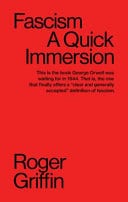
DESCRIPTION
Review
Handwrite First
Use this section with the book and notes closed. The goal is retrieval, not polish.
1. Before Reading
Prime your mind before reading.
- Prediction:
- Question I want answered:
- What I already think about this topic:
- What I expect to disagree with:
2. Closed-Book Recall Dump
Close the book and notes. Reconstruct what you read from memory.
-
Main points I remember:
-
Key examples, evidence, stories, or cases I remember:
-
Terms, people, dates, or concepts I remember:
-
-
What feels fuzzy or incomplete:
3. Core Argument From Memory
- The book/section in one sentence:
- Main claim:
- Problem the author is responding to:
- Why the author thinks this is true:
- Best evidence/example I remember:
- Conclusion the author wants the reader to accept:
4. Argument Map From Memory
5. Feynman Check
Explain the idea simply, as if teaching it to someone unfamiliar with the topic.
- Simple explanation:
- Analogy or concrete example:
- Where someone might misunderstand this:
6. Pushback From Memory
- Strongest objection or weakness:
- What evidence would weaken the author’s argument?
- What a rival thinker/book might say:
- My current judgment:
7. Personal Takeaway
- What changed, clarified, or challenged my thinking?
- What am I less certain about now?
- One way I could apply this:
- One question I need to keep investigating:
Type Into Obsidian
Use this section after handwriting. The goal is long-term storage, search, linking, and spaced review.
1. Correction After Checking Notes
Reopen the book/notes. Compare them against your handwritten recall.
- I forgot:
- I misunderstood:
- I overemphasized:
- I underemphasized:
- This needs review:
2. Clean Core Argument
- The book/section in one sentence:
- Main claim:
- Problem the author is responding to:
- Why the author thinks this is true:
- Best evidence/example:
- Conclusion the author wants the reader to accept:
3. What Actually Matters?
- Most important idea:
- Best quote or passage:
- Term/concept worth remembering:
- Most useful example:
- Most surprising point:
- One sentence I want to remember:
4. Connections
- Connects to:
- Fascism — the hub; Griffin’s definition anchors its “What Counts as Fascism?” table
- Griffin interview (The Moynihan Report, 2026) — Griffin applying this definition to Trump, populism, and “incurvation”
- Political Ideologies course — Fascism · Neo-fascism
- Supports:
- Challenges:
- Paxton — rebirth myth captures the core passion but needs an account of institutions and stages
- Alex argument map — the Marxist “agents theory” in contemporary form
- Reminds me of:
- Communism in Power — the sister ideology-in-power book in this folder
- Far Right & Woke Right (MOC) — contemporary groupuscular and online far-right material
- Possible future note:
- Palingenetic ultranationalism (atomic concept note, not yet created)
5. Clean Pushback
- Strongest objection or weakness:
- What evidence would weaken the author’s argument?
- What the author might say in response:
- What a rival thinker/book would say:
- My current judgment:
Retrieval Questions
Answer these without looking during future reviews.
Basic Recall
- What is the author’s main thesis?
- What problem is the author responding to?
- What are the 3–5 main claims?
- What are the key terms or concepts?
- What is the best example or piece of evidence?
Argument Reconstruction
- How does the author move from evidence to conclusion?
- What assumptions does the argument depend on?
- What would the argument look like in premise-conclusion form?
- What does the author want the reader to reject?
Comparison
- How does this book/section compare with [[]]?
- How does this support or challenge [[]]?
- Which thinker would agree with this?
- Which thinker would disagree with this?
Criticism
- What is the strongest objection?
- What evidence would weaken the argument?
- What does the author ignore, minimize, or assume?
- Is the author’s conclusion stronger than the evidence allows?
Synthesis
- How does this change my larger framework?
- Where does this fit in the broader historical/philosophical debate?
- What question should I ask next?
- What would I write about using this idea?
Flashcards / Atomic Recall
Use only for facts, definitions, distinctions, names, dates, and compact claims.
- Q:
- A:
- Q:
- A:
- Q:
- A:
Retention Check
24 Hours Later
- I can explain the main argument without notes.
- I remember the best example or evidence.
- I can define the key concept.
- I can state one objection.
24-hour recall notes:
- What I remembered:
- What I forgot:
- What needs another review:
1 Week Later
- I can summarize this in 5 sentences.
- I can reconstruct the argument.
- I can connect it to another book, thinker, or historical period.
- I can state whether I agree, disagree, or remain undecided.
1-week recall notes:
- What I remembered:
- What I forgot:
- New connection:
- Revised judgment:
1 Month Later
- I still remember the core argument.
- I can explain why this matters.
- I know whether this changed my larger framework.
- I know whether this is worth rereading, citing, or building into a permanent note.
1-month recall notes:
- What endured:
- What disappeared:
- What this changed:
- Next action:
Scratchpad
Unfiltered thoughts, questions, comparisons, argument trees, future writing ideas, or possible links.
Simplified rule
Handwrite
Use handwriting for:
- Before-reading predictions
- Closed-book recall dump
- Core argument from memory
- Argument map from memory
- Feynman explanation
- Initial pushback
- Personal takeaway
- Confusion list
These are the sections where the benefit comes from struggling to reconstruct the idea.
Type in Obsidian
Use Obsidian for:
- Corrections after checking notes
- Clean one-sentence thesis
- Clean argument summary
- Important quotes
- Key concepts
- Links to other notes
- Retrieval questions
- Flashcards
- Retention checks
- Review logs
- Scratchpad for future essays or synthesis
These are the sections where the benefit comes from searchability, linking, spaced review, and long-term organization.
Best workflow
Use this order:
1. Handwrite from memory.
2. Check the book/notes.
3. Type only the corrected, useful version into Obsidian.
4. Create retrieval questions.
5. Review those questions later without looking.
Do not type all your handwritten notes into Obsidian. That turns the system into transcription work. Only transfer what is worth preserving, linking, or reviewing.
Notes
Handwritten Notes (Notebook pp. 27–28)
Notebook pages (reference images)
Current notebook (September 2026 onward), pp. 27–28. These pages are not yet in a scanned notebook PDF or indexed in Personal Journal.
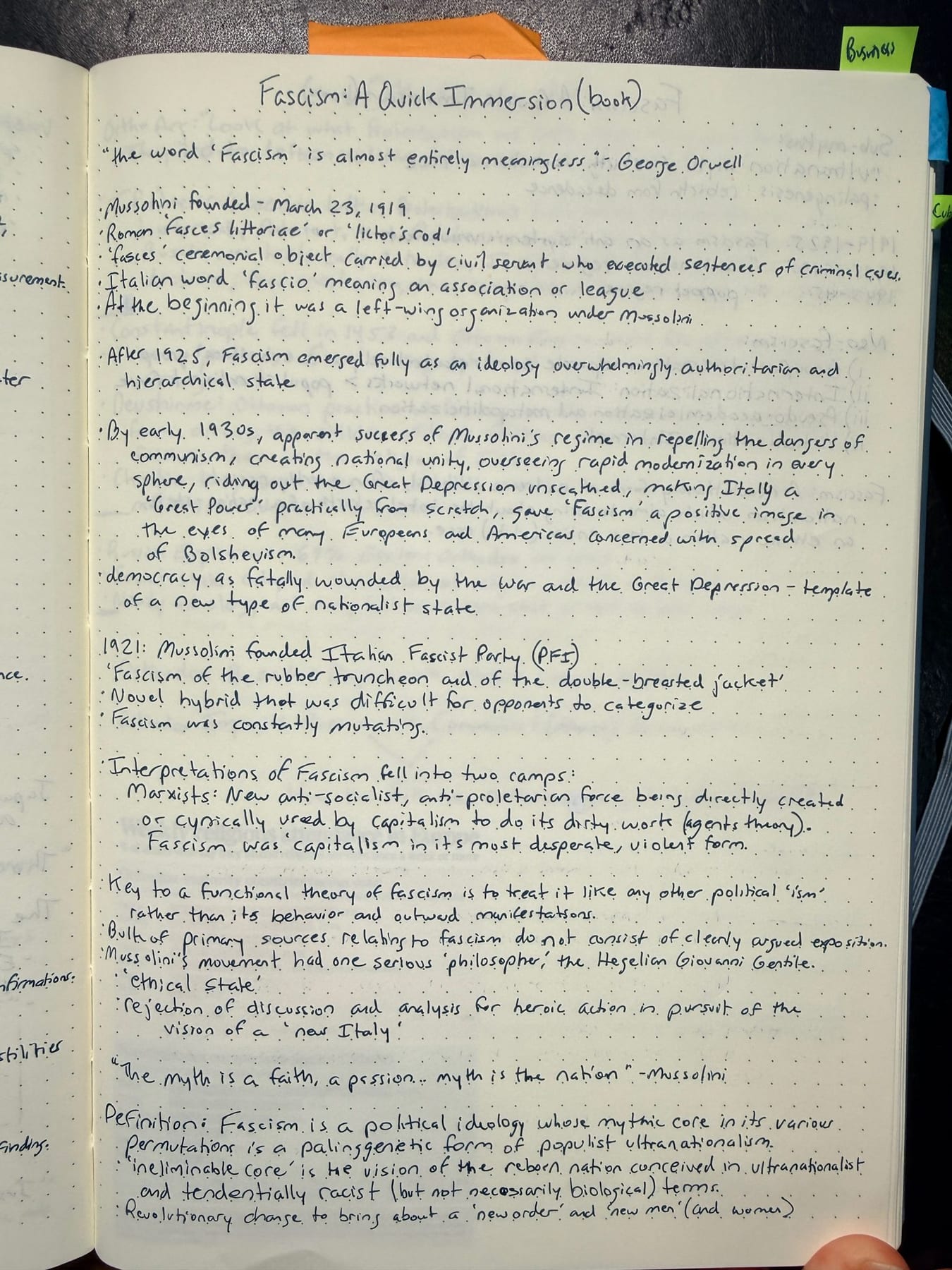
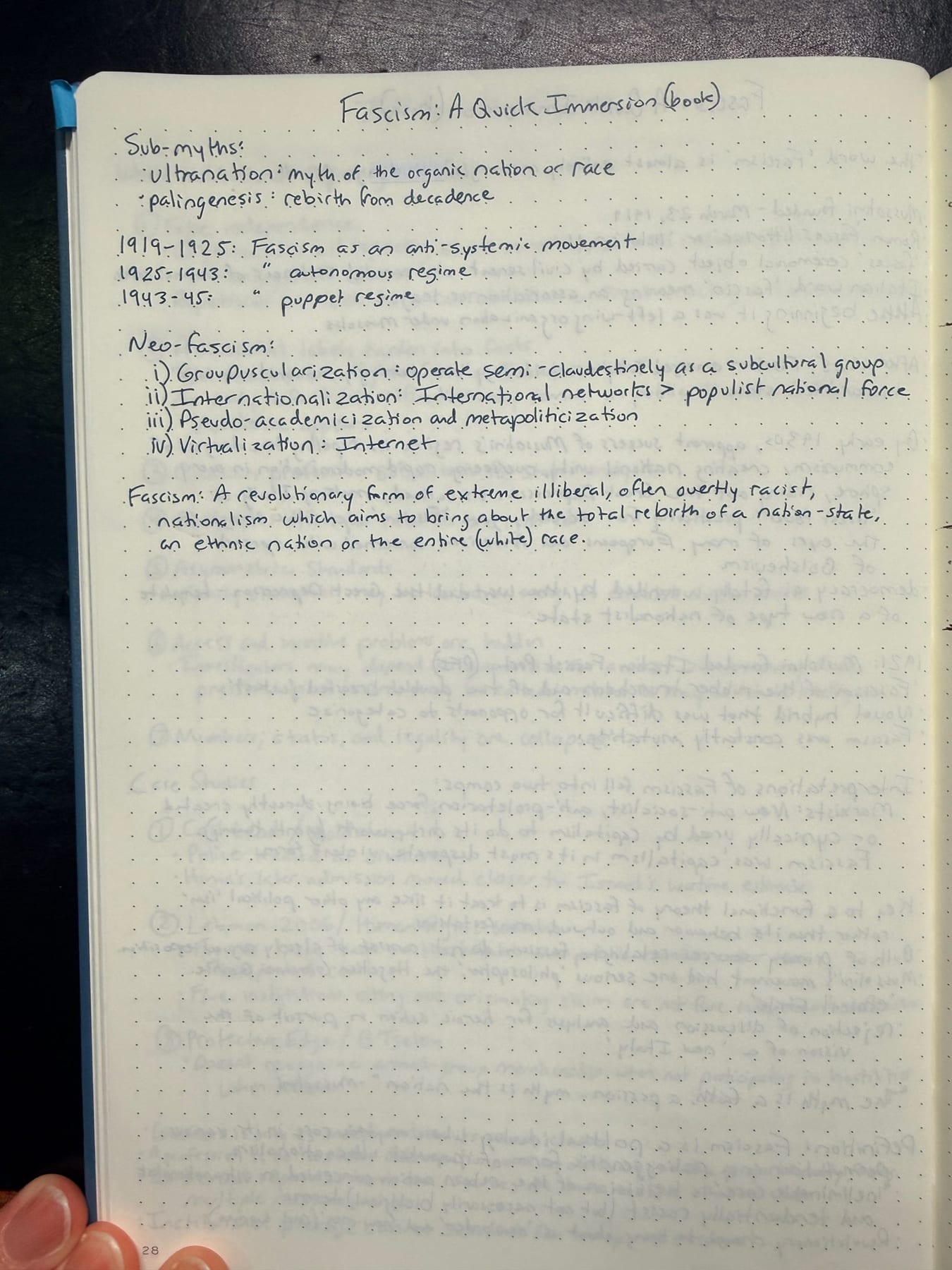
Transcribed from the notebook and grouped by theme. Wording is kept as written; bracketed text marks transcription expansions or corrections, which are explained under Transcription checks.
The word and its origins
“the word ‘Fascism’ is almost entirely meaningless” — George Orwell
- Mussolini founded [the movement] — March 23, 1919
- Roman fasces littoriae [lictoriae] or “lictor’s rod”
- Fasces: ceremonial object carried by [a] civil servant who executed sentences of criminal cases
- Italian word fascio, meaning an association or league
- At the beginning it was a left-wing organization under Mussolini
Italian Fascism: from movement to regime
| Years | Phase |
|---|---|
| 1919–1925 | Fascism as an anti-systemic movement |
| 1925–1943 | Fascism as an autonomous regime |
| 1943–45 | Fascism as a puppet regime [the Salò Republic under German control] |
- 1921: Mussolini founded [the] Italian Fascist Party (PFI) [PNF]
- “Fascism of the rubber truncheon and of the double-breasted jacket”
- novel hybrid that was difficult for opponents to categorize
- Fascism was constantly mutating
- After 1925, Fascism emerged fully as an ideology [of an] overwhelmingly authoritarian and hierarchical state
Interwar appeal
- By [the] early 1930s, [the] apparent success of Mussolini’s regime in repelling the dangers of communism, creating national unity, overseeing rapid modernization in every sphere, riding out the Great Depression unscathed, [and] making Italy a “Great Power” practically from scratch gave “Fascism” a positive image in the eyes of many Europeans and Americans concerned with [the] spread of Bolshevism.
- Democracy [was seen] as fatally wounded by the war and the Great Depression; [Fascism offered a] template of a new type of nationalist state.
Interpretations of fascism
Interpretations of Fascism fell into two camps:
- Marxists: [Fascism was a] new anti-socialist, anti-proletarian force being directly created or cynically used by capitalism to do its dirty work (“agents theory”). Fascism was “capitalism in its most desperate, violent form.”
- [The second camp is not recorded on these pages.]
Treating fascism as an ideology
- [The] key to a functional theory of fascism is to treat it like any other political “ism,” rather than [defining it by] its behavior and outward manifestations.
- [The] bulk of primary sources relating to fascism do not consist of clearly argued exposition.
- Mussolini’s movement had one serious “philosopher,” the Hegelian Giovanni Gentile:
- [the] “ethical state”
- rejection of discussion and analysis for heroic action in pursuit of the vision of a “new Italy”
“The myth is a faith, a passion … myth is the nation” — Mussolini
Griffin’s definition
Definition: palingenetic ultranationalism
Fascism is a political ideology whose mythic core in its various permutations is a palingenetic form of populist ultranationalism.
- [Its] “ineliminable core” is the vision of the reborn nation conceived in ultranationalist and tendentially racist (but not necessarily biological) terms.
- Revolutionary change to bring about a “new order” and “new men” (and women).
Working definition (p. 28): Fascism: a revolutionary form of extreme illiberal, often overtly racist, nationalism which aims to bring about the total rebirth of a nation-state, an ethnic nation or the entire (white) race.
Sub-myths:
- Ultranation[alism]: myth of the organic nation or race
- Palingenesis: rebirth from decadence
Neo-fascism
Four trends in post-war fascism:
- Groupuscularization: operate semi-clandestinely as a subcultural group
- Internationalization: international networks > populist national force
- Pseudo-academicization and metapoliticization
- Virtualization: [the] Internet
Transcription checks
Corrections and context to verify against the book
- Party name: The party founded in November 1921 was the Partito Nazionale Fascista (PNF), not “PFI.” The March 23, 1919 founding was of the Fasci Italiani di Combattimento in Milan’s Piazza San Sepolcro.
- Spelling: The Latin is fasces lictoriae. Lictors were the attendants of Roman magistrates who carried the fasces and carried out punishments.
- “Left-wing at the beginning”: This needs qualifying. Mussolini was a former Socialist, and the 1919 program mixed nationalist demands with radical social ones. By 1920–21, however, the squads were violently attacking socialists and unions. Check how Griffin himself phrases it.
- Orwell, exact wording: “It will be seen that, as used, the word ‘Fascism’ is almost entirely meaningless.” From “What is Fascism?”, Tribune, 1944 (text).
- Mussolini, fuller wording: “We have created our myth. The myth is a faith, a passion. It is not necessary for it to be a reality…. Our myth is the nation, our myth is the greatness of the nation!” From his speech to the Fascist Congress in Naples, October 1922, as quoted in Jason Stanley, How Fascism Works (2018).
- Definition source: The palingenetic-ultranationalism definition originates in Griffin’s The Nature of Fascism (1991), where it reads “a genus of political ideology.” The notebook wording follows the Quick Immersion presentation.
- Gap: Only the Marxist camp of interpretation is recorded. Add the second camp from the book.