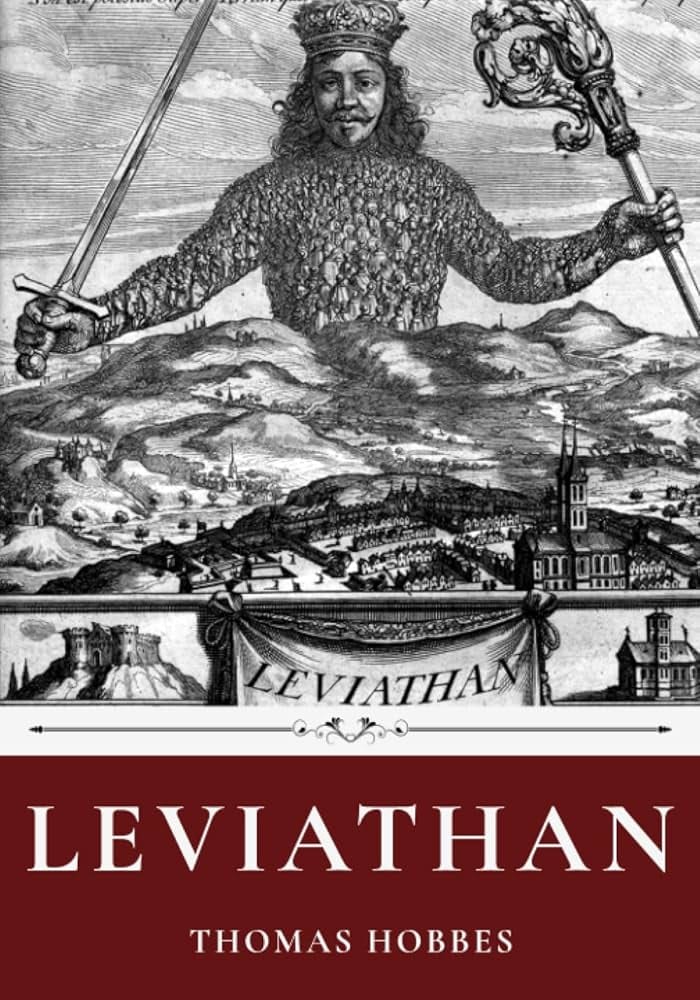

DESCRIPTION
Designed to meet the needs of both student and scholar, this edition of Leviathan offers a brilliant introduction by Edwin Curley, modernized spelling and punctuation of the text, and the inclusion, along with historical and interpretive notes, of the most significant variants between the English version of 1651 and the Latin version of 1668. A glossary of seventeenth-century English terms, and indexes of persons, subjects, and scriptural passages help make this the most thoughtfully conceived edition of Leviathan available.
Hobbes- Leviathan- Revised student edition (Cambridge Texts — Thomas Hobbes; edited by Richard Tuck — 2nd Revised ed.pdf (file not included in this release)
My Summary
AI Summary
Introduction
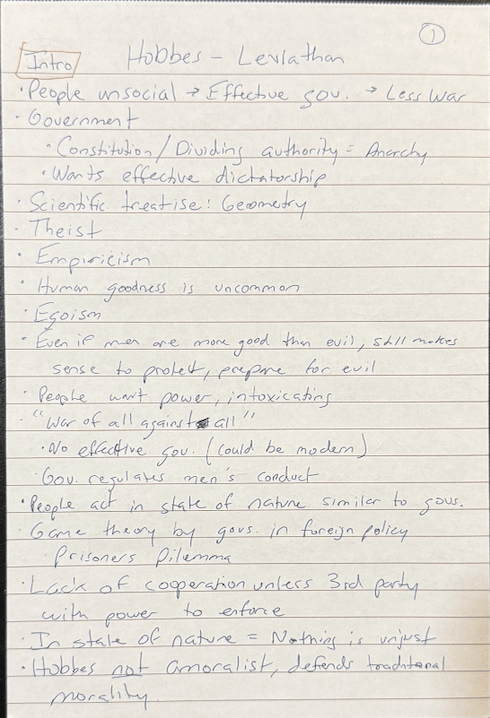
1. The Purpose and Method of Leviathan
- Hobbes aims to create a scientific foundation for civil philosophy, modeled on geometry.
- Just as geometry builds from clear definitions, Hobbes begins by defining key concepts (voluntary action, good, obligation, justice) and derives political conclusions from them .
- His approach is reformist in definitions: he deliberately redefines contested terms to avoid confusion and to build a coherent system, even if this differs from common usage (e.g., will, justice, law of nature, conscience, religion vs superstition) .
2. Human Thought and Language
- Thought is the product of sense impressions: images left in the mind by external objects acting on the body.
- Language enables humans to connect thoughts and form science, but misuse of words produces nonsense, error, and superstition .
- Hobbes criticizes scholastic philosophy for using meaningless terms (e.g., “incorporeal substance”) .
3. Religion, God, and Controversy
- Hobbes often treats religious concepts materialistically. He implies that calling God an “incorporeal substance” is contradictory, suggesting instead that if God exists, He must in some sense be corporeal .
- This position led to charges of atheism. Hobbes oscillates between affirming God’s existence by natural reason and reducing religious concepts to political constructs .
- Religion vs superstition: depends on what rulers permit to be taught (showing Hobbes’ relativism about religious truth) .
4. Human Nature: Desires and Passions
- Hobbes is a realist about human nature: people act primarily from self-interest.
- Voluntary action is defined as the pursuit of perceived good for oneself; thus egoism is built into his definitions .
- Core desires:
- Self-preservation (fear of death is powerful, but not always overriding).
- Honor and glory (often stronger than the fear of death).
- Power: a “perpetual and restless desire of power after power, that ceaseth only in death” (11.2) .
5. State of Nature and War of All Against All
- In the absence of government, humans live in a state of nature: no laws, no justice, no security.
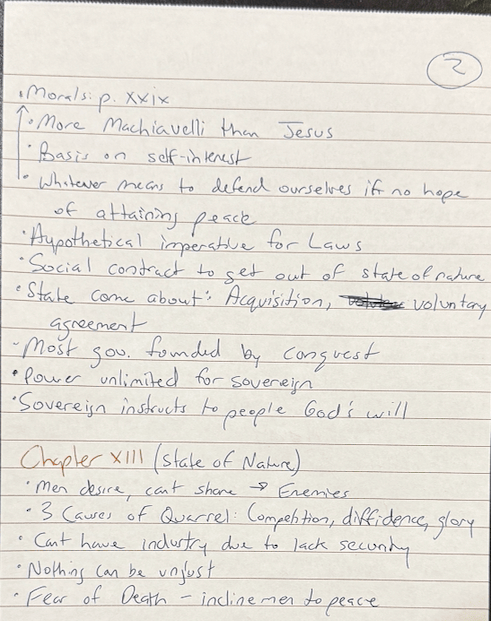
- This condition is a state of war, defined not only by actual fighting but by the constant threat and disposition to violence (13.8) .
- Causes of conflict:
- Competition (for gain).
- Diffidence (fear/mistrust).
- Glory (honor, reputation).
- Life in this state is “solitary, poor, nasty, brutish, and short” (13.9) .
6. Laws of Nature and the Problem of Cooperation
- Even in the state of nature, reason dictates laws of nature (rules for peace and cooperation):
- Seek peace when possible.
- Lay down rights when others will too.
- Keep covenants.
- Show gratitude, accommodate others, pardon offenses, etc.
- But covenants without enforcement are fragile: “Covenants without the sword are but words” (17.2) .
- The “Fool” denies justice, claiming it’s rational to break promises when advantageous. Hobbes counters that breaking faith undermines long-term survival, making it contrary to reason .
7. Why Government is Necessary
- Without a sovereign authority, cooperation is unstable (like the logic of a Prisoner’s Dilemma).
- Only an absolute sovereign can guarantee peace by enforcing covenants.
- Hence the argument builds: from definitions → human passions → state of nature → laws of nature → need for a common power.
Overall
This section sets up Hobbes’ system:
- Start with a scientific method (geometry of politics).
- Define human thought and passions in materialist terms.
- Show that egoism and fear lead to insecurity in the state of nature.
- Derive laws of nature, but argue they need enforcement.
- Conclude that only an absolute sovereign can make stable peace.
Part I: Of Man
Human Nature and the State of Nature
- Human beings are driven by passions and self-interest, chiefly self-preservation and power (1.6, 1.10).
- Natural equality of strength and prudence makes conflict inevitable (13.1–2).
- In the state of nature, there is a “war of every man against every man,” where life is “solitary, poor, nasty, brutish, and short” (13.8–9).
- The laws of nature include seeking peace, keeping covenants, gratitude, justice, etc. (14–15).
Formation of the Commonwealth
- The state is an artificial man: sovereignty is its soul, magistrates its joints, and laws its reason (Introduction, 1–2).
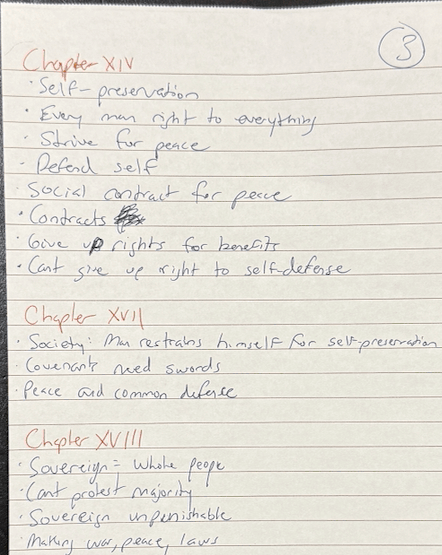
- To escape the state of nature, men covenant to authorize a sovereign who holds all power (17.1–13).
- Sovereignty must be absolute and indivisible; divided authority leads back to conflict (18.1–3; 19.1–2).
Sovereignty and Obedience
- Subjects owe “simple obedience” to the sovereign, since any effective government is preferable to anarchy (18.6; 19.9).
- The sovereign holds power over law, judgment, war, taxation, and religion (18.9–18).
- Liberty of subjects means freedom in matters not regulated by law — “the silence of the law” (21.6).
- Civil law is the command of the sovereign; without enforcement, contracts are void (26.1–2).
- A state dissolves when sovereign power cannot protect its people, returning them to the state of nature (29.1–3).
Religion and the Christian Commonwealth
- Scripture’s authority depends on sovereign interpretation to avoid sectarian strife (32.1; 33.1–2).
- The Kingdom of God is not a present church government but a future reality; until then, religion must obey civil authority (35.1–3).
- Prophecy, miracles, and sacraments cannot establish power apart from the sovereign (36–38).
- Christ’s authority is mediated through sovereign rulers; the Church has no independent jurisdiction (41.4; 42.1–5).
Kingdom of Darkness
- Darkness arises from:
- Misinterpretation of Scripture (44.1–3),
- Pagan superstition and demonology (45.1–2),
- Vain philosophy and scholastic traditions (46.14–30).
- Those who profit from darkness are clergy and philosophers claiming authority outside the sovereign (47.1–4).
- State of Nature:
“The life of man [is] solitary, poor, nasty, brutish, and short.” — 13.9 - On human action:
“Of the voluntary actions of every man, the object is some good to himself.” — 14.8 - On covenants:
“Covenants without the sword are but words, and of no strength to secure a man at all.” — 17.2 - On sovereignty:
Institution of Leviathan as a “mortal god” — 17.13 - On liberty:
“Liberty… is the silence of the law.” — 21.6 - On Scripture and authority:
Sovereign as interpreter of Scripture — 33.1–2; 42.1 - On spiritual darkness:
“Of spiritual darkness from misinterpretation of Scripture” — 44.1
“Of demonology and relics of the religion of the Gentiles” — 45.1
“Of darkness from vain philosophy” — 46.14–30
Part 2: On Commonwealth
The Generation of Commonwealth
- Men create commonwealths to escape the insecurity of the state of nature and obtain peace and defense (17.1–2).
- Mere numbers or agreements without coercive power cannot secure peace; unity requires a sovereign power(17.3–12).
- The covenant: each individual authorizes one man or assembly to act in their name, forming one political person — the Leviathan, “that Mortal God” (17.13).
- Sovereignty may arise either by institution (voluntary covenant) or acquisition (through force) (17.15).
Rights of Sovereigns by Institution
- Subjects cannot lawfully change the form of government (18.3).
- Sovereign cannot forfeit power or be accused of injustice (18.4–6).
- The sovereign is unpunishable by subjects (18.7).
- Sovereign decides on peace, defense, doctrines, censorship, property, and laws (18.8–12).
- Sovereign controls war, taxation, appointment of officials, rewards, punishments, and honors (18.12–15).
- These rights are indivisible and inseparable; division leads to civil war (18.16–18).
Several Kinds of Commonwealth
- Three forms only: Monarchy, Democracy, Aristocracy (19.1).
- Tyranny/oligarchy are pejorative labels, not separate systems (19.2).
- All forms hold the same power, but monarchy is most effective for unity of public and private interest (19.4).
- Monarchies allow secrecy, speed, and consistency in decision-making; assemblies are prone to division, inconstancy, and corruption (19.5–7).
- Objection: monarchy risks favoritism or infant rulers; Hobbes replies that assemblies have equal or worse defects (19.8–9).
- Sovereignty must include control of succession to preserve political continuity (19.14–15).
Dominion Paternal and Despotical
- Commonwealths by acquisition are formed when people submit out of fear to conquerors or masters (20.1–2).
- Sovereign rights are the same whether by institution or acquisition (20.3).
- Paternal dominion is by consent of children, not generation; authority may belong to father or mother depending on custom or law (20.4).
- Despotic dominion arises when captives consent to obey conquerors for survival (20.10–11).
- On covenants and power:
“Covenants without the sword are but words, and of no strength to secure a man at all.” — 17.2 - On the Leviathan:
“This is the generation of that great Leviathan, or rather (to speak more reverently) of that Mortal God to which we owe… our peace and defence.” — 17.13 - On the institution of sovereignty:
“A commonwealth is said to be instituted, when a multitude of men do agree and covenant… that to whatsoever man or assembly of men shall be given by the major part the right to present the person of them all… every one shall authorize all the actions and judgments of that man or assembly.” — 18.1 - On the indivisibility of sovereignty:
“These are the rights which make the essence of sovereignty… and which are incommunicable and inseparable.” — 18.16 - On monarchy’s superiority:
“In monarchy the private interest is the same with the public… the riches, power, and honour of a monarch arise only from the riches, strength and reputation of his subjects.” — 19.4 - On succession:
“This artificial eternity is that which men call the right of succession.” — 19.14 - On paternal power:
“The right of dominion by generation is… not from the generation… but from the child’s consent, either express or by other sufficient arguments declared.” — 20.4
Part III: On the Christian Commonwealth
Principles of Christian Politics
- Sovereignty in a Christian commonwealth rests not only on natural law but also on prophetic revelation, interpreted under civil authority (32.1).
- Reason and Scripture do not contradict; mysteries above reason must still be accepted, but never against reason (32.2–3).
- Claims of private revelation, dreams, or inspiration cannot obligate belief or obedience; only sovereign authority can command obedience (32.5–6).
- A true prophet must show both a miracle and teach doctrine consistent with established religion; neither is sufficient alone (32.7–8).
- Since miracles have ceased, the only rule of faith is Holy Scripture, to be interpreted under sovereign authority (32.9).
Authority of Scripture
- Scripture is law only when made so by the sovereign; canonical authority is political, not inherent (33.1–2).
- Books of the Old and New Testament were written after the events they describe; their authority derives from recognition by the sovereign power (33.3–20).
- The scope of Scripture is to direct men to obedience to God, through priests, Christ, and apostles; its unity of purpose proves divine authorship (33.20).
- The question of scriptural authority reduces to this: Are Christian kings absolute in their territories, or subject to a universal church? Hobbes answers: kings are supreme (33.21–25).
Interpretation of Key Religious Terms
- Words like “spirit,” “angel,” and “inspiration” must be understood materially or metaphorically, not as incorporeal substances (34.1–7).
- Angels are simply messengers of God’s will, often images or visions raised in the fancy, not independent incorporeal beings (34.16–19).
- The “Kingdom of God” in Scripture often means a civil-political kingdom, not an invisible spiritual realm (35.1–5).
Christ’s Authority and the Christian Commonwealth
- Christ is king by divine appointment; obedience to him was required of the Jews as Messiah (36.1–4).
- During his earthly life, Christ ruled directly, but after his ascension, authority was mediated through apostles, and later through sovereign rulers of Christian states (36.8–10).
- The keys of the kingdom (power of binding and loosing) belong to sovereign rulers, not independent clergy (37.1–3).
- Sacraments (baptism, Eucharist) are signs of obedience to Christ but derive their authority from civil power, not from priests alone (38.1–4).
Ecclesiastical Power
- There is no separate spiritual authority above the civil sovereign (42.1–5).
- Clergy cannot claim power independent of kings; church and commonwealth are the same entity under one sovereign (42.8–12).
- To admit papal or clerical supremacy is to undermine civil peace and return to the causes of division (42.15–18).
- On reason and revelation:
“Though there be many things in God’s word above reason… yet there is nothing contrary to it.” — 32.2 - On private revelation:
“To say God hath spoken to a man in a dream is no more than to say he dreamed God spake to him.” — 32.6 - On prophecy and miracles:
“Miracles alone are not sufficient… the true prophet must both do a miracle and teach the doctrine already established.” — 32.7–8 - On Scripture’s authority:
“Those books only are canonical in every nation which are established for such by the sovereign authority.” — 33.1 - On authorship of the Pentateuch:
“It is manifest that those words [about Moses’ sepulchre] were written after his interment.” — 33.4 - On unity of Scripture:
“The scope… is the setting forth of the rights of the kingdom of God, the Father, Son, and Holy Ghost.” — 33.20 - On sovereignty vs. church power:
“The question… is whether Christian kings be absolute in their own territories, immediately under God, or subject to one vicar of Christ over the universal church.” — 33.22 - On angels:
“In most places… angel means some image raised in the fancy, to signify God’s presence.” — 34.19 - On Christ’s authority:
“The keys of the kingdom of heaven are… the power to teach, absolve, and bind; which power belongeth not to any priest alone, but to the sovereign.” — 37.3 - On ecclesiastical power:
“A church and a commonwealth are the same thing… united under one Christian sovereign.” — 42.8
Part IV: Of the Kingdom of Darkness
Nature of the Kingdom of Darkness
- The “kingdom of darkness” is not a literal realm of demons but a confederacy of deceivers who use false doctrines to obscure natural and revealed truth (44.1).
- Darkness comes from misinterpretation of Scripture, pagan demonology, Greek philosophy (especially Aristotle), and false traditions (44.3).
- The greatest abuse of Scripture is equating the kingdom of God with the present Church, giving clerics and popes a false claim to rule over sovereigns (44.4–6).
Clerical Power and Papal Authority
- The Pope’s claim to be Christ’s vicar and to absolve subjects from obedience to kings is a dangerous corruption (44.6).
- From this error arose:
- the division of civil vs. canon law,
- the demand of tithes as divine right,
- ecclesiastical exemptions from civil justice,
- persecution of non-Catholics as rebels against papal authority (44.7–10).
Abuse of Sacraments and Rites
- Consecration has been turned into conjuration and incantation—pretending bread and wine become Christ’s body (transubstantiation) is idolatry (44.11).
- Baptism, marriage, unction, and consecrations were likewise filled with magical rites and exorcisms, contrary to Scripture (44.12–13).
Errors on the Soul and Afterlife
- Misinterpretation of “soul” and “eternal life” led to belief in natural immortality of the soul, contrary to Scripture (44.14–15).
- From this error followed doctrines of eternal torments, purgatory, ghosts, invocation of saints, indulgences, and exorcisms (44.16).
- Hobbes argues Scripture shows souls are not naturally immortal; resurrection and eternal life are by grace only (44.23–29).
Refutation of Purgatory
- Texts used for purgatory are misread; fasting and mourning (e.g., David for Saul, Jonathan, Abner) were acts of honor, not prayers for souls (44.30–31).
- New Testament passages (e.g., Matthew 12:32; 1 Corinthians 15:29) do not prove purgatory but have alternative explanations (44.32–34).
Final Critique
- The kingdom of darkness thrives wherever false philosophy and clerical ambition obscure obedience to the sovereign and true religion (44–47).
- True light comes only from reason and Scripture as interpreted under civil authority.
- Definition of the kingdom of darkness:
“The kingdom of darkness… is nothing else but a confederacy of deceivers that… by dark and erroneous doctrines… extinguish in men the light both of nature and of the gospel.” — 44.1 - Sources of corruption:
“The enemy… abused Scripture; introduced the demonology of heathen poets… mingled Greek philosophy… and false traditions.” — 44.3 - On the kingdom of God not being the present Church:
“The kingdom of God is not yet come… we are now under no other kings by pact but our civil sovereigns.” — 44.4 - On papal power:
“If a king… do not purge his kingdom of heresies… his subjects are absolved of the bond of their obedience.” — 44.6 - On clergy as ‘clergy’:
“From this mistaking… pastors, deacons, and ministers took the name of clergy, obliging the people everywhere to double tribute.” — 44.7 - On transubstantiation:
“This daily act of the priest… turneth the bread into a man, nay more, into a God, and requireth men to worship it.” — 44.11 - On immortality of the soul:
“The soul, in Scripture, signifieth always either the life or the living creature… nowhere do we read of an immortal soul.” — 44.15 - On eternal punishment:
“The elect are the only children of the resurrection… To the reprobate remaineth a second and eternal death.” — 44.29 - On purgatory:
“There is neither the word nor the thing of purgatory… neither in this nor any other text.” — 44.32