Haidt, Chapter 12 — liberty as a sacred value and markets as discovery
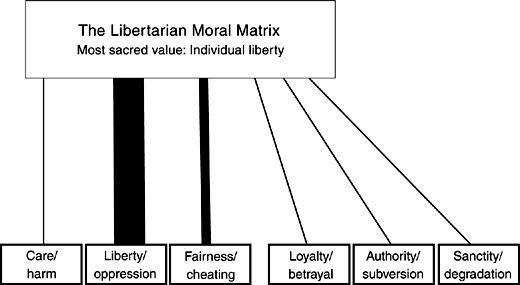
Haidt’s source-era YourMorals comparison places libertarians near liberals in openness and low Loyalty, Authority, and Sanctity, but lower than both major coalitions on Care and exceptionally high on economic liberty. Figure 12.3 is a schematic group profile, not an individual classifier: the underlying project compared about 12,000 self-selected libertarians with tens of thousands of other voluntary visitors.
The strongest libertarian insight in the chapter is institutional. Prices, choice, rivalry, and responsibility for trade-offs combine dispersed information and make experimentation possible. David Goldhill’s inquiry after his father died from a hospital-acquired infection becomes Haidt’s example: routine third-party payment can make providers optimize reimbursement rather than price, quality, or user value. The can-of-peas analogy is illuminating but incomplete because emergency care, expertise asymmetry, risk pooling, public health, and unequal ability to pay differ from grocery shopping. Haidt’s endnote also says Goldhill retains government roles in safety, competition, catastrophic pooling, and subsidy for people unable to afford care. The infection, checklist, and LASIK figures are historical claims, not current statistics. Libertarian history and source-era profile, PDF pp. 338–340 (file not included in this release) · Figure 12.3 and Goldhill, PDF pp. 340–342 (file not included in this release) · Goldhill’s retained government roles, endnote 65, PDF p. 431 (file not included in this release) · Chapter 12 source audit
Main Ideas of Libertarianism
Libertarianism is a political philosophy that prioritizes individual liberty, limited government, and free markets. While there are different strains (e.g. right-libertarianism, left-libertarianism, anarcho-capitalism), the core ideas include:
1. Individual Liberty
- People have natural rights—especially to life, liberty, and property.
- Freedom from coercion is paramount; the government’s role is only to protect these rights.
2. Self-Ownership
- Individuals own themselves and the fruits of their labor.
- No one has the right to initiate force against another.
3. Private Property
- Property rights are extensions of self-ownership.
- Most libertarians view property acquisition as legitimate through homesteading, voluntary exchange, or gift.
4. Free Markets
- Economic activity should be voluntary and unregulated.
- Markets, not governments, are seen as the best mechanisms for allocating resources.
5. Limited Government / Non-Aggression Principle (NAP)
- The state should be restricted to protecting rights via police, courts, and national defense.
- Some libertarians argue for no state at all (anarcho-capitalists).
https://www.cato.org/commentary/key-concepts-libertarianism
What is a libertarian?
Key Concepts of Libertarianism
Libertarianism (Stanford Encyclopedia of Philosophy)
Philosophical Roots & Influences
| Philosopher | Contribution |
|---|---|
| John Locke | Natural rights theory; social contract; private property as derived from labor. |
| Adam Smith | Economic liberalism; the “invisible hand” of markets. |
| David Hume | Limited government; skepticism of central planning. |
| John Stuart Mill | Individual liberty; harm principle (though more moderate). |
| Frédéric Bastiat | Defense of free markets; critique of legal plunder. |
| Herbert Spencer | Social Darwinism; minimal state. |
| Ludwig von Mises | Austrian economics; economic calculation problem. |
| F.A. Hayek | Knowledge problem; critique of socialism. |
| Murray Rothbard | Anarcho-capitalism; natural rights; ethics of liberty. |
| Robert Nozick | Libertarian justice theory; minimal state justified if it arises without violating rights. |
🏛️ Ancient Foundations
- Socrates (c. 470–399 BCE): While not a libertarian, Socrates’ method of critical inquiry laid the groundwork for individual reasoning and skepticism of authority.
- Laozi (6th century BCE): The Chinese philosopher advocated for minimal government intervention, suggesting that rulers should “do nothing” to allow natural harmony—a concept resonating with libertarian ideals.(Wikipedia)
📜 Classical Liberalism and Enlightenment Thinkers
- John Locke (1632–1704): Often dubbed the “Father of Liberalism,” Locke’s theories on natural rights, property, and government’s role in protecting individual freedoms heavily influenced libertarian thought.(Encyclopedia Britannica)
- Adam Smith (1723–1790): His seminal work, The Wealth of Nations, championed free markets and the “invisible hand” guiding economic prosperity without government interference.
- Thomas Paine (1737–1809): An advocate for individual rights and limited government, Paine’s writings, including Common Sense, inspired democratic revolutions and libertarian principles.
🏛️ 19th-Century Individualists
- Lysander Spooner (1808–1887): A staunch opponent of slavery and advocate for natural law, Spooner challenged state authority and promoted individual sovereignty.
- Benjamin Tucker (1854–1939): Through his publication Liberty, Tucker disseminated individualist anarchist ideas, emphasizing voluntary cooperation over state control.(The Anarchist Library)
📘 20th-Century Libertarian Thinkers
- Friedrich Hayek (1899–1992): In The Road to Serfdom, Hayek warned against central planning and highlighted the importance of spontaneous order in free societies.(Wikipedia)
- Ayn Rand (1905–1982): Her philosophy of Objectivism, presented in novels like Atlas Shrugged, underscored rational self-interest and capitalism as moral imperatives.
- Murray Rothbard (1926–1995): A leading figure in anarcho-capitalism, Rothbard combined Austrian economics with a radical vision of a stateless society grounded in voluntary exchanges.(Investopedia)
- Robert Nozick (1938–2002): In Anarchy, State, and Utopia, Nozick defended a minimal state limited to protecting individual rights, challenging redistributive justice theories.(Wikipedia)
🧭 Visual Representation
To visualize the progression of libertarian thought, consider this simplified timeline:
Socrates (470–399 BCE)
      ↓
Laozi (6th century BCE)
      ↓
John Locke (1632–1704)
      ↓
Adam Smith (1723–1790)
      ↓
Thomas Paine (1737–1809)
      ↓
Lysander Spooner (1808–1887)
      ↓
Benjamin Tucker (1854–1939)
      ↓
Friedrich Hayek (1899–1992)
      ↓
Ayn Rand (1905–1982)
      ↓
Murray Rothbard (1926–1995)
      ↓
Robert Nozick (1938–2002)
📚 Further Reading
For those interested in delving deeper into libertarian philosophy, here are some recommended resources:
- The Libertarian Reader: Classic & Contemporary Writings: Edited by David Boaz, this anthology compiles seminal texts from various thinkers, providing a comprehensive overview of libertarian ideas.(Wikipedia)
- Man, Economy, and State: Murray Rothbard’s treatise offers an in-depth exploration of Austrian economics and its implications for a free society.
- Atlas Shrugged: Ayn Rand’s novel presents her Objectivist philosophy through a compelling narrative, illustrating the role of individualism in society.
- The Encyclopedia of Libertarianism: This reference work provides detailed entries on key concepts, figures, and movements within libertarian thought.
- Charts of Philosophy and Philosophers: For visual learners, this resource maps out philosophical developments, including those pertinent to libertarianism.
This lineage underscores the evolution of libertarianism from ancient philosophical inquiries into the nature of freedom and governance to contemporary debates on the role of the state and individual rights.
Timeline of Libertarianism
17th–18th Century: Classical Liberalism
- John Locke (1632–1704) lays the groundwork for property rights and limited government.
- Enlightenment values (reason, individualism) fuel early classical liberal thought.
19th Century
- Adam Smith, Bastiat, and Mill advocate for laissez-faire economics and civil liberties.
- Emphasis is on liberty from monarchy and feudal systems.
Early 20th Century
- Rise of state power (e.g. WWI, welfare state) prompts defense of classical liberalism.
- Ludwig von Mises (1920s–40s) argues that socialism cannot allocate resources efficiently.
Mid-20th Century Libertarian Revival
- F.A. Hayek publishes The Road to Serfdom (1944), warning against central planning.
- Ayn Rand promotes radical individualism and capitalism via Objectivism.
- Murray Rothbard founds anarcho-capitalism, blending Austrian economics and natural rights.
- Robert Nozick’s Anarchy, State, and Utopia (1974) challenges Rawls and defends a minimal state.
Late 20th Century to Present
- Think tanks like Cato Institute and Reason Foundation promote libertarian policies.
- Political figures: Ron Paul, Gary Johnson, David Boaz.
- Popularization through internet activism, crypto-libertarian movements, and anti-war stances.
Key Figures in Modern Libertarianism
| Name | Contribution |
|---|---|
| Murray Rothbard | Architect of anarcho-capitalism; Man, Economy, and State. |
| Robert Nozick | Anarchy, State, and Utopia; justification of the minimal state. |
| Ayn Rand | Objectivist ethics; rational egoism; novels like Atlas Shrugged. |
| Milton Friedman | Monetarist economist; advocate of school choice and free markets. |
| F.A. Hayek | Classical liberalism; spontaneous order; The Constitution of Liberty. |
| Ron Paul | Politician; anti-war, anti-Fed, pro-gold standard. |
| David Boaz | Intellectual leader at Cato Institute; author of The Libertarian Mind. |
Main Critiques of Libertarianism
1. Inequality and Social Justice
- Critics argue that unregulated markets lead to extreme inequality.
- Rawlsian liberals contend that justice requires redistribution to benefit the least well-off.
2. Public Goods and Externalities
- Libertarians struggle to justify provision of public goods (e.g. roads, defense, environment).
- Critics argue markets alone cannot solve problems like pollution or pandemics.
3. Historical Injustice
- Libertarians often ignore the legacy of colonialism, slavery, and systemic inequality, which complicate claims to property rights.
- Left-libertarians seek to address this by emphasizing equal access to natural resources.
4. Anarcho-Capitalist Utopianism
- Critics see anarcho-capitalism as impractical or naïve.
- Concerns about private defense firms, justice inequality, and potential for monopoly.
5. Lack of Communal Ethics
- Emphasis on individualism may erode social bonds, solidarity, or shared purpose.
- Some argue it leads to consumerism and alienation.
6. Minimalist View of the State
- Critics from both right and left argue that the state has a moral and practical role in securing education, healthcare, infrastructure, etc.
Variants of Libertarianism
| Type | Description |
|---|---|
| Right-libertarianism | Emphasizes property rights, capitalism, and minimal state. Most prominent in the U.S. |
| Left-libertarianism | Stresses equal access to natural resources, critiques capitalism from a pro-liberty lens. |
| Anarcho-capitalism | Advocates for eliminating the state entirely in favor of market-based private governance. |
| Geolibertarianism | Based on Henry George’s idea that land value should be taxed to ensure fairness. |
| Minarchism | Supports a minimal state limited to protecting life, liberty, and property. |
Look Into:
- Andrew Wilson vs Dave Smith - Libertarianism and Christian Populism Argument Map
- Full transcript-based map of the self-ownership, non-aggression, moral-realism, legal-moralism, taxation, conscription, and institutional-capture disputes.
- Original debate on YouTube
- Related X post
- Non-aggression principle
Mises Institute
Mises Caucus - Wikipedia
Mises Caucus - Wikipedia > Political positions
Into the Mainstream > **Ludwig von Mises Institute**
Transclude of into-the-mainstream#^thn96g
Transclude of into-the-mainstream#^i2d8zr
Inside the Battle Over the Soul of the Libertarian Party
Libertarian Party Rebuffs Mises Uprising
The Wrong Narrative in Charlottesville
Cancel Culture
Walter Block is cancelled for supporting Israel - YouTube
- Youtube comments interesting
- collectivist argument
An Open Letter to Walter E. Block - LewRockwell
Hans-Hermann Hoppe
Hans-Hermann Hoppe - Wikipedia
- opposition to democracy
- Democracy: The God That Failed - Wikipedia
- Hoppe argues that monarchy would preserve individual liberty more effectively than democracy.14 The book helped popularize Hoppe in the far-right, particularly a section of the book that called for the exclusion of political rivals.
- Hoppe writes: “In a covenant concluded among proprietor and community tenants for the purpose of protecting their private property, no such thing as a right to free (unlimited) speech exists, … naturally no one is permitted to advocate ideas contrary to the very purpose of the covenant of preserving and protecting private property, such as democracy and communism. There can be no tolerance toward democrats and communists in a libertarian social order. They will have to be physically separated and expelled from society. Likewise, in a covenant founded for the purpose of protecting family and kin, there can be no tolerance toward those habitually promoting lifestyles incompatible with this goal. They – the advocates of alternative, non-family and kin-centered lifestyles such as, for instance, individual hedonism, parasitism, nature-environment worship, homosexuality, or communism – will have to be physically removed from society, too, if one is to maintain a libertarian order.”4118
- A section of the book favoring exclusion of democrats and homosexuals from society helped popularize Hoppe on the far-right.
- Hoppe was a protégé of Murray Rothbard, who established him at UNLV, where Hoppe taught from 1986 to 2008.
- After Rothbard’s death in 1996, Hoppe was a leading anarcho-capitalist figure at the Mises Institute.
- Hoppe was active in the John Randolph Club, a far-right alliance of paleolibertarians and paleoconservatives that was organized by Rothbard and associated with the Rockford Institute. The club was known for promoting secessionist and neo-Confederate views in the 1990s.
- Lives in Turkey
- The Property and Freedom Society (PFS)
- Hoppe was criticized for inviting white nationalist speakers such as Jared Taylor and neo-Nazi Richard B. Spencer to speak at the PFS.203222 Describing the PFS, the Southern Poverty Law Center said in 2016 that “in Hoppe one can see the connection between the ultra-Libertarians and white nationalists”.22 [Intelligencer](https://en.wikipedia.org/wiki/Intelligencer(website) “Intelligencer (website)”)_ in 2017 described the annual PFS meeting as “Davos, but for racists”.21
- Janek Wasserman writes that Hoppe “reimagined the Austrian legacy as one of authoritarianism, conservatism, antidemocracy, and anti-Enlightenment”.10 Steven Horwitz called the approaches of Hoppe and his Mises Institute colleague Joseph Salerno “a fascist fist in a libertarian glove”.10 The political scientist George Hawley writes that Hoppe “may be the most important bridge between libertarianism and the Alt-Right”.35 Hawley notes that Hoppe has argued that “libertarians must actually be radical conservatives”, and that libertarians must favor a right to discrimination, including on the basis of race.9
Anarcho-Capitalism
- “The Anarchists” HBO show
Critique
Anarcho-capitalism, which advocates for a stateless society governed entirely by voluntary transactions and private property rights, has faced substantial criticism from various philosophical, economic, and practical perspectives. Here’s an overview of the primary critiques:
🏛️ 1. Incompatibility with Traditional Anarchism
Many anarchists argue that anarcho-capitalism contradicts the core principles of anarchism, which traditionally opposes hierarchical structures and economic inequality. They contend that capitalism inherently creates power imbalances and coercive relationships, making it incompatible with anarchist ideals. Noam Chomsky, for instance, has stated that anarcho-capitalism would lead to “forms of tyranny and oppression that have few counterparts in human history.” Philosophize This!Libertarianism.org
🛡️ 2. Concerns Over Private Defense Agencies
Critics question the feasibility of replacing state functions with private entities, particularly regarding law enforcement and defense. They argue that private defense agencies could become monopolistic or behave like mafia organizations, leading to conflicts and undermining the rule of law. RationalWiki
⚖️ 3. Challenges to Voluntarism and Consent
The assumption that all market transactions are voluntary is contested. Critics highlight that economic disparities can coerce individuals into unfavorable agreements, questioning the genuine freedom of such choices. This challenges the anarcho-capitalist emphasis on voluntary exchange as a cornerstone of societal organization. WikipediaWikipedia
🏗️ 4. Potential for Power Concentration
Without regulatory mechanisms, there’s a risk that wealth and power could become concentrated among a few, leading to de facto governance by the wealthy. This scenario raises concerns about the emergence of new forms of oppression and inequality in the absence of a state.
🧩 5. Practical Implementation Issues
Implementing anarcho-capitalism poses significant challenges. For example, the Anarchapulco community in Mexico, which attempted to embody anarcho-capitalist principles, faced internal conflicts and practical difficulties, as documented in the HBO series “The Anarchists.” WIRED
📚 Further Reading
- Anarcho-Capitalism – An overview of the philosophy and its critiques.
- Anarchism and Capitalism – Explores the relationship and tensions between anarchist and capitalist ideologies.
- Critical Comments on Anarcho-Capitalism – A detailed analysis of the criticisms leveled against the philosophy.
Murray Rothbard
- RIP Che Guevara
- Left and Right_3_3_1.pdf (file not included in this release)
Transclude of stefan-molyneux#^y1umvf
Transclude of stefan-molyneux#^ovbu5b
Transclude of stefan-molyneux#^upoc97
Transclude of stefan-molyneux#^7wtv68
- Left and Right_3_3_1.pdf (file not included in this release)
Transclude of into-the-mainstream#^c40z67
Vs. William F. Buckley
- William F. Buckley Jr. and Murray Rothbard had a longstanding and often bitter feud, rooted in both ideological differences and strategic disagreements over the direction of the American right. Buckley, as the founder of National Review, represented the fusionist, Cold War–oriented conservative movement, while Rothbard was a radical libertarian and anarcho-capitalist who rejected the Cold War, the warfare state, and much of traditional conservatism.---
🧠 What Buckley Said About Rothbard
While Buckley didn’t write extensively about Rothbard personally in the way Rothbard did about him, here are the key ways Buckley criticized Rothbard:
1. Criticism of Rothbard’s Foreign Policy Stance
Buckley strongly opposed Rothbard’s non-interventionist and anti–Cold War views. In a 1962 National Review piece, Buckley condemned what he saw as a naïve libertarian approach to foreign policy:
“The old isolationists, and their neo-isolationist heirs like Murray Rothbard, have refused to acknowledge that Communism constitutes a uniquely aggressive international threat.”
Buckley believed Rothbard’s opposition to the Cold War and military buildup made him unfit for the mainstream conservative coalition.
2. Purge from the Conservative Movement
In the early 1960s, Buckley began purging National Review of elements he considered unhelpful to the conservative cause—including the John Birch Society, anti-Semites, and eventually Rothbard and his circle.
He saw Rothbard as:
- Too radical
- Anti-American in tone
- Uncooperative with coalition politics
Buckley didn’t just disagree with Rothbard’s views—he considered them a threat to the respectability and strategic viability of conservatism.
3. Personal Comments and Characterization
Buckley was often dismissive of Rothbard’s style and personality. In private letters and comments, he described Rothbard and his followers as “sectarian,” “cultish,” and “dogmatic.” He considered Rothbard’s tendency to launch attacks on everyone—from Rand to Friedman to conservatives—as destructive.
In a 1971 letter, Buckley said:
“Murray is brilliant, but he insists on being a sect unto himself.”
4. Public Silence Later On
As Rothbard moved even further into paleolibertarianism and later paleoconservatism (allying with figures like Pat Buchanan and Lew Rockwell), Buckley mostly ignored him publicly. National Review stopped engaging Rothbard altogether by the 1980s.
🥊 In Contrast: Rothbard on Buckley
Rothbard was far more openly hostile toward Buckley, accusing him of:
- Betraying the Old Right
- Embracing statism, militarism, and elitism
- Selling out libertarian principles to gain respectability
He even wrote:
“The essence of Buckleyism is to jettison principle whenever it becomes politically inconvenient.”
🎯 Summary: Buckley’s View of Rothbard
| Topic | Buckley’s Position |
|---|---|
| Foreign policy | Rothbard was dangerously naïve and isolationist |
| Personality | Brilliant but sectarian and destructive |
| Ideological alignment | Too radical for a big-tent conservative movement |
| Legacy | A marginal and self-marginalizing figure |
Criticism’s of Rothbard’s Pro-Secessionist Stance
Yes, many critics—both inside and outside libertarian circles—have sharply criticized Murray Rothbard for appearing to “side with the South” in the Civil War, or at least for defending the Confederacy’s right to secede while downplaying the central role of slavery.
These criticisms focus on moral, historical, and ideological grounds, with many accusing Rothbard of romanticizing or excusing a regime that was explicitly founded to preserve slavery.
🔥 Main Criticisms of Rothbard’s Pro-Secessionist Stance
1. Downplaying or Whitewashing Slavery
- Critics argue Rothbard’s treatment of the Confederacy minimizes the fact that its core motivation was to preserve slavery.
- The Confederate constitution, declarations of secession, and speeches by leaders like Jefferson Davis and Alexander Stephens make slavery explicitly central.
- Rothbard focused heavily on states’ rights, tariffs, and centralization—treating slavery as secondary or incidental.
“To defend the Confederacy on the basis of ‘states’ rights’ while ignoring slavery is like defending Nazi Germany for reviving German pride while brushing aside the Holocaust.”
— Common criticism in academic and progressive circles
2. Moral Blindness
- Critics argue Rothbard’s emphasis on abstract libertarian principles (like secession and decentralization) ignores the moral horror of slavery.
- By treating secession as a “libertarian” cause, he appears to elevate procedural freedom over substantive justice.
“The Confederacy wanted the freedom to enslave. Rothbard seems more upset about federal coercion than about human bondage.”
— Critique from within left-libertarian circles
3. Misuse of Libertarian Theory
- Libertarians like Roderick Long and Jason Kuznicki have pointed out that true libertarianism can’t support a slave state, even under the banner of secession.
- They argue Rothbard’s theoretical purity on decentralization led him into contradiction, because the South was not a free society.
“A voluntary association cannot include chattel slavery.”
— Jason Kuznicki, Cato Institute (paraphrased)
4. Strategic and Historical Naivety
- Critics contend that Rothbard’s idealization of decentralization ignores the reality that local tyrannies can be worse than central authority.
- They argue that sometimes federal power (e.g., during Reconstruction or civil rights era) is necessary to protect individual liberty.
“Liberty isn’t just about keeping Washington out of your life—it’s also about protecting people from being whipped, raped, or sold.”
— Neolibertarian critique
5. Association with Neo-Confederates and Paleolibertarians
- Later in his life, Rothbard aligned with paleolibertarians and Southern traditionalists (e.g., Lew Rockwell, Thomas DiLorenzo), some of whom have openly romanticized the Old South.
- This further fueled criticism that Rothbard’s movement flirted with reactionary, even racist, narratives.
“The more Rothbard joined hands with Lost Cause apologists, the more he undermined the moral credibility of libertarianism.”
— Critics from Reason Magazine and elsewhere
🎯 Summary of the Criticisms
| Criticism | Explanation |
|---|---|
| Moral indifference to slavery | Focused on abstract liberty over human suffering |
| Ahistorical defense of secession | Ignored that secession was to protect slavery |
| Contradicted libertarian principles | Defending a state that denied liberty to millions |
| Enabled reactionary alliances | Associated with neo-Confederate sympathizers |
| Undermined libertarian credibility | Made libertarianism look like it excuses injustice |
🔄 In Rothbard’s Defense (From His Followers)
- They argue he opposed both slavery and the war.
- Claim he supported peaceful abolition, not centralized warfare.
- Believed secession and decentralization were important checks on tyranny, even if misused.
But even some sympathetic libertarians believe Rothbard failed to address the moral contradictions of defending a slaveholding society’s political “freedom.”
Counter Argument against Anti-War Stance
- Linked: war War
Key Take-aways (one-paragraph overview)
Libertarian anti-war theorists such as Murray Rothbard treat every war as illegitimate because (1) the state has no rights individuals lack, (2) war financing violates property rights, and (3) the non-aggression principle forbids initiating force. Yet moral philosophy and modern international norms show that defensive or humanitarian force can be a positive duty when it is the final means to protect innocent life from large-scale aggression or atrocity. Just-war theorists (Walzer, McMahan), cosmopolitans (Kant), and the Responsibility to Protect doctrine all argue that sovereignty and property claims yield when genocide, ethnic cleansing, or cross-border aggression threaten fundamental human rights. Rothbard’s framework systematically undervalues those rights, misconstrues collective self-defence, and—if followed—would render peaceful societies morally complicit in mass atrocities such as Rwanda or Bosnia.
1. Rothbard’s Anti-War Foundations
1.1 Non-Aggression & “War Is the Health of the State”
- Rothbard calls every modern war “aggression by states financed through theft (taxation)” [Mises Institute](https://mises.org/mises-wire/murray-rothbard-war-and-isolationism
- The Mises Institute extends this, praising historical “isolationist” libertarians and equating intervention with empire Mises Institute.
- He therefore rejects foreign wars even to halt atrocities, treating them as mere “excuses” for Leviathan Independent InstituteWikipedia.
2. Moral Grounds for Legitimate Force
2.1 Just-War Criteria
- Classical jus ad bellum holds that last-resort force is permissible (and sometimes obligatory) to repel aggression or rescue the innocent Wikipedia.
- Walzer argues that “crimes that shock the moral conscience of mankind” create a right of humanitarian intervention ejil.org.
- McMahan extends this: innocent victims have an enforceable claim to armed rescue when no non-violent option remains Rutgers Philosophy Department.
2.2 Cosmopolitan & Treaty-Based Duties
- Kant’s cosmopolitan law treats gross rights-violations anywhere as an affront to all rational persons, legitimising collective coercion Osgoode Hall Law School Digital Commons.
- The 1948 Genocide Convention obliges signatories to prevent and punish genocide—inaction itself breaches the treaty United Nations.
- The Responsibility to Protect (R2P) doctrine codifies a shared duty to halt genocide, ethnic cleansing, war crimes and crimes against humanity Global Centre for R2P.
3. Why Rothbard’s Logic Fails Morally
| Rothbardian Claim | Moral Rebuttal |
|---|---|
| State actions can’t be more moral than individual self-defence. | Individuals may use lethal force to protect third parties from murder; states (collective agents) inherit that duty when threats are large-scale Stanford Encyclopedia of Philosophy. |
| Tax-funded war violates property rights. | Property rights are conditional on respecting the right to life; emergencies license narrowly tailored taxation similar to expropriating a well to fight a city fire (Lockean proviso). |
| Non-intervention is “pacific.” | Systematic inaction in face of genocide enables aggressors and makes libertarians accessories after the fact (Walzer’s critique of “moral holiday” pacifism). |
| Humanitarian wars always expand state power. | Constitutional checks, UN mandates, and post-conflict sunset provisions can limit overreach; accepting zero interventions sacrifices real lives for hypothetical liberty losses. |
4. Historical Evidence
- Rwanda 1994: 800 000 killed in 100 days; early limited intervention (blocked by non-interventionist arguments) might have stopped the killings Global Centre for R2P.
- Bosnia 1992-95: NATO force halted ethnic cleansing at Srebrenica after earlier restraint proved disastrous Stanford Encyclopedia of Philosophy.
- These cases show that principled force, though imperfect, saved lives—refuting blanket anti-war absolutism.
5. Addressing Libertarian Objections
- “War always grows government.”
- Not necessarily: narrowly scoped, UN-approved missions with exit timelines can constrain Leviathan more than global instability would
- “Humanitarian aims are pretexts.”
- Moral frameworks supply criteria (intent, proportionality, probability of success) precisely to sift genuine from cynical wars Wikipedia.
- “Intervention harms innocents too.”
- Just-war proportionality weighs foreseeable collateral harm against certain slaughter absent intervention; refusing aid is not neutral but a choice to let atrocities proceed Rutgers Philosophy Department.
6. Conclusion
Murray Rothbard’s non-interventionism ranks property and sovereignty above the right to life. Modern moral theory and post-1945 legal norms insist the hierarchy runs the other way: when peaceful remedies fail and mass atrocity looms, force becomes a moral duty, not an aggression. A principled, just-war-constrained foreign policy thus better respects core liberal values than the absolute anti-war stance urged by the Mises Institute.
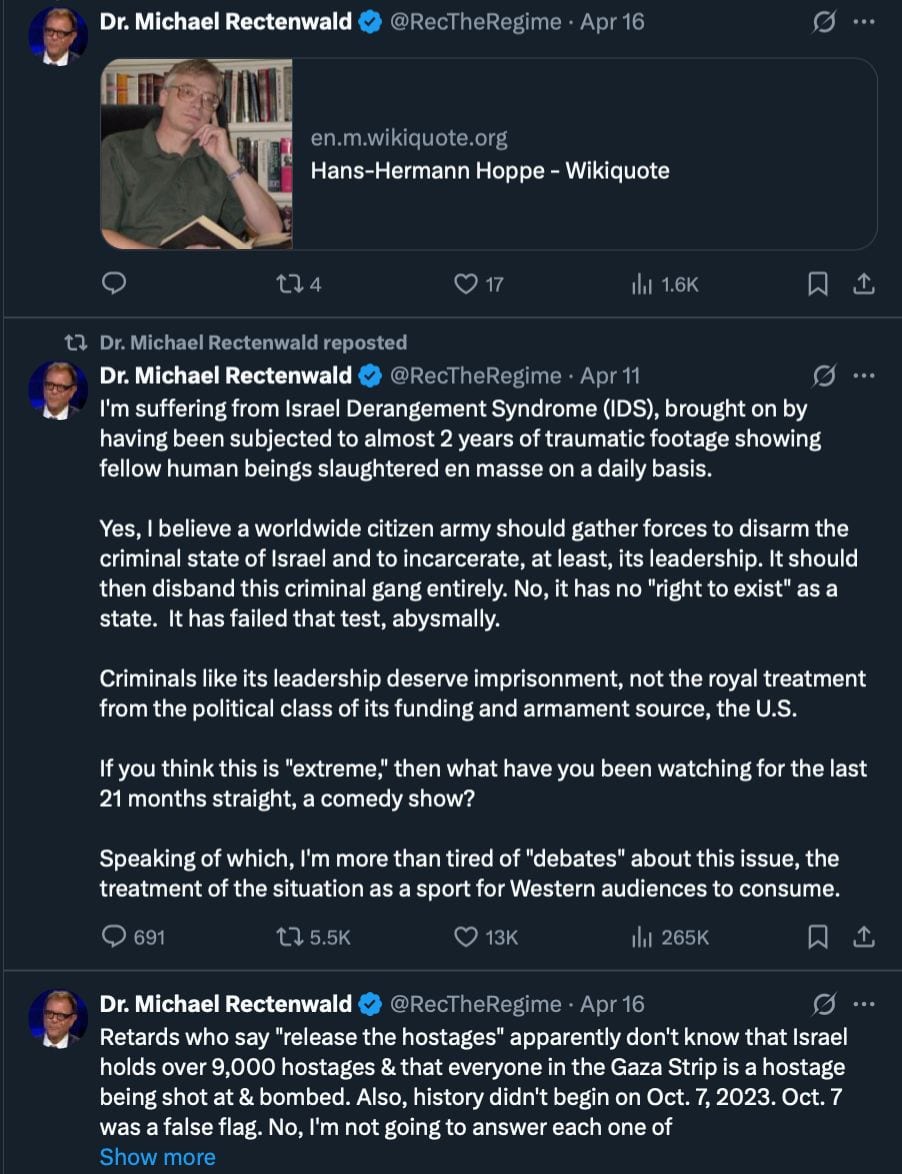
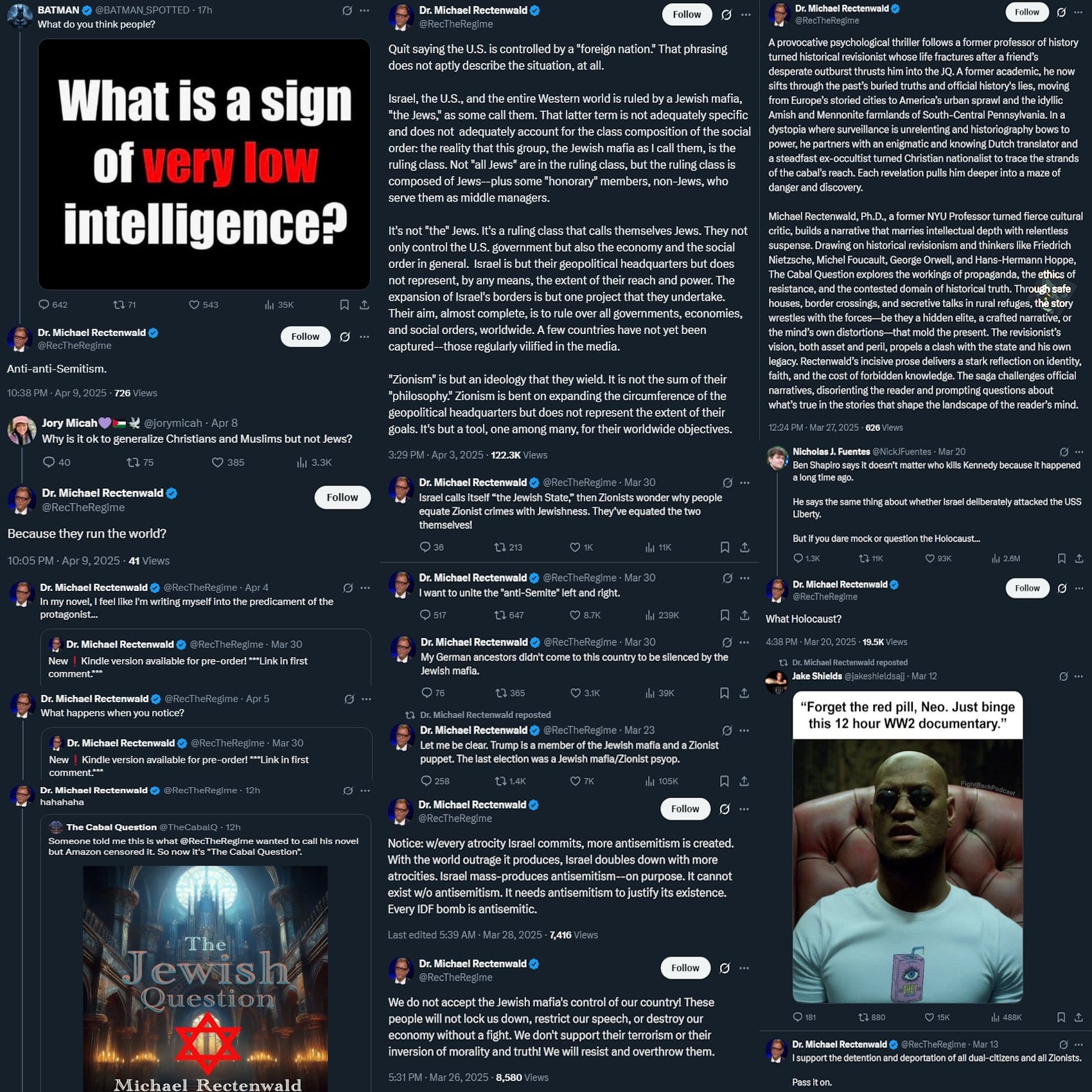
Michael Rectenwald
Michael Rectenwald - Wikipedia
https://x.com/RecTheRegime

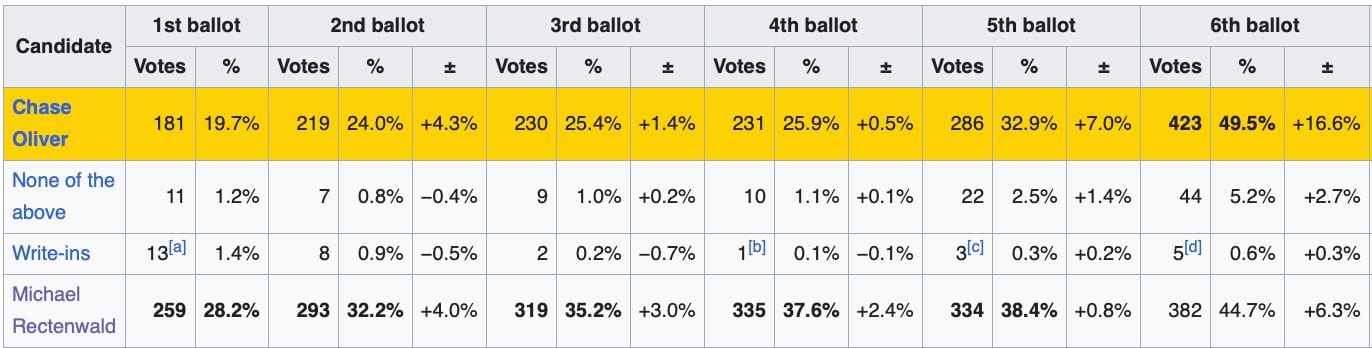
- The Mises Caucus supported Michael Rectenwald in the 2024 Libertarian Party presidential primaries. The caucus also backed Clint Russell to be the Libertarian Party’s nominee for US Vice President.3637(https://en.wikipedia.org/wiki/Mises_Caucus#cite_note-:16-37) Both Rectenwald and Russell lost their nominations at the 2024 Libertarian National Convention, the former which, before losing the nominating vote, gave a speech while stoned.38
Stefan Malyneux
Stefan Molyneux
Internal Conflict
How the Libertarian Party lost its way
Isolationism
What Both Sides STILL Don’t Get About Iran (Experts Explain) – Yaron Brook and Elan Journo - YouTube
Watch @yaronbrook go scorched earth on libertarian isolationists - Full Ep out now..mp4 (file not included in this release)
NOTES
filters:
  and:
    - file.ext == "md"
    - 'file.hasLink("Libertarianism")'
    - '!file("Libertarianism").links.contains(file.asLink())'
views:
  - type: table
    name: Notes not linked from the hub
    order:
      - file.name
      - file.folder
      - Category
      - Genre
      - up
      - related
    sort:
      - property: file.name
        direction: ASC
Libertarianism.base (file not included in this release)