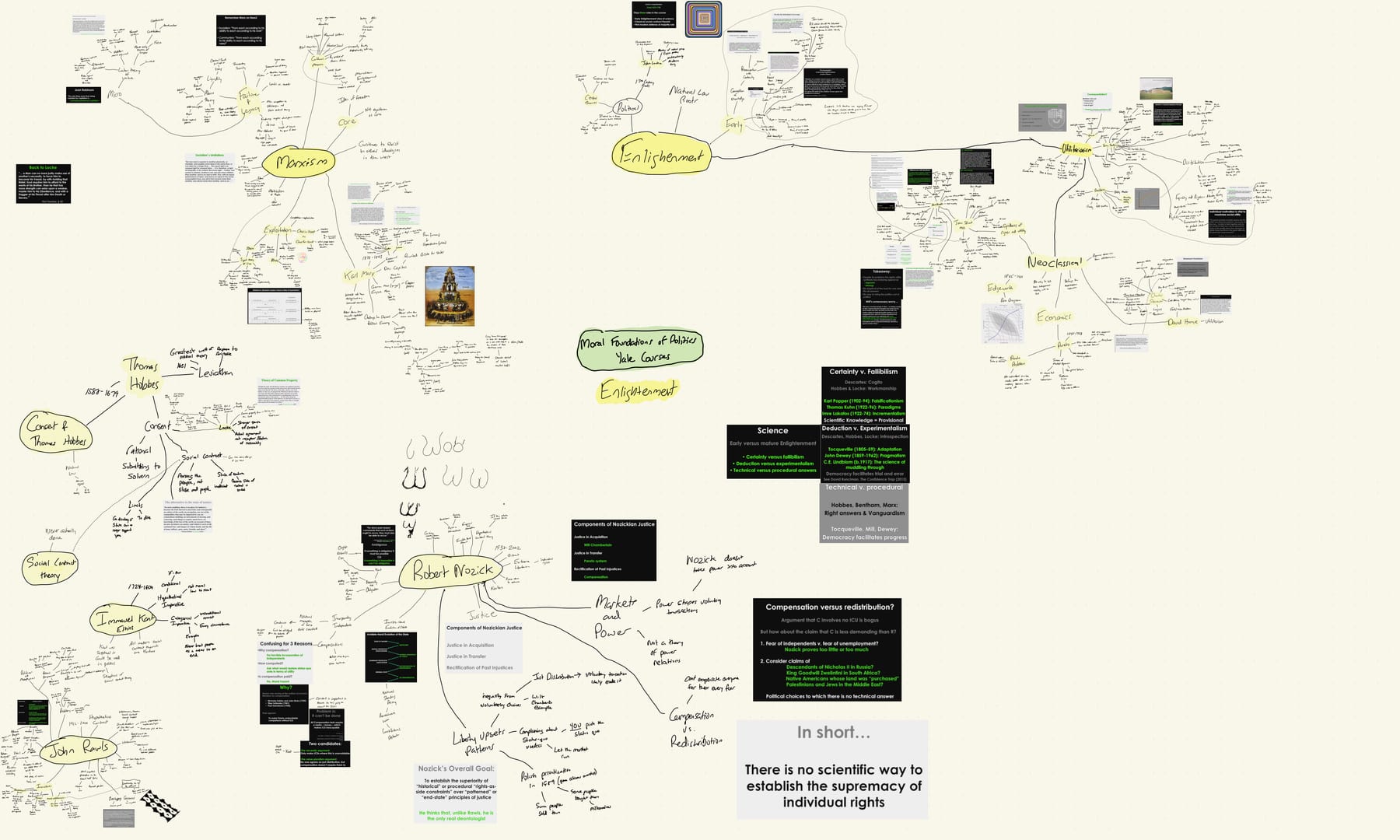
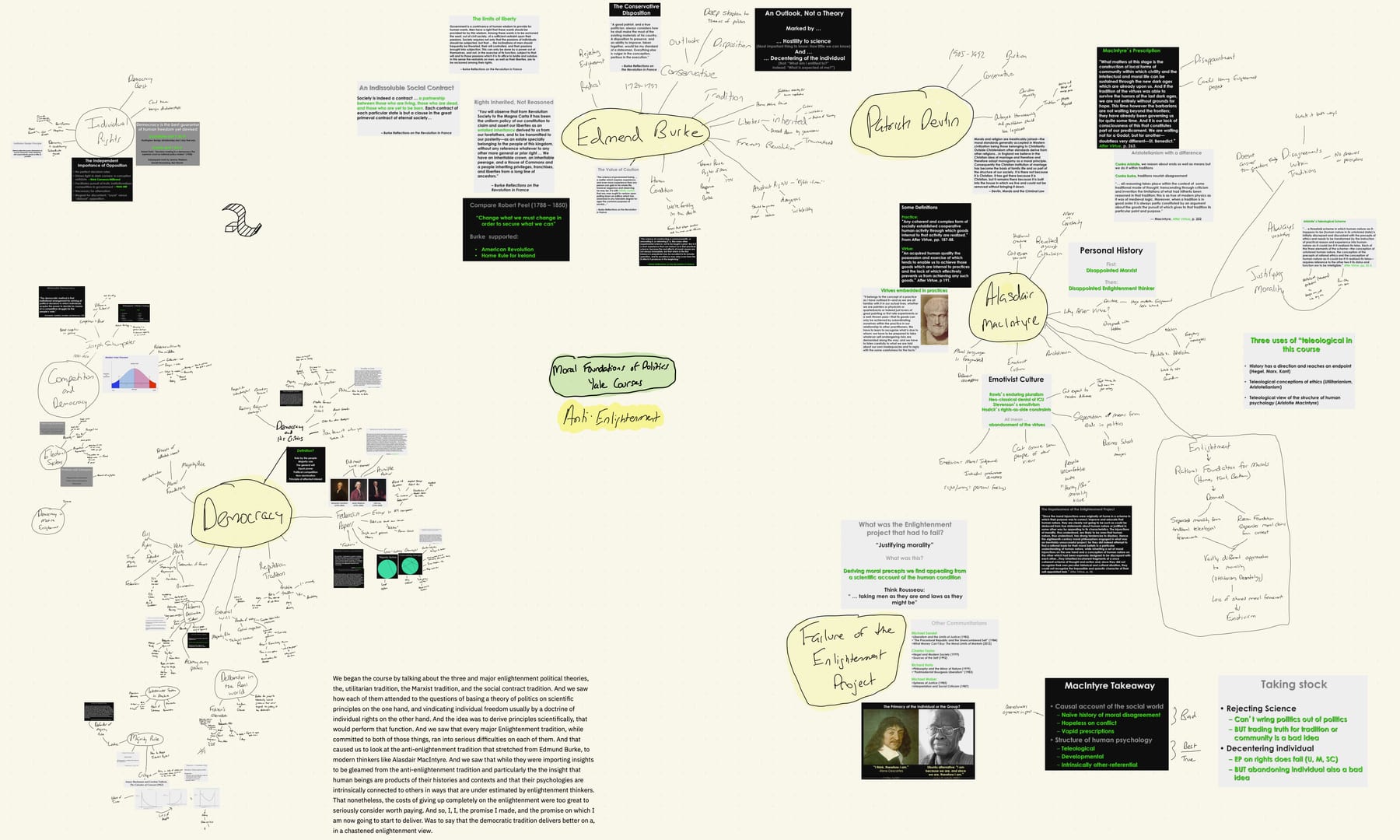
706181019733d63f5ffa599b2ea477e7_MD5.pdf (file not included in this release)
Enlightenment
- Natural Law Roots
Political
- if natural law timeless universal, that’d bind God
- Unable to change mind
- John Cocke
- Choose omnipotent
- Will
- Struggled wit hit
- Choose omnipotent
- Central Theories
- Individual Rights
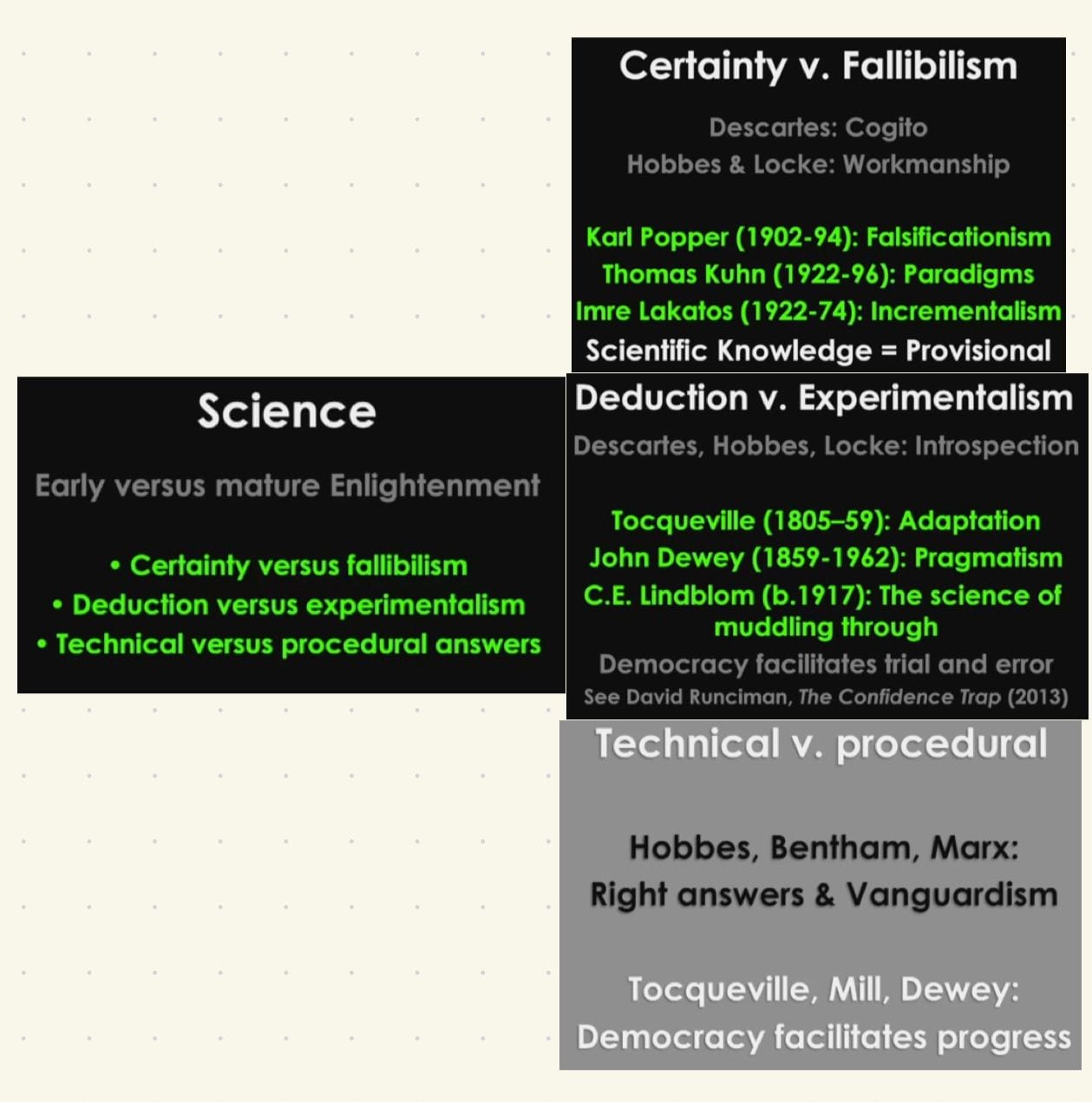
- Science as basis for politics
- Tension with individual rights
- 17th Century Roots
- John Locke
- Natural Law Realist
- Quintessential trust of Early Enlightenment
- Member of radical group of English politics
- Shaffebury’s Circle
- Underachieving Academic early
- Three Roles
- Early Enlightenment view of science
- Classical social contract theorist
- First modern defense of majority rule
- John Locke
Early
- Conception of Knowledge
- Preoccupation with Certainty
- Science
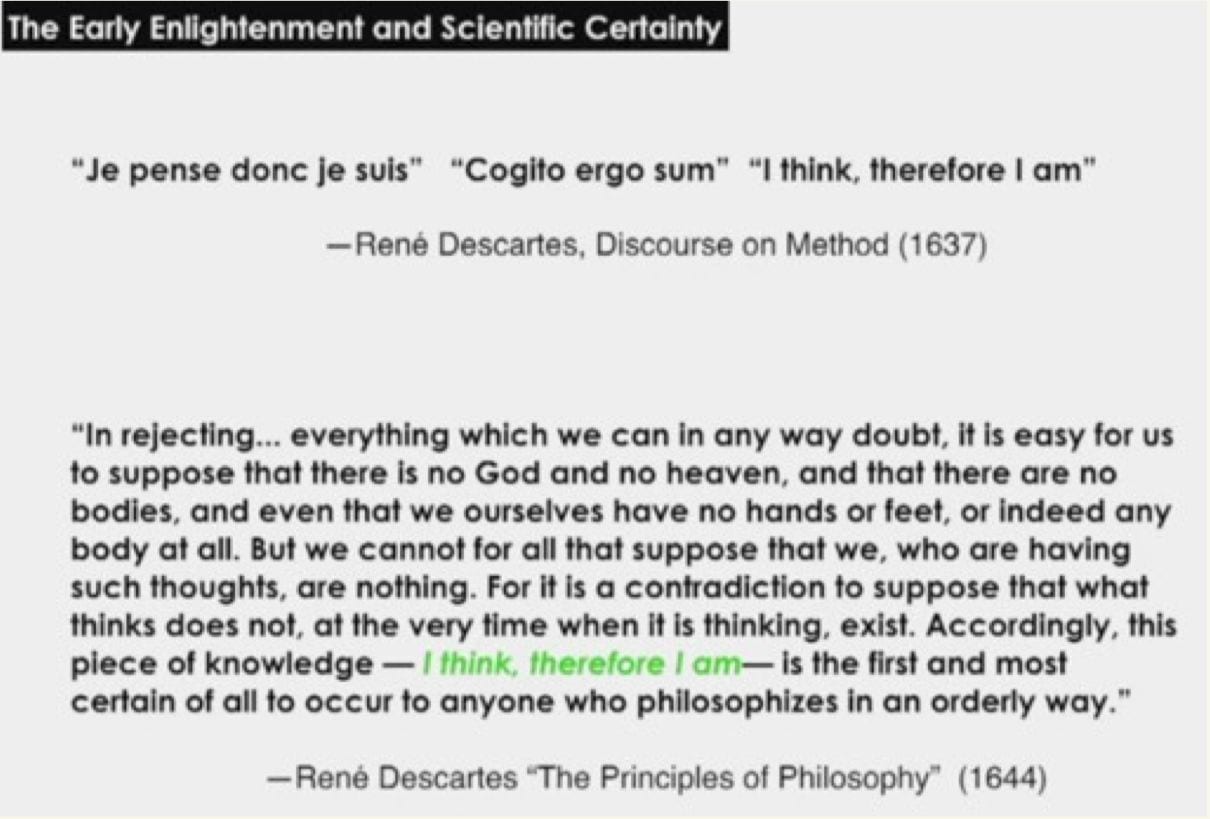
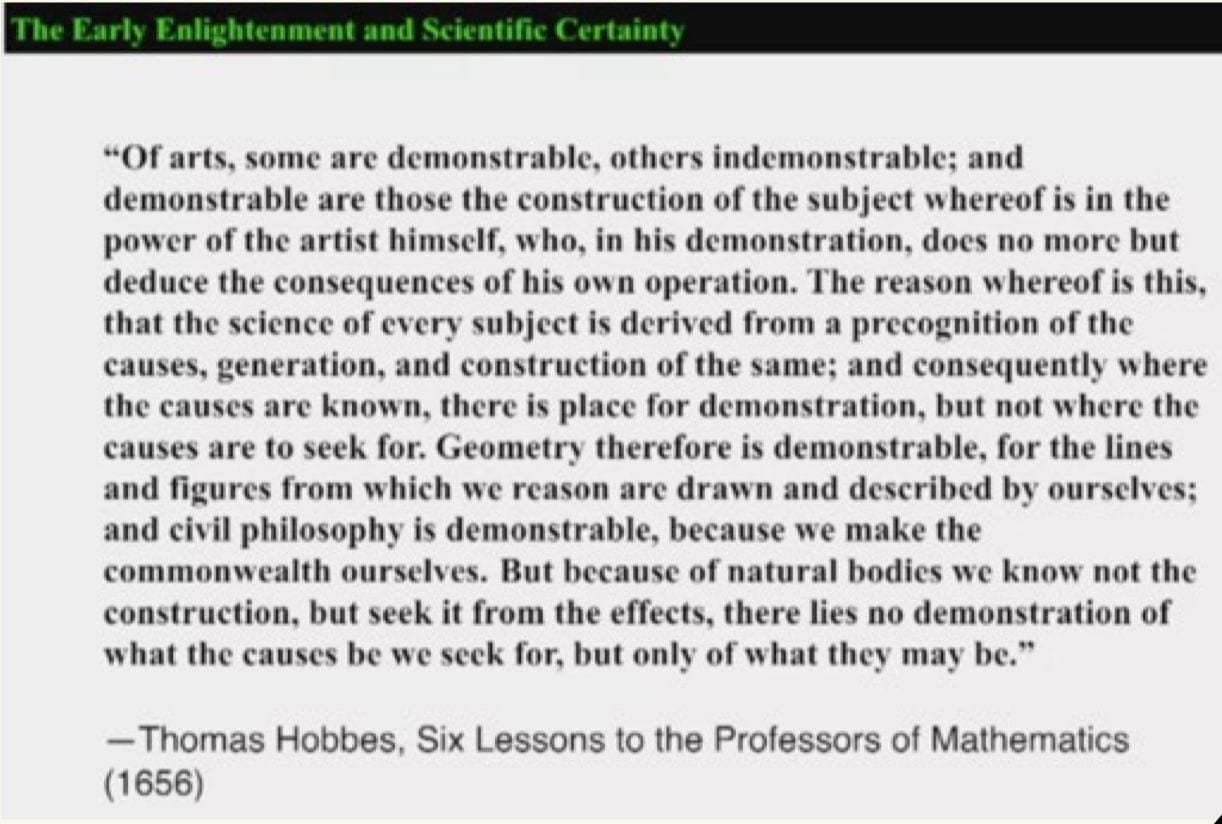
- Product of Human Reasoning > Natural World
- Preoccupation with Certainty
- Workmanship Ideal
- John Locke
- Miniture Gods
- Natural Law
- God = Will
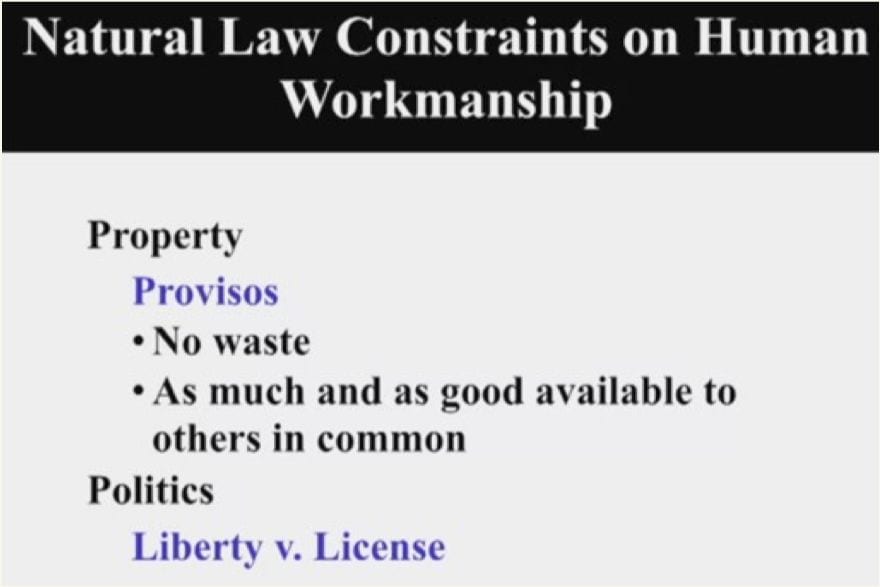
- Can’t create state that violates law of nature
- How to know Natural Law breached?
- Scripture
- Individual
- Only God
- Not pope
- Not State
- Only God
- Individual
- Obligation to Resist
- Always a right
- “All views should be tolerated except for atheists (lie), Muhanmaditins, Catholics” -John Locke
- Scripture
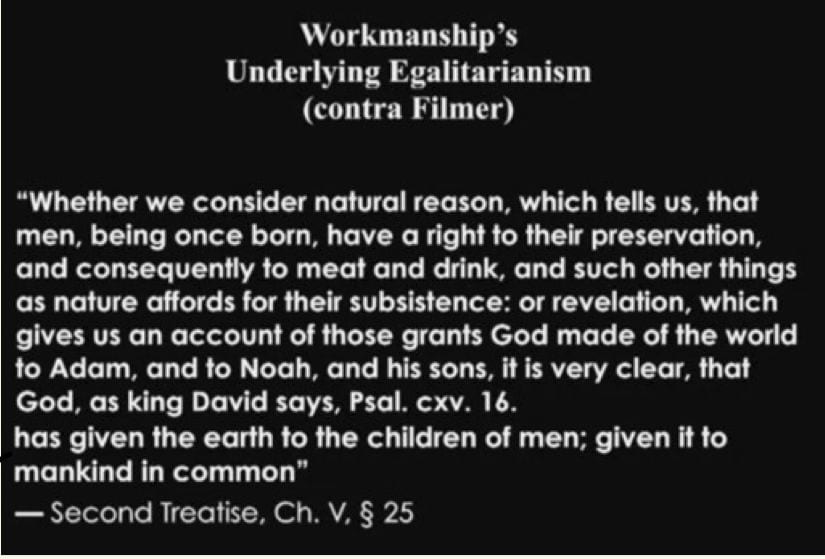
- Science
- We know what we make
- Cartesian certainty
- We know what we make
- Rights
- We own what we make
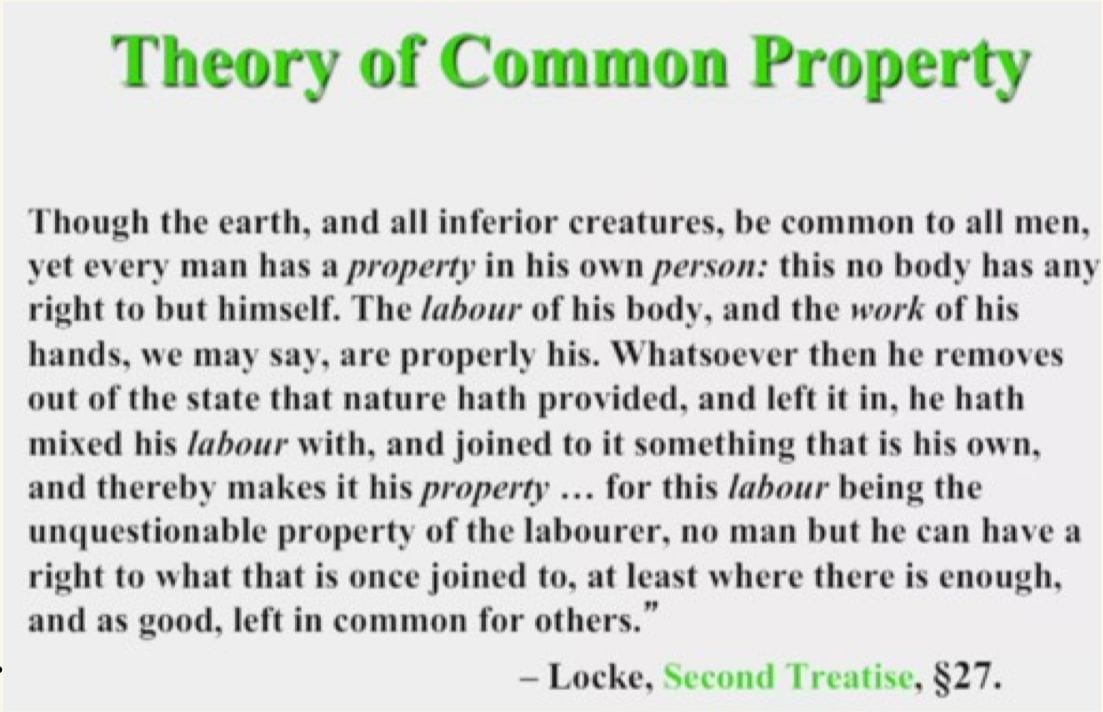
- Theory of property
- Common + Labor = Value
- Theory of commonwealth
- Social Construct
- Theory of commonwealth
- We own what we make
- Limits within the law of nature
- God’s natural fight
- Locke’s 1+2 Treatise was arguing Filmer who thought absolute authority goes to those that are heretical closet to Adam.
- John Locke
Utilitarianism
- Comprehensive Theory
- Explains everything
- Naturalistic theory
- How would humans exist if not guided by pleasure/pain
- Egoistic
- Individual self-interest
- Sticks & Carrots
- Not Subjective
- Happens if you want or not
- Invisible forces
- Happens if you want or not
- Individual self-interest
- Elements
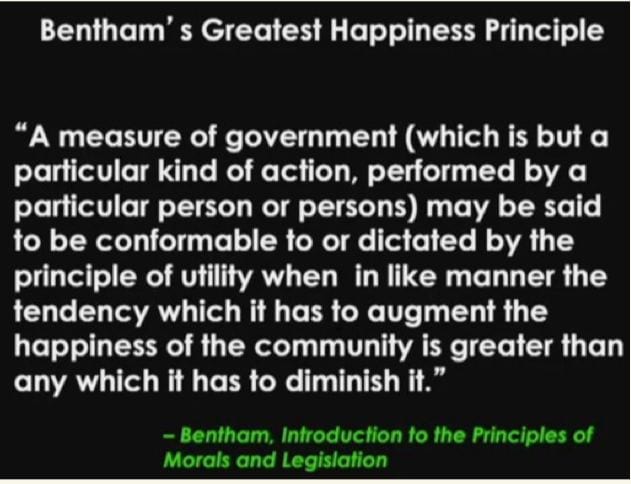
- Principle of Utility
- Moral rights maximize happiness
- Consequentialism
- Morality
- Outcome
- Consequence
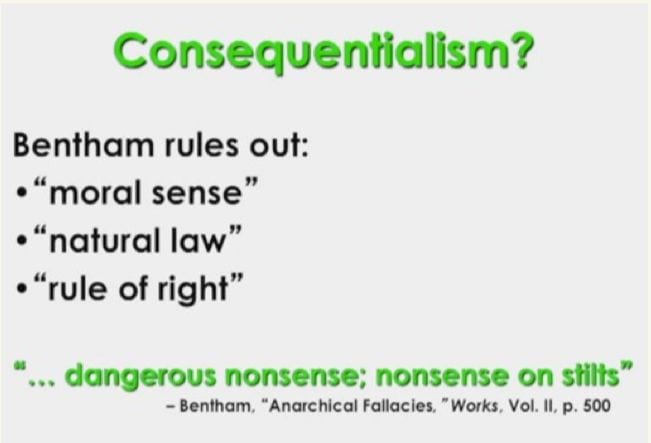
- Morality
- Hedoism
- good/bad — pleasure/pain
- Principle of Utility
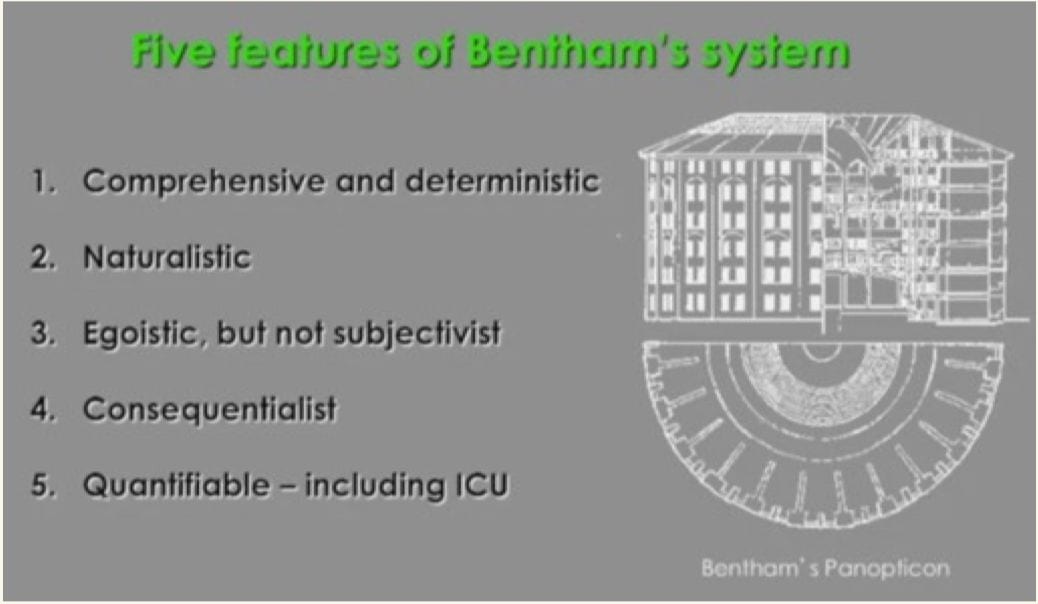
Jeremy Bentham
- Obsessed with efficiency
- Prison
- Value of Pain & Pleasure (quantify)
- Intensity
- Duration
- Certainty, Uncertainty
- Propinquity Remoteness
- Extreme
- Useful
- Interpersonal judgements, comparisons
- Pushed ideas to their end to test them
- Would write country constitutions
- Upset when not accepted
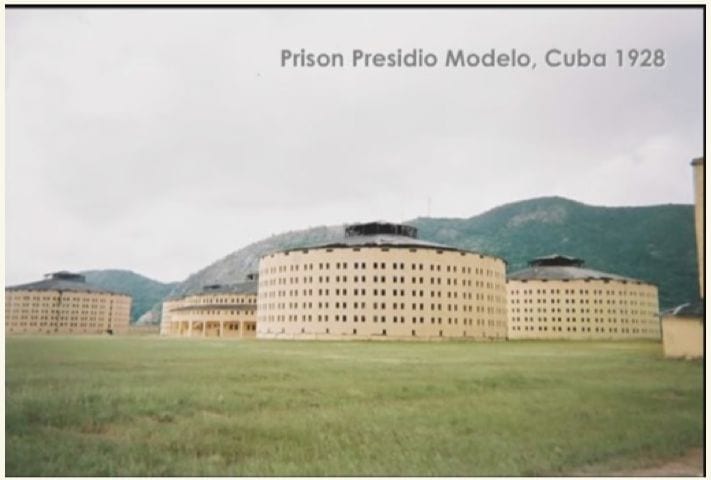
- Government
- Market Failure Theory
- Free-Rider problem
- Gov. necessary for this
- Public Goods
- Selfish Utility maximizes
- Force to pay taxes
- Security adversaries
- Free-Rider problem
- Market Failure Theory
- Wrote 70 years before Darwin
- Distribution
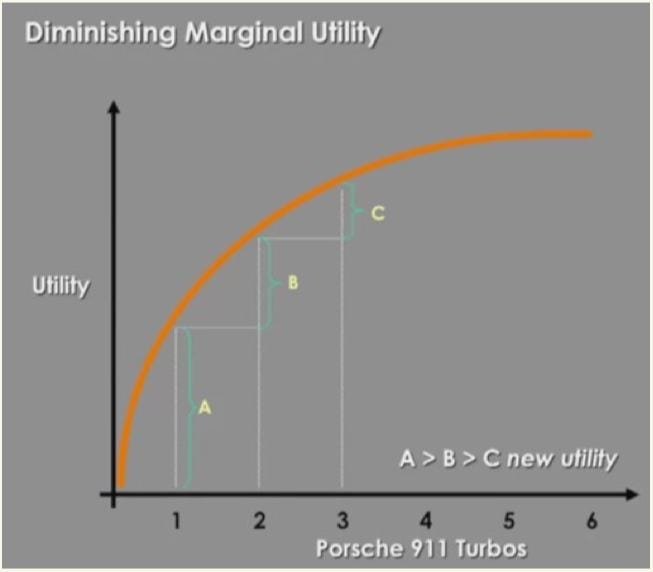
- Diminishing Marginal Utility + Interpersonal comparisons utility = Redistribution to equality
- Income Redistribution
- Rich will use much less utility compared to gains for the poor
- The richer you are the more you need to get an increment in happiness
- Eccentric
- “Sovereign masters” that govern mankind = Pain + Pleasure
- Principle of Utility
- Rights
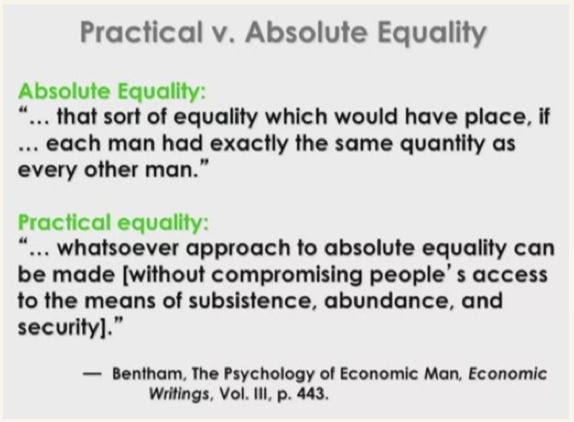
- Practical Equality
- Consequentialism
- Enter through back door
- Workmanship substrature by theory of value
- Governments have to protect whats created
- Practical Equality
- Equality and Rights
- Absolute Equality vs. Practical Equality
- Distraction, not realistic
- Loss aversion
- Pie shrinks
- Rich would destroy their wealth
- Trickle down theory
- Hard to know where the limit is
- Absolute Equality vs. Practical Equality
Problems
- Utility monster
- Types of people
- Normal
- Depressed
- Handicapped
- Waste of resources
- Nazi’s
- Waste of resources
- Diminishing Marginal Utility
- Doesn’t take seriously the difference between people
- Types of people
- Altruism
- Charity
- Self-sacrifice
- Where people are starting from?
- Loss aversion
Neo-Classical
- Removes economics from Utilitarianism
- Defangs the redistribution radicalism
- No way to tell how interpersonal utility will be lost
Charles Stevenson
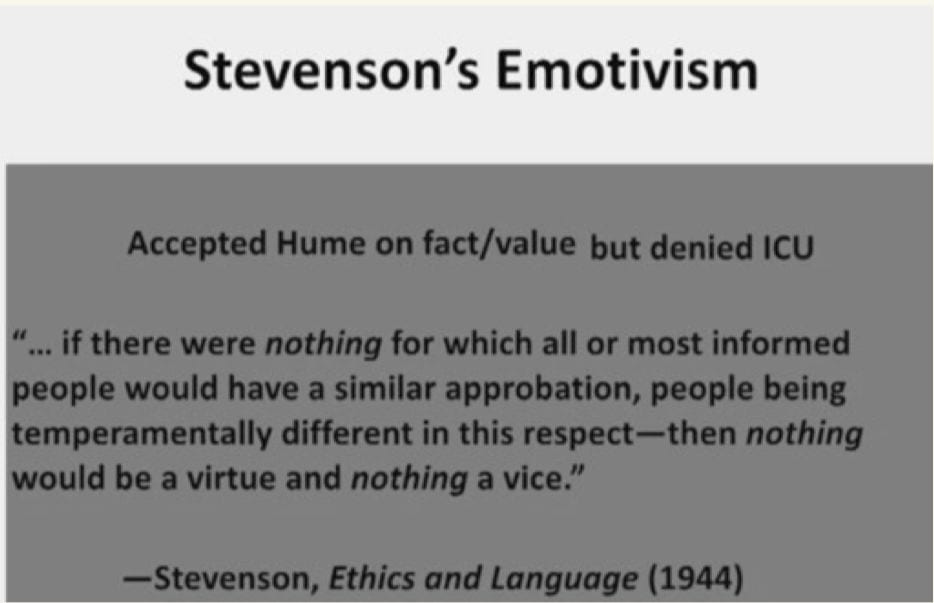
- Emotivism
- Moral Arguments
- Persuasive definition
- Ethical sentences
- emotional attitudes
- not propositions
- emotional attitudes
- Moral philosophy = “Hurray/Boo”
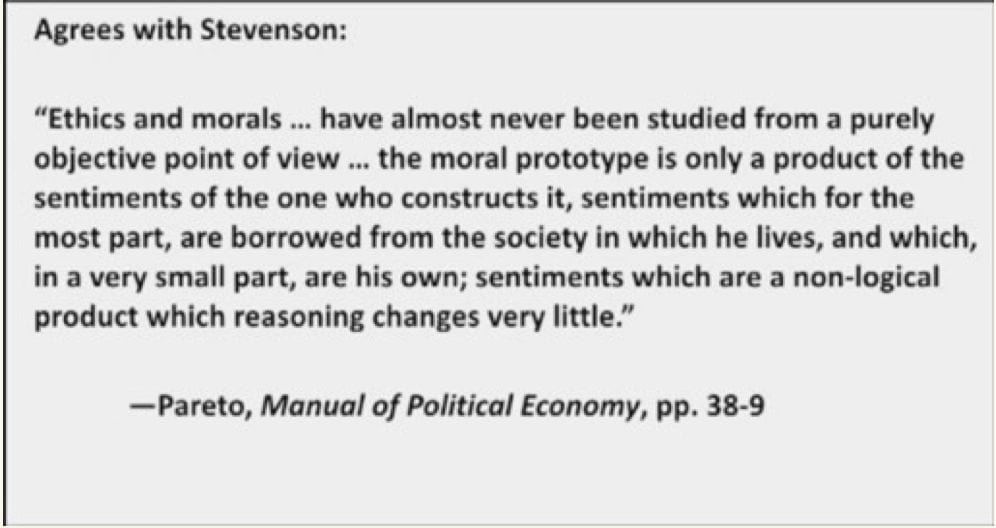
- Moral Arguments
- How do you know?
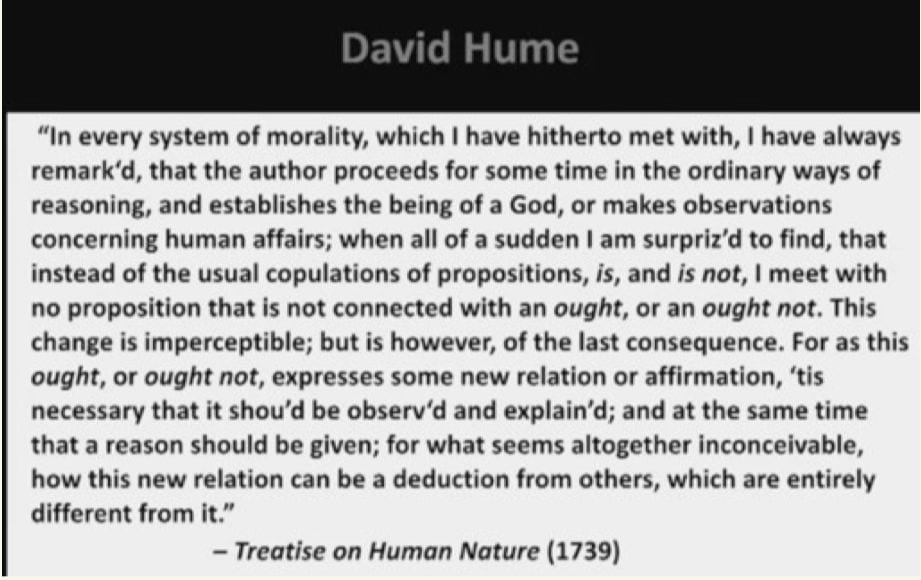
- Can’t derive “ought” from an “is”
- Makes morality shakey
- Good/Bad same for everyone
- What ‘ought’ to be the case
- Fast / Value Problem
- David Hume
- Utilitarian
- Logical Postivism
- Freddie Ayer
- Three Kinds of Assertions
- Analytic truths
- (Math) Definitions
- Empirical truths
- (science) Observe
- Everything else = meaningless nonsense
- Oughts
- Morals
- Metaphysics
- Analytic truths
- Three Kinds of Assertions
- Freddie Ayer
- One of the most important moral philosophers in 20th Century
Economics
- Pareto
- 1848-1923
- Use little information how markets behavior
- Rank/Order
- Not using interpersonal units of utility
- Science of Market Dynamics
- How prices behave
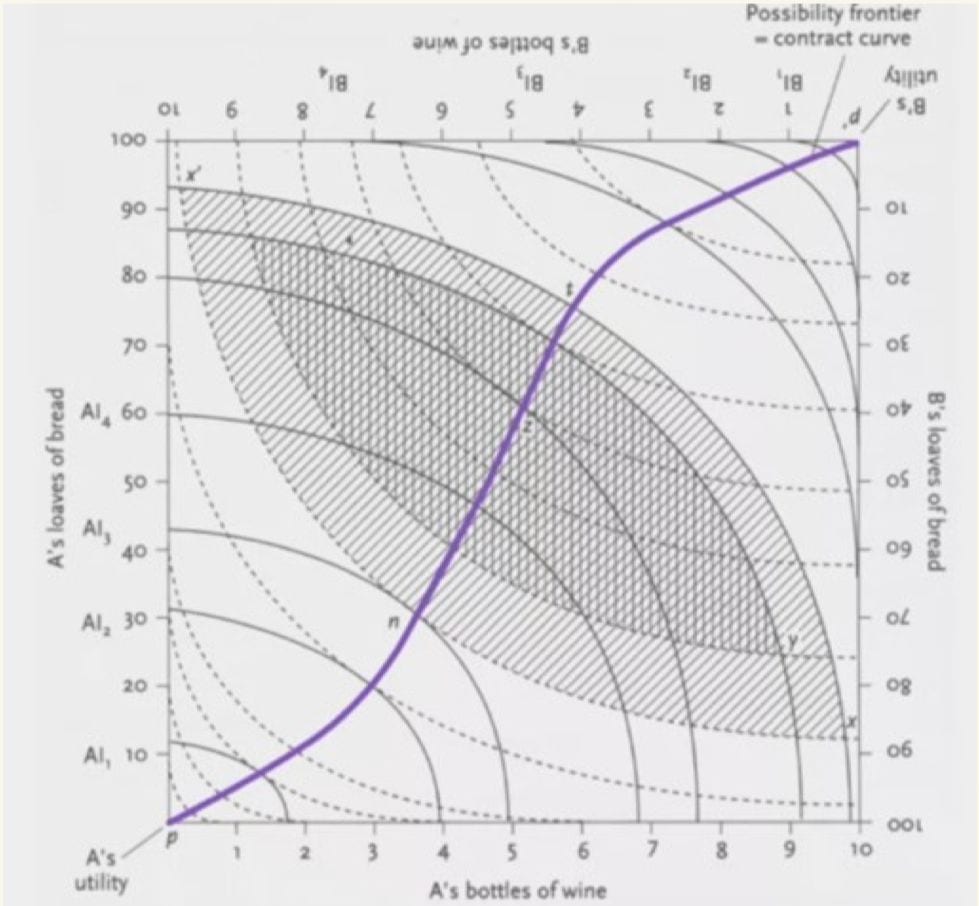
- Indifference curves
- Choice between A/B make no difference
- No science that justifies redistribution
- Pareto Problem
- No individual can be make better off without making someone else worse off
- Doesn’t address Justice & Fairness
- Edgeworth
- 1845-1926
- Box Diagram
Synthesis of Rights and Utility
John Stuart Mill
- 1806-1873
- Wife
- Harriet
- Major role writing On Liberty
- Father
- Utilitarian
- Son raised as one
- Home School
- Genius but nervous breakdown
- No social
- Freedom of Speech
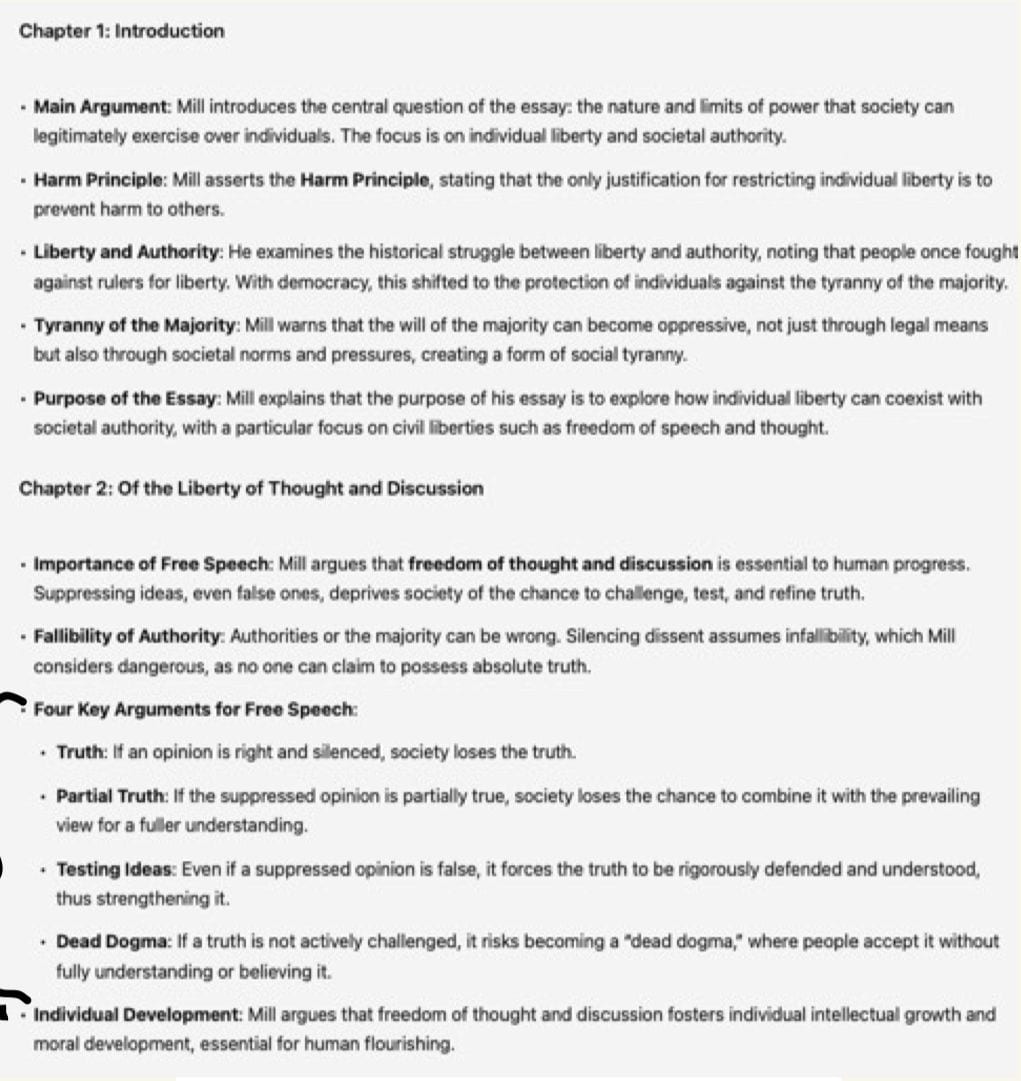
- Fallibilist conception of truth
- Science begins thinking everything is fallible
- Karl Popper
- We never know if we have the truth
- Cant verify only falsify
- Commonality
- One sentence/explanation
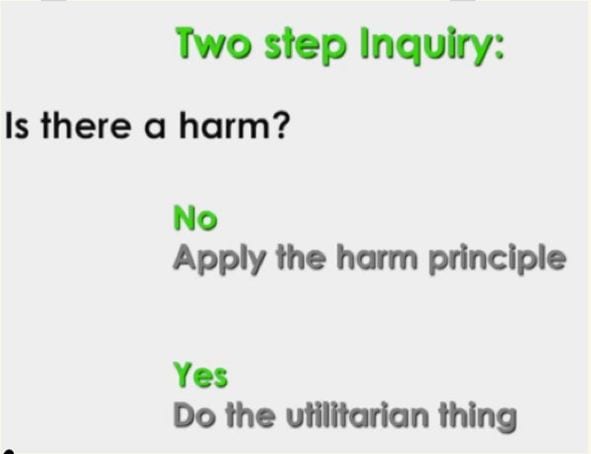
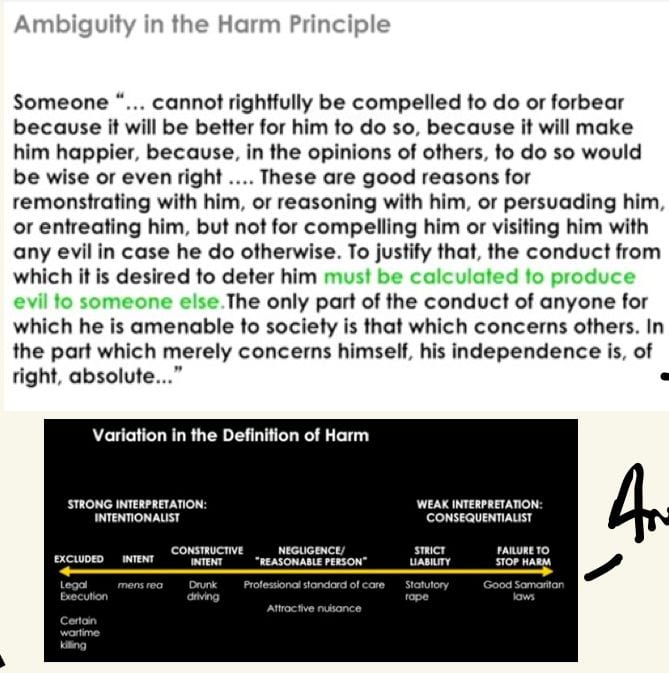
- Harm Principle
- One sentence/explanation
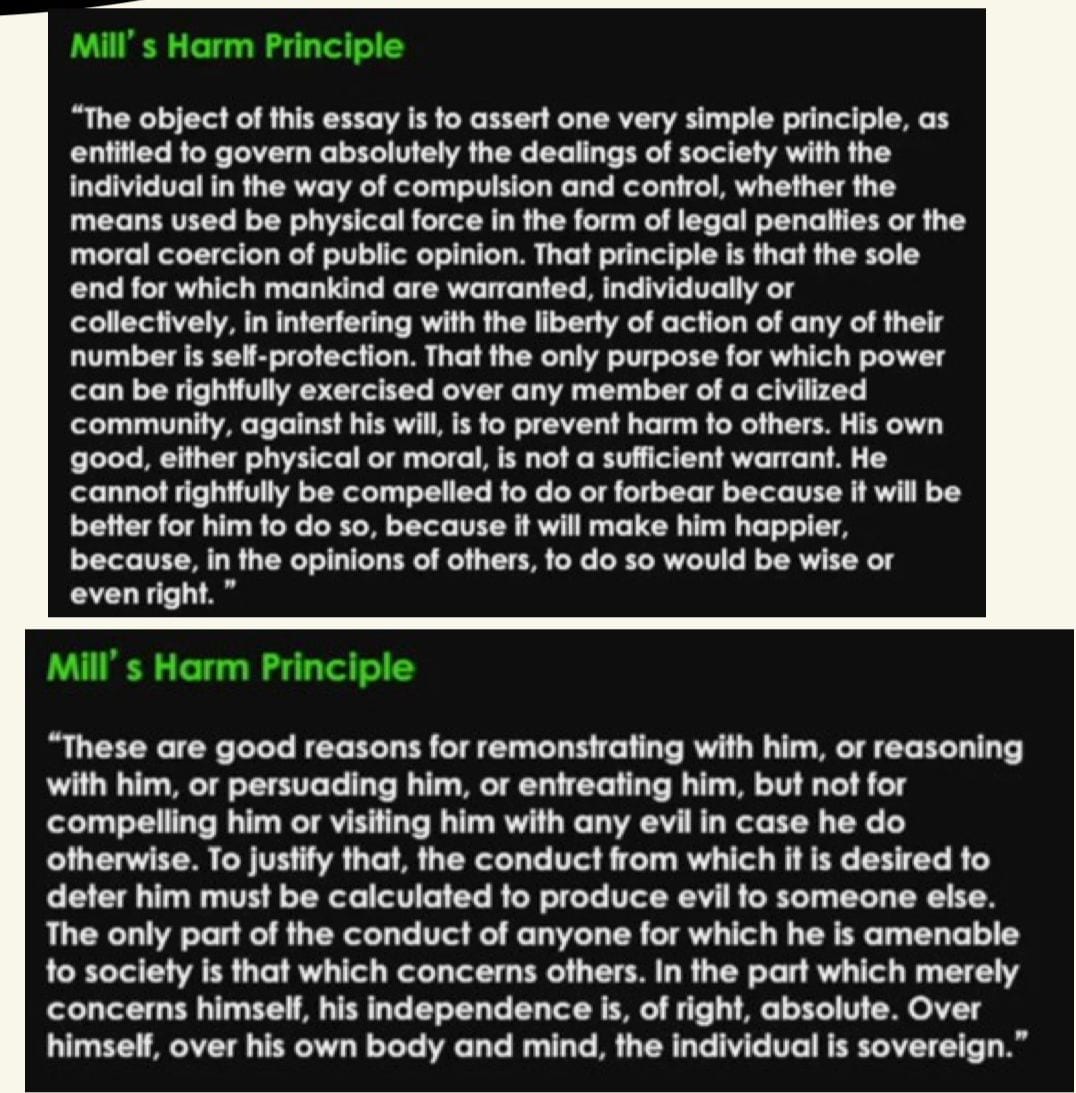
Harm Principle
- Protected
- self-regarded
- Exceptions
- Price Gouging
- Extreme coercion
- Exceptions
- If you harm others, government steps in
- other-regarding
- self-regarding
- In practice
- Free Trade
- Giving out any scarce resource is harming
- Do it by merit
- Giving out any scarce resource is harming
- self-regarded
- Examples
- Marital Rape
- Racial discrimination
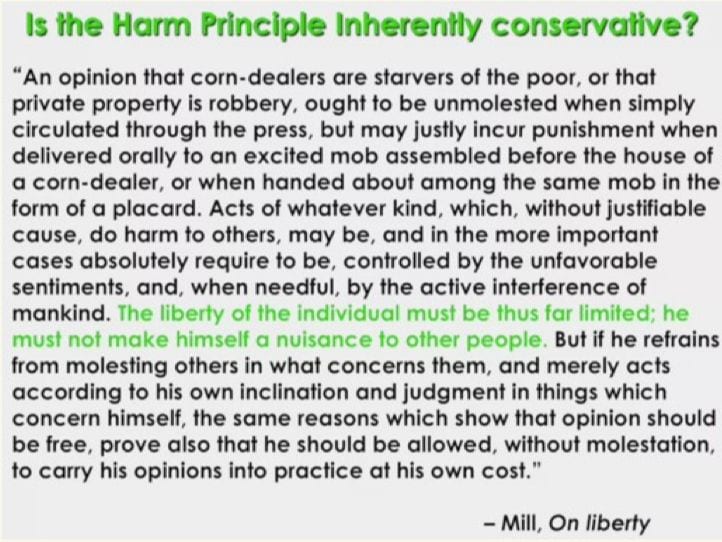
- Conservative?
- Yes
- Harm principle procedural
- Bias towards status quo
- Action
- self-regarding
- market
- other regarding
- gov. constrained by harm principle
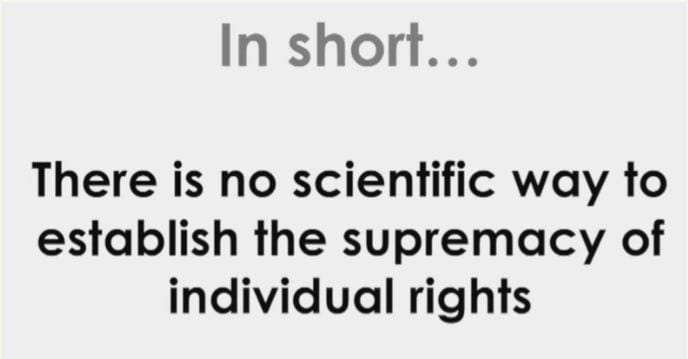
- Can’t find scientific answer what to do in political questions
- self-regarding
- Ambiguity
- Invisible Hand Argument
- Freedom leads to utility by truth
- Science
- Freedom leads to utility by truth
- Difference with Bentham
- Long run appeal
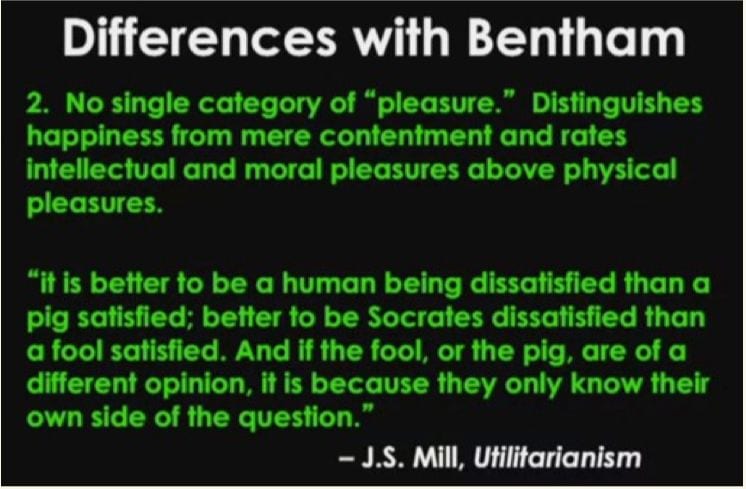
- No single category of pleasure
- Richer view of freedom
- Positive vs. Negative
- resources
- to do
- not to do (negative)
- Positive vs. Negative
- nuanced ICU
Robert Nozick
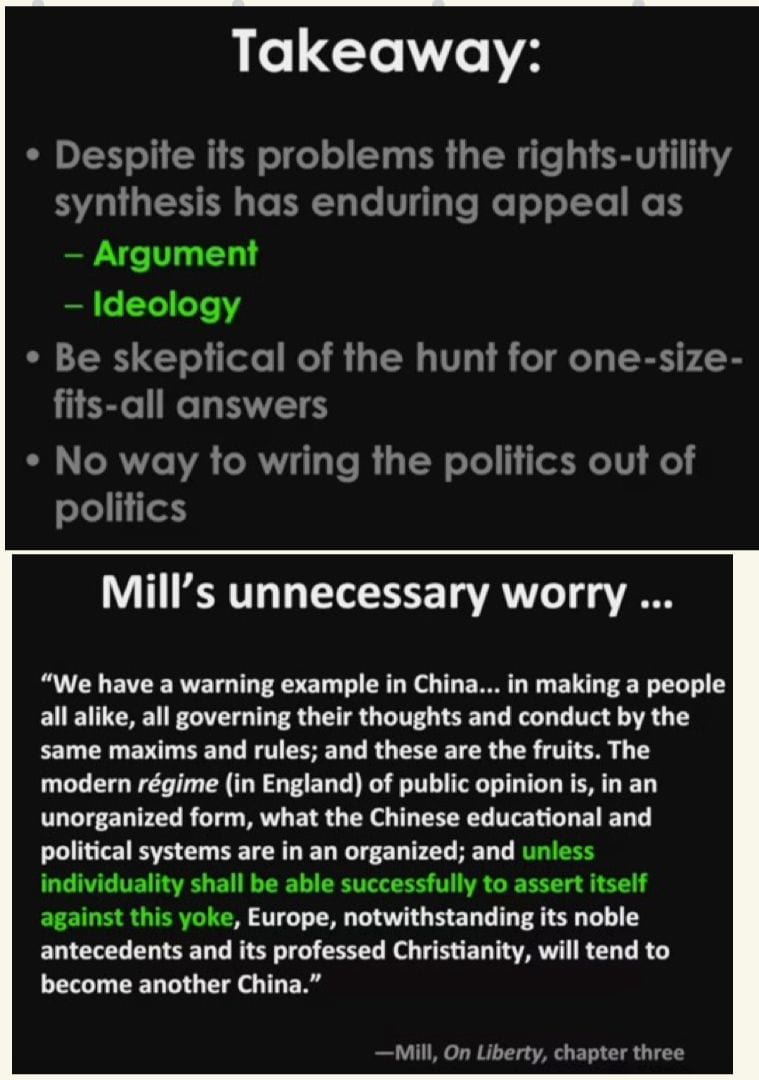
- Combining individual freedom and science of politics
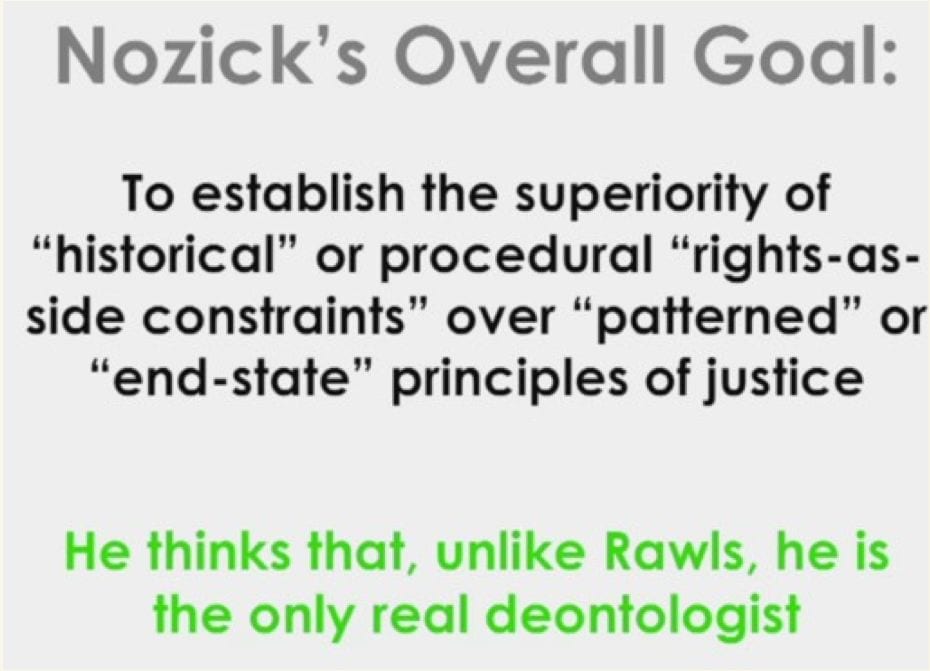
- Rights as side-constraints
- Deontialogical
- Genuinely Kantian
- Invisible Hand account
- Empirical and Normative
- Hypothetical contract theory
- If the state wasn’t there
- 1938-2002
- Brilliant
- Extreme Libertarian
- Individual rights
- Pushed ideas to extreme
- Kantian
- Markets and Power
- Not a theory of power relations
- Power shapes voluntary transactions
- Nozick doesn’t take power into account
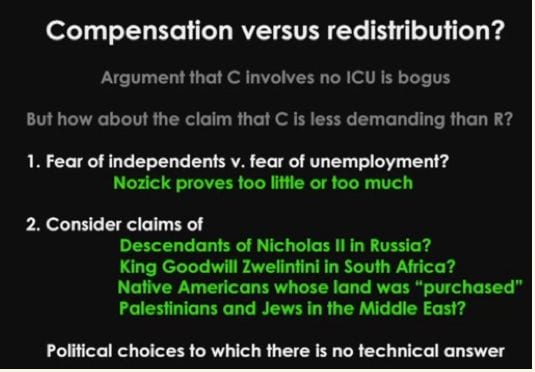
- Compensation vs Redistribution
- Can’t compensate everyone for their every fear
- Justice
- Liberty upsets Patterns
- inequality from volunteering choices
- Wilt Chamberlin example
- Just Distribution
- voluntary transaction literally erode it
- Complaining about status-quo useless
- You pick the status quo
- Let the market run
- Polish privatization in 1989 (gave citizens ownership)
- Some people sold them
- Some people bought them
- millionaires
- inequality from volunteering choices
- Invisible-Hand evolution of state
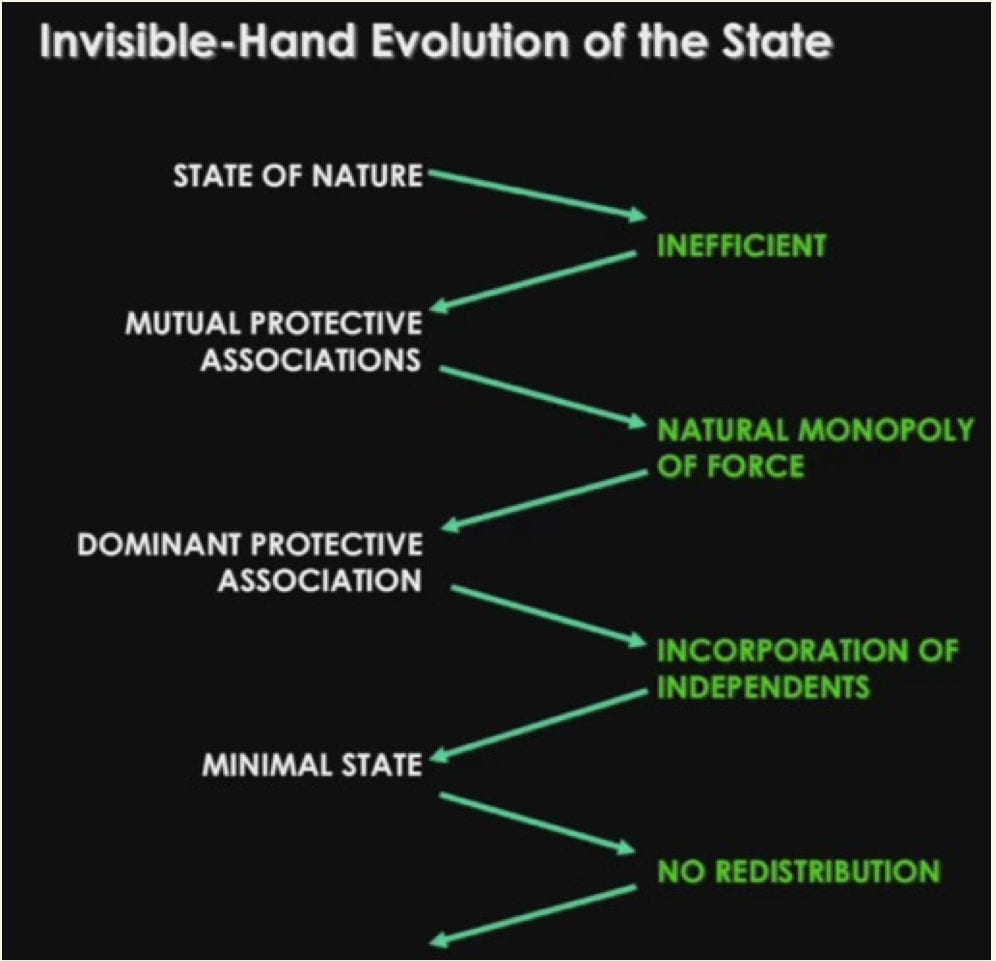
- National standing army
- Revolutionary War
- Constitution debate
- Revolutionary War
- National standing army
- Incorporating Independents
- Compensations
- defacto state dejure
- state legitimate
- defacto state dejure
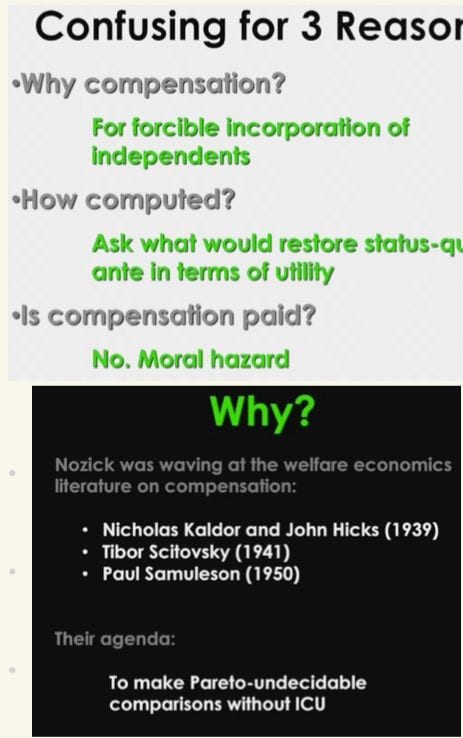
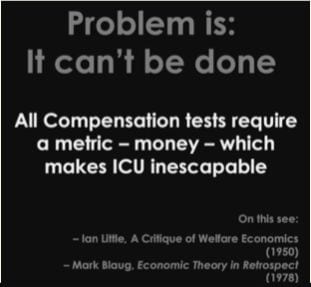
- Consent is important to Noziak so he’s going to account for ICU’s
- Kant
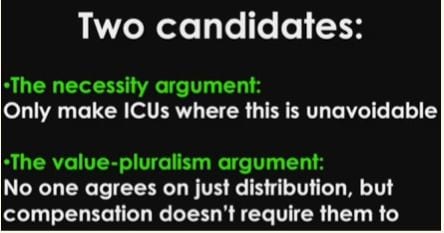
- ought entails can
- Kant
- Natural monopoly of force puts constrait
- Constraint
- Can’t be obliged to tolerate if possible
- ought entails can
- Can’t be obliged to tolerate if possible
- Constraint
- Compensations
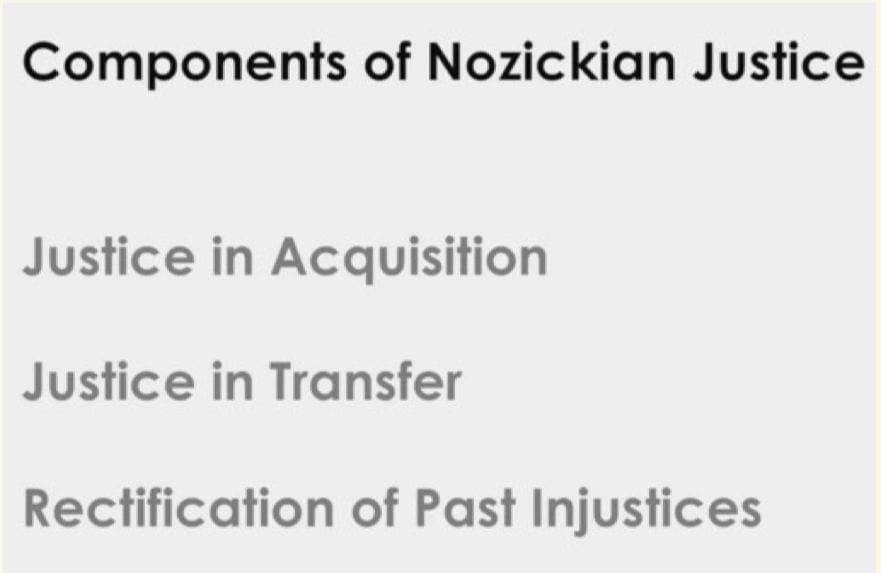
John Rawls
- 1912-2000
- Hypothetical contract
- Grand tradition of Pol. Phil out of favor
- Utilitarianism, Marxism
- Social contract seemed hopeless
- More interested in meta-analysis
- Back water philosophy at time
- Utilitarianism, Marxism
- Utilitarianism
- Doesn’t account for difference in persons
- Neoclassical
- Too much difference between people
- Marxism
- Labor theory of value
- Shit
- Failed at every question
- Labor theory of value
- Social contract
- No agreement
- Never happened
- Overlapping Consensus
- Common Good
- None on justice
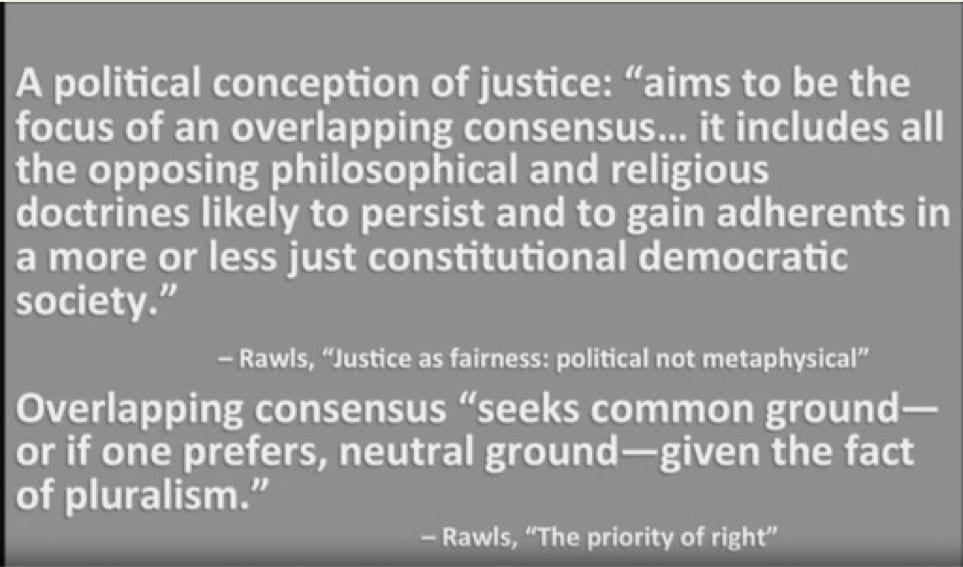
- Most important philosopher in the second half of 20th Century
- Citations
- Law
- Revived pol. phil.
- Citations
- Innovations
- Moral arbitrariness
- More radical than Marx
- Nature & nurture are unimportant
- Both luck
- Rawls himself tries to weasal out of implication
- Workmanship has to be affirmed
- People want to feel they made themselves
- Resourcism
- v. welfarism
- Stop talking about welfare utility
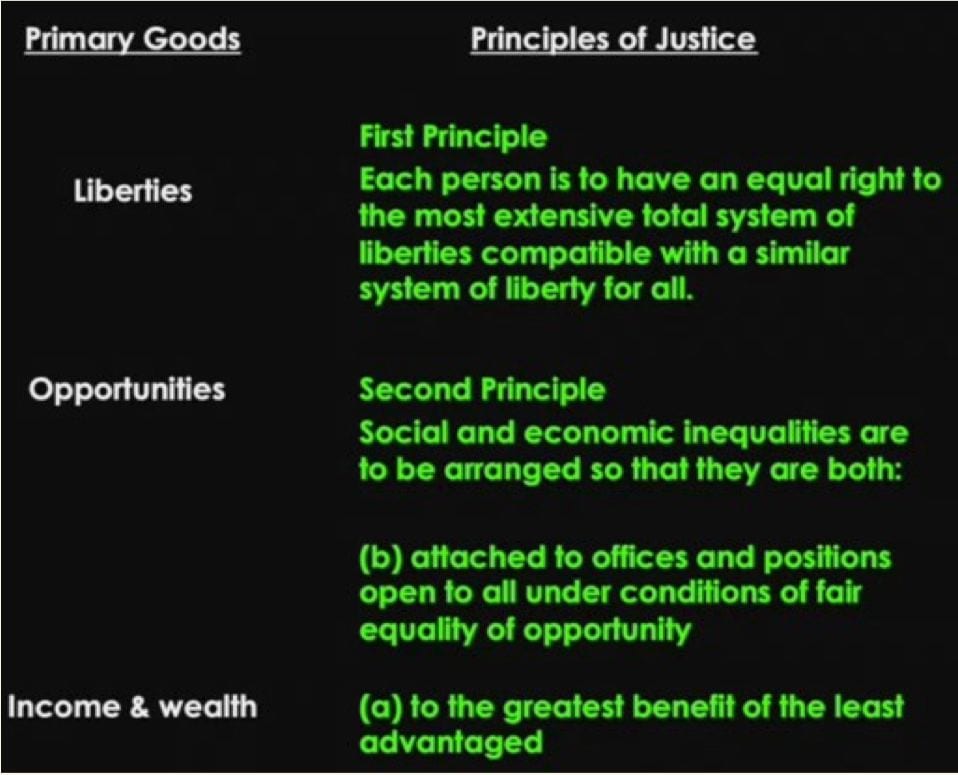
- Primary Goods
- income
- Political freedoms
- Focus on basis resources
- Deontological Theory
- v. teleological
- Distribute rights that doesn’t presuppose the good
- Thin as possible presupposed
- We have diff values
- like mill
- Kantian
- Moral arbitrariness
- Veil of Ignorance
- Principles to affirm if you didn’t know who you’d be
- not state of nature
- here, now
- not state of nature
- Kantian universal liability
- Advanced Countries Applicable
- General Conception of Justice
- Principles
- Non neutral
- Catelogical imperative
- Difference Principle
- Serve least well-off always
- Maximize the minimum
- Principles
- General Conception of Justice
- Hobbes > Locke
- Reflective Equilibrium
- rational over agreement
- Reflective Equilibrium
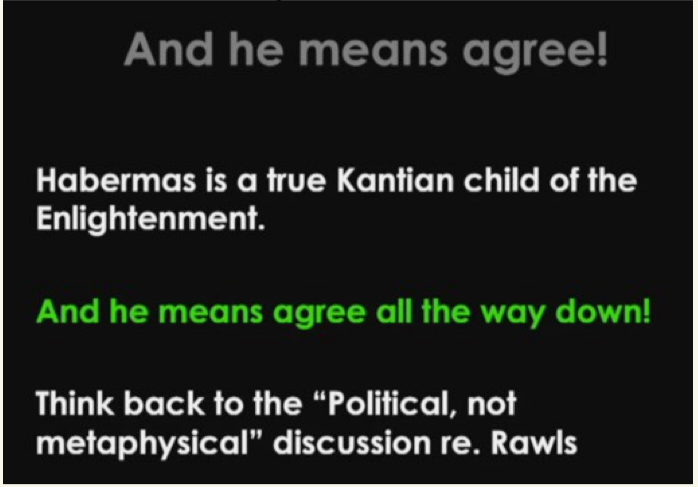
- Political not metaphysical
- Political Disagreement
- Agree on general principles, devil in details
- Descartes
- Kant
- Early Rawls
- Many paths to agreement, don’t ask why
- Amarty a sen
- Cass Sunstein
- Mature Rawls
- Lawyer Reasoning
- Persuasive
- Anything that works
- to win
- Authoritative argument
- settled > settled right
- Different reasons for agreement
- Agree on general principles, devil in details
- Problems
- Risk
- Have to assume you’ll be worst
- Kantian argument
- Chain connection
- Keynesian backdoor
- Moral arbitrary argument proves too much
- if luck
- Risk
- Principles to affirm if you didn’t know who you’d be
Immanual Kant
- 1724-1804
- Hypothetical Imperative
- conditional
- if-then
- not moral law to Kant
- conditional
- Categorical Imperative
- unconditional must
- Every circumstance
- Example
- Never trust people as a means to an end
- All modern social contract theorists are Kantians
- Kant was skeptical it could be used in politics
- Skeptical of social contract theory
Thomas Hobbes
- 1588-1679
- Leviathan
- Greatest work of political theory
- 1651
- Response to Aristotle
- Consent
- John Locke
- Theory of Politics
- Workmanship
- Obedience to gov is conditional
- Consent
- Irrevocable
- Even tacitly consent
- radical during Locke’s time
- Even tacitly consent
- Bound to the majority
- not gov.
- Trust relationship
- Residual right against gov.
- High stakes
- Can’t selectively resist one law
- Residual right against gov.
- Irrevocable
- Welfare State
- Everyone has right of what they could dare with land
- Part of Enclosure Movement
- Private Property
- Common property from the land
- Earth is for humans
- Cant stop others
- Except by labor
- Earth is for humans
- Stronger sense of consent
- Actual agreement not metaphor / feature of rationality
- Theory of Politics
- John Locke
Marxism
- Cultural Marxism
- Karl Mannheim
- Literacy Criticism
- Humanities
- ideologies
- Power relations
- Raymond Williams
- Frankfurt School
- University faculty
- 1980s
- Conservative think tanks
- Heritage
- AEI
- Conservative think tanks
- 1980s
- By-product of Marxism failure
- WWI Shock
- Nationalism more powerful
- why?
- Wanted to understand
- why?
- Nationalism more powerful
- Core
- Idea of Freedom
- Not egalitarian at core
- Continues to exist in other ideologies in the West
Karl Marx
- 1818-1883
- Enlightenment thinker
- Freedom
- Workmanship
- Alienation + Division of Labor
- Equality vs.
- If freedom is depended on exploitation, no one has freedom
- Capitalism productive to bring in communism highest good
- Organizing production
- Tension -> Falls apart -> repeat
- Thesis / antithesis / synthesis
- Organizing production
- Science
- Dialectical method
- Hegel
- Marx reacting against
- Hegel
- Materialist conception of history
- Dialectical method
- Das Capital
- Rivaled Bible for Sales
- Base (economy) -> Superstructure (politics)
- German Marx (Younger)
- Utopian politics
- English Marx
- Sober to reality
- Challenge to Classical Political Economy
- Trying to answer: where does value come from?
- Commodity exchange
- Commodity -> money -> commodity
- Money -> commodity -> money
- M > m (profit)
- How does money seem to grow?
- Labor
- use value
- utility
- Exchange Value
- Price
- Determined by labor
- Socially necessary labor time (SNCT)
- Average skill to make product
- Waste of time to perfect
- Supply and demand
- Short run: prices
- long; output
- Labor theory of value explains long-run equilibrium price
- Price
- Labor Theory of Surplus Value
- Labor Power
- Commonity
- Takes more time to specialize
- Unique: Leads to fresh exchange value
- buying time (dinner) vs Investment
- Living human labor power is that its consumption as a use value leads to the creation of fresh exchange value = Value / Profit
- Secular variant of John Locke‘s miniture God’s
- Labor Power
- use value
- Labor
- Money -> commodity -> money
- Commodity -> money -> commodity
- Freedom
- Exploitation
- competition = exploitation
- Class in itself vs. Class for itself
- Identity politics
- Communist Revolution
- What people believe about their class identities
- Members interests
- Working class
- Necessity
- in the power of others
- Micro
- What costs to produce the worker
- Wage
- Will always tend toward subsistence
- unemployed always around
- Will always tend toward subsistence
- Wage
- What costs to produce the worker
- Macro
- 5 Part Theory of Crisis
- Competition will eventually produce less value
- Margins narrow
- Rate of profit falls over time
- Money
- Liquidity
- Monopolies and the elimination of competition
- competition eliminates competition
- Under-consumption
- Pre-curer of Keynes
- People at top will save, workers will spend
- Imperialism create new New Markets
- Pre-curer of Keynes
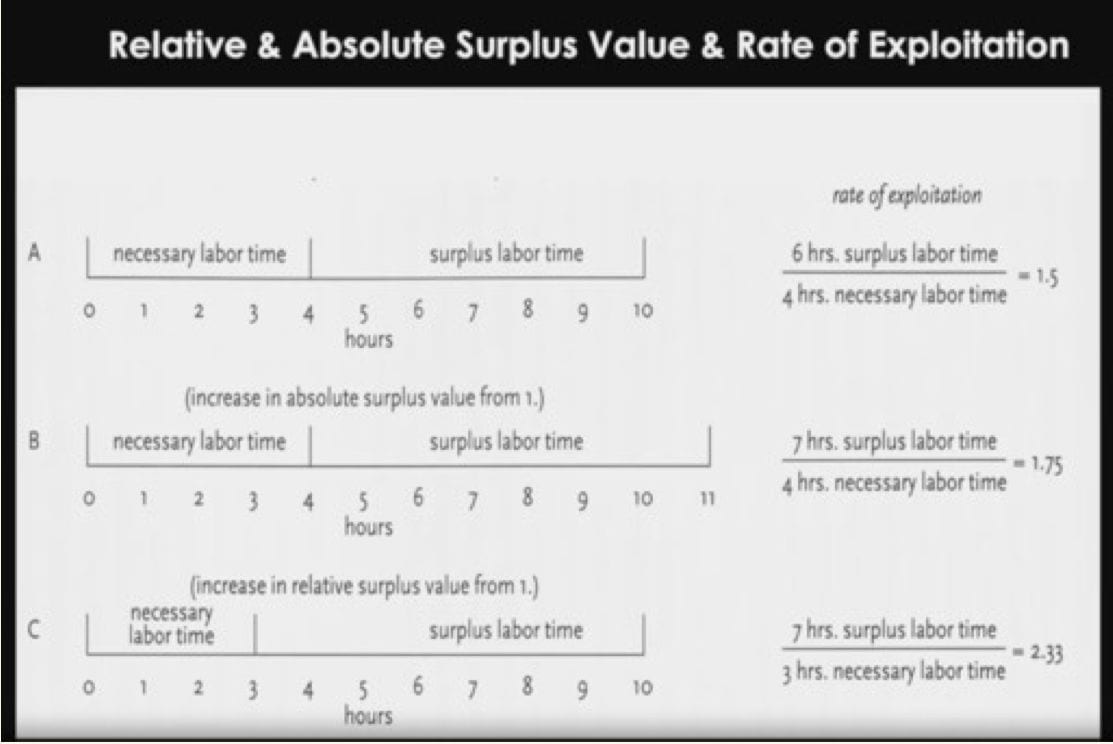
- Adding more hours limits on physical
- Machines
- Why capitalism is successful
- Find new innovation to make labor more productive
- more and more capital intensive
- Find new innovation to make labor more productive
- Why capitalism is successful
- Competition will eventually produce less value
- Working class consciousness
- Cause communism
- 5 Part Theory of Crisis
- Motivation of people
- other referential
- Ideal
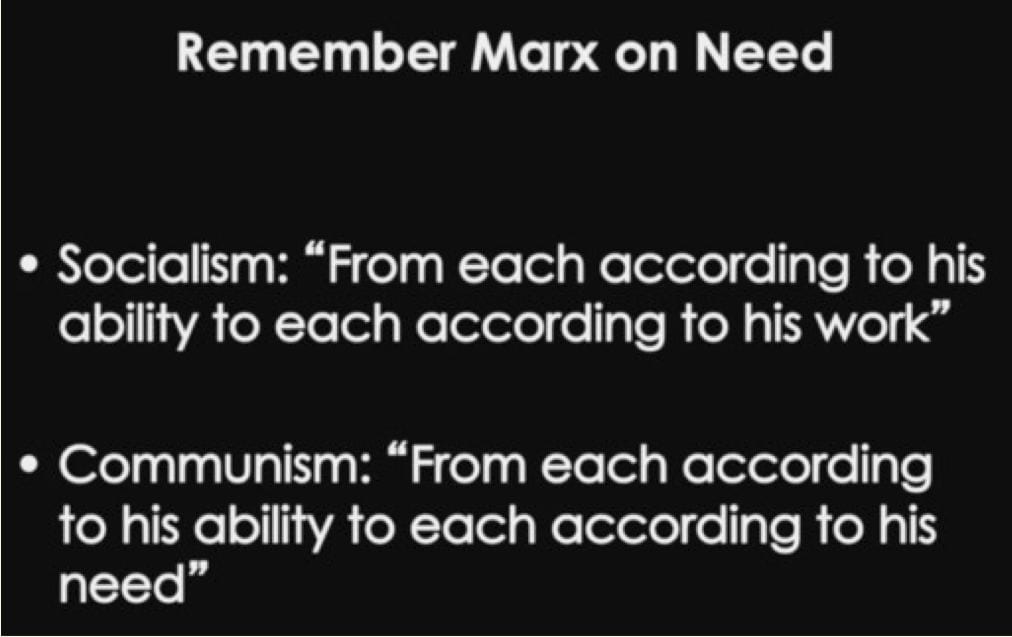
- To each according to his ability to each according to his worth
- Rewarded for the value of what they produce, wont be commonalities of the cost to produce them
- To each according to his ability to each according to his worth
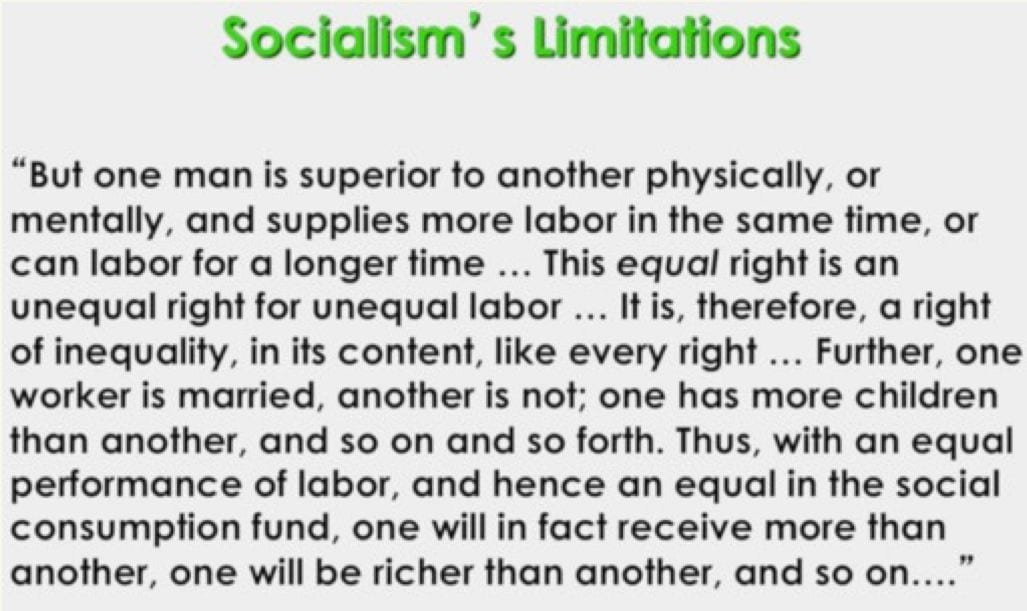
- Wont be an equal society in socialism
- until communism highest phase
- Failure & Legacy
- Failures
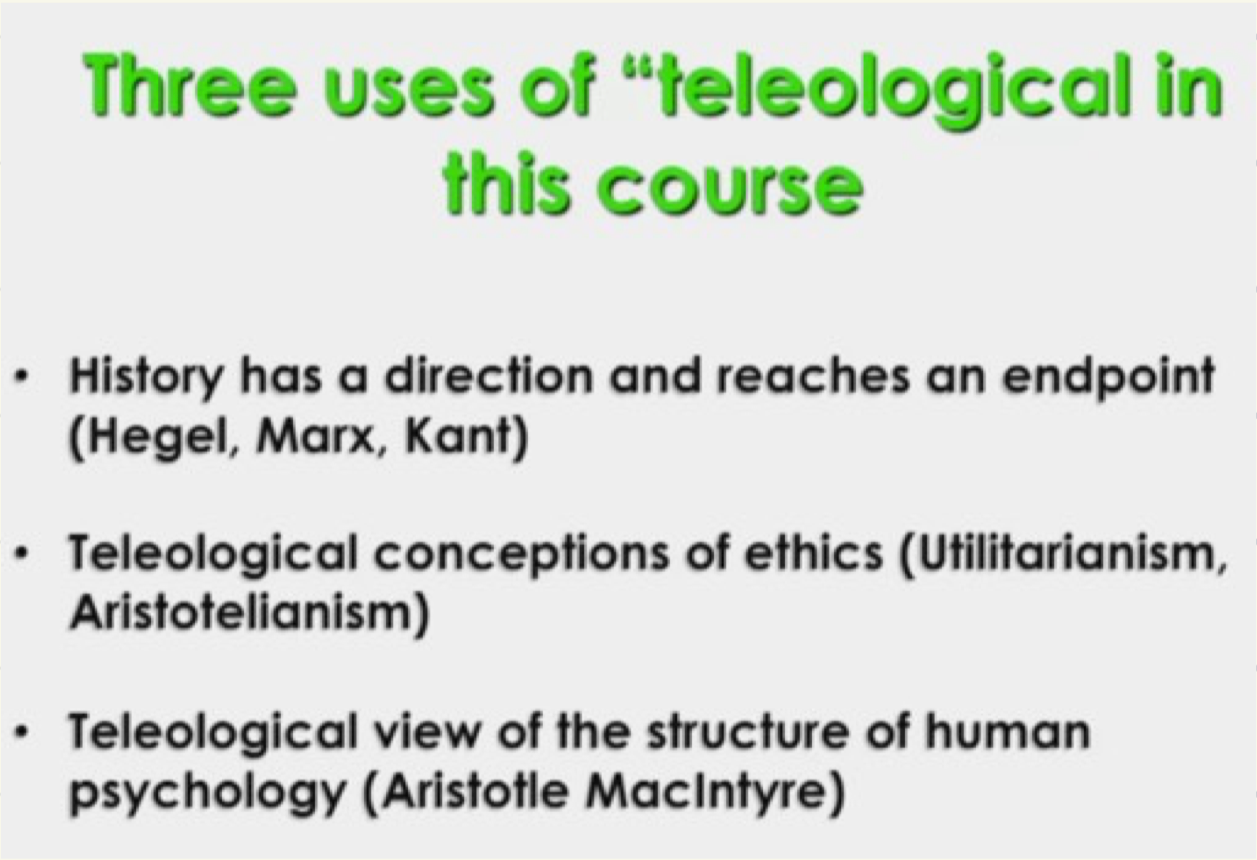
- teleological view of history
- socialist utopia
- Revolutions happened in peasant societies
- teleological view of history
- Wants vs Needs
- Main competitor to Utilitarianism and social contract theory
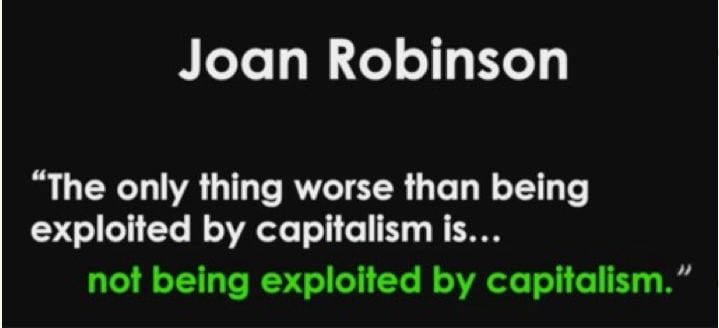
- Enduring insights about power relations
- not small
- other-referential
- deep insight
- right people aren’t self-referential
- wrong who
- insight of being in the power of others
- Micro
- Labor Theory of Value
- Alternative formulations
- Freedom argument: Class monopoly and domination
- Exploit might not reward fairly
- but markets don’t reward fairly either
- Hidden moral argument
- Role of workmanship
- Why think labor is so special?
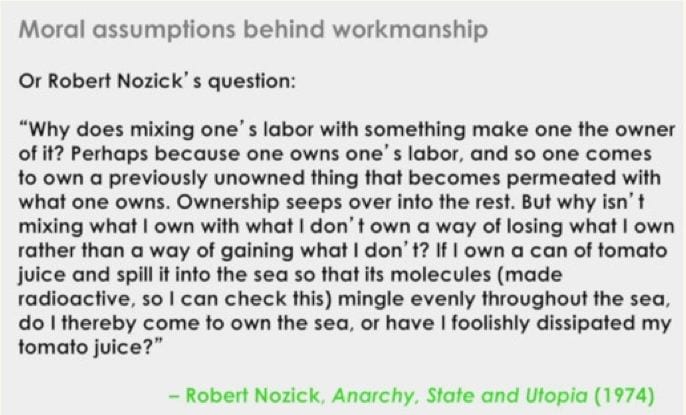
- Corn theory of value and exploitation
- Corn no different than labor
- Role of workmanship
- Power only source of surplus
- Feminist critique
- Contributions
- capitalists
- dead workers
- False
- Incorrect
- Alternative formulations
- Under-estimated the state stepping in to save capitalism
- Marco Theory
- Working class consciousness
- Compare to similar people
- under consumption
- Keynes
- Counter-cyclical policies
- Keynes
- Monopoly
- Anti-trust Laws
- Rate of Profit
- New industries fixes it
- Liquidity
- 2008
- Central bank solved it
- 2008
- Transcending scarcity
- Working class consciousness
- Failures
Anti-Enlightenment
Edmend Burke
- 1729-1797
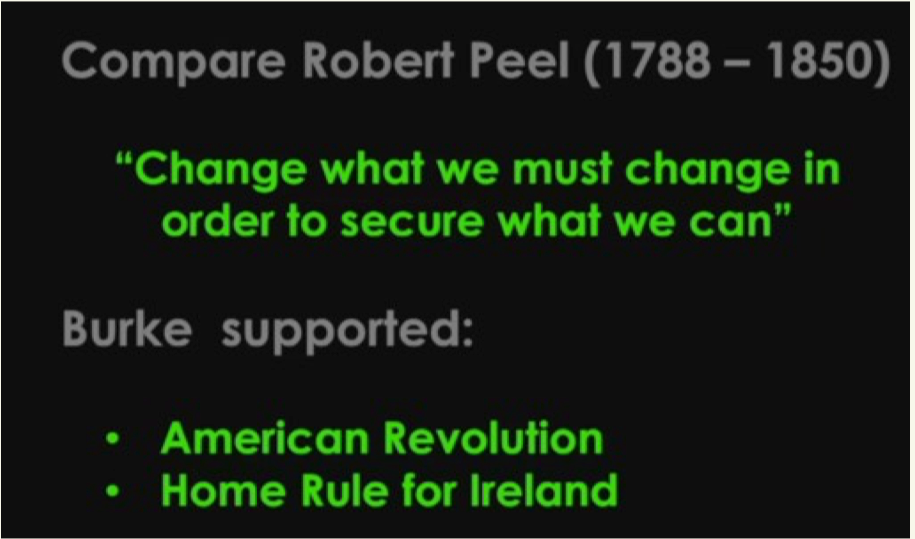
- Conservative
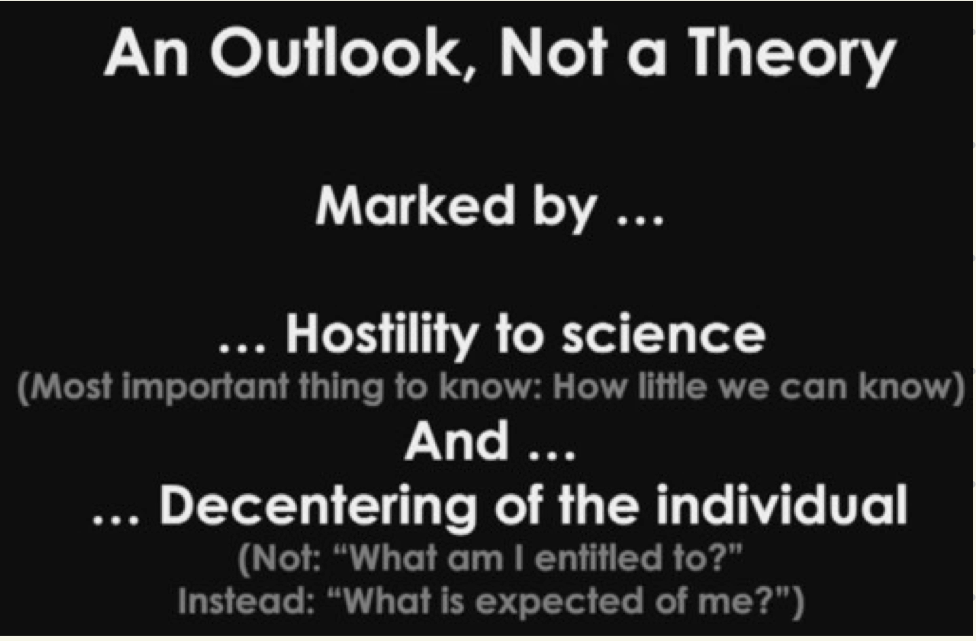
- Outlook
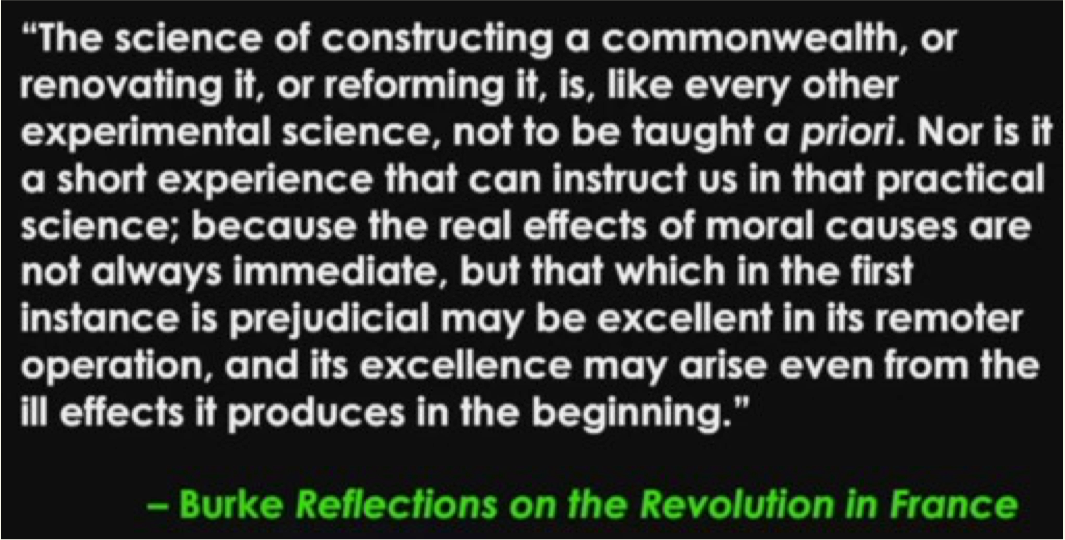
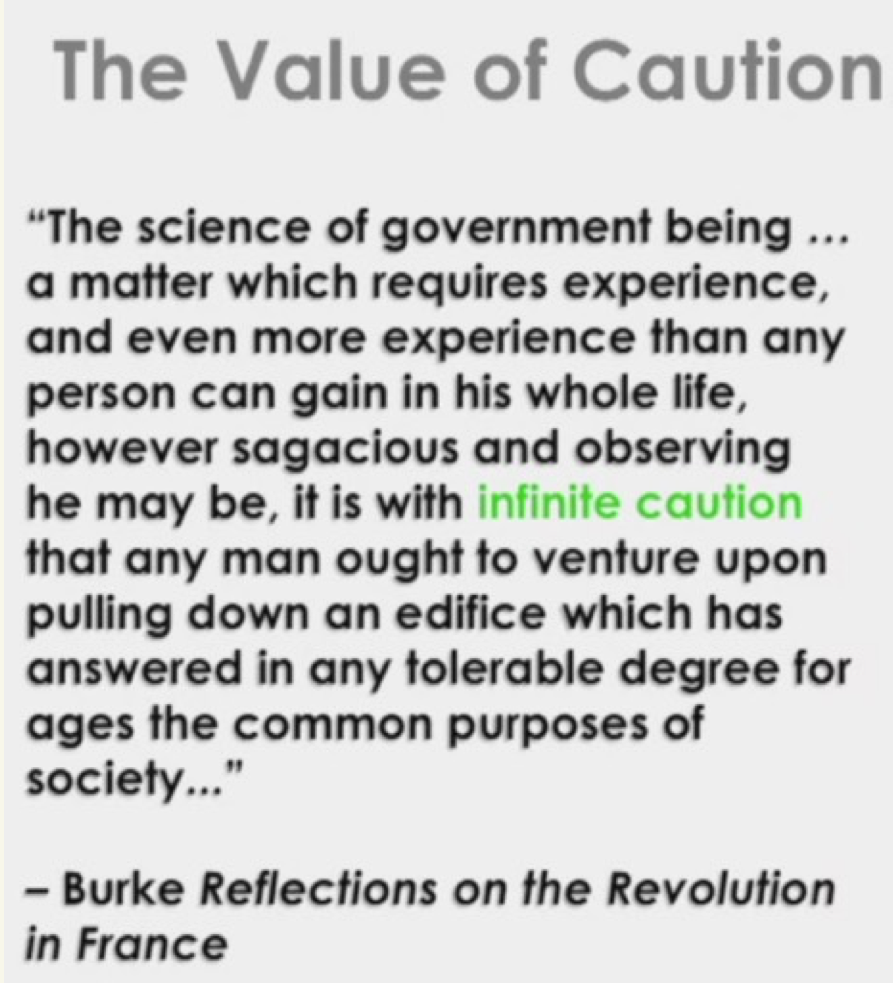
- Deep skepticism to theories of politics
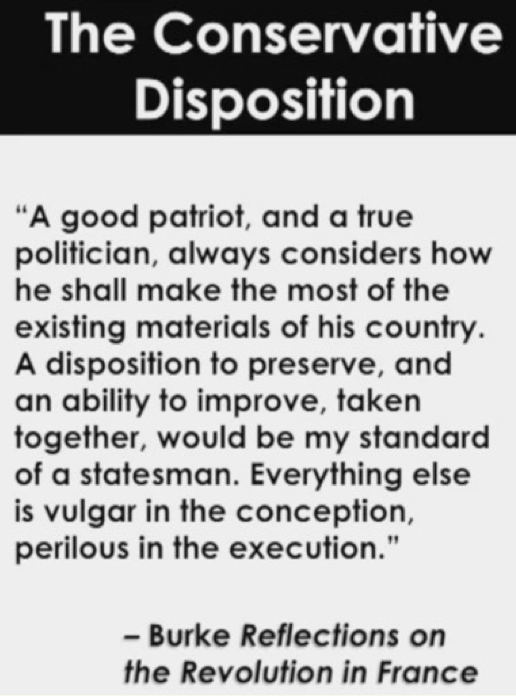
- Disposition
- Tradition
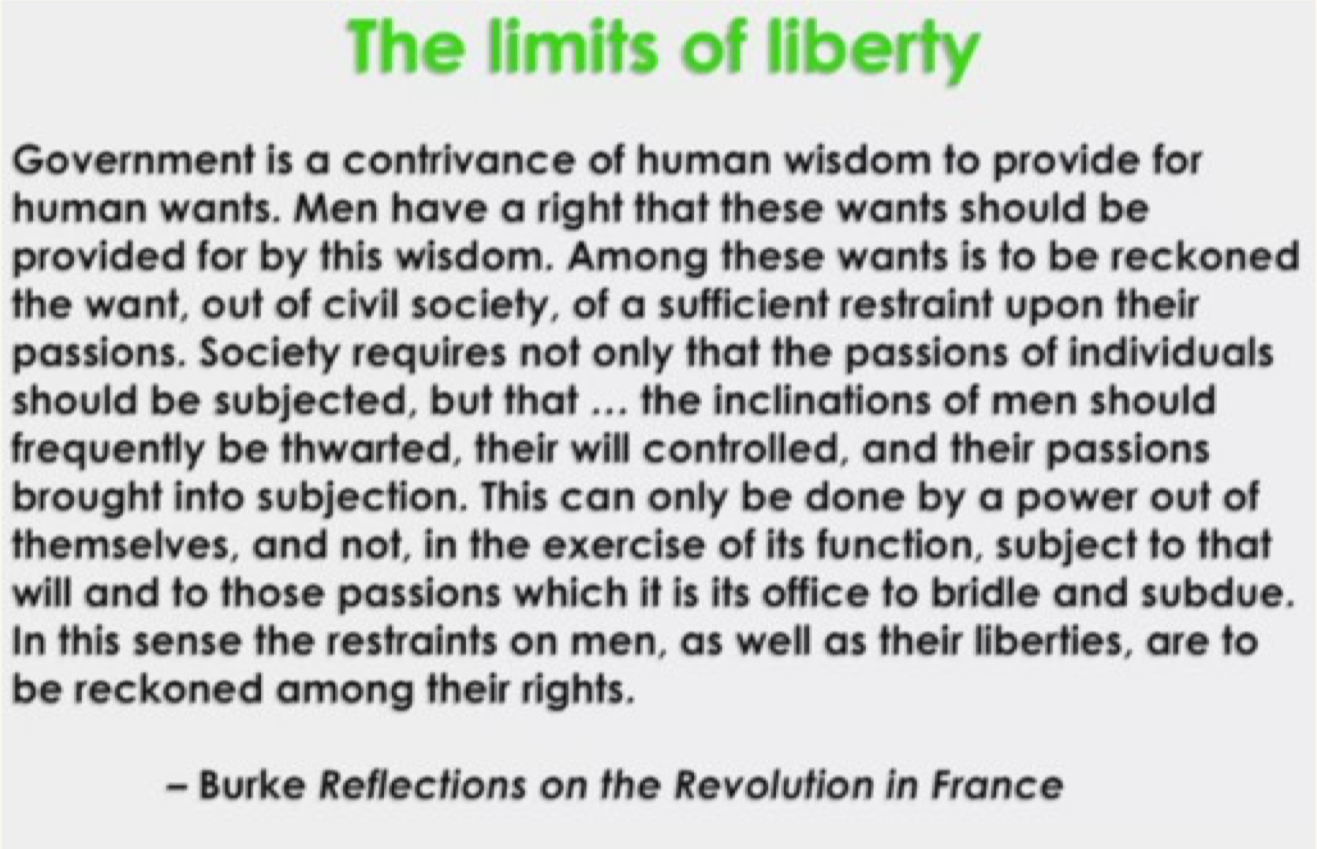
- Human nature flawed
- Institutions accounting for human imperfections
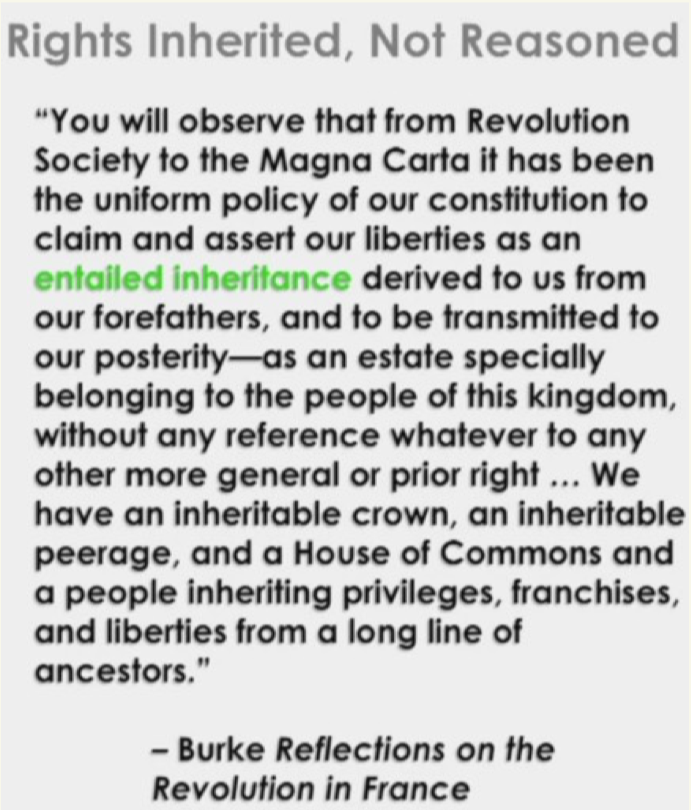
- Liberties
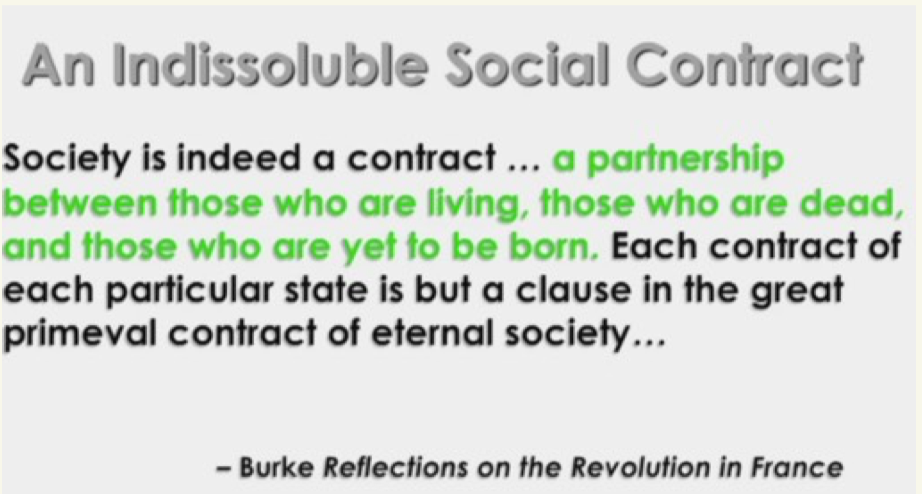
- inherited
- Customs
- institutions
- Practice of society
- Passed down by generations
- inherited
- French Revolution
- Traumatized
- Abstract Rights
- “Rights of man”
- dangerous
- instability
- Should be grounded
- practical
- Historical
- Thomas Paine Rights of Man
- 1791
- Response to Burke
- Human Condition
- We’re fumbling in the dark
- Forces that shape societies and how much we can influence
- We’re fumbling in the dark
Patrick Devlin
- 1905-1992
- Conservative
- Burkian
- Outraged Homosexuality and prostitution should be legalized
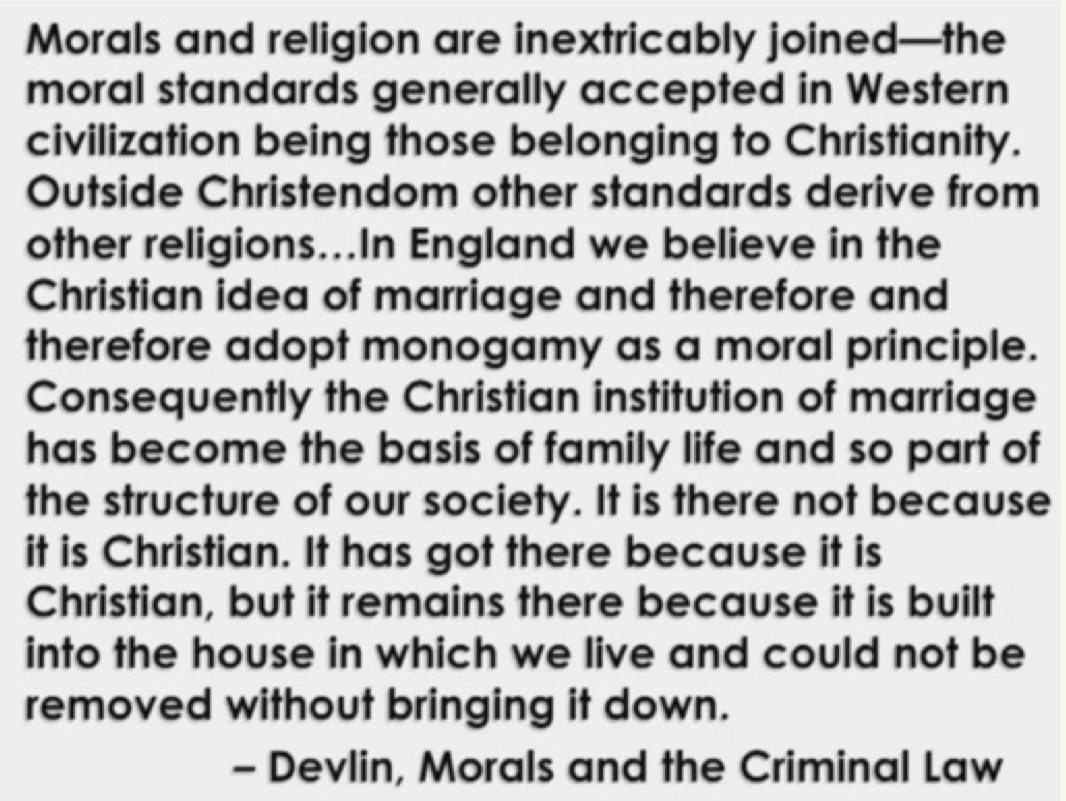
- Christian morality
- Tradition
- Norms and beliefs of average person
- People disgusted
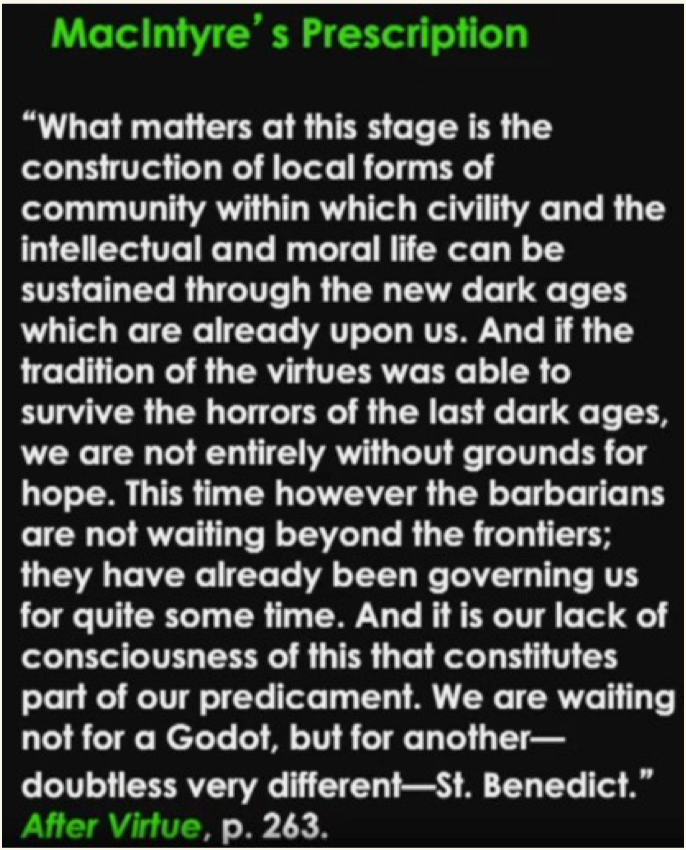
Alasdair MacIntyre
- Cant escape your roots
- Historical creatures
- Revolted against Catholicism
- Marx vs Christianity
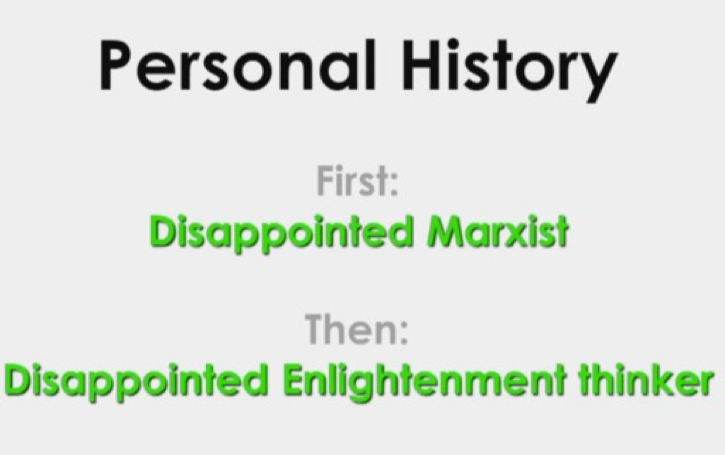
- Disappointed
- Careful leaving Enlightenment project
- Why after virtue?
- Aristotle
- Huge mistake Enlightenment left behind
- Disagreed with Hobbes
- Aristotle
- Justifying Morality
- Raw clay when born
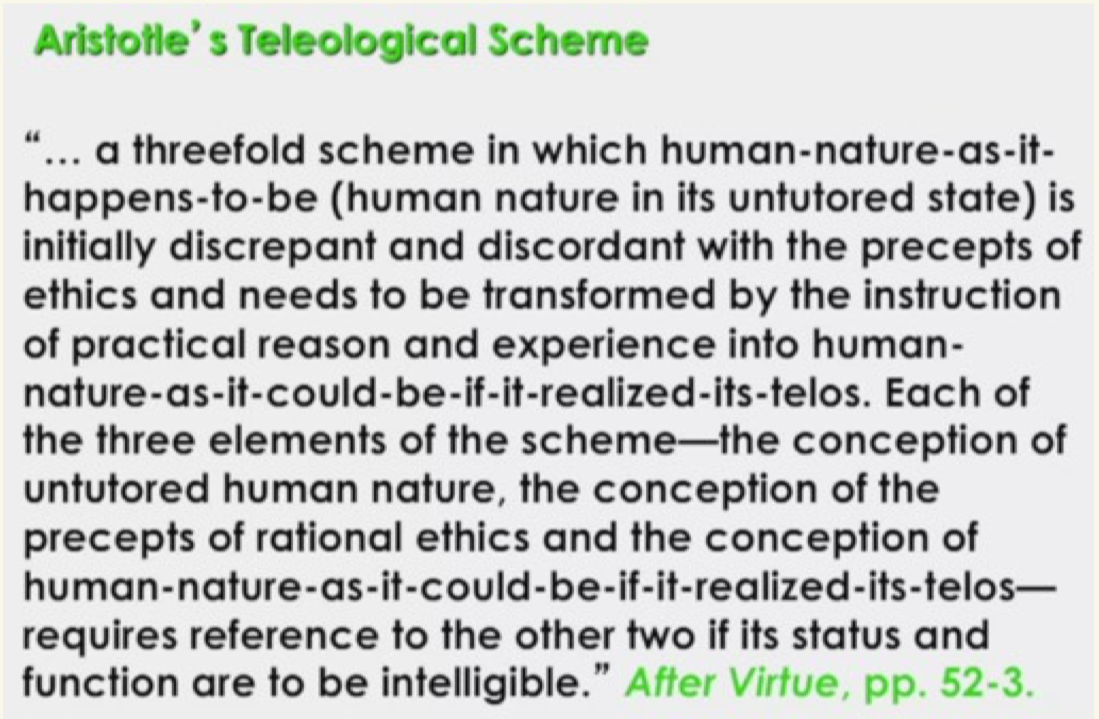
- unrealized potential (tetelogical) vs. people are just who they are
- Always unsatisfying
- Raw clay when born
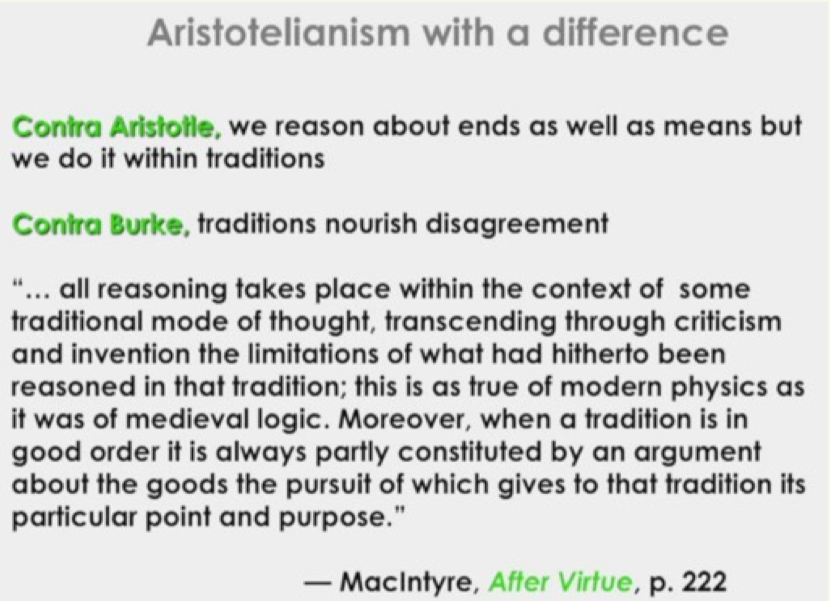
- Disagreements within traditions
- Doesn’t answer the questions
- Want it both ways
- No answers or prescriptions
- Aristotle vs Nietzche
- Wants to solve the conundrum
- Nihilism
- Everything is meaningless
- Enlightenment
- -> Rational Foundation for Morals (Hume, Kant, Bentham)
- -> Doomed
- Separated morality from traditional teleological framework
- Reason Foundation separates moral claims from context
- both ^: Vastly different approaches to morality (Utilitarianism, Deontology)
- Loss of shared moral framework
- Emotivism
- Loss of shared moral framework
- both ^: Vastly different approaches to morality (Utilitarianism, Deontology)
- -> Doomed
- -> Rational Foundation for Morals (Hume, Kant, Bentham)
- Aristotianism
- Emotivist Culture
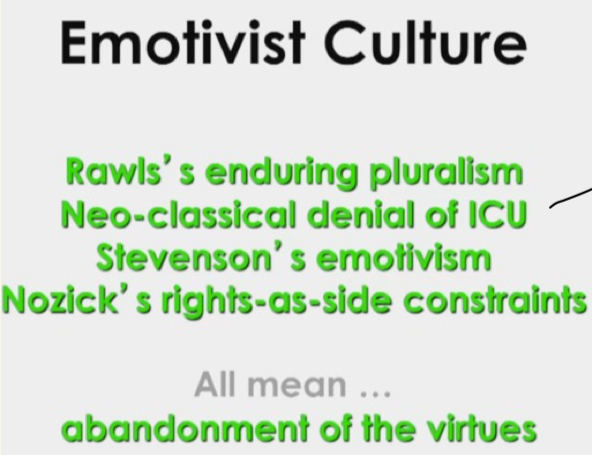
- Can’t expect to resolve differences
- Just have to find how to get along
- Seperation of means from ends in politics
- Business schools
- Managers
- Business schools
- People uncomfortable with “Horray/Boo” morality issue
- Can’t convince some people of other views
- Emotivism = Moral Judgements = Individual preference/emotions
- right/wrong = personal feelings
- Moral language is fragmented
- Different assumptions
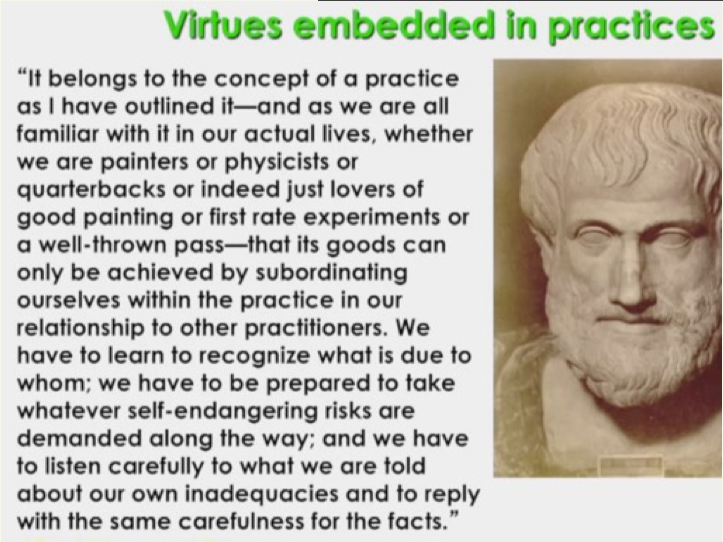
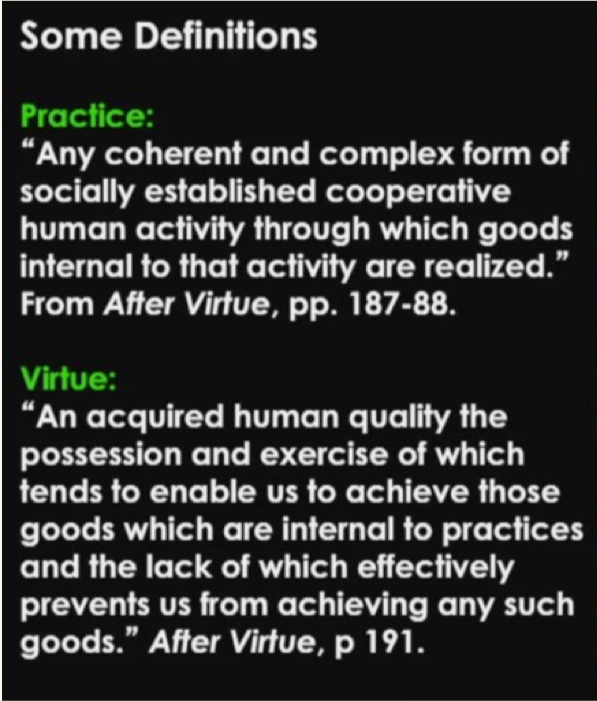
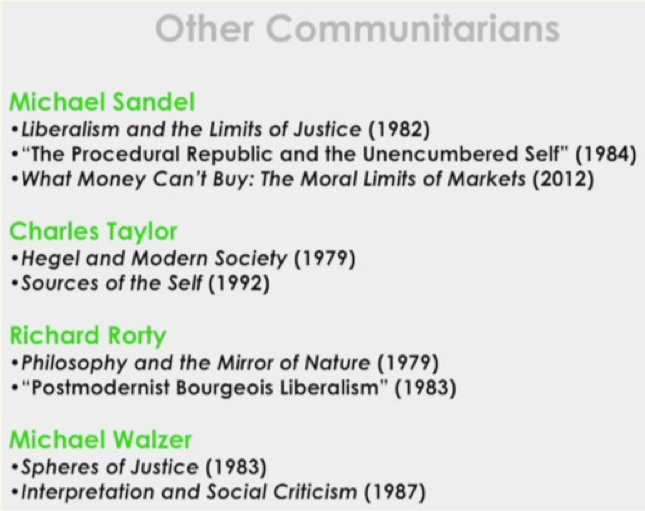
Failure of the Enlightenment Project
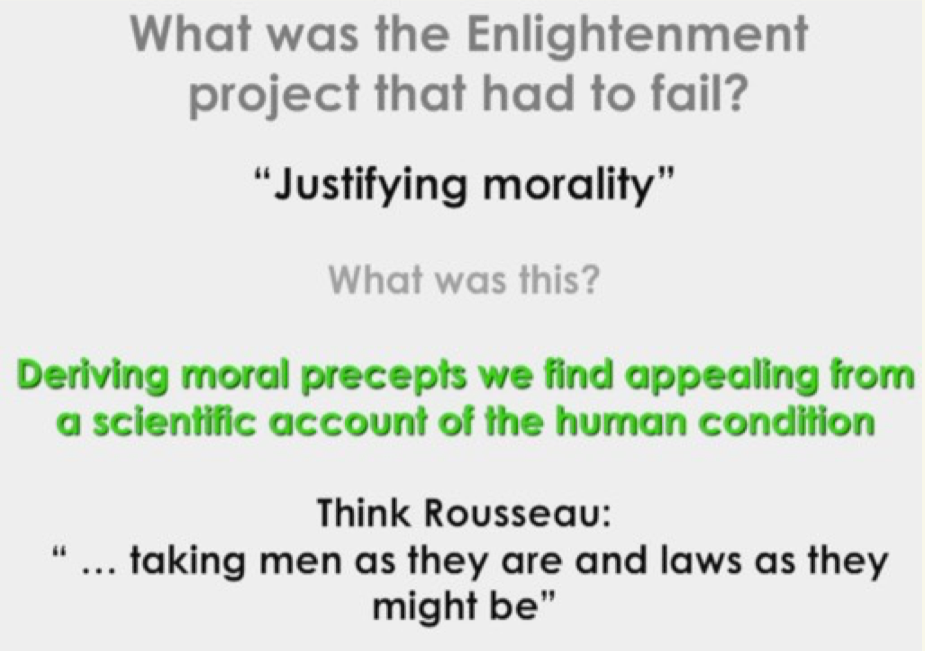
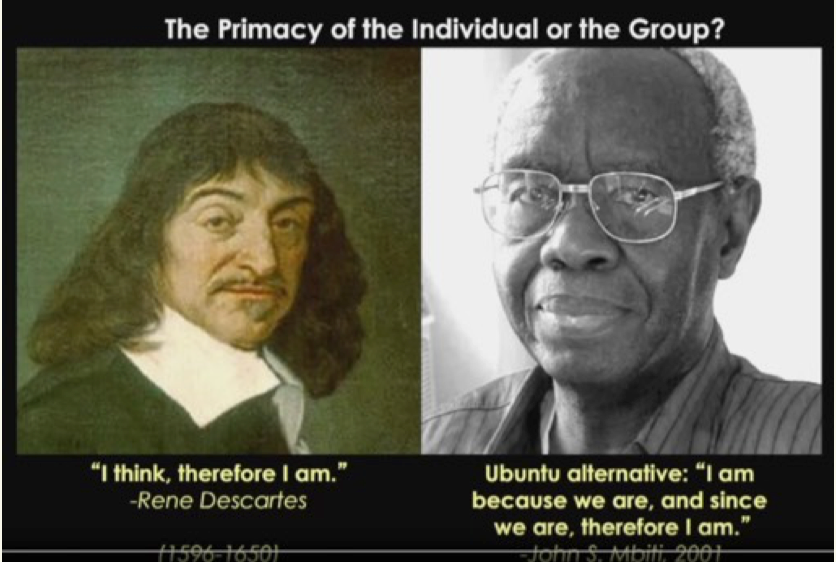
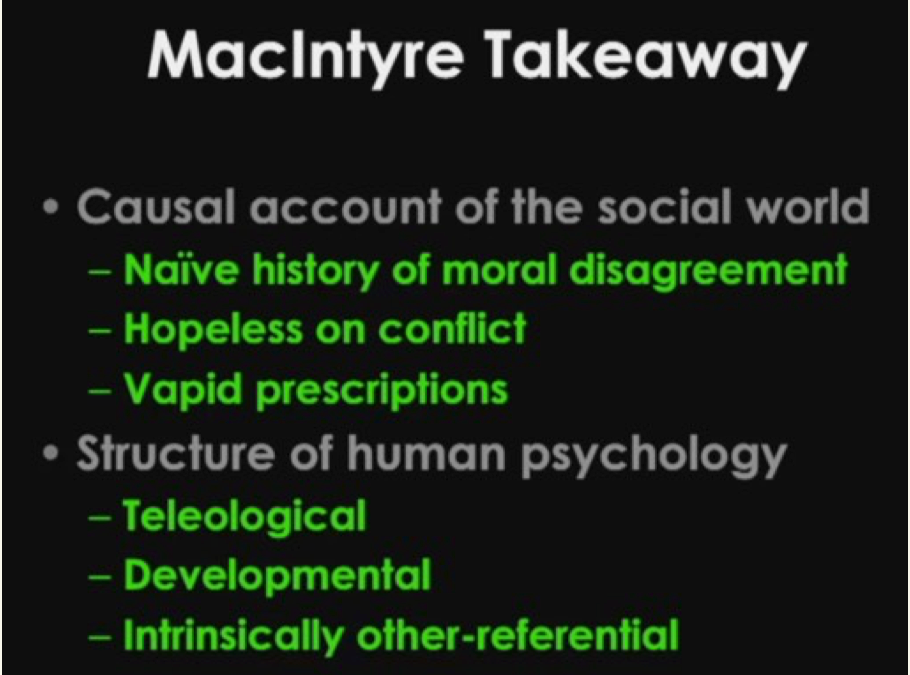
- Overestimates agreements in past
- Bad (Casual account)
- Best/True: Structure of human psychology
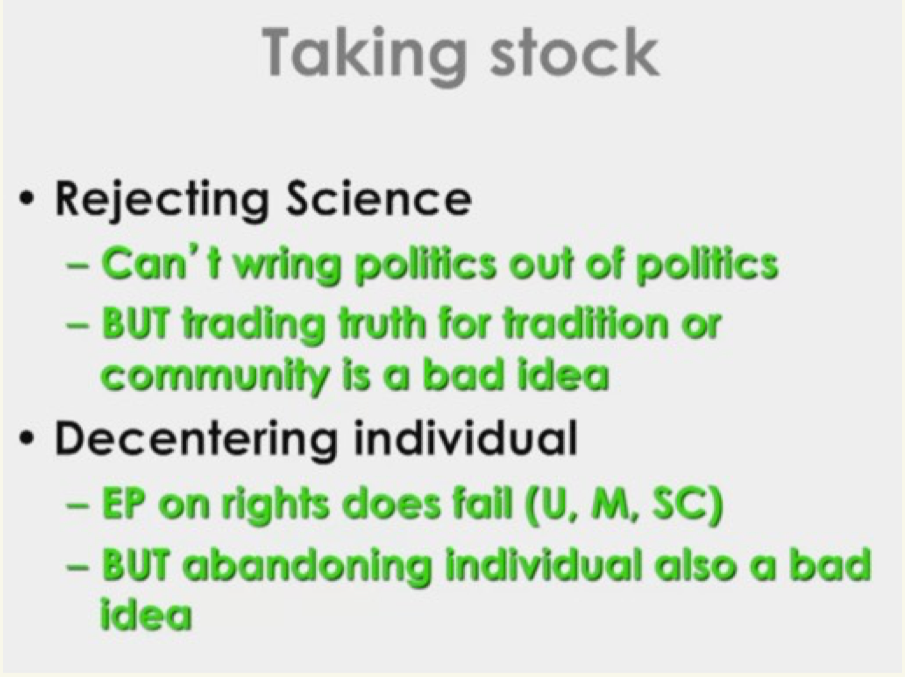
Democracy
- Democracy and its Critics
- Realizing Enlightenment challenge?
- Respect for individual rights?
- Based on science?
- Made famous by its critics
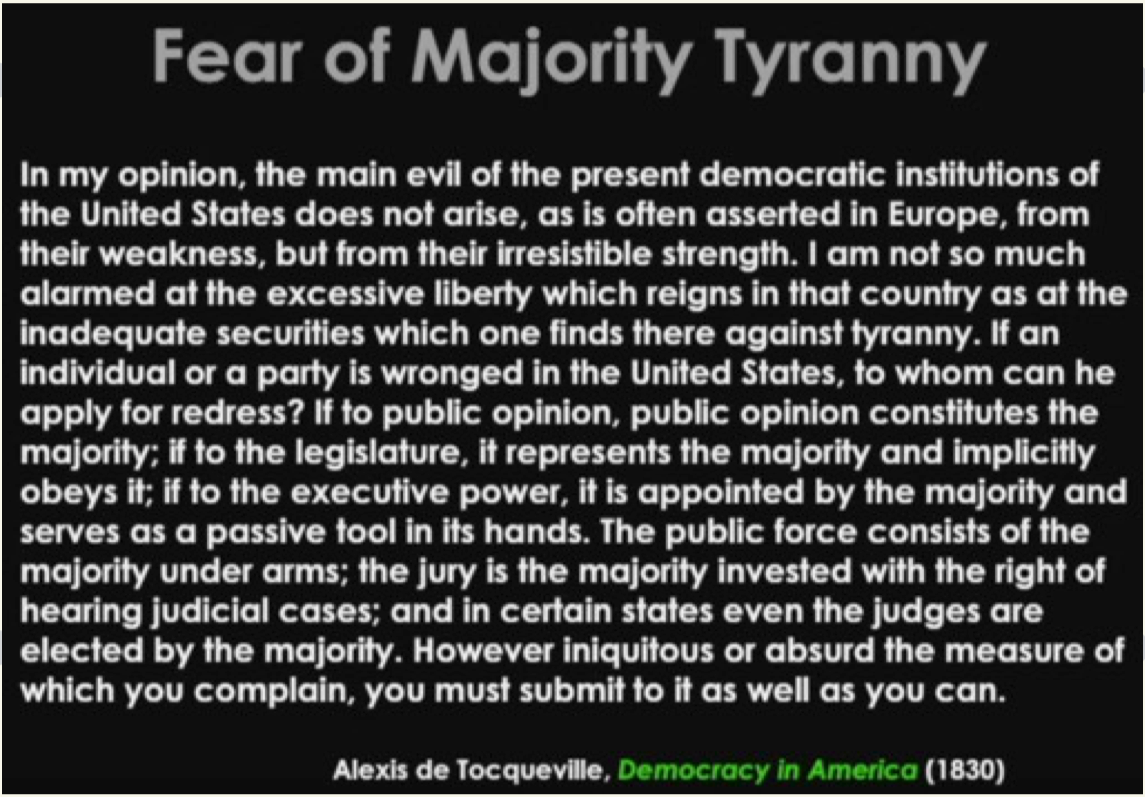
- Alexis de Tocqueville
- Majority Tyranny
- Distilled America
- More as he got older due to slavery
- U.S. knew how to tame equality
- You can’t stop equality
- Plato
- Due to putting Socrates to death
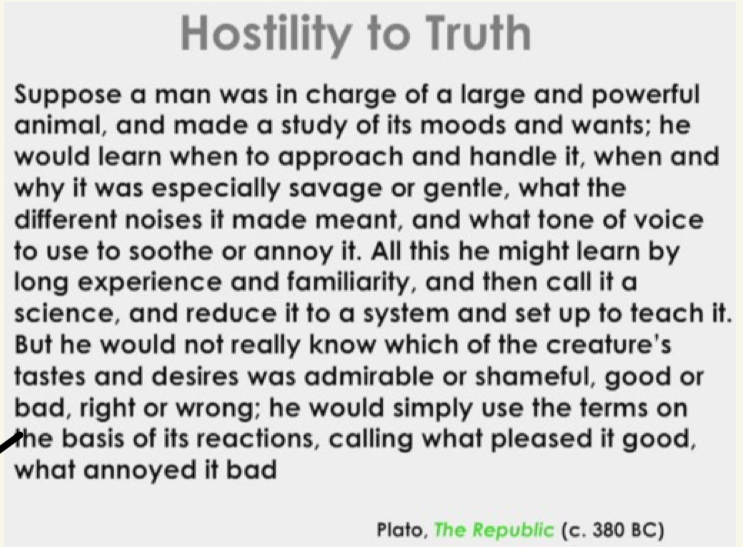
- Older than other ideologies
- You know it when you see it
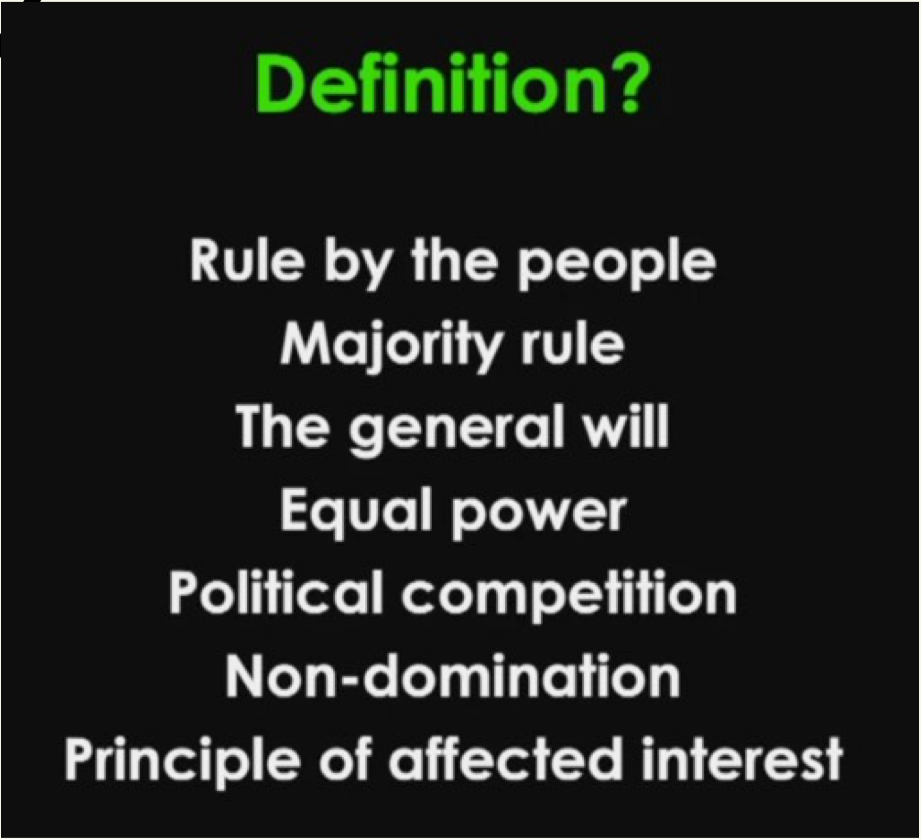
- Alexis de Tocqueville
- Realizing Enlightenment challenge?
Federalist Papers
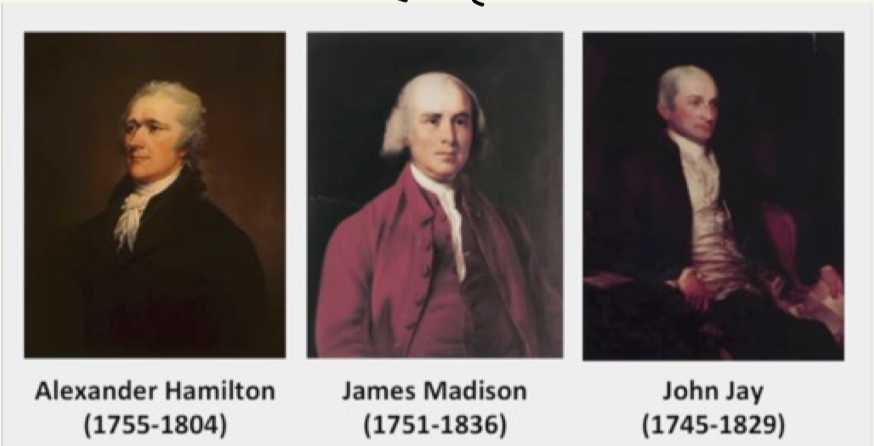
- Hamilton & Madison did the most; enemies
- Madison principle author
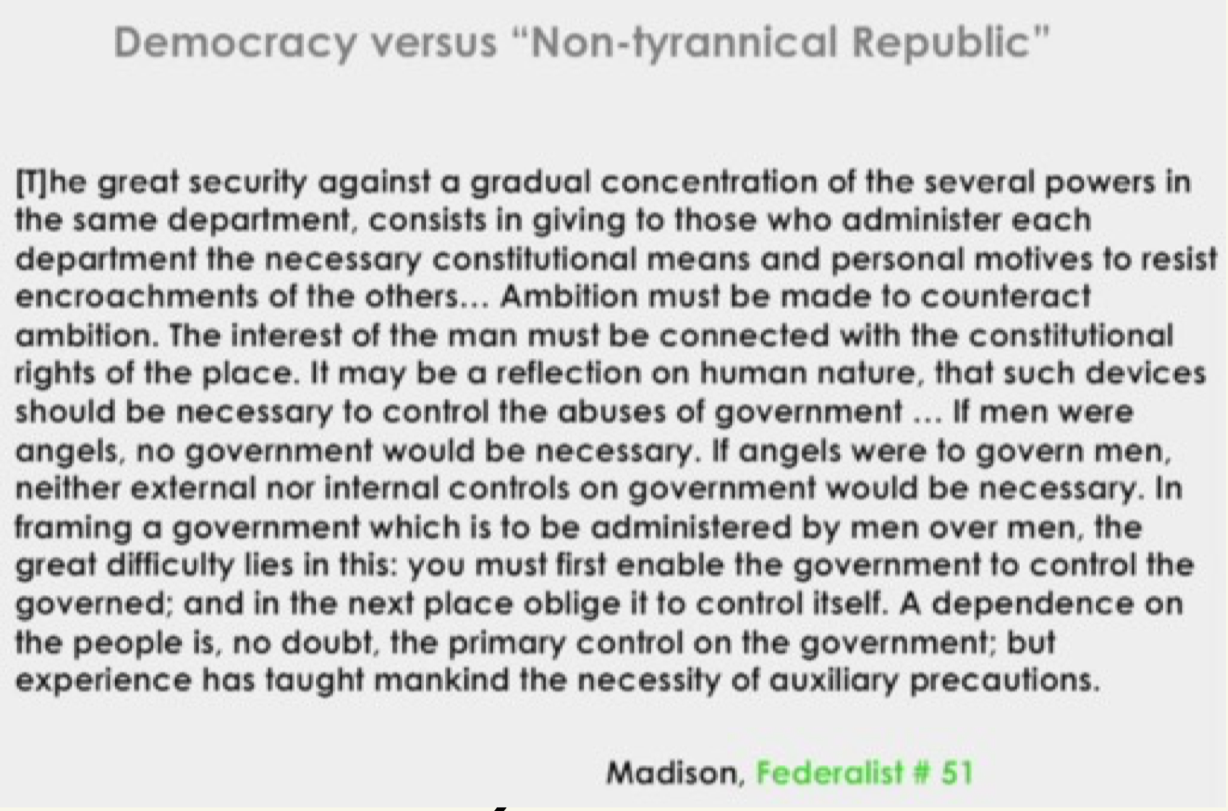
- Essays in NY Newspapers
- to increase federation
- Almost lost revolution
- Needed stranger Federal Gov.
- Constitution needed states to ratify
- Needed NY
- to increase federation
- Didn’t use their own name
- “Publius”
- Roman consul
- “Publius”
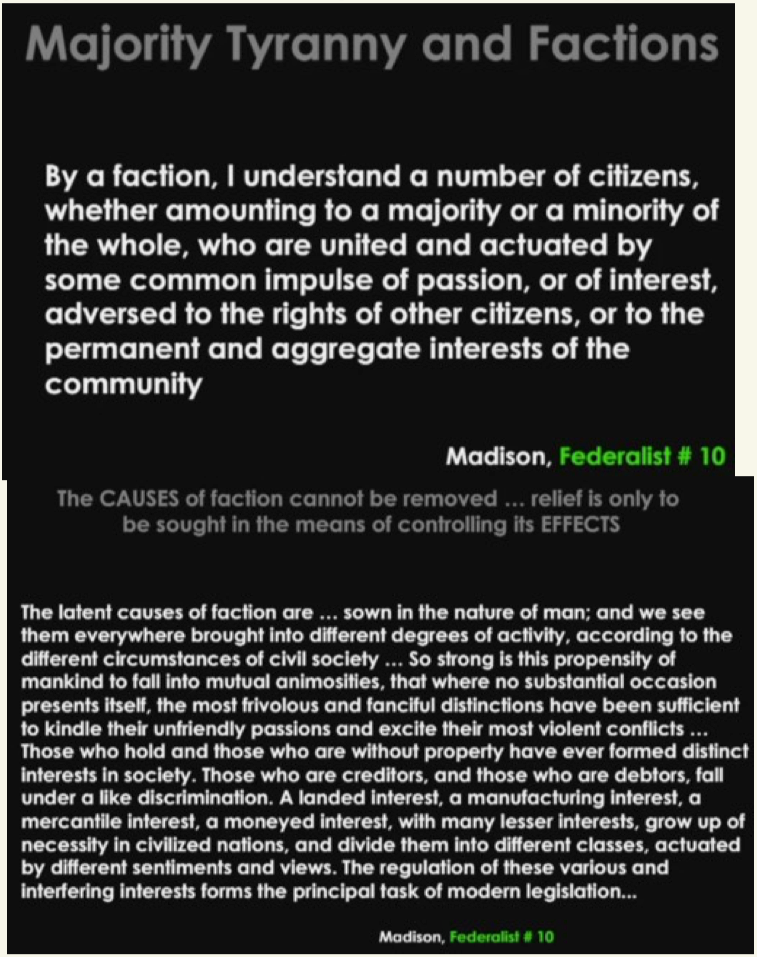
- Single most political theory
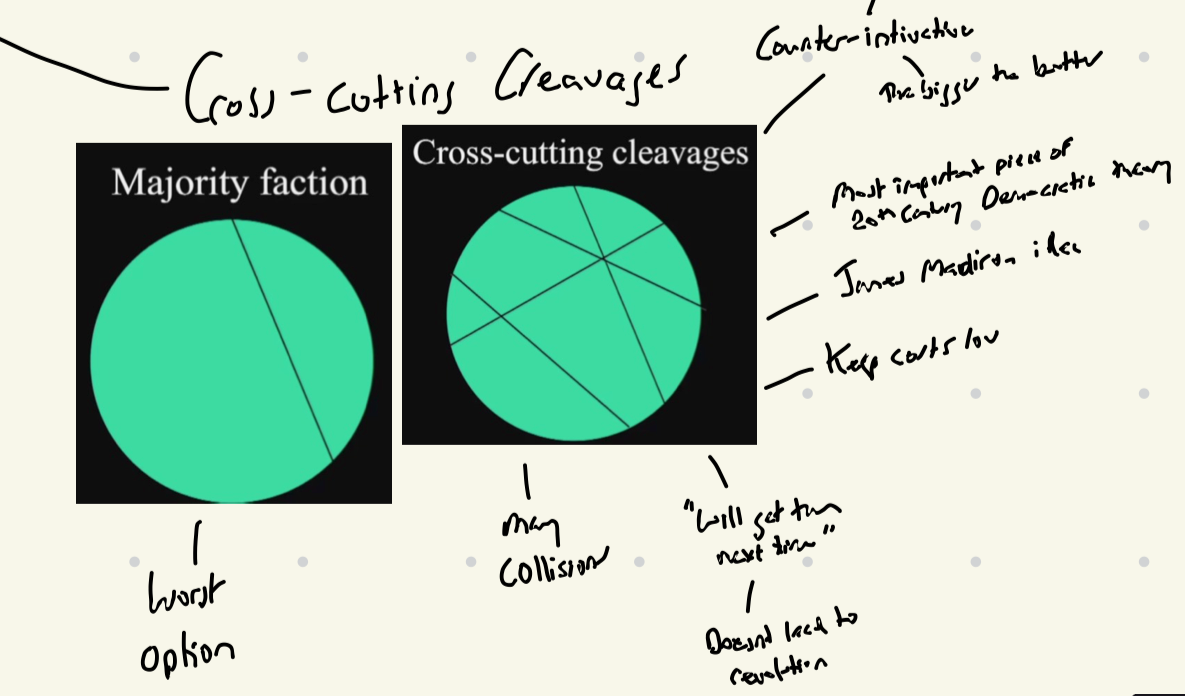
- “Factions”
- Republican Tradition
- Aristotle tradition
- 1-Monarchy
- Few
- Aristotracy
- Many
- Democracy
- Best to have elements of all three
- Polity
- US version of that
- Polity
- Aristotle tradition
- General Will
- Majority Rule
- Technical solutions fail
- Paradox of Voting
- Cyclical majorities
- Societies seem to be irrational
- control order of voting + preferences
- Control voting
- Arrow’s Impossibility Theorem
- Three or more options
- Doesn’t produce fair decisions
- “Will of the people”
- Voting systems structure
- Three or more options
- Majority Rule
- Deliberation in the real world
- Better for group to individually submit guesses or the answer compared to getting it by deliberation
- Wisdom of Crowds
- Fishkin’s alternative
- Deliberative Polls
- Adv.
- Random
- in depth
- 3 days
- Experts to argue both sides
- Problem
- Demo’s?
- Framing Effects
- Agenda Control
- Gerald Kramer
- You can get any result
- Gerald Kramer
- Deliberation can undermine truth
- Deliberation between people that agree make them more extreme
- Adv.
- Deliberative Polls
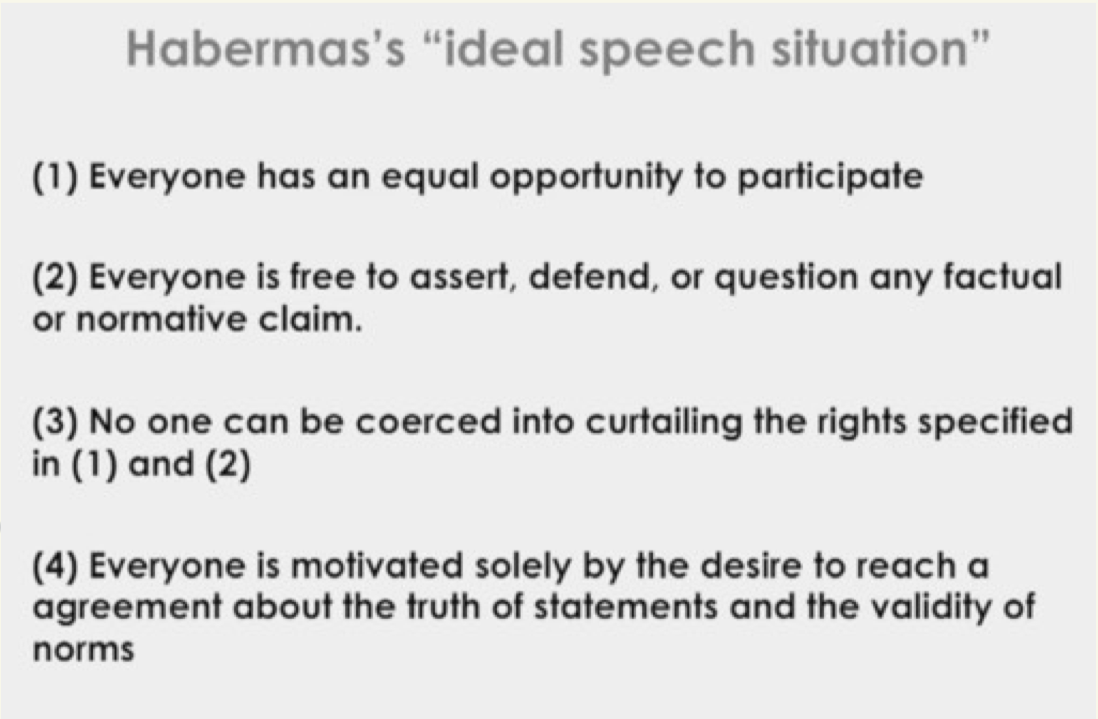
- Habermas Deliberate Ideal
- Assumes people want to agreement
- Assuming away politics
- Demanding
- Deliberation can undermine agreement
- Marriage therapy
- Marx on conscious raising
- “Gag rules”
- Stephen Holmes
- People who believe things too strongly
- Get them out of politics
- Religion
- Counter factual
- ideal
- ‘ideal speech situation’
- Deliberate Democracy
- Get people to agree to what General Will will be
- Manufacturing then discovering
- Assumes people want to agreement
- Westminister System in Practice
- Passionate
- Argumentative
- House of Commons
- All the Power in one place
- No Judicial
- No Congress
- Majoritarian Democracy
- Majority Rule
- How to Protect Individual Rights?
- Critique
- Being on side of status que minimizes chance you’ll be on the losing side
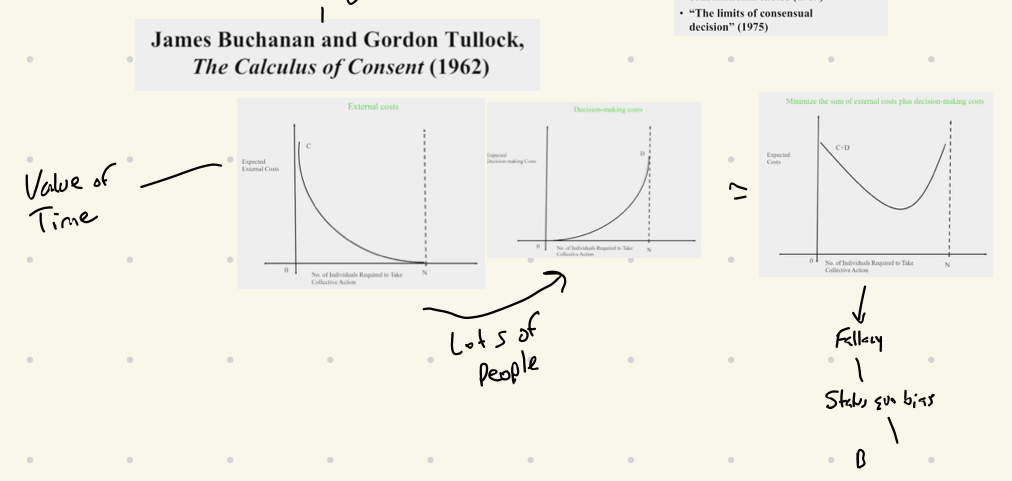
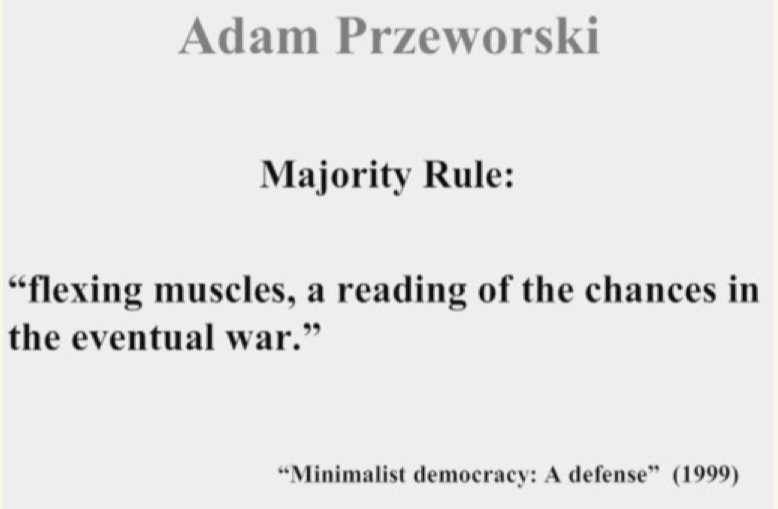
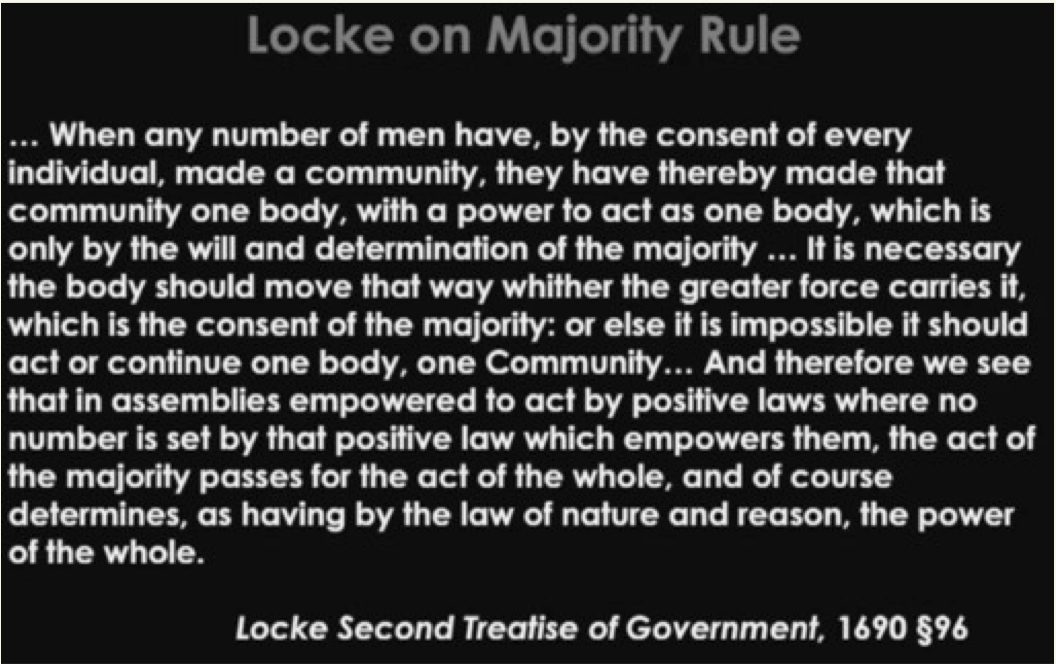
- John Locke
- Defender of Majority Rule
- Defender of Majority Rule
Competition and Democracy
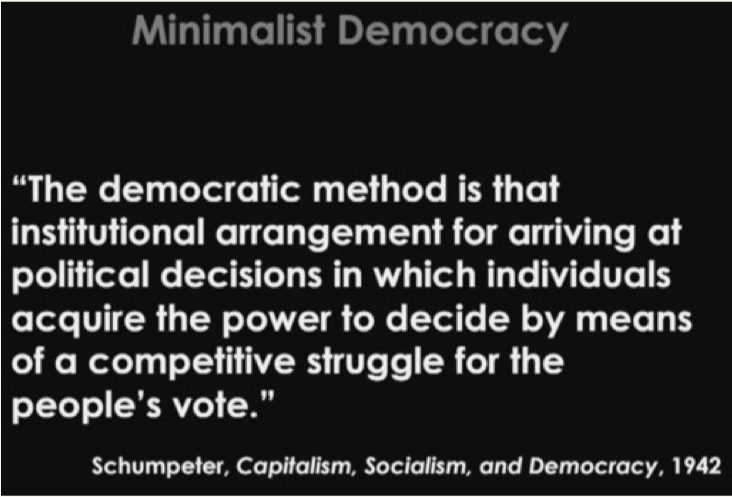
- Joseph Schumpeter
- Need competition in politics
- Competition > Power
- Difference and federalist
- Not dividing it up
- Difference and federalist
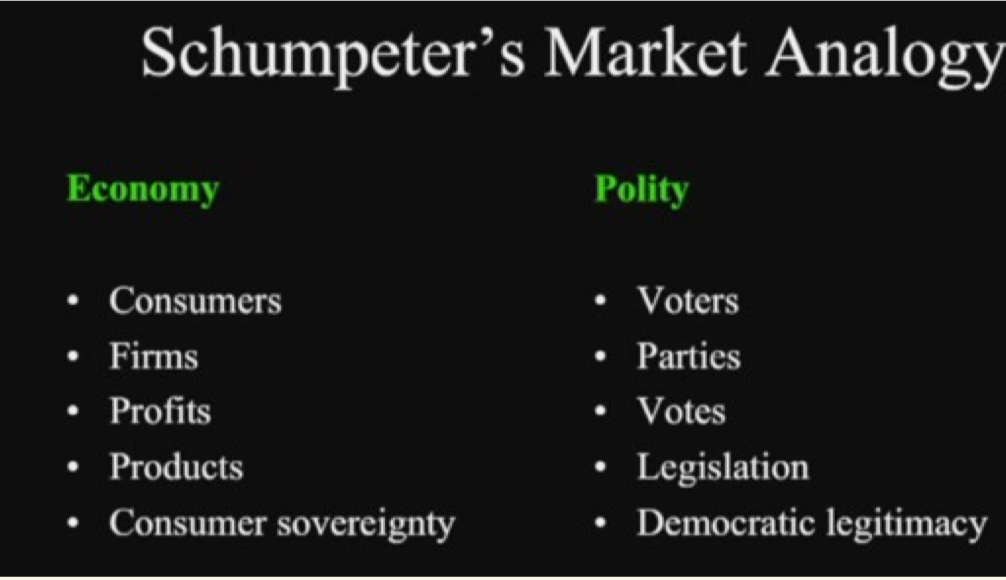
- Market Analogy
- Democracy is a political analogue to consumer sovereignty in the market
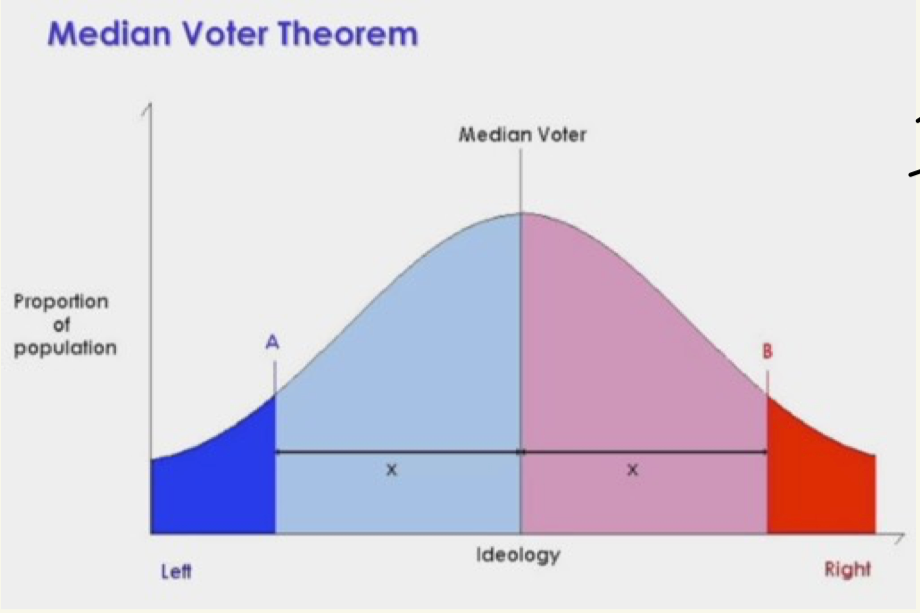
- Politicians will run to the middle
- Goldwater - lost
- Reagan - won
- What to compete over?
- Primary
- Have to get base then pivot in general
- Personality
- Personal attacks
- Polling
- Primary
Electoral Systems
- Plurality
- Most votes get the seal
- single member districts
- Two big parties
- Duuverger’s Law
- Most votes get the seal
- Proportional Representation
- percentage of votes is how many seats you get
- Tiny parties can extract massive amounts of power
- Israel
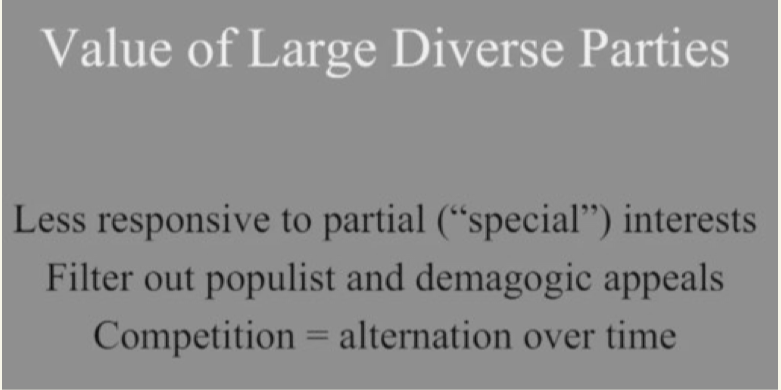
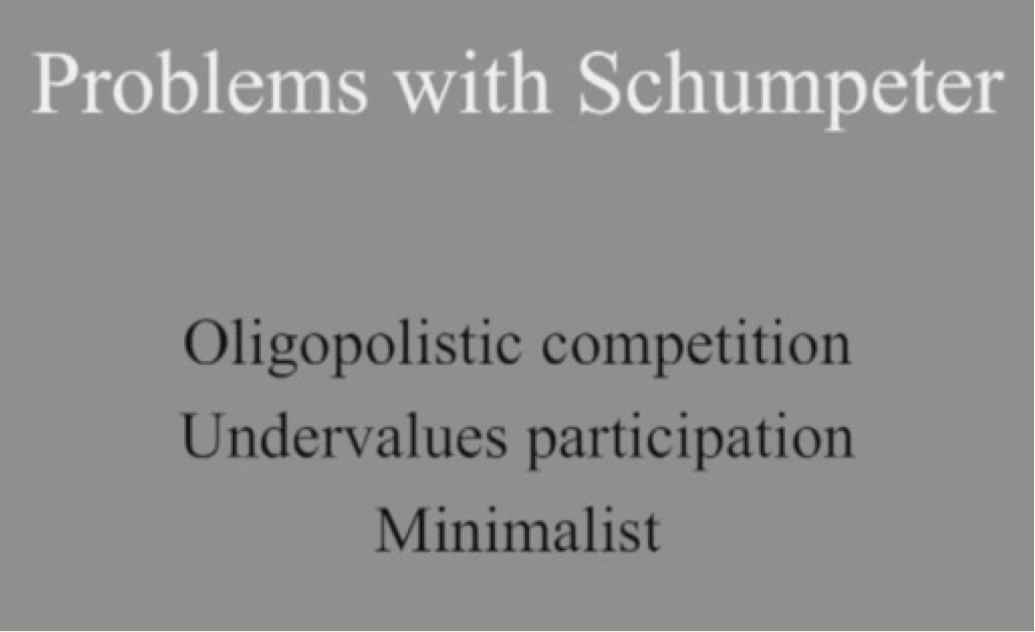
Democracy in mature Enlightenment
- Science
Mindmap