1. The Revolutionary Danger
Peterson Academy - The Philosophy of Politics Part I (Hicks) - Lecture 01.pdf (file not included in this release)
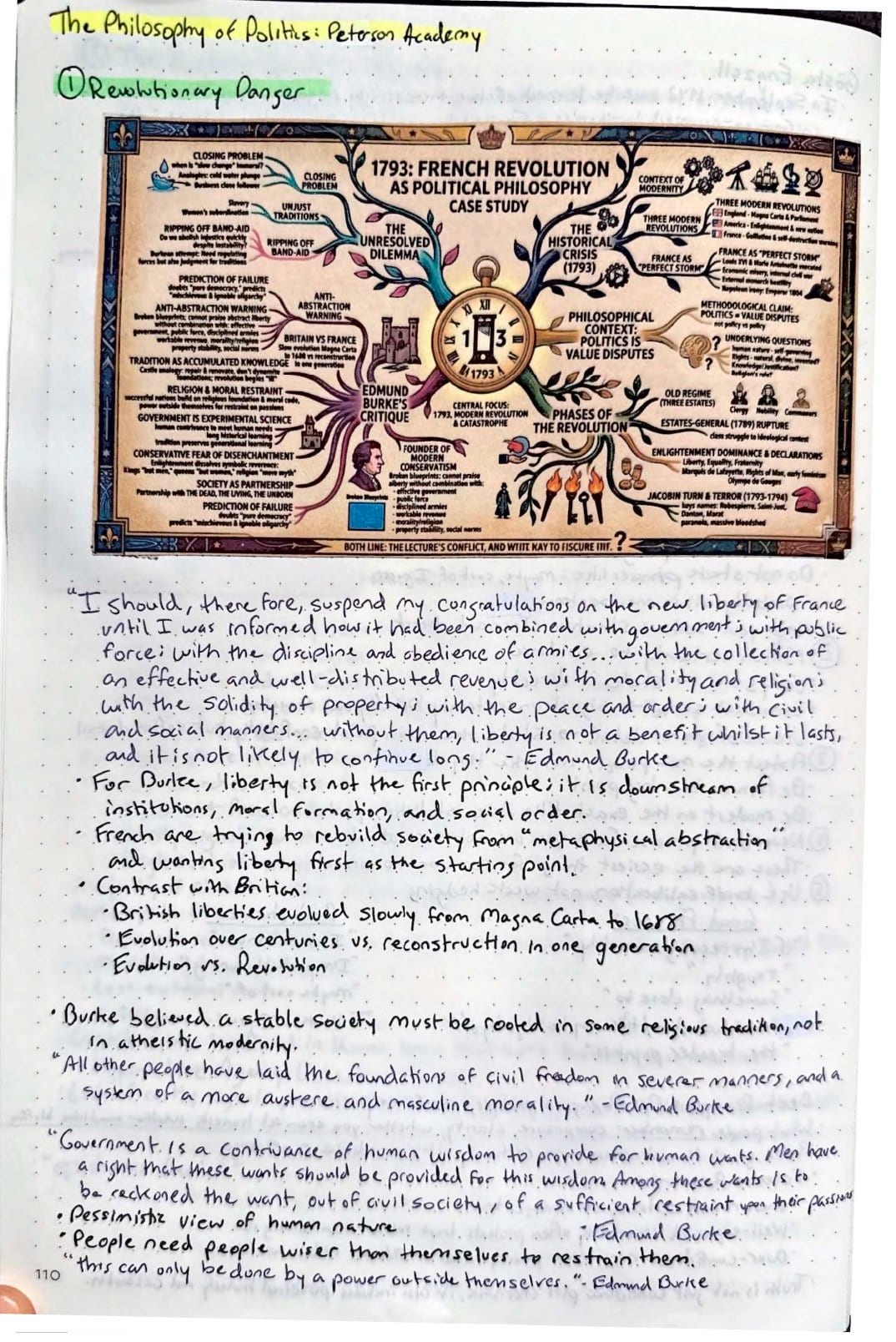
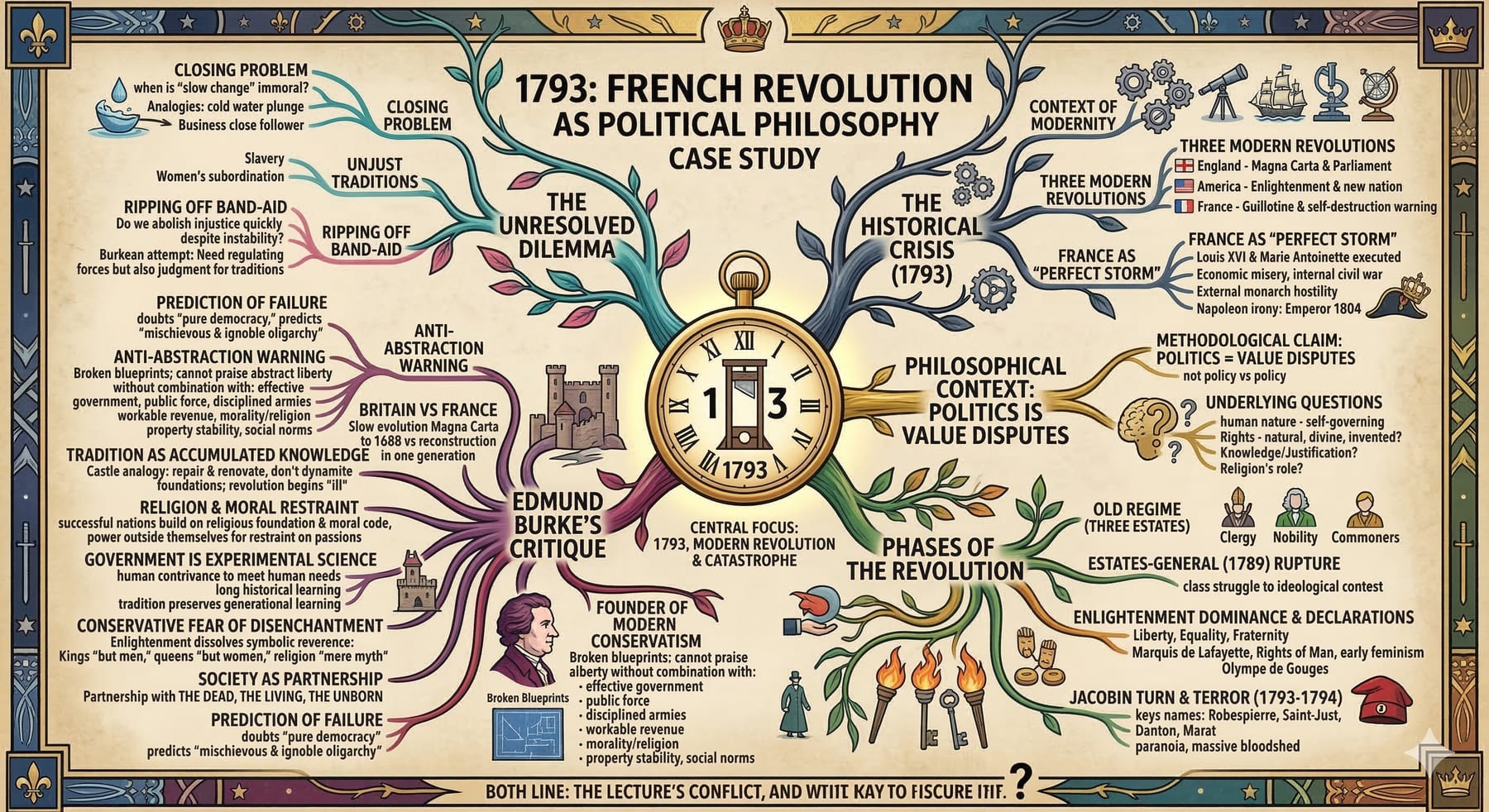
This lecture uses France in 1793 as the opening case study for a philosophy-of-politics course: a modern revolution that spirals into catastrophe, raising questions about why revolutions happen, why some succeed while others collapse, and how political events are inseparable from deeper philosophical assumptions about reason, rights, tradition, religion, and human nature.
1) Why 1793 matters: modernity’s darkest political lesson
- By 1793, Europe is already deep into modernity: the Scientific Revolution, the Reformation/Counter-Reformation, the Renaissance, global exploration and trade, and major political upheavals have transformed how humans understand nature, religion, art, economics, and government.
- In politics, the lecture contrasts three “modern” revolutions:
- England’s Glorious Revolution: limits monarchical power and supports parliamentary governance.
- America’s Revolution: a new nation founded on Enlightenment ideas and new political principles.
- France’s Revolution: by 1793, a warning example of how political and cultural change can become violently self-destructive.
- The symbol of the danger is the guillotine: mass executions, often summary and unjust, alongside riots, civil breakdown, and widespread fear.
2) What went wrong in France: revolution becomes social collapse
The lecture paints 1793 France as a “perfect storm” of political failure:
- Execution of Louis XVI (and later Marie Antoinette) signals not reform but a radical, symbolic destruction of the entire old political order.
- Economic and social misery: hunger, disrupted economy, instability intensifying existing fiscal problems.
- Internal violence: civil war erupts, leading to massive casualties.
- External war: Europe’s monarchies react with fear and hostility, fueling international conflict.
- The longer-term irony: revolutionary chaos produces a power vacuum that helps elevate Napoleon, who becomes Emperor by 1804, meaning the revolution that began in 1789 ends (15 years later) with another quasi-monarchical regime and immense additional bloodshed.
3) From history to philosophy: political disputes are value disputes
A core claim of the course is methodological:
- Politics is never just about “this policy vs that policy.” Policy fights often mask deeper philosophical differences:
- What counts as knowledge and justification?
- What is human nature: self-governing or passion-driven?
- Are rights natural, divine, social, or invented?
- What is the proper place of religion and morality in public order?
- The French Revolution becomes a first “case example” showing how philosophical ideas animate political action—and how political disasters provoke philosophical reflection.
4) The revolution’s internal phases: from estates to ideology to terror
The lecture sketches a simplified but structured narrative:
A. Old regime structure
- France is a feudal monarchy organized into three estates:
- First estate: clergy (powerful Church institution)
- Second estate: nobility/aristocracy
- Third estate: everyone else (the vast majority)
B. The Estates-General as the opening rupture (1789)
- Aristocrats push for calling the Estates-General (a representative assembly not convened for nearly two centuries), aiming to claw back power from the monarchy.
- But the assembly quickly stops being primarily a class-based power struggle and becomes an ideological contest.
C. Liberal Enlightenment dominance and revolutionary declarations - “Liberals” (in the Enlightenment sense) appear across classes: nobles, clergy, and commoners who adopt Enlightenment ideals.
- Revolutionary principles are condensed into liberty, equality, fraternity.
- The revolution issues the Declaration of the Rights of Man and of the Citizen, associated with Marquis de Lafayette, who had fought with Washington in America and drafts an early version modeled on American revolutionary ideals.
- The lecture highlights the emergence of early feminist thinking, especially Olympe de Gouges (1791) arguing women are born free and equal in rights, extending the logic of rights beyond men.
D. The Jacobin turn (1793–1794): Reign of Terror - A new faction, the Jacobins, takes control and escalates violence.
- Key names: Robespierre, Saint-Just, Danton, Marat.
- The period is defined by intensifying executions, civil war dynamics, and political paranoia, ending only after exhaustion and the fall of key Jacobins—leaving a vacuum soon filled by Napoleon.
5) Edmund Burke as the lecture’s philosophical anchor
The lecture then centers on Edmund Burke, presented as:
- The most influential early interpreter of the French Revolution (writing in 1790, before the worst violence).
- A founder of a distinctive modern conservatism—respected even by political opponents because he is not a simplistic reactionary.
Burke’s profile (as presented here): - Supports constitutional limits on monarchy (not divine-right absolutism).
- Supports religious toleration.
- Was sympathetic to the American cause (so he is not “anti-revolution in every case”).
- Known for opposing corruption and defending fairness, even prosecuting powerful figures when warranted.
6) Burke’s critique: why abstract rights-talk can produce political disaster
Burke’s central warning is that the French are trying to rebuild society from “metaphysical abstraction”:
- He says he can’t praise “liberty” in the abstract until he sees how it is combined with:
- effective government and public force,
- disciplined armies,
- workable revenue,
- morality and religion,
- stability of property,
- peace, order, and functioning social norms.
- For him, liberty is not the first principle; it is downstream of institutions, moral formation, and social order.
He contrasts France with Britain: - Britain’s liberties evolved slowly from Magna Carta to 1688, framed as inherited, developed, and passed down.
- The key difference is evolution over centuries vs reconstruction in one generation.
7) Tradition as accumulated knowledge: society as a “castle”
Burke’s imagery and logic emphasize:
- Society is like a castle: you repair walls and renovate, but you don’t dynamite the foundations.
- Revolution begins “ill” because it despises what it inherited, severing the social continuity that stabilizes reform.
- Freedom should be auxiliary to law, not prior to law.
8) Religion and moral restraint as preconditions of liberty
A major Burkean claim in the lecture:
- Successful modern nations build civil freedom on some form of religious foundation and an austere moral code.
- The French revolutionaries are portrayed as dismantling France’s religious base (confiscations, persecution, killings), and Burke reads that as a recipe for chaos.
This connects to Burke’s anthropology: - People need restraint upon their passions.
- Such restraint often requires “a power outside themselves”—institutions, norms, religion, inherited authority—because many people will not reliably self-regulate.
9) Government is an “experimental science,” not an a priori blueprint
Burke is presented as rejecting two common foundations for political legitimacy:
- not divine revelation as a political blueprint,
- not natural-rights theory as a blueprint for constructing government from first principles.
Instead: - Government is a human contrivance to meet human needs.
- Building and reforming political systems is like an experimental science: it depends on long historical learning, not on abstract theory alone.
- No individual can master enough experience in a lifetime; tradition preserves generational learning.
10) “Pleasing illusions” and the conservative fear of disenchantment
A striking theme is Burke’s willingness to describe religion and reverence for monarchy as potentially “illusions,” but socially functional ones:
- The Enlightenment’s “empire of light and reason” dissolves the symbolic reverence that once made authority and obedience more stable and socially harmonizing.
- If kings are “but men” and queens “but women,” and religion becomes “mere myth,” the social psychology that supports stability may collapse.
- In this framing, some shared reverence for something “higher” helps cultivate disciplined citizens capable of liberty.
11) Society as a partnership across time
Burke’s famous idea appears as a direct political principle:
- Society is a partnership not only among the living, but also with the dead (tradition) and the unborn (future generations).
- This expands the moral constituency of politics and makes radical redesign much harder to justify.
12) Burke’s prediction: democracy sliding into oligarchy
Burke doubts the French regime is a stable “pure democracy” and predicts it will become a “mischievous and ignoble oligarchy” (small factions capture power). The lecture notes how prescient this seems when read against the Jacobin takeover and the Terror.
13) The lecture’s closing problem: when is “slow change” immoral?
The lecture doesn’t end by simply endorsing Burke. It turns his theory into a live philosophical dilemma:
- Maybe France didn’t move “too fast” in the 1790s; maybe it moved too slowly for centuries, bottling pressures until the break became explosive.
- It offers analogies:
- Cold-water plunge: quick shock vs slow entry.
- Business “close follower” strategy: later adopters can implement lessons faster than pioneers; maybe political modernization can accelerate by learning from earlier successes.
- Then the hardest challenge: some traditions are plainly unjust.
- Women’s subordination
- Slavery
- If tradition can be “repugnant,” do we still defer to it? Or do we “rip off the band-aid” and abolish injustice quickly, even at the cost of instability?
- The lecture frames Burkean conservatism as a modern attempt to answer this: we need something beyond individual preference (institutions, inherited norms, religion, moral authority) to regulate passions and guide change, but we still need judgment about when traditions deserve respect and when they deserve abolition.
Bottom line
The lecture uses the French Revolution—especially 1793—as a case study in how modern revolutions can collapse into terror, and it introduces Edmund Burke’s modern conservatism as a philosophical explanation: abstract rights and rapid, tradition-rejecting redesign can destroy institutions, moral restraint, and social cohesion, producing factional violence and eventually a new authoritarian order. But it ends by pressing the unresolved problem: if some inherited traditions are deeply unjust (women’s status, slavery), how do we balance Burke’s “go slow” caution against the moral urgency to change fast?
2. Georg Wilhelm Friedrich Hegel’s Philosophy of the State
Peterson Academy - The Philosophy of Politics Part I (Hicks) - Lecture 02.pdf (file not included in this release)
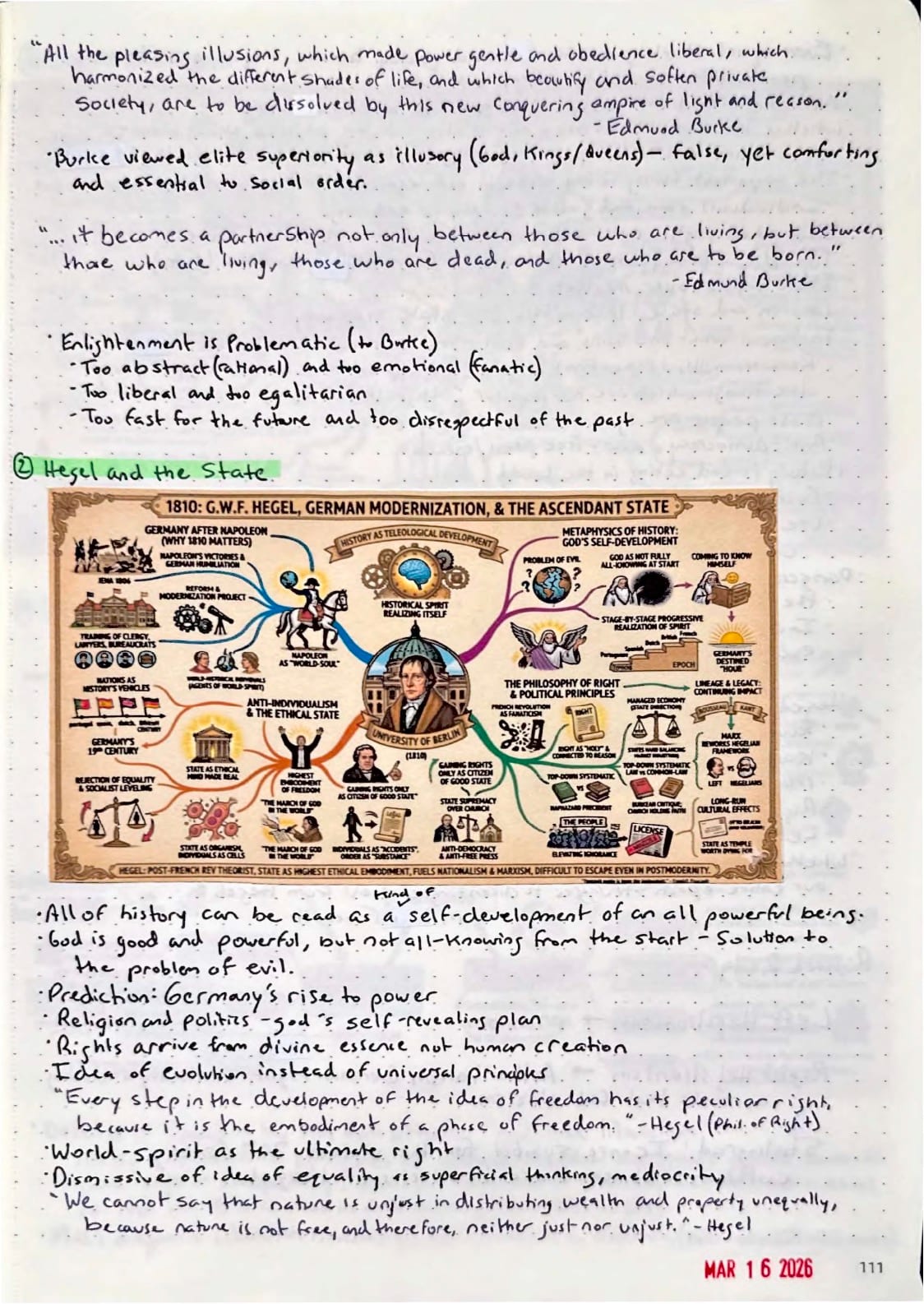
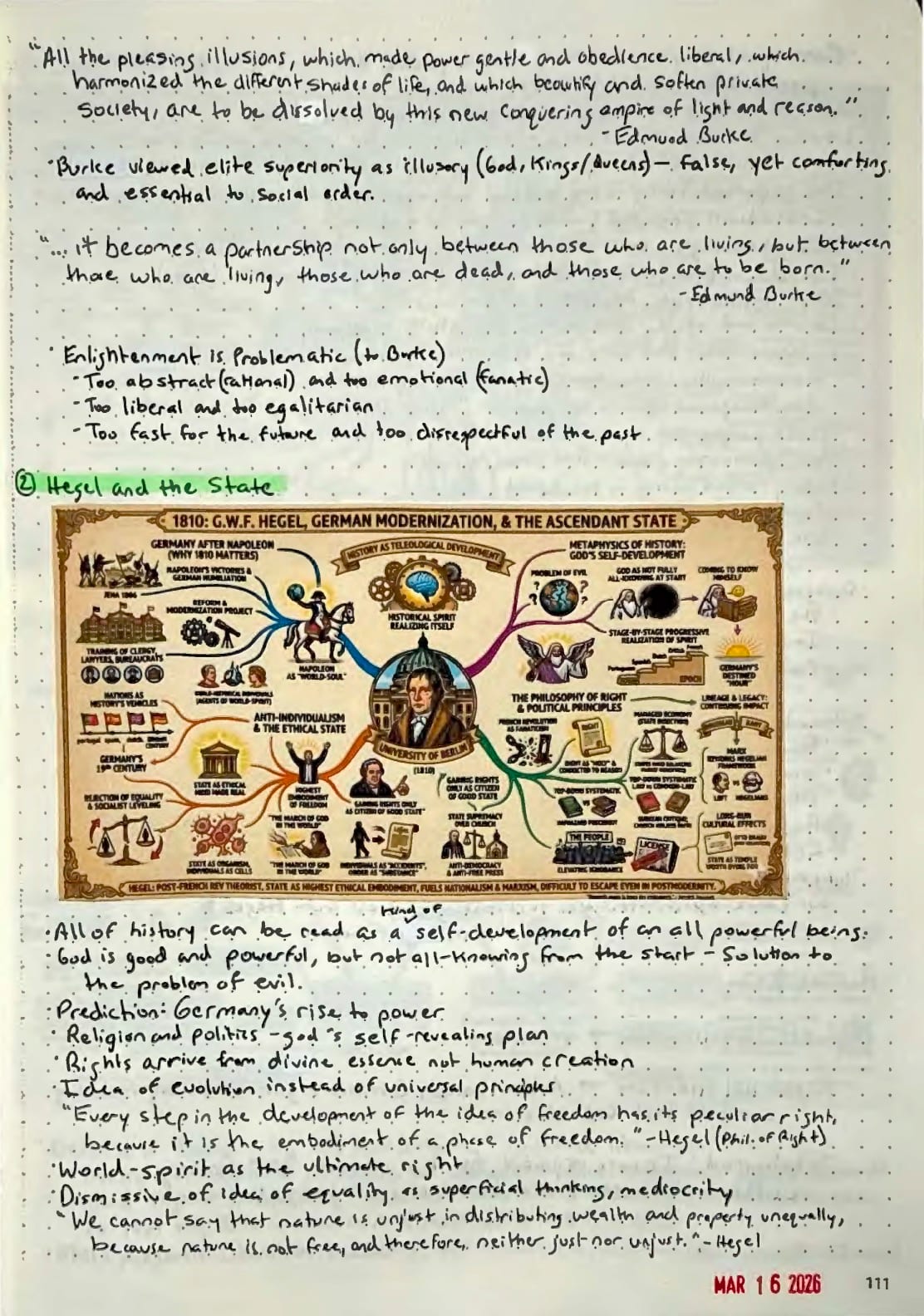
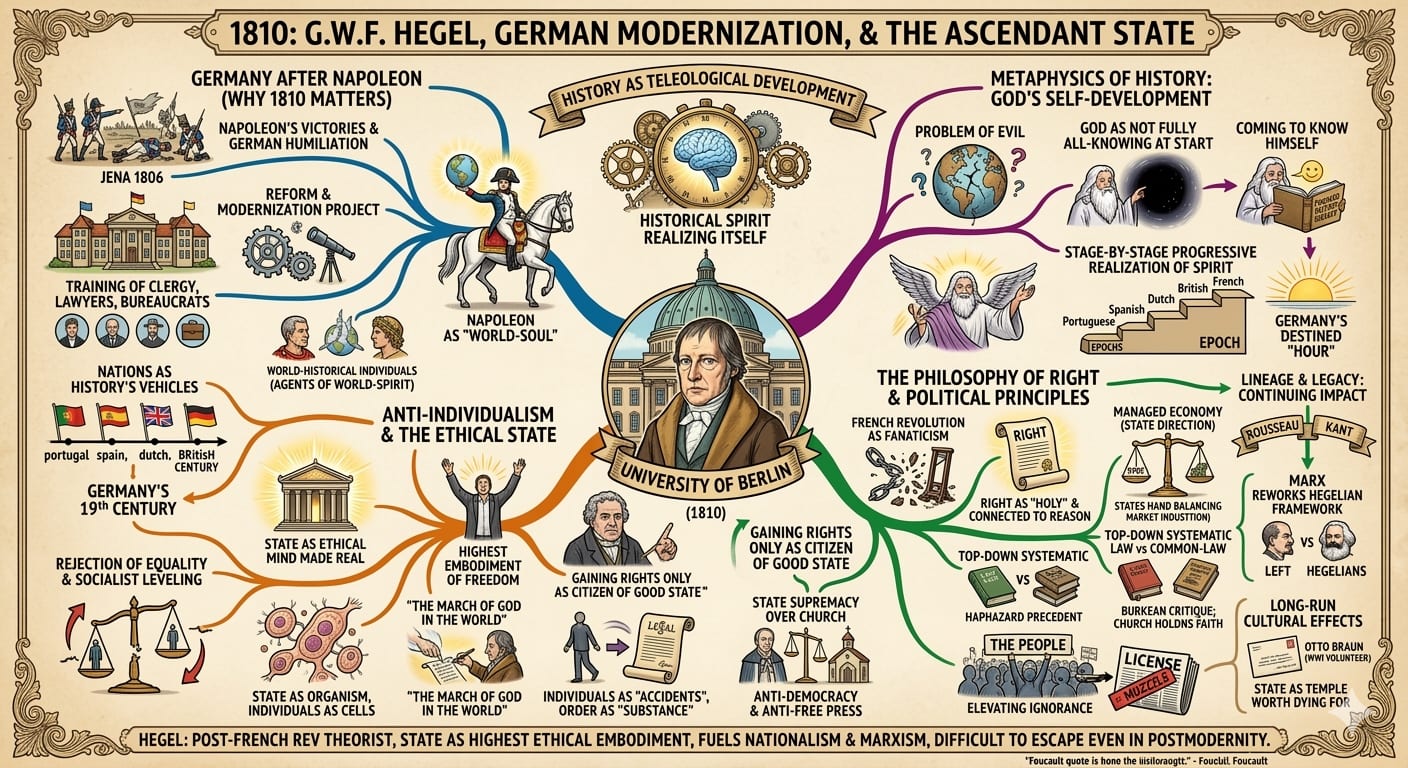
This lecture shifts from revolutionary France to the German states around 1810, arguing that the next major transformation in modern political thought happens in German philosophy, especially in G.W.F. Hegel. The founding of the University of Berlin (1810) symbolizes Germany’s deliberate modernization—intellectual, cultural, and political—spurred in part by humiliation at the hands of Napoleon. The lecture presents Hegel as a system-builder whose ideas about history, rights, freedom, and the state become a foundation for later modern ideologies (including Marxism and nationalist statism) and remain difficult to escape even in postmodern thought.
1) Why 1810 Germany matters: modernization after Napoleon
- Germany is portrayed as becoming the leading philosophical region, overtaking Britain and France.
- Napoleon’s victories over the German states (and the shock of being defeated by France) provoke a German response: reform and “revolutionize” education and national capacity.
- The University of Berlin is founded as part of that modernization project—training not only philosophers but future clergy, lawyers, and bureaucrats in a new national-intellectual framework.
2) Hegel’s “religious” engine: history as God’s self-development
The lecture roots Hegel’s political philosophy in his broader metaphysical/religious view of history:
- It begins with the problem of evil: how can an all-powerful, all-good, all-knowing God create an evil-filled world?
- Hegel’s distinctive answer (as presented here): God is all-powerful and all-good, and the end of history is good, but God is not fully all-knowing at the beginning. God comes to know himself through creating and unfolding history.
- This framework makes history intelligible as a teleological development rather than randomness: events are stages in a world-process where “spirit” (God/world-mind) progressively realizes itself.
3) Napoleon as “world-soul”: world-historical individuals
A vivid anecdote anchors Hegel’s political imagination:
- In 1806 at Jena, Hegel sees Napoleon and calls him “this world soul”, admiring his concentrated power to “reach out over the world and master it.”
- The lecture uses this to introduce Hegel’s category of world-historical individuals (Alexander the Great, Julius Caesar, Napoleon): people whose personal ambition and capability make them instruments of a larger historical force.
- Key claim: such figures aren’t merely talented conquerors; they are agents of the world-spirit/God’s plan, advancing history’s next stage.
4) Nations as the main vehicles of history’s plan
Hegel’s “world-spirit” operates not only through individuals but through nations:
- Different epochs belong to different nations (Portugal, Spain, Dutch, British, French), each having a “moment” where it drives world development.
- Hegel predicts (and the lecture emphasizes) that the 19th century will be Germany’s century—Germany’s time to rise as the next bearer of historical destiny.
5) The Philosophy of Right: rights, freedom, and the state after the French Revolution
The lecture turns to Hegel’s The Philosophy of Right, warning that Hegel is hard to read, but isolating major claims:
A. The French Revolution as fanaticism
- Hegel treats the Revolution as a modern case of freedom becoming fanaticism, unleashing mass political passion and destructive violence—echoing Burke’s concern, though with a different theory underneath.
B. Right as “holy,” not a human contrivance - Unlike Burke (rights as political inventions arising from practical governance), Hegel treats Right as having a quasi-sacred status: not merely fabricated, but connected to the deeper rational/spiritual structure of history.
- Rights are tied to the development of freedom over time: each stage of freedom has its “peculiar right,” meaning rights evolve as freedom evolves.
C. The “world-spirit” as the ultimate right - Particular rights (in religion, property, law, etc.) are limited and historically shaped.
- The only unlimited right is the right of the world-spirit/absolute, which is the deepest authority guiding history.
6) Hegel’s rejection of equality and socialist leveling
The lecture portrays Hegel as dismissive of equality as a foundational ideal:
- Equality is described as abstract and intellectually shallow.
- Egalitarian redistribution (like equal division of land/resources) is treated as superficial because:
- nature is not free, so it cannot be “unjust” for distributing talents unequally,
- even equal starting conditions would quickly become unequal again because people differ in ability, energy, and luck.
7) Anti-individualism: the person exists for the ethical whole
A central theme is Hegel’s reversal of liberal individualism:
- The individual is subordinate and must dedicate themselves to the ethical whole.
- If the state demands life, the individual must surrender it.
- Individual identity itself is treated as socially constituted: the self becomes itself through recognition and relation with others (so the “isolated individual” is metaphysically misguided).
8) The ethical order as substance; individuals as “accidents”
Hegel’s metaphysical vocabulary is applied to politics:
- The ethical/legal order is the substance (the enduring reality).
- Individuals are “accidents” (temporary instances) who come and go.
- The state and its laws are what persist and regulate life; individuals gain true standing only within that objective order.
Key conclusion drawn by the lecture: - You do not bring rights into the state as pre-political possessions; you gain rights by becoming a citizen of a good state.
9) Top-down law versus common-law evolution
The lecture directly contrasts Hegel with the Burkean/British common-law tradition:
- British common law develops bottom-up from cases, precedent, and gradual refinement.
- Hegel criticizes this as “mischievous,” preferring a more systematic, top-down legal rationality: start with general principles, codify, then apply.
10) Managed economy: state direction over markets
Hegel is also presented as rejecting laissez-faire:
- Producers and consumers clash; their adjustment requires a supervising power “above both.”
- Especially in major industries, individuals lack the global perspective needed to regulate wisely; thus public care and direction are necessary.
11) The state as ethical mind and the “march of God”
The lecture intensifies Hegel’s statism:
- The state is the actuality of the ethical idea—ethical mind made real.
- The state is described as rational and as the embodiment of freedom’s highest realization.
- Therefore the state has “supreme right” against the individual; the individual’s “supreme duty” is membership in the state.
- This is sometimes put bluntly in religious language: the state is the march of God in the world.
- Another metaphor: the state is an organism; individuals are like cells—replaceable parts serving the life of the whole.
12) Church and state: integration, but state supremacy
Hegel rejects the liberal separation of church and state:
- True religion should recognize and uphold the state.
- The state should protect and assist the church, and may require citizens to belong to a church as part of moral unity.
- Yet the partnership is unequal: the church is “faith,” while the state is what knows—the state has epistemic authority and may restrict religious claims that challenge objective rationality.
13) Anti-democracy and anti–free press
The lecture highlights Hegel’s hostility to mass-rule and unrestricted expression:
- “The people” (as the many) do not know what they will; genuine knowledge of the rational will requires rare insight.
- Democracy is treated as structurally unreliable because it elevates ignorance and passion.
- Free speech/free press defined as saying whatever one pleases is mocked as crude and uneducated—because freedom is not license.
14) World history and Germany’s destined “hour”
Hegel’s philosophy of history is connected directly to nationalism and geopolitics:
- In each epoch, one nation becomes the vehicle of the world-spirit’s next step; it has a kind of “absolute right.”
- Other nations, in that moment, have no comparable rights in world-historical terms.
- Individuals within the chosen nation are instruments; their reward is often only “undying fame,” not moral innocence or personal fulfillment.
The lecture concludes this implies a dangerous political trajectory if Germany internalizes the idea that: - the nation is chosen to advance history,
- individuals have no independent rights against the state,
- exceptional leaders may be world-historical agents authorized by destiny.
15) Lineage and legacy: Rousseau, Kant, Marx, nationalism, and postmodernism
The lecture situates Hegel in an intellectual genealogy:
- Rousseau: Hegel credits Rousseau with making freedom a world-historical principle.
- Kant: Hegel sees himself building from Kant and expects a “revolution in Germany” from the Kantian system’s completion.
- Marx: a later transformation of Hegel—Marx begins as a Hegelian and reworks the framework.
- “Right Hegelians” vs “Left Hegelians”: one lineage toward nationalist/statist conservatism, another toward radical critique and revolutionary theory.
- A final framing claim: modern thought repeatedly tries—and fails—to escape Hegel. A Foucault quote is used to suggest the breadth of Hegel’s continuing grip on modern debates.
16) Illustration of long-run cultural effects: Otto Braun (WWI letter)
A century-later example is used to show how Hegelian statism can shape personal meaning:
- A young German volunteer writes that his deepest yearning and highest hope is “the state,” imagined as a temple worth dying for.
- The letter is presented as an echo of Hegelian education and the sacralization of the state.
Bottom line
This lecture presents Hegel as the key post–French Revolution theorist of the modern state: history is a purposive spiritual process, and the state is its highest ethical embodiment—so individuals gain rights only through citizenship, owe ultimate duty to the state, and may be sacrificed for its ends. Hegel’s framework fuels later movements across the political spectrum (nationalist statism and Marxism) and helps explain why modern intellectual life keeps “wrestling” with his categories long after his time.
3. Engels and Karl Marx
Peterson Academy - The Philosophy of Politics Part I (Hicks) - Lecture 03.pdf (file not included in this release)
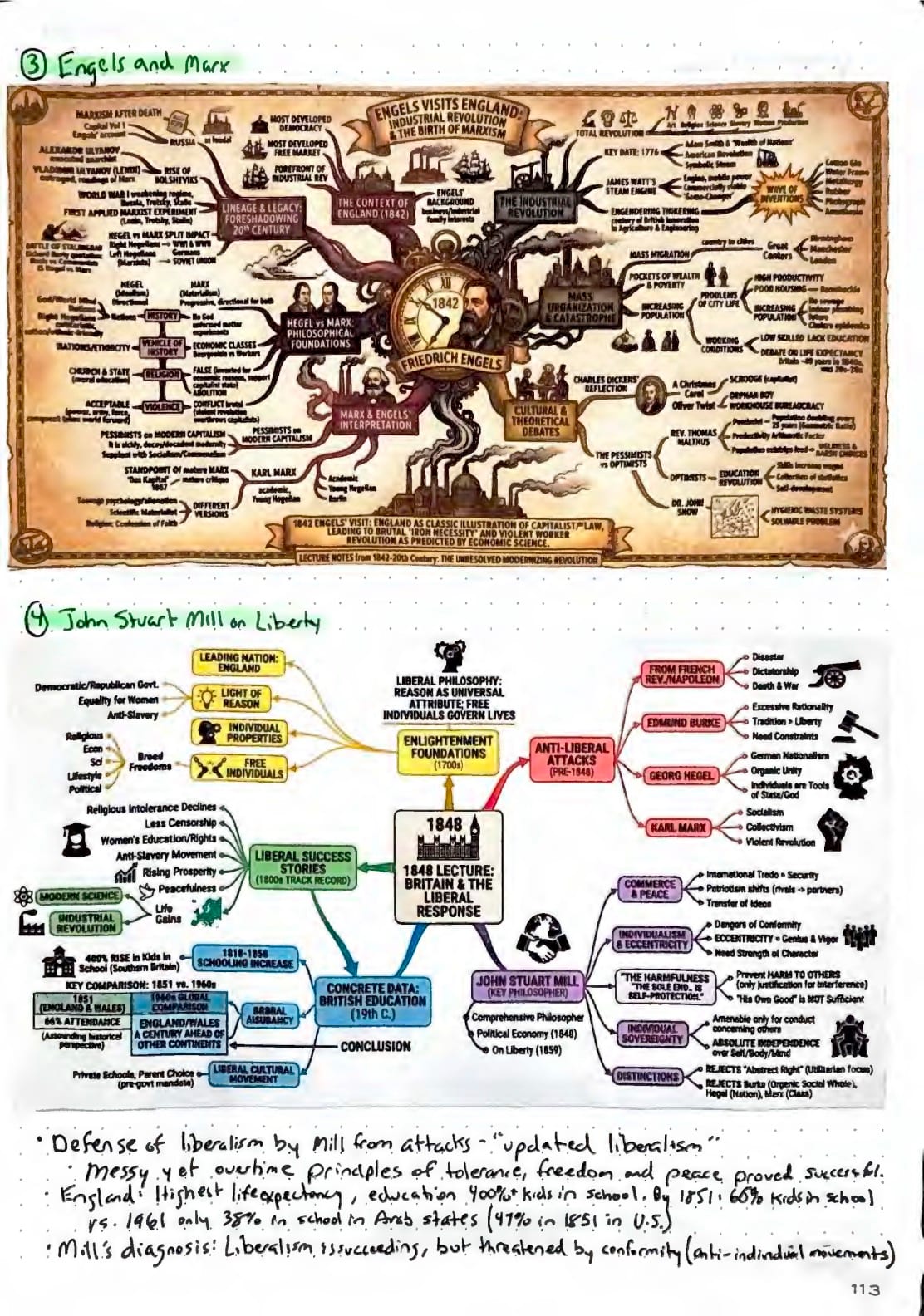
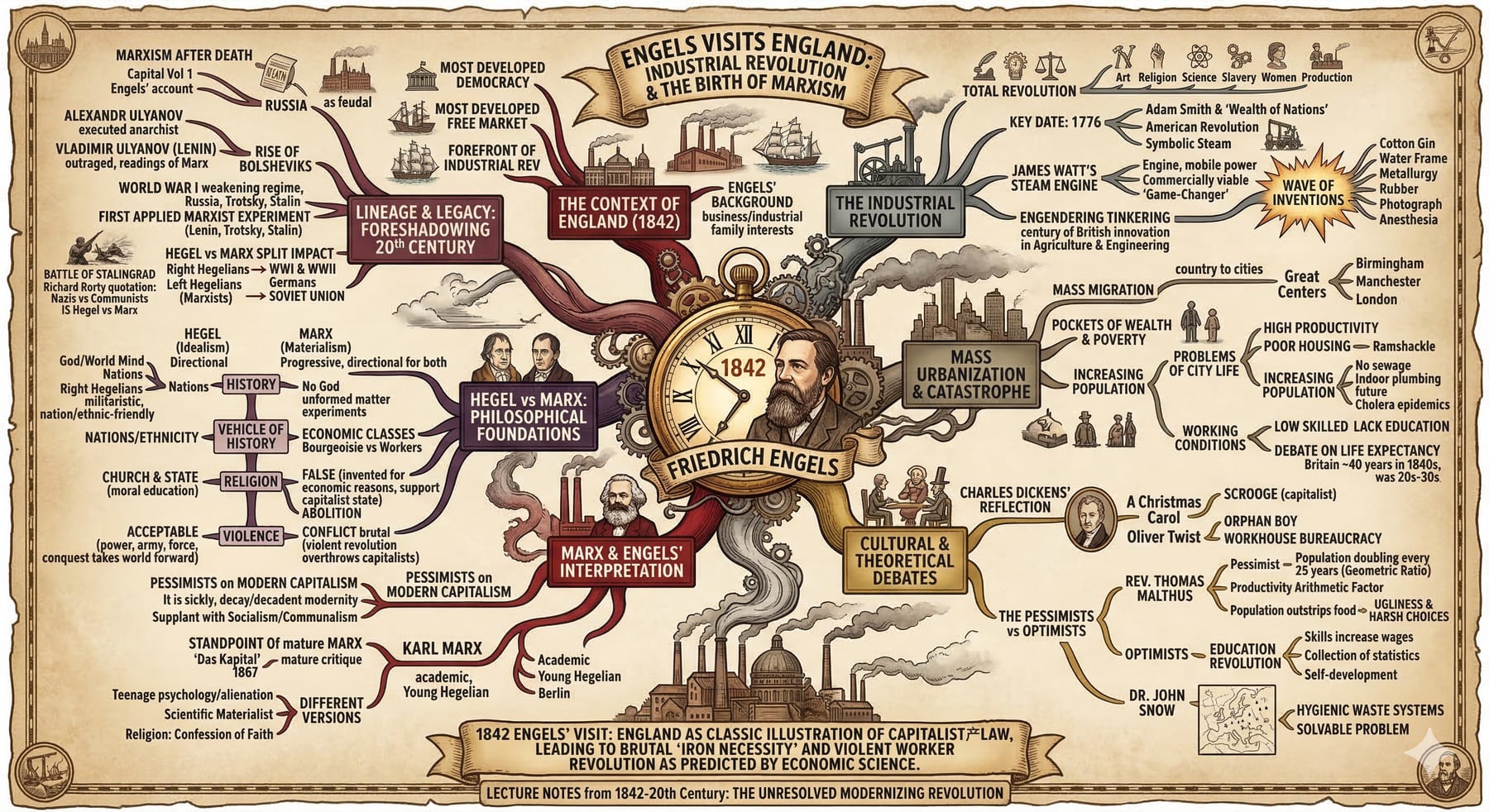
This lecture jumps to 1842, when Friedrich Engels visits England. England is chosen because it is the most advanced example of liberal democracy, free-market capitalism, and the Industrial Revolution—making it, in Marxist terms, the clearest “laboratory” for understanding capitalism’s trajectory. The lecture frames Engels’ observations (later written up as The Condition of the Working Class in England) as a major input into Marx’s developing system, then pivots into how Marx’s mature theory (especially Capital, 1867) reframes history, politics, and morality around economic forces and class conflict. It ends by foreshadowing how Marxism becomes a revolutionary program in Russia, while “right-Hegelian” themes contribute to German nationalism and militarism—culminating in 20th-century total war.
1) Why England is the focal point in 1842
- Engels visits England because it is:
- the most developed capitalist economy,
- the leading industrial nation,
- the most vivid site of modern urbanization and factory labor,
- and a global power with expanding trade and empire.
- The lecture marks the Industrial Revolution symbolically with:
- James Watt’s steam engine (as a transformative energy technology),
- and 1776 as a “triple-significance” year: American Revolution, Adam Smith’s Wealth of Nations, and industrial takeoff symbolism.
- But it stresses that “1776” is misleadingly neat: Britain’s industrial transformation rests on more than a century of cumulative tinkering and invention.
2) Industrial Revolution: huge gains, glaring costs
The lecture emphasizes a dual reality in industrial England:
A. Visible progress
- Massive increases in production: goods once reserved for elites become common (clothing, household items, window glass).
- Population grows, seen as one proxy for economic capacity.
- Scientific knowledge and medical understanding improve, and literacy begins to spread.
B. Severe social disruption - Rapid urbanization concentrates poverty into cities (Manchester, Birmingham, London).
- Living conditions are often terrible: overcrowded housing, poor sanitation, no modern sewage infrastructure.
- Hygiene is poor due to lack of indoor plumbing and limited washing facilities.
- Wages and labor conditions are contested: plentiful factory jobs may still produce low pay, dangerous work, and insecurity.
- Life expectancy debates emerge: some data suggests improvement (around 40 at birth by the 1840s), but it still appears bleak by modern standards and unevenly distributed.
3) Dickens as a cultural mirror of industrial anxieties
The lecture uses Dickens as a way of capturing public moral concern:
- Scrooge represents the fear that capitalism produces cold, miserly elites who exploit workers (e.g., Bob Cratchit).
- Oliver Twist represents the fear that the poorest (orphans, workhouse inmates) are abandoned to harsh bureaucratic systems.
These literary images condense the question: is industrial capitalism creating a better society, or a morally degrading one?
4) Malthus: population growth as a potential “unsolvable” limit
A major interpretive fork is introduced through Thomas Malthus:
- Productivity may rise (the lecture uses simplified growth-rate examples), but population, “when unchecked,” doubles roughly every 25 years (geometric growth).
- If population growth outpaces productivity growth, scarcity returns, forcing ugly decisions about survival.
- The lecture frames Malthus as challenging modern optimism: maybe some problems created by modern growth cannot be solved by more science and markets.
5) The optimist counter-case: education and public health as solvable problems
Against Malthusian pessimism, the lecture presents a reformist optimism:
- Low wages can reflect low skill; mass literacy and education could raise productivity and wages.
- Urban disease and sanitation crises are not mysterious; they can be solved by:
- statistical mapping of outbreaks,
- improved public health knowledge,
- and engineering infrastructure (sewers, pipes, water systems) enabled by industrial production.
This becomes the big question: is industrial society an improvable experiment, or an inherently sick system?
6) Engels and Marx: capitalism as transformative but fundamentally pathological
The lecture places Marx and Engels firmly on the pessimistic side:
- Capitalism is acknowledged as revolutionary in productive power, but morally and socially corrosive.
- Engels’ England research becomes an evidentiary foundation for Marx’s later theorizing.
- Engels is presented not merely as a sidekick but as an important early contributor to Marx’s development.
7) Interpreting Marx: three lenses the lecture puts on the table
The lecture explicitly raises competing ways to understand Marx:
A. The psychological Marx
- Marx’s early poetry is read as alienation and destructive resentment (“Worlds I would destroy forever…”).
- The lecture suggests some interpret Marxism as a rationalization of this temperament.
B. Marxism as a secular religion - The working title Confession of Faith (before Communist Manifesto) is used to suggest Marxism can function like a faith-commitment dressed in “scientific” language: a vision of a redeemed world opposed to a fallen present.
C. Marx the serious philosopher-scientist - The lecture’s main focus is this third reading: Marx as a trained philosopher (Berlin, Young Hegelians, PhD on Democritus/Epicurus) who thinks philosophy drives politics and tries to ground revolution in a materialist “science” of society.
8) Marx’s core inversion of Hegel: from idealism to materialism
Marx adopts major Hegelian structure but flips its metaphysics:
- Keeps Hegel’s sense that history is not random and develops through conflict toward new stages.
- Rejects Hegel’s “world-spirit/God” idealism.
- Replaces it with atheistic materialism: the engine of history is material life—especially the economy.
9) What replaces nation-history: class-history
Against right-Hegelian nationalism (nations as the key historical agents), Marx centers:
- economic classes as the real collective actors.
- Capitalism simplifies feudal complexity into two core classes:
- bourgeoisie (owners of capital/property),
- proletariat (workers who sell labor).
- Politics, law, and culture are treated as downstream of class structure and class conflict.
10) Religion in Marx: not foundation, but ideological tool
The lecture contrasts Hegel and Marx sharply:
- Hegel: religion supports the state; church-state integration helps moral discipline.
- Marx: religion is false and functions as ideological reinforcement for the dominant class.
- Religious narratives are explained as reflections of economic life (hunters → animal gods, fishers → sea gods, farmers → earth/rain gods).
- In capitalist societies, religion is framed as a mechanism to keep workers compliant.
- Therefore, Marxist transformation implies abolishing religion as a sustaining illusion.
11) Violence as historical mechanism
Both right-Hegelians and Marxists are presented as rejecting liberal gradualism:
- History moves through conflict, conquest, and revolution.
- Marx’s version: class antagonism cannot be resolved through democratic compromise because the ruling class controls institutions; revolution is necessary.
**12) Mature Marx and Capital (1867): economics as deterministic science
The lecture turns to Capital to characterize Marx’s mature stance:
A. Ambition: solve the “mystery” of value
- Marx claims the money/value form has eluded thinkers since antiquity.
- He treats capitalism as something that can be anatomized scientifically.
B. Method: society as an organism; commodities as “cells” - He uses biological metaphors: the economy is the body; the commodity is the cell-form.
- Abstraction replaces microscopes: you can’t chemically test “value,” but you can analyze its form and function.
C. England as the “classic ground” - England is the most developed capitalist society, so it reveals capitalism’s tendencies most clearly.
- “The more developed country shows the less developed the image of its own future.”
D. “Iron necessity”: laws of capitalism produce inevitable outcomes - Marx describes economic antagonisms as governed by laws producing inevitable results.
- Individuals are not treated as primary moral agents but as personifications of economic categories (class roles).
13) Capitalism as rigged politics: why reform won’t work
The lecture emphasizes Marx’s claim that political reform cannot solve class oppression:
- Capitalists use economic power to influence politicians, courts, and law.
- Workers, increasingly concentrated and organized by factory systems, develop class consciousness.
- Over time, inequality intensifies (“rich get richer, poor get poorer”), organization grows, and the proletariat eventually uses numerical superiority to overthrow the bourgeois order by force.
14) America as a “signal”: independence and civil war as class omens
The lecture uses American events as revolutionary signals to Europe:
- American Independence was a “tocsin” (alarm bell) for the European middle class.
- The American Civil War is portrayed as a “tocsin” for the European working class, foreshadowing further conflict over capital and property relations.
15) Foreshadowing: Lenin, Russia, and the 20th-century collision of ideologies
The lecture closes by projecting forward:
- After Marx, Engels popularizes Marx’s legacy.
- In Russia, the execution of Aleksandr Ulyanov (1887) helps radicalize his brother Vladimir Ulyanov (Lenin).
- Lenin and the Bolsheviks exploit World War I’s destabilization to carry out the Russian Revolution, creating the first major applied Marxist state (the Soviet Union).
- A broader framing claim is offered: 20th-century conflicts, culminating in battles like Stalingrad, can be read as the clash of ideological descendants—“Hegel versus Marx” (nationalist/statist right-Hegelian lines vs Marxist revolutionary lines).
Bottom line
Engels’ 1842 England visit is presented as a turning point because industrial Britain is the most advanced case of capitalist modernity—its productivity boom, urban misery, and social dislocation become the empirical foundation for Marx’s mature theory. The lecture frames Marx as reworking Hegel’s developmental logic into an atheistic, economic determinism: class conflict, not nations or individuals, is history’s engine; religion is ideology; reform is structurally blocked; and capitalist “laws” drive society toward revolutionary rupture—an arc later embodied in the Russian Revolution and the violent ideological struggles of the 20th century.
4. John Stuart Mill on Liberty
Peterson Academy - The Philosophy of Politics Part I (Hicks) - Lecture 04.pdf (file not included in this release)
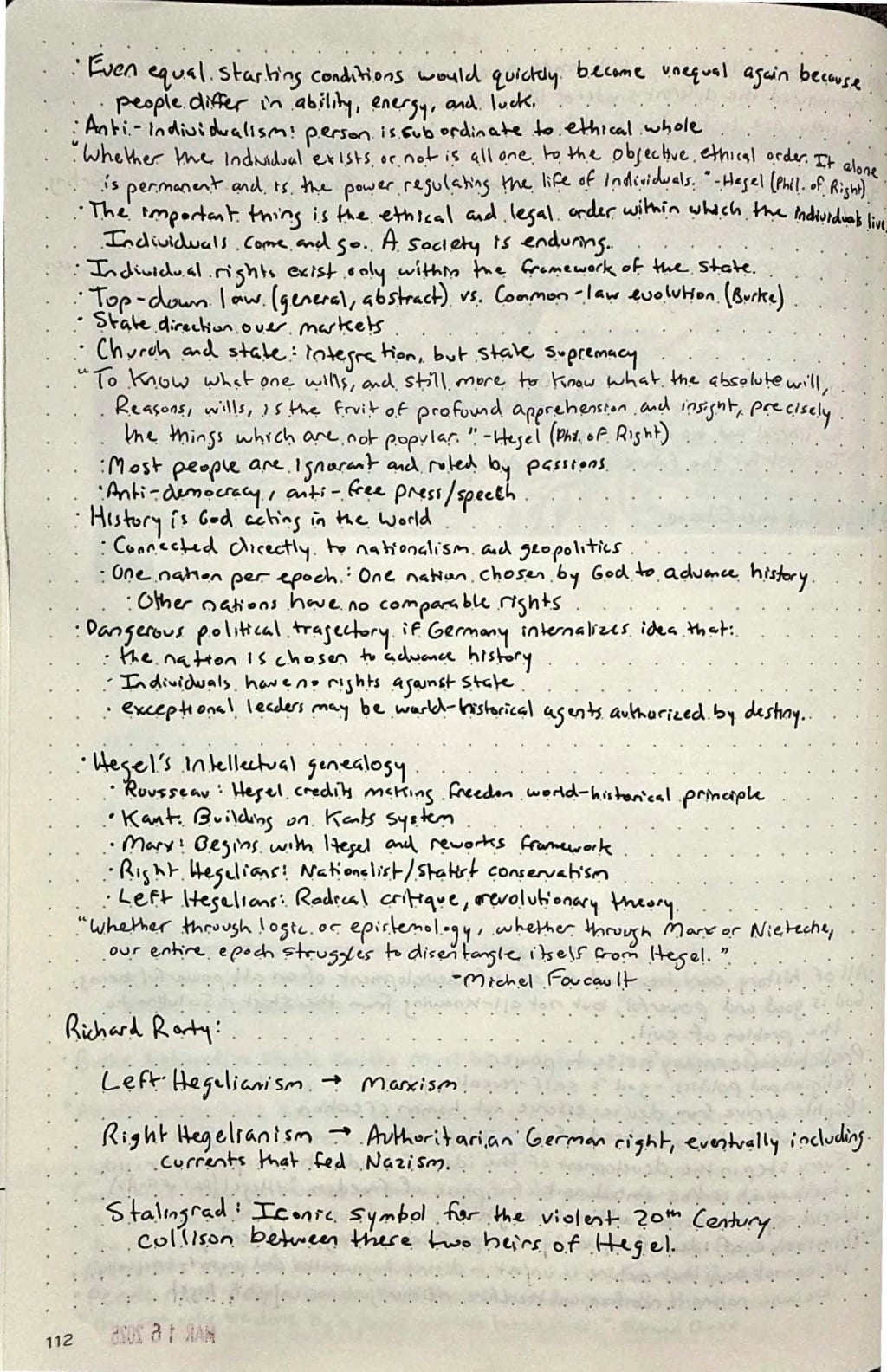
This lecture returns to Britain (centered on 1848) to give Enlightenment liberalism its strongest mid-19th-century reply to the critiques raised by the French Revolution, Burkean conservatism, Hegelian nationalism, and Marxist socialism. The lecture argues that by the 1840s liberals can appeal not only to abstract principles, but to a growing empirical record: liberal societies have expanded toleration, loosened censorship, advanced women’s status, driven abolitionism, increased prosperity, and—crucially—reduced war among commercial nations. The main philosophical voice for this “updated liberalism” is John Stuart Mill, especially Principles of Political Economy (1848) and On Liberty (1859), where Mill warns that the greatest modern threat is no longer only state despotism, but “the tyranny of the majority” and the social pressure to conform.
1) The Enlightenment project and why it needs defending by 1848
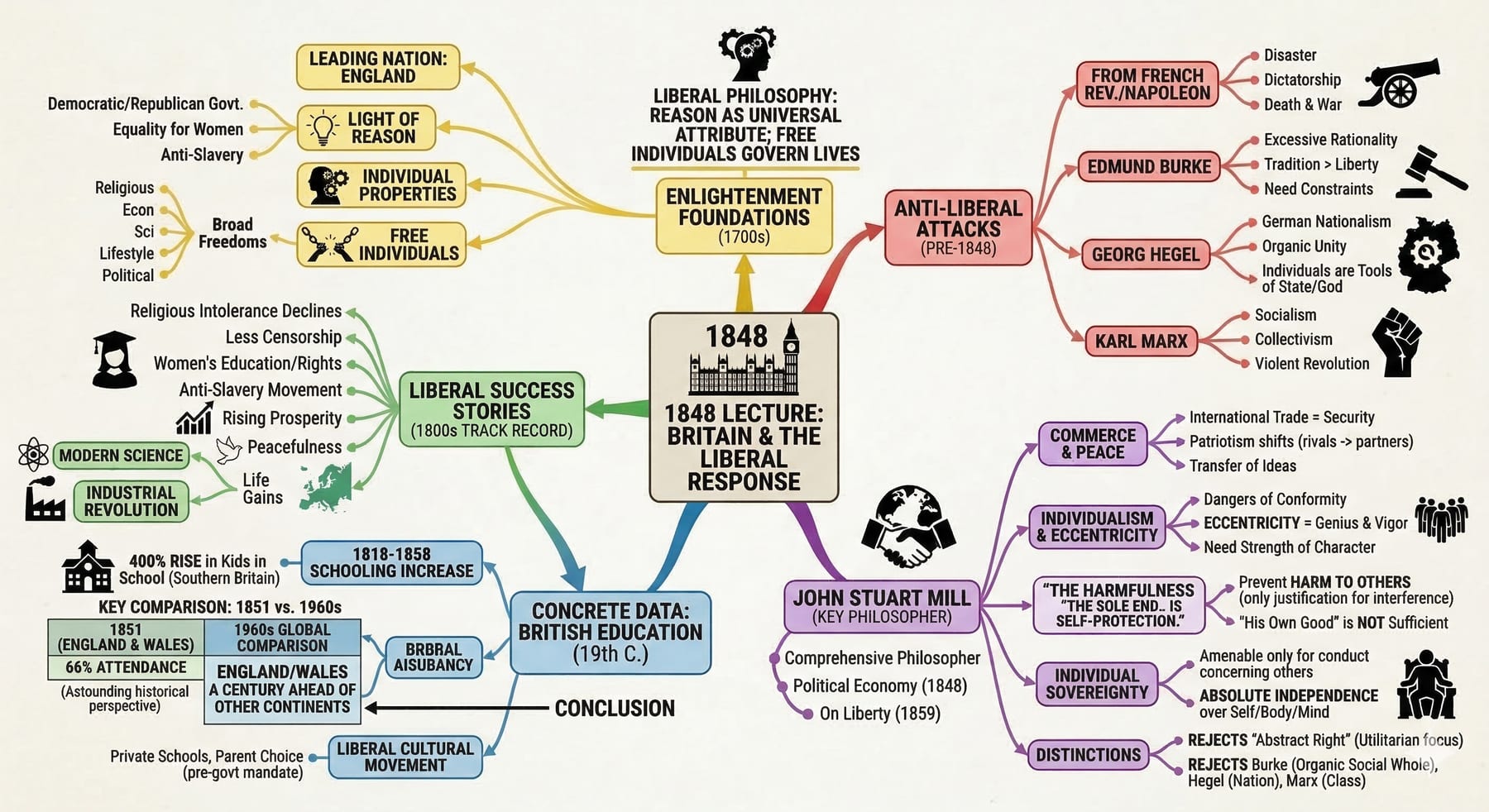
- The Enlightenment (full flower in the 1700s) is framed as the “reason project”: reason belongs to each individual, so people should be free to think in religion, science, art, lifestyle, and politics.
- Liberalism is attacked on multiple fronts in earlier lectures:
- France: Enlightenment ideals allegedly culminate in terror and then dictatorship (Napoleon).
- Burke: rational redesign unmoored from tradition is reckless; liberty is not primary and must be tightly constrained by inherited institutions and morality.
- Hegel/nationalism: individuals are subordinate to the nation/state (and in some readings to history’s or God’s plan); nations assert destiny and power.
- Marx/socialism: individuals are class embodiments; capitalism is irredeemable; only violent revolution can transform society.
This lecture’s aim is to let liberals respond: not by denying messiness, but by arguing that the overall liberal experiment has been a striking success.
2) The liberal reply: the 19th-century track record looks good
The lecture sketches liberalism’s case as “results-driven” as well as principled:
- Decline of religious persecution and censorship: liberal societies normalize freedom of conscience and freer circulation of ideas through books, newspapers, and magazines.
- Women’s progress: expanding education, property rights, and the beginnings of political rights are presented as Enlightenment-driven.
- Anti-slavery: framed as a moral revolution largely born in Enlightenment nations, with Britain especially prominent.
- Prosperity and living standards: the Industrial Revolution plus liberal freedoms raise production and access to goods; health and nutrition improve over time; life expectancy rises.
- Peace among liberal/commercial nations: the lecture claims that the more liberal, commerce-oriented states appear less war-prone than illiberal states.
It flags that some of these claims require data work, but presents them as the confident liberal narrative after a century of experimentation.
3) Education as a measurable liberal achievement
A major piece of “evidence” highlighted is schooling and literacy:
- Between 1818 and roughly the late 1850s, the number of children in school increases dramatically (the lecture cites around a 400% increase over about 40 years).
- This is attributed largely to voluntary private schooling and parental initiative, not yet a mature system of state-mandated public education.
- A later reference point is used for scale: by 1851, roughly two-thirds of children in England and Wales attend school (presented as historically extraordinary), and far ahead of many regions even a century later.
The point: liberal culture encourages self-development and human capital formation at mass scale.
4) Mill’s diagnosis: liberalism is succeeding, but threatened by conformity
The lecture introduces Mill as the most articulate liberal political philosopher of the era, worried about:
- rising pressure toward conformity and “anti-individual” movements,
- the divergence between the Anglo world and the European continent, where France and Germany are seen as trending toward illiberalism (revolutionary instability, nationalism, socialism).
Mill’s distinctive emphasis is cultural as much as political: liberal society needs a social ethos that protects individuality, not merely institutions that limit kings.
5) Trade as a peace engine: Mill’s liberal political economy (1848)
From Principles of Political Economy (1848), the lecture presents Mill’s “commerce → peace” argument:
- Commerce teaches nations to regard each other’s prosperity with goodwill because trade is mutually beneficial.
- Trade networks make war costly by interrupting markets and mutual gains.
- International trade spreads not only goods but ideas, pushing “progress” in institutions and character.
- Commercial negotiation is presented as civilizing: it trains people to persuade, exchange, and cooperate instead of conquer and plunder.
This is framed as an early form of the “liberal/capitalist peace thesis.”
6) The cultural core: eccentricity as a social good
Mill’s argument isn’t only that liberty is morally right, but that it produces the kinds of people a society needs:
- Nonconformity is socially valuable because it models independence from custom.
- Eccentricity correlates with genius, vigor, and moral courage.
- A decline in eccentricity signals a society growing timid and conformist—one of the “chief dangers” of the time.
7) On Liberty
(1859): the modern problem is not only despotism, but majority power and social tyranny
Mill reframes the central political question:
- Not metaphysical free will, but the legitimate limits of society’s power over the individual.
- Historically, liberty meant protection against rulers (kings, castes) who held power by inheritance or conquest.
- Modern representative government seems to solve this by identifying the ruler with “the people,” but that creates a new danger:
- “the people” often means the majority, or the most active faction that can present itself as the majority.
This produces a new form of oppression:
- “the people” often means the majority, or the most active faction that can present itself as the majority.
- Tyranny of the majority (a Tocqueville-influenced theme): a democratic majority can use law to oppress minorities.
- Even worse, a society can impose conformity without legal punishment through shame, ostracism, and moral pressure—social tyranny.
So liberalism needs:
- constitutional/political limits on state action, and
- cultural limits on coercive public opinion.
8) Mill’s solution: the harm principle and individual sovereignty
Mill offers a single governing principle for compulsion and control—whether by law or social pressure:
- The only legitimate reason to interfere with someone’s liberty is self-protection, i.e., preventing harm to others.
- “His own good,” physical or moral, is not sufficient warrant for coercion.
- Individuals must be free even to make serious mistakes, because that is part of self-responsible human life.
This culminates in the lecture’s key liberal claim: - The individual is sovereign over their own body and mind.
- Society may judge, argue, persuade, and criticize—but should not coerce unless others are harmed.
9) A philosophical note: Mill’s liberalism is utilitarian, not “natural rights”
The lecture distinguishes Mill from Locke-style liberalism:
- Mill does not ground liberty in abstract natural rights.
- He grounds it in utility: liberty is justified by its consequences for human flourishing and social improvement.
- Utility is treated as the final appeal in ethical questions.
10) Coda: 1859 as a “banner year” and the pivot toward American pragmatism
The lecture closes by situating Mill within a broader moment:
- 1859: On Liberty appears alongside other significant works (Dickens, Nightingale, self-help culture), and Darwin’s Origin of Species transforms scientific and philosophical thinking.
- The next lecture will pivot to American pragmatism, presented as partly shaped by evolutionary ideas and as a sign of America’s rising intellectual presence.
Bottom line
By 1848, liberals argue that Enlightenment liberalism has an empirical track record: more toleration, more knowledge, rising prosperity, expanding education, and fewer wars among trading nations. Mill updates liberal theory for the modern democratic age: the key danger is no longer only tyrannical rulers, but majority power and social conformity. His answer is the harm principle—coercion is justified only to prevent harm to others—paired with a cultural defense of individuality, eccentricity, and free expression as the engines of progress.
5. Pragmatic Democracy
Peterson Academy - The Philosophy of Politics Part I (Hicks) - Lecture 05.pdf (file not included in this release)
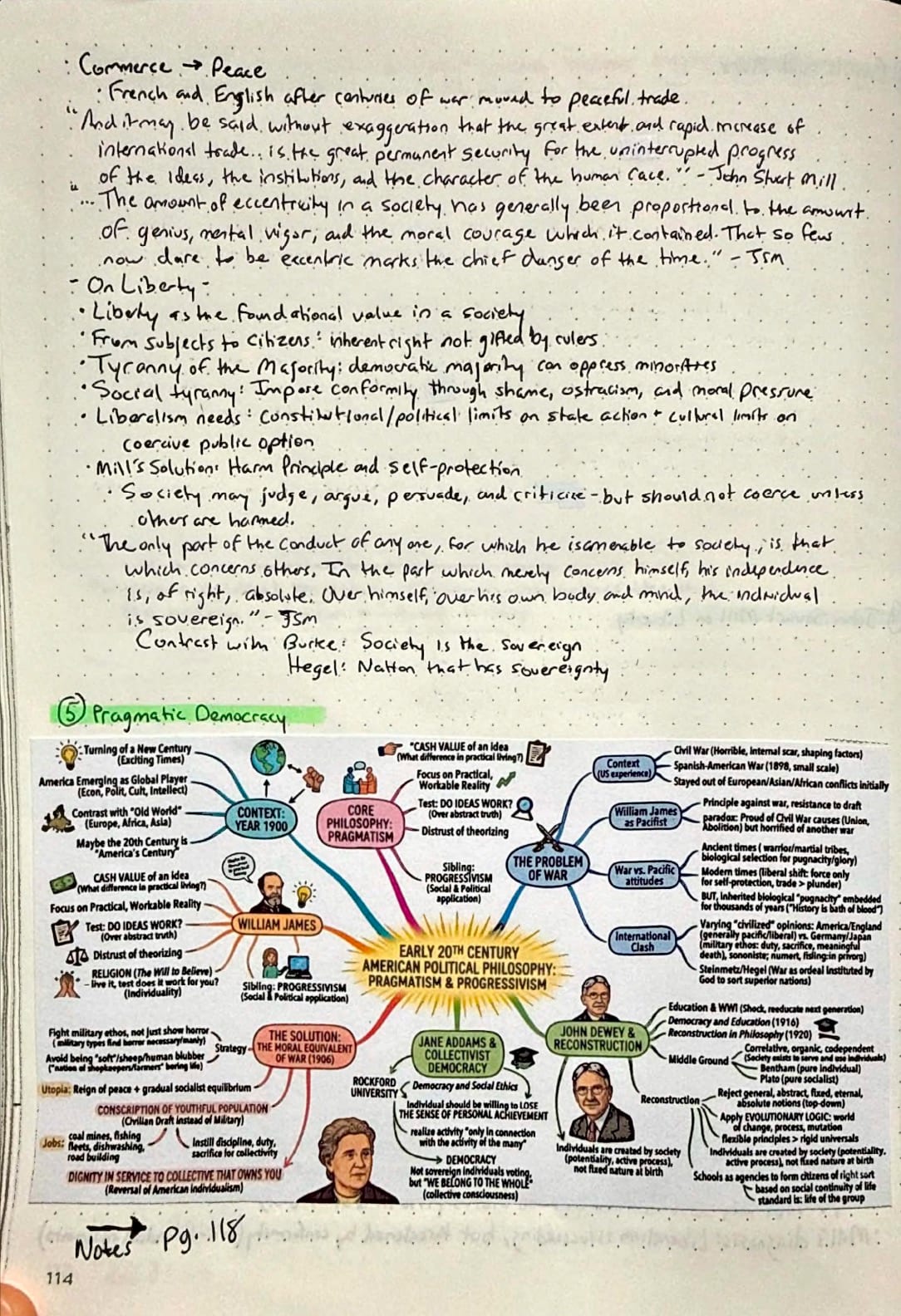
This lecture moves to America around 1900, presenting the United States as a rising “new-world” power and arguing that the country’s signature contribution to political philosophy is pragmatism, closely tied to progressivism. The core figures are William James and John Dewey (with Jane Addams as a key progressive voice). The lecture frames pragmatism as a philosophy of practical testing (“what works?”) shaped by evolutionary thinking, and it connects progressive pragmatism to a major political aim: reforming society to overcome war, conflict, and social disorder—often by re-centering the collective over the individual through national service, moral discipline, and education.
1) America’s “new century” self-understanding
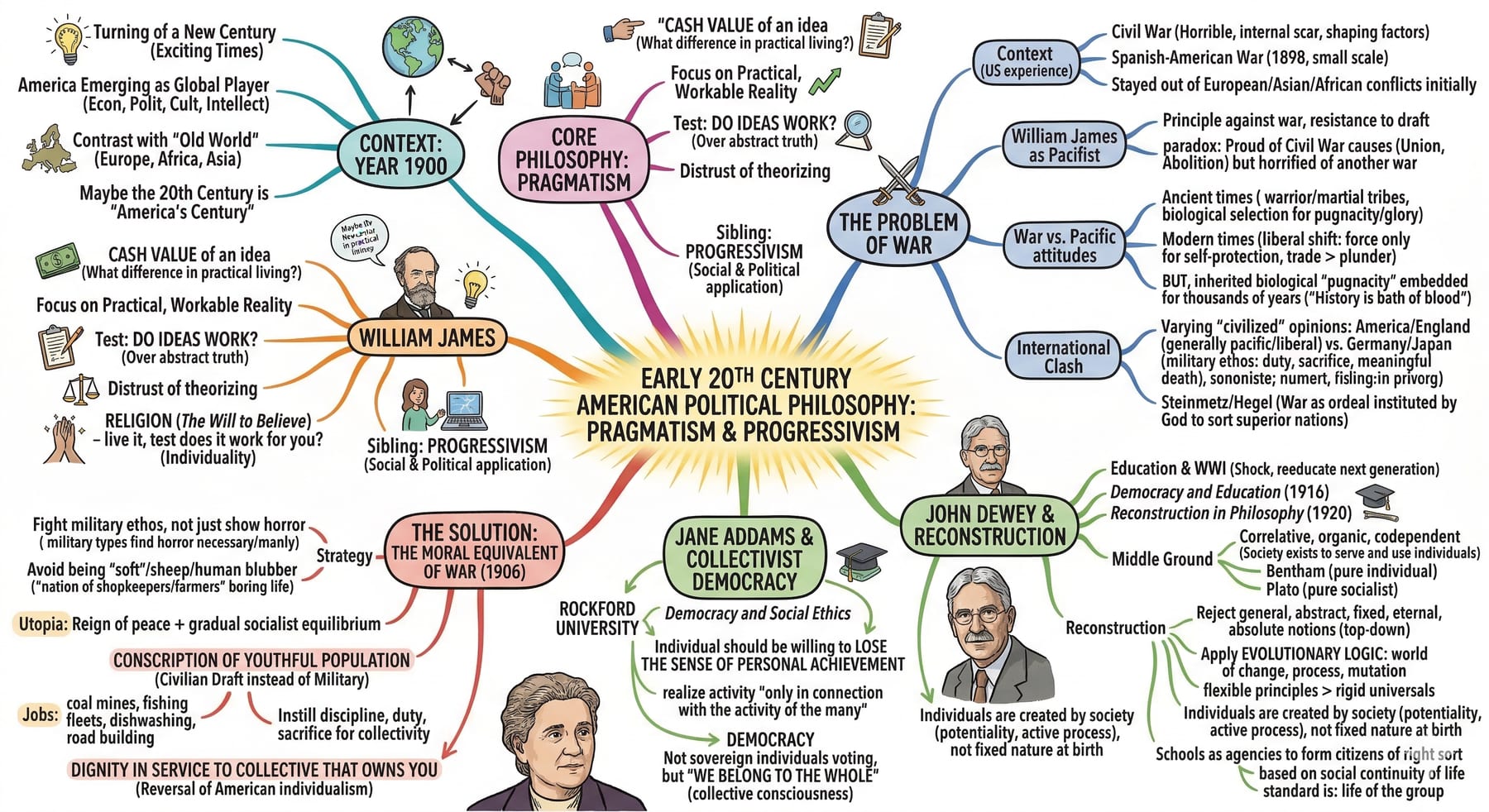
- The lecture opens with the idea that the 20th century may be “America’s century,” as the United States becomes a major economic, political, cultural, and intellectual player.
- It turns to what America contributes philosophically to politics: pragmatism and its social-political sibling, progressivism.
2) Pragmatism’s core stance: ideas are tools judged by outcomes
- Pragmatism is introduced as a deliberate break from “old world” theorizing:
- Less interest in abstract truth “in itself”
- More interest in practical consequences: does the idea work in real life?
- William James’ slogan captures this: the “cash value” of an idea—what difference it makes when lived or applied.
- Pragmatism is comfortable with messiness and revision: imperfect ideas are acceptable if they solve problems.
Application to religion (James) - In The Will to Believe, religion is approached pragmatically:
- not primarily “is it true?”
- but “does living it work for you?”
- This aligns with an American temperament that tolerates diverse religious paths and de-emphasizes final doctrinal proof.
3) Evolutionary thinking as the intellectual backdrop
- James (born 1842) and Dewey (born 1859) grow up under the expanding influence of Darwinian evolution.
- The philosophical shift emphasized:
- away from fixed, eternal principles (often linked to traditional theology),
- toward adaptive, changing, experimental approaches to ideas and institutions.
- Political arrangements are treated as evolving experiments, not the implementation of timeless “correct” blueprints.
4) War as the political problem that pragmatism wants to solve
The lecture focuses pragmatist-progressive politics through the lens of war:
- The American experience is shaped by the Civil War (a massive internal trauma) and later the smaller-scale Spanish-American War (1898).
- America is portrayed as relatively peaceful internationally through most of the 1800s, but now entering a global arena where militaristic cultures (notably Germany and Japan) are growing in power.
5) William James: pacifism that takes the “war ethic” seriously
James’ key text is “The Moral Equivalent of War” (1906). The lecture presents his argument as follows:
A. The war paradox
- Americans can honor past wars (e.g., preserving the Union, ending slavery) yet reject future war as intolerable.
- Modern morality increasingly treats war as permissible only in self-defense, but human psychology retains deep martial impulses.
B. The evolutionary claim about aggression - James argues that human beings inherit pugnacity through long evolutionary and cultural history; it won’t disappear quickly.
- History is described as saturated with warfare, reinforcing warlike ideals culturally.
C. The international mismatch - Some nations (America, Britain) are more commerce-minded and peace-inclined, while others (Germany, Japan) preserve strong warrior ideals and view commercial softness with contempt.
- Therefore, pacifists cannot win merely by pointing to war’s horror and expense; militarists can interpret horror as proof of the need for toughness and duty.
D. The philosophical task - James says pacifism must defeat the moral prestige of war:
- discipline
- sacrifice
- collective service
- willingness to suffer and die for something larger than oneself
- If peace advocates can’t offer an alternative that provides these moral “functions,” militarism retains a psychological advantage.
E. The “moral equivalent” proposal - James proposes replacing military conscription with universal national service: “an army against nature.”
- Young people would be drafted into hard, socially useful labor (mines, rail, fishing fleets, road building, cleaning, etc.) to cultivate:
- discipline
- endurance
- shared sacrifice
- collective loyalty
- The aim: preserve the character-forming benefits of war without war.
F. A provocative reversal of American individualism - The lecture stresses how radical this is in an American context:
- James flirts with a “socialistic equilibrium”
- and uses language implying citizens should be “owned” in service terms—redirecting the war ethic into civic labor rather than combat.
6) Jane Addams: democracy as belonging to the whole
Jane Addams is used to illustrate progressive social ethics:
- In Democracy and Social Ethics, morality is framed not as personal achievement but as participation in the collective:
- the individual should be willing to lose the sense of personal achievement,
- and realize activity only in connection with “the many.”
- Democracy is reinterpreted less as individual sovereignty and more as the felt security and meaning of belonging to the whole.
7) John Dewey: reconstructing philosophy, society, and education after war
Dewey is presented as the major philosophical architect of progressive pragmatism, especially through:
- Democracy and Education (1916) — written during WWI (before U.S. entry), focusing on schooling as the formation of democratic life.
- Reconstruction in Philosophy (1920) — written in the war’s aftermath, asking how philosophical frameworks shape social outcomes and how they must be rebuilt.
A. Dewey’s starting problem
He surveys three classic models of society:
- society exists for individuals,
- individuals exist for society,
- individuals and society are organically correlative.
He favors the “organic” middle path but argues all traditional theories share a deeper defect:
- they rely on fixed, top-down universals applied to situations (“the logic of rigid universals”).
B. The pragmatist/evolutionary alternative - Individuals are not “given” with fixed identities and final rights; they are formed through social processes.
- Institutions are instruments not merely to deliver goods to already-formed individuals, but to create kinds of individuals.
Key pivot: - social arrangements shape experience, values, and personality;
- democracy’s meaning shifts toward how association forms citizens and makes shared life possible.
C. Education as social continuity - Dewey treats education as the mechanism by which a group reproduces and renews itself over time.
- Children are born without language, beliefs, and standards; society transmits these through schooling and social life.
- The “life of the group” persists as individuals pass away, so education becomes central to shaping the next generation’s habits and commitments.
8) Overall arc: from liberal individualism to progressive social formation
Across James, Addams, and Dewey, the lecture highlights a major shift:
- away from the Mill/Locke picture where society primarily protects individuals’ sovereignty,
- toward a progressive-pragmatist picture where society deliberately forms individuals through service, institutions, and education.
The hope is that this reconstructive program can move humanity beyond war and toward a more cooperative democratic future—understood as a shared, evolving way of life rather than just a voting procedure.
Bottom line
The lecture presents American pragmatism and progressivism as a new political philosophy for the 20th century: ideas are judged by practical consequences, institutions are experimental and evolutionary, and the central political task is reconstructing social life—especially through national service and education—to channel human energies away from war and into collective democratic development. In this framework, “democracy” increasingly means belonging to and being shaped by the whole, not simply the protection of individual sovereignty.
6. Fascism and Force
Peterson Academy - The Philosophy of Politics Part I (Hicks) - Lecture 06.pdf (file not included in this release)
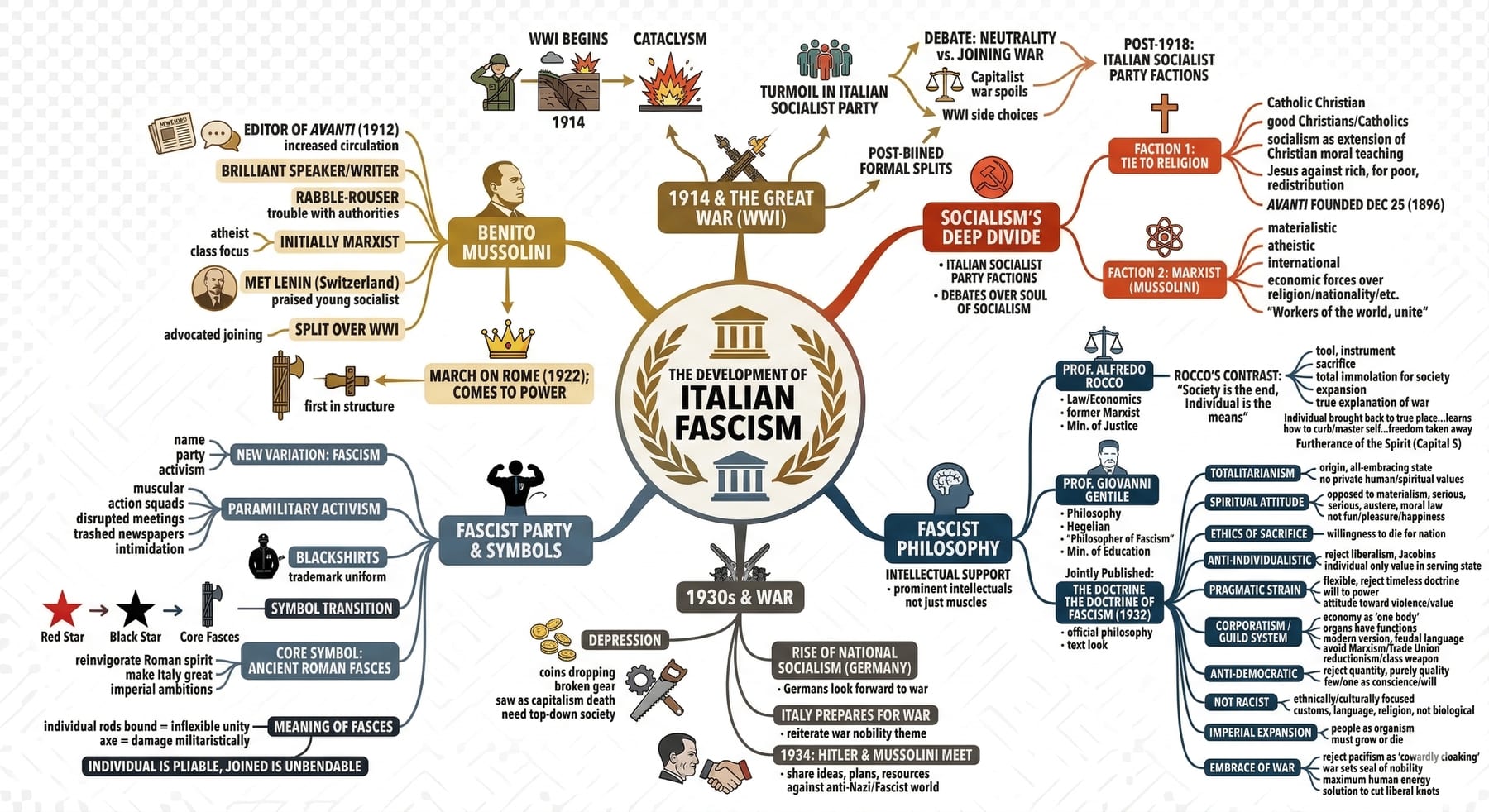
This lecture begins in 1914, when World War I starts, and uses that same year’s upheaval inside the Italian Socialist Party to explain fascism’s emergence as a distinct political philosophy. The central figure is Benito Mussolini, who moves from prominent Marxist socialist leadership to founding a new movement—fascism—that keeps some socialist themes (anti-liberalism, anti-capitalism, state direction) while rejecting Marxist internationalism and economic reductionism, replacing them with national unity, spiritual politics, total state authority, and an embrace of war. The lecture tracks fascism’s development through party conflict, wartime alignment, paramilitary activism, and the official doctrinal statements produced after Mussolini’s rise to power.
1) Why 1914 matters: WWI and a socialist rupture
- 1914 is framed as doubly pivotal:
- the outbreak of the Great War (World War I),
- and a crisis inside Italian socialism that accelerates the formation of fascism.
- The lecture situates fascism among the era’s competing “isms” already covered: conservatism, nationalism, communism, liberalism, progressivism, pragmatism—now adding socialism and fascism.
2) Italian socialism’s internal contradictions: Christian socialism vs Marxist atheism
- The Italian Socialist Party is portrayed as chronically factional.
- A striking example: Avanti (party newspaper) launched its first issue on December 25 (1896), signaling a strand of Italian socialism that sought alignment with Catholic moral symbolism—socialism as a political extension of Christian concern for the poor.
- Mussolini represents the opposing pole:
- a Marxist, committed to atheism and materialism,
- seeing religion (including Catholicism) as ideological cover for existing power structures.
- So even within “socialism,” the lecture emphasizes deep divides:
- spiritual/moral socialism vs materialist Marxism,
- religion-friendly socialism vs militant secularism.
3) Mussolini’s rise within socialism and early Marxist networks
- Mussolini becomes editor-in-chief of Avanti in 1912, boosting circulation dramatically.
- His background includes agitation and trouble with authorities in Italy and Switzerland.
- He gains international Marxist attention; the lecture notes a coincidence: Lenin and Mussolini overlap in Switzerland, and Lenin praises him as a promising socialist.
4) The war question detonates the party: neutrality vs intervention
World War I becomes the decisive wedge:
- Many socialists argue: the war is capitalist rivalry; workers should not die for bourgeois interests; Italy should remain neutral.
- Others argue Italy should enter the war (even if alignment is contested).
- Mussolini takes the interventionist side, and this contributes to his break:
- he leaves the official socialist party,
- starts a new newspaper,
- and begins building a new movement described as “socialism for Italians”—national rather than international.
- Italy ultimately enters the war (a year later) on the Allied side, and postwar turmoil continues to fracture Italian politics.
5) Fascism becomes a new “ism”: action squads, intimidation, and the march to power
- The movement grows beyond intellectual organizing:
- paramilitary “action squads” appear,
- the Blackshirts become the recognizable militant arm,
- they disrupt opponents’ meetings and intimidate enemies.
- Mussolini’s influence expands through the postwar chaos.
- A “march on Rome” is presented as a culminating mobilization; shortly after, Mussolini takes power and fascism becomes the ruling party.
6) Symbols and meaning: fasces, unity, and force
- The fascist emblem centers on the fasces (borrowed from ancient Rome):
- rods bound together = individual weakness vs collective strength,
- axe = coercive power and readiness for violence/war.
- The Roman reference signals a desire to revive imperial greatness and national spirit.
7) Fascism’s intellectual backbone: Rocco and Gentile
The lecture emphasizes fascism is not only street politics; it has elite theoretical support.
A. Alfredo Rocco
- Former doctrinaire Marxist who shifts to fascism.
- As Mussolini consolidates power, Rocco becomes Minister of Justice.
- In 1925 he states fascism’s central reversal of liberalism:
- Liberalism: individuals are ends, society is a means.
- Fascism: society is the end, individuals are means.
- Society has “historical and immanent ends” (preservation, expansion, improvement), distinct from individuals’ ends.
- Sacrifice is necessary—even total “immolation” of individuals for society—providing “the true explanation of war.”
- Individuals must have freedom curtailed to serve the higher “Spirit” (capital-S), echoing Hegelian language.
B. Giovanni Gentile - A lifelong Hegelian philosopher, becomes Minister of Education under Mussolini.
- Mussolini calls Gentile the “philosopher of fascism.”
- Together they publish The Doctrine of Fascism (final form 1932), presented as fascism’s official philosophical statement.
8) The Doctrine of Fascism (1932): core claims
The lecture extracts key themes from the text:
A. Fascism as action plus immanent doctrine
- Fascism is “action and thought,” with doctrine arising from historical forces and working within them.
- It claims both context-sensitivity (time/place) and “ideal content” (truth in a higher historical-philosophical realm), reflecting Hegelian framing.
B. The state as a philosophy of life - No state theory is neutral: it implies a conception of life, a faith, and an “organic” worldview.
- Fascism rejects the view of humans as isolated individuals pursuing selfish pleasure under natural law.
C. Spiritual, not materialist - Fascism presents itself as a spiritual reaction against 19th-century materialistic positivism.
- It binds individuals and generations through moral law, tradition, and mission.
- The highest life is duty, sacrifice, renunciation—even death—for participation in a spiritual society.
D. Explicit anti-individualism and anti-liberalism - Fascism opposes “individualistic abstractions” associated with 18th-century materialism.
- It rejects the pursuit of “happiness” as the central aim.
- The individual is accepted only insofar as interests coincide with the state’s interests.
E. Totalitarianism in the original sense - “Outside of the state, no human or spiritual values can exist.”
- The state is all-embracing: religion, economy, family life, leisure, associations—everything falls under state scope.
- Fascism defines itself as totalitarian because it claims jurisdiction over the totality of life.
9) Fascism versus socialism: proximity and separation
Fascism tries to distinguish itself especially from Marxism:
- It rejects socialism that sees only class struggle and treats the economic as the master key for everything.
- It rejects trade unionism as a “class weapon” because unions imply interests independent of the state.
- Yet it claims to recognize the needs that gave rise to socialism and unions, and to “harmonize” interests through a corporative/guild system:
- society as a single body (corpus),
- sectors organized like organs/guilds,
- conflicts coordinated within the unity of the state rather than negotiated independently.
10) Fascism’s theory of democracy: quality, not quantity
- Fascism rejects majoritarian democracy as “equating the nation with the majority.”
- It argues democracy should reflect “quality”:
- the conscience and will of the few,
- potentially even “the one” who embodies the nation’s will.
This frames authoritarian leadership as the truest expression of national unity.
11) Nation, ethnicity, and power: culture over biology
- The lecture notes fascism portrays itself as not fundamentally “race-based” in biological terms, because it claims to be spiritual rather than materialist.
- It emphasizes peoplehood as a historical-cultural unity: traditions, language, mission, and collective will.
12) War and anti-pacifism: war as moral intensifier
A defining fascist commitment is the embrace of war:
- Fascism rejects the possibility or usefulness of perpetual peace.
- Pacifism is framed as cowardice and renunciation.
- War is said to “key up” human energies and confer nobility on peoples willing to face it.
- The Great War is even framed as evidence against liberalism: liberal ideology is blamed for creating problems that end in war, and fascism claims to supersede liberalism rather than return to pre-1789 monarchy.
13) A pragmatic strain: doctrine not for all times
Despite its spiritual absolutism, the lecture highlights a declared flexibility:
- Fascism rejects a doctrine suited to all times and peoples.
- It explicitly notes a “pragmatic strain”: adaptation, will to power, and a readiness to use violence as valued tools.
14) Toward alliance and escalation: Italy and Germany
The lecture ends by linking fascist Italy to the emerging German counterpart:
- In the early 1930s, economic crisis and political radicalization create conditions for militarized, anti-liberal regimes.
- By 1934, Mussolini and Hitler meet, coordinating and signaling alignment in outlook and future conflict planning.
Bottom line
The lecture frames fascism as a breakaway from Italian socialism catalyzed by World War I: Mussolini and allied intellectuals reject liberal individualism and Marxist international class politics, replacing them with a spiritualized, Hegel-influenced nationalism where the state is the highest reality, individuals are instruments, and war is morally elevating. Fascism brands itself totalitarian because it claims authority over every sphere of life, and it pursues social unity through corporative organization and coercive mobilization—culminating in Mussolini’s seizure of power and eventual ideological convergence with Nazi Germany.
7. A Darker Turn
Peterson Academy - The Philosophy of Politics Part I (Hicks) - Lecture 07.pdf (file not included in this release)
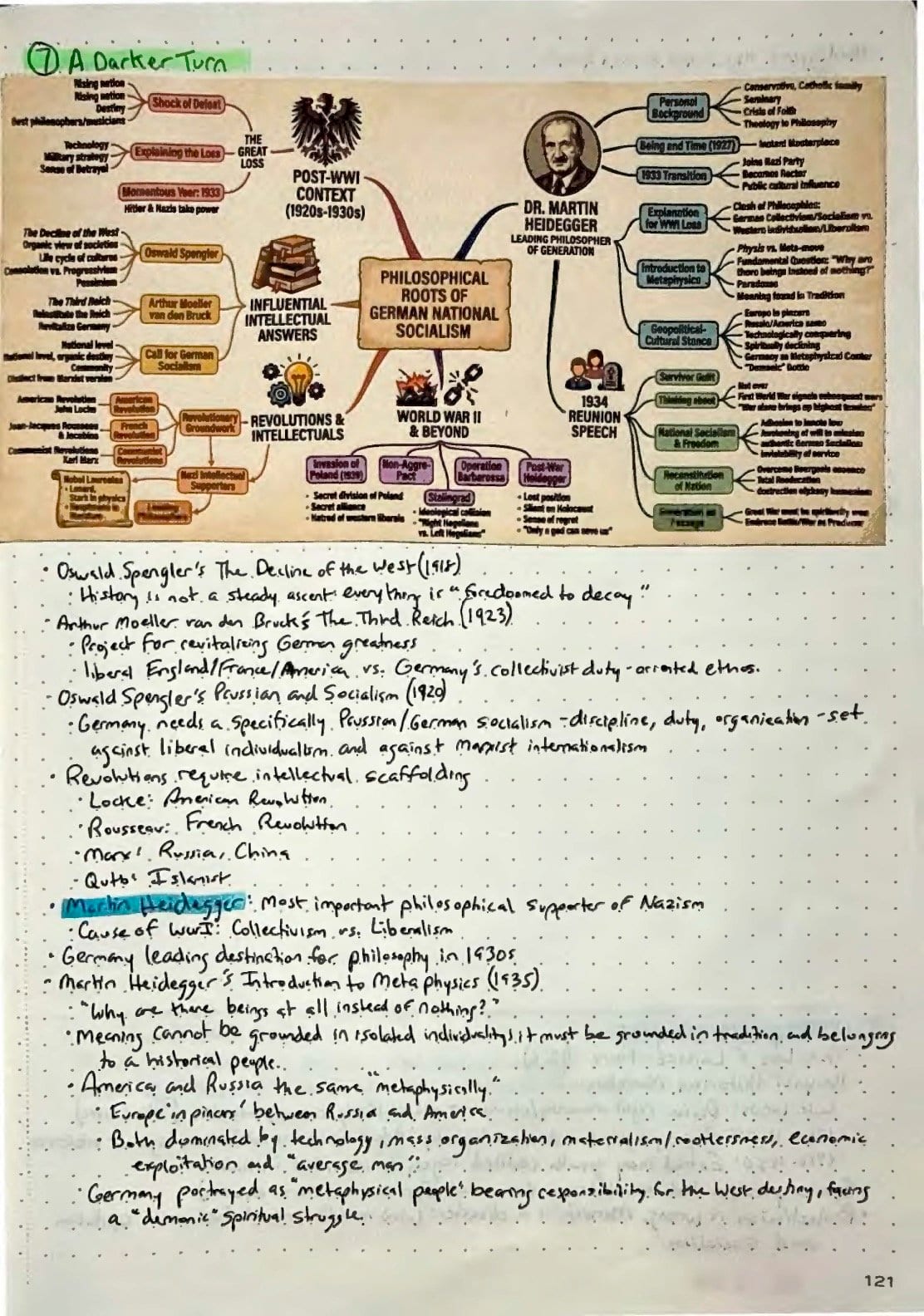
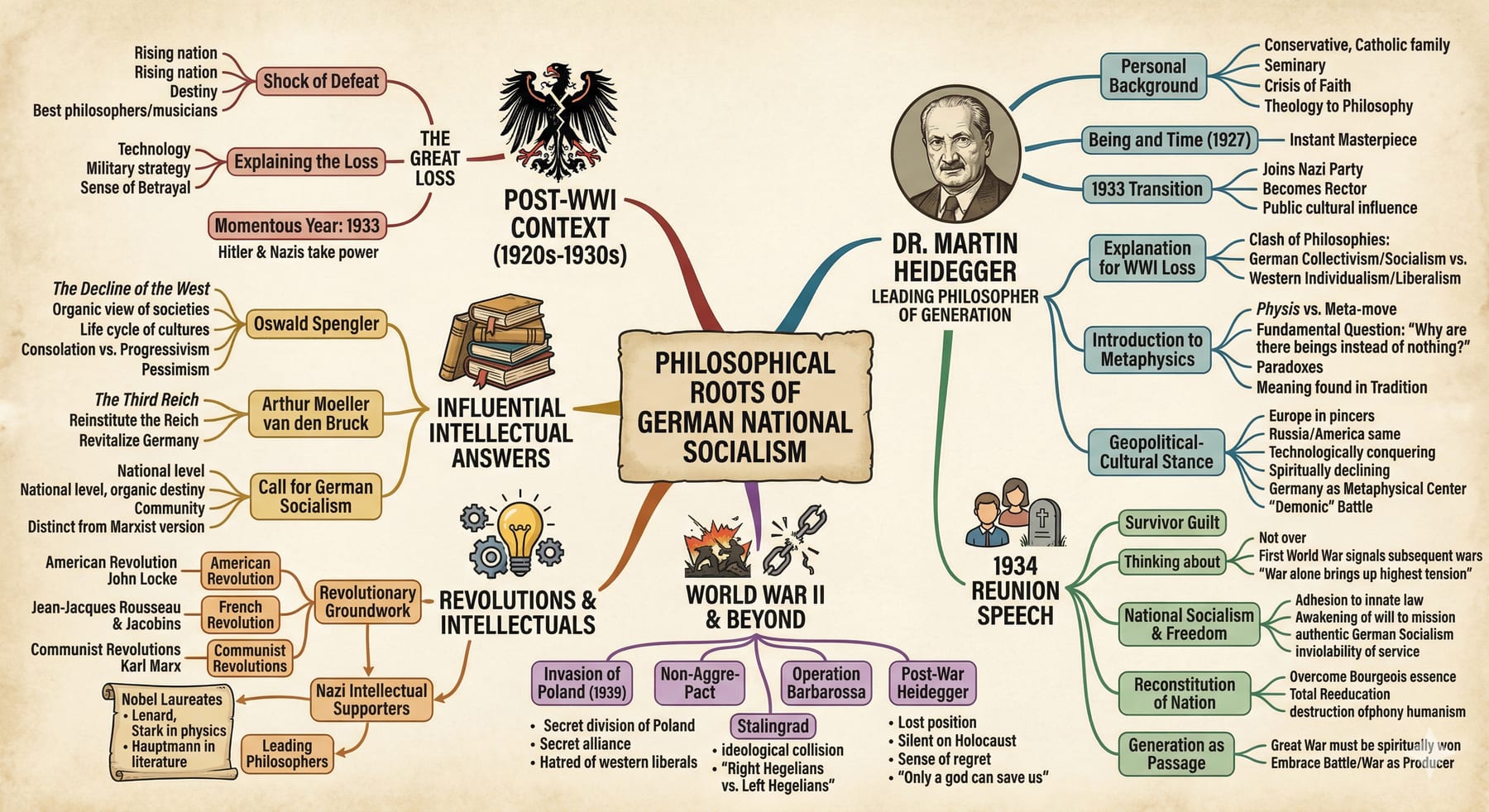
This lecture centers on 1933, when Hitler and the National Socialists take power in Germany, and argues that Nazism cannot be explained only as mass irrationality or political opportunism. Instead, it is presented as the practical expression of a long-prepared philosophy of life, supported by major intellectuals and grounded in Germany’s post–World War I crisis. The lecture highlights how Germans sought a meaning for defeat, how some thinkers proposed decline while others proposed renewal through a “Third Reich,” and then focuses on Martin Heidegger as the most influential philosopher whose writings and speeches explicitly integrate metaphysics, national destiny, education, sacrifice, and war. The lecture closes by interpreting World War II—especially the German-Soviet conflict—as ideology against ideology (a philosophical civil war within the Hegelian legacy), and notes Heidegger’s postwar refusal to repent.
1) The German trauma after WWI: “Why did we lose?”
- In the 1920s–30s, the overriding German question is why Germany lost World War I.
- Defeat feels intolerable because Germany saw itself as:
- an advanced industrial and scientific nation,
- the leading philosophical culture,
- a civilization with a mission to “take the world forward.”
- Explanations circulate (technology, strategy), but a powerful narrative emerges: betrayal—Germany didn’t truly lose on merit; it was sabotaged from within. The lecture treats this as fertile ground for radical parties, including the early Nazis.
2) Competing intellectual diagnoses: decline vs renewal
A. Oswald Spengler — The Decline of the West
- Spengler proposes an organic theory of cultures:
- societies behave like organisms,
- they pass through youth, maturity, and decline,
- conflict is natural, but decay is unavoidable.
- Germany’s defeat is interpreted as a sign of entering the decline phase.
- The lecture uses Spengler to mark a deeply anti-progressive mood: history is not a steady ascent; everything is “foredoomed to decay.”
B. Arthur Moeller van den Bruck — The Third Reich - Moeller van den Bruck argues for renewal: Germany should not settle into republican, liberal-democratic “Western” forms.
- The “Third Reich” idea is presented as a project of revitalizing German greatness.
- Crucially, he and others frame the conflict as a philosophical and cultural war: liberal England/France/America versus Germany’s collectivist duty-oriented ethos.
3) “German socialism” as the anti-liberal answer (not Marxism)
- A central claim: Germany must become socialist again, but not Marxist/communist.
- The socialism envisioned is national, rooted in German identity and destiny rather than international class solidarity.
- Spengler’s Prussianism and Socialism (1920) is used to reinforce this: Germany needs a specifically Prussian/German socialism—discipline, duty, organization—set against liberal individualism and against Marxist internationalism.
4) The lecture’s caution: revolutions require intellectual scaffolding
- The lecture warns against dismissing Nazis as simply insane or irrational.
- It argues that major political revolutions are typically preceded by:
- intellectual networks,
- philosophical justifications,
- cultural preparation.
- Examples are given by analogy: Locke before America, Rousseau before the Jacobins, Marx before communist revolutions, and (later) ideologues before Islamist revolutions.
- The goal is to treat Nazism as an ideology supported by serious intellectuals, not just street violence.
5) Elite endorsement: scientists and artists as Nazi supporters
- The lecture emphasizes that support came from high-status intellectuals:
- Nobel Prize–winning physicists Lenard and Stark,
- Nobel Prize–winning writer Gerhart Hauptmann, portrayed as personally admiring Hitler.
- This is meant to show Nazism’s cultural legitimacy among parts of the educated elite.
6) Heidegger as the key figure: top philosopher, active Nazi
- Martin Heidegger is presented as the most important philosophical supporter of Nazism.
- Biographical arc:
- conservative Catholic upbringing, early intention to become a priest,
- crisis of faith, turn toward philosophy,
- rising academic career after WWI,
- 1927: Being and Time becomes an instant philosophical landmark.
- By 1933:
- Heidegger joins the Nazi Party,
- becomes a university rector,
- participates in shaping higher education under the new regime.
A side-note is included as context:
- Hannah Arendt was Heidegger’s student and intermittent lover; the relationship becomes fraught given Arendt’s Jewish identity and Nazi antisemitism.
7) Heidegger’s diagnosis: WWI was a clash of philosophies
The lecture attributes to Heidegger a sweeping explanation:
- World War I is fundamentally a collision between:
- German collectivist, duty-based, mission-centered philosophies (Hegelian nationalism and related socialist currents),
- and Anglo-American liberal individualism (freedom, rights, pursuit of happiness, toleration, markets).
- Globalization makes these incompatible cultural worlds collide; war becomes the eruption of irreconcilable conceptions of life.
8) Introduction to Metaphysics: meaning requires belonging to tradition
Heidegger is interpreted as linking metaphysics to politics through meaning:
- He frames metaphysics around the question: “Why are there beings at all instead of nothing?”
- Human life seems tiny against deep time and cosmic scale; individual existence appears insignificant.
- The lecture presents his move: meaning cannot be grounded in isolated individuality; it must be grounded in tradition and belonging to a historical people.
9) America and Russia as the same “metaphysically”
A key Heidegger passage is used to frame Germany’s position:
- Europe is “in pincers” between Russia (Soviet communism) and America (capitalist liberalism).
- Heidegger claims they are metaphysically alike:
- both dominated by technology,
- mass organization,
- materialism/rootlessness,
- economic exploitation and “average man.”
- Germany, by contrast, is portrayed as the “metaphysical people” bearing responsibility for the West’s destiny, facing a “demonic” spiritual struggle.
10) The reunion speech: sanctifying sacrifice and preparing for the “next war”
The lecture then moves to a more directly political text: Heidegger’s mid-1930s reunion speech (25-year high school reunion), aimed at a broader audience.
Key themes:
- Fallen WWI comrades are remembered not with grief only, but with moral elevation:
- their early death is portrayed as the “most beautiful and greatest death” because it is sacrifice for national destiny.
- Death becomes a national measure:
- how a nation conceives death reflects its conception of life.
- The Great War is reframed as not truly concluded:
- it produced no final “decision”; the real decision still lies ahead.
- Heidegger explicitly calls it the “First World War,” implying another is coming.
- The coming decision is “spiritual” and global:
- the question is which nation has the inner strength and legitimacy to lead.
11) Redefining freedom as obedience to national essence
Heidegger’s rhetoric redefines “freedom”:
- Not liberal license or personal choice,
- but adhesion to the nation’s “innermost law,” institutions, and mission.
- National Socialism is presented as the deepest concern of German freedom.
- “German socialism” is framed as:
- an order of merit based on inner achievement,
- inviolable service,
- honor of labor,
- and total restructuring of the nation (groups, occupations, classes, every individual).
He targets the “bourgeois essence” (using language reminiscent of Marxist critique) and calls for reeducation:
- schools and universities must be transformed,
- “phony humanism” (individual worth and liberal dignity) must be destroyed,
- the Great War must be “spiritually won” by the living generation.
He closes with Heraclitus: - “Battle is the father of all things” (war/conflict as creative principle),
- framing conflict as the engine of order, hierarchy, and destiny.
12) WWII and Stalingrad: ideology versus ideology
The lecture then projects forward:
- WWII begins in 1939 with Germany’s invasion of Poland.
- It highlights the initial Nazi–Soviet non-aggression pact and joint partition of Poland.
- Germany later breaks the pact and invades the Soviet Union, leading to the epic struggle culminating at Stalingrad.
- The conflict is framed as philosophical:
- Nazi National Socialism versus Soviet Marxism.
- Richard Rorty’s quip is invoked: Stalingrad as Right Hegelians versus Left Hegelians—Hegelian statism/national destiny against Hegel reworked into Marxist revolution.
13) Heidegger after 1945: no apology, “Only a god can save us”
- After the war Heidegger loses his position and is marginalized.
- The lecture emphasizes:
- he never publicly repented for Nazism or addressed the Holocaust with contrition,
- he remained largely silent.
- Late in life, in a major interview, he expresses not moral remorse but pessimistic resignation:
- Germany “failed again,”
- “Only a god can save us.”
Bottom line
The lecture argues that Nazism’s 1933 rise is inseparable from Germany’s post–WWI crisis and a pre-existing intellectual ecosystem that framed politics as destiny, sacrifice, and spiritual national mission. It uses Spengler and Moeller van den Bruck to show how “decline” and “Third Reich renewal” narratives prepared the ground, then focuses on Heidegger as the clearest bridge from high philosophy to Nazi political mobilization: meaning is found in tradition and national essence, freedom is obedience to that essence, war and sacrifice are ennobling, and education must be rebuilt to form the new national type. WWII, especially the Nazi–Soviet clash, is then presented as ideology fighting ideology—philosophy translated into mass violence—while Heidegger’s postwar silence underscores how deeply he remained committed to the framework even after catastrophe.
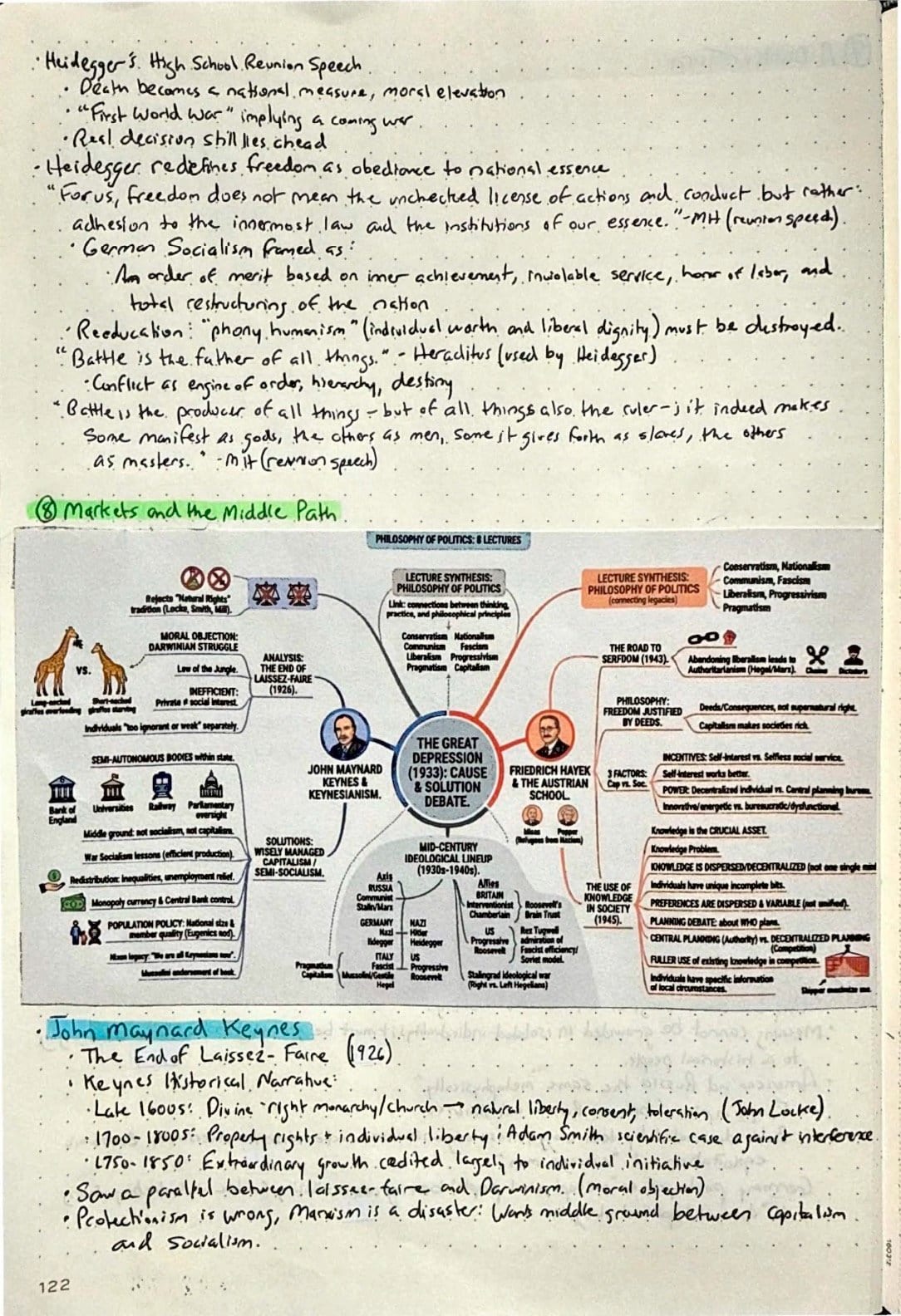
8. Markets and the Middle Path
Peterson Academy - The Philosophy of Politics Part I (Hicks) - Lecture 08.pdf (file not included in this release)
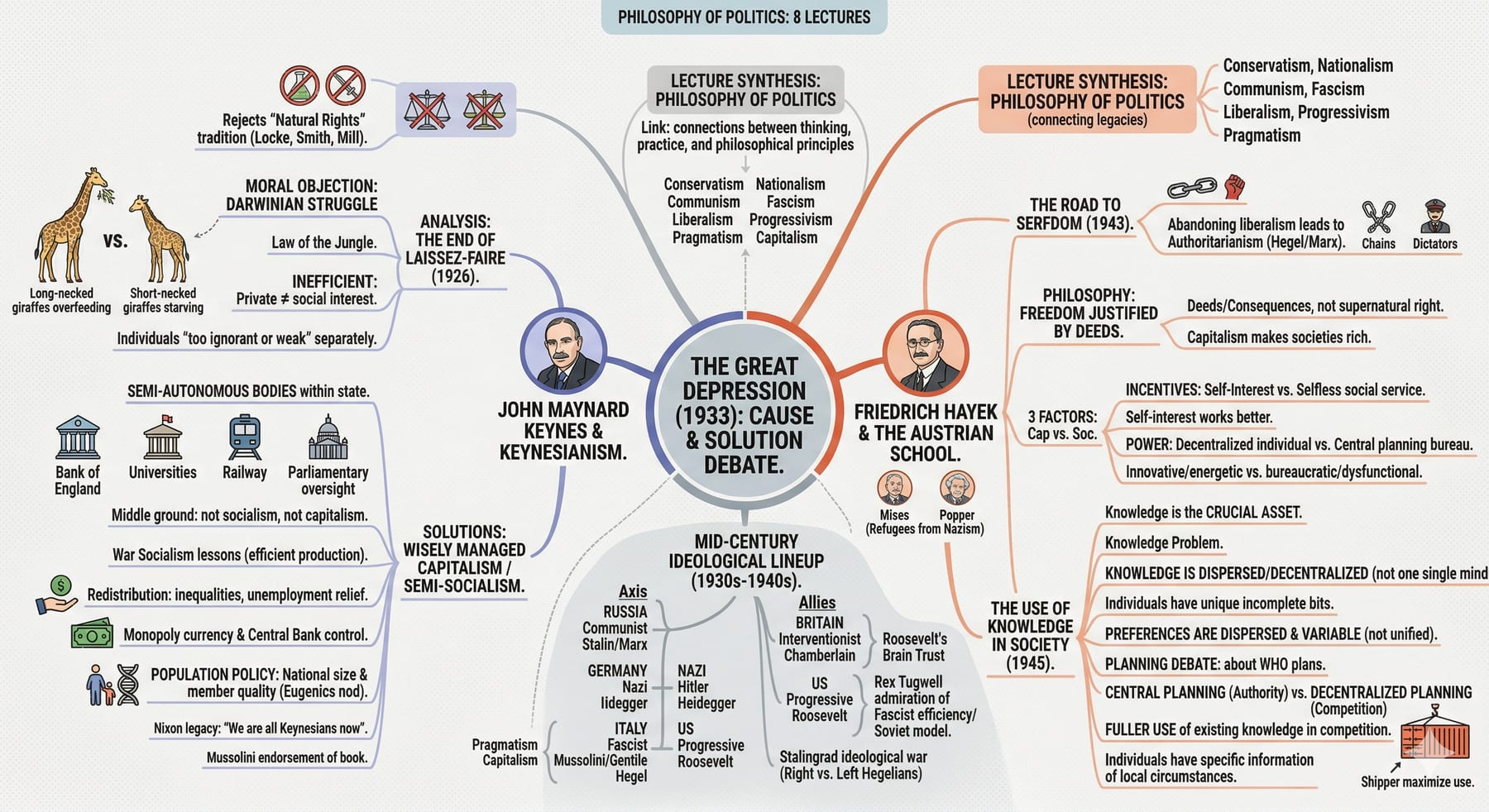
This lecture uses 1933—the depth of the Great Depression—to shift the course from political “isms” toward the philosophy of economics, then carries the story through World War II and ends with Friedrich Hayek as the major mid-century defender of liberal capitalism against central planning. The lecture’s through-line is that economic and political crises are not only technical problems; they are driven by underlying philosophical premises about freedom, rights, knowledge, and the proper scope of the state.
1) The Great Depression: cause-diagnosis drives policy
The lecture opens with the Depression as a civilizational shock that forces two rival diagnoses:
- Capitalism caused it: laissez-faire is uncoordinated, driven by ignorance and herd enthusiasm; without central planning it will periodically collapse.
- Government interference caused it: WWI debt, monetary tinkering (gold standard disruptions), deficit financing, central banking, and intervention distorted markets and made collapse more likely.
Because the causal story determines the remedy, the policy fork becomes: - more government management (stimulus, jobs, coordinated investment, relief),
- or less government meddling (restore market self-correction; avoid the illusion that state “creates” activity without opportunity costs).
2) Keynes enters as the “middle way” architect
The lecture frames John Maynard Keynes as the dominant 20th-century economic philosopher whose influence later becomes policy orthodoxy (“we are all Keynesians now”).
It focuses on his 1926 essay The End of Laissez-Faire, presented as:
- historically reflective (Locke → Smith → Mill),
- predictive of capitalism’s limits,
- and explicitly arguing that laissez-faire should end.
Keynes’ historical narrative - Late 1600s: divine-right monarchy/church gives way to natural liberty, consent, and toleration (Lockean foundations).
- 1700s–1800s: property rights + individual liberty become philosophical orthodoxy; Adam Smith supplies the “scientific” case against interference.
- 1750–1850: extraordinary growth is credited largely to individual initiative with minimal “directive” social planning.
Keynes’ critique of laissez-faire - Laissez-faire implies harsh moral consequences: those who invest or work “wrongly” receive no mercy.
- He links capitalism’s selection mechanism to a Darwinian struggle:
- bankruptcy as economic natural selection,
- the “giraffe” analogy: long-necked winners starve out short-necked losers.
- He argues this is ethically troubling: a system may produce efficiency while generating suffering, anxiety, greed, overfeeding of winners, and waste.
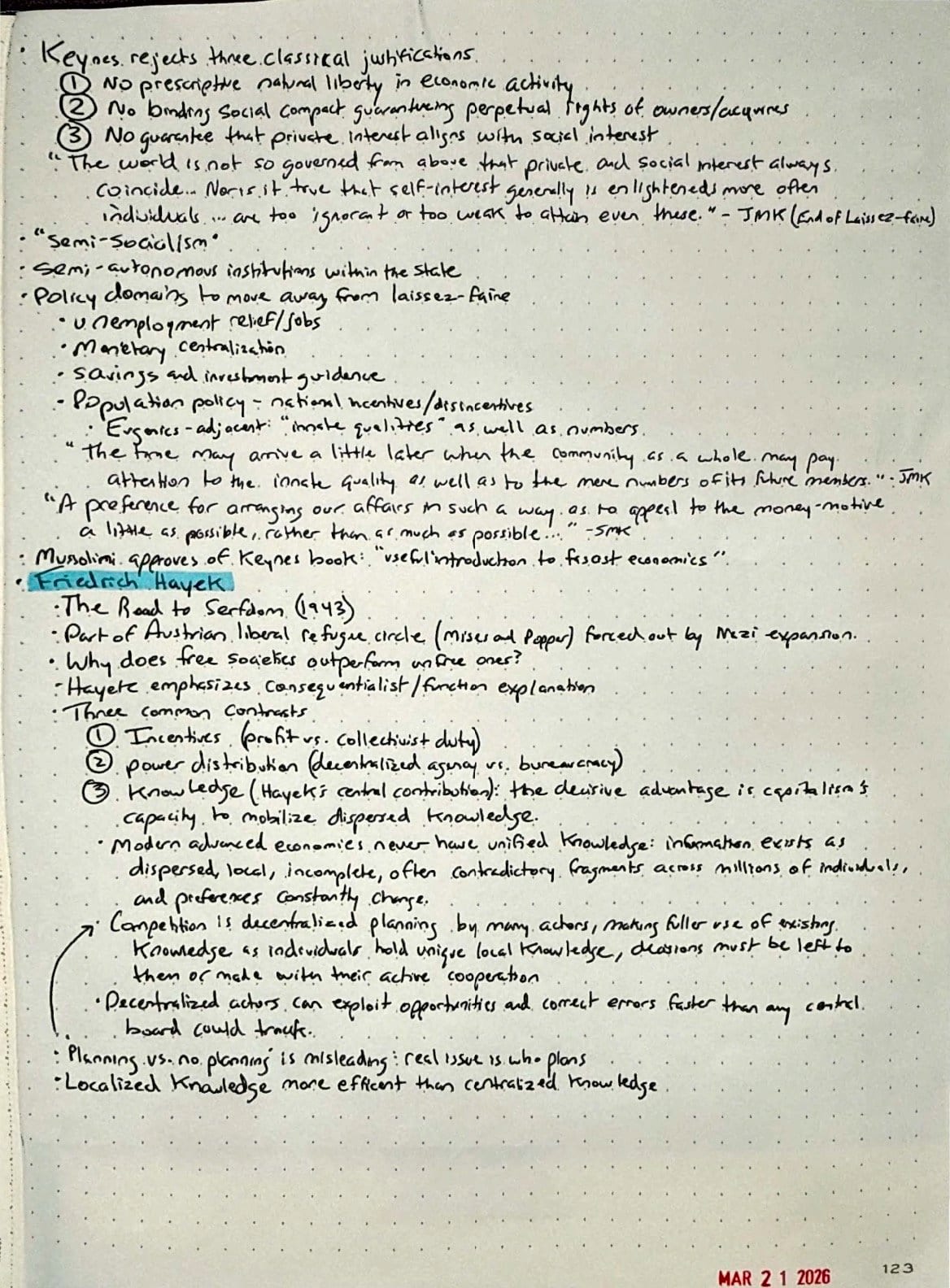
Keynes rejects three classical justifications
He explicitly clears away the “metaphysical” claims behind laissez-faire:
- No prescriptive natural liberty in economic activity.
- No binding social compact guaranteeing perpetual rights of owners/acquirers.
- No guarantee that private interest aligns with social interest, nor that self-interest is generally enlightened (people are often ignorant/weak even at achieving their own ends).
Keynes’ Burkean-style balancing
Keynes quotes Burke approvingly: the central legislative question is what the state should direct by “public wisdom” and what it should leave to private exertion. He positions himself between:
- total laissez-faire,
- and full socialism.
Institutional proposal: “semi-autonomous bodies”
He proposes a form of “semi-socialism”: - empowered semi-autonomous institutions within the state,
- chartered/overseen by government,
- aiming at “public good” rather than private advantage.
He even acknowledges it resembles medieval autonomies (chartered bodies), citing examples like universities, the Bank of England, and rail infrastructure—suggesting a mixed system of private enterprise plus public-mandated coordination in key sectors.
Policy domains he wants to move away from laissez-faire - unemployment relief/jobs and managing instability,
- monetary centralization (currency monopoly and central banking),
- savings and investment guidance,
- and even population policy: not full Nazi/Soviet control, but national incentives/disincentives, plus a later possibility of attending to “innate quality” as well as numbers (the lecture flags this as a eugenic-adjacent move).
Moral critique of profit motives
Keynes says Europe increasingly recoils from organizing society around money motives; many religions and philosophies deprecate a life centered on personal profit. Yet he still concludes that capitalism “wisely managed” is likely the most efficient system available—if stripped of laissez-faire purity.
3) Fascist approval as an uncomfortable convergence
A striking side point: a review of Keynes’ End of Laissez-Faire is praised by a British fascist, with Mussolini endorsing the review and claiming Keynes could serve as an introduction to fascist economics. Keynes appreciates the policy relevance but wants to distance himself from fascist totalitarianism—yet the overlap underscores how anti-laissez-faire arguments can be co-opted by authoritarian systems.
4) The 1930s ideological “lineup” before WWII
The lecture then surveys the major powers as philosophical-economic regimes:
- Soviet Union: Stalin; Marxism as official doctrine.
- Germany: Hitler; National Socialism with Heidegger as a leading philosophical endorser.
- Italy: Mussolini; fascism with Gentile as philosophical architect.
- Britain: Keynesian influence rising; Chamberlain trying to avert war via negotiation.
- United States: Roosevelt’s New Deal; key advisors include Rex Tugwell, who admires Soviet planning and fascist administrative efficiency and wants elements of both for America.
This frames WWII as a conflict among nations convinced of their moral-economic mission.
5) Hayek in 1943–45: liberalism’s warning and the “knowledge argument”
In 1943, amid the war, Friedrich Hayek publishes The Road to Serfdom, arguing Europe abandoned Enlightenment liberalism and slid toward authoritarian systems (Marxist, fascist, Nazi) that logically tend toward coercion and dictatorship. The lecture presents Hayek as part of an Austrian liberal refugee circle (with Mises and Popper) forced out by Nazi expansion.
Hayek’s foundational claim
Why do free societies outperform unfree ones?
- Some argue from rights (natural/divine).
- Hayek emphasizes a consequentialist/functional explanation: freedom works better in practice, especially economically.
He notes three common capitalism-vs-socialism contrasts:
- Incentives (profit vs collectivist duty),
- power distribution (decentralized agency vs bureaucracy),
- knowledge (Hayek’s central contribution): the decisive advantage is capitalism’s capacity to mobilize dispersed knowledge.
6) “The Use of Knowledge in Society”: the core problem is not logic, but dispersion
In his 1945 argument, Hayek reframes the economic question:
- If all relevant information and preferences were given to one mind, allocation would be a “problem of logic.”
- But real economies never have unified knowledge: information exists as dispersed, local, incomplete, often contradictory fragments across millions of individuals, and preferences constantly change.
Therefore the real economic problem is: - how to make the best use of resources and knowledge known to different people for ends only those individuals understand.
Planning redefined
Hayek argues “planning vs no planning” is misleading: - the real issue is who plans.
- Central planning is planning by one authority for the whole system.
- Competition is decentralized planning by many actors.
Efficiency depends on which system makes fuller use of existing knowledge: - Individuals hold unique local knowledge; decisions must be left to them or made with their active cooperation.
He illustrates with practical examples (local, real-time decisions like using empty shipping capacity), emphasizing that decentralized actors can exploit opportunities and correct errors faster than any central board could track.
7) Where the debate lands post-WWII
After 1945, the lecture frames a new Western divide:
- interventionist liberalism (Keynes-style mixed economy),
- versus more classical-market liberalism (Hayek/Mises-style).
Both oppose Nazi/fascist dictatorship and Soviet totalitarianism, but disagree on how much economic steering is compatible with a free society.
Bottom line
The lecture traces how the Great Depression and World War II forced economics to the center of political philosophy. Keynes argues laissez-faire rests on false metaphysical premises about natural economic liberty and enlightened self-interest, and proposes a managed mixed system using semi-autonomous public bodies to correct capitalism’s moral and practical failures. Hayek counters that the deepest problem is not motivation or even power alone, but the knowledge problem: modern economies depend on dispersed local information that no planner can centralize, so free-market competition is best understood as decentralized planning that coordinates knowledge. The lecture closes by tying these economic debates back to the course’s main theme: modern politics is the applied battlefield of philosophical ideas.