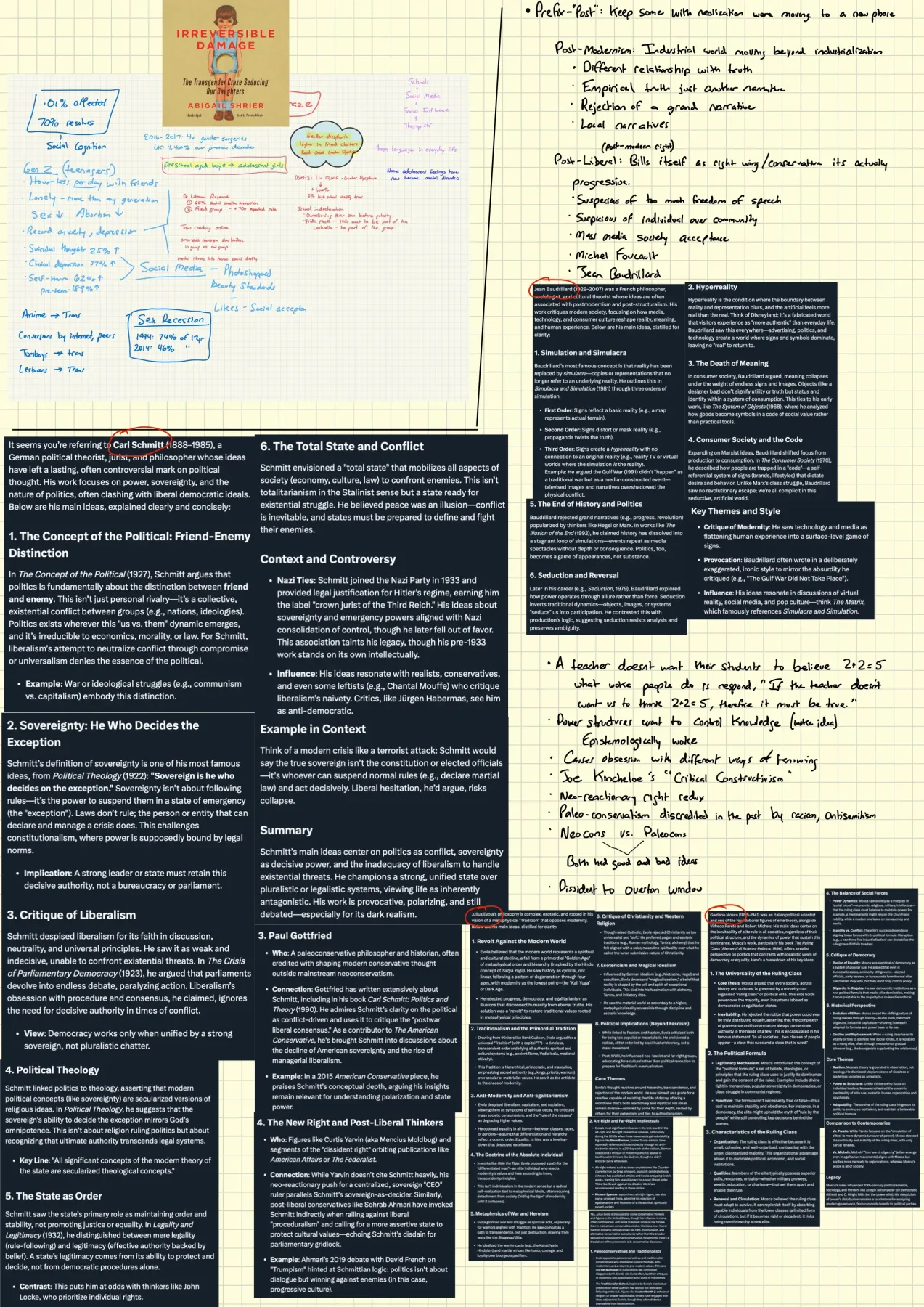
Carl Schmitt (1888-1985) was a highly influential and deeply controversial German jurist and political theorist. His work, characterized by its trenchant critique of liberalism, its focus on the nature of political power, and its association with National Socialism, continues to provoke debate and inspire analysis across the political spectrum.
Here’s a breakdown of his main ideas, important quotes, impact, and influences:
Main Ideas
Schmitt’s thought revolved around several core concepts:
-
The Concept of the Political (The Friend-Enemy Distinction): This is arguably Schmitt’s most famous and foundational idea.
- Main Idea: The essence of “the political” lies not in any particular subject matter (like economics or morality) but in the existential distinction between friend and enemy. An enemy is not necessarily a personal foe or an economic competitor, but rather a public enemy, an “other” whose existence poses an existential threat to one’s own collective way of life. This distinction is the most intense and extreme antagonism, and it defines the realm of the political. The possibility of war is inherent in this distinction.
- Significance: Schmitt argued that liberalism, with its emphasis on individualism, universalism, and the neutralization of conflict through discussion and compromise, fails to grasp this fundamental reality of the political. By attempting to depoliticize life, liberalism, in his view, leaves societies vulnerable.
-
Sovereignty and the State of Exception:
- Main Idea: “Sovereign is he who decides on the exception.” For Schmitt, sovereignty is not primarily about upholding the normal legal order, but about the power to decide when that order no longer applies—when a “state of exception” (Ausnahmezustand) exists. In moments of existential crisis (e.g., war, severe internal unrest), the sovereign has the authority to suspend the law to preserve the state.
- Significance: This concept challenges liberal constitutionalism, which seeks to limit sovereign power through law. Schmitt argued that no legal norm can anticipate or govern every possible exceptional situation. The decision on the exception is a purely political one, preceding and grounding the legal order.
-
Decisionism:
- Main Idea: Political and legal order ultimately rests not on rational deliberation, abstract norms, or objective truth, but on a fundamental, authoritative decision. In the absence of clear, pre-existing rules for every eventuality, or when norms conflict, what matters is that a decision is made by a recognized authority. The validity of the law comes from the will of the sovereign who decides, not necessarily from the content of the law itself.
- Significance: This contrasts sharply with liberal ideals of a government of laws, not of men. Schmitt believed that liberalism’s attempt to replace decision with endless discussion and procedure was a sign of its weakness and inability to act decisively in a crisis.
-
Critique of Liberalism and Parliamentary Democracy:
- Main Idea: Schmitt was a profound critic of liberalism, which he saw as inherently incapable of true political action because it denies or seeks to neutralize the friend-enemy distinction. He argued that liberal parliamentarism, based on discussion and compromise, was a sham in an age of mass democracy. He believed that genuine democracy required substantive homogeneity (a shared identity and will of the people) rather than the pluralism and proceduralism championed by liberals. He saw parliamentary debate as often masking the pursuit of particularistic interests rather than the common good.
- Significance: His critiques targeted the perceived weaknesses of the Weimar Republic, arguing that its liberal-democratic framework was unable to cope with deep social and political divisions.
-
Political Theology:
- Main Idea: Schmitt argued that “all significant concepts of the modern theory of the state are secularized theological concepts.” He explored the structural analogies between political and theological concepts, suggesting that the modern state, despite its secular appearance, retained patterns of thought and authority derived from theology (e.g., the omnipotent lawgiver analogous to God, the state of exception to the miracle).
- Significance: This idea aimed to reveal the deeper, often unacknowledged, foundations of political authority and to critique the Enlightenment’s claim to have fully rationalized politics.
-
The Nomos of the Earth:
- Main Idea: In his later work, Schmitt explored the concept of “Nomos” as the fundamental spatial ordering and distribution of the earth, which underpins international law and political existence. He traced the historical evolution of different global orders, from the Res Publica Christiana to the Eurocentric global order and its crisis in the 20th century.
- Significance: This work provided a grand historical and geopolitical framework for understanding international relations and the changing nature of global power.
Spatial geopolitics and Dugin’s appropriation
Schmitt’s later geopolitical work supplies a second route into contemporary anti-liberal politics beyond sovereignty and the exception:
- Land and sea: Land and Sea treats terrestrial and maritime powers as different historical forms. In Dugin's reception, land becomes fixed, traditional, ideocratic, and communal while sea becomes mobile, commercial, liberal, and dissolving.
- Nomos: A world order rests on a concrete spatial division, appropriation, and legal ordering rather than only universal rules detached from territory.
- Grossraum: “Large space” describes a supranational regional order organized around a leading power and an anti-intervention principle directed against powers external to the region. Schmitt’s Nazi-period use sought to rationalize German regional hegemony; it should not be redescribed as neutral federalism.
- Multipolar afterlife: Dugin explicitly turns Grossraum and the “Fourth Nomos” into civilizational multipolarity. His own Foundations of Geopolitics gives Schmitt a full chapter and treats land/sea, nomos, and large spaces as major foundations. See Dugin’s Schmitt chapter (file not included in this release), land and sea (file not included in this release), and Grossraum (file not included in this release).
Influence boundary
The Schmitt-to-Dugin transmission is direct. A Schmitt-to-“Woke Right” claim is more variable. Some writers cite Schmitt; others merely share criticisms of liberalism, strong-executive arguments, or civilizational language with many possible sources. The Hegel–Schmitt–Dugin analysis separates direct adoption, mediated influence, and analogy.
Important Quotes
- On the Concept of the Political:
- “The specific political distinction to which political actions and motives can be reduced is that between friend1 and enemy.” (The Concept of the Political)
- “Tell me who your enemy is, and I will tell you who you are.” (Often attributed, reflects his thinking)
- “War is the existential negation of the enemy.” (The Concept of the Political)
- On Sovereignty and the State of Exception:
- “Sovereign is he who decides on the exception.” (Political Theology)
- “All law is ‘situational law.’ The sovereign produces and guarantees the situation in its totality. He has the monopoly over this last decision.”2 (Political Theology)3
- “The exception in jurisprudence is analogous to the miracle in theology.” (Political Theology)
- On Democracy and Liberalism:
- “Every actual democracy rests on the principle that not only are equals equal but unequals will not be treated equally. Democracy requires, therefore, first homogeneity and second—if the need arises—elimination or eradication of heterogeneity.”4 (The Crisis of Parliamentary Democracy)5
- On Political Theology:
- “All significant concepts of the modern theory of the state are secularized theological concepts.” (Political Theology)
Impact
Carl Schmitt’s impact is profound, wide-ranging, and deeply controversial, largely due to his intellectual support for and membership in the Nazi Party (from 1933).
- During the Nazi Era: Schmitt provided legal and political justification for Hitler’s regime, famously declaring “The Führer makes the law, the Führer protects the law.” His theories of the strong state, decisionism, and the need for a homogenous “people” were readily adaptable to Nazi ideology. Though his influence within the regime waned after the mid-1930s, his association permanently tainted his legacy.
Antisemitism was substantive, not incidental biography
Schmitt’s 1938 Hobbes book and later notebooks contain explicit antisemitic interpretations, including a conspiratorial role assigned to Jews in the Leviathan/Behemoth symbolism. His loss of Nazi institutional influence after 1936 did not amount to a clean intellectual repudiation. This matters analytically because land/sea, law/nomos, Leviathan/Behemoth, and friend/enemy can carry a historically racialized and antisemitic conceptual burden even when later readers abstract the concepts from it.
- Post-War Reception:
- Initial Disgrace: After World War II, Schmitt was ostracized by the mainstream academic community, particularly in Germany.
- Revival of Interest: From the late 20th century onwards, there has been a significant resurgence of interest in his work.
- On the Right: Some conservative and neo-conservative thinkers have drawn on his critique of liberalism, his emphasis on strong executive power, and his understanding of international relations (e.g., his ideas on “Grossraum” or large spatial orders). Leo Strauss, a highly influential conservative political philosopher, had an early and complex intellectual relationship with Schmitt.
- On the Left (“Left-Schmittians”): Paradoxically, Schmitt’s work has also been influential among leftist and critical theorists. Thinkers like Chantal Mouffe (advocating for an “agonistic” model of democracy that acknowledges ineradicable conflict), Giorgio Agamben (whose work on the “state of exception” and “bare life” is heavily indebted to Schmitt), and others associated with the journal Telos have engaged with Schmitt’s critique of liberalism and his conceptualization of the political to understand contemporary power structures and the limitations of liberal democracy. They often seek to use his insights to develop a more robust, and sometimes radical, democratic theory.
- Legal and Political Theory: Schmitt’s concepts of sovereignty, the state of exception, and the political continue to be central to debates in constitutional law, international relations theory, and political philosophy. His work is often used to analyze moments of crisis, the nature of executive power, and the challenges to liberal order.
- Enduring Controversy: Schmitt remains a deeply divisive figure. Critics argue that his theories are inherently anti-democratic and provided an intellectual pathway to authoritarianism and totalitarianism. Defenders, while often acknowledging his problematic biography, argue that his analyses of power, liberalism’s weaknesses, and the nature of the political are too incisive to ignore and offer crucial insights for understanding political reality.
Influences on Carl Schmitt
Schmitt’s thought was shaped by a variety of intellectual and historical contexts:
- Thomas Hobbes: Schmitt saw Hobbes as a crucial theorist of the state and sovereignty. He drew from Hobbes’s pessimistic view of human nature (the “war of all against all” in the state of nature) and the idea that a strong, decisive sovereign is necessary to create order and security.
- Niccolò Machiavelli: Like Machiavelli, Schmitt focused on the realities of political power, often to the exclusion of traditional moral considerations. He appreciated Machiavelli’s understanding of the role of conflict in politics.
- Catholic Political Theology: Schmitt’s early work was influenced by conservative Catholic thought and its emphasis on authority, order, and the limits of human reason. His concept of “political theology” reflects this engagement. Counter-revolutionary thinkers like Joseph de Maistre and Juan Donoso Cortés, who critiqued the French Revolution and liberalism, were also important.
- German State Theory: He was educated in the German tradition of legal and state theory (Staatsrechtslehre), which emphasized the unique status and authority of the state.
- Max Weber: While not always in agreement, Schmitt engaged with Weber’s ideas on bureaucracy, legitimacy, and the rationalization of modern life. Weber’s definition of the state as holding a monopoly on legitimate violence resonates with Schmitt’s focus on decisive power.
- Georges Sorel: The French syndicalist thinker’s ideas on myth and violence as political motivators may have influenced Schmitt’s understanding of political mobilization.
- The Weimar Republic: The political instability, crises, and perceived failures of the Weimar Republic (1919-1933) provided the immediate backdrop and a critical target for much of Schmitt’s most influential work. He saw its liberal constitutionalism as fatally flawed.
- Nietzschean Themes: While not a direct “Nietzschean,” some of Schmitt’s work echoes Nietzschean themes such as the critique of modern egalitarianism, the importance of will, and the revaluation of values, albeit channeled into a political and legal framework.
In conclusion, Carl Schmitt remains a complex and unsettling figure in 20th-century thought. His incisive critiques of liberalism and his stark conceptualizations of political power and sovereignty have ensured his continued relevance, even as his deep complicity with the Nazi regime demands critical and cautious engagement with his ideas.
Handwritten Notebook Pages
Source
Open Carl Schmitt notebook pages — start at notebook p. 8 (file not included in this release).