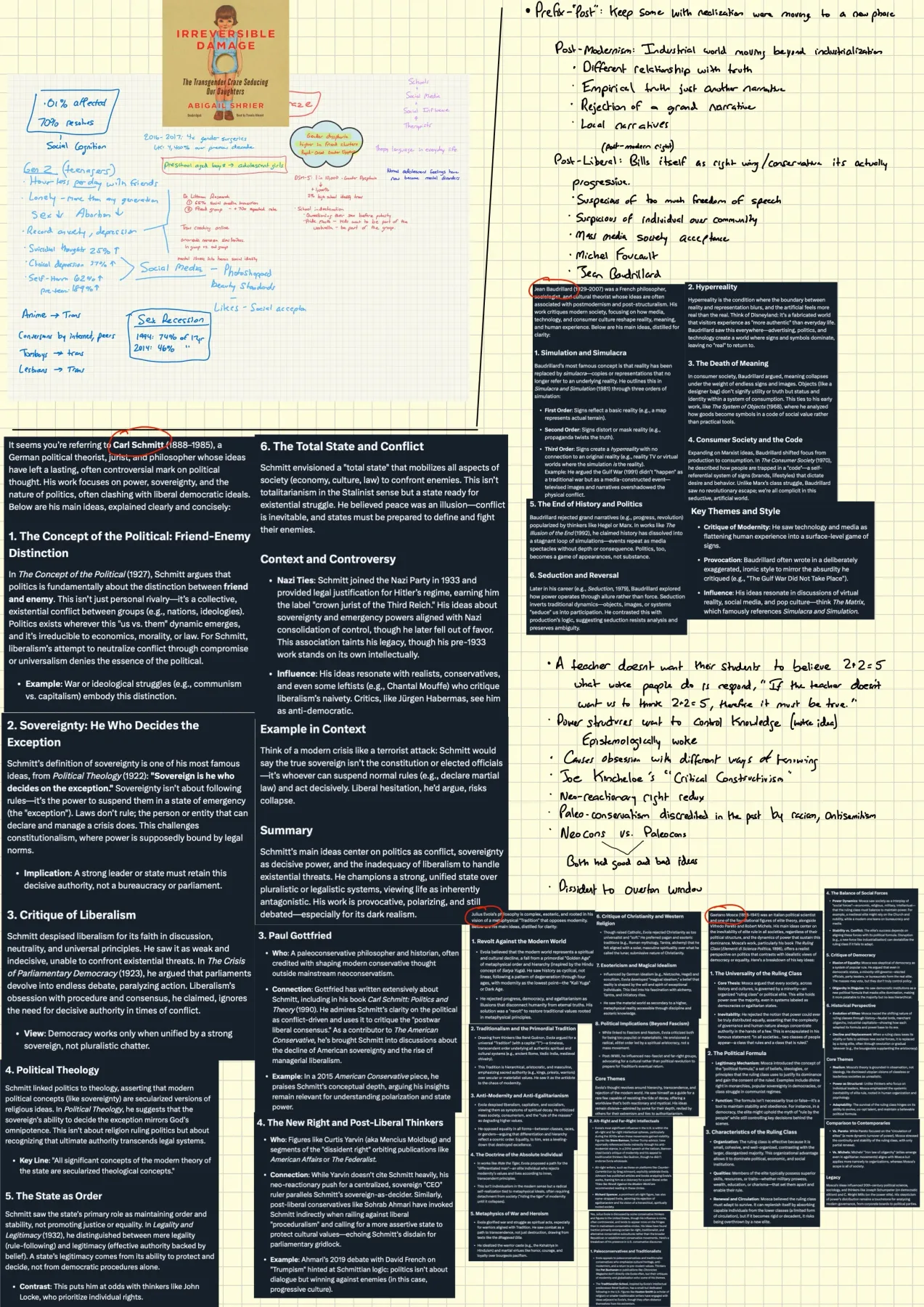
Here’s a comprehensive breakdown of Gaetano Mosca, one of the foundational figures of elite theory, structured by main ideas, quotes, impact, and influences:
🧠 Main Ideas
1. The Political Class (Elite Theory)
- Core Idea: Every society, regardless of how democratic it claims to be, is ruled by a minority elite, not the majority.
- “The ruling class” is inevitable—whether in monarchies, democracies, or dictatorships.
- Masses are governed by organized minorities with superior resources, organization, and cohesion.
“In all societies—from societies that are very primitive and have barely attained the dawnings of civilization, down to the most advanced and powerful societies—two classes of people appear—a class that rules and a class that is ruled.”
2. Formula of Political Rule
-
Every ruling class legitimizes its power through a “political formula”—a set of ideological, religious, or legal justifications for its authority.
-
These are often myths or fictions used to pacify the governed and mask the reality of elite control.
- Example: Divine right in monarchies, democracy in modern republics.
3. Iron Law of Oligarchy (precursor)
- Though this phrase is associated with Robert Michels, Mosca laid the groundwork: organization always leads to oligarchy, because those who coordinate power do so more effectively than the masses.
4. Elites Are Not Monolithic
-
He distinguished between “open” and “closed” elites:
- Open elites allow some social mobility (e.g., liberal democracies).
- Closed elites guard power through heredity or rigid caste systems.
5. Pessimism About Popular Sovereignty
- Mosca rejected the notion that the will of the majority governs in any meaningful sense.
- Believed democracy simply replaced one ruling class with another, using more sophisticated political formulas.
🗣️ Important Quotes
“The masses do not govern themselves. If we leave out certain Utopian dreams, all political experimentation confirms this empirical law.”
“A political class always exists and will always exist.”
“In politics, it is always the few who lead, and the many who follow.”
“The ruling class justifies its privileges by appealing to a political formula that has more symbolic than practical value.”
🌍 Impact
1. Foundational Figure of Elite Theory
- Alongside Vilfredo Pareto and later Robert Michels, Mosca is one of the “triumvirate” of elite theorists.
- Challenged both liberal democratic and Marxist assumptions about power distribution.
- His work laid the foundation for realist political science—focusing on who actually governs, not just institutional design.
2. Influence on Political Realism
- Influenced modern political realists like James Burnham, Samuel Huntington, and even C. Wright Mills (in The Power Elite).
- Anticipated critiques of liberal democracy by thinkers such as Carl Schmitt and even Michel Foucault (in regard to power structures).
3. Continuing Relevance
- Modern populist critiques often echo Mosca: they claim to speak for “the people” against a self-reinforcing political elite.
- Political scientists and sociologists still reference Mosca in discussions of elite capture, technocracy, and deep state dynamics.
🧬 Influences
Intellectual Influences:
- Niccolò Machiavelli: Realism in politics and focus on power rather than morality.
- Aristotle: Classification of governments and ruling classes.
- Enlightenment Rationalism: Though Mosca rejected its optimism, he was influenced by its methodical critique of power.
He Influenced:
- Vilfredo Pareto: Developed ideas on “circulation of elites.”
- Robert Michels: Expanded elite theory into mass party dynamics (Iron Law of Oligarchy).
- James Burnham: The Managerial Revolution echoes Mosca’s elite-centric framework.
- Modern political realists and conservative critics of egalitarianism.
🏛️ Major Work
The Ruling Class (Elementi di Scienza Politica, 1896)
- Most influential text; introduced the term “classe politica”.
- Provided a sociological, empirical, and historical study of how elites rule.
Summary Description for Notes:
Gaetano Mosca (1858–1941) was an Italian political theorist best known for developing the theory of the political class. He argued that in all societies, a small minority inevitably rules over the majority, and that these ruling elites justify their power with political formulas—ideological myths designed to legitimize authority. Mosca is a foundational figure in elite theory and a precursor to modern political realism.
Let me know if you’d like a visual mind map or a markdown note template you can paste into Obsidian.