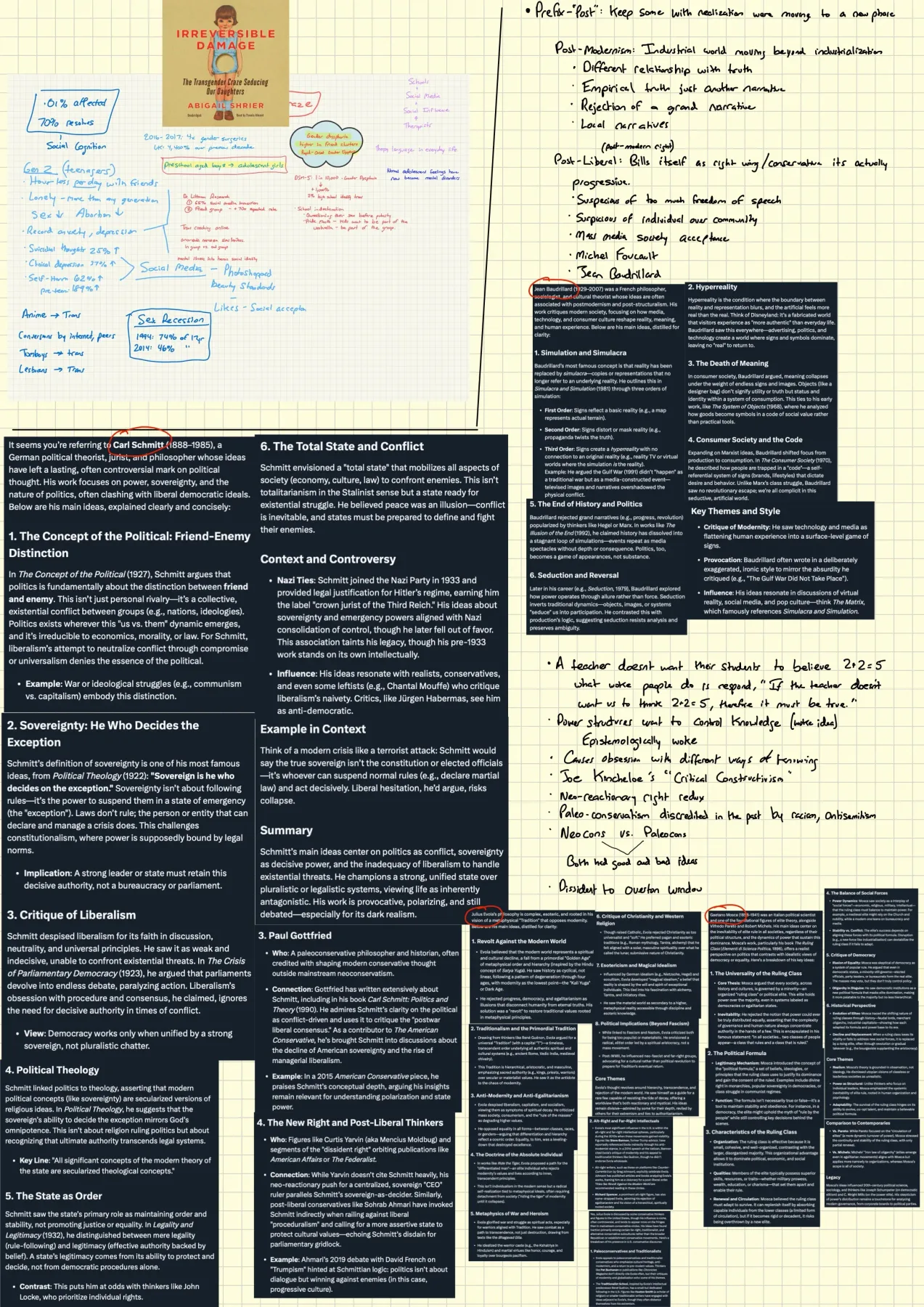
Here’s a comprehensive breakdown of Jean Baudrillard — one of the most influential postmodern theorists — organized by main ideas, important quotes, impact, and influences:
🧠 Main Ideas
1. Simulacra and Simulation
- Core Concept: In the postmodern world, reality is replaced by representations of reality—called simulacra.
- A simulation is a copy of something that no longer has an original, or never had one to begin with.
- We live in a hyperreality, where signs and images don’t refer to real things, but only to each other.
Example: Disneyland is not a “fantasy world,” but a simulation that exists to make us believe reality exists outside of it.
2. The Four Stages of the Image
Baudrillard outlined a progression of how images relate to reality:
- Reflects a basic reality (faithful copy)
- Masks and perverts a reality (distorted)
- Masks the absence of a reality (pure facade)
- Bears no relation to any reality — pure simulacrum
“It is no longer a question of imitation, nor of duplication, nor even of parody. It is a question of substituting signs of the real for the real itself.”
3. Hyperreality
- Our experience of the world is now mediated entirely by simulations—media, consumer culture, digital spaces.
- In hyperreality, we can no longer distinguish between reality and representation.
- Truth becomes irrelevant because everything is performative and referential, not real.
4. The Death of the Real
- Postmodern society is marked by the disappearance of meaning.
- Events like war, terrorism, and politics are consumed as media spectacles, detached from their real human costs.
E.g., The Gulf War didn’t happen (as we experienced it)—it was a TV war, a simulated event.
5. The Precession of Simulacra
- The order of reality has flipped:
Representation precedes and determines the real, rather than the other way around. - Social media, advertising, and political narratives function as reality generators.
6. Critique of Marxism and Production
- Baudrillard broke with Marxism by rejecting the idea that production (labor, capital) is the central category of modern life.
- Instead, he argued we live in a sign economy, where consumption and symbolism define identity and power.
🗣️ Important Quotes
“We live in a world where there is more and more information, and less and less meaning.”
“The Gulf War did not take place.”
“Disneyland is presented as imaginary in order to make us believe that the rest is real.”
“The simulation is no longer that of a territory, a referential being, or a substance. It is the generation by models of a real without origin or reality: a hyperreal.”
“When the real is no longer what it used to be, nostalgia assumes its full meaning.”
🌍 Impact
1. Postmodernism and Critical Theory
- Baudrillard is a key figure in postmodern thought, often grouped with thinkers like Foucault, Lyotard, and Derrida.
- He influenced debates in media theory, cultural studies, philosophy, sociology, and art theory.
2. Media and Culture Studies
-
His concepts of simulation and hyperreality are central to analyzing:
- Reality TV
- Social media
- News cycles
- Digital identity
- Celebrity culture
3. Philosophy of Technology and Virtuality
- Anticipated how virtual environments, AI, and digital media would reshape reality perception.
- Precursor to discussions of metaverse and deepfakes.
4. Pop Culture
- Inspired the creators of The Matrix (1999); Simulacra and Simulation appears in the film.
- Referenced in design, architecture, literature, and art.
5. Criticism
- Some see Baudrillard as overly abstract or nihilistic.
- Accused of being more poetic than analytical, and of reveling in the meaninglessness he describes.
🧬 Influences
Influenced By:
- Marshall McLuhan – media theory and effects of communication technologies
- Karl Marx – though later rejected Marxist materialism
- Roland Barthes – semiotics, mythologies of consumer culture
- Friedrich Nietzsche – perspectivism, will to power, critique of truth
- Georges Bataille – excess, transgression, non-rational drives
He Influenced:
- Media theorists: Douglas Kellner, Mark Poster
- Cultural critics: Slavoj Žižek (critical engagement), David Foster Wallace (fictional themes)
- Artists and filmmakers: The Wachowskis, Jean-Luc Godard, contemporary digital artists
- Post-truth political discourse: His ideas are widely cited in analyses of fake news, spin, and politics as spectacle
📚 Key Works
- Simulacra and Simulation (1981) — foundational text on simulation and hyperreality.
- The System of Objects (1968) — critique of consumer culture and symbolic consumption.
- The Consumer Society (1970) — cultural critique of late capitalism.
- Fatal Strategies (1983) — deals with the excess and seduction in postmodern systems.
- The Gulf War Did Not Take Place (1991) — polemic on media war as simulation.
🏷️ Suggested Note Category
Category: Postmodern Theory / Simulation and Media Critique
Would you like a markdown-formatted note version of this for your note-taking system like Obsidian or Notion?