DESCRIPTION
Peter Adamson presents an engaging and wide-ranging introduction to the thinkers and movements of two great intellectual cultures: Byzantium and the Italian Renaissance. First he tells the story of philosophy in the Eastern Christian world, from such early figures as John of Damascus in the eighth century to the late Byzantine scholars of the fifteenth century. Then he explores the rebirth of philosophy in Italy in the fifteenth and sixteenth centuries, the era ofMachiavelli, Giordano Bruno, and Galileo. This is the sixth volume in Adamson’s History of Philosophy Without Any Gaps, taking us to the threshold of the early modern era.
Timeline and Maps (file not included in this release)
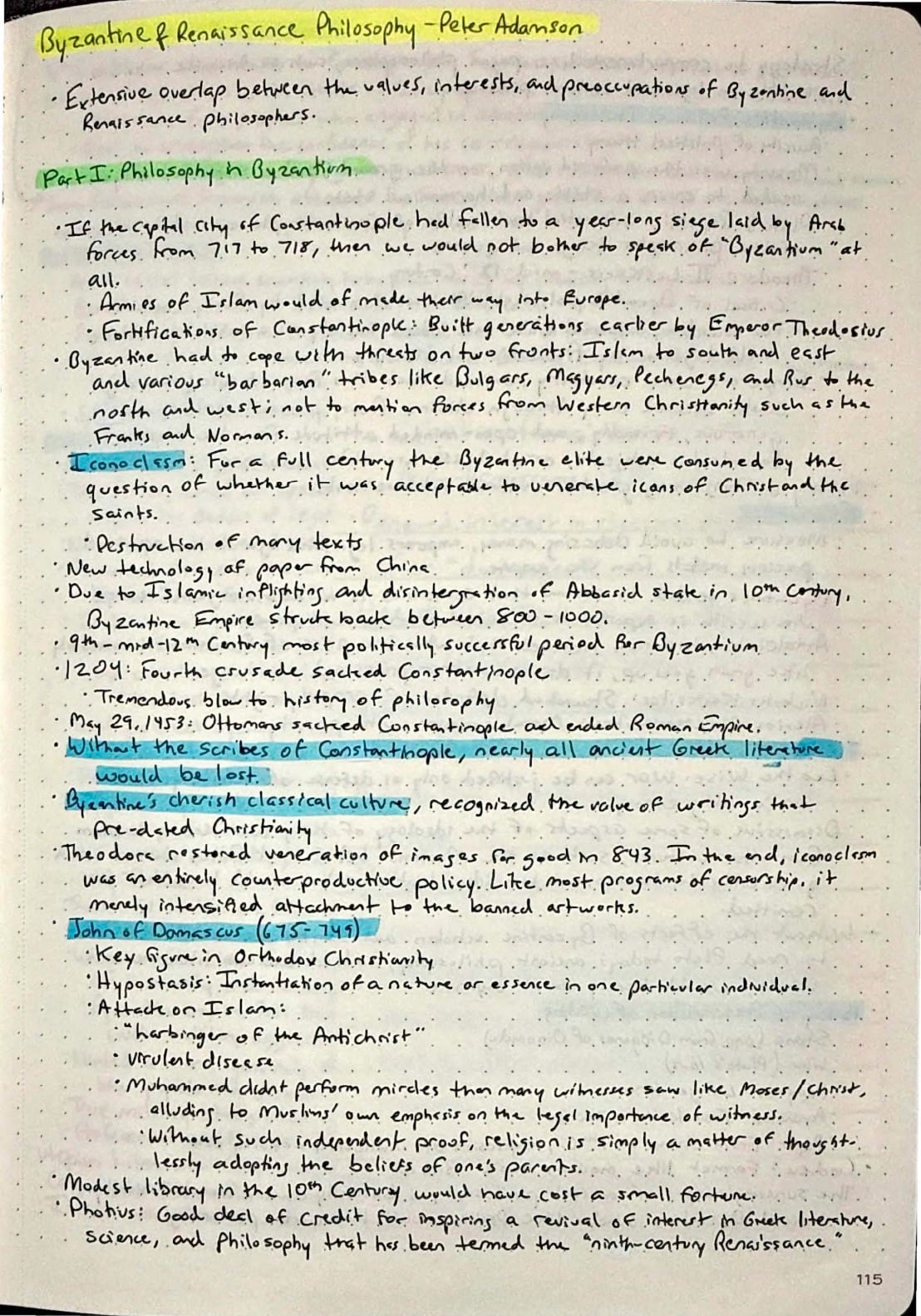
PART I: PHILOSOPHY IN BYZANTIUM
1: THE EMPIRE STRIKES BACK: INTRODUCTION TO BYZANTINE PHILOSOPHY
Here are the main ideas of this section from Byzantine and Renaissance Philosophy:
- The Byzantine Empire was historically fragile, and its survival was far from guaranteed. Its defense of Constantinople, especially against the Arab siege of 717–718, helped prevent Islamic expansion deeper into Europe and preserved the Eastern Roman world.
- Early Byzantium went through severe military, political, and cultural crises. Major territorial losses to Islamic armies, pressure from other enemies, plague, and internal instability created a “dark age” in which philosophical writing became sparse and many intellectual centers were lost.
- Iconoclasm was one of the central internal disputes of early Byzantium. The fight over whether images of Christ and the saints could be venerated was not only theological but also philosophical, and it contributed to the destruction of many texts, which helps explain why so little survives from this period.
- From the ninth to the mid-twelfth century, Byzantium experienced a major recovery. Improvements in book production, the adoption of more efficient script and paper, and a period of political and military strength helped create better conditions for scholarship and the preservation and spread of philosophical works.
- The Fourth Crusade’s sack of Constantinople in 1204 was a cultural and philosophical catastrophe. It caused enormous destruction, loss of artworks, and especially loss of texts, doing more damage to the philosophical record than even the final Ottoman conquest in 1453.
- Byzantium should be understood as the continuation of the Roman Empire in Greek form. Its inhabitants still saw themselves as Romans, its Christianity continued directly from late antiquity, and its philosophical tradition is best viewed as an extension of the late ancient Roman-Christian intellectual world.
- One of Byzantium’s greatest contributions was preserving ancient Greek philosophy. Without Byzantine scribes, much of Plato, Aristotle, and ancient Greek literature would have been lost. The survival of these texts is one of the main reasons Byzantium matters to the history of philosophy.
- But Byzantine thinkers did more than preserve texts; they also interpreted and developed philosophical ideas. Like thinkers in the Islamic world and Latin Christendom, they wrote commentaries on Aristotle, debated Plato versus Aristotle, and engaged seriously with pagan thinkers such as Proclus.
- Byzantine intellectual life was deeply shaped by both classical culture and Christian theology. Educated Byzantines continued to study Homer, rhetoric, logic, mathematics, and classical authors, while also producing philosophical theology on issues such as God, human knowledge of God, and the Trinity.
- A major issue raised in the chapter is whether Byzantine thought really counts as “philosophy.” Some modern scholars argue that because Byzantine thinkers were too constrained by religious doctrine, they were not genuinely philosophical. Adamson pushes back against this narrow definition, arguing that philosophy should include any serious engagement with enduring questions about knowledge, being, ethics, and human nature, even when these arise in theological contexts.
- The chapter argues for a broader and more inclusive understanding of Byzantine philosophy. Rather than excluding thinkers because they were religious, Adamson suggests historians should pay attention to what is philosophically interesting in their work, whether it appears in commentaries on Aristotle or in theological debates.
- Finally, the author expands the scope of “Byzantine philosophy” beyond Greek thinkers in Constantinople. He notes that important philosophical work was also done in Syriac, Armenian, and Georgian contexts, so the story is really one of philosophy across Eastern medieval Christianity more broadly.
A one-paragraph version:
This introduction argues that Byzantine philosophy matters both because Byzantium preserved ancient Greek thought and because it developed its own rich intellectual tradition. Despite military crises, iconoclasm, and devastating cultural losses such as the sack of Constantinople in 1204, the Byzantine world remained the Greek-speaking continuation of the Roman Empire and became a crucial center for transmitting Plato, Aristotle, and other classical authors. Byzantine thinkers did not merely copy old texts; they commented on them, debated pagan philosophy, and applied philosophical reasoning to Christian theology. The chapter’s main interpretive claim is that Byzantine thought should still count as philosophy even though it was often shaped by religious commitments, because it engaged real philosophical questions about God, knowledge, being, and ethics.
2: ON THE EASTERN FRONT PHILOSOPHY IN SYRIAC AND ARMENIAN
- The transmission of Greek philosophy in the premodern world was far broader than most people realize. To follow Aristotle’s commentary tradition fully, one would need not only Greek, Latin, Arabic, and Hebrew, but also Syriac and Armenian, because important translations and commentaries were produced in those languages too.
- Greek philosophy did not pass in a simple line from Greece to the Islamic world and then to Latin Europe. It spread across a much wider geography, reaching Eastern Christian cultures in Syria, Armenia, Georgia, Ethiopia, and beyond. This chapter focuses on Syriac- and Armenian-speaking Christians as an underappreciated part of that larger story.
- Syriac and Armenian philosophical cultures emerged within distinct Christian communities that were often outside Chalcedonian orthodoxy. Many of the scholars involved were monks or clerics from churches like the Church of the East or Monophysite traditions, so philosophy developed in close connection with theological and ecclesiastical life.
- Syriac became an important literary and scholarly language in late antiquity. At first it was used heavily for religious translation, but later scholars developed a very precise style for rendering Greek philosophical works, especially Aristotle, into Syriac. This happened even during a period when Greek Christian literature itself was often described as being in decline.
- Early Syriac thinkers already showed deep engagement with Greek philosophy. Bardaiṣān drew on Platonism and connected Plato’s Timaeus to the biblical creation story. Later, Sergius of Reshʿaynā studied in Alexandria and tried to transmit Aristotelian logic and cosmology into Syriac, in a role somewhat parallel to Boethius in the Latin West.
- A major center of Syriac Aristotelianism was the monastery of Qenneshre. Scholars there, including Severus Sebōkht, Athanasius of Balad, Jacob of Edessa, and George of the Arabs, translated and commented on Aristotle’s logical works. Their activity helped prepare the way for later Arabic translation movements under the Abbasids.
- Syriac mattered historically not only for its own philosophical tradition but also because it served as a bridge into Arabic. Greek texts were often translated first into Syriac and then from Syriac into Arabic, which made sense because Syriac already had a long-established scholarly vocabulary for Greek science and philosophy.
- Not every Syriac Christian welcomed Greek philosophy. Some religious figures attacked pagan thought, but overall Greek learning remained prestigious, both as a marker of education and as a useful tool for theology. Even some churchmen thought Syriac lacked the precision of Greek for expressing subtle theological ideas.
- Armenia shows a similar pattern. Armenian writing and translation culture arose in late antiquity largely for Christian missionary and educational purposes. Over time, Armenian scholars translated grammar, logic, commentaries, and theological texts, often in very literal ways that closely mirrored the Greek originals.
- The standout Armenian philosopher is David the Invincible. He studied in Alexandria, wrote important commentaries on Aristotle’s logic, and may also have translated Platonic works. His logical writings were highly respected, and modern scholars still consider some of them among the best ancient commentaries on Porphyry.
- Syriac and Armenian commentaries are especially important for textual history. Because these translations are often earlier than the surviving Greek manuscripts, they help scholars reconstruct lost or corrupted Greek originals. In some cases, works lost in Greek survive only in Syriac.
- Philosophically, these traditions were not usually highly original in the modern sense, but they preserved and transmitted major late antique debates. For example, they continued discussions about whether logic is part of philosophy or merely its instrument, and they carried forward different ways of understanding demonstration, necessity, and the relationship between logic and metaphysics.
- Logic was the main focus because it was treated as the foundation of philosophical education, especially in the Alexandrian tradition. But these scholars also worked on cosmology, medicine, astronomy, mathematics, and history, so their intellectual world was broader than logic alone.
- Still, theology remained the dominant framework. Philosophy was often valued because it helped with theology, and in both Syriac and Armenian contexts philosophy could be defined in a theologically shaped way, especially through the Platonic idea that philosophy is becoming “like God” as far as humans can.
- George of the Arabs is presented as a strong example of this fusion of philosophy and theology. He combines Platonic and Christian imagery, describing the intellect as the eye of the soul, truth as light, and virtue as polishing the mirror of the mind so that the soul can approach God. His view is that philosophy is good in itself, and the fault lies not with philosophy but with those who misuse it.
One-paragraph version:
The chapter argues that Syriac and Armenian Christianity formed a crucial but often overlooked part of the history of philosophy. These traditions translated, preserved, and commented on Greek philosophy, especially Aristotle’s logic, while also helping transmit Greek thought into Arabic. Their scholars were usually clerics working within theological settings, so philosophy and theology were deeply intertwined. Even if their writings were often educational rather than radically original, they were historically and philosophically important because they preserved ancient debates, shaped later intellectual traditions, and sometimes preserve Greek works that would otherwise be lost.
3. DON’T PICTURE THIS ICONOCLASM
Here are the main ideas of this section on iconoclasm:
- The chapter uses the controversy over icons to explore a deeper philosophical question: how an image relates to the thing it represents, or in Byzantine terms, how an image relates to its archetype.
- The iconoclasts argued that religious images should not be venerated because a painted image does not truly contain the person it depicts. If Christ or a saint is not genuinely present in the image, then honoring the image risks becoming idolatry.
- The iconophiles argued that an image does not need to contain the full essence of its archetype in order to represent it meaningfully. A likeness can still direct the mind and emotions toward the person depicted, making a certain kind of veneration appropriate.
- Historically, official Byzantine iconoclasm took shape in the eighth century, especially under Constantine V, though earlier Christian anxieties about images already existed. The controversy led to alternating periods of banning and restoring icons, until icon veneration was permanently restored in 843.
- The chapter stresses that iconoclasm was not mainly a mass movement of total image destruction, as people often imagine. It was more a political, theological, and elite intellectual dispute, centered especially in Constantinople.
- One major iconoclast claim was that true representation would require the essence of the archetype to be present in the image. On this view, only something like the eucharist, where Christ is really present, could count as a genuine image of Christ. A painting, by contrast, is just inert matter.
- The iconophiles rejected this essentialist standard. They argued that images represent not by sharing the same essence as the archetype, but through likeness, participation, activity, or a meaningful relationship to the original.
- A particularly important iconophile idea is that image and archetype can share the same name while remaining different in nature. Drawing on Aristotle’s discussion of homonyms, they argued that a person and his painted likeness can both be called by the same name without being the same kind of thing.
- The chapter distinguishes images from mere symbols like the cross. A symbol may remind someone of Christ, but an image more directly presents a specific person, which is why iconophiles thought icons had a stronger representational power.
- Another debate was whether words alone would be enough. Some iconoclasts preferred verbal descriptions of Christ and the saints. But iconophiles argued that visual representation does something words cannot do as easily: it brings the mind more immediately to the depicted figure, whereas words require more interpretation and can lead to more disagreement.
- The most serious issue involved Christology. Iconoclasts argued that painting Christ creates heresy: either it shows only his human nature and wrongly separates it from his divinity, or it confuses the two natures by implying that the divine can be painted.
- The iconophiles responded that the Incarnation is exactly what makes an image of Christ possible. Because Christ truly took on human flesh and retained it, he can be depicted in his incarnate form. In their view, iconoclasm showed too much contempt for the material world and failed to appreciate that matter had been redeemed through Christ.
- More broadly, the chapter shows how this theological controversy became a sophisticated discussion in aesthetics, metaphysics, and language. Questions about likeness, names, universals, participation, and representation all appear in the debate.
- Adamson’s overall judgment is that the iconophiles had the stronger philosophical case. It seems wrong to say that an image must share the full essence of what it depicts, and more plausible to think representation works through likeness or partial identity. At the same time, he leaves open whether full veneration of an image is always justified, noting that popular religious practice sometimes treated icons as more than mere representations.
One-paragraph version:
This chapter argues that the Byzantine iconoclasm controversy was not only a religious dispute but also a major philosophical debate about representation. Iconoclasts claimed that painted images of Christ or the saints were illegitimate because they did not truly contain the essence of what they depicted and therefore encouraged idolatry. Iconophiles replied that images do not need to share essence in order to represent something; likeness, participation, and shared naming are enough to ground a real relationship between image and archetype. The debate became especially intense over Christ, since his depiction raised questions about the Incarnation and the relation between his human and divine natures. Adamson presents the iconophiles as offering the more convincing theory of representation, while also noting that actual religious devotion to icons sometimes went beyond the careful philosophical distinctions their defenders tried to make.
4. BEHIND ENEMY LINES JOHN OF DAMASCUS
Here are the main ideas of this section on John of Damascus:
- John of Damascus was one of the key architects of what became Eastern Orthodox theology. His importance came less from originality than from the way he gathered, systematized, and defended positions that later came to be seen as orthodox, especially against heresies, Islam, and iconoclasm.
- Although he became a major authority in Byzantine Christianity, John actually lived outside the Byzantine Empire, under Umayyad Islamic rule in Damascus and later Palestine. This made him intellectually important because he worked in a religiously plural environment where Christians, Muslims, Jews, and rival Christian sects debated one another directly.
- A central concern of John’s work was defending the Chalcedonian view of Christ against rivals like the Monophysites, Nestorians, and Monothelites. He insists that Christ has two natures, divine and human, united in one hypostasis or concrete individual existence.
- John’s theology depends heavily on philosophical concepts borrowed from Greek thought. His major work, the Fountain of Knowledge, begins with the Philosophical Chapters, which functions like a philosophical textbook explaining logic and key metaphysical terms before moving into theology and heresiology.
- This shows one of the chapter’s main claims: for John, philosophy and theology are inseparable. He assumes that human reason, given by God, can discover genuine truths, and these truths must harmonize with Christian doctrine. Philosophy therefore serves as preparation for theology and as a tool for defending it.
- John defines nature (physis) as the same as essence or being (ousia). A nature is what makes a thing the kind of thing it is, and as such it can be understood universally. A hypostasis is that nature instantiated in an individual. This distinction lets him explain both the Trinity and the Incarnation.
- In the Trinity, there is one divine nature instantiated in three hypostases or persons. In Christ, there is one hypostasis that possesses two natures. The chapter stresses that this is philosophically difficult, but John argues it is possible because the two natures do not fuse into one and do not cancel each other out.
- To make this intelligible, John uses analogies. One is the ordinary human being, who unites body and soul without collapsing them into one thing. Another is a burning sword, where iron and fire coexist while preserving their distinct properties: the iron cuts, the fire burns. This helps him explain how distinct natures can remain present together in one subject.
- John also argues against Monothelitism, the claim that Christ had only one will. Since will belongs to nature, and Christ has two natures, John says Christ must have two wills, one human and one divine. Yet these wills do not conflict, because Christ’s human will is perfectly aligned with divine knowledge and goodness.
- This leads to a philosophical anthropology: in ordinary humans, willing belongs to the rational soul, not the body. Human will is tied to rational deliberation and self-control, which distinguishes humans from non-rational animals. Christ shares human willing, but unlike ordinary humans, he does not need deliberation because of divine omniscience.
- The chapter also treats John’s critique of Islam. His anti-Islamic arguments are less philosophically sophisticated than his intra-Christian theology, but they still raise an important issue: how to choose between competing religions. John and later Theodore Abū Qurra argue that public miracles and independent witnesses support Christianity in a way they believed Islam could not match.
- Another major theme is John’s defense of icons. Though living under Islamic rule, he also stood against Byzantine iconoclasm. He argued that the Incarnation changes the meaning of images: because God became visible in Christ, material images can legitimately reveal spiritual realities. Reverence toward icons is therefore appropriate, even though worship belongs to God alone.
- More broadly, John sees the created world itself as capable of imaging divine truth. The chapter’s example of the rose, flower, and fragrance as an image of the Trinity shows that for him physical things can disclose spiritual realities. Icons are thus part of a wider sacramental view of the world.
- A final important point is that John’s influence did not come from inventing new doctrines but from compiling and organizing authoritative traditions. Much of his work is made up of borrowed definitions, quotations, and earlier teachings woven together into powerful syntheses. This chapter suggests that compilation itself became a major feature of Byzantine intellectual culture.
One-paragraph version:
This section argues that John of Damascus is a pivotal figure because he fused Greek philosophy and Christian theology into a systematic defense of Orthodoxy. Living under Islamic rule, he wrote in a world of intense interreligious and intra-Christian debate, and he used philosophical ideas such as nature, essence, hypostasis, and will to defend Chalcedonian Christology, the Trinity, and the veneration of icons. For John, philosophy is not separate from theology but a rational preparation for it, since truth discovered by reason must harmonize with truth revealed by God. Even though his anti-Islamic writings are less subtle, they still show his concern with how rival religions justify themselves. His lasting importance lies less in originality than in his ability to gather earlier authorities into a comprehensive theological-philosophical synthesis that shaped Eastern Orthodoxy for centuries.
5. COLLECTORS’ ITEMS PHOTIUS AND BYZANTINE COMPILATIONS
Here are the main ideas of this section on Photius and Byzantine compilations:
- The chapter argues that compilations, summaries, and collections were far more important to the survival of philosophy than they usually get credit for. Even if these works were not highly original, they preserved texts, ideas, and historical information that might otherwise have disappeared.
- Byzantine intellectual culture often valued collecting, excerpting, and organizing knowledge rather than always producing brand-new philosophical systems. This was already true with John of Damascus, and the chapter shows that compilation itself became a major scholarly activity in Byzantium.
- Early Byzantine logical handbooks were mostly pedagogical tools. They summarized Aristotelian logic for students and helped keep logic alive through periods when original philosophical production was thin. Their importance lies less in originality than in showing the continued prestige of logic in Byzantine education.
- Byzantine thinkers found logic especially acceptable because it seemed religiously neutral. Unlike explicitly pagan metaphysics or theology, logic could be treated as a practical instrument or tool that Christians could use without compromising doctrine.
- The chapter highlights the importance of scholia, or marginal notes written in manuscripts. These notes explained difficult vocabulary, grammar, and literary references, but they also sometimes preserved fragments of otherwise lost philosophical commentary and biographical information about authors.
- A major example of Byzantine compilation is the Suda, a huge tenth-century encyclopedia made by drawing together material from many earlier sources. It is described as a “compilation of compilations,” and although derivative, it is immensely valuable because it preserves older knowledge and shows how Byzantine readers understood philosophy and classical culture.
- The Suda’s definition of philosophy is especially revealing. It presents philosophy as ethical correctness joined with true knowledge of being, and it divides philosophy into ethics, physics, and theology. This shows a moderate Byzantine attitude: Christian truth completes philosophy, but philosophy still includes real inquiry into nature and morals, not theology alone.
- Arethas is presented as an example of the wealthy Byzantine book collector and annotator. His library included major works like Euclid, Plato, and Aristotle, and his handwritten notes survive. His case shows both the expense of books and the seriousness with which Byzantine elites could pursue classical learning.
- At the same time, Arethas’ story shows the ambiguity of pagan philosophy in Christian Byzantium. He openly loved Aristotle, but later compared Aristotelian philosophy to the Sirens’ song, suggesting that attachment to Hellenic thought could be seen as spiritually dangerous or politically suspect.
- The central figure of the chapter is Photius, who helped drive the so-called ninth-century Renaissance in Byzantium. He was both a major churchman and a major scholar, and he played a crucial role in reviving interest in Greek literature, science, and philosophy.
- Photius’ most important scholarly work is the Bibliotheca or Library, a collection of summaries and evaluations of hundreds of texts. Many of the works he describes are now lost, so his reports are sometimes our main source of knowledge about them. That is why he is compared to the “inventor of the book review.”
- The chapter also shows that Photius was not merely a bookish scholar but an important historical actor. He became patriarch under dramatic circumstances, was repeatedly deposed and restored, and played a major role in the growing tensions between Eastern and Western Christianity.
- One example of philosophy serving theology is Photius’ attack on the filioque clause. He uses philosophical ideas about properties, simplicity, and causation to argue that the Holy Spirit proceeds only from the Father, not from both Father and Son. This illustrates how Byzantine theology often relied on logical and metaphysical reasoning.
- The Bibliotheca reflects a broad intellectual world. It includes history, literature, theology, medicine, and philosophy, with about half its contents being secular. This suggests that Byzantine learned culture was not narrowly theological, even when its leading scholars were churchmen.
- Photius had particular interest in topics like scientific method and free will. He valued Galen not just as a doctor but as a thinker on method, and he preserved an important summary of Hierocles’ lost work on providence, fate, and human freedom.
- In recounting Hierocles, Photius shows a distinctive scholarly attitude: he can report pagan philosophical ideas in detail even when they conflict with Christianity. He criticizes errors like reincarnation, but still preserves the theory fairly and even praises the style of the author.
- The same pattern appears in his treatment of Pythagorean and skeptical thought. Photius transmits these pagan doctrines not because he endorses them, but because he sees them as intellectually worth knowing, provided readers use caution.
- The chapter’s larger point is that Byzantine scholars like Photius were devout Christians and serious heirs of Hellenism at the same time. They often did not try to erase pagan learning; instead, they preserved, organized, and selectively used it.
- The final attitude the chapter attributes to Photius is essentially: classical philosophy and culture are useful and worth studying, but they must be approached carefully. They can sharpen dialectical skill and expand knowledge, but they can also mislead unstable minds if used without judgment.
One-paragraph version:
This section argues that Byzantine compilations were crucial to the preservation of philosophy and classical culture. Even when Byzantine scholars were not highly original, their summaries, encyclopedias, scholia, and teaching manuals kept Aristotelian logic, historical information, and pagan philosophical doctrines alive. The chapter centers on Photius, whose Bibliotheca preserved knowledge of many otherwise lost works and helped fuel the ninth-century Byzantine Renaissance. Photius represents a characteristic Byzantine balance: he was a devout Christian theologian who still valued Greek learning, reported pagan ideas with impressive fairness, and used philosophy both as a scholarly inheritance and as a tool for theological argument. The overall picture is of a culture that respected classical thought, but wanted to handle it carefully and under Christian guidance.
6. CONSUL OF THE PHILOSOPHERS MICHAEL PSELLOS
Here are the main ideas of this section on Michael Psellos:
- Michael Psellos was one of the most important figures in Byzantine philosophy because he stood at the intersection of intellectual life and political power. Unlike many philosophers who lived mainly in monasteries or schools, Psellos moved within the imperial court, served emperors, and was honored as “consul of the philosophers.”
- He was also important as a writer far beyond narrow philosophy. His Chronographia made him a major historical source for eleventh-century Byzantium, while his letters, theological works, rhetorical pieces, and philosophical writings show the breadth of Byzantine learned culture.
- Psellos continued earlier Byzantine habits of compilation and teaching, especially in logic, rhetoric, and grammar. In that sense he inherited the scholarly tradition of figures like John of Damascus and Photius, who preserved and organized knowledge rather than always building entirely new systems.
- At the same time, Psellos saw himself as reviving philosophy in a more ambitious way. He famously described himself as “a lone philosopher in an age without philosophy,” even though he in fact worked within a network of teachers, students, and elite patronage. His teaching relationships were not just academic but socially and politically significant.
- A central feature of Psellos’ thought is his deep admiration for Platonism and especially Neoplatonism. He respected Aristotle and wrote on logic, but his strongest intellectual enthusiasm was for Plotinus, Porphyry, Iamblichus, and above all Proclus, whom he ranked just below Plato.
- This creates the chapter’s main tension: how could a sincere Christian be so devoted to pagan philosophy? The answer given here is that Psellos tried to affirm both. He was genuinely Christian, but also deeply committed to classical Greek learning. Rather than rejecting pagan thought outright, he tried to use it selectively and reinterpret it where possible.
- Psellos’ method for handling pagan literature was often allegorical. He thought works like Homer could contain truths if read symbolically rather than literally. Pagan myths, gods, and stories could be re-read in a way that pointed toward Christian truths rather than away from them.
- More broadly, he believed Christians should know pagan philosophy and use it when it helps lead toward truth. He explicitly rejected abandoning Christianity for Hellenic wisdom, but he also rejected throwing pagan thought away entirely. This reveals a characteristic Byzantine balance: appropriation without surrender.
- His commentary on the Chaldean Oracles is a strong example of that balance. He openly acknowledged their pagan character, compared individual doctrines with Christianity, accepted some elements as compatible, and criticized others as false or ridiculous.
- Psellos was therefore neither a hidden pagan nor a simple orthodox censor. He could criticize pagan doctrines such as the world soul, astrology, and magical practices, while also stressing places where Plato or other Greek thinkers seemed close to Christian theology.
- One of his favorite examples of overlap between Greek philosophy and Christianity is the Aristotelian phrase “intellect from outside.” Psellos treated this as an anticipation of the Christian idea that divine knowledge, especially through the Holy Spirit, can come to the human mind from beyond ordinary bodily processes.
- Psellos also developed a distinctive religious outlook. He accepted that God is ultimately beyond full human comprehension, and he valued divine illumination, but he was skeptical of extreme displays of monastic holiness and harsh asceticism. He distrusted religious hypocrisy and thought external performance of piety could be empty.
- Ethically, he preferred moderation over extremes. Instead of the stricter ideal of apatheia—complete freedom from bodily passion—Psellos favored metriopatheia, the moderation of the passions. He accepted that human beings are embodied creatures and did not think sanctity required total rejection of bodily life.
- This moderate ethics connects to his political philosophy. Psellos treats political virtue as a middle condition: better than a life devoted to pleasure, but short of a purely contemplative and fully divine life. This makes him more realistic than thinkers who demand perfection either from rulers or from ordinary people.
- His realism shows in his judgments of both monks and emperors. He could admire virtue without demanding impossible purity, and he extended the same tolerant standard to political rulers, recognizing that effective rule and exemplary holiness rarely fully coincide.
- Overall, the chapter presents Psellos as a thinker of balance: between philosophy and theology, pagan learning and Christian faith, contemplation and public life, body and soul, high ideals and practical human limitation. That balanced stance is what makes him such a distinctive Byzantine philosopher.
One-paragraph version:
This section presents Michael Psellos as one of the greatest Byzantine intellectuals because he combined courtly influence, historical writing, philosophical scholarship, and Christian theology. Deeply attracted to Plato and the Neoplatonists, especially Proclus, he also remained a sincere Christian and tried to reconcile these commitments by reading pagan thought selectively, allegorically, and critically. He believed classical philosophy could help Christians approach truth without replacing revelation. In religion and ethics he rejected extremes, preferring moderation over harsh asceticism and realistic political virtue over impossible ideals. The result is a portrait of Psellos as a mediator between Hellenism and Christianity, philosophy and theology, and contemplation and worldly life.
7. HOOKED ON CLASSICS ITALOS AND THE DEBATE OVER PAGAN LEARNING
Here are the main ideas of this section on John Italos and the debate over pagan learning:
- The chapter’s central question is why Byzantine Christians continued to study pagan philosophers at all, given that they believed those philosophers were wrong about the most important truths, especially God, salvation, and revelation. The answer is that Byzantine thinkers often treated pagan philosophy as useful in limited ways while insisting that Christian truth remained superior.
- One common strategy was compartmentalization: pagan thinkers like Aristotle could be trusted in areas such as logic or natural philosophy, even if they were mistaken in theology. This let Byzantines preserve and study Greek philosophy without accepting it wholesale.
- Another strategy was to argue that pagan philosophers achieved as much truth as unaided human reason could reach. Since they lacked revelation, their ignorance of specifically Christian doctrines was not always treated as blameworthy. Some Byzantines, like Psellos, even suggested that Plato dimly anticipated truths later revealed in Christianity.
- Byzantine openness to pagan literature was also driven by cultural and educational values. Classical Greek authors were admired for stylistic excellence, and major church fathers such as Basil and the Cappadocians explicitly encouraged selective use of pagan writings. The famous image is that Christians should read pagan texts like bees gathering nectar: taking what is useful and leaving the rest.
- At the same time, the church fathers were deeply cautious. They warned that pagan philosophy, especially when applied carelessly to theology, could mislead Christians. So the Byzantine approach to pagan thought was always a balancing act: use it where helpful, reject it where it conflicted with doctrine.
- The chapter presents John Italos as the most famous case where that balance became politically dangerous. In 1082 he was put on trial and forced to denounce certain teachings attributed to him, and the charges against him were added to the Synodikon as a warning against excessive attachment to “Hellenic” philosophy.
- The accusations against Italos included accepting Platonic Forms as real, granting matter independent status, and questioning God’s power to create from nothing. But the chapter suggests these charges were inconsistent, exaggerated, and likely driven more by politics than by the actual content of his thought.
- The trial seems to have been at least partly a show trial. Italos was politically exposed because he was prominent, connected to elite intellectual circles, foreign-born, and associated with the civil aristocracy at a time when Emperor Alexios Komnenos had reasons to humble that class. The chapter suggests that his condemnation reflected political timing as much as philosophical danger.
- Psellos’ description of Italos is revealing: Italos was not admired for elegant style, but for sharp, forceful reasoning and logical skill. Even critics like Anna Komnene, who disliked him personally, admitted that he excelled in logic.
- When the chapter turns to Italos’ surviving writings, it finds that he was far less radical than his reputation suggests. Some of his work is derivative, and much of it shows a careful, scholarly engagement with pagan philosophy rather than blind devotion to it.
- A major example is his treatment of universals. Italos adopts the late ancient scheme of universals “before the many,” “in the many,” and “after the many.” These correspond to divine paradigms in God’s mind, instantiated realities in particular things, and abstract concepts formed in human thought. This shows his familiarity with Neoplatonic metaphysics, but not an uncritical acceptance of pagan doctrine.
- His comments on Homer show the same pattern. He reads classical literature allegorically and philosophically, preferring elevated metaphysical readings over more mundane ones. This places him within the same tradition as Psellos, where pagan literature could be mined for philosophical meaning.
- Yet Italos also clearly rejects major pagan doctrines. He denies the Platonic World Soul, criticizes conflicting pagan theories of nature and matter, and insists that Christian belief must correct pagan philosophy where necessary.
- His discussion of matter is especially important. He rejects the Neoplatonic idea, influential through Augustine, that matter is identical with or the source of evil. Since matter is part of God’s creation, it cannot be evil in itself. At the same time, he is also dissatisfied with Proclus’ theory of matter, so his stance is critical rather than simply pro-pagan.
- Italos also rejects the pagan doctrine of the eternity of the world. He argues that an everlasting world would undermine Christian teaching about bodily resurrection, since matter would always already be occupied. This reinforces the point that he was not willing to let pagan metaphysics override Christian doctrine.
- More broadly, the chapter argues that Italos was not condemned because he was a reckless paganizer. Rather, he was a visible professional philosopher whose devotion to teaching and interpreting the Greek philosophical tradition made him vulnerable in a politically charged moment.
- The final takeaway is that the controversy around Italos reveals the persistent Byzantine tension over pagan learning: Greek philosophy was treasured as part of the cultural and intellectual inheritance of Byzantium, but it could never be embraced without limits. The question was never simply whether to use pagan thought, but how far one could go before crossing into theological or political danger.
One-paragraph version:
This section argues that John Italos became the symbol of a larger Byzantine struggle over how Christians should use pagan philosophy. Byzantine thinkers generally justified reading Plato and Aristotle by limiting their authority, using them where reason could help while subordinating them to revelation and church teaching. Italos was tried and condemned in 1082 for allegedly going too far in his attachment to Hellenic thought, but Adamson suggests the charges were politically motivated and exaggerated. Italos’ surviving writings show not a radical paganizer, but a careful thinker who borrowed from late ancient philosophy while rejecting major pagan doctrines like the eternity of the world, the World Soul, and the idea that matter is evil. The chapter’s broader point is that Byzantine intellectual life depended on pagan learning, but always under tension, because admiration for Greek philosophy could quickly become suspect if political conditions changed.
8 PURPLE PROSE BYZANTINE POLITICAL PHILOSOPHY
Here are the main ideas of this section on Byzantine political philosophy:
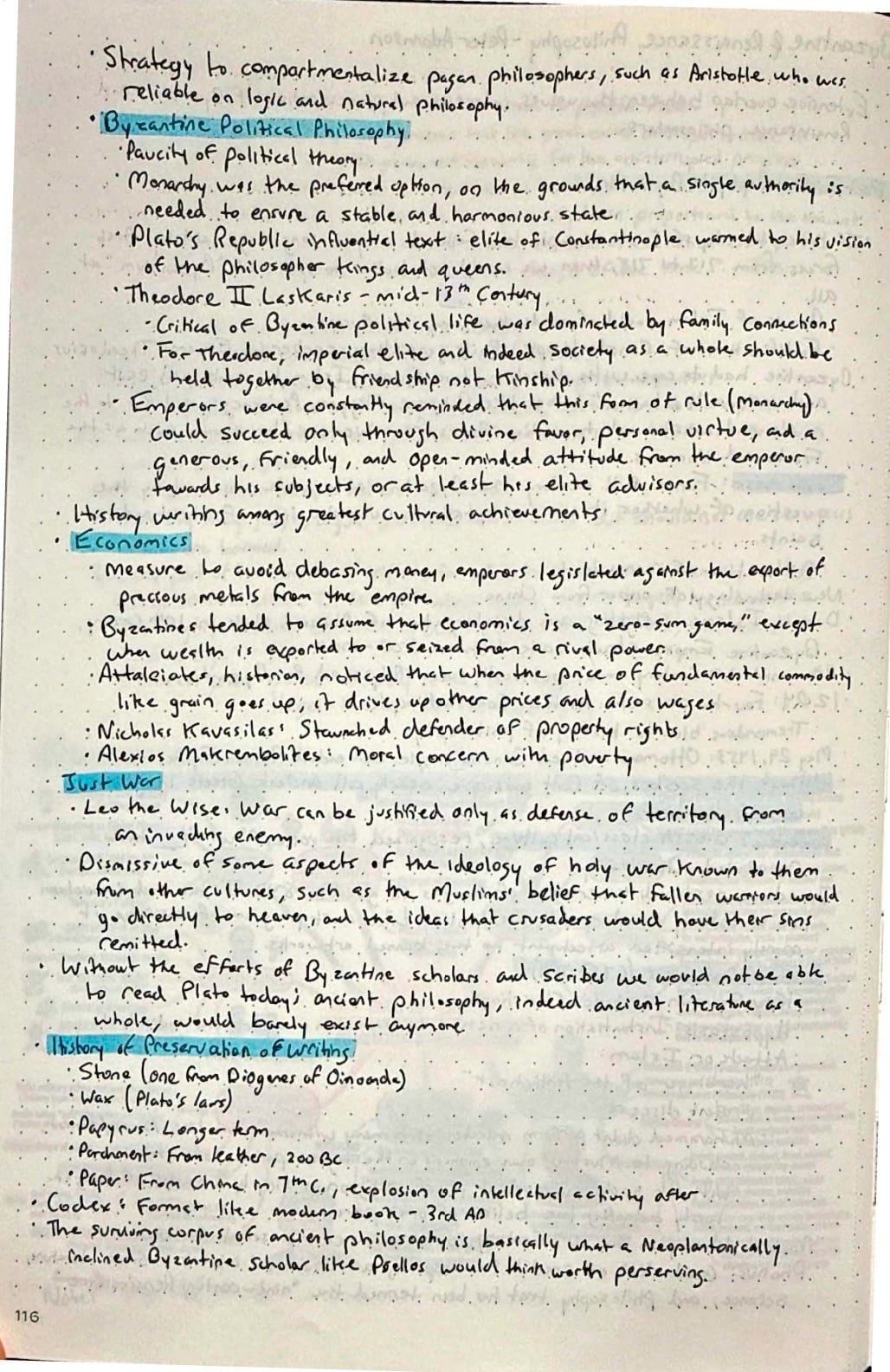
- Byzantine political thought overwhelmingly favored monarchy. Even though educated Byzantines knew the classical alternatives of monarchy, aristocracy, and democracy, they generally treated rule by a single emperor as the proper and stable form of government.
- This preference was deeply shaped by Plato’s ideal of the philosopher king. Byzantine writers admired the image of a wise and virtuous ruler who governs for justice and harmony, and they adapted that classical ideal into a Christian imperial setting.
- Byzantine political writing often took the form of “mirrors for princes”—works advising emperors on how to rule well. Authors like Agapetus and the anonymous writer of On Political Science combined classical political ideas with Christian teaching, presenting the emperor as both ruler and morally elevated guardian of the people.
- The emperor was often portrayed as a kind of earthly image of divine order. Writers compared him to Zeus or to the sun, and described authority as flowing downward from him through society the way divine providence orders the cosmos. This gave Byzantine monarchy a strongly metaphysical and religious character.
- The ideal emperor was expected to possess the cardinal virtues—courage, temperance, wisdom, and above all justice. Another especially prized imperial quality was philanthropia, meaning love of humankind, which included generosity, mercy, and restraint in punishment, not just charitable giving.
- Byzantine political thought was not purely idealistic. Some authors, especially Michael Psellos, recognized that rulers sometimes need to act harshly, use anger appropriately, or do morally troubling things in their public role that would be questionable in private life.
- This led to a distinction between the emperor as a private Christian and as a public officeholder. In that framework, an emperor could carry out actions like lawful punishment or execution as part of governing, without that automatically counting as personal moral guilt in the same way.
- Praise of emperors was not just flattery. Political writers used praise strategically to shape imperial behavior, encouraging rulers toward mercy, justice, generosity, and lighter taxation while also warning, indirectly, against bad rule.
- A major contrast in Byzantine political thought is between the good king and the tyrant. The true ruler governs for the good of the subjects, like a shepherd caring for a flock, whereas the tyrant rules for himself, by force, or without regard for law and common welfare.
- Even in an autocratic system, popular consent still mattered ideologically. Usurpers and emperors alike often sought public acclamation, and some writers suggested that legitimacy required at least the appearance of being accepted by the people.
- Byzantine thinkers were divided on the emperor’s relation to law. On one hand, the emperor could be described as a “living law” who had authority to make laws. On the other hand, some insisted that emperors themselves should obey the law and govern within legal limits.
- They also distinguished between positive law and something like natural justice. Michael of Ephesus, following Aristotle, argued that some forms of justice are naturally valid for all people everywhere, while others are conventional and vary by society.
- The emperor’s role was inseparable from religion. Unlike the prolonged church-state conflict of medieval Western Europe, Byzantium generally aimed at cooperation between emperor and patriarch. The emperor had major influence over church affairs, doctrine, and councils, even though this influence was never absolute.
- At the same time, the chapter stresses that imperial authority had limits. Figures like John of Damascus refused to accept that the church should simply obey imperial decrees, especially in matters like iconoclasm. So Byzantine political theology never fully erased the possibility of religious resistance.
- Byzantine political thought also had to reckon with a fragmented Christian world. Western rulers, foreign kings, non-Chalcedonian Christians, and semi-autonomous local powers all challenged Constantinople’s claim to universal supremacy.
- Natural disasters, plagues, and military defeats were often interpreted as signs of divine judgment against emperors. That meant political legitimacy depended not only on force or inheritance but also on the perception that God still favored the ruler.
- After the disaster of 1204, Byzantine political writing continued but also became more inventive. Later thinkers tried to shore up imperial legitimacy in new ways as the empire weakened.
- Theodore II Laskaris argued that political order should rest more on friendship and virtue than on family ties and aristocratic blood. For him, nobility should come from character, not lineage, and the emperor should be the highest friend of the political community.
- Manuel Moschopoulos offered a proto-contract theory: political society arises from disorder through an agreement between ruler and people, but political stability ultimately depends on sacred bonds under God, not on contract alone.
- Theodore Palaiologos argued that good monarchy requires the ruler to listen to advisors. He was influenced by Italian political practice and criticized emperors who ignored counsel, suggesting a somewhat less solitary model of monarchy.
- The chapter’s overall conclusion is that Byzantine thinkers did not challenge monarchy itself very much, but they did try to moralize, restrain, and refine it. Their political philosophy focused less on choosing among constitutions and more on showing what kind of emperor could make monarchy just, stable, and acceptable.
One-paragraph version:
This chapter argues that Byzantine political philosophy accepted monarchy as the normal and best form of government, but did not therefore lack political thought. Instead of debating rival constitutions, Byzantine writers concentrated on defining the ideal emperor: a ruler modeled on the philosopher king, endowed with justice, wisdom, mercy, and love of humankind, and responsible for maintaining both civil and religious order. They also recognized real tensions around tyranny, law, public consent, punishment, and the emperor’s relation to the church. In the later Byzantine period, especially after 1204, thinkers became somewhat more creative, emphasizing friendship, virtue, sacred political bonds, and the need for rulers to take advice. The broader point is that Byzantine political theory aimed not to replace monarchy, but to discipline and elevate it through virtue, law, religion, and prudent counsel.
9 THE ELEMENTS OF STYLE RHETORIC IN BYZANTIUM
Here are the main ideas of this section on rhetoric in Byzantium:
- Rhetoric was a major pillar of Byzantine elite education. Byzantines studied ancient rhetorical manuals like those of Hermogenes and Dionysius of Halicarnassus, and educated people were expected to understand types of speeches, styles, and the formal rules behind eloquence.
- This training began very early and was rooted in classical literature. Students first learned grammar and literacy, then read major pagan Greek works such as Homer, Sophocles, Aristophanes, and Plato. These texts were treated not only as literature but as models of refined speech and rhetorical technique.
- Byzantine schooling cared intensely about style. Teachers and manuals focused on figures of speech, tropes, grammar, and verbal precision, often explaining why seeming flaws in classical texts were actually rhetorically effective choices rather than mistakes.
- Rhetoric was not seen as merely decorative. Byzantine scholars also understood rhetoric as politically and morally important, especially as a tool for civic order, public persuasion, and proper conduct in political settings. In this respect, rhetoric was distinguished from dialectic, which could apply to any topic, whereas rhetoric was tied especially to public and political life.
- The old classical tension between rhetoric and philosophy remained alive. Plato had criticized rhetoric as a mere knack for persuasion rather than a path to truth, and Byzantine readers inherited that tension. Christian thinkers, especially the Cappadocian Fathers, sometimes treated rhetoric with suspicion because it could seem worldly, manipulative, or spiritually inferior to philosophy and piety.
- Byzantine Christianity had an ambivalent attitude toward rhetoric. On one hand, rhetoric could look like vanity or pagan display; on the other hand, major Christian authors such as Gregory of Nazianzus were themselves admired as supreme masters of eloquence. So Byzantines often both distrusted and revered rhetorical brilliance.
- In the early Byzantine period, rhetoric seems to have lost some prestige as an explicit public identity. For several centuries few authors openly styled themselves “rhetoricians,” and “philosophy” seemed safer and more prestigious as a label because it could be aligned with the love of divine wisdom.
- This changed in the eleventh century, especially with Michael Psellos. Psellos and others helped revive rhetoric in what the chapter describes as something like a “Third Sophistic.” In this revival, rhetoric was not treated as the enemy of philosophy but as its partner.
- Psellos’ central view is that rhetoric and philosophy belong together. He explicitly says that philosophical content should be clothed in rhetorical beauty. For him, the highest discourse combines truth, intellect, and verbal elegance rather than choosing between them.
- Rhetoric also had practical value in court politics and social advancement. In Constantinople, persuasive and brilliant speaking could win favor, defeat rivals, and advance one’s career. Psellos’ own success at court is presented as a clear example of rhetoric’s real-world power.
- Psellos admired Christian eloquence above all, especially Gregory of Nazianzus. Gregory is presented as the supreme model because he combines seriousness and beauty, brevity and expansiveness, philosophical depth and rhetorical grace. Psellos treats Gregory almost as the Christian counterpart to the greatest pagan stylists.
- For Psellos, rhetoric is not just rule-following but creative artistry. He goes beyond textbook rhetoric and treats great speech almost like sculpture, gem-cutting, or even divine craftsmanship. Perfect eloquence cannot be reduced to formulas; it is closer to literary genius.
- Psellos is more open than Plato about the pleasures and powers of rhetoric. He is not embarrassed that eloquent language gives pleasure or that myths and compelling stories can convey truth through attractive forms. Even so, he still thinks the best rhetoric, especially in politics, should ultimately serve truth rather than falsehood.
- Aristotle’s Rhetoric was present in Byzantium but initially less central than the standard rhetorical handbooks. It seems not to have been widely studied until around the turn of the twelfth century, partly because authors like Hermogenes were thought to cover the subject sufficiently and partly because Aristotle was seen as more difficult.
- Later Byzantine Aristotelians interpreted rhetoric differently from Psellos. Commentators linked Aristotle’s Rhetoric to logic, treating it as a study of weaker or less rigorous forms of proof, in contrast to genuine philosophical demonstration. This produced a more technical and “Aristotelian” view of rhetoric, whereas Psellos represents a more “Platonic” effort to unite philosophy with literary eloquence.
One-paragraph version:
This section argues that rhetoric was central to Byzantine education, culture, and politics, even though it was often viewed with suspicion by philosophers and Christian moralists. Byzantine students were deeply trained in classical literature and rhetorical theory, and rhetoric was valued not only for style but for its political and civic function. The chapter highlights a long-standing tension between rhetoric and philosophy inherited from Plato, then shows how Michael Psellos helped revive rhetoric by presenting it as the beautiful expression of philosophical truth rather than its rival. For Psellos, the highest discourse combines wisdom and eloquence, and great rhetoric is a form of artistic genius. Later Byzantine Aristotelians approached rhetoric more technically, as a lesser form of proof connected to logic. So the chapter presents Byzantine rhetoric as a field shaped by a persistent debate: is speech mainly ornament and persuasion, or can it be joined to truth and philosophy?
10 PAST MASTERS BYZANTINE HISTORIOGRAPHY
Here are the main ideas of this section on Byzantine historiography:
- History writing was one of Byzantium’s greatest intellectual achievements. Adamson presents Byzantine historians as heirs to Herodotus and Thucydides, continuing the classical tradition of writing about political events, character, causation, and human affairs.
- Several major Byzantine intellectuals were also historians. Michael Psellos, Anna Komnene, and George Pachymeres are examples of thinkers who combined historical writing with philosophy, science, or broader scholarly activity. This suggests a strong overlap between historiography and philosophy in Byzantine culture.
- History gave Byzantine writers room for originality. Unlike commentary traditions that often depended on earlier authorities, history allowed authors to add new material about recent events and offer their own judgments. Zonaras is a good example: he compiled earlier material for most of his vast history, but wrote independently on more recent rulers.
- Some Byzantine historians were especially personal and interpretive. Psellos, Attaleiates, and Anna Komnene wrote in a more subjective, opinionated mode, drawing on personal memory, court records, and eyewitness testimony rather than merely compiling older chronicles.
- History and rhetoric were deeply connected. Byzantine historians wrote under the influence of classical rhetorical education, imitating earlier Greek models not only in style and structure but even in grammar and diction. Anna Komnene, for example, wrote in a highly classicizing way, shaping contemporary material as though ancient Athenians might read it.
- The study of history let Byzantines imaginatively inhabit the classical past. Their engagement with ancient texts was not superficial. It shaped how they wrote, how they imagined older societies, and sometimes how they judged their own political order.
- Although Byzantium favored monarchy, some historians still admired republican Rome. Authors like Psellos and especially Attaleiates treated aspects of Rome’s pre-imperial political life with respect, and Attaleiates even gave the people of Constantinople a more legitimate political role than most Byzantine writers did.
- Attaleiates is presented as unusually independent-minded. He could describe popular uprisings sympathetically, admire virtues in non-Christians like the Seljuk sultan, and even suggest that committed pagans might in practice outperform half-hearted Christians in justice and devotion.
- At the same time, Byzantine historiography remained deeply providential. Historians often saw events as part of God’s plan, interpreting victories, defeats, natural disasters, and political upheaval as expressions of divine judgment or divine guidance.
- Natural and divine explanations were often combined, not simply opposed. For example, Attaleiates mentions a natural explanation for earthquakes but still insists that a particular earthquake could also be a providential warning meant to correct human behavior.
- Byzantine historians were very interested in the tension between providence and free will. They wanted to affirm both that God governs history and that humans act freely. Theophylact and others tried to hold these together philosophically, and the chronicles often reflect the same balance.
- Anna Komnene strongly emphasizes divine aid in her father Alexios’ reign. She often credits his successes to God’s help, while still narrating events in a classicizing literary style that blends Christian providence with ancient heroic language.
- Niketas Choniates shows how historiography processed catastrophe. Writing after the sack of Constantinople in 1204, he interprets the disaster as both a sign of divine anger and the result of human political failure, especially bad imperial leadership.
- Byzantine historians could be sharply critical of emperors. Niketas condemns rulers for injustice, greed, and oppression; Zonaras criticizes Alexios I for favoring his inner circle over the wider political community. So Byzantine history was not always court propaganda.
- A recurring tension in Byzantine historiography is truth versus partisanship. Some historians were accused of writing to flatter rulers or attack enemies. John Skylitzes complains that biased accounts leave readers confused, while Anna Komnene openly wrestles with the difficulty of telling the truth about her own father.
- The chapter’s larger point is that Byzantine historiography sits at the intersection of classical imitation, political judgment, theology, and literary self-consciousness. These historians were not just chroniclers of events; they used history to think about providence, freedom, justice, empire, and the moral character of rulers.
One-paragraph version:
This section argues that Byzantine historiography was one of the empire’s richest intellectual traditions because it combined classical literary models, philosophical reflection, political judgment, and Christian theology. Historians like Psellos, Attaleiates, Anna Komnene, Zonaras, and Niketas Choniates did more than record events: they interpreted recent history through personal observation, rhetorical artistry, and a strong belief in divine providence. At the same time, they grappled with free will, moral responsibility, imperial failure, and the problem of historical bias. The result is a form of historical writing that is deeply classicizing yet also distinctly Christian, and that uses history as a way to reflect on politics, ethics, and God’s role in human affairs.
11. QUEEN OF THE SCIENCES ANNA KOMNENE AND HER CIRCLE
Here are the main ideas of this section on Anna Komnene and her scholarly circle:
- Anna Komnene was not only a historian but also a major patron of philosophy. After withdrawing from political life, she gathered scholars around her and supported a large-scale project of producing Aristotelian commentaries, especially on texts that had not yet received full commentary in the Greek tradition.
- Her circle treated scholarship as a serious collective enterprise. Thinkers like Eustratios of Nicaea and Michael of Ephesus worked under her patronage, and their project continued the late ancient commentary tradition rather than merely admiring it from a distance.
- Anna herself was highly educated and consciously presented as such. The text stresses her familiarity with Aristotle, Plato, rhetoric, grammar, medicine, and even astrology, though she says she studied astrology mainly to refute it. Even critics of her family acknowledged that she engaged deeply with learned men and books.
- Her support for scholarship had a cultural and political dimension. Anna saw Hellenic learning as a mark of Byzantine superiority over surrounding “barbarians,” whether Muslim or Western Christian. Greek rhetoric and Aristotelian logic were part of Byzantium’s claim to civilizational refinement.
- The chapter also examines Anna’s authorship of the Alexiad. Some later readers doubted that a woman could have written such a learned and militarily detailed history, but the chapter argues that these doubts are weak. Anna explains her sources, including court memories, interviews, and written materials, and the work’s strong military focus fits her classicizing ambitions rather than proving male authorship.
- Anna carefully constructed an authorial persona to overcome gender prejudice. She presents herself at times in emotionally feminine terms, but also repeatedly asserts her intellectual authority, self-control, and reliability. The chapter argues that she wrote with full awareness that a woman historian would face suspicion and therefore shaped her self-presentation strategically.
- Her scholarly project included a major revival of Aristotle’s Nicomachean Ethics. Since antiquity had never produced a complete commentary on the Ethics, Anna’s circle took it up as part of their effort to complete the Aristotelian corpus. Different books of the Ethics were assigned to different commentators, making the project collaborative.
- Anna’s circle did not simply preserve ancient philosophy; it extended it. Their commentaries drew on late antique materials, integrated older scholia, and added fresh analysis. So the chapter portrays them as continuing the intellectual agenda of antiquity, not just copying it.
- Eustratios of Nicaea is shown as a strongly Platonizing reader of Aristotle. In his commentary on the Ethics, he brings in Neoplatonic ideas, especially from Proclus, and interprets wisdom as a participation in a higher and eternal intellect. This goes beyond a straightforwardly Aristotelian reading.
- A major example is Eustratios’ defense of Plato’s Form of the Good. When Aristotle criticizes the idea of a single Form of the Good, Eustratios responds by reinterpreting Plato in a Neoplatonic way: the Good is a first principle, and lower goods receive their goodness from it in varying degrees.
- Eustratios also distinguishes two kinds of universals or wholes. He accepts the Aristotelian point that abstract universals formed by our minds are not independently real, but he still defends Platonic Forms as paradigms existing “before the parts,” while immanent forms exist “in the parts.” This is a classic Neoplatonic structure.
- This suggests that Byzantine Aristotelian commentary could be philosophically partisan. Eustratios is officially commenting on Aristotle, but the chapter strongly implies that he is really a committed Platonist using commentary as a vehicle for his own metaphysical commitments.
- Eustratios also used philosophy in theology, which could be risky. Like earlier Byzantine thinkers, he applied logical and metaphysical reasoning to doctrinal questions such as Christ’s two natures. This eventually contributed to charges of heterodoxy against him.
- Michael of Ephesus provides a contrast to Eustratios. He was less Platonist and more straightforwardly Aristotelian, more cautious about paradigmatic Forms, and much more committed to recovering Aristotle across a wide range of texts.
- Michael’s importance lies partly in the breadth of his Aristotelian scholarship. Beyond ethics and metaphysics, he commented on the Parva naturalia and especially Aristotle’s zoological works, helping revive parts of Aristotle’s science that had long been neglected.
- His zoological commentaries show his preference for Aristotle over Plato. He sides with Aristotle’s embryology and with Aristotle’s view that the heart is the central governing organ, even though later medical theory had favored the brain. This shows his willingness to defend Aristotelian science even against influential later developments.
- The larger historical point is that Byzantine commentary on Aristotle became a continuous tradition in its own right. Anna’s circle drew on earlier commentators, but later Byzantine writers in turn drew on Anna’s circle. This means Byzantium was not just preserving ancient exegesis but sustaining a living philosophical tradition across generations.
- The chapter ends by suggesting that Byzantine commentators deserve reevaluation. Just as late ancient commentators were once dismissed as dry pedants and are now taken seriously, Adamson suggests a similar reassessment may be due for Anna’s collaborators and other Byzantine exegetes.
One-paragraph version:
This section argues that Anna Komnene was not only the author of the Alexiad but also a major patron of Byzantine philosophy, sponsoring a circle of scholars who extended the ancient tradition of commenting on Aristotle. Her project had cultural significance as well, since Hellenic learning served as a badge of Byzantine superiority and refinement. The chapter focuses especially on two members of her circle: Eustratios of Nicaea, whose Aristotelian commentaries are deeply shaped by Neoplatonic Platonism, and Michael of Ephesus, who is more consistently Aristotelian and notable for reviving neglected parts of Aristotle’s scientific works. The broader point is that Byzantine philosophy was not just passive preservation but an active, continuous, and intellectually ambitious engagement with the Greek philosophical inheritance.
12 WISER THAN MEN GENDER IN BYZANTIUM
Here are the main ideas of this section on gender in Byzantium:
- Anna Komnene was exceptional, but not completely isolated. She was unique in the scale of her historical and philosophical achievement, yet she also belonged to a recognizable Byzantine pattern: elite women close to political power who could exercise influence, patronage, and occasionally intellectual leadership.
- Byzantine ideals of femininity stressed privacy, modesty, and seclusion. Elite women were expected to remain indoors, avoid public visibility, and embody reserve and chastity. Public life, warfare, and open display were coded as masculine, while elite femininity was associated with concealment and withdrawal.
- Despite these norms, women could and did wield political power. Empresses like Irene, Zoe, and Theodora show that Byzantine society allowed female rule in practice, even if male writers often expressed discomfort or ambivalence about women occupying imperial authority.
- Our evidence is heavily skewed toward elite women. Most surviving texts tell us about aristocratic women, empresses, saints, and nuns, not ordinary peasant women. The chapter stresses that literacy and education were rare and usually available only through wealth or religious institutions.
- Female literacy was real but usually channeled through Christian reading. Women, especially nuns, often read saints’ lives, biblical material, and devotional literature. Even educated women were often warned away from pagan texts, which were seen as spiritually risky.
- Hagiography gave women moral authority even within a culture that ranked them as weaker. Lives of female saints taught that women could become exemplary in virtue, and sometimes even surpass men morally, precisely because they achieved holiness despite social assumptions about female weakness.
- Macrina the Younger is presented as a philosophical ideal. In Gregory of Nyssa’s On Soul and Resurrection, she takes on the role that Socrates plays in Plato’s Phaedo: calmly facing death, mastering emotion, and using reason to argue for the soul’s immortality. This makes her one of the most important female figures in the history of philosophy.
- The chapter argues that Macrina is not just “acting like a man.” Gregory’s deeper point is that rational perfection transcends gender. Since God has no gender, a human being who lives by reason and likeness to God is not becoming masculine so much as rising above gendered limitations.
- This creates an important Byzantine tension around women and virtue. Women were often praised by saying they had become “manly,” but the chapter suggests a more philosophical possibility: sanctity and rational excellence may represent a condition beyond the ordinary male/female hierarchy.
- Psellos’ praise of his mother shows the same pattern. In his Encomium for his Mother, he presents Theodote as intellectually serious, morally powerful, and deeply ascetic. She becomes a kind of philosopher through pious living, while Psellos presents himself as philosopher in the sense of learned engagement with books and pagan thought.
- The chapter highlights two meanings of “philosophy” in Byzantium. One meaning is intellectual scholarship and mastery of texts; the other is a disciplined, ascetic, holy way of life. Psellos and his mother illustrate these two ideals side by side.
- Eunuchs complicate the Byzantine gender system. They occupied an ambiguous social position: biologically male, but culturally treated as something between male and female. They were useful at court and could become powerful, yet they were also targets of suspicion, ridicule, and hostility.
- Byzantine attitudes toward eunuchs were deeply conflicted. They were seen as sexually ambiguous, politically useful, spiritually closer to chastity, and yet morally suspect. Some texts compare them to angels; others attack them viciously.
- The chapter presents eunuchs as something like a “third gender.” This helps explain why they unsettled Byzantine society: they blurred boundaries between man and woman, court and household, spirituality and sensuality, church and state.
- Theophylact of Ohrid offers a defense of eunuchs by comparing them to monks. His point is that one should judge individuals morally, not condemn the whole group. This parallels the broader chapter theme that social categories in Byzantium were powerful, but not absolute.
One-paragraph version:
This section argues that gender in Byzantium was structured by strong ideals of female modesty, seclusion, and hierarchy, yet these norms were never absolute. Elite women could rule, patronize learning, and achieve intellectual or spiritual distinction, while hagiography and works like Gregory of Nyssa’s portrait of Macrina opened space for women to appear as models of philosophical rationality and holiness. The chapter also shows that Byzantine culture recognized more ambiguity than a simple male-female binary suggests, especially in its treatment of eunuchs, who occupied an uneasy middle ground and were sometimes treated as a kind of third gender. Overall, the section presents Byzantium as a society with rigid gender expectations, but also with real cracks in those expectations, especially where sanctity, reason, and political power were concerned.
13 JUST MEASURES LAW, MONEY, AND WAR IN BYZANTIUM
Here are the main ideas of this section on law, money, and war in Byzantium:
- Justinian’s legal codification was one of Byzantium’s most important achievements. His Digest, Codex, Institutes, and later Novels gathered and replaced earlier Roman law, becoming the central legal reference point for both Byzantium and, later, Western medieval law.
- Byzantine law remained deeply imperial. New laws were issued in the emperor’s name, which made legislation a direct expression of imperial authority. Over time, however, emperors were increasingly encouraged to see themselves as subject to law and as instruments of God’s justice, not simply rulers above the law.
- Later Byzantine legal projects were mostly conservative rather than revolutionary. Works like the Ecloga, Eisagoge, and Leo VI’s Basilica translated, reorganized, and updated earlier law, but largely preserved Justinian’s framework instead of replacing it.
- Custom could become law. Leo VI explicitly argued that widespread practices could be given legal force, while bad customs could be stripped of recognition. This shows that Byzantine law was not wholly static, even though it respected inherited authority.
- There was a tension between strict law and practical judgment. Some Byzantine writers praised adherence to inherited law, but others like Psellos preferred discretion, friendship, or rhetorical persuasion over rigid legalism. This reveals that courtroom and political practice did not always match legal theory.
- Civil law and canon law were related but not sharply separated. Justinian’s laws covered religious matters as well as secular ones, and later church councils added another source for canon law. Because the emperor remained religiously important and the patriarch lacked full independence, Byzantium had less church-state separation than Latin Christendom.
- Law was central to the economy. Byzantine law regulated contracts, inheritance, ownership, taxation, fines, and confiscations. Economic administration was closely tied to imperial power, especially because Constantinople maintained centralized fiscal control.
- Coinage was a political instrument as well as an economic one. Byzantine coins symbolized imperial authority and circulated widely enough to function almost like an international standard currency. But debasement was a constant danger, and emperors took measures to protect the value of money and precious metals.
- The Byzantines often treated economics as a zero-sum game. Wealth was usually thought of as something redistributed rather than grown, except when gained from or lost to foreign powers. This shaped their concern with the relation between rich and poor.
- Byzantine law aimed to restrain unfair advantage by the rich, but with limited success. Romanos I tried to stop wealthy landowners from buying land cheaply from poorer people, reflecting a recurring concern that the rich were swallowing up the holdings of the weak.
- The chapter highlights the idea of a “just price.” Some laws assumed that land and goods had an objective value, so a sale far below that value could be treated as unjust. This stands in contrast to a purely market-based view of price, though in practice market pressures often overrode official price controls.
- Byzantine thinkers showed real economic observation. Attaleiates noticed that state attempts to fix grain prices distorted the market, and that rising grain prices pushed up other prices and wages too. So even within a more moralized economic outlook, some observers understood market ripple effects.
- Usury was allowed more readily in Byzantium than in the Latin West, but remained morally suspect. Civil law permitted lending at interest within limits, while religious writers still attacked greedy moneylenders. Nicholas Kavasilas is especially important for arguing both that property rights matter and that usury exploits borrowers whose need leaves them little real choice.
- Poverty and inequality were moral as well as legal issues. Texts like Makrembolites’ Dialogue Between Rich and Poor strongly criticize the selfishness of the wealthy and argue that wealth should be used to help the needy, while also preserving the arguments the rich used to justify themselves.
- Byzantium was frequently at war, but usually lacked a strong ideology of holy war. Its wars were often defensive or aimed at recovering territory, not framed in the same crusading or jihadist terms seen in neighboring cultures.
- War was seen as sometimes necessary, but still morally troubling. Christian sources often treated soldiering as spiritually dangerous. Even when war was justified, killing in battle could stain the soul, which is why Byzantine thought never fully embraced the idea that warfare itself could cleanse sin.
- Religion was deeply involved in warfare without fully sanctifying it. Armies used prayers, fasting, icons, and appeals to divine help, but that did not amount to a full doctrine of holy war. Byzantine thinkers rejected the idea that fighting automatically earned salvation or remission of sins.
One-paragraph version:
This section argues that Byzantine thought about law, economy, and war combined Roman inheritance, Christian moral concerns, and imperial centralization. Justinian’s law code remained the foundation of Byzantine legal life, even as later emperors translated, adapted, and supplemented it. Economically, Byzantines used law to regulate property, prices, taxation, and coinage, while often assuming that wealth was limited and needed to be distributed justly rather than endlessly expanded. This created recurring concern about exploitation, usury, and the condition of the poor. On war, Byzantium was clearly not pacifist, but it also never fully embraced a doctrine of holy war: conflict could be necessary, especially in defense, yet it remained spiritually dangerous and morally compromised rather than automatically sanctified.
14 MADE BY HAND BYZANTINE MANUSCRIPTS
Here are the main ideas of this section on Byzantine manuscripts and the transmission of ancient philosophy:
- The chapter’s main point is that we do not read Plato, Aristotle, and other ancient philosophers directly in their original form. What we read are texts that survived through a long chain of copying, correction, loss, and reconstruction, and Byzantium was the crucial bridge in that chain. Without Byzantine scribes and scholars, much of ancient philosophy would not exist for us at all.
- Ancient texts originally circulated in very different physical forms, especially wax tablets, papyrus scrolls, and later codices. Over time, the materials and formats changed dramatically, moving from papyrus to parchment to paper, and from scrolls to book-like codices. Each transition affected what survived.
- The introduction of paper was a major turning point. Because it was cheaper and more durable than earlier materials, it made large-scale copying and scholarship much easier. The chapter links the arrival of paper to later bursts of intellectual activity in both the Islamic world and Byzantium.
- Another crucial shift was from majuscule script to minuscule script. Many ancient works survived only because Byzantine scribes transliterated older texts into the newer script. If a work was not recopied during these transitions, it often disappeared.
- Survival depended on selection, not just preservation. Byzantine scholars did not copy everything. They copied what they valued, taught, and found useful. That is one reason why some authors, like Plato, Aristotle, Galen, and Aristophanes, survive abundantly, while much of Stoic philosophy and many other ancient works are lost.
- The surviving corpus of ancient philosophy therefore reflects Byzantine priorities. Works used in classrooms, especially Aristotle’s logical treatises, were copied more often and thus survive in more manuscripts. Other works, like Aristotle’s Poetics, survive in far fewer copies because they were less central to teaching.
- The chapter stresses that manuscripts are full of copying errors, corrections, and marginal notes. Scribes skipped lines, misread letters, merged glosses into the main text, or tried to “improve” difficult passages. This means every manuscript is both a witness to the text and a source of possible distortion.
- Modern textual criticism tries to reconstruct the most reliable text by comparing manuscripts and identifying shared errors. From this, scholars build a stemma codicum, a kind of family tree showing how manuscripts descend from one another. The goal is not simply to find the oldest manuscript, but the most useful witness to the lost earlier text.
- A key lesson is that newer manuscripts are not always worse. Sometimes a later copy preserves better readings than earlier ones because it descends from a superior line of transmission. So textual editing requires judgment, not just preference for the oldest available witness.
- Byzantine scholars were already doing forms of textual criticism themselves. They compared copies, noted variants, added scholia, and sometimes corrected texts on their own initiative. In that sense, modern editors continue work that Byzantine philologists had already begun.
- The chapter highlights the importance of the “philosophical collection,” a group of Byzantine manuscripts copied in Constantinople by multiple scribes. This collection preserved Plato, Aristotle, and many later commentators such as Proclus, Simplicius, and Philoponus, making it one of Byzantium’s greatest gifts to the history of philosophy.
- Finally, the chapter explains that Greek philosophical manuscripts survived not only because Byzantines copied them, but also because many were later carried or copied into the Latin West, especially after 1204. This helped fuel the medieval and Renaissance recovery of Greek philosophy in Western Europe.
One-paragraph version:
This section argues that the survival of ancient philosophy was not automatic but depended on centuries of fragile manuscript transmission, with Byzantium playing the decisive role. As texts moved from papyrus to parchment to paper and from scrolls to codices and minuscule script, only works that Byzantine scholars chose to copy continued to exist. Their choices shaped the philosophical canon we now inherit, especially by preserving Plato, Aristotle, and major commentators. Because manuscripts inevitably contain errors, corrections, and glosses, both Byzantine and modern scholars had to compare copies and reconstruct the best text through philological judgment. The broader point is that ancient philosophy survives not as a pristine inheritance, but as a Byzantine-mediated tradition painstakingly transmitted by hand.
15 GEORGIA ON MY MIND PETRITSI AND THE PROCLUS REVIVAL
Here are the main ideas of this section on Petritsi and the Proclus revival:
- The chapter’s central issue is that in Byzantium, the most controversial pagan philosopher was often not Aristotle but Proclus. Because Byzantines had direct access to the Greek tradition, they could see more clearly than many Latin readers how openly pagan and religious Proclus’ philosophy was, especially in the Elements of Theology.
- Proclus became a symbolic test case for how far a Christian intellectual could go in appreciating pagan Hellenic philosophy. Interest in him signaled openness to the deepest and most dangerous parts of the classical inheritance, not just to relatively “safe” logic or rhetoric.
- Michael Psellos helped spark this Proclus revival. He admired Proclus enormously, drew on him in philosophical and even theological contexts, and treated him as a major authority, even while trying to distance himself from pagan error by saying that one studies dangerous authors the way one learns about poisons in order to avoid them.
- One possible safer route would have been to use Pseudo-Dionysius, who had already translated much of Proclean thought into a Christian register. But Psellos does not simply replace Proclus with Dionysius; instead, he treats Proclus as philosophically valuable in his own right, which shows how strong Byzantine attraction to Neoplatonism could be.
- The chapter then presents Nicholas of Methone as the major anti-Proclus thinker. He wrote a detailed refutation of the Elements of Theology because he saw Proclus as a real danger to Christians and as a thinker whose pagan metaphysics could support heretical ideas.
- Nicholas does not reject philosophy as such. Instead, he argues that Proclus fails even by philosophical standards. He tries to defeat Proclus on Proclus’ own ground by criticizing his logic, terminology, and metaphysical structure, while claiming that Christian doctrine is both more faithful and more rational.
- A major target of Nicholas is Proclus’ hierarchy of divine principles—the One, henads, Being, Intellect, and so on. Nicholas argues that these multiplying intermediaries are unnecessary because a single Christian God can create directly. If God is truly perfect and all-powerful, He does not need supplementary causes like henads.
- Nicholas also uses an Aristotelian critique of universals against Proclus. Instead of treating things like Being, Limit, or Intellect as separately existing principles, he says these are either concepts in the mind or simply names/aspects we attribute to the one God. This compresses Proclus’ many-level metaphysical hierarchy into a more unified Christian theology.
- At the same time, Nicholas insists that God is not an inert unity. He argues that God must include inner activity, will, and dynamic life, and he connects this to the Trinity, using Christian theology to answer what he sees as weaknesses in Proclus’ first principle.
- The chapter contrasts Nicholas with Ioane Petritsi, the leading medieval philosopher writing in Georgian. Petritsi studied in Constantinople, shared the Proclean and Neoplatonic interests of the Psellos-Italos line, and produced a translation and commentary on Proclus’ Elements of Theology.
- Petritsi’s approach is almost the opposite of Nicholas’. Rather than attacking Proclus, he mostly tries to explain and preserve the Neoplatonic system. He treats Proclus as the greatest pagan philosopher and sees him as clarifying ideas that Plato had expressed less systematically.
- Petritsi even defends Proclus against the charge of polytheism. He argues that the lower “gods” or divine principles in Proclus are not rivals to the highest God, but subordinate realities marked as divine only in a relative sense.
- Unlike Nicholas, Petritsi is willing to preserve the Neoplatonic idea of emanation. He does not frame creation primarily as a free, one-time divine act in the strongly anti-Proclean way Nicholas does. Instead, effects flow from the first principle like light from a source or water from a spring, though Petritsi still avoids saying God creates by necessity.
- Petritsi’s major strategy for reconciling Christianity and Proclus is to find Trinitarian patterns inside Proclus himself. He identifies features of the Proclean system with Father, Son, and related triadic structures, and even suggests that Plato and Proclus dimly intuited the Trinity.
- Even so, the chapter suggests that Petritsi’s main aim is not simply apologetic harmonization. Much of the commentary is valuable because it treats explaining Proclus as worthwhile in itself. Petritsi seems at least as interested in philosophical exegesis and in the challenge of expressing Greek ideas in Georgian as he is in proving orthodoxy.
- This makes Petritsi especially important for the broader history of philosophy: he shows that serious philosophy in the Christian East was not limited to Greek. Georgian philosophy could also become a vehicle for transmitting and interpreting major pagan metaphysical systems.
- The larger takeaway is that this chapter is really about two different Christian strategies for handling pagan philosophy: Nicholas tries to refute and absorb Proclus into a more strictly Christian framework, while Petritsi tries to preserve, interpret, and partially integrate Proclus as a profound philosophical resource.
One-paragraph version:
This section argues that Proclus became a uniquely important and controversial figure in Byzantine and eastern Christian philosophy because he represented the most systematic and religiously charged form of pagan Neoplatonism. Psellos helped create a Byzantine revival of interest in Proclus, which then provoked a backlash from Nicholas of Methone, who attacked Proclus philosophically and theologically as a threat to Christian truth. In contrast, the Georgian thinker Ioane Petritsi embraced Proclus much more sympathetically, translating and commenting on the Elements of Theology, defending him against charges of crude polytheism, and finding Trinitarian patterns within his metaphysics. The chapter’s deeper point is that Byzantine and eastern Christian thinkers did not respond to pagan philosophy in only one way: some tried to defeat it, while others tried to absorb and reinterpret it from within.
16 PEOPLE OF THE SOUTH BYZANTIUM AND ISLAM
Here are the main ideas of this section on Byzantium and Islam:
- The chapter argues that the relationship between Byzantium and Islam was shaped by both military conflict and intellectual-religious rivalry. War mattered enormously, but so did debate, diplomacy, translation, and apologetics.
- Byzantine and Muslim rulers both wanted to appear not just as political leaders but as defenders of true religion. Emperors and caliphs used religious argument, public image, and scholarly patronage to strengthen their legitimacy in competition with one another.
- Polemics against Islam written in Byzantium were often aimed less at converting Muslims than at reassuring Christians. Authors like Niketas of Byzantium attacked the Quran and Islam harshly in order to strengthen Christian confidence and identity.
- These Byzantine polemics could be very hostile, especially when written from the relative safety of Constantinople. By contrast, Christian-Muslim debates conducted inside the Islamic world were often more respectful and philosophically serious, because Christians and Muslims there lived in much closer daily contact.
- The chapter stresses that Christians under Muslim rule were usually allowed to continue practicing their religion, though under unequal conditions such as the jizya tax and certain social restrictions. This environment also allowed Christian scholars to remain active in philosophy, theology, and translation.
- One of the most important consequences of this setting is that Christian scholars living under Islam played a major role in translating Greek philosophy into Arabic. This means interreligious rivalry also became a channel for philosophical transmission.
- A central example is the debate between Timothy I and the caliph al-Mahdī. Timothy’s account is presented as a model of how Christians could defend their faith rationally and courteously before Muslim critics.
- In Timothy’s disputation, the big issue is the Trinity. He uses analogies like the sun and its rays, or soul and speech, to explain how God can be one yet include Father and Son. These analogies are admitted to be imperfect, but they show how Christians used philosophical reasoning to defend revealed doctrine.
- The debate also raises broader philosophical questions, such as the problem of evil. When asked whether God wills evil events like sin or the crucifixion, Timothy answers that evils arise through free human action, though God can bring good out of them.
- Timothy’s attitude toward Islam differs from John of Damascus. John had treated Islam largely as a Christian heresy, whereas Timothy treats it more like a religious stage between Judaism and Christianity, which leads to a more nuanced style of engagement.
- The chapter argues that rational argument, more than scriptural proof-texting, became the main weapon in Christian-Muslim theological dispute. Since Christians rejected the Quran and Muslims questioned the integrity of the New Testament, both sides increasingly turned to logic and philosophical analysis.
- Muslim critics attacked Christianity as irrational, especially over the Trinity and Incarnation. They argued that Christian doctrine made God both one and many, or Christ both created and uncreated. This pressure helps explain why Christian thinkers sharpened their logical and metaphysical defenses.
- The chapter places Christian philosophy in the Islamic world within this context. Figures from the Baghdad school, such as Abū Bishr Mattā, Yaḥyā Ibn ʿAdī, and Ibn al-Ṭayyib, combined deep study of Aristotle with serious theological argument, showing that philosophy and Christian apologetics were closely linked.
- Abū Rāʾiṭa is another important example. He explicitly tries to defend Christianity through reasoned demonstration, using analogies and Aristotelian concepts like species, individuals, substance, and properties to explain how the divine persons can be distinct yet share one essence.
- The chapter also highlights Antioch as an important center of cross-cultural transmission. Under Byzantine rule, it became a place where Greek works were translated into Arabic, Georgian, and Armenian, helping spread both philosophy and theology across Christian communities.
- A later development is the Syriac renaissance, culminating in Bar Hebraeus. He drew heavily on Muslim philosophers, especially Avicenna and al-Ṭūsī, and incorporated their work into Syriac encyclopedic philosophy. This shows that Christian thinkers were not just defending themselves against Islam; they were also learning from Muslim intellectual achievements.
- One of the chapter’s most important themes is that philosophy became a marker of cultural prestige in interreligious rivalry. Mastery of science, logic, medicine, and metaphysics was seen as evidence of civilizational superiority, so Christians and Muslims both cared about who possessed deeper wisdom.
- The overall picture is therefore more complex than simple hostility. The Christian-Muslim encounter involved conflict, criticism, borrowing, translation, debate, and mutual intellectual pressure. Far from shutting philosophy down, rivalry often stimulated philosophical development.
One-paragraph version:
This section argues that the relationship between Byzantium and Islam was not just a story of warfare but also of sustained intellectual competition. Christians and Muslims argued over the Trinity, Incarnation, revelation, and divine unity, and because neither side accepted the other’s scriptures as decisive, they increasingly relied on rational and philosophical argument. Christian thinkers such as Timothy I, Abū Rāʾiṭa, and the Baghdad school used Greek logic and metaphysics to defend Christian doctrine, while Muslim critics pressed them hard on questions of coherence. At the same time, Christians under Islam translated Greek philosophy into Arabic and later borrowed heavily from Muslim thinkers like Avicenna. The chapter’s larger point is that interreligious rivalry in the medieval Near East was also a major engine of philosophical exchange and development.
17 DO THE MATH SCIENCE IN THE PALAIOLOGAN RENAISSANCE
Here are the main ideas of this section on science in the Palaiologan Renaissance:
- The chapter argues that late Byzantium experienced a real scientific and scholarly revival, especially in the thirteenth and fourteenth centuries under the Palaiologan dynasty. Even after political decline and the catastrophe of 1204, Byzantine intellectual life rebounded strongly in mathematics, astronomy, medicine, textual scholarship, and philosophy.
- A key sign of this revival is renewed prestige for the mathematical sciences. In the Byzantine framework, these included arithmetic, geometry, astronomy or spherics, and harmonics. Mastery of these disciplines was treated as a marker of cultural flourishing.
- The chapter opens by showing that Byzantine science could still impress outsiders. Leo the Philosopher (Leo the Mathematician) became famous because the learning associated with him so impressed Muslim audiences that the caliph tried to recruit him, only for the Byzantine emperor to outbid the offer. This story symbolizes the continued prestige of Byzantine learning even in comparison with the scientifically advanced Islamic world.
- Byzantine scholars were not completely isolated from Islamic science. Symeon Seth is an important example because he borrowed from Muslim medical authors and translated works by al-Rāzī, even while criticizing Galen. This shows that Byzantine science could be receptive, though usually less open to Islamic achievements than it might have been.
- In medicine, Byzantines largely continued the Greek-Galenic tradition rather than transforming it as much as Muslim thinkers did. Still, they had hospitals, pharmacists, surgeons, and some notable medical practice, including an attempted separation of conjoined twins.
- Astronomy and astrology became especially important areas of contact with the Islamic world. Already by the eleventh century Byzantines were using Arabic astronomical material, and later George Choniades studied in Tabrīz and translated Persian astronomical works into Greek.
- The chapter shows that astrology occupied an ambiguous place in Byzantine culture. It was widely practiced at court and sometimes defended as a legitimate discipline distinct from magic, yet it could also provoke theological condemnation and political anxiety, especially when astronomical events were treated as omens.
- The so-called Palaiologan Renaissance was not merely repetition. Scholars of the period saw themselves as recovering neglected learning, and modern historians think there really was a meaningful revival, even if Byzantines often liked to describe their own age as a renaissance.
- This revival also anticipates the Italian Renaissance. Late Byzantine scholars were already doing things associated with later humanism: tracking down manuscripts, editing texts, writing commentaries, and mastering multiple disciplines. The chapter suggests they were genuine precursors to Renaissance humanists in Italy.
- Nikephoros Blemmydes is presented as a major early figure in this movement. He searched widely for manuscripts, wrote epitomes on logic and natural philosophy, and taught influential students such as Theodore II Laskaris and George Akropolites.
- George Akropolites helped reestablish scientific education after the exile at Nicaea. The episode where he correctly explained eclipses, only to be mocked by less informed courtiers, is used to symbolize the effort to restore genuine scientific understanding after a period of decline.
- Maximos Planoudes stands out as one of the great Byzantine humanists. He copied and edited texts across an enormous range, from Plato and Plutarch to Ptolemy, Diophantus, and Marcus Aurelius. His work shows how broad late Byzantine scholarship had become.
- The chapter also notes that this scholarly culture was not exclusively male. Theodora, the emperor’s niece, collected books, copied Simplicius, and corresponded with Planoudes about correcting a work on harmonics. This is evidence of female participation in high-level scholarship.
- The most important thinker in the chapter is Theodore Metochites. He wrote on Aristotle, astronomy, and philosophy, but was not a strict Aristotelian. He admired Plato more deeply and thought Aristotle was strongest in logic and natural philosophy, while mathematics occupied a higher epistemic rank.
- Metochites presents a strongly Platonic hierarchy of knowledge. Because the physical world is unstable and changing, natural science cannot provide certainty in the way mathematics can. Theology too has certainty, though through faith rather than demonstration. This elevates mathematics as a bridge between lower physical inquiry and higher truth.
- The chapter also shows Byzantine awareness of Hellenistic skepticism. Metochites treats skepticism as support for the view that changing physical reality cannot be fully known, which fits his Platonic distrust of the sensory world.
- Another major figure is Nikephoros Gregoras, Metochites’ student. He inherited his teacher’s scientific interests, proposed a calendar reform that anticipated the later Gregorian reform, and shared a similar preference for Plato over Aristotle.
- At the same time, Gregoras and other late Byzantines were willing to depart from Aristotle on specific natural-philosophical issues. The chapter lists examples such as accepting void, rejecting Aristotle’s theory of vision, and denying the fifth element of the heavens. This shows that Byzantine science was not mere repetition of ancient authority.
- A striking example of late Byzantine scientific debate is the dispute over the qualities of the elements, especially Nikephoros Choumnos’ claim that air is “wetter” than water. The point is not silliness, but theoretical reasoning: moisture is being defined not as what feels wet to us, but as fluidity. The debate reveals how abstract and systematic Aristotelian natural philosophy could be.
- The chapter stresses that Aristotelian elemental theory functioned more like a theoretical explanatory framework than common-sense observation. Pure elements and their qualities were not simply everyday things but explanatory postulates underlying the visible world.
- Overall, the Palaiologan scholars combined detailed engagement with Aristotelian science and a broadly Platonic valuation of mathematics. Astronomy in particular was seen as a ladder toward theology and a means of lifting the soul away from bodily distractions.
- The chapter ends by insisting that this scientific work was deeply connected to Christian piety. Scholars like George Pachymeres could praise Aristotle precisely because they believed his philosophy pointed toward truths fulfilled in Christianity, especially the idea of a first cause. Science and philosophy were therefore not secular pursuits set apart from theology, but part of a religious intellectual culture.
- Finally, the works of these Byzantine scholars mattered beyond Byzantium itself. Their writings were read in Renaissance Italy and also continued to circulate in later Greek traditions, confirming the long afterlife of the Palaiologan intellectual revival.
One-paragraph version:
This section argues that the Palaiologan period saw a genuine revival of Byzantine science and scholarship, especially in mathematics, astronomy, medicine, and natural philosophy. Scholars such as Blemmydes, Akropolites, Planoudes, Metochites, Gregoras, Choumnos, and Pachymeres recovered manuscripts, edited texts, debated scientific questions, and helped restore serious intellectual life after earlier decline. Their outlook combined close engagement with Aristotle and the sciences with a more Platonic conviction that mathematics offers greater certainty than the study of changing physical things. At the same time, their scientific work remained embedded in Christian piety, since they often understood philosophy and science as ways of approaching truths ultimately fulfilled in theology. The broader claim is that late Byzantium was not merely preserving old learning but actively reviving and reshaping it, while also helping prepare the ground for the Italian Renaissance.
18 THROUGH HIS WORKS YOU SHALL KNOW HIM PALAMAS AND HESYCHASM
Here are the main ideas from this section on Gregory Palamas and Hesychasm:
- Monasticism was more central to Byzantine culture than it might first appear. Even though Byzantine philosophy often seems less institutionally church-centered than Latin medieval philosophy, monasteries were still major spiritual, political, economic, and cultural centers. They preserved manuscripts, attracted aristocratic patronage, and shaped religious life.
- Symeon the New Theologian is presented as an important precursor to Palamas. Symeon emphasized that God is ultimately beyond language and thought, and that true knowledge of God comes not through philosophy or rhetoric but through purity, ascetic discipline, and mystical experience. He described union with God as an overwhelming experience of divine light.
- Hesychasm is a monastic practice centered on silence, restfulness, and continual prayer. It involved disciplined bodily and spiritual practices such as breath control, fasting, and inner stillness, all meant to prepare the monk for direct encounter with God. Gregory Palamas became its greatest defender.
- The Hesychast controversy began partly as a dispute over how God can be known. Barlaam of Calabria argued that God is too transcendent to be grasped with certainty by human reason and criticized attempts to use Aristotelian logic to prove things about God. Palamas agreed that reason cannot fully grasp God, but argued that God can still be known with certainty through faith and mystical experience.
- The central doctrine in Palamas’ defense is the distinction between God’s essence and God’s energies or activities. God’s essence remains utterly unknowable and transcendent, but God’s energies are the ways God manifests Himself. So when mystics encounter divine light, they are not seeing God’s essence, but they are truly experiencing God through His uncreated activity. This is Palamas’ way of defending real participation in God without claiming that humans comprehend God’s inner nature.
- This distinction had broader philosophical importance, not just theological significance. The chapter explains that earlier Christian thinkers, especially the Cappadocians and Maximus the Confessor, had already distinguished between essence and activity. More broadly, this connects to philosophical questions about whether we ever know the inner nature of things directly, or only know them through their outward manifestations.
- Palamas argues that mystical experience surpasses rational philosophy, but does not completely reject reason. He criticizes pagan philosophers and overly rational theologians not because they use reason, but because they misuse it and overestimate what it can achieve. True knowledge of God comes from spiritual practice and divine grace, not from syllogisms alone.
- His opponents thought the essence-energies distinction threatened divine unity. Critics like Gregory Akindynos and Nikephoros Gregoras argued that if God has many energies distinct from His essence, then Palamas risks dividing God into parts. Palamas responds that the energies do not split God; rather, they are inseparable from His essence while still genuinely distinct as God’s freely manifested operations.
- Palamas’ view is deeply Christian because it emphasizes grace, freedom, and incarnation. God’s self-manifestation is not a necessary emanation, as in some Neoplatonic thought, but a free act of grace. Likewise, Palamas insists that God can be encountered in and through bodily reality, which fits the Christian idea of the Incarnation better than the more body-rejecting tendencies of some of his opponents.
- The controversy also reflects larger tensions between Eastern and Western Christianity. Barlaam’s openness to Latin scholasticism and his later move to the papal court show that this was not just an internal Byzantine dispute. It was part of a broader late medieval moment of contact, conflict, and attempted reconciliation between Greek and Latin Christian worlds.
Overall takeaway:
This section presents Palamas as defending a specifically Byzantine ideal of religious knowledge: God cannot be grasped by abstract reasoning in His essence, but He can be truly encountered through prayer, ascetic discipline, and mystical participation in His uncreated energies. The chapter uses this debate to show how Byzantine thought combined monastic spirituality, theology, and philosophical reflection in a distinctive way.
19 UNITED WE FALL LATIN PHILOSOPHY IN BYZANTIUM
Here are the main ideas from this section on Latin philosophy in Byzantium:
- This chapter reverses the usual story of philosophical transmission. Instead of philosophy moving from Greek into Latin, it examines the late Byzantine translation of major Latin thinkers into Greek, especially Augustine, Boethius, Anselm, and above all Thomas Aquinas. The chapter presents this as the culmination of long contact between East and West.
- Relations between Byzantium and the Latin West were marked by both exchange and deep division. There were political marriages, diplomatic contacts, artistic influence, literary borrowing, and intellectual contact, but these were repeatedly undermined by theological disputes such as the filioque, icons, eucharistic bread, and purgatory.
- Efforts at church reunion were usually driven by politics more than genuine theological agreement. Byzantine elites often sought union with Rome because they hoped for Western military help against Islamic powers and, later, the Ottomans. But popular and ecclesiastical resistance in the East repeatedly undid these agreements, as at Lyons (1274) and Florence (1452).
- The desperate final centuries of Byzantium created a strong incentive to engage Latin thought. As the empire weakened, some Byzantine intellectuals, especially pro-union figures, became increasingly open to Western theology and philosophy. This helps explain why Latin scholastic texts began to be translated and taken seriously in the Greek world.
- Augustine mattered, but Aquinas mattered most. Maximos Planoudes translated Latin works including Augustine’s On the Trinity, which even influenced Gregory Palamas. But the biggest impact came from Thomas Aquinas, whose major theological and philosophical works were translated into Greek in astonishing numbers.
- The Kydones brothers were central to the Byzantine reception of Aquinas. Demetrios Kydones learned Latin from a Dominican and became a major translator of Aquinas, while Prochoros Kydones used Aquinas in attacks on Hesychasm and Palamite theology. Their work brought Latin scholastic arguments directly into Byzantine debates.
- Aquinas became a weapon in the Hesychast controversy. Palamas had distinguished between God’s unknowable essence and His knowable energies, but the Kydones brothers used Aquinas to reject this distinction. Drawing on Aristotelian and Thomistic ideas, they argued that God is pure actuality, thereby undermining Palamas’ essence-energies contrast.
- The dispute also turned on the nature of divine light and analogy. Against Palamas, who said mystical light is truly divine, the Kydones brothers used Aquinas’ theory of analogy to argue that such light is not literally divine but only symbolizes God analogically.
- Byzantine views of the Latin West became more complicated and respectful. Demetrios Kydones openly admired the rigor and subtlety of Latin scholasticism and even suggested that Latin could be more precise than Greek. This marked a major break from the older Byzantine habit of dismissing the West as crude or inferior.
- Even Palamites who opposed Latin theology still borrowed Latin methods. The chapter stresses that mystical Byzantine thinkers were not simply anti-rational. Supporters of Palamas, including John VI Kantakouzenos and Theophanes of Nicaea, used syllogistic reasoning and even Thomistic formulations in defending their own views. So the issue was not reason itself, but how reason was used.
- Some Byzantines attacked Aquinas in detail rather than ignoring him. Authors like Kallistos Angelikoudes produced large-scale refutations of Aquinas, showing that Latin scholasticism had become important enough to require sustained engagement. Even its enemies had to meet it on philosophical ground.
- Latin influence reached beyond the Hesychast debate into older theological questions. The chapter gives the example of the “term of life” problem—whether God predetermines how long each person will live. Here too Byzantine thinkers were influenced by contact with Dominican theology and Latin discussions of divine foreknowledge and freedom.
- The chapter ends by linking this Latin reception to Byzantium’s final days. As the empire approached collapse in 1453, Greek thinkers were still actively debating questions shaped by Aquinas and scholastic theology. One of the most important figures here is Gennadios Scholarios, who will lead into the next chapter and the transition from late Byzantium into the Renaissance world.
Overall takeaway:
The section argues that late Byzantine philosophy cannot be understood as sealed off from the Latin West. In its final centuries, Byzantium engaged deeply with Latin scholasticism, especially Aquinas. This engagement sharpened internal Byzantine debates, complicated East-West religious hostility, and helped form the intellectual bridge between Byzantine thought and the Renaissance.
20 PLATONIC LOVE GEMISTOS PLETHON
Here are the main ideas from this section on Gemistos Plethon:
- Plethon is presented as one of the most genuinely unorthodox figures in Byzantine philosophy. Unlike most Byzantine thinkers, who stayed within Christian orthodoxy even when using pagan philosophy, Plethon pushed much further toward an explicitly Platonic and possibly pagan worldview.
- He was a passionate champion of Plato against Aristotle. Plethon believed Aristotle had departed from Plato in damaging ways, especially on metaphysics, causation, and theology. He thought Plato offered a far better account of God, reality, and the structure of the cosmos.
- The chapter leaves open the question of whether Plethon was really a pagan. His rival Gennadios Scholarios accused him of paganism, and Plethon’s Book of Laws uses the names of pagan gods like Zeus, Poseidon, and Hera in laying out a Neoplatonic metaphysics. But the text suggests this may have been either a genuine religious alternative or a symbolic philosophical language rather than straightforward religious conversion.
- Plethon saw himself as reviving ancient wisdom traditions. He drew inspiration not only from Plato and later Platonists like Plotinus, Porphyry, and Iamblichus, but also from figures such as Zoroaster and the Brahmans. He presents himself as recovering a lost ancient metaphysical tradition.
- He played an important role in stimulating Renaissance Platonism in Italy. At the Council of Ferrara-Florence, Plethon interacted with Italian humanists and helped spark renewed interest in Plato. The chapter suggests he was an important influence on the later Platonic revival associated with figures like Marsilio Ficino and perhaps Cosimo de’ Medici.
- Plethon was also a political thinker with utopian ambitions. In Mistra, he advised rulers and proposed a highly structured ideal society. His political model included a three-part social hierarchy, strong monarchy, citizen soldiers instead of mercenaries, and land ownership tied to productive use rather than aristocratic accumulation.
- His political thought has a surprisingly secular and even proto-national dimension. He emphasized Hellenic identity in the Peloponnese and has been seen as anticipating forms of Greek nationalism. His proposals focus less on specifically Christian political ideology and more on rational social order, civic solidarity, and effective governance.
- Metaphysically, Plethon embraces a strongly deterministic universe governed by divine providence. He argues that everything has a cause, that true causes guarantee their effects, and that all chains of explanation ultimately lead back to the highest God. Human freedom, for Plethon, is not indeterministic choice but willing alignment with divine order.
- He defends a deeply Platonic metaphysics of reality. Plethon holds that the highest God produces lower divine intelligences, which correspond to Platonic Forms, and these in turn structure the cosmos. The heavenly realm is eternal and divine, while change and destruction belong only to the lower material realm.
- He attacks Aristotle for being philosophically and theologically inferior to Plato. Plethon argues that Aristotle’s god is too limited because it explains motion rather than genuine creation. By contrast, Plato allows for a true creator and a unified account of being grounded in the divine.
- Plethon rejects major themes of mainstream Byzantine theology. He opposes negative theology and rejects the Palamite distinction between God’s essence and energies. He thinks human reason can genuinely grasp reality, including God, which puts him sharply at odds with Hesychasm and much of the Byzantine religious tradition.
- He also stands outside the usual late Byzantine divide between Latin scholastic Aristotelians and Palamite mystics. Plethon disliked both the Aristotelian scholastic tradition of the West and the Hesychast movement in the East, making him an unusual third position in late Byzantine thought.
- The chapter suggests Plethon may have viewed paganism and Christianity as two symbolic expressions of the same philosophical truth. Rather than choosing simply between them, he may have believed that both religions point, in different languages, to the same rational metaphysical system discovered most fully by Platonism.
- Although Scholarios politically defeated him, Plethon may have won the larger intellectual battle. His influence on Renaissance Platonism helped shift European thought toward Plato and away from the dominance of Aristotle, giving him a lasting importance far beyond the final years of Byzantium.
Overall takeaway:
This section presents Plethon as a radical late Byzantine Platonist who challenged Aristotle, criticized Hesychasm, flirted with or symbolically revived pagan metaphysics, proposed ambitious political reforms, and helped open the path from Byzantine philosophy to Renaissance humanism. He stands out as one of the boldest and most original thinkers at the end of Byzantium.
21 ISTANBUL (NOT CONSTANTINOPLE) THE LATER ORTHODOX TRADITION
Here are the main ideas from this section on the later Orthodox tradition after the fall of Constantinople:
- 1453 ended Byzantium politically, but not Greek Orthodox intellectual life. The fall of Constantinople was a clear political endpoint for the Byzantine Empire, yet it did not end philosophy, theology, or scholarship in the Greek Orthodox world. Under Ottoman rule, a new phase began in which Orthodox thinkers continued to study, write, debate, and teach.
- The Ottoman conquest changed the setting, not the existence, of Orthodox thought. Mehmet II installed Gennadios Scholarios as patriarch, and Orthodox intellectual life adapted to life under Muslim rule. Scholars in his circle continued writing history, apologetics, and translations, showing continuity rather than total collapse.
- Apocalyptic expectations repeatedly failed, but Christian intellectual life persisted. Many Christians had long associated the fall of Constantinople or Rome with the end times, yet after 1453 history simply continued. The chapter uses this to show that the Orthodox world had to rethink itself not as a civilization about to end, but as one continuing in changed political circumstances.
- Orthodox thinkers under Ottoman rule often saw themselves as culturally diminished, but learning survived. Many writers lamented that Greek wisdom had declined after the loss of empire and contact with Turkish rulers. Still, schools, monasteries, and urban centers such as Constantinople and Mount Athos remained active sites of education.
- Debates with the West became even more complicated after the Reformation. What had once been mainly an Orthodox-Catholic dispute became a three-sided conversation involving Catholics, Orthodox, and Protestants. Issues such as church authority, tradition, scripture, free will, and predestination became central.
- Some Orthodox leaders were strongly influenced by Western theology and philosophy. The chapter highlights figures such as Kyrillos Lukaris, who absorbed Calvinist ideas, and others who studied in Italy, Germany, England, and elsewhere. These figures show that post-Byzantine Orthodoxy was never isolated from European intellectual developments.
- Aristotle remained a major foundation for Orthodox education. Logic and Aristotelian philosophy continued to serve as preparation for theology. Theophilos Korydaleus became especially important by creating standard Aristotelian commentaries that shaped Greek education for centuries.
- Platonism also remained alive within the Orthodox world. Thinkers like Athanasius Rhetor worked on both Aristotle and Plato, drawing especially on Proclus and even admiring Iamblichus. This shows that the old Byzantine pattern of combining Christian theology with classical Greek philosophy continued after 1453.
- Enlightenment ideas eventually entered Greek Orthodox thought as well. Figures like Adamantios Korais and Athanasios Psalidas were influenced by Voltaire, Rousseau, Locke, Kant, and Hume, helping connect Greek intellectual life with European modernity and with emerging Greek nationalism.
- Russia and Eastern Europe became increasingly important for preserving and developing Orthodox thought. After Byzantium’s fall, the center of gravity for later Orthodox philosophy shifted northward. Russian and Slavic contexts helped preserve Greek texts, spread Hesychast traditions, and develop new forms of Orthodox reflection.
- Hesychasm became one of the most enduring elements of the Orthodox legacy. In later Orthodox tradition, especially in Russia, the practical and spiritual side of Hesychasm often mattered more than its technical metaphysics. Figures like Nil Sorskii stressed inner discipline, resistance to temptation, and monastic poverty.
- Printing and translation helped shift the Orthodox intellectual world. While printing was restricted in Ottoman Constantinople, texts could be printed in places like Moscow, Kiev, Venice, and elsewhere. This helped spread Greek patristic and Hesychast literature more widely.
- The Philokalia was a turning point in the revival of Orthodox spirituality. Published in Greek in 1782 and then translated into Slavonic, it gathered Hesychast texts and became enormously influential in later Orthodox thought and practice.
- Modern Orthodox philosophers often combined Byzantine sources with modern Western philosophy. Thinkers such as Pavel Florensky, Vladimir Lossky, George Florovsky, and Christos Yannaras drew on both the Greek fathers and modern European thinkers like Kant, Heidegger, and existentialists, while often criticizing the West’s more abstract, conceptual theology.
- A central modern Orthodox theme is apophaticism: God exceeds human concepts. Modern Orthodox thinkers repeatedly return to the idea that God cannot be captured through abstract reasoning. This emphasis on divine mystery is linked to freedom, personhood, direct experience, and critique of overly rational theology.
- Yannaras uses Byzantine ideas to critique Western individualism. Drawing on Palamas’ essence-energies distinction and a personalist view of human beings, Yannaras argues that we should understand both God and other people relationally, through lived activity and communion, rather than as abstract individuals defined only by universal human nature.
- The chapter’s larger argument is that Byzantine philosophy did not simply matter because it influenced the Renaissance. The author insists that post-1453 Orthodox thought deserves attention in its own right. It remained a living, complex, and evolving philosophical tradition, not merely a bridge to Western Europe.
Overall takeaway:
This section argues that the fall of Constantinople did not end Byzantine intellectual life but transformed it into a broader later Orthodox tradition. That tradition preserved Aristotle and Platonism, wrestled with Catholicism and Protestantism, absorbed Enlightenment and modern philosophy, and kept developing distinctive ideas about God, personhood, freedom, and community well into the modern world.
PART II: THE ITALIAN RENAISSANCE
22 OLD NEWS THE ITALIAN RENAISSANCE
The main idea of this section is that the Italian Renaissance was not a sudden rebirth after a dead Middle Ages, but a new and especially powerful phase in a much longer process of recovering, reinterpreting, and expanding ancient learning. Humanists helped create the story of a sharp break with medieval scholasticism, but the chapter argues that Renaissance philosophy actually grew out of earlier medieval and Byzantine recoveries of Greek thought. What made the Renaissance distinctive was the scale and self-consciousness of this revival: scholars collected Greek manuscripts, improved translations, widened access to ancient authors, and promoted a new educational and cultural ideal centered on classical language, moral formation, civic life, and broad learning.
A second major point is that Renaissance humanism was not just a literary taste but part of larger political, social, and educational change in Italy. Classical study was tied to the rise of literate urban elites, republican ideals, civic participation, and elite patronage. Thinkers like Bruni and Vergerio treated history and moral philosophy as tools for forming virtuous and effective citizens, while patrons like the Medici helped institutionalize this cultural program. Humanism also produced the ideal of the widely educated “Renaissance man,” someone engaged not only in philosophy but also in literature, medicine, rhetoric, history, and public life.
The chapter also stresses that the Renaissance expanded the philosophical canon far beyond what most of the Middle Ages had emphasized. Medieval philosophy had largely centered on Aristotle, usually mixed with some Platonism, but Renaissance scholars recovered and circulated a much broader range of ancient schools, including Epicureanism, Skepticism, and Stoicism. At the same time, Aristotle did not disappear. In fact, he was studied more accurately and extensively through better Greek texts, new Latin translations, printing, lectures, and continued engagement with medieval and Arabic commentators such as Averroes and Aquinas. So the Renaissance was not simply “Plato replacing Aristotle,” but a period of intensified competition and diversification among ancient philosophical traditions.
Another core idea is that Platonism gained a new status in Latin Europe during the Renaissance. While medieval thinkers had known only a limited part of Plato, Renaissance scholars—especially Ficino—made the full Platonic corpus and later Platonists like Plotinus and Proclus available in Latin. This meant that for the first time in the Latin West, Platonism could compete with Aristotelianism on nearly equal terms. The chapter presents this as one of the most important philosophical shifts of the period.
Finally, the section argues that Renaissance philosophy must be understood through its institutions and cities. Florence became a major center for humanism and Platonism outside the university setting, while Padua remained a powerful center of Aristotelian and scientific thought. This helps explain why Renaissance philosophy was so diverse: depending on one’s city, education, and intellectual taste, one might be drawn most strongly to Cicero, Plato, Aristotle, or Averroes. The chapter closes by presenting Renaissance Italy not as a completely new beginning, but as a continuation of threads already visible in Byzantium, now unfolding in a richer and more varied intellectual world.
23 GREEKS BEARING GIFTS BYZANTINE SCHOLARS IN ITALY
Here are the main ideas from this section on Byzantine scholars in Italy and their role in the Renaissance:
- Greek émigré scholars were crucial to the Renaissance recovery of ancient learning. The chapter argues that the Renaissance revival of Greek philosophy and literature did not happen on its own inside Italy; it depended heavily on scholars who came from the Byzantine world and brought with them knowledge of Greek language, texts, and philological methods.
- Many important Greek scholars arrived in Italy before 1453, not only after the fall of Constantinople. The migration of Byzantine intellectuals had already been underway for generations during the empire’s long decline. Figures like Manuel Chrysoloras, Bessarion, George Trapezuntius, and Theodore Gaza were already teaching and translating in Italy well before the final Ottoman conquest.
- These scholars taught Italians how to read Greek and opened direct access to ancient sources. Chrysoloras in particular trained major humanists, and his students recognized that Greek learning was indispensable because so much philosophy and science originally came from the Greeks. This teaching role was foundational for Renaissance humanism.
- The Byzantine scholars brought not just texts, but a whole scholarly ideal. They imported the values of Byzantine humanism: admiration for classical style, close attention to language, and commitment to philological precision. These values helped shape the standards of Renaissance scholarship in Latin as well as Greek.
- Translation was one of their most important contributions. Greek scholars in Italy translated philosophical, scientific, rhetorical, and patristic works into Latin, making them available to a much wider audience. This was a major channel through which ancient philosophy entered Renaissance intellectual life.
- The chapter focuses especially on rivalry over Plato and Aristotle. A major intellectual conflict erupted between George Trapezuntius and Cardinal Bessarion, echoing earlier Byzantine disputes. George attacked Plato and favored Aristotle, while Bessarion defended Plato and tried to show that Plato and Aristotle were more compatible than their partisans claimed.
- George Trapezuntius attacked Plato on both moral and philosophical grounds. He accused Plato of sexual immorality, criticized Platonic political theory as elitist and restrictive, and objected to Plato’s willingness to let philosopher-rulers prescribe how everyone should live. The chapter presents George as sounding, at moments, surprisingly close to later liberal objections to political paternalism.
- Bessarion answered by defending Plato while still respecting Aristotle. Educated under Plethon but also highly trained in Aristotelian and scholastic thought, Bessarion did not want a simple Plato-versus-Aristotle war. His project was conciliatory: to defend Plato from crude attacks while arguing that both philosophers could be used by Christian thinkers.
- Other Greek scholars also worked to reconcile Plato and Aristotle. Theodore Gaza is shown doing similar work, especially in cases involving providence, fate, and free action. The chapter suggests that many émigré scholars were less interested in choosing one ancient camp than in harmonizing them.
- These debates were not abstract only; they shaped Renaissance political and moral thinking. George’s criticisms of Plato’s class hierarchy, hostility to foreigners, and social rigidity reflect the realities of Renaissance Italy, with its civic life, mobility, and humanist concern for public culture. The philosophical debate therefore connects directly to emerging Renaissance values.
- Renaissance humanism was intensely competitive and often personally vicious. The chapter emphasizes that these scholars were not serene custodians of culture. They fought constantly through insults, polemics, public criticism, and sometimes physical violence. The rivalries were driven by ego, status, and the high prestige attached to mastery of classical learning.
- George Trapezuntius is portrayed as especially combative. He quarreled with multiple leading humanists, including Poggio, Bessarion, Lorenzo Valla, Guarino Veronese, and others. The chapter uses him almost as a symbol of the sharp-edged, competitive atmosphere of Renaissance scholarship.
Overall takeaway:
This section argues that Byzantine scholars were indispensable architects of the Italian Renaissance. They taught Greek, translated key texts, imported Byzantine scholarly standards, and carried old Byzantine debates into Italy—especially the struggle over Plato and Aristotle. At the same time, the chapter shows that Renaissance humanism was a fiercely competitive world in which the recovery of classical wisdom was inseparable from rivalry, ambition, and intellectual combat.
24 REPUBLIC OF LETTERS ITALIAN HUMANISM
Here are the main ideas from this section on Italian humanism and the “republic of letters”:
- Letters were central to early Italian humanism. Humanists did not treat letters as mere private communication; they used them as polished literary and philosophical works, tools of diplomacy, and markers of education and status. Coluccio Salutati, as chancellor of Florence, made letter-writing into a political weapon as well as a humanist art.
- Salutati is shown as a key builder of the humanist movement, but Petrarch is treated as its symbolic founder. Salutati helped organize and promote a circle of younger scholars, yet he saw Petrarch as the great initiator of the movement. The chapter emphasizes continuity: humanism did not appear all at once, but grew out of earlier rhetorical and literary traditions.
- Florence became a major center of humanist culture through networks of teachers and protégés. Salutati gathered around him figures like Leonardo Bruni, Poggio Bracciolini, and Niccolò Niccoli, while also bringing the Byzantine scholar Manuel Chrysoloras to Florence to teach Greek. This shows how humanism depended on mentorship, civic institutions, and the recovery of ancient languages.
- Humanists believed their own age had suffered a decline in learning. In Bruni’s Dialogue, Niccoli laments a “shipwreck of learning,” arguing that contemporary education and literary culture fall far below the standards of antiquity, especially Cicero. This sense of cultural decline helped fuel the humanist project of recovery and reform.
- The humanist revival was tied to civic pride and politics, not just literary taste. Debates over Dante, Petrarch, and Boccaccio were partly debates about Florence itself, since these writers were seen as cultural heroes of the city. Humanism in Florence was also linked to republican self-understanding, admiration for Cicero, and defense of liberty against tyranny.
- Cicero was the supreme model for the early humanists. They admired him not only for his political role as a defender of the Roman republic, but above all for his Latin style. For them, proper language mattered deeply, and Cicero set the standard for eloquence, argument, and educated prose.
- Humanism involved an intense concern for linguistic purity and classical correctness. Salutati and others criticized medieval Latin as ugly, corrupt, and full of bad innovations. They wanted Latin restored to the standards of ancient usage, which meant close imitation of classical authors and careful attention to grammar, vocabulary, and style.
- This concern with eloquence was moral as well as aesthetic. The chapter stresses that humanists did not see rhetoric as empty ornament. They believed eloquence should be joined to wisdom and used to improve readers morally, forming virtuous citizens and better human beings rather than merely showing off verbal skill.
- Humanist education could extend beyond men in public life. Bruni, for example, recommended classical study even for elite women, not because they would enter public rhetoric, but because great literature could cultivate judgment and moral character. This shows that humanism presented itself as a broader educational ideal.
- The humanists did not simply reject the vernacular. Even though they exalted Latin and Greek, they could still appreciate fine writing in Italian. Their admiration for Dante, Petrarch, and Boccaccio shows that they valued eloquence wherever it appeared, even while treating classical languages as superior models.
- They also reflected on language historically. Humanists became interested in how vernacular languages developed from Latin and even debated whether classical Romans actually spoke the same polished Latin that appeared in literature. These debates reveal that humanism included early philological and historical thinking about language itself.
- Their attitude toward the Middle Ages was hostile but not absolute. Humanists often mocked scholastics and medieval authors for bad style and poor learning, yet figures like Salutati still insisted that Christian truth mattered more than pagan eloquence. Ancient literature was to be used, but within a Christian framework.
- One of the humanists’ major projects was retranslation. They did not merely rediscover old texts; they tried to replace medieval Latin translations with new versions that were more elegant and more faithful to classical standards. Bruni’s translation of Aristotle’s Nicomachean Ethics is a major example, and the controversy around it shows the tension between stylistic polish and philosophical precision.
- Humanism revived the ancient practice of arguing both sides of a question. Bruni’s dialogical structure, modeled on Cicero, shows the humanist admiration for rhetorical flexibility and disputation. But this also raised a danger: if one can argue persuasively for both sides, that may encourage skepticism rather than certainty.
- The chapter ends by hinting that humanism had an uneasy relationship with skepticism. Some hoped that truth would emerge through debate, but others recognized that reason can generate contrary arguments against nearly any claim. So behind the confidence of humanist eloquence lies a deeper philosophical tension about whether rhetoric leads to truth or destabilizes it.
Overall takeaway:
This section presents early Italian humanism as a movement centered on the recovery of classical eloquence, especially through letters, rhetoric, education, and philology. But it was never just about style. It was also civic, moral, political, and philosophical: a program for reshaping culture through ancient learning while wrestling with Christianity, language history, and the skeptical implications of arguing both sides.
25 LITERARY CRITICISM LORENZO VALLA
Here are the main ideas from this section on Lorenzo Valla:
- Valla represents the humanist attack on scholastic philosophy at its sharpest and most intellectually serious. The chapter asks whether humanist criticism of scholasticism was thoughtful or superficial, and presents Valla as the best test case because he challenged the schoolmen not only on style and language, but also on logic, metaphysics, the soul, and free will.
- He was above all a master philologist. Valla is famous for using language, historical context, and stylistic analysis to expose errors and forgeries. His best-known example is his demolition of the Donation of Constantine, which he showed could not be authentic because of its bad Latin, anachronisms, and historical implausibilities.
- His work on the Donation shows a new, strikingly modern method of criticism. Rather than treating the text mainly as an institutional authority, Valla tested it through linguistic plausibility, historical fit, and psychological realism. The chapter presents this as very close to modern textual criticism.
- Valla saw eloquence as morally and politically serious. For him, good speech was not ornament alone. The true orator has a duty to speak truth openly, even against powerful institutions. His attack on the Donation was therefore not just philological but also moral and political.
- He rejected much of scholastic philosophy as needlessly technical, artificial, and spiritually harmful. Valla disliked scholastic metaphysics, logical jargon, and the elaborate terminology of the schools. He thought philosophy had become detached from clear language, common sense, and Christian truth.
- His critique was deeply Christian, not simply classical or secular. Valla did not oppose scholasticism merely because he preferred pagan eloquence. He believed Christianity did not need philosophy to defend it and that philosophy had often created confusion, dissension, and heresy. He saw himself as reforming Christian culture, not abandoning it.
- In the Dialectical Disputations, Valla tries to build a humanist alternative to scholastic logic and metaphysics. He does not just mock the schoolmen; he attempts to replace Aristotelian philosophy with an approach grounded in rhetoric, grammar, and ordinary language, drawing especially on Quintilian.
- He reduces Aristotle’s categories and simplifies scholastic metaphysics. Instead of Aristotle’s ten categories, Valla thinks three are enough: substance, quality, and action. He also rejects most scholastic transcendentals, arguing that we can largely get by with the simpler notion of “thing” (res) rather than multiplying abstractions like entity, quiddity, and ens.
- Language is the key to his method. Valla repeatedly argues that philosophers distort reality because they distort language. He treats good classical Latin, and sometimes ordinary practical speech, as a better guide to reality than scholastic technical terminology.
- He attacks several core Aristotelian doctrines. The chapter highlights his rejection of the idea that virtue is a stable habit, his criticism of Aristotle’s division of the soul, and his refusal of scholastic accounts of potency and act. He prefers more concrete, common-sense ways of speaking about moral action, life, and causation.
- He also attacks scholastic logic for being overly formal and artificial. Valla mocks symbolic abstraction, rules of negation, modal logic, and syllogistic conventions. He thinks much of this is arbitrary, detached from actual language, and sometimes simply absurd.
- But the chapter does not fully side with Valla. It argues that his criticisms are often entertaining and sometimes refreshing, yet not always philosophically convincing. In a number of cases, he dismisses useful logical tools too quickly, fails to grasp the full reasoning behind scholastic positions, or simply repeats earlier scholastic solutions without acknowledgment.
- Ironically, Valla is often closer to Aristotle than he admits. Even while attacking Aristotle, he shares Aristotle’s general habit of using language as a clue to the structure of reality. The chapter suggests that Valla is not creating a wholly alien philosophy so much as reworking philosophical inquiry through humanist grammar and rhetoric.
- His lasting importance lies in both destruction and reconstruction. Valla did not merely attack scholasticism. He tried to create a distinctly humanist logic and metaphysics, grounded not in medieval Aristotelianism but in classical rhetorical and linguistic authority.
Overall takeaway:
This section presents Lorenzo Valla as one of the boldest Renaissance humanists: a brilliant philologist, a fierce critic of scholastic jargon and Aristotelianism, and a Christian reformer who wanted philosophy to return to clear language, moral seriousness, and rhetorical force. The chapter admires his originality and energy, while also showing that his attacks on scholastic philosophy were often stronger as polemic than as careful argument.
26 DIFFICULT TO BE GOOD HUMANIST ETHICS
Here are the main ideas from this section on humanist ethics:
- Renaissance humanists treated ethics as one of the highest parts of philosophy. Unlike more technical branches of philosophy, ethics was valued because it addressed the practical question of how to live well and become a better person. Ancient philosophy, especially Greek ethics, was seen as a guide for self-improvement.
- Humanist ethics was not a rejection of ancient schools, but a selective recovery of them. Thinkers like Leonardo Bruni presented the major Greek ethical traditions—especially Aristotelianism, Stoicism, and Epicureanism—as live options for Renaissance readers. They tried to compare them, adapt them, and sometimes harmonize them.
- Bruni gives Aristotle the edge over the other schools. He treats the differences among the schools as smaller than they seem, but still thinks Aristotle is basically right: happiness requires virtue, rational control of the passions rather than their total elimination, and also some external goods like health, wealth, friends, and family.
- Stoicism was admired, but often seen as too severe. Humanists respected the Stoic claim that virtue is enough for happiness and that hardship should be endured bravely. But several of them thought this went too far, because it underplayed the natural role of emotion and the importance of ordinary human goods.
- Aristotelian ethics remained very strong during the Renaissance. The chapter stresses that Renaissance moral philosophy was not simply a break from medieval Aristotle. Aristotle’s Nicomachean Ethics continued to be translated, commented on, taught in universities, and even adapted into the vernacular for broader audiences.
- Humanists adjusted ethical writing to different audiences. Some authors wrote in Latin for scholars; others wrote in Italian for courtiers, rulers, or educated lay readers. In doing so, they often reduced the amount of scholastic technicality and made ethical teaching more literary, accessible, and practical.
- Lorenzo Valla is the most original and disruptive moral thinker in the chapter. He attacks standard ethical categories, rejects the usual account of virtue as a mean between extremes, and even argues that the traditional four cardinal virtues can be reduced in effect to one central moral strength: the will’s determination to pursue the good.
- Valla also gives Epicureanism a surprisingly positive treatment. In On Pleasure or On the Good, he sharply distinguishes Stoic devotion to virtue from Epicurean pursuit of pleasure and sides more with the Epicureans than most Christian thinkers would. He argues that pleasure is the good, though he transforms this into a Christian hedonism by saying the highest pleasure is the eternal joy of heaven, not bodily indulgence.
- This shows that Epicureanism had a more favorable Renaissance reception than people often assume. While still controversial, some humanists tried to rehabilitate pleasure, especially by distinguishing higher pleasures of the soul from crude bodily enjoyment.
- Other humanists leaned more toward Stoicism or Aristotle when thinking about public life. Poggio Bracciolini and Enea Silvio Piccolomini emphasize how hard it is to remain virtuous in politics and court life. They often portray courts as corrupting environments where freedom and moral integrity are threatened.
- A major question running through the chapter is whether one should engage in political life or avoid it. Some writers treat public life as morally dangerous and inwardly degrading, while others see political activity as a proper arena for virtue, honor, and practical wisdom.
- Giovanni Pontano represents the ideal of the active, virtuous statesman. He praises fortitude in the face of suffering and embraces a more Aristotelian vision in which happiness includes both virtue and external advantages like strength, beauty, and some wealth.
- Castiglione’s Book of the Courtier turns ethics into a guide for civilized life at court. The ideal courtier is not just polished and talented, but morally serious: he should advise the prince honestly, use wit wisely, avoid flattery, and help cultivate virtue in the ruler and the court.
- For Castiglione, ethics is inseparable from social performance, rhetoric, and politics. Good character must appear in conduct, speech, judgment, and one’s ability to influence others well. The courtier becomes a moral educator within a political setting.
- Epicurean withdrawal from politics remained a minority position. Most humanists were too involved in courts, diplomacy, and civic life to fully embrace the quietist Epicurean ideal. That is why Valla stands out so sharply.
Overall takeaway:
This section argues that Renaissance humanist ethics was a lively attempt to recover ancient moral philosophy for real life. Aristotle remained central, Stoicism was respected, Epicureanism was partially rehabilitated, and the biggest practical issue was how to remain virtuous amid wealth, politics, court life, and ambition. Humanist ethics was therefore not abstract moral theory alone, but a guide to character, public life, and the art of living well.
27 CHANCE ENCOUNTERS REVIVING HELLENISTIC PHILOSOPHY
Here are the main ideas from this section on the revival of Hellenistic philosophy in the Renaissance:
- The recovery of ancient texts was a physical and scholarly achievement, not just an abstract “rediscovery.” Humanists like Poggio Bracciolini had to travel widely, search monastery libraries, identify neglected manuscripts, copy them by hand, and circulate them among other scholars. The rediscovery of Lucretius’ On the Nature of Things in 1417 is the chapter’s clearest example.
- Humanists were not just collectors; they actively studied and annotated the texts they found. Manuscripts of Lucretius show readers marking passages, commenting on vocabulary, and reacting to philosophical claims. Their interest was often philological, but also philosophical and religious.
- The rediscovery of Lucretius forced Renaissance thinkers to confront the full implications of Epicureanism. Earlier humanists had already known Epicurean ethics through Cicero and sometimes adapted it into Christianity by identifying pleasure with the joy of heaven or with moderate living. But Lucretius revealed a much more radical Epicurean worldview.
- Epicureanism was challenging because it denied key Christian doctrines. Lucretius teaches that the soul dies with the body, explains the world through atomism and chance, and rejects divine providence in the usual Christian sense. The gods may exist, but they do not govern human life. This made Epicureanism intellectually explosive for Christian readers.
- Renaissance responses to Epicureanism varied. Some rejected it outright, like Marsilio Ficino, who moved from youthful study of Lucretius to later attacks on his denial of immortality and providence. Others took a more selective approach, accepting useful insights while rejecting impious doctrines. Still others, like Bartolomeo Scala and Marcello Adriani, found Epicurean ideas about pleasure, fear, and chance genuinely attractive.
- One reason Epicureanism appealed to some Renaissance thinkers was its treatment of chance and instability. In a politically volatile world, especially late fifteenth-century Florence, Epicurean ideas helped explain disorder, uncertainty, and fortune. Adriani admired Epicureanism for helping people remain calm amid upheaval and for freeing them from fear of unexplained events or divine wrath.
- Machiavelli is presented as especially interested in Lucretius’ account of fortune and freedom. His annotations show interest in atomism and the role of randomness in making human freedom possible. This connects directly to his larger political concern with how bold and adaptive people can act effectively within unstable conditions.
- Stoicism offered a rival Hellenistic response to fortune. Instead of adapting to chance through strategic boldness, Stoicism taught that fortune is indifferent and that virtue alone matters. Poggio is shown leaning in this direction, advising detachment from worldly ups and downs and emphasizing that virtue is the one thing truly under our control.
- Some humanists found Stoicism too harsh when faced with real suffering. Figures like Salutati and Giannozzo Manetti turned away from Stoic severity after personal losses, preferring a more Aristotelian position that allows moderate grief rather than demanding emotional invulnerability.
- Skepticism was the third major Hellenistic school to re-emerge, but it was more unsettling than either Epicureanism or Stoicism. Through renewed access to Diogenes Laertius and especially Sextus Empiricus, Renaissance thinkers gained tools for questioning all human claims to knowledge. Yet most humanists hesitated to embrace full skepticism because it threatened philosophy broadly and could seem dangerous to Christianity.
- For most humanists, there was a revival of skeptical texts more than a revival of skeptical philosophy. They studied Sextus philologically or historically, but usually did not deploy Pyrrhonian skepticism in a thoroughgoing way against philosophical systems or religion. The chapter says the fifteenth century revived skeptical writings without fully adopting skeptical life or method.
- An important exception was Gianfrancesco Pico della Mirandola, influenced by Savonarola. He used skepticism strategically: not to destroy Christianity, but to destroy confidence in human philosophical systems. The idea was that skepticism could humble Epicureans, Stoics, Aristotelians, and other rationalist thinkers, leaving revealed Christian faith standing above merely human reason.
Overall takeaway:
This chapter argues that Renaissance humanism revived not just classical texts, but also the major Hellenistic schools—especially Epicureanism, Stoicism, and Skepticism. Their recovery forced Renaissance thinkers to wrestle with chance, providence, free will, grief, happiness, and the limits of reason. But the revival was selective: these schools were often admired, adapted, or used against one another rather than simply embraced in their original ancient form.
28 WE BUILT THIS CITY CHRISTINE DE PIZAN
Here are the main ideas from this section on Christine de Pizan:
- Christine de Pizan is presented as a bridge figure between the medieval and Renaissance worlds. She spans the late fourteenth and early fifteenth centuries, draws on medieval traditions, writes in the vernacular rather than Latin, and at the same time anticipates later Renaissance concerns such as civic rule, political prudence, classical learning, and even themes that will later appear in Machiavelli.
- She was an unusually independent female intellectual for her age. Unlike many earlier women writers, she was not a nun or religious recluse, but a secular author who supported herself through writing and patronage. Her career included poetry, moral instruction, political advice, military and chivalric writing, and defenses of women.
- Her political writings focus on virtue, counsel, and peace. In works like Book of the Body Politic and Book of Peace, she argues that good government depends on the moral excellence of rulers, especially virtues like prudence, justice, magnanimity, fortitude, clemency, generosity, and truthfulness. She remains monarchist, but insists that rulers must listen to wise and virtuous advisors rather than flatterers or self-interested schemers.
- She is not a pacifist, but she is deeply wary of war. Christine accepts a version of just war theory, allowing war only for justice, punishment of wrongdoing, or recovery of stolen goods. But she emphasizes that war should come only after careful counsel and procedure, and she repeatedly stresses how destructive and unpredictable war is because fortune plays such a large role in outcomes.
- Her political thought is notably practical and sometimes hard-headed. She often appeals to rulers’ self-interest rather than only to theology. For example, she warns that mistreating the poor can provoke revolt, and that vice is punished not only by God but by events themselves. This gives her political writing a pragmatic tone that makes her seem strikingly modern.
- In The Vision, Christine reflects on fortune, knowledge, and the instability of human life. The work combines French history, autobiography, and a survey of ancient philosophy into an allegorical dream framework. One major theme is that human life is shaped by fortune’s reversals, but another is that human judgment is often distorted by “opinion,” imagination, and false ideas about what is truly good.
- She uses allegorical female figures to do philosophy. In The Vision, Lady Philosophy appears in the tradition of Boethius and offers consolation, teaching Christine that suffering comes partly from mistaken judgments about wealth, pleasure, and worldly goods. Opinion also appears as a personified force behind belief, religion, politics, and philosophy, showing Christine’s interest in how uncertain human conviction can be.
- A major philosophical idea in this section is the contrast between opinion and true knowledge. Christine suggests that much of what humans believe is only opinion, shaped by imagination and lacking certainty. This applies both to philosophical theories and to personal self-understanding. Her own despair over her life is treated as a false opinion that philosophy must correct.
- She presents philosophy as therapy for the soul. Like Boethius, Christine treats philosophical instruction as a kind of medicine. Lady Philosophy, and ultimately God, help heal the soul by correcting false desires and false evaluations, teaching that the highest good is not worldly success but God.
- In The City of Ladies, Christine mounts a major defense of women against misogynistic tradition. The book begins from despair over hostile male writings about women, then answers them through the personified figures of Reason, Justice, and Rectitude. Together they build an allegorical city populated by examples of great women from history, myth, and Christianity.
- Her defense of women is both rational and historical. Christine argues that women are not naturally inferior in intellect or virtue. She points to female philosophers, rulers, inventors, saints, and martyrs as evidence that women have the same capacities as men. When women seem less accomplished, she often explains this by lack of education and opportunity rather than nature.
- She makes a remarkably early argument for women’s education. Christine explicitly says that if girls were educated like boys, they would show equal aptitude in learning and science. This is one of the most forward-looking claims in the chapter and a major reason she stands out in the history of philosophy.
- She turns the accusation of vice back on men. Christine argues that misogyny often reflects male corruption, bitterness, lust, or moral failure rather than any truth about women. Men do not possess a monopoly on virtue, and women’s bodily weakness, she says, is often matched or outweighed by moral strength.
- The City of Ladies is meant not just to defend women, but to inspire them. The city symbolizes the accumulated virtue of women across history and serves as a moral model for Christine’s female readers. Its endurance depends on women continuing to cultivate virtue themselves.
Overall takeaway:
This section presents Christine de Pizan as a highly original transitional thinker: politically practical, philosophically reflective, and one of the strongest early defenders of women in European intellectual history. She combines medieval allegory, Boethian consolation, classical moral philosophy, and sharp social criticism to argue for virtuous rule, intellectual humility, and the dignity and capability of women.
29 MORE RARE THAN THE PHOENIX ITALIAN WOMEN HUMANISTS
Here are the main ideas from this section on Italian women humanists:
- Women entered Renaissance humanism most successfully through letters and rhetoric. Because humanism valued eloquence, style, and mastery of classical language, educated women could participate more easily in this world than women could in the male-dominated scholastic culture of the Middle Ages. Letter-writing became one of the main ways women claimed intellectual space on terms recognizable to male humanists.
- The chapter argues that this was historically significant because women were writing on unusually equal literary terms with men. Collections of letters by women were published just as collections by famous male humanists were, and these women showed that they too could write polished Latin, seek patronage, offer consolation, and perform the rhetorical conventions of the age.
- Humanist education did open real opportunities for some women. The chapter links this development to the broader humanist willingness, at least in some cases, to educate girls in classical studies. As a result, some women in fifteenth- and sixteenth-century Italy learned Latin and Greek at a very high level.
- The main figures here are Isotta Nogarola, Laura Cereta, and Cassandra Fedele. All three were highly educated, wrote letter collections, sought literary distinction, and became well-known examples of female learning in Renaissance Italy.
- Their success depended heavily on unusual access to teachers and support. These women did not rise in a neutral environment. They needed rare educational opportunities, mentors, and favorable family or religious circumstances to attain the level of learning they displayed.
- Male praise of learned women was often double-edged. Women like Fedele were admired extravagantly, but the praise was frequently condescending. Men celebrated them as astonishing exceptions, as if female learning were unnatural or “manly,” rather than simply recognizing them as scholars. The admiration often carried the implication that women were valuable as cultural showpieces.
- Laura Cereta is especially clear-eyed about the gender hierarchy. She rejects the idea that learned women are miraculous exceptions and argues instead that men underestimate women’s abilities. Her striking formulation is that men possess social authority, while women possess the natural ability that is too often blocked from recognition.
- These women openly sought fame, glory, and literary immortality. Like male humanists, they wanted recognition for eloquence and learning. Nogarola, Fedele, and Cereta all pursued reputation, though the chapter notes that Cereta later became more critical of fame as an empty goal.
- Their intellectual lives were constrained by the conflict between learning and conventional female roles. A major theme is that women were often forced to choose between scholarship and marriage. Marriage usually ended or sharply limited literary production, while continued study often required chastity, widowhood, or unusual domestic arrangements.
- Women humanists often wrote self-consciously as women. Their letters do not simply imitate men’s writing in a gender-neutral way. They repeatedly reflect on what it means to write, study, and seek renown as women in a culture where female learning provoked envy, suspicion, and ridicule.
- Their modesty formulas were partly conventional, but also reflected real constraints. Like male humanists, they often called themselves insignificant or unlearned. But in their case this rhetoric sometimes also reveals genuine frustration with how women were treated by envious or dismissive men.
- The chapter shows that these women did engage philosophy, not only rhetoric. They studied Aristotle and other philosophical traditions, and male contemporaries sometimes praised their philosophical ability. The evidence in the letters is limited, but enough appears to show that philosophy was part of their education and ambition.
- Cassandra Fedele and Laura Cereta both adapt ancient philosophy into a Christian framework. Their references to thinkers like Epicurus often soften or transform pagan doctrines so that they can support Christian moral reflection. This shows a broader Renaissance pattern of selective appropriation rather than straightforward recovery of ancient ideas.
- Laura Cereta emerges as the most philosophically distinctive figure in this section. A central concern in her letters is time, change, and the instability of worldly goods. Early on, she treats time as a precious resource that should be spent on study rather than wasted. Later, after grief and disappointment, she develops a darker and more religious view: time, pleasure, fame, and worldly success are fleeting and unreliable, so the soul should turn instead toward God and eternity.
- Cereta’s thought moves from humanist ambition toward Christian renunciation. She begins with the humanist ideal of using time well to achieve learning and perhaps glory, but ends by treating earthly goods as unstable products of fortune and by grounding value only in God’s enduring providence.
Overall takeaway:
This section argues that Italian women humanists carved out a real, though fragile and highly constrained, place within Renaissance intellectual life. Through eloquence, letters, and classical education, they entered a world previously dominated by men, pursued fame, reflected on the burdens of gender, and in some cases moved beyond rhetoric into serious moral and philosophical reflection—especially on learning, time, fortune, grief, and the contrast between worldly glory and eternal goods.
30 ALL ABOUT EVE THE DEFENSE OF WOMEN
Here are the main ideas from this section on the defense of women in Renaissance humanism:
- The “defense of women” was a major humanist genre, but it often began within a male-controlled framework. Renaissance writers inherited older traditions of praising or blaming women, drawing on authorities like Boccaccio, medieval authors, and classical discussions of household management and virtue. This gave humanists a chance to display learning, but it also meant that women were often discussed as objects of male judgment rather than as authors of their own case.
- Male humanist defenses of women were usually limited and paternalistic. Works like Francesco Barbaro’s On Marriage praise female virtue, but only within a strongly hierarchical model: women are expected to serve men, manage the household, bear children, obey their husbands, and remain largely silent in public. Even when women are praised, they are praised for fulfilling a constrained domestic role.
- Aristotle was one of the main intellectual supports for this limited view of women. The chapter shows that male humanists often relied on Aristotelian ideas that women are naturally inferior in rational capacity, suited mainly for household life, and unequal to men in friendship and public action. Humanists could soften Aristotle’s harshness, but they usually kept his basic hierarchy intact.
- Plato offered a more useful classical resource for defending women. Because Plato in the Republic allowed that talented women could engage in philosophy, warfare, and political rule, he became a key source for anti-misogynist writers. The chapter presents the Renaissance defense of women partly as an extension of the broader Plato-versus-Aristotle rivalry.
- Castiglione’s defense of women is spirited but still moderate. In The Book of the Courtier, one speaker refutes misogynistic arguments and pushes back against the claim that women are naturally defective. Yet the overall picture still leaves women in a carefully limited role as modest, charming household figures. So even sophisticated male defenses often stopped short of full equality.
- Women writers themselves pushed the argument much further than most men did. Once the defense of women is taken up by female authors, it becomes less about praising women within male expectations and more about directly attacking misogynistic assumptions, exposing male vice, and asserting women’s equal or superior capacities.
- Isotta Nogarola’s dialogue on Adam and Eve turns a traditional misogynist theme against men. Instead of simply repeating the blame of Eve for original sin, Nogarola argues that Adam may be more culpable than Eve, because as a man he had greater rational strength and therefore less excuse. This is a clever reversal: what is normally used to degrade women becomes a reason to judge men more harshly.
- Nogarola also hints at a more radical rehabilitation of Eve. Her treatment suggests that Eve’s action was connected to a desire for knowledge of good and evil. While she does not openly excuse the sin, this line of argument moves beyond merely shifting blame and starts to recast Eve’s act in more intellectually ambitious terms.
- Moderata Fonte’s The Worth of Women offers a much more openly pro-woman and anti-male stance. Her all-female dialogue presents women speaking freely without male supervision, often mocking men, criticizing marriage, and arguing that men are generally more vicious than women. The text treats female virtue as normal and male excellence as the true rarity.
- Fonte challenges the idea that women need to be defended as unusual exceptions. She implicitly attacks the whole tradition of cataloguing “famous women,” since this assumes female virtue is rare. Her point is nearly the reverse: women are usually good, while vice is more commonly a male problem.
- Fonte also links women’s freedom to intellectual independence. Her characters insist that women should learn broadly, including natural philosophy, and one of the book’s themes is that women should understand the world well enough not to depend on men. The scientific digressions in the dialogue are part of that larger claim.
- Lucrezia Marinella offers the boldest and most systematic defense in the chapter. In On the Nobility and Excellence of Women, and the Defects and Vices of Men, she does not merely answer misogyny; she reverses it completely, arguing not only that women are equal, but that they are in many ways superior to men.
- Marinella’s method is to turn traditional anti-woman arguments back against men. She reinterprets etymologies positively, recasts women’s cooler bodily constitution as a sign of nobility rather than weakness, and argues that male heat makes men unstable and unreliable. Even male physical strength, she says, does not imply superiority any more than blacksmith strength makes blacksmiths nobler than kings or scholars.
- She makes especially strong use of Plato against Aristotle. Marinella aligns herself with Plato, whose political and philosophical openness to women supports her case, while treating Aristotle as one of the chief intellectual sources of misogyny. She even uses Platonist metaphysics to argue that women, being more beautiful, instantiate higher perfection more fully and help elevate men toward the divine.
- At the same time, Marinella can use Aristotle against misogynists when it helps her. She points out, for example, that one cannot draw universal conclusions from a few bad cases, and that if women were naturally defective, nature would be failing constantly—which Aristotelian science itself would not allow. This makes her defense philosophically agile rather than merely rhetorical.
- A major theme across these women writers is that women’s apparent inferiority comes from lack of education, not nature. Marinella and Fonte both suggest that men keep women from study because they fear female excellence. Their claim is that if girls were educated properly, women would equal or surpass men in the arts and sciences.
- The chapter ends by suggesting frustration with the whole terms of the debate. Fonte especially seems aware that women are being forced to write about “women versus men” simply because they are women. Her inclusion of scientific discussions may imply that women should be free to think and write about any subject, not just defend their sex against male attacks.
Overall takeaway:
This section argues that the Renaissance “defense of women” moved from limited male praise within hierarchy to far more radical female-authored critiques of misogyny. Male humanists often praised women only as obedient wives and household managers, usually under Aristotelian assumptions. Women writers like Nogarola, Fonte, and Marinella pushed much further: they challenged male authority, reinterpreted biblical and philosophical traditions, argued for women’s intellectual equality or superiority, and insisted that women’s supposed inferiority was largely the result of exclusion from education.
31 I’D LIKE TO THANK THE ACADEMY FLORENTINE PLATONISM
Here are the main ideas from this section on Florentine Platonism, especially Marsilio Ficino, Poliziano, and the Medici:
- Florence became strongly associated with Platonism because of Medici patronage. The Medici used support for art, books, and scholarship to strengthen their political legitimacy in Florence. Plato was especially attractive because his political thought could be read as favoring wise, elite rulers guiding the state from above.
- Platonic learning in Florence had a political backdrop, not just a purely intellectual one. Humanists praised Cosimo and Lorenzo de’ Medici as rulers whose wisdom resembled that of Plato’s ideal political leaders. This means Florentine Platonism was partly tied to how the Medici wanted themselves to be seen.
- Florence was the main center of Renaissance Platonism, but not the only one. Milan and other cities also sponsored Platonic studies and translations. Still, Florence stood out above all because of Ficino’s enormous work translating Plato and later Platonists into Latin.
- Ficino was the decisive figure in the revival of Platonism. He translated the complete Platonic dialogues, translated major Neoplatonists like Plotinus, and wrote his own major philosophical works. The chapter presents him as the central architect of the Latin revival of late ancient Platonism.
- This revival depended on Byzantine influence as well as Italian humanism. Greek émigré scholars such as John Argyropoulos helped bring Greek learning into Florence, and the chapter connects Florentine Platonism to the wider transfer of learning from Byzantium into Italy.
- A major issue in Florence was whether Plato was being studied philosophically or mainly as literature. The chapter contrasts two tendencies: Ficino’s more philosophical Platonism and Poliziano’s philological, text-centered approach. Both cared about texts, but Ficino was primarily a philosopher, while Poliziano was primarily a scholar of language and interpretation.
- Poliziano defended philology as a serious intellectual discipline. He did not think the scholar or grammarian was a mere schoolteacher. For him, true philology required broad mastery of all forms of ancient learning and was a legitimate way of understanding human thought.
- Poliziano helped advance a more historical and critical form of scholarship. He emphasized that authors have distinct styles, that standards of writing change over time, and that evidence should be weighed rather than merely counted. This made his philology more historically grounded and methodologically advanced.
- Ficino, by contrast, wanted to move beyond words toward truth. He distrusted empty rhetoric and preferred a philosophical approach aimed at the substance of ideas rather than stylistic display. He admired concise, idea-driven writing and treated Plato as a source of deep philosophical insight, not just literary elegance.
- The famous “Florentine Academy” was probably not a real institution. The chapter argues that the traditional story of Cosimo founding a Platonic academy for Ficino at Careggi is exaggerated. More likely, “Academy” was often a metaphor for Platonic study, translation, books, and informal circles of students rather than a formal academy.
- Even without a formal academy, Ficino’s achievement remains extraordinary. The real importance of Florence was not that it housed a literal new Academy, but that it became the place where Plato and Neoplatonism were fully reintroduced into Latin intellectual life through translation, patronage, and scholarly collaboration.
Overall takeaway:
This section argues that Florentine Platonism was a blend of politics, patronage, philosophy, and philology. The Medici supported Platonic culture partly for prestige and legitimacy; Ficino gave Florence its philosophical center by translating and reviving Plato; Poliziano represented the parallel rise of historically minded philology; and the so-called Florentine Academy was less a formal institution than a powerful cultural myth built around the real revival of Platonic thought.
32 FOOTNOTES TO PLATO MARSILIO FICINO
Here are the main ideas from this section on Marsilio Ficino:
- Ficino was the central architect of Renaissance Platonism. He translated all of Plato into Latin, wrote commentaries on the dialogues, translated Plotinus, and helped make Platonism available across Europe through print. The chapter presents him as one of the most important interpreters of Plato in the Renaissance.
- He saw no contradiction between Christianity and Platonism. Ficino was a priest and deeply committed Christian, yet he believed pagan Platonism could support Christian truth. His larger project was to show that Platonic philosophy, properly understood, harmonized with religion rather than threatening it.
- His Platonism included elements modern readers might separate from “philosophy.” Ficino treated numerology, astrology, demonology, magic, and metaphysics as parts of one unified Platonic worldview. He did not think the “occult” side of late Platonism was separate from its serious philosophical content.
- A central feature of his thought is a five-level hierarchy of reality: God, Angel, Soul, quality, and matter. This scheme, drawn from late ancient Neoplatonism, places the soul in the middle as the key mediating level between the divine and material worlds.
- The soul is the core of Ficino’s philosophy. He calls it the center, bond, and knot of the universe because it links higher and lower realms: it reaches upward toward divine and intellectual reality, and downward toward the body and the physical world.
- His major philosophical goal was to defend the immortality of the human soul. In his Platonic Theology, Ficino piles up arguments to show that the rational soul survives bodily death. This is the main doctrinal focus of the work.
- He argues through mediation and “mean terms.” Following later Neoplatonists, Ficino thinks reality must form a continuous chain: between radically different levels of being there must be an intermediate level connecting them. This is why Soul must exist between angels and the material world.
- The soul’s immortality follows from its metaphysical status. Soul changes in its thoughts, unlike angels, but it does not decay like bodily qualities do. Because it stands between unchanging intellect and perishable material features, Ficino argues that it cannot be destroyed.
- Human knowledge is achieved by turning away from the body rather than immersing oneself in matter. Ficino follows Plotinus in urging the soul upward toward intellectual and divine contemplation. He rejects materialist and Epicurean accounts of human nature and knowledge.
- He rejects some Platonic doctrines while keeping others. Ficino accepts the immortality of the soul and the World Soul, but rejects reincarnation and the pre-existence of individual souls, since he thinks these clash with Christianity. Souls are created by God, not eternal in the backward direction, even though they do continue forever once created.
- He strongly opposes Averroist theories of mind. Ficino rejects the claim that all human beings share a single intellect. He insists that individual minds are genuinely distinct, and he treats the Averroist position as philosophically mistaken and religiously dangerous.
- Even though he was a Platonist, he was not simply anti-Aristotelian. Unlike Plethon, Ficino did not make hostility to Aristotle central to his program. He was often more interested in opposing contemporary Averroists than attacking Aristotle himself.
- His whole project was to Christianize and simplify late ancient Neoplatonism. When pagan Platonists spoke of many gods, Ficino reinterpreted them as symbolic names for parts or aspects of his Christian-Platonic hierarchy. He constantly tried to translate pagan metaphysics into a form compatible with Christian doctrine.
- The chapter ends by presenting Ficino as a thinker of synthesis and revival. His aim was not merely to preserve Plato, but to resurrect Platonic philosophy as a living intellectual force that could reinforce Christian belief, especially belief in the immortality of the soul and the soul’s ascent to divine reality.
Overall takeaway:
This section presents Ficino as the great Renaissance interpreter of Plato: a Christian priest, Neoplatonist metaphysician, and defender of the immortal soul who tried to fuse Plato, Plotinus, and Christian theology into one grand hierarchy of reality centered on the soul as mediator between matter and God.
33 TRUE ROMANCE THEORIES OF LOVE
Here are the main ideas from this section on Renaissance theories of love, especially Ficino, Pico, Bembo, Castiglione, and Tullia d’Aragona:
- The chapter shows that Renaissance discussions of love were really debates about what kind of desire is worthy of human beings. The central issue is whether love should be understood mainly as sexual appetite, as attraction to beauty, as a path to virtue, or as an ascent toward God.
- Ficino is the key figure in turning “Platonic love” into a largely non-sexual ideal. In his commentary on Plato’s Symposium (De amore), he tries to cleanse Plato of charges of erotic impropriety and reinterpret the dialogue as teaching that true love rises above bodily desire toward spiritual and divine beauty.
- Ficino does not eliminate desire, but he radically reorders it. He defines love as desire for the beautiful, yet insists that genuine love belongs to sight, hearing, and thought rather than touch. Sexual touching belongs to lust, not love proper. For him, the lover should move from bodily beauty to the beauty of souls, minds, and ultimately God.
- Beauty, in Ficino’s view, is a spiritual force running through the whole hierarchy of reality. Beauty begins in God, shines into the angelic realm, into souls, and then into bodies and sounds. Love is therefore not just a human emotion but a metaphysical principle that helps explain attraction, order, and unity throughout the cosmos.
- At the same time, Ficino keeps an older medical and psychological view of love as a kind of madness or sickness. Erotic attraction can become “love sickness,” a bodily and psychic disturbance, but love can also be a higher madness akin to poetic or prophetic inspiration. The lowest form is bodily obsession; the highest is ecstasy before divine beauty.
- Ficino’s reading of Plato is highly allegorical and morally sanitizing. He often suppresses or transforms the more openly sexual elements of Plato’s text. For example, themes involving bodily attraction or same-sex desire are reinterpreted into symbolic lessons about virtue, harmony, and spiritual ascent.
- Giovanni Pico della Mirandola pushes back against Ficino’s purified version of love. Pico criticizes Ficino for weak definitions and argues that love should be understood as desire to possess what is, or even only seems to be, beautiful. This matters because it reopens the door to erotic and sexual desire as genuine forms of love, even when their object is only apparently good.
- Pico agrees that there is a higher, contemplative love, but he is less dismissive of earthly desire. He distinguishes earthly from heavenly love, yet insists that even animals experience love in mating. He also disagrees with Ficino over beauty, arguing that beauty is grasped by sight alone and is one kind of good rather than the universal flowering of all goodness.
- Later writers tried both to preserve and soften the disagreement between Ficino and Pico. Francesco Cattani da Diacceto worked to reconcile them, usually leaning toward Ficino. This shows that Renaissance Platonism was not a single doctrine but an ongoing internal debate over beauty, desire, and method.
- These philosophical debates spilled into popular and vernacular literature. Pietro Bembo’s Gli Asolani stages competing views of love: one speaker stresses love’s misery and suffering, another defends love as natural and good, and a final more elevated voice argues that earthly love should be left behind in favor of love of God. The chapter presents this as a literary echo of Ficinian themes, but in a more socially accessible form.
- Castiglione adapts Platonic love into courtly culture. In The Book of the Courtier, the character Bembo presents love as longing for beauty and as a path upward from beautiful bodies to higher beauty. But Castiglione also lightly mocks this lofty Platonism and places it beside more sensual, practical views of erotic life.
- A major shift in the chapter comes with Tullia d’Aragona, who enters the discussion as a female philosopher rather than merely a beautiful object of love. Her Dialogue on the Infinity of Love treats love through an actual back-and-forth conversation, mixing philosophical argument, flirtation, and parody of scholastic method.
- D’Aragona does not simply repeat Ficino’s spiritualized Platonism. She distinguishes “honest” love from vulgar sexuality, but she handles the topic in a more balanced and human way, combining rational refinement with pleasure and mutual exchange. Her treatment keeps love tied to lived human interaction instead of only to metaphysical ascent.
- Her main philosophical contribution is the claim that love is limitless in a potential, not actual, sense. Love never reaches final satisfaction; it can continue indefinitely, like counting numbers without end. This gives love an open-ended structure without requiring the impossible idea of an actually infinite passion.
- The chapter ends by widening the frame beyond Christian Platonism. D’Aragona openly draws on Judah Abravanel (Leone Ebreo), whose Dialogues of Love became highly influential in Renaissance Italy. This highlights the important role of Jewish philosophy in shaping Renaissance discussions of desire, beauty, and love.
Overall takeaway:
This section argues that Renaissance theories of love were really theories of human aspiration. Ficino turned love into a ladder from bodily beauty to God; Pico insisted that desire for apparent beauty, including erotic desire, must still count as love; later literary writers adapted these ideas for courts and polite society; and Tullia d’Aragona brought a more dialogical, gender-aware, and philosophically subtle voice into the tradition. Together, they show that love in the Renaissance was treated not as a simple feeling, but as a problem touching beauty, sex, virtue, metaphysics, and the soul’s highest end.
34 AS FAR AS EAST FROM WEST JEWISH PHILOSOPHY IN RENAISSANCE ITALY
Here are the main ideas from this section on Jewish philosophy in Renaissance Italy:
- The chapter centers on how Jewish thinkers in Renaissance Italy engaged the same philosophical currents as Christians, but reworked them through specifically Jewish concerns. The main examples are Leone Ebreo (Judah Abravanel), Sara Copia Sulam, Elijah Del Medigo, Messer Leon, Kabbalists, and the broader interaction between Platonism, Aristotelianism, scholasticism, and Jewish revelation.
- Leone Ebreo’s Dialogues on Love are the philosophical centerpiece of the chapter. He uses the dialogue between Philo and Sophia to explore whether love always implies lack, whether one can love what one already possesses, and how love operates in human life, spiritual beings, and even in God.
- A key philosophical move in Leone Ebreo is distinguishing ordinary desire from higher love. Earthly desire often aims at things we lack and consume, but higher love is directed toward enduring goods like wisdom, virtue, and God. Even when one possesses such goods, one still desires to keep them forever, so love remains tied to a kind of incompleteness rooted in time and finitude.
- He also gives a specifically Jewish response to the problem of divine love. God does not love out of need or deficiency, but wills perfection for creation. So divine love is not lack but a generous desire for the good of what God has made. This lets Leone Ebreo preserve the language of divine love without implying imperfection in God.
- The dialogue form dramatizes competing views of human nature. Sophia tends to defend a more intellectualized and elevated account of love, while Philo insists that bodily pleasure and erotic experience also belong to human flourishing. So the work is not just about love in theory; it stages the conflict between spiritualized and embodied views of the human person.
- Leone Ebreo represents both continuity with Christian humanism and clear religious difference from it. He was strongly influenced by thinkers like Ficino and Pico, yet when he discusses themes like God’s self-love, he resists Christian Trinitarian implications and instead interprets apparent threefoldness as a product of the weakness of human intellect.
- The chapter places these philosophical works in the harsh social setting of Jewish life in Renaissance Italy. Jews often arrived in Italy through expulsion and persecution, faced legal restrictions, segregation, forced disputations, and eventually ghettos. Their philosophy developed not in isolation, but under sustained pressure from Christian dominance.
- Sara Copia Sulam illustrates both Jewish intellectual participation and its limits. In debate with the Christian Baldassare Bonifaccio, she offers sophisticated arguments about immortality, corruption, soul, and human essence, yet the exchange is distorted by his effort to push her toward conversion rather than engage her as a philosopher on equal terms.
- Jewish thinkers did not only engage Platonism; they also entered scholastic Aristotelianism. Jewish intellectuals recognized the value of scholastic training, and some pursued Aristotelian and Averroist philosophy intensely, especially in fifteenth-century Italy.
- Elijah Del Medigo is the major representative of Jewish Aristotelianism in this chapter. He studied and translated Averroes, contributed to renewed interest in Averroism in Italy, and treated difficult doctrines like the unicity of the intellect with unusual seriousness, even when they conflicted with ordinary religious expectations.
- Del Medigo’s importance lies in his sharp distinction between philosophy and revelation. He believes philosophical investigation is valuable and even religiously encouraged, but also holds that scripture contains truths reason cannot discover. So unlike a stronger rationalist view, revelation sometimes goes beyond philosophy and can overrule it.
- This tension appears clearly in his treatment of Averroes. Del Medigo can expound Averroes’ arguments rigorously, especially on the intellect, without endorsing them as his own belief. He repeatedly distinguishes what philosophy seems to show from what he holds as a Jew.
- The chapter also presents a major internal Jewish conflict between rationalism and Kabbalah. Some thinkers tried to subordinate mystical traditions to philosophy or reinterpret them through Averroism and Platonism, while others argued that revelation and Kabbalah provide a deeper wisdom than philosophy ever can.
- Rationalist and mystical thinkers both borrowed from philosophy, but in different ways. Figures like Messer Leon used rhetoric, Aristotelianism, and humanist learning while attacking Kabbalah. By contrast, Kabbalists like Elijah Ḥayyim Genazzano and the tradition of speculative Kabbalah incorporated philosophical elements, especially Neoplatonic ones, while insisting that revelation stands far above unaided reason.
- One recurring solution was syncretism: the claim that philosophy and Jewish wisdom ultimately agree. Some Renaissance Jews argued that Plato and other philosophers had drawn from older biblical truths associated with Moses or Abraham. This opened the way for combinations of Kabbalah, Platonism, and Aristotelianism into a single wisdom tradition.
- This syncretic style helped shape Christian Renaissance thought too, especially through Pico della Mirandola. Pico relied on Jewish teachers and translators for Hebrew, Kabbalah, and Averroes, showing that Jewish philosophy in Italy was not marginal to Renaissance thought but one of its active contributors.
Overall takeaway:
This section argues that Jewish philosophy in Renaissance Italy was deeply entangled with the wider Renaissance world, yet remained distinct in its commitments and pressures. Jewish thinkers adopted and transformed Platonism, Aristotelianism, scholasticism, and humanism while also debating the authority of Torah, revelation, and Kabbalah. The result was not a single Jewish philosophical program, but a rich field of tensions: reason and revelation, philosophy and mysticism, integration and resistance, shared culture and religious difference.
35 THE COUNT OF CONCORD PICO DELLA MIRANDOLA
Here are the main ideas from this section on Pico della Mirandola:
- Pico’s defining ambition was intellectual concord. He wanted to show that authorities who seemed opposed were actually in deep agreement, especially Plato and Aristotle, but also Aquinas and Scotus, and even Avicenna and Averroes. This is why the chapter presents him as the “Count of Concord.”
- He challenged Ficino’s Neoplatonic reading of Plato. In On Being and One, Pico argues against the idea that the One is beyond being, which was central to Plotinus, Proclus, and Ficino. Instead, he holds that being and unity coincide, and that God is not beyond being but is the highest and fullest instance of it.
- On this point Pico leans toward scholastic metaphysics more than Ficinian Platonism. He uses ideas associated with Scotus and Aquinas, such as calling God ipsum esse (“being itself”), while reserving ordinary “beings” for created things. So even when working on Plato, Pico often interprets him through scholastic categories.
- His famous 900 Theses were meant as a spectacular public display of universal learning. Pico invited scholars to Rome to debate propositions spanning theology, metaphysics, natural philosophy, magic, and Kabbalah. The list was not simply a statement of everything he personally believed; many theses were offered as positions for debate, comparison, or harmonization.
- The project was extraordinarily bold and also deliberately provocative. Some propositions were phrased in ways likely to shock church authorities, even when Pico thought they could be defended in orthodox terms. The chapter presents this as part brilliance, part arrogance, and part youthful overconfidence.
- The papacy condemned parts of the 900 Theses, and Pico was investigated for heresy. Several theses were censured, the debate was canceled, and Pico had to defend himself in an Apology. The conflict shows how risky it was to range freely across theology, philosophy, and disputed doctrines in late fifteenth-century Italy.
- A major issue for Pico was the relation between belief, truth, and free will. One condemned thesis argued that people cannot believe something to be true merely by choosing to believe it. Pico insisted this was obvious: belief responds to reasons and evidence, not sheer will. That position raised dangerous implications for how the Church treated heresy.
- Pico’s interest in Kabbalah was central, not peripheral. He saw Hebrew and Kabbalistic learning as giving access to profound metaphysical, theological, and natural truths. He believed Kabbalah could actually be used to support Christianity and demonstrate the divinity of Christ.
- This made Pico one of the great syncretists of the Renaissance. He tried to combine Christian theology, Platonism, scholasticism, Hebrew learning, and Kabbalah into one comprehensive wisdom tradition. In works like the Heptaplus, he interprets Genesis through multiple levels of meaning tied to a cosmic hierarchy of worlds.
- His biblical interpretation is highly layered and symbolic. In the Heptaplus, a single scriptural phrase can refer at once to the physical world, the celestial world, the intelligible world, and human nature. This creates a many-level hermeneutic structure that matches his broader metaphysical vision.
- Even with all this mysticism and syncretism, Pico remained deeply shaped by scholastic training. He had studied canon law, Aristotelianism, Averroism, and university disputation, and the 900 Theses themselves are framed in a scholastic style. The chapter stresses that Pico was not just a mystical Platonist, but also a serious heir to medieval school philosophy.
- He also reflected on philosophical style and sided, in principle, with truth over eloquence. In his famous exchange with Ermolao Barbaro, Pico defends the rougher style of scholastic writing against purely elegant humanist prose. His point is that philosophy’s job is to uncover truth, whether with a “wooden or golden key.”
- Yet Pico did not simply reject eloquence. The irony is that he makes the case for plain, content-driven philosophy in beautifully polished Latin. The chapter suggests that his true ideal was not crude scholasticism or empty rhetoric alone, but a union of intellectual seriousness and stylistic excellence.
Overall takeaway:
This section presents Pico as one of the most dazzling and ambitious minds of the Renaissance: a thinker who wanted to unite Plato, Aristotle, scholasticism, Kabbalah, and Christianity into a single vision of truth. He was bold enough to provoke the papacy, eclectic enough to range across nearly every tradition available to him, and philosophically serious enough to insist that beneath verbal and doctrinal conflict there is a deeper unity waiting to be uncovered.
36 WHAT A PIECE OF WORK IS MAN MANETTI AND PICO ON HUMAN NATURE
Here are the main ideas from this section on Manetti, Pico, human dignity, and human nature:
- The chapter examines the Renaissance idea of “human dignity” by comparing Giannozzo Manetti and Pico della Mirandola. It argues that Pico’s famous Oration on the Dignity of Man did not appear out of nowhere, but belongs to a broader humanist tradition that had already begun defending the excellence of human beings.
- Manetti represents the earlier and more traditional humanist defense of humanity. In response to pessimistic views like Pope Innocent III’s On the Miseries of the Human Condition, Manetti wrote On Human Dignity and Excellence to celebrate the beauty of the human body, the power of reason, the soul’s immortality, and humanity’s orientation toward wisdom, virtue, and God.
- Manetti’s praise of humanity is optimistic, but still fairly conventional. He draws on Aristotle, Galen, Avicenna, Cicero, Lactantius, and Christian theology. His basic claim is that human beings are admirable because of their rationality, bodily design, moral capacity, and ultimate destiny in God, even if suffering and bodily weakness exist in fallen life.
- Pico takes the theme of human dignity in a more radical direction by emphasizing freedom and self-formation. The chapter presents Pico’s key idea as this: human beings do not have one fixed nature assigned to them in the way other creatures do. Instead, God created humans in an indeterminate middle position and gave them the power to shape themselves through choice.
- For Pico, humanity’s greatness lies in its openness. Humans stand between the material and immaterial realms, sharing something with plants, beasts, angels, and even the divine. Because of this middle status, we can descend into lower forms of life by living for appetite and sensation, or rise toward angelic and divine life through contemplation and spiritual discipline.
- This makes choice the center of Pico’s anthropology. Human dignity is not mainly that we already occupy the highest rank, but that we have been given the power to determine what we become. We are remarkable not because our nature is fixed and complete, but because it is flexible and self-directing.
- Even this apparently revolutionary view has older roots. The chapter shows that Pico’s idea draws on earlier Platonic and Neoplatonic traditions, especially the notion that the human soul stands on the border between bodily and intellectual reality and can identify more with one side or the other. So Pico’s achievement was less inventing the idea from nothing than retrieving and reformulating it for a Christian humanist audience.
- The chapter challenges the idea that Pico invented a completely new exaltation of humanity. The contrast between rational humans and irrational animals long predates the Renaissance, and so does the claim that humans hold a special place in creation. In that sense, both Manetti and Pico are continuing older ancient and medieval themes even while giving them new force.
- At the same time, the Renaissance did not simply harden the line between humans and animals. The section begins with Peter Singer’s charge that Renaissance humanism fostered “speciesism,” but it ends by complicating that claim. While many thinkers still treated reason as humanity’s distinguishing mark, some Renaissance writers also questioned sharp human-animal divisions and stressed continuity between humans and more intelligent animals.
- So the chapter presents a tension inside Renaissance thought about human uniqueness. On one side, thinkers like Pico urge humans to rise above their animal side through reason and contemplation. On the other side, later Renaissance discussions increasingly acknowledge that animals may possess forms of language, inference, training, emotion, or cognition that blur the boundary.
Overall takeaway:
This section argues that Renaissance humanism developed a powerful account of human dignity, but not a simple one. Manetti praises humanity as a rational and divinely ordered creature, while Pico makes human dignity rest on freedom, indeterminacy, and the power of self-creation. Yet the chapter also shows that these ideas grew out of older traditions and existed alongside growing reflection on the continuity between humans and animals.
37 BONFIRE OF THE VANITIES SAVONA ROLA
Here are the main ideas from this section on Savonarola:
- Savonarola is presented as a deeply disturbing but philosophically important figure. The chapter does not hide his brutality: he was anti-Semitic, fiercely hostile to homosexuality, suspicious of women’s visionary authority, and associated with harsh moral repression, including the famous Bonfire of the Vanities. Yet the author argues he still matters because he was a central force in Florentine politics and a serious thinker in theology, epistemology, and republican political theory.
- He stood for a moral and religious revolt against Medici Florence. Unlike Ficino, who could see Medici rule as a kind of enlightened elite leadership, Savonarola attacked the wealth, corruption, and worldliness of both Florence and the Church. He led a popular movement for reform and cast political crisis in apocalyptic terms.
- His rise was tied to the collapse of Medici authority. After Lorenzo de’ Medici died in 1492 and his son Piero mishandled the French invasion, Florence expelled the Medici. Savonarola interpreted these upheavals as confirmation of his prophecies and briefly became one of the most powerful voices in the city.
- His prophetic claims were central to both his authority and his downfall. Savonarola became convinced that God was revealing future events to him. But after excommunication, political opposition, and the failed “trial by fire” spectacle in 1498, his authority collapsed. He was arrested, tortured, forced to disavow his prophetic gift, and executed.
- Later thinkers sharply disagreed about him. Machiavelli treated him as an example of a prophet who failed because he lacked force, while Guicciardini viewed him more sympathetically as an opponent of tyranny and supporter of popular government. This shows how contested his legacy remained.
- Although he attacked pagan philosophy in public, he was not actually anti-intellectual in any simple sense. His sermons contain sharp denunciations of Plato, Aristotle, and pagan learning, but the chapter argues that this is misleading if taken at face value. His anti-philosophical rhetoric was partly political, aimed at the Medici cultural world and the Platonic image cultivated around Ficino.
- In practice, Savonarola relied heavily on scholastic and Aristotelian thought. He had studied the liberal arts and was influenced strongly by Thomas Aquinas. He taught scholastic texts, wrote textbooks on logic and philosophy, and regularly used Aristotelian ideas in sermons and treatises. So his public attacks on philosophy coexisted with deep dependence on it.
- He used philosophy against rival intellectual trends, especially astrology. Savonarola argued that if Aristotelian natural philosophy is true, then astrology must be false because future events are contingent and not predetermined by the stars. If Aristotelianism is false, then astrology also collapses, since it depends on that same framework.
- His solution to the problem of prediction was prophecy, not determinism. The future is not fixed by the stars, which preserves free will. But God, through divine foreknowledge, can reveal future events miraculously to chosen prophets. This is how Savonarola defended his own predictions while rejecting astrology.
- A major philosophical contribution here is his theory of prophetic certainty. In the Dialogue on Prophetic Truth, he argues that prophecy has its own special object: divine illumination. Just as sight reliably grasps color and intellect grasps first principles, the prophet who genuinely receives revelation can have inner certainty about it. This is a strong epistemological claim, not mere irrationalism.
- He distinguishes between private certainty and public proof. The prophet may be subjectively certain because of privileged access to revelation, but other people cannot directly share that certainty. They must judge by external signs, such as fulfilled predictions, moral effects, and transformed eloquence. This is one of the chapter’s most philosophically interesting points.
- Savonarola contrasts prophetic or saintly knowledge with scientific knowledge. Revelation may produce greater inner certainty than philosophical demonstration, yet philosophical knowledge has the advantage of being public and checkable by anyone who understands the proof. So he does not simply reject reason; he assigns prophecy and demonstration different epistemic strengths.
- His politics combines medieval hierarchy with Florentine republicanism. In theory, he says the most perfect regime would be a wise monarchy that imitates God’s rule. But he argues that this is not suitable for Florence, whose people are too intelligent and independent to accept monarchy or tyranny. For Florence, a republic is more natural and more fitting.
- He gives republican government a theological justification. In Florence, God Himself should be understood as the true king, with the people acting as His representatives. So republican government is not defended in secular terms alone; it is framed as a religious polity under divine sovereignty.
- His republican recommendations are concrete and institutional. He supports election for major offices, selection by lot for lesser offices, and a large representative council designed to resist bribery and corruption. This places him within the broader Renaissance tradition of republican political thought.
Overall takeaway:
This section presents Savonarola as a violent, fanatical reformer who nevertheless made serious contributions to Renaissance thought. He was not simply an enemy of philosophy, but a preacher who used scholastic reasoning to defend prophecy, attack astrology, oppose Medici tyranny, and justify a religious form of republican government for Florence.
38 THE SWEET RESTRAINTS OF LIBERTY REPUBLICANISM AND CIVIC HUMANISM
Here are the main ideas from this section on republicanism and civic humanism:
- The chapter questions the classic idea of “civic humanism.” Hans Baron argued that early fifteenth-century Florence developed a new political humanism during its struggle with Milan, especially through figures like Salutati and Leonardo Bruni, who used classical learning and rhetoric to defend republican liberty.
- Baron’s view is that Renaissance humanism became politically engaged, not just literary. On this account, the key shift was from admiration of antiquity in a general sense to active defense of the republic, civic virtue, military courage, and public service. Bruni’s praise of Florence is one of the main examples.
- Florentine writers did strongly praise liberty and republican institutions. Bruni describes Florence as balanced, law-governed, descended from republican Rome, and committed to equality before the law. Later figures like Rinuccini, Savonarola, and Guicciardini also used republican language and defended liberty against tyranny or oligarchic domination.
- But the chapter complicates the idea that this was a straightforward democratic republicanism. In practice, Florentine republicanism was highly restricted and often oligarchic. Only a small minority of male citizens could hold office, and leading humanists often wanted a republic run by the socially prominent, not by the mass of the people.
- Bruni himself was less radical than the rhetoric can make him sound. He feared rule by the multitude, preferred a mixed constitution, and followed Aristotle’s idea that good government should reduce faction and stabilize the city rather than hand direct power to the masses.
- The chapter argues that one could be politically engaged without being fully republican. Some civic-minded humanists preferred republics only conditionally, or only for certain cities like Florence. Others admitted that monarchy could be better in principle if a truly good ruler existed.
- Renaissance republicanism was often local and pragmatic, not universal. Thinkers like Savonarola and Guicciardini argued that the best constitution depends on the character of a particular people. Florence might suit republicanism, while other peoples might need firmer rule.
- There is a major tension between Florentine liberty at home and Florentine domination abroad. Humanists praised Florence as free, yet also defended Florentine control over other cities. Those subject cities were said to enjoy the “sweet restraints of liberty,” meaning freedom from arbitrary rule under Florentine law, but not genuine self-rule.
- So “liberty” had at least two meanings. One was freedom from tyranny through stable laws. The other was positive political self-government. Florence claimed both for itself, but often granted only the first to places it ruled.
- The chapter also argues that humanist politics was not only republican. Baron downplayed Medici Platonism because it did not fit his model, but the author says this is misleading. Humanists also supported princely or quasi-monarchical regimes, and Medici power was often wrapped in republican language.
- Republican rhetoric may sometimes have functioned as political cover. Some scholars argue that humanists used the language of liberty to disguise the growing power of elites. Even so, the chapter says the rhetoric still matters, because the need to speak in republican terms shows that liberty had real political prestige.
- The biggest correction to Baron is that republican discourse was not new to the Renaissance. Scholars like Quentin Skinner have shown that Italian cities had long traditions of republican government and republican political language going back into the medieval period. Renaissance humanists did not invent these ideas from scratch; they refined and strengthened them with better classical learning and more polished rhetoric.
Overall takeaway:
The main point of the chapter is that Renaissance civic humanism was real, but more complicated than the classic story suggests. Humanists did celebrate liberty, republicanism, and civic virtue, but their republicanism was often elitist, conditional, inconsistent, and sometimes imperialistic. More importantly, these ideas were not a sudden Renaissance invention. They were a more polished and classically informed continuation of older medieval republican traditions.
39 NO MORE MR NICE GUY MACHIAVELLI
Here are the main ideas from this section on Machiavelli:
- Machiavelli is presented as the great spokesman for political realism. The chapter opens with the familiar contrast between idealism and realism and places Machiavelli firmly on the realist side: politics is not mainly about acting nobly, but about doing what actually preserves power and order.
- His reputation for cynicism comes mainly from The Prince, but the chapter argues that he is more than a simple advocate of wickedness. He certainly gives ruthless advice, such as preferring colonies over garrisons because they leave the conquered population unable to resist, but these recommendations are tied to a specific political goal rather than cruelty for its own sake.
- The historical setting of The Prince is crucial. Machiavelli wrote after the Medici returned to power in Florence, after he himself had served the republic, been imprisoned, and tortured. The book was partly an attempt to win Medici favor and return to political life.
- Machiavelli was a historian as much as a political theorist. The chapter stresses that The Prince and the Discourses are full of examples from Roman history, Greek history, and recent Italian events. His political ideas grow out of historical study, and his historical interpretations are guided by a definite view of human nature and political necessity.
- The chapter argues that Machiavelli still aims at “good government,” but defines it differently from moral idealists. For him, the highest political priority is not justice in the abstract, but stability and continuity. A state cannot flourish without security, so a ruler may need to do morally troubling things in order to preserve the political order on which everything else depends.
- The Prince is specifically advice for a “new prince.” Machiavelli is not mainly discussing hereditary rulers, but men who have newly seized power and therefore lack legitimacy. Because their position is fragile, they must act boldly, reshape institutions, and sometimes overturn the existing order completely if they want to survive.
- This is why Machiavelli sometimes recommends cruelty, deception, and force. A new ruler cannot afford passivity or scruples when rivals threaten the state. The famous lesson is that a successful ruler must be both lion and fox: strong enough to intimidate enemies and cunning enough to avoid traps.
- Still, he does not think rulers should be hated. Machiavelli says it is better to be feared than loved if one must choose, because fear is more reliable. But he also insists that the prince should avoid hatred and ideally win the people’s support, since popular favor is one of the surest safeguards of rule.
- His view of the people is socially stratified and still quite classical. Like Aristotle, Machiavelli assumes a basic conflict between nobles and common people. Politics is not about eliminating this tension, but about managing it intelligently through institutions.
- Fortune is one of the central ideas in the chapter. Influenced in part by Lucretius, Machiavelli does not think history is governed by providence or strict predictability. Chance plays a major role. But human action still matters: fortune controls only part of life, and bold, adaptable leaders can exploit opportunities when they arise.
- This makes political success a mixture of skill and luck. Great leaders need ability, daring, and timing, but even they cannot guarantee permanent success because fortune eventually changes. The most successful rulers often seem great partly because they die before their luck runs out.
- The chapter also complicates the idea that Machiavelli only cared about princes. While The Prince focuses on monarchy, the Discourses show that he admired republican government, especially Rome. In fact, the chapter suggests that free republics may achieve over the long term what even the most capable prince can only achieve briefly.
- Machiavelli sharply rejects earlier humanist moralism, especially the idea that virtue automatically produces good political outcomes. Against writers like Petrarch, he argues that justice and usefulness do not always coincide. Sometimes cruelty, fear, or apparent vice is politically necessary.
- Religion matters to Machiavelli mainly in political terms. He thinks religion can help bind a people together, inspire discipline, and support greatness, but he is critical of Christianity when it encourages humility, passivity, and contempt for worldly glory. He prefers a more muscular religion that can work together with arms and civic energy.
- His contrast with Savonarola makes this especially clear. Savonarola, as an “unarmed prophet,” relied only on religious conviction. Machiavelli thought this was doomed. A successful founder or leader must unite belief with force. Religion alone is not enough to sustain political power.
- The chapter ends by showing that Machiavelli hoped Lorenzo de’ Medici could become such a leader. In the closing appeal of The Prince, Lorenzo is urged to liberate Italy from foreign domination by combining military power and political skill with a quasi-religious mission of national rescue.
Overall takeaway:
The main point of the chapter is that Machiavelli is not simply a teacher of evil, but a thinker who redefines politics around power, stability, conflict, fortune, and historical reality. He breaks with the more moralized politics of earlier humanists by insisting that rulers sometimes must act against ordinary virtue. Yet he is not endorsing cruelty for its own sake: his deeper concern is how states are founded, preserved, and made strong in a dangerous and unstable world.
40 SENSE OF HUMORS MACHIAVELLI ON REPUBLICANISM
Here are the main ideas from this section on Machiavelli’s republicanism:
- The chapter centers on one famous claim from the Discourses: liberty is born from conflict, not harmony. Machiavelli argues that in every republic there are two opposing “humors” or social drives: the people, who do not want to be dominated, and the great or nobles, who want to command. The surprising point is that good laws protecting liberty often arise from the clash between these groups rather than from social peace.
- This sharply breaks with most earlier political thought. Medieval and Renaissance thinkers usually treated faction and class conflict as unhealthy. Machiavelli instead says that Roman freedom was preserved precisely because the struggle between plebs and nobles forced the creation of institutions and laws that checked domination.
- His use of the word “humors” shows how naturalistic his politics is. Just as bodily humors shape health and temperament, political humors shape the life of a city. The nobles naturally seek power, and the people naturally seek not to be ruled. Machiavelli treats this conflict as permanent and rooted in human nature, not as something that can be eliminated by moral preaching.
- He has a dark view of human nature. Machiavelli assumes that people are generally selfish and unreliable, and that both social classes can become dangerous if left unchecked. Unrestrained popular license leads to chaos, while unchecked noble ambition leads to oppression and eventually tyranny. Liberty therefore depends on institutional balance, not on virtue alone.
- Rome is his main model because it achieved a mixed constitution. The Roman republic balanced the people, the aristocracy, and executive power through institutions like the tribunes, Senate, and consuls. Machiavelli sees this not as static harmony but as a productive tension that prevented any one element from overwhelming the others.
- The chapter asks what kind of republic Machiavelli actually wanted. It argues that he was clearly a republican, but not in a simple or modern democratic sense. He wanted more real power for the people than many elite Renaissance republicans were willing to allow, yet he also thought the ambitions of nobles were politically useful and even necessary.
- Machiavelli appears more pro-popular than many other republican thinkers of his time. Compared with figures like Guicciardini, who preferred a more oligarchic system, Machiavelli trusted the people more and wanted broader participation. He thought the people were often more reliable than princes or nobles, and he was shaped by his own bad experiences with oligarchic Medici rule.
- Still, he does not want pure popular rule. The nobles play an essential role because their ambition drives a republic toward greatness, achievement, and expansion. The people preserve liberty by resisting domination; the nobles contribute energy, competition, and leadership. Republican strength comes from using both impulses rather than suppressing one of them entirely.
- For Machiavelli, liberty is tied to greatness and military power. Rome was not simply free internally; it was also expansionist, aggressive, and militarily successful. He believes peace and inactivity weaken states, while conflict, conquest, and political ambition keep republics vigorous. This means liberty is not just self-government at home but is bound up with power abroad.
- Citizen militias are a key part of republican liberty. Machiavelli distrusts mercenaries and wants the people armed. Citizens who fight for their own republic are more reliable than hired soldiers, and military participation also ties the common people directly to the preservation and expansion of the state.
- The chapter ends by noting a possible shift in Machiavelli’s later thought. In a later work on Florence, he may move away from celebrating productive tumult and toward a more carefully balanced constitution aimed at preventing any group from becoming too dominant. This suggests that his republicanism may have become somewhat more cautious over time.
Overall takeaway:
The main point of the chapter is that Machiavelli’s republicanism is built on managed conflict. Freedom does not come from erasing class struggle, but from channeling the permanent tension between the people and the great into institutions, laws, and military energy. His republic is therefore not peaceful or egalitarian in a modern sense, but dynamic, conflict-driven, expansionist, and designed to turn rivalry into liberty and strength.
41 THE TEACHER OF OUR ACTIONS RENAISSANCE HISTORIOGRAPHY
Here are the main ideas from this section on Renaissance historiography, especially Bruni, Poggio, Machiavelli, and Guicciardini:
- Renaissance humanists treated history as a practical guide to action. History was not mainly studied to preserve facts for their own sake, but because past events offered examples that could teach prudence, counsel, rhetoric, and political judgment. This is why history was often called the “teacher of our actions.”
- History was closely tied to rhetoric. Humanists believed that writing history well required literary skill, eloquence, and powerful speeches. Historians like Bruni imitated ancient models such as Livy, Thucydides, Polybius, Sallust, and Caesar, and often inserted imagined speeches to capture motives and political reasoning.
- History was also meant to cultivate virtue. Writers like Vergerio, Salutati, Valla, and Bruni thought history formed character better than abstract moral theory because it taught through vivid examples. By seeing great deeds, failures, and consequences, readers could become wiser and more modest.
- Humanist historiography was more evidence-conscious than many medieval chronicles. Bruni in particular is praised for checking sources critically and rejecting legendary claims, such as the idea that Florence was founded by Julius Caesar or restored by Charlemagne. This gave Renaissance history writing a more empirical and source-critical quality.
- But Renaissance history was never neutral. Even when historians aimed at truth, they also wrote with political, civic, and rhetorical purposes in mind. Florentine histories by Bruni, Poggio, and others were partly works of praise for Florence and often served the interests of ruling elites, especially the oligarchic government and later the Medici.
- Bruni’s history reflects elite Florentine values more than pure republican idealism. Although once celebrated as the great theorist of “civic humanism,” the chapter argues that Bruni was also sympathetic to oligarchy, supportive of noble rule, hostile to radical popular politics like the Ciompi revolt, and willing to shape history in ways favorable to powerful families.
- A major shift in Renaissance historiography is the emphasis on human agency rather than providence. Medieval chronicles often highlighted God’s plan unfolding through events, whereas Bruni and Poggio focus much more on the actions, ambitions, virtues, and failings of human beings as the main drivers of history.
- Machiavelli takes the practical use of history further than the earlier humanists. For him, the point of studying history is to identify recurring patterns rooted in constant human nature and then apply successful ancient solutions—especially Roman ones—to present problems. He studies history so that political actors can repeat what worked before.
- Machiavelli reads history through his theory of conflict. He sees the struggle between people and nobles as a permanent feature of political life. Rome succeeded because it managed and benefited from this tension, while Florence failed because faction and bad laws let conflict become destructive rather than productive.
- His historical writing is distinctive for its aphorisms, realism, and harsh view of politics. Machiavelli’s histories are full of memorable maxims, cynical observations, and lessons about ambition, force, and political necessity. He treats war and interstate rivalry as normal facts of political life rather than as primarily moral questions about justice.
- Machiavelli assumes a strong continuity between ancient and modern politics. Because he thinks human beings always have the same desires and traits, he believes Roman examples can still guide Renaissance Florence. This leads him to model even warfare on antiquity, sometimes downplaying how much conditions had changed.
- Guicciardini challenges Machiavelli’s confidence in historical imitation. He shares Machiavelli’s realism and concern with prudence, fortune, and power, but he is much less willing to believe that ancient examples can simply be copied. For him, circumstances change too much, fortune is too unpredictable, and history offers experience for judgment rather than fixed models to reproduce.
- Fortune becomes an increasingly central theme in later Renaissance historiography. Poggio, Machiavelli, and especially Guicciardini stress the instability of political life. Machiavelli thinks prudence can partly master fortune, while Guicciardini is more skeptical and emphasizes how often events turn out differently from what even wise people expect.
- The chapter ends on a note of deep political disillusion. A remark from Francesco Vettori suggests that all actual governments, whether republics or principalities, amount in practice to forms of tyranny. This leaves ideal freedom looking more like a utopian dream than a historical reality.
Overall takeaway:
The section argues that Renaissance historiography turned history into a practical, rhetorical, and political discipline. Humanists used it to teach virtue, prudence, and eloquence, but also to shape civic identity and serve political agendas. With Machiavelli and Guicciardini, historiography becomes even more analytical and realistic: history is no longer just a storehouse of moral examples, but a field for understanding conflict, fortune, ambition, and the limits of political control.
42 THE GOOD PLACE UTOPIAS IN THE ITALIAN RENAISSANCE
Here are the main ideas from this section on utopias in the Italian Renaissance:
- Renaissance utopian writing imagines ideal societies as a way of criticizing real politics. The chapter begins with Thomas More’s Utopia as the most famous model, but argues that Italian thinkers quickly developed their own utopian tradition. These works describe perfect cities and social systems not simply as fantasies, but as reflections on education, politics, religion, class, and property.
- This shows that Renaissance philosophy was not only an Italian export; it was also shaped by northern Europe. More was English, yet his Utopia became influential in Italy, especially after the Italian translation of 1548. It helped inspire Italian authors such as Anton Francesco Doni, Francesco Patrizi da Cherso, Tommaso Campanella, and Lodovico Zuccolo to write their own imagined republics.
- Italian utopias vary, but they share a common goal: imagining a harmonious society free from ordinary conflict and suffering. Doni’s Wise and Crazy World, Patrizi’s The Happy City, Campanella’s The City of the Sun, and Zuccolo’s The Republic of Evandria all propose carefully ordered communities meant to overcome the disorder of actual political life.
- These works stand in tension with Machiavelli’s realism. Machiavelli had mocked imaginary republics that ignore how people really behave, but the utopian writers deliberately do the opposite: they explore what political life would look like if society were organized around ideal principles rather than necessity, ambition, and conflict.
- Even so, the utopias are not cut off from classical political philosophy. Their authors look back especially to Plato’s Republic and Aristotle’s Politics. Plato provides the deeper model for common property, philosophical rule, class organization, and even eugenic proposals, while Aristotle helps shape more practical discussions of the city and its structure.
- Utopian thought also grew out of Renaissance architecture and city planning. Before the literary utopias, thinkers like Alberti, Filarete, and Leonardo da Vinci had already imagined ideal cities in architectural terms. These plans often used geometric order, radial streets, and visible hierarchy to express social and political ideals physically in urban space.
- A recurring idea is that the city should be a visible image of order and unity. Circular plans, radial streets, and carefully arranged classes suggest that the ideal city is transparent, legible, and fully organized. This can seem attractive, but the chapter also hints at a darker side: such designs make surveillance and control easier, anticipating later concerns about highly supervised societies.
- Campanella’s City of the Sun is the most ambitious and philosophically rich of the Italian utopias. Its city is arranged in concentric circles, ruled by philosopher-priests, and designed so that education is built into the environment itself, with walls covered in images and knowledge. The city is both a political order and a pedagogical machine.
- Campanella’s utopia reflects his broader anti-Aristotelian philosophy. He rejects the stale book-learning and Aristotelianism dominant in the schools and instead favors a new science influenced by Bernardino Telesio, especially the importance of heat and the central role of the sun. His utopian politics is therefore tied directly to his natural philosophy.
- Religion is central to these utopias, especially in Campanella. Unlike Machiavelli, who treated religion as politically useful, Campanella thinks religion should be the heart of political life. His ideal city is a theocracy ruled by philosopher-priests, and he insists that injustice and tyranny persist in history precisely because religion has never truly been placed at the center of the state.
- These utopias emphasize unity rather than productive conflict. This sharply contrasts with Machiavelli’s republicanism, where liberty arises from struggle between social classes. In the utopian works, the city is imagined as a single harmonious organism in which internal opposition is minimized or erased.
- They are often surprisingly radical on sex, family, and gender. Following Plato, some of these writers accept shared labor between men and women, communal child-rearing, and state regulation of mating for eugenic purposes. Doni goes even further, almost satirically, in imagining communal sexual arrangements.
- They differ on class and hierarchy. Patrizi is overtly aristocratic and divides society into serving and ruling groups, making his happy city a utopia for elites. Doni, by contrast, pushes toward equality and attacks economic inequality more directly. So the utopian genre includes both hierarchical and egalitarian possibilities.
- A major shared theme is the rejection of poverty and extreme wealth. Even when authors disagree about class, they usually want a society with neither beggars nor excessively rich people. Utopia becomes a way of imagining economic life without the extremes of misery and luxury that marked real Renaissance society.
- Campanella is especially notable for rejecting slavery inside the ideal city. In the City of the Sun, everyone works, so there is no need for slaves. He even suggests that if labor were shared fairly, people would work only a few hours a day. This gives the work a strikingly anti-slavery and quasi-socialist tone, even though Campanella elsewhere could still speak more conventionally about slavery in non-utopian contexts.
- The economic model of these utopias often approaches proto-communism. Wealth and labor are shared, private property is minimized or abolished, and money is either marginal or used only for foreign trade. The ideal citizen is free from greed because the social order has removed the conditions that make greed necessary or attractive.
- The chapter ends by stressing the irony of Renaissance utopianism. Renaissance Italy is often associated with the rise of commerce and early capitalism, yet its utopian thinkers often imagined the exact opposite: societies without private property, with common labor, little or no money, and a deliberate suppression of acquisitiveness.
Overall takeaway:
This section argues that Italian Renaissance utopias offered an alternative to political realism by imagining perfectly ordered, unified, religiously grounded, and often economically communal societies. Drawing on Plato, Aristotle, architecture, and contemporary religious conflict, these writers used imaginary cities to rethink class, property, education, labor, and government. Their ideal worlds were often anti-Machiavellian, anti-capitalist, and intensely concerned with harmony, even at the cost of hierarchy, control, and social engineering.
43 GREED IS GOOD ECONOMICS IN THE ITALIAN RENAISSANCE
Here are the main ideas from this section on economics in the Italian Renaissance:
- Renaissance “economics” began as household management, not modern macroeconomics. The chapter starts from the ancient meaning of oikonomia: managing the household. That included relations between husband and wife, raising children, property, spending, labor, and attitudes toward wealth. Renaissance thinkers revived these ancient models and adapted them to their own world.
- Ancient economic writing was revived and then updated for Renaissance conditions. Texts like Xenophon’s work on household management and the pseudo-Aristotelian Economics re-entered circulation, and writers like Leon Battista Alberti imitated them. But the Renaissance city, especially commercial centers like Florence, required more than old advice for landowning estates.
- The household remained hierarchical and patriarchal. In works like Alberti’s On the Family, the husband is treated as the central manager who oversees all things, while the wife handles delegated domestic tasks but is excluded from major financial control. Economic theory here is inseparable from assumptions about gender and family hierarchy.
- Renaissance economic thought had to adjust from landed wealth to merchant capitalism. Ancient models assumed aristocratic estates, but Renaissance Italy was increasingly shaped by urban trade, banking, and investment. Families like the Medici embodied this shift: great wealth now came from banking and commerce, not just landownership.
- Benedetto Cotrugli is the chapter’s key figure for merchant economics. His On the Art of Trade brings together traditional household management with practical advice for the merchant. He defines trade as a discipline aimed both at maintaining human life and at financial gain, and he writes in Italian so it can reach practitioners rather than only scholars.
- Commerce is presented as a skill requiring experience, prudence, and technique. Cotrugli treats trade as a genuine art learned through practice. He discusses negotiation, pricing, risk, and even gives the earliest known written description of double-entry bookkeeping, showing that Renaissance economic thinking was becoming more practically sophisticated.
- A major theme is that successful commerce depends on moral character as well as technical skill. Cotrugli insists that merchants need honesty, discipline, endurance, moderation, and a reputation for trustworthiness. He sees wealth-building as gradual and stable, not as reckless profit-grabbing.
- Many humanists tried to reconcile wealth with virtue. Thinkers like Bruni, Alberti, and Christine de Pizan argue that money is an “external good” that can support virtue, generosity, public service, and the common good. Wealth is treated not as automatically corrupting, but as a useful instrument when properly governed.
- The central moral danger is not wealth itself but avarice. Renaissance writers often distinguish legitimate pursuit of profit from disordered love of money. Cotrugli and Alberti both condemn avarice as destructive to happiness and reputation, even while allowing wealth-seeking within limits.
- Churchmen and moralists attacked greed, especially usury. Preachers like Bernardino of Siena denounced avarice and dishonest financial practices, continuing the long scholastic tradition that set ethical limits on commercial life. The question was not whether trade existed, but where moral boundaries should be drawn.
- Poggio’s dialogue on avarice complicates the moral picture. Although framed as a criticism of greed, the dialogue gives strikingly forceful arguments in greed’s favor: avarice motivates effort, endurance, intelligence, charity, patronage, and even the building of cities and kingdoms. The chapter suggests this may be one of those cases where the argument meant to be rejected seems unusually persuasive.
- Usury remained a major problem because everyone knew money itself had value. Officially, taking profit from a loan was condemned. But in practice, merchants and bankers developed ways around the rule, especially by appealing to risk, disguising interest through exchange rates, or describing returns as voluntary gifts. The intellectual and financial worlds were both aware that money changes in value over time.
- Risk became one of the main ways to justify profit. If a merchant or investor exposed capital to real danger, then gain could be morally legitimate. This distinction helped defend trading ventures and parts of banking while still condemning certain guaranteed returns as usurious.
- The chapter shows growing awareness of monetary change and inflation. Thinkers like Bernardo Davanzati noticed that large inflows of precious metals from the Americas were lowering the value of gold and silver. So Renaissance economic thought was beginning to notice broader monetary dynamics, not just household or merchant behavior.
- Another key concept is the “just price.” Following scholastic tradition, writers held that goods should be sold at a fair price shaped by local conditions and accepted custom. Cotrugli accepts this framework, though he also admits there is room for cheating and stresses that legality and morality are not the same thing.
- Renaissance discussions of taxation reveal a strong concern with hierarchy and fairness. In Guicciardini’s dialogue on progressive taxation, one side argues that the rich should pay more because equal tax rates burden the poor more heavily, while the opposing side insists society should preserve rank rather than reduce inequality. This shows how economic thought was tied directly to political views about social order.
- Underlying much of the chapter is a zero-sum view of wealth. Wealth is often assumed to be finite: if some gain more, others must lose. This means Renaissance economic thinking does not yet operate with a strong idea of overall growth making everyone richer. Instead, redistribution, rank, and limited resources dominate the discussion.
Overall takeaway:
The main point of the chapter is that Renaissance economic thought sits between ancient household ethics and emerging commercial capitalism. Writers tried to adapt old ideas about household order, virtue, and moderation to a new world of merchants, bankers, risk, accounting, exchange, and urban wealth. They generally accepted profit and commerce as legitimate, but only within a moral framework that condemned avarice, worried about usury, defended fair pricing, and still assumed a strongly hierarchical and often zero-sum social order.
44 TOWN AND GOWN ITALIAN UNIVERSITIES
Here are the main ideas from this section on Italian universities and the relationship between scholasticism and humanism:
- Renaissance Italian universities were intensely competitive institutions. The chapter opens by comparing them to modern academic league tables and even sports teams. Universities competed for star professors, paid high salaries, scheduled rival lectures at the same time, and monitored teaching closely. This shows that intellectual prestige, rivalry, and institutional competition were already central features of academic life.
- The university system in Italy remained deeply shaped by medieval structures, but with distinctive local features. Bologna remained the model: it had a long medieval pedigree, a large faculty, and a more “bottom-up” tradition compared with places like Paris or Oxford. But in practice, Italian universities were marked by constant tension among students, teachers, and civic authorities rather than true student control.
- Italian universities were more secular in focus than northern ones. Unlike Paris or Oxford, where theology dominated, Italian universities concentrated much more on law, medicine, logic, and natural philosophy. Theology was often taught outside the universities by religious orders. The chapter suggests this may have helped Italy move earlier toward scientific developments, because intellectual attention was centered less on theology and more on the arts and sciences.
- Universities were closely tied to political power and civic prestige. Major cities and rulers controlled universities, appointed professors, and used them to enhance their own glory. Florence controlled Pisa and Siena, Venice oversaw Padua, and papal influence extended into Bologna. Universities were therefore not isolated scholarly communities, but instruments of political reputation and state interest.
- Logic remained a foundational part of education and a major site of philosophical work. Students typically encountered philosophy first through logic, and logic served as preparation for medicine, law, and further philosophical study. Yet it was not merely introductory: under the label of logic, thinkers debated serious issues like universals, argument structure, and the relation between logic and natural philosophy.
- Padua stood out as a major center of Aristotelian logic and natural philosophy. The chapter highlights figures like Paul of Venice, Pomponazzi, Achillini, and Nifo, showing how Padua sustained a strong tradition that combined medieval logical inheritance with Renaissance Aristotelianism. The presence of the Oxford Calculators in the curriculum also shows continuity with late medieval analytical approaches to motion and change.
- Renaissance university Aristotelians still depended heavily on medieval scholastic traditions. Nifo, for example, knew medieval terminist logic well, even if he tried to simplify it and reduce logic to syllogistic structure. This shows that Renaissance Aristotelianism was not a clean break with the Middle Ages, but often a continuation, revision, and streamlining of medieval school philosophy.
- At the same time, the boundary between humanists and scholastics was porous. Humanists studied in scholastic settings, taught in universities, and influenced the curriculum. University culture absorbed rhetoric, philology, translation, and textual criticism from the humanists. Conversely, scholastics benefited from humanist editions of Greek texts and ancient commentaries. So the chapter resists any simple opposition between “humanism” and “scholasticism.”
- The real divide was less institutional than linguistic and methodological. Humanists emphasized eloquent Latin, philology, rhetoric, and classical style, while Aristotelian schoolmen increasingly argued that language is secondary to truth. For them, philosophy should focus on rigorous reasoning and demonstration, not stylistic polish.
- This tension eventually encouraged the use of vernacular languages in philosophy. Thinkers like Sperone Speroni, Pomponazzi, and others defended the idea that truth does not depend on elegant Latin. Words are only vehicles or “shells” for ideas, which can be expressed in any language. This opened the way for Aristotelian philosophy to be written and taught in Italian, not only in Latin.
- The chapter ends by framing Renaissance scholastic Aristotelians as defenders of philosophy as science rather than literature. Humanists made major contributions by improving texts and languages, but the schoolmen believed philosophy’s true aim was demonstrative knowledge in the Aristotelian sense. Their priority was not eloquence, but structured argument and scientific understanding.
Overall takeaway:
This section argues that Italian Renaissance universities were competitive, politically entangled, and heavily shaped by Aristotelian logic, law, and medicine rather than theology. It also shows that the usual contrast between humanists and scholastics is too simple: the two traditions overlapped constantly. The deeper difference was that humanists prized language and style, while university Aristotelians increasingly insisted that philosophy is about rigorous truth, no matter what language expresses it.
45 I’D LIKE TO THANK THE LYCEUM ARISTOTLE IN RENAISSANCE ITALY
Here are the main ideas from this section on Aristotle in Renaissance Italy:
- Renaissance humanists did not abandon Aristotle; they tried to recover the “real” Aristotle. The chapter argues that figures like Leonardo Bruni believed medieval translations had badly distorted Aristotle, making him sound clumsy, obscure, and philosophically weaker than he really was. Humanists therefore aimed to replace medieval versions with translations based on Greek and written in better Latin.
- Translation became a major philosophical issue. Bruni attacked older translators like Robert Grosseteste for leaving Greek words untranslated and for producing awkward Latin. He insisted that a good translation should correspond to the Greek accurately while still being elegant and readable. This reflects the growing humanist belief that philological precision mattered deeply for philosophy.
- But there was disagreement over how free a translation should be. The chapter shows a tension between overly literal medieval translations and overly polished humanist ones. Giannozzo Manetti and later Francesco Vimercato argued for a middle path: not word-for-word translation, but not so free that Aristotle’s compressed, technical style gets turned into Ciceronian rhetoric.
- The printing press transformed access to Aristotle. A major turning point came with Aldus Manutius, whose press in Venice produced printed Greek editions of Aristotle, Theophrastus, and ancient commentators like Alexander of Aphrodisias, Ammonius, and Philoponus. This made Aristotelian texts far more available and helped widen the scholarly world that could engage them.
- Even so, most readers still encountered Aristotle in Latin, not Greek. The chapter stresses that knowledge of Greek remained rare. Printed Greek texts were important, but the overwhelming majority of Renaissance readers still relied on Latin translations and Latin discussion of Aristotle. In that sense, Renaissance Aristotelianism remained continuous with the medieval world.
- What changed was the range and character of Aristotle being studied. Because Renaissance scholars now had better access to ancient commentaries and lesser-studied Aristotelian works, they could engage more of Aristotle’s original scientific project. The chapter especially highlights the new interest in botany, zoology, and meteorology, areas that had received less emphasis in medieval Latin scholasticism.
- Renaissance Aristotelianism became more empirical. Aristotle reappears here not just as a logician or metaphysician, but as an observer of the natural world. The section emphasizes how this broader Aristotle encouraged closer attention to physical phenomena and natural explanation.
- Meteorology is used as a key example of this renewed natural philosophy. Renaissance scholars treated Aristotle’s Meteorology as a science of visible atmospheric and earthly phenomena: storms, lightning, rainbows, comets, earthquakes, and related events. These were often explained through material processes like vapors, winds, heating, and cooling rather than through substantial forms or highly teleological explanations.
- This science was often cautious and conjectural. Thinkers like Agostino Nifo admitted that explanations in meteorology were often provisional because the causes of such phenomena are hard to observe directly. So Aristotelian natural philosophy could include epistemic modesty, not just dogmatic certainty.
- Christian thinkers still tried to reconcile natural explanation with divine providence. Even when storms or earthquakes were explained naturally, many Renaissance authors still insisted that such events ultimately fit within God’s purposes. The chapter shows repeated attempts to hold together empirical causation and providential meaning.
- Dialogues about earthquakes show multiple explanatory frameworks coexisting. Writers discussed disasters like the earthquakes of Ferrara using philosophical, historical, and theological voices side by side. This reveals a Renaissance habit of staging natural explanation and divine interpretation together rather than simply choosing one or the other.
- There was not one single “Renaissance Aristotelianism.” The chapter explicitly argues for speaking of “Renaissance Aristotelianisms” in the plural. Aristotle appeared in many forms: Greek editions, Latin translations, scholarly commentaries, university texts, vernacular summaries, and practical works aimed at engineers, courtiers, rulers, and other non-specialists.
- Aristotle was increasingly vernacularized and popularized. In the sixteenth century, more Aristotelian material appeared in Italian through summaries, paraphrases, translations, and dialogues. This widened the audience beyond elite Latin readers and helped make philosophy a broader cultural resource.
- This vernacular expansion had social importance. Some authors explicitly said that Italian versions of Aristotle were meant for engineers, political elites, and even women, who were often excluded from Latin education. So vernacular philosophy helped loosen the monopoly of learned Latin culture.
- At the end, the chapter turns toward Averroes and the revival of scholastic Aristotelianism. While humanists improved the texts and languages, the sixteenth century also saw a major resurgence of Averroes as Aristotle’s commentator. Printed editions increasingly paired Aristotle with Averroes, setting the stage for a more openly scholastic and controversial phase of Renaissance Aristotelian thought.
Overall takeaway:
The main point of the chapter is that Aristotle remained enormously important in the Renaissance, but in transformed ways. Humanists retranslated him, printers spread him, scholars broadened the range of his works, natural philosophers used him more empirically, and vernacular writers brought him to wider audiences. So the Renaissance did not replace Aristotle with Plato; it reinvented Aristotle through new languages, new media, new sciences, and new readers.
46 OF TWO MINDS POMPONAZZI AND NIFO ON THE INTELLECT
Here are the main ideas from this section on Pomponazzi and Nifo on the intellect and the immortality of the soul:
- The chapter centers on a major Renaissance dispute over whether Aristotle supports the immortality of the individual human soul. After the Church declared in 1513 that the soul is immortal and that this can be proven by reason, Pietro Pomponazzi argued the opposite: philosophy, at least Aristotelian philosophy, points more toward the soul’s mortality than its immortality.
- Pomponazzi’s position was shocking politically, but philosophically it came out of an existing debate within Aristotelianism. Renaissance Aristotelians had long been split between two inherited interpretations: Averroes, who held that there is one separate intellect shared by all humans, and Alexander of Aphrodisias, who was taken to imply that the soul dies with the body. Pomponazzi sided mostly with Alexander.
- The real issue was not whether intellect is special, but how it is related to the body. Everyone agreed intellect is higher than sensation and imagination. The problem was whether human thinking can operate independently of bodily organs, or whether it always depends on bodily powers like memory and imagination.
- Pomponazzi’s key claim is that all human thinking depends on imagination. For him, even universal and abstract thought requires images drawn from sensation and memory. You cannot think purely intellectually without also relying on bodily representations. Because of this dependence, intellect cannot continue once the body dies.
- This makes Pomponazzi’s reading of Aristotle strikingly naturalistic. He argues, in effect, that human beings think as embodied individuals and cannot think without the bodily basis of thought. In modern terms, his position comes surprisingly close to saying that human thinking depends on the brain.
- Pomponazzi rejects Averroes because a single universal intellect would not secure personal immortality. Even if such an intellect were immortal, it would not belong to each of us as individuals. So it would not preserve me or you after death.
- He also rejects Aquinas, though more cautiously. Pomponazzi agrees with Aquinas that each human has one individual soul, not a separate mortal and immortal soul. But he thinks Aquinas fails to show philosophically how an immaterial and immortal soul could still depend on bodily images in order to think. Thus Christian belief in immortality may be true by faith, but it cannot be demonstrated by reason.
- Pomponazzi therefore draws a sharp line between philosophy and theology. Philosophically, Aristotle leads to mortality; religiously, Christianity teaches immortality. Pomponazzi accepts the latter as a believer, but denies that philosophy can prove it. This is one of the most important themes of the chapter.
- He also redefines the purpose of human life in a more down-to-earth way. Since theoretical contemplation is rare and not the destiny of most people, Pomponazzi says the true human goal is not immortal intellectual contemplation but moral virtue in practical life. We should be good for virtue’s own sake, not for reward after death.
- Agostino Nifo responds by trying to preserve both Aristotle and personal immortality. Nifo had once been sympathetic to Averroism, but later turned against it. He argues that each person has an individual intellect and that the intellect can survive bodily death.
- Nifo’s solution is that the mind first needs images to learn, but not forever. At the beginning, sensation and imagination are necessary because knowledge starts from experience. But once universal truths have been grasped, intellect can continue to think them without relying on bodily images. This lets Nifo claim that the intellect can remain active after death.
- This gives Nifo a more exalted view of human nature than Pomponazzi’s. For Nifo, humans are made not only for practical virtue but also for contemplation, and speculative intellect is what most distinguishes us from other animals. Human life reaches fulfillment in intellectual activity.
- But Nifo’s view creates its own problems. If the afterlife consists in pure intellectual activity, then what about infants or ordinary people who never developed philosophical understanding? Nifo ends up falling back on religion and divine mercy to explain how such people can still attain beatitude.
Overall takeaway:
The chapter presents Pomponazzi and Nifo as two rival ways of reading Aristotle at the edge of orthodoxy. Pomponazzi argues that human thought is inseparable from embodiment, so philosophy points to mortality and practical virtue as the human end. Nifo argues that intellect can outgrow its bodily dependence, so philosophy can still support personal immortality and contemplation. The deeper issue is the relation between body and mind, reason and faith, Aristotle and Christian doctrine.
47 THERE AND BACK AGAIN ZABARELLA ON SCIENTIFIC METHOD
Here are the main ideas from this section on Jacopo Zabarella and scientific method:
- Zabarella tries to explain why Aristotle’s writings often do not look like strict demonstrations even though Aristotle defined demonstration as the ideal scientific method. His solution is to distinguish between the true method of science and the order of teaching used in books and classrooms. Aristotle often writes in the order students can best learn, not in the order of perfect scientific demonstration.
- The order of teaching should begin from what is better known to us, not from what is primary in itself. Students first encounter obvious effects and familiar phenomena, while the deepest causes and principles are more obscure. So teaching should move from what is evident to the learner toward hidden explanatory principles.
- This means Aristotle’s expositions often mirror the order of discovery. According to Zabarella, Aristotle leads readers step by step along the same path by which a scientist would first discover the truth: from observed facts toward underlying causes. That is why Aristotle often starts with what is most striking or familiar rather than what is metaphysically fundamental.
- Scientific inquiry therefore has a “there and back again” structure. One first moves from observed effects to their causes, and then returns from those causes back to the effects in order to explain them properly. This two-stage movement is central to Zabarella’s conception of science.
- The first stage establishes that a cause exists, but does not yet provide full scientific explanation. Zabarella calls this movement toward the cause a proof that something is the case, not yet a strict demonstration. It tells us what the cause is, but not yet why the effect follows from it in the fullest explanatory sense.
- The second stage is the true demonstration. Once the cause is known, one can reason from that cause back to the effect and provide a properly scientific explanation. This is the more perfect kind of knowledge because it explains phenomena through their causes rather than merely inferring causes from symptoms or signs.
- Zabarella uses this distinction to answer the charge of circularity. It may seem like science first argues from effect to cause and then from cause back to effect, which sounds circular. But he says it is not circular because the two stages are different kinds of reasoning: the first is discovery, the second is explanatory demonstration.
- A crucial middle step is reflecting on the nature of the discovered cause. After identifying a cause, the mind must pause to “negotiate” or examine it so as to understand what sort of thing it is. This turns an initial vague grasp into a deeper and more distinct understanding, making genuine explanation possible.
- Zabarella also describes science as moving through “resolution” and “composition.” In theoretical science, one first resolves a complex phenomenon into its principles or causes, then composes an explanation by showing how those principles generate the phenomenon. This is another way of describing the move from observed effects to causes and back again.
- This method is mainly for theoretical sciences, especially natural philosophy. Zabarella does not think the same structure applies to practical disciplines like ethics, politics, or productive arts such as housebuilding. Those fields begin from an intended end or purpose, not from a need to explain already given natural phenomena.
- His account reflects the priorities of Padua and Aristotelian natural philosophy. Zabarella unites logic and natural philosophy, treating logic as a tool that becomes fully meaningful when put to use in scientific explanation. In this framework, natural philosophy becomes the model science.
- He defended the autonomy of natural philosophy from metaphysics and theology. Against rivals like Alessandro Piccolomini, Zabarella argued that one does not need to begin natural science from metaphysical first principles. Science of nature can proceed on its own terms, grounded in observation and causal explanation.
- The chapter presents Zabarella as anticipating later empiricist themes, but only in a limited way. He stresses that knowledge of nature begins from sensation and distinguishes a posteriori from a priori knowledge. Yet he does not think simple induction is enough for science: induction can note obvious regularities, but it cannot by itself reveal the essential natures and deeper causes that science seeks.
- So Zabarella is empirical, but not crudely inductive. Observation is the starting point, but real science requires moving beyond observation to causal principles and then using those principles for explanation.
- He sharply separates pure science from applied disciplines like medicine. Medicine aims at a practical end, the health of the patient, whereas natural philosophy seeks knowledge for its own sake. For Zabarella, the genuine science lies in the explanatory study of nature that underpins medicine, not in the practical art itself.
Overall takeaway:
This section presents Zabarella as a major Renaissance theorist of science who tried to reconcile Aristotle’s actual writings with Aristotle’s ideal of demonstration. His key idea is that science moves from observed effects to hidden causes and then back from causes to effects in explanatory proof. In this way, he makes natural philosophy into a disciplined process of discovery, reflection, and explanation grounded in sensation but aiming at much deeper causal understanding.
48 THE MEASURE OF ALL THINGS MATHEMATICS AND ART
Here are the main ideas from this section on mathematics, art, and Renaissance thought:
- Renaissance thinkers treated mathematics as one of the highest forms of knowledge. It was admired as the clearest example of certainty and rigor, which is why philosophers repeatedly used it as a model for knowledge even when they were not mathematicians themselves.
- Humanists helped recover ancient mathematical texts and presented this as a revival of lost wisdom. They sought out manuscripts of Euclid, Archimedes, Ptolemy, and others, often boasting that they had restored mathematics after a period of decline. As elsewhere in the Renaissance, this recovery was framed as a rebirth of antiquity.
- Yet the chapter stresses that mathematical progress did not come only from the ancient Greeks. Renaissance scholars had to acknowledge important medieval and especially Islamic contributions, including al-Khwarizmi in algebra and Ibn al-Haytham in optics, even if many humanists preferred to emphasize Greek origins.
- Mathematics in the Renaissance was both theoretical and practical. Figures such as Federico Commandino, Guidobaldo dal Monte, and Bernardino Baldi worked not only on pure mathematics but also on mechanics, centers of gravity, projectile motion, sundials, and other applied topics. The chapter shows that mathematics was valued precisely because it could illuminate both nature and useful arts.
- Mechanics became an important example of combining mathematics with observation. Renaissance thinkers saw works like pseudo-Aristotle’s Mechanics and Archimedes as models for explaining physical phenomena mathematically, while also testing ideas through experiment and practical application.
- Mathematics also reshaped everyday life through technologies like clocks. The spread of mechanical and astronomical clocks changed how people experienced time, making time something more precisely measured, managed, and economized. The chapter links this to a broader Renaissance concern with efficiency and discipline.
- A central claim of the chapter is that Renaissance visual art depended heavily on mathematics. In painting and architecture, geometry was essential for representing space convincingly, above all through perspective. Artists such as Leonardo da Vinci and Masaccio used mathematical structure to guide the eye and organize meaning within the image.
- Alberti is the key theorist of this union between mathematics and art. In On Painting and On the Art of Building, he argues that artists need geometry, especially optics, to depict the world properly. He explains vision through pyramids of sight-lines and shows how painting involves mathematically calculating the relation between the viewer, the picture plane, and the objects represented.
- Perspective reveals a deeper philosophical point: human vision is always relative to a point of view. Alberti connects this to the idea that “man is the measure of all things,” meaning that the visible world is grasped in proportion to the human observer. Renaissance art thus combines exact mathematics with an awareness of human subjectivity and limited perspective.
- Architecture likewise negotiates between abstract proportion and concrete reality. Alberti presents the architect as imposing mathematical order on matter, but always with adaptation to place and circumstance. So mathematics in architecture is not mere abstraction; it is the disciplined shaping of the material world.
- Platonism helped Renaissance thinkers understand why mathematics mattered so much in art and architecture. Abstract forms, ratios, and geometrical structures could be seen as reflecting deeper realities. The plan in the architect’s mind before the building exists in stone becomes an image for Platonic Forms and for the priority of intelligible design over material realization.
- The chapter culminates in the importance of Pythagoreanism. Many Renaissance thinkers believed, in a strongly Pythagorean spirit, that the cosmos is fundamentally mathematical. This influenced philosophy, architecture, urban design, theology, and art, including works on harmony, divine proportion, and the geometrical symbolism of the Trinity.
- So mathematics was not a narrow technical subject in the Renaissance. It was a unifying discipline linking philosophy, science, mechanics, economics of time, painting, architecture, Platonism, and theology. The chapter’s larger point is that number and proportion were seen as keys to understanding both the natural world and the humanly created world.
Overall takeaway:
This section argues that mathematics was one of the organizing principles of Renaissance culture. It served as the model of certainty, guided scientific and mechanical inquiry, transformed art through perspective, shaped architecture through proportion, and supported a broader Platonic and Pythagorean vision in which reality itself is structured mathematically.
49 JUST WHAT THE DOCTOR ORDERED RENAISSANCE MEDICINE
Here are the main ideas from this section on Renaissance medicine:
- Renaissance medicine was still shaped by premodern limits, but it was not simply ignorant or stagnant. The chapter begins by noting that much premodern healing probably benefited from something like the placebo effect, yet Renaissance medicine also made real institutional and observational advances.
- Italy became a major center of medical learning in Europe. Its hospitals improved, universities like Bologna, Padua, and Ferrara trained physicians from across Europe, and Italian medicine gained prestige much like Italian law did.
- Public health measures were becoming more serious and practical. Even without modern germ theory, governments recognized contagion and imposed useful measures such as quarantine, sanitary regulation, and debates over clean water.
- Renaissance medicine remained deeply Galenic. Physicians still worked within the theory of the four humors and thought health depended on maintaining balance through regimen, environment, and, when necessary, interventions like drugs or bloodletting.
- Medicine was closely tied to natural philosophy. Learned medicine drew heavily on Galen and also on major Islamic authorities like al-Rāzī, Avicenna, and Averroes. The body was understood through broader philosophical ideas about elements, qualities, psychology, and environment.
- Doctors saw medicine as an applied science built on philosophy. Medicine was not usually treated as part of philosophy itself, but as something that used logic and natural philosophy for practical ends. Hence the saying that where the philosopher stops, the doctor begins.
- This is why university-trained physicians looked down on mere practitioners. Learned doctors believed they were superior to surgeons and apothecaries who relied on experience alone, because true medicine needed both practice and causal understanding.
- At the same time, Renaissance medicine was not just bookish traditionalism. There were fierce debates over which books mattered most, with some humanists favoring Greek sources and attacking Arabic authorities, while in practice most physicians still depended heavily on Arabic medical literature.
- Arabic medicine remained indispensable despite humanist classicism. Works by Avicenna and al-Rāzī were central in curricula and widely printed, cited, and studied. The chapter stresses that Renaissance medicine could not simply cut itself off from the Islamic medical tradition.
- Botany and materia medica became important areas of medical scholarship. Botanical gardens, philological study of plant names, and interest in ancient and biblical remedies all show how medicine blended textual scholarship with practical investigation of drugs and healing substances.
- Jewish physicians were an important part of this medical world. The chapter notes that Jews in Renaissance Italy, as in the Islamic world, were strongly associated with medical study and practice.
- Anatomy marks one of the clearest advances of the period. Human dissection returned as a research and teaching practice, especially in Bologna and Padua, and anatomists increasingly insisted that direct observation could correct ancient authority.
- Berengario da Carpi and Vesalius symbolize this more empirical turn. Berengario said observation could outweigh Galen if actual bodies showed otherwise, and Vesalius famously catalogued Galen’s mistakes on the basis of dissection.
- Illustration became a major scientific tool. Anatomical works by Berengario and Vesalius used detailed images not just to decorate the text, but to clarify bodily structure in ways actual dissection could not easily show. The chapter links this to the broader Renaissance union of science and art.
- Teleology remained central in anatomy. Even with growing emphasis on direct observation, anatomists like Fabrici d’Acquapendente still pursued Aristotelian explanations of function and purpose, asking not only what organs look like but what they are for.
- So Renaissance anatomy combined empiricism with Aristotelian causation. Observation came first, but the goal was still to discover causes, especially final causes, that explain bodily structure. In that sense anatomy was treated as both an empirical discipline and a culmination of natural philosophy.
Overall takeaway:
This section argues that Renaissance medicine stood between inherited authority and growing empirical inquiry. It remained grounded in Galen, humoral theory, and philosophical causation, while also advancing through hospitals, quarantine, botany, anatomy, dissection, and scientific illustration. The chapter’s larger point is that Renaissance medicine was not yet modern medicine, but it was becoming more observational, more institutional, and more intellectually ambitious.
50 MAN OF DISCOVERIES GIROLAMO CARDANO
Here are the main ideas from this section on Girolamo Cardano:
- Cardano is presented as one of the most vivid and unconventional thinkers of the Renaissance, not just because of his ideas but because of his intense, eccentric personality. His autobiography reveals a man who was brilliant, boastful, unstable, self-dramatizing, and deeply aware of his own originality.
- He saw himself as a universal genius and “man of discoveries.” Cardano constantly emphasized the breadth of his achievements, claiming tens of thousands of discoveries and portraying himself as someone who combined contemplative wisdom with resilience in suffering. His self-presentation is a major theme of the chapter.
- Medicine was central to his identity and intellectual work. He was both a learned physician and a practicing doctor, combining classical medical authorities with firsthand observation. He wrote case studies, promoted practical medical training, emphasized regimen and prevention, and was willing to criticize even major authorities like Galen when experience suggested they were wrong.
- Cardano admired ancient authorities, but not blindly. He revered Hippocrates most of all, respected Avicenna highly, appreciated Vesalius, and used Galen as both a model and a target of criticism. This shows a Renaissance pattern: deep respect for tradition paired with increasing confidence in personal judgment and empirical observation.
- His philosophy of the soul mixed ancient, medieval, and Renaissance ideas. He defended the immortality of the soul against materialist tendencies like those associated with Pomponazzi, argued that body can hinder thought rather than ground it, and explored ideas that sound close to Averroism while stopping short of fully endorsing a single universal intellect. He believed intellect is immortal and shared in some universal way, yet still partly individualized in each person.
- For Cardano, intellectual life was a refuge from suffering. Writing and study helped him escape bodily pain, grief, and misfortune. The chapter presents this as one of the most moving sides of his personality: thought was not just a profession or status marker, but a way of surviving hardship.
- He also had a practical and even reckless side, especially in gambling. Cardano openly admits to gambling addiction, but this vice contributed to his intellectual achievements because it led him to study games of chance mathematically. His work on dice and cards became an early landmark in the development of probability theory.
- His mathematical work shows both originality and the changing Renaissance idea of discovery. In works like Ars magna, Cardano contributed significantly to algebra and helped publicize methods for solving cubic equations. The chapter uses this to show that Renaissance thinkers increasingly wanted credit for innovation, even though norms about intellectual ownership and priority were still unsettled.
- Cardano was highly controversial and often embroiled in intellectual conflict. He had many enemies, and his wide-ranging work attracted fierce criticism, especially from Scaliger. This reinforces the picture of him as a provocative, polarizing thinker whose ambition and self-confidence made him both admired and attacked.
- He also worked on dreams, prophecy, and interpretation, showing how porous the boundary still was between science, medicine, and the occult. Cardano treated dreams not as mere superstition but as connected to bodily condition, mental state, and sometimes insight into future events. The chapter uses this to show that Renaissance natural philosophy still included areas we would no longer consider scientific.
- Overall, Cardano represents the Renaissance thinker as polymath, self-creator, and restless investigator. He stands at the intersection of medicine, mathematics, philosophy, autobiography, and natural inquiry, while also embodying the Renaissance shift toward originality, self-assertion, and a more personal style of intellectual life.
51 SPIRITS IN THE MATERIAL WORLD TELESIO AND CAMPANELLA ON NATURE
Here are the main ideas from this section on Telesio and Campanella on nature:
- This chapter shows a transitional stage between Aristotelian physics and modern science. The change away from Aristotle did not happen all at once. Thinkers like Bernardino Telesio and Tommaso Campanella rejected important parts of Aristotelianism, especially its emphasis on substantial forms, while still preserving a broadly matter-form framework.
- Telesio wanted a simpler and more sensory-based account of nature than Aristotle’s. Instead of Aristotle’s more elaborate theory of elements and forms, Telesio reduced nature to three principles: matter, heat, and cold. Matter is what undergoes change, heat acts like an active formative principle, and cold is the privation or opposite of heat. He thought these were enough to explain the physical world.
- His universe is still geocentric, but physically very different from Aristotle’s. Telesio keeps the earth at the center, but he rejects Aristotle’s fifth element. Instead, the heavens are primarily hot and luminous, while the earth is cold. All other things arise from the struggle and interaction between these two principles, especially through expansion and contraction, which then generate other properties and natural processes.
- Matter becomes more concrete and substantial in Telesio than in Aristotle. Aristotle treated matter as pure potentiality for receiving form, but Telesio treats it as a real corporeal mass whose quantity stays constant. Matter itself is inert and passive, while heat and cold are active principles that do the real work in nature.
- Heat and cold are not just physical forces; they are in some sense sensitive. Because they preserve themselves, seek what is like themselves, and resist what is opposed, Telesio argues that they must possess a primitive kind of sensation. This is a major break from traditional Aristotelian views: sensation is no longer limited to animals with organs, but exists in varying degrees throughout the natural world. Campanella later pushes this idea even further.
- Telesio gives a radically material account of soul. In animals and in much of human life, the soul is identified with a warm, subtle spirit moving through the body, borrowing from Galenic medicine. This spirit is not merely an instrument of the soul; it is the soul. That means sensation and psychic life are treated as fundamentally physical processes.
- Yet Telesio does not become a complete materialist. Humans alone also possess an immaterial divine soul, created by God. So his philosophy mixes materialism with a residual Platonism: bodily and sensory life are explained naturally, but intellect and immortality still require something beyond matter.
- His method is explicitly empirical. Telesio opens his project by saying that earlier thinkers relied too much on abstract reasoning, whereas he will base natural philosophy on sensation. He argues that knowledge of particular things given in experience is richer and more informative than abstract universal concepts. This is one reason later thinkers, including Bacon, saw him as a forerunner of modern science.
- Even so, Telesio is not simply “modern” in a clean break from the past. His ideas still grow out of close engagement with Aristotle, especially themes already present in Aristotle’s own writings on heat, cold, and change. The chapter stresses continuity as much as rupture: new science often emerges by revising old frameworks rather than abandoning them instantly.
- Telesian theory also aimed to explain specific natural and medical phenomena. His followers used heat and cold to explain colors, pulse, sleep, and other bodily processes. So this was not just abstract metaphysics; it was meant to be a working natural philosophy with practical explanatory power.
- Campanella became Telesio’s most famous and enthusiastic follower. He admired Telesio deeply, embraced the idea that nature should be read directly rather than filtered through Aristotle, and used the metaphor of the “book of nature” as superior to merely textual authority. For Campanella, real philosophy comes from observing the living world, not slavishly repeating inherited doctrines.
- Campanella defended intellectual freedom against both Aristotelian orthodoxy and religious repression. Though he did not accept every new scientific theory such as Copernicanism, he supported freedom in inquiry and even defended Galileo. His embrace of Telesian philosophy helped make him a controversial and persecuted figure.
- Campanella’s theory of knowledge is also anti-Aristotelian. He rejects the idea that the soul is merely a bundle of powers or that perception is just passive reception of forms. Instead, the soul is a real substantial being, and perception occurs when the soul becomes aware of changes in the body. He emphasizes the unity of the soul across sensing, imagining, remembering, and reasoning.
- He adds a powerful doctrine of self-knowledge. Alongside outward perception, Campanella says we have constant awareness of ourselves, which he calls presential knowledge. This inner self-awareness provides a response to skepticism and links him to Augustine and, later, Descartes. It also grounds his account of the mind as what knows divine things and survives bodily death.
- Campanella blends Telesian naturalism with Platonism. He draws on Ficino and Neoplatonism, especially ideas like the World Soul, while still keeping Telesio’s picture of a world suffused with sensitivity. In the end, both thinkers combine anti-Aristotelian natural philosophy with spiritual or metaphysical commitments that preserve immortality, divine reality, and humanity’s aspiration toward eternal life.
Overall takeaway:
This section presents Telesio and Campanella as important bridge figures. They attack scholastic Aristotelianism, elevate sensation and empirical observation, simplify the principles of nature, and move toward a more dynamic, quasi-material understanding of the world. But they do not fully abandon older metaphysical and religious ideas. Instead, they mix empiricism, material explanation, hylomorphic residue, and Platonism into a distinctive late Renaissance philosophy of nature.
52 THE MEN WHO SAW TOMORROW RENAISSANCE MAGIC AND ASTROLOGY
Here are the main ideas from this section on Renaissance magic and astrology:
- Astrology and magic were taken seriously in the Renaissance, not treated as fringe superstition. Educated elites, courts, physicians, and scholars often believed the stars influenced events on earth, and astrology could shape politics, medicine, and personal decision-making.
- Astrology was closely connected to medicine. Doctors used horoscopes as part of diagnosis and prognosis, and ideas like “critical days” in illness were tied to lunar cycles. Medical astrology was therefore not a separate curiosity, but part of mainstream learned medicine.
- Cardano is shown as a major defender of astrology, especially in a purified, Ptolemaic form. He believed horoscopes could reveal character, talent, and major life events, and even published natal charts for famous figures, including Jesus. But he denied that astrology meant strict fatalism; rather, it warned of conditions so people could respond prudently.
- Renaissance humanists often tried to purge astrology of later medieval and Arabic accretions. Thinkers like Cardano and Nifo wanted to return to what they saw as the authentic teachings of Ptolemy, and they criticized parts of Arabic astrology such as interrogations and some uses of conjunction theory. This reflects a broader Renaissance tendency to recover “pure” ancient sources.
- Pico della Mirandola became one of the strongest critics of astrology. In his Disputations against Judicial Astrology, he argued that astrology lacked solid scientific basis, was frequently wrong, relied on distorted readings of ancient authorities, and threatened Christian free will because of its deterministic implications. He allowed that heavenly bodies have general effects, like the sun on climate, but denied that they determine individual fates.
- The debate over astrology was not simply belief versus disbelief. Some thinkers rejected full determinism while still defending a limited, more moderate astrology. Others accepted astrology’s broad natural influences while attacking superstitious or overly specific predictive uses. The real argument was often over boundaries: what counted as legitimate natural science, and what crossed into superstition or impiety.
- Magic was often defended in a similar way, by distinguishing “natural magic” from demonic magic. Pico, despite attacking astrology, defended a lawful form of magic grounded in the hidden powers of nature, Kabbalah, and ancient traditions like the Orphic hymns. So one could reject one occult science and still preserve another in a philosophically respectable form.
- Marsilio Ficino is the major Renaissance theorist linking astrology, medicine, and natural magic. In Three Books on Life, he presents advice for health and longevity that begins conventionally but increasingly relies on astral influences, temperament theory, and occult correspondences. He treats astrology as a tool for self-understanding and self-management, not as a doctrine of unavoidable fate.
- Ficino explains magic through hidden natural forces rather than crude superstition. Just as a magnet has an unseen power, so stones, metals, and talismans may possess occult properties shaped by astral influence. In this framework, magic is not necessarily irrational or anti-Christian; it can be treated as part of natural philosophy if it studies real but hidden causal powers.
- A central idea behind Ficino’s natural magic is cosmic sympathy. The universe is held together by bonds of likeness, kinship, and resonance. Things affect one another because they naturally correspond, much like musical instruments vibrating together. This theory lets Ficino connect love, astrology, medicine, and magic into one unified cosmology.
- Even defenders of magic had to be careful about daemons and orthodoxy. Ficino distinguishes natural magic from dealings with daemons, though he does believe daemons exist. Other figures like Della Porta also tried to defend “natural magic” while avoiding explicitly demonic practices, but they still risked censorship and inquisitorial scrutiny.
- Della Porta represents a more skeptical and naturalizing approach to occult sciences. He tried to explain alleged magical events in natural terms, for example by treating witches’ salves as drugs affecting the imagination rather than literal supernatural transport. He also linked occult inquiry with physiognomy and empirical observation.
- Even skeptical philosophers did not simply deny everything occult. Pomponazzi debunked many magical claims with natural explanations, yet still admitted that real miracles can occur through divine action. So the safest Renaissance position was often a middle path: reject crude superstition, demonic magic, and astral determinism, while allowing hidden natural forces and divine miracles.
- Overall, the chapter shows that Renaissance thought on magic and astrology was complex, not naive. These thinkers were trying to sort out where legitimate natural explanation ended and superstition began. The period is marked by efforts to preserve astrology or magic as rational sciences of hidden causation, while also imposing limits so they would not undermine religion, morality, or free will.
53 BOUNDLESS ENTHUSIASM GIORDANO BRUNO
Here are the main ideas from this section on Giordano Bruno:
- Bruno turns Copernicanism into a far more radical vision of the universe. He does not just accept that the earth moves around the sun; he argues that the universe is infinite and contains infinitely many worlds. Our world is only one among countless others, so the old idea of a fixed cosmic center disappears entirely.
- For Bruno, the Copernican revolution is not humbling so much as liberating. In the old Aristotelian-Ptolemaic cosmos, the earth’s central position was not a place of honor but the lowest region of the universe. Bruno’s view removes the hierarchy of “up” and “down” altogether and replaces it with an open, boundless cosmos.
- He was an unusually bold, combative, and controversial thinker. Bruno traveled widely across Europe, made enemies in many places, and was rejected by Catholic, Calvinist, and Lutheran authorities alike. His eventual arrest by the Inquisition and execution in 1600 show how dangerous his ideas were judged to be, especially when philosophical speculation crossed into theology.
- Bruno believed philosophers should have freedom to think beyond accepted doctrine. He tried to defend some of his claims as philosophical rather than theological, but this distinction did not save him. The chapter presents him, like Campanella, as someone who pushed for greater intellectual freedom in an age that still set hard limits on speculation.
- A central doctrine in Bruno’s philosophy is that reality is one infinite substance. Rather than a world made up of many distinct substances with substantial forms in the Aristotelian sense, Bruno says there is only one infinite universe, constantly changing only in accidental or outward ways. Beneath apparent plurality, all things are fundamentally one.
- This infinite universe is alive. Bruno describes it as an organism animated by the World Soul, which pervades all matter. This idea combines Aristotelian form-matter analysis with Platonic themes, especially the notion from the Timaeus that the cosmos itself is ensouled.
- His theory of matter is highly unconventional and partly atomistic. Bruno rejects Aristotle’s conception of matter and instead proposes minimal three-dimensional bodies, effectively atoms, from which larger bodies are composed. Yet his atomism is not identical to ancient Epicurean atomism: his atoms are spherical, and he denies the existence of a vacuum. Space is always filled.
- He also rejects the classical idea of natural place. In an infinite universe there can be no absolute center, so there is no universal “down” toward which heavy things naturally fall. Motion can only be understood within the universe, not relative to a cosmic midpoint. This is one of Bruno’s sharpest breaks from Aristotle.
- The motions of heavenly bodies are explained through animation rather than inert mechanics. Since the World Soul pervades the cosmos, stars, earth, and sun are in a sense living things capable of motion. Earth’s rotation and orbit are thus not anomalies but part of an ensouled, providential cosmic order.
- Bruno vigorously defended Copernicus as describing physical reality, not just a mathematical model. He insists the earth truly moves, and he uses the example of a stone dropped from a moving ship’s mast to explain why we do not directly notice the earth’s motion. This anticipates later inertial reasoning.
- Like many Renaissance thinkers, Bruno presents himself as recovering ancient wisdom while overturning scholastic orthodoxy. He criticizes Aristotle’s followers more harshly than Aristotle himself and claims support from figures like Plotinus, the Presocratics, and even hints from Scripture, though he denies that the Bible is meant to teach natural philosophy.
- Magic is an important part of Bruno’s worldview. Like Ficino, he distinguishes legitimate natural magic from demonic magic. Natural magic works because everything in the universe is connected through the World Soul and through “bonds” linking things to one another. The magician manipulates these real connections within nature.
- He connects magic, medicine, alchemy, and astrology, though not uncritically. Bruno thinks the best healer should understand all of these, but he is more skeptical about astrology than one might expect, partly because the heavens are not perfectly regular in the way astrologers assume. He is more confident in magic than astrology because magic imitates how nature itself operates through images, symbols, and bonds.
- Bruno’s writings on memory are a major and disputed part of his philosophy. He develops elaborate mnemonic systems using symbolic wheels, letters, and images, drawing on Ramon Llull. Scholars disagree about whether these works are basically practical memory systems or closely tied to occult and magical practice. The chapter suggests they are at least closely related in spirit, even if memory art and magic are not identical.
- Imagery is central to Bruno’s theory of thought. He takes seriously the Aristotelian idea that thought depends on images, and his mnemonic method uses this insight systematically. But he also thinks the philosopher must ultimately rise beyond images toward higher contemplation.
- His final ideal is an endless heroic pursuit of knowledge. In On the Heroic Frenzies, Bruno presents the highest love as a form of intellectual and contemplative striving, not ordinary sensual desire. Because the universe is an infinite expression of divine power, human inquiry can never be exhausted. This makes knowledge an unending adventure rather than a finished system.
- Overall, Bruno is portrayed as one of the most daring thinkers of the Renaissance. He fuses Copernican astronomy, Platonism, atomism, natural magic, mnemonic theory, and mystical-intellectual aspiration into a sweeping vision of an infinite, living universe. His philosophy is marked by boundlessness: boundless cosmos, boundless matter, boundless inquiry, and boundless enthusiasm.
54 THE HARDER THEY FALL GALILEO AND THE RENAISSANCE
Here are the main ideas from this section on Galileo and the Renaissance:
- Galileo’s importance lies in helping unify heaven and earth under one physics. The older Aristotelian view treated celestial bodies as perfect, changeless, and made of a different kind of matter from earthly things. Galileo’s observations helped undermine that divide by showing that the heavens are changeable and physically similar to the world below.
- His telescopic discoveries were revolutionary because they gave visible evidence against Aristotle’s cosmology. He observed mountains and irregularities on the moon, spots on the sun, a nova beyond the moon, the phases of Venus, and moons orbiting Jupiter. Together, these discoveries showed that the heavens change, are not perfect, and fit better with Copernican astronomy than with the old geocentric picture.
- Galileo did not emerge from nowhere; he extended currents already present in the Renaissance. The chapter stresses continuity as well as revolution. Ideas resembling Telesio and Campanella’s unified physics were already circulating, and Galileo shared other Renaissance features too, including astrology, patronage culture, and links to earlier Italian intellectual traditions.
- His scientific method was less a total break with the past than a creative reworking of Aristotelian and scholastic method. Scholars argue that Galileo was deeply influenced by Paduan Aristotelianism, especially figures like Zabarella. He rejected many Aristotelian conclusions in physics, but he still believed Aristotle’s method of science remained fundamentally sound.
- Galileo’s self-image was that of a true Aristotelian against bad Aristotelians. He mocked scholastics who merely repeated Aristotle’s words without checking whether they were true. In his view, genuine loyalty to Aristotle meant following Aristotle’s empirical method and being willing to abandon Aristotle’s conclusions when new observations disproved them.
- A key feature of Galileo’s method was combining scholastic causal reasoning with mathematics. He worked within the tradition of the “mixed sciences,” where mathematics is applied to nature, and he drew especially on Archimedes. This let him bring rigorous mathematical analysis into the study of motion, floating bodies, and falling bodies.
- His work on falling bodies illustrates this method. Galileo studied how bodies fall and float by relating their behavior to relative heaviness compared to the surrounding medium. Through experiments, especially with inclined planes, he argued that steeper descent increases force and discovered the law of free fall: falling distance increases with the square of time, because the body accelerates continuously as it falls.
- These experiments were not “hypothesis testing” in the modern sense. The chapter argues that Galileo was using the scholastic method of regress: start from observed effects, infer a cause, then show how that cause explains the effects. Experiments helped clarify and display the action of the cause rather than merely test an arbitrary hypothesis.
- For Galileo, a cause is confirmed by showing that when it is present the effect follows, and when removed the effect disappears. This use of experiment helped him analyze how causes work and distinguish real explanations from merely verbal ones. It also allowed him to reject rival Aristotelian explanations.
- Still, Galileo’s method had limits. His experiments did not always perfectly match theory because of friction and air resistance, and he was willing to idealize these away by imagining perfect conditions. This shows that he was not simply reading facts straight off experiment, but using experiment alongside abstraction and causal reasoning.
- He often treated empirical proof as a process of eliminating alternatives. If rival causes could be ruled out, his own explanation remained standing. But this left a philosophical weakness: even if current alternatives were eliminated, it did not prove that no future explanation might do better. The chapter uses this point to show why Galileo’s claims to certainty were more vulnerable than they seemed.
- This issue became crucial in the conflict with the Church. Church authorities were willing to tolerate Copernicanism as a useful mathematical model, but not as certain physical truth. Galileo refused that compromise. He insisted that the evidence established heliocentrism as reality, not just calculation.
- The dispute was not just science versus religion in a simple modern sense; it was also about standards of certainty. By the Aristotelian epistemic standards accepted at the time, true science required demonstrative certainty grounded in causes. The Church could therefore argue that scripture should not be reinterpreted on the basis of scientific theories that had not reached absolute certainty.
- Galileo responded by arguing that proven science should guide biblical interpretation, not the other way around. If a physical conclusion is truly demonstrated, then scriptural passages that seem to conflict with it should be re-read figuratively or contextually. He argued that the Bible teaches how to get to heaven, not how the heavens move.
- His argument depends on the claim that truth cannot contradict truth. Since both scripture and genuine scientific demonstration are true, any apparent conflict must be due to mistaken interpretation. This stance closely parallels earlier reasoning associated with Averroes: revelation and reason cannot genuinely conflict because truth is one.
- Overall, Galileo is presented as both revolutionary and deeply traditional. He transformed astronomy and natural philosophy through observation, mathematics, and bold argument, yet he remained intellectually shaped by Aristotelian logic and scholastic method. His downfall came partly because he insisted on certainty in a context where certainty itself was the contested issue.