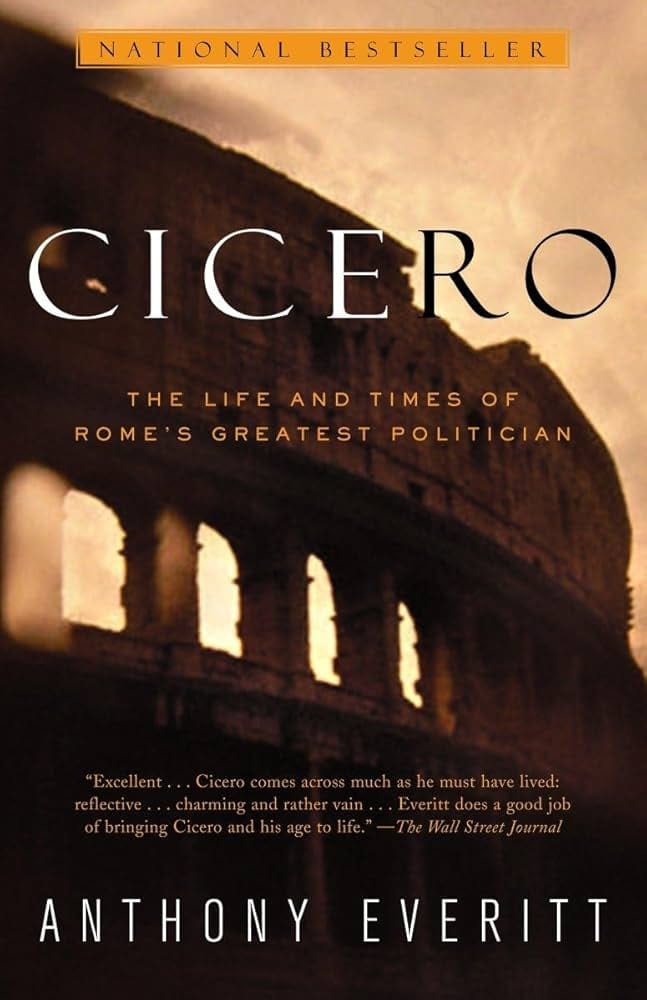

DESCRIPTION
“All ages of the world have not produced a greater statesman and philosopher combined.” —John Adams He squared off against Caesar and was friends with young Brutus. He advised the legendary Pompey on his somewhat botched transition from military hero to politician. He lambasted Mark Antony and was master of the smear campaign, as feared for his wit as he was for exposing his opponents’ sexual peccadilloes. Brilliant, voluble, cranky, a genius of political manipulation but also a true patriot and idealist, Cicero was Rome’s most feared politician, one of the greatest lawyers and statesmen of all times. Machiavelli, Queen Elizabeth, John Adams and Winston Churchill all studied his example. No man has loomed larger in the political history of mankind. In this dynamic and engaging biography, Anthony Everitt plunges us into the fascinating, scandal-ridden world of ancient Rome in its most glorious heyday. Accessible to us through his legendary speeches but also through an unrivaled collection of unguarded letters to his close friend Atticus, Cicero comes to life in these pages as a witty and cunning political operator. Cicero leapt onto the public stage at twenty-six, came of age during Spartacus’ famous revolt of the gladiators and presided over Roman law and politics for almost half a century. He foiled the legendary Catiline conspiracy, advised Pompey, the victorious general who brought the Middle East under Roman rule, and fought to mobilize the Senate against Caesar. He witnessed the conquest of Gaul, the civil war that followed and Caesar’s dictatorship and assassination. Cicero was a legendary defender of freedom and a model, later, to French and American revolutionaries who saw themselves as following in his footsteps in their resistance to tyranny. Anthony Everitt’s biography paints a caustic picture of Roman politics—where Senators were endlessly filibustering legislation, walking out, rigging the calendar and exposing one another’s sexual escapades, real or imagined, to discredit their opponents. This was a time before slander and libel laws, and the stories—about dubious pardons, campaign finance scandals, widespread corruption, buying and rigging votes, wife-swapping, and so on—make the Lewinsky affair and the U.S. Congress seem chaste. Cicero was a wily political operator. As a lawyer, he knew no equal. Boastful, often incapable of making up his mind, emotional enough to wander through the woods weeping when his beloved daughter died in childbirth, he emerges in these pages as intensely human, yet he was also the most eloquent and astute witness to the last days of Republican Rome. On Cicero: “He taught us how to think.” —Voltaire “I tasted the beauties of language, I breathed the spirit of freedom, and I imbibed from his precepts and examples the public and private sense of a man.” —Edward Gibbon “Who was Cicero: a great speaker or a demagogue?” —Fidel Castro From the Hardcover edition.
My Summary
Main Ideas, Takeaways & Similarities
Questions
I. What is the problem?
A. How is this problem formulated?
B. Why is this problem important?
C. What is the history of this problem?
D. Which prominent personalities have been interested in this problem?
II. What solutions to the problem are there?
A. What are the conclusions reached?
B. By what argument(s) is the conclusion reached?
C. What facts or assumptions serve as premises?
D. When a prominent personality offers a solution, does he also argue for or against other prominent personalities? Does he raise objections to alternative solutions? Does he consider objections to his own solutions?
III. Evaluation
A. What are the advantages and disadvantages of the alternative formulations to the problem?
B. Has the importance or history of the problem ever been misrepresented?
C. Are the solutions logically related to the premises?
D. Are the facts true? Are the assumptions acceptable? Are the objections answerable?
AI Summary
“Cicero: The Life and Times of Rome’s Greatest Politician” by Anthony Everitt is a biographical account of the life of Marcus Tullius Cicero, a prominent Roman statesman, orator, and philosopher. Here is a comprehensive summary in bullet points:
- Title: Cicero: The Life and Times of Rome’s Greatest Politician
- Author: Anthony Everitt
Introduction:
- Introduces Cicero as a central figure in the late Roman Republic.
- Highlights his contributions as an orator, statesman, and philosopher.
Chapter 1: Early Life and Education:
- Explores Cicero’s upbringing in Arpinum, Italy.
- Discusses his education in rhetoric and philosophy.
Chapter 2: Legal Career:
- Chronicles Cicero’s legal career in Rome.
- Discusses his early successes as a lawyer and advocate.
Chapter 3: Political Ascent:
- Examines Cicero’s entry into Roman politics.
- Highlights his rise to prominence as a “novus homo” (new man) without aristocratic pedigree.
Chapter 4: The Catilinarian Conspiracy:
- Details Cicero’s role in thwarting the Catilinarian conspiracy.
- Discusses his famous speeches denouncing Catiline’s plot.
Chapter 5: Opposition and Exile:
- Chronicles Cicero’s political struggles and conflicts with figures like Clodius.
- Discusses his exile from Rome and eventual return.
Chapter 6: The Triumvirate and Civil War:
- Explores Cicero’s interactions with Julius Caesar, Pompey, and Crassus.
- Discusses the events leading up to the Roman Civil War.
Chapter 7: Decline of the Republic:
- Examines Cicero’s writings during the turmoil of the late Republic.
- Highlights his philosophical works, including “De Re Publica.”
Chapter 8: Julius Caesar and the Ides of March:
- Details Cicero’s ambivalence towards Julius Caesar’s dictatorship.
- Discusses his involvement in the conspiracy against Caesar and the aftermath of the assassination.
Chapter 9: The Second Triumvirate and Cicero’s Execution:
- Chronicles Cicero’s clashes with Mark Antony and Octavian (Augustus).
- Discusses Cicero’s execution in 43 BC.
Chapter 10: Legacy and Influence:
- Examines Cicero’s enduring legacy as a philosopher, orator, and statesman.
- Discusses the impact of his writings on later thinkers and political leaders.
Conclusion:
- Summarizes Cicero’s life and contributions to Roman politics and philosophy.
- Reflects on the significance of his legacy in the context of Roman history.
Legacy:
- “Cicero” provides a comprehensive and accessible biography of one of ancient Rome’s most influential figures.
- The book offers insights into the political and intellectual climate of the late Roman Republic.
- It highlights Cicero’s enduring impact on the fields of oratory, philosophy, and political thought and his role as a defender of republican ideals during a tumultuous period in Roman history.