📓 In your handwritten notebooks
- Feb – March 21 2026, pp. 41–42 — Laozi’s Dao De Jing** → open PDF p47 (file not included in this release)
Index: Personal Journal

DESCRIPTION
A fresh, graceful translation of one of the most important and timeless classics—the foundational work of Daoism—by award-winning novelist Ken Liu, who contextualizes and demystifies this famously enigmatic text. Laozi’s Dao De Jing was written around 400 BC by a compassionate soul in a world torn by hatred and ambition, dominated by those that yearned for apocalyptic confrontations and prized ideology over experience. By speaking out against the cleverness of elites and the arrogance of the learned, Laozi upheld the wisdom of the concrete, the humble, the quotidian, the everyday individual dismissed by the great powers of the world. Earthy, playful, and defiant, Laozi’s words gave solace to souls back then, and offer comfort today. Now, this beautifully designed new edition serves as both an accessible new translation of an ancient Chinese classic and a fascinating account of renowned novelist Ken Liu’s transformative experience while wrestling with the classic text. Throughout this translation, Liu takes us through his own struggles to capture the meaning in Laozi’s text in a series of thoughtful and provocative interstitial entries. Unlike traditional notes that purport to be objective, these entries are explicitly personal and unapologetically subjective. Gradually, as Liu learns that true wisdom cannot be pinned down in words, the notes grow sparser until they fade away entirely. His journey suggests the only way out of struggle is to engage with texts that have survived the millennia, wrestling with ideas that gesture at something eternal, in hopes that we might eventually reach that moment of transcendent joy. Liu’s translation, by eschewing cleverness, paradoxically reveals the slipperiness of Laozi’s original. The Dao De Jing has been translated countless times and will be translated countless times in the future. In that constant change and flow, we finally find our home in Dao, the eternal principle that allows us, finite beings in time and space, to reckon and reconcile with the infinite.
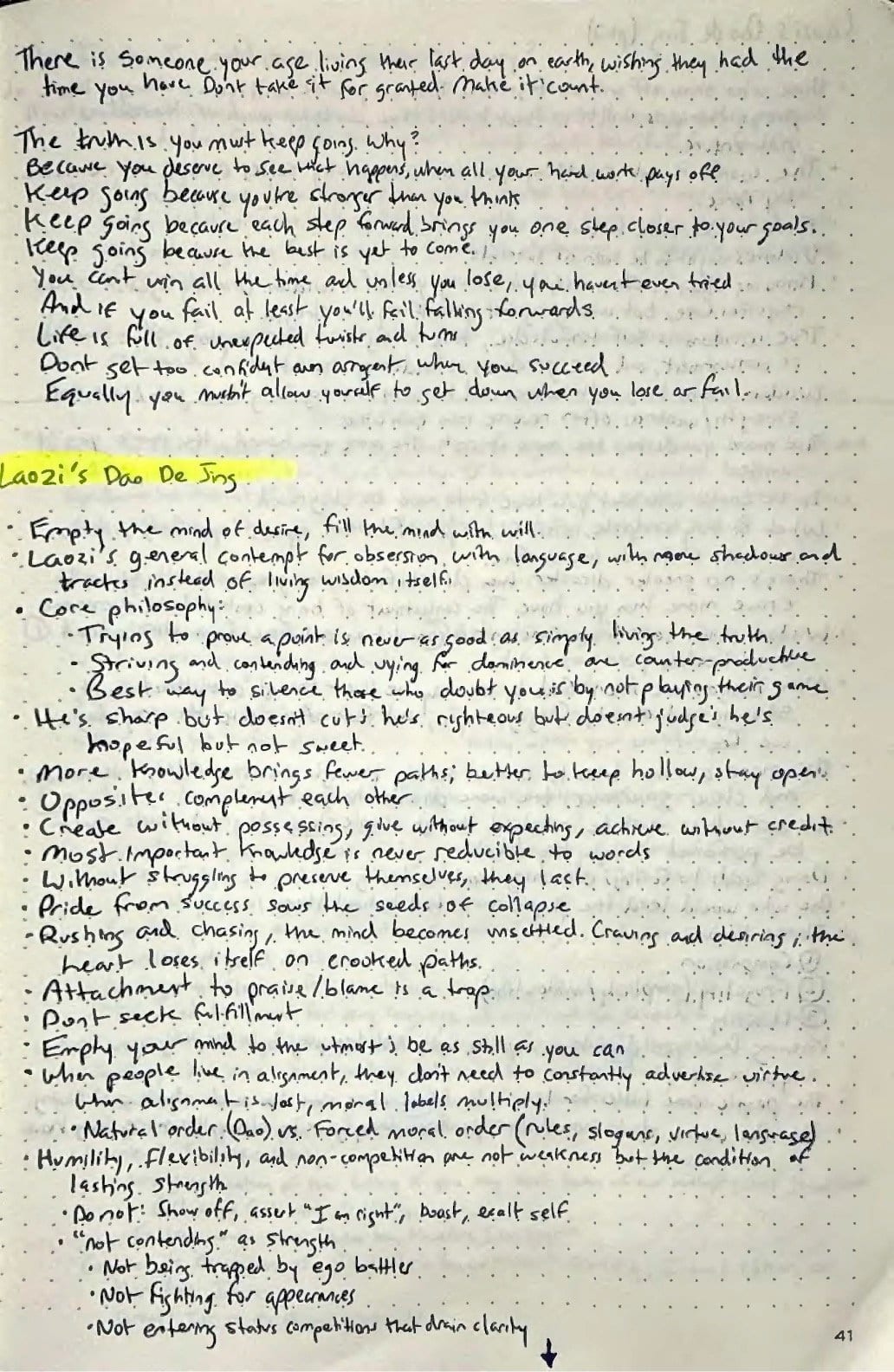
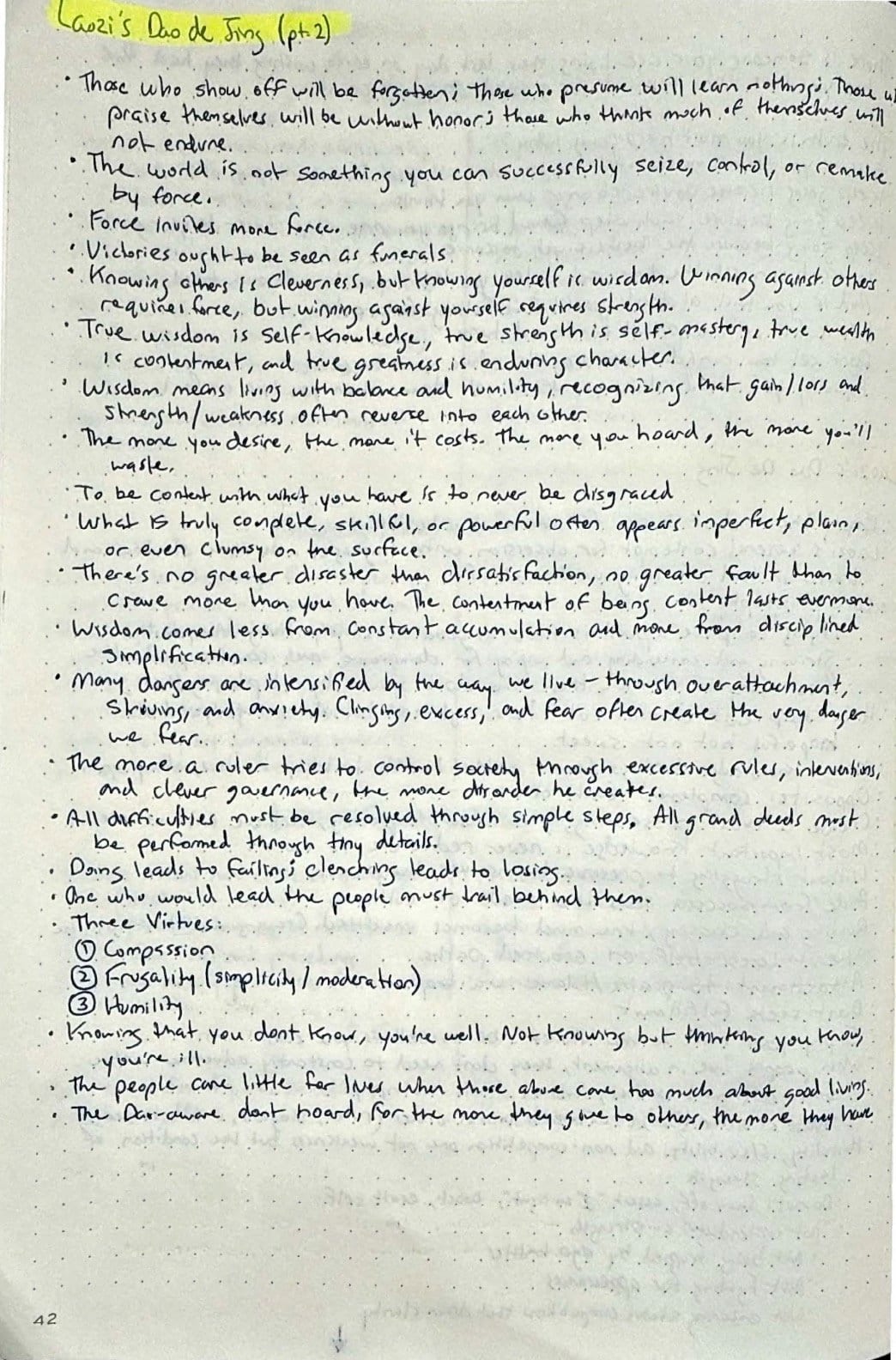
- Pride from success sows the seeds of collapse.
- Victories ought to be seen as funerals
- Thus seek not to be praised
- All things hold yang and bear yin and in their contention find harmony. (Similar to Aristotle)
Dao De Jing - Chapter 2 Without Beauty (book scan).pdf (file not included in this release)
Part I — The Book of Dao (Ch. 1–37)
- The Dao can’t be fully named; desireless openness vs. desiring grasping; both arise from the same mystery.
- Opposites generate each other; the Dao-aware practice noncoercive action (wu-wei) and create without possession.
- Don’t inflate status, rarity, or temptations; governing means simplifying desire and reducing clever grasping.
- Dao is inexhaustible and prior to all; it “softens” sharpness and dissolves entanglement.
- Heaven-and-earth are impartial; the wise act without sentimental favoritism and use emptiness.
- The “valley spirit” (the receptive/feminine) endures; yielding is the source of vitality.
- Heaven lasts because it doesn’t live for itself; the sage endures by putting self last.
- Be like water: benefit all, avoid contention, flow to low places.
- Excess and display invite loss; know when “enough” is enough.
- Cultivate inner integrity while acting outwardly; nurture without controlling; lead without dominating.
- Emptiness makes things useful (hub, room, vessel); what is “not there” enables function.
- Sensory overload and luxury scatter the mind; the sage chooses simplicity over stimulation.
- Attachment to praise/blame is a trap; treat the body and self as fragile and shared with the world.
- Dao is subtle, formless, and hard to “grasp”; attend to what’s before appearances.
- The ancient masters were careful and unshowy; clarity comes through patience and restraint.
- Return to the root through stillness; everything cycles, so learn the rhythm of return.
- The best rulers are barely noticed; trust and steadiness let people feel they did it themselves.
- When Dao is lost, moralizing begins; “virtue talk” often signals decline.
- Drop cleverness and excessive desire; recover plainness, compassion, and uncarved simplicity.
- Step outside social obsession; embrace not-knowing, like an infant near the “mother.”
- De (virtue/power) follows Dao; Dao can be sensed in its effects, not pinned down in concepts.
- Yielding becomes whole; humility and non-display preserve integrity.
- Nature speaks sparsely; align with Dao rather than forcing identity and outcomes.
- Self-exaltation doesn’t last; standing on tiptoe is unstable—avoid performative superiority.
- Dao precedes and outlasts heaven and earth; greatness is steady, natural, and not self-asserting.
- Weight is the root of lightness; inner stability should govern outward motion.
- True skill leaves little trace; the wise save others without show, and avoid waste.
- Hold both strength and softness; return to the “valley” and the uncarved block.
- Don’t seize and reshape the world by force; possession and control backfire.
- Power and violence rebound; avoid conquest and coercion if you want lasting order.
- Weapons are ominous tools; do not celebrate killing—victory without joy.
- Dao is nameless; keep to humility so the world doesn’t fracture into rival claims.
- Self-knowledge is stronger than conquest; contentment is real wealth.
- The great Dao flows everywhere and claims nothing; it nourishes without ownership.
- Hold to the “great image” (Dao) and people settle; flashy pleasures are brief.
- Reversal is the pattern: what you’d weaken you first strengthen; softness outlasts hardness.
- Dao “does nothing,” yet nothing is left undone; when rulers hold to it, things self-order and desires quiet.
Part II — The Book of De (Ch. 38–81)
- High De is unselfconscious; when Dao is lost, De decays into morality, ritual, and coercion.
- Unity/Oneness grounds stability; leaders should stay humble and not inflate themselves.
- Return is Dao’s motion; being arises from nonbeing.
- Dao looks paradoxical; the wise practice, the average doubt, the foolish mock—yet mocking is part of the test.
- Dao generates the many; life depends on balancing opposites; embrace humility even in honor.
- The soft overcomes the hard; teaching without words and acting without forcing are strongest.
- Fame and gain cost you life; protect what truly matters.
- Great completeness seems incomplete; stillness and patience sustain power.
- No greater misfortune than wanting more; knowing “enough” brings peace.
- Know the world without frantic roaming; clarity comes from inner alignment, not constant seeking.
- Learning adds; Dao practice subtracts—until effortless action becomes possible.
- The sage has no fixed agenda; meets people where they are, returning trust for trust.
- Live close to Dao and you’re less “harmable”; fear and fixation make you vulnerable.
- Dao births; De nurtures; everything grows without being owned—imitate that care.
- Return to the “mother” (source); guard the senses and desires to avoid spiritual ruin.
- The great way is simple but people prefer side roads; luxury atop poverty signals disorder.
- Cultivate De in self, family, community, nation, world; small integrity scales outward.
- De looks like the newborn: soft, unforced, resilient; softness is strength.
- Those who know don’t show off; “close the mouth,” blunt sharpness, and merge with dust.
- Rule by noninterference; more prohibitions produce more thieves; avoid coercive busyness.
- Gentle governance yields simple people; harsh governance breeds fear and cleverness.
- Frugality and restraint build deep reserves of De; rootedness makes endurance possible.
- Governing a large state is like cooking a small fish: don’t over-handle; meddling creates harm.
- The great state wins by being low (like water); yielding and receptivity triumph.
- Dao is a refuge for all; don’t discard people for being “bad”—value what can’t be bought.
- Handle the hard while it’s easy; meet hatred with De; start with the small and ordinary.
- Prevent before problems form; the huge begins tiny; don’t grasp at outcomes.
- Keep the people from manipulative cleverness; “too much knowledge” can make life ungovernable.
- Rivers rule by staying below; leadership works through humility and non-competition.
- Three treasures: compassion, frugality, and not presuming to lead; losing them leads to ruin.
- The best warrior isn’t warlike; the best victor doesn’t contend—strength without aggression.
- Don’t advance as aggressor; yield; underestimating opponents (or conflict itself) is costly.
- Dao’s words are simple but rarely lived; the sage looks plain outside but holds treasure within.
- Knowing you don’t know is health; the sickness is thinking you already know.
- Don’t crowd and oppress people; the Dao-aware know themselves without display and avoid overreach.
- Reckless daring can kill; Dao “wins” without contending—Heaven’s net misses nothing.
- If people don’t fear death, threats fail; killing is not your role—don’t usurp “the master of death.”
- People starve when rulers consume; governance fails when leaders chase grand deeds; doing nothing can be higher than “prizing life.”
- Life is soft and flexible; death is stiff; rigidity breaks—yielding survives.
- Dao is like drawing a bow: correct excess and deficiency; Heaven equalizes, humans hoard—so give without preening.
- Water is weakest yet unbeatable; everyone knows softness beats hardness, but few live it.
- Even after resolution, resentment can remain; the wise keep to their own obligations rather than demanding payment from others; Dao’s justice is nonpartisan.
- Ideal society is small and content: limited technology-use, no war, simple pleasures; neighbors are near yet life stays rooted.
- Truth isn’t decorative; the wise don’t argue; they give without hoarding—Dao benefits all without contending.
Based on Ken Liu’s Laozi’s Dao De Jing: A New Interpretation, the text is divided into two main sections—The Book of Dao and The Book of De—interspersed with Liu’s own essays and parables from the philosopher Zhuangzi.
Here is a summary of the main ideas organized by section and theme.
Part I: The Book of Dao (Chapters 1–37)
The first section focuses on the nature of reality, the limits of language, and the concept of “doing by not doing.”
- The Ineffability of Dao: The text opens by declaring that the path (Dao) that can be described or named is not the eternal path1. Dao is the “mother of all creation” and the origin of heaven and earth, best understood through emptying the mind of desire2. It is described as a “vessel from which the flow never ends” and as something that exists before the Creator3333.
- Wu Wei (Action through Inaction): A central theme is acting without striving. The “Dao-aware” (Liu’s translation for the sage) “do by not doing” and teach without speaking4. By not contending or striving for dominance, one accomplishes everything necessary5555.
- The Symbolism of Water: Water is presented as the highest form of good because it nourishes everything without strife and flows to the lowest places that others disdain6. Water illustrates how the soft and yielding can overcome the hard and strong7.
- Impartiality of Nature: The text famously states that “Heaven and earth are not benevolent,” treating all things as “straw dogs” (ceremonial objects discarded after use)8888. This implies that the universe operates on objective patterns rather than human morality.
- Simplicity and the Uncarved Block: The text advocates for a return to simplicity, often symbolized as “unworked wood” or plain silk9. It suggests abandoning cleverness, profit, and complex laws to allow people to return to their natural state of kindness and integrity10101010.
- Rejection of War: Arms and weapons are described as “sinister things” that should be despised11. Victory in war should not be celebrated but conducted with the solemnity of a funeral12.
Part II: The Book of De (Chapters 38–81)
The second section focuses on De (virtue, character, or power), governance, and the application of Dao in society.
- True vs. Performative Virtue: Liu translates that those with “High De” do not flaunt their virtue, whereas those with “Low De” are obsessed with not deviating from it13. The text argues that explicit moral codes (like benevolence, righteousness, and propriety) only arise when the natural Dao is lost14141414.
- Leadership and Governance: The ideal ruler is one whose presence is barely felt by the people15. When the ruler’s work is done, the people should feel they did it themselves16. Governing a large state is compared to “cooking a small fish”—it should not be poked or handled too much17.
- The Dangers of Cleverness: Administering a state with “clever stratagems” is viewed as a calamity, while governing without cleverness is a blessing18. The text warns that the more laws and prohibitions exist, the more poverty and lawbreaking will occur19191919.
- Contentment and Humility: There is no greater disaster than dissatisfaction and craving more than one has20. The text praises the “three treasures”: love, thrift, and never daring to elevate oneself21.
- The Ideal State: The text envisions a utopia of a small territory with few people who, despite having tools and weapons, do not use them, and who are so content they do not wish to travel to neighboring states222222222222222222.
- Paradoxes of Wisdom: The text concludes with the idea that trustworthy words are not pretty, and pretty words are not trustworthy23. True wisdom lies in knowing that you do not know24.
Liu’s Interpretative Essays & Zhuangzi’s Parables
Ken Liu includes essays and retellings of stories by Zhuangzi (a later Daoist philosopher) to illuminate the text.
- The Limits of Language: In the essay “The Wheelwright,” Liu uses a story about a wheel maker to explain that true wisdom cannot be captured in words or books, which are merely the “dregs” of the ancients25252525.
- Translation as “Trolling”: Liu describes Laozi as a “troll” in the best sense—someone who uses language to shock, sting, and irk the reader out of complacency to see deeper patterns26. He explicitly avoids academic footnotes, preferring a “plain” translation style that avoids “cleverness”27272727.
- Subjectivity of Usefulness: In “The Useless Bottle Gourd,” a story is told to illustrate that things (and people) considered “useless” by conventional standards often possess a grander freedom and utility that small minds cannot grasp28282828.
- Life and Death: Liu uses the story of Laozi’s death to argue against performative mourning, viewing death as part of the natural flow of Dao29292929. He contrasts this with the “nightmare” of the straw dogs, suggesting that trying to preserve what should be discarded is a source of suffering30.