

DESCRIPTION
#1 New York Times bestseller Featured on The Daily Show and 60 Minutes The acclaimed book that illuminates our world and its politics by revealing why bullshit is more dangerous than lying One of the most prominent features of our world is that there is so much bullshit. Yet we have no clear understanding of what bullshit is, how it’s distinct from lying, what functions it serves, and what it means. In his acclaimed bestseller On Bullshit, Harry Frankfurt, who was one of the world’s most influential moral philosophers, explores this important subject, which has become a central problem of politics and our world. With his characteristic combination of philosophical acuity, psychological insight, and wry humor, Frankfurt argues that bullshitters misrepresent themselves to their audience not as liars do, that is, by deliberately making false claims about what is true. Rather, bullshitters seek to convey a certain impression of themselves without being concerned about whether anything at all is true. They quietly change the rules governing their end of the conversation so that claims about truth and falsity are irrelevant. Although bullshit can take many innocent forms, excessive indulgence in it can eventually undermine the bullshitter’s capacity to tell the truth in a way that lying does not. Liars at least acknowledge that the truth matters. Because of this, bullshit is a greater enemy of the truth than lies are. Remarkably prescient and insightful, On Bullshit is a small book that explains a great deal about our time.
My Summary
Main Ideas, Takeaways & Similarities
Questions
I. What is the problem?
A. How is this problem formulated?
B. Why is this problem important?
C. What is the history of this problem?
D. Which prominent personalities have been interested in this problem?
II. What solutions to the problem are there?
A. What are the conclusions reached?
B. By what argument(s) is the conclusion reached?
C. What facts or assumptions serve as premises?
D. When a prominent personality offers a solution, does he also argue for or against other prominent personalities? Does he raise objections to alternative solutions? Does he consider objections to his own solutions?
III. Evaluation
A. What are the advantages and disadvantages of the alternative formulations to the problem?
B. Has the importance or history of the problem ever been misrepresented?
C. Are the solutions logically related to the premises?
D. Are the facts true? Are the assumptions acceptable? Are the objections answerable?
AI Summary
Highlights
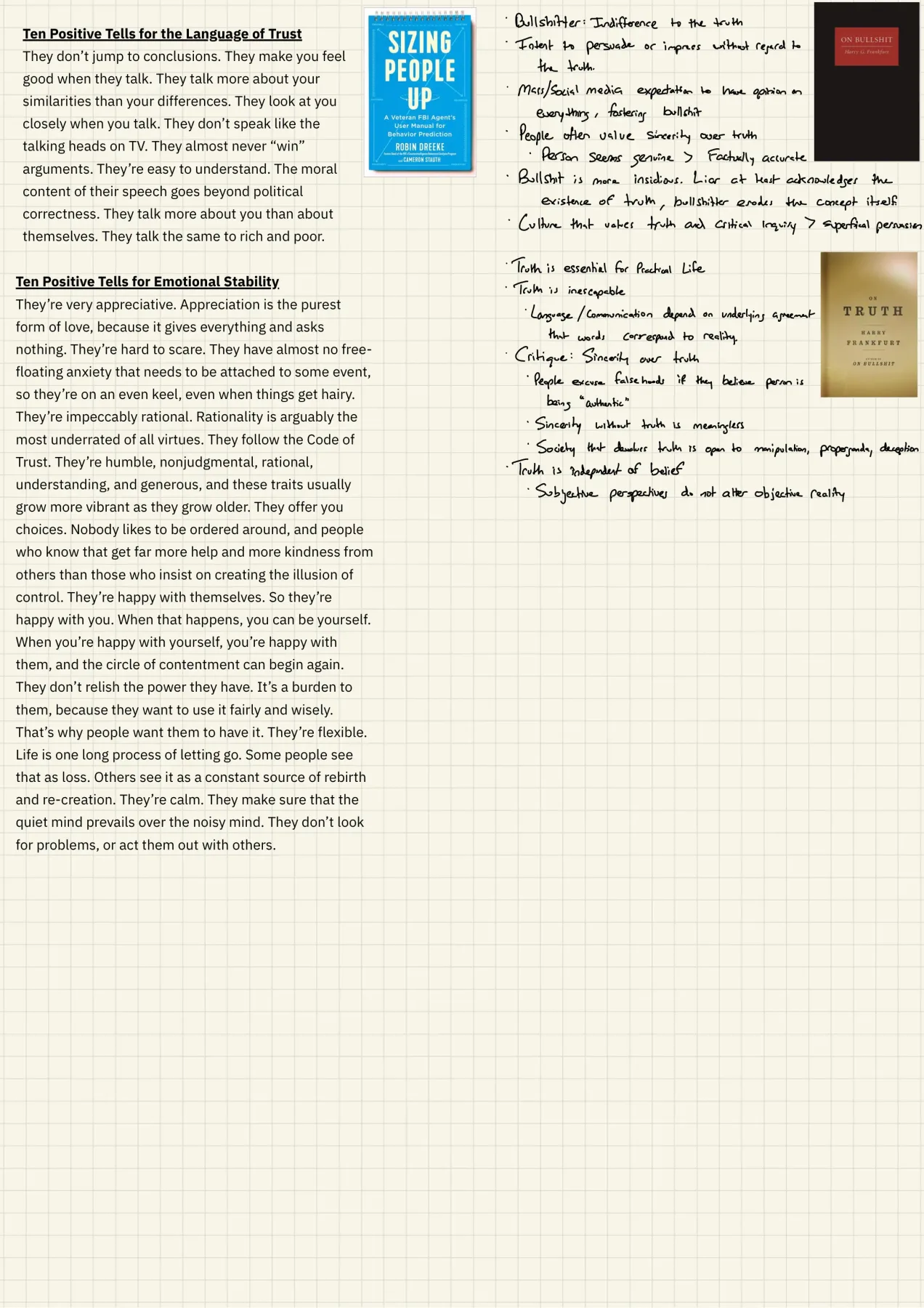
Here is a thorough summary of the book “On Bullshit” by Harry Frankfurt in bullet points:
- Title: “On Bullshit”
- Author: Harry Frankfurt
Introduction:
- A philosophical exploration of the concept of “bullshit” and its role in language and communication.
- Addresses the distinction between lying and bullshitting.
Chapter 1: On Bullshit
- Defines “bullshit” as a form of communication characterized by insincerity, indifference to truth, and a lack of concern for accuracy.
- Discusses the prevalence of bullshit in everyday discourse.
Chapter 2: A Theory of Bullshit
- Explores the nature and structure of bullshit.
- Discusses how bullshitters aim to create a certain impression rather than convey truthful information.
- Differentiates between lying, telling the truth, and bullshitting.
Chapter 3: Why is There Bullshit?
- Examines the reasons behind the proliferation of bullshit in society.
- Discusses factors such as social norms, deception, and the desire for persuasion.
- Considers the role of bullshit in politics, advertising, and academia.
Chapter 4: How to Overcome Bullshit
- Addresses the challenge of recognizing and countering bullshit.
- Encourages critical thinking, skepticism, and a commitment to truth.
- Discusses the importance of honest and meaningful communication.
Chapter 5: The Future of Bullshit
- Considers the future of bullshit in an increasingly digital and information-driven world.
- Discusses the challenges posed by fake news, misinformation, and online deception.
- Emphasizes the importance of media literacy and ethical communication.
Conclusion:
- Summarizes the key insights and arguments presented in the book.
- Highlights the significance of addressing bullshit as a philosophical and societal concern.
- Encourages readers to engage in meaningful and truthful discourse.