
DESCRIPTION
The first philosophers paved the way for the work of Plato and Aristotle - and hence for the whole of Western thought. Aristotle said that philosophy begins with wonder, and the first Western philosophers developed theories of the world which express simultaneously their sense of wonder and their intuition that the world should be comprehensible. But their enterprise was by no means limited to this proto-scientific task. Through, for instance, Heraclitus’ enigmatic sayings, the poetry of Parmenides and Empedocles, and Zeno’s paradoxes, the Western world was introduced to metaphysics, rationalist theology, ethics, and logic, by thinkers who often seem to be mystics or shamans as much as philosophers or scientists in the modern mould. And out of the Sophists’ reflections on human beings and their place in the world arose and interest in language, and in political, moral, and social philosophy. This volume contains a translation of all the most important fragments of the Presocratics and Sophists, and of the most informative testimonia from ancient sources, supplemented by lucid commentary. ABOUT THE SERIES: For over 100 years Oxford World’s Classics has made available the widest range of literature from around the globe. Each affordable volume reflects Oxford’s commitment to scholarship, providing the most accurate text plus a wealth of other valuable features, including expert introductions by leading authorities, helpful notes to clarify the text, up-to-date bibliographies for further study, and much more.
AI Summary
Introduction
1. Mythos vs. Logos – Setting the Stage
- Waterfield opens with Schiller’s poem “The Gods of Greece,” which laments the passing of the old gods and suggests that mythos (myth, lived symbol, “ensouled” reality) was replaced by logos (“the de-souled word”).
- He explains the richness of the Greek term logos:
- “account,” “story,” “value,”
- “word,” “speech,” “argument,”
- “proportion,” “principle,” “formula,”
- “reason” (both the faculty and an explanation).
- The standard story (shared by Romantic poets and academic historians) is:
- Around the 6th century BCE, Greek thinkers—the Presocratics—triggered a revolution by moving from mythic explanation to rational, naturalistic explanation.
- These thinkers are said to have “invented” philosophy and science for the West by treating the world as an orderly cosmos governed by discoverable laws.
Waterfield will complicate this simple mythos→logos story, but uses it as the initial frame.
2. Who Are the Presocratics and Sophists?
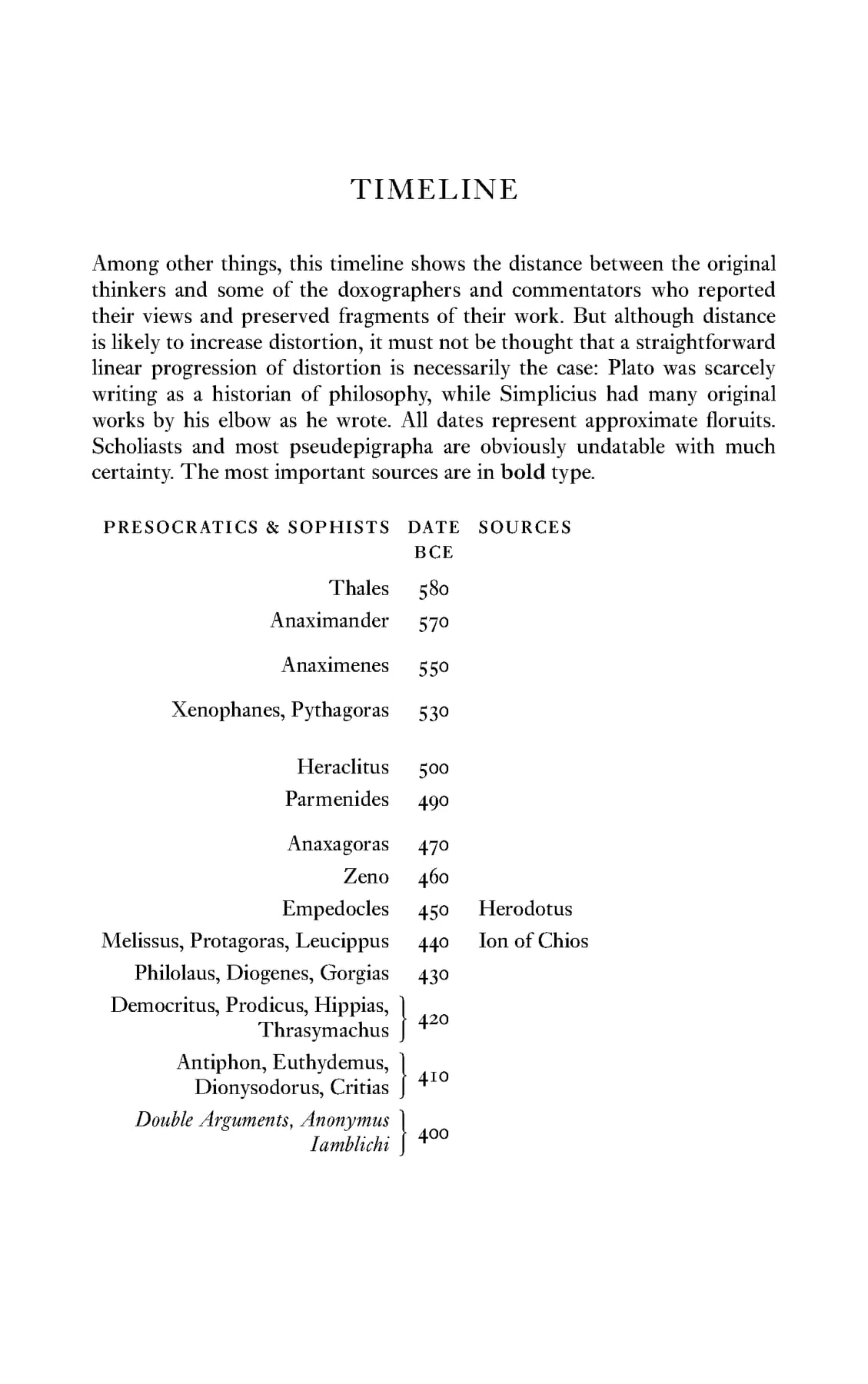
Waterfield lists the main Presocratic figures and roughly situates them:
- Milesians (Asia Minor):
- Thales, Anaximander, Anaximenes – early cosmologists based in Miletus.
- Other Presocratics:
- Xenophanes (Colophon, Asia Minor)
- Heraclitus (Ephesus)
- Parmenides, Zeno (Elea in southern Italy)
- Melissus (Samos)
- Pythagoras (born in Samos, lived in southern Italy)
- Empedocles (Acragas, Sicily)
- Anaxagoras (Clazomenae, Asia Minor)
- Democritus (Abdera, in northern Greece)
- Diogenes (Apollonia, on the Black Sea).
- Chronology:
- They live roughly 600–400 BCE; Socrates (469–399 BCE) overlaps with the last Presocratics.
- The earliest Sophists are contemporaries of Socrates; their thought is also included in the book.
Key point: None of the Presocratics’ or Sophists’ works survive complete. We possess only:
- Fragments (actual quotations)
- Testimonia (reports/summary accounts) in later authors.
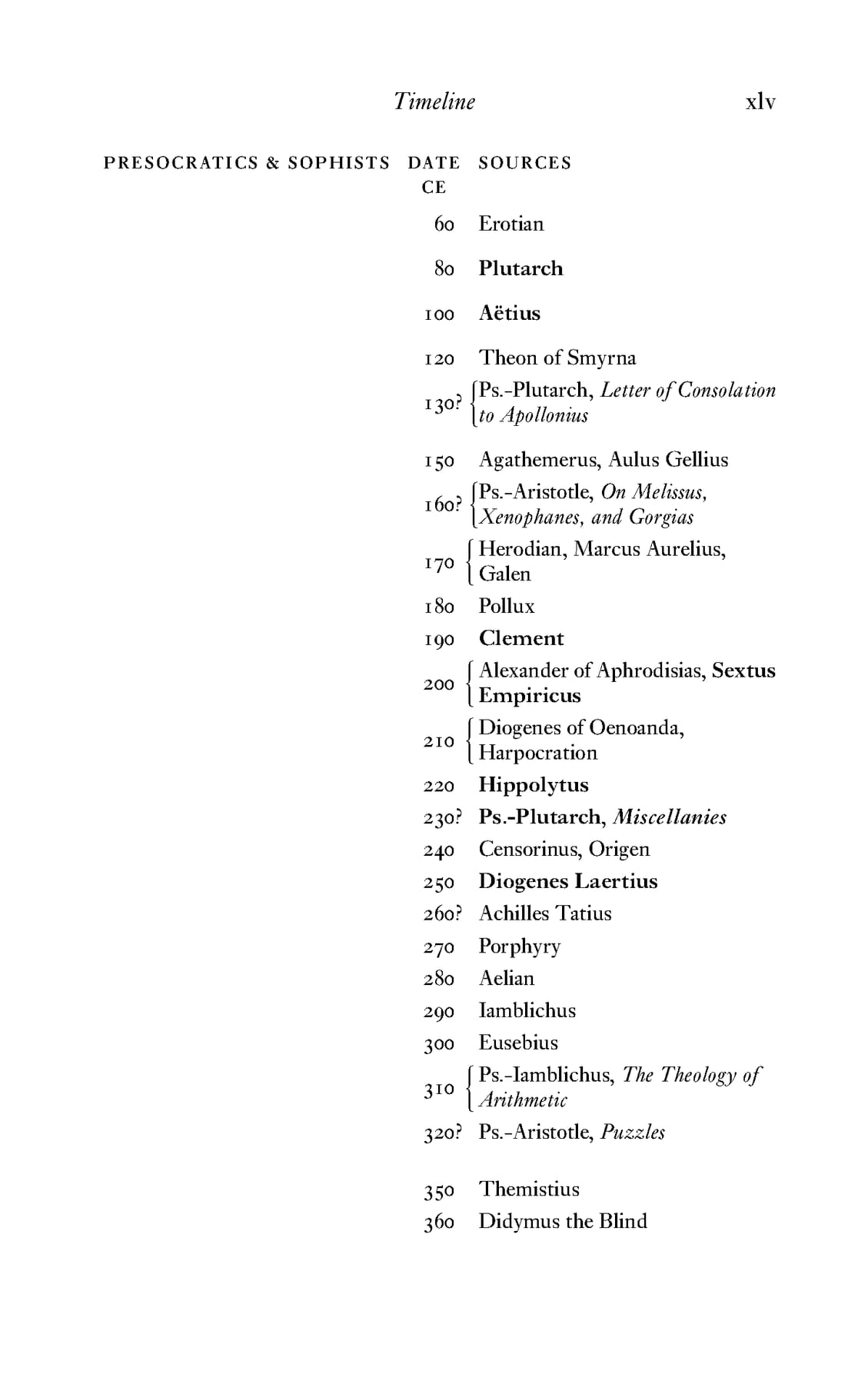
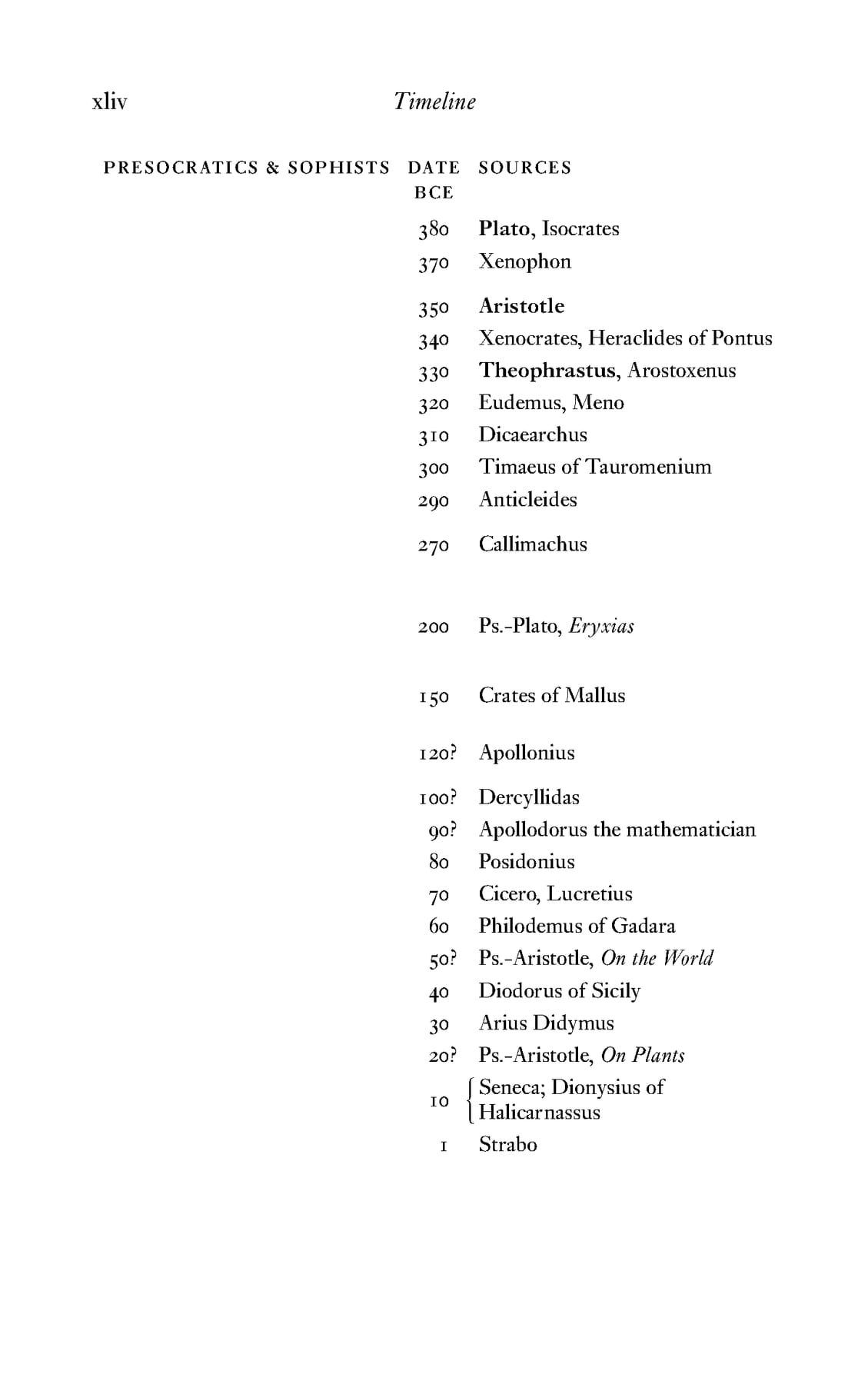
3. The Problem of Sources and Distortion
Waterfield stresses how precarious and biased our evidence is:
- Later authors—Aristotle, Theophrastus, later doxographers, Stoics, Christians—read the Presocratics through their own lenses, often distorting their views.
- Example 1:
- Aristotle’s theory of four causes (material, efficient, final, formal) leads him to interpret earlier thinkers as if they were groping toward that framework.
- He reads Thales as saying that everything is made of water (material cause) when perhaps Thales originally said something more mythic or cosmological such as everything began from or rests on water, echoing Near Eastern mythic models rather than proto-Aristotelian physics.
- Example 2:
- Anaxagoras gets praised as “sober” compared to his “babbling” predecessors because Aristotle thinks Anaxagoras introduced an efficient cause (Mind/Nous) in addition to a material cause.
- Aristotle is explicit that he is investigating earlier thinkers primarily to buttress his own theory of causation.
- Theophrastus, in Opinions of the Natural Scientists, becomes the main source behind later doxographies; where comparison is possible (e.g., with Plato’s own texts), serious distortion appears.
- For the Sophists, distortion is more Platonic than Aristotelian:
- Plato and Xenophon portray Socrates as morally serious and truth-seeking, and Sophists as mercenary, superficial, corrupting, or trivial.
- This polemical contrast shapes the entire later image of the Sophists, who thus lack a robust, independent doxographical tradition.
Conclusion: Our picture of both Presocratics and Sophists is filtered, partial, and often hostile.
4. Are the Presocratics “Scientists”?
Waterfield distinguishes:
- Scientific reasoning / method (in the modern sense) vs.
- Scientific attitudes or tendencies.
4.1. Scientific Method (Modern Sense)
Modern science involves:
- Observation → induction to explanatory principles → deduction of consequences.
- Constant feedback: refining observations and hypotheses.
- Testable hypotheses, quantification, and experiment; predictions that can be checked.
By this standard: - Presocratics do not qualify as “scientists”:
- No systematic experimentation.
- Their cosmological accounts (e.g., of the origin and structure of the universe) are not testable with available means.
- When observation clashes with theory, they usually privilege theory, not data.
- They are dogmatists rather than experimentalists.
Even the more empirical Hippocratic doctors:
- Use observation and experiment primarily to support their own views or refute rivals, not to rigorously test hypotheses.
- Often rely on similes and analogies (e.g., comparing breathing to a device for drawing liquid, lightning to phosphorescent water).
- Waterfield gives examples of flawed “experiments” (a wax bottle in seawater; freezing and thawing water) to show the limits of early empirical reasoning.
4.2. Scientific Attitudes
He then lists five “scientific attitudes” that some Presocratics exhibit:
- Optimism about intelligibility – The world is comprehensible; it has order.
- Trust in reason – The human rational mind is the right tool to understand the world.
- Methodical problem-solving – Analyzing problems into parts, moving from simple to complex.
- Tempered curiosity – Curiosity guided by discipline, resisting wild speculation (where the Presocratics often fall short).
- Love of abstraction – Facility with abstract concepts.
The Presocratics:
- Show some of these attitudes, especially 2, 3, and 5, but often lack 4 (their curiosity is not tempered; they indulge in bold, speculative systems).
- They are reductionists: seeking to explain many phenomena via a few basic principles (e.g., air, water, atoms) and relying on natural rather than supernatural causes.
- Yet many retain a mystical or visionary streak—e.g., Empedocles as “shaman,” Pythagoras as mystic, Heraclitus as prophet.
- Their thought is holistic: aiming at a systematic account of the whole universe, not just isolated problems.
So they are best described as proto-scientists: they help invent the intellectual posture that makes science possible, even if they don’t yet practice “science” as we now understand it.
5. From Mythic Religion to Natural Philosophy
Waterfield then contrasts Presocratics with their religious-mythic predecessors.
5.1. The Earlier Worldview
- The ancient Greek (and wider Mediterranean) world was saturated with sacrality:
- Caves, mountains, trees, rocks, rivers, localities each had presiding deities or spirits.
- Weather and large natural forces were especially divine.
- Over time, various local cults and deities get systematized into a more coherent pantheon, especially via Homerand Hesiod:
- By Homer (c. 750 BCE), there is a sort of Panhellenic pantheon of anthropomorphic gods (the Olympians).
- The gods are powerful but human-like: they eat, drink, quarrel, suffer wounds, make love. They are not omniscient or omnipresent; they are immortal but otherwise very human.
- Hesiod (c. 700 BCE), especially in the Theogony, is a key figure of rationalization within myth:
- He organizes countless gods into family trees, using genealogy as a way to bring conceptual order (e.g., Night → Death, Sleep, Dreams).
- But he remains an unquestioning pluralist: he does not reduce the many gods to a single principle.
- His gods are still intimately cultic—beings you supplicate with sacrifice and prayer.
5.2. Presocratic Break
Presocratics diverge in several ways:
- They continue to talk about “divine” things but now divinize natural processes or principles (e.g., Anaximenes calling air divine).
- These are impersonal principles, not cult gods; you cannot influence them with ritual.
- The gods of Presocratic thinking manifest themselves in the order and lawfulness of nature rather than in disruptions of order.
- Their shift is less about changing the questions (still: What is the nature of reality? How did the world arise?) and more about changing the framework of answers: from mythic-personal to natural-systematic, from plural stories to reductionist explanations.
At the same time, Waterfield warns against caricaturing pre-Presocratic cultures as irrational. Anthropologists show: - “Primitive” or pre-literate societies have systematic ways of thinking, with their own logic of causality and reality; they often think more analogically and metaphorically than we do, but not “randomly.”
The change is real, but it is not a move from no thinking to thinking, nor from chaos to order in a simple sense.
6. The Presocratic “Revolution” and Its Limits
Waterfield describes the Presocratic development as a genuine paradigm shift, but with important caveats:
- Revolution vs. continuity:
- It’s misleading to imagine a hard “before/after” divide where everything mythic disappears with Thales.
- The old worldview persists alongside the new; even the Presocratics are not fully self-conscious about doing “philosophy” or “science.”
- What is new:
- Assigning roles once filled by gods to natural causes.
- Using something recognizably like logic in constructing general hypotheses.
- Embracing reductionism: striving to explain many phenomena from few principles.
- An iconoclastic spirit of inquiry and willingness to speculate about cosmic origins and the remote past.
But:
- They lack self-reflection about method. They do not yet systematically ask, “How do we know?”
- Parmenides is a turning point, criticizing earlier cosmologies and insisting on rigorous reasoning, but even his revolution is incomplete.
- The fully reflective turn comes with Socrates, who asks:
- In ethics: not just “What is good to do?” but “What is the Good?”
- In epistemology: not just “What is the world made of?” but “How can we know anything about the world?”
- Without this kind of reflection, the Presocratics’ bold systems become quickly outmoded and vulnerable to critique; hence philosophy must “start again” with Socrates.
7. Hippocratic Medicine and the Reaction Against Dogmatism
Waterfield briefly describes how Hippocratic medicine (late 5th–early 4th century BCE) both draws on and reacts against Presocratic thought:
- Some treatises, like On Ancient Medicine, criticize the use of arbitrary postulates (e.g., everything is composed of hot/cold/wet/dry), a common Presocratic style.
- Others adapt Presocratic ideas:
- Empedocles’ four elements become the four humours of medical theory.
- On the Sacred Disease explains epilepsy in purely natural terms, rejecting supernatural causes.
- On Fleshes uses Presocratic-style explanations for the origin of bodily parts.
So medicine advances by selectively borrowing from Presocratics while also pushing toward more empirical, anti-dogmatic attitudes.
8. The Sophists as Heirs of the Presocratics
Waterfield then turns to the Sophists—the second large group covered in the book.
8.1. Who They Were and Where They Came From
He lists major Sophists and their places of origin:
- Protagoras – Abdera (northern Greece)
- Gorgias – Leontini (Sicily)
- Hippias – Elis (near Olympia)
- Prodicus – Ceos (island)
- Euthydemus and Dionysodorus – Chios (island)
- Thrasymachus – Chalcedon (near Byzantium)
- Athenians: Callicles, Antiphon (only two of those represented in the book)
They are itinerant professional teachers, but Athens is the main hub in our sources.
8.2. How They Inherit Presocratic Themes
Although their subject-matter differs (they focus on humans rather than cosmology):
- The Sophists are the first major humanist/anthropocentric thinkers in Greek philosophy.
- Once the Presocratics made the world intelligible to the human mind, it was natural to turn the rational spotlight onto human beings, their morality, politics, and institutions.
- Sophists specialize in logos in its rhetorical, linguistic, and argumentative senses:
- Rhetoric, public speaking, argumentation, language, education, law, and politics.
Waterfield suggests:
- Rhetoric, public speaking, argumentation, language, education, law, and politics.
- The Sophists, not Socrates, are the first to bring philosophy fully “down to earth” by focusing systematically on moral, social, and political questions.
- Their issues (justice, law, nature vs. convention, virtue, persuasion) remain very much alive today.
8.3. Social & Political Context
Several socio-political factors explain their rise:
- Post–Persian War optimism; technological and cultural progress encouraging confidence in human capabilityrather than divine control.
- Athenian democracy and Athenian “empire”:
- Massive importance of public speaking for political success and legal defense.
- Rhetoric becomes essential for exercising one’s rights and defending oneself in court.
- Traditional education is basic and limited (reading, writing, Homer, music, sport), usually finished by early teens and largely managed by slaves.
- Sophists offer higher education—advanced training in rhetoric, argument, memory, politics, and sometimes math or martial arts—for wealthy young men.
They teach through: - Public lectures (display speeches),
- Seminar-style classes with paying pupils (Plato’s Protagoras is the literary model),
- Practice in antilogic: arguing both sides of a question, especially legal and forensic topics.
8.4. Variety Within the Sophistic Movement
There is a genuine “Sophistic movement,” but it’s internally diverse:
- Protagoras – relativist and moderate sceptic; supporter of democratic Athens; teaches rhetoric and civic virtue.
- Gorgias – master stylist; composes poetic, ornate speeches; writes On What Is Not, perhaps a parody of Eleatic metaphysics.
- Prodicus – moral conservative; famous for refining near-synonyms (contributing to early lexicography); offers an anthropological account of the origin of religion.
- Hippias – polymath (“knows everything” and claims to be self-sufficient even in making his own clothes).
Common threads: - Professional experts in logos and education, selling their skills for a fee.
- Initially “Sophist” simply means a wise, skilled teacher—very close to our word “teacher.”
- Only later, especially through Plato’s polemics (and then Aristotle’s), does “Sophist” become a term of abuse: implying bad logic, moral indifference, or corrupting influence.
9. Why Study the First Philosophers?
Finally, Waterfield addresses the deeper significance of the Presocratics and Sophists.
9.1. Not Just Historical Curiosities
- They are key figures in the evolution of Western thought, but their importance is not merely historical.
- Because they are “firsts,” they reveal something fundamental about how human intellectual life works:
- How we move from myth to theory, from cult to concept, from plural stories to systematic explanation.
- How our attempts at rationality are always entangled with imagination, myth, and emotion.
9.2. The Myth of “The Death of the Gods”
Waterfield uses Plutarch’s story of the “death of Pan” (a voice tells a helmsman to proclaim “Great Pan is dead”; the world cries out in grief) to illustrate Schiller’s theme: the idea that the old gods have vanished.
But he complicates this:
- What is myth?
- At minimum: a traditional tale with social function, helping a community explain reality and make experience meaningful.
- If myth is “a framework that explains reality,” then science is also a kind of myth:
- A model accepted by a community that structures its view of the world.
- Thus, one person’s mythos is another’s logos, and vice versa; Plato’s Socrates explicitly frames a story as “mythos to you, logos to me.”
- Logos never fully banishes mythos; rationality cannot fully repress the irrational.
- Religious faith, aesthetic rapture, tribal violence—all show that the “old gods” of unreason persist.
9.3. The Deeper Lesson
- The Presocratics blend vision and logic, reason and a kind of mysticism; this mixture is not an embarrassing flaw but a model for how our intellectual life actually works.
- Modern attempts to separate reason from imagination (science from myth, rationality from emotion) are at best partial and at worst destructive (e.g., ecological devastation, loss of human meaning).
- Schiller’s idea of a wholly “de-souled” logos is therefore misleading; our reason still has “soul,” and that may be the seed of the next paradigm shift, with new “gods” (new overarching frameworks) emerging.
- As Homer knew and Waterfield emphasizes: the gods never truly die; they return in new forms.
Bottom Line of the Introduction
- The Presocratics and Sophists emerge in a world saturated with mythic religion but already moving toward rational systematization.
- The Presocratics initiate a revolution in thinking: using reason and abstract principles to explain the cosmos in natural terms, yet still infused with vision and mythic residues.
- The Sophists inherit this revolution, shift focus to human affairs, and institutionalize an early form of professional education in language, morality, and politics.
- Studying them shows not just the origin of philosophy and science, but the enduring tension and interplay between mythos and logos, reason and imagination, that still shapes how we think today.
Introduction (first PDF, pp. 12–34)
Waterfield sets the scene for the Presocratics and Sophists as the first “philosophers” in the West, active roughly between 600 and 400 BCE. He stresses:
- What’s new about them
They represent a shift from mythic explanation (mythos) to rational explanation (logos): trying to give unified, general accounts of the cosmos as an ordered whole (kosmos).
But he warns that it is too crude to say “they invented science” in the modern sense. They are dogmatic cosmologists, not experimental scientists. - The evidence problem
No complete works survive. We have fragments and reports preserved in later authors (especially Aristotle, Theophrastus, and later doxographers), who often read the Presocratics through their own conceptual schemes and distort them. The classic example: Aristotle reinterpreting early claims about water, air, etc. as if they were clean answers to his own question “What are things made of?” (material cause), even though the original thinkers may have been saying something more mythic or cultic. - Diversity among the “Presocratics”
“Presocratic” is a misleadingly homogeneous label. Waterfield distinguishes:- shamans (Empedocles),
- mystics (Pythagoras),
- prophets (Heraclitus),
- metaphysicians (Parmenides),
- philosophers (Anaxagoras),
- and proto-scientists (Milesians, Atomists).
They’re united less by content and more by the fact that they take rational reflection on nature (and later on humans) seriously.
- Why the Sophists are tricky
The Sophists survive mostly through hostile portrayals by Plato and dismissive remarks by Aristotle, so reconstructing them is even harder. Yet Waterfield stresses they “earth” Presocratic speculation by turning attention to human affairs—language, politics, virtue—before Socrates refashions philosophy yet again. - Why study them at all?
Beyond historical curiosity, Waterfield thinks they show what it looks like when humans first try to use reason systematically to understand the world, and how messy, speculative, and religiously entangled that process inevitably is.
The Milesians: Thales, Anaximander, Anaximenes (Miletus, c. 600–540 BCE)
Thales of Miletus
- Where/when: From Miletus in Ionia (Asia Minor), traditionally active c. 624–546 BCE. One of the earliest named Greek thinkers.
- Role in the book: The first figure in the Presocratic “revolution,” roughly where Waterfield’s story begins.
- Main ideas (as Waterfield reconstructs them):
- Famous for saying something like “everything originates from water” or “rests on water,” though Aristotle later glosses this as “everything is made of water.” Waterfield pushes back: the original claim was probably cosmological/mythic (water as primordial stuff or support), not a clean material-cause theory.
- He’s associated with the idea of a unified underlying stuff and with attempts to explain phenomena without invoking traditional Olympian gods (e.g. predicting eclipses, geometric work), though details are thin and heavily reconstructed.
- Represents the shift from local myth to a single, ordered cosmos governed by some intelligible principle.
Anaximander of Miletus
- Where/when: Also from Miletus, about a generation after Thales, active early–mid 6th century BCE.
- Main ideas:
- Introduces the apeiron (“the indefinite” or “boundless”) as the ultimate source of all things, instead of a familiar element like water. This is more abstract and less anthropomorphic.
- Thinks the world and its opposites (hot/cold, wet/dry) arise by a kind of differentiation from this indefinite stuff and are subject to a quasi-moral “justice” when one element encroaches too far on another.
- Reinforces the idea of the universe as an ordered system with its own internal laws, not the stage for arbitrary divine whims.
Anaximenes of Miletus
- Where/when: Third of the Milesians, mid-6th century BCE, again from Miletus.
- Main ideas:
- Chooses air as the primary stuff of the cosmos: the underlying material from which everything else is formed. Air can be condensed and rarefied to yield fire, wind, cloud, water, earth, and stones.
- Air is always in motion, and this motion accounts for physical processes. We breathe air; our soul is somehow air, linking the macrocosm (cosmos) with the microcosm (the human being).
- He envisages a layered cosmos (earth and heavenly bodies “floating” on air) and exemplifies early “scientific” cosmology, although Waterfield emphasizes that this is still speculative, not experimentally tested science.
Together, the Milesians are Waterfield’s paradigm of early naturalistic cosmology: one underlying stuff, natural processes of change (condensation/rarefaction, separation, etc.), and little reliance on mythic gods.
Xenophanes of Colophon (c. 570–475 BCE)
- Where/when: From Colophon in Ionia (Asia Minor), a wandering poet and critic of traditional religion; late 6th–early 5th century BCE.
- Main ideas (as Waterfield frames them):
- Critique of anthropomorphic religion: Xenophanes famously attacks Homeric and Hesiodic gods as immoral and human-shaped. He notes that if oxen or lions could paint, they’d make gods in their own image; Ethiopians imagine black gods, Thracians blue-eyed, etc. This is an early reflection on cultural relativity in religious belief.
- One god above all: He articulates the notion of a single greatest god, unlike mortals in body or mind, who moves all things by thinking, without physical effort. This is not yet rational theology in a later sense, but it’s a radical critique of popular polytheism.
- Cautious epistemology: Xenophanes stresses how hard it is for humans to achieve certainty about reality; we have to be content with “opinions” rather than complete knowledge. This anticipates later skepticism and is part of Waterfield’s theme that not all Presocratics are straightforward dogmatists.
- Naturalizing phenomena: He offers down-to-earth explanations of earth, water, and meteorological phenomena, reinforcing the movement away from mythic stories.
Heraclitus of Ephesus (fl. c. 500 BCE)
- Where/when: From Ephesus (Ionia), roughly contemporary with late Milesians and Xenophanes, but culturally distinct; early 5th century BCE.
- Main ideas:
- Logos and hidden order: Heraclitus says everything happens according to the logos—a rational structure or law of reality that most people fail to understand. Logos is a key term for Waterfield throughout the book.
- Flux and unity of opposites: He’s famous for the doctrine of permanent change (“you cannot step into the same river twice”) and the idea that opposites are somehow one (day/night, life/death, war/peace). Reality is structured by tension and conflict, not static harmony.
- Fire as primary stuff: He sometimes speaks of fire as the underlying principle, continually transforming into other things, symbolizing the dynamic character of the cosmos.
- Prophetic, riddling style: Waterfield stresses that Heraclitus is more of a prophet than a neat theorist, using cryptic aphorisms to provoke insight rather than to lay out a systematic treatise.
Heraclitus marks a turn from simple cosmological recipes (“everything is air”) toward a more metaphysical and psychological reflection on how humans understand a constantly changing world.
Parmenides of Elea (early 5th century BCE)
- Where/when: From Elea (Velia) in southern Italy, active early in the 5th century BCE.
- Main ideas:
- Eleatic school founder: Waterfield presents Parmenides as the first Presocratic to found a recognizable “school” (the Eleatics), with Zeno and Melissus as followers.
- The poem’s two “ways”: His didactic poem distinguishes a Way of Truth, where strict rational reasoning shows that “what-is” must be one, ungenerated, unchanging, timeless, and indivisible; and a Way of Opinion, which describes the apparent world of plurality and change for ordinary mortals.
- Radical rationalism: Parmenides insists that reason trumps the senses. If the senses tell us there is change, becoming, and non-being, they are deceiving us. Genuine thinking can only think “what is”; talk of “not-being” is incoherent.
- Impact on later Presocratics: This creates a crisis: if change and plurality are impossible at the level of reality, how can any cosmology be true? Much of later Presocratic philosophy is a response to this Eleatic challenge, trying to reconcile rational constraints with the evident world.
Zeno of Elea (c. 490–430 BCE)
- Where/when: From Elea; a generation younger than Parmenides; mid-5th century BCE.
- Main ideas:
- Defender of Eleatic monism: Zeno writes paradoxical arguments designed to show that belief in plurality and motion leads to contradictions, thereby indirectly defending Parmenides’ claim that reality is one and motionless.
- Paradoxes of motion and plurality: The famous paradoxes (Achilles and the tortoise, the arrow, the stadium, etc.) argue that if space and time are divisible in the ways common sense assumes, motion becomes impossible or incoherent.
- Methodological significance: Waterfield stresses that Zeno pioneers the use of reductio ad absurdum: assume your opponent’s position and show it leads to absurdity. This method becomes central to Greek philosophy and mathematics.
Melissus of Samos (mid–5th century BCE)
- Where/when: From Samos; another member of the Eleatic school, perhaps slightly later than Zeno.
- Main ideas (per Waterfield’s framing):
- Systematizing Eleatism: Melissus develops Parmenides’ arguments more systematically and in straightforward prose, emphasizing that the One must be infinite in extent, ungenerated, indestructible, and unchanging.
- Refinement of arguments: He elaborates logical arguments that any coming-to-be or passing-away would involve non-being, which is impossible, and that any division within being would also imply non-being.
- Less poetic, more treatise-like: Compared to Parmenides’ poem, Melissus offers something closer to a rational treatise, pushing Eleatic metaphysics toward a more explicit philosophical style.
Pythagoras and Pythagoreanism (late 6th–5th c. BCE)
- Where/when: Pythagoras was born on Samos but emigrated to southern Italy (Croton, then Metapontum), active late 6th century BCE.
- Who he was:
- A semi-legendary figure around whom a religious-philosophical movement formed—part communal, part political, part mystical.
- He founded communes in southern Italy that combined religious practice, ascetic discipline, and political influence.
- Main ideas, as Waterfield reconstructs them:
- Soul and transmigration: Strong belief in the immortality and transmigration of the soul, with strict rules of purity (including some form of vegetarianism) and association with Orphic religion. The body is a kind of prison for the soul; ritual purity is needed for liberation.
- Way of life: Pythagorean sect life is governed by numerous symbolic prohibitions and precepts (akousmata, “things heard”), designed to keep the mind constantly alert and to harmonize life with divine order.
- Number and harmony: Later Pythagoreans develop a more explicitly mathematical cosmology: reality is fundamentally numerical and structured by mathematical ratios (especially in music and astronomy). Pythagorean mathematics (triangle angle sum, harmonic means, theorems about triangle angles, cosmic figures, etc.) becomes legendary.
- Philosopher or sage? Waterfield emphasizes that Pythagoras himself is probably best seen as a teacher of perennial wisdom—a religious sage—rather than as a technical Presocratic cosmologist like the Milesians. Mathematics served the broader aim of purifying and ordering the soul in line with divine harmony.
The chapter also touches on later Pythagoreans (Philolaus, Eurytus, etc.) and their increasingly mathematical interpretations of reality—using numbers and pebbles to “define” forms, seeing a tight tie between macrocosm and microcosm.
Empedocles of Acragas (c. 494–434 BCE)
- Where/when: From Acragas (Agrigento) in Sicily, mid-5th century BCE.
- Waterfield’s characterization (from the intro and chapter):
- A shaman-like figure: poet, healer, wonder-worker, and political actor, blending rational speculation with religious drama.
- Four roots and two forces: Empedocles explains the world through four eternal “roots” (earth, air, fire, water) combined and separated by two cosmic forces: Love (attraction/unification) and Strife(separation/conflict). Nothing truly comes into being or perishes; things are just rearrangements of these roots.
- Cosmic cycle: The universe oscillates between periods of dominance by Love (unity, spherical god) and by Strife (dispersion), giving a kind of mythic-scientific account of cosmic history.
- Religious-ethical teaching: He presents human beings as fallen daimonic beings undergoing a cycle of reincarnations because of some primordial crime. Purification, ritual, and right living are needed for return to divine status.
- Proto-science plus mysticism: He offers remarkably detailed “scientific” explanations (e.g. of respiration, sensation) while simultaneously asserting a spiritual, quasi-Orphic worldview.
Anaxagoras of Clazomenae (c. 500–428 BCE)
- Where/when: From Clazomenae in Asia Minor, later active in Athens; early-mid 5th century BCE.
- Main ideas (as Waterfield lays them out):
- Everything-in-everything: Anaxagoras holds that everything is made up of infinitely many tiny “seeds” or ingredients (e.g. of flesh, bone, gold), and that in any given thing, all seeds are present, but some dominate. So nothing is generated from nothing; everything is mixture and separation.
- Nous (Mind): He introduces Nous (Mind or Intelligence) as a distinct, pure, and finest thing that initiates the original cosmic rotation and orders the cosmos. Nous is not mixed with other things; it knows and controls all. This is a major step toward a teleological or rational ordering principle.
- Response to Parmenides: By saying there is no coming-to-be or annihilation—only rearrangement of ingredients—he responds to Eleatic worries about change, while preserving the reality of the changing world.
- Cosmology and astronomy: He offers naturalistic explanations of the sun, moon, eclipses, meteors, etc., often demythologizing phenomena that were previously treated religiously (e.g. the sun as a fiery stone, not a god).
The Atomists: Leucippus and Democritus (mid–late 5th c. BCE)
- Where/when: Leucippus is somewhat shadowy; Democritus is from Abdera in northern Greece, active in the later 5th century BCE.
- Main ideas (in Waterfield’s set-up):
- Atoms and void: They propose that reality consists of indivisible atoms moving in empty space (void). Atoms are eternal, ungenerated, unchanging; all qualitative differences in things result from differences in shape, size, arrangement, and motion of atoms.
- Reconciliation with Eleatics: This is a sophisticated answer to Parmenides: at the ultimate level there is no “coming-to-be” (atoms are eternal) and no genuine non-being (void is reinterpreted as “what is not full”), but at the level of appearances we can explain change and plurality via rearrangements of atoms in space.
- Cosmology and worlds: They imagine innumerable worlds arising from atomic vortices; there is no single, teleologically designed cosmos.
- Ethics and psychology (Democritus): Democritus develops a rich ethics emphasizing euthymia (cheerful tranquility), moderation, and the role of belief and judgment in happiness; he also has early views about perception as physical contact between effluences and sense organs. Waterfield flags the Atomists as paradigmatic proto-scientists among the Presocratics.
Diogenes of Apollonia (late 5th century BCE)
- Where/when: From Apollonia on the west coast of the Black Sea; active in the later 5th century BCE.
- Waterfield’s characterization:
- Diogenes is “something of a throwback”—a Milesian-style monist in a post-Parmenidean, post-pluralist world, and also an eclectic borrower from Anaxagoras, Leucippus, and Heraclitus, with a major debt to Anaximenes.
- Main ideas:
- Air as intelligent, divine archê: He returns to air as the single underlying stuff from which everything is formed by condensation and rarefaction, but adds a key twist: air is also intelligent and divine, the source of order and life in the cosmos.
- Underlying unity and interaction: In F2 he argues that unless all things are modifications of the same underlying substance, interaction and generation would be impossible. This is his “major new insight” that lets him reinstate monism against the complex pluralism of Empedocles and Anaxagoras.
- Physiology and psychology: Diogenes is very interested in the human body: veins, respiration, perception, and the role of the brain. He treats air as the medium of life and intelligence circulating through the body (even in blood and semen), and he stands out for recognizing the importance of the brain as the seat of perception, not the heart.
- Late Presocratic endpoint: Waterfield presents him explicitly as “the last of the Presocratics,” someone who selects and synthesizes elements from earlier thinkers, emphasizes the individual and bodily processes more than cosmic speculation, and closes the Presocratic era rather than opening a new path.
Here’s a chapter-by-chapter digest of the Sophists section (pages 250–383), focusing on Waterfield’s introductory material for each chapter (i.e., before the primary texts). I’ll also start with a brief overview of how the book frames the Sophistic movement, since that’s the backdrop for all the individual figures.
The Sophistic Movement – Context from the Introduction
In the introduction, Waterfield presents the Sophists as a distinct intellectual movement of the fifth century BCE, shaped by major social changes — especially in democratic Athens. Traditional Greek education was basic (reading Homer, some lyric poetry, music, and sport), finished by the early teens, and often handled by slaves. The rise of a wealthy leisure class and the demands of radical democracy (mass assemblies, jury-courts, imperial politics) created a hunger for advanced education, especially in rhetoric and civic skills.
Sophists were itinerant professional teachers, typically men of high education who travelled between cities (above all Athens), offering instruction for fees. They gave public lectures but did their main work in small, paying “seminar” groups, teaching young aristocrats and ambitious citizens skills useful for public life: rhetoric, argumentation, politics, mathematics, sometimes military skills, and more.
Crucially, Waterfield stresses that “Sophist” originally meant something like “expert” or “teacher”; it only becomes pejorative largely thanks to Plato and Aristotle, who attack them for charging money, encouraging showy argumentation, and not caring for their students’ moral improvement.
Within this broad movement, the figures in your section represent a spectrum:
- Protagoras: a relativist and moderate sceptic, democratic in sympathy, teacher of civic virtue.
- Gorgias: a showman of grand, poetic rhetoric and author of an infamous treatise On What Is Not.
- Prodicus: moral conservative, specialist in fine verbal distinctions, theorist of the origins of religion.
- Hippias: encyclopedic polymath and champion of “nature” over mere convention.
Waterfield frames the whole movement as a response to a felt need for new morality, political theory, and persuasive speech, and a turn from vast cosmological speculation to human affairs: law, politics, language, ethics.
Protagoras of Abdera
Who / where / when
- From Abdera in northern Greece (Thrace).
- Flourished roughly in the mid-fifth century BCE (c. 490–420 BCE).
- Regarded by Waterfield as “the first and greatest of the Sophists” and the effective founder of the Sophistic movement.
Role and life
Protagoras was famous across the Greek world but especially in Athens, where he joined the intellectual circle around Pericles. He even drafted the constitution for the colony of Thurii in southern Italy, indicating serious political responsibility and prestige.
Although later stories claim he was exiled or his books burned for impiety, Waterfield notes that these are late and dubious; Plato portrays him as teaching for forty years with an unbroken reputation. Protagoras charged very high fees, effectively catering to wealthy young men who sought political success, even while he talked in democratic terms about teaching “civic virtue.”
Main ideas and doctrines - Man is the measure of all things
Protagoras famously began his book Truth with the dictum: “Man is the measure of all things – of things that are, that they are; of things that are not, that they are not.” Waterfield reads this as a broad relativist thesis: each person is the authority regarding how things appear and are for them. There is no independent “wind-in-itself”; only the wind as warm for one person and cold for another. - Relativism and the denial of falsehood
If each person’s impressions are incorrigibly true for them, then, in principle, no one is wrong; “falsehood” disappears in the strict sense. Critics (Aristotle, Plato) charge that this destroys meaningful discourse and violates the law of non-contradiction, but Waterfield notes that once you insist on subjective “suffixes” (“for me,” “for you”), the logical law itself is preserved—only objective truth is undercut. - Moderate scepticism and agnosticism about the gods
In another book Protagoras wrote that he could not know whether the gods exist or what they are like, because of the obscurity of the subject and the shortness of human life. Waterfield emphasizes this as agnosticism, not outright atheism: it is a refusal to claim knowledge about divine realities, not a denial that they exist. - Teaching civic virtue and political expertise
Protagoras claimed to teach political aretē – the excellence required to be a good citizen and successful public man. In Plato’s Protagoras, he justifies the teachability of civic virtue, outlines a non-retributive theory of punishment (punish to deter, not to avenge), and grounds participatory democracy in the capacity of citizens to deliberate rationally. Waterfield reads him as a kind of proto-utilitarian democrat: laws and constitutions are evaluated by how beneficial they are to the majority, though Protagoras still accepts an elite role for experts. - Nomos vs physis
Protagoras sides strongly with nomos (law, convention) over physis (nature). Human beings in their natural state are vulnerable; survival requires society, and society requires law and political skills. Law is thus a human construct but also indispensable for human flourishing. However, since what is just is what each city legislates as such, justice has no objective standard beyond each community’s settled nomoi. - Rhetoric, language, and grammar
He was a pioneering theorist of rhetoric and linguistic analysis, distinguishing tenses, grammatical moods, and even genders, as well as insisting on correct usage of terms. These interests both served practical persuasion and reflect a deeper concern with how logos shapes experience.
Waterfield’s overall picture: Protagoras is both a Sophist and a genuine philosopher whose interconnected positions—relativism, scepticism, democratic penology, and rhetoric—form a coherent outlook centered on moderate scepticism and human-centered politics.
Gorgias of Leontini
Who / where / when
- From Leontini in Sicily.
- Flourished in the later fifth century BCE (active in Athens from about 427 BCE).
- Famous as a dazzling orator and teacher of rhetoric.
Role and style
Waterfield characterizes Gorgias as writing rhetoric in a “grand, poetic style”—highly ornamental, rich in rhythm, antithesis, and verbal play. His speeches (like the Encomium of Helen and Defence of Palamedes) showcase how pure verbal artistry can rehabilitate even apparently indefensible positions.
Main ideas and doctrines - Rhetoric as pure power of speech
Gorgias exemplifies the Sophistic fascination with logos as a force—language as something that can overpower the listener, like a drug or a spell, regardless of the truth of what is said. The ethical worry (present in Plato) is that such rhetoric can be detached from any commitment to justice or reality, becoming a tool for manipulation. - On What Is Not (or On Nature)
Gorgias wrote a treatise titled On What Is Not, or On Nature, which Waterfield reports was perhaps a parody of Eleatic metaphysics. In later summaries this work advances three notorious claims:- Nothing exists.
- Even if something exists, it cannot be known.
- Even if it can be known, it cannot be communicated.
Whether Gorgias is serious or playful, Waterfield treats the treatise as a Sophistic demonstration of how far argumentative technique can be pushed: a kind of intellectual stunt that undermines metaphysical pretension and shows that logic can be used to “prove” absurdities.
Taken together, Gorgias represents the aesthetic and sceptical edge of Sophistry: a celebration of rhetorical virtuosity and a deep scepticism about truth, knowledge, and communication, executed in dazzling style.
Prodicus of Ceos
Who / where / when
- From the island of Ceos.
- Active in the later fifth century BCE, often in Athens.
- Famous as a moralizing Sophist and an expert on fine verbal distinctions.
Role and focus
Prodicus was renowned for lectures that distinguished near-synonyms (e.g. “pleasure” vs “enjoyment” vs “delight”), effectively helping to build an early Greek “dictionary” of usage. This concern with precise wording had obvious rhetorical value, but also a philosophical dimension: morality hinges on clarity about what we praise or blame.
Main ideas and doctrines - Moral conservatism and the “Choice of Heracles”
Waterfield highlights Prodicus’ famous fable, later quoted by Xenophon, where the young Heracles must choose between Virtue and Vice. Virtue promises hard work and struggle but genuine fulfillment; Vice offers easy pleasures that lead to disgrace. This story reveals Prodicus as a moral conservative, praising traditional virtues (hard work, self-control, civic duty) and warning against indulgent hedonism. - Origins of religion
Prodicus also wrote an anthropological account of the origins of religion, according to which early humans deified whatever was beneficial to them (like the sun, rivers, crops, or culture-heroes who brought agriculture or civilization). Gods are thus projections of human gratitude toward life-supporting features of the world. Waterfield stresses this as a classic Sophistic move: explaining religious belief in naturalistic and human terms. - Nomos and physis
In line with this, Prodicus treats many social institutions as human creations—rooted in utility rather than in divine command—yet he himself is not a moral radical; he broadly defends conventional virtues, using rationalization rather than overthrow.
Overall, Prodicus is the ethicist-lexicographer of the Sophistic movement: committed to traditional virtue, but explaining it and religion in terms of human needs and language rather than in mythological terms.
Hippias of Elis
Who / where / when
- From Elis in the Peloponnese.
- Flourished in the later fifth century BCE.
- Famous as an encyclopedic polymath—a man who claimed to know something about almost everything.
Role and persona
Hippias toured Greek cities as both ambassador and teacher, advertising his self-sufficiency by appearing dressed entirely in items he had made himself (clothes, ring, sandals, etc.). This theatrically embodied the Sophistic ideal of versatile expertise and independence.
He cultivated skills in mathematics, astronomy, poetry, history, and even memory techniques. One of the fragments Waterfield includes describes a system for training memory: pay attention so that your mind grasps content as a whole; repeatedly rehearse; and link new items to familiar ones through associative images or word-plays.
Main ideas and doctrines - Nature vs law
Hippias famously declares that he regards all Greeks as “relatives by nature, not by law”, and calls law a “tyrant” imposed on humans. For Waterfield, this is a key Sophistic position in the nomos vs physis debate:- Physis (nature) points to what is universal and shared (human kinship).
- Nomos (law/convention) is local, variable, and often oppressive.
Hippias thus uses “nature” as a basis for a kind of cosmopolitanism: we naturally belong together as humans, even if our city-laws draw harsh boundaries.
- Universal knowledge and expertise
The fragments show Hippias boasting that his knowledge ranges over everything from crafts to poetry to law. Waterfield treats this “I can answer any question” persona as part philosophy, part sales pitch: it exemplifies the Sophistic promise of universal education, but also invites Plato’s ridicule.
Hippias therefore stands for the polymathic and “natural law” dimension of Sophistry: an almost exaggerated versatility married to a critical stance toward conventional law in the name of universal human nature.
Thrasymachus of Chalcedon
Who / where / when
- From Chalcedon in Bithynia (across from Byzantium).
- Active in the late fifth century BCE.
- Known as a professional rhetorician, but also appears as a character in Plato’s Republic.
Role and contributions to rhetoric
Waterfield presents Thrasymachus as a pioneer of rhetorical theory and composition. He wrote a manual discussing how to arrange a speech and how to deploy pathos—emotion and shock—to sway an audience. He recommends that an orator “hit the audience hard” at the beginning, scaring or startling them, and then calm them down later: a deliberate aesthetic of emotional manipulation.
Stylistically, he argued for mixing styles rather than sticking to a single pure “grand” or “plain” style: an early theorist of flexible rhetorical register tailored to context and audience.
Main ideas and doctrines - Justice and power
In Plato’s Republic, Thrasymachus is famous for the claim that “justice is nothing other than the advantage of the stronger”. Waterfield relates him to the broader Sophistic tendency to question conventional morality, although the surviving fragments from his own writings do not simply repeat the Republic formulation. - Political stance
Interestingly, the one extended political fragment we have from Thrasymachus (a speech praising the post-404 Athenian democratic settlement) shows him as supporting democratic institutions and condemning tyranny and lawlessness. This complicates the usual picture of him as merely a cynic about justice.
In Waterfield’s hands, Thrasymachus is both an innovative rhetorical theorist and a provocative voice in the debate over justice and power, but one whose actual political commitments may have been more democratic than Plato’s portrait suggests.
Antiphon (the Sophist)
Who / where / when
- An Athenian writer, distinct from but possibly identical with the oligarch politician Antiphon.
- Flourished in the later fifth century BCE.
- Known for speechwriting, a treatise On Concord (Peri Homonoias), and the work called On Truth (Peri Alētheias).
Role and works
Waterfield explains that On Concord is a political/moral treatise urging unity and cohesion in the city, while On Truth(preserved only in papyrus fragments) is more theoretical, exploring the relation between law (nomos) and nature (physis). The fragments from On Truth are especially radical and are central to later discussions of Sophistic “immoralism.”
Main ideas and doctrines - Physis vs nomos, with a radical twist
Antiphon argues that many laws are hostile to natural human advantage. Nature demands the satisfaction of basic needs and desires; law imposes restraints that often go beyond what is necessary for safety. Publicly, one must obey nomos to avoid punishment; but privately, when there are no witnesses, one should follow physis—one’s natural interest—since only legal penalties, not nature itself, punish breaches of law. - Equality by nature
In a famous fragment, Antiphon insists that by nature all humans are the same, regardless of Greek/barbarian distinctions: we all breathe the same air, have the same bodily needs, and suffer the same when injured. This is a striking early statement of natural human equality, in tension with the hierarchical realities of Greek society. - Justice as a legal, not natural, category
For Antiphon, “justice” is defined by obeying the city’s laws, not by any cosmic moral order. But because those laws can be at odds with our natural advantage, he implicitly invites a critical attitude toward the authority of law itself.
Waterfield’s Antiphon is perhaps the most radical naturalist among the Sophists: he combines a proto-egalitarian view of human nature with a cold, almost Hobbesian analysis of the conflict between law and self-interest.
Double Arguments (Dissoi Logoi)
What / when / where
- An anonymous treatise, probably written around 400 BCE in southern Italy (exact date uncertain).
- Composed by someone widely read and familiar with Athenian intellectual culture.
Role in the collection
Waterfield calls this text “second-rate” and derivative: it freely borrows ideas from earlier Sophists and is intellectually shallow. But precisely for that reason, it vividly shows why Plato and Aristotle saw Sophistry as synonymous with bad argumentation.
Main ideas and techniques - Two-sided argumentation
The treatise systematically presents contrasting arguments (dissoi logoi) on questions such as whether the same thing can be both good and bad, just and unjust, noble and shameful. The goal is to show that, with enough ingenuity, any position can be argued both for and against, and that many evaluative distinctions are relative to circumstance, perspective, or law. - Relativity of value terms
Examples show how a single action (e.g. killing in war vs. in private life) may be praised or condemned under different descriptions, leading to the conclusion that terms like “good” and “just” are not absolute but context-dependent. - Memory and technique
The treatise ends with a short piece on memory training, advising students to attend carefully, rehearse frequently, and associate new material with familiar images (e.g. breaking names into parts that recall other words). This cements its identity as a practical handbook for students of rhetoric and argument.
For Waterfield, Double Arguments is the clearest surviving specimen of “low-grade” Sophistic practice: endlessly clever, overtly relativistic, but philosophically thin.
Euthydemus and Dionysodorus of Chios
Who / where / when
- Two brother-Sophists, originally from Chios, later linked with Thurii.
- Flourished in the late fifth century BCE.
- Best known from Plato’s dialogue Euthydemus, which provides most of our evidence.
Role and reputation
According to Plato, they first taught military skills (one of the rarer Sophistic specialties) before shifting into verbal and argumentational fireworks. They are portrayed as eristic specialists—professionals in arguing for victory, not for truth or moral improvement.
Main ideas and techniques - Eristic, not philosophy
In Euthydemus, Socrates presents them as deliberately exploiting fallacies, especially various forms of equivocation, to trap and embarrass their interlocutor, the young Cleinias. They explicitly boast that whichever answer the boy gives, they will prove him wrong. - Theoretical roots of the tricks
Waterfield notes that, behind some of their sophisms, there may be serious philosophical influences:- Eleatic denial of change (used to argue that wanting someone to become wise is wanting them to “cease to be the person they are,” i.e., wanting them to die).
- Protagorean relativism (used to spin paradoxes about knowledge at “each given time”).
But the central point is that Plato uses them as a comic parody of Sophistic method: their arguments are intentionally bad, and that badness is the joke.
- Historical existence
Despite the parody, cross-references in Plato, Aristotle, and Xenophon show that Euthydemus and Dionysodorus really existed, and that Plato is satirizing actual eristic practitioners who used these techniques in public performances.
For Waterfield, they represent the degenerate, purely agonistic side of Sophistry: verbal victory as an end in itself, divorced from any concern with knowledge or virtue.
Anonymous and Miscellaneous Texts (Callicles, Critias, Anonymus Lamblichi)
This final chapter gathers various texts (mostly not by professional Sophists) that nonetheless develop core Sophistic themes, especially:
- The tension between nomos (law/convention) and physis (nature).
- The origins of society and its institutions.
Callicles
Who / when
- A historical Athenian figure from the late fifth century BCE.
- Known primarily through Plato’s Gorgias.
Main ideas
Callicles argues that nature and convention are in permanent conflict. According to convention (laws and moral codes), it is wrong to “do injustice,” understood as taking more than one’s fair share. According to nature, he claims, the strong are entitled to dominate and take more: “might is right.” Laws and customs are conspiracies by the weak majority to shackle the naturally superior few.
Waterfield compares Callicles with Thrasymachus: both subvert conventional morality, but whereas Thrasymachus thinks pursuing one’s own advantage is unjust (though the powerful will still do it), Callicles openly identifies that pursuit with natural justice.
Critias
Who / when
- An oligarchic Athenian politician and associate of Socrates; one of the “Thirty Tyrants.”
- Active at the very end of the fifth century BCE.
Main ideas
From a fragment of his play Sisyphus, Waterfield extracts a radical theory of religion as political invention: - Law is valuable for keeping human behavior in check, but people will still offend in secret.
- A shrewd lawgiver, realizing this, invents gods who see everything, even hidden actions, and punish wrongdoing.
- The gods thus function as useful fictions to enforce morality where human surveillance fails.
Critias therefore offers a defence of law—it is needed and valuable—while simultaneously debunking religion as a human tool of social control. This combination shows how Sophistic debates about nomos and physis could support both radical scepticism and practical conservatism at once.
Anonymus Lamblichi
What / when
- A prose passage from the end of the fifth century BCE, preserved in Iamblichus’ Exhortation to Philosophy.
- Iamblichus doesn’t name the author, but scholars agree it is a fifth-century text.
Main ideas
The anonymous writer is, in Waterfield’s phrase, a utilitarian democrat and an ardent champion of law and order. He praises: - The benefits of law for restraining wrongdoing and enabling communal life.
- The way law shapes character and makes people better citizens.
Stylistically, the piece is derivative and written in awkward Greek, but conceptually it stands as a counterpoint to Antiphon and Callicles: here nomos is not a tyrant or conspiracy of the weak, but the rational guarantee of social flourishing.