Country study: Sudan — conflicts, sources and journal pages
How Africa’s Geography Traps It in Endless Poverty (infographic).pdf (file not included in this release)
Sub-Saharan Africa vs. Western Democratic Countries (GDP per Capita, PPP - 2023 Estimates)
| Sub-Saharan Country | Population (M) | GDP per Capita PPP (USD) | Comparison Country | Comparison GDP per Capita PPP (USD) | SSA vs. Comparison (Ratio) |
|---|---|---|---|---|---|
| Nigeria | 223 | 5,800 | Brazil | 20,200 | 0.29 |
| Ethiopia | 126 | 3,200 | Mexico | 22,100 | 0.14 |
| South Africa | 60 | 15,200 | Italy | 51,700 | 0.29 |
| Kenya | 55 | 5,500 | South Korea | 56,700 | 0.10 |
| Ghana | 34 | 6,200 | Canada | 60,200 | 0.10 |
| Tanzania | 67 | 3,100 | United Kingdom | 56,500 | 0.05 |
| Uganda | 48 | 3,300 | Spain | 50,300 | 0.07 |
| Angola | 36 | 6,500 | Poland | 47,600 | 0.14 |
| Mozambique | 33 | 1,500 | Greece | 41,000 | 0.04 |
| Botswana | 2.6 | 19,000 | Ireland | 126,000 | 0.15 |
Money given to Africa: the world and the US
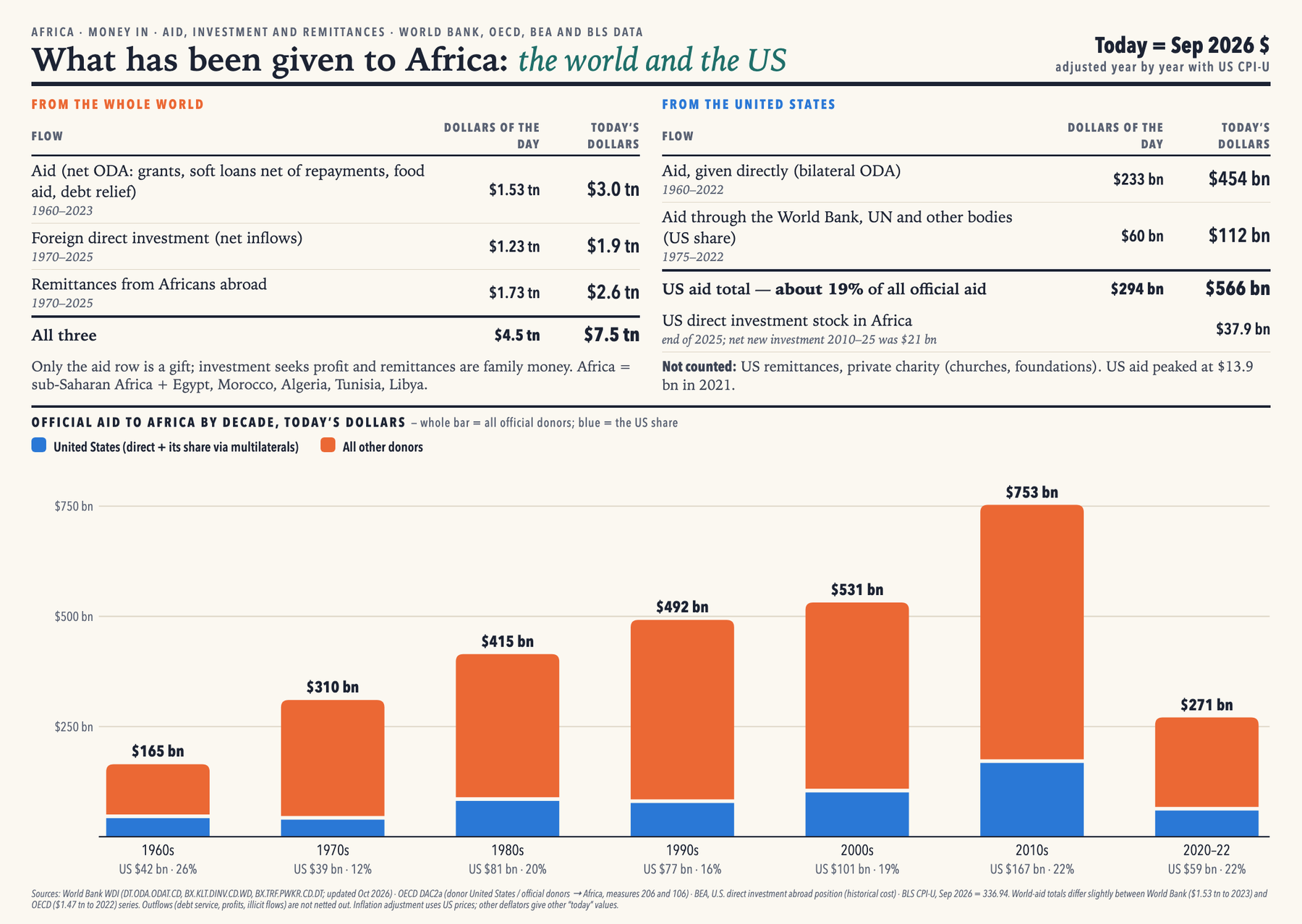
Notebook card (half B5), made 9 November 2026. “Today’s dollars” means September 2026 dollars, adjusted year by year with US CPI-U.
From the whole world, 1960–2025:
- Aid (net ODA): $1.53 trillion, or about $3.0 trillion today (1960–2023).
- Foreign direct investment: $1.23 trillion, or about $1.9 trillion today.
- Remittances from Africans abroad: $1.73 trillion, or about $2.6 trillion today.
- Total: $4.5 trillion, or about $7.5 trillion today.
From the United States:
- Aid given directly: $233 billion, or about $454 billion today (1960–2022).
- Aid through multilateral bodies, the US share: $60 billion, or about $112 billion today.
- US aid total: $294 billion, or about $566 billion today. That is roughly 19% of all official aid to Africa.
- US direct investment stock in Africa: $37.9 billion at the end of 2025.
The card also has a chart of official aid by decade, with the US share of each decade shown.
Sources:
- World Bank WDI (updated October 2026).
- OECD DAC2a, aid by donor; the US series runs to 2022.
- BEA, US direct investment abroad.
- BLS CPI-U.
Caveats:
- Only the aid row is a gift.
- Outflows (debt service, profits, illicit flows) are not subtracted.
- US remittances and private charity are not counted.
- Africa here means sub-Saharan Africa plus Egypt, Morocco, Algeria, Tunisia and Libya.
Card source file: HTML (file not included in this release).
breakdown of Sub-Saharan Africa’s historical contributions in terms of inventions, technology, written language, and the wheel:
1. Inventions and Technological Contributions
Ironworking and Metallurgy
- The Nok Culture (modern Nigeria, ~1000 BCE – 300 CE) was among the earliest in sub-Saharan Africa to smelt iron.
- Independent ironworking appeared in Central Africa (notably in modern-day Congo and Rwanda) potentially as early as 1000 BCE.
- This is significant because sub-Saharan iron smelting may have developed independently of Mediterranean or Near Eastern influence.
Agricultural Tools and Practices
- Indigenous groups developed hoe-based agriculture, terracing, and irrigation systems (notably in the Sahel and Ethiopian highlands).
- Banana and yam domestication occurred independently in Central and West Africa.
Architecture
- Great Zimbabwe (11th–15th century): Massive stone structures built without mortar.
- Sahelian mud-brick architecture (e.g., Timbuktu’s Djinguereber Mosque in Mali).
- Yoruba cities like Ile-Ife developed urban planning and terracotta sculpture.
Navigation and Boatbuilding
- East African Swahili coast civilizations (e.g., Kilwa, Mombasa) were skilled seafarers.
- West Africans used canoes hollowed from tree trunks, some over 20 meters long, to navigate rivers like the Niger.
Textiles and Weaving
- Longstanding traditions of cotton weaving and kente cloth in West Africa.
- Bark cloth production in Central Africa dates back centuries.
2. Written Language
Indigenous Scripts (Limited but Present)
| Script | Region | Timeframe | Notes |
|---|---|---|---|
| Nsibidi | Southeastern Nigeria | 500 CE–present (mainly among the Ekoi, Igbo, and Ibibio) | Ideographic and symbolic; used in secret societies |
| Meroitic | Nubia (modern Sudan) | 3rd century BCE–400 CE | Still not fully deciphered; developed from Egyptian scripts |
| Ge‘ez | Ethiopia and Eritrea | From ~500 BCE | Still used in liturgy of Ethiopian Orthodox Church |
| Tifinagh | Tuareg regions (Sahel/Sahara) | Ancient to present | Used to write Tamazight; derived from ancient Libyco-Berber |
Most sub-Saharan cultures were oral, not illiterate: they transmitted history, law, and science through griots, drumming, and memory systems rather than alphabetic writing.
3. Did They Use the Wheel?
Short Answer: No, not for transport
- The wheel was known in some African societies, likely through contact with North Africa, but:
- It was not widely adopted in sub-Saharan Africa for carts or wagons.
- This was largely due to environmental and economic factors, not ignorance.
Why Not?
- Tsetse fly zones made horses and oxen (wheel haulers) vulnerable to disease.
- Thick forests, rugged terrain, and lack of paved roads made wheel use impractical.
- Labor and trade were often carried by porters and canoes, which were more efficient.
Use in Toys and Pottery
- Evidence of toy wheels and ceramic wheels (pottery turning devices) exists in several regions, suggesting conceptual familiarity.
4. Summary
| Category | Highlights |
|---|---|
| Inventions | Iron smelting, complex agriculture, architecture, textiles, boat-building |
| Written Languages | Ge‘ez, Nsibidi, Meroitic, Tifinagh—rare but notable |
| Use of Wheel | Not widely used for transport; impractical in terrain and ecology |
| Knowledge Systems | Oral traditions, proverbs, mnemonic devices, and musical notation (e.g., drum language) |
Conclusion
Sub-Saharan Africa developed sophisticated and contextually adapted technologies, especially in metallurgy, agriculture, and architecture. It had some indigenous scripts, though oral culture predominated. While the wheel was conceptually known, it was not widely adopted due to practical constraints, not intellectual deficiency. African ingenuity was often expressed in non-industrial, ecologically adapted, and socially embedded ways that Western metrics may overlook.
Would you like this turned into a blog-ready format or infographic?