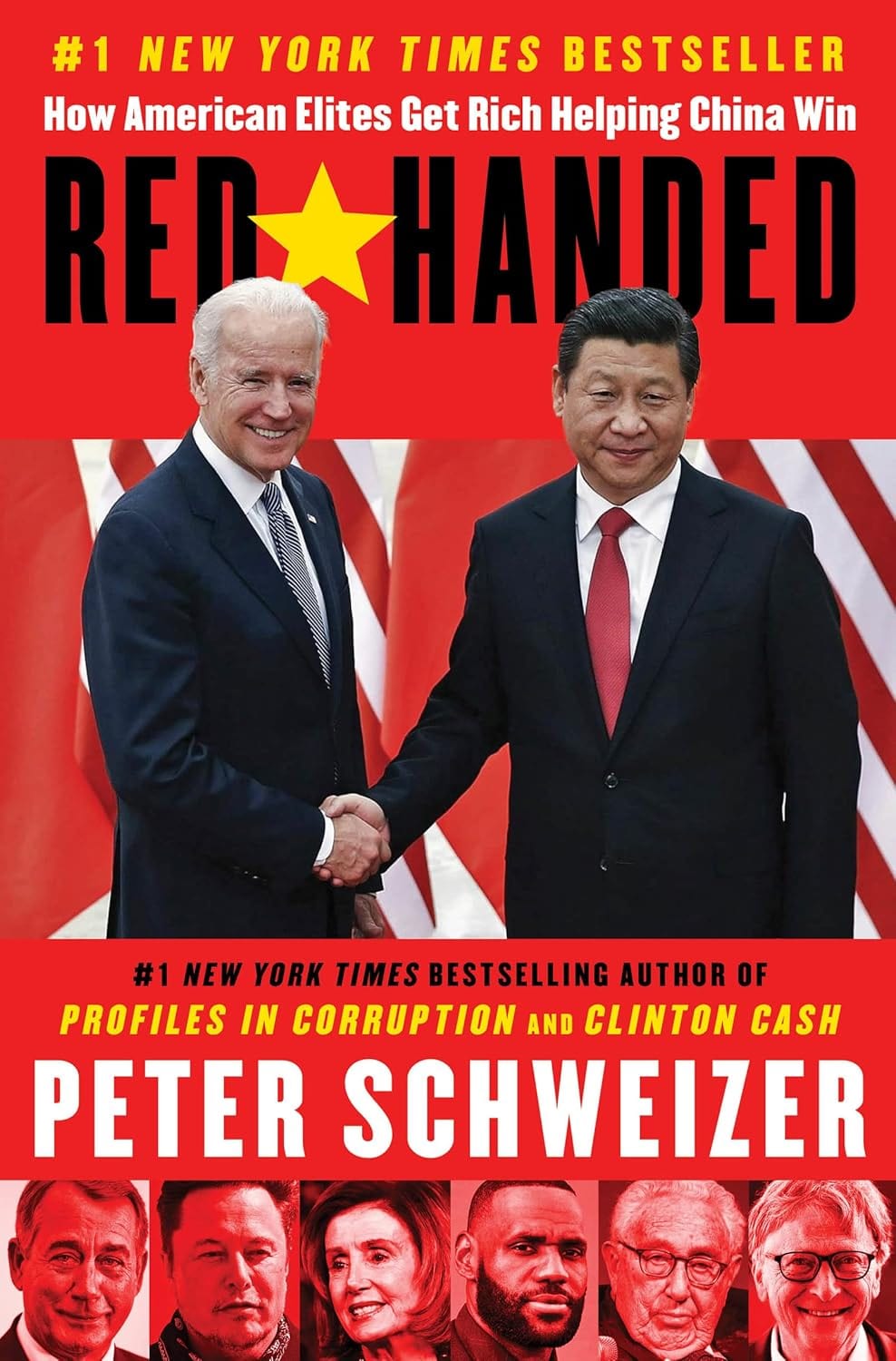
Red-handed - how American — Peter Schweizer.pdf (file not included in this release)
Red-handed - how American -- Peter Schweizer (PDF Extract)
Below is a table of the people/families Schweizer claims received money, business value, investment access, lobbying fees, donations, or other financial benefit from China, Chinese state-linked firms, Chinese businessmen, or China-facing commercial networks.
Important distinction: not every case is “cash wired personally from the CCP.” Some are direct payments, some are family-business benefits, some are firm-level profits, and some are institutional donations or investment opportunities that Schweizer treats as influence channels. His broader concept is elite capture, where Beijing gives “money and deals” to influential foreigners who then become less hostile to Beijing’s interests.
| Person / Family | Role | Chinese Source / Vehicle | Money or Benefit Alleged in the Book | Amount Mentioned | Why Schweizer Says It Matters |
|---|---|---|---|---|---|
| Hunter Biden | Son of Joe Biden; businessman | Chinese businessmen tied, according to Schweizer, to Chinese intelligence and United Front networks | Business deals, BHR equity, CEFC/Hudson West payments, Chinese-backed investment opportunities | Part of alleged $31 million to Biden family; BHR stake estimated by one professor near $20 million, though Team Biden claimed much less | Schweizer presents Hunter as the main access point for Chinese-linked financiers seeking proximity to Joe Biden. |
| James Biden | Joe Biden’s brother | CEFC / Hudson West-linked Chinese business network | Included in Biden-family China deals, especially CEFC-related arrangements | Included in alleged $31 million figure | Schweizer argues China-linked money flowed not only to Hunter but to other Biden family members. |
| Joe Biden / Biden family | Vice president, later president | Chinese businessmen tied by Schweizer to intelligence-linked networks | Schweizer argues Joe was not merely adjacent because emails referenced “JRB,” Hunter allegedly paid some family expenses, and Biden Center/Penn later received China-linked funds | Family total alleged: $31 million; Penn China donations/contracts after Biden Center: roughly $40–60 million, depending on inclusion of contracts | Schweizer’s claim is that the Biden name and policy access were monetized through family channels. |
| University of Pennsylvania / Biden Center network | Institution tied to Biden’s post-VP role | China Merchants Bank, Cathay Fortune, other mainland sources | Donations and contracts from Chinese mainland increased after Biden Center announcement | Chinese mainland donations rose from about $15 million before to nearly $40 million after; $60 million including contracts | Schweizer presents this as institutional China-linked money around a Biden-affiliated foreign-policy center. |
| Dianne Feinstein / Richard Blum | U.S. senator; husband investor | Shanghai Investment and Trust, Chinese state-linked firms, China-focused funds | Blum’s firms invested in China, including state-linked companies and banking deals | Includes a $30 million Shanghai complex; later China funds and investments | Schweizer argues Feinstein’s China-friendly posture coincided with her husband’s China business access. |
| Richard Blum | Investor; husband of Feinstein | Newbridge Capital / Newbridge Asia; Chinese state-linked firms | China-focused investment activity, including stake in Shenzhen Development Bank and Chinese companies | Tens of millions raised for China-focused funds; no single personal total given | Schweizer treats Blum as the financial beneficiary of Feinstein’s political China network. |
| Nancy Pelosi / Pelosi family | Speaker of the House; family investors | Matthews International Capital Management; China-focused funds; Chinese ventures pursued by Paul Pelosi Jr. | Paul Pelosi had board/investment ties to China-focused funds; Pelosi Jr. pursued China-related investment and media ventures | Pelosi disclosure: $5–25 million in Matthews Asian investment fund; partnership income $100,000–$1 million | Schweizer argues Pelosi’s earlier hardline China stance softened while family China-linked financial exposure grew. |
| Paul Pelosi | Investor; husband of Nancy Pelosi | Matthews China/Asia investment funds; Global Ambassador Concierge / Olympics-related China market | China-facing investment exposure and partnership income | $5–25 million invested; $100,000–$1 million partnership income | Treated as Pelosi-family financial benefit tied to China-facing markets. |
| Paul Pelosi Jr. | Businessman; son of Nancy Pelosi | Tree Top / Global Tech Industries; International Media Acquisition Corp.; Chinese investors/clients sought | China-related commercial ventures and investor-seeking activity | No specific realized total given | Schweizer frames this as the next generation of a political family seeking China-linked opportunities. |
| Mitch McConnell / Elaine Chao family | Senate leader; former cabinet secretary | Foremost Group; China State Shipbuilding Corporation; Chinese state-linked customers and financing | Chao family shipping business relies heavily on Chinese shipbuilding, finance, crews, and customers | Shipbuilding contracts in the hundreds of millions; individual personal amount not specified | Schweizer argues the family business could be vulnerable to Beijing pressure because China builds, finances, crews, and supplies customers for the fleet. |
| James Chao | Founder of Foremost Group; Elaine Chao’s father | CSSC and Chinese state-linked shipping networks | Shipbuilding contracts, financing, official praise, board ties | Hundreds of millions in shipbuilding contracts discussed | Schweizer presents Chao as a key beneficiary of Chinese state-linked maritime business. |
| Angela Chao | Foremost executive; Elaine Chao’s sister | Bank of China; CSSC-related ecosystem | Board role at Bank of China; family shipping ties | Amount not specified | Schweizer treats her as part of the McConnell-Chao family’s China-linked business network. |
| Jim Breyer | Investor; Angela Chao’s husband | IDG Capital, China investments, SenseTime, Qihoo 360 | Major China venture-capital exposure | Amount not specified | Schweizer links Breyer’s China investments to firms with military, surveillance, or security concerns. |
| John Boehner | Former Speaker of the House | Squire Patton Boggs, which represents Chinese government and Chinese firms | Strategic advisory role at firm lobbying for Beijing and Chinese state-linked firms | “Large fees,” no personal total given | Schweizer argues Boehner blocked anti-China currency legislation while in office and later joined a firm representing Beijing-related interests. |
| Tim Hutchinson | Former U.S. senator | Alibaba via Greenberg Traurig | Lobbying work for Alibaba | Alibaba paid firm $200,000 in 2020 | Schweizer lists him among ex-lawmakers paid by Chinese-linked firms. |
| Rodney Frelinghuysen | Former congressman | Alibaba via Greenberg Traurig | Lobbying team member | Included in $200,000 firm payment | Same lobbying-for-Chinese-firm concern. |
| Albert Wynn | Former congressman | Alibaba via Greenberg Traurig | Lobbying team member | Included in $200,000 firm payment | Same concern. |
| Ed Royce | Former congressman; former House Foreign Affairs chair | Tencent | Lobbying for Tencent | Tencent paid his firm $330,000 in 2020 | Schweizer says Tencent is fused with Chinese security and military-linked tech systems. |
| John Breaux | Former U.S. senator | ByteDance / TikTok | Lobbying | Amount not specified in the snippet | Schweizer presents ByteDance as CCP-influenced and politically sensitive. |
| Trent Lott | Former U.S. senator | ByteDance / TikTok | Lobbying | Amount not specified in the snippet | Same ByteDance lobbying concern. |
| Jeff Denham | Former congressman | ByteDance / TikTok | Lobbying | Firm received $160,000 in 2020 | Schweizer includes him in the ByteDance lobbying network. |
| Bart Gordon | Former congressman | ByteDance / TikTok | Lobbying | Firm received $160,000 in 2020 | Same ByteDance lobbying concern. |
| Norm Coleman | Former U.S. senator | ZTE | Lobbying | Coleman’s firm received $2.94 million in 2019 | Schweizer links ZTE to Chinese military/security concerns. |
| Joe Lieberman | Former U.S. senator | ZTE | Lobbying/legal representation | Amount not specified individually | Included as a former senator working for Chinese telecom interests. |
| Jon Christensen | Former congressman | ZTE | Lobbying | Amount not specified individually | Same ZTE concern. |
| Connie Mack IV | Former congressman | ZTE | Lobbying | Amount not specified individually | Same ZTE concern. |
| Don Bonker | Former congressman | Huawei; COSCO-linked lobbying | Lobbying through APCO Worldwide | Amount not specified individually | Schweizer links Huawei/COSCO to Chinese military/security risks. |
| Cliff Stearns | Former congressman | Huawei; COSCO-linked lobbying | Lobbying through APCO Worldwide | Amount not specified individually | Same Huawei/COSCO concern. |
| Lee Terry | Former congressman | Huawei | Lobbying | Amount not specified | Listed as another former lawmaker working for Huawei. |
| Jack Kingston | Former congressman | ChemChina | Lobbying | Amount not specified | ChemChina is described as state-owned. |
| David Vitter | Former U.S. senator | Hikvision | Lobbying | Hikvision paid Moffett’s firm $70,000/month; Vitter included among those serving Hikvision | Schweizer emphasizes Hikvision’s surveillance role in Xinjiang. |
| Toby Moffett | Former congressman | Hikvision | Lobbying | $70,000/month to his firm | Same Hikvision concern. |
| Rick Boucher | Former congressman | Hikvision | Lobbying | Firm received $1.75 million in 2019 | Same Hikvision concern. |
| Barbara Boxer | Former U.S. senator | Hikvision | Registered to advise company; withdrew after public outcry | Amount not specified | Schweizer treats it as an example of former officials taking Chinese surveillance-linked clients. |
| Henry Kissinger | Former secretary of state | Kissinger Associates clients doing China deals; China Ventures; China Development Bank advisory role; Chinese government-backed forums | Consulting, investment partnership, advisory prestige | China Ventures promised management fees over $1 million/year plus 20% of profits after investor return | Schweizer presents Kissinger as the prototype of post-government China monetization. |
| Madeleine Albright | Former secretary of state | Albright Group / Albright Stonebridge China work | Consulting and advisory business connected to China-facing corporate clients | Amount not specified | Schweizer argues she promoted engagement, then built a firm positioned to profit from China-related access. |
| William Cohen | Former senator; former defense secretary | Cohen Group; Chinese SOEs; Huawei; Tianjin government | Consulting/advisory work for Chinese state-owned enterprises and Huawei-related efforts | Amount not specified | Schweizer says Cohen’s firm offered to help Chinese central SOEs expand abroad and worked for Huawei. |
| Carla Hills | Former U.S. trade representative | Hills & Company | China-related consulting/business advisory work | Amount not specified | Listed among former officials monetizing China access. |
| Brent Scowcroft | Former national security advisor | Scowcroft Group | China-related consulting/advisory work | Amount not specified | Listed among diplomatic/national-security figures doing China business. |
| Mickey Kantor | Former U.S. trade representative / commerce secretary | Mayer Brown China work | China-related legal/business work after government | Amount not specified | Schweizer presents him as part of the revolving-door China ecosystem. |
| Charlene Barshefsky | Former U.S. trade representative | WilmerHale China team | Led China-facing private-practice work after negotiating China’s WTO entry | Amount not specified | Treated as a case of post-government China monetization. |
| Gary Locke | Former governor; former U.S. ambassador to China | Davis Wright Tremaine; Chinese clients; Gordon Tang / Huaidan Chen connections | China trade/lobbying work; later hired by Chinese-linked real-estate figures | Amount not specified in the tableable excerpt | Schweizer presents Locke as an ambassador who later benefited from China-linked business relationships. |
| Max Baucus | Former senator; former U.S. ambassador to China | China-facing advisory/lobbying networks; Binance policy work also noted | Post-office China-related business and advisory work | Amount not specified | Schweizer treats Baucus as another example of monetizing China-policy expertise after office. |
| Stephen Schwarzman | Blackstone cofounder | China Investment Corporation; Chinese state-linked business opportunities | CIC bought major Blackstone stake; China-linked deals; China-facing prestige | CIC bought 9.9% of Blackstone for $3 billion | Schweizer says Beijing invested in Blackstone while Schwarzman became a major China-friendly Wall Street voice. |
| Blackstone / Schwarzman network | Investment firm | CIC, Chinese SOEs, JD Logistics | China deals, investments, advisory/prestige channels | No personal total beyond CIC stake; firm-level deals significant | Schweizer says Wall Street profits helped finance and legitimize Beijing. |
| Goldman Sachs leaders / John Thornton | Goldman executive; former Goldman Sachs Asia head | CITIC, Chinese SOEs, Chinese political/military-linked partners | Advisory fees, privatization work, joint ventures, China investments | One Goldman China investment rose nearly $4 billion in six months | Schweizer argues Goldman helped structure CCP influence inside privatized Chinese firms. |
| Ray Dalio | Bridgewater founder | Chinese state and elite investors; Bridgewater China funds | Access to Chinese financial markets and clients | Amount not specified in excerpt | Schweizer criticizes Dalio’s praise of China while Bridgewater expanded there. |
| Larry Fink / BlackRock | BlackRock CEO | CIC, Chinese high-net-worth clients, China Construction Bank joint venture, mainland wealth-management approval | Portfolio-management fees, China market access, joint venture | Amount not specified; CIC hired BlackRock to manage large portfolio portions | Schweizer argues BlackRock applies ESG selectively while collecting Chinese-market fees. |
| Michael Bloomberg | Billionaire media/finance figure | Bloomberg China business exposure; Chinese state-linked conference networks | Business access and regime-friendly posture | Amount not specified | Schweizer cites Bloomberg as a financier/media figure who denied Xi was a dictator. |
| Neil Bush | Son/brother of presidents | SingHaiyi board; CUSEF funding to Bush China Foundation; China-linked business ties | Board roles, foundation funding, China business access | CUSEF pledged $1 million/year for five years to Bush China Foundation | Schweizer argues the Bush family name became valuable to Beijing and China-linked funders. |
| Jeb Bush | Former Florida governor | HNA Group; Chinese investors in Britton Hill / BH Logistics / BH Global Aviation | Chinese investment into post-office business ventures | BH Logistics raised $26 million; HNA among investors; 98% of BH Global Aviation funding from non-U.S. persons | Schweizer says Chinese entities gained legitimacy and political protection through the Bush name. |
| Right to Rise PAC / Jeb Bush campaign orbit | Pro-Jeb Bush SuperPAC | Gordon Tang and Huaidan Chen / APIC | Campaign-linked funds later penalized as foreign-national contribution scheme | $1.3 million sent; APIC fined $550,000, PAC paid $390,000 | Schweizer frames this as China-linked money entering U.S. political networks. |
| Pierre Trudeau / Trudeau family | Former Canadian prime minister; political dynasty | China-linked business and elite networks | Commercial and political ties after long ideological relationship with China | Amount not specified | Schweizer argues Trudeau-family China ties shaped both fortune and policy outlook. |
| Justin Trudeau | Canadian prime minister | China-linked political/family ecosystem | Not framed as a simple personal payment; presented as inheriting a China-friendly dynasty with financial/political ties | Amount not specified | Schweizer emphasizes ideological admiration and family-linked China networks. |
| Joe Tsai | Alibaba cofounder; Yale donor; Nets owner | Alibaba wealth; CCP-linked Chinese tech ecosystem | Donated heavily to Yale and U.S. causes; China-derived fortune gave institutional influence | $30 million to Yale’s Paul Tsai China Center; later $50 million to U.S. social-justice groups | Schweizer presents Tsai as a China-linked billionaire shaping elite institutional debate. |
| Zhang Lei | Hillhouse Capital founder; Yale graduate | China investment markets; Tencent; Chinese AI and propaganda-linked projects | Managed Yale money through China investments; donated to AI projects linked to CCP institutions | Yale gave $20 million seed funding, then another $10 million; Zhang donated $45 million to Renmin AI school | Schweizer says Yale’s financial interests became tied to China’s market and AI ecosystem. |
| Charles Lieber | Harvard chemistry chair | Chinese research funding / Thousand Talents-style arrangement | DOJ charged him for taking China research money and failing to disclose it | Amount not given in excerpt | Schweizer uses him as an example of undisclosed China-funded academic research. |
| Yale University | Elite university | Chinese donors, Hillhouse, China-linked gifts/contracts | Foreign gifts, investment exposure, underreported China-linked funding | DOE said Yale failed to report about $375 million in foreign funds | Schweizer treats Yale as a major institutional example of China-linked elite influence. |
Cleanest Short List: Direct or Most Concrete Money Cases
The most concrete money cases in the book are:
| Person / Entity | Amount |
|---|---|
| Biden family | Alleged $31 million from Chinese businessmen tied by Schweizer to intelligence-linked networks |
| Hunter Biden / BHR | Possible value near $20 million according to outside estimate cited by Schweizer; Biden team claimed $420,000 |
| Blackstone / Stephen Schwarzman | $3 billion CIC investment for 9.9% stake |
| Jeb Bush / BH Logistics | $26 million raised, with HNA among investors |
| Bush China Foundation | CUSEF pledge of $1 million/year for five years |
| Paul Pelosi / Pelosi family | $5–25 million invested in Matthews Asian fund; $100,000–$1 million partnership income |
| Goldman Sachs | Nearly $4 billion increase in one China investment over six months |
| Norm Coleman’s firm for ZTE | $2.94 million in 2019 |
| Rick Boucher’s firm for Hikvision | $1.75 million in 2019 |
| Tencent lobbying via Ed Royce’s firm | $330,000 in 2020 |
| Alibaba lobbying team | $200,000 in 2020 |
| ByteDance lobbying firm with Denham/Gordon | $160,000 in 2020 |
| Hikvision / Toby Moffett firm | $70,000/month |
| Yale / foreign funding issue | About $375 million allegedly underreported foreign funds |
| Penn / Biden Center period | Chinese mainland donations rose to about $40 million, or $60 million including contracts |
Executive Summary
Peter Schweizer’s Red-Handed: How American Elites Get Rich Helping China Win argues that the Chinese Communist Party has used money, market access, prestige, political flattery, and strategic business opportunities to cultivate American and Western elites in politics, finance, technology, diplomacy, and academia. Schweizer’s central claim is not simply that American elites have done business in China, but that some of those relationships have strengthened Beijing’s strategic position while enriching influential Western figures and muting criticism of the CCP. The book frames this as elite capture: a foreign adversary does not need to control an entire society if it can influence the decision-making class. Source PDF:
The book’s significance lies in its attempt to connect several domains usually discussed separately—Hunter Biden’s business dealings, congressional family wealth, Silicon Valley technology transfer, Wall Street investment, former diplomats’ consulting work, elite universities, and think-tank influence—into one broader national-security argument: American openness creates vulnerabilities when paired with an authoritarian rival that uses access strategically and reciprocity selectively.
The Core Metaphor
“By ‘rope,’ I am talking very specifically about technology, money, intelligence, or even political support given to the communist regime.” — PDF p. 8
Contents Structure
The PDF’s table of contents lists nine chapters and does not include formal parts or named subsections. The summary below follows that original chapter structure:
- 1: The Rope
- 2: The Bidens
- 3: Capitol Hill
- 4: Silicon Valley
- 5: Wall Street
- 6: Diplomats
- 7: The Bush and Trudeau Dynasties
- 8: Higher Education
- 9: Fighting Back
1: The Rope
Main Ideas
Schweizer opens with the Lenin-attributed metaphor that capitalists will “sell us the rope with which to hang them.” He clarifies that, whether or not Lenin used the popular version, Lenin did argue that capitalist states would provide credits, materials, and technical equipment that communist regimes could later use against them.
The chapter establishes the book’s central vocabulary:
- “Beijing” means the CCP regime, not the Chinese people.
- “Rope” means strategic assistance: technology, capital, intelligence, legitimacy, political support, or anything else that improves the CCP’s military or geopolitical position.
- “Elite capture” means the successful cultivation, inducement, or purchase of influential foreign figures.
Schweizer argues that the old U.S. consensus of engagement—the belief that trade and access would liberalize China—has failed. Instead of China becoming more like the United States, he argues that American elites became more accommodating toward China.
The chapter also introduces yang wei Zhong yong, translated as “make the foreign serve China.” Schweizer presents this as a Mao-era strategy that Beijing has modernized through business deals, honors, access, investments, and public-private influence networks.
[!quote] Make the Foreign Serve China
“Beijing offers deals, inducements, praise, and access to seduce foreign elites into serving their interests.” — PDF p. 9
Schweizer then distinguishes between public criticism and strategic usefulness. He argues that Beijing tolerates mild criticism from useful partners because it gives them credibility in the West. This is summarized with the phrase “big help with a little badmouth.”
[!quote] Big Help With a Little Badmouth
“As long as these elites deliver on key policies and actions that benefit the regime, some criticism is acceptable.” — PDF p. 10
The chapter ends by presenting Beijing as both morally repressive and strategically ambitious. Schweizer cites repression in Xinjiang, the suppression of COVID whistleblowers, censorship, detention, religious persecution, Hong Kong, Tibet, Falun Gong, organ-harvesting allegations, and Chinese strategic ambitions to overtake the United States.
Supporting Evidence Used
- Lenin’s statements about capitalist assistance to communist regimes.
- Xi Jinping’s rhetoric about historic transformation and China’s momentum.
- Maoist influence strategy: yang wei Zhong yong.
- Anne-Marie Brady’s work on Chinese influence operations.
- CCP repression and strategic ambitions.
- Xinhua statements about China’s future global role.
- Liu Mingfu’s The China Dream and the “world’s No. 1 power” ambition.
Chapter Function
This chapter is the theoretical foundation. It turns later case studies into examples of one general pattern: American elites exchange access, legitimacy, capital, or strategic technology for private gain, while Beijing receives national-security advantages.
2: The Bidens
Main Ideas
This chapter argues that members of the Biden family, especially Hunter Biden, developed lucrative relationships with Chinese businessmen connected to high levels of Chinese intelligence, and that those relationships created potential conflicts involving Joe Biden.
Schweizer begins with Chinese academic Di Dongsheng’s 2020 remarks about Beijing having “old friends” inside America’s core power structure and references to Biden family business. Schweizer presents Di’s comments as unusually candid evidence that Chinese elites viewed commercial relationships with American power brokers as politically useful.
[!quote] Old Friends in America’s Core Circle
“Beijing had ‘old friends … inside America’s core circle of power.’” — PDF p. 15
The chapter’s major allegation is that the Biden family received roughly $31 million from Chinese businessmen with close links to Chinese intelligence or United Front-related organizations. Schweizer stresses that his claim is not just about Hunter Biden acting alone, but about intertwined Biden-family finances and emails referencing Joe Biden as “JRB.”
He then details Hunter Biden’s business structure: Rosemont Seneca Partners, related LLCs, and partnerships with figures such as Devon Archer, Christopher Heinz, James Bulger, Michael Lin, Che Feng, Henry Zhao, and others.
The chapter focuses heavily on Bohai Harvest RST / BHR, a private equity fund involving Chinese state-linked financial institutions and Hunter Biden’s network. Schweizer argues that Hunter’s main value was not technical investment expertise, but access to Western political networks.
Key Cases
- Di Dongsheng speech: Presented as evidence that Chinese insiders recognized the usefulness of Biden-family relationships.
- Rosemont Seneca: Schweizer describes a web of LLCs and pass-through entities used to manage foreign money.
- BHR / Bohai Harvest RST: A Chinese-backed investment vehicle in which Hunter Biden received a board seat and equity stake.
- Che Feng / “Super Chairman”: Described as connected to Chinese intelligence figures, especially Ma Jian.
- Henry Zhao / Harvest Fund Management: Presented as linked to senior CCP and intelligence families.
- CGN investment: BHR’s investment in China General Nuclear is framed as strategically troubling because CGN later became associated with nuclear espionage allegations.
- Henniges Automotive acquisition: BHR’s role in acquiring a U.S. company with anti-vibration technology is presented as an example of U.S. technology transfer with military implications.
Main Argument
Schweizer’s argument is that Beijing did not merely make ordinary investments. It allegedly cultivated the family of a vice president because that family provided access, political prestige, and potential leverage.
[!quote] The Access Model
“The Bidens—father and son together—apparently followed a business model offering access to the highest levels of power in Washington in exchange for big-money international deals.” — PDF p. 19
Chapter Function
The Biden chapter is the book’s central political case study. It seeks to show how family-business networks around a major political figure can become a channel for foreign influence.
3: Capitol Hill
Main Ideas
This chapter argues that Beijing has cultivated members of Congress, congressional families, and former lawmakers through business opportunities, lobbying contracts, personal relationships, and political influence.
Schweizer opens with the image of a SCIF—a secure intelligence facility—to emphasize that physical security cannot protect a government from influence operations that operate through money and relationships.
The chapter focuses on several figures:
- Dianne Feinstein
- Richard Blum
- Russell Lowe
- Eric Swalwell
- Christine Fang / Fang Fang
- Nancy Pelosi
- Paul Pelosi and Paul Pelosi Jr.
- Mitch McConnell
- Elaine Chao
- James Chao
- John Boehner and other former lawmakers turned lobbyists
Dianne Feinstein and Richard Blum
Schweizer argues that Senator Feinstein’s China policy became unusually sympathetic while her husband, Richard Blum, developed lucrative China-related business relationships. Blum’s investment ties, including connections to Chinese state-linked entities and Lenovo, are presented as examples of family financial exposure overlapping with national-security policy.
The Lenovo episode is framed as especially sensitive because Lenovo’s acquisition of IBM’s personal computer division raised security concerns, while Feinstein sat on the Senate Intelligence Committee.
Schweizer also discusses Russell Lowe, a longtime Feinstein staffer reportedly targeted by Chinese intelligence. Feinstein’s minimization of the episode is used to argue that elite relationships often dull threat perception.
Eric Swalwell and Fang Fang
Schweizer uses the Swalwell-Fang case as an example of Beijing’s political cultivation at the local-to-national pipeline. Fang allegedly helped with fundraising and campaign access before Swalwell entered Congress and later joined the House Intelligence Committee.
Nancy Pelosi and Family Dealings
The chapter presents Pelosi as a figure who was once publicly confrontational toward Beijing, especially after Tiananmen Square, but whose family later pursued China-related business opportunities. Schweizer argues that her posture softened as her family became more commercially connected to China.
He also criticizes Pelosi’s resistance to congressional COVID-origin investigations, presenting it as an example of political behavior that benefited Beijing.
McConnell-Chao Network
Schweizer argues that Mitch McConnell and Elaine Chao’s family wealth is tied to James Chao’s shipping empire, which benefited from Chinese business relationships. He presents the McConnell-Chao case as subtler than others: McConnell sometimes criticized China, but Schweizer says the family’s long-standing ties embody “big help with a little badmouth.”
Former Lawmakers as Lobbyists
The chapter ends by criticizing former senators and representatives who lobby for Chinese companies or Chinese military-linked firms. Schweizer’s broader point is that Beijing can bypass formal diplomacy by hiring former insiders who understand U.S. politics and retain influence.
Chapter Function
This chapter extends the book’s thesis from the executive branch to Congress. Its key argument is that foreign influence often works through family wealth, post-office lobbying, and private-sector incentives rather than explicit bribery.
4: Silicon Valley
Main Ideas
This chapter argues that American technology companies and tech billionaires have helped China through market-seeking compromises, research collaboration, censorship accommodation, artificial-intelligence partnerships, and strategic technology transfer.
Schweizer begins with Xi Jinping’s 2015 visit to American tech leaders at Microsoft’s headquarters and later White House events. The scene is used to depict Silicon Valley’s fascination with Chinese authoritarian efficiency and the promise of access to the Chinese market.
[!quote] Silicon Valley’s Awe
“Silicon Valley’s tech giants seem enamored with the Chinese dictatorship’s ability to get things done.” — PDF p. 80
Microsoft and Bill Gates
Schweizer argues that Microsoft has had deep China ties, including research partnerships that benefited Chinese institutions connected to military or state priorities. Bill Gates is criticized for praising Beijing and for foundation work that, according to Schweizer, helped raise China’s role in global health governance.
Google receives major attention. Schweizer describes Google’s initial willingness to censor search in China, its later public exit, and then its continued China-related work. He presents Google’s AI research in Beijing and other collaborations as evidence that the company remained entangled with Chinese strategic goals even after portraying itself as having taken a moral stand.
Key themes:
- Censorship accommodation.
- AI research.
- Data hunger.
- Project Dragonfly-type concerns.
- Links between civilian AI and military application.
Facebook and Mark Zuckerberg
Schweizer portrays Zuckerberg as unusually eager for Chinese market access, citing language-learning, public flattery, attempts to build relationships with Xi, and other gestures. The argument is that Facebook’s blocked access to China did not prevent its leadership from seeking favor.
Apple
Apple is treated as a company deeply dependent on China for manufacturing and market access. Schweizer argues that this dependency affects Apple’s political behavior and makes it reluctant to criticize Beijing.
Hollywood, Sports, and Celebrity Capital
The chapter also discusses entertainment and sports figures, including Disney and LeBron James, as examples of cultural elites who avoid criticizing China when business interests are at stake.
Chapter Function
This chapter shows that “rope” is not only money. It is also technology, data, AI research, manufacturing dependence, censorship compliance, and cultural legitimacy.
5: Wall Street
Main Ideas
This chapter argues that Wall Street has helped Beijing by directing capital into Chinese companies, normalizing investment in Chinese state-linked firms, praising authoritarian governance, and subordinating moral-investment rhetoric to China-related profit.
Schweizer focuses on major financial figures and institutions:
- Stephen Schwarzman / Blackstone
- Ray Dalio / Bridgewater
- Larry Fink / BlackRock
- Goldman Sachs
- J.P. Morgan
- Morgan Stanley
- Michael Bloomberg
- MSCI and index inclusion
Stephen Schwarzman
Schweizer presents Schwarzman as a symbolic figure: a Wall Street titan who built deep relationships with Chinese leaders and served as a kind of unofficial bridge between Beijing and Washington. The chapter argues that Schwarzman’s access and prestige worked both ways: he benefited financially while Beijing gained legitimacy.
Ray Dalio
Dalio is criticized for admiration of Chinese governance and senior CCP figures. Schweizer frames Dalio’s comments about Wang Qishan and China as part of a broader pattern among financiers who see authoritarian competence as attractive.
BlackRock and Larry Fink
Schweizer argues that BlackRock’s stated commitment to ESG—environmental, social, and governance standards—is applied inconsistently. He criticizes BlackRock for urging moral standards in Western markets while investing in or promoting exposure to Chinese firms that operate under an authoritarian system.
The central contradiction: ESG at home, strategic silence abroad.
Index Funds and Capital Flows
Schweizer also emphasizes the power of index inclusion. When Chinese companies enter major indexes, passive investment flows automatically direct American retirement and institutional capital into them. This means ordinary Americans may indirectly invest in Chinese firms, including firms tied to state, military, or surveillance goals.
Chapter Function
This chapter argues that Beijing’s rise has been financed not only by Chinese state planning, but also by Western capital markets. The deeper concern is that Americans may be unknowingly funding a strategic rival through retirement accounts, index funds, and asset-manager decisions.
6: Diplomats
Main Ideas
This chapter argues that former diplomats and national-security officials often monetize the relationships they developed while serving the United States, then use those same relationships to assist Chinese state-linked entities, Chinese companies, or China-friendly policy positions.
Schweizer opens with Anson Burlingame, a nineteenth-century U.S. diplomat who later represented Chinese imperial interests. He contrasts that relatively harmless historical case with today’s situation, where China is a strategic rival.
Henry Kissinger
Kissinger is the chapter’s central diplomatic figure. Schweizer acknowledges Kissinger’s historic role in opening U.S.-China relations but argues that Kissinger’s later consulting activity blurred the line between strategic statecraft and private profit. Kissinger is portrayed as both architect and beneficiary of the engagement model.
[!quote] The Kissinger Warning
“When [the Chinese] don’t need us, they are going to be very difficult to deal with.” — PDF p. 214
Madeleine Albright
Schweizer discusses Albright’s post-government consulting and China-related business activity as another example of former public officials leveraging their public-service networks for private gain.
Max Baucus
Former Senator and Ambassador to China Max Baucus is presented as a figure whose post-office work involved advising or assisting China-linked interests. Schweizer uses him to illustrate how diplomatic experience becomes monetizable after public service.
William Cohen and the Cohen Group
Former Defense Secretary William Cohen is discussed as an example of a national-security official whose consulting firm worked with Chinese state-linked enterprises. Schweizer’s concern is that former U.S. defense officials possess relationships, knowledge, and credibility that are highly valuable to Beijing-linked companies.
Beacon Global Strategies and Former Intelligence Officials
Schweizer criticizes former security and intelligence officials who assist companies seeking technology transfers or deals involving China-linked entities. His concern is that the people who understand U.S. national-security review processes can help foreign-linked companies navigate or pressure those systems.
Chapter Function
This chapter expands the argument from elected officials to the revolving door: public service creates expertise and access, then private consulting sells that access to foreign-linked clients.
7: The Bush and Trudeau Dynasties
Main Ideas
This chapter argues that political dynasties are especially attractive targets for Beijing because they combine name recognition, elite networks, and multigenerational influence.
The Bush Family
Schweizer focuses especially on Neil Bush, son of George H. W. Bush and brother of George W. Bush. He describes Neil Bush’s business relationships with Chinese firms and his public appearances defending China or criticizing U.S. policy toward China.
Neil Bush is presented as a recurring figure in Chinese state-linked media and China-friendly forums. Schweizer argues that Beijing benefits from such figures because their last names carry symbolic value.
The chapter also discusses the George H. W. Bush Foundation for U.S.-China Relations and funding from China-linked organizations, especially CUSEF.
Jeb Bush
Jeb Bush is discussed in relation to post-office China business opportunities and investment-related activity. Schweizer frames this as part of a broader family pattern of China-related access and commercial opportunity.
Pierre and Justin Trudeau
The Trudeau portion begins with Justin Trudeau’s 2013 statement admiring China’s “basic dictatorship” because it could move quickly on green policy. Schweizer uses this as an example of elite admiration for authoritarian efficiency.
The chapter then turns to Pierre Trudeau, who normalized relations with China, maintained deep China ties after leaving office, and worked with Canadian business interests seeking access to China. Schweizer argues that the Trudeau family’s relationship with Beijing involved ideological sympathy, access, and financial benefit.
Chapter Function
This chapter shows how Beijing can cultivate families, not just individuals. A family name becomes a political asset, and Beijing rewards those who publicly soften criticism or defend engagement.
8: Higher Education
Main Ideas
This chapter argues that elite American universities have become vulnerable to Chinese influence through donations, foreign-student pressure, Confucius Institutes, underreported foreign gifts, and the ideological framing of CCP criticism as racism.
Schweizer begins with Nathan Law, the Hong Kong democracy activist who attended Yale after being imprisoned for pro-democracy activism. Law’s experience of harassment by pro-Beijing students and insufficient institutional support becomes the chapter’s emblem of the broader problem.
[!quote] Campus Influence
“The plight of Nathan Law is emblematic of the growing problem of Chinese communist influence at America’s elite universities.” — PDF p. 192
Yale
Yale receives significant attention because of its historic ties to China and its modern donor relationships. Schweizer argues that Yale has been influenced by wealthy Chinese or China-linked donors, including figures connected to Alibaba and the CCP ecosystem.
The key allegation is not simply that Yale accepted Chinese money, but that such money creates a political environment where criticism of Beijing becomes less institutionally welcome.
Foreign Gifts and Underreporting
Schweizer argues that universities have chronically underreported foreign gifts, making the true scale of Chinese funding difficult to assess.
Confucius Institutes and CSSAs
The chapter criticizes:
- Confucius Institutes as CCP-linked cultural influence operations.
- Chinese Students and Scholars Associations as groups that can amplify Beijing-friendly pressure on campus.
Academic Framing
Schweizer argues that American universities often frame criticism of the CCP as anti-Asian racism or ignorance, which he sees as a useful rhetorical shield for Beijing. This is one of the chapter’s strongest claims: elite institutions may unintentionally launder CCP talking points into respectable academic language.
Chapter Function
This chapter turns the book’s argument toward elite knowledge production. If universities shape future leaders, foreign influence on universities becomes a long-term strategic vulnerability.
9: Fighting Back
Main Ideas
The final chapter moves from diagnosis to prescription. Schweizer argues that the United States must abandon naïve engagement and adopt a more defensive, reciprocal posture toward Beijing.
He begins by invoking the Founders’ concern with foreign influence. Hamilton, Washington, and Madison appear as historical authorities warning that republics are vulnerable to foreign corruption because elites can be tempted by foreign money.
[!quote] Foreign Corruption
“One of the weak sides of republics… is that they afford too easy an inlet to foreign corruption.” — Alexander Hamilton, quoted PDF p. 215
Existing Legal Tools
Schweizer discusses:
- FARA: Foreign Agents Registration Act.
- Laws restricting foreign nationals from campaign contributions.
- Weak enforcement and loopholes involving U.S.-based affiliates of foreign companies.
He argues these laws are inadequate because elite influence often operates through consulting, lobbying, family business, university donations, board seats, and investment channels rather than direct political donations.
Proposed Responses
Schweizer recommends several broad reforms:
- Ban lobbying for Chinese military- and intelligence-linked companies.
- Enforce FARA more aggressively.
- Require stronger disclosure of foreign-linked income and consulting.
- Apply ESG standards consistently to Chinese companies.
- Use shareholder activism against corporations that aid Beijing.
- Restrict or ban Chinese influence institutions if U.S. organizations face similar restrictions in China.
- Adopt reciprocity as the guiding principle in U.S.-China relations.
Reciprocity
The final chapter’s most important concept is reciprocity: if Beijing restricts U.S. media, universities, nonprofits, businesses, or religious organizations, Washington should restrict comparable Chinese entities operating in the United States.
Positive Examples
Schweizer names political figures he thinks have taken Beijing seriously, including Donald Trump and Chuck Schumer. His argument is that China policy should become bipartisan because the threat is structural, not partisan.
Chapter Function
The final chapter reframes the book as a reform agenda. Schweizer wants the reader to see elite capture as a national-security problem requiring law, disclosure, reciprocity, and moral clarity.
Key Concepts
Elite Capture
Elite capture is the book’s central analytical framework. It refers to Beijing’s alleged strategy of cultivating powerful people through wealth, honors, access, deals, and market opportunities so that those people either defend Beijing, soften criticism, or assist Chinese strategic goals.
Rope
Rope means the resources American elites provide to Beijing that strengthen China strategically. Schweizer explicitly includes technology, money, intelligence, and political support.
Engagement
Engagement is the older U.S. strategy of expanding trade and diplomatic relations with China in the hope that China would liberalize. Schweizer argues this policy failed and enriched the elites who advocated it.
Yang Wei Zhong Yong
Schweizer translates this as “make the foreign serve China.” It is presented as a Mao-era influence strategy that Beijing continues to use.
Big Help With a Little Badmouth
This phrase means Beijing can tolerate some criticism from foreign elites as long as they provide major strategic assistance. Mild criticism preserves their credibility.
United Front
The United Front is the CCP-linked influence network used to shape foreign elites, diaspora communities, business groups, universities, think tanks, and public narratives. Schweizer treats it as one of Beijing’s core foreign-influence tools.
Reciprocity
Reciprocity is Schweizer’s preferred policy alternative to engagement. The United States should give Chinese entities only the level of access that China gives equivalent U.S. entities.
Strategic Technology Transfer
This refers to the flow of U.S. technology, AI research, manufacturing know-how, aerospace technology, surveillance tools, or military-adjacent capabilities to Chinese firms or institutions.
Revolving Door
The revolving door is the movement of former officials, diplomats, intelligence figures, or legislators into private consulting or lobbying roles that serve foreign-linked clients.
Key Terms
- CCP: Chinese Communist Party; the authoritarian party-state governing the People’s Republic of China.
- PRC: People’s Republic of China.
- PLA: People’s Liberation Army; China’s military.
- MSS: Ministry of State Security; China’s civilian intelligence and security agency.
- United Front: CCP influence apparatus used to cultivate non-party actors domestically and internationally.
- FARA: Foreign Agents Registration Act; U.S. law requiring registration by those acting on behalf of foreign principals.
- SCIF: Sensitive Compartmented Information Facility; secure space used for classified intelligence discussions.
- BHR: Bohai Harvest RST; Chinese-backed investment fund associated with Hunter Biden and partners.
- ESG: Environmental, Social, and Governance investing criteria.
- CUSEF: China-U.S. Exchange Foundation; a China-linked organization Schweizer describes as part of influence operations.
- Confucius Institute: Chinese government-linked educational and cultural program hosted on foreign campuses.
- CSSA: Chinese Students and Scholars Association; student groups that Schweizer argues can operate as pro-Beijing pressure networks.
- Index Inclusion: The addition of companies to investment indexes, causing passive funds to buy them automatically.
- Strategic Rival: A state competitor whose economic, military, technological, and ideological goals conflict with U.S. interests.
Critical Analysis
Methodology
Schweizer uses an investigative method built around:
- Financial records.
- Emails.
- Corporate filings.
- Government reports.
- News archives.
- Public speeches.
- Lobbying records.
- Institutional donor relationships.
- Chinese state media statements.
The strength of this method is that it connects scattered details across domains. The book is effective at showing how formal legality does not exhaust the category of corruption. Many of the behaviors described may be legal, but Schweizer’s argument is that they create national-security vulnerabilities.
The weakness is that the book often relies on pattern inference: financial connection plus policy softness plus Chinese strategic interest is treated as evidence of influence. That pattern can be suggestive, but it does not always prove causation. Some readers will find the accumulation persuasive; others will argue that Schweizer sometimes moves too quickly from correlation to motive.
Strength of Conclusions
The strongest parts of the book are those dealing with structural incentives:
- Former officials have valuable access.
- China offers unique market opportunities.
- U.S. disclosure rules are weak.
- Universities underreport foreign money.
- Wall Street can channel U.S. capital into Chinese firms.
- Tech transfer can have military consequences.
- Beijing uses elite access strategically.
These claims do not depend entirely on proving that every individual acted corruptly. They stand as a broader institutional critique.
The more contested parts involve individual allegations, especially where Schweizer suggests that policy positions were changed or softened because of financial ties. Those claims require high evidentiary standards, and in several cases the book’s evidence is circumstantial rather than conclusive.
Biases and Framing
Schweizer writes from an openly adversarial view of the CCP and a skeptical view of American elites. His tone is prosecutorial. That makes the book vivid and forceful, but it also means the reader should separate:
- Documented financial or institutional connections.
- Plausible influence risks.
- Proven quid pro quo corruption.
- Ideological interpretation.
The book is strongest as a national-security warning and weaker when read as a fully adjudicated legal brief.
Omissions
Notable omissions or limitations include:
- Less attention to cases where engagement may have produced benefits.
- Limited comparison with influence operations by other states.
- Less sustained discussion of ordinary Chinese citizens, Chinese dissidents, or internal CCP factional politics.
- Limited engagement with counterarguments from the figures criticized.
- Limited distinction between legal business activity, unethical conflict of interest, and direct disloyalty.
Overall Evaluation
Red-Handed is best read as an investigative indictment of the U.S.-China engagement elite. Its main contribution is not a single allegation, but the cumulative argument that American institutions are poorly designed to resist foreign influence when that influence is routed through profit, prestige, philanthropy, and access.
The book’s central warning is persuasive at the structural level: an authoritarian rival can exploit an open society’s markets, universities, campaign-finance channels, consulting firms, and prestige economy. Its individual case studies vary in evidentiary strength, but together they raise a serious question: how much foreign-linked enrichment should be tolerated among people who shape national policy?
Questions for Reflection
- Where is the line between legitimate international business and foreign influence that undermines national security?
- Does Schweizer prove direct corruption, or is the book’s stronger argument about structural vulnerability and conflicts of interest?
- Was the U.S. policy of engagement with China a reasonable gamble that failed, or was it compromised from the beginning by elite financial incentives?
- Should former diplomats, defense officials, intelligence officials, and legislators face stricter limits on working for foreign-linked companies after leaving office?
- Can ESG investing be credible if firms apply moral standards to Western companies but not to Chinese state-linked or authoritarian-linked firms?
- How should universities balance openness to international students and donors with protection against authoritarian influence?
- Is reciprocity a sufficient framework for U.S.-China relations, or would it risk making the United States more closed and less liberal?
Connections
Influential Works and Thinkers Mentioned or Relevant
- Vladimir Lenin — source of the “rope” metaphor and the book’s opening strategic frame.
- Mao Zedong — associated with “make the foreign serve China.”
- Xi Jinping — central figure in China’s modern authoritarian and strategic ambitions.
- Anne-Marie Brady — scholar of Chinese influence operations.
- Clive Hamilton and Mareike Ohlberg, Hidden Hand — relevant comparative work on CCP influence abroad.
- Michael Pillsbury, The Hundred-Year Marathon — relevant to the claim that China seeks long-term global dominance.
- Clyde Prestowitz, The World Turned Upside Down — relevant to reciprocity and critique of engagement.
- Walter Russell Mead — cited on foreign influence and elite ethical erosion.
- Alexander Hamilton, Federalist No. 22 — cited on republics’ vulnerability to foreign corruption.
- George Washington, Farewell Address — cited on foreign influence.
- James Madison — cited on foreign money and republican vulnerability.
- Henry Kissinger — central to U.S.-China engagement and later China consulting networks.
- Liu Mingfu, The China Dream — cited regarding China’s ambition to become the world’s top power.
Historical Movements and Institutions
- U.S.-China Engagement Policy
- Chinese Communist Party United Front Work
- Wall Street Globalization
- Silicon Valley Global Expansion
- Post-Cold War Liberal Internationalism
- University Globalization
- Foreign Agents Registration Reform
- ESG Investing
- Passive Index Investing
- Confucius Institutes
- Belt and Road Initiative
- Hong Kong Democracy Movement
- Tiananmen Square
- Xinjiang Repression
- U.S. Committee on Foreign Investment / CFIUS-style national-security review
“Red-Handed: How American Elites Get Rich Helping China Win” is an investigative book by Peter Schweizer that delves into the relationships between American elites and the Chinese government. Here are the main points summarized with bullet points:
- The book reveals secret deals and influence peddling between American elites across various sectors and the Chinese government.
- Schweizer argues that these relationships have helped fuel China’s domestic repression and military expansion.
- The book names and details the involvement of prominent figures and families, including politicians from both major U.S. political parties, tech CEOs, Wall Street executives, and others.
- It examines how these elites have compromised national security and American interests for personal financial gain.
- The book follows the money trail and provides extensive source notes to support its claims.
- Schweizer suggests that this “elite capture” by China can be countered, but it requires concerted efforts from the media, shareholders, and policymakers.
- The book is a call to recognize and address the influence of Chinese money and power on American institutions and leaders.
The book is critical of both Democrats and Republicans, sparing no one in its exposé of greed and compromised honor among American elites. It also offers suggestions for how to combat the influence of Chinese lobbying on American policy and institutions.
Citations:
[1]
https://www.amazon.com/Red-Handed-American-Elites-Helping-China/dp/0063061147
[2]
https://www.nyjournalofbooks.com/book-review/red-handed-how-american
[3]
https://www.amazon.com/Summary-Red-Handed-Peter-Schweizer-American/dp/B09RM12NM5
[4]
https://www.goodreads.com/book/show/60127809-red-handed
[5]
https://www.everand.com/book/577705915/Summary-Red-Handed-by-Peter-Schweizer-How-American-Elites-Get-Rich-Helping-China-Win
[6]
https://www.harpercollins.com/products/red-handed-peter-schweizer
[7]
https://www.barnesandnoble.com/w/red-handed-peter-schweizer/1140863725
[8]
https://www.reddit.com/r/ADVChina/comments/sg2bcd/redhanded_how_american_elites_get_rich_helping/
[9]
https://youtube.com/watch?v=x2nfcDZV6TM
The book “Red Handed: How American Elites Get Rich Helping China Win” by Peter Schweizer describes several individuals and companies that have allegedly helped China in various ways:
- Google’s parent company, Alphabet: Alphabet owns a $550 million stake in JD.com, a Chinese e-commerce platform with deep ties to the Chinese military. JD.com’s founder and CEO, Liu Qiangdong, is a strong supporter of the Chinese communist system[1].
- Senator Dianne Feinstein and her husband, Richard Blum: Feinstein has been a strong advocate for commercial ties with China, supporting trade deals and China’s entry into the World Trade Organization. Meanwhile, her husband has invested heavily in China, working with Chinese state-backed companies and becoming very wealthy[1].
- Senator Mitch McConnell and his wife, Elaine Chao: McConnell and Chao have deep ties to Beijing-linked entities. Chao’s father, James Chao, built his fortune in the shipping business, maintaining good relations with the Beijing government and Chinese state-linked shipping companies[1].
- Jim Breyer: Breyer has done well in China and enjoys close relations with the political elite in Beijing. His firm was an early stakeholder in SenseTime, which works closely with China’s Ministry of State Security to monitor the population[1].
- John Boehner: During his tenure as Speaker of the House, Boehner took positions and actions that were beneficial to Beijing. After retiring from public office, he joined Squire Patton Boggs (SPB), a firm that advises and helps the Beijing government navigate issues that threaten their interests[1].
- Charles Boustany: The former Republican congressman lobbies for the China-United States Exchange Foundation (CUSEF), a nonprofit organization founded by Tung Cheehwa, a Chinese billionaire with close ties to the Chinese Communist Party[1].
- Beacon Global Strategies: This firm advises clients on U.S.-China dynamics, foreign direct investment, and national security critical technologies such as AI. They also help clients understand trade and challenges arising from geopolitical instability[1].
The book also mentions several other former U.S. senators or members of Congress who have worked in recent years representing Chinese firms with ties to the military or intelligence services[1].
Citations:
[1]
https://ppl-ai-file-upload.s3.amazonaws.com/web/direct-files/7484891/8302ad87-20fa-46f0-b68e-48d3a17ea0cd/Peter Schweizer - Red Handed_ How American Elites Get Rich Helping China Win (2022) - libgen.li.pdf
The following individuals and companies are described in the book “Red Handed: How American Elites Get Rich Helping China Win” by Peter Schweizer as having worked in recent years representing Chinese firms with ties to the military or intelligence services:
- Former U.S. Senator Tim Hutchinson of Arkansas: Lobbies for Alibaba, a Chinese company closely aligned with the Beijing government[1].
- Former U.S. Senator David Vitter of Louisiana: Lobbied on behalf of Hikvision, a surveillance company in China[1].
- Former U.S. Senator Barbara Boxer of California: Initially signed on to advise Hikvision but later withdrew from the arrangement following a public outcry[1].
- Former U.S. Senator Norman Coleman: Lobbied for ZTE Corporation, a military-linked Chinese telecom firm[1].
- Former U.S. Senator Joe Lieberman: Also lobbied for ZTE Corporation[1].
- Former U.S. Senator John Breaux of Louisiana: On the payroll of ByteDance, which runs TikTok[1].
- Former U.S. Senator Trent Lott of Mississippi: Also on the payroll of ByteDance[1].
- Former U.S. Congressman Charles Boustany of Louisiana: Worked at Capitol Counsel, a D.C. lobbying shop, which represented CUSEF, a Chinese government-funded organization[1].
- Former U.S. Congressman Ed Royce of California: Lobbied for Tencent Holdings, another massive Chinese company with ties to the Chinese government[1].
- Former U.S. Congressman Jack Kingston of Georgia: Lobbied for ChemChina, a state-owned chemical company[1].
- Former U.S. Congressman Lee Terry of Nebraska: Signed up to work for Huawei, a Chinese telecom company with close ties to Chinese intelligence[1].
- Former U.S. Congressman Don Bonker: Lobbied for Huawei[1].
- Former U.S. Congressman Cliff Stearns: Also lobbied for Huawei[1].
- Former U.S. Congressman Jon Christensen: Lobbied for ZTE Corporation[1].
- Former U.S. Congressman Connie Mack IV: Also lobbied for ZTE Corporation[1].
- Former U.S. Congressman Jeff Denham: On the payroll of ByteDance[1].
- Former U.S. Congressman Bart Gordon: Also on the payroll of ByteDance[1].
- Former U.S. Congressman Toby Moffett: Lobbied for Hikvision[1].
- Former U.S. Congressman Rick Boucher of Virginia: Lobbied for Hikvision[1].
The book also mentions other individuals and companies with ties to China, including former members of Congress who have worked for Chinese firms with military or intelligence links, but these are the specific names provided in the search results.
Citations:
[1]
https://ppl-ai-file-upload.s3.amazonaws.com/web/direct-files/7484891/8302ad87-20fa-46f0-b68e-48d3a17ea0cd/Peter Schweizer - Red Handed_ How American Elites Get Rich Helping China Win (2022) - libgen.li.pdf