Host of Martyr Made
Let’s discuss America’s so-called “most honest historian”, Darryl Cooper.pdf (file not included in this release)
Hitler Apologia
https://x.com/EYakoby/status/1910428576488260058
Grok Analysis
Key Points
- It seems likely that Darryl Cooper, host of the Martyr Made podcast, has made statements that could be interpreted as defending or justifying Adolf Hitler, particularly in a recent interview with Tucker Carlson.
- Research suggests these statements include downplaying Nazi responsibility for the Holocaust, suggesting deaths were due to poor planning rather than intent, which has been widely criticized as revisionist history.
- The evidence leans toward this content being controversial, with accusations of Holocaust denial and Nazi apologia, sparking significant backlash from Jewish groups and the White House.
Background
Darryl Cooper, known for his Martyr Made podcast, is a podcaster and self-described historian who has gained attention for his views on historical events, including World War II. His recent interview with Tucker Carlson, which has garnered over 34 million views on X, has been at the center of controversy due to his comments on Hitler and the Nazis.
Analysis
In the interview, Cooper argued that the Nazis were unprepared for the war and that the deaths of millions, including Jews, were a result of this unpreparedness rather than a deliberate genocidal plan. He also suggested that Winston Churchill was more to blame for the war’s escalation than Hitler. These statements have been interpreted by many, including Yad Vashem and Jewish members of Congress, as downplaying Nazi atrocities and excusing Hitler’s actions, fitting the definition of an “apologia for Hitler.”
Implications
This controversy highlights the tension between historical revisionism and accepted historical facts, especially on sensitive topics like the Holocaust. Cooper’s views have been condemned as dangerous and antisemitic, with calls for platforms to distance themselves from such content.
Survey Note: Detailed Examination of Darryl Cooper’s Statements and Context
This section provides a comprehensive analysis of content from the Martyr Made podcast and Darryl Cooper that could be considered an “apologia for Hitler,” based on available online sources and public reactions. The focus is on Cooper’s recent interview with Tucker Carlson, given its prominence, and any relevant podcast episodes, with an emphasis on historical accuracy and the controversy surrounding his views.
Context and Background
Darryl Cooper, the host of the Martyr Made podcast, is known for exploring historical narratives, often challenging mainstream interpretations. The podcast covers topics like Zionism, the Epstein scandal, and labor wars, but recent attention has centered on his views on World War II, particularly his interview with Tucker Carlson on September 2, 2024. This interview, which has amassed over 34 million views on X, has been criticized for promoting revisionist history and Nazi apologia.
The term “apologia” refers to a defense or justification, and in this context, it means content that excuses or minimizes Adolf Hitler’s actions, especially regarding the Holocaust and Nazi atrocities. Given the sensitivity of this topic, we approach the analysis with care, acknowledging the complexity and controversy involved.
Specific Content from Darryl Cooper
The primary source of alleged apologia for Hitler comes from Cooper’s interview with Tucker Carlson, as detailed in various critiques and statements. Key points include:
- Downplaying Nazi Intent: Cooper claimed that the Nazis were “unprepared” to handle millions of prisoners of war and political dissidents, suggesting their brutality was a result of poor planning rather than ideological intent. For example, he quoted a letter supposedly from a German Wehrmacht officer, indicating that murders were due to “humane” concerns over insufficient food supplies (Yad Vashem Denounces Remarks Made by Darryl Cooper). This is seen as misrepresenting historical facts, as the Nazi invasion of the Soviet Union included planned genocidal strategies, not mere logistical failures.
- Revisionist View of the Holocaust: Cooper suggested that the deaths of millions, including Jews in concentration camps, were inadvertent, resulting from the Nazis’ lack of resources rather than a systematic plan. This is evident in statements like those criticized by Jewish members of Congress, who noted Cooper falsely claimed “millions of Jews in concentration camps ‘ended up dead’ only because the Nazis did not have the resources to care for them” (Statement from Jewish Members of the House).
- Blaming Churchill Over Hitler: Cooper called Winston Churchill the “chief villain of the Second World War,” arguing he was primarily responsible for the war’s escalation beyond an invasion of Poland, while portraying Hitler as less culpable (Debunking Tucker Carlson’s Darryl Cooper Interview). This framing shifts blame away from Hitler, which critics see as an attempt to whitewash Nazi crimes.
These statements have been widely condemned as Holocaust denial and Nazi sympathizing, with the White House describing the interview as “Nazi propaganda” and a “sadistic insult” to Holocaust victims (White House describes Tucker Carlson’s ‘Nazi propaganda’ interview).
Martyr Made Podcast Episodes
While the search for specific Martyr Made podcast episodes about Hitler or Nazis did not yield direct content, one Apple Podcasts review mentioned Cooper’s “series about the German POV,” which some listeners compared to the work of Holocaust denier David Irving, noting Cooper’s tweeting of Hitler memes (The Martyr Made Podcast Podcast). This suggests a pattern of revisionist tendencies, though no direct quotes from episodes were found in the search results.
Public and Expert Reactions
The backlash has been significant, with Yad Vashem calling Cooper’s remarks “one of the most repugnant forms of Holocaust denial of recent years,” and Jewish members of Congress issuing a joint statement condemning the interview as promoting antisemitism (Yad Vashem Denounces Remarks Made by Darryl Cooper, Statement from Jewish Members of the House). Historian Victor Davis Hanson also responded, debunking Cooper’s claims as “flawed theories” about World War II (Reply to Darryl Cooper: The Truth About World War II).
Analysis of Apologia
Cooper’s statements can be seen as an apologia for Hitler because they minimize his responsibility for the Holocaust and Nazi atrocities, framing them as unintended consequences of poor planning rather than deliberate genocide. This revisionism aligns with historical denialism, as it distorts the documented intent behind Nazi policies, such as the Wannsee Conference and Hitler’s “Final Solution.” The use of terms like “humane concerns” to describe mass murders further suggests an attempt to justify or excuse Nazi actions, fitting the definition of apologia.
Table: Summary of Key Statements and Reactions
| Statement by Darryl Cooper | Interpretation | Reaction |
|---|---|---|
| Nazis were unprepared, deaths due to planning | Downplays intent, excuses brutality | Yad Vashem calls it Holocaust denial, antisemitic ( Yad Vashem ) |
| Churchill chief villain, not Hitler | Shifts blame from Hitler | Historians debunk as ahistorical ( Reply to Darryl Cooper ) |
| Holocaust deaths due to resource lack | Minimizes Nazi responsibility | Jewish Congress members condemn as Nazi apologia ( Statement from Jewish Members ) |
Unexpected Detail: Social Media Amplification
An unexpected aspect is the role of social media, particularly X, in amplifying Cooper’s views. Elon Musk initially boosted the interview post, later deleting it, which highlights how platform dynamics can exacerbate controversial content’s reach (How Tucker Carlson’s Nazi apologist guest).
Conclusion
Based on the available evidence, Darryl Cooper’s recent interview with Tucker Carlson contains content that can be reasonably interpreted as an apologia for Hitler, given its revisionist framing of Nazi actions and minimization of their intent. While no direct podcast episodes explicitly defending Hitler were found, the controversy centers on this interview, reflecting broader debates about historical accuracy and the ethics of platforming such views.
Key Citations
- Yad Vashem Denounces Remarks Made by Darryl Cooper Regarding Nazi Atrocities as Historically False
- White House describes Tucker Carlson’s ‘Nazi propaganda’ interview as a ‘sadistic insult’
- Debunking Tucker Carlson’s Darryl Cooper Interview Winston Churchill Perspective
- The Atlantic Article on Tucker Carlson and Darryl Cooper’s Hitler Discussion
- Reply to Darryl Cooper The Truth About World War II Historical Analysis
- Statement from Jewish Members of the House Regarding Tucker Carlson and Darryl Cooper Interview
- How Tucker Carlson’s Nazi apologist guest Darryl Cooper won fame by defending big lie supporters
- The Martyr Made Podcast Podcast Apple Podcasts Platform
Podcast Series: Fear and Loathing in New Jerusalem
Crackpot History investigates Fear and Loathing in New Jersalem Podcast
Critiquing Palestinian Historiography - by Ivan Karamazov.pdf (file not included in this release)
Episode 1
Quote
After a series of riots and revolutions shook the Russian Empire in 1905, hundreds of pogroms followed. In terms of bloodbath in Odessa, Ukraine, Robert Weinberg has written extensively on the labor unrest leading up to the revolution and how it supercharged tensions between the Jews and other subjects of the Russian Empire. You see, the Jews, encountering so much discrimination without having any legal recourse, they did what most people would do. They were attracted in great numbers to revolutionary movements. Who can blame them, given what they were dealing with? But the problem was that this often gave fuel to the fires that were already burning, because when riots and strikes and revolutions began to disrupt society, people often blamed the Jews for being behind it all. And so on October 19th, 1905, after a few days of street fights between left-wing Jewish students and workers groups with Russian demonstrators, shots were fired at a crowd of Russians by a few Jewish revolutionaries. And then the city of Odessa went insane.
The Bolshevik Piatnitsky who was in Odessa at the time recalls what happened: “There I saw the following scene: a gang of young men, between 25 and 20 years old, among whom there were plain-clothes policemen and members of the Okhrana, were rounding up anyone who looked like a Jew—men, women and children—stripping them naked and beating them mercilessly… We immediately organised a group of revolutionaries armed with revolvers… we ran up to them and fired at them. They ran away. But suddenly between us and the pogromists there appeared a solid wall of soldiers, armed to the teeth and facing us. We retreated. The soldiers went away, and the pogromists came out again. This happened a few times. It became clear to us that the pogromists were acting together with the military.”69(https://web.archive.org/web/20070930165451/http://www.marxist.com/bolshevism/part2-4.html#note69) The official report ordered by Witte clearly exposed the role of the police in this butchery, not only organising the lumpenproletarian mobs and supplying them with vodka, but directing them to places where Jews were hiding and even participating directly in the massacre of men, women and children. The governor of Odessa, Neidgart, admitted that “the crowds of hooligans engaged in wrecking and robbing, greeted him enthusiastically”. Baron Kaulbars, commander of the local troops, addressed the police with a speech beginning with the words: “Let’s call a spade a spade. Let’s admit that all of us, in our hearts, sympathise with this pogrom!”70(https://web.archive.org/web/20070930165451/http://www.marxist.com/bolshevism/part2-4.html#note70)
Bolshevism: The Road to Revolution - Part 2, Section 4
Suddenly, shots rang out and a young boy carrying an icon lay dead. Most accounts of the incident assert that the shots came from surrounding buildings, probably from the offices of luzhnoe obozrenie. No one knows for certain who fired first, but evidence strongly suggests that revolutionaries or members of Jewish and student self-defense brigades were responsible. In any case, the crowd panicked and ran through the streets as more shots were fired from rooftops, balconies, and apartment windows, prompting some to plead for police protection. Revolutionaries and self-defense units organized by students and Jews threw homemade bombs at the Russian demonstrators. These actions suggest that they, along with pro-government forces, were itchy for confrontation and ready to instigate trouble. The shootings triggered a chain reaction: convinced that Jews were responsible for the shootings, members of the patriotic demonstration began to shout “Beat the Yids” and “Death to the Yids” and went on a rampage, attacking Jews and destroying Jewish apartments, homes, and stores.
The pogrom of 1905 in Odessa
Quote
Many were embracing socialism and labor groups like the Bund. Others were finding hope, preventing their frustration in radical revolutionary movements. They’d had it. They were finished waiting around for change and they were embracing in great numbers, they were embracing movements of forceful, violent overthrow of existing orders. Jewish members formed an important part of Bolshevism and other communist groups. They played a prominent role in 19th and early 20th century anarchist movements. In addition to Bolshevism and anarchism, others began turning to an ideology of radical Jewish nationalism known as Zionism.
- Painting Jews in a negative light
Quote
As you learn about the history of the conflict in Palestine
“Palestine”
Quote
A moment ago I mentioned some of the other revolutionary movements of the late 19th and early 20th centuries. We think of the Bolshevists of Lenin and Trotsky and Stalin executing Nazar and his family or communists fighting with sticks and knives in the streets against fascists in Germany or the good old bomb-throwing anarchists in Italy. What do you think of when you hear the word Zionist?
- Conflating them all?
Quote
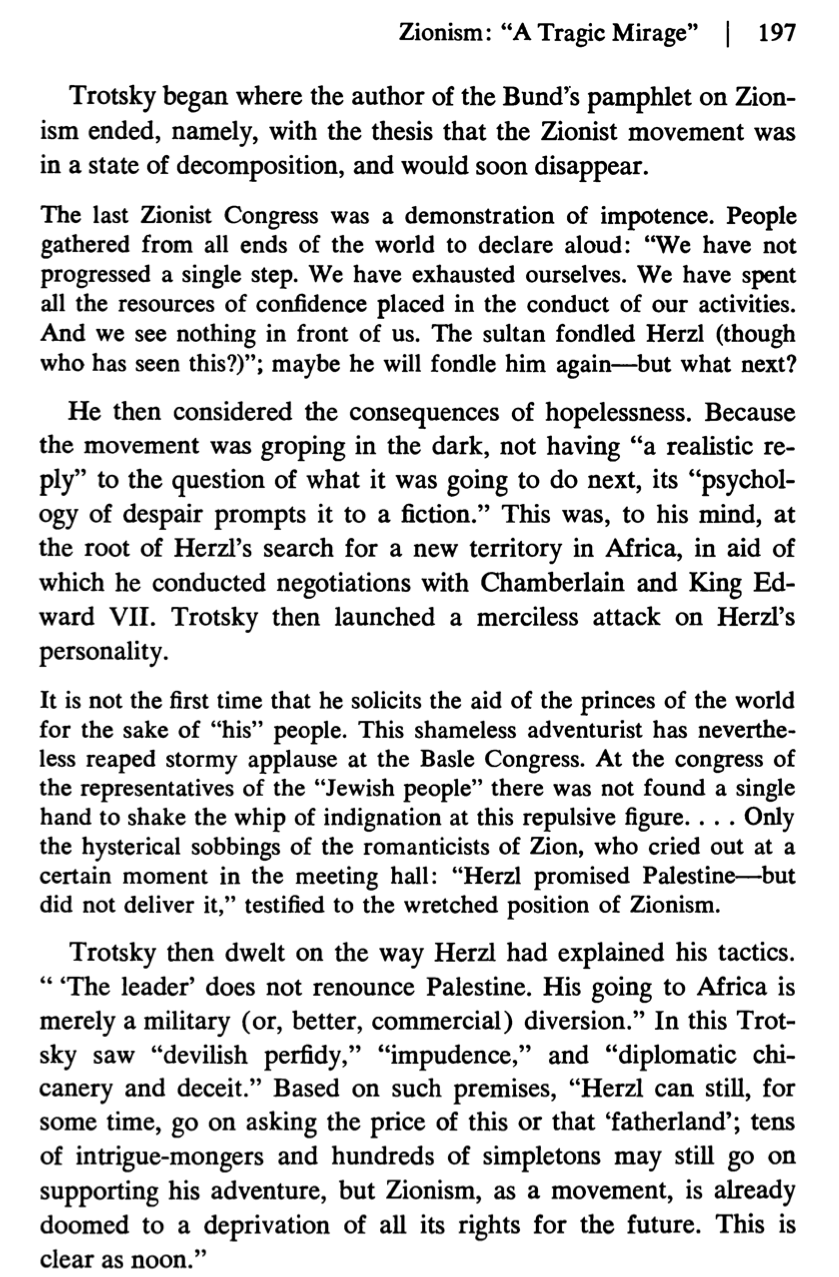
When I say Zionist in this story, you need to think of mostly young, fierce, fiery radicals drawn from the same pool of revolutionaries that will soon be putting people against the wall in Communist Russia in just a few years. In fact, Zionism was competing for recruits with Bolshevism and these other radical movements. It’s a competition which Winston Churchill and maybe typical Churchillian hyperbole would later call, quote, little less than a struggle for the soul of the Jewish people. Leon Trotsky, who would found and command the Soviet Red Army in the Russian Revolution, he was at the 6th Zionist Congress and many other early meetings.
-
Idea that Trotsky was aligned with the Zionist is unfounded and misleading, attempting to link Zionism with the deaths in Soviet Russia.
-
Trotsky and the “Jewish Question”
Convinced that there was no future for the Jews as a separate people, Trotsky favored their assimilation. At the second congress of the Russian Social Democratic Party (1903), he attacked the *Bund, claiming that despite its opposition to Zionism, it had adopted the nationalist character of Zionism. After the Sixth Zionist Congress he wrote an article in Iskra prophesying the disappearance of the movement (Jan. 1, 1904).Trotsky visualized the solution of the Jewish problem only through the socialist reshaping of society within an international framework. But he was quite aware of the fact that his Jewish origin was a political handicap. When Lenin, after the victory of Nov. 7, 1917, proposed to put him at the head of the first Soviet government, Trotsky refused, and – in his own words (Moya Zhizn, II, 62–63) – mentioned “among other arguments the national aspect: would it be wise to give into the hands of the enemies such an additional weapon as my being Jewish?” Later he was shocked at the antisemitic innuendos of the campaign conducted against him in the late 1920s in the Soviet Union and he later emphasized the antisemitic undertones of the Moscow trials against Zinoviev, Kamenev, and others. In an interview with the New York Jewish Daily Forward, he admitted, in 1937, that the reemergence of antisemitism in Germany and the U.S.S.R. had brought him to the conclusion that the Jewish problem required a territorial solution, but he did not believe that Palestine was the answer; and the final solution would come only through the emancipation of all humanity by international socialism. “The longer the rotten bourgeois society lives, the more and more barbaric will antisemitism become everywhere,” he said in the same interview.
In Trotsky and the Jews (1972), J. Nedava has made a special study of this question, throwing new light on the subject and revealing, inter alia, that Trotsky sat as an adviser at the Sixth Zionist Congress in Basle (1903), and later became increasingly interested in the Jewish Labor Movement in Ereẓ Israel.
Trotsky (Bronstein), Lev Davidovich -
Herzl by Amos Elon
Although technically a victory for Herzl, the vote heralded his defeat. A storm broke loose. Threatening secession, the Russian members of the Actions Committee left their seats on the dais. Followed by their supporters, they marched out of the hall. Once outside, according to Israel Cohen, an eyewitness, “they gave vent to indignation and grief, without restraint. Many fell on one another’s necks and wept. One man fainted, and all presented the most doleful and mournful looks, as though Zion had been abandoned forever.” Leon Trotsky, observing the stormy scene from the press gallery, predicted the imminent collapse of the Zionist movement. (pg. 388) -
Trotsky and the Jews by J. Nedava
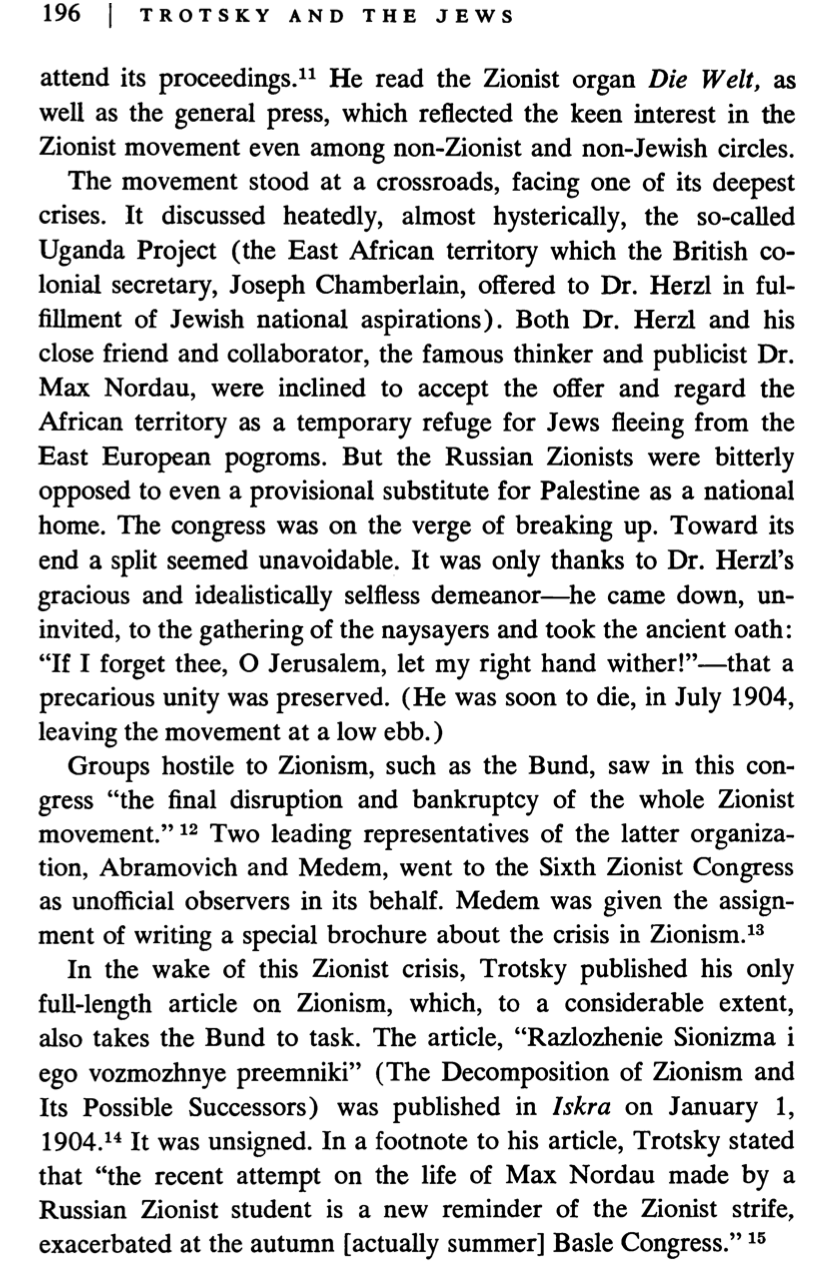
Trotsky must have followed very closely the Sixth Zionist Congress at Basle in 1903. Shortly after the close of the Second Social-Democratic Congress in London he arrived in Switzerland, at the very time when the Zionist Congress was taking place, in August. It should be noted that this congress marked the zenith of Dr. Herzl’s activities, and the Zionist Organization was granted an international status following the diplomatic negotiations which had been carried on by the British government with its representatives. Preparations for convening the Zionist Congress were well publicized by the world press, and Trotsky was attracted-either on his own account or through his Bundist acquaintances-to196 TR 0 TS KY AND THE JEWS attend its proceedings.11 He read the Zionist organ Die Welt, as well as the general press, which reflected the keen interest in the Zionist movement even among non-Zionist and non-Jewish circles.
Quote
Ignoring for the moment their somewhat confusing conflation of the Turks with the descendants of Ishmael, notice that the Arabs and the Muslims are not the enemy in 1882. The Europeans and the Russians are the enemy they’re talking about, clad in the rough skins of the wolf and the bear and running through the dark woods like savages. Our brother Ishmael is looked upon as a friend. This is important because, again, you’ll often hear people say that the Israeli-Palestinian conflict is a fight that goes back thousands of years. The implication is that it has no beginning, has no end, has no discernible cause. It’s just ancient ethnic and religious hatred. These people just hate each other and that’s that. It’s very important to understand that this simply isn’t true. The world was a less tolerant and inclusive place over most of the last millennium, of course, but with that qualification, overall you could say that the Muslims and the Jews got on pretty well. Larry Collins in his book, O Jerusalem, about the birth of the State of Israel, he wrote, quote, with few exceptions, the Jewish people had dwelt in relative security among the Arabs over the centuries. The golden age of the Diaspora had come in the Spain of the Caliphs and the Ottoman Turks had welcomed the Jews when the doors of much of Europe were closed to them. The ghastly chain of crimes perpetrated on the Jewish people culminating in the crematoriums of Germany had been inflicted on them by the Christian nations of Europe, not those of the Islamic East, end quote. You can see that in the Bilu Manifesto and in the writings of a lot of the early Zionists. To them, the Christians were the threat, the Europeans, the Muslims were all right. To a lot of people, writing this off as some intractable ancient feud is also pretty convenient. It saves us from having to learn too much about it.
- Grok Analysis
- Historical Context and Jewish-Muslim Relations
The claim that Jews and Muslims got along “pretty well” throughout history requires a nuanced understanding, as relations varied by time, region, and political context. Under Islamic rule, Jews were typically considered dhimmis, a protected minority status that granted certain rights, such as religious practice, but also imposed restrictions, like the jizya tax. Compared to Christian Europe, where Jews faced widespread pogroms, expulsions, and the Inquisition, their situation in the Islamic world was often better, allowing for periods of coexistence and cultural flourishing.
A notable example is the Golden Age of Jewish culture in Spain (8th-12th centuries) under Moorish (Muslim) rule, where Jews like Maimonides contributed significantly to philosophy, science, and medicine. When Jews were expelled from Spain in 1492, many found refuge in the Ottoman Empire, with Sultan Bayezid II reportedly welcoming them, stating, “You venture to call Ferdinand a wise ruler, he who has impoverished his own country and enriched mine!” (History of the Jews in the Middle East). This historical precedence supports the idea of relative security under Muslim rule. - However, it’s important to acknowledge exceptions. In the 11th century, there were pogroms against Jews in North Africa and the Middle East, such as in Granada in 1066, where thousands were killed. In the 19th century, incidents like the 1840 Damascus affair involved anti-Jewish violence, and there were periodic tensions in Yemen and Morocco. Bernard Lewis, a prominent historian, has critiqued the “myth” of Islamic tolerance, arguing it was not equal to modern Western standards, though he notes it was generally better than Christian Europe’s treatment (The Jews of Islam by Bernard Lewis).
- Counter to Martyr Made’s narrative of Jews European colonizers
- At this time, the local Muslim population, primarily Arab, was not initially seen as the primary enemy by Jewish immigrants. Historical accounts suggest early cooperation, with local Arab farmers selling land to Jews and sometimes working for them. For instance, in Rishon LeZion, established in 1882, there were reports of Arab laborers helping with agricultural work, and economic interactions were common (First Aliyah - Wikipedia). While there were minor conflicts, such as a 1886 water rights dispute in Petah Tikva, these were not widespread, and relations were relatively peaceful compared to later periods.
- For Muslims, European colonialism was a significant adversary, with the British occupation of Egypt in 1882 seen as a direct threat, and Russia’s gains after the Russo-Turkish War a concern. This shared external pressure likely fostered a sense that both groups viewed Europeans and Russians as enemies rather than each other, supporting the user’s narrative for 1882.
- Early Zionist writings, like the Bilu Manifesto of 1882, also reflect this perspective, focusing on the challenges of settling in the Land of Israel and dealing with Ottoman authorities, rather than viewing the local Muslim population as enemies. The Bilu Movement saw their mission as benefiting the entire population, including Arabs, suggesting initial cooperation (First Aliyah - Wikipedia).
- Historical Context and Jewish-Muslim Relations
On Joe Rogan
Kristallnacht
Quote
“Like in 1938, which is pretty far down the line when Kristallnacht happened. And it was kind of a nationwide pogrom against the Jews in Germany that was launched by primarily by Goebbels, the propaganda minister. But there was outrage in the German cities. People in Berlin , a lot of the places were outraged by what was going on. And Hitler had to actually get on the phone with Goebbels and say, cut this shit out. Like this is not good. Not because he loves the Jews all of a sudden obviously but because this is bad propaganda.”
The first thing I fact checked from Darryl Cooper on Joe Rogan ends up being false. Hitler’s reaction to Kristallnacht WAS NOT to “get on the phone with Goebbels and say, cut this shit out.” Hitler didn’t condemn or have concern about public perception from the attacks publicly or in private. Darryl seems to have confused Hitler’s reaction to “Night of the Long Knives” with Kristallnacht. Confusion weaves itself into many corners of Darryl’s portrayal of WWII history, unraveling its coherence as it spreads.
https://x.com/zyntonone/status/1900354738022953210
Grok
Adolf Hitler’s reaction to Kristallnacht, the violent anti-Jewish pogrom that took place on November 9–10, 1938, has been a subject of historical debate, particularly regarding claims that he opposed the event or ordered it stopped. Let’s examine the evidence and address the specific claim that Hitler told Joseph Goebbels, his Propaganda Minister, to stop it.

Hitler’s Reaction to Kristallnacht

Historical records indicate that Hitler was aware of and authorized the escalation of violence that became Kristallnacht. On November 9, 1938, Nazi Party leaders, including Hitler and Goebbels, were in Munich commemorating the anniversary of the 1923 Beer Hall Putsch. That evening, news arrived of the death of Ernst vom Rath, a German diplomat assassinated in Paris by Herschel Grynszpan, a Jewish teenager. This event provided the pretext for the pogrom. After discussions with Hitler, Goebbels delivered a fiery speech to Nazi officials, stating that “the Führer has decided that… demonstrations should not be prepared or organized by the Party, but insofar as they erupt spontaneously, they are not to be hampered.” This phrasing was widely understood as a green light for violence, with the caveat that the Party should not appear as the official instigator.

Hitler left the gathering abruptly without giving his usual address, leaving Goebbels to relay his instructions. The subsequent violence—coordinated attacks on Jewish homes, businesses, and synagogues—was carried out by SA (Storm Troopers), SS, and Hitler Youth units, often in civilian clothes to maintain the illusion of spontaneity. This suggests Hitler’s tacit approval rather than opposition. Goebbels’ diary entries further support this: he noted that Hitler was informed of early disturbances and approved their continuation and expansion. For instance, Goebbels wrote that he briefed Hitler on the unfolding events and that Hitler agreed to let the actions proceed.

There is no direct evidence from primary sources—such as Hitler’s own statements, orders, or contemporary Nazi documentation—that he expressed disapproval of Kristallnacht during or immediately after the event. On November 10, 1938, Hitler attended a press conference in Munich alongside Goebbels but made no mention of the pogrom, focusing instead on unrelated matters. This silence contrasts with claims of condemnation. Additionally, a report from the Supreme Nazi Party Court after the pogrom confirmed that Goebbels had invoked Hitler’s approval during his speech, stating that the Führer supported the actions.

Some Nazi officials, like Heinrich Himmler, later expressed frustration with the pogrom’s diplomatic fallout, and Goebbels himself noted in his diary on November 10 that Hitler wanted to assess the situation further. However, this reflects strategic evaluation, not moral or practical opposition to the violence itself. The pogrom continued into November 10, with orders from Reinhard Heydrich (head of the Security Police) at 1:20 a.m. reinforcing its execution, including arrests of Jews and protection of non-Jewish property—directives consistent with Hitler’s broader anti-Semitic policies.

Fact-Checking the Claim: Did Hitler Tell Goebbels to Stop It?

The claim that Hitler told Goebbels to stop Kristallnacht lacks substantiation in historical records. Holocaust deniers, notably David Irving, have asserted that Hitler was “livid with rage” upon learning of the pogrom and ordered Goebbels and others to halt it. Irving claimed Hitler sent aides like Julius Schaub to curb the violence. However, this narrative is contradicted by primary evidence:

1. Goebbels’ Diary: Goebbels recorded that Hitler was briefed on the pogrom’s early stages and approved its escalation. There is no entry indicating Hitler ordered it stopped. Instead, Goebbels noted a meeting with Hitler on November 10 to review the pogrom’s impact, suggesting ongoing coordination rather than a directive to cease.

2. Telexes and Orders: Telegrams issued during the night of November 9–10, such as Heinrich Müller’s at 11:55 p.m. and Heydrich’s at 1:20 a.m., instructed police and SA units to facilitate the pogrom, not stop it. A later telex on November 10 forbade arson of Jewish shops (likely to protect German-owned property), but this was a tactical adjustment, not a cessation order.

3. Hitler’s Behavior: Hitler’s absence from public condemnation and his delegation of the pogrom’s messaging to Goebbels align with his typical strategy of maintaining plausible deniability while supporting anti-Jewish actions. No documented order from Hitler to Goebbels or anyone else exists to suggest he intervened to stop the violence.

4. Post-Event Actions: After Kristallnacht, the Nazi regime imposed a 1-billion-Reichsmark fine on Jews and accelerated anti-Semitic policies, such as barring Jews from economic life. These measures, endorsed by Hitler, indicate he viewed the pogrom as a success, not a misstep to be reversed.


Claims of Hitler’s opposition often stem from misinterpretations or revisionist agendas. For example, posts on X have referenced a speech Hitler allegedly gave on November 10 condemning the violence, but no such speech is documented. His known address that day avoided the topic entirely. Similarly, assertions about Goebbels’ diary revealing Hitler’s displeasure are vague and unsupported by published excerpts, which instead show Hitler’s alignment with the pogrom’s goals.

Conclusion

Hitler’s reaction to Kristallnacht was one of approval and authorization, not opposition. He sanctioned the violence through Goebbels and allowed it to proceed as a demonstration of Nazi power against Jews. The claim that he told Goebbels to stop it is not supported by credible historical evidence and appears to be a distortion, possibly originating from Holocaust denial narratives. Instead, the pogrom marked a turning point toward more overt and violent anti-Semitism, consistent with Hitler’s long-term objectives, culminating in the Holocaust.
ChatGPT
Hitler’s reaction to **Kristallnacht** (November 9–10, 1938) was largely indirect and strategic. He did not publicly comment on the pogrom, nor did he issue direct orders for it to happen. However, his actions before and after suggest approval and encouragement of the violence.


**Before Kristallnacht:**

• Hitler had long used antisemitic rhetoric, blaming Jews for Germany’s economic and political struggles.

• He allowed and encouraged the increasing persecution of Jews under Nazi rule.

• Joseph Goebbels, Hitler’s Minister of Propaganda, played a major role in instigating the violence by framing it as a “spontaneous outburst of public anger” after the assassination of a German diplomat (Ernst vom Rath) by a Polish-Jewish teenager (Herschel Grynszpan).


**During Kristallnacht:**

• Hitler was in a Munich restaurant celebrating the anniversary of the 1923 Beer Hall Putsch when he was informed of the unfolding violence.

• Reports suggest he left the event early and allowed Goebbels to take the lead in coordinating further attacks.

• The Nazi Party’s SA and SS forces received implicit approval to escalate the destruction of Jewish homes, businesses, and synagogues across Germany and Austria.


**After Kristallnacht:**

• Hitler **did not publicly condemn the attacks**. Instead, he allowed Goebbels to spin the event as an organic reaction of the German people.

• The Nazi regime **blamed the Jews for the destruction** and **imposed a massive fine of 1 billion Reichsmarks** on the Jewish community to pay for the damages.

• Jewish businesses and property were forcibly confiscated, accelerating Hitler’s goal of Jewish economic exclusion.

• Tens of thousands of Jews were arrested and sent to concentration camps, marking a significant escalation in Nazi persecution.


In essence, while Hitler did not personally direct Kristallnacht, he **permitted and benefited from it**, using it as a pretext for harsher policies against Jews. The event was a key step in the Nazi regime’s transition from economic and social oppression to open physical violence and, ultimately, the Holocaust.

Hitler’s reaction to the **Night of the Long Knives** (June 30 – July 2, 1934) was one of **public justification and private relief**, as the purge solidified his control over the Nazi Party and the German military.


**Background:**

• The purge targeted **Ernst Röhm** and the **SA (Sturmabteilung)**, the Nazi paramilitary organization that had helped Hitler rise to power but had become a liability.

• The German Army (Reichswehr) and conservative elites viewed Röhm and the SA as a threat due to their radical demands for a “second revolution” and their desire to absorb the army into the SA.

• Hitler also used the purge to eliminate **political opponents** beyond the SA, including former Chancellor **Kurt von Schleicher** and conservative critics like **Gregor Strasser**.


**Hitler’s Immediate Reaction:**

• On **June 30, 1934**, Hitler personally arrested Röhm in Munich and authorized widespread executions of SA leaders and political enemies.

• He framed the purge as a **necessary action to prevent a coup**, though there was no real evidence of an impending uprising.

• Over **85 people were killed (possibly more)**, and many others were arrested or disappeared.


**Public Justification (July 13, 1934):**

• In a **speech to the Reichstag**, Hitler **took full responsibility**, claiming he acted as **“the supreme judge of the German people”** to prevent an SA uprising.

• He framed the killings as **self-defense** against treasonous elements, stating, _“If anyone reproaches me and asks why I did not resort to the regular courts, all I can say is this: In this hour, I was responsible for the fate of the German people, and thereby I became the supreme judge of the German people.”_

• He emphasized **loyalty to the Führer** and portrayed the army as a key ally in ensuring stability.


**Aftermath and Long-Term Impact:**

• **Hitler was relieved and emboldened**—the purge had removed a major internal threat and demonstrated his ability to act decisively.

• The **SA was sidelined**, with its membership reduced and its power drastically diminished.

• The **German Army** and conservative elites, reassured by Röhm’s execution, pledged allegiance to Hitler.

• On **August 2, 1934**, after President **Paul von Hindenburg** died, Hitler combined the roles of President and Chancellor, making himself the **absolute dictator (Führer) of Germany**.


**Conclusion:**


The **Night of the Long Knives** was a turning point that secured Hitler’s total control. His reaction—both immediate and long-term—demonstrated his willingness to use violence to maintain power, and his ability to manipulate public opinion to justify his actions.

There is no definitive record of Hitler telling Joseph Goebbels that the **Night of the Long Knives** was “bad propaganda.” However, some sources suggest that Hitler was initially concerned about how the public and Nazi supporters would perceive the mass killings—particularly because many of those executed, like **Ernst Röhm**, had been loyal members of the Nazi movement.


**Hitler’s Immediate Reaction**

• After personally overseeing the arrests and executions, Hitler reportedly had moments of **unease**, particularly regarding the **brutality** of the purge and how it might be received by the German people.

• Some accounts suggest that Hitler **worried about public opinion** and whether the killings would damage his image as a strong but just leader.

• However, Goebbels, as Minister of Propaganda, **worked to frame the purge positively**, portraying it as a **necessary action** to prevent a supposed SA coup and ensure national stability.


**Did Hitler Say It Was “Bad Propaganda”?**

• There is no strong historical evidence that Hitler explicitly told Goebbels that the purge was bad for Nazi propaganda.

• If he did express **concern**, it was likely over how to manage public perception rather than disapproval of the purge itself.

• Goebbels successfully spun the events in Nazi-controlled media, portraying Hitler as a **decisive leader who had saved Germany from chaos**.


**Public Justification & Outcome**

• **On July 13, 1934**, Hitler **publicly defended the purge** in a Reichstag speech, stating he had been the **“supreme judge”** protecting Germany.

• The German public, for the most part, **accepted** the justification, and the army **welcomed the removal of the SA’s influence**.

• Far from being “bad propaganda,” the purge ultimately **consolidated Hitler’s power** and increased loyalty to him.


So while Hitler may have briefly **worried about perception**, he did not oppose the purge in principle, and with Goebbels’ skillful propaganda, it **reinforced** rather than weakened his dictatorship.
Hitler’s Speeches
Quote
“It’s not like Hitler was going and giving big speeches at City Square in Berlin going on and on and on about how we’re going to kill the Jews. And the German people said right on, like, let’s go do it. That was like the speeches that are out there where he is talking about the Jewish question, like almost all of those are like internal Nazi party like rally speeches. You know, they’re not him he had to be careful about that.”
Fact Check #2: Darryl Cooper on Joe Rogan said, “It’s not like Hitler was going and giving big speeches at City Square in Berlin going on and on and on about how we’re going to kill the Jews. And the German people said right on, like, let’s go do it. That was like the speeches that are out there where he is talking about the Jewish question, like almost all of those are like internal Nazi party like rally speeches. You know, they’re not him he had to be careful about that.” False: While you could skew and say Hitler’s 30 January 1939 Reichstag Speech was an “internal Nazi Party” rally—that’d be disingenuous as all of Hitler’s “internal” speeches were heavily broadcast reaching millions via radio, newsreels and newspapers. Hitler was NOT “careful about that.” Just to demonstrate this contortion of history, Hitler had a speech titled, “Why are we antisemites?” in 1920 delivered at Munich’s largest brewery and public house.
https://x.com/zyntonone/status/1900354284996210824
ChatGPT
Yes, **Hitler’s Reichstag speeches were heavily broadcast throughout Germany**, reaching millions via **radio, newsreels, and newspapers**. This was a crucial part of **Joseph Goebbels’ propaganda strategy** to ensure Hitler’s voice and message dominated public discourse.

**How Were Reichstag Speeches Broadcast?**

1. **Radio (Volksempfänger - “People’s Receiver”)**

• The Nazi regime made radio ownership widespread, even producing cheap radios (Volksempfänger) so that almost every household could listen.

• Major Reichstag speeches were **broadcast live** nationwide, with workplaces, cafes, and public squares setting up loudspeakers so that **everyone would hear**.

• The speeches were **replayed** multiple times for those who missed them.

2. **Loudspeakers in Public Spaces**

• To ensure maximum reach, Nazis installed loudspeakers in **factories, schools, and town squares**.

• On major speech days, businesses and public life **paused** so people could listen.

3. **Newsreels in Cinemas**

• Since radio only conveyed Hitler’s voice, Nazi-controlled newsreels showed him **speaking in full force** in theaters across Germany.

• These clips **highlighted key moments**, portraying Hitler as a decisive and commanding leader.

4. **Newspapers & Magazines**

• Nazi newspapers like **Völkischer Beobachter** and **Der Angriff** printed **full transcripts** of Hitler’s speeches.

• **Propaganda posters and pamphlets** summarized key points for those who didn’t listen.


**Impact on the German Public**

• **Controlled Narrative:** Since all media was state-controlled, there was no room for alternative interpretations.

• **Emotional Manipulation:** Hitler’s passionate delivery, combined with Nazi propaganda, **reinforced nationalistic fervor**.

• **Cult of Personality:** The constant exposure made Hitler seem **omniscient and all-powerful**.


**Conclusion**


Yes, Hitler’s **Reichstag speeches were intensely broadcast across Germany**, ensuring that his messages reached the entire population. This wasn’t just about policy—it was a **propaganda tool** used to shape public opinion, maintain control, and justify Nazi actions.

- **Grok**

**Reichstag Speeches**

• These were often **formal, policy-driven addresses** meant to justify Nazi actions, such as the **Reichstag Fire Decree (1933)**, the **Night of the Long Knives defense (1934)**, and his **justifications for war (1939–1941)**.

• Since the Reichstag was essentially a **rubber-stamp parliament** under Nazi control, these speeches were less about debate and more about **publicly legitimizing his rule** and decisions.

• Key examples include:

• **February 1, 1933** – First speech as Chancellor, outlining his authoritarian vision.

• **September 1, 1939** – Declaring war on Poland.

• **December 11, 1941** – Declaring war on the United States.


**Public Speeches (Mass Rallies & Propaganda Events)**

• Hitler thrived in large-scale **public rallies**, where he could stir up **nationalist fervor and emotional loyalty** among the masses.

• His most famous public speeches were at **Nuremberg Rallies** (held annually from 1923 to 1938), where he delivered fiery rhetoric to massive crowds of uniformed Nazis.

• Other public addresses took place in **Munich, Berlin, and Vienna**, often after major political victories.

• Key examples include:

• **January 30, 1933** – Proclaiming the Nazi rise to power in Berlin.

• **March 1938 (Anschluss)** – Addressing 200,000 people in Vienna after annexing Austria.

• **September 26, 1938** – Speech in Berlin demanding the Sudetenland from Czechoslovakia.


**Radio & Media Influence**

• Hitler’s speeches were heavily broadcast via **radio, newsreels, and printed media**, ensuring his voice reached millions, even those who couldn’t attend in person.

• Goebbels made sure Hitler’s speeches were **carefully staged and widely disseminated**, reinforcing his presence as the “savior” of Germany.


**Conclusion**


While Hitler used **Reichstag speeches** for official justifications and war declarations, his **real power** came from **public speeches**, where his intense delivery, theatrical style, and propaganda tactics could **electrify** crowds and deepen his grip on the German people.

Adolf Hitler frequently addressed his antisemitic ideology in numerous speeches throughout his rise to power and during his leadership of Nazi Germany. Notable instances include:

**1. 30 January 1939 Reichstag Speech:**

In this address, Hitler issued a chilling warning:


“If the international Jewish financiers inside and outside Europe should succeed in plunging the nations once more into a world war, then the result will not be the Bolshevization of the earth, and thus the victory of Jewry, but the annihilation of the Jewish race in Europe.”


This statement, later referred to as “Hitler’s prophecy,” was widely disseminated through Nazi propaganda channels. It became a central theme in subsequent speeches and writings, underscoring the regime’s genocidal intentions.


**2. 30 September 1942 Speech at the Sportpalast:**

Hitler reiterated his earlier threat, emphasizing the ongoing execution of his so-called prophecy:


“On September 1, 1939, in the meeting of the Reichstag I said two things… if Jewry imagines itself to be able to lead an international world war to exterminate the European races, then the result will not be the extermination of the European races but rather the extermination of Jewry in Europe!”


He further asserted that those who once mocked his predictions were no longer laughing, implying the systematic extermination of Jews was underway.


**3. 8 November 1942 Speech:**

During his annual address commemorating the Beer Hall Putsch, Hitler declared:


“National Socialist prophecies are not empty phrases… If Jewry imagines itself to be able to lead an international world war to exterminate the European races, then the result will not be the extermination of the European races but rather the extermination of Jewry in Europe!”


He claimed that Jews were no longer laughing at his prophecies, insinuating that their annihilation was actively being realized.


These speeches exemplify Hitler’s persistent and escalating antisemitic rhetoric, which laid the ideological groundwork for the Holocaust.

Yes, Adolf Hitler frequently addressed antisemitic themes in his speeches and writings well before 1939. Notable instances include:

**1. Early Speeches (1920s):**

• In an April 1920 meeting, Hitler declared: “We will carry on the struggle until the last Jew is removed from the German Reich.”

• In a 1920 letter to Konstantin Hierl, Hitler wrote: “The Jew… becomes and has become through thousands of years in his work the racial tuberculosis of the peoples. To fight him is to destroy him.”


**2. Mein Kampf (1925–1926):**

• Hitler’s autobiography is replete with antisemitic rhetoric, describing Jews as “parasites” and “vermin.” He suggested that if “twelve or fifteen thousand of these Hebrew corrupters of the people had been held under poison gas… the sacrifice of millions at the front would not have been in vain.”


**3. Nuremberg Rally (1935):**

• At the 1935 Nazi Party Congress in Nuremberg, Hitler announced the implementation of the Nuremberg Laws, which institutionalized racial discrimination against Jews, stripping them of citizenship and prohibiting intermarriage with Germans.


These examples illustrate that antisemitism was a central and persistent theme in Hitler’s ideology and public addresses long before 1939.
Grok
Key Points
-
Research suggests Hitler gave several speeches before 1939 mentioning Jews, focusing on anti-Semitic themes.
-
It seems likely that key speeches include February 24, 1920, August 13, 1920, April 12, 1922, April 24, 1923, November 10, 1933, and September 15, 1935.
-
The evidence leans toward these speeches outlining his views on Jewish exclusion and racial superiority, with varying levels of detail.
Overview
Adolf Hitler’s speeches before 1939 often included references to Jews, reflecting his anti-Semitic ideology central to Nazi policy. These speeches, delivered during his rise to power and early leadership, laid the groundwork for later discriminatory laws and actions. Below, we explore the main speeches and their contexts, providing a clear picture for those unfamiliar with this history.
Early Speeches (1920–1923)
Hitler’s early speeches, such as those in 1920 and 1922, introduced his anti-Semitic views, framing Jews as a threat to German identity. For example, on February 24, 1920, he presented the 25-point program, which included excluding Jews from citizenship, and on August 13, 1920, he gave a speech titled “Why are we Antisemites?” These set the tone for his later rhetoric.
Mid-1930s Speeches
By 1933, as Chancellor, Hitler continued this theme, with a speech on November 10, 1933, at the Siemens Dynamo Works likely referring to Jews as internationalists. The September 15, 1935, speech announcing the Nuremberg Laws was a significant escalation, legally defining Jews and stripping their rights, marking a formalization of his earlier rhetoric.
Unexpected Detail
An unexpected detail is the November 10, 1933, speech, where he may have indirectly referenced Jews, suggesting a subtler approach compared to his more explicit earlier statements, possibly to appeal to a broader audience.
Survey Note: Detailed Analysis of Hitler’s Speeches Before 1939 Mentioning Jews
This section provides a comprehensive examination of Adolf Hitler’s speeches before 1939 that explicitly or implicitly mentioned Jews, reflecting his anti-Semitic ideology and its evolution. The analysis is grounded in historical records and aims to offer a detailed, professional overview for readers seeking depth beyond the key points.
Historical Context and Methodology
Hitler’s speeches from his early political career through his chancellorship were pivotal in shaping Nazi policy, particularly regarding Jews. The focus here is on speeches before 1939, interpreted as up to December 31, 1938, to align with standard historical timelines. Sources include compiled speech collections, such as Norman H. Baynes’ “The Speeches of Adolf Hitler, April 1922 to August 1939” The Speeches of Adolf Hitler, April 1922 to August 1939, and historical archives like Wikipedia’s list of speeches List of speeches given by Adolf Hitler.
The analysis identifies speeches where Jews were mentioned, either directly by name or through coded language, and categorizes them by date, location, and content. This approach ensures a thorough survey, acknowledging the complexity of interpreting historical rhetoric and the sensitivity of the topic.
Detailed List of Speeches
Below is a table summarizing the identified speeches, with dates, locations, and key content related to Jews:
| Date | Location | Key Content Related to Jews |
|---|---|---|
| February 24, 1920 | Munich | Presented the 25-point program, including Point 4: “Only a member of the race can be a citizen. A member of the race can only be one who is of German blood, without consideration of faith. Consequently no Jew can be a member of the race.” |
| August 13, 1920 | Munich | Titled “Why are we Antisemites?”, explicitly outlining his early anti-Semitic views, framing Jews as a racial threat. |
| April 12, 1922 | Munich | Stated, “There are only two possibilities: either victory of the Aryan, or annihilation of the Aryan and the victory of the Jew,” emphasizing a racial struggle. |
| April 24, 1923 | Munich | Remarked, “The Jew who coined the word meant by ‘Proletariat,’ not the oppressed, but those who work with their hands,” linking Jews to economic exploitation. |
| November 10, 1933 | Berlin | Speech at the Siemens Dynamo Works, likely referring to Jews as internationalists with the statement, “They are the only ones who can be addressed as international, because they conduct their business everywhere, but the people cannot follow them,” though not explicitly named BBC - History - World Wars: Audio: Hitler and the Jews . |
| September 15, 1935 | Nuremberg | Announced the Nuremberg Laws, legally defining Jews racially and stripping their rights, a formalization of earlier rhetoric, during the Reichstag session Nuremberg Laws . |
Analysis of Each Speech
- February 24, 1920, Munich: This speech introduced the Nazi Party’s 25-point program, a foundational document that included anti-Jewish measures. Point 4 explicitly excluded Jews from citizenship, reflecting Hitler’s intent to segregate them from German society. This was a public declaration at a large party gathering, setting the stage for future policies The Nazi Party 25 Points (1920) - document extract.
- August 13, 1920, Munich: Titled “Why are we Antisemites?”, this speech was an early articulation of Hitler’s racial ideology, framing Jews as a threat to German purity. It was delivered to an audience of about 2,000, interrupted 58 times by cheering, indicating strong support List of speeches given by Adolf Hitler.
- April 12, 1922, Munich: In this speech, Hitler posed a binary choice between Aryan victory and Jewish dominance, reinforcing his narrative of racial struggle. This rhetoric was part of his broader campaign to mobilize support, emphasizing the need for Aryan supremacy The Speeches of Adolf Hitler, April 1922 to August 1939.
- April 24, 1923, Munich: Here, Hitler linked Jews to economic exploitation, suggesting they manipulated the concept of the proletariat. This speech continued his theme of blaming Jews for Germany’s woes, aligning with his economic and racial arguments The Speeches of Adolf Hitler, April 1922 to August 1939.
- November 10, 1933, Berlin: Delivered at the Siemens Dynamo Works, this speech is less explicitly documented for Jewish references, but historical analysis suggests he referred to Jews as internationalists, a common Nazi trope. This was broadcast live, reaching a wide audience, and reflects a subtler approach post-chancellorship BBC - History - World Wars: Audio: Hitler and the Jews.
- September 15, 1935, Nuremberg: This speech announced the Nuremberg Laws, a legal framework for racial discrimination against Jews, marking a significant escalation. It was delivered at the Nazi Party rally, formalizing earlier rhetoric into law, and had profound implications for Jewish rights Nuremberg Laws.
Additional Considerations and Gaps
Research suggests there may be other speeches, particularly in 1938, such as during the Kristallnacht period, but no direct speeches by Hitler on that event mentioning Jews were found, with Goebbels taking a more prominent role. The November 10, 1933, speech’s reference to Jews is inferred, highlighting the need for caution in interpretation due to potential indirect language.
An unexpected detail is the evolution from explicit early rhetoric to more coded references in the 1930s, possibly to maintain diplomatic relations while signaling to core supporters. This shift underscores the complexity of analyzing Nazi propaganda, where subtlety could mask intent.
Conclusion
The identified speeches before 1939 reflect Hitler’s consistent anti-Semitic narrative, evolving from ideological foundations to legal implementation. They provide insight into the ideological groundwork for the Holocaust, with each speech contributing to the escalation of Nazi policy. For further reading, consult the cited sources for primary texts and historical analysis.
Key Citations
- [List of speeches given by Adolf Hitler](https://en.wikipedia.org/wiki/List of speeches given by Adolf Hitler)
- The Speeches of Adolf Hitler, April 1922 to August 1939
- [Nuremberg Laws](https://en.wikipedia.org/wiki/Nuremberg Laws)
- BBC - History - World Wars: Audio: Hitler and the Jews
- The Nazi Party 25 Points (1920) - document extract
f
Hitler Never Compromised
Quote
If people think of him as like a politician, they’re missing a big part of what he was about. Like if anything, he was more like a prophet figure. He saw himself as like almost like a not a religious figure in the sense that he was sent by God and anything like that.
But that he had this like sacred mission to save the German people. And these were not political questions. It’s why he just he never compromised even when it seemed insane not to compromise. Like in 1923 when the French invaded. Western Germany to take over a lot of their industrial area, all the parties, right, left, and center, all came together to like oppose that in Germany.
And he stayed out of it. He ordered all of his, you know, his whole party to stay out of it because he was not going to, you know, accept the compromises that were going to come with working with the other groups.
Kaufman’s Book
https://x.com/zyntonone/status/1904038261774778635
https://x.com/noam_dworman/status/1903940043426709736
Podcast: WWII
https://x.com/crocoduck_king/status/1894777439265734880
Churchill
https://x.com/DrewPavlou/status/1835587339487494517
His Books
List
If a person said his politics is contained within this list of books, what would you say that person’s politics would be?
The Betrayal of the American right rothbard
The Constitution of Liberty Friedrich A. Hayek
history of political philosophy strauss
Political Paranoia: The Psychopolitics of Hatred Robert S. Robins , Jerrold Post
The Ruin of Kasch Roberto Calasso
Alienated America: Why Some Places Thrive While Others Collapse Timothy P. Carney
Coming Apart: The State of White America, 1960-2010 Charles Murray
The Dark Side of Modernity Jeffrey C. Alexander
Imperialism: A Study J.A. Hobson
Europe’s Orphan: The Future of the Euro and the Politics of Debt Martin E. Sandbu
The Political Economy of Theocracy Ronald Wintrobe , M. Ferrero
Unqualified Reservations, Vol. 01 Curtis Yarvin
On Resistance to Evil by Force Ivan Ilyin
Unjust Justice: Against the Tyranny of International Law Chantal Delsol
Bowling Alone Putnam
Social origins of dictatorships and democracy Moore
Icarus fallen delsol
Fascism Gottfried
The Crisis of Parliamentary democracy Schmitt
Nationalism Keith woods
The Lonely Crowd: A Study of the Changing American Character David Riesman
The power of the powerless Sharpe
The managerial revolution Burnham
Imagined communities Anderson
The republic plato
Rules for radicals alinsky
The captive mind Milosz
Political parties Michels
Foods frauds and firebrands Roger Scruton
Delusion James glass
The unlearned lessons of the twentieth century Delsol
Propaganda formation of men’s attitudes ellul
Power and the idealists berman
Fear and loathing hunter Thompson
The demon in democracy legutko
Class: A Guide Through the American Status System Paul Fussell
Soldiers in politics nordlinger
The long march Kimball
Tale of two utopias Paul Berman
Edmund burke viking portable library
Leviathan and Its Enemies: Mass Organization and Managerial Power in Twentieth-Century America Samuel T. Francis
The anarchist handbook malice
Alexis de tocqueville
Citizens and cannibals Sagan
Mostly on the edge hess
European revolution and correspondence with Govineau Tocqueville
Revolt of the elites lasch
On power jouvenel
The new deal’s war on the bill of rights beito
Western self-contempt beckeld
The crowd: a study of the popular mind le bon
The machiavellians Burnham
First things last things hoffer
Revolt against the masses Siegel
The new right malice
Uncivil agreement mason
Confessions of an original sinner lilacs
Habits of the Heart: Individualism and Commitment in American Life Robert N. Bellah
The New Redicalism in America Lasch
Quotations from the Anarchists Paul Berman
Future once happened here
Zero to one thiel
Antifragile taleb
Barren metal Michael jones
ChatGPT Analyzation
That’s a fascinating and eclectic list. If someone said their politics is contained within these books, you’d be looking at a highly intellectualized, post-liberal, and somewhat reactionary worldview—informed by a mix of:
🔹 Right-Libertarian and Classical Liberal Thought
• Rothbard, Hayek, and Malice represent a libertarian to anarcho-capitalist current, skeptical of centralized power, especially the state.
• Beito’s The New Deal’s War on the Bill of Rights and Thiel’s Zero to One fit here, emphasizing entrepreneurialism and anti-statism.
🔹 Conservative and Paleoconservative Thought
• Burke, Lasch, Murray, Francis, Scruton, and Gottfried signal traditionalism, cultural conservatism, critiques of egalitarianism, and strong suspicion of managerial or technocratic elites.
• Francis’s Leviathan and Its Enemies and Burnham’s The Managerial Revolution suggest influence from elite theory and early critiques of liberal democracy.
🔹 Post-Liberal, Reactionary, and Dissident Right
• Curtis Yarvin (aka Moldbug) and Legutko embody the post-liberal / neo-reactionary critique of modernity and liberal democracy.
• Schmitt’s Crisis of Parliamentary Democracy is a major influence on authoritarian critiques of liberalism and parliamentary governance.
🔹 Sociological and Cultural Decline Literature
• Books like Coming Apart, Alienated America, Bowling Alone, Habits of the Heart, The Lonely Crowd, and Class point toward deep concern with social fragmentation, atomization, and the erosion of civic and moral cohesion in modern life.
🔹 Philosophical / Theological / Existential Influences
• Thinkers like Ivan Ilyin, Calasso, Delsol, and Hoffer bring in spiritual, metaphysical, and civilizational concerns—warning of nihilism, technocracy, and the moral void of modern liberalism.
• Tocqueville, Plato, Jouvenel, and Moore contribute a foundational lens for thinking about power, democracy, and political structure.
🔹 Elite Theory & Mass Psychology
• Burnham, Le Bon, Michels, and Schmitt explore how elites manipulate masses, how mass psychology works, and how democracy often masks deeper power structures.
• Ellul’s Propaganda and Post & Robins’ Political Paranoia continue this analysis in the 20th century frame.
🔹 Critical of Globalism, Liberal Hegemony, and Modernity
• Hobson’s Imperialism, Michael Jones’s Barren Metal, and Western Self-Contempt suggest deep critiques of capitalism, global finance, and secular liberalism.
• There’s overlap with populist or nationalist sentiments, though not always overt.
🔹 Anarchist & Countercultural Currents
• While there are clearly conservative and reactionary texts, there’s also a strange affinity with dissenting radicals: Alinsky, Hunter S. Thompson, Paul Berman, Malice, and even the Anarchist Handbook.
🔹 Key Themes Across the Board
• Distrust of centralized authority (whether the state, globalist institutions, or managerial elites).
• Concern with cultural decay, loss of virtue, and spiritual meaning.
• Critiques of liberal democracy, mass society, and technocratic rule.
• A tendency toward civilizational diagnosis rather than policy prescriptions.
• Emphasis on elites vs. the people, structure vs. spontaneity, and power vs. ideals.
🧭 Political Orientation Summary:
This person’s politics would likely sit at the intersection of post-liberalism, paleoconservatism, and libertarianism, with strong sympathies for elite theory, traditionalism, and skepticism of modernity. They might reject both the modern left and mainstream right, embracing a meta-political or philosophical right that emphasizes cultural restoration, decentralized power, and deep civilizational critique.
They may appear to many as “dissident right”, but with a library that shows serious engagement with the entire political tradition, including left-wing thinkers for contrast or critique.
Would you say this profile fits the person in mind—or is there a particular direction you think it misses?
Research later
- Shits on himself then blames the dog and lets his friend scream at his dog to save his own ass